
Written By: Dean Shali
Fact Checked By: Sabré Cook
Reviewed By: Tamara Warren
Basically, a car’s wheel actually experiences constant pressure from the acceleration, braking, cornering, potholes, uneven roads and changing the temperatures every single day.
But, there’s torque lug nuts that actually keeps those wheels tightly secured to the vehicle and carefully balances clamping forces as well.
Every vehicle has specific torque values which is measured in foot-pounds or Newton-meters instead of a simple “tight it as much as possible” approach, thanks to the automotive manufacturers that spends years of testing how much pressure wheel studs, hubs, alloy wheels and braking components can safely handle under the real driving conditions.
Also, proper lug nut torquing is not just about using your brute force against it, as it is all about applying equal and accurate pressure in the correct pattern so that the wheel actually sits perfectly flat against the hub.
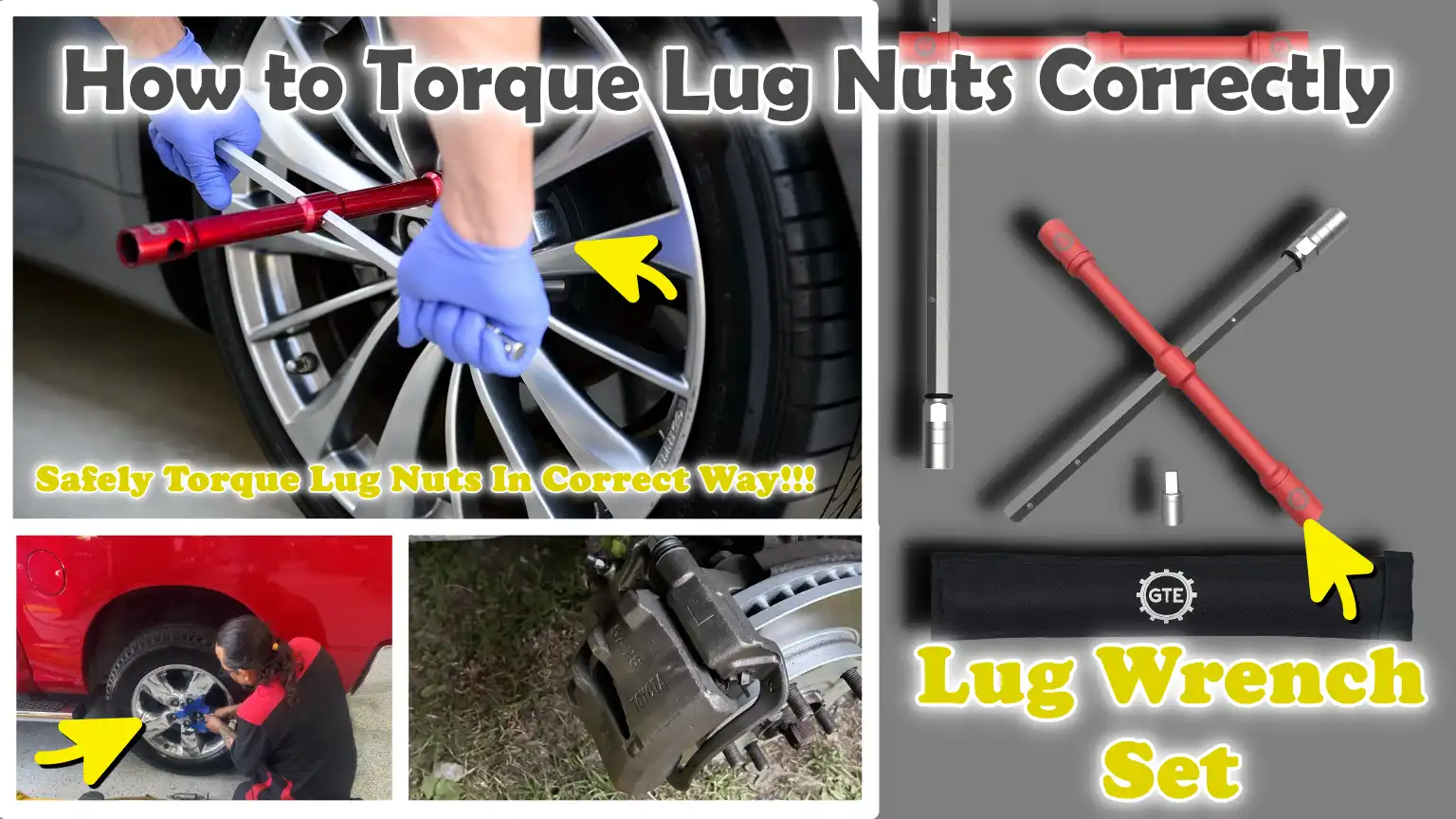
Now, in this guide you’ll exactly learn How to Torque Lug Nuts Correctly so that you can learn about importance of star-pattern tightening and avoid common mistakes as well.
Why Correct Lug Nut Torque Is Important
Correct lug nut torque is the most critical, yet most frequently overlooked, aspect of wheel safety, as it determines the strength of the connection between the wheel and the vehicle’s hub.
Every manufacturer specifies a precise torque value because wheels are designed to operate within a very specific range of forces.
This force is measured in units such as foot-pounds or Newton-meters and undergoes rigorous testing to ensure that the wheel remains secure even during hard braking, high-speed driving and travel over rough terrain.
When torque is applied correctly, the wheel seats evenly against the hub and distributes pressure in a balanced manner, ensuring that the entire system continues to function smoothly and safely over the long term.
1. Prevents the Wheel from Loosening
Correct torque ensures that the lug nuts do not gradually loosen while the vehicle is in motion.
This is crucial because road vibrations, temperature fluctuations and the constant rotation of the wheel naturally cause any mechanical joint to weaken over time.
When lug nuts are tightened to the correct specifications, they generate sufficient clamping force to counteract these forces and keep the wheel firmly secured.
If the torque is even slightly insufficient, the wheel may begin to shift slightly while driving, causing the lug nuts to loosen further.
This can lead to vibrations, uneven tire wear and, in extreme cases, the complete detachment of the wheel from the vehicle.
This constitutes one of the most dangerous mechanical failures that can occur in a vehicle.
2. Protects Wheel Studs and Threads
Wheel studs and threads are designed to withstand a specific amount of tensile force and proper torque keeps this force within safe limits.
When lug nuts are overtightened, the metal studs can stretch beyond their designed strength, permanently weakening them and increasing the risk of future breakage.
Overtightening can also damage the threading, making it difficult to remove or reinstall the lug nuts in the future.
Conversely, proper torque ensures that the load is distributed evenly across all studs, preventing excessive stress on any single stud.
This maintains the long-term reliability of the wheel mounting system.
3. Prevents Brake Rotor Warping
Uneven or excessive wheel torque can adversely affect the brake rotor, as the wheel must sit perfectly flat and flush against the hub and rotor assembly.
If lug nuts are tightened unevenly or with excessive force, it can create uneven pressure on the rotor’s surface.
Over time, this uneven pressure can cause slight deformation in the rotor, leading to brake pulsation, vibration and a less smooth stopping experience.
Applying the proper torque in the correct pattern ensures that the wheel’s clamping force is distributed evenly, keeping the brake rotor true and ensuring consistent, optimal performance.
4. Enhances Driving Safety
Driving safety depends significantly on how stable the wheel remains under various conditions such as: sudden braking, cornering, driving over potholes and traveling at highway speeds.
Applying the correct torque to lug nuts ensures that the wheel remains firmly seated in place under all conditions, without shifting or vibrating.
A wheel tightened with the proper torque helps the tire maintain full contact with the road surface, thereby improving steering control, braking responsiveness and the vehicle’s overall stability.
Incorrect torque, even if the deviation is slight, as it can induce vibrations or looseness, which may gradually compromise driver control and increase the risk of unexpected wheel-related issues.
5. Extends Wheel Lifespan
When wheels are installed with the correct torque, their lifespan is extended because the load is distributed evenly across the wheel hub, studs and mounting surface.
This prevents the formation of unnecessary stress points, which could otherwise lead to cracks in alloy wheels, deformation of mounting holes, or long-term metal fatigue in the components.
Proper torque also minimizes uneven tire wear and prevents stress from concentrating repeatedly on any single part of the wheel.
Over time, this helps preserve both the structural integrity and the aesthetic appearance of the wheels, thereby reducing repair costs and extending their useful service life.
Tools
| Tools | Why It Is Needed | How to Use It Correctly |
|---|---|---|
| Torque Wrench | This is the most essential tool because it applies the precise tightening force specified by the vehicle manufacturer. Without it, lug nuts are often either overtightened or undertightened, which can lead to damage to the studs, wheels and brakes. | Set the torque value according to your vehicle’s manual, then gradually tighten each lug nut in a star pattern until the wrench emits a ‘click’ sound or indicates that the correct torque has been reached. Do not use this tool to loosen bolts. |
| Beam Torque Wrench | This is a simple type of torque wrench that displays torque measurements via a pointer moving across a calibrated scale. It is reliable and does not require frequent recalibration, making it an excellent choice for general use. | Keep an eye on the scale while tightening the lug nuts. Stop once the pointer beam reaches the specified torque value on the scale. Maintain steady pressure to avoid errors in the reading. |
| Click Torque Wrench | This is a widely used tool that produces a distinct ‘click’ sound when the correct torque is achieved. It helps prevent overtightening and offers a high degree of accuracy for most vehicles. | Set the required torque value, then tighten gradually until you hear and feel the ‘click.’ Stop immediately as soon as the click occurs; do not continue tightening beyond that point. |
| Digital Torque Wrench | This is a modern tool that displays torque readings on a screen and often provides an alert, either audibly or via vibration, when the correct torque is reached. It offers exceptional accuracy and allows for easy, convenient reading of measurements. | Select your desired torque value on the digital display, tighten gradually and stop once the screen or alert indicates that the correct torque has been reached. |
| Socket Set | This kit contains sockets of various sizes, designed to fit specific lug nuts. Using the correct socket size prevents the corners of the lug nuts from rounding off and ensures a secure fit. | Select the appropriate socket size for your vehicle’s lug nuts, attach it to the torque wrench and, before tightening, ensure that it is seated fully and evenly. |
| Breaker Bar | This tool is used to loosen overtightened or seized lug nuts, allowing for the subsequent application of the correct torque. It enables you to apply greater leverage without damaging the tool itself. | Attach the appropriate socket to the breaker bar and, before lifting the vehicle or beginning the final torque tightening, apply steady and even pressure to loosen the lug nuts. |
| Vehicle Owner’s Manual | This provides the precise torque specifications for your vehicle, information that is crucial, as every vehicle’s requirements vary based on its weight, wheel type and design. | Before tightening any lug nut, consult your vehicle’s owner’s manual or the label located on the door frame to determine the correct torque value (typically specified in foot-pounds or Newton-meters). |
| Jack and Jack Stands | These are used to safely lift and support the vehicle, making it easier to safely remove or install the wheels. Jack stands are essential safety components, as they prevent the vehicle from falling. | Use a jack to lift the vehicle at the designated points and then, before commencing any work on the wheels, place jack stands securely beneath sturdy support points to provide stable support. |
| Wheel Chocks | These items prevent the vehicle from rolling when it is lifted or parked on an incline; thus, they provide an additional layer of safety while you are working on the wheels. | Before lifting the vehicle, firmly place wheel chocks either behind or in front of the wheels that remain in contact with the ground. |
| Gloves and Safety Gear | These protect your hands from sharp edges, dirt and the heat generated by brake components; this enhances both safety and grip while working on the wheels. | Put on gloves before beginning work and ensure that your safety gear fits you properly so that you can maintain a firm grip on your tools without them slipping. |
So, How to Determine the Correct Lug Nut Torque Specifications
Determining the correct lug nut torque specifications before tightening the wheels is one of the most critical steps, as every vehicle is designed with a specific clamping force in mind.
This value is not arbitrary; manufacturers determine it with great precision based on factors such as the vehicle’s weight, wheel size, stud strength, hub design and the load placed on the braking system.
Using incorrect torque can lead to serious safety issues over time, even if the wheels appear sufficiently tight during the tightening process.
Therefore, rather than guessing or relying on a generic value, it is essential to always verify the correct specifications using reliable sources.
1. Consult the Owner’s Manual
The owner’s manual is the most reliable source for lug nut torque specifications, as it is written specifically for your vehicle model.
It provides the precise torque value, typically expressed in foot-pounds or Newton-meters, and often includes instructions regarding the correct procedure for tightening the wheels.
Manufacturers conduct extensive testing on every vehicle; consequently, the manual contains the safest and most accurate torque settings for real-world driving conditions.
Carefully reading this section ensures that you apply a force that aligns perfectly with the design capacity of your wheel studs and hub assembly.
2. Check the Sticker on the Driver’s Door
Many vehicles also feature a factory information label located inside the driver’s door frame, which provides essential information such as tire pressure recommendations and, in some cases, wheel torque specifications.
Manufacturers affix this sticker so that drivers and technicians can quickly access essential service-related information without having to consult the owner’s manual.
Although torque values are not provided on this label for every vehicle, it remains one of the fastest methods for verifying necessary specifications.
This method proves particularly useful when immediate information is required such as: when changing a tire or performing roadside repairs.
3. Manufacturer Websites
Vehicle manufacturers often publish technical specifications on their official websites, including lug nut torque values for various models, trim levels and wheel types.
This is specially helpful if the owner’s manual has been misplaced or if you are considering using aftermarket wheels.
Online service manuals or support sections typically provide the most accurate and up-to-date information.
However, it is crucial to ensure that the provided information precisely matches your vehicle’s model year and wheel configuration, as even slight variations between different versions can affect the correct torque settings.
4. Why Torque Specifications Vary by Vehicle
Torque specifications are not universal across all vehicles, as every car, SUV, or truck is designed with distinct requirements in mind.
Generally, heavier vehicles require higher torque values because they exert greater stress on the wheel assembly during acceleration, braking and cornering.
The wheel material also plays a significant role, as alloy wheels and steel wheels respond differently to clamping pressure.
Furthermore, the size of the wheel studs, the thread design and the hub’s composition, all of these factors influence the maximum safe clamping force that can be applied.
Even the size and performance design of the tires can impact torque requirements.
These safety measures are implemented to ensure that, under actual driving conditions, every wheel remains secure and that neither are the wheel components damaged nor is their structural integrity compromised over time.
Understand, Standard Lug Nut Torque Chart
A standard lug nut torque chart helps drivers and technicians understand the common tightening specifications used across various types of vehicles; however, it is crucial to remember that these values serve merely as general guidelines and cannot replace the specific instructions provided by the manufacturer.
Torque is measured in foot-pounds or Newton-meters and engineers carefully select these specifications based on each vehicle’s weight, wheel design and structural integrity.
While precise values may vary, these ranges provide a reliable estimate of the torque typically applied during routine automotive servicing.
1. Specific Torque Specifications for Standard Passenger Cars
Most passenger cars such as: sedans and compact vehicles, typically utilize a lower range for lug nut torque, as they are lighter in weight and exert less stress on wheel components during operation.
In many cases, the torque falls between approximately 70 and 100 foot-pounds, depending on the car’s make, model and wheel design.
These vehicles are engineered such that a moderate tightening force is sufficient to securely fasten the wheels, thereby avoiding unnecessary stress on the wheel studs or hubs.
Applying the correct torque within this range ensures driving stability, prevents wheels from loosening and protects braking components from uneven pressure.
2. Torque Ranges for SUVs and Trucks
SUVs and trucks require higher torque values because they are heavier in weight, carry heavier loads and are subjected to greater stress during acceleration, braking and driving on rough terrain.
For these vehicles, the lug nut torque range typically falls between approximately 100 and 150 foot-pounds; for heavy-duty trucks, this figure can be even higher.
This increased torque ensures that the wheels remain securely fastened despite the stresses imposed by towing, cargo weight and adverse road conditions.
As these vehicles place greater strain on the wheel assemblies, applying the correct torque is crucial to prevent stud breakage, wheel loosening and long-term structural damage.
3. Aluminum vs Steel Wheels
Wheel material plays a significant role in torque requirements, as aluminum alloy wheels and steel wheels react differently to tightening forces.
Aluminum wheels are lighter in weight and more sensitive to stress; therefore, torque must be applied with great care to prevent cracking, warping, or uneven pressure distribution around the mounting holes.
Steel wheels are generally more durable and can withstand minor variations in pressure distribution; nevertheless, they too require the correct torque to ensure safety.
In both cases, the objective remains the same: to generate a uniform clamping force so that the wheel seats perfectly flush and stable against the hub, without any misalignment or movement.
4. Why Should Generic Torque Charts Be Used Only as a Backup Reference?
Although generic torque charts are useful for general information, they should never be used as a substitute for the precise specifications provided by the vehicle manufacturer.
This is because every vehicle is engineered with specific design considerations in mind such as: stud size, hub strength, wheel type, brake system design and the vehicle’s total weight.
Even minor variations between different models or model years can alter the correct torque specifications.
Relying solely on generic charts may prevent the wheel from being properly tightened, potentially subjecting the wheel studs to excessive stress over time, compromising braking performance, or leading to unsafe wheel operation.
This is why knowledgeable professionals view generic charts merely as supplementary references, relying primarily on the owner’s manual or the manufacturer’s official data to ensure accurate and safe results.
How to Torque Lug Nuts Correctly – Most Easy Way
Properly torquing lug nuts is a precise process that ensures the wheel is securely and evenly attached to the hub with the exact force specified by the manufacturer.
This process is critical because the wheel is subjected to constant stress during braking, turning, driving over potholes and changes in speed.
Even a minor error during tightening can lead to problems such as vibration, uneven brake wear, or the wheel becoming loose over time.
Following the correct, step-by-step procedure ensures that pressure is distributed evenly across all wheel studs, keeping the entire assembly secure and stable.
1. Park on Level Ground
To begin, park the vehicle on a completely level and stable surface, as uneven ground can cause the vehicle to shift while being jacked up or while the lug nuts are being tightened.
A level surface ensures that the jack and jack stands remain stable and that the wheel seats properly in place after torquing.
It also minimizes the risk of the vehicle rolling or tipping to one side while you are working on it.
2. Secure the Vehicle
Before beginning any work, it is essential to fully secure the vehicle to prevent it from moving.
This involves engaging the parking brake and, for automatic vehicles, shifting the transmission into ‘Park’ mode, or, for manual vehicles, engaging a gear.
Wheel chocks (blocks used to prevent wheels from moving) should be placed against the wheels that remain in contact with the ground.
This step is crucial, as even a slight shift in the vehicle’s position could lead to injury or improper wheel installation.
3. Safely Lift the Vehicle
To lift the vehicle, use a jack with an appropriate weight-lifting capacity at the specific lift points designated by the manufacturer.
These points are designed to safely support the vehicle’s weight without causing damage to the frame or body.
Once the vehicle is lifted, and before beginning any work on the wheel, ensure that you place jack stands beneath sturdy support points.
Never rely solely on the jack, as it is not designed to support weight for extended periods.
4. Begin Tightening the Lug Nuts by Hand
When mounting the wheel, start by tightening all the lug nuts by hand rather than using a tool.
This ensures that the threads are properly aligned and prevents “cross-threading”, a condition that can cause permanent damage to the wheel studs.
Hand-tightening ensures that the wheel is properly seated against the wheel hub before any significant force is applied.
5. Tighten the Lug Nuts Evenly
Once all the lug nuts have been hand-tightened, use a lug wrench to snug them down lightly in a “star pattern” – a star-shaped sequence.
The objective of this step is not to fully tighten the nuts, but rather to bring the wheel into even contact with the hub surface.
Applying even pressure at this stage prevents misalignment and prepares the wheel for the final torque application.
6. Lower the Vehicle Slightly
Lower the vehicle until the tire makes contact with the ground, but do not yet allow the vehicle’s full weight to rest upon it.
This position helps prevent the wheel from rotating while also providing safe and stable access for applying the final torque.
This ensures that the wheel remains properly seated on the hub during the final tightening process.
7. Set the Correct Torque on the Wrench
Before tightening, set the torque wrench to the precise specifications provided in the owner’s manual or the manufacturer’s instructions.
This value is determined through careful calculation based on the vehicle’s weight, the wheel’s design and the strength of the studs.
Setting the correct torque is crucial, as it ensures that each lug nut receives the exact amount of clamping force required for safe driving.
8. Tighten the Lug Nuts in a Star Pattern
Instead of tightening the lug nuts in a circular motion, tighten them using a star or criss-cross pattern.
This method distributes the pressure evenly across the wheel and prevents it from becoming misaligned or improperly seated.
Each lug nut should be tightened gradually until the torque wrench “clicks” or indicates that the correct value has been reached.
This ensures that no single stud is subjected to excessive load during the tightening process.
9. Re-check the Torque
After the initial tightening, use the torque wrench to re-check every lug nut to ensure they are all set to the correct specifications.
This step is vital because, following the initial tightening, once the wheel settles properly into place, the tightness of the nuts may sometimes loosen slightly.
Re-checking maintains uniformity and eliminates the risk of improper torque settings.
10. Re-check the Torque After Driving 50–100 Miles
After driving for a short distance, it is advisable to re-check the lug nut torque; this is because, following the initial installation, the wheels naturally settle into their proper seating positions.
Fluctuations in temperature, vibrations and road forces can cause slight variations in the clamping force.
Re-torquing ensures that all lug nuts remain within the correct specifications, thereby helping to prevent loosening, vibrations and potential long-term damage to the wheels.
Know, The Proper Methods for Tightening Lug Nuts
Proper methods for tightening lug nuts are crucial, as they ensure that when a wheel is mounted onto the hub, the pressure exerted upon it is uniform.
Wheels are designed to sit perfectly flush; if lug nuts are tightened in the incorrect sequence, the wheel may sit crookedly, leading to vibrations, brake rotor distortion, or excessive long-term stress on the wheel studs.
The objective of every tightening method is to distribute pressure in a balanced manner, thereby ensuring that the wheel sits evenly, securely and without any distortion.
1. 4-Lug Pattern
In a 4-lug wheel setup, the tightening sequence follows a cross or diagonal pattern; this ensures that equal pressure is applied to opposing sections of the wheel.
This method prevents one section of the wheel from being tightened more than another, a situation that could cause the wheel to sit unevenly against the hub.
By tightening the lug nuts alternately in a diagonal sequence, the wheel gradually settles into its fully correct position.
This is particularly important in small passenger cars, where even a slight imbalance can generate clearly perceptible vibrations at high speeds.
2. 5-Lug Star Pattern
For 5-lug wheels, a star-shaped tightening pattern is employed; due to the odd number of lug nuts, a specific sequence is required to maintain balance.
In this method, each lug nut is tightened while skipping the adjacent nut, moving around the wheel in a star-like motion.
This technique ensures that no two adjacent lug nuts are tightened consecutively, thereby preventing any uneven tension or distortion on the wheel.
The Star pattern is utilized in most modern vehicles; This is essential for maintaining excellent braking performance and ensuring wheel stability, particularly under heavy loads.
3. 6-Lug Pattern
For 6-lug wheels, a criss-cross or alternating triangular sequence is required to distribute pressure evenly across all six tightening points.
As this configuration involves a higher number of contact points, the tightening sequence ensures that opposing lug nuts are tightened in a balanced manner.
This helps prevent the wheel surface from warping and ensures that the hub seats the wheel correctly by applying uniform tension.
6-lug patterns are typically found on SUVs and light trucks, vehicles where the wheels are subjected to heavy loads and high torque, situations in which the uniform distribution of pressure becomes even more critical.
4. 8-Lug Pattern
8-lug wheels are commonly found on heavy-duty trucks and commercial vehicles.
Tightening them requires a carefully balanced cross-pattern, wherein force is applied in a systematic sequence to lug nuts located in opposing directions.
Because these wheels carry extremely heavy loads, if they are not tightened correctly, pressure distribution can become uneven, studs may weaken, or the wheel could even detach.
This pattern ensures that torque (tightening force) is applied gradually and uniformly across all eight points, allowing the wheel to seat properly against the hub.
This is particularly important for maintaining vehicle stability during towing, hauling and long-distance driving, as the stress placed on the wheels is significantly higher in such situations.
Know, Common Mistakes When Tightening Lug Nuts
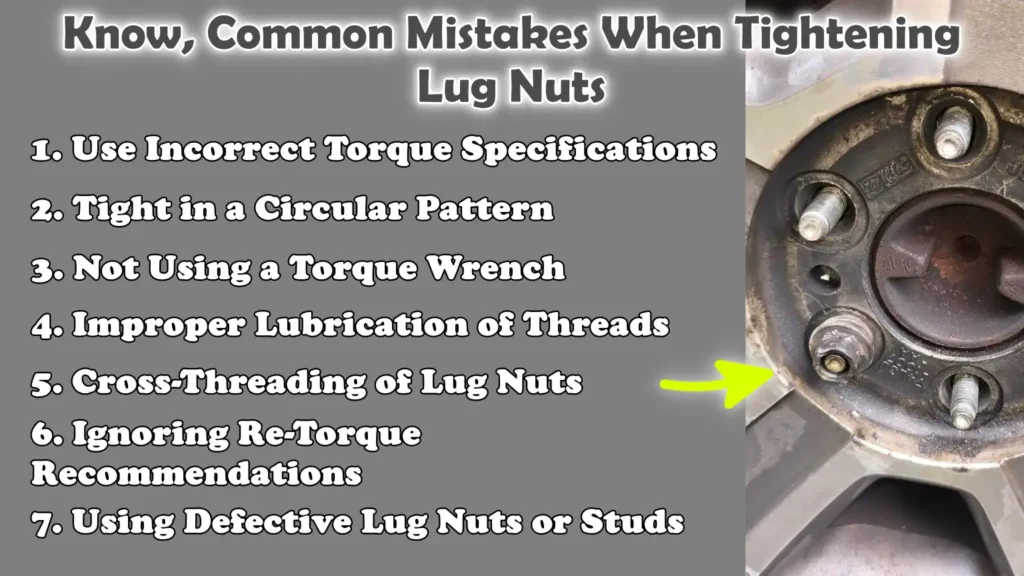
Many wheel-related problems stem not from defective parts, but from minor errors made during installation or maintenance.
Lug nut torque (tightening force) must be applied with great care, as it directly impacts how securely the wheel remains attached to the hub.
Even a minor oversight can lead to uneven pressure, vibrations, braking issues, or long-term damage to the wheel studs and rims.
Understanding these common mistakes can help you avoid unsafe driving conditions and costly repair bills.
1. Use Incorrect Torque Specifications
One of the most serious errors is applying the wrong torque value, as every vehicle is designed with a specific clamping force in mind.
If the torque is too low, the wheel may gradually loosen while driving due to vibrations and road forces.
Conversely, if the torque is too high, it can stretch or weaken the wheel studs and potentially damage alloy wheels.
Adhering to the manufacturer’s specified instructions ensures that the wheel is securely fastened and that no component is subjected to stress beyond its safe limits.
2. Tight in a Circular Pattern
Instead of tightening lug nuts in a simple circular sequence, they should be tightened in a proper star or cross pattern; failing to do so can cause the wheel to pull unevenly against the hub.
This uneven pressure prevents the wheel from seating correctly, which can lead to vibrations while driving or cause the brake rotor to warp.
The correct tightening sequence ensures that pressure is distributed evenly across all mounting points, allowing the wheel to sit perfectly flush against the hub surface.
3. Not Using a Torque Wrench
Relying solely on manual force or impact tools, rather than using a torque wrench, is a common mistake that results in a lack of uniformity in tightening.
Human judgment is not sufficiently precise for applying exact force and impact tools can easily overtighten lug nuts.
A torque wrench is designed to measure and control precise torque, ensuring that every lug nut receives a uniform and accurate amount of tension to securely fasten the wheel.
4. Improper Lubrication of Threads
Applying grease or anti-seize compound to lug nut threads without the manufacturer’s approval can alter the way torque is distributed.
Lubrication reduces friction, meaning that at the same torque setting, a significantly higher clamping force may be applied than intended.
Consequently, even if a torque wrench is used correctly, the lug nuts may still end up overtightened.
Some vehicles are designed for “dry torque” (tightening without any lubrication); therefore, for safety reasons, it is crucial to strictly adhere to the manufacturer’s instructions.
5. Cross-Threading of Lug Nuts
Cross-threading occurs when a lug nut is not properly aligned and is forcibly tightened onto a stud at an angle.
This damages the threads on both the lug nut and the wheel stud, weakening the connection and making future removal difficult.
It can also compromise the clamping force of the wheel assembly.
Hand-tightening all lug nuts first ensures that they are properly aligned before any tools are used.
6. Ignoring Re-Torque Recommendations
After driving for a short distance, wheels often loosen slightly due to heat, vibration and changes in load.
Ignoring the recommendation to re-check the torque after driving 50 to 100 miles can result in the lug nuts gradually coming loose.
Over time, this can lead to vibrations, uneven pressure on the wheel, or even dangerous instability within the wheel assembly.
Re-torquing ensures that all lug nuts remain properly tightened even after the initial installation.
7. Using Defective Lug Nuts or Studs
Using worn, broken, or rusted lug nuts and wheel studs poses a serious safety hazard, as damaged threads are unable to maintain proper torque.
Even if tightened correctly, defective components cannot withstand the stresses faced during driving and may fail.
This can result in a lug nut suddenly coming loose or a stud snapping.
Inspecting for and replacing defective hardware ensures that the wheel mounting system remains strong, reliable and safe for long-term use.
Read More:
- How to Check Wheel Lug Torque
- How to Install Directional Tires Properly
- How to Identify Directional Tires Correctly
- How to Choose Tires for Snow Driving
- How to Choose Tires for Wet Roads
- How to Check Tire Load Rating
- How to Store Tires Properly Long Term
- How to Prevent Tire Dry Rot
- How to Fix Tire Bulge Issue
- How to Inspect Tire Inner Sidewall Damage
- How to Fix TPMS Sensor Not Detected
- How to Relearn TPMS Without Scan Tool
- How to Reset Tire Pressure Monitoring System Manually
- How to Check Tire Pressure Sensor Battery
- How to Seal Bead Leak in Tire
- How to Use Tire Plug Kit Correctly
- How to Repair Tubeless Tire Puncture
- How to Locate a Nail in a Tire
- How to Fix Slow Tire Air Leak
- How to Detect Tire Sidewall Damage
- How to Check Tire Tread Depth at Home
- How to Bleed ABS System Properly
- How to Replace Rusted Brake Lines
- How to Inspect Brake Lines for Rust
- How to Flush Contaminated Brake Fluid
Know, The Symptoms of Improperly Tightened Lug Nuts
Incorrect lug nut torque often does not manifest immediately as an obvious malfunction; instead, it presents a series of warning signs that emerge gradually while driving.
These symptoms are critical because they indicate that the wheel is not securely or evenly attached to the hub.
When the torque is too low or uneven, the forces exerted during driving can cause the wheel to shift slightly.
Conversely, when the torque is excessive, it can lead to damage to the studs, wheels and brake components.
Recognizing these early warning signs helps prevent serious safety hazards and avoids costly repair expenses.
Not only this, there’s research from the SAE International that confirms that proper lug nut tightening is not only about reaching a torque number but it is all about having correct clamp force between the wheel and hub, also study shows that friction and tightening method can change how much actual holding force is created, even when the same torque value is used, so this is why inconsistent tightening still lead to the wheel loosening or uneven stress, that makes the proper torque technique essential for safe wheel installation as well.[¹]
1. Steering Wheel Vibration
Vibration in the steering wheel is one of the most common symptoms of incorrect lug nut torque.
When a wheel is not tightened evenly, it may sit slightly off-center on the hub, creating an imbalance during high-speed rotation.
This imbalance is transmitted directly through the suspension and steering systems, causing the driver to feel vibrations in the steering wheel.
These vibrations often become more pronounced as speed increases and may feel similar to unbalanced tires; however, the root cause may actually be improper wheel torque.
2. Clicking or Knocking Sounds
Clicking or knocking sounds emanating from the wheels while driving or turning can be an indication that the lug nuts are loose or have been tightened unevenly.
As the wheel shifts slightly against the hub, metal components may rub against one another, producing distinct noises.
These sounds are often most audible during acceleration, braking, or turning, as the forces acting on the wheel change rapidly.
Ignoring these noises can lead to loose lug nuts and place increased stress on the wheel studs.
3. Brake Pulsation
Brake pulsation is a condition in which the driver experiences a rhythmic vibration or throbbing sensation while applying the brakes.
Improper lug nut torque can cause the wheel to seat unevenly against the brake rotor, resulting in uneven pressure on the braking surface.
Over time, this can lead to slight warping of the rotor or an uneven wear pattern.
Consequently, the braking system may feel less smooth and more erratic during normal stops.
4. Wheels Feeling Loose
A sensation of looseness or instability in the wheels is a serious warning sign that the lug nuts may not have been tightened correctly.
This sensation often occurs when the wheel, due to a lack of clamping force, is able to shift slightly on the hub.
Drivers may perceive a reduction in vehicle stability, particularly when taking turns or driving on rough roads.
This situation is dangerous because continuous movement can rapidly exacerbate the looseness, potentially leading to further damage or even causing the wheel to detach from the vehicle.
5. Broken Wheel Studs
Broken wheel studs are often the result of prolonged exposure to incorrect torque, specifically when lug nuts are overtightened or tightened unevenly.
Excessive force causes the metal to stretch beyond its designed tensile strength, thereby weakening the stud until it eventually fractures under pressure.
In other instances, uneven torque can place excessive strain on specific studs, causing them to fail prematurely compared to the others.
A broken stud reduces the total clamping force of the wheel and if not repaired immediately, it increases the risk of further mechanical failure.
Know, Lug Nut Torque Specifications Based on Vehicle Type
Lug nut torque specifications vary significantly across different types of vehicles, as each category is designed to accommodate distinct weights, power outputs, wheel sizes and cargo-carrying requirements.
Manufacturers carefully calculate these values to ensure that the wheel remains securely attached with the correct clamping force, thereby facilitating safe driving in real-world conditions.
Applying the correct torque is critical, as it strikes a balance between safety, wheel integrity and braking performance, while also preventing issues associated with overtightening or undertightening.
1. Sedans
Sedans are generally lighter vehicles; consequently, they require lower lug nut torque values compared to larger vehicles.
In most cases, torque specifications for sedans fall within a moderate range, as their wheel studs and hubs are designed to withstand the loads associated with daily driving such as: city traffic, highway speeds and standard braking conditions.
The objective is to provide sufficient clamping force to keep the wheel stable without placing undue stress on the wheel components.
For sedans, applying the correct torque ensures smooth steering, minimizes the risk of vibration and protects brake rotors from uneven pressure over time.
2. Compact SUVs
Compact SUVs are heavier than sedans and often carry more passengers or cargo, which places greater stress on the wheel assembly.
For this reason, their lug nut torque specifications are typically higher, ensuring that the wheels remain securely fastened even under more demanding driving conditions.
These vehicles are also designed to handle a variety of road conditions, including, in some instances, light off-road driving.
Applying the correct torque helps maintain wheel stability during cornering, braking and acceleration and also prevents lug nuts from gradually loosening due to heavy loads and vibrations.
3. Full-Size Trucks
Full-size trucks require significantly higher lug nut torque, as they are designed to haul heavy loads, tow and navigate rugged terrain.
In these vehicles, the wheel assembly is engineered to withstand immense forces, particularly when carrying heavy cargo or towing a trailer.
Higher torque ensures that the wheel remains securely fastened despite constant stress and heavy loads.
This level of torque also helps prevent stud fatigue and wheel movement, specially when the vehicle is under maximum load; therefore, properly tightening the wheels is crucial for both safety and performance.
4. Performance Cars
Performance cars often have distinct torque requirements, as they are designed for high speeds, rapid acceleration and aggressive cornering.
These vehicles may be equipped with lightweight alloy wheels, which require precise torque application to prevent damage while maintaining wheel integrity.
Carefully controlling the torque is essential to ensure a uniform clamping force; if the nuts are not tightened correctly, the vehicle’s handling and braking capabilities can be adversely affected at high speeds.
Applying the correct torque ensures precise steering response and minimizes the risk of vibrations occurring during high-speed driving.
5. Heavy-Duty Trucks
Heavy-duty trucks require the highest lug nut torque, as they are engineered to perform the most demanding tasks such as: commercial hauling, construction work and long-distance freight transport.
Due to their immense weight and the harsh conditions in which they operate, these vehicles exert constant and intense pressure on their wheel components.
High torque is essential to maintain a robust clamping force and to prevent the wheels from loosening amidst severe vibrations, load fluctuations and prolonged periods of continuous operation.
Therefore, in heavy-duty trucks, applying the correct torque is critical to preventing stud breakage, wheel detachment and long-term structural damage to the wheel hub system.
Conclusion – How to Torque Lug Nuts Correctly
So, wheel failures does not happens in instant way, as they begin with small torque mistakes that grows silently over the period of time and usage.
Every wheel on modern vehicles is designed to withstand a very specific amount of clamping force, the force that firmly binds the wheel to the hub while the vehicle is in motion.
When this balance is correct, the wheel rotates smoothly, braking remains stable and the load is distributed evenly across the wheel studs, hub and brake components.
However, when the torque is incorrect, even by a small margin, serious problems can gradually emerge, such as vibration, uneven braking, broken studs, warped rotors, or, in extreme cases, the wheel coming completely loose and detaching from the vehicle.
What makes lug nut torque so critical is that damage often occurs silently over time.
A wheel that has been slightly under-tightened may seem fine initially, but road vibrations and temperature fluctuations can cause the nuts to gradually loosen further.
Conversely, over-tightening can stretch the metal beyond its safe elastic limit, thereby weakening the wheel studs and damaging the threads in ways that may not be immediately visible.
This is why manufacturers specify a precise torque value rather than relying on vague estimates like “tight enough,” as precision is the ultimate guarantee of long-term safety and reliability.
Using the right tools, following the correct tightening sequence and re-checking the torque after driving, these are all simple steps, yet they play a pivotal role in preventing serious wheel-related failures.
A torque wrench is not merely a professional-grade tool; This is a safety tool that ensures equal and precise force is applied to every lug nut.
So, that’s all from this guide about How to Torque Lug Nuts Correctly, as well as you can ask comment below.
Frequently Asked Questions
FAQ 1: What does it actually mean to torque lug nuts?
Answer: Torquing lug nuts means tightening them to a specific force specified by the vehicle manufacturer. This force is measured in foot-pounds or Newton-meters. It involves not merely tightening the lug nuts, but applying the precise pressure required to securely fasten the wheel to the hub. This ensures that the wheel remains secure, while also protecting the wheel studs, threads and brake components from damage caused by applying excessive or insufficient force.
FAQ 2: Why is the correct lug nut torque so important?
Answer: Correct lug nut torque is crucial because it directly impacts wheel safety and vehicle stability. If lug nuts are too loose, the wheel may wobble or vibrate while driving, increasing the risk of them becoming dangerously loose over time. Conversely, if they are overtightened, they can stretch or damage the wheel studs and may even cause cracks in alloy wheels. Proper torquing ensures that all wheels are tightened uniformly, resulting in a smoother driving experience, effective braking and extended longevity of wheel components.
FAQ 3: Can I tighten lug nuts without a torque wrench?
Answer: While it is technically possible to tighten lug nuts without a torque wrench, it is not recommended, as human estimation is rarely precise enough to apply the exact amount of force required. Without a torque wrench, there is a significant risk of either overtightening or undertightening the lug nuts. A torque wrench is designed to stop at the exact torque value required, thereby ensuring safety and preventing damage. For best results, you should always use a torque wrench to perform the final tightening of the lug nuts.
FAQ 4: What happens if lug nuts are overtightened?
Answer: If lug nuts are overtightened, it can lead to serious mechanical problems in the vehicle over time. The wheel studs may stretch beyond their safe limit, causing them to weaken and increasing the risk of breakage. Overtightening can also damage the wheel threads, making it difficult to remove the nuts in the future. In some cases, uneven pressure can cause brake rotors to warp or alloy wheels to crack. These issues may not be immediately apparent, but they can gradually worsen and compromise the vehicle’s safety.
FAQ 5: What happens if lug nuts are undertightened?
Answer: If lug nuts are not tightened properly, the wheel will not be securely fastened to the hub; this can result in slight movement or wobbling of the wheel while driving. This movement can cause vibrations, uneven tire wear and noise while the vehicle is in motion. Over time, road vibrations and temperature fluctuations can cause the lug nuts to loosen even further. In severe cases, loose lug nuts can cause the wheel to completely detach from the vehicle, a highly dangerous situation, specially at high speeds.
FAQ 6: How often should I check the lug nut torque?
Answer: You should always check the lug nut torque after installing new tires, performing a wheel rotation, or completing any brake-related work. It is also recommended to re-check the torque after driving approximately 50 to 100 miles, as the wheels may settle slightly into place following the initial installation. Performing regular checks such as: when changing seasonal tires or before embarking on a long road trip, is also a good habit. This ensures that all lug nuts are properly tightened and that the vehicle is safe to drive.
FAQ 7: Why do lug nuts sometimes loosen over time?
Answer: Lug nuts can loosen over time due to constant vibration, temperature fluctuations and road shocks. Driving naturally generates minor forces; if the lug nuts are not properly tightened, these forces can gradually reduce the clamping pressure. This is more likely to occur if a torque wrench was not used or if the correct tightening pattern was not followed. Applying the correct torque and periodically re-checking the nuts helps prevent this issue.
FAQ 8: Is it safe to reuse old lug nuts?
Answer: Old lug nuts can be reused only if they are in good condition and free of defects. If a lug nut is worn, rusted, cracked, or damaged, it should be replaced immediately. Defective lug nuts fail to provide the necessary clamping pressure and may even snap under stress. It is always essential to inspect both the lug nuts and the wheel studs before reinstallation to ensure they are safe for use.
References:
[1] Lug Nut Tightness Reliability: Application of Torque-Angle Signature Analysis for Installation / Auditing Studies
https://saemobilus.sae.org/papers/lug-nut-tightness-reliability-application-torque-angle-signature-analysis-installation-auditing-studies-2014-01-0070
Hello Folks, Dean Shali here to help you out to solve the problems with your lovely vehicle, as i have lots of experience and knowledge about automotive industry as i woks directly with the customers and repair vehicles and i love to help the people to keep their cars safe and running smoothly.