
Written By: Dean Shali
Fact Checked By: Sabré Cook
Reviewed By: Tamara Warren
You need to understand that the tires are designed to move water away, but it will work when they spin in the correct direction, otherwise lead to the poor grip.
So, those 4-small contact patches something like: Size of Your Hand: are literally responsible for your safety.
As well as, modern tires are not just a piece of rubber, as they are precisely engineered systems that are designed to manage the grip, heat and water at the high speeds.
And, the directional tires such as: V-Shaped Tread Pattern that is carefully built to push water away from the center of the tire that’s how it reduces the risk of hydroplaning.
Along with this, there’s studies in the tire engineering that clearly shows that even a small mistake in tire direction can significantly reduces the wet traction and braking performance as well.
Even though all these safety concerns, many drivers never check the most important detail which is clearly printed on the tire itself: “THE ROTATION DIRECTION”.
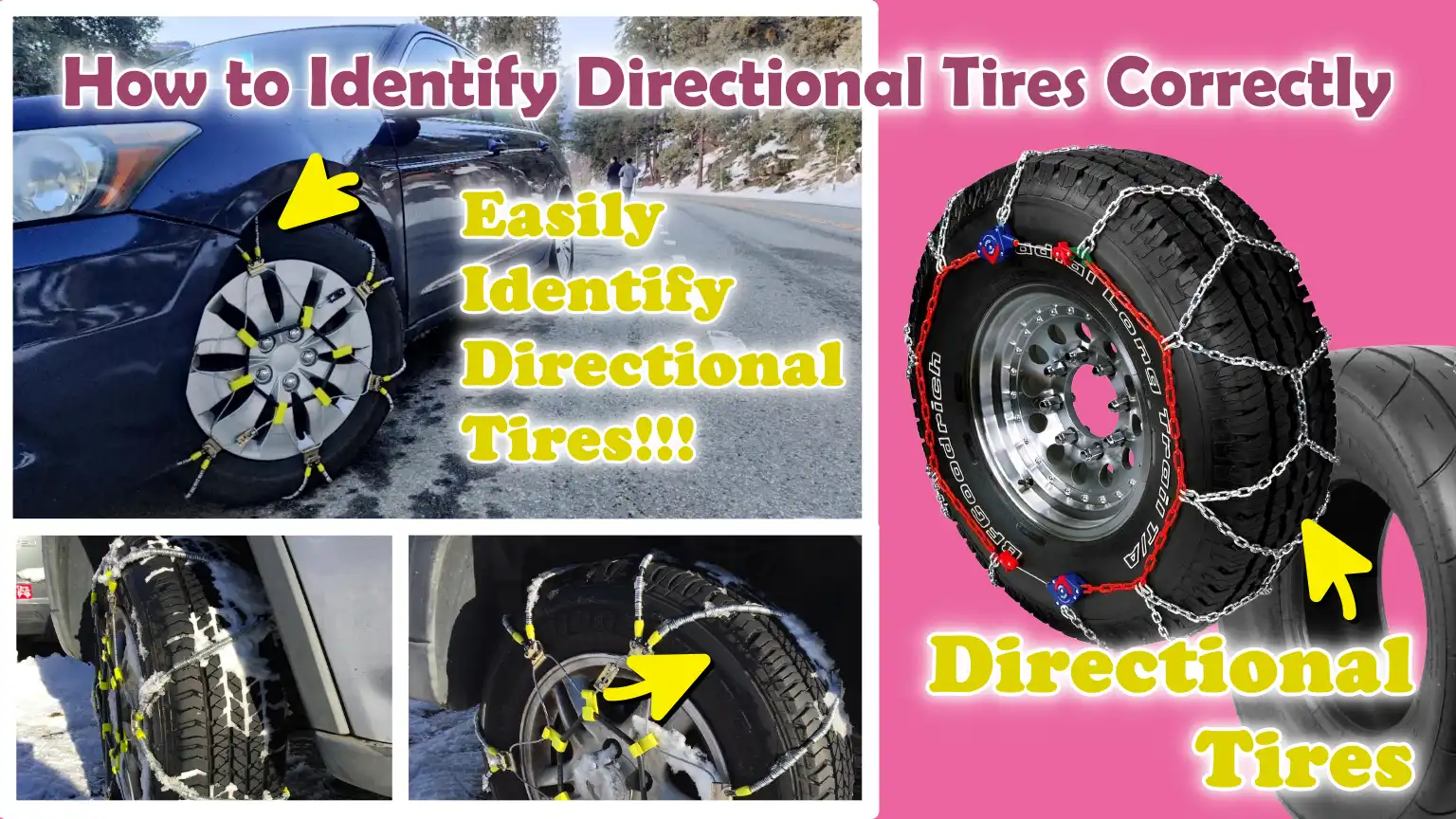
That’s why, in this guide you’ll learn How to Identify Directional Tires Correctly so that you can visually check and improve your control, safety and tire life as well.
Know, What Are Directional Tires?
Directional tires are specialized tires designed to rotate in only one specific direction as the vehicle moves forward.
Unlike standard tires, the tread patterns on directional tires are meticulously engineered to perform optimally only when rotating in the correct orientation.
Most directional tires feature grooves that form a V-shaped or arrow-like pattern across the tread surface.
This design assists the tire while driving by channeling water away from the center of the tread toward the edges.
The primary objective is to enhance traction, stability and control, particularly during rainfall or on wet road surfaces.
Directional tires are commonly found on sports cars, high-performance vehicles and many modern passenger cars, as they offer superior handling capabilities at high speeds.
Manufacturers typically imprint an arrow symbol on the tire’s sidewall to indicate the correct direction of rotation.
If a directional tire is mounted in the reverse direction, its tread cannot effectively displace water; this can compromise the tire’s grip and significantly increase the risk of hydroplaning.
Understanding directional tires is crucial, as their proper installation directly impacts safety, braking performance, road handling and the overall lifespan of the tire.
1. Directional Tread Design
A directional tread design refers to a specific type of tread pattern engineered to rotate in only one predetermined direction.
Its grooves and channels are configured in such a way that, as the tire rotates forward, they channel water, mud and road debris away from the tire’s contact patch.
This design typically forms a distinct V-shape, with the apex of the “V” pointing in the direction in which the tire is intended to rotate.
Engineers design these tread patterns to enhance performance on wet roads, as water trapped between the tire and the road surface can lead to hydroplaning.
When the tire rotates in the correct direction, the grooves rapidly channel water outward, thereby maintaining superior contact with the road surface.
This results in improved steering response, cornering stability and braking capability.
Directional tread designs are renowned for delivering excellent stability even at high speeds, as their tread blocks are arranged to ensure smoother contact with the road surface.
However, because these tires are engineered to rotate in only one specific direction, great care must be exercised during installation and specific rotation procedures must be followed during maintenance.
Even a minor error in the tire’s mounting orientation can compromise many of the performance benefits for which the tire was originally designed.
2. How Directional Tires Differ from Asymmetrical Tires
At first glance, directional and asymmetrical tires may appear similar; however, they are designed for distinct purposes and can be identified by specific characteristics.
A directional tire focuses primarily on the direction of rotation, meaning that the tire must rotate in a specific manner to function correctly.
An asymmetrical tire, on the other hand, features two distinct tread patterns across its surface.
The inner section of the tread is typically designed to evacuate water and provide grip on wet surfaces, while the outer section is engineered for handling and cornering stability on dry roads.
Rather than relying on directional arrows as the primary indicator of rotation, asymmetrical tires typically utilize labels such as “Inside” and “Outside” on the tire’s sidewall to ensure that the tire is mounted in the correct orientation.
Some modern tires even combine both directional and asymmetrical designs to achieve maximum performance.
The key difference is that directional tires fundamentally rely on being mounted in the correct direction of rotation, whereas asymmetrical tires primarily rely on being mounted on the correct side of the vehicle.
Understanding this distinction helps drivers avoid incorrect tire installation, thereby ensuring that the tires operate safely and exactly as the manufacturer intended.
3. How Directional Tires Differ from Symmetrical Tires
Compared to directional tires, symmetrical tires feature a significantly simpler design.
In symmetrical tires, an identical tread pattern is repeated uniformly across the entire surface of the tire; this means there is no specific designated inner, outer, left, or right side, nor a specific direction of rotation.
Consequently, symmetrical tires can be mounted on a vehicle in almost any position and they are easy to rotate during routine maintenance.
Directional tires are more specialized because their tread pattern is designed to function effectively only when rotating in a specific direction.
While symmetrical tires are generally quieter, longer-lasting and more economical, directional tires are often chosen for their superior grip on wet roads, enhanced stability during cornering and improved handling at high speeds.
Symmetrical tires are typically found on standard passenger cars and vehicles that prioritize a comfortable ride, whereas directional tires are primarily used on performance-oriented vehicles.
The key difference is that symmetrical tires prioritize simplicity and uniform tread wear, while directional tires prioritize superior grip and resistance to hydroplaning.
4. Why Do Manufacturers Use Directional Patterns?
Manufacturers utilize directional tread patterns because they offer several significant advantages in terms of safety and performance, particularly when driving on wet roads.
When a vehicle travels over a wet surface, water can accumulate between the tire and the road surface.
If excessive water becomes trapped, the tire may lose contact with the road and begin to slide (a phenomenon known as hydroplaning).
Directional tread patterns are designed to mitigate this risk by rapidly expelling water through a series of angled grooves.
This helps the tire maintain a strong grip on the road and enhances driver control over the vehicle during rainy conditions.
Directional patterns also improve handling stability at high speeds, as the tread blocks are arranged to facilitate smoother and more controlled motion.
Directional tires are frequently used on high-performance vehicles because they offer sharper steering response and exhibit more predictable behavior when cornering.
During the winter season, directional tread designs can also assist in more effectively clearing away slush and light snow from the tire.
Tire manufacturers spend years testing tread patterns across various weather conditions to enhance grip, braking and overall driving confidence.
The result is a tire that delivers exceptional performance when installed correctly and properly maintained.
Why Correct Identification of Directional Tires Is Important
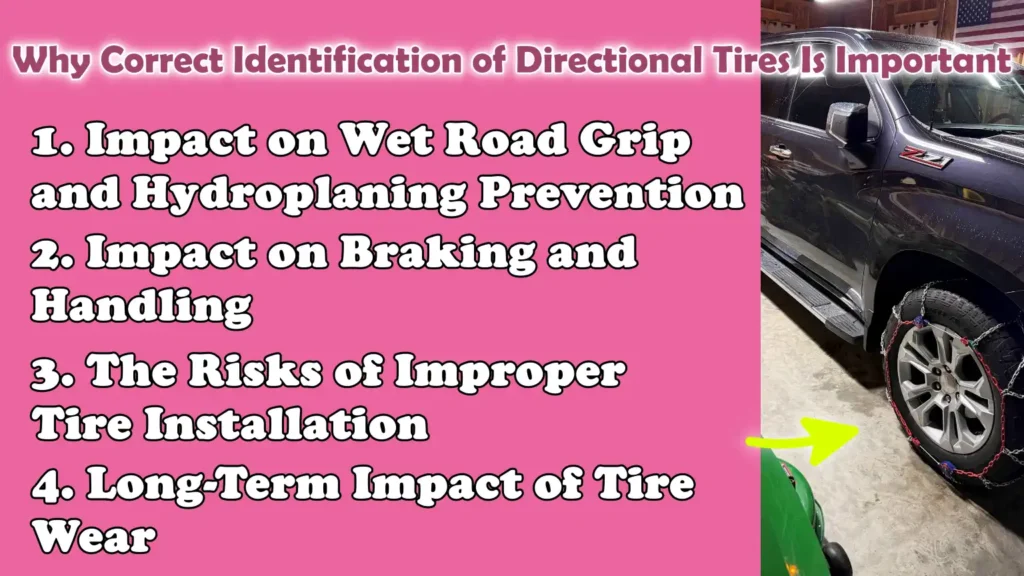
Correctly identifying directional tires is crucial because these tires are designed to rotate in one specific direction only.
Their tread pattern is meticulously engineered to ensure superior grip on the road surface, efficient water displacement and consistent contact while driving.
If a tire is installed incorrectly, it cannot function safely, particularly during rainy weather or when driving at high speeds.
Proper identification also helps drivers avoid issues such as improper installation, uneven tire wear and difficulties with vehicle handling.
A simple check of the tire’s direction can significantly enhance safety, stability and overall tire performance.
1. Impact on Wet Road Grip and Hydroplaning Prevention
Directional tires are primarily designed to enhance grip on wet roads and minimize the risk of hydroplaning.
As the vehicle moves forward, their V-shaped grooves work to channel water away from the tire, allowing it to maintain better contact with the road surface.
When installed correctly, these tires can provide excellent grip and stability in rainy conditions.
Conversely, if installed in the wrong direction, the tread fails to displace water effectively; this can compromise grip and increase the likelihood of skidding on wet roads.
2. Impact on Braking and Handling
Correctly installed directional tires help improve braking performance, steering response and overall vehicle handling.
Their tread pattern is designed to distribute road pressure evenly, particularly when cornering or applying sudden brakes.
When the tire rotates in the correct direction, it delivers more stable and reliable control.
Improper tire installation can compromise handling performance, increase road noise and erode driver confidence, particularly when driving at high speeds or in wet weather conditions.
3. The Risks of Improper Tire Installation
Incorrect installation is a common issue with directional tires, as many people overlook the directional arrows marked on the tire’s sidewalls.
A tire mounted in the wrong direction may appear normal visually, but it can significantly degrade the tire’s performance capabilities.
This error can lead to reduced water evacuation, compromised traction and accelerated tire wear over time.
Verifying the tire’s orientation after installation is a crucial step that ensures the tire functions exactly as intended by the manufacturer.
4. Long-Term Impact of Tire Wear
Improperly mounted directional tires may experience uneven wear and lose their performance capabilities more rapidly than usual.
The tire’s tread blocks are designed to interact with the road surface in a specific manner; reversing the direction of rotation can induce abnormal stress on the tire’s structure.
Over time, this can result in accelerated tread wear, increased vibrations and a reduction in ride comfort.
Ensuring the correct tire orientation promotes more uniform tread wear, extends the tire’s lifespan and maintains optimal road performance throughout the tire’s entire service life.
Know the Key Indicators for Identifying Directional Tires
Directional tires can typically be identified by specific markings and tread patterns that indicate the tire is designed to rotate in only one specific direction.
These indicators are crucial because directional tires rely on correct rotation to deliver optimal grip, water evacuation and stable handling.
Learning to recognize these nuances helps drivers avoid installation errors, thereby ensuring that the tires perform safely and effectively in both wet and dry conditions.
1. Look for Arrow Markings on the Sidewall
The easiest way to identify a directional tire is to look for arrow markings on the sidewall that indicate the direction of rotation.
Tire manufacturers place these arrows to specify the correct direction in which the tire should rotate when the vehicle is moving forward.
This arrow is typically located near the lettering on the outer sidewall and may be accompanied by words such as “Rotation” or “Direction.”
When the tire is installed correctly, the arrow marking should point toward the front of the vehicle, that is, in the same direction the tire rotates when moving forward.
This marking serves as the most reliable method for confirming whether a tire is directional, as it is specifically placed by the manufacturer to facilitate proper installation.
2. Look for Labels Marked “Rotation” or “Direction”
Many directional tires also feature clear labels on their sidewalls that assist in identifying the correct direction of rotation.
These labels typically display words such as “Rotation,” “Direction,” or “Rotational.”
These labels are usually printed in close proximity to the directional arrow markings and are designed to make the installation process easier for both technicians and drivers.
The label explicitly indicates the specific direction in which the tire must rotate as the vehicle moves forward.
It is crucial to pay close attention to these markings; if the tire is mounted in the direction opposite to the one indicated, its ability to maintain road grip and effectively displace water may be compromised.
3. Observe the Tread Pattern Shape
The tread pattern of directional tires is often V-shaped or resembles an arrow, making it easy to identify.
Typically, the tread grooves and blocks extend outward from the center of the tire, creating a design that, when the tire is mounted correctly, points in the direction of forward motion.
This pattern is engineered to rapidly channel water away from the tire and enhance grip on wet road surfaces.
Even if the markings on the sidewall are difficult to discern, the shape of the tread alone can provide vital clues regarding the tire’s orientation.
When viewed from the front, the tire’s tread pattern should appear to flow in the same direction in which the tire rotates as the vehicle moves forward.
4. Check the Direction of the Grooves
In directional tires, the orientation of the grooves is meticulously designed to ensure that water is channeled outward while the vehicle is in motion.
These angled grooves act as drainage channels, diverting water away from the tire’s contact patch, the area touching the road, thereby maintaining superior grip during rainy conditions.
If the tire is mounted incorrectly, the grooves will fail to displace water effectively, potentially diminishing the tire’s performance on wet roads.
By observing the angles and direction of the grooves on the tread surface, drivers can often determine whether the tire has been installed correctly.
The precise orientation of these grooves is the primary factor that endows directional tires with enhanced resistance to hydroplaning and superior stability on the road.
5. Comparing Left and Right Tires
Directional tires cannot be easily swapped from left to right, or vice versa, without remounting them, as changing sides would reverse their designated direction of rotation.
If a tire that was correctly mounted on the left side is simply installed directly onto the right side, without being dismounted from the wheel and properly remounted, it may rotate in the wrong direction.
To verify the correct orientation, check that the directional arrows marked on the tires on both sides of the vehicle point forward relative to the vehicle’s direction of travel.
Comparing the tread patterns on both sides can also help confirm that the tires have been installed correctly.
Installing tires on the proper side ensures that their grip, handling and water-evacuation capabilities are maintained.
How to Confirm Correct Installation
Ensuring the correct installation of directional tires is crucial; if a tire is mounted incorrectly, it may lose its traction and handling performance, regardless of its quality.
Directional tires are designed to rotate in a specific direction, allowing their tread pattern to effectively displace water and maintain superior contact with the road surface.
After installing or replacing tires, drivers should always carefully verify the tire’s orientation rather than simply assuming it has been mounted correctly.
A few simple visual checks can help confirm that the tire is installed properly and is functioning as intended.
1. Visual Checks During Tire Installation
To begin, park the vehicle on a level surface where all four tires are clearly visible.
Carefully inspect the sidewall of each tire to locate the rotation arrow or directional indicator provided by the manufacturer.
When viewed from either side of the vehicle, this arrow should point toward the front of the car, as the tire rotates in a forward direction when the vehicle is in motion.
After checking the sidewall, examine the tread pattern.
Most directional tires feature a V-shaped or arrow-like design, which should appear to point forward as the tire moves ahead.
Carefully inspect all four tires, as even a single incorrectly mounted tire can compromise the vehicle’s overall performance and wet-road traction.
2. How to Confirm Rotation Direction While Driving
The simplest method to confirm the direction of rotation is to observe how the tire spins as the vehicle moves forward.
The rotation arrow marked on the sidewall should align with the direction in which the tire rotates under normal driving conditions.
On the left side of the vehicle, when viewed from that perspective, the directional arrow should point in a clockwise direction.
On the right side, it should point in a anti-clockwise direction, as the tire on that side rotates differently even as the vehicle moves forward.
Aligning the rotation arrow with the vehicle’s actual forward motion helps confirm that the tire has been installed correctly and is ready for safe operation.
3. A Quick Check on the Driveway
A brief check on the driveway can help drivers re-verify the installation of directional tires without the need for any specialized tools.
Drive the vehicle slowly for a short distance and if possible, keep an eye on the markings located on the tire treads and sidewalls.
Once the vehicle comes to a stop, double-check to ensure that the rotation markings are still pointing in the correct forward direction.
During this short drive, drivers should also watch out for any unusual signs, such as excessive road noise, reduced traction on wet surfaces, vibrations, or instability while driving.
Although these symptoms may not always manifest immediately, they can sometimes indicate that the tires have been installed incorrectly.
Performing a simple driveway check after tire service can help prevent long-term wear-and-tear issues and enhance overall driving safety.
Common Mistakes When Identifying Directional Tires
Many drivers misidentify directional tires because, at first glance, the designs of modern tires can appear quite similar.
Minor errors are common when replacing tires, switching to seasonal tires, or installing tires as part of a rotation service.
As directional tires are designed to rotate in a specific direction, even a slight misunderstanding can negatively impact traction on wet roads, handling and tire wear.
Understanding the most common identification errors helps drivers avoid safety issues and maintain optimal tire performance over time.
1. Confusion Between Directional and Asymmetrical Tires
One of the most common mistakes is confusing directional tires with asymmetrical tires, as the tread patterns (the designs on the tire surface) of both can appear quite aggressive.
Directional tires focus primarily on a single direction of rotation and typically feature arrow markings on their sidewalls that indicate the correct direction of travel.
Asymmetrical tires differ in that they possess distinct inner and outer tread sections, each designed to handle different driving functions.
Instead of directional arrows, these tires typically utilize “Inside” and “Outside” markings.
Some drivers assume that any tire featuring a V-shaped or sporty tread pattern is directional; however, this is not always the case.
Carefully examining the markings on the sidewall remains the most reliable method for correctly identifying the tire type and avoiding improper installation.
2. Ignoring Worn Markings
Over time, dirt, aging, fading, or general wear and tear from road use can make it difficult to read the markings on a tire’s sidewall.
Many drivers overlook these faded arrows and labels when installing new tires or performing tire rotations.
When the markings are no longer clearly visible, people may rely entirely on the visual appearance of the tread pattern, a practice that can sometimes lead to errors.
Cleaning the tire’s sidewall and examining it closely under good lighting can help reveal crucial information regarding the correct direction of tire rotation.
Ignoring worn markings increases the risk of incorrect tire installation, which can compromise the tire’s ability to maintain proper traction on wet roads and ensure stable handling.
3. Unintentionally Installing Tires Backwards
During tire replacement or rotation services, directional tires are sometimes unintentionally installed in the wrong direction.
This typically occurs when the installer forgets to check the directional arrow, which indicates the intended direction of rotation, before fitting the tire.
An incorrectly installed tire may look right visually and may even perform normally at low speeds, making it difficult to detect this error immediately.
However, the tire’s tread pattern will be unable to displace water effectively; consequently, traction may be compromised during rainy weather or under sudden braking.
Re-checking the arrows on the sidewall after installation is the simplest way to avoid this common issue and ensure the safe operation of the tires.
4. Assuming All Performance Tires Are Directional
Many people assume that all performance tires are directional, primarily because the tread designs of performance tires are often aggressive in appearance and look sporty.
In fact, many modern performance tires are asymmetric rather than directional.
Some tires even feature a blend of both asymmetric and directional characteristics, which can lead to confusion during the installation process.
Assuming that every high-performance tire is designed to rotate in a specific direction can result in improper installation.
The safest approach is to check the clear markings provided by the manufacturer on the tire’s sidewall such as: rotation arrows, directional labels, or inner and outer indicators, before installation or rotation.
What Happens If Directional Tires Are Installed Incorrectly?
Directional tires are specifically designed to rotate in a single direction, ensuring that their tread pattern delivers maximum grip, water displacement capabilities and driving stability.
When these tires are installed incorrectly, the tread fails to function as intended.
Although the vehicle may continue to operate normally, serious safety and performance-related issues can arise over time.
Incorrect installation can negatively impact traction on wet roads, braking efficiency, tire longevity, ride comfort and overall vehicle control.
Understanding these issues helps drivers recognize why correct tire orientation is so crucial for safety during daily driving.
1. Reduced Water Displacement
Directional tires utilize angled grooves to channel water away from the tire’s contact patch while the vehicle is in motion.
When the tire rotates in the correct direction, these grooves push water outward, thereby maintaining firm contact between the tire and the road surface.
If the tire is installed in reverse, these grooves may draw water toward the center of the tire rather than efficiently expelling it outward.
This diminishes the tire’s ability to displace water during rainfall and can compromise its overall traction on wet roads.
Efficient water displacement is one of the primary reasons why directional tread patterns are employed on many modern vehicles, particularly on high-performance and all-season tires.
2. Increased Risk of Hydroplaning
Hydroplaning occurs when a layer of water forms between the tire and the road surface, causing the tire to lose direct contact with the road.
The risk associated with hydroplaning is significantly heightened when directional tires are installed incorrectly, as the tread pattern fails to effectively channel water away when rotating in the wrong direction.
Consequently, particularly during heavy rain and at high speeds, the vehicle may feel unstable or be prone to skidding.
Drivers may notice reduced steering responsiveness on wet roads or observe that a greater distance is required to bring the vehicle to a halt.
Correct tire orientation is paramount; even the most advanced tread designs cannot perform as intended if the tire is rotating in a direction contrary to its specific design.
3. Uneven Wear Patterns
Incorrectly mounted directional tires can wear unevenly over time, as the tread blocks are forced to make contact with the road surface in a manner for which they were not designed.
This abnormal pressure can accelerate wear on specific sections of the tire’s surface, thereby reducing the tire’s overall lifespan.
Uneven tire wear can also compromise grip and complicate future tire rotation procedures.
In some instances, drivers may notice that one section of the tire tread is wearing smooth more rapidly than another.
Proper tire installation ensures that road pressure is distributed evenly across the tread, resulting in uniform wear under normal driving conditions.
4. Noise and Vibration Issues
Incorrectly mounted directional tires can sometimes generate excessive road noise and vibrations while driving.
As the tread pattern is designed to rotate smoothly in a specific direction, reversing that direction can disrupt airflow and compromise the tire’s contact with the road surface.
Drivers may perceive humming, droning, or other unusual noises emanating from the tires, particularly at certain speeds.
In some vehicles, this may also manifest as subtle vibrations or a reduction in stability when driving on rough or uneven roads.
Although these symptoms may seem minor at first, they can compromise driving comfort and indicate that the tires are not performing as they should.
Regularly checking tire alignment can help prevent these issues and enhance the driving experience.
Read More:
- How to Choose Tires for Snow Driving
- How to Choose Tires for Wet Roads
- How to Check Tire Load Rating
- How to Store Tires Properly Long Term
- How to Prevent Tire Dry Rot
- How to Fix Tire Bulge Issue
- How to Inspect Tire Inner Sidewall Damage
- How to Fix TPMS Sensor Not Detected
- How to Relearn TPMS Without Scan Tool
- How to Reset Tire Pressure Monitoring System Manually
- How to Check Tire Pressure Sensor Battery
- How to Seal Bead Leak in Tire
- How to Use Tire Plug Kit Correctly
- How to Repair Tubeless Tire Puncture
- How to Locate a Nail in a Tire
- How to Fix Slow Tire Air Leak
- How to Detect Tire Sidewall Damage
- How to Check Tire Tread Depth at Home
- How to Bleed ABS System Properly
- How to Replace Rusted Brake Lines
- How to Inspect Brake Lines for Rust
- How to Flush Contaminated Brake Fluid
Can Directional Tires Be Rotated?
Directional tires can be rotated; however, they adhere to different rotation protocols compared to standard symmetrical tires.
As these tires are engineered to rotate in a specific direction, they cannot simply be swapped to any wheel position without carefully observing their intended direction of rotation.
Proper rotation is essential as it promotes even tire wear, extends tire longevity and maintains superior handling and traction.
Drivers who understand the correct rotation procedures can help preserve tire performance and avoid issues associated with premature wear over time.
1. Correct Rotation Methods
The most common rotation method for directional tires involves rotating them strictly from front to rear on the same side of the vehicle.
This means the front left tire moves to the rear left position, while the front right tire moves to the rear right position.
This method ensures that the tires continue to rotate in their intended direction while also helping to balance tread wear between the front and rear axles.
As the front tires on many vehicles bear the brunt of the stress during steering and braking, regular front-to-rear rotation can help extend tire life and maintain more consistent traction.
Adhering to the correct rotation pattern is critical, as altering a tire’s direction of rotation can negatively impact performance and handling stability, particularly on wet road surfaces.
2. When Re-mounting Is Necessary
Re-mounting becomes necessary when a directional tire needs to be moved from one side of the vehicle to the other.
Simply swapping a tire directly from the left side to the right side would reverse its direction of rotation, causing the tread to rotate backward.
To avoid this issue, the tire must first be dismounted from the wheel and then correctly remounted so that, even when installed on the opposite side of the vehicle, the rotation arrow continues to point in the forward direction.
Remounting is typically performed at a tire shop using specialized tire-changing equipment.
This process helps drivers achieve a more balanced wear pattern across their tires when needed, while simultaneously maintaining proper directional performance.
3. Cost vs Benefit of Remounting
Remounting directional tires can be more expensive than a standard tire rotation, as it requires greater labor and specialized equipment.
Tire shops typically charge a higher fee to dismount the tire from the wheel, reposition it and then re-balance it after installation.
However, the long-term benefits often far outweigh the costs.
Tires that are properly rotated and remounted wear more evenly, last longer and maintain excellent grip throughout their entire lifespan.
Uneven tire wear can significantly reduce a tire’s lifespan and increase the cost of premature replacement.
For drivers seeking optimal performance, enhanced safety and greater long-term value from their tires, proper directional rotation and remounting can prove to be a worthwhile investment.
Difference Between Directional vs Asymmetrical Tires
Both directional and asymmetrical tires are advanced tire designs engineered to enhance vehicle performance; however, they function in different ways and are distinguished by distinct characteristics.
Directional tires are designed to rotate in a specific direction and typically prioritize superior traction on wet surfaces as well as efficient water evacuation.
Asymmetrical tires utilize two distinct tread designs on a single tire surface to strike a balance between wet-road traction, dry-road handling, ride comfort and cornering stability.
Many drivers confuse these two types of tires because both often possess a sporty and visually appealing aesthetic; however, understanding the differences between them is crucial for proper installation, rotation and maintenance.
Comprehending how each tire design functions can help drivers avoid common errors when selecting and installing the right tires for their vehicle.
Not only this, directional tires are actually designed based on the hydrodynamic principles where tread grooves actually controls how water moves under the tire, as there’s even research that shows that tread geometry actually plays the most important role to prevent the hydroplaning, specially at the higher speeds, so whenever these tires are installed in correct way then the water is pushed outward efficiently: but incorrect orientation significantly reduces this ability and increases the slipping risk as well.[¹]
1. Key Differences
The most significant difference between directional and asymmetrical tires lies in the functional mechanism of their tread designs.
Directional tires feature a tread pattern that typically resembles a V-shape or an arrowhead and they are engineered to rotate in only one specific direction.
Their primary objective is to facilitate superior water evacuation and minimize the risk of hydroplaning (skidding on water) while driving on wet roads.
Asymmetrical tires differ in that the inner and outer sections of their tread perform distinct functions.
The inner section is often engineered to aid in generating traction on wet surfaces and facilitating water evacuation, whereas the outer section is designed to enhance dry-road grip and cornering stability.
Directional tires typically feature arrow markings on their sidewalls indicating the direction of rotation, whereas asymmetrical tires bear “Inside” and “Outside” markings to ensure correct installation.
Directional tires often deliver superior performance in wet weather, while asymmetrical tires are renowned for striking a balance between comfort, handling and overall driving performance.
2. Identification Checklist
Distinguishing between directional and asymmetrical tires becomes straightforward once drivers know which specific features to look for.
The sidewalls of directional tires typically display clear arrow markings or labels such as “Rotation.”
When installed correctly, their tread pattern often forms a V-shape that points in the forward direction.
Conversely, asymmetrical tires do not typically rely solely on directional arrows.
Instead, their sidewalls feature “Inside” and “Outside” labels, as different sections of the tread are designed to perform distinct functions.
The tread pattern on asymmetrical tires may appear uneven across the tire’s surface; for instance, the outer section often features larger tread blocks to provide enhanced grip during cornering.
Carefully examining the markings on the sidewall remains the most accurate method for identifying the tire type and ensuring that it has been installed correctly.
3. Which is More Common Today?
Currently, asymmetrical tires are generally more prevalent in modern passenger vehicles, as they offer a balanced combination of comfort, handling, wet-road grip and long-lasting tread life.
Many tire manufacturers favor asymmetrical designs because they perform effectively across a variety of driving conditions and offer greater flexibility in tire rotation patterns compared to directional tires.
However, directional tires are still widely used in sports cars, high-performance vehicles, winter tires and certain all-season tires, as they deliver excellent performance on wet roads and at high speeds.
In recent years, some premium tire models have combined both directional and asymmetric technologies to achieve superior overall performance.
The most suitable tire type depends on the vehicle’s design, driving conditions and the performance objectives set by the manufacturer.
Know, Pro Tips from Tire Experts
Tire experts advise paying close attention when installing directional tires, as even a minor error can negatively impact traction, braking performance and tire longevity.
Many tire-related issues stem not from poor tire quality, but rather from improper installation or shortcomings in inspection procedures.
Directional tires are designed with specific tread patterns that perform optimally only when rotating in the correct direction.
By following a few simple tips from experts, drivers can ensure their tires are installed correctly, prevent premature wear and maintain enhanced safety while driving on both wet and dry road surfaces.
1. Always Double-Check After Installation
One of the most critical pieces of advice from experts is to always double-check the tire’s orientation following an installation or rotation service.
Even experienced technicians can occasionally install directional tires incorrectly, particularly during busy service appointments.
Before driving the vehicle out of the shop, drivers should visually verify the rotation arrows marked on all four tire sidewalls.
These arrows should point in the same direction that the tire rotates when the vehicle is moving forward.
Performing this quick check takes just a few minutes, yet it can prevent future issues such as reduced traction, uneven tire wear and compromised vehicle handling.
2. Use a Flashlight to Inspect Tire Sidewalls
The markings on a tire’s sidewall can sometimes be difficult to read due to dirt, shadows, brake dust, or faded lettering.
Many tire experts recommend using a flashlight during inspections, specially when in garages, parking lots, or dimly lit environments.
Using a flashlight makes it easy to clearly identify essential markings such as rotation arrows, “Direction” labels and “Inside” or “Outside” indicators.
Closely examining the tire sidewall is particularly beneficial for older tires, as their markings may become worn down over time.
With proper lighting, drivers can avoid installation errors and identify directional tires with greater precision.
3. Take Photos of the Tires Before Removal
Before removing tires for rotation, replacement, or seasonal storage, experts often recommend taking clear photographs of each tire’s specific position and orientation.
These photos serve as a convenient reference, helping drivers or technicians correctly reinstall the tires later on.
Quickly snapping a picture of the tread pattern and the directional arrows on the sidewall minimizes confusion and ensures that the tires are returned to their correct locations during reinstallation.
This practice is specially beneficial for vehicles equipped with directional or asymmetrical tires, as precise installation is critical to maintaining their optimal performance.
4. Ask the Installer to Confirm the Direction
Although professional tire installers work with a wide variety of tires on a daily basis, experts still advise that, before driving your vehicle away from the shop, you should explicitly ask the installer to confirm the correct direction of tire rotation.
A brief confirmation can help prevent accidental reverse installation and provide the driver with greater peace of mind.
Many drivers simply assume, without verifying, that the tires have been installed correctly by default; However, from a safety perspective, checking the direction of the tires is a prudent habit.
Communicating openly with the tire installer also ensures that the tires have been properly rotated and installed in accordance with the manufacturer’s recommendations.
Conclusion – How to Identify Directional Tires Correctly
Yes, Directional tires are actually designed with precision and that’s why you should understand about their rotation direction as it actually necessary for performance and safety wise as well.
Their tread patterns are engineered to effectively displace water, enhance grip on wet surfaces, aid in vehicle stability and minimize the risk of hydroplaning.
Nevertheless, these benefits are realized only when the tires are correctly identified and properly installed.
A minor error such as: mounting a tire backward or overlooking the rotation arrow marked on the sidewall, as it can adversely affect braking, traction, tire wear and your overall control over the vehicle.
Learning to identify directional tires is an essential skill for every driver, as tires are the sole components of a vehicle that make direct contact with the road.
By observing rotation arrows, interpreting sidewall markings, examining tread patterns and verifying that the tires have been installed correctly, drivers can avoid many common tire-related issues.
Performing these brief checks takes just a few minutes, yet it can significantly contribute to extending tire longevity, enhancing ride comfort, improving fuel efficiency and maintaining road safety, on both wet and dry surfaces.
Modern tires are the product of exceptional engineering and years of rigorous testing; however, if installed incorrectly, even the finest tire will fail to perform as intended.
For this very reason, tire experts consistently advise drivers to double-check the orientation of their tires following any installation or tire rotation service.
Small details such as: tread patterns and the orientation of grooves, play a crucial role in determining how safe your vehicle remains during the rainy season, under sudden braking and while driving at high speeds.
So, that’s it from this guide about How to Identify Directional Tires Correctly, also you can comment for more information.
Frequently Asked Questions
FAQ 1: What are directional tires and how do they work?
Answer: Directional tires are specialized tires designed to rotate in only one specific direction as the vehicle moves forward. They feature a V-shaped or arrow-like tread pattern that helps channel water away from the center of the tire. This improves traction on wet roads and reduces the risk of skidding. These tires are primarily used to achieve better vehicle control, ensure safer braking in rainy conditions and maintain greater stability at high speeds. They function correctly only when mounted in the proper direction of rotation.
FAQ 2: How can I identify whether my tire is directional or not?
Answer: You can identify directional tires by examining the tire’s sidewall (the side surface). Most directional tires feature a small arrow symbol that indicates the correct direction of rotation. When the vehicle is in motion, this arrow should always be pointing forward. You may also find words such as “Rotation” or “Direction” printed near the arrow. Another method of verification is to observe the tread pattern; if the tire is mounted correctly, the pattern typically forms a V-shape that points toward the front of the vehicle.
FAQ 3: What happens if directional tires are mounted in the wrong direction?
Answer: If directional tires are mounted in the wrong direction, they are unable to effectively channel water away from the road surface. This can lead to reduced traction and an increased risk of hydroplaning (skidding on water), particularly during rainy weather. You may also experience compromised braking performance, reduced handling stability and increased road noise. Over time, improper mounting can cause uneven tread wear and significantly reduce the overall lifespan of the tire.
FAQ 4: Are directional tires superior to standard tires?
Answer: It is not necessarily true that directional tires are superior in every situation; however, they offer specific advantages and perform more effectively under certain driving conditions. They excel in wet weather because they rapidly displace water, thereby preventing hydroplaning. These tires are frequently utilized on sports cars and high-performance vehicles. Conversely, standard or symmetrical tires typically offer a longer lifespan and are easier to rotate. The optimal choice ultimately depends on your driving style, current weather conditions and the type of vehicle you drive.
FAQ 5: Can I swap the positions of my car’s directional tires?
Answer: Yes, directional tires can be rotated, but doing so requires adherence to a specific procedure. Typically, they are rotated strictly along the same side of the vehicle, moving from front to rear. This ensures that the tire’s correct direction of rotation is maintained. If you wish to move a tire to the opposite side of the vehicle, the tire must be dismounted and remounted to preserve the proper rotational direction. For this reason, many drivers prefer to enlist the assistance of a professional service to handle their tire rotations.
FAQ 6: Do directional tires wear out faster?
Answer: Provided that directional tires are installed correctly and properly maintained, they do not experience premature wear. They are engineered to deliver peak performance and when utilized correctly, they exhibit uniform wear. However, if installed in the wrong direction, they may wear unevenly and rapidly lose their performance capabilities. Regular tire rotation, maintaining proper tire inflation pressure and ensuring correct wheel alignment are all practices that contribute to extending the lifespan of your tires.
FAQ 7: Why do some tires have arrow markings on them?
Answer: The arrow markings on tires serve to indicate the correct direction of rotation. Tire manufacturers use these markings to make the tire installation process easier and safer. These arrows help ensure that the tire’s tread pattern functions exactly as it was designed to, specifically for displacing water and enhancing grip. If an arrow marking points in the wrong direction, it indicates that the tire has been installed incorrectly and requires immediate correction.
References:
[1] Tires and Hydroplaning
https://saemobilus.sae.org/papers/tires-hydroplaning-680140
Hello Folks, Dean Shali here to help you out to solve the problems with your lovely vehicle, as i have lots of experience and knowledge about automotive industry as i woks directly with the customers and repair vehicles and i love to help the people to keep their cars safe and running smoothly.