
Written By: Dean Shali
Fact Checked By: Sabré Cook
Reviewed By: Tamara Warren
So, finally you have balanced those wheels, but even though the vehicle is not remains stable at all speeds.
Although, wheel balancing is literally designed to correct those uneven weight distribution so that the tires rotate in even way, reduce the vibration and improve the overall comfort.
But in real-world driving, specially at the highway speed between 50 to 120 km/h, many drivers still feels those shaky things in the steering wheel, seat or floor even after a recent balancing service.
So, that happens because vibration is rarely caused by a single issues at all, as there’s even studies in automotive service diagnostics that shows that more than 60% of post-balancing vibration cases are linked not only to imbalance but there’s could be hidden problems such as: tire wear irregularities, bent rims, improper mounting, brake rotor distortion or worn out suspension component as well.
Not only this, even small issues such as: uneven tire bead seating or road force variation can lead to vibration under the load.
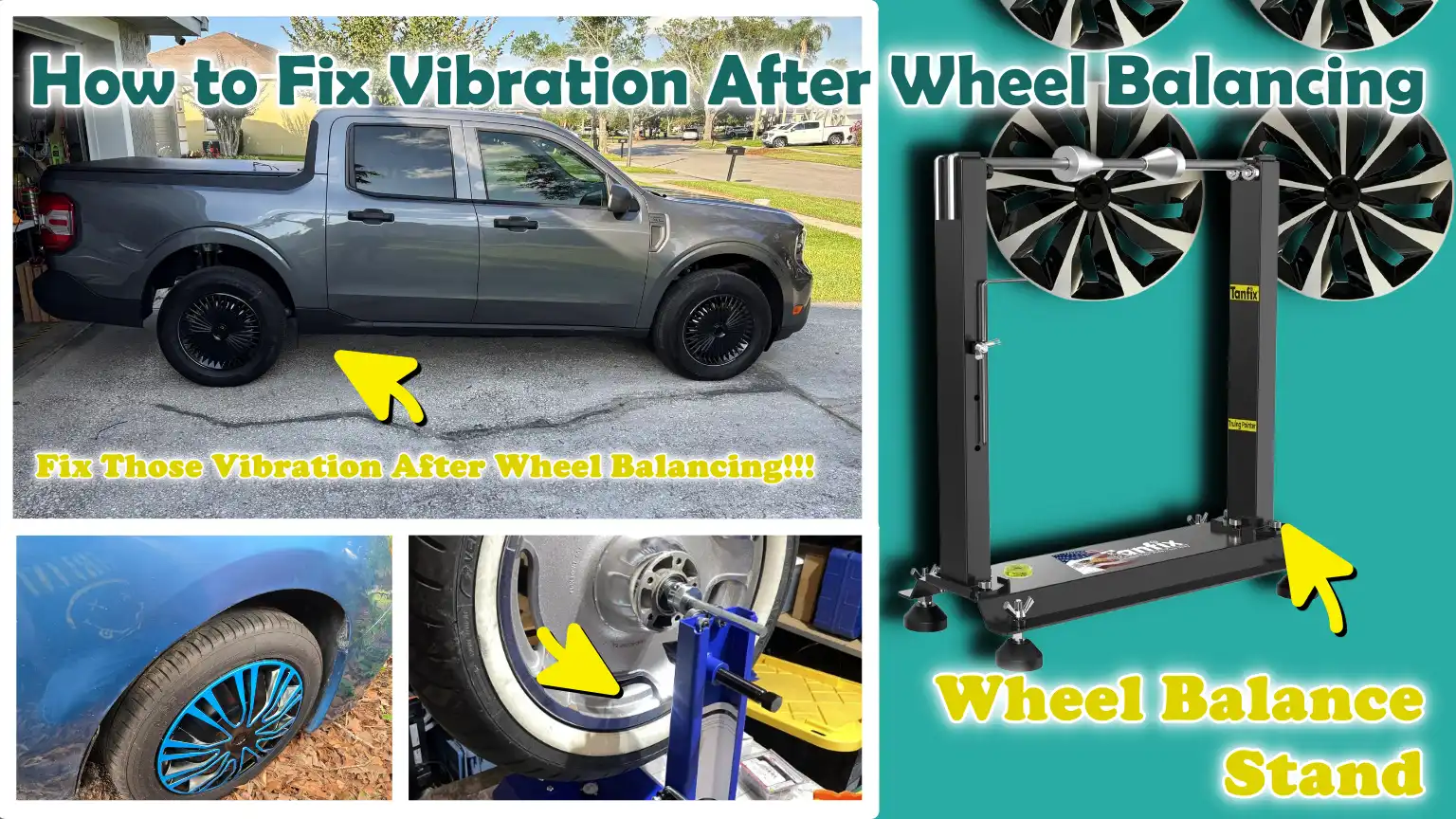
That is why, in this guide you’ll learn How to Fix Vibration After Wheel Balancing so that you can break down to the real reasons why vibration continues even after wheel balancing and working methods to eliminate those problems completely.
Now, Let’s Understand About the Symptoms of Wheel Vibration
1. Steering Wheel Shaking at Specific Speeds
Steering wheel shaking is one of the most common symptoms of vibration issues following wheel balancing and it typically manifests within a specific speed range rather than occurring continuously.
In many real-world scenarios, drivers perceive this shaking most distinctly at speeds between 50 km/h and 100 km/h, where even minor imperfections in the tires or wheels become more pronounced due to the increased rotational speed.
This type of vibration is often linked to issues involving the front wheels, as the steering system transmits these forces directly to your hands.
Common causes include a slight tire imbalance that was not fully corrected, uneven tire wear, or a slightly bent rim.
Even a minor shift in weight distribution, sometimes as little as a few grams, as it can generate a noticeable shaking effect when the wheel rotates at high speeds.
2. Vibration in the Seat or Floorboard
When vibration is felt more distinctly in the seat or floorboard rather than in the steering wheel, it typically points to issues involving the rear wheels or the drivetrain.
This occurs because vibrations originating from the rear do not pass directly through the steering column; instead, they propagate and are felt through the vehicle’s body structure.
In many cases, this type of vibration is caused by an imbalance in the rear tires, uneven tread wear, or structural defects within the tire itself such as: a separation of the internal belts.
In certain vehicles, particularly those equipped with rear-wheel-drive or all-wheel-drive systems, drivetrain components can also contribute to this vibration if they are worn out or improperly aligned.
This symptom is crucial because it aids in pinpointing the root cause of the problem without the need for guesswork.
3. Vibration During Braking vs At Constant Speed
The timing of the vibration is one of the most critical diagnostic indicators.
If the vibration occurs primarily during braking, it is often linked to issues involving the brake rotors such as: warping or uneven surface wear, which prevent the brake pads from maintaining a consistent grip.
Conversely, if the vibration persists while the vehicle is traveling at a steady speed without the brakes applied, the problem is more likely to be associated with the tires, wheels, or suspension components.
This distinction is widely utilized in automotive diagnostics, as it helps differentiate between issues within the braking system and imbalances caused by rotating components.
Understanding this distinction saves time and helps avoid unnecessary repairs.
4. The Speed Range Where Vibration Is Most Pronounced
Most vibration-related issues manifest most distinctly within a specific speed range and this pattern serves as one of the strongest diagnostic clues.
At lower speeds, due to the slower rotational velocity of the wheels and the minimal forces involved, minor imbalances or tire imperfections often go unnoticed.
As speed increases, particularly on highways, these minor flaws are amplified by centrifugal forces, causing the vibration to become significantly more intense and palpable.
In many cases, vibration peaks between 60 km/h and 110 km/h; depending on its underlying cause, it may diminish or even disappear completely at higher speeds.
Precisely because of this speed-specific behavior, technicians often conduct road tests at various speeds to accurately pinpoint the root cause, rather than relying solely on static balancing machines.
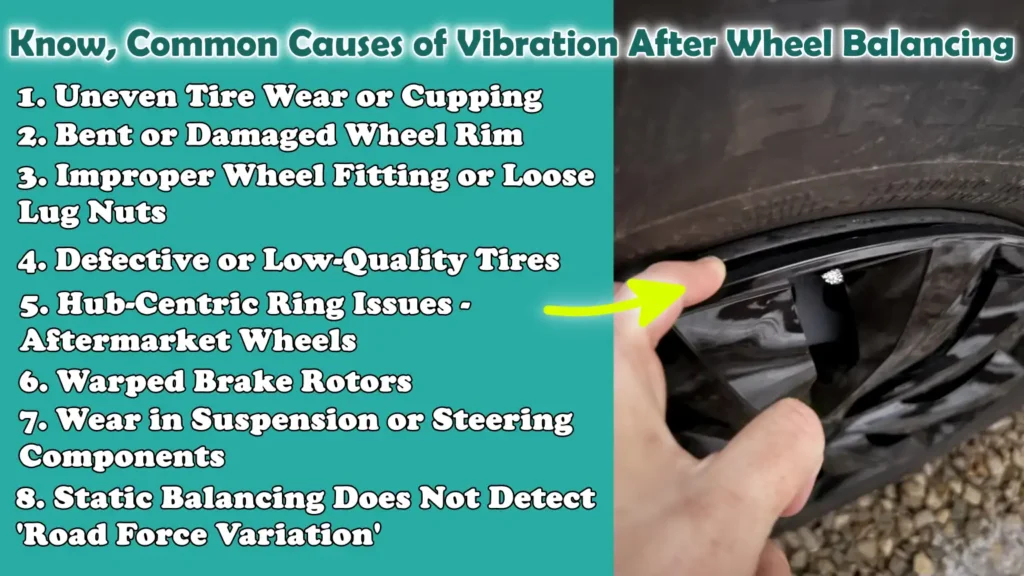
Know, Common Causes of Vibration After Wheel Balancing
1. Uneven Tire Wear or Cupping
Uneven tire wear, specifically a pattern known as “cupping”, is one of the most common reasons why vibration persists even after wheel balancing.
This occurs when specific sections of the tire tread wear down unevenly; this is often caused by worn suspension components or improper tire inflation pressure over time.
Even if the wheel itself is perfectly balanced, the uneven surface of the tire creates a bouncing effect against the road, which is perceived as vibration at higher speeds.
This type of wear typically develops gradually, so the vibration may feel as though it begins slowly rather than appearing suddenly.
2. Bent or Damaged Wheel Rim
A bent or slightly damaged rim can easily cause vibration, even if proper balancing has been performed.
This often happens after striking potholes, curbs, or rough sections of the road.
A bent rim does not rotate along a perfectly circular path, causing the tire to follow a slightly erratic trajectory.
Balancing machines cannot fully correct this issue because the structural integrity of the wheel has already been compromised.
This is why vibration may still be felt even after the correct balance weights have been applied to the wheel.
3. Improper Wheel Fitting or Loose Lug Nuts
If a wheel has not been fitted correctly, or if the lug nuts have not been tightened uniformly, vibration may begin immediately after the service is completed.
Even a very small gap between the wheel hub and the rim can create instability during rotation.
In some cases, applying uneven torque (tightening force) to the lug nuts causes the wheel to sit slightly off-center, resulting in vehicle vibration at specific speeds.
This is a minor yet serious issue, as it directly impacts the stability and safety of the wheel.
4. Defective or Low-Quality Tires
A tire with internal defects or poor construction can generate vibrations even after being properly balanced.
Issues such as inconsistencies in rubber density, internal belt separation, or structural weaknesses can cause irregular movements while driving.
Low-quality tires are more prone to these issues, particularly at highway speeds or when carrying heavy loads.
This type of vibration often feels irregular and its intensity may fluctuate over time.
5. Hub-Centric Ring Issues – Aftermarket Wheels
Aftermarket wheels sometimes require hub-centric rings to ensure a precise fit between the wheel’s center bore and the vehicle’s hub.
If these rings are missing, damaged, or incorrectly sized, the wheel cannot seat properly in the center.
This minor misalignment can generate vibrations that are distinctly felt at moderate to high speeds.
This issue is common in modified vehicles where the wheels are not the original factory-fitted parts.
6. Warped Brake Rotors
Warped or uneven brake rotors can cause vibrations, which are often mistaken for wheel balancing issues.
When rotors are not perfectly flat, their contact with the brake pads becomes inconsistent during braking.
Consequently, a pulsating sensation or vibration is felt throughout the vehicle, particularly when decelerating from high speeds.
Although this is fundamentally an issue with the braking system, it can manifest as wheel vibration, potentially causing confusion when diagnosing the problem.
7. Wear in Suspension or Steering Components
Worn suspension or steering components such as: tie rods, ball joints, or bushings, as it can introduce excessive looseness into the wheel system.
This instability becomes even more pronounced at higher speeds, where even the slightest amount of play translates into vibration.
Even if the wheels are perfectly balanced, worn components are unable to maintain their stability on the road.
This is why ensuring the suspension system is in proper working order is crucial for resolving persistent vibration issues.
8. Static Balancing Does Not Detect ‘Road Force Variation’
Standard wheel balancing primarily checks for weight distribution; however, it does not always detect “Road Force Variation”, that is, fluctuations in the stiffness of a rotating tire.
Even if a tire is balanced, certain sections may be stiffer or softer than others, generating vibrations when the vehicle’s weight is applied to them.
Road Force Variation becomes evident only under actual driving conditions and often goes undetected without the use of an advanced ‘Road Force Balancing Machine’.
This is one of the hidden causes behind vibration issues that persist even after standard wheel balancing has been performed.
What are the Immediate Pre-Repair Inspection Steps
1. Visual Inspection of Tires and Rims
The first and simplest method for identifying vibrations that persist after a wheel balancing procedure is to conduct a careful visual inspection of both the tires and the rims.
This helps identify obvious issues that cannot be resolved solely through balancing such as: bulges on the tire sidewalls, uneven tread wear, cracks, or minor deformations in the rims.
Even minor damage can disrupt the smooth rotation of the wheel and induce vibrations at high speeds.
It is also crucial to check for stones lodged in the rims, accumulated mud, or improper seating of the tire bead against the rim, as these seemingly minor issues can significantly impact balance and stability.
A slow, meticulous visual inspection often reveals problems that diagnostic machines may fail to detect completely.
2. Checking for Uniformity in Lug Nut Torque
Another essential step is ensuring that all lug nuts are tightened uniformly and in accordance with the manufacturer’s specific torque specifications.
If one or more lug nuts are tightened significantly more or less than the others, the wheel will not sit flush against the hub, which can lead to vibrations while driving.
This issue is frequently overlooked, yet it can generate substantial vibration even after a professional wheel balancing service has been performed.
Using a torque wrench ensures that equal pressure is applied to each lug nut, thereby keeping the wheel properly centered and securely seated.
Uniform torque is critical for both vehicle safety and smooth operational performance.
3. Swapping Front and Rear Wheels to Detect Vibration
Swapping the front and rear wheels is a simple yet effective diagnostic technique used to determine whether the source of vibration lies within the tires themselves or within the vehicle’s chassis or suspension system.
If, after swapping the wheels, the vibration shifts from the steering wheel to being felt in the seat, it generally indicates a problem with the wheel or tire itself.
Conversely, if the vibration persists in the same location, it may point to an issue with the suspension or drivetrain.
This method helps pinpoint the root cause of the problem without the need for expensive specialized equipment and is commonly used to diagnose fundamental vehicle issues.
4. Test Drive to Identify Vibration Patterns Based on Speed
A controlled test drive is one of the most critical steps in diagnosing vibrations that persist even after wheel balancing.
While driving, it is beneficial to observe the specific speed at which the vibration begins, how its intensity changes and whether it ceases completely at a particular speed.
Many wheel-related issues are perceptible only within a specific speed range, often while accelerating on smooth roads.
Noting whether the vibration occurs during braking, while maintaining a steady speed, or while turning provides crucial clues for understanding the nature of the problem.
This real-world assessment, conducted before commencing repairs, helps confirm whether the issue stems from tire balance, wheel condition, or another mechanical component.
How to Fix Vibration After Wheel Balancing – Easy Guide
1. Re-balance Using a Road Force Balancing Machine
When vibrations persist even after standard balancing, the next step is often Road Force Balancing.
This is an advanced method in which pressure is applied to the tire while it rotates, simulating real-world driving conditions.
This helps detect issues such as: variations in tire stiffness or uneven contact, that standard balancing machines cannot identify.
Many vibration issues are resolved at this stage because the process reveals how the tire behaves on the road, rather than merely in a static state.
2. Proper Tire Mounting and Bead Seating
Improper tire mounting or incorrect bead seating can lead to uneven rotation, even if the wheel itself is balanced.
The tire bead must seat uniformly around the entire rim; otherwise, slight jolts or wobbling will occur during rotation.
Technicians often dismount and remount the tire, using controlled air pressure to ensure proper alignment, to verify correct seating.
This step is crucial, as even a minor error in seating can generate vibrations that are distinctly felt at highway speeds.
3. Repair or Replace a Bent Rim
A bent rim cannot rotate in a perfectly circular motion, which directly results in vibrations.
In some cases, minor bends can be repaired; however, severely damaged rims typically require replacement.
As balancing weights only correct weight distribution, and not structural deformities, repairing or replacing the rim is essential to restore smooth rotation.
This step becomes even more critical if the vibration began after striking a pothole or another obstruction on the road.
4. Swap Tires to Identify the Problematic Wheel
Tire rotation is a simple yet effective method for pinpointing exactly which wheel is generating the vibration.
By swapping the positions of the front and rear tires, the pattern or location of the vibration may shift.
If the vibration migrates to a different part of the vehicle, it confirms that the issue is indeed linked to the tire or wheel assembly.
This helps identify the faulty component without the need to unnecessarily replace multiple parts.
5. Replace Worn or Damaged Tires
Tires with internal defects, uneven tread wear, or manufacturing flaws may continue to generate vibrations even after being balanced.
In such instances, replacing the tires is often the only reliable solution.
Worn tires lose their uniform shape, which negatively impacts how they roll across the road surface.
Even minor cracks in the internal belts can cause persistent vibrations at specific speeds, making tire replacement essential for safe driving.
6. Tighten Wheels to Correct Torque Specifications
Failure to properly tighten the lug nuts prevents the wheel from seating correctly against the wheel hub surface.
This imbalance results in vibrations, even if all other components are functioning perfectly.
Using a torque wrench ensures that each lug nut is tightened uniformly and precisely, in accordance with the manufacturer’s specifications.
Proper torque centers the wheel and prevents it from shifting while rotating, thereby enhancing both safety and ride quality.
7. Replace Hub-Centric Rings If Necessary
In the case of aftermarket wheels, hub-centric rings are used to ensure that the wheel fits perfectly and securely onto the vehicle’s hub.
If these rings are missing, broken, or of the incorrect size, the wheel will not sit properly centered.
This slight imbalance can lead to vibrations at moderate to high speeds.
Replacing defective or incorrect rings re-centers the wheel correctly and helps eliminate unnecessary vibrations.
8. Inspect and Service Brake Rotors
Uneven or slightly warped brake rotors can cause vibrations, particularly during braking.
Although this is not directly related to wheel balance, it often manifests as a sensation similar to tire vibration.
Inspecting the rotor’s thickness and surface condition helps in diagnosing the issue.
If necessary, resurfacing or replacing the rotors ensures smooth and stable brake contact, thereby eliminating vibrations experienced while decelerating the vehicle.
9. Repair Suspension Components – Tie Rods, Ball Joints, Bushings
Worn suspension or steering components introduce excessive looseness into the wheel system, which becomes clearly noticeable at higher speeds.
Components such as tie rods, ball joints and bushings help keep the wheels stable and properly aligned.
When these parts become worn, they develop play that cannot be resolved simply by correcting the wheel balance.
Repairing or replacing these parts restores structural integrity to the vehicle and helps resolve long-standing vibration issues.
Know, The Advanced Solutions for Persistent Vibration
And, there’s research that shows that even small mass asymmetries in the tire and rim assembly literally able to generate the measurable dynamic forces that increases with speed, which is why vibration often becomes more noticeable at highway speeds, so the study shows that prolonged driving with imbalance that can also accelerate the wear in bearings, bushings and steering components, that’s why it becomes important not only balancing the wheels but also checking for underlying the structural issues whenever vibrations persists after the service.[¹]
1. Road Force Matching Technology – Tire + Rim Alignment
When vibration persists even after standard balancing and basic repairs, Road Force Matching is often employed as a more advanced solution.
Rather than conducting separate checks, this method measures how the tire and rim interact with each other under load.
It helps identify stiff spots in the tire and heavy spots in the rim and then aligns them in the optimal position to eliminate vibration.
This process is highly effective because it mitigates the uneven forces that naturally arise when a tire rotates under load, particularly at highway speeds, where minor imperfections are felt most distinctly.
2. Alignment Correction Following Suspension Repairs
Following the repair of worn or damaged suspension components, wheel alignment becomes crucial for eliminating any residual vibration issues.
If the wheels are not properly aligned, they will not track straight and true; this can cause the vehicle to pull to one side, result in uneven tire wear and generate subtle vibrations.
Proper alignment ensures that all wheels are oriented correctly and maintain consistent contact with the road surface.
This step is particularly important because, if the alignment angles are incorrect or uneven, even a perfectly balanced wheel can still generate vibration.
3. High-Speed Vibration Testing
High-speed vibration testing serves as the final verification step to confirm whether the issue has been fully resolved.
During this test, the vehicle is driven at various speeds, typically within the specific speed range where the vibration was previously experienced, to assess how the vehicle performs under actual driving conditions.
Technicians closely monitor steering response, seat vibration and the vehicle’s overall stability.
This helps verify whether the repairs have effectively resolved the root cause of the problem or if any other hidden issues still persist.
It is a practical method to ensure that the vehicle remains stable, smooth and safe, even at highway speeds.
How to Prevent Vibration After Wheel Balancing
1. A Regular Tire Rotation Schedule
The most effective method for preventing vibration after wheel balancing is regular tire rotation.
Over time, front and rear tires wear down at different rates because they are subjected to varying loads and steering pressures.
If this uneven wear is left uncorrected, it can gradually lead to an imbalance, potentially causing vibrations at higher speeds.
Rotating the tires at regular intervals ensures that wear is distributed evenly across all four tires, thereby maintaining their uniform shape and reducing the likelihood of vibration recurring.
This practice also extends the lifespan of the tires and contributes to a more comfortable driving experience over time.
2. Maintaining Correct Tire Air Pressure
Maintaining the correct air pressure in your tires is crucial for preventing both vibration and uneven tire wear.
If tires are underinflated, they flex excessively, generating heat and causing the tread to wear unevenly; conversely, if tires are overinflated, their contact patch with the road is reduced, resulting in a harsher ride and reduced vehicle stability.
Both of these conditions can lead to vibrations, particularly when driving at high speeds on highways.
Proper tire inflation ensures that the tire’s contact patch (the area touching the road) remains consistent, allowing the wheels to roll smoothly and remain balanced over the long term.
Regularly checking your tire pressure is a simple yet highly effective preventive measure.
3. Avoiding Potholes and Curbs
Violent impacts with potholes, speed bumps, or curbs are a primary cause of wheel misalignment or internal tire damage.
Even a single severe impact can slightly warp a wheel rim or compromise the internal structure of a tire; although this damage may not be immediately visible, it can subsequently lead to vibrations.
Avoiding such impacts as much as possible helps protect both the tires and the suspension components.
Driving cautiously on poor roads significantly reduces the risk of hidden damage, damage that ultimately leads to long-term vibration-related issues.
4. Regular Inspection of Wheels and Suspension
Regular inspections of wheels, tires and suspension components allow for the detection of minor issues before they escalate into major problems (such as vibrations).
Checking for signs of uneven tire wear, cracks, loose parts, or early symptoms of suspension wear can prevent significant future complications.
Components such as bushings, tie rods and ball joints play a crucial role in keeping the wheels stable and properly aligned.
When these components are in good condition, the vehicle maintains smooth and stable contact with the road, thereby significantly reducing the likelihood of vibrations occurring after wheel balancing.
Read More:
So, When to Consult a Professional Mechanic
1. Persistent Vibration Even After Wheel Balancing
If your car continues to vibrate even after proper wheel balancing, it is a clear indication that the underlying issue is far more serious than a simple weight imbalance.
In many cases, persistent vibration signals an internal problem that balancing machines cannot resolve such as: structural defects in the tire, worn-out suspension components, or alignment issues.
When standard remedies fail to eliminate the vibration, a professional mechanic can utilize advanced diagnostics such as: road force testing and suspension inspections, to accurately pinpoint the root cause of the problem.
Continuing to drive without a proper diagnosis can allow the issue to worsen significantly over time.
2. Visible Damage to the Rim or Tire
When visible damage is apparent on a rim or tire such as: bending, cracks, bulges, or uneven tire wear, it is crucial to seek professional assistance immediately.
These defects directly impact the wheel’s rotation and cannot be corrected merely through balancing.
A mechanic can determine whether the rim can be safely repaired or if it requires replacement and can also identify internal tire damage that may not be visible from the outside.
Ignoring these warning signs can exacerbate the vibration and significantly increase the risk of a tire blowout.
3. Safety Hazards at Highway Speeds
If the vibration becomes severe or erratic while driving at highway speeds, it should be treated as a serious safety hazard.
At high speeds, vibrations can compromise steering control, place excessive strain on the tires and negatively impact braking stability.
Such issues often signal a combination of underlying problems such as: tire imbalance, worn suspension components, or structural damage to the vehicle.
A professional inspection ensures that all critical components are thoroughly examined, thereby guaranteeing that the vehicle remains safe and stable even at high speeds.
Addressing the issue promptly at this stage helps prevent future mechanical damage and enhances overall driving safety.
Conclusion – How to Fix Vibration After Wheel Balancing
Now, you have clearly understood that smooth ride is never just about balancing the wheels alone, as it is about the full condition of the wheels, tires and suspension and they should work together like family.
When vibrations persist even after balancing, it typically indicates an underlying issue affecting how the wheels interact with the road surface.
The root causes can vary, ranging from uneven tire wear, slightly bent or improperly mounted rims, or worn-out suspension components, to issues involving the brakes or wheel alignment that may not be immediately apparent.
Each of these issues impacts the rotational uniformity of the tires, as well as the manner in which forces are transmitted through the vehicle’s steering system and body structure.
The key takeaway is that vibration is not, in itself, a singular or isolated problem; rather, it is the cumulative result of various potential factors acting in concert.
A minor defect that might seem trivial such as: a slight imperfection in a tire or a worn suspension bushing, as it can become acutely perceptible at higher speeds; this occurs because the forces involved increase in direct proportion to the rotational speed of the wheels.
Now, that’s it from this guide and you can comment down below for more related questions.
Frequently Asked Questions
FAQ 1: Why is my car still vibrating after wheel balancing?
Answer: If your car continues to vibrate even after wheel balancing, it usually indicates that the problem is not solely related to the weight distribution of the wheels. In many cases, the vibration persists because the tires are not worn evenly, a rim is slightly bent, or there is an internal defect within the tire that cannot be corrected merely by balancing. Sometimes, suspension components such as: ball joints or tie rods, become worn out, causing excessive wheel movement at higher speeds. This explains why balancing alone does not always resolve the issue and why a more in-depth inspection is often required to identify the root cause.
FAQ 2: At what speeds is wheel vibration typically felt?
Answer: Wheel vibration is most pronounced at moderate to high speeds, typically between 60 km/h and 110 km/h. At lower speeds, the rotational forces are not strong enough to make minor imperfections perceptible. As speed increases, even slight irregularities in the tires or rims become much more noticeable because the wheel is spinning faster, thereby amplifying any existing imbalance. This explains why many drivers feel their car is running perfectly fine while driving in the city, yet begin to experience vibrations as soon as they reach the highway.
FAQ 3: Can defective tires cause vibration to persist even after balancing?
Answer: Yes, defective or worn-out tires are one of the most common reasons why vibration persists even after wheel balancing has been performed. A tire may appear perfectly fine on the outside, yet harbor internal issues such as: belt separation, a lack of structural uniformity, or manufacturing defects. These issues prevent the tire from rolling smoothly on the road, resulting in vibration. Even if balancing weights have been applied to the correct locations during the balancing process, vibration may persist due to a lack of uniformity in the tire’s construction.
FAQ 4: How can I determine whether the vibration is caused by the tires or the suspension?
Answer: You can often identify the source of the problem by observing when and where the vibration is felt. If the vibration is felt primarily in the steering wheel, it is typically linked to the front tires or wheels. If it is felt in the seat or the floorboard, the cause may lie with the rear wheels or suspension components. If the intensity or nature of the vibration changes when applying the brakes, there is a strong likelihood that the issue lies with the brake rotors. Suspension-related vibrations often manifest as a sensation of looseness or instability while driving, even on smooth roads.
FAQ 5: Is wheel balancing sufficient to resolve all vibration-related issues?
Answer: Wheel balancing is essential, but it is not always sufficient to resolve every vibration-related issue. It only corrects the uneven distribution of weight within the wheel; it does not address structural issues such as: bent rims, tire defects, or worn suspension components. Resolving many vibration problems requires a multifaceted approach, which may involve correcting wheel alignment, inspecting the tires and, in some cases, replacing specific components. This is why, if vibration persists even after balancing, a more in-depth inspection is typically required.
FAQ 6: Can wheel alignment fix vibration issues?
Answer: Wheel alignment can help reduce vibration, but only if the problem stems from incorrect wheel angles. If the wheels are not properly aligned, the vehicle may pull to one side and cause uneven tire wear, which can eventually lead to vibration. However, wheel alignment alone cannot resolve issues caused by defective tires, bent rims, or worn-out suspension components. It is most effective when performed as part of a comprehensive repair process.
References:
[1] Real-Time Estimation of Wheel Imbalances for Chassis Prognosis
https://saemobilus.sae.org/papers/real-time-estimation-wheel-imbalances-chassis-prognosis-2010-01-0245
Hello Folks, Dean Shali here to help you out to solve the problems with your lovely vehicle, as i have lots of experience and knowledge about automotive industry as i woks directly with the customers and repair vehicles and i love to help the people to keep their cars safe and running smoothly.