
Written By: Dean Shali
Fact Checked By: Sabré Cook
Reviewed By: Tamara Warren
So, from the moment your TPMS literally stops detecting a sensor, then your vehicle actually loses part of its awareness and that can affect safety and performance as well.
Plus, if your vehicle is showing a “TPMS Sensor Not Detected” warning, then it is actually communication issue with one or more sensors that constantly monitors tire pressure in real time.
As well as, this happens due to the something as simple as a drained sensor battery: which basically lasts 5 to 10 years of time or something more complex thing can be behind this issue such as: signal interference, damaged sensors or lost programming after the tire service.
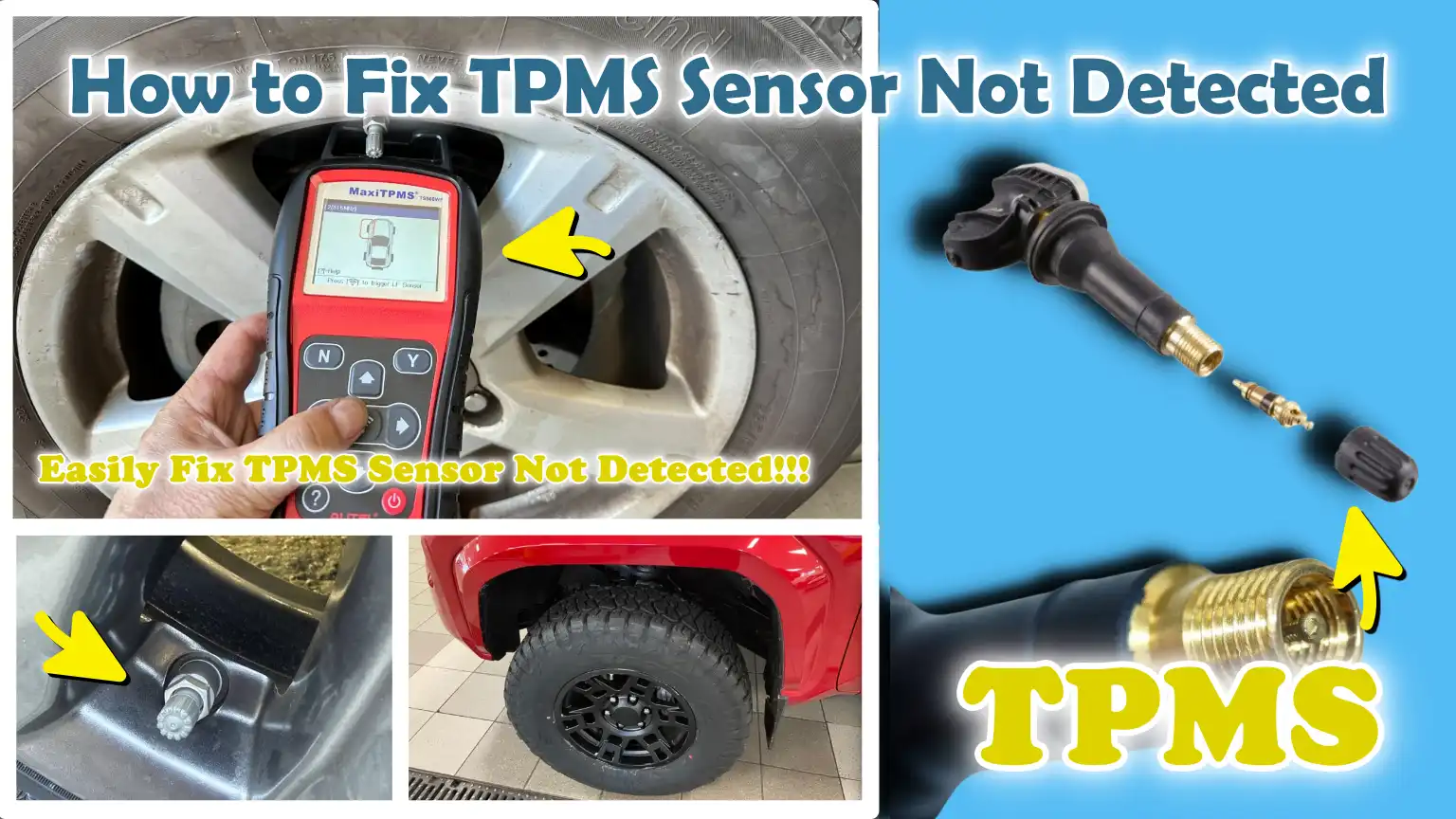
That’s why, you need to learn How to Fix TPMS Sensor Not Detected so that you can identify the exact cause and fix it using simple methods.
What is a TPMS Sensor and How Does It Work?
A TPMS sensor, or Tire Pressure Monitoring System sensor, is a small electronic device installed inside or near each tire.
It continuously monitors air pressure and transmits that data to the vehicle.
Its primary purpose is to alert the driver when tire pressure reaches an unsafe level.
This is crucial because low tire pressure can negatively impact fuel efficiency, accelerate tire wear and increase the risk of a blowout or loss of vehicle control while driving.
This system has now become a standard feature in most modern vehicles, as tire pressure is directly linked to road safety and overall vehicle performance.
1. Direct vs Indirect TPMS Systems
Vehicles primarily utilize two types of TPMS systems: Direct and Indirect.
A Direct TPMS system employs physical sensors installed inside each tire, which measure actual air pressure in real-time.
These sensors are typically attached to the valve stem and transmit precise pressure readings directly to the vehicle’s computer (ECU).
In contrast, an Indirect TPMS system does not use physical pressure sensors.
Instead, it relies on wheel speed data provided by the Anti-lock Braking System (ABS).
When a tire’s air pressure drops, its diameter changes slightly, causing it to rotate at a different speed compared to the other tires.
The system detects this discrepancy and infers that there is an issue with the tire pressure.
Although Indirect systems are less expensive, they are generally less accurate than Direct systems.
2. How Do Sensors Communicate with the Vehicle’s ECU?
TPMS sensors communicate with the vehicle’s Electronic Control Unit (commonly referred to as the ECU) using low-frequency wireless signals.
Each sensor possesses a unique identification code (ID), enabling the ECU to identify which specific tire that sensor is associated with.
The ECU continuously receives data from all four sensors and displays tire pressure information on the dashboard.
If a sensor ceases transmitting data, sends an erroneous signal, or loses its programmed ID, the ECU is unable to verify the status of that particular tire.
In such instances, a warning such as: “TPMS Sensor Not Found”, appears, signaling an interruption in communication between the sensor and the vehicle’s system.
3. Typical Sensor Lifespan – Battery Life: 5 to 10 Years
Most TPMS sensors feature an internal battery that cannot be replaced independently.
These batteries are designed to last approximately five to ten years, depending on driving habits, climatic conditions and vehicle usage patterns.
Exposure to extreme temperatures, frequent driving and prolonged vehicle operation can shorten their lifespan.
Over time, the battery’s power gradually diminishes until the sensor completely ceases transmitting signals to the ECU.
When this occurs, the system stops recognizing the sensor entirely; typically, the only remaining solution is to replace the sensor itself.
This limited lifespan is one of the most common reasons why drivers face TPMS-related warnings or issues several years after purchasing their vehicle.
Know, Common Reasons for Undetected TPMS Sensors
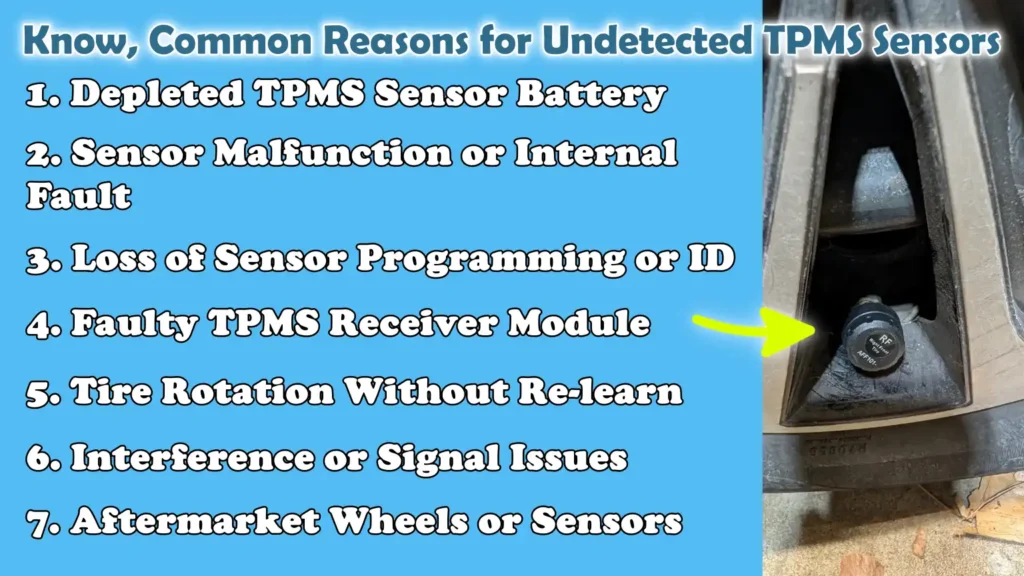
The “TPMS Sensor Not Detected” warning typically indicates that the vehicle is no longer receiving proper signals from one or more tire pressure sensors.
This does not always signify a major malfunction, but it certainly points to a disruption in communication between the sensor and the vehicle’s monitoring system.
Understanding the exact cause is crucial, as the solution varies for each issue, ranging from a simple system reset to the complete replacement of the sensor.
1. Depleted TPMS Sensor Battery
The most common reason for an undetected TPMS sensor is the depletion of its internal battery.
Most TPMS sensors utilize sealed lithium batteries designed to last approximately five to ten years, depending on driving conditions, temperature fluctuations and usage patterns.
Over time, the battery gradually loses its charge until the sensor completely ceases transmitting data to the vehicle.
When this occurs, the system stops receiving a signal from that specific tire, thereby triggering the “Not Detected” warning.
This type of malfunction is more prevalent in older vehicles or in sensors that have never been replaced as their initial installation at the factory.
2. Sensor Malfunction or Internal Fault
TPMS sensors are small yet sensitive electronic devices, typically mounted inside or near the tire, exposing them to heat, vibration and physical stress.
A sensor can become damaged during tire installation, by driving over potholes, or due to corrosion that develops over time.
Even if the sensor appears intact externally, its internal circuitry may fail due to moisture intrusion or general wear and tear.
When this happens, the sensor ceases to function entirely and the vehicle is unable to detect it at all.
In such cases, the entire sensor often needs to be replaced, as internal malfunctions typically cannot be repaired.
3. Loss of Sensor Programming or ID
Every TPMS sensor possesses a unique identification code (ID) that the vehicle’s computer uses to recognize it.
In some instances, this programming may be lost or corrupted, particularly after disconnecting the battery, replacing a sensor, or resetting the ECU.
When the vehicle ceases to recognize a sensor’s ID, it interprets this as the sensor being missing or non-functional.
This triggers a “Sensor Not Detected” message, even if the sensor itself is fully operational.
Performing a “re-learn” or reprogramming of the sensor ID typically resolves this issue.
4. Faulty TPMS Receiver Module
The TPMS receiver module, located within the vehicle, is responsible for collecting signals from all tire sensors and relaying that information to the dashboard display.
If this module malfunctions, it may fail to properly read signals from one or more sensors.
This can result in false warnings or the system failing to detect sensors on multiple wheels.
Although sensor failure is more common, a faulty receiver module can compromise the entire system; diagnostic testing is typically required to confirm such a malfunction.
5. Tire Rotation Without Re-learn
Following a tire rotation or wheel swap, the TPMS system may lose track of which specific sensor corresponds to which specific wheel position.
As each sensor is linked to a particular wheel location, rotating the tires without performing the necessary “re-learn” procedure can confuse the system.
This often manifests as inaccurate readings or a “Sensor Not Detected” warning for one or more tires.
While the sensors themselves continue to function, the system requires an update to properly re-establish their connection from their new locations.
6. Interference or Signal Issues
TPMS sensors utilize wireless signals to communicate with the vehicle and these signals can occasionally face interference.
Such interference may stem from electronic components, sensor misalignment, weak batteries, or the surrounding environment such as: an area rich in dense metals or one characterized by high levels of electromagnetic noise.
When the signal becomes excessively weak or unstable, the ECU may temporarily lose contact with the sensor, leading to intermittent or persistent issues in detecting the sensor.
7. Aftermarket Wheels or Sensors
Installing aftermarket wheels or non-original TPMS sensors can sometimes lead to compatibility issues.
Not all sensors operate on the same frequency or protocol; if a replacement sensor does not properly match the vehicle’s specifications, the system will be unable to recognize it.
Similarly, certain aftermarket wheels may obstruct signal transmission depending on their material or design.
In such instances, the system may display a “Sensor Not Detected” warning, even if the sensor is physically installed and fully functional.
Know About Some Warning Signs You Should Not Ignore
Problems with the TPMS rarely occur without warning.
Before the system fails completely, your vehicle typically provides clear indications that something is amiss with the Tire Pressure Monitoring System.
These signs are crucial because they help you identify the problem early, before it impacts driving safety, tire longevity, or fuel efficiency.
Understanding these symptoms can help you avoid misdiagnosis and unnecessary repairs.
1. The TPMS Light Flashes, Then Stays Illuminated
One of the most common early warning signs is when the TPMS light begins to flash briefly upon starting the vehicle and then remains continuously illuminated while driving.
A flashing light often indicates a malfunction within the system itself, rather than simply low tire pressure.
This behavior typically signifies that the system has detected a communication issue with one or more sensors.
After an initial diagnostic check, the system confirms that it is unable to properly read the data, causing the light to remain lit.
This pattern is frequently associated with a faulty sensor, lost programming data, or a weak sensor battery.
2. “No Sensor Detected” Message
When a “No Sensor Detected” message appears on the dashboard, it means that the vehicle is no longer receiving a signal from one or more TPMS sensors.
This is a more serious warning than a standard low-pressure alert, as it indicates a complete loss of communication.
In many cases, this occurs when a sensor’s battery has died, the sensor itself has failed, or the system has lost the sensor’s identification data.
Until communication is restored, whether through a system reset, a “re-learn” procedure, or sensor replacement, the vehicle will be unable to display a tire pressure reading for that specific tire.
3. Inaccurate Tire Pressure Readings
Another clear warning sign occurs when the displayed tire pressure does not match the actual pressure inside the tire.
For instance, the system may indicate normal pressure even when the tire is low on air, or it may display sudden fluctuations that do not reflect actual conditions.
This typically indicates that a sensor is failing or is transmitting erroneous data to the vehicle’s onboard computer.
This can also happen when sensors are aging or partially deteriorating, situations where they continue to transmit signals, but not reliably.
Such issues are dangerous because they create a false sense of security for the driver.
4. Missing Data for a Specific Tire
If a specific tire suddenly stops displaying pressure data while the remaining tires continue to function correctly, it is a definitive indication that the particular TPMS sensor has malfunctioned or that its communication link has been severed.
This often implies that the sensor’s battery has died, an internal component has failed, or the programming for that specific wheel has been erased.
In some cases, this issue may also arise following a tire rotation or wheel service if the system has not been properly ‘re-learned’ (reset).
When only a single tire is affected, the problem is generally confined to that specific sensor rather than stemming from a malfunction within the entire system.
Tools
| Tools | Why It Is Needed | How to Use It |
|---|---|---|
| TPMS Reset Button – Vehicle-Specific | This helps clear old sensor data and restart the system following tire rotation, pressure adjustments, or minor sensor glitches. | Turn on the ignition, press and hold the reset button until the TPMS light begins to flash, then release it and drive the vehicle for a short distance to allow the system to recalibrate itself. |
| OBD2 Scanner with TPMS Capability | This is used to identify which sensor is malfunctioning, to read error codes and, in some cases, to reprogram or “re-learn” sensor IDs. | Plug the device into the OBD port located under the dashboard, turn on the ignition, select the TPMS function and follow the on-screen instructions to scan or reset the sensors. |
| TPMS Relearn Tool | This is necessary when sensors are replaced, their positions are swapped, or the vehicle’s system fails to recognize them. | Following the vehicle-specific instructions, position this tool near the valve stem of each tire, one by one, so that each sensor can transmit its unique ID to the vehicle’s ECU. |
| Tire Pressure Gauge | This is essential to verify whether the issue is genuinely low tire pressure or merely a sensor recognition error. | Press the gauge firmly onto the tire’s valve stem to obtain a pressure reading, then compare this reading against the recommended PSI listed on the sticker located on the driver’s-side doorjamb. |
| Air Compressor | This is necessary to correct low tire pressure and ensure that all tires maintain the proper air pressure required for safe driving; this step is often a prerequisite before resetting the TPMS. | Connect the compressor nozzle to the valve stem, inflate the tire to the correct PSI level and then use the gauge to re-check and confirm the accuracy of the pressure reading. |
How to Fix TPMS Sensor Not Detected – Easy Method
Resolving the “TPMS Sensor Not Detected” issue requires a simple yet logical process, as this problem can stem from minor discrepancies in tire pressure, system calibration errors, or a faulty sensor.
Modern TPMS systems rely on accurate pressure data, seamless communication between sensors and the vehicle’s onboard computer system to correctly identify each sensor.
If any of these steps fail to function properly, the system may cease to detect one or more sensors.
The step-by-step guide below will assist you, in a clear and practical manner, in pinpointing the root cause of the problem.
1. First, Check Tire Pressure
The first and most critical step is to verify the actual air pressure in all four tires using a reliable tire pressure gauge.
Many TPMS-related warnings appear simply because the air pressure in one or more tires has dropped below, or risen above, the PSI level recommended by the manufacturer; this information is typically found on a sticker located on the driver-side door frame.
Before proceeding further, ensure that all tires are inflated to the correct pressure; if the tire pressure remains incorrect, the system will not be able to reset properly.
This step helps eliminate common pressure-related issues and ensures that the TPMS system is operating based on accurate, real-time data.
2. Reset the TPMS
Once the tire pressure has been corrected, the next step is to reset the TPMS system so that it can clear any outdated data and re-verify all sensors.
Many vehicles feature a dedicated reset button on the dashboard, allowing the system to restart its monitoring process.
In some vehicles, a “drive-to-reset” method is utilized; This involves driving the vehicle at a steady speed for a specific distance, allowing the system to automatically relearn and acquire sensor signals.
This step is crucial because TPMS systems often retain previous sensor readings; if they are not reset, they may continue to display error messages even after the underlying issue has been resolved.
3. Relearn the TPMS Sensors
If resetting the system does not resolve the problem, the next step is to complete the “relearn” process so that the vehicle can correctly re-identify each sensor.
Some vehicles automatically support the sensor relearn process; this process typically occurs under specific driving conditions, often referred to as a “drive cycle”, while the vehicle is in motion.
In other vehicles, sensors must be relearned manually by following a specific sequence of button presses inside the cabin.
In more advanced cases, a specialized TPMS scan tool is used to individually activate each sensor, allowing the vehicle to register its unique ID.
This step is necessary when sensors are replaced, their positions are swapped, or they lose their connection to the system.
4. Check for Faulty Sensors
If the system still fails to detect one or more sensors, the next step is to physically inspect the sensors to determine if they have malfunctioned.
TPMS sensors can be damaged during tire installation, by road impacts, corrosion, or simply through prolonged use.
Signs of damage include cracks in the housing, a loose valve stem, or a sensor becoming dislodged during recent tire servicing.
If the problem began immediately after a tire replacement or repair, there is a high probability that the sensor was accidentally damaged or was not properly reinstalled.
At this stage, identifying any physical defects helps determine whether a repair is feasible or if the sensor requires replacement.
5. Replace the Faulty TPMS Sensor
Once it is confirmed that a sensor has failed or is defective, replacing it becomes necessary, as most TPMS sensors are sealed units containing non-replaceable batteries.
A faulty sensor cannot be repaired internally and must be replaced with a new, compatible unit.
In the United States, the cost of replacing a TPMS sensor typically covers both parts and labor and this cost may vary depending on the type of vehicle and the brand of the sensor.
Replacing a faulty sensor re-establishes the connection between the tire and the vehicle’s system, thereby restoring accurate pressure readings.
6. Reprogram the New Sensor’s ID
After installing the new sensor, the final step is to reprogram or register its unique identification code within the vehicle’s system.
This is essential because every TPMS sensor possesses a unique ID that the vehicle’s computer must recognize in order to display accurate data.
Without this programming, the system will be unable to detect that a new sensor has been installed and may continue to display a “sensor not detected” warning.
This process is typically performed using an OBD2 scanner equipped with TPMS capabilities or a specialized “re-learn tool”; this tool transmits the new sensor’s information to the vehicle’s ECU, ensuring that all tires are being properly monitored once again.
Learn, Vehicle-Specific Methods for Resetting TPMS
The procedures for resetting and “re-learning” the TPMS are not uniform across all vehicles, as every manufacturer designs its own proprietary system that dictates how the tire sensors communicate with the vehicle’s onboard computer.
Although the objective remains the same, namely, ensuring that the vehicle correctly identifies each individual tire sensor, the specific steps involved may vary depending on the brand.
Understanding these differences is crucial; employing an incorrect method may fail to resolve a “TPMS sensor not found” issue, even if the sensors themselves are fully functional.
1. GM Re-Learn Procedure
In General Motors vehicles such as: Chevrolet, GMC and Cadillac models, the TPMS re-learn procedure is typically initiated via the vehicle’s dashboard menu or through a specific reset sequence.
Once the system enters re-learn mode, the vehicle often prompts the driver to activate each tire sensor in a specific order, beginning with the front left tire.
This is typically accomplished using a dedicated TPMS activation tool, or by slightly deflating and then reinflating each tire until the vehicle confirms that the sensor has been successfully recognized.
Upon the successful registration of each sensor, the vehicle typically provides feedback, usually in the form of a horn chirp or flashing hazard lights.
This method ensures that the vehicle’s ECU can accurately associate each sensor with its correct wheel position.
2. Ford Re-Learn Procedure
Ford vehicles typically utilize either an automatic or a manual re-learn mode, which can be activated via the dashboard interface or through a specific ignition sequence.
Once “Re-learn” mode is activated, the system prompts the driver to trigger each sensor, beginning with the front left tire and proceeding in a specific clockwise pattern.
In many Ford models, the sensor signal is triggered by using a TPMS reset tool on each valve stem.
Once every sensor has been “re-learned,” the vehicle confirms successful recognition by sounding its horn.
This process helps the system update itself to reflect any changes resulting from tire replacements, sensor replacements, or battery failures.
3. Toyota Re-learn Process
Toyota vehicles often utilize a simple system that relies on a reset button, typically located beneath the dashboard or near the steering wheel.
After setting the tire pressure to the correct levels, the reset button is pressed and held until the TPMS warning light begins to flash and subsequently turns off.
In many Toyota models, the system automatically recalibrates itself once the vehicle is driven at normal speeds for a short period.
However, in some newer models, a scan tool may be required to register new sensors following a replacement.
This method places greater emphasis on recalibrating the entire system rather than manually triggering each individual sensor.
4. Honda Re-learn Process
Honda vehicles generally feature a straightforward reset process that does not always require specialized tools.
After ensuring that all tires are at the correct pressure, newer models allow users to select the TPMS calibration option via the vehicle’s settings menu or infotainment system.
Once initiated, the system begins to automatically recalibrate itself as the vehicle is driven under normal conditions.
In older Honda models, a physical reset button may be used instead.
The system learns the behavior of the sensors over time and adjusts itself based on driving patterns; therefore, it is considered one of the most user-friendly TPMS systems in terms of its reset process.
So, When to Use a TPMS Scan Tool
A TPMS scan tool is a specialized diagnostic device that connects directly to your vehicle’s Tire Pressure Monitoring System to read sensor data, detect faults and, when necessary, assist in resetting or “re-learning” the sensors.
It is particularly useful when a TPMS warning indicates “sensor not detected,” as the underlying issue is not always visually apparent or easily identified through a standard tire inspection.
Rather than guessing which specific sensor is malfunctioning, this scan tool provides clear electronic data from each wheel, making the diagnostic process faster, more accurate and more reliable.
1. Identifying Which Sensor Has Failed
One of the most critical functions of a TPMS scan tool is to pinpoint exactly which tire sensor has ceased functioning.
In many cases, a TPMS warning does not explicitly specify which particular wheel is experiencing an issue, specially when multiple sensors are involved or when the system has completely lost communication.
This scan tool establishes individual communication with each sensor, helping to verify whether it is active, transmitting a weak signal, or has failed completely.
This eliminates the need to unnecessarily inspect all four tires, allowing you to focus directly on the faulty sensor, thereby saving both time and effort.
2. Reading Sensor IDs and Battery Status
Another primary function of a TPMS scan tool is to retrieve the unique identification codes and status information stored within each sensor.
Every TPMS sensor possesses a distinct ID that the vehicle’s onboard computer uses for identification purposes; if this ID is missing, incorrect, or unregistered, the system will trigger a detection error.
In many modern systems, this scan tool can also provide data regarding the sensor’s battery status, indicating whether the sensor is nearing the end of its operational lifespan.
As most TPMS sensors utilize sealed batteries that cannot be replaced, this information proves invaluable for anticipating future malfunctions in advance.
3. Avoiding Unnecessary Replacements
The use of a TPMS scan tool also helps prevent the unnecessary replacement of sensors, thereby saving both significant time and money.
Without proper diagnostics, drivers often assume that a sensor is defective, whereas the actual issue may stem from system reset glitches, lost programming, or signal connectivity problems.
By confirming whether a sensor has genuinely failed or has simply failed to register a reading, the scan tool helps ensure that only faulty components are replaced.
This is particularly important given that TPMS sensors are relatively expensive and often require professional assistance for installation and programming.
Accurate diagnostics ensure that repair work is undertaken only when absolutely necessary, thereby improving both operational efficiency and cost control.
Estimated Cost Breakdown
Understanding the costs associated with resolving TPMS sensor detection issues helps drivers decide whether to attempt the repairs themselves or consult a professional.
In the United States, the cost of TPMS repairs can vary depending on the type of vehicle, the brand of the sensor, labor charges and whether additional programming is required.
As TPMS systems involve both electronic components and tire service work, the total cost is typically divided into the cost of replacing the sensor and the service or “re-learn” charges.
1. Sensor Replacement Cost – $40 to $150 Per Sensor
In the U.S., the cost to replace a single TPMS sensor typically ranges from approximately $40 to $150, depending on the vehicle’s make and whether the sensor is an OEM (Original Equipment Manufacturer) or an aftermarket part.
Luxury vehicles and newer models often utilize more advanced sensors, the cost of which typically falls toward the higher end of this range.
In most cases, this cost covers only the sensor component itself, it does not include installation or programming.
As TPMS sensors are sealed units with non-replaceable batteries, a faulty sensor must be replaced entirely rather than repaired; this constitutes one of the most common expenses drivers face when resolving sensor detection issues.
2. Re-learn or Service Cost – $20 to $80
After replacing a TPMS sensor or rotating the tires (which alters the sensors’ positions), the system typically requires a “re-learn” procedure to ensure the vehicle correctly re-identifies each sensor.
In the U.S., having this re-learn or service procedure performed at a tire shop or dealership typically costs between $20 and $80.
The cost depends on whether a simple system reset suffices, or if a specialized TPMS scan tool is required to program the sensors.
Some vehicles require more time and involve additional technical steps, which can increase labor costs.
This step is crucial because, without proper re-learning, the system may continue to display a “sensor not found” warning, even if new sensors have already been installed.
3. DIY Repair vs Professional Repair
The choice between performing a DIY repair and seeking professional service depends on the tools available to the driver, their level of experience and the complexity of the TPMS issue.
If the problem is related to low tire pressure, fixing it typically does not require specialized equipment for simple reset procedures or easy re-learning steps; in such cases, you can save money by performing the repair yourself.
However, when sensor replacement, programming, or diagnostic scanning is required, enlisting the help of a professional often becomes necessary.
While DIY repair can save on labor costs, if performed incorrectly, it may result in recurring warnings or sensors that are not properly configured.
Professional service ensures precision and accurate calibration, guaranteeing that the TPMS functions reliably and continuously monitors tire safety.
Difference Between DIY vs Professional Repair
Resolving the “TPMS sensor not detected” issue can sometimes be simple enough for a driver to fix at home; however, in certain cases, it requires professional-grade tools and technical expertise.
The right choice depends on the complexity of the problem, specifically whether it stems from a common tire pressure issue or a deeper electronic communication fault, and whether you have the appropriate tools available.
Understanding the distinction between DIY and professional service can help you avoid unnecessary expenses, as well as potential damage resulting from incorrect repairs, which could ultimately exacerbate the problem.
1. When You Can Fix It Yourself
The DIY approach is typically effective when the TPMS issue arises from a simple and common cause such as: low tire pressure, a minor sensor glitch, or the need to reset the system.
If all tires appear to be in good condition and the warning light or “sensor not detected” message persists even after inflating or rotating the tires, resetting the system or initiating a “re-learn” procedure may resolve the issue.
In many vehicles, drivers can reset the TPMS system using a specific button on the dashboard or through the vehicle’s internal menu; in some instances, simply driving the vehicle for a short period allows the system to automatically recalibrate itself.
Checking tire pressure with a gauge and adjusting it to the correct level is another simple DIY method that often resolves minor warning-related issues.
These tasks do not require any specialized tools and are safe for most vehicle owners to perform, provided they follow the specific instructions outlined in their vehicle’s owner’s manual.
2. When to Visit a Tire Shop or Mechanic
Professional service becomes necessary when the TPMS system continues to display a “sensor not detected” warning, even after performing a standard reset and checking the tire pressure.
This typically indicates a deeper underlying issue such as: a faulty sensor, a programming glitch within the sensor, or a communication failure between the sensor and the vehicle’s control module.
If the sensor’s battery has died, physically replacing the sensor becomes necessary, a process that also requires reprogramming using specialized diagnostic tools.
In situations where multiple sensors are not being detected, or the system fails to recognize pressure readings from any of the tires, having the vehicle inspected by a professional is the safest course of action; technicians can utilize TPMS scanning tools to pinpoint the root cause of the malfunction.
Furthermore, if a warning light illuminates after installing new tires or performing a wheel rotation, a mechanic can verify whether the sensors have been installed correctly and if the system’s “re-learn” process has been successfully completed.
When accuracy, safety and proper system calibration are of paramount importance, consulting a tire shop or a professional mechanic remains the most reliable solution.
Know, Common Mistakes People Do While Fixing TPMS Sensor Not Detecting
When issues arise where TPMS sensors fail to be detected, many drivers inadvertently make mistakes that either delay the proper resolution of the problem or increase repair costs.
The TPMS system is highly sensitive, as it relies on precise communication between the sensors and the vehicle’s computer; therefore, even a minor error made while handling or diagnosing it can lead to recurring warnings or the unnecessary replacement of parts.
Understanding these common mistakes helps ensure that the issue is resolved correctly the very first time.
1. Ignoring a Flashing TPMS Light
One of the most common mistakes is ignoring a flashing TPMS light, specially when it subsequently remains continuously illuminated.
A flashing light is not merely a general warning regarding tire pressure; it typically indicates a malfunction within the system itself or a communication issue involving one or more sensors.
Many drivers assume that the problem will resolve itself; however, in reality, it often signifies that the system has lost contact with a specific sensor or is unable to read its data correctly.
Ignoring this initial warning can result in driving without accurate information regarding tire pressure, thereby increasing the risk of tire damage and loss of vehicle control.
2. Unnecessarily Replacing All Sensors
Another common mistake is replacing all TPMS sensors when, in reality, only a single sensor is defective.
As each sensor operates independently, the likelihood of all four sensors failing simultaneously is extremely low.
Many issues stem not from a complete system failure, but rather from a specific sensor having a low battery, sustaining physical damage, or experiencing a programming glitch.
Replacing all sensors without proper diagnosis can be a costly and unnecessary undertaking.
With the aid of a proper scan tool or diagnostic check, a faulty sensor can typically be identified with complete accuracy; this prevents you from replacing parts that are still functioning correctly, allowing you to replace only the specific component that is defective.
3. Skipping the ‘Re-learn’ Process After Tire Rotation
Neglecting the TPMS ‘re-learn’ process after a tire rotation is another common mistake that frequently leads to confusion.
As each sensor is configured for a specific tire position, swapping the tires’ locations without updating the system can result in inaccurate readings or trigger a “sensor not detected” warning.
The sensors themselves may be functioning perfectly well, yet the vehicle’s system remains unaware of their new positions.
Without the ‘re-learn’ process, the system may display incorrect data or fail to recognize one or more sensors; this often leads drivers to mistakenly believe there is a hardware malfunction within the system, when in reality, no such defect exists.
4. Using Incompatible Aftermarket Sensors
The use of incompatible aftermarket TPMS sensors is another common issue that prevents the system from functioning correctly.
Not all sensors are designed to communicate with every vehicle, as different manufacturers utilize varying frequencies, protocols and programming methods.
If a sensor is not fully compatible, the vehicle will be unable to detect it, even if it has been installed correctly.
This often results in persistent warning messages, causing frustration for the driver.
Selecting the correct sensor, one that matches the vehicle’s specific specifications, is crucial for ensuring proper communication and avoiding detection-related issues.
Read More:
- How to Relearn TPMS Without Scan Tool
- How to Reset Tire Pressure Monitoring System Manually
- How to Check Tire Pressure Sensor Battery
- How to Seal Bead Leak in Tire
- How to Use Tire Plug Kit Correctly
- How to Repair Tubeless Tire Puncture
- How to Locate a Nail in a Tire
- How to Fix Slow Tire Air Leak
- How to Detect Tire Sidewall Damage
- How to Check Tire Tread Depth at Home
- How to Bleed ABS System Properly
- How to Replace Rusted Brake Lines
- How to Inspect Brake Lines for Rust
- How to Flush Contaminated Brake Fluid
- How to Check Brake Fluid Contamination Level
- How to Fix Brake Bias Issues
- How to Test Brake Proportioning Valve
- How to Replace a Brake Light Switch
- How to Diagnose Brake Light Switch Failure
- How to Fix Intermittent ABS Activation
- How to Clean ABS Wheel Speed Sensor
- How to Diagnose ABS Sensor Wiring Issues
- How to Test Electronic Brake Module (EBCM)
- How to Fix Parking Brake Dragging
How to Avoid TPMS Sensor Problems
Preventing TPMS sensor problems is far easier and less expensive than repairing them after they have malfunctioned.
As the TPMS relies on small electronic sensors located inside or near each tire, its performance is significantly influenced by tire maintenance, installation procedures and the natural aging of the sensor batteries.
By adopting a few simple maintenance habits, drivers can significantly reduce the likelihood of facing a “TPMS sensor not detected” warning and ensure that the system continues to provide accurate tire pressure information over time.
And, NHTSA actually conducted a large-scale real-world study that shows that the vehicles that are equipped with TPMS has significantly fewer severely underinflated tires when they compared it to other vehicles without TPMS, so study actually found out that only 11.8% of TPMS-equipped vehicles had at least one severely underinflated tire compared to the 23.1% in non-TPMS vehicles, that literally proves that TPMS actually is safety tool that reduces the risk of dangerous underinflation that’s how it prevents tire-related accidents and which is why sensor detection failures should not be ignore at all at they literally removes this safety advantage.[¹]
1. Regular Tire Maintenance
Regular tire maintenance is the most effective way to keep the TPMS functioning correctly.
This involves checking tire pressure using a reliable gauge, at least once a month and before long trips, rather than relying solely on the readings displayed on the dashboard.
Keeping tires inflated to the manufacturer’s recommended pressure helps the sensors transmit consistent and accurate data to the vehicle’s onboard computer.
It also reduces unnecessary strain on the sensors, as severely under- or over-inflated tires can interfere with how the system interprets tire conditions.
Proper wheel alignment, rotation and balancing also contribute to even tire wear, thereby ensuring consistent TPMS performance.
2. Avoiding Damage During Tire Changes
TPMS sensors are most vulnerable to damage during the installation, removal, or repair of tires.
As many sensors are mounted inside the wheel, near the valve stem, improper handling with tools or machinery can cause damage that may not be immediately apparent.
Even a slight jolt during tire installation can fracture internal components or dislodge the sensor from its mounting position, potentially leading to communication issues later on.
Employing proper tire servicing techniques and ensuring that technicians are knowledgeable about wheels equipped with TPMS helps prevent sudden damage.
Exercising caution when changing tires is crucial, as even a minor error can completely ruin a sensor.
3. Replacing Sensors in Sets as They Age
Although TPMS sensors typically fail individually, they often share a similar lifespan as they are installed simultaneously during the vehicle’s manufacturing process.
Most sensors last between five and ten years, depending on driving conditions and climate.
When a sensor begins to fail due to a depleted battery, the remaining sensors have likely also reached the end of their operational life.
In such cases, replacing sensors in sets, specifically those on the same axle or all four sensors simultaneously, as it can minimize the need for frequent repairs and prevent future issues, such as the system failing to detect a sensor.
This approach helps maintain consistent system performance and avoids situations where new and old sensors operate inconsistently.
4. Monitoring Battery Lifespan
Understanding the lifespan of TPMS sensor batteries is essential for preventing sudden system failures.
Most TPMS sensors are equipped with sealed, internal lithium batteries that cannot be individually recharged or replaced.
As the battery weakens, the sensor gradually loses its ability to transmit signals to the vehicle’s ECU.
This is the primary reason why older vehicles often display a “sensor not detected” warning.
As the typical battery lifespan ranges from five to ten years, drivers should monitor the condition of their sensors as an integral part of their vehicle’s long-term maintenance routine.
Paying attention to the vehicle’s age and the last time its sensors were replaced allows for the early anticipation of potential malfunctions, thereby reducing the risk of sudden system-related warnings while driving.
Conclusion – How to Fix TPMS Sensor Not Detected
Now, you have clearly understood the fact that: fixing a sensor is actually simple, as you just have to understand its warning signs and some practical tips to bring it alive.
As proper tire pressure directly impacts braking distance, fuel efficiency, tire longevity and overall vehicle stability, ignoring this warning can compromise safety and lead to unnecessary repair costs.
In most instances, this issue does not arise suddenly or without cause; rather, it stems from identifiable factors such as: a low sensor battery, a programming glitch, physical damage to the sensor during tire servicing, or simply the need to reset or “re-learn” the system.
It is crucial to understand that while TPMS systems are designed for high precision, they do not function indefinitely without maintenance.
Most sensors degrade over time, typically within five to ten years, and may gradually cease transmitting signals long before they fail completely.
This is precisely why early detection of the problem is so vital.
By taking a few simple steps such as: checking tire pressure, resetting the system and completing the re-learn procedure, the system can often be restored to proper working order without requiring major repairs.
So, that’s it from this guide about How to Fix TPMS Sensor Not Detected and if you still have questions then just comment that damn question in comment section.
Frequently Asked Questions
FAQ 1: What does it mean when a TPMS sensor is not detected?
Answer: If you receive a message indicating that a TPMS sensor has not been detected, it means that your vehicle is not receiving a signal from one or more of its tire pressure sensors. Each tire is equipped with a sensor that transmits air pressure data to the vehicle’s computer system. When that signal is interrupted, the system is unable to monitor that specific tire and consequently, it displays a warning. This typically occurs due to a depleted sensor battery, a programming error, external damage to the sensor, or a communication issue within the system. This does not necessarily mean that your tire has a puncture; however, it certainly implies that your vehicle is unable to verify the safety status of that particular tire.
FAQ 2: Can I drive with a TPMS sensor detection warning?
Answer: Technically, you can continue to drive despite this warning; however, doing so for an extended period is not advisable. The reason is that your vehicle will no longer be able to accurately monitor tire pressure, leaving you unaware if a tire is underinflated or has developed a fault. This increases the risk of handling difficulties, reduced fuel efficiency and premature tire wear. Rather than continuing to drive with a malfunctioning TPMS system, it is best to manually check your tire pressures yourself and have the issue resolved as soon as possible.
FAQ 3: Why does my TPMS sensor suddenly stop working?
Answer: A TPMS sensor can suddenly stop working for several reasons. The most common cause is the depletion of the sensor’s internal battery, as most sensors have a lifespan of approximately five to ten years. This can also occur if a sensor sustains damage, whether during a tire change, due to striking an object on the road, or as a result of corrosion over time. Occasionally, after removing a battery or performing a tire rotation, the system may fail to recognize the ID of a specific sensor; this creates the impression that a sensor is missing, even if it is fully functional.
FAQ 4: How can I fix the issue of a TPMS sensor not being detected?
Answer: Resolving this issue typically begins by checking the pressure in all tires and ensuring they are at the recommended levels. Subsequently, you may need to reset the TPMS system using the vehicle’s reset function, or drive the vehicle for a short period to allow it to recalibrate itself. If the warning persists, the vehicle may require a “re-learn” procedure to re-identify each sensor. In cases where a sensor is defective or its internal battery has died, replacement is the only solution.
FAQ 5: How long do TPMS sensors last?
Answer: Most TPMS sensors last between five and ten years, depending on driving conditions, climate and usage. The primary factor limiting their lifespan is their internal battery, which is sealed within the sensor itself and cannot be replaced independently. Extreme heat or cold, frequent driving and driving on rough roads can all reduce their lifespan. Once the battery is depleted, the sensor ceases transmitting data and must be replaced entirely.
FAQ 6: Does a “Sensor Not Found” warning appear when tire pressure is low?
Answer: Typically, a “Sensor Not Found” warning does not appear when tire pressure is low. Instead, a low-pressure warning light usually illuminates. However, in certain instances such as: when tire pressure is extremely low or the tire has gone completely flat, it may be difficult for the sensor to function correctly, particularly if the tire itself has sustained damage. A “Sensor Not Detected” message typically indicates a technical malfunction within the sensor (a communication error), rather than simply low tire pressure.
References:
[1] Technical Report Evaluating the Effectiveness of Tire Pressure Monitoring Systems (TPMS) in Proper Tire Pressure Maintenance, 69541-69542 [2012-27994]
https://regulations.justia.com/regulations/fedreg/2012/11/19/2012-27994.html
Hello Folks, Dean Shali here to help you out to solve the problems with your lovely vehicle, as i have lots of experience and knowledge about automotive industry as i woks directly with the customers and repair vehicles and i love to help the people to keep their cars safe and running smoothly.