
Written By: Dean Shali
Fact Checked By: Sabré Cook
Reviewed By: Tamara Warren
It is really important that: when you have to brake the vehicle then it about just not stop in fast way, but is should be stop in the whole “CONTROLLED” way.
Actually, when you presses that brake pedal, then your car literally performs a carefully engineered balance between physics, friction and control.
And, most of the drivers just assume that brakes either work or fail, but in reality it is far more precise.
Also, modern vehicles are designed so that around 60% to 80% of braking force is only handled by the front wheels due to the weight transfer that happens instantly whenever you slows down the vehicle.
So, this shift is what actually keeps your car really stable and predictable as well.
But, whenever this balance known as “BRAKE BIAS”, is off even slightly then the results can be seriously concerning.
As, too much front bias can literally increase the stopping distance and wear out components quickly, while too much rear bias can cause sudden skidding or loss of control as well.
Additionally, there’s studies in vehicle dynamics that shows that improper brake balance is actually a big factor in instability during the emergency braking specially on the wet or uneven roads.
Plus, the big challenge is that the brake bias issues can often develop in quiet way, also it shows some small signs such as: uneven pad wear, pulling to one side or inconsistent stopping feel as well.
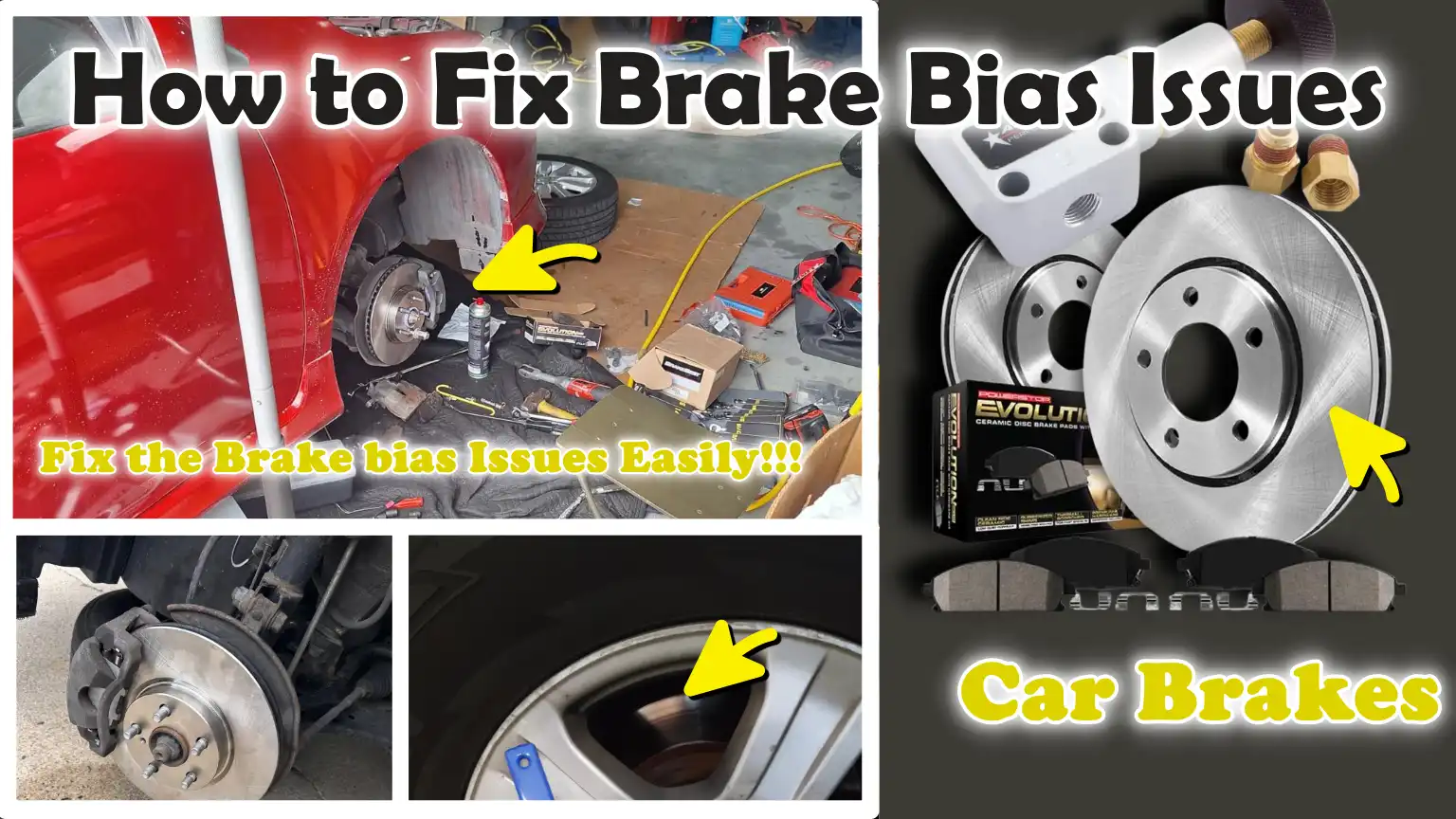
Now, in this guide you’ll learn How to Fix Brake Bias Issues so that you can understand those signs clearly, connect them to the real causes and fix the problem easily.
What is Brake Bias?
Brake bias refers to how the braking force is distributed between the front and rear wheels of a vehicle when the brake pedal is applied.
Simply put, it determines the extent to which the front brakes work harder than the rear brakes.
This balance is calibrated with great precision to ensure that all four wheels decelerate simultaneously and in a controlled manner, without locking up prematurely.
If the front brakes exert greater force, this is referred to as a ‘front-heavy bias’; conversely, if the rear brakes exert greater force, it is termed a ‘rear-heavy bias.’
The correct balance ensures that the tires maintain their grip on the road surface, a critical factor for coming to a safe and predictable stop.
Why Do Manufacturers Design for a ‘Front-Heavy Bias’?
Most vehicles are deliberately designed to apply greater braking force to the front wheels, as this aligns with the vehicle’s dynamic behavior during deceleration.
When a vehicle slows down, its weight naturally shifts forward due to inertia.
Consequently, the load on the front tires increases, while the load on the rear tires decreases.
As the front tires now possess greater traction, they are capable of handling a higher braking force without slipping.
Engineers leverage this phenomenon to design braking systems in which the front brakes perform the majority of the work, often accounting for approximately 60 to 80 percent of the total braking effort.
This design enhances vehicle stability, reduces the risk of rear-wheel lock-up and assists the driver in maintaining control over the vehicle, particularly during sudden or emergency braking situations.
The Role of Weight Transfer During Braking
Weight transfer is one of the most critical physical phenomena influencing braking performance.
When a vehicle decelerates, momentum pushes the vehicle’s mass forward; this causes the front suspension to compress and the rear section to lift slightly.
This shift occurs instantaneously and alters the grip of each tire on the road surface.
The front tires press more firmly against the road, enabling them to handle greater braking forces, while the rear tires become lighter and are more prone to locking up.
Understanding this concept clarifies why proper brake bias is so essential.
If the braking force is not calibrated to account for this weight shift, the tires may lose their grip on the road, potentially causing the vehicle to skid or requiring a longer distance to come to a halt.
How Does Brake Bias Affect Stopping Distance and Vehicle Control?
Brake bias directly influences how quickly and safely a vehicle can come to a stop.
When the balance is optimal, all four tires work in unison to decelerate the vehicle without losing their grip on the road; consequently, the vehicle stops in a shorter distance and remains more stable.
If the bias is skewed too heavily toward the front (front bias), the front tires may quickly reach the limits of their grip, while the rear brakes remain underutilized; this results in a longer stopping distance and accelerated wear on the front components.
Conversely, if the bias is shifted too far toward the rear (rear bias), the rear wheels may lock up before the front wheels, potentially disrupting the vehicle’s stability, or, in severe cases, even causing the vehicle to spin out.
Proper brake balance ensures that braking force is distributed effectively across all wheels, providing the driver with maximum control and confidence in both normal and emergency braking situations.
So, Why is Correct Brake Bias Really Important?
1. Prevents Wheel Lock-up
Correct brake bias plays a crucial role in preventing wheel lock-up.
Wheel lock-up occurs when a tire stops rotating while the vehicle is in motion.
When a wheel locks up, it loses its grip on the road surface and begins to slide rather than maintaining traction, making it extremely difficult to control the vehicle.
A balanced brake bias ensures that the braking force is distributed across each tire in proportion to the available grip.
As the front tires bear a greater load during braking, they can handle more force, whereas the rear tires require less force.
If this balance is correct, all wheels decelerate smoothly without locking up prematurely.
This preserves tire grip and provides the driver with superior control over both steering and stopping the vehicle.
2. Maintains Vehicle Stability During Braking
Vehicle stability during braking depends heavily on how evenly the braking force is distributed between the front and rear tires.
When the brake bias is set correctly, the vehicle remains straight, stable and predictable, even under heavy braking.
If the rear brakes are too strong, the rear end of the vehicle may become unstable and begin to wobble or slide, particularly on slippery road surfaces.
Conversely, if the front brakes are too dominant, the vehicle may pitch forward excessively and feel unbalanced.
Correct brake bias keeps the vehicle straight and stable, a factor that is particularly critical when braking at high speeds or while cornering.
3. Improves Vehicle Stopping Capability
Vehicle stopping capability refers to how quickly and effectively a vehicle can come to a complete halt by utilizing the available tire grip.
Proper brake bias allows all four tires to contribute to braking without exceeding their grip limits.
This means the braking system leverages the maximum available grip from every tire, enabling the vehicle to stop within a shorter distance.
If the bias is incorrect, some tires are not utilized effectively, while others are subjected to excessive load, thereby diminishing overall braking performance.
A well-balanced system ensures that braking force is distributed in the most efficient manner, thereby enhancing both performance and safety.
4. Reduces Uneven Brake Wear
Brake components such as: pads and rotors, wear down over time.
However, incorrect brake bias can cause brakes to wear unevenly and at a faster rate than normal.
When excessive braking force is applied to a single axle, those components are forced to work harder and overheat, leading to accelerated wear.
For instance, if the front brakes bear a disproportionate load, the front brake pads may wear out significantly faster than the rear pads.
This not only increases maintenance costs but, if left unaddressed, can also compromise braking performance.
Correct brake bias distributes the workload evenly, ensuring that all components last longer and deliver consistent performance over time.
5. Enhances Safety in Emergency Braking Situations
In emergency braking situations, where immediate reaction and maximum stopping capability are paramount, proper brake bias becomes even more critical.
During sudden stops, the vehicle’s weight shifts rapidly forward and the braking system must respond with precision to maintain control over the vehicle.
If the brake bias is balanced, the vehicle can decelerate rapidly while remaining stable and under control.
However, if the bias is incorrect, the risk of wheel lock-up, skidding, or loss of control increases significantly.
A properly balanced braking system instills confidence in the driver and enhances the likelihood of avoiding accidents by maintaining traction and stability during the most critical moments.
Know, Common Signs of Dealing With Brake Bias Issues
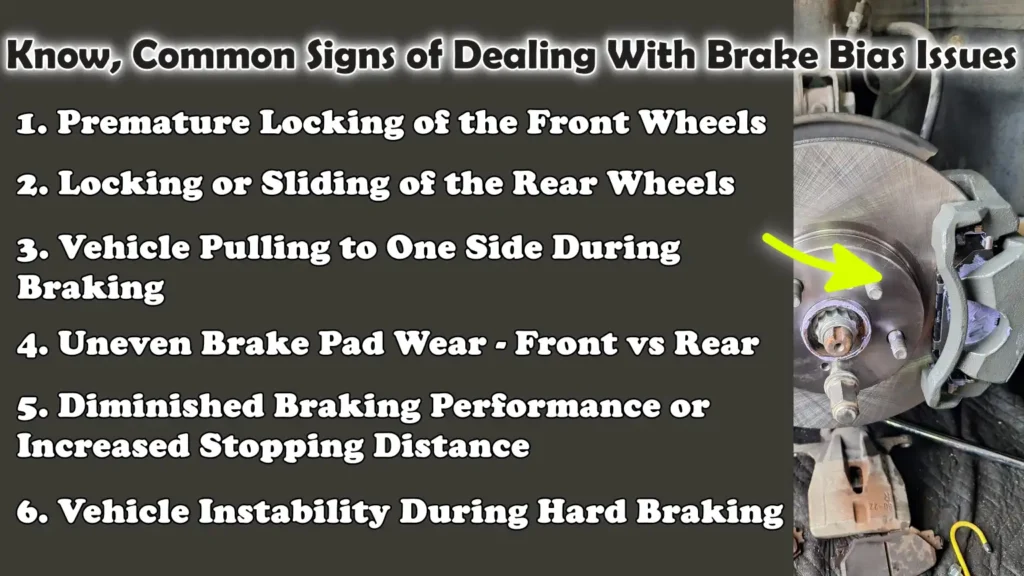
1. Premature Locking of the Front Wheels
When the front wheels lock up too quickly during braking, it generally indicates that the majority of the brake bias is concentrated on the front wheels.
This occurs when the front brakes exert force exceeding the traction limits of the tires, even though the vehicle’s weight naturally shifts predominantly to the front wheels during braking.
You may experience a sudden loss of steering control, as the locked front wheels are unable to guide the vehicle in the intended direction.
Instead of coming to a gradual stop, the vehicle may slide forward.
This situation generates excessive heat and accelerates wear on the front brake components, thereby reducing their lifespan and overall braking efficiency.
2. Locking or Sliding of the Rear Wheels
The locking of the rear wheels is a more dangerous symptom, as it can lead to a sudden and rapid loss of control.
This happens when excessive braking force is applied to the rear wheels; during braking, the natural forward shift of the vehicle’s weight inherently reduces the available traction at the rear wheels.
When the rear wheels lock up, the rear end of the vehicle may begin to slide sideways, particularly on wet or loose surfaces.
This can cause the vehicle to spin out or “fishtail” (where the rear end oscillates rapidly back and forth), making it extremely difficult to regain control.
Proper brake bias prevents this issue by ensuring that the rear brakes apply only as much force as the tires can safely handle.
3. Vehicle Pulling to One Side During Braking
If your vehicle pulls to one side while braking, it is often an indication that the braking force is not distributed equally between the left and right wheels; This anomaly may stem from issues related to brake bias or defective brake components.
The underlying causes could include an imbalance in brake pressure, a seized brake caliper, or disparities in tire traction.
Even a slight imbalance in brake pressure can cause the vehicle to veer off course, particularly during sudden braking.
This not only compromises vehicle control but also heightens the risk of an accident if the driver is unable to maintain a straight trajectory.
4. Uneven Brake Pad Wear – Front vs Rear
Uneven brake pad wear is a clear and easily identifiable indicator of incorrect brake bias.
If the front brake pads wear down significantly faster than the rear pads, it may suggest that excessive braking force is being applied to the front wheels, meaning the front brakes are doing too much of the work.
Conversely, if the rear brake pads wear out too quickly, it may indicate that the majority of the braking force is being directed toward the rear wheels.
This imbalance not only increases vehicle maintenance costs but also signals that the braking system is not functioning optimally.
Regular inspection of the brake pads can help detect and rectify this issue before it adversely affects safety.
5. Diminished Braking Performance or Increased Stopping Distance
When the brake bias (brake balance) is incorrect, the vehicle is unable to effectively utilize all four tires during braking.
Consequently, braking performance suffers and the vehicle’s stopping distance increases.
Some wheels may reach their traction limit prematurely, while others remain underutilized; this implies that the full potential of the vehicle’s total available traction is not being harnessed.
The driver may perceive that the vehicle is taking longer to come to a stop or that greater force is required on the brake pedal.
This diminished braking efficiency becomes particularly noticeable when driving at high speeds or when sudden braking is required.
6. Vehicle Instability During Hard Braking
Vehicle instability during hard braking is one of the most serious symptoms associated with brake bias issues.
When the brakes are applied forcefully, the vehicle may feel unstable, shaky, or uncontrollable.
This can occur due to an imbalance between the front and rear sections of the vehicle, resulting in uneven tire traction.
In some instances, it may feel as though the front end of the vehicle is dipping excessively, or that the rear end is becoming loose.
This instability erodes the driver’s confidence and makes controlling the vehicle difficult, particularly during critical moments when precise braking is essential.
Know, The Primary Causes of Brake Bias Issues
1. Mechanical Causes
Worn Brake Pads or Rotors
Worn brake pads or rotors are among the most common causes of brake bias issues, as they directly influence the amount of friction generated at each wheel.
When brake pads become worn, their ability to grip the rotor diminishes, thereby reducing the braking force applied to that specific wheel.
If the front pads are more worn than the rear pads, the rear brakes may engage more abruptly than expected; conversely, if the rear components are worn, the exact opposite effect occurs.
Rotors that are uneven, warped, or excessively thin can also compromise contact with the pads, leading to an imbalance in braking force.
This imbalance alters the distribution of braking force, potentially increasing the stopping distance required to halt the vehicle and compromising vehicle control.
Stuck Brake Calipers
Brake calipers are responsible for pressing the brake pads against the rotors; if they fail to move freely, they can create an imbalance in braking force.
A stuck caliper may exert excessive pressure on a specific wheel, or it may fail to retract properly after the brakes have been applied.
Consequently, one side of the vehicle, or one axle, works harder than the other, resulting in a distinct brake bias issue.
In some instances, a stuck caliper can generate continuous drag, causing the brake components to overheat and reducing their overall efficiency.
Over time, this not only affects braking balance but also causes damage to the pads and rotors, thereby exacerbating the problem.
Air in the Brake Lines
The presence of air inside the brake lines disrupts the hydraulic pressure necessary for effective braking.
Unlike brake fluid, air is compressible; this means that a portion of the force applied via the brake pedal is dissipated before it ever reaches the actual braking components.
If the volume of air in one section of the system exceeds that in another, it can create an imbalance in braking force between the front and rear wheels, or between the left and right wheels.
Consequently, the brake pedal may feel soft or spongy and the overall effectiveness of the braking system is diminished.
To restore balanced braking, it is crucial to purge the air from the system through the proper ‘bleeding’ procedure.
Uneven Tire Grip or Pressure
Tires play a pivotal role in braking, as they are the only components of the vehicle that make direct contact with the road surface.
If the tire pressure on a specific axle is either too low or too high, it alters that tire’s ability to generate grip.
Similarly, worn or uneven tire treads (the patterned surface of the tire) reduce traction on the road; as a result, when the brakes are applied, some wheels may lose their grip sooner than others.
Even if the braking system itself is functioning correctly, disparities in tire condition can lead to a problem known as ‘poor brake bias.’
Maintaining equal air pressure in all tires and keeping the treads in good condition ensures that braking force is distributed evenly across all wheels.
2. Issues Related to the Hydraulic System
Faulty Proportioning Valve
The proportioning valve is a critical component that regulates the amount of braking force applied to the front and rear wheels.
It is designed to reduce the pressure applied to the rear brakes during hard braking, thereby preventing them from locking up.
If this valve malfunctions or becomes stuck, it can apply either excessive or insufficient pressure to the rear brakes.
Excessive pressure can cause the rear wheels to lock up, thereby compromising the vehicle’s stability, whereas insufficient pressure diminishes the effectiveness of the rear brakes.
A faulty proportioning valve directly impacts brake bias; therefore, repairing or replacing it is essential to maintain the correct balance.
Deterioration of Brake Fluid
For brake fluid to function correctly, it must remain clean and free of moisture.
Over time, brake fluid can absorb water or become contaminated with dust, dirt and debris, thereby reducing its ability to transmit hydraulic pressure uniformly.
Contaminated fluid leads to an improper distribution of braking force across the various components of the system, resulting in an imbalance.
Furthermore, this can cause internal corrosion within components such as calipers and valves, further degrading the vehicle’s overall braking performance.
Regular replacement of the brake fluid is crucial to maintain consistent hydraulic pressure and ensure proper brake bias.
Imbalance in the Master Cylinder
The master cylinder is responsible for generating and distributing hydraulic pressure throughout the entire braking system.
If it suffers from internal wear or imbalance, it becomes unable to deliver equal pressure to the front and rear circuits.
Consequently, one part of the braking system bears a heavier load than the other, resulting in uneven braking performance.
A failing master cylinder can cause the brake pedal to feel spongy (soft) or diminish the overall braking response.
To maintain the proper balance in braking force, the proper functioning of the master cylinder is absolutely crucial.
3. Modification-Related Causes
Upgrading Only the Front Brakes Without Upgrading the Rear Brakes
Upgrading only the front brakes such as: installing larger rotors or more powerful calipers, as it can significantly increase the front braking force, while the rear brakes remain unchanged.
This creates an imbalance where the front brakes perform far more work than intended.
Although this may seem beneficial, it can actually reduce the overall braking capacity, as the rear brakes are not being utilized to their full potential.
This can lead to excessive wear on the front brakes and result in longer stopping distances.
When performing upgrades, one should always prioritize maintaining the correct balance between the front and rear braking systems.
Incorrect Aftermarket Brake Kits
Not all aftermarket brake kits are designed with proper balance in mind.
Installing components that do not align with the vehicle’s original design can alter the distribution of braking force.
For instance, using brake pads with different friction levels on the front and rear brakes can lead to inconsistencies in braking response.
Poorly designed or mismatched kits can disrupt the original brake bias (braking balance) established by the manufacturer.
To maintain proper balance and performance, it is essential to select high-quality components that are specifically designed for that particular vehicle.
Modifications to Suspension or Tires That Affect Weight Distribution
Changes in suspension height, stiffness, or tire dimensions can impact weight distribution during braking.
For instance, lowering the vehicle or installing stiffer suspension components can reduce the forward transfer of weight, thereby altering the tires’ grip on the road.
Similarly, the use of wider or different types of tires can alter the level of traction available at each axle.
These modifications can inadvertently affect brake bias, as the balance between braking force and available traction is altered.
Any modification that impacts weight distribution or traction must be carefully considered to ensure that safe and balanced braking is maintained.
Tools
| Tools | Why It Is Needed | How to Use It Properly |
|---|---|---|
| Jack and Jack Stands | These tools are used to safely lift and support a vehicle, allowing you to access the wheels and brake components. Relying solely on a jack while working underneath a vehicle is unsafe; therefore, jack stands are essential to keep the vehicle stable. | Position the jack directly beneath the vehicle’s designated lifting points and slowly raise the vehicle. Once the vehicle is lifted, place the jack stands beneath sturdy frame points and lower the vehicle onto them. Always ensure the vehicle is stable before beginning any work. |
| Lug Wrench | A lug wrench is required to loosen and tighten the wheel lug nuts, enabling you to remove the wheels and access the braking system. | Slightly loosen the lug nuts before lifting the vehicle. Once the vehicle is lifted, remove the nuts completely and take off the wheel. When reinstalling the wheel, tighten the nuts in a cross pattern to ensure even pressure distribution. |
| Brake Cleaner | Brake cleaner removes dirt, dust, grease and residual brake fluid from brake components. Clean components function more efficiently and are easier to inspect properly. | Spray the cleaner directly onto the brake components, such as the rotors and calipers. Allow it to drip off and air-dry naturally. Do not wipe it down with dirty rags, as this may leave behind dirt residue. Use this product in a well-ventilated area. |
| Brake Fluid | Brake fluid transmits hydraulic pressure from the brake pedal to the brake components. Clean, fresh fluid is essential for maintaining proper brake pressure and balance. | Check the fluid level in the reservoir and top it up as needed. When bleeding the brakes, replace old or contaminated fluid with fresh fluid. Always use the specific fluid recommended for your vehicle. |
| Line Wrench | A line wrench is designed to firmly grip brake line fittings without causing damage (i.e., without rounding them off). It is essential for safely loosening and tightening brake line connections. | Position the wrench correctly on the brake line nut and turn it carefully. Maintain constant pressure on the wrench to prevent it from slipping. This tool provides a superior grip compared to standard wrenches and protects the fittings from damage. |
| Brake Bleeding Kit | This kit is used to bleed air from the brake lines, which is crucial for maintaining proper brake pressure and balance. | Connect this kit to the brake bleeder valve located at each wheel. Open the valve and pump the brake pedal to expel air and old fluid. Once clear fluid begins to flow without any bubbles, close the valve. Repeat this process for all wheels in the correct sequence. |
| Torque Wrench | A torque wrench ensures that bolts and nuts are tightened precisely according to specified specifications. When the torque is correct, components are neither too loose nor overtightened, conditions that could compromise safety. | Set the torque value on the wrench according to your specific requirements. Tighten the bolts (such as lug nuts) until the wrench emits an audible “click” or indicates that the target torque has been reached. For accurate results, adhere to the torque specifications provided by the manufacturer. |
| Safety Gloves and Glasses | These items protect your hands and eyes from brake dust, chemicals and sharp components. Use appropriate safety gear to minimize the risk of injury while working. | Wear gloves before handling any brake components or fluids. Wear safety glasses to protect your eyes, specially when spraying cleaners or working underneath the vehicle. Keep them on until the repair work is complete. |
How to Diagnose Brake Bias Issues – Easy Guide
1. Conduct a Controlled Brake Test
The easiest and most effective way to identify brake bias issues is to conduct a controlled brake test.
Drive the vehicle in an open area at a moderate, safe speed and apply the brakes firmly, yet smoothly.
Pay close attention to how the vehicle reacts as it slows down.
If the front wheels lock up first, it generally indicates that there is excessive braking force at the front.
If the rear wheels lock up, or if the rear end of the vehicle feels unstable, it suggests that the bias is shifted too heavily toward the rear.
This test helps you understand how braking force is being distributed under actual driving conditions.
To avoid any risks, always perform this test in a safe environment and under good road conditions.
2. Inspect the Brake Pads and Rotors
Brake pads and rotors provide clear evidence of how braking force is being utilized.
Remove the wheels and closely inspect the thickness and condition of the brake pads on both the front and rear axles.
If the front pads are significantly more worn than the rear pads, it may indicate that the bias is shifted too far toward the front.
Conversely, if the rear pads appear to be wearing out rapidly, it could mean that excessive braking force is being applied to the rear.
Additionally, check the rotors for any uneven surfaces, scratches, or signs of discoloration caused by heat.
Comparing the condition of the front and rear components provides a clear indication of whether or not the braking system is balanced.
3. Inspect the Brake Calipers
To maintain proper brake balance, it is essential that the brake calipers move freely and exert equal pressure on the brake pads.
Inspect each caliper to ensure that the pistons move smoothly back and forth when the brakes are applied and released.
If a caliper sticks or jams, one wheel will receive either excessive or insufficient braking force.
This can disrupt brake balance and negatively impact the overall brake bias.
Watch for signs such as uneven pad wear, excessive heat generation at a specific wheel, or difficulty in rotating the wheel.
The proper functioning of the calipers is crucial for maintaining consistent braking force across all wheels.
4. Inspect the Brake Fluid and Lines
The braking system operates on hydraulic pressure and the condition of the brake fluid and lines directly affects how this pressure is transmitted.
Check the brake fluid level and observe its color.
Clean fluid is typically transparent or light amber in color, whereas dark or cloudy fluid may indicate contamination.
The presence of air in the brake lines can cause the brake pedal to feel soft or inconsistent and it can also lead to uneven pressure distribution.
Additionally, inspect the brake lines for any leaks, cracks, or signs of wear and tear, as these can result in a loss of pressure in certain parts of the system.
Ensuring that the fluid is clean and the lines are properly sealed helps maintain a uniform braking force.
5. Evaluate the Condition of the Tires
Tires play a critical role in how braking force is transmitted to the road; therefore, their condition must be inspected with great care.
Check the air pressure in all four tires and ensure that it corresponds to the recommended level.
Variations in pressure can alter the grip of each individual tire, potentially creating the sensation of “poor brake bias” (unbalanced braking), even if the braking system itself is functioning correctly.
Furthermore, inspect the tire tread depth and wear patterns.
Tires with shallow tread or uneven wear exhibit reduced grip and may lock up sooner than other tires.
For accurate assessment and balanced braking performance, it is essential that the condition of the tires on all wheels is consistent.
How to Fix Brake Bias Issues – Multiple Working Methods
1. Fix Brake Bias Issue By Replacing the Worn Brake Parts
Worn brake pads and rotors reduce friction and alter the distribution of braking force between the front and rear wheels when the brakes are applied.
For this reason, replacing worn parts is the first and most effective method for resolving brake bias issues.
Always replace pads and rotors in pairs on the same axle to ensure that equal braking force is applied to both sides.
Using different types of materials or mixing old and new parts results in inconsistent friction levels, which directly impacts the vehicle’s stability.
It is also crucial to use parts that are designed to work in conjunction with one another for both the front and rear wheels.
When the braking surfaces at both ends of the vehicle are in proper and uniform condition, the system is able to distribute braking force more precisely and safely.
2. Fix Brake Bias Issue By Bleeding the Brake System
Air trapped inside the brake lines is a common cause of uneven braking, as air is compressible while brake fluid is not.
This means that some of the force applied via the brake pedal is wasted, resulting in inconsistent pressure across the various wheels.
Bleeding the brake system expels this trapped air and restores strong hydraulic pressure throughout the entire system.
When performed correctly, this procedure ensures that equal and immediate braking force is applied to every wheel whenever the brake pedal is depressed.
During this process, it is also essential to drain any old or degraded brake fluid and replace it with fresh fluid.
This helps maintain consistent brake performance and ensures proper brake balance.
3. Fix Brake Bias Issue By Cleaning or Replacing the Brake Calipers
To ensure that the brake pads apply uniform pressure, it is essential that the brake calipers are able to move freely.
If a caliper is sticking or partially seized, it may apply braking force to one wheel more or less intensely than the others, thereby creating an imbalance.
If a caliper is malfunctioning due to dirt or corrosion, cleaning the caliper and its moving components will often restore it to proper working order.
For the brake system to function correctly, it is crucial to lubricate the guide pins and ensure that the piston can move freely back and forth.
If a caliper is damaged or unable to move properly, it should be replaced to restore the correct distribution of braking force.
Properly functioning calipers help ensure that brake pressure is applied uniformly across all wheels.
4. Fix Brake Bias Issue By Adjusting or Replacing the Proportioning Valve
The proportioning valve regulates the amount of braking force distributed between the front and rear wheels; therefore, it plays a pivotal role in maintaining proper brake balance.
If this valve is faulty or malfunctioning, it may apply excessive or insufficient pressure to the rear brakes.
Adjusting or replacing the valve can restore the correct balance between the front and rear braking forces.
In some instances, upgrading to an adjustable proportioning valve offers more precise control, particularly for modified or performance-oriented vehicles.
This ensures that the braking force is optimized relative to the vehicle’s weight transfer and tire traction.
5. Fix Brake Bias Issue By Addressing Tire-Related Issues
Tires directly influence how braking force is transmitted to the road surface; consequently, any issues with them can initiate or exacerbate problems related to brake bias (imbalance).
Uneven tire pressure can alter the contact patch between the tire and the road surface, reducing traction and potentially causing certain wheels to lock up sooner than others.
Maintaining correct and uniform pressure across all tires ensures consistent traction.
Worn-out or unevenly worn tires also compromise traction and can induce imbalance during braking.
Replacing defective or unevenly worn tires restores uniform traction across all wheels, allowing the braking system to function exactly as intended.
6. Fix Brake Bias Issue By Balancing the Brake Upgrades
Upgrading only a single component of the braking system, particularly the front brakes, while leaving the rear brakes unchanged can lead to severe imbalance.
Larger or more powerful front brakes are capable of handling greater force; however, if the rear brakes cannot match this capacity, the system becomes front-heavy.
The result is a reduction in overall braking efficiency, potentially requiring a longer distance to bring the vehicle to a halt.
To resolve this issue, brake upgrades should always be balanced between the front and rear axles.
Selecting the appropriate components ensures that both ends of the vehicle contribute correctly to the braking process.
Adopting a balanced approach to upgrades maintains proper brake bias, thereby enhancing both performance and safety.
Know, Advanced Upgrades for Performance Vehicles
1. Installing an Adjustable Proportioning Valve
An adjustable proportioning valve allows you to precisely set the amount of braking pressure reaching the rear wheels relative to the front wheels.
In performance driving, even minor changes in pressure can make a significant difference in vehicle stability and stopping control.
Such a valve either replaces the factory valve or works in conjunction with it, enabling the driver or technician to fine-tune the rear brake pressure based on driving conditions, tire grip and the vehicle’s specific setup.
For instance, reducing rear pressure can prevent the rear wheels from locking up during hard braking, while slightly increasing it, when rear-wheel grip is high, as it can enhance overall stopping power.
Proper adjustment is crucial; excessive rear pressure can render the vehicle unstable, whereas insufficient pressure can negatively impact braking performance.
When set correctly, it delivers a more precise and balanced braking experience.
2. Upgrading the Brake Master Cylinder
The brake master cylinder is responsible for generating hydraulic pressure and distributing it throughout the entire braking system.
In performance vehicles, particularly those equipped with upgraded braking components, the stock master cylinder may fail to provide the precise pressure or fluid volume required for balanced braking.
Upgrading to a larger or performance-oriented master cylinder can improve pedal feel, sharpen braking response and ensure that both the front and rear brakes receive consistent pressure.
A properly matched master cylinder helps maintain an even distribution of force and prevents issues such as a spongy pedal or delayed braking response.
This upgrade is particularly beneficial when significant modifications have been made to the braking system.
3. Brake Bias Tuning for Track Use
Compared to driving on public roads, driving on a racetrack places significantly greater stress on the braking system.
High speeds and frequent, heavy braking generate immense heat and demand a higher degree of precise control.
Brake bias tuning for track use involves adjusting the balance in such a way that the vehicle remains stable while simultaneously achieving maximum stopping power.
Drivers can slightly increase the braking force applied to the rear wheels to alleviate the load on the front brakes and enhance overall efficiency; however, this must be executed with caution to prevent the vehicle from becoming unstable.
Track conditions such as: dry, wet, or uneven surfaces, also influence how the brake bias should be configured.
Correctly setting the brake bias helps reduce lap times, improves consistency and boosts driver confidence during heavy braking maneuvers.
4. Changes in Weight Distribution
Weight distribution has a direct impact on how braking force is applied to each wheel.
Performance vehicles often undergo modifications that alter the weight distribution between the front and rear axles such as: engine swaps, suspension upgrades, or the relocation of components like batteries.
Adjusting the weight distribution can improve braking balance, as it ensures that the appropriate amount of weight is distributed across each axle during braking.
For instance, shifting weight toward the rear of the vehicle can increase the grip of the rear tires, thereby allowing for the application of greater braking force without the wheels locking up.
Similarly, suspension tuning can be utilized to manage weight transfer during braking.
A combination of proper weight distribution and brake bias adjustments results in a more stable and effective braking system.
Know, Common Mistakes While Fixing Brake Bias Issues to Avoid Them Easily
1. Neglecting the Condition of the Rear Brakes
Many drivers focus solely on the front brakes because they perform the majority of the work; however, neglecting the rear brakes can lead to a serious imbalance.
The rear brakes are designed to support the front brakes and help stabilize the vehicle during braking.
If the rear pads are worn, dirty, or malfunctioning, the front brakes are forced to work beyond their capacity.
This results in increased stopping distances, accelerated wear on the front components and compromised brake balance.
Regular inspection and maintenance of the rear brakes ensure that they contribute effectively to the overall braking system.
2. Mixing and Matching Incompatible Brake Components
Using brake components that were not designed to work together can easily disrupt brake balance.
Different brake pads possess varying friction levels and mixing them between the front and rear brakes can result in uneven braking force.
The same applies to rotors, calipers and other components that do not match in terms of size or performance.
Such mismatches can lead to unpredictable braking behavior, reduced efficiency and accelerated wear.
It is crucial to always use components that are compatible with one another and fit correctly to ensure that the braking system functions as a cohesive and balanced unit.
3. Skipping Brake Bleeding
Brake bleeding is a critical procedure, particularly whenever the braking system has been opened or when there is a possibility of air entering the lines.
Skipping this step can leave trapped air within the system, resulting in reduced hydraulic pressure and uneven braking force.
The presence of air within the system causes the brake pedal to feel soft or spongy, preventing equal braking force from reaching every wheel.
This directly impacts the balance and overall performance of the brakes.
Proper bleeding expels this trapped air, ensuring that the braking system responds instantly and uniformly whenever the pedal is depressed.
4. Overtightening or Improper Installation
Improper installation of brake components can lead to serious performance issues.
Overtightening bolts can damage parts or restrict their proper movement, while leaving them too loose can cause components to loosen over time.
In either scenario, the application and distribution of braking force can be compromised.
For instance, improperly installed calipers may not align correctly with the rotors, resulting in uneven contact and reduced efficiency.
Adhering to correct torque specifications and following proper installation procedures ensures that all components function exactly as intended, thereby maintaining the balance of the braking system.
5. Failure to Test After Repairs
After any brake repair or adjustment, testing the system is a critical step that must never be overlooked.
Without testing, it is difficult to determine whether the original problem has been fully resolved or if any new issues have emerged.
A simple road test helps assess braking balance, pedal feel and overall performance.
It also enables you to identify any residual imbalances, unusual noises, or instability.
Proper testing ensures that the braking system is safe, effective and ready for real-world driving conditions.
How to Check Brake Bias After Adjustment?
1. Perform Repeated Braking Tests
After addressing brake bias issues, it is crucial to perform repeated braking tests to ensure that the system is functioning correctly under actual driving conditions.
Drive the vehicle in a controlled environment at a moderate and safe speed and apply the brakes multiple times while maintaining consistent pressure.
This approach helps you understand the nature of the braking response across multiple applications, rather than relying on the results of a single test.
Consistency in the response is essential, as a properly balanced system should yield uniform results every time, without any sudden or erratic variations.
Repeating these tests also serves to heat up the brakes, a vital step, as brake performance can undergo slight changes as temperatures rise.
A consistent and predictable response observed during these repeated tests indicates that the braking force is being distributed correctly.
2. Check for Balanced Wheel Lock-up
The clearest method for assessing brake bias is to observe how the wheels behave under heavy braking.
During a controlled test, no single wheel should lock up prematurely; furthermore, if lock-up does occur under extreme braking pressure, it should happen in a balanced and predictable manner.
Typically, due to the natural forward transfer of weight, the front wheels may reach their traction limit slightly sooner than the rear wheels; however, the rear wheels should never lock up before the front wheels.
If the rear wheels lock up first, it signals an excessive bias toward the rear axle, whereas the premature lock-up of the front wheels may indicate an excessive bias toward the front axle.
Balanced behavior indicates that the braking force is correctly matched to the available tire traction at each axle.
3. Monitor Vehicle Stability
Vehicle stability during braking is a strong indicator of proper brake bias.
When conducting a braking test, observe whether the vehicle remains straight and controlled, or if it feels unstable.
A correctly balanced system will allow the vehicle to decelerate smoothly without pulling to one side, skidding, or feeling unsteady.
If the rear end of the vehicle feels loose, or if the front end dips excessively, it may be a sign that the balance is not yet optimal.
Stability should be maintained even under heavy braking, as this demonstrates that all four wheels are working together effectively.
4. Re-inspect Brake Wear After a Period of Use
After driving the vehicle for some time following repairs, it is essential to re-inspect the brake components.
Check both the front and rear brake pads and rotors to ensure that they are wearing evenly.
Early signs of uneven wear can indicate that the brake bias is still not properly balanced.
This step helps confirm that the adjustments made were not only effective during the initial inspection but also remain correct during normal operation.
Uniform wear patterns on both axles indicate that the braking force is being distributed correctly and that the system is functioning exactly as intended.
Read More:
- How to Test Brake Proportioning Valve
- How to Replace a Brake Light Switch
- How to Diagnose Brake Light Switch Failure
- How to Fix Intermittent ABS Activation
- How to Clean ABS Wheel Speed Sensor
- How to Diagnose ABS Sensor Wiring Issues
- How to Test Electronic Brake Module (EBCM)
- How to Fix Parking Brake Dragging
- How to Adjust Parking Brake Cable
- How to Check Parking Brake Cable Tension
- How to Fix Brakes Dragging While Driving
- How to Diagnose Brake Dragging Issue
- How to Fix Internal Master Cylinder Leak
- How to Test Brake Master Cylinder Pressure
- How to Replace Brake Booster
- How to Fix Brake Booster Vacuum Leak
- How to Test Brake Booster Functionality
- How to Lubricate Brake Caliper Pins Properly
- How to Rebuild Brake Caliper at Home
- How to Check Brake Caliper Piston Movement
- How to Resurface Brake Rotors at Home
- How to Fix Brake Rotor Runout
How to Prevent Future Brake Bias Issues
Even, there’s research that clearly shows that braking performance is not just about pressing that damn pedal in harder way, but it is more about how consistently and evenly the braking system responds to that brake, so whenever the brake bias is incorrect, then these small variations can become a larger problems that even leads to the longer stopping distances and reduces the control as well: which is why fixing that brake bias issues literally helps to ensure that braking force is applied in smooth and predictable way, that’s how it improves the overall vehicle safety as well.[¹]
1. Regular Brake Inspections
The most effective way to prevent brake bias issues from becoming severe is to conduct regular brake inspections.
Over time, due to heat, friction and daily use, brake components naturally undergo wear and tear.
By inspecting brake pads, rotors, calipers and lines at regular intervals, you can detect uneven wear, seized components, or incipient damage that could compromise braking balance.
Even a minor discrepancy between the front and rear braking components, if left unaddressed, as it can lead to an imbalance.
Regular inspections help ensure that all components are functioning uniformly, giving you the opportunity to rectify minor issues before they impact safety or performance.
2. Timely Fluid Replacement
Brake fluid plays a crucial role in transmitting hydraulic pressure from the brake pedal to the wheels and its condition directly influences how uniformly that pressure is distributed.
Over time, brake fluid absorbs moisture from the air, which diminishes its effectiveness and can lead to irregularities in braking force.
Contaminated fluid can also cause corrosion within the braking system, potentially damaging components such as calipers and valves.
Replacing brake fluid at recommended intervals keeps the hydraulic system clean and responsive.
Fresh fluid ensures that pressure is delivered consistently to all wheels, thereby helping to maintain proper brake bias.
3. Use of High-Quality Brake Components
The quality of brake components has a direct impact on braking performance and balance.
High-quality brake pads, rotors and other components are designed to deliver consistent friction and durability across a wide range of operating conditions.
Low-quality or mismatched parts can wear unevenly, lose their effectiveness prematurely, or introduce irregularities in the distribution of braking force between the front and rear wheels.
The use of reliable and properly matched components ensures that the braking system functions exactly as intended.
This helps maintain a uniform distribution of force and minimizes the risk of brake bias issues developing over time.
4. Proper Tire Maintenance
Tires are a critical component of the braking system, as they provide the necessary grip to decelerate the vehicle.
If tires are not properly maintained, even a perfectly functioning braking system can feel unbalanced.
Maintaining the correct air pressure in the tires ensures optimal contact between each tire and the road surface.
Unevenly worn tires or worn-out treads compromise grip, increasing the likelihood that certain wheels will slip sooner than others during braking.
Regularly checking tire pressure, alignment and tread condition helps maintain consistent grip across all wheels.
This ensures balanced braking and helps avoid false alarms related to brake bias.
5. Avoiding Unbalanced Modifications
If modifications made to a vehicle are not properly planned, they can inadvertently affect brake bias.
Modifications such as: upgrading only the front brakes, altering the suspension height, or installing tires of different sizes, as it can fundamentally alter the braking force and weight distribution.
These changes can introduce imbalances, even if the original system was designed correctly.
To avoid this, whenever any modification is made, it is essential to consider the vehicle’s overall balance, including braking, weight distribution and traction.
Maintaining a balance between upgrades made to the front and rear sections ensures that the braking system continues to function safely and effectively.
When to Consult to the Professional Mechanic?
1. Persistent Imbalance Even After Repairs
If brake bias issues persist even after replacing parts, bleeding the system (purging air) and inspecting basic components, it is a clear indication that a deeper underlying problem exists.
The root of this persistent imbalance may lie in internal issues, such as uneven pressure within the hydraulic system, internal defects in brake components, or improper system calibration.
Diagnosing these problems is often difficult without the right tools and expertise.
A professional technician can conduct a comprehensive inspection, precisely measure brake pressure and identify faults that might not be apparent during a basic visual check.
Seeking expert assistance at this stage can prevent further damage and ensures that the braking system is restored to a safe and fully functional condition.
2. ABS or Electronic Braking System Issues
Modern vehicles utilize advanced systems such as: the Anti-lock Braking System (ABS) and Electronic Brake-force Distribution (EBD), to automatically regulate braking force.
These systems rely on sensors, control modules and software to adjust brake pressure in real time.
If any of these components malfunction, the brake bias can become incorrect, even if the mechanical components are functioning perfectly.
Warning lights illuminating on the dashboard, unusual changes in braking behavior, or fluctuations in performance can all be signs of electronic system issues.
Diagnosing these problems requires specialized diagnostic tools capable of reading system data and error codes.
A trained professional can accurately identify and repair faults within these complex electronic systems.
3. Complex Hydraulic Faults
A hydraulic braking system comprises components such as the master cylinder, brake lines, valves and calipers; Collectively, these components work to distribute pressure evenly.
If an internal fault occurs such as: a leaking seal, a clogged line, or uneven pressure distribution, it can lead to serious issues related to brake bias.
Such faults are not always externally visible; accurately diagnosing them may require pressure testing and a physical inspection of the system’s internal components.
Extreme caution is also required when handling hydraulic components to prevent air from entering the system or causing further damage.
Professional repair services ensure that the system is restored correctly and safely.
4. High-Performance Tuning Requirements
High-performance vehicles, or those that have undergone extensive modifications, often require precise brake bias tuning to optimize their enhanced power, speed and handling capabilities.
Adjusting brake bias for racing track use or high-performance driving involves meticulous calculations and rigorous testing to strike the perfect balance between braking force, tire grip and vehicle weight distribution.
Even minor modifications to the vehicle can significantly impact its stability and stopping power.
Without the requisite knowledge and experience, incorrect adjustments can render the vehicle unsafe.
Professionals specializing in performance tuning can configure the braking system to suit the vehicle’s specific specifications and operating conditions, thereby ensuring both safety and peak performance.
Conclusion – How to Fix Brake Bias Issues
Yes, it is true that well balanced braking system actually improves performance and also handle any situation on the road with some confidence.
A properly balanced system ensures that all four wheels work in unison, utilizing the tires’ available grip to their full potential while maintaining stable control over the vehicle, thereby allowing it to stop in the shortest possible distance.
When brake bias is incorrect, even slightly, it can lead to serious issues such as wheel lock-up, uneven tire wear, reduced braking efficiency and a loss of vehicle stability during sudden stops.
The key to resolving these issues lies not merely in replacing parts, but in understanding how the entire system functions as an integrated unit, encompassing mechanical components, hydraulic pressure and tire grip.
By carefully analyzing symptoms, addressing the root causes of problems and conducting a thorough inspection of the system, you can restore proper balance and regain the reliability of your braking system.
Regular maintenance, proper installation of components and the use of appropriate parts play a pivotal role in preventing these issues from recurring.
It is also crucial to recognize when a problem extends beyond the scope of routine repairs and necessitates expert assistance, particularly in modern vehicles equipped with advanced braking systems, or in high-performance automobiles.
Also, you can ask related queries below this guide.
Frequently Asked Questions
FAQ 1: Why does an imbalance occur in brake bias?
Answer: Brake bias balance typically becomes compromised due to uneven wear of brake components, issues within the hydraulic system, or modifications made to the vehicle. Worn brake pads or rotors can reduce braking force on a specific axle, while stuck calipers can exert uneven pressure. Air in the brake lines or degraded brake fluid can also affect how pressure is distributed to each wheel. In some cases, upgrading only the front or rear brakes, without matching the components on the opposite end, as it can also create an imbalance. Even tire condition and pressure can influence how braking force is distributed.
FAQ 2: How can I tell if my brake bias is incorrect?
Answer: You can determine whether your brake bias is incorrect by observing how your vehicle behaves when braking. Common symptoms include the vehicle pulling to one side, the front or rear wheels locking up prematurely, or the vehicle feeling unstable during hard braking. You may also notice uneven wear on the brake pads of the front and rear wheels. In some instances, the vehicle may take longer to come to a stop, or the brake pedal may not feel consistent when depressed. These symptoms indicate that braking force is not being distributed evenly.
FAQ 3: Can brake bias affect stopping distance?
Answer: Yes, brake bias has a direct impact on stopping distance. When braking force is properly balanced, all four tires work together effectively, helping to bring the vehicle to a stop in the shortest possible distance. If the bias is incorrect, some tires may reach their traction limit too quickly, while others are not fully utilized. This reduces the overall braking capacity and increases the stopping distance. A balanced system ensures that maximum traction is utilized without the wheels locking up.
FAQ 4: Is rear brake lock-up dangerous?
Answer: Rear brake lock-up is extremely dangerous, as it can cause the vehicle to become unstable very rapidly. When the rear wheels lock up, they lose their traction and can slide sideways, specially on wet or slippery roads. This can cause the rear end of the vehicle to swing outward, a phenomenon often referred to as “fishtailing.” In severe cases, this can even cause the vehicle to spin out completely. Proper brake bias prevents this by limiting the amount of braking force applied to the rear wheels.
FAQ 5: Can I fix brake bias issues at home?
Answer: Many issues related to brake bias can be resolved at home, provided you have some basic tools and a fundamental understanding of how the braking system functions. Tasks such as replacing worn brake pads, bleeding air from the brake lines, or checking tire pressure often help restore the correct balance. However, more complex issues such as: a faulty proportioning valve, hydraulic system malfunctions, or problems involving electronic braking systems, may require the assistance of a professional. It is crucial to recognize your limitations and ensure that any work you undertake is performed safely.
FAQ 6: What role does the proportioning valve play in brake bias?
Answer: The proportioning valve regulates the amount of braking pressure reaching the rear wheels relative to the front wheels. During hard braking, it reduces the pressure applied to the rear brakes to prevent them from locking up. This helps maintain the vehicle’s stability and ensures proper balance. If this valve is defective or not functioning correctly, it may send either excessive or insufficient pressure to the rear wheels, potentially leading to issues related to brake bias. A properly functioning valve is crucial for safe braking.
FAQ 7: Does the condition of the tires affect brake bias?
Answer: Yes, the condition of the tires plays a vital role in braking performance and can certainly impact brake bias. Tires with reduced grip (shallow tread depth) or those that are unevenly worn have diminished traction; this means they are at a higher risk of locking up when the brakes are applied. Uneven tire inflation pressure can also alter the “contact patch”, the specific area where the tire meets the road. Even if the braking system itself is functioning correctly, poor tire condition can result in a sensation of imbalance. Maintaining your tires in good condition ensures that braking force is utilized effectively.
References:
[1] Vehicle dynamics with brake hysteresis
https://www.researchgate.net/publication/235820513_Vehicle_dynamics_with_brake_hysteresis
Hello Folks, Dean Shali here to help you out to solve the problems with your lovely vehicle, as i have lots of experience and knowledge about automotive industry as i woks directly with the customers and repair vehicles and i love to help the people to keep their cars safe and running smoothly.