Written By: Dean Shali
Fact Checked By: Sabré Cook
Reviewed By: Tamara Warren
Even with the “TINY DELAY” in the piston movement can lead to the big difference in how your car actually stops.
And, braking performance actually depends on many parts as they works together and even one small component plays a major role: so does the “BRAKE CALIPER PISTON” as well.
So, basically this is the piston which actually uses hydraulic pressure from the brake fluid to push the brake pads against the rotor, which is what actually slows your vehicle down.
Also, piston must move smoothly in and out movement to work this entire braking system properly, every time whenever you presses and releases the brake pedal.
But, if it sticks, then it moves unevenly or fails to retract at all; that can cause problems such as: uneven brake pad wear, pulling to one side, overheating and even reduces the stopping power as well.
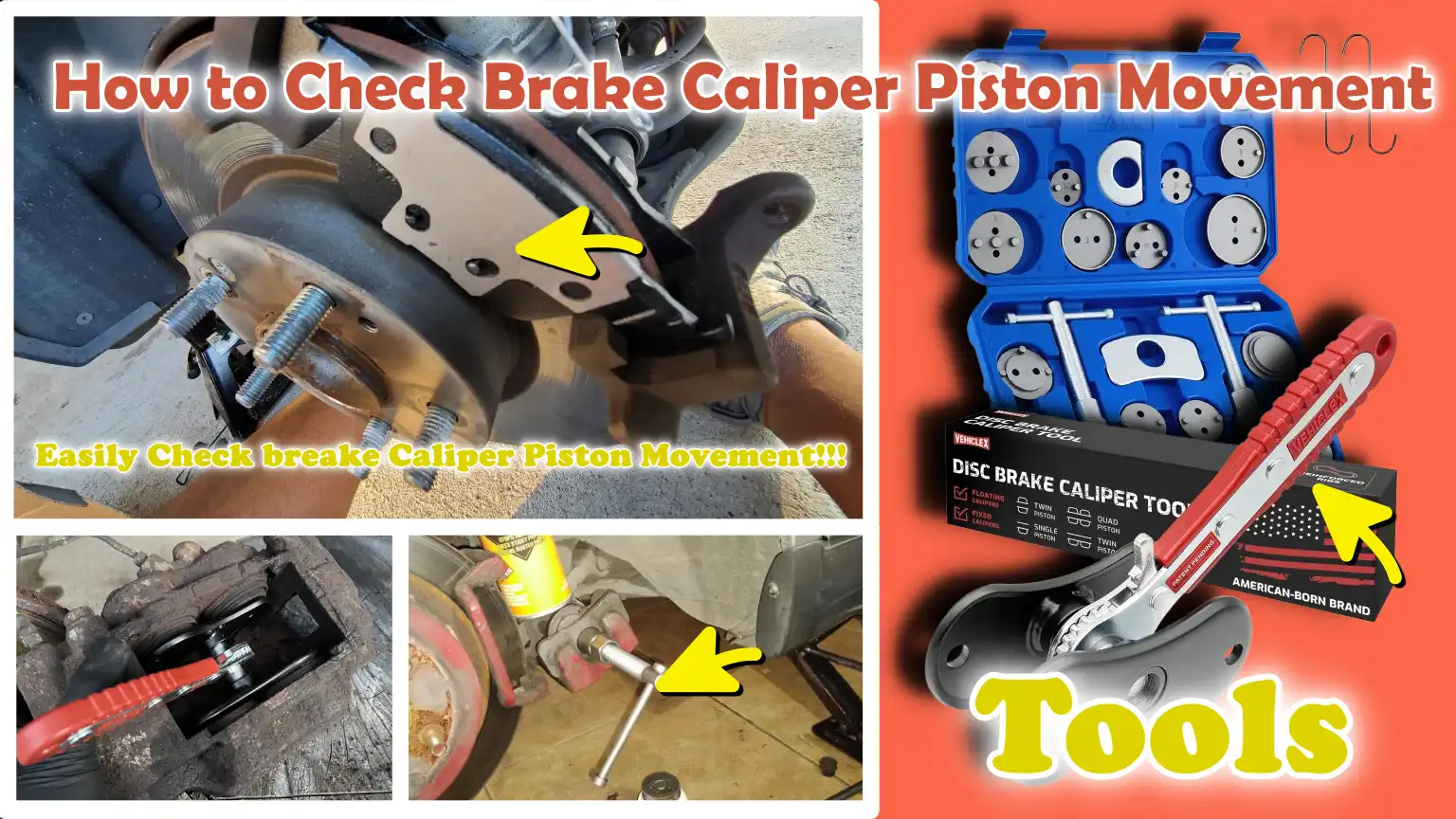
That’s why, we have come up with this guide on How to Check Brake Caliper Piston Movement so that you can identify from the common symptoms, test the piston movement in correct way and understand what normal and faulty behavior actually looks like.
What is a Brake Caliper Piston?
A brake caliper piston is a round metal component situated inside the brake caliper and it plays a direct role in bringing your vehicle to a halt.
It functions as part of a hydraulic system, meaning it utilizes the pressure of brake fluid to generate motion.
When you depress the brake pedal, the master cylinder pumps brake fluid through the brake lines into the caliper.
The pressure from this fluid causes the piston to extend outward.
The piston then transmits this force to the brake pads, initiating the process of slowing down the wheel.
Without this piston, the braking system would be unable to convert the pressure applied to the pedal into the physical force required to stop the vehicle.
1. How It Presses the Brake Pads Against the Rotor
When the piston extends outward due to hydraulic pressure, it presses the inner brake pad directly against the spinning brake rotor.
Simultaneously, the caliper shifts slightly so that the outer brake pad is also pressed against the rotor.
This creates friction on both sides of the rotor, thereby slowing down the wheel’s rotation.
The greater the pressure you apply to the brake pedal, the more force the piston exerts, resulting in increased friction and stopping power.
As soon as you release the brake pedal, the hydraulic pressure subsides and the piston retracts slightly; this disengages the brake pads from the rotor, allowing the wheel to spin freely once again.
2. Why Smooth Piston Movement Is Essential for Braking Performance
Smooth movement of the piston is critical because it ensures that the braking force is applied uniformly, and released properly, every single time.
If the piston moves freely, the brake pads engage and disengage in a controlled manner, providing you with consistent stopping power and better control over the vehicle.
However, if the piston gets stuck, moves sluggishly, or fails to retract properly, it can result in uneven pressure being applied to the pads.
This can lead to issues such as uneven wear, reduced braking efficiency, excessive heat generation and the vehicle pulling to one side.
Over time, a malfunctioning piston can also cause damage to other brake components and increase the vehicle’s stopping distance, factors that have a direct impact on safety.
Why is it Important to Check the Movement of the Brake Caliper Piston?
1. Prevents Uneven Brake Pad Wear
Checking the movement of the brake caliper piston ensures that whenever you apply the brakes, both brake pads exert equal pressure on the rotor.
When the piston moves freely, it creates balanced pressure on both sides, causing the pads to wear down at the same rate.
If the piston sticks or moves unevenly, one pad may remain pressed against the rotor longer or harder than the other, leading to uneven wear.
This not only reduces the lifespan of the brake pads but can also compromise braking balance and cause vibrations while driving.
2. Prevents Brake Drag and Overheating
Proper piston movement ensures that when you lift your foot off the brake pedal, the brake pads fully disengage from the rotor.
If the piston fails to retract properly, the pads may continue to lightly rub against the rotor, generating constant friction.
This condition is known as ‘brake drag’ and results in excessive heat generation.
Over time, this heat can damage the rotors, reduce braking efficiency and lead to ‘brake fade’ (a loss of braking power) under repeated use.
Checking the piston’s movement helps prevent this issue and ensures that the brake system continues to operate at normal temperatures.
3. Ensures Proper Braking Force
The piston is the component responsible for applying the force required to slow the vehicle down; therefore, its movement must be smooth and consistent.
When functioning correctly, the brake system responds instantly and applies uniform pressure whenever you depress the pedal.
If the piston is not functioning correctly, the braking force may become uneven or weak; this can increase the vehicle’s stopping distance and compromise your control over the vehicle.
Regular inspections ensure that the piston is exerting the precise amount of force required for safe and reliable braking.
4. Helps detect early-stage faults in the braking system
Regularly checking the piston’s movement allows you to identify minor issues before they escalate into major malfunctions.
Problems such as dirt accumulation, corrosion, worn-out seals, or degraded brake fluid can gradually impair piston movement, often without displaying any obvious symptoms in the early stages.
By conducting timely inspections, you can detect these issues and rectify them before any serious damage occurs or the brakes fail completely.
This not only enhances safety but also helps reduce repair costs over time.
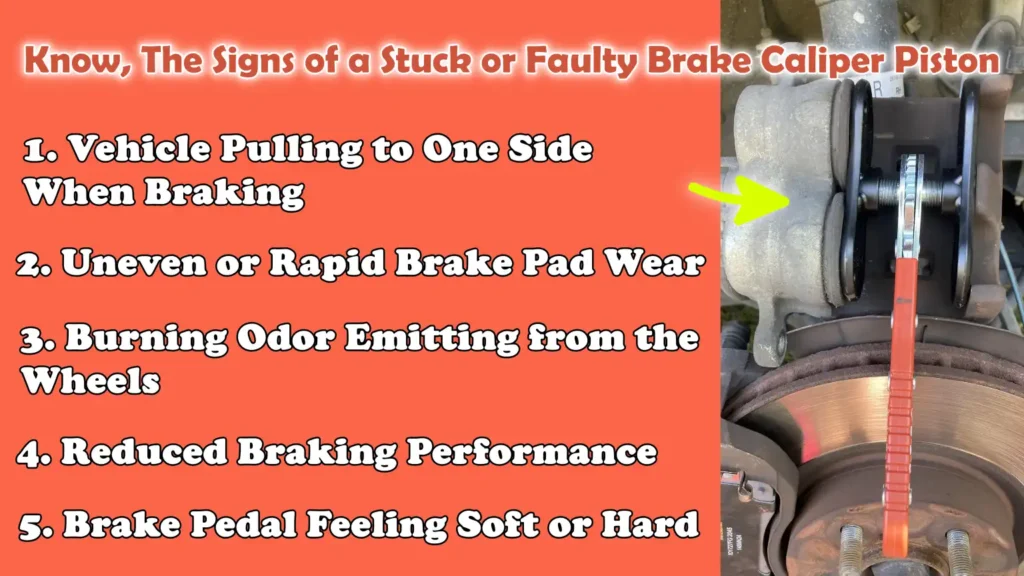
Know, The Signs of a Stuck or Faulty Brake Caliper Piston
1. Vehicle Pulling to One Side When Braking
When a brake caliper piston gets stuck or fails to move properly, it can create an imbalance in braking force between the left and right wheels.
This means that when you press the brake pedal, one wheel may slow down more than the other.
Consequently, the vehicle may pull to one side or veer off course while braking.
This is a clear indication that one caliper is exerting more pressure than the other, often because the piston is either jammed in place or failing to retract correctly.
This condition can compromise vehicle control, particularly during sudden stops or at high speeds.
2. Uneven or Rapid Brake Pad Wear
A properly functioning piston applies equal pressure to both brake pads, ensuring that they wear down uniformly over time.
If a piston is faulty, one pad may remain in contact with the rotor for longer than necessary, while the other fails to make full contact.
This results in uneven brake pad wear, where one side becomes significantly thinner than the other in a much shorter period.
In some cases, the pads may wear out much faster than usual, increasing maintenance costs and, if left unaddressed, potentially compromising the vehicle’s braking capability.
3. Burning Odor Emitting from the Wheels
A stuck piston can keep the brake pad in constant contact with the rotor, even when you are not pressing the brake pedal.
This generates continuous friction, which produces excessive heat.
Over time, this heat can create a distinct burning odor emanating from the wheel area.
This smell is typically caused by overheated brake pads or rotor surfaces.
If left unaddressed, this accumulation of heat can damage brake components and compromise braking efficiency.
4. Reduced Braking Performance
When the piston is unable to move freely, it fails to exert the precise amount of pressure required for effective braking.
This manifests as a decline in braking performance, where the vehicle takes longer to come to a stop or fails to respond with the necessary urgency when the brake pedal is depressed.
In some instances, braking may feel uneven, leading to fluctuations in the vehicle’s deceleration.
This is a critical issue, as it directly impacts stopping distances and overall safety.
5. Brake Pedal Feeling Soft or Hard
A faulty caliper piston can also alter the tactile sensation experienced when depressing the brake pedal.
If the piston is sticking or if there is an issue with pressure buildup, the pedal may feel soft, requiring greater force to bring the vehicle to a halt.
Conversely, if the piston has seized and is completely immobile, the pedal may feel unusually hard, as the system is unable to effectively transmit hydraulic pressure.
Any distinct change in pedal feel serves as a serious warning sign that warrants immediate inspection.
Tools
| Tool/Material | Why It Is Needed | How to Use It Properly |
|---|---|---|
| Jack and Jack Stands | Safely lifting the car is essential so that you can remove the wheel and access the brake caliper. | Use a jack to lift the car at the correct lift points; then, place jack stands under the frame and lower the car onto them. Never work underneath a car that is supported solely by a jack. |
| Lug Wrench | Removing the wheel is necessary to gain access to the brake components. | Before lifting the car, loosen the lug nuts by turning them counter-clockwise; then, once the car is lifted, remove them completely. |
| Socket Set | Helps in easily and safely removing caliper bolts and other fasteners. | Select the correct socket size, attach it to a ratchet and turn carefully to avoid damaging the bolts. |
| C-Clamp or Brake Caliper Tool | Essential for checking whether the piston retracts smoothly, as well as for resetting it during inspection or repair. | Position it over the caliper and tighten it gradually to push the piston inward. Apply steady pressure; if the piston feels stuck, do not force it. |
| Flathead Screwdriver | Useful for gently removing or adjusting brake pads and for checking for minor movement. | Carefully insert it between the components and apply light pressure. Do not apply excessive force to avoid causing damage. |
| Flashlight | Helps you see clearly inside the caliper, allowing you to inspect the condition of the piston, check for leaks, or look for debris. | Direct the light onto the caliper area to check for rust, fluid leaks, or uneven wear. |
| Gloves | Keeps your hands clean and protects them from sharp edges, heat and brake dust. | Keep them worn throughout the entire process to avoid direct contact with brake components and chemicals. |
| Safety Glasses | Protects your eyes from dust, debris and splashes of brake fluid. | Put them on before beginning work and keep them worn throughout the entire inspection process. |
How to Ensure Safety By Taking All The Necessary Precautions Before Starting Work
1. Park on Level Ground
Always begin work only after parking your vehicle on a level and uniform surface, as this ensures that the vehicle remains stable while you are working on it.
On a sloped or uneven surface, the vehicle could suddenly slide or roll, specially if its wheels have been removed.
Even the slightest movement can render the vehicle unstable and unsafe.
A level surface ensures that the vehicle’s weight is distributed evenly, which is crucial for safely lifting the vehicle with a jack and supporting it with stands.
2. Engage the Parking Brake
Engaging the parking brake locks the rear wheels, preventing the vehicle from rolling while you are working on it.
This becomes even more critical when you are lifting one end of the vehicle, as it is essential that the remaining wheels, which are still in contact with the ground, remain firmly anchored in place.
The parking brake provides an additional layer of safety by keeping the vehicle stable; however, you should not rely solely on it to prevent the vehicle from moving.
3. Use Wheel Chocks
Wheel chocks are small blocks placed in front of and behind the wheels that remain in contact with the ground.
They physically prevent the wheels from rolling forward or backward.
This is one of the most effective methods for securing a vehicle, as it does not rely on any mechanical system.
Even if the parking brake fails or its grip loosens, these chocks will still prevent the vehicle from moving.
Using them significantly reduces the risk of accidents while working underneath or around the vehicle.
4. Never Rely Solely on the Jack
A jack is designed to lift a vehicle, not to safely support it for an extended period.
The pressure in a hydraulic jack can decrease over time, or the jack may fail suddenly, causing the vehicle to drop without any warning.
For this reason, it is absolutely essential to always use jack stands after lifting a vehicle.
Once the vehicle has been raised, place the jack stands beneath sturdy support points and slowly lower the vehicle onto them.
This creates a stable and secure setup, making it significantly safer to work on your braking system.
How to Check Brake Caliper Piston Movement – Effective Method
1. Lift the Vehicle and Remove the Wheel
To begin, use the correct lifting points specified by the manufacturer to safely raise the vehicle; these points are typically located near the frame or the pinch weld areas.
Using incorrect points can result in damage to the vehicle or cause it to become unstable.
Once the vehicle is slightly raised, loosen the lug nuts; then, lift the vehicle completely and secure it on jack stands.
Next, fully remove the lug nuts and take off the wheel to expose the brake assembly.
This step provides clear access to the brake caliper, rotor and pads, which is essential for a proper inspection.
2. Inspect the Brake Caliper and Pads
After removing the wheel, carefully inspect the brake caliper and its surrounding components.
Check for any signs of brake fluid leakage around the piston area or the rubber boot, as leaks can lead to a loss of hydraulic pressure and affect piston movement.
Look for rust, dirt accumulation, or any visible damage on the caliper body, as these factors can hinder proper operation.
Additionally, inspect the brake pads to ensure they are wearing evenly.
Uneven pad wear is often a strong indication that the piston is not applying pressure correctly.
3. Check Piston Movement via the Brake Pedal
To observe how the piston extends outward, ask a second person to slowly depress the brake pedal while you closely watch the caliper.
When the pedal is pressed, the piston should extend smoothly outward, pushing the brake pad against the rotor.
The movement should be steady and uniform, neither sudden nor jerky.
This step helps you determine whether the piston is responding correctly to hydraulic pressure and if it is capable of applying the appropriate braking force.
4. Push the Piston Back In
After checking the outward movement, you must verify how effectively the piston retracts to its original position.
Use a C-clamp or a brake caliper tool and carefully position it against the caliper so that it applies pressure directly onto the piston.
Slowly tighten the tool to push the piston back inward.
The piston should retract smoothly and steadily under light pressure.
If it feels extremely difficult to push, gets stuck midway, or refuses to move at all, it may be seized or damaged.
For the brakes to function correctly, the piston’s ability to retract smoothly is just as crucial as its ability to extend outward.
5. Observe the Movement Pattern
Finally, observe the overall pattern of the piston’s extension and retraction.
A properly functioning piston will move in and out smoothly, without any obstructions, sticking, or erratic behavior.
This indicates that the internal seals, surfaces and hydraulic pressure system are operating correctly.
If the movement feels rough or irregular, or appears to bind at any point, it is a clear indication of an internal issue such as: corrosion, dirt accumulation, or internal damage.
Identifying such anomalies early on helps prevent further complications within the brake system, thereby ensuring safe and reliable braking performance.
So, How to Determine if a Brake Caliper Piston is Faulty?
1. The Piston Does Not Move at All
If the brake caliper piston fails to move whatsoever when the brake pedal is depressed, it is a clear indication of a serious internal fault within the caliper.
Typically, the hydraulic pressure generated by the brake fluid should effortlessly push the piston outward.
If there is no movement, it may imply that the piston has seized due to rust, accumulated grime, or an internal mechanical defect.
This could also signal a blockage in the brake line or an issue with the brake fluid pressure.
When the piston remains immobile, the brake pads are unable to exert the necessary pressure on the rotor; this severely compromises braking performance and can render the vehicle unsafe to drive.
2. Moves Unevenly or Gets Stuck Mid-Travel
A properly functioning piston should move smoothly and at a uniform pace; however, if it moves unevenly or gets stuck midway through its travel, it indicates an obstruction within the caliper.
This condition is often caused by rust, a damaged seal, or the accumulation of debris inside the piston bore.
Uneven movement results in uneven pressure being applied to the brake pads, which can cause the vehicle to pull to one side, induce vibrations and lead to uneven wear on the pads.
If left unaddressed, this issue tends to worsen over time as the piston faces increasing resistance in its attempt to move freely.
3. Requires Excessive Force to Retract
When attempting to retract the piston back into the caliper, typically using a tool such as a C-clamp, it should slide back in smoothly and without significant resistance.
If excessive force is required to push it back in, it is a definitive sign that the piston is sticking or has partially seized.
This obstruction may be caused by corrosion on the piston surface, hardening of the seals, or an accumulation of debris inside the caliper.
A piston that is difficult to retract will also fail to release properly during normal driving, potentially leading to issues such as brake drag, excessive heat generation and accelerated wear of brake components.
4. Fluid Leaking Around the Piston Boot
The rubber boot surrounding the piston is designed to keep dirt and moisture out while simultaneously sealing the brake fluid inside.
If you observe fluid leaking around this area, it typically indicates that the internal seal has failed or that the boot itself is compromised.
A brake fluid leak reduces the hydraulic pressure necessary to actuate the piston, thereby directly impacting braking performance.
Furthermore, a leak allows air and contaminants to enter the system, making the piston’s movement less reliable.
This issue must be addressed immediately, as it can lead to further damage and compromise braking safety.
Know, The Common Causes of Poor Piston Movement
Additionally, there’s research that actually confirms that the smooth and even piston movement is literally necessary for proper pressure distribution, which is needed to prevent the uneven wear and overheating problems as well, that’s why it becomes really important to perform regular inspection of piston movement in terms to maintain the safe and consistent braking for longer period of time.[¹]
1. Rust or Corrosion
Rust or corrosion is one of the most common reasons why a brake caliper piston fails to move properly.
The piston is made of metal and is housed inside the caliper, where it is exposed to heat, moisture and road conditions.
Over time, exposure to water, salt and air can cause rust to form on the metal surface, specially if the protective rubber boot has become damaged.
This rust creates a rough surface that increases friction within the caliper bore, making it difficult for the piston to slide freely.
As the rust progresses, the piston may begin to stick, move unevenly, or even seize completely, directly impacting braking performance and safety.
2. Accumulation of Dirt and Debris
If the protective seals have worn out or become damaged, dirt, dust and small particles from the road can infiltrate the caliper assembly.
Brake dust generated by worn pads can also accumulate around the piston.
When this debris builds up inside or around the piston, it creates obstructions and hinders the piston’s smooth movement.
Even a slight accumulation of dirt can impede the piston’s ability to slide in and out.
Over time, this can lead to uneven pressure on the brake pads, accelerated wear and reduced braking efficiency.
To prevent this issue, it is essential to keep the caliper clean and properly sealed.
3. Deterioration of the Piston Seal
The piston seal is a rubber component located inside the caliper that helps maintain hydraulic pressure and facilitates the smooth movement of the piston.
It also assists the piston in retracting slightly back to its original position when the brake pedal is released.
If this seal becomes worn, cracked, or damaged, it hinders the proper movement of the piston.
A faulty seal can lead to brake fluid leaks, a loss of hydraulic pressure, or the ingress of contaminants into the system.
Consequently, the piston may seize, move unevenly, or fail to retract properly, all of which adversely affect braking performance.
4. Old or Contaminated Brake Fluid
Brake fluid plays a crucial role in transmitting hydraulic pressure from the brake pedal to the piston.
Over time, brake fluid absorbs moisture from the air, which diminishes its effectiveness and can lead to corrosion within the internal components of the caliper.
Contaminated fluid may also contain dirt or fine particles that obstruct the smooth movement of the piston.
When the fluid becomes old or degraded, it fails to generate consistent pressure; as a result, the piston responds sluggishly or erratically.
Regularly replacing the brake fluid ensures that the hydraulic system functions correctly and that the piston continues to operate smoothly.
What to Do If the Piston Gets Stuck?
1. Temporary Measures
If the piston is only slightly stuck and not completely seized, you may be able to resolve the issue with some minor cleaning and careful handling.
First, clean the area surrounding the piston to remove dust, brake residue and any visible debris.
Use an appropriate brake cleaner spray, as these products are specifically formulated to remove grime without damaging brake components or leaving behind residue.
While cleaning, ensure that the rubber boot (dust cover) is intact and free of any tears or damage, as it serves to protect the piston from further contamination.
After cleaning, gently actuate the piston by lightly pressing the brake pedal and then use a suitable tool to push the piston back into its housing.
If the issue is merely due to surface dirt or minor buildup, this method may be sufficient to restore proper piston movement.
However, this serves only as a temporary fix and cannot fully resolve deeper internal issues.
2. Permanent Solutions
If the piston remains stuck, does not move freely, or shows signs of visible damage, a permanent repair is essential to ensure safe braking.
One option is to rebuild the brake caliper; this involves extracting the piston, cleaning the internal components and replacing worn-out seals and rubber parts.
Provided that the metal surfaces are in good condition, this process effectively restores both the integrity of the seals and the piston’s range of motion.
However, if there is extensive corrosion, severe damage, or if the piston continues to seize repeatedly, it is generally advisable to replace the entire caliper assembly.
A new or remanufactured caliper comes equipped with properly functioning pistons and seals, ensuring reliable and consistent braking performance.
Choosing a dependable solution is crucial, as a seized piston can quickly lead to issues such as erratic braking, brake overheating and damage to other brake components.
Read More:
- How to Resurface Brake Rotors at Home
- How to Fix Brake Rotor Runout
- How to Check Brake Disc Runout
- How to Prevent Brake Fluid Boiling
- How to Diagnose Brake Fluid Boiling
- How to Fix Brake Pedal Sinking Slowly
- How to Check Brake Pad Wear Sensor
- How to Measure Brake Pad Thickness Without Removing Wheel
- How to Replace Brake Pads
- How to Replace Brake Rotors
- How to Bleed Car Brakes
Effective Tips for Maintaining Smooth Caliper Piston Movement
1. Regular Brake Inspections
Regularly inspecting your brake system allows you to catch minor issues before they escalate into serious problems.
By checking the calipers, piston areas and brake pads at regular intervals, you can identify early warning signs such as uneven wear, dirt accumulation, or slight sticking.
These inspections do not always require disassembling the entire system; often, a simple visual check is sufficient to detect leaks, damaged rubber boots, or corrosion.
Detecting these issues early ensures that the piston continues to move without obstruction and helps avoid costly repairs in the future.
2. Change Brake Fluid on Time
Brake fluid plays a crucial role in the smooth movement of the piston, as it transmits hydraulic pressure from the brake pedal to the caliper.
Over time, brake fluid absorbs moisture from the air, which reduces its effectiveness and can lead to corrosion within the internal components of the caliper.
Old or degraded fluid can also cause piston movement to become sluggish or erratic.
Changing the brake fluid at the recommended intervals keeps the hydraulic system clean, maintains proper pressure and helps protect internal components from corrosion.
3. Use High-Quality Brake Components
Using high-quality brake components such as: calipers, seals and brake pads, ensures that piston operation remains reliable and smooth.
Low-quality parts may wear out prematurely, suffer from compromised sealing, or allow dirt and moisture to infiltrate the system.
High-quality components are designed to withstand heat, pressure and regular use without deteriorating quickly.
This ensures that the piston moves accurately and consistently, thereby reducing the likelihood of it sticking or the brakes functioning unevenly over time.
4. Prevent Brake Overheating
Excessive heat is a primary cause of brake-related issues, including restricted piston movement.
Frequent hard braking, maintaining constant pressure on the brakes while descending slopes, or hauling heavy loads can generate excessive heat within the brake system.
This heat can degrade seals, dry out lubricants and increase the risk of piston seizure.
Driving with controlled precision, utilizing engine braking whenever possible and allowing the brakes to cool down after heavy use can help maintain proper piston function and extend the lifespan of brake components.
When You Should Go to Mechanic
1. Excessive Rust or Damage
If you observe excessive rust, deep pitting, or obvious physical damage on the caliper or piston, it is best to seek professional assistance.
Excessive rust can compromise the internal surface where the piston travels, rendering it rough and unsafe for proper operation.
In such cases, simple cleaning will not resolve the issue, as the damage has penetrated deep into the metal.
A professional mechanic possesses the necessary tools and expertise to accurately determine whether the caliper can be rebuilt or if it requires complete replacement.
Driving with corroded brake components can lead to sudden brake failure and compromise braking safety.
2. Brake Fluid Leaks
A brake fluid leak around the piston or caliper is a serious issue that must not be ignored.
Brake fluid is essential for generating the hydraulic pressure required to actuate the piston; any leak results in a loss of this pressure.
This can lead to reduced braking power, a spongy brake pedal feel, or, in severe cases, complete brake failure.
Leaks are often an indication of damaged seals or worn components that require repair or replacement.
A professional can safely repair the leak, replace defective parts and bleed the brake system to restore it to full operational capacity.
3. Sticking Piston
If the piston fails to move at all when the brake pedal is depressed, it is a clear indication of a major underlying issue within the brake system.
This may be caused by a seized piston, a clogged brake line, or a malfunction within the hydraulic system.
Diagnosing the root cause of such a problem requires specialized tools and technical expertise.
Attempting to repair it without prior experience can lead to further damage or create unsafe conditions.
A trained technician can identify the root cause of the problem and, by performing the correct repairs, ensure that the brakes function properly once again.
4. Any Doubts Arising During Inspection
If you are unsure about what you are observing or how the piston should behave during an inspection, it is always safer to consult a professional.
Brake systems are critical to vehicle safety and even a minor error can have serious consequences.
A mechanic can verify whether the piston’s movement is normal, detect hidden issues and recommend the appropriate solution.
Whenever in doubt, seeking professional assistance ensures that your brake system remains reliable and helps you avoid unnecessary risks while driving.
Conclusion – How to Check Brake Caliper Piston Movement
At last, you have to keep the internal components properly working, as strong and consistent stopping power always starts within.
The piston is the component that translates hydraulic pressure directly into stopping force; therefore, even the slightest irregularity in its movement can significantly impact how your vehicle slows down.
When the piston moves without obstruction, it applies uniform pressure to the brake pads, allows them to disengage properly after braking and helps prevent issues such as uneven wear, overheating and reduced stopping power.
Conversely, a stuck or faulty piston can create hidden problems that gradually worsen over time, often without any obvious warning signs in the early stages.
By understanding the symptoms of a faulty piston, the common causes of restricted movement and the correct inspection procedure, you can identify issues early on and take action before they become severe.
Simple measures such as: regular inspections, keeping the braking system clean and timely brake fluid changes, as it can make a significant difference in maintaining the smooth operation of the piston.
When issues extend beyond basic troubleshooting, opting for proper repairs or component replacements ensures that the braking system continues to function exactly as intended.
Ultimately, consistently good braking performance depends on the proper functioning of every small component each time the brake pedal is depressed.
Paying attention to the movement of the caliper piston not only enhances your control over the vehicle but also helps you avoid costly repair bills and unsafe driving situations.
Now, that’s it from this guide on How to Check Brake Caliper Piston Movement, now you can ask related questions below.
Frequently Asked Questions
FAQ 1: Can I check the movement of the brake caliper piston without removing the caliper?
Answer: Yes, you can check the basic movement of the piston without removing the entire caliper, although this inspection will be limited. You can inspect the caliper by removing the wheel while another person slowly presses the brake pedal. This allows you to observe whether or not the piston is pushing the brake pad outward. However, to properly assess how easily the piston retracts and the degree of resistance it encounters, you may need to inspect it directly or use a tool such as a C-clamp. A comprehensive inspection yields more accurate results, particularly if you suspect that the piston is sticking or that there is an irregularity in its movement.
FAQ 2: How much resistance is normal when pushing the piston back?
Answer: A normal brake caliper piston, when compressed with the correct tool, should retract smoothly and with moderate resistance. You should not need to apply excessive force; conversely, it should not retract too easily without any resistance. The resistance you feel is a result of the hydraulic system and the internal seals functioning correctly. If pushing the piston back proves very difficult, if it feels stuck, or if its movement appears irregular, this typically indicates an internal issue within the caliper such as: rust, accumulated debris, or a faulty seal.
FAQ 3: Can a stuck piston fix itself?
Answer: A stuck piston generally does not fix itself. In some instances, minor resistance caused by slight dirt or debris may resolve to some extent after cleaning and resuming normal brake usage; however, this is neither a reliable nor a guaranteed solution. In most cases, a stuck piston only worsens over time because the underlying cause such as: rust or a faulty seal, goes unaddressed. To prevent further damage to the braking system, it is always best to identify and resolve the issue as quickly as possible.
FAQ 4: How often should I inspect my brake caliper pistons?
Answer: Brake caliper pistons should be inspected during routine brake servicing; typically, this is done when you have your brakes serviced or when replacing your brake pads. For most vehicles, this can be performed every 10,000 to 15,000 miles, depending on driving conditions. If you notice symptoms such as improper braking, strange noises, or the vehicle pulling to one side, you should have your brakes inspected immediately rather than waiting for the next scheduled service. Regular inspections allow for the timely detection of minor issues, preventing them from escalating into major problems later on.
FAQ 5: Is it safe to drive with a stuck caliper piston?
Answer: Driving with a seized caliper piston is unsafe, as it directly compromises braking performance. A stuck piston can lead to uneven braking, increased stopping distances and overheating of brake components. In some instances, it may also cause the vehicle to pull to one side, reducing vehicle control and increasing the risk of an accident. Although this issue may seem minor initially, it can deteriorate rapidly; therefore, it is crucial to have it repaired as soon as possible to ensure safe driving.
References:
[1] Design and analysis of a hydraulic Brake caliper
https://www.researchgate.net/publication/317745400_Design_and_analysis_of_a_hydraulic_Brake_caliper
Hello Folks, Dean Shali here to help you out to solve the problems with your lovely vehicle, as i have lots of experience and knowledge about automotive industry as i woks directly with the customers and repair vehicles and i love to help the people to keep their cars safe and running smoothly.