Written By: Dean Shali
Fact Checked By: Sabré Cook
Reviewed By: Tamara Warren
Even, with the few millimeters of rubber can decide whether you stop in time or slide like there’s no engineering design at all.
Because, whenever you drive, then your entire vehicle actually depends on 4-small contact patches and each about the size of your hands, so it is exactly where your tires actually “MEETS THE ROAD”.
As well as, that thin layer of rubber is actually responsible for gripping dry pavement, channelling water away in the rain and also helps your car to stop in safe way whenever it matters the most.
Plus, there’s studies from the NHTSA and AAA that shows that many drivers underestimate how quickly tire tread wears down and how dangerous low tread can become.
Because, as the tread depth decreases, then your tire’s ability to push water out drops sharply, that increases the risk of hydroplaning and significantly extends stopping distances, specially on the wet roads.
Along with this, there’s more concerning thing is that worn out tires don’t always look obviously unsafe and the warning signs can be subtle until the performance suddenly drops sharply.
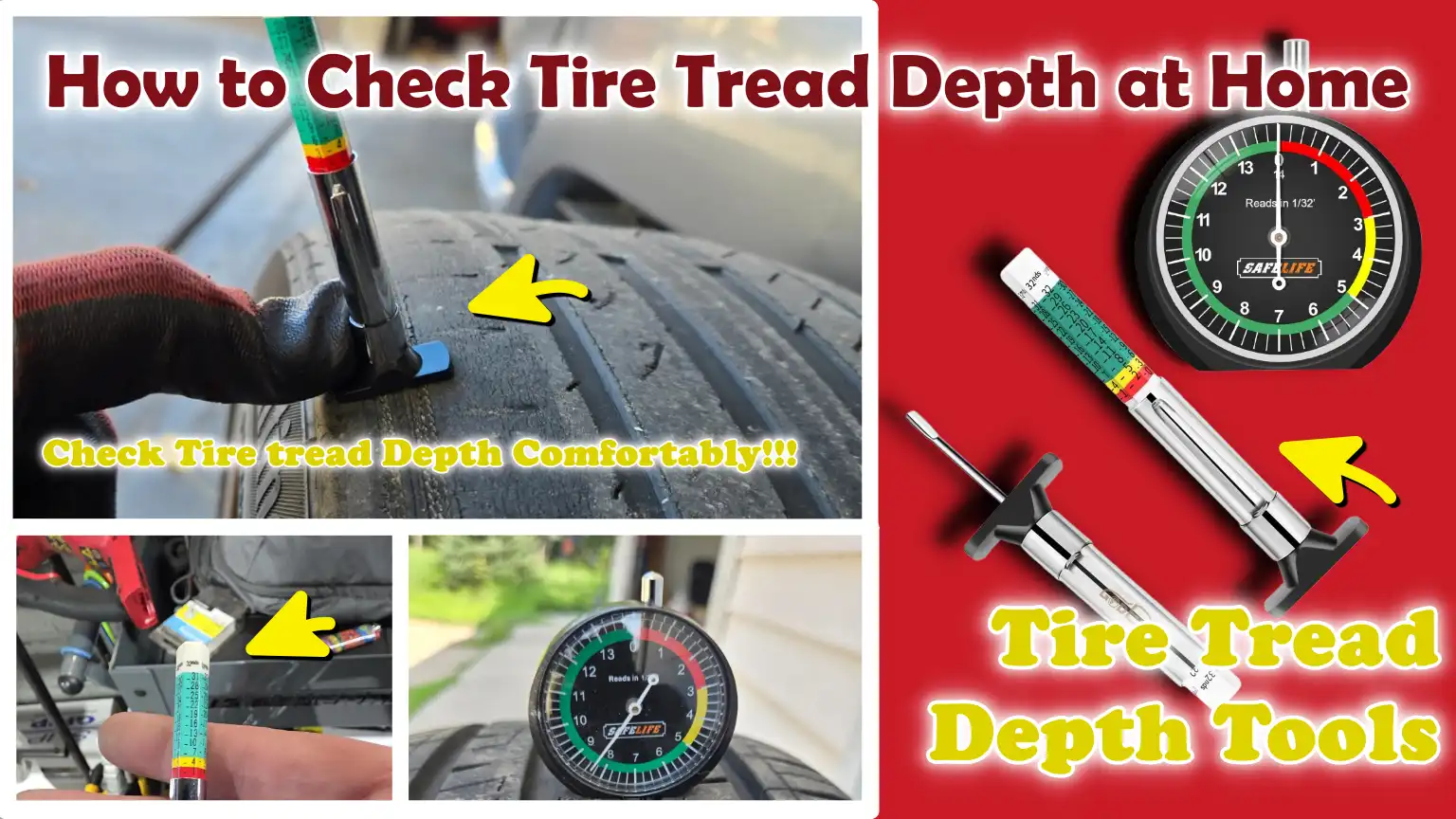
Now, in this guide you’ll learn How to Check Tire Tread Depth at Home so that you can easily spot out early symptoms of worn out tread and how to measure it in correct way.
Know, Why Tire Tread Depth Matters?
1. Impact on Safety – Traction, Braking, Risk of Hydroplaning
Tire tread depth plays a direct role in how safely your vehicle can travel, stop and maintain control on the road.
The tread is the patterned surface of your tire that grips the road and displaces water when the surface is wet.
As tread depth diminishes, the tire loses its ability to maintain proper contact with the road, particularly during rainfall.
This increases the likelihood of hydroplaning, a phenomenon that occurs when a layer of water forms between the tire and the road surface, resulting in a loss of control.
According to road safety data from the National Highway Traffic Safety Administration (NHTSA), reduced tread depth is directly linked to increased braking distances and a higher risk of accidents in wet conditions.
Even during normal driving, worn tread reduces traction (grip) when cornering or braking suddenly; this means the car requires a greater distance to slow down and becomes less stable when navigating turns or reacting to sudden situations.
2. Minimum Legal Tread Depth in the U.S. – 2/32 Inches
In the United States, the minimum legal tread depth for passenger vehicles is 2/32 inches.
This is the threshold at which a tire is legally considered worn out and unsafe for road use.
Many drivers assume that if a tire still falls within the legal limit, it is inherently safe; however, this is not always the case.
Safety experts and organizations such as AAA recommend replacing tires well before they reach this limit, as tire performance degrades significantly as the tread approaches this threshold.
At a depth of 2/32 of an inch, a tire’s ability to displace water becomes severely diminished, making driving on wet roads particularly hazardous.
This legal limit serves primarily as a minimum compliance standard rather than a safety recommendation; therefore, it is crucial to inspect your tires regularly, well before they reach this threshold.
3. How Worn Tread Affects Fuel Efficiency and Handling
Tire tread depth also influences how efficiently your vehicle consumes fuel and how smoothly it performs on the road.
As tires wear unevenly or excessively, they may lose their optimal circular shape, thereby increasing rolling resistance between the tire and the road surface.
Consequently, the engine may have to work slightly harder, which can lead to a decline in fuel efficiency over time.
Vehicle handling is also compromised, as worn treads struggle to maintain consistent grip, particularly during acceleration, braking and cornering.
Drivers may notice that the steering feels less precise or that the vehicle feels less stable at higher speeds.
Simply put, proper tread helps the vehicle operate with ease and control while requiring less effort, whereas worn tread makes driving less predictable and, overall, less efficient.
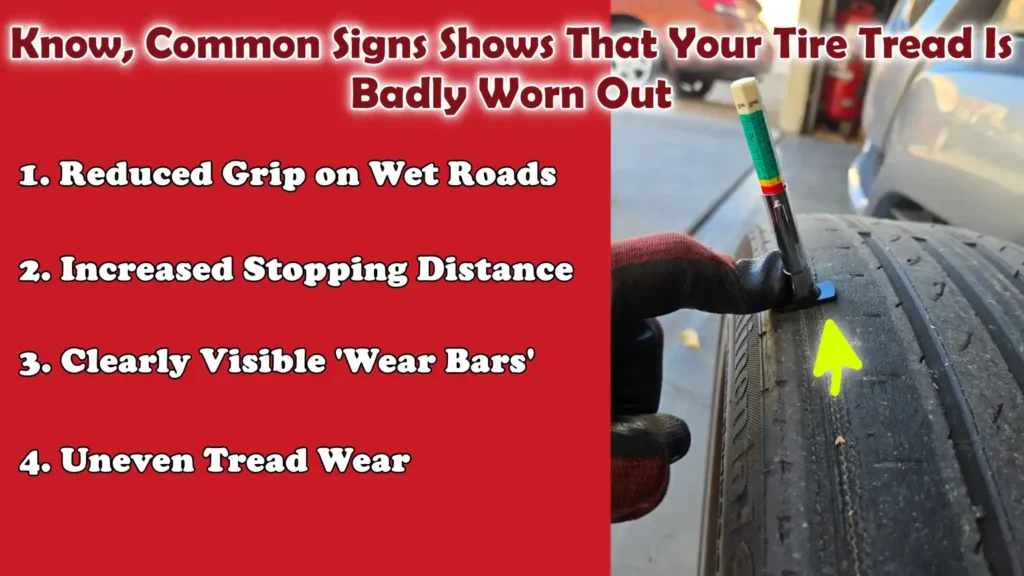
Know, Common Signs Shows That Your Tire Tread Is Badly Worn Out
1. Reduced Grip on Wet Roads
The earliest and most noticeable sign of diminishing tire tread is a reduction in grip, particularly when the road is wet.
The tread on quality tires is designed to channel water away from the contact patch, ensuring the rubber remains in direct contact with the road surface.
As the tread becomes shallower, this water-displacement capability weakens and the vehicle may feel less stable, even during light rain.
Drivers often describe this sensation as a slight slipping or sliding feeling while accelerating or negotiating turns.
Research by the National Highway Traffic Safety Administration (NHTSA) indicates that worn tread significantly increases the risk of losing traction on wet surfaces; this is why even light rain can prove hazardous when tires are worn.
2. Increased Stopping Distance
Another critical warning sign is a noticeable increase in stopping distance.
As tread depth decreases, the tire becomes less effective at gripping the road surface during braking.
This means the vehicle requires a greater distance to come to a complete stop, specially at high speeds or in emergency situations.
Many drivers fail to perceive this change because it occurs gradually over time.
Even a minor difference of 1/32 of an inch in tread depth can have a substantial impact on braking performance.
Safety data from the AAA reveals that worn tires can significantly extend stopping distances on both wet and dry roads, a critical factor in avoiding collisions.
3. Clearly Visible ‘Wear Bars’
Most modern tires feature built-in indicators known as ‘Wear Bars’; These are small, raised marks located within the grooves of the tire tread.
As the tire wears down, these bars become increasingly visible.
When the tread surface becomes flush with these bars, it indicates that the tire has reached its legal wear limit and must be replaced.
These indicators are designed to provide drivers with a simple visual warning that can be detected without the need for any tools.
However, many people overlook them because they are not always clearly visible unless the tire grooves are examined very closely.
When wear bars become clearly visible across multiple sections of the tire, it is a definitive sign that the tread is no longer safe for normal driving conditions.
4. Uneven Tread Wear
Uneven tread wear is another major indicator that your tires may be in poor condition.
Instead of wearing down uniformly across the entire surface of the tire, certain sections may wear out faster than others.
This can be caused by incorrect tire inflation pressure, poor wheel alignment, or an issue with the suspension system.
For instance, if the inner or outer edge of the tire is more worn than the central section, it often signals an alignment issue.
Conversely, if the central section is more worn than the edges, it may indicate that the tire is overinflated.
Uneven tread wear not only reduces the lifespan of the tire but also compromises its ability to maintain traction on the road; this results in unstable handling while driving and a reduced level of vehicle control.
Tools
| Tools | How to Use It | Why It Is Needed |
|---|---|---|
| Penny Test – Most Popular Method | Insert a penny into a tire’s tread groove with the “head” facing downward. If you can see the top of Abraham Lincoln’s head, it means the tread is significantly worn and the tire is likely no longer safe. Check multiple spots on all tires to ensure an accurate assessment. | This is the quickest and easiest way to perform a basic safety check without any tools. It helps drivers quickly identify tires that are excessively worn before they become dangerous on wet roads. |
| Quarter Test – More Conservative Check | Insert a quarter into a tread groove with the “head” facing downward. If the top of the head is visible, it indicates that the tread is thinning and the tire should be replaced soon. | This check offers a higher level of safety and provides an earlier warning compared to the penny test. It helps you detect tire wear in advance, particularly before driving in rainy conditions or embarking on long trips where tire grip is critical. |
| Tread Depth Gauge – Most Accurate Tool | Insert the gauge’s small probe directly into a tread groove. Press the base of the gauge firmly and flatly against the tire’s surface, then read the measurement displayed on the gauge in 32nds of an inch. Check multiple spots on each tire. | This method provides a precise and reliable measurement, eliminating the need for guesswork. It is the best option for making accurate safety-related decisions and for comparing tread wear across all four tires. |
| Ruler or Tape Measure – Alternative Option | Insert a ruler vertically into a tread groove and measure the distance from the base of the groove to the top of the tread. Ensure that the ruler remains perfectly vertical to obtain an accurate measurement. | This is a simple alternative method that can be used when you do not have a coin or gauge available. It helps you estimate the depth of the tread, although it is not as accurate as a dedicated gauge. |
How to Check Tire Tread Depth at Home – Great & Working Methods
1. How to Check Tire Tread Depth By Using the Penny Test
Insert a penny into a tread groove
The Penny Test begins by taking a standard coin and inserting it into one of the main grooves of the tire tread.
Rather than resting the coin on the raised rubber surface, you should push it directly down into the rubber channels, where the tread is deepest.
It is essential to perform this test at several different spots on the tire, as tread wear is often uneven and checking only one location may yield an inaccurate result.
Position Abraham Lincoln’s head upside down
Once the penny has been inserted, orient it so that Abraham Lincoln’s head is facing downward into the tread groove.
This specific orientation is used because it provides a clear visual marker for measuring the depth of the remaining tread.
To ensure an accurate comparison between the tire’s surface and the coin, the coin should remain firmly in place without shifting.
Check if the top of the head is visible
After positioning the penny correctly, carefully observe how much of Lincoln’s head is visible.
If the very top of his head is fully visible above the tread, it indicates that the rubber has worn down significantly.
If only a portion of his head is visible, the tread is moderately worn.
If the majority of his head is obscured by the rubber, the tire still retains a safe level of tread depth.
Interpret the results
The final step is to understand what these results signify in terms of safety.
If Lincoln’s head is clearly visible, it suggests that the tire is likely approaching unsafe tread levels and should be replaced in the near future.
If the head is partially covered, the tire is still usable, though it should be monitored regularly.
If the head is completely covered by the tread, the tire is generally in an acceptable condition for normal driving.
This simple method helps drivers quickly assess the safety of their tires without the need for any specialized tools or technical expertise.
2. How to Check Tire Tread Depth By Using the Quarter Test
Insert the Quarter into the Tread
The Quarter Test is a simple at-home method used to check whether your tire tread remains within a safe range before wearing down to the legal limit.
To begin, take a quarter coin and insert it vertically into the deepest tread groove on your tire.
Ensure that the coin goes straight into the groove, not at an angle, as a tilted position can result in an inaccurate reading.
It is also essential to repeat this test on different sections of the tire, as tread wear is often not uniform across the entire surface.
Observe George Washington’s Head
Once the quarter is properly positioned, orient it so that George Washington’s head is facing downward, into the tread.
This visual reference is used because it provides a consistent standard for measuring the depth of the remaining tread.
After inserting the coin, carefully observe how much of Washington’s head is visible above the rubber surface.
If the top of his head is clearly visible, it indicates that the tread is becoming shallow and may no longer be safe for certain driving conditions, particularly on wet roads.
If only a small portion of his head is visible, the tire is still in reasonably good condition, though it should be monitored closely.
Analyze the Safety Implications of the Tread Depth
The final step is to understand what this result signifies from a safety perspective.
The Quarter Test is considered a more precautionary measure compared to the Penny Test, as it provides a warning signal regarding potential risks before the tire tread actually reaches its legal wear limit.
If Washington’s head is visible, it indicates that the tire’s grip has diminished, particularly in rainy conditions, where its ability to displace water becomes less effective.
Conversely, if his head remains largely obscured by the tread, the tire still retains a sufficient safety margin for continued use and can generally handle normal driving conditions.
This method helps drivers detect wear early and make more informed decisions regarding tire replacement before performance and safety are seriously compromised.
3. How to Check Tire Tread Depth By Using a Tread Depth Gauge
Insert the Probe Into the Tread Groove
A tread depth gauge is a small, precision instrument specifically designed to measure how much usable rubber remains on your tires.
To begin, take the gauge’s thin metal or plastic probe and insert it directly into one of the tire’s main tread grooves.
It is essential to insert it deep enough to reach the very bottom of the groove, as this represents the lowest point of the tread where wear is measured.
You should repeat this step in various sections of the tire, as tread wear can vary from one spot to another due to alignment or air pressure issues.
Press the Base of the Gauge Flat Against the Tire
After inserting the probe, gently press the flat base of the gauge downward so that it sits evenly against the surface of the tire.
This step is crucial because it ensures that the tool is stable and properly aligned, thereby helping to prevent inaccurate readings.
If the base is tilted or does not sit completely flat, the measurement may be slightly incorrect.
Keeping the gauge steady allows you to accurately measure the depth of the tread relative to the tire’s surface.
Read the Measurement in 32nds of an Inch
Once the gauge is properly seated, read the measurement displayed on the scale, which is typically marked in 32nds of an inch.
This number tells you exactly how much tread depth remains on the tire.
New tires typically feature deep tread and as the tire wears down, this number decreases.
When the reading approaches 2/32nds of an inch, it indicates that the tire has reached the legal minimum limit in the United States and should be replaced.
This is the most accurate method for checking tread depth, as it eliminates guesswork and provides a clear, numerical value that helps you make a safe and informed decision regarding your tires.
Understand, What Should Be the Minimum Safe Depth of a Tire’s Tread?
2/32 Inches – Legal Limit
In the United States, the minimum legal tread depth for tires is 2/32 inches; this is the point at which a tire is legally considered worn out.
At this level, the grooves in the tire become very shallow, significantly reducing the tire’s ability to displace water from the road surface.
This increases the risk of hydroplaning (skidding on water) and loss of control, particularly in rainy weather.
Although this is the legal limit established by road safety regulations from agencies such as the National Highway Traffic Safety Administration, it is crucial to understand that this does not imply the tire remains safe for use.
At 2/32 inches, braking effectiveness is significantly diminished and tire traction becomes unreliable; for this reason, this level is regarded as an “absolute minimum” threshold rather than a safe target.
4/32 Inches – Recommended for Wet Conditions
A tread depth of 4/32 inches is considered a safe threshold for everyday driving, particularly in wet conditions.
At this level, the tire retains sufficient groove depth to displace water more effectively, thereby helping to maintain better contact with the road surface.
This results in improved braking performance and a reduced likelihood of skidding on wet roads.
Safety organizations such as the AAA advise paying close attention to tire condition once tread depth reaches this level, as tire performance begins to deteriorate more noticeably in adverse weather.
Although the tire remains usable at this stage, it is approaching a point where plans should be made to replace it in the near future to ensure the maintenance of safe driving performance.
6/32 Inches – Ideal for Better Performance in Snowfall
A tread depth of 6/32 inches is considered ideal for superior performance in snowy and wintry driving conditions.
At this level, the deep grooves assist the tire in establishing a better grip on snow and slush, thereby ensuring enhanced traction and stability.
This is particularly crucial in regions with cold climates, where road surfaces can become slippery due to snow or frost.
This additional tread depth enables the tire to maintain better control during winter conditions, specifically while accelerating, braking and cornering.
As the tread depth falls below this threshold, the tire’s winter performance begins to deteriorate; this makes it increasingly difficult for the tire to maintain its grip on low-traction surfaces.
For this reason, many safety experts advise that anyone planning to drive regularly during the winter season should consider replacing their tires before the tread depth drops below this specific limit.
How to Check for Uneven Tire Wear?
1. Inner vs Outer Tread Wear
Uneven wear on the inner or outer edges of a tire often points to alignment issues.
When a vehicle’s wheels are not properly aligned, one part of the tire makes greater contact with the road surface than another, causing it to wear down more rapidly.
For instance, if the inner edge appears more worn, it may indicate that the wheels are angled inward; conversely, excessive wear on the outer edge could signal the opposite situation.
This type of wear affects vehicle stability because the tire’s “contact patch” (the area in contact with the road) is no longer balanced, which can negatively impact steering precision and overall vehicle control.
Regularly inspecting both edges allows for the early detection of alignment problems, before they cause significant damage to the tires or render driving conditions unsafe.
2. Center Wear – Overinflation
When the center section of a tire’s tread is more worn than its edges, it typically indicates that the tire is overinflated.
Excessive air pressure causes the center of the tire to bulge slightly outward; consequently, while driving, the majority of the vehicle’s weight rests upon this central section.
As a result, the center wears down much faster than the edges.
Overinflation also diminishes the tire’s ability to effectively absorb road shocks, potentially resulting in a harsher ride and reduced traction on uneven surfaces.
Over time, this type of wear reduces the tire’s lifespan and can compromise vehicle stability during braking and cornering, particularly at high speeds.
3. Edge Wear – Underinflation
Edge wear occurs when both edges of the tire tread wear down faster than the central section; this is typically an indication of underinflation (insufficient air pressure) in the tire.
When the internal air pressure is inadequate, a larger portion of the vehicle’s load is borne by the outer edges, causing them to wear out more rapidly.
Underinflated tires also generate increased “rolling resistance,” which can compromise fuel efficiency and lead to a buildup of heat within the tire.
This condition is particularly hazardous because excessive heat can, over time, weaken the structural integrity of the tire.
Regularly checking tire pressure helps prevent this type of wear and ensures that the tire maintains balanced and secure contact with the road surface.
4. Cupping or Scalping Issues
Cupping, also known as scalping, is an uneven tire wear pattern characterized by small depressions or a wave-like texture on the tire’s surface.
This issue is often caused by worn suspension components, unbalanced tires, or irregularities in the way the tire makes contact with the road while the vehicle is in motion.
Unlike the uniform wear typically observed on the edges or center of a tire, cupping creates a rough surface texture, which can result in vibrations or noise while driving.
It also diminishes the tire’s smooth contact with the road, negatively impacting both driving comfort and vehicle stability.
If cupping begins to appear, it often serves as a warning sign of a serious underlying mechanical issue, one that requires a far more thorough inspection than simply replacing or rotating the tires.
Understand, How Often Should You Check Your Tire Tread Depth?
1. Monthly Checks
Making it a habit to check your tire tread depth once a month is the easiest way to significantly enhance road safety.
Over time, tires naturally wear down, even during normal driving, and this wear is not always easy to detect with the naked eye alone.
Conducting a monthly check allows you to identify early signs of diminishing tread before they become hazardous; this is particularly important because tires can wear unevenly, even if there are no obvious external symptoms.
Regular checks also keep you informed about gradual changes in your tires’ condition, such as reduced traction or subtle shifts in handling.
Organizations like the National Highway Traffic Safety Administration (NHTSA) consider regular tire checks an essential component of basic vehicle safety, as early detection can prevent many avoidable tire-related accidents.
2. Before Long Trips
Checking your tire tread depth before any long journey is crucial, as extended periods of driving place increased stress on the tires.
Long-distance travel typically involves higher speeds, continuous contact with the road surface and varying road conditions, all of which demand good traction and stable handling.
If the tread depth is already low, these conditions can heighten the risk of skidding, particularly in rainy weather or on rough roads.
A quick check prior to your trip helps ensure that all four tires are in a safe condition, thereby reducing the likelihood of a tire failure or loss of control while you are far from home or repair services.
This simple step not only enhances safety but also provides you with peace of mind throughout your entire journey.
3. During Seasonal Transitions
It is crucial to check your tire tread depth during seasonal transitions, as road conditions can vary significantly throughout the year.
For instance, in wet and rainy weather, effective water evacuation from the tire surface is essential, whereas cold weather necessitates strong traction on slippery roads.
As the tread wears down, its ability to handle these diverse conditions diminishes.
Conducting checks aligned with the changing seasons allows you to prepare your vehicle for upcoming seasonal challenges and ensures that your tires still retain sufficient tread depth for safe operation.
Safety guidelines from organizations such as the AAA emphasize that seasonal tire inspections, particularly before driving in heavy rain or winter conditions, are vital, as traction becomes even more critical during such times.
Know, When to Replace Your Tires?
Also, there’s academic research in transportation engineering that shows that tire tread depth actually plays a major role in hydroplaning risk, as tread becomes shallow, then the grooves literally loses their ability to efficiently channel the water away from the tire surface, so that’s how it creates a thin water layer between the tire and the road that further reduces the direct contact and increases the chance of skidding. So, this study confirms that the tread depth is one of the most important factors that controls the wet-road safety with the speed and water depth as well.[¹]
1. When the Tread Reaches 2/32 Inches
Tires should be replaced immediately as soon as the tread depth reaches 2/32 inches; this is the legally mandated minimum limit in the United States.
At this stage, the grooves in the tire have worn down almost completely, meaning the tire is no longer capable of effectively displacing water from the road surface.
This significantly increases the risk of hydroplaning (skidding on water), particularly during rain, and reduces braking effectiveness on both wet and dry roads.
According to safety guidelines from the National Highway Traffic Safety Administration, tires worn to this extent are considered unsafe for continued use, as they have lost a significant portion of their traction and stability.
Although this constitutes the legal limit, most experts recommend replacing tires before they reach this threshold to ensure safe driving.
2. In the Presence of Visible Cracks, Bulges, or Damage
Tires should also be replaced whenever you observe any visible damage such as: cracks in the rubber, bulges on the sidewall, or cuts in the tread area.
Cracks often appear when the rubber begins to dry out or age; over time, this compromises the tire’s structural integrity.
Bulges are even more serious, as they may indicate internal damage; these are often caused by hitting potholes or curbs, which damages the tire’s inner layers.
If a bulge is present, the risk of sudden tire failure or a blowout increases significantly.
Any visible damage impairs the tire’s ability to maintain proper air pressure and maintain safe contact with the road; therefore, replacing the tire becomes imperative to avoid hazardous driving situations.
3. Age-Related Deterioration – 6+ Year Guideline
Even if a tire still looks good visually and possesses adequate tread depth, it may nonetheless be unsafe due to its age.
Most tire manufacturers and safety organizations recommend replacing tires that are approximately six years old, regardless of whether they have seen heavy use or very little use.
Over time, rubber naturally hardens and loses its elasticity; this diminishes its grip and increases the risk of cracks and structural weakness.
Environmental factors such as: heat, sunlight and prolonged periods of disuse, as it can further accelerate this aging process.
Safety experts, including the AAA, suggest that tires older than six years should be carefully inspected and replaced periodically to ensure they continue to deliver reliable performance.
This guideline helps prevent sudden tire failure caused by aging, rather than merely by obvious physical wear and tear.
Read More:
- How to Bleed ABS System Properly
- How to Replace Rusted Brake Lines
- How to Inspect Brake Lines for Rust
- How to Flush Contaminated Brake Fluid
- How to Check Brake Fluid Contamination Level
- How to Fix Brake Bias Issues
- How to Test Brake Proportioning Valve
- How to Replace a Brake Light Switch
- How to Diagnose Brake Light Switch Failure
- How to Fix Intermittent ABS Activation
- How to Clean ABS Wheel Speed Sensor
- How to Diagnose ABS Sensor Wiring Issues
- How to Test Electronic Brake Module (EBCM)
- How to Fix Parking Brake Dragging
- How to Adjust Parking Brake Cable
- How to Check Parking Brake Cable Tension
- How to Fix Brakes Dragging While Driving
- How to Diagnose Brake Dragging Issue
- How to Fix Internal Master Cylinder Leak
Know, Common Mistakes On Checking Tire Tread Depth to Avoid Them
1. Checking Only One Tire
One of the most common mistakes drivers make is checking the tread depth of only a single tire and assuming that all the other tires are in the same condition.
In reality, every tire wears differently; this depends on its position on the vehicle, driving habits, road conditions and alignment settings.
For instance, in front-wheel-drive vehicles, the front tires often wear out faster because they have to handle both steering and power delivery.
If you check only one tire, you might overlook dangerously worn tires located elsewhere on the vehicle, an oversight that can jeopardize braking balance, stability and overall safety.
2. Neglecting the Inner Tread
Another serious mistake is overlooking the inner section of the tire tread.
Checking the inner edge of a tire is often difficult unless you turn the steering wheel or view it from the correct angle; consequently, many drivers neglect it entirely.
However, wear on the inner tread can be an early indicator of alignment or suspension-related issues.
Even if the outer tread appears to be in good condition, the inner section may have already worn down to an unsafe level.
This hidden wear can lead to a sudden loss of grip, particularly during emergency braking or while taking sharp turns, making it crucial to inspect both the inner and outer edges of the tire.
3. Failing to Take Measurements at Multiple Points
A tire’s tread does not wear uniformly across its entire surface; therefore, taking a measurement at only a single spot can give you a false sense of security.
Due to factors such as road conditions, the stress exerted during turns and fluctuations in tire pressure, the level of wear can vary significantly across different sections of a tire.
If you do not take measurements at multiple points around the tire, you run the risk of overlooking areas that have already worn down to an unsafe level.
Taking measurements at various locations provides a more accurate assessment of the tire’s true condition and helps ensure that no uneven wear is occurring.
4. Relying Solely on Visual Inspection
Many drivers rely exclusively on the visual appearance of their tires; however, a visual inspection alone is insufficient to guarantee safety.
Even if tires appear to be in good condition at first glance, they may lack sufficient tread depth or harbor internal wear that is not easily visible.
Tread wear can occur in a manner that appears normal to the eye, yet has actually reached, or is very close to reaching, legal or unsafe limits.
Organizations such as the National Highway Traffic Safety Administration emphasize the critical importance of taking precise measurements, as visual inspections alone can be misleading.
Rather than relying solely on a visual check, using a simple tool or a coin to conduct an inspection yields more reliable and accurate information.
Know, The Pro Tips for Extending Tire Lifespan
1. Rotate Your Tires Regularly
Tire rotation involves periodically swapping the positions of the tires on your vehicle at regular intervals to ensure that all four tires wear down evenly over time.
This is crucial because different tires on a car are subjected to varying amounts of stress.
For instance, front tires often wear out faster due to steering and braking, specially in front-wheel-drive vehicles.
When tires are rotated, the wear is distributed more uniformly, allowing each tire to last longer and maintain its grip.
Most safety and maintenance guidelines from organizations like the National Highway Traffic Safety Administration recommend regular rotation to enhance both tire longevity and driving stability.
2. Maintain Proper Tire Air Pressure
Maintaining the correct air pressure in your tires is one of the most effective ways to extend their lifespan.
When tires are underinflated, their edges wear out faster and excessive heat builds up within the tire, which can weaken its structural integrity over time.
Conversely, when tires are overinflated, the center section wears out faster and the tire loses its ability to effectively absorb road shocks.
Proper tire inflation ensures that the tire maintains uniform contact with the road surface, thereby improving both safety and durability.
Regularly checking tire pressure also contributes to fuel efficiency and reduces unnecessary stress on the tire tread.
3. Get Your Wheels Aligned and Balanced
Wheel alignment and balancing play a pivotal role in how evenly your tires wear.
If the wheels are not properly aligned, the tires may tilt slightly inward or outward, resulting in uneven wear on one side of the tire.
This can shorten the lifespan of your tires and also compromise your control over the steering.
Wheel balancing ensures that the weight of the entire tire and wheel assembly is distributed evenly, thereby preventing vibrations in the vehicle at high speeds.
Poor alignment or imbalance not only causes premature tire wear but also makes driving less comfortable and less stable.
Regular alignment checks ensure that all tires maintain proper contact with the road surface, thereby maximizing their lifespan.
4. Avoid Aggressive Driving Habits
Your driving style has a direct impact on how long your tires will last.
Sudden acceleration, hard braking and taking sharp turns, all of these actions generate excessive friction and heat within the tires, causing the tire tread to wear down rapidly.
Over time, these habits can significantly reduce the lifespan of your tires and negatively affect the vehicle’s overall performance.
Driving smoothly and with control ensures even tire wear and reduces the structural stress placed on the tires.
A consistent driving style also enhances safety by maintaining good tire grip and stability.
By avoiding aggressive driving, you not only extend the life of your tires but also improve fuel efficiency and maintain better overall control over your vehicle.
Conclusion – How to Check Tire Tread Depth at Home
So, now you have clearly understand that, tire tread is not a small thing to avoid, as it quietly controls how safely every journey begins and ends.
Tires serve as the sole point of contact between your vehicle and the road, meaning that even a slight variation in tread depth can profoundly affect vehicle control, particularly during rainy weather or in sudden braking situations.
When tread depth becomes critically low, the tire loses its ability to effectively displace water, thereby increasing the risk of hydroplaning and extending stopping distances.
This is why conducting regular inspections, using simple methods such as the penny test, the quarter test, or a tread depth gauge, is absolutely essential, as these tools enable you to identify signs of wear and tear before a hazardous situation arises.
Furthermore, tire safety entails more than just a one-time measurement of tread depth; it requires cultivating a habit of regular inspection.
Checking your tires once a month, prior to long-distance trips and whenever weather conditions change helps you identify early warning signs of uneven wear, underinflation, or physical damage.
These brief, routine checks can effectively prevent major issues such as tire blowouts, handling difficulties and sudden tire failure.
Now, you can still ask some related queries below.
Frequently Asked Questions
FAQ 1: How can I check my tire tread depth at home without any tools?
Answer: You can easily check your tire tread depth at home using a simple coin test. The most common method is the “Penny Test,” in which you insert a coin into the grooves of the tire tread and observe how much of the coin remains visible. If the tread covers a portion of the coin, the tire still retains a usable amount of depth; however, if most of the coin remains visible, it indicates that the tread has worn down significantly. Another similar method is the “Quarter Test,” which provides an earlier warning that the tire is approaching the limit of excessive wear. While these methods may not be as precise as using a dedicated gauge, they prove quite useful for performing a quick safety check when specialized tools are not available.
FAQ 2: What tire tread depth is considered unsafe?
Answer: Generally, a tire is considered unsafe once its tread depth reaches 2/32 of an inch. At this stage, the grooves become so shallow that they can no longer effectively channel water away from the tire’s surface, thereby increasing the risk of hydroplaning on wet roads. Although this is the legally mandated minimum limit in the U.S., many safety experts recommend replacing tires before they reach this threshold, as tire performance diminishes significantly as the tread wears down. Reduced tread depth can result in longer braking distances and compromised traction in emergency situations, making driving considerably more hazardous.
FAQ 3: How often should I check my tire tread depth?
Answer: It is advisable to check your tire tread depth at least once a month to ensure that your tires remain in a safe condition. You should always inspect your tires before embarking on a long journey, as highway driving places greater stress on the tires and demands superior traction. It is also crucial to inspect your tires during seasonal transitions, as rain, snow, or extreme heat can significantly impact their performance. Regular inspections allow you to identify signs of uneven wear or diminishing tread depth early on, thereby enhancing safety and extending the lifespan of your tires.
FAQ 4: Can tire tread wear affect fuel efficiency?
Answer: Yes, worn or uneven tire tread can indeed impact fuel efficiency. When a tire’s proper tread pattern degrades or wears unevenly, its rolling resistance, the resistance faced against the road surface, increases. This means the engine has to work harder to propel the vehicle forward, which can lead to increased fuel consumption over time. Properly maintained tires, featuring intact tread patterns (the design on the tire’s surface), minimize rolling resistance (the force required to rotate the tire). This allows the vehicle to move more smoothly and efficiently, resulting in overall improved fuel efficiency.
FAQ 5: Why do tires often not wear evenly?
Answer: Tires often do not wear evenly due to a variety of factors, such as incorrect tire pressure, wheel alignment issues, or suspension problems. If a tire is overinflated, its center section will wear out faster; conversely, if it is underinflated, the edges will wear down more rapidly. Improper alignment can cause one specific section of a tire to wear down much faster than the rest. Driving style also plays a significant role in this regard, as hard braking and sharp turns increase wear on specific sections of the tires. Uneven tire wear reduces their lifespan and can also lead to handling difficulties; therefore, it is crucial to regularly inspect all parts of the tires.
FAQ 6: How long do tires typically last before needing replacement?
Answer: Most tires last for five to six years, depending on driving conditions, maintenance and usage patterns. However, some tires may deteriorate prematurely if driven on rough roads, improperly maintained, or used in extreme weather conditions. Even if the tread depth (the thickness of the tire’s surface) appears adequate, tires can still become unsafe over time due to the aging of the rubber and a loss of elasticity. For this reason, experts advise against relying solely on tread depth when deciding whether to replace tires; instead, the age of the tires should also be taken into consideration.
References:
[1] Analytical Modeling of Effects of Rib Tires on Hydroplaning
https://www.researchgate.net/publication/245562592_Analytical_Modeling_of_Effects_of_Rib_Tires_on_Hydroplaning
Hello Folks, Dean Shali here to help you out to solve the problems with your lovely vehicle, as i have lots of experience and knowledge about automotive industry as i woks directly with the customers and repair vehicles and i love to help the people to keep their cars safe and running smoothly.