
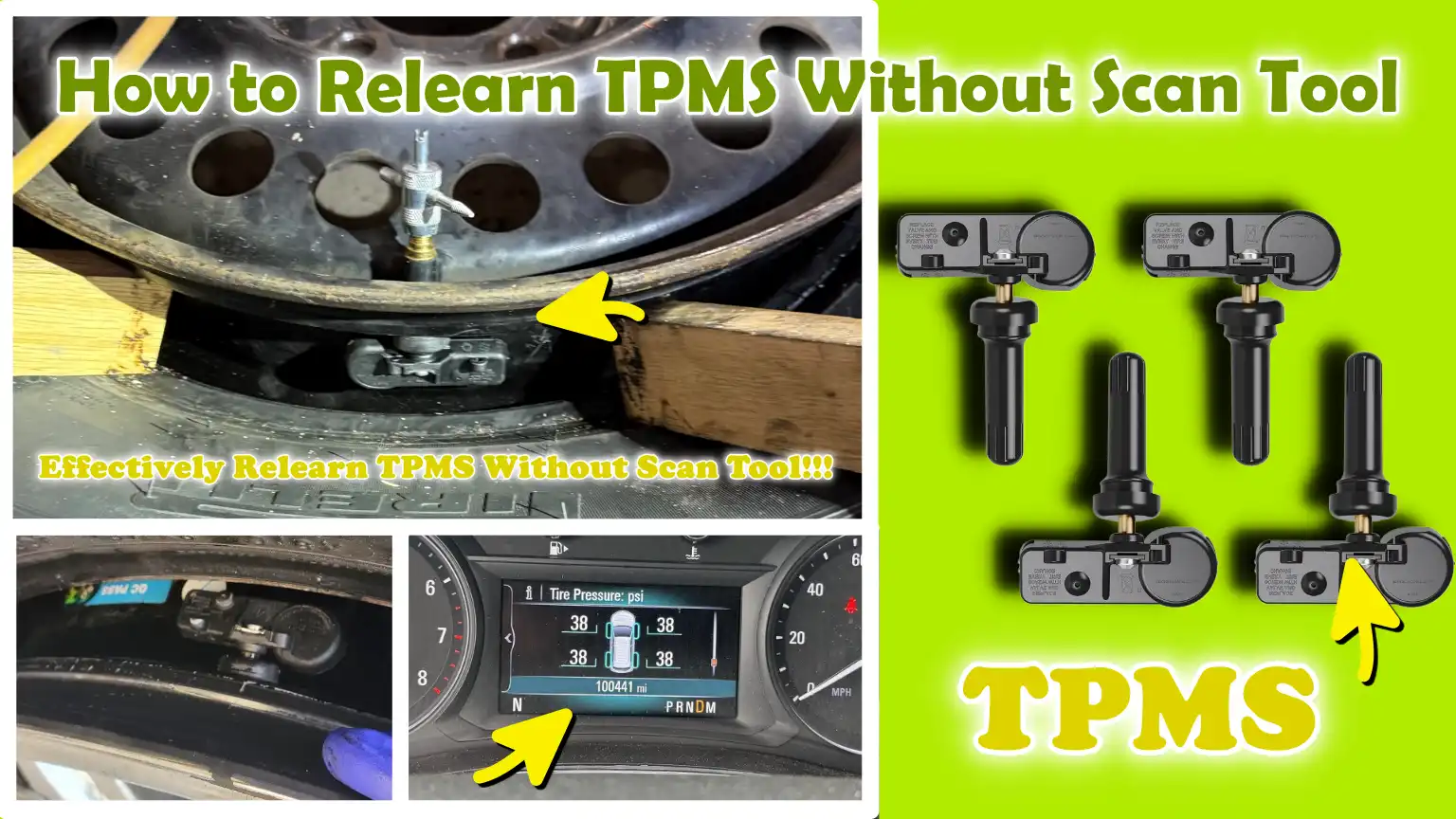
Written By: Dean Shali
Fact Checked By: Sabré Cook
Reviewed By: Tamara Warren
You need to know this thing that: many TPMS problems actually not because of the mechanical failures, sometimes you just need to relearn with that system.
So, whenever you start your car and see that small tire warning light, which clearly means that your vehicle is trying to protect you from any mishap.
Because, that tiny TPMS light on your dashboard actually represents one of the most important safety system in your entire vehicle as it tells you about the condition of the vehicle’s tire that is the only part that literally contacts with the road.
If you are facing TPMS light issues even after fixing tire pressure or rotating tires, then this is not just because of any system failure, but it is just communication gap and that’s all.
Plus, your car actually needs to relearn where each sensor is and how to read it in correct way.
Now, with this guide you’ll learn How to Relearn TPMS Without Scan Tool so that you can regain full control over one of your car’s most important safety system again.
Understand, What is a TPMS Relearn?
A TPMS relearn is a procedure that helps your car recognize and correctly identify tire pressure sensors following a change.
Vehicles equipped with a Tire Pressure Monitoring System feature a sensor in each wheel that transmits pressure data to the car’s onboard computer.
When you rotate your tires, replace a sensor, or install new wheels, the system may lose track of which specific sensor corresponds to which specific tire.
This can result in inaccurate readings, persistently illuminated warning lights, or pressure readings being displayed for the wrong tire location.
A relearn simply instructs the vehicle to re-establish a connection with each sensor and associate it with its correct tire position.
It is not about adjusting tire pressure, but rather about restoring proper communication between the sensors and the system to ensure that the information displayed to you is accurate and reliable.
1. The Difference Between TPMS Reset, Relearn and Reprogramming
A TPMS reset is the simplest procedure; typically, it merely turns off the warning light after the tires have been inflated to the correct pressure.
It does not alter sensor locations, nor does it teach the system any new information.
A TPMS relearn is a more advanced procedure required when the system needs to re-learn sensor locations or re-establish connections following a tire rotation or service.
This is the crucial step that ensures the pressure reading for each tire is displayed at its correct corresponding position.
TPMS reprogramming is an even more in-depth process, required when new sensors, ones the car has never faced before, are installed.
In this scenario, the system must be taught the specific ID codes of the new sensors in order to correctly identify them.
It is crucial to understand this distinction, as many drivers attempt to simply “reset” the system when, in reality, a “relearn” is required, a common mistake that prevents the actual problem from being resolved.
2. Types of TPMS Systems
Two main types of TPMS systems are utilized in vehicles and knowing which system is installed in your car helps you understand how the relearning process functions.
Direct TPMS measures tire air pressure in real-time using physical sensors mounted inside each tire.
These sensors transmit data wirelessly to the vehicle; consequently, whenever their position is altered, they require a relearning procedure.
This type is more accurate and is employed in most modern vehicles.
Indirect TPMS does not utilize sensors inside the tires.
Instead, it detects changes in tire shape, caused by low air pressure, by analyzing wheel speed data obtained from the Anti-lock Braking System (ABS).
As it does not rely on physical sensors, it typically does not require a “relearn” process in the same manner.
Instead, after adjusting the tire pressure, a quick “reset” or “calibration” is often all that is needed.
Understanding whether your vehicle utilizes a “Direct” or “Indirect” system helps you select the correct procedure and avoid unnecessary steps.
Understand, When Do You Need to Re-learn Your TPMS?
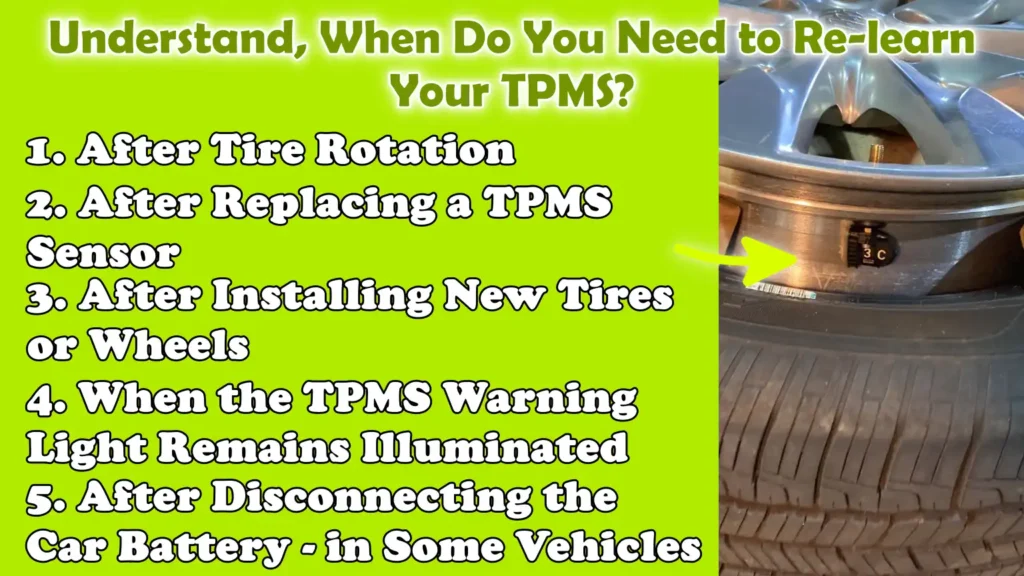
You need to re-learn your Tire Pressure Monitoring System (TPMS) when the vehicle “forgets” which sensor is paired with which tire, or when it stops reading sensor data correctly.
To display accurate tire pressure readings, the system relies on the precise location of each sensor and stable communication between them.
Whenever there is a change involving the wheels, sensors, or the vehicle’s power supply, the system can become confused.
This can lead to various issues, such as a warning light remaining constantly illuminated, the system displaying an incorrect pressure reading for a specific tire, or failing to display any reading at all.
The “re-learn” process resolves this issue; it helps the vehicle re-establish connections and correctly associate each sensor with its proper location.
1. After Tire Rotation
After a tire rotation, the position of each wheel changes; however, the TPMS retains the memory of their previous locations.
This means that the pressure readings displayed on the dashboard may not correspond to the actual pressure inside the tires.
For instance, the system might indicate low pressure in the front-left tire, whereas the actual issue may lie with a rear tire.
The re-learn process updates the system, enabling it to recognize the new location of each sensor.
Without this step, the system may continue to function, but the information it provides could be misleading, making it difficult to identify actual problems.
2. After Replacing a TPMS Sensor
When a TPMS sensor is replaced, the new sensor possesses a unique identification code that the vehicle does not automatically recognize.
It is necessary to “teach” the system to accept and register this new sensor so that it can read its data.
If the re-learn or programming step is skipped, the vehicle may continue to display a warning light or fail to provide pressure readings for that specific tire.
Therefore, following a sensor replacement, a “re-learn” procedure is almost always required to restore the system’s full functionality.
3. After Installing New Tires or Wheels
Installing new tires or a different type of wheels can affect the internal communication within the TPMS system.
In some instances, sensors may be relocated to new positions or replaced entirely.
Even if the original sensors are reused, their physical location on the vehicle may change, which can confuse the system.
The re-learn procedure ensures that the vehicle correctly identifies each sensor and continues to provide accurate pressure readings even after the installation of new tires or wheels.
4. When the TPMS Warning Light Remains Illuminated
If the TPMS warning light remains illuminated despite all tires having the correct pressure, it often indicates that the issue lies not with the air pressure itself, but with the system’s ability to read it.
The system may have lost its connection with one or more sensors, or it may be receiving data from an incorrect location.
Performing a “re-learn” resets this communication link, allowing the system to update itself.
If the light persists even after the re-learn procedure, it may indicate a faulty sensor or another internal issue that requires further investigation.
5. After Disconnecting the Car Battery – in Some Vehicles
In certain vehicles, disconnecting or replacing the car battery can cause specific components of the onboard computer, including the TPMS memory, to reset.
When this occurs, the system may lose track of sensor locations or lose previously stored data.
Consequently, upon restarting the vehicle, you may observe that the warning light is illuminated or discover that the tire pressure information is missing.
By “re-learning,” the system retrieves this information and begins functioning normally.
Can You Re-learn TPMS Without a Scan Tool?
Yes, many vehicles allow you to re-learn the Tire Pressure Monitoring System (TPMS) without using a scan tool; however, this depends on how the manufacturer has designed the system.
Scan tools are typically used to activate sensors and quickly inform the system of their specific locations, but some cars feature built-in “re-learn modes” that allow you to perform this task yourself.
These systems are designed to be user-friendly, enabling drivers to complete basic re-learn procedures at home following tire changes or routine maintenance.
However, not all vehicles support this feature and it is essential to understand your vehicle’s capabilities before attempting to initiate this process.
1. Vehicles That Support Manual Re-learn
Many common vehicles, particularly those from brands like General Motors and Ford, are designed with a manual re-learn procedure that requires no specialized equipment.
These vehicles allow you to enter re-learn mode by performing a few simple steps, such as turning on the ignition, pressing a reset button, or activating the hazard lights.
Once in this mode, the vehicle listens for signals transmitted from each tire in a specific sequence.
Some systems provide confirmation of each step via a horn chirp or flashing lights.
Thanks to this built-in feature, you can complete the re-learn process simply by performing basic actions such as: adjusting tire pressure or following a specific sequence, making it a highly practical tool for everyday drivers.
2. Vehicles That Require Specialized Tools
Some vehicles do not support manual re-learn procedures and require a specialized scan tool or TPMS activation tool to complete the process.
This is more common in certain European brands and newer models equipped with modern systems.
In these vehicles, sensors do not automatically transmit signals until they are activated using a specialized tool, or the system may require the programming of sensor IDs, a task that cannot be performed manually.
Without the appropriate tool, the vehicle will be unable to fully recognize the sensors, causing the warning light to remain illuminated.
In such instances, visiting a service center or utilizing a professional diagnostic tool becomes necessary.
3. Commonly Available Methods
Even without a scan tool, there are several proven methods that effectively assist in the TPMS “re-learn” process for many vehicles.
In the “Auto Re-learn” method, the system updates itself continuously while the vehicle is being driven, utilizing data gathered from the rotation of the wheels over time.
In the “Stationary” or “Manual Re-learn” method, the vehicle is placed into a specific mode and each sensor is then individually triggered; this is often accomplished by slightly adjusting the tire pressure or by following a specific sequence of steps.
The “Driving Re-learn” method is a simpler variation of this process, wherein the system automatically recalibrates itself after the vehicle has been driven at a consistent speed for a specific duration.
Each method functions differently depending on the specific vehicle model, but all aim to re-establish proper synchronization between the sensors and the vehicle’s onboard computer, without the need for specialized equipment.
Know, How to Prepare Your Vehicle Before Relearning TPMS
Before initiating a TPMS re-learn, proper preparation is crucial, as the system relies on precise initial conditions to function correctly.
The re-learn process does not fix tire pressure issues or repair sensors; it merely helps the vehicle recognize and synchronize sensor data.
If the initial setup is incorrect, the re-learn process may fail or yield inaccurate results.
Taking a few simple steps before beginning ensures that the system can accurately read each tire and complete the process without any errors.
1. Ensure All Tires Are Inflated to the Correct PSI
The most critical step is setting the correct pressure in all tires, as recommended by the vehicle manufacturer.
This information is typically found on a sticker located inside the driver’s door frame or within the owner’s manual.
TPMS systems are designed to detect pressure discrepancies; therefore, if the pressure in any single tire is too low or too high, the system may continue to display a warning even after the re-learn process has been completed.
Using an accurate tire pressure gauge helps ensure that each tire is set correctly.
Proper inflation also enhances safety, fuel efficiency and tire longevity; therefore, this step should always be performed before attempting a re-learn.
2. Check Sensor Batteries – If Applicable
In vehicles equipped with Direct TPMS, each sensor located inside the tire contains a small battery that powers the unit.
These batteries are sealed and typically last between five and ten years, depending on usage and operating conditions.
If a sensor’s battery is weak or depleted, the system will fail to receive a signal from that specific tire and the re-learn process will not complete successfully.
Signs of a failing battery include a flashing TPMS warning light or the absence of a pressure reading for a specific tire.
If this occurs, the sensor may need to be replaced before attempting the re-learn procedure.
3. Safely Park the Vehicle
Before initiating the re-learn procedure, the vehicle must be parked on a level and stable surface.
This helps prevent any movement during the process and ensures safety while working around the tires.
It is best to engage the parking brake and, depending on the type of transmission, place the vehicle in the ‘Park’ or ‘Neutral’ position.
A stable stance also makes it easier to adjust tire pressure or complete any steps that require moving around the car in a specific sequence.
4. Set the Ignition to the Correct Mode – ON or RUN
Most manual re-learn procedures require the ignition to be in the ‘ON’ or ‘RUN’ position, without actually starting the engine.
This activates the vehicle’s electronic systems, enabling them to receive and process signals from the TPMS sensors.
If the ignition is not in the correct position, the system may fail to enter ‘re-learn mode’ or may not respond to inputs.
In some vehicles equipped with a ‘push-button start’ feature, this may require pressing the ‘Start’ button without depressing the brake pedal.
Adhering to the correct ignition setting is crucial for successfully initiating this process.
5. Keep Your Vehicle’s ‘Owner’s Manual’ Handy
The process for ‘re-learning’ the TPMS can vary slightly from one vehicle to another, even among different models of the same brand.
The ‘Owner’s Manual’ outlines the precise procedure specifically designed for that particular model, including all relevant details such as the correct sequence, timing and confirmation signals.
Keeping the manual close at hand helps eliminate confusion and minimizes the likelihood of errors.
It also provides useful information such as: correct tire pressure specifications, the specific type of installed system and troubleshooting tips, making the entire re-learn process smoother and more accurate.
How to Relearn TPMS By Driving Re-learn – Automatic Re-learn
The driving re-learn method is one of the easiest ways to restore the accuracy of the TPMS, as it updates automatically while the vehicle is being driven.
Many modern vehicles are designed to automatically recognize sensor signals as soon as the wheels begin to rotate, subsequently associating those signals with the correct tire positions.
This method works best when the sensors are already functioning properly and simply need to re-identify their locations such as: after a tire rotation.
By utilizing data points such as wheel speed, rotation patterns and signal strength, the system identifies each sensor without requiring any manual input.
As this process is integrated directly into the vehicle’s software, it requires patience and consistent driving conditions rather than specialized tools or complex procedures.
1. Properly Inflate All Tires
Before initiating the driving re-learn process, all tires must be inflated to the pressure specifications recommended by the vehicle manufacturer.
TPMS systems are designed to detect discrepancies in tire pressure; therefore, even a slight variation can confuse the system and delay the re-calibration process.
Ensuring proper tire inflation guarantees that each sensor transmits stable and accurate data while the vehicle is in motion.
This step also helps prevent false alerts during the re-learn process and assists the system in establishing an accurate baseline for all four tires.
2. Begin Driving at a Consistent Speed
Once the tires have been properly inflated, drive the vehicle at a steady speed, typically between 30 and 50 miles per hour.
Maintaining a consistent speed is crucial, as the system collects data most effectively when the wheels rotate uniformly, without frequent stops or sudden changes in velocity.
Abrupt braking, heavy traffic, or challenging driving conditions can disrupt this process, potentially prolonging its duration.
Driving smoothly and at a steady pace enables the system to accurately interpret the signals transmitted by each individual sensor.
3. Drive for 10 to 30 Minutes
The re-learn process typically requires 10 to 30 minutes of continuous driving, depending on the specific vehicle model.
During this time, the system monitors each wheel and progressively updates the corresponding sensor locations.
Some vehicles may complete this process relatively quickly, while others may require a longer period of driving to fully recalibrate.
It is essential to drive without interruption during this phase to ensure the system gathers the necessary data to successfully complete the re-learn procedure.
4. The System Recalibrates Automatically
After a sufficient period of driving, the TPMS system will automatically recalibrate itself, correctly associating each sensor with its specific wheel position.
In many instances, the warning light will automatically turn off as soon as this process is complete.
Some vehicles may not provide an explicit notification; however, you can verify that the tire pressure readings have returned to normal and are being displayed in the correct locations on the dashboard.
This method is highly effective because it leverages the vehicle’s internal intelligence, making it one of the simplest and most user-friendly ways to perform a TPMS re-learn without the need for any specialized tools.
How to Relearn TPMS By Stationary Re-learn – Manual Button or Key Cycle
With the Stationary Re-learn method, the TPMS can be recalibrated while the vehicle is stationary, without driving the vehicle or using any specialized tools.
This method is built into many vehicles and works by placing the system into a ‘learning mode,’ where it listens for sensor signals and resets its stored data.
This is particularly useful when the system needs to update sensor locations following a tire rotation or minor service, or when it needs to clear erroneous data.
As the vehicle is not in motion, this process relies on the correct ignition settings and precise timing for each step.
When executed correctly, the system reacquires the sensor data and displays accurate pressure readings.
1. Turn on the Ignition – Keep Engine Off
The first step is to switch the ignition to the ON or RUN position without starting the engine.
This activates all of the vehicle’s electrical systems, including the TPMS, enabling them to receive and process signals from the sensors.
For vehicles equipped with a traditional key, this means turning the key to the position immediately preceding the engine start.
For vehicles with a push-button start, this typically involves pressing the start button without depressing the brake pedal.
Keeping the engine off ensures that the system can focus entirely on the re-learn process without any interference from driving conditions.
2. Press and Hold the TPMS Reset Button
Most vehicles that support this method feature a dedicated TPMS reset button, often located beneath the dashboard, near the steering column, or inside the glove box.
Pressing and holding this button signals the system to enter the re-learn or reset mode.
This step is crucial because it instructs the vehicle to clear its old data and prepare to acquire new information from the sensors.
Typically, this button must be held down for a few seconds until the system provides a response.
3. Wait for the TPMS Light to Flash
After pressing and holding the reset button, the TPMS warning light will typically begin to flash or blink.
This flashing confirms that the system has entered “re-learn” mode.
This signifies that the vehicle is ready to update its sensor data and initiate the recalibration process.
If the light does not flash, it may indicate that the button was not held down for a sufficient duration, or that a different procedure is required for your specific vehicle model.
Monitoring this signal is essential, as it ensures that the process has commenced correctly.
4. Start the Engine
Once the system has entered “re-learn mode,” the engine can be started.
Starting the engine activates all of the vehicle’s systems, thereby enabling the TPMS to complete its recalibration.
At this stage, the system begins processing signals received from the sensors and updating its internal data records.
Keeping the engine running ensures a stable power supply, allowing the “re-learn” process to proceed without interruption.
5. Wait for the System to “Re-learn”
After starting the engine, it may take a few minutes for the system to complete the “re-learn” process.
During this time, the TPMS collects data from each sensor, updates their respective locations and clears any stored error codes.
In many cases, the warning light will automatically turn off once this process is complete.
For some vehicles, it may be necessary to drive the car for a short period afterward to fully verify the calibration.
It is crucial to exercise patience here, as if this process is interrupted prematurely, the system will be unable to complete the ‘re-learn’ procedure.
6. The ‘Key Cycle’ Method – Optional
Some vehicles do not feature a dedicated reset button; instead, they utilize a ‘key cycle’ method to enter ‘re-learn mode.’
This involves switching the ignition on and off in a specific sequence, for instance, three times within a span of just a few seconds.
This action signals the vehicle’s onboard computer to enter ‘re-learn mode’ without the need to press any physical buttons.
The exact number of cycles and the required timing may vary depending on the vehicle manufacturer; therefore, consulting the vehicle’s owner’s manual is highly recommended.
Once the system successfully enters ‘re-learn mode,’ the subsequent steps proceed in the same manner, enabling the system to update the TPMS sensor data and restore accurate readings.
How to Relearn TPMS By How to Lower Tire Pressure – Without Any Tools
The tire pressure reduction method is a widely used manual relearn process that works for many vehicles, particularly those that provide an audible (horn) or visual (light) signal for confirmation.
This method requires no specialized tools, as it operates on a simple principle: when you release a small amount of air from a tire, the TPMS sensor transmits a new pressure signal and the vehicle uses this change to identify which specific sensor is installed at that particular wheel position.
By following a specific sequence and triggering each sensor one by one, the system can accurately map all four tires.
This method is highly effective following a tire rotation or when the system is displaying incorrect tire positions; however, it is crucial to strictly adhere to the correct sequence and, subsequently, reinflate the tires to the proper pressure levels.
1. Turn On the Ignition
This process begins by turning the ignition to the “ON” or “RUN” position without actually starting the engine.
This step powers up the vehicle’s electronic systems, including the TPMS, enabling them to receive signals from the sensors.
For vehicles equipped with a push-button start, this typically involves pressing the start button without depressing the brake pedal.
Placing the ignition in this mode ensures that the system is active and ready to enter the relearn mode.
2. Enter Relearn Mode
Before releasing air from any tire, it is necessary to place the system into “relearn mode,” either by using a dedicated reset button or by following a specific procedure such as: cycling the ignition on and off, or activating the hazard lights.
This step signals the vehicle to begin listening for sensor signals in a specific, predetermined sequence.
Once the “re-learn” mode has been successfully activated, the system typically provides confirmation via a horn sound or a flashing light signal.
Without entering this mode, the system will ignore any changes in pressure and this process will not work.
3. Start with the Front Left Tire
The re-learn sequence almost always begins with the front left tire, also known as the driver-side front wheel.
This starting point is crucial because the system follows a specific pattern to identify each sensor.
Starting with the correct tire ensures that, as you progress through the sequence, the system assigns each sensor to its proper location.
Skipping a tire or starting with the wrong tire can confuse the system and lead to incorrect results.
4. Slowly Release Air Until the Horn Sounds
For the first tire, you will need to slowly release air for a few seconds.
As the pressure drops slightly, the sensor sends an updated signal to the vehicle.
Once the system recognizes this signal, it typically responds with an audible horn beep or a flashing light, confirming that the sensor has been detected and registered at that specific location.
It is important to release only a small amount of air to prevent the tire from becoming significantly underinflated.
5. Repeat the Process for All Tires in the Specified Order
After the first tire is complete, the process continues in a specific sequence followed by most vehicles.
Typically, this sequence begins with the front left tire, moves to the front right tire, then to the rear right tire and finally concludes with the rear left tire.
Following this specific order allows the system to map each sensor one by one.
For each tire, the same process is repeated: a small amount of air is released, followed by waiting for the confirmation signal.
It is essential to strictly adhere to this sequence, as the system relies on this specific pattern to accurately and correctly assign each sensor to its proper location.
6. Inflate All Tires to the Correct PSI
Once all four tires have been identified, the final step involves inflating each tire to the specific air pressure recommended by the vehicle manufacturer.
During this process, a small amount of air is released from each tire; therefore, driving the vehicle without reinflating them can lead to handling issues, reduced fuel efficiency and accelerated tire wear.
Using a reliable pressure gauge ensures that each tire is inflated to the correct pressure level; this also helps the TPMS provide accurate readings once the ‘re-learn’ process is complete.
7. Important Points to Remember
The success of this method depends largely on adhering to the correct tire sequence and paying attention to the confirmation signals.
A beep from the horn or a flashing light serves as an indication that the system has recognized the sensor at that specific location.
If you do not hear or see this signal, it may mean that the step was not completed correctly, or that the system is not in ‘re-learn mode.’
By avoiding haste, carefully following the sequence and finally ensuring the correct air pressure in the tires, you will be able to successfully complete this process and restore the proper functioning of the TPMS.
How to Relearn TPMS By Using the Hazard Lights Trick – GM and Select Models
The hazard lights method serves as a simple and effective way to enter TPMS re-learn mode in many General Motors vehicles, as well as certain other models equipped with a similar system.
Rather than requiring a specific reset button or a scan tool, this method sends a signal to the vehicle’s computer via the hazard light switch, thereby initiating the re-learn process.
This feature is included in select vehicles to simplify the TPMS re-learn procedure for drivers following a tire rotation or sensor service.
The system operates by entering a “listening mode,” wherein it awaits signals from each tire sensor in a specific, predetermined sequence.
This method is particularly advantageous as it requires no external tools, relying entirely on the basic controls already present within the vehicle.
1. Turn On the Ignition
The first step is to turn the ignition to the “ON” or “RUN” position, but without starting the engine.
This activates the vehicle’s electronic systems, including the TPMS module, preparing them to receive and process signals from the sensors.
For vehicles equipped with a push-button start, this typically involves pressing the start button without depressing the brake pedal.
Keeping the engine off ensures a stable environment for entering re-learn mode and prevents any interruptions during the process.
2. Press the Hazard Lights Button Multiple Times
Once the ignition is on, you must press the hazard lights button multiple times, rapidly and rhythmically.
Doing so sends a command to the vehicle’s computer to enter TPMS re-learn mode.
The specific number of times the button needs to be pressed may vary depending on the vehicle’s particular model; However, this sequence is typically completed very rapidly, within just a few seconds.
This step eliminates the need for a separate reset button, as the system interprets this action as the signal to initiate the re-learn process.
3. Horn Sound Indicates Re-Learn Mode
Once the correct sequence is completed, the vehicle responds by sounding its horn or emitting a similar audible alert.
This sound indicates that the system has successfully entered “re-learn mode” and is now ready to recognize each individual tire sensor.
The horn serves as a crucial signal, informing you that the system is now awaiting input.
If no sound is heard, you may need to repeat this process more carefully to ensure that the system has recognized the command.
4. Follow the Tire Sequence by Deflating
Once the system has entered “re-learn mode,” the next step involves following a specific sequence by slightly deflating each tire.
This process typically begins with the front left tire, proceeds to the front right tire, followed by the rear right tire and concludes with the rear left tire.
As air is released from each tire, the sensor transmits a signal and the vehicle confirms this action by sounding its horn or flashing its lights.
This allows the system to accurately register each sensor at its correct location.
Once this process is completed for all four tires, the system exits “re-learn mode”; at this point, all tires should be reinflated to the correct pressure to ensure the vehicle operates safely and properly.
Know, Vehicle-Specific TPMS Re-learn Procedures
TPMS re-learn procedures are not uniform across all vehicles, as every manufacturer designs its system using distinct software, sensor communication protocols and safety checks.
Although the objective remains the same, to correctly associate each tire sensor with its specific location, the method for entering the vehicle’s re-learn mode and completing this process can vary significantly.
Some systems are straightforward and user-friendly, while others require more controlled steps or specialized tools.
Understanding these differences helps prevent confusion and ensures that the correct procedure is applied for each specific vehicle.
1. GM Vehicles – Chevy, GMC, Cadillac
General Motors vehicles, including Chevrolet, GMC and Cadillac models, are known for offering simple, manual TPMS re-learn options.
Many of these vehicles support methods such as the “hazard lights trick” or specific “key sequences” to enter the re-learn mode.
Once activated, the system typically confirms each tire sensor via an audible horn chirp as you deflate the tires in a specific sequence.
This makes the process very straightforward and allows it to be completed without the need for any scan tools.
These systems are designed to guide the user step-by-step, making them widely regarded as some of the most user-friendly TPMS setups available.
2. Ford Vehicles
Ford Motor Company vehicles often employ a different approach, which may involve cycling the ignition key multiple times or using a specific combination of buttons to enter the re-learn mode.
In many instances, the system confirms that it has successfully entered the correct mode by responding with an audible horn chirp.
In certain Ford models, particularly newer vehicles, it may be necessary to use a TPMS activation tool to trigger each individual sensor.
While older models may support a manual “re-learn” procedure, newer systems are often more strictly controlled, potentially limiting the ability to complete this process without additional equipment.
3. Differences Between Toyota and Honda
Toyota and Honda vehicles often utilize a straightforward system; however, they handle TPMS differently compared to their American counterparts.
Many Toyota and Honda vehicles rely on “Indirect TPMS” or “Automatic Re-learn Systems,” which do not require sensors to be manually triggered.
Rather than needing to identify the precise location of each sensor, these systems may simply require a “reset” or “calibration” following a change in tire pressure.
In models equipped with “Direct TPMS,” the re-learn process often occurs automatically and completes while the vehicle is being driven.
This means there is no distinct manual procedure such as: the button-based method found in GM vehicles, which can sometimes cause confusion for drivers expecting a manual intervention.
4. Why Procedures Vary by Manufacturer
The primary reason for the differences in TPMS re-learn procedures lies in variations regarding system design, technology and safety requirements.
Each manufacturer determines how sensors communicate with the vehicle, how data is processed and the level of control granted to the driver.
Some systems are designed for convenience, allowing for manual re-learning without the need for tools, while others are engineered for precision, requiring specialized equipment to ensure accurate programming.
Regulatory standards, vehicle type and the level of technological sophistication also play a significant role in these variations.
For this reason, it is crucial to follow the correct procedures for your specific vehicle to ensure that the system is functioning properly and providing reliable information regarding tire pressure.
Know, Common Mistakes While Relearning Process to Avoid
Many issues associated with TPMS re-learning do not arise because the system is defective, but rather because small steps are overlooked or executed incorrectly.
The re-learn process relies on correct inputs, precise timing and accurate signals received from the sensors.
Even a minor error can cause the system to fail, leave the warning light illuminated, or display incorrect information regarding the tires.
Understanding these common mistakes can help you avoid complications and successfully complete the process on your very first attempt.
Plus, there’s study that confirms that because tire pressure directly affects the safety and performance, that’s why TPMS by-default becomes really essential safety system, so when you relearn that TPMS in correct way then it ensures that the system continues to deliver truly accurate pressure data; as it also leads to the safer steering movement, braking performance and ensures long-term tire health as well.[¹]
1. Incorrect Tire Pressure Prior to Re-learn
Initiating the re-learn process with incorrect tire pressure is one of the most common and significant errors.
The TPMS system uses the current tire pressure as a baseline to determine whether everything is functioning correctly.
If one or more tires are under-inflated or over-inflated, the system may continue to display a warning even after the re-learn process has been completed.
This can create the impression that the re-learn failed, whereas the actual issue lies with the incorrect tire pressure itself.
Before beginning the process, always use a reliable gauge to ensure that all tires are inflated to the manufacturer’s recommended pressure, thereby providing the system with accurate and consistent data.
2. Skipping a Tire in the Sequence
In manual re-learn methods, particularly those involving the deflation of tires to lower pressure, the specific sequence in which you activate each tire is critical.
The system expects to receive signals in a predetermined order, which typically begins with the front-left tire and proceeds according to a specific pattern.
If you skip a tire, start from the wrong position, or break the sequence, the system may misidentify the sensors or fail to complete the re-learn process.
The result is often inaccurate pressure readings or a warning light that remains illuminated.
Adhering to the correct sequence ensures that every sensor is connected to the appropriate location.
3. Rushing the Re-learn Process
Many TPMS re-learn procedures take time to complete, particularly those involving automatic methods or those performed while driving the vehicle.
A common mistake is to prematurely interrupt the process or to expect immediate results.
The system requires sufficient time to recognize sensor signals, process the data and update its internal memory.
Interrupting this process such as: by turning off the ignition or stopping the vehicle too soon, as it can prevent the re-learn procedure from reaching completion.
Exercising patience and waiting for the full specified duration helps ensure that the system successfully completes the procedure.
4. Weak or Defective TPMS Sensor Batteries
Every direct TPMS sensor contains an internal battery that powers it; over time, this battery may weaken or fail completely.
When this occurs, the sensor is unable to transmit signals to the vehicle, meaning the system cannot detect that specific tire during the re-learn process.
The result is often a flashing TPMS warning light or a missing pressure reading.
Many drivers repeatedly attempt to re-learn the system without success, unaware that the root cause of the problem lies within the sensor itself.
In such cases, replacing the defective sensor before initiating the re-learn process is the only solution.
5. Confusion Between Reset and Re-learn
Another common mistake is assuming that a simple TPMS reset will resolve all issues.
A reset typically serves only to turn off the warning light once the tire pressure has been corrected; it does not update the status of the sensors, nor does it re-establish connections with sensors that have lost contact.
If the sensor mapping within the system is incorrect, or if communication has been lost following a tire rotation or service, a full “re-learn” procedure is required rather than a simple reset.
Confusing these two distinct processes often leads to repeated, futile attempts that fail to resolve the actual underlying issue.
To effectively troubleshoot TPMS-related problems, it is crucial to understand precisely when to perform a reset and when a re-learn is necessary.
So, How Long Does It Take To Relearn the TPMS?
The time required to relearn the TPMS depends on the method used and the condition of the system; however, in most cases, it is a brief procedure that can be completed within just a few minutes.
The relearning process functions by helping the vehicle recognize sensor signals, verify their correct locations and update its internal memory.
This process takes time because the system requires continuous, repetitive data from each sensor to ensure accuracy.
Although many drivers expect immediate results, the system is designed to operate with great care and precision, which is why some methods take longer than others.
Understanding the estimated timeframe helps you remain patient and avoid prematurely interrupting the process.
1. Duration of the Driving Method
The driving, or “automatic”, relearning method typically requires driving the vehicle continuously for 10 to 30 minutes.
During this time, the vehicle collects data from each wheel as it rotates, gradually identifying the sensors.
To successfully complete this process, the system requires a consistent speed and uninterrupted driving conditions; consequently, in heavy traffic or stop-and-go situations, this process may take longer.
Some vehicles can complete the relearning process quite rapidly, while others may require the full driving duration to ensure that all sensors are correctly identified and paired.
2. Duration of the Manual Method
The manual, or “stationary”, relearning method is generally faster, often taking only 5 to 15 minutes to complete.
This method operates while the vehicle is stationary and it facilitates faster sensor recognition by the system by directly activating each individual sensor.
The duration of this process may depend on how easily the system enters the re-learn mode and how smoothly each step is completed.
If the procedure is followed correctly and without any interruptions, the system can update the location of all sensors and turn off the warning light in a relatively short period.
3. Factors Affecting Duration
The total time required to re-learn the TPMS can vary based on several key factors, including the vehicle type and the condition of the sensors.
Different vehicles utilize different TPMS designs and some systems are faster than others at recognizing and processing sensor data.
Modern vehicles equipped with newer systems may take longer, as they perform additional checks to ensure accuracy.
The condition of the sensors also plays a crucial role; sensors with strong batteries and clear signals are recognized quickly, whereas weak or deteriorating sensors can delay the process or prevent it from completing successfully.
External conditions such as: driving speed, road conditions and signal interference, as it can also influence how quickly the system completes the ‘re-learn’ process.
Read More:
- How to Reset Tire Pressure Monitoring System Manually
- How to Check Tire Pressure Sensor Battery
- How to Seal Bead Leak in Tire
- How to Use Tire Plug Kit Correctly
- How to Repair Tubeless Tire Puncture
- How to Locate a Nail in a Tire
- How to Fix Slow Tire Air Leak
- How to Detect Tire Sidewall Damage
- How to Check Tire Tread Depth at Home
- How to Bleed ABS System Properly
- How to Replace Rusted Brake Lines
- How to Inspect Brake Lines for Rust
- How to Flush Contaminated Brake Fluid
- How to Check Brake Fluid Contamination Level
- How to Fix Brake Bias Issues
- How to Test Brake Proportioning Valve
- How to Replace a Brake Light Switch
- How to Diagnose Brake Light Switch Failure
- How to Fix Intermittent ABS Activation
- How to Clean ABS Wheel Speed Sensor
- How to Diagnose ABS Sensor Wiring Issues
- How to Test Electronic Brake Module (EBCM)
- How to Fix Parking Brake Dragging
What are the Signs of a Successful TPMS Re-Learn?
After completing a TPMS re-learn, the system should resume normal operation and provide clear, accurate information regarding your tire pressure.
A successful re-learn signifies that the vehicle has correctly identified each sensor, matched it to the appropriate tire location and re-established proper communication.
As the TPMS is a safety system, it is designed to provide clear indications when everything is functioning correctly.
Recognizing these signs helps you verify that the process is complete and that your vehicle is safe to drive without any underlying tire pressure issues.
1. The TPMS Light Turns Off
The clearest indication of a successful re-learn is that the TPMS warning light turns off completely.
This light is designed to remain illuminated whenever the system detects an issue such as: low tire pressure or a failure to receive sensor data.
Once the re-learn process is complete and the system confirms that all sensors are operational and correctly positioned, the light will extinguish automatically.
In some vehicles, the light may turn off immediately, while in others, the system may require a brief period of driving to fully update and clear the warning.
2. No Warning Messages
In addition to the warning light turning off, no error messages or warnings should appear on the dashboard or information display.
Messages indicating sensor malfunctions, system errors, or a failure to receive tire pressure data should disappear following a successful re-learn.
The absence of these warnings indicates that the system no longer detects any issues and that all sensors are communicating correctly with the vehicle’s onboard computer.
3. Displays Tire Pressure Correctly
In vehicles equipped with a tire pressure display, a successful re-learn ensures that the accurate pressure for each tire is displayed at its correct location.
This means that the front left, front right, rear right and rear left, all tires, will display their actual pressure values and these values should correspond with the measurements taken using your gauge.
If the positions are accurate and the readings are stable, it confirms that the system has correctly mapped each sensor.
This is one of the most reliable methods for verifying that the re-learn process has been successfully completed.
When You Actually Needs a Scan Tool?
Although many TPMS re-learn procedures can be performed without any specialized tools, there are certain situations where a scan tool, or a dedicated TPMS programming tool, becomes absolutely essential.
These tools are designed to communicate directly with the vehicle’s onboard computer and tire sensors, enabling them to read sensor data, transmit signals and program new information that cannot be entered manually.
When the system fails to recognize sensors, cannot store their data, or continues to display persistent error messages despite re-learn attempts, a scan tool offers a more direct and reliable method for resolving the issue.
Understanding when a tool is required helps save time and prevents the frustration associated with repeated, unsuccessful attempts.
1. Programming New Sensors
When new TPMS sensors are installed, the vehicle must “learn” their unique identification codes (IDs) before it can read their data.
Each sensor possesses a distinct ID and the vehicle’s system must store this ID in its memory.
In many instances, a manual re-learn procedure alone is insufficient to accomplish this task, particularly when the sensors are entirely new to the vehicle.
A scan tool is utilized to program these IDs into the system, thereby enabling the vehicle to recognize and communicate with the new sensors.
Without this crucial step, the system may fail to recognize the sensors altogether, potentially causing the warning light to remain illuminated.
2. Failure to Recognize Sensor IDs
Occasionally, a vehicle may fail to recognize its existing sensors, even if they are functioning correctly.
This can occur due to signal interference, memory loss following a battery reset, or a system-wide error.
When sensor IDs go unrecognized, the system is unable to associate specific sensors with their corresponding tire locations; Consequently, pressure readings may fail to appear, or error messages may be displayed.
A scan tool facilitates the direct reading of each sensor’s ID and assists the technician in re-registering it to its correct location within the vehicle’s system.
This ensures that all sensors are properly registered and functioning exactly as intended.
3. Luxury or Advanced TPMS Systems
Some vehicles, particularly luxury or newer models, utilize more advanced TPMS designs that require precise programming and controlled communication.
These systems may not permit manual “re-learn” procedures, or they may limit the tasks that can be performed without specialized equipment.
They often incorporate additional features such as: detailed pressure monitoring, temperature readings, or advanced diagnostics, that rely on accurate data received from the sensors.
In such cases, a scan tool is essential for accessing the system, activating the sensors and correctly completing the re-learn or programming process.
4. Persistent TPMS Errors
If the TPMS warning light or error messages persist even after performing the appropriate “re-learn” procedure, it may indicate an underlying issue that cannot be resolved manually.
Persistent problems can stem from faulty sensors, defective components, or communication glitches within the system.
A scan tool can assist in diagnosing these issues by reading error codes and checking the status of each individual sensor.
This enables you to pinpoint the exact problem and take appropriate action, whether that involves replacing a sensor or repairing a specific component of the system.
How to Solve TPMS Re-learn Issues
When a TPMS re-learn does not complete as expected, the issue typically stems from an interruption in communication between the sensors and the vehicle, incorrect steps taken during the procedure, or a faulty system component.
The Tire Pressure Monitoring System relies on clear signals, the correct sequence of steps and stable conditions to update its memory.
If any part of this process is interrupted or executed incorrectly, the system may fail to re-learn and may continue to display a persistent warning indicator.
Understanding the most common issues and knowing what they signify, helps you quickly identify the root cause of the problem and resolve it without unnecessarily repeating the entire re-learn procedure.
1. The TPMS Light Is Still Flashing
A flashing TPMS light is a definitive indication that the system is not merely detecting low tire pressure, but is also experiencing a system-level malfunction.
In many vehicles, a light that flashes for approximately one minute before remaining continuously illuminated signals a fault within the TPMS itself.
This can occur if the re-learn procedure was not completed correctly, if the system failed to properly enter re-learn mode, or if one or more sensors are failing to transmit signals.
It is essential to double-check that all steps of the procedure were followed precisely and that the ignition was set to the correct position.
If the light continues to flash after multiple attempts, it may indicate a sensor-related issue requiring further investigation.
2. No Confirmation Received from the Horn
During manual re-learn procedures, particularly those involving the tire deflation method, the vehicle typically provides confirmation (such as a horn chirp or flashing lights) that a specific sensor has been successfully detected.
If no confirmation signal is received, it often indicates that the system has failed to successfully enter “re-learn mode” or is unable to receive a signal from the corresponding sensor.
This can occur if re-learn mode was not activated correctly, the sequence was initiated at the wrong tire, or air was either released too rapidly or in such small quantities that the sensor failed to register a response.
Ensuring that the system is properly engaged in re-learn mode and releasing air slowly and steadily, can help resolve this issue.
3. Failure of a Single Tire to Register
If a specific tire fails to register during the re-learn process, while the remaining tires register successfully, it generally implies an issue with that particular sensor or its signal.
The sensor’s internal battery may be depleted, it may have sustained external damage, or there could be an obstruction preventing it from establishing proper communication with the vehicle.
In some instances, the air pressure inside the tire may not have changed sufficiently for the sensor to trigger a response.
Attempting the procedure again, this time by reducing the tire pressure slightly further, may prove beneficial; however, if the tire still fails to register, the sensor may require inspection or replacement.
4. Possibility of a Defective Sensor
A defective TPMS sensor is one of the most common reasons for a failed re-learn process.
Sensors contain an internal battery that degrades over time; typically, these batteries last for several years before failing.
When a sensor weakens or ceases to function, it is unable to transmit a signal to the vehicle, thereby preventing the system from completing the re-learn process.
Symptoms of a defective sensor include the absence of a tire pressure reading, repeated failures during the re-learn process, or a warning light that remains continuously illuminated.
In such cases, replacing the sensor is the only reliable solution; furthermore, after replacing the sensor, the re-learn process may need to be repeated to ensure the system functions fully and correctly.
What are the Tips to Enhance the Safety
Working with your Tire Pressure Monitoring System involves more than just turning off a warning light; it means keeping your vehicle safe and stable on the road.
Tire pressure directly impacts braking, steering, fuel efficiency and tire longevity.
Even a minor error made during the TPMS re-learn process, if not handled with care, as it can create unsafe driving conditions.
Understanding these safety measures protects your vehicle and everyone inside it, while also ensuring that the system provides accurate and reliable information.
1. Never Drive on Underinflated Tires
Driving on underinflated tires is one of the most dangerous situations a vehicle can face.
Low tire pressure increases the surface area of the tire in contact with the road, generating excessive heat.
Over time, this heat can weaken the tire’s structure and increase the risk of a sudden blowout or tire failure, specially at high speeds.
Underinflated tires also reduce fuel efficiency and make the vehicle more difficult to control, particularly when braking or cornering.
Even during the re-learn process, it is crucial to refrain from driving until the correct pressure has been restored to all tires.
2. Use an Accurate Tire Pressure Gauge
Having an accurate tire pressure gauge is essential for setting the correct pressure both before and after the TPMS re-learn process.
TPMS systems are designed to detect even very minute changes in pressure; therefore, even a slight error in measurement can result in false readings or unnecessary warnings.
Using a reliable gauge ensures that every tire contains precisely the recommended pressure.
This not only facilitates a smooth re-learn process but also improves tire longevity, fuel efficiency and overall driving safety.
3. Do Not Release Excessive Air
During manual re-learn procedures, which require deflating the tires, it is crucial to release only a small amount of air at a time.
Releasing too much air can result in critically low tire pressure; if the vehicle is driven before the tires are reinflated, this poses a significant safety risk.
Furthermore, it can make it difficult to restore the correct pressure later on.
Deflating the tires gradually and in a controlled manner allows the TPMS sensors to transmit signals without compromising the integrity of the tires.
4. Reinflate Tires Immediately After the Re-learn Process
Once the re-learn procedure is complete, all tires should be reinflated to the correct pressure as soon as possible.
During this process, a small amount of air is typically released from each tire, meaning that at this stage, none of the tires contain the correct air volume.
Driving even a short distance with incorrect tire pressure can lead to uneven tire wear, negatively affect vehicle handling and increase the risk of tire damage.
Immediate reinflation ensures that the vehicle remains safe to drive and that the TPMS continues to provide accurate and consistent readings.
Conclusion – How to Relearn TPMS Without Scan Tool
When you understand how simple it is to relearn that TPMS then you can quickly fix it without any problems.
The TPMS is not merely a warning light; it is a safety system designed to provide you with accurate, real-time information regarding your tire pressure.
When the system fails to detect sensor positions or ceases to communicate properly, the issue often lies not in a system malfunction, but rather in the need for recalibration.
By utilizing techniques such as drive-cycle relearns, stationary resets, or tire-pressure deflation methods, many drivers can resolve these issues right at home, without spending money on specialized tools or visiting a service center.
The key to success lies in preparation, patience and strictly adhering to the specific steps applicable to your vehicle.
Maintaining correct tire pressure, following the steps in the precise sequence and allowing the system sufficient time to process the data, all play a crucial role in successfully completing the relearn process.
Furthermore, it is important to recognize that manual methods do have their limitations.
If the sensors are faulty, the battery is low, or the system requires reprogramming, the use of a scan tool becomes necessary.
Now, you can comment down below for more info.
Frequently Asked Questions
FAQ 1: What is the easiest way to relearn the TPMS without a scan tool?
Answer: The easiest method is typically the ‘Driving Relearn’ procedure, in which you simply inflate all tires to the correct pressure and drive the vehicle at a steady speed for a specific duration. Many modern vehicles are designed to automatically recognize sensor signals while driving and update their locations without any manual input. This method works best when the sensors are already functioning correctly and simply require recalibration following a tire rotation.
FAQ 2: Can all vehicles relearn the TPMS without a scan tool?
Answer: No, not all vehicles support a manual TPMS relearn. Some vehicles, particularly newer or luxury models, require a scan tool or a specialized TPMS programming tool to complete this process. These systems are designed with more advanced controls and may not allow for manual input. However, many common vehicles still support methods such as button resets, driving relearns, or pressure-drop relearns.
FAQ 3: Why is my TPMS light still on after performing a relearn?
Answer: If the TPMS light remains illuminated after performing a relearn, it usually indicates that there is still an issue within the system. This could be due to incorrect tire pressure, an undetected sensor, or a dead sensor battery. In some cases, the relearn process may not have been completed correctly, or the system may simply be taking longer than usual to update. Double-checking the tire pressure and carefully repeating the steps often resolves the issue; however, if the problem persists, it may be necessary to have the sensors inspected.
FAQ 4: How do I know if my TPMS relearn was successful?
Answer: A successful re-learn is typically confirmed when the TPMS warning light turns off and no error messages appear on the dashboard. In vehicles equipped with a tire pressure display, you will also be able to view the exact pressure and specific location of each individual tire. If everything appears normal and stable, it indicates that the system has correctly recognized all the sensors.
FAQ 5: Do I need to re-learn the TPMS every time I perform a tire rotation?
Answer: Yes, in many vehicles equipped with Direct TPMS, it is recommended to perform the re-learn procedure following a tire rotation. This is because the sensors are moved to different positions and the system needs to update their locations. Without a re-learn, the system may display incorrect tire locations, making it difficult to identify which specific tire is low on pressure.
FAQ 6: What happens if I do not re-learn the TPMS?
Answer: If you do not re-learn the TPMS after certain changes such as: a tire rotation or sensor replacement, the system may display inaccurate information. This can lead to confusion, as the warning light may point to the wrong tire. Although the system may still be able to detect changes in pressure, it will not provide accurate location data, thereby diminishing its overall utility and safety benefits.
FAQ 7: Can low tire pressure affect the re-learn process?
Answer: Yes, low or uneven tire pressure can interfere with the re-learn process. TPMS systems rely on accurate pressure data; therefore, if the tires are not properly inflated, the system will be unable to calibrate correctly. This may result in false warnings or failed attempts to complete the re-learn process. Always ensure that all tires are inflated to the recommended pressure before initiating the procedure.
FAQ 8: How long does it take to re-learn the TPMS?
Answer: The time required for this process depends on the method used. A “Drive Re-learn” typically involves driving continuously for 10 to 30 minutes, whereas manual re-learn methods, if performed correctly, may take approximately 5 to 15 minutes. In some vehicles, depending on the system design and sensor placement, this process may take longer.
References:
[1] Tire Pressure Monitoring [Applications of Control]
http://researchgate.net/publication/3207920_Tire_Pressure_Monitoring_Applications_of_Control
Hello Folks, Dean Shali here to help you out to solve the problems with your lovely vehicle, as i have lots of experience and knowledge about automotive industry as i woks directly with the customers and repair vehicles and i love to help the people to keep their cars safe and running smoothly.