
Written By: Dean Shali
Fact Checked By: Sabré Cook
Reviewed By: Tamara Warren
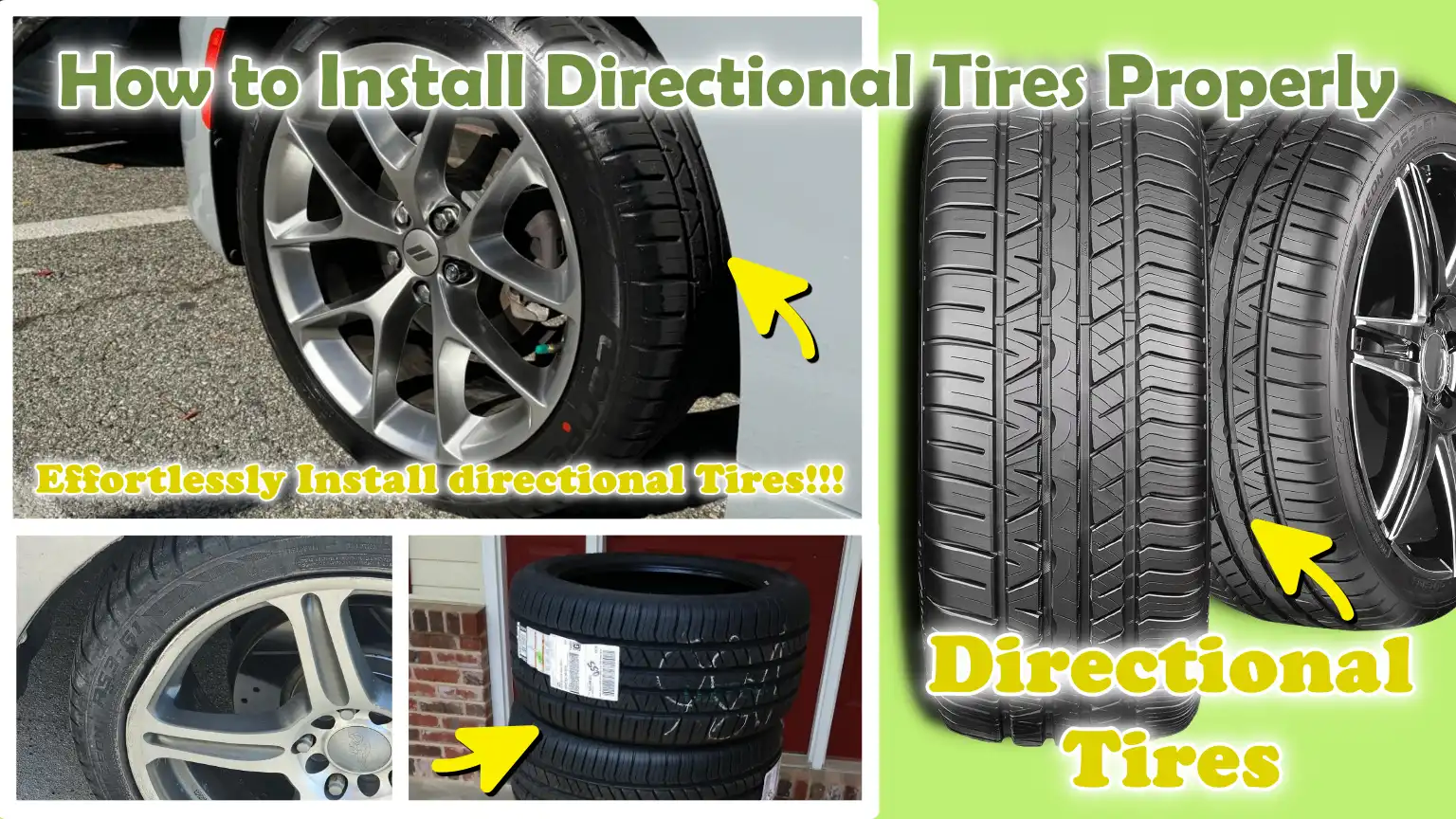
If you install directional tire in backward direction, yes it still roll like a normal one, but its safety performance can change dramatically during the rain, braking and high-speed driving.
Basically, directional tires are actually engineered with the specific tread pattern which is designed to rotate only one way, usually shaped like arrows or a “V” pattern that literally pushes water away from the center of the tire.
Plus, this is the design that literally helps them to improve the traction on wet roads, reduces hydroplaning risk, increases high-speed stability and even gives drivers better control during rain and emergency braking as well.
But, if they are installed backward, then the tread can no longer move water efficiently and that leads to the other things like: reduces grip, producing louder road noise, having uneven tread wear, steering stability and overall poor handling performance as well.
Now, in this guide you’ll learn How to Install Directional Tires Properly so that you can achieve road performance in both dry and wet conditions.
Understand, Why Proper Installation of Directional Tires is Really Important?
Directional tires are manufactured with a specific tread design that performs optimally only when the tire rotates in a single, designated direction.
This design is not arbitrary; rather, it is grounded in engineering principles that help manage the flow of water, heat and road pressure acting upon the tire during vehicle operation.
When installed correctly, directional tires enhance safety, stability and overall performance in both dry and wet conditions.
Conversely, if installed incorrectly, even a high-quality tire will fail to perform as intended, potentially compromising braking distances, steering control and tire longevity.
1. Enhanced Performance on Wet Roads
Directional tires are specifically engineered to handle wet road conditions more effectively, as their tread pattern is designed to channel water outward from the center of the tire.
This water-displacement process helps maintain superior contact between the rubber and the road surface, a critical factor when driving in rain or through standing water.
If installed incorrectly, this directional flow of water is disrupted, thereby diminishing the tire’s ability to effectively evacuate water.
This is one of the primary reasons why proper tire installation has a direct impact on safety when driving in rainy weather.
The water-evacuation benefits of directional tires stem from their angled grooves, which function as channels.
These channels rapidly displace water from the contact patch, ensuring that the tire maintains a firm grip on the road rather than hydroplaning (skimming) over a thin layer of water.
This design enhances traction on wet surfaces and significantly reduces the risk of skidding, particularly at high speeds or during sudden changes in weather conditions.
A major advantage is the reduced risk of hydroplaning, a phenomenon that occurs when a layer of water forms between the tire and the road surface, resulting in a complete loss of traction.
Directional tread patterns are specifically engineered to cut through and displace this layer of water.
When installed correctly, the risk of hydroplaning is substantially minimized, as the tire is able to maintain superior contact with the surface, even on wet or water-logged roads.
2. Enhanced Handling and Stability
Directional tires also play a crucial role in improving a vehicle’s handling and stability, as their tread design helps the tire maintain consistent grip across a variety of driving conditions.
Proper installation ensures that the tires respond precisely to steering inputs, an advantage that becomes particularly evident when driving on highways or executing rapid lane changes.
Control is enhanced at higher speeds because directional tires are designed to minimize the irregular movement of water and air beneath the tire tread.
This allows the tire to remain more stable at high velocities, making the vehicle feel more controlled and predictable.
Conversely, if the tires are installed in the wrong direction, stability may be compromised, causing the vehicle to feel less stable on straight roads or while accelerating rapidly.
Correct installation also improves cornering performance, as the tread blocks are designed to maintain their grip despite the lateral forces exerted upon them.
When a vehicle turns, increased pressure is placed on the outer edge of the tire.
Directional patterns help distribute this pressure more evenly, thereby improving traction during turns and reducing the risk of slipping or skidding on winding roads.
3. Extended Tire Lifespan
The correct installation of directional tires directly influences how evenly the tire wears over time, thereby extending its usable lifespan.
If directional tires are installed in the wrong direction, they may still function; however, they often do not wear evenly because their tread is not operating in the manner for which it was designed.
Preventing uneven tread wear is crucial, as incorrect rotation can cause certain parts of the tire to wear out faster than others.
This occurs when water displacement and road contact do not align properly with the specific tread pattern.
Over time, this uneven wear can lead to diminished performance and may necessitate premature tire replacement.
Maintaining a proper “contact patch” is another critical factor, as the contact patch refers to the specific area of the tire that remains in contact with the road at any given moment.
Directional tires are designed to ensure that this contact patch remains stable and consistent.
When installed correctly, these tires distribute pressure evenly across their entire surface; this ensures balanced tire wear and enhances overall operational efficiency.
4. Improved Braking Performance
One of the most critical reasons for correctly installing directional tires is braking safety, particularly in emergency situations.
As tires serve as the sole point of contact between the vehicle and the road, their grip on the surface directly impacts the vehicle’s stopping distance.
Properly installed directional tires prove advantageous during emergency braking, as their tread pattern helps maintain traction even under sudden, intense forces.
This enables the tires to grip the road more effectively during braking, thereby reducing the stopping distance and enhancing vehicle control in unexpected situations.
The benefits regarding road traction are also significant, as correct installation ensures that the tread design functions exactly as intended while the vehicle is decelerating.
The angled grooves and channels incorporated into the design help maintain stability during deceleration, preventing the tires from slipping and ensuring they maintain their grip on the road.
This becomes even more critical on wet or slippery surfaces; if the tires are not installed correctly, braking control can be severely compromised in such conditions.
So, How to Identify Directional Tires?
Directional tires are not always immediately obvious at first glance; however, they feature specific design cues that clearly indicate how they should be mounted.
Correct identification is crucial, as a tire’s performance, safety and resistance to hydroplaning (skidding on water) depend entirely on whether it has been mounted to rotate in the correct direction.
Most modern directional tires combine both sidewall markings and tread pattern indicators, making it easy to identify exactly what to look for.
1. Look for the Rotation Arrow
The most reliable method for identifying a directional tire is to look for the rotation arrow located on the sidewall.
This arrow precisely indicates the direction in which the tire should rotate when the vehicle is moving forward.
It is typically either printed on or embossed into the rubber and is often accompanied by the word “Rotation” to ensure easy comprehension.
This marking is not merely decorative; it serves as a vital instruction provided by the tire manufacturer, ensuring that the tread pattern functions exactly as it was designed to do.
When the arrow points in the correct forward direction of the wheel, the tire effectively displaces water, maintains excellent road grip and delivers balanced performance.
If this arrow is ignored, or if the tire is mounted in the reverse direction, the tire may still fit correctly onto the wheel, but its safety and functional efficiency could be severely compromised, as the tread pattern would be forced to operate contrary to its original design.
2. Understand Left and Right Side Mounting
Directional tires can sometimes be slightly confusing, as their proper installation depends on which side of the vehicle they are being mounted.
Unlike non-directional tires, many directional tires are designed to rotate in only one forward direction; this means that you cannot simply move a tire directly from the left side of the vehicle to the right side without reversing its orientation.
This is because the tread pattern is engineered to channel water outward in a specific direction as the vehicle moves forward.
If a tire is mounted on the wrong side of the vehicle, without correcting its orientation, it may appear to be installed correctly, but in reality, it will be rotating in the reverse direction.
This compromises its ability to effectively displace water and maintain traction on the road.
Understanding which side of the vehicle a tire belongs on helps you avoid installation errors that could negatively impact the vehicle’s handling and safety.
3. Check the Tread Pattern
The tread pattern itself serves as a clear indicator of a directional tire, even if you do not read the markings on the sidewall.
Most directional tires feature a V-shaped pattern or angled grooves that create a continuous flow extending from the center of the tire toward its outer edges.
This design is engineered such that as the tire rotates forward, it channels water away from the tire’s contact patch.
Upon close inspection, these grooves often resemble arrows pointing in a specific direction, thereby clearly indicating the correct direction of rotation.
These angled grooves are designed to mitigate hydroplaning, enhance traction on wet surfaces and improve stability at high speeds.
If the tread pattern appears symmetrical, or seems capable of performing identically in both directions, the tire is likely non-directional.
However, if the pattern clearly indicates a specific directional flow, it must always be installed in accordance with that specific design to ensure optimal performance and safety.
Tools
| Tools | Why It Is Needed | How To Use It |
|---|---|---|
| Jack | This is used to lift the vehicle off the ground so that a wheel can be safely removed. | Place it beneath the vehicle’s designated lifting point and slowly raise the vehicle until the tire clears the ground. |
| Jack stands | Once the vehicle has been lifted, this is used to provide support for safety purposes. | Before working underneath or around the vehicle, place these beneath sturdy support points; never rely solely on the jack. |
| Lug wrench | This is used to loosen and tighten the wheel lug nuts. | Place it over each lug nut and turn it anti-clockwise to loosen, or clockwise to tighten. |
| Torque wrench | This is used to tighten the lug nuts to the correct tension level. | Set the correct torque value specified by the vehicle manufacturer and tighten each nut evenly in a star pattern. |
| Gloves | These protect your hands from dirt, sharp edges and hot components. | Wear them before beginning work to ensure better grip and protection while handling wheels and tools. |
| Wheel chocks | This prevents the vehicle from rolling while it is being lifted. | To keep the vehicle stable, place these behind or in front of the wheels that remain on the ground. |
| Safety glasses | These protect your eyes from dust, rust, or small airborne particles. | Wear them throughout the entire procedure, specially when removing or tightening wheels. |
| Tire pressure gauge | This checks whether the tire pressure is at the correct level. | Press it onto the valve stem to take a pressure reading and compare it against the specified PSI value. |
| Anti-seize lubricant | This helps prevent the lug nuts from seizing or rusting. | Before reinstalling the lug nuts, apply a small amount to the wheel studs to make them easier to remove in the future. |
| Tire inflator | This is used to inflate the tire after it has been mounted. | Connect it to the valve stem and inflate the tire until it reaches the correct pressure level. |
How to Ensure Safety By Taking All the Necessary Precautions Before Installing Directional Tires
Before installing directional tires, safety is of paramount importance, as even a minor error while lifting or handling the vehicle can result in serious injury or damage.
The process of installing tires involves heavy components, elevated vehicles and tools, all of which must be handled with extreme caution and control.
By adhering to a few simple precautions, you can ensure that the vehicle remains stable, the workspace remains safe and the tire installation process is completed smoothly without any unnecessary risks.
1. Park the Vehicle on Level Ground
Stability is crucial when working on a vehicle, particularly when it has been lifted off the ground.
Parking the vehicle on a level and uniform surface ensures that it will not roll or shift while the tires are being installed.
Uneven terrain can cause the jack to tilt or the vehicle to lose its balance, thereby increasing the risk of an accident.
Furthermore, parking on a level surface ensures an even distribution of the vehicle’s weight, making it safer to lift and support the vehicle while changing directional tires.
2. Engage the Parking Brake
Before lifting any wheel, it is essential to prevent the vehicle from moving.
Engaging the parking brake locks the rear wheels, significantly reducing the likelihood of the vehicle rolling forward or backward while being lifted.
This simple step adds an extra layer of safety, as even the slightest movement of the vehicle during tire installation could cause the jack to slip or the vehicle to lose its balance.
For vehicles equipped with a manual transmission, engaging either first gear or reverse gear also helps to keep the vehicle stabilized.
3. Never Rely Solely on the Jack
A jack is designed solely for the purpose of lifting a vehicle, not for safely supporting it over an extended period.
Relying solely on a jack can be dangerous, as hydraulic or mechanical failures could cause the vehicle to suddenly collapse.
Therefore, it is absolutely essential to always use jack stands when installing tires.
Jack stands provide sturdy and stable support beneath the vehicle, ensuring that it remains safely elevated while you are working.
Once the vehicle has been lifted, jack stands should be positioned to replace the jack, thereby guaranteeing that the vehicle’s weight is properly supported while you are removing or installing directional tires.
4. Inspect the Tires Before Installation
Before installing directional tires, it is crucial to inspect them carefully to ensure they are safe and in good condition.
Checking for any signs of damage can prevent future issues and ensures that, once installed, the tire will perform as expected.
Keep an eye out for any visible damage such as: cuts, bulges, or cracks in the sidewall, as these can compromise the structural integrity of the tire and render it unsafe for use.
Cracks in the rubber, particularly in older tires, may indicate that the tire has aged or is suffering from “dry rot” (damage caused by drying out); this can reduce the tire’s durability and increase the risk of failure.
You should also check for uneven wear patterns on the tires, as these may signal alignment issues or improper installation in the past, factors that can negatively impact the tire’s on-road performance.
Manufacturing defects are rare, but they can still occur; therefore, before installation, it is vital to ensure that the tire’s tread is uniform and free of any irregularities.
Conducting a thorough inspection at this stage helps ensure safety, optimal performance and tire longevity.
How to Install Directional Tires Properly – Easy & Perfect Method
Correctly installing directional tires is not merely a mechanical task; it is a safety procedure that ensures the tires perform exactly as they were designed to.
Every step matters, as directional tires rely on the correct direction of rotation to manage water displacement, maintain traction and ensure stable handling.
By carefully following each step, you can avoid errors that could compromise braking, steering and overall road safety.
1. Verify the Tire’s Direction of Rotation
Before doing anything else, the most critical step is to identify the correct direction of the tire’s rotation.
Every directional tire features a small arrow on its sidewall indicating the direction in which the tire should rotate as the vehicle moves forward.
This arrow must always point in the direction the wheel will turn when the vehicle is in motion.
Checking this before installation ensures that the tire’s tread pattern will effectively channel water away, maintain traction and minimize the risk of hydroplaning.
If this step is overlooked, even an otherwise properly installed tire may perform poorly on wet roads.
2. Loosen the Lug Nuts
The lug nuts should always be loosened before lifting the vehicle.
The correct procedure involves slightly loosening the nuts while the wheel is still resting on the ground, as this prevents the wheel from spinning.
The lug nuts should be loosened in a criss-cross or star pattern to ensure that the pressure on the wheel remains balanced.
This helps protect the wheel from warping or being subjected to uneven stress.
It is also essential to apply steady, consistent force rather than sudden, jerky force, as this reduces the risk of damaging the lug nuts or the wrench.
3. Safely Lift the Vehicle
The vehicle should always be lifted using only the specific jacking points designated by the manufacturer.
These points are reinforced sections designed to safely support the weight of the vehicle.
Placing the jack in an incorrect location can damage the vehicle’s frame or cause the vehicle to slip.
Once the vehicle has been lifted, jack stands should immediately be placed beneath sturdy support points.
This ensures that even if the jack were to fail, the vehicle would remain secure, thereby creating a safe environment for installing the tire.
4. Remove the Old Wheel
After the vehicle has been safely lifted and supported, the loosened lug nuts can be completely removed, allowing the wheel to be safely detached.
To prevent any damage to the hub, the wheel should be pulled straight off without applying excessive force or twisting.
Once removed, be sure to inspect the wheel hub area for any rust, dirt, or debris, as these can hinder the new tire from seating properly against the surface.
A clean hub helps ensure proper balance and the secure fitting of the directional tire.
5. Install the Directional Tire Correctly
When installing a new directional tire, align the rotation arrow marked on the sidewall so that it points forward when viewed from the side of the vehicle.
This ensures that the tread pattern functions correctly while the vehicle is in motion.
It is also crucial to understand the importance of installing tires in the correct positions on both the left and right sides of the vehicle, as directional tires are designed to rotate in only one specific direction.
If installed incorrectly, either facing the wrong way or without the proper orientation, the tire may rotate backward relative to its design, thereby reducing its ability to channel water and compromising stability.
6. Hand-Tighten the Lug Nuts
Once the wheel is properly seated, the lug nuts should first be tightened by hand to prevent cross-threading, which can damage the wheel studs.
Hand-tightening ensures that the nuts are properly seated before the final tightening takes place.
At this stage, a star or crisscross pattern should again be used to evenly distribute pressure across the entire wheel.
This step helps properly center the wheel and minimizes the risk of imbalance when lowering the vehicle.
7. Slowly Lower the Vehicle
The vehicle should be lowered slowly and carefully until the tire makes full contact with the ground.
Lowering it in a controlled manner ensures that the wheel settles into its correct position without any sudden shifts.
Once the vehicle is resting fully on the ground, the jack can be completely removed.
At this stage, the wheel is stable enough to allow for the final tightening of the lug nuts.
8. Apply the Correct Torque to the Lug Nuts
Proper torque is crucial for wheel safety, as it ensures that the nuts are neither too loose nor excessively tight.
For every vehicle, the manufacturer specifies a specific torque setting and this precise level of tightness can be achieved by using a torque wrench.
Correct torque firmly secures the wheel in place and protects the studs or brake components from damage.
If the torque is inconsistent or incorrect, it can lead to vehicle vibration, loosening of the wheel, or uneven tire wear over time.
9. Check Tire Pressure
After installing the tires, use a tire pressure gauge to check the pressure and ensure it matches the PSI recommended by the vehicle manufacturer.
Maintaining the correct pressure is vital, as it directly impacts the vehicle’s traction, fuel efficiency and tire longevity.
Tire pressure should always be measured when the tires are cold, that is, when the vehicle has not been driven for several hours.
This ensures an accurate reading, as driving can temporarily increase the air pressure inside the tires.
10. Take a Test Drive
The final step to confirm that the tires have been installed correctly is to take a short test drive.
During this drive, it is essential to pay attention to any unusual noises such as: humming or vibration, as these could indicate an imbalance or improper installation.
The steering response should feel stable and predictable and the vehicle should not pull to either side.
If you feel any vibration in the steering wheel or the seat, have it inspected immediately, as this could signal an installation error or a torque-related issue.
By carefully conducting a test drive before resuming daily use, you can ensure that the tires are functioning correctly and safely.
Know, About the Common Mistakes When Installing Directional Tires
Installing directional tires may seem simple, but minor errors can significantly compromise safety, performance and tire longevity.
These tires are engineered with a specific direction of rotation to ensure their tread effectively displaces water from the road surface and maintains consistent contact with the pavement.
When installation errors occur, the tire fails to function as intended, directly impacting grip, braking and handling in real-world driving conditions.
1. Installing Tires Backwards
One of the most significant errors is installing directional tires in the wrong direction of rotation.
When a tire is mounted backwards, its tread pattern works against its intended design rather than in accordance with it.
This hinders water evacuation, meaning the tire cannot effectively channel water away during rainy weather.
Consequently, the tire can easily lose contact with the road surface, substantially increasing the risk of hydroplaning.
Grip on wet surfaces is reduced, braking distances may increase and the vehicle may feel less stable at high speeds.
Even on dry roads, improper installation can lead to increased noise and uneven tire wear, as the tread blocks fail to engage with the road surface in the manner for which they were designed.
2. Ignoring the Directional Arrows on the Sidewall
Directional tires always feature an arrow on the sidewall indicating the correct direction of rotation; ignoring this marking is a common and dangerous mistake.
This arrow precisely indicates the direction in which the tire must rotate as the vehicle moves forward.
If this instruction is not followed, even if the tire appears to be properly seated on the wheel, the tire’s overall performance will be severely compromised.
Safety-related consequences include reduced grip in wet conditions, unstable handling while cornering and generally poor vehicle control during sudden maneuvers.
This error often goes unnoticed until the driver perceives a distinct change in the vehicle’s handling on the road, particularly during rainy weather or while driving at highway speeds.
3. Incorrect Lug Nut Torque
Another common error involves applying incorrect torque to the lug nuts during tire installation.
Overtightening the lug nuts can stretch or damage the wheel studs, making them difficult to remove later and increasing the risk of thread damage.
This can also lead to an uneven distribution of pressure on the wheel, potentially affecting braking smoothness and causing vibrations.
Conversely, undertightening is equally dangerous, as it can cause the wheel to loosen over time, leading to wobbling or, in severe cases, the wheel detaching completely.
Applying the correct torque ensures that the wheel is securely fastened while also guaranteeing an even distribution of load across all lug nuts.
4. Mixing Directional and Non-Directional Tires
Mixing directional and non-directional tires on the same vehicle can create an imbalance in the vehicle’s handling.
Directional tires are designed to perform optimally when rotating in a specific direction, whereas non-directional tires can be mounted in various orientations.
When both types of tires are used simultaneously, differences in the behavior of their tread patterns can compromise the road grip of each individual tire.
This can result in uneven steering response, unstable traction and reduced stability during braking or cornering.
The vehicle may feel slightly unbalanced because each tire reacts differently to road conditions, particularly in wet weather or when driving at high speeds.
5. Improper Tire Rotation
There are specific limitations regarding the rotation methods for directional tires and adopting an incorrect rotation procedure is a common mistake.
Unlike non-directional tires, directional tires cannot be easily swapped from one side of the vehicle to the other without reversing their orientation.
This means they are typically rotated only from front to rear, remaining on the same side of the vehicle.
If a tire is rotated incorrectly, it may begin to spin in the wrong direction, thereby compromising its ability to displace water and degrading its overall performance.
Improper rotation can also lead to uneven tire wear and a reduced lifespan, as the tread is no longer functioning in the direction for which it was originally designed.
How to Properly Rotate Directional Tires
Rotating directional tires is crucial, as it ensures uniform tread wear, extends tire longevity and maintains consistent handling performance over time.
However, unlike standard tires, directional tires are designed to rotate in only one specific direction; consequently, the methods for rotating them are limited.
Understanding the correct rotation procedure is essential, as improper rotation can reverse the tread direction, negatively impacting water evacuation capabilities, traction and overall safety.
When executed correctly, rotation helps ensure that all four tires wear evenly and continue to perform exactly as intended by the manufacturer.
1. Front-to-Rear Rotation Method
The most common and recommended method for directional tires involves rotating them strictly from front to rear on the same side of the vehicle.
This means the front right tire moves directly to the rear right position and the front left tire moves directly to the rear left position.
This method ensures that each tire continues to rotate in its original intended direction, a critical factor for effective water evacuation and maintaining traction.
Rotating tires on the same side helps balance tread wear between the front and rear axles, as front tires typically wear out faster due to the stresses of steering and braking.
By moving them to the rear, tread wear is distributed more evenly across all tires, thereby enhancing long-term performance and stability.
2. When Cross-Rotation is Possible
Cross-rotation, a method involving moving tires diagonally from one side of the vehicle to the other, is generally not suitable for directional tires, unless the tires are dismounted from their wheels and remounted in the correct orientation.
This process involves removing the tire from the rim and reinstalling it in such a way that the directional arrow continues to point forward relative to the tire’s new position on the vehicle.
This task is typically performed at professional tire shops, as it requires specialized equipment and expertise in wheel balancing.
Attempting to perform a cross-rotation without dismounting the tires would reverse their intended direction of rotation, a change that can negatively impact traction, water displacement capabilities and handling safety.
For most drivers, cross-rotation is impractical and rarely necessary, except in cases where wear patterns are uneven or specific maintenance requirements arise.
3. Recommended Rotation Intervals
Directional tires should generally be rotated at regular mileage intervals to ensure uniform wear and consistent performance.
A common recommendation is to rotate tires approximately every 8,000 to 12,000 kilometers, although this interval may vary depending on driving habits, road conditions and the type of vehicle.
For vehicles frequently driven on highways or those carrying heavy loads, rotating the tires more often can be beneficial; conversely, for vehicles with lower usage, a slightly longer interval may be appropriate.
Regular tire rotation is crucial, as it prevents the front tires from wearing out significantly faster than the rear tires.
Uneven tire wear can compromise traction and reduce the overall lifespan of the tires.
Regularly rotating the tires helps maintain balance over time, improves braking performance and makes the driving experience more comfortable.
Understand, the Signs Shows That Your Directional Tires Are Installed Incorrectly
Directional tires are designed to function in a very specific manner; consequently, when they are installed incorrectly, the effects often become apparent very quickly, manifesting in how the vehicle feels to drive, the sounds it emits and its overall behavior on the road.
These signs are crucial because they help drivers identify tire-installation issues in a timely manner, before they create unsafe driving conditions, lead to premature tire wear, or result in a loss of vehicle control during emergency situations.
Understanding these symptoms can help prevent long-term problems and ensure that the tires perform exactly as intended.
Yes, directional tires are actually designed with specific tread geometry that literally improves the water evacuation and road grip in the wet conditions and according to the tire engineering principles Wikipedia shows that tread direction literally plays a key role in how effectively a tire disperses water from the contact patch, also it should be correctly installed as reversing the tire direction can reduce the hydroplaning resistance, weakens the traction and negatively affects the handling stability specially at the higher speeds or while slowing down the vehicle.[¹]
1. Increased Road Noise
The first indication of incorrectly installed tires is an increase in road noise.
Directional tires are designed with a tread pattern that facilitates smooth rotation in a single direction, thereby minimizing airflow turbulence within the tread grooves.
When installed in the reverse direction, this airflow becomes irregular, which can result in a loud humming or buzzing sound while driving.
This noise is often more pronounced at higher speeds and may sound distinctly different from normal tire noise.
This change in acoustics occurs because the tread blocks are operating contrary to their intended direction, generating increased vibration and air resistance.
2. Reduced Grip on Wet Surfaces
Directional tires are specifically engineered to enhance grip in wet conditions by effectively channeling water away from the tire’s contact patch.
When installed incorrectly, this water-displacement system fails to function properly, meaning the tire cannot effectively channel water away.
Consequently, tires may feel slippery on wet roads, even during light rainfall.
Drivers may experience a lack of confidence when braking or cornering, as the tires fail to maintain proper contact with the road surface.
This is one of the most critical warning signs, as it has a direct impact on safety.
3. Uneven Tread Wear
Incorrect tire installation can also lead to uneven tread wear over time.
Directional tread patterns are designed to wear in a specific direction, ensuring that pressure is distributed evenly across the entire tire.
When installed incorrectly, that is, in the reverse direction, certain sections of the tread may experience greater friction than others.
This can result in accelerated wear on one side of the tire or the formation of irregular patterns on the surface.
This uneven wear reduces the tire’s lifespan and can negatively impact its performance, as the tread is no longer able to maintain balanced contact with the road.
4. Steering Pull Issues
Another common symptom is “steering pull,” where the vehicle feels as though it is drifting slightly to one side while driving, even when the steering wheel is held straight.
This occurs because incorrectly installed directional tires fail to generate equal grip on the road on both sides of the vehicle.
This imbalance in traction forces causes a slight deviation in the car’s direction, requiring the driver to make frequent steering corrections.
This can make driving more fatiguing and less stable, particularly during long highway journeys or when driving at high speeds.
5. Reduced Fuel Efficiency
When directional tires are installed incorrectly, fuel efficiency can also be adversely affected.
When the tire tread (surface) is not properly aligned with the correct direction of rotation, rolling resistance increases; this means the engine has to work harder to propel the vehicle forward at the same speed.
Although this additional resistance may seem negligible at first, over time, it can lead to a significant increase in fuel consumption.
The vehicle’s efficiency diminishes because energy is wasted in overcoming the unnecessary friction generated between the tires and the road surface.
Can You Install Directional Tires Yourself?
Installing directional tires yourself is possible, but it requires a clear understanding of the correct tire orientation, proper safety precautions and the right tools.
While the task may seem simple, it involves lifting the vehicle, handling heavy wheels and ensuring proper alignment with the direction of rotation.
Even a minor error during installation can compromise safety, particularly because directional tires rely on correct orientation to effectively displace water and maintain optimal road grip.
The decision of whether to perform this task yourself or enlist the help of a professional depends on your level of experience and the availability of the appropriate tools.
1. DIY vs Professional Installation
When comparing DIY tire installation to professional service, the primary differences lie in the level of skill, the quality of tools used and the assurance of safety.
DIY installation is suitable for individuals who are comfortable using tools such as jacks, lug wrenches and torque wrenches and who fully understand how to identify the correct direction of tire rotation.
While this approach can offer cost savings and convenience, it also carries inherent risks if any step is executed incorrectly such as: failing to properly tighten lug nuts or mounting a tire in the wrong direction.
Conversely, professional installation utilizes specialized equipment to ensure that tires are mounted and balanced correctly.
Technicians are trained to quickly identify the directional markings on the tires and to ensure that each tire is installed in strict accordance with the manufacturer’s specifications.
The advantage of professional service is a reduced risk of error, superior wheel balancing and more consistent performance.
The primary drawback is the cost; however, it provides an added layer of safety and reliability, a crucial consideration, particularly for high-speed or long-distance driving.
2. When to Visit a Tire Shop
Visiting a tire shop is recommended in situations where the task at hand goes beyond basic tire installation and requires greater precision, safety measures, or additional specialized services.
A primary reason for this is the mounting and balancing of tires on rims, as simply fitting a tire onto a rim is not sufficient.
The tire must be properly balanced to ensure that weight is distributed evenly around the wheel.
Without proper balancing, the vehicle may vibrate at high speeds, driving comfort can be compromised and the tires may experience uneven wear over time.
Professional-grade tools ensure that even the slightest weight imbalance is corrected with absolute precision.
Another crucial reason to visit a tire shop relates to the TPMS, or Tire Pressure Monitoring System, which is a standard feature in many modern vehicles.
When tires are replaced or rotated, the sensors located inside the wheels may be affected or may require resetting.
Tire shops possess the specialized equipment necessary to recalibrate or reset this system, thereby ensuring that it continues to provide accurate tire pressure readings.
This is vital, as inaccurate pressure data can lead to under-inflation or over-inflation of tires, factors that directly impact fuel efficiency, driving performance and overall safety.
Know, Estimated Cost of Installing Directional Tires
The cost of installing directional tires depends on whether you install them yourself or have them installed at a professional workshop, as well as whether your vehicle requires additional services such as balancing or alignment.
Although the tires themselves constitute the primary expense, the cost of installation remains significant because proper installation directly impacts safety, tire longevity and driving comfort.
Understanding each component of the cost helps drivers make more informed decisions regarding how to strike a balance between saving money and ensuring professional precision.
1. The Cost of DIY Tire Installation
Installing tires yourself is typically the most economical option, as you are not paying for labor, only for basic tools, provided you do not already own them.
If you already possess tools such as a jack, jack stands, a lug wrench and a torque wrench, the cost can be nearly zero, aside from your time and effort.
However, if you need to purchase tools, the initial setup cost can increase, particularly for high-quality torque wrenches and safety equipment.
The greatest hidden cost of DIY tire installation is the risk of error; improper installation, failure to properly tighten the lugs, or unbalanced wheels can lead to uneven tire wear, vibrations, or reduced tire lifespan, ultimately resulting in increased repair expenses or the need for premature tire replacement.
2. The Cost of Professional Installation
Professional installation typically includes labor fees for removing old tires and correctly mounting the new directional tires.
This service ensures that the tires are mounted with the correct direction of rotation and are tightened according to the manufacturer’s specifications using calibrated tools.
Although the cost is higher than a DIY installation, it guarantees precise workmanship, includes safety checks and, in most cases, also covers proper wheel balancing.
Many tire shops also inspect the tires and wheels during installation, adding an extra layer of safety.
The primary benefit of professional installation is precision, as even minor errors in mounting directional tires can affect vehicle handling, particularly on wet roads.
3. Essential Additional Services
Wheel balancing is often required after installing directional tires, as it ensures that the weight of the tire and wheel assembly is evenly distributed.
Without tire balancing, the vehicle may vibrate at certain speeds, reducing driving comfort and potentially leading to uneven tire wear over time.
Balancing improves ride smoothness, stability and the overall performance of the tires.
Wheel alignment is another essential service that may be required, specially if the vehicle is pulling to one side or if the tires show signs of uneven wear.
Proper alignment ensures that the wheels are correctly positioned relative to one another and to the road surface.
This helps directional tires maintain consistent contact with the road, thereby improving steering response, tire longevity and fuel efficiency.
Modern vehicles equipped with a Tire Pressure Monitoring System (TPMS) may also require a TPMS reset.
After installing or rotating tires, the sensors may need to be recalibrated so that the system can accurately detect the air pressure in each tire.
A proper TPMS reset ensures that the warning system functions correctly and alerts the driver if tire pressure becomes low or unsafe.
This is crucial, as correct tire pressure directly impacts safety, braking performance and fuel consumption.
How to Maintain Directional Tires After Installing Them
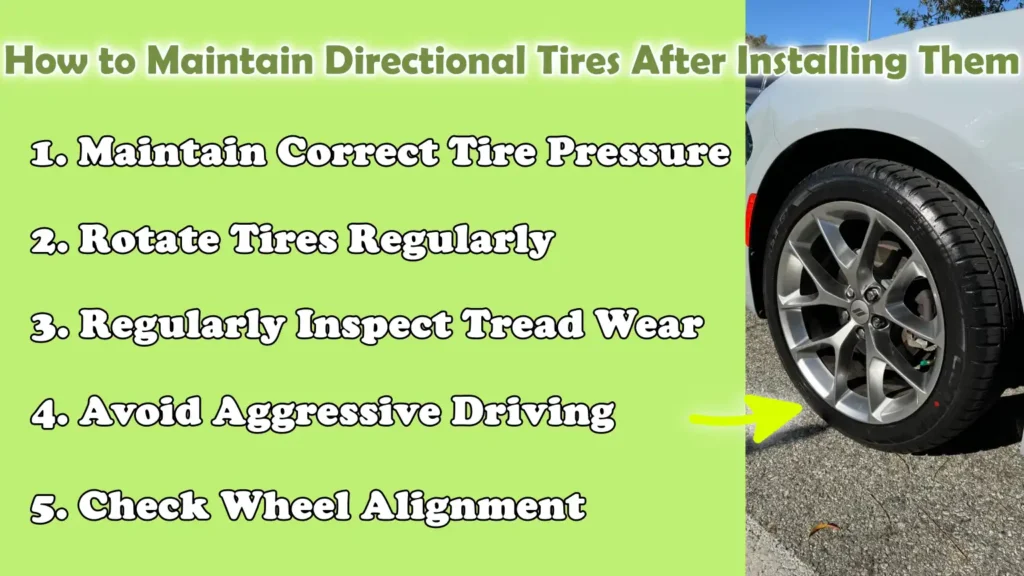
If properly maintained, directional tires can deliver excellent performance and offer a long service life; however, their performance depends significantly on regular care and proper usage.
These tires are designed with a specific tread direction that aids in water displacement, enhances grip and maintains stability; consequently, even minor maintenance habits can make a substantial difference in both safety and tire longevity.
Proper maintenance ensures that the tires continue to function exactly as intended, particularly on wet surfaces and at high speeds.
1. Maintain Correct Tire Pressure
Maintaining the correct tire pressure is one of the most critical steps in caring for directional tires, as air pressure directly influences how the tire interacts with the road surface.
When the pressure is too low, the tire may flex excessively, generating excessive heat, reducing fuel efficiency and causing uneven wear along the tire’s edges.
Conversely, when the pressure is too high, the center of the tire wears out more rapidly and the contact patch, the area touching the road, shrinks, resulting in reduced grip.
Maintaining the correct tire pressure ensures that the tread pattern functions uniformly, allowing the directional grooves to displace water effectively and maintain consistent contact with the road surface in both dry and wet conditions.
2. Rotate Tires Regularly
Regularly rotating your tires ensures that wear is distributed evenly across all four tires.
This is particularly important for directional tires, which often tend to wear out faster on the front axle due to the stresses associated with steering and braking.
As directional tires are designed to rotate in only one direction, they are typically rotated exclusively from front to rear on the same side of the vehicle.
This process helps to equalize tread wear, enhance handling stability and extend the overall lifespan of the tires.
If tires are not rotated regularly, the front tires may wear out much faster; this reduces road grip and can lead to uneven tire performance.
3. Regularly Inspect Tread Wear
Regularly checking tread wear helps identify early signs of uneven wear or performance-related issues.
Directional tires rely on a precise tread pattern to channel water away from the road surface; consequently, worn or damaged treads can significantly diminish their effectiveness.
If certain sections of a tire are wearing down faster than others, it may indicate incorrect tire pressure, alignment issues, or improper installation.
Regular inspections allow drivers to detect problems early, before they compromise safety or necessitate premature tire replacement.
4. Avoid Aggressive Driving
Driving habits have a profound impact on the lifespan of directional tires.
Sudden acceleration, hard braking and sharp cornering place excessive stress on the tire treads and shorten the tires’ useful life.
High-speed driving leads to uneven tire wear, as the tires are subjected to friction and heat levels exceeding normal conditions, circumstances for which they were not designed.
Driving smoothly maintains consistent contact between the tire and the road surface, improves fuel efficiency and ensures the tread pattern functions optimally, particularly on wet roads, where vehicle stability is paramount.
5. Check Wheel Alignment
Proper wheel alignment is crucial for ensuring even tire wear and maintaining vehicle stability.
When alignment is incorrect, the tires may tilt slightly inward or outward, resulting in uneven contact with the road surface.
This causes the tread pattern on one side of the tire to wear out prematurely and may also cause the vehicle to pull to one side while driving.
Correct alignment ensures that all tires are oriented in the proper direction and bear weight evenly; this improves steering responsiveness, extends tire lifespan and maintains consistent traction, both on straight roads and while cornering.
Read More:
- How to Identify Directional Tires Correctly
- How to Choose Tires for Snow Driving
- How to Choose Tires for Wet Roads
- How to Check Tire Load Rating
- How to Store Tires Properly Long Term
- How to Prevent Tire Dry Rot
- How to Fix Tire Bulge Issue
- How to Inspect Tire Inner Sidewall Damage
- How to Fix TPMS Sensor Not Detected
- How to Relearn TPMS Without Scan Tool
- How to Reset Tire Pressure Monitoring System Manually
- How to Check Tire Pressure Sensor Battery
- How to Seal Bead Leak in Tire
- How to Use Tire Plug Kit Correctly
- How to Repair Tubeless Tire Puncture
- How to Locate a Nail in a Tire
- How to Fix Slow Tire Air Leak
- How to Detect Tire Sidewall Damage
- How to Check Tire Tread Depth at Home
- How to Bleed ABS System Properly
- How to Replace Rusted Brake Lines
- How to Inspect Brake Lines for Rust
- How to Flush Contaminated Brake Fluid
Conclusion – How to Install Directional Tires Properly
So, in the end the thing is: directional tires are a simple idea with a powerful purpose, as these are precisely-designed to improve the safety but you need to maintain and install them in the correct direction.
Their V-shaped or angled tread patterns are specifically designed to channel water away from the tire’s surface, thereby enhancing road grip and maintaining stability across various speeds and weather conditions.
When installed correctly, these tires help mitigate the risk of hydroplaning, improve braking performance and deliver superior handling, particularly during rainy weather or on slippery roads.
However, even minor errors such as: reversing the direction of rotation or overlooking the directional arrows marked on the sidewall, as it can compromise these benefits and lead to a host of discernible issues, including increased noise, uneven tire wear, reduced traction and steering instability.
The key takeaway is that directional tires deliver their optimal performance only when every detail, from installation to inflation and rotation, is executed correctly.
With proper care, regular inspections and safe driving habits, these tires can provide long-lasting performance, improved fuel efficiency and enhanced safety.
Now, that’s all from this guide and you can comment for more information regarding this guide.
Frequently Asked Questions
FAQ 1: What are directional tires and how do they work?
Answer: Directional tires are specialized tires designed to rotate in only one specific direction. They typically feature a V-shaped or angular tread pattern, which helps channel water away from the center of the tire while driving. This design improves grip on wet roads, reduces the risk of hydroplaning (skidding on water) and helps maintain vehicle stability at high speeds. They perform optimally only when mounted in the correct direction of rotation, as indicated by an arrow mark on the sidewall.
FAQ 2: How can I identify if my tire is directional?
Answer: You can identify a directional tire by looking for an arrow mark or the word “Rotation” on the sidewall. This arrow indicates the correct direction of rotation, that is, the direction in which the tire should spin when the vehicle is moving forward. Another way to identify one is by observing the tread pattern; if the tread grooves are V-shaped and point in a single direction, it is generally a directional tire.
FAQ 3: What happens if directional tires are mounted in the wrong direction?
Answer: If directional tires are mounted in the wrong direction, their performance can be significantly compromised. The tread will be unable to channel water effectively, thereby increasing the risk of skidding on wet roads. You may also experience increased road noise, reduced grip, uneven tire wear and diminished steering stability. Simply put, the tire will still function, but it will not be as safe or effective as it was designed to be.
FAQ 4: Can directional tires be used on either side of the vehicle?
Answer: Directional tires can be used on either side of the vehicle, but only if they are mounted in such a way that the arrow indicating the direction of rotation always points forward. The key factor is not a specific side of the tire, but rather its direction of rotation. If a tire is moved to the other side of the vehicle without being dismounted from the rim, it may begin to rotate in the reverse direction, which negatively impacts its performance. At some tire shops, the tire can be dismounted from the rim and remounted, thereby allowing it to be installed on either side of the vehicle, though doing so is not always necessary.
FAQ 5: Can I rotate directional tires just like regular tires?
Answer: Directional tires cannot be rotated in all directions like regular tires. Generally, they are rotated only along the same side of the vehicle, specifically, from front to rear. This is because moving a tire to the other side without dismounting it from the rim would reverse its direction of rotation, thereby negatively affecting safety and performance. Some shops can dismount and remount the tires so that they can be installed on either side of the vehicle, but this procedure is not always necessary.
FAQ 6: Do directional tires enhance safety in rainy weather?
Answer: Yes, directional tires are specifically designed to enhance safety, particularly on wet roads. Their tread pattern rapidly evacuates water from the tire’s surface, thereby maintaining contact with the road. This reduces the risk of hydroplaning and provides better control over braking and steering during rainy conditions. This is one of the primary reasons why they are frequently used on high-performance vehicles and vehicles driven primarily on highways.
FAQ 7: Are directional tires better than regular tires?
Answer: Directional tires are not inherently “better,” but they are superior for certain specific driving conditions. Due to their tread design, they perform exceptionally well during rainy weather, at high speeds and during aggressive driving. However, compared to standard tires, the options for rotating them are limited. While standard tires are easier to rotate and maintain, directional tires prioritize performance and safety on wet roads.
References:
[1] Wikipedia, Tire tread
https://en.wikipedia.org/wiki/Tire_tread
Hello Folks, Dean Shali here to help you out to solve the problems with your lovely vehicle, as i have lots of experience and knowledge about automotive industry as i woks directly with the customers and repair vehicles and i love to help the people to keep their cars safe and running smoothly.