
Written By: Dean Shali
Fact Checked By: Sabré Cook
Reviewed By: Tamara Warren
Your vehicle’s wheels directly controls how your car grips, steers, brakes and stays stable on the road, as it is not just for holding the tires in place.
There’s not doubt that: when you upgrade your wheels then it gives your vehicle nice and stylish modified look, but you also have to make sure that it stays completely secure and doesn’t compromise with performance even a little bit.
Because, the wheels and tires are the only parts of the vehicle that actually touches the road, which is why even with the small changes in wheel size, offset, weight, width or tire fitment literally changes the steering feel, braking performance, suspension movement, ride comfort and tire wear as well.
But, many drivers just install larger aftermarket wheels for having the sportier appearance and doesn’t realize that incorrect fitment can actually create some serious problems such as: steering vibration, rubbing noises, uneven tire wear, reduced fuel economy, poor acceleration, wheel bearing stress, brake clearance issues and unstable handling during the emergency time.
Now, in this guide you’ll learn How to Upgrade Wheels Safely so that you can choose the design and also carefully calculate wheel offset, load capacity, tire diameter and suspension geometry to maintain the safety, traction and predictable road behavior under the all-weather conditions.
So, Why Do People Change Their Wheels?
Changing wheels is a common practice because it alters both the vehicle’s aesthetic appeal and its driving dynamics.
Wheels influence tire fitment, steering feel, braking capability, suspension performance and vehicle stability on the road; consequently, replacing them results in a noticeable difference in the vehicle’s overall character.
Some drivers change their wheels for the sake of style, while others seek improved handling, greater durability, or enhanced capability for specific conditions such as: driving in snow or on rough terrain.
Choosing the right wheels enhances comfort, control and driver confidence, whereas ill-fitting wheels can compromise safety or lead to unnecessary wear and tear on the vehicle.
1. Enhanced Aesthetics and Styling
Many people change their wheels to make their vehicle more visually appealing.
New wheels can give a vehicle a sportier, more modern, or more aggressive look, even if no other modifications have been made.
Wheel size, spoke design and fitment all combine to help transform the vehicle’s overall styling.
A vehicle with the right styling appears balanced and well-proportioned, whereas an improper fitment can make the vehicle look unbalanced or awkward.
Although the vehicle’s appearance is often the primary motivation behind changing wheels, selecting the correct size remains crucial for safe driving.
2. Improved Handling and Cornering Control
Wheels can enhance handling by influencing the contact interface between the tires and the road surface.
Wider wheels typically accommodate wider tires, which improves the vehicle’s grip during cornering and braking.
A performance-oriented wheel setup can also minimize tire sidewall flex, resulting in steering that feels sharper and more responsive.
This proves particularly beneficial when taking corners at high speeds or executing sudden lane changes.
Overall, a proper wheel setup can significantly enhance a vehicle’s stability, specially at high speeds on highways.
3. Weight Reduction through Lightweight Wheels
Many aftermarket wheels available on the market are lighter than the vehicle’s factory-installed wheels, a factor that can improve the vehicle’s overall performance.
Lighter wheels reduce the vehicle’s “unsprung weight” (the weight of the components below the suspension), allowing the suspension system to react more quickly to potholes and uneven road surfaces.
These wheels also reduce the vehicle’s rotational mass, which can lead to slight improvements in acceleration and braking capabilities.
Lightweight “forged” wheels are particularly popular, as they offer an excellent combination of strength and low weight.
Even a slight reduction in weight can enhance the driving experience and boost the vehicle’s efficiency.
4. Increased Brake Clearance for Performance Cars
Performance vehicles often require larger wheels to accommodate larger braking systems.
While larger brake rotors and calipers increase stopping power, they demand more internal clearance within the wheel.
Installing larger wheels creates the necessary space for these components.
This is a common practice not only for sports cars but also for vehicles used for towing or high-speed driving.
Adequate brake clearance is crucial, as contact between the wheel and brake components can be hazardous.
5. Off-Road Capability and Durability
Owners of trucks and SUVs often upgrade their wheels to enhance off-road performance.
Off-road wheels are generally more robust and are designed to withstand the shocks and impacts faced on rocky terrain, potholes and rough trails.
They can also be fitted with wider tires to ensure superior traction on mud, sand, or gravel.
In some configurations, smaller wheels paired with taller tires are utilized to enhance shock absorption capabilities.
These upgrades prioritize strength, durability and control in challenging conditions.
6. Seasonal Wheel Sets for Winter or Summer
Some drivers utilize distinct sets of wheels for different seasons.
Winter wheel sets typically feature snow tires to ensure optimal traction during cold weather.
Smaller wheels paired with taller tires often perform better in snowy conditions and can navigate potholes more safely.
Summer sets typically employ larger wheels and performance tires to provide superior grip on dry roads.
Seasonal wheel sets also serve to protect expensive rims from damage caused by road salt and harsh winter conditions.
Understand the Basics Before Upgrading Your Wheels
Before upgrading your wheels, it is crucial to understand the basic measurements, as even a slight discrepancy can compromise the vehicle’s safe operation.
Wheels are not merely decorative components; they directly influence steering response, suspension travel, braking performance, tire wear, fuel efficiency and ride comfort.
Manufacturers design each vehicle to accommodate specific wheel sizes; therefore, altering wheel dimensions without a grasp of the fundamentals can lead to rubbing, vibrations, poor handling, or excessive strain on wheel bearings and suspension components.
Familiarizing yourself with specific measurements will help you select wheels that fit correctly and function safely.
1. What is Wheel Diameter?
Wheel diameter refers to the size of the wheel, measured across its center from one edge to the other, typically expressed in inches.
Common sizes include 15-inch, 17-inch, 18-inch and 20-inch wheels.
This measurement determines the size of the tire that can be fitted, as well as the height of the tire’s sidewall.
Larger wheels generally require low-profile tires; while this can enhance steering response, it often results in reduced ride comfort.
Conversely, smaller wheels typically accommodate taller tire sidewalls, which are more effective at absorbing bumps and improving comfort on rough or uneven roads.
2. What is Wheel Width?
Wheel width is the distance between the inner edges of the wheel, specifically, the points where the tire seats against the rim.
This dimension determines the range of tire widths that can be safely mounted on a wheel.
A wider wheel can accommodate a wider tire, often resulting in improved grip as a larger portion of the tire comes into contact with the road.
However, wheels that are excessively wide may rub against the fenders, compromise steering feel and lead to uneven tire wear.
Wheel width should be selected based on the tire size and the available clearance within the wheel well.
3. What is Wheel Offset?
Wheel offset is the distance between the wheel’s centerline and the mounting surface that rests against the hub.
This measurement determines how far inward or outward the wheel sits relative to the suspension and fenders.
A positive offset positions the wheel further inward, while a low or negative offset pushes it outward.
Offset = Centerline Position – Hub Mounting Surface Position
An incorrect offset can cause tire rubbing, alter steering dynamics, accelerate wheel bearing wear and negatively impact suspension geometry.
This is one of the most critical measurements to consider when upgrading wheels.
4. What is a Bolt Pattern?
The bolt pattern specifies the number of lug holes in a wheel and the spacing between them.
It is typically expressed as a numerical sequence such as: 5×114.3, indicating that there are five lug holes arranged in a circle (or Pitch Circle Diameter) of 114.3 mm.
The wheel’s bolt pattern must precisely match the vehicle’s pattern.
Even a slight discrepancy will prevent the wheel from seating properly, potentially posing a serious safety hazard.
Using an incorrect bolt pattern can lead to vibrations, loose wheels, or damaged studs.
5. What is the Hub Bore?
The hub bore is the central opening in a wheel that fits onto the vehicle’s hub.
This central opening helps ensure that the wheel remains perfectly centered during installation.
If the hub bore is too small, the wheel will not fit.
If it is too large, a hub ring may be required to properly center the wheel.
Even if the wheel itself is perfectly balanced, an improper hub fitment can still result in steering vibrations.
6. What is a Wheel Load Rating?
The wheel load rating indicates the maximum weight that a single wheel is designed to safely support.
Every vehicle has a specific curb weight, which includes passengers, cargo and towing loads, and the wheels must be capable of safely handling this weight under all driving conditions.
Installing wheels with a load rating lower than the vehicle’s requirements increases the risk of bending, cracking, or structural failure.
This is particularly critical for SUVs, trucks, EVs and heavy-duty vehicles.
7. What is the Difference Between Cast, Flow-Formed and Forged Wheels?
Cast wheels are produced by pouring molten aluminum into a mold; this makes them affordable and the standard choice for everyday driving.
They are generally heavier and not as strong as premium options.
Flow-formed wheels begin as cast wheels but undergo an additional strengthening process involving the spinning and compressing of the wheel barrel; this makes them both lighter and stronger than standard cast designs.
Forged wheels are crafted from solid blocks of aluminum subjected to immense pressure, resulting in exceptional strength at a reduced weight.
Forged wheels are generally the strongest and lightest option, although they also come with a significantly higher price tag.
How to Check Your Vehicle’s Factory Wheel Specifications
Before purchasing new wheels, the safest approach is always to verify your vehicle’s factory wheel specifications.
Vehicle manufacturers design every vehicle with precise wheel and tire dimensions to ensure that the steering, braking, suspension, speedometer and safety systems function correctly.
Factory specifications are rigorously tested for weight distribution, suspension clearance and road stability, meaning they serve as the baseline standard for any safe wheel upgrade.
Ignoring these measurements often leads to common issues such as tire rubbing, unstable steering, vibrations, inaccurate speedometer readings and the premature wear of suspension components.
Checking the OEM specifications first helps you understand the type of wheels your vehicle was designed to use and how safely you can deviate from that original setup.
1. Where to Find OEM Wheel Information
The easiest way to obtain factory wheel information is to check the official labels and manufacturer documentation that came with the vehicle.
A sticker located on the driver’s door typically indicates the original tire size and recommended tire pressure, providing crucial information regarding wheel dimensions.
The owner’s manual often offers detailed information regarding wheel size, approved tire sizes and load-related recommendations for various trim levels.
The tire label, usually located on the door frame or near the fuel filler area, depending on the vehicle, also lists the specifications for the original tires selected by the manufacturer.
These factory sources are more reliable than making estimates or comparing online photographs, as different wheel designs may be utilized across various trim levels of the same vehicle model.
2. Why OEM Specifications Are Important
OEM wheel specifications are crucial because the suspension geometry of every vehicle is specifically engineered based on these precise dimensions.
Wheel diameter, width and offset, all these factors influence how the tires align with the suspension, brakes, steering components and body panels.
If a new wheel significantly alters these relationships, the vehicle’s steering characteristics may change, tires may wear unevenly, or excessive stress may be placed on wheel bearings and steering components.
OEM specifications also ensure adequate brake clearance and proper load support relative to the vehicle’s total weight.
Treating factory specifications as the baseline standard helps prevent fitment errors, thereby ensuring that the vehicle remains safe, predictable and comfortable even after upgrades.
3. Critical Measurements You Should Never Overlook
Wheel diameter determines the overall size of the wheel and dictates which tire sizes can be fitted.
If the wheel diameter is significantly altered without adjusting the tire’s sidewall height, the overall tire diameter changes; this can impact speedometer accuracy and the functioning of the drivetrain.
Wheel width determines which tire widths are safe to use and ensures that the tire sidewall seats correctly on the rim.
Choosing an incorrect width can compromise tire traction and lead to uneven tire wear.
Offset determines how far inward or outward the wheel sits relative to the suspension and fenders.
Incorrect offset is one of the most common causes of wheel bearing wear, vibrations and excessive stress.
The bolt pattern must match precisely; even a slight misalignment will prevent the wheel from seating correctly, potentially creating dangerous instability within the wheel assembly.
The center bore ensures that the wheel sits perfectly centered on the hub, a critical factor in preventing vibrations at highway speeds.
The tire size must correspond to the wheel dimensions and maintain a safe overall diameter to ensure proper vehicle handling and accurate speedometer readings.
The “lug seat type” refers to the specific shape of the contact surface between the lug nut and the wheel such as: conical, spherical (ball), or flat.
Using an incorrect lug seat type prevents the wheel from being properly secured, which can lead to it loosening over time.
All these specifications work in conjunction; overlooking any one of them can result in safety-related issues that may only become apparent once the vehicle is in motion.
How to Safely Choose the Right Wheel Size
Selecting the correct wheel size is crucial when upgrading wheels, as wheel size directly impacts ride comfort, steering response, braking, acceleration and suspension travel.
Many drivers opt for larger wheels primarily to enhance the vehicle’s aesthetics; however, altering the wheel size also changes the tire’s sidewall height and overall diameter, factors that have a direct bearing on the vehicle’s performance.
Vehicle manufacturers select wheel sizes based on suspension design, braking systems and vehicle weight; therefore, making frequent and ill-considered changes to this configuration can lead to issues regarding fitment and performance.
A safe wheel upgrade entails choosing a size that enhances the vehicle’s aesthetics or improves its handling, while simultaneously maintaining the correct tire diameter, ensuring adequate ground clearance and preserving the vehicle’s original on-road dynamics.
1. How Larger Wheels Affect Ride Quality
Larger wheels typically necessitate tires with a lower sidewall profile, as the overall tire diameter must remain close to the standards established by the manufacturer.
A lower sidewall offers less flexibility, resulting in a more precise steering feel and improved vehicle responsiveness when cornering.
However, a lower sidewall also implies that the cushioning (comfort) provided to the vehicle over potholes and rough roads is reduced.
Consequently, the ride often feels stiffer, and at times, more jarring, particularly in vehicles used for daily commuting.
While larger wheels can offer a more direct connection with the road, they typically compromise ride comfort, as the tires become less effective at absorbing shocks and vibrations emanating from the road surface.
2. Pros and Cons of Increasing Wheel Size
Increasing wheel size can enhance a vehicle’s aesthetics, improve steering response and provide more clearance for braking components.
Larger wheels often lend a sportier look to the vehicle and facilitate the installation of wider tires, which can lead to improved road grip (traction).
Furthermore, they can provide the necessary space to accommodate larger brake rotors and calipers.
However, larger wheels are often heavier, which can result in reduced fuel efficiency and place greater stress on suspension components.
This can also increase the cost of tire replacements and lead to higher levels of road noise entering the cabin.
The ideal upgrade strikes the right balance between the vehicle’s aesthetics and performance, ensuring that the deviation from the factory-specified wheel size remains within reasonable limits.
3. Risks of Installing Excessively Large Wheels
Installing wheels that are excessively large can give rise to several issues, potentially compromising both the vehicle’s safety and comfort.
Tire rubbing, where the wheel or tire makes contact with the vehicle’s fenders or suspension components, is a common problem that frequently occurs while cornering or driving on rough, pothole-ridden roads.
If wider wheels interfere with the control arms, struts, or brake components, it can lead to issues regarding suspension clearance.
Altering the overall tire diameter can also cause speedometer inaccuracies, as the vehicle calculates its speed by measuring the rotational velocity of the wheels.
Larger and heavier wheels can also reduce a vehicle’s acceleration, as the engine is required to exert greater effort to rotate them.
In some instances, braking distances may increase because greater force is needed to halt the increased rotational mass, particularly during sudden braking situations.
4. Understanding Safe ‘Plus-One’ and ‘Plus-Two’ Sizing
Safe upsizing typically employs the “Plus-One” or “Plus-Two” method.
“Plus-One” entails increasing the wheel diameter by one inch, for example, upgrading from a 17-inch wheel to an 18-inch wheel.
“Plus-Two” involves an increase of two inches.
In both scenarios, the tire’s sidewall height is reduced so that the overall tire diameter remains close to the original factory specifications.
This approach helps maintain speedometer accuracy and minimizes the risk of tire rubbing or suspension-related issues.
This method is widely adopted because it enhances both the vehicle’s aesthetics and handling without significantly altering its original driving dynamics.
5. How Tire Sidewall Height Changes When Wheel Diameter Is Altered
When the wheel diameter is increased, the tire’s sidewall height typically needs to be reduced to ensure that the overall tire size remains consistent with the original setup.
This ensures that the tire does not become excessively tall, thereby preventing issues such as rubbing against the vehicle’s bodywork or suspension components.
Total Tire Diameter = Wheel Diameter + 2 × (Tire Sidewall Height)
This relationship is crucial, as merely changing the wheel size, without adjusting the tire sidewall, as it can adversely affect speedometer accuracy, vehicle handling and drivetrain performance.
It is essential to keep the total tire diameter close to the factory specifications.
How to Choose the Correct Wheel Offset
Wheel offset is one of the most critical measurements when upgrading wheels, as it determines the wheel’s positioning relative to the suspension, brakes and fenders.
Even if the bolt pattern and wheel size are correct, an incorrect offset can lead to severe fitment issues.
Offset alters how far inward or outward the wheel sits relative to the hub, directly impacting steering geometry, suspension function and tire clearance.
Many wheel fitment problems stem from selecting the wrong offset; while it may give the wheels an “aggressive” look, it can also result in rubbing, vibrations and excessive stress on suspension components.
Understanding offset helps prevent costly mistakes and ensures the safe operation of the vehicle.
1. Positive vs Negative Offset
Positive offset means that the wheel’s mounting surface is closer to the outer face of the wheel, causing the wheel to sit deeper within the wheel well.
Most modern passenger cars utilize positive offset, as it helps maintain the factory steering geometry and keeps the wheel aligned with the suspension components.
Negative offset means that the mounting surface is closer to the back of the wheel, effectively pushing the wheel outward.
This is more common in certain off-road vehicles and trucks, where a wider stance is often desired.
A lower offset can give the vehicle a wider appearance, but excessive deviation can negatively affect steering performance and create clearance issues.
2. How Offset Affects Suspension Geometry
Offset alters the positioning of the tire relative to suspension components such as: the strut, control arm and wheel bearing.
If a wheel is mounted too far inward, it may make contact with suspension components during cornering or when the suspension articulates vertically.
Conversely, if it is mounted too far outward, it increases the load on the wheel bearings and alters the manner in which suspension forces are distributed.
Suspension geometry is engineered with meticulous precision and any deviation in offset can alter the operating angles of the suspension system.
This can have repercussions on vehicle handling, ride quality and component longevity.
3. Changes in Steering Feel and Scrub Radius
Wheel offset also influences the scrub radius, the distance between the tire’s contact patch on the road surface and the steering axis.
Altering the offset changes this relationship, which can result in the steering feeling heavier, lighter, or less stable.
When wheels protrude too far outward, drivers often experience increased steering kickback, sudden jolts felt through the steering wheel, when driving over potholes or rough terrain.
Drivers may also perceive increased pulling or vibration in the steering wheel while navigating uneven road surfaces.
The correct offset ensures proper steering response and helps maintain the ideal balance between road feel and stability, precisely as the vehicle was originally designed.
4. The Risks of Incorrect Offset
Incorrect offset can give rise to several serious issues.
“Fender rubbing” occurs when the tire makes contact with the inner fender liner during cornering or when the suspension compresses.
Pushing the wheels outward places excessive stress on the wheel bearings, leading to premature wear and potentially reducing their lifespan.
Steering instability may arise because the altered “scrub radius” causes the vehicle to react differently to road forces, a concern that can be particularly critical in emergency situations.
Uneven tire wear is also a common consequence, as the tire no longer maintains its original alignment position.
These issues often manifest gradually; consequently, some drivers remain unaware of the problem until damage has already begun to occur.
5. Recommendations for Safe Offset Limits
The safest approach is to remain close to the factory offset, making only minor adjustments unless precise fitment measurements have been verified.
Many vehicles can safely accommodate slight variations in offset; however, deviating significantly from OEM (Original Equipment Manufacturer) specifications increases the risk of rubbing and handling-related issues.
A subtle difference can enhance a vehicle’s aesthetics without compromising its performance, but major modifications should only be undertaken after simultaneously verifying suspension clearance, tire size and wheel width.
Offset selection should never be based solely on aesthetics, as proper fitment is always more critical than simply how far the wheel protrudes toward the fender.
How to Match the Correct Bolt Pattern and Hub Bore
When upgrading your wheels, matching the correct bolt pattern and hub bore is crucial, as these two measurements determine whether the wheel will seat properly on the vehicle.
Even if the wheel’s diameter and width appear correct, even a slight discrepancy in the bolt pattern or center bore can lead to vibrations, improper fitment and serious safety issues.
Wheels are designed to fit with absolute precision so that the vehicle’s weight is distributed evenly across the hub and lug hardware.
Improper fitment can place excessive stress on the studs, cause the wheels to loosen and compromise steering stability.
Therefore, verifying these measurements before purchasing wheels is just as important as checking the size or offset.
1. Why Bolt Pattern Accuracy Matters
The bolt pattern refers to the number of lug holes and the diameter of the circle they form.
It is typically expressed in a format such as 5×114.3; this indicates that the wheel features five lug holes arranged on a circle with a diameter of 114.3 mm.
This measurement must align perfectly with the vehicle’s specifications, as even a minor deviation will prevent the wheel from seating correctly.
Some wheels may appear to fit, specially if their patterns look similar, but forcing them onto studs for which they were not designed can damage the threads and render the vehicle unsafe to drive.
The correct bolt pattern ensures that the wheel remains properly centered and maintains stability during braking, cornering and highway driving.
2. Understanding Common Bolt Patterns
Different vehicles utilize varying bolt patterns depending on the manufacturer and design.
Passenger cars often employ patterns such as 5×100, 5×112, or 5×114.3, whereas trucks may utilize larger patterns like 6×139.7.
The first number indicates the quantity of lug holes on the wheel, while the second number specifies the diameter of the bolt circle in millimeters.
It is possible for two different vehicles to share the same number of lugs yet have differing bolt circle diameters; in such instances, the wheel will not fit.
Therefore, when purchasing aftermarket wheels, simply counting the lug holes is insufficient.
3. Hub-Centric vs Lug-Centric Wheels
Hub-centric wheels are designed such that their center bore fits precisely and securely onto the vehicle’s hub.
This allows the hub to bear the weight of the wheel and ensures that the wheel remains perfectly centered during installation.
Most factory-produced wheels are hub-centric, as this design minimizes vibration and improves alignment.
Lug-centric wheels center themselves using the lug nuts rather than the hub.
Some aftermarket wheels are manufactured in this manner to ensure compatibility with a wide range of vehicles; however, they require careful installation and tightening the lug nuts in the correct sequence is critical.
Hub-centric fitment is generally preferred because it results in more precise wheel centering and provides a smoother driving experience.
4. Are Hub Rings Safe?
Hub rings are utilized when the center bore of an aftermarket wheel is larger than the vehicle’s hub.
These rings fill the gap between the wheel and the hub, ensuring that the wheel remains perfectly centered.
Provided they are of the correct size and installed properly, hub rings are generally safe and their use is a common practice.
They help prevent the vibrations that can occur when a wheel is mounted even slightly off-center.
Hub rings can be made of either plastic or metal; if correctly matched, both materials can function effectively.
They cannot serve as a substitute for the correct bolt pattern; however, if the wheel’s center bore is significantly oversized, they can safely improve the hub fitment.
5. The Risks of Using Incorrect Adapters or Spacers
Adapters and spacers are sometimes used to install wheels that do not match the vehicle’s original specifications; however, their improper use can lead to serious problems.
Poor-quality adapters may fail to properly center the wheel and can place excessive stress on the wheel studs.
Thick spacers can drastically alter the wheel’s offset, creating a risk of wheel rubbing or increasing the load on the wheel bearings.
Adapters used to change the bolt pattern are effective only when they have been specifically designed for that particular vehicle and are installed correctly.
Using low-quality or incorrectly sized components can result in vibrations, loosening of the wheels and difficulties in controlling the vehicle.
Without precise measurements and safety checks, these parts should never be used to force a wheel onto a vehicle for which it was not originally designed.
How to Choose Safe Tires for Your New Wheels
Selecting the right tires is just as crucial as choosing the right wheels, as tires are the specific components of the vehicle that actually make contact with the road.
If the size, type, or quality of the tires is incorrect, even the finest wheels cannot guarantee safety.
Upgrading to new wheels often necessitates replacing existing tires; therefore, drivers must carefully match tire sizes to ensure optimal grip, braking performance, ride comfort and steering control.
Tire size impacts speedometer accuracy, suspension clearance, wet-road traction and the vehicle’s overall stability.
A safe wheel upgrade always involves selecting tires that are fully compatible with the new wheels and capable of handling the vehicle’s weight, speed and intended driving conditions.
1. Understanding Tire Width and Aspect Ratio
Tire width refers to the width of the tire’s tread (the section that contacts the road), measured in millimeters; it determines the surface area of the rubber in contact with the road.
Wider tires typically provide superior grip during cornering and braking by increasing the surface area of the contact patch.
However, tires that are excessively wide may rub against suspension components or fenders.
The aspect ratio indicates the height of the sidewall relative to the tire’s width, expressed as a percentage.
A lower aspect ratio signifies a shorter sidewall, which typically enhances steering response but may result in a slightly firmer ride.
Maintaining the proper balance between tire width and sidewall height ensures that ride comfort is preserved while simultaneously improving vehicle control.
2. Maintaining the Correct Overall Tire Diameter
When you upgrade your wheels, the overall diameter of the tire should remain close to the dimensions specified by the manufacturer.
This means that if the wheel diameter increases, the tire’s sidewall profile typically needs to be reduced.
Maintaining the correct overall tire diameter is crucial because the speedometer, odometer, ABS and traction control systems rely on accurate wheel rotation data to function correctly.
If the tire becomes significantly larger or smaller than the specified size, the vehicle’s speed readings may become inaccurate and the vehicle may fail to perform properly during critical braking or stability situations.
Keeping the overall diameter close to the factory size ensures that the vehicle’s original driving characteristics and safety systems remain intact.
3. Understanding Load Index and Speed Rating
Every tire has a load index and a speed rating, which indicate the maximum weight it can support and the maximum speed at which it can be safely operated.
The load index is vital because tires must support the entire weight of the vehicle, as well as the combined weight of passengers and cargo.
Installing tires with a load rating lower than required can increase the risk of tire overheating or structural failure.
The speed rating indicates how well the tire can withstand the heat and stress generated at high speeds.
Even daily drivers should use tires with the appropriate ratings, as this reflects the tire’s structural integrity and safety performance under real-world driving conditions.
4. Why Can Cheap Tires Be Dangerous?
Although cheap tires may save money initially, they often feature poor construction, utilize lower-quality rubber compounds and deliver poor performance on wet surfaces.
Poor-quality tires may require a longer braking distance, specially on wet roads, and tend to wear out much faster.
Furthermore, some inexpensive tires feature weak sidewalls, which increases the risk of a blowout when driving over potholes or hauling heavy loads.
As tires constitute the sole point of contact with the road, poor tire quality directly impacts braking distance, traction and vehicle handling capabilities during emergency situations.
Investing in reliable tires typically yields greater improvements in safety compared to almost any other modification made to the wheels.
5. Summer, All-Season and Winter Tires
Different types of tires are designed to suit varying temperatures and road conditions.
Summer tires provide robust traction on both dry and wet roads during warm weather and typically enhance steering responsiveness; however, their performance deteriorates significantly in extremely cold temperatures.
All-season tires are engineered for diverse weather conditions, striking a good balance between comfort, durability and year-round utility.
Winter tires utilize softer rubber compounds and deeper tread patterns that remain flexible even in freezing temperatures, thereby improving grip on snow and ice.
The choice of the right tire depends on local weather conditions and how the vehicle is used throughout the year.
6. Risks and Safety Concerns Associated with Tire Stretching
Tire stretching occurs when a tire is mounted onto a wheel that is wider than the tire’s original design specifications, causing the tire’s sidewalls to stretch outward.
Although some drivers opt for this style for aesthetic purposes, it compromises sidewall support and can negatively impact safety.
A stretched tire may offer reduced protection to the rim, diminish shock-absorbing capabilities and increase the risk of bead separation during severe impacts.
It can also reduce tire traction, as the tire is unable to seat properly against the road surface in the manner for which it was designed.
For daily driving, selecting a tire width that is appropriate for the wheel width is a safer choice; this ensures better vehicle handling, improved braking performance and extended tire longevity.
Read More:
- How to Check Wheel Offset Compatibility
- How to Fix Wheel Wobble Issue
- How to Diagnose Wheel Wobble at Speed
- How to Inspect Wheel Hub Damage
- How to Replace Broken Wheel Stud
- How to Remove Stuck Lug Nuts
- How to Torque Lug Nuts Correctly
- How to Check Wheel Lug Torque
- How to Install Directional Tires Properly
- How to Identify Directional Tires Correctly
- How to Choose Tires for Snow Driving
- How to Choose Tires for Wet Roads
- How to Check Tire Load Rating
- How to Store Tires Properly Long Term
- How to Prevent Tire Dry Rot
- How to Fix Tire Bulge Issue
- How to Inspect Tire Inner Sidewall Damage
- How to Fix TPMS Sensor Not Detected
- How to Relearn TPMS Without Scan Tool
- How to Reset Tire Pressure Monitoring System Manually
- How to Check Tire Pressure Sensor Battery
- How to Seal Bead Leak in Tire
- How to Use Tire Plug Kit Correctly
How Wheel Material and Construction Quality Matters
The material and construction quality of wheels matter far beyond mere aesthetics, as they directly impact strength, safety, weight, durability and driving performance.
Wheels bear the entire weight of the vehicle and constantly withstand impacts from potholes, road debris, braking forces and cornering stresses.
A wheel that looks attractive but possesses a weak structure is far more likely to bend, crack, or fail prematurely compared to a properly engineered wheel.
This is precisely why the type of material and the quality of construction are critical considerations whenever you install a new set of wheels.
The right wheel should be suited to the vehicle’s intended use, whether for daily commuting, high-performance driving, towing, or off-road adventures.
1. Aluminum vs Steel Wheels
Most new vehicles come equipped with aluminum wheels, as they are lightweight and often enhance the vehicle’s aesthetic appeal.
Aluminum alloy wheels help reduce the vehicle’s overall weight, which can lead to improved steering response, braking feel and fuel efficiency.
They also offer greater design flexibility, allowing manufacturers to create a wide variety of styles and spoke patterns.
Steel wheels are heavier, but they generally withstand severe impacts more effectively and are often less expensive to replace.
They are typically used for winter driving, work vehicles and base-model trims, as they are durable and, if bent, are relatively easy to repair.
Aluminum is generally preferred for everyday comfort and enhanced performance, whereas steel is chosen for rugged terrain and cost-effectiveness.
2. Strength of Cast vs Forged Wheels
Cast wheels are produced by pouring molten aluminum into a mold, making them an economical option that is well-suited for driving on standard roads.
While adequate for typical driving conditions, they are generally heavier and do not withstand severe impacts as effectively as premium alternatives.
Forged wheels are created by subjecting solid aluminum to immense pressure, resulting in a very dense and robust structure.
Due to this process, forged wheels are not only lighter but also capable of withstanding greater stress.
This is why they are a popular choice for high-performance vehicles and demanding driving conditions.
Flow-formed wheels fall somewhere between these two categories; they offer greater strength compared to standard cast wheels, while remaining more affordable than forged designs.
3. How Lightweight Wheels Improve Performance
Lightweight wheels enhance performance by reducing “unsprung mass”, the weight that is not supported by the suspension springs.
Lower unsprung weight allows the suspension to react more rapidly when the vehicle faces uneven terrain or potholes, thereby improving road contact and ride control.
Lightweight wheels also reduce rotational mass (the weight of rotating components), meaning the engine and brakes require less effort to accelerate or decelerate the vehicle.
This can lead to improvements in steering response, acceleration, braking distance and fuel efficiency.
Although this difference may seem minor, the impact of reduced wheel weight is felt every time the vehicle accelerates, brakes, or turns.
4. Signs of Low-Quality or Unsafe Wheels
Low-quality wheels often exhibit certain warning signs that should not be ignored.
Poor finishing, rough casting marks, uneven paintwork and visible defects around the lug holes or center bore can all be indicators of substandard manufacturing.
Wheels that feel excessively heavy for their size may have been constructed using inferior-grade materials.
While inexpensive counterfeit wheels may visually mimic premium designs, they typically lack the strength and durability of their high-quality counterparts.
Cracks near the spokes, rim deformation upon impact with small potholes, or persistent vibrations even after wheel balancing can all serve as warning signs.
Unsafe wheels may fail under heavy braking, on rough roads, or when subjected to sudden impacts; therefore, manufacturing quality is a critical aspect of safety.
5. Certifications to Look For
Certifications indicate that wheels have been tested for structural integrity and compliance with safety standards.
SAE standards are widely recognized in automotive engineering and signify that the structural reliability of the wheels has been validated.
JWL certification indicates that the wheel meets Japanese durability requirements regarding load-bearing capacity and impact resistance.
VIA provides independent verification that the wheel has successfully passed the necessary tests.
TÜV certification is highly regarded for its rigorous European safety and quality testing protocols.
So, How Wheel Weight Affects Vehicle Performance
Wheel weight has a profound impact on a vehicle’s driving dynamics, as wheels are in constant rotation and constitute an integral part of the suspension system.
Many drivers focus solely on a wheel’s size and design; however, its weight can significantly influence the vehicle’s acceleration, braking, ride comfort, steering feel and fuel efficiency.
Heavier wheels require more energy to set in motion and demand greater force to bring to a halt, thereby diminishing the vehicle’s overall efficiency.
As wheels are in direct contact with the road, altering their weight can make the vehicle feel either more responsive or notably sluggish.
This is precisely why high-performance vehicles often utilize lightweight wheels, whereas heavy-duty vehicles prioritize durability over weight reduction.
1. Understanding Unsprung Weight
Unsprung weight refers to those components of a vehicle that are not supported by the suspension springs.
This category includes the wheels, tires, brakes, hubs and specific elements of the suspension system.
Because these components move in direct tandem with the road surface, their weight influences the speed at which the suspension can react.
Heavier wheels increase unsprung weight, which can compromise the suspension’s ability to maintain consistent contact between the tires and the road.
Conversely, lower unsprung weight generally enhances a vehicle’s handling, as it enables the suspension to respond more rapidly to potholes and changing road conditions.
2. Impact on Suspension Response
When driving on rough roads, the weight of the wheels directly influences how the suspension system performs.
Heavier wheels retain greater momentum as they move up and down; consequently, the shock absorbers and springs must exert more force to bring them under control.
The suspension’s response can become sluggish after facing potholes or driving over uneven terrain.
Lighter wheels alleviate this burden, allowing the suspension to rebound to its neutral position more rapidly and maintain better contact with the tires.
Enhanced tire contact improves the vehicle’s traction and stability, particularly when cornering or braking on uneven surfaces.
This is why lighter wheels often provide a superior road feel and greater steering precision.
3. Impact on Acceleration and Braking
Wheel weight affects a vehicle’s acceleration, as the engine is required to rotate the wheels whenever the vehicle is in motion.
Heavier wheels possess greater rotational mass, meaning they offer more resistance to changes in speed compared to lighter wheels.
This can result in sluggish acceleration, particularly in vehicles equipped with smaller engines.
Braking is similarly affected, as greater force is required to decelerate heavier wheels.
The brakes must work harder to counteract the additional rotational mass, which may result in the vehicle taking slightly longer to come to a complete stop.
Lighter wheels reduce this burden, making the process of bringing the vehicle to a halt quicker and more effortless.
4. Impact on Fuel Economy
Heavier wheels can negatively impact fuel economy, as the engine is compelled to expend more energy to rotate them.
This effect is particularly evident when driving in urban areas, where the vehicle frequently accelerates and decelerates.
Larger wheels are often heavier than the factory-fitted ones; furthermore, if paired with wider tires, rolling resistance (friction) can also increase.
Over time, this can result in a reduction in the vehicle’s fuel efficiency.
Lighter wheels can offer a slight improvement in fuel economy by reducing both rotational inertia and the vehicle’s overall weight.
Although this difference may not be substantial, it becomes distinctly noticeable during prolonged daily driving.
5. Aspects Related to Driving Comfort
Wheel weight also impacts driving comfort, as it alters how the suspension absorbs road shocks and vibrations.
Heavier wheels can make rough roads and potholes feel more pronounced, as they exert greater force through the suspension system.
If paired with low-profile tires, the overall driving experience may deteriorate even further.
Lighter wheels often enhance comfort by helping the suspension absorb road surface irregularities more effectively.
Consequently, daily driving becomes more comfortable, particularly on rough or uneven roads.
The optimal setup strikes a perfect balance between weight, wheel durability and tire sidewall height, ensuring that both driving comfort and vehicle handling are maintained.
How to Ensure That Wheels Do Not Interfere with the Brakes
When upgrading your wheels, checking for brake clearance (the space between the brake components and the wheel) is crucial; even if the wheel size and bolt pattern are correct, the wheel may still not fit properly over the brake components.
Modern vehicles often utilize large brake calipers and rotors, particularly in performance models, SUVs, trucks and vehicles designed for towing.
If a wheel lacks sufficient internal clearance, it may collide with the caliper or rotor, rendering the vehicle unsafe to drive.
Brake clearance is not determined solely by the wheel’s diameter; rather, the design of the wheel spokes and the shape of the inner barrel also significantly impact fitment.
A wheel may appear to fit correctly from the outside, yet still present internal clearance issues.
Regularly checking for brake clearance can help you avoid costly returns and mitigate serious safety risks.
1. Why Brake Clearance Is Important
Brake clearance is essential because the wheel rotates around the brake system and all components require sufficient space to move freely.
Even the slightest contact between the wheel and the brake caliper can generate friction, potentially damaging the wheel and compromising braking performance.
In severe cases, such interference can prevent the wheel from rotating properly altogether.
During operation, brake components expand due to heat; consequently, frequent braking can exacerbate issues associated with insufficient clearance.
Proper clearance ensures that the brakes function safely under normal driving conditions, during sudden braking and while driving on long descents, situations where heat builds up rapidly.
2. How to Measure Caliper Clearance
Caliper clearance is determined by measuring the distance between the brake caliper and the inner surface of the wheel.
This encompasses both radial clearance (the space surrounding the upper section of the caliper) and lateral clearance (the space between the front face of the caliper and the wheel spokes).
Measurements are typically taken using templates, by test-fitting the wheels, or by consulting the manufacturer’s fitment guide.
Even wheels of the same diameter can vary in their internal contours; consequently, one 18-inch wheel might fit, while another 18-inch wheel might not.
It is crucial to verify both the wheel diameter and spoke clearance before installing the wheels.
3. Issues Caused by Improper Wheel Spokes
Wheel spokes serve more than just an aesthetic purpose; their shape directly impacts brake fitment.
Some wheels feature flat or inwardly curved spokes that sit very close to the caliper, thereby reducing the clearance between them.
This can result in the spokes making contact with the caliper, even if the wheel barrel does not interfere with the rotor.
An improper spoke design can lead to rubbing noises, prevent the wheel from seating correctly, or necessitate the use of spacers, which, in turn, can alter the wheel offset.
Spoke clearance is particularly critical for vehicles equipped with large factory brake systems, as the design of many aftermarket wheels prioritizes aesthetics but often lacks the necessary internal clearance.
4. Big Brake Kit Compatibility
Big Brake Kits utilize larger rotors and calipers to enhance a vehicle’s stopping power; however, this necessitates greater internal space (clearance) within the wheel.
Many high-performance cars and modified vehicles employ these systems to better manage heat and ensure robust braking performance, even under repeated, heavy braking conditions.
Not all wheels are compatible with Big Brake Kits, even if their dimensions match the vehicle’s original factory wheels.
The wheel’s barrel profile, spoke design and offset are all critical factors that influence compatibility.
Before installing larger brakes, it is absolutely essential to verify that the wheels you have selected are approved for use with that specific brake kit.
A compatible wheel ensures safe braking, facilitates the necessary airflow for cooling and guarantees the clearance required for the oversized components to function correctly.
Are Wheel Spacers Safe?
Wheel spacers can be safe, provided they are of the correct size, made from high-quality materials and installed correctly; however, if misused, they can lead to serious problems.
A spacer fits between the wheel and the hub, effectively pushing the wheel outward.
Drivers often use spacers to enhance a vehicle’s aesthetics, create clearance for brakes, or resolve fitment issues associated with aftermarket wheels.
Although spacers may appear simple, they alter the wheel offset and position the wheel further away from the hub, thereby placing increased stress on the wheel bearings and studs.
Consequently, the use of incorrect spacers can negatively impact steering, accelerate suspension wear and compromise safety in the long run.
Spacers should only be used when precise measurements confirm that they are necessary.
1. Types of Wheel Spacers
Wheel spacers are generally available in two designs: slip-on and bolt-on.
Slip-on spacers are thinner and slide directly onto the wheel studs before the wheel is mounted.
They are typically used to make minor adjustments to clearance.
Bolt-on spacers are thicker and attach directly to the hub; they feature a separate set of studs specifically for mounting the wheel.
These are often used to make more significant adjustments to fitment.
The choice of spacer type depends on the amount of clearance required and whether the original wheel studs are long enough to engage securely with the threads.
2. Hub-Centric vs Universal Spacers
Hub-centric spacers are designed to fit precisely into the vehicle’s hub bore (the central opening) and feature a central lip that supports the wheel.
This ensures that the wheel remains perfectly centered, thereby minimizing vibrations.
Universal spacers lack this precise centering feature and rely primarily on the lug nuts to keep the wheel aligned.
Hub-centric spacers are generally considered safer because they maintain the wheel in its correct, centered position.
Although universal spacers can serve as a makeshift solution in certain situations, they are more prone to causing balance issues if not installed with absolute precision.
For daily driving, hub-centric spacers are generally considered the superior choice.
3. Guidelines for Safe Spacer Thickness
The choice of spacer thickness must be made with great care, as even a slight discrepancy can affect the wheel’s positioning and the load placed on suspension components.
Thin spacers shift the wheel by only a few millimeters and are typically used to create clearance for brake components or to fine-tune the wheel’s stance.
Thicker spacers push the wheel further outward, placing increased stress on the wheel bearings and studs.
The safest thickness depends on the specific vehicle, the wheel design and the length of the wheel studs.
If a spacer is excessively thick, and not accompanied by the appropriate hardware, the wheel will fail to achieve the necessary thread engagement required for secure fastening.
Spacers should always be selected based on precise calculations of the wheel offset, rather than solely for aesthetic appeal.
4. Common Issues Associated with Spacers
Improperly installed or low-quality spacers can give rise to a variety of problems.
Vibrations occur when the spacer fails to properly center the wheel or when the mounting surfaces are dirty.
If the lug nuts are not tightened to the correct torque, or if the spacer interferes with the proper engagement of the studs, the wheels may come loose.
If the wheel protrudes too far outward, the studs may fracture due to excessive stress placed upon them while cornering or driving over potholes on rough roads.
These issues often develop over time; therefore, it is essential to inspect the spacers regularly after installation.
5. When Not to Use Spacers
Spacers should not be used to force-fit a wheel that is incompatible with the vehicle, or when the wheel is already positioned too close to the fender lip.
They should also be avoided if the vehicle frequently carries heavy loads, is used for towing, or is fitted with wheels that have a low load rating.
If a fitment issue can be resolved simply by selecting the correct wheel offset, that is generally the superior option, as it ensures that the wheel remains positioned in accordance with the vehicle’s original design.
Although spacers can function safely in many instances, they should not be viewed as a substitute for selecting the correct wheel specifications from the outset.
How to Safely Install New Wheels
Installing new wheels correctly is just as important as choosing the right ones, because improper installation can lead to issues such as vibration while driving, loose wheels, damaged studs, or even a wheel detaching completely.
Many wheel-related problems do not occur because the wheel itself is defective, but rather because it was installed incorrectly.
Wheels must sit flush against the hub, the correct hardware must be used and they must be tightened according to precise torque specifications.
As wheels support the entire weight of the vehicle and handle all the forces generated during braking and cornering, they must be installed with the utmost care.
Proper wheel installation ensures the safety of the wheels, tires, suspension and, most importantly, the driver.
1. Tools You Will Need
Installing wheels correctly requires the right tools, as using improper tools can damage the wheel hardware or prevent the wheels from being tightened securely.
A torque wrench is one of the most essential tools, as it applies the precise force required to tighten lug nuts or bolts.
A floor jack and jack stands provide safe and stable support while lifting the vehicle.
A breaker bar can assist in safely removing old wheels without damaging the hardware.
A wire brush or cleaning tool is useful for removing rust from the hub surface.
Using the correct tools ensures that the wheel seats properly and remains secure while the vehicle is in motion.
2. Thoroughly Clean the Hub Surface
Cleaning the hub surface before installing a new wheel is crucial, as dust, rust, or debris can prevent the wheel from seating properly.
Even a small amount of rust can prevent the wheel from seating flush against the hub, potentially causing vibrations that might be mistaken for wheel imbalance.
Cleaning the hub with a wire brush removes accumulated debris, allowing the wheel to seat properly against the mounting surface.
This is particularly important in regions where road salt is used during winter, as such environments often lead to rust formation around the hub.
A clean surface ensures that the wheel remains perfectly centered and securely mounted.
3. Use the Correct Lug Nuts or Bolts
Not all wheels utilize the same lug hardware; therefore, the correct lug nuts or bolts, specifically designed to match the wheel’s unique design, must be selected.
Some wheels feature a conical seat, others a spherical seat and some a flat seat.
The shape of the seat determines how the hardware secures the wheel against the hub.
Using the wrong seat type prevents the wheel from tightening properly, which can lead to it becoming loose.
Furthermore, the thread size and length must precisely match the specific vehicle.
Even if the wheel appears to be properly mounted, using incorrect hardware can result in dangerous wheel instability while driving.
4. Correct Torque Specifications
Every vehicle has a specific torque value prescribed for tightening its wheels and adhering to this specification is crucial.
Torque refers to the rotational force applied to tighten the wheel hardware.
Insufficient torque can cause the wheel to loosen, while excessive torque can stretch the studs or damage the threads.
τ = rF
This formula defines torque as the force applied at a specific distance.
Using the torque value specified by the manufacturer ensures that the wheel is properly secured and that no damage is inflicted upon the hardware.
To determine the correct value, always consult the vehicle’s service manual or official specifications.
5. Why Torque Sequence Is Important
The tightening sequence is crucial because it ensures that the wheel seats evenly against the hub.
Lug nuts should typically be tightened in a star or criss-cross pattern, rather than sequentially in a circular motion.
This guarantees that the tightening force is distributed uniformly, preventing the wheel from pulling to one side during installation.
If the wheel is not tightened evenly, its alignment may be slightly compromised, potentially leading to vibrations or improper seating.
Adhering to the correct tightening sequence is particularly vital for alloy wheels, as they rely on uniform tension to maintain their structural integrity.
6. Re-tighten Wheels After Driving
Newly installed wheels should be re-tightened after driving a short distance, typically after covering approximately 50 to 100 miles.
This is because heat and road vibrations can cause the wheel to settle slightly further onto the hub.
Re-checking the torque ensures that the mounting hardware remains secure even after initial use.
This step is specially important when using aftermarket wheels, spacers, or new lug hardware.
Skipping this step could result in the wheel gradually loosening over time, often without any obvious warning signs.
7. Avoid Over-tightening with Impact Guns
Impact guns are easy to use; however, if used carelessly, they can overtighten lug nuts.
Overtightening can stretch wheel studs, damage threads and make it difficult to remove the wheel in the future.
Furthermore, if uneven force is applied, overtightened wheels can even warp the brake rotors.
The safest approach is to use the impact gun only to lightly snug the hardware and then use a torque wrench to fully tighten it to the correct specifications.
This ensures proper clamping without subjecting the wheel or mounting hardware to any unnecessary stress.
Common Mistakes to Avoid During a Wheel Upgrade
A wheel upgrade can enhance both a vehicle’s aesthetics and its performance; however, overlooking minor fitting details during installation can lead to a host of issues.
At first glance, the wheels may appear perfectly fine, but over time, this oversight can result in problems such as vibrations, poor steering response, premature suspension wear, braking issues, or tire damage.
Many mistakes occur because drivers focus solely on the wheel’s size or design, failing to consider how the wheels interact with the suspension, braking system, tire dimensions and the vehicle’s safety electronics.
Understanding these common pitfalls can help prevent costly repairs and ensure that the upgrade genuinely improves the vehicle rather than creating hidden complications.
Moreover, you should know that one of the most overlooked parts while upgrading the wheels is to maintain the overall tire diameter, as there’s official federal guidance that shows that changing the wheel diameter without adjusting the tire sidewall height literally affects the speedometer accuracy and safety systems such as: ABS, that’s why safe wheel upgrades always calculates their total tire diameter, not just the rim size.[¹]
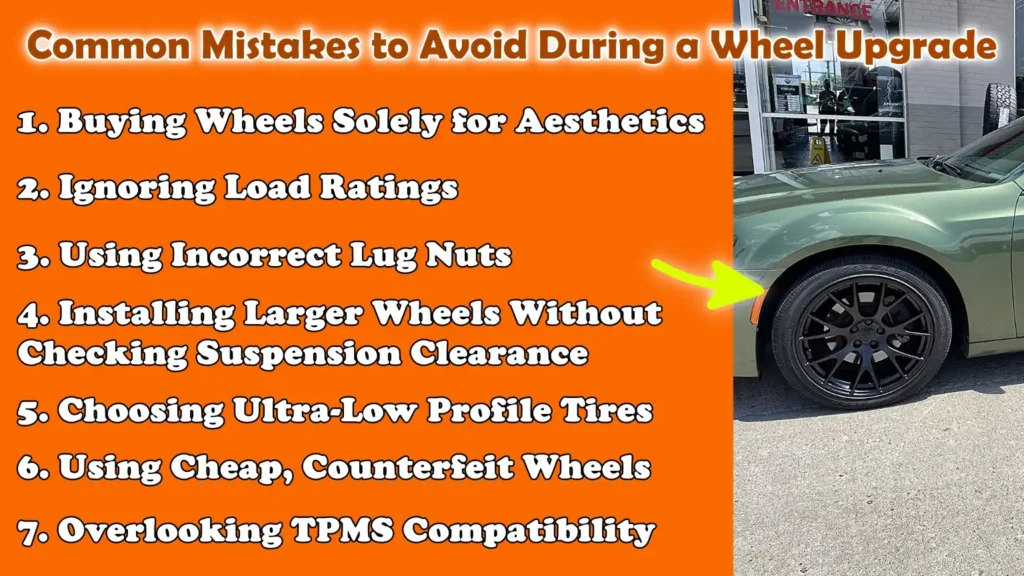
1. Buying Wheels Solely for Aesthetics
One of the most common mistakes is selecting wheels simply because they look attractive.
Large-diameter wheels, deep concave designs, or aggressive offsets may boost a vehicle’s visual appeal, but they may not align with its actual fitment requirements.
A visually appealing wheel could rub against suspension components, alter steering dynamics, or accelerate wear and tear on bearings and tires.
The process of selecting a safe wheel should always begin by verifying the correct specifications, with aesthetics being considered only after proper fitment has been confirmed.
2. Ignoring Load Ratings
Load ratings are frequently overlooked, yet they are critical because each wheel must safely support a portion of the vehicle’s total weight.
This includes the combined weight of passengers, cargo and any towed loads.
Wheels with low load ratings may bend, crack, or fail under heavy use, particularly on SUVs, trucks and electric vehicles, which often weigh more than anticipated.
Daily driving over potholes or rough roads also places excessive stress on the wheels.
For long-term safety, it is essential to install wheels with a load rating equal to or exceeding the specifications set by the manufacturer.
3. Using Incorrect Lug Nuts
Using incorrect lug nuts is a common installation error.
Different wheels require different types of seating surfaces such as: conical, ball, or flat seat designs.
If the shape of the lug nut does not match the wheel’s seat, the wheel cannot be properly secured to the hub.
This can lead to issues such as vibration, wheel loosening, or damage to the lug holes.
The thread size and length must also be appropriate for the specific vehicle.
Even if the wheel appears to be securely tightened, using incorrect hardware can result in dangerous instability while driving.
4. Installing Larger Wheels Without Checking Suspension Clearance
Larger wheels can enhance both a vehicle’s aesthetics and handling; however, installing them without verifying suspension clearance is risky.
During turns or suspension travel, the wheels may come into contact with struts, control arms, brake lines, or inner fenders.
These issues often manifest only after driving over rough terrain or carrying passengers.
A wheel that appears to fit perfectly when the vehicle is parked may rub against components when the suspension compresses.
Whenever the wheel size or offset is altered, it is crucial to verify clearance before driving the vehicle.
5. Choosing Ultra-Low Profile Tires
Ultra-low profile tires are popular for their sporty aesthetic, but they can compromise ride comfort and increase the risk of damage.
Their short sidewalls offer minimal protection against potholes and road impacts, resulting in a harsher ride and a higher likelihood of wheel damage.
Furthermore, low-profile tires provide less shielding for the wheel rims, making them more susceptible to damage from curb strikes.
While they may enhance steering response, excessively low-profile tires can detract from daily drivability and overall ride comfort.
6. Using Cheap, Counterfeit Wheels
Cheap, counterfeit wheels may mimic the appearance of premium brands, but many are constructed from inferior materials and suffer from poor workmanship.
They may not have undergone the rigorous testing standards applied to certified wheels and can easily bend or fracture upon impact with potholes.
Some counterfeit wheels may feature poor machining around the hub bore or lug seats, potentially leading to vibrations or installation difficulties.
As the wheel is a structural component of the vehicle, quality is paramount, extending far beyond mere aesthetics.
7. Overlooking TPMS Compatibility
Many modern vehicles utilize TPMS sensors to monitor tire pressure and alert the driver in the event of low air pressure.
When upgrading wheels, depending on the specific wheel design, these sensors may need to be relocated or replaced.
If the new wheels do not properly support these sensors, warning lights may illuminate and the Tire Pressure Monitoring System may cease to function.
TPMS is a critical safety system, as underinflated tires can overheat, experience premature wear and increase braking distances.
Checking for compatibility prior to installation helps prevent warning lights and safety-related issues.
Conclusion – How to Upgrade Wheels Safely
The main moto of upgrading the wheels should be to improve the way it drives every day and gives you ultra-protective ride and looks should be the cherry on the top and nothing more than that.
Each wheel constitutes a critical component of a meticulously engineered system that includes tires, brakes, wheel bearings, alignment angles and electronic systems such as ABS and traction control.
Therefore, upgrading wheels should never be viewed solely as a means of aesthetic enhancement.
An incorrect wheel size, offset, bolt pattern, or an improper choice of tires can trigger issues that may not be immediately apparent such as: steering vibrations, rubbing, reduced fuel efficiency, accelerated suspension wear and compromised vehicle stability during sudden braking or sharp turns.
Even minor modifications can significantly alter how a vehicle behaves at highway speeds, as the wheels are the sole components responsible for transmitting the engine’s full power, braking force and steering inputs to the road surface.
The process of safely upgrading wheels always begins with a thorough understanding of the factory specifications, as these parameters were carefully selected by engineers to strike an optimal balance between the vehicle’s handling, ride comfort, safety and durability.
Wheel diameter, width, offset, bolt pattern, hub bore and load rating, all these factors work in concert and altering any one of them often has a ripple effect on the others.
This is precisely why ensuring the correct wheel fitment is a far more critical consideration than simply opting for larger wheels or a more visually appealing design.
The safest upgrades are those in which the correct tire diameter is maintained, there is sufficient clearance for the brakes, the appropriate lug hardware is utilized and, most importantly, adequate room remains for suspension travel while driving.
Now, that’s it from this guide about How to Upgrade Wheels Safely, also you can ask questions below.
Frequently Asked Questions
FAQ 1: Can larger wheels damage a car?
Answer: Larger wheels can have a negative impact on a car if their size is altered too drastically, or if they are not paired with the correct tire size. Larger wheels typically require shorter tire sidewalls to ensure that the overall diameter remains close to the manufacturer’s specifications. If the wheel and tire combination becomes excessively large, the tires may rub against the fenders or suspension components while turning or driving over rough terrain. Heavier and larger wheels can also place increased stress on suspension components, wheel bearings and brakes. If chosen correctly, larger wheels generally cause no harm; however, selecting the wrong size can lead to costly damage over time.
FAQ 2: How do I know which wheels will fit my car?
Answer: The safest way to determine which wheels will fit your car is to consult the manufacturer’s specifications. These specifications include the wheel diameter, width, offset, bolt pattern, center bore and load rating. You can find this information in the owner’s manual, on a sticker located on the driver-side door frame, or in the manufacturer’s wheel specification chart. It is crucial to match all of these specifications, as a wheel may have the correct diameter but still fail to fit due to discrepancies in the offset or bolt pattern.
FAQ 3: Is changing wheel size detrimental to fuel efficiency?
Answer: Changing wheel size can impact fuel efficiency, particularly if the new wheels are larger and heavier than the original ones. Heavier wheels require more energy to accelerate; Consequently, the engine consumes more fuel when accelerating the vehicle. Wider tires can also increase rolling resistance, thereby reducing the vehicle’s efficiency. In many cases, the change in fuel economy is minimal; however, over time, it becomes clearly noticeable, specially when driving in the city, where the vehicle frequently stops and starts.
FAQ 4: Can incorrect wheel offset cause problems?
Answer: Yes, incorrect wheel offset can lead to a variety of issues. It can cause the wheels to sit too far inward or outward, potentially resulting in tire rubbing, compromised steering feel, excessive strain on wheel bearings and uneven tire wear. Offset also alters the steering geometry, which can impact the vehicle’s stability at high speeds. Even if the wheels physically fit, an incorrect offset can degrade the driving experience and reduce the lifespan of suspension components.
FAQ 5: Are aftermarket wheels safe?
Answer: Aftermarket wheels can be very safe, provided they are manufactured by reputable brands and are correctly matched to the specific vehicle. Many aftermarket wheels meet rigorous engineering standards and are designed to offer enhanced performance or durability. Safety depends on selecting wheels with the correct size, load rating and certified construction. Low-quality wheels made from inferior materials, or those that do not fit correctly, as it can be unsafe; therefore, it is crucial to check for certifications and ensure that the specifications are accurate.
FAQ 6: What is the safest size for a wheel upgrade?
Answer: For most vehicles, the safest upgrade option typically involves a “plus-one” or “plus-two” size increase. This entails increasing the wheel diameter by one or two inches while simultaneously reducing the tire’s sidewall height, ensuring that the overall tire diameter remains approximately the same as that of the original factory-installed tires. This helps maintain speedometer accuracy, suspension clearance and braking characteristics close to the original design specifications. Increasing the size beyond this often necessitates more rigorous fitment checks and may negatively impact ride comfort or handling.
FAQ 7: Will I need new tires when upgrading my wheels?
Answer: In most cases, yes. New wheels often require tires of a different size, as the tire must match the diameter and width of the new wheel. For instance, upgrading from 17-inch wheels to 18-inch wheels typically necessitates tires with a lower sidewall profile. Reusing your old tires is only possible if the new wheels have the exact same diameter and their width also matches. You should always verify the tire size before installing the wheels.
References:
[1] Replacement Tire Consumer Information Program Part 575.106
https://www.nhtsa.gov/sites/nhtsa.gov/files/rolling_resistance_fria.pdf
Hello Folks, Dean Shali here to help you out to solve the problems with your lovely vehicle, as i have lots of experience and knowledge about automotive industry as i woks directly with the customers and repair vehicles and i love to help the people to keep their cars safe and running smoothly.