
Written By: Dean Shali
Fact Checked By: Sabré Cook
Reviewed By: Tamara Warren
It is true that modern vehicles are actually designed for stable highway driving, which means if there’s noticeable wheel wobble then it is the strong signal that something important needs to be fixed or properly aligned again.
So, just don’t ignore that small vibration in the steering wheel during drive, as a strange shaking feeling through the seat or a light bouncing sensation that can quickly escalate if there’s something fishy in the hood.
It is not the minor problem, as there could be unbalanced tire, uneven tire wear, incorrect tire pressure or loose lug nuts as well: that’s why diagnosing is necessary to find out exact reason and fix them later on.
As well as, in some of the serious cases; the wheel wobble indicates to the damaged suspension parts, worn out wheel bearings, bent rims, failing steering components or even tire belt separation as well and we all knows that how dangerous that could proven during journey.
But, if there’s vibration between 50 to 70 MPH then these are commonly linked to the wheel balance problems, but if there’s serious wobble during braking then it could be warped brake rotors and if it is shaking after the bumps then it could be worn out suspension or steering components as well.
So, in this guide you’ll learn How to Diagnose Wheel Wobble at Speed so that you can catch the problem with warning signs and improve overall driving safety by preventing those safety hazards.
Understand, What is Wheel Wobble?
1. All About Wheel Wobble
Wheel wobble is a condition in which one or more of a vehicle’s wheels do not rotate smoothly while in motion; instead, they oscillate slightly from side to side or up and down.
This occurs when the balance or alignment of the wheels, tires, or their supporting components becomes compromised.
Simply put, it means the wheel is not rotating uniformly, creating a disturbance that can be felt throughout the entire vehicle.
This issue is often linked to problems such as unbalanced tires, bent rims, worn suspension components, or loose wheel parts; as the vehicle’s speed increases, this sensation becomes even more pronounced.
2. How Wheel Wobble Affects Vehicle Stability
When wheel wobble occurs, it directly impacts how stable and controllable the vehicle feels on the road.
As the wheels serve as the primary point of contact between the vehicle and the road surface, any irregular movement of the wheels degrades the overall driving experience.
This can diminish steering precision, make the vehicle difficult to control and place excessive strain on the suspension and steering systems.
Over time, even minor vibrations can lead to uneven tire wear, damage to wheel bearings and unnecessary stress on the components designed to maintain vehicle stability.
This is why even minor vibrations should not be ignored, particularly at high speeds, when maintaining vehicle control becomes a far more critical and sensitive matter.
3. Why Does Wheel Vibration Often Intensify at High Speeds?
As speed increases, wheel vibration typically becomes even more distinctly perceptible; This occurs because when a wheel spins rapidly, even a minor internal imbalance is amplified into a significant disturbance.
At lower speeds, these irregular movements may seem negligible, or perhaps go entirely unnoticed.
However, once the vehicle reaches highway speeds, any minor defect within the tires, wheels, or suspension system is magnified manifold due to centrifugal force and the rapid rotation of the wheels.
This generates intense vibrations that can be felt through the steering wheel, the seats and even the floor of the vehicle.
At high speeds, the suspension system has very little time to dampen the wheel movements, causing the vibrations to feel even more intense and erratic.
4. What Symptoms Do Drivers Typically Experience?
When wheels vibrate, there are several distinct signs that drivers can easily identify without the need for specialized tools.
These symptoms typically manifest gradually; however, they become more pronounced when the vehicle is traveling at a steady speed, particularly on highways or smooth roads, as vibrations are easier to detect in such environments.
Identifying these signs in a timely manner can prevent further damage to the vehicle and help maintain driving safety.
Steering Wheel Vibration
One of the most common symptoms is vibration in the steering wheel, particularly at moderate to high speeds.
This occurs because the front wheels transmit these vibrations directly to the steering system.
Initially, this vibration may feel mild; however, as speed increases, or if an underlying mechanical issue worsens, the vibration can become quite severe.
This is often an indication of issues such as unbalanced tires, bent wheels, or worn-out steering components.
Seat Vibration
Vibration in the seat occurs when there is a fault in the rear wheels or drivetrain components.
Rather than being felt in the steering wheel, the driver and passengers may experience a persistent vibration in the seats or the floorboard area.
This type of vibration is frequently linked to issues with the rear tires, worn suspension components, or an unbalanced drivetrain and it is typically most noticeable when the vehicle is traveling at a steady speed.
Vehicle Pulling to One Side
Due to wheel irregularities, the vehicle may drift slightly or pull to one side, even when the steering wheel is held straight.
This happens because the irregular motion of the wheels affects the distribution of forces acting on the tires.
Alignment issues or uneven tire wear are often the root causes of this symptom, making the vehicle feel less stable and requiring constant steering corrections to keep it moving in a straight line.
Sensation of Uneven Tires
Drivers may notice that the vehicle’s behavior on the road feels inconsistent, as if one tire is gripping the road differently compared to the others.
This sensation of uneven tire contact is caused by irregular rotation or defects within the wheel or tire assembly.
It can make the vehicle feel as though it is not rolling smoothly, particularly at a steady speed, and often serves as an early warning sign of tire damage, imbalance, or alignment issues.
Sensation of Rhythmic Bouncing
Another primary symptom is the sensation of a rhythmic bounce, wherein the vehicle feels as though it is gently, and repeatedly, bouncing or pulsating in a consistent pattern.
This typically occurs when there is a structural defect in the tire such as: a separated belt or severe imbalance, or when a wheel is bent.
At higher speeds, this bouncing becomes even more pronounced, manifesting as a continuous, repetitive vibration that synchronizes with the rotation cycle of the wheel.
Is It Safe to Drive with a Shaking Wheel?
1. Situations Where Driving May Be Possible
A shaking wheel is not always an immediate indication of an impending mechanical failure; in some mild cases, particularly if the vibration is very slight and occurs only at specific speeds, it may be possible to drive for a short distance.
For instance, a slightly unbalanced tire or a minor alignment issue can cause mild vibrations that are perceptible but not severe enough to adversely affect the vehicle’s basic handling.
However, even in such situations, this condition should be treated as a warning sign, as wheel vibration rarely resolves on its own.
Continuing to drive without having the vehicle inspected can cause the problem to gradually worsen, specially if it stems from tire wear, wheel damage, or suspension issues, all of which deteriorate further with continued use.
2. Signs Indicating That You Should Not Drive
There are certain clear warning signs indicating that driving with a shaking wheel has become unsafe and that you should refrain from driving until the underlying issue has been diagnosed and repaired.
These symptoms typically suggest that the problem is not minor and, if ignored, could lead to a sudden loss of vehicle control or a mechanical failure.
When these symptoms appear, have the vehicle inspected by a professional immediately, or keep the vehicle parked until the necessary repairs are complete.
Excessive Steering Vibration
Excessive steering vibration implies that the steering wheel is shaking violently or uncontrollably, particularly at moderate or highway speeds.
This type of vibration often points to a serious underlying issue, such as a severely bent wheel, a grossly unbalanced tire, or worn-out steering components.
When it becomes difficult to keep the steering wheel steady, it indicates that the vibration is severe enough to directly and negatively impact the vehicle’s handling, thereby making driving unsafe.
Knocking Sounds
Hearing knocking or rattling sounds emanating from the wheels or suspension components while driving may signal that a mechanical part has become loose, damaged, or worn out.
These noises often point to worn-out ball joints, faulty tie rods, or loose suspension components that are no longer capable of securely holding the wheel in place.
When knocking sounds are accompanied by vibrations felt in the steering wheel, it suggests that the issue is not merely superficial but may involve structural instability within the wheel assembly itself.
A Sensation of Loose Wheels
When the vehicle feels unstable, the wheels may feel “loose”, as if one or more wheels are not firmly connected to the road surface.
This sensation can occur when wheel bearings are worn, lug nuts are not properly tightened, or suspension components are deteriorating.
This creates a hazardous situation, as the driver may experience a reduced sense of control over the vehicle’s steering, particularly when making turns or changing lanes.
Sudden Tire Movement
Sudden or unexpected tire movement refers to a condition where, while the vehicle is in motion, the tires appear to slip, bounce, or move erratically.
This can be caused by tire belt separation, severe internal structural damage to the tire, or a severely damaged wheel rim.
This situation is particularly dangerous because it can lead to a rapid loss of tire pressure or even a tire blowout while driving at high speeds.
3. Potential Dangers of Ignoring Wheel Wobble
Ignoring wheel wobble can lead to severe mechanical damage and significant safety risks over time.
What begins as a minor vibration can gradually escalate into serious vehicle instability, mounting repair costs and hazardous driving conditions.
The longer this issue remains unaddressed, the greater the strain placed on the tires, suspension, steering and braking systems.
Tire Failure
One of the most serious risks of ignoring wheel wobble is tire failure.
Constant vibration can damage the internal structure of the tire, particularly if it already harbors existing defects or imbalances.
Over time, this can lead to issues such as tire blowouts, tread separation, or sudden air pressure loss, all of which can occur without warning while driving at high speeds.
Suspension Damage
Wheel wobble places constant stress on suspension components such as shocks, struts, control arms and bushings.
Although these parts are designed to withstand the normal bumps and jolts of the road, excessive vibration can cause them to wear out much faster than usual.
If left unaddressed, this issue compromises ride comfort, impairs vehicle handling and can result in costly repairs.
Loss of Control
Excessive wheel wobble can compromise steering precision and the overall stability of the vehicle.
This makes it difficult for the driver to maintain a straight line on level roads, or to react promptly while cornering or in emergency situations.
In severe cases, the vehicle may feel uncontrollable, particularly at high highway speeds, where even a slight deviation can significantly impact vehicle handling.
Increased Braking Distance
Wheel wobble can also adversely affect braking performance by causing uneven contact between the tires and the road surface.
When the tires fail to maintain consistent traction with the road, braking force becomes less effective, potentially increasing the vehicle’s stopping distance.
This situation becomes particularly hazardous during sudden braking scenarios, where every single meter of stopping distance is critical for safety.
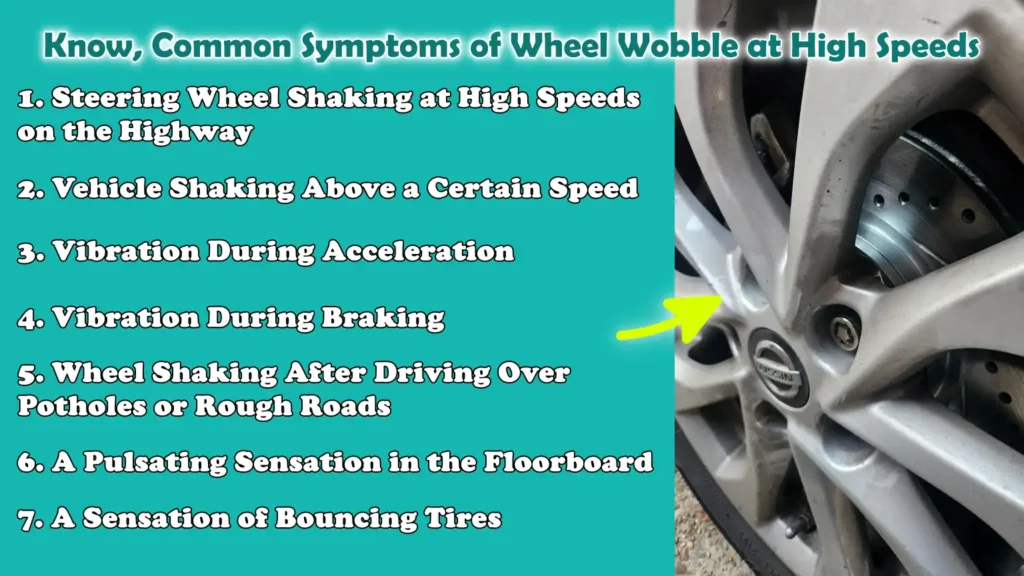
Know, Common Symptoms of Wheel Wobble at High Speeds
1. Steering Wheel Shaking at High Speeds on the Highway
When driving at high speeds on a highway, a shaking steering wheel is the most easily identifiable symptom of wheel wobble; this is typically felt most distinctly at speeds between 50 and 70 miles per hour.
This occurs because even a slight imbalance in the front wheels becomes significantly amplified as the rotational speed of the wheels increases.
This vibration travels directly through the steering system, causing the steering wheel to feel unstable in the driver’s hands.
In most cases, this symptom is linked to unbalanced tires, bent rims, or worn steering components; furthermore, if the vehicle is frequently driven at high speeds, this issue often becomes even more severe.
2. Vehicle Shaking Above a Certain Speed
Wheel wobble is often not constant; rather, it typically manifests only within specific speed ranges, which serves as a crucial clue for diagnosing the problem.
For instance, a vehicle may drive smoothly at low speeds but begin to shake violently once it reaches a certain speed on the highway.
This pattern typically points to an imbalance in the wheels or tires, as these issues become significantly exacerbated at high wheel rotational speeds.
When the speed changes, the vibration may diminish or temporarily disappear entirely; this helps to establish that the problem lies not with components related to engine power, but rather with components that react to the rotational speed of the wheels.
3. Vibration During Acceleration
If the vehicle primarily vibrates while accelerating, it may indicate that the underlying issue runs deeper than a simple tire imbalance.
Acceleration places increased torque (rotational force) on the drivetrain and wheels, which can expose internal problems such as worn CV joints, an unbalanced driveshaft, or uneven tire contact with the road surface.
This type of vibration is often felt most intensely when the driver depresses the accelerator; the vibration may subside once the vehicle reaches a steady speed.
This serves as a crucial indicator that, under mechanical stress, specifically when the vehicle is under load, the stability of the wheels is being compromised.
4. Vibration During Braking
Vibration in the wheels during braking is frequently linked to issues within the braking system itself or the wheels.
A warped brake rotor is a common culprit, resulting in uneven contact between the brake pads and the rotor’s surface.
This generates vibrations that can be felt through the steering wheel or the brake pedal.
In some instances, loose suspension components or uneven tire wear can also cause the vehicle to shake during braking, particularly as the vehicle’s weight shifts forward upon application of the brakes.
5. Wheel Shaking After Driving Over Potholes or Rough Roads
When wheels begin to shake after driving over potholes or rough terrain, it often signals a defect within the suspension system or the wheel components.
Such impacts can warp the rims, cause internal damage to the tires, or loosen components such as tie rods or ball joints.
In such situations, wheel wobble may not be immediately apparent; instead, it may manifest some time after the initial jolt, as the wheel continues to rotate unevenly.
This serves as a serious warning sign indicating that the vehicle has sustained physical damage and requires immediate inspection.
6. A Pulsating Sensation in the Floorboard
A sensation of throbbing or rhythmic vibration in the floorboard is typically associated with issues involving the rear wheels or an imbalance within the drivetrain.
Rather than being felt primarily in the steering wheel, this vibration propagates throughout the entire cabin, often presenting as a steady pulse that corresponds to the rotational speed of the wheels.
Common causes include imbalances in the rear tires, uneven tire wear, or worn-out suspension components.
This symptom is significant because it often indicates that the underlying issue is not limited solely to the front wheels.
7. A Sensation of Bouncing Tires
When a sensation of bouncing tires occurs, it feels as though the wheel is slightly bouncing or skipping along the road surface in a repetitive pattern.
This is frequently caused by severe tire imbalance, separation of the internal tire belts, or a significantly warped wheel rim.
At higher speeds, this effect becomes even more pronounced, making the vehicle feel unstable or uncontrollable.
Among the various symptoms of wheel instability, this particular one serves as a critical warning sign, as it indicates that the tire is no longer able to maintain consistent contact with the road; if left unaddressed, this can quickly lead to further damage or a loss of vehicle control.
Know, The Most Common Causes of Wheel Wobble at High Speeds
1. Tire-Related Issues
One of the most common causes of wheel wobble at high speeds involves tire-related issues, as tires are the only components that come into direct contact with the road.
Even minor defects can generate vibrations as the vehicle’s speed increases.
Unbalanced tires are a primary culprit; due to uneven weight distribution, the wheels rotate unevenly, creating vibrations that intensify with speed.
A broken tire belt represents a more serious issue, as the tire’s internal structure begins to disintegrate, leading to bulges and erratic rotation that may manifest as a bouncing or thumping sensation.
Flat spots can develop on tires after a vehicle has been parked for an extended period or following sudden, hard braking; these flattened areas generate rhythmic vibrations as the tire rotates.
Uneven tire wear also disrupts smooth contact with the road surface and often signals underlying alignment or suspension issues.
Incorrect tire pressure, whether too high or too low, alters the tire’s interaction with the road surface and can induce instability at high speeds.
Damaged sidewalls compromise the tire’s structural integrity and can generate unexpected wobbling or vibrations under load.
2. Wheel-Related Issues
Wheel-related issues directly impact the smooth rotation of the tires and constitute a major cause of wobbling at high speeds.
A bent wheel or rim, often resulting from hitting potholes or facing road impacts, is a common problem; even a slight bend can generate noticeable vibrations when driving at high speeds.
Cracked wheels pose a more serious hazard, as they compromise the structural integrity of the wheel, a condition that may deteriorate further over time.
Improper wheel installation can also lead to wobbling if the wheel does not seat correctly against the hub, resulting in uneven rotation.
The absence of wheel weights is often overlooked, yet they play a crucial role in balancing the wheel; their absence can generate vibrations within specific speed ranges.
Incorrect torque (whether the nuts are too loose or tightened unevenly) can prevent the wheel from seating properly, leading to instability and potentially unsafe driving conditions.
3. Suspension-Related Issues
Suspension components are responsible for keeping the wheels stable and correctly aligned with the road; consequently, wear and tear on these parts often causes wheel wobbling.
Worn ball joints can introduce looseness into the wheel assembly, leading to unwanted movement while driving.
Faulty tie rods affect steering control and can induce vibrations in the front wheels.
Worn control arm bushings reduce stability and allow for excessive wheel movement, particularly during acceleration or braking.
Worn wheel bearings can create play within the wheel hub, generating vibrations that intensify as speed increases.
Damaged shock absorbers or struts diminish the suspension’s ability to absorb road shocks, making any existing imbalances or mechanical defects more pronounced in the form of wobbling or vibration.
4. Alignment Issues
Wheel alignment issues often develop gradually but can severely compromise stability at high speeds.
Toe misalignment occurs when the wheels are not positioned correctly relative to one another, resulting in uneven tire contact and vibration.
Camber-related issues refer to the inward or outward tilting of the wheels, which can lead to uneven wear and instability while driving.
Caster angle issues affect steering balance and vehicle stability, making the car feel less controllable at high speeds.
Overall, these alignment problems can exacerbate even minor flaws in the tires or suspension, turning slight vibrations into a distinct wobbling of the wheels.
5. Brake-Related Causes
Brake system issues can also generate vibrations that mimic the sensation of wobbling wheels, particularly when decelerating.
Warped brake rotors are a common culprit, as their uneven surfaces create vibrations during braking, which are felt through the steering wheel or brake pedal.
A seized brake caliper can apply a constant or uneven braking force to the wheel, leading to overheating, uneven wear and vibrations that may feel like wobbling wheels even when the brakes are not engaged.
6. Drivetrain-Related Causes
Drivetrain components can also contribute to vibrations at high speeds, particularly in rear-wheel or all-wheel drive vehicles.
A defective CV axle can generate vibrations during acceleration if it fails to transmit power smoothly to the wheels.
An unbalanced driveshaft is another potential cause; the uneven rotation of the driveshaft creates vibrations that intensify as the vehicle’s speed increases.
Worn U-joints can introduce looseness into the drivetrain connections, resulting in rhythmic vibrations or wobbling that becomes more pronounced at highway speeds.
Tools
| Tools | Why It Is Needed | How To Use It |
|---|---|---|
| Tire Pressure Gauge | Maintaining correct tire pressure is crucial, as under-inflation or over-inflation can lead to issues such as vibration, uneven tire wear and vehicle instability at high speeds. Many problems related to vehicle wobbling stem directly from incorrect air pressure. | Remove the valve cap from each tire, firmly press the gauge onto the valve stem and take a pressure reading. Compare this reading against the recommended PSI listed on the sticker located on the driver-side door jamb. Adjust the air pressure using an air pump as needed. |
| Floor Jack and Jack Stands | These tools are essential for safely lifting the vehicle, allowing you to inspect the wheels and suspension components. Without lifting the vehicle, you cannot properly check for looseness or damage. | Position the jack beneath the vehicle’s designated lifting points, slowly raise the vehicle and then place jack stands beneath secure support points. Never work underneath a vehicle that is supported solely by a jack. |
| Lug Wrench | These tools are used to loosen and tighten the wheel’s lug nuts. Loose or unevenly tightened nuts can directly cause wheel wobbling at high speeds. | Fit the wrench onto each nut and loosen or tighten them in a star pattern; this ensures that even pressure is applied to all nuts when reinstalling the wheel. |
| Torque Wrench | This tool ensures that the nuts are tightened with the precise amount of force required. This prevents the wheels from being either too loose or excessively tight, as both conditions can lead to vibration or damage. | Set the wrench to the torque value recommended by the vehicle manufacturer and then tighten each nut in a star pattern until the wrench emits a “click” sound. |
| Flashlight | This helps in checking for hidden damage such as: cracks, worn suspension components, leaks, or bent parts, which may be difficult to spot in low-light conditions. | Shine a light around the wheels, suspension joints and the inner surfaces of the tires to check for any visible damage or movement. |
| Pry Bar | This is used to check for any unwanted movement within the suspension and steering components. Excessive looseness in these parts often indicates that they are worn out or failing, which can cause the vehicle to wobble. | After lifting the vehicle, apply gentle pressure to the control arms, bushings and joints to check for any looseness or movement. |
| Dial Indicator | This is a precision tool used to measure wheel or rotor movement (runout). It helps detect even the slightest deformation or uneven rotation in the wheel, which can lead to vibrations at high speeds. | Position the dial indicator near the wheel or rotor, slowly rotate the wheel and observe any fluctuations in the measurement to detect wheel wobble or runout. |
| Tire Tread Depth Gauge | Uneven tire wear is a common cause of vibration. This tool helps measure tread depth to identify worn or uneven sections of the tire. | Place the gauge into the tire grooves and read the measurement. Compare measurements taken from different sections of the tire to determine if the tire has worn unevenly. |
| Gloves and Safety Glasses | When inspecting the underbody of the vehicle, particularly when examining sharp edges, soiled components, or moving parts, ensure the protection of your hands and eyes. Safety is paramount during any mechanical inspection. | Wear gloves before touching the wheels or suspension components and use safety goggles when working underneath the vehicle or in the vicinity of moving parts. |
Take Safety Precautions Before Inspection
1. Park on Level Ground
Before beginning any inspection for wheel wobble, it is essential that you park the vehicle on a completely level and stable surface.
A level surface prevents the vehicle from suddenly rolling or shifting while you are inspecting the wheels, tires, or suspension components.
This is particularly important because, when the vehicle is lifted, even a slight incline in the ground can compromise its stability, making it unsafe to work around the wheels.
Parking on level ground also ensures that any measurements or visual inspections you perform are accurate and not skewed by the vehicle’s tilt.
2. Use Wheel Chocks
Wheel chocks are small blocks placed against the tires to prevent the vehicle from rolling forward or backward.
They are a simple yet crucial safety measure, as they prevent the vehicle from rolling while it is stationary or lifted.
Even if the parking brake is engaged, wheel chocks provide an additional layer of safety by securing the opposing wheels.
This is specially useful when you are diagnosing wheel wobble issues, as you may need to lift one side of the vehicle and any unintended movement could be dangerous.
3. Never Rely Solely on a Jack
Jacks are designed to lift a vehicle, not to hold it securely for an extended period.
Relying solely on a jack is extremely risky, as it can slip or fail under the weight of the vehicle, specially on uneven surfaces or if the vehicle shifts even slightly.
After lifting the vehicle, always use jack stands, as they provide stable and secure support.
This ensures that the vehicle remains securely in place while you inspect the wheels, suspension, or steering components from underneath.
4. Allow the Brakes to Cool Down
If the vehicle has been driven recently, the brake system may still be hot.
During normal driving, specially after braking at high speeds, the brakes generate a significant amount of heat.
Touching hot brake components or working in close proximity to them can result in severe burns or injuries.
Allowing the brakes to cool down before the inspection also helps you avoid misdiagnosing heat-induced expansion or temporary noises emanating from the brakes as mechanical faults associated with wheel wobble.
5. Wear Safety Gear
You should always wear safety gear, such as gloves and safety glasses (goggles), during the inspection.
Gloves protect your hands from sharp metal edges, grime and hot surfaces, while safety glasses shield your eyes from dust, rust particles, or falling debris during the inspection.
As diagnosing wheel wobble often involves peering into tight spaces, lifting the vehicle and handling heavy components, taking appropriate safety precautions minimizes the risk of injury and makes the entire inspection process safer.
How to Diagnose Wheel Wobble at Speed – Easy Method to Know Correctly
1. Identify When the Vibration Occurs
The first and most crucial step in diagnosing wheel vibration is understanding exactly when it occurs, as the timing provides vital clues regarding the root cause.
Pay attention to the speed at which the vibration begins, as many issues related to tire and wheel balance manifest only within specific speed ranges such as: at highway speeds.
Observe whether the vibration intensifies during acceleration, which could indicate issues with the drivetrain or axles, or if it persists steadily even at a constant speed, which often points to wheel imbalance.
Additionally, check whether applying the brakes alters the vibration, as issues within the braking system such as: warped rotors, as it can generate vibration specifically during deceleration.
Finally, determine whether the vibration is felt primarily in the steering wheel, typically indicating issues with the front wheels, or throughout the entire vehicle, which may suggest problems with the rear wheels or suspension.
2. Check Tire Pressure
Tire pressure plays a critical role in wheel stability, as it directly influences how the tire makes contact with the road surface.
Every vehicle has a specific recommended PSI range, typically listed on a label located inside the driver’s door, and maintaining the pressure within this range is essential for smooth rotation.
Underinflated tires can become excessively flexible, resulting in improper contact with the road and leading to vibration at higher speeds.
Overinflated tires reduce the contact patch, resulting in a harsher ride and increased sensitivity to road imperfections, which can cause the tires to wobble.
Checking and adjusting tire pressure is a simple yet crucial step, as even a slight discrepancy in pressure between tires can create a noticeable imbalance while driving.
3. Inspect the Tires for Visible Damage
You should carefully inspect the tires to detect any signs of visible damage, as structural issues are often the root cause of tire wobbling.
Bulges on the tire surface may indicate internal damage or a broken belt, a hazardous condition that can lead to sudden tire failure.
You should also check for uneven tire wear patterns, as these often point to alignment or suspension issues that affect wheel dynamics.
Broken belts inside the tire can cause a sensation of rhythmic bouncing at high speeds.
Cracks or cuts in the tire sidewall compromise the tire’s structural integrity; this can lead to air leaks or sudden deformation while driving, thereby increasing vibrations and jeopardizing safety.
4. Check Wheel Balance
Wheel imbalance is the most common cause of vibrations at high speeds, particularly when the vibration occurs only within a specific speed range.
Symptoms of unbalanced tires include steering wheel vibration, shaking seats, or a sensation of rhythmic pulsing that intensifies as speed increases.
This issue is most noticeable at medium to highway speeds, as rotational forces amplify even minor weight discrepancies within the wheel.
Wheel balancing is necessary if a balance weight falls off, new tires are installed, or if vibrations occur after hitting potholes or curbs.
Proper balancing ensures smooth rotation and reduces stress on suspension and steering components.
5. Check Lug Nut Torque
Lug nuts firmly secure the wheel in place; improper tightening can directly lead to wheel vibration.
Loose lug nuts allow the wheel to shift slightly on the hub, creating dangerous vibrations and instability while the vehicle is in motion.
The correct torque sequence is paramount, as tightening in a star pattern ensures uniform pressure distribution across the entire wheel.
Overtightening is equally hazardous, as it can damage the wheel studs or deform the wheel’s mounting surface, potentially leading to future structural issues.
Ensuring proper torque is a critical safety measure when diagnosing wheel vibration.
6. Inspect Wheels for Bends or Cracks
Wheels can bend or crack upon impact with potholes, curbs, or rough road surfaces; even minor damage can result in noticeable vibration.
A bent rim causes uneven rotation, a condition that becomes even more pronounced at higher speeds.
Rim runout, a slight deviation in the wheel’s shape, as it can be detected through visual inspection or by using specialized measuring tools.
Steel wheels are generally more robust and tend to bend rather than break, whereas alloy wheels are lighter but more prone to cracking upon impact.
Both types of damage can significantly hinder the wheel’s ability to rotate smoothly.
7. Lift the Vehicle and Observe Wheel Movement
Lifting the vehicle allows you to inspect the movement of the wheels and suspension, movement that is not visible when the vehicle is resting on the ground.
Loose wheel bearings can be detected by gently rocking the wheels from side to side or up and down; any “play” (looseness) in this movement indicates wear.
Worn ball joints can also cause instability by creating unwanted movement within the steering and suspension systems.
Looseness in the tie rods affects steering precision and can cause the vehicle to wander while driving.
Any looseness in these components compromises the vehicle’s stability and must be addressed immediately.
8. Inspect Suspension Components
Suspension components are responsible for keeping the wheels stable and absorbing road shocks; consequently, wear in these parts often leads to vibrations.
Control arm bushings help maintain wheel alignment and when they become worn, they allow excessive wheel movement, resulting in instability.
Sway bar links keep the vehicle stable during turns; if these links fail, it can compromise vehicle handling.
Strut mounts support the suspension system and can generate noise or vibrations when worn.
Leaking shock absorbers reduce the vehicle’s ability to absorb impacts, making the vehicle more susceptible to bumps on rough roads and causing it to feel unsteady.
9. Check for Symptoms of Wheel Misalignment
Wheel alignment ensures that all wheels are pointing in the correct direction; misalignment can cause the vehicle to vibrate.
When driving on a straight road, if the steering wheel is slightly off-center, it is often an indication of an alignment issue.
Uneven tire wear is also a clear sign that the wheel alignment is incorrect.
The vehicle gradually drifting to one side (without steering input) also points to an alignment problem.
Misalignment causes tires to wear out prematurely and compromises the vehicle’s stability, particularly at high speeds.
10. Inspect Brake Components
Problems within the braking system sometimes manifest as wheel vibrations, specially when the brakes are applied.
Warped brake rotors make uneven contact with the brake pads, generating vibrations that can be felt through the steering wheel or the brake pedal.
It is crucial to distinguish between brake-related vibrations and general wheel vibrations, as the correct method for resolving the issue depends entirely on identifying its root cause.
A seized brake caliper can exert uneven pressure on a wheel; this can cause the wheel to overheat and vibrate, even when the brakes are not being applied forcefully.
A comprehensive inspection of the braking system helps in identifying these potential causes.
11. Inspect Axle and Drivetrain Components
Drivetrain components transmit power from the engine to the wheels; any imbalance within this system can generate vibrations at high speeds.
Worn or defective CV joints, particularly in front-wheel-drive vehicles, as it can cause vibrations during acceleration.
An imbalance in the driveshaft can cause a rhythmic vibration that intensifies as speed increases and is often felt throughout the entire vehicle.
U-joints provide flexibility within the drivetrain; when these components become worn, they develop excessive play, leading to wobbling or knocking sounds while the vehicle is in motion.
12. Conduct a Controlled Road Test
A controlled road test helps confirm the specific cause of wheel wobble under actual driving conditions.
This test should be performed on a smooth road and at a safe speed to avoid any confusion caused by irregularities in the road surface.
Comparing the vehicle’s behavior on both smooth and rough roads helps determine whether the issue is mechanical in nature or related to the road itself.
It is crucial to observe carefully when the vibration begins, how it changes with speed and whether it is affected by acceleration or braking.
Accurately noting these symptoms aids in identifying the root cause of the problem, thereby enabling more precise decisions regarding repairs.
How Speed Helps Identify the Cause
1. Vibration at 30 to 40 MPH
When wheel vibration begins at lower speeds, specifically between 30 and 40 MPH, it often points to more distinct mechanical or tire-related issues rather than just a minor imbalance.
In this range, issues such as excessive uneven tire wear, flat spots on the tires, or slightly bent wheels can trigger vibrations early on, as the rotational speed of the wheels is slow enough that these defects become readily apparent.
This may also signal problems with suspension components such as: worn bushings or loose steering parts, as these deficiencies can compromise the vehicle’s stability before it even reaches highway speeds.
If vibration begins this early, it generally implies that the underlying issue is far more significant than a simple balancing problem and requires immediate investigation.
2. Vibration at 50 to 60 MPH
Wheel vibration that begins around 50 to 60 MPH is one of the most common patterns and is frequently linked to tire balancing issues.
In this speed range, even a slight irregularity in the weight distribution of the tire or wheel is amplified due to the increased rotational speed.
This is why the symptoms of unbalanced tires, or wheels that have lost their counterweights (balancing weights), often become clearly evident at this specific speed.
It may also indicate a slight amount of wheel “run-out” (lateral or radial deviation), where the rim is slightly bent or not perfectly round.
In some instances, premature wear of suspension components or even slight looseness in steering linkages can begin to induce vibrations at this stage, particularly on smooth roads, where road noise is unable to mask the vibrations.
3. Shaking at Speeds Exceeding 70 MPH
When vibrations occur primarily at speeds exceeding 70 MPH, this typically points to issues related to precise wheel balancing or alignment, problems that manifest only when the wheels are rotating at very high velocities.
At this level, even the slightest imperfection in the tires, wheels, or alignment settings can generate intense vibrations, as centrifugal force increases rapidly in proportion to speed.
This is commonly linked to tire imbalance at high speeds, slight wheel “run-out” (wobble), or incorrect alignment angles, factors that become unstable only when subjected to extreme stress.
If the vibration occurs exclusively at these speeds, it often implies that the vehicle is generally in good mechanical condition, but harbors a very minor imbalance that requires correction.
4. Vibration Solely During Braking
Wheel vibration that is felt exclusively during braking is typically linked to the braking system rather than the wheels themselves.
Warped brake rotors are the most common culprit behind this issue; in such cases, uneven contact occurs between the brake pads and the rotor, resulting in a pulsating vibration felt through the steering wheel or brake pedal.
This type of vibration can also be exacerbated by uneven brake pad wear or a seized caliper, which exerts uneven pressure on a specific wheel.
As braking causes weight to shift toward the front wheels, any underlying internal issue tends to manifest much more distinctly during deceleration.
Consequently, this pattern serves as a significant indicator of issues within the braking system.
5. Vibration Solely During Acceleration
When wheel vibration occurs primarily during acceleration, it often signals problems related to the drivetrain or components operating under load.
This includes worn CV joints, which can generate vibration while transmitting power to the wheels, particularly in front-wheel-drive vehicles.
A driveshaft imbalance can also be another potential cause, as the increased torque generated during acceleration exacerbates any existing imbalance.
In some instances, worn engine or transmission mounts can also transmit vibrations to the wheels by allowing for excessive movement.
If the vibration subsides when driving at a steady speed, it is a definitive indication that the issue is load-dependent, rather than being caused by a persistent imbalance in the wheels.
How to Avoid Wheel Wobble at High Speeds
Plus, there’s study in vehicle dynamics that confirms that even minor tire or wheel imbalance literally creates measurable vibration forces that grows rapidly with the speed, this is true because centrifugal force actually increases with the rotation speed, that makes the small imperfections more noticeable at the highway driving conditions, that actually shows that why wheel wobble often appears only at the higher speeds and that’s why it is important to have proper balancing for much needed stability and comfort.[¹]
1. Rotate Your Tires Regularly
Regularly rotating your tires ensures that all four tires wear evenly over time.
As front and rear tires are often subjected to different loads and rotational forces, they tend to wear at different rates.
If this imbalance is not corrected, uneven tread depth can develop, leading to vibrations and instability at high speeds.
Regular rotation helps maintain balanced performance across all wheels, extends tire lifespan and reduces the likelihood of wobble caused by uneven wear.
2. Maintain Correct Tire Pressure
Maintaining the recommended pressure in your tires is one of the simplest and most effective ways to avoid wheel wobble.
Proper pressure ensures that the tires maintain full and uniform contact with the road surface.
When tires are underinflated, they flex excessively and create instability; conversely, overinflated tires reduce road grip and increase sensitivity to minor road imperfections.
Regularly checking tire pressure helps maintain smooth rotation and reduces unnecessary strain on suspension and steering components.
3. Avoid Impacts from Potholes
Potholes and road impacts are a major cause of wheel wobble, as they can bend rims, damage tires, or throw off wheel alignment.
A severe impact can even cause hidden wheel damage that only becomes apparent at high speeds.
Driving cautiously on rough roads and slowing down when approaching potholes helps preserve the structural integrity of the wheels and prevents sudden shifts in wheel balance.
Avoiding sudden and severe impacts is one of the most crucial long-term habits for maintaining stable wheel performance.
4. Have Your Tires Balanced Regularly
Regular tire balancing ensures that the weight of the wheel and tire assembly is distributed evenly.
Over time, slight shifts in weight can occur due to tire wear or loose balancing weights, potentially causing vibrations at specific speeds.
Regular balancing helps prevent these imbalances from compromising driving comfort and stability.
This is particularly important when installing new tires, performing tire repairs, or whenever you experience vibrations while driving at highway speeds.
5. Inspect the Suspension Regularly
Suspension components play a vital role in keeping the wheels stable; therefore, regular inspections are essential to prevent wheel wobbling.
Components such as ball joints, control arms, bushings and shock absorbers gradually wear out over time and can introduce looseness into the wheel system.
Early detection of wear allows these parts to be replaced in a timely manner, before they begin to compromise the vehicle’s stability.
A properly functioning suspension system helps effectively absorb road shocks and keeps wheel movement under control.
6. Tighten Lug Nuts Correctly
Properly tightening lug nuts is critical for both wheel safety and stability.
If lug nuts are too loose, the wheel may shift slightly while driving, generating vibrations and creating a safety hazard.
Conversely, if they are overtightened, they can damage the wheel studs or exert uneven pressure on the wheel’s mounting surface.
Using the correct torque specifications and tightening the nuts in the proper sequence ensures that the wheel is mounted securely and evenly, thereby minimizing the risk of wheel wobble.
7. Get Periodic Wheel Alignments
Regular wheel alignment helps ensure that all wheels are positioned correctly according to factory specifications.
Over time, normal driving, road conditions and minor impacts can alter the alignment angles.
When alignment is compromised, the tires do not make uniform contact with the road, leading to uneven tire wear and vibrations at high speeds.
Periodically checking the alignment maintains straight-line stability, extends tire life and prevents long-term steering and handling issues that could eventually lead to wheel wobble.
Read More:
- How to Inspect Wheel Hub Damage
- How to Replace Broken Wheel Stud
- How to Remove Stuck Lug Nuts
- How to Torque Lug Nuts Correctly
- How to Check Wheel Lug Torque
- How to Install Directional Tires Properly
- How to Identify Directional Tires Correctly
- How to Choose Tires for Snow Driving
- How to Choose Tires for Wet Roads
- How to Check Tire Load Rating
- How to Store Tires Properly Long Term
- How to Prevent Tire Dry Rot
- How to Fix Tire Bulge Issue
- How to Inspect Tire Inner Sidewall Damage
- How to Fix TPMS Sensor Not Detected
- How to Relearn TPMS Without Scan Tool
- How to Reset Tire Pressure Monitoring System Manually
- How to Check Tire Pressure Sensor Battery
- How to Seal Bead Leak in Tire
- How to Use Tire Plug Kit Correctly
Avoid These Mistakes When Diagnosing Wheel Wobble
1. Ignoring Minor Vibrations
One of the most common mistakes drivers make is ignoring minor vibrations, assuming they are not serious.
In reality, wheel wobble often begins as a very subtle vibration that gradually intensifies over time.
Minor vibrations can be early warning signs of tire imbalance, uneven tire wear, or worn suspension components.
If these initial symptoms are ignored, the underlying issue typically escalates, leading to higher repair costs and increased safety risks, particularly at highway speeds.
Paying attention even to minor vibrations helps prevent major problems down the road.
2. Replacing Parts Without Proper Diagnosis
Another major mistake is replacing parts without properly diagnosing the true cause of the wobble.
Many drivers assume the problem always lies with the tires or suspension and begin replacing components indiscriminately, resulting in wasted money and a failure to resolve the actual issue.
Wheel wobble can stem from various causes, such as wheel imbalance, bent rims, alignment issues, or drivetrain problems.
Without a proper diagnosis, it is easy to replace the wrong part while the real problem persists; this allows the vibration to continue or potentially even worsen.
3. Forgetting to Check Wheel Torque
Failing to check wheel torque during the diagnostic process is a minor, yet critical, mistake.
It is essential to tighten the lug nuts (wheel nuts) according to the correct specifications, as tightening them unevenly or leaving them too loose directly causes the wheel to shift and generates vibrations.
If this step is overlooked, the wheel may not seat properly against the hub, creating an instability that manifests as a wobble, even if all other components are in good condition.
Verifying the correct torque ensures that the wheel is securely and evenly tightened, which is essential for an accurate diagnosis.
4. Misdiagnosing Tire Issues
Tires are often blamed for every vibration-related issue; however, misdiagnosing tire problems is a common mistake.
While tire imbalance, wear, or damage can indeed cause a wobble, not every vibration originates from the tires.
Worn suspension components, alignment issues, or wheel damage can produce identical symptoms.
Always assuming that the tires are the sole cause of the problem can lead to unnecessary tire replacements, while the true root of the issue remains unresolved.
Before reaching any conclusion, a proper diagnosis must involve a thorough inspection of all other related systems in addition to the tires.
5. Neglecting Alignment Checks
Failing to check wheel alignment is another error that prevents the accurate identification of a problem.
Even if the tires and wheels are in good condition, incorrect alignment angles can cause vehicle vibration, lead to uneven tire wear and result in vehicle instability at high speeds.
If the wheels are not properly aligned, they do not track straight on the road; this places excessive strain on both the tires and the suspension system.
Without an alignment check, the true cause of the vehicle’s wobble may remain hidden.
In such a scenario, the problem may persist or resurface even after subsequent repairs.
Conclusion – How to Diagnose Wheel Wobble at Speed
Now, you have understood that when you have the smooth ride at the highway speed then it is actually efficiently working parts that works together in perfect way, so even with a small imbalance it can break that stability as well.
This is a critical point because the problem often begins as a subtle vibration or a slight tremor in the steering wheel; as speed increases or the underlying issue worsens, it gradually becomes more pronounced and easily perceptible.
In many instances, the cause may be quite straightforward such as: unbalanced tires, improper tire pressure, or a missing wheel weight, but it can also stem from more serious issues, such as bent rims, worn suspension components, faulty wheel bearings, or improper wheel alignment.
It is precisely for this reason that understanding the symptoms and characteristics of the vibration is crucial, as the vehicle’s behavior at various speeds often provides vital clues for diagnosing the root cause of the problem.
The fundamental takeaway is that wheel wobbling should never be regarded as a normal aspect of driving.
Even if the vehicle still feels under your control, driving continuously with such vibrations can gradually lead to premature tire wear, reduce the lifespan of suspension components, compromise steering precision and diminish braking efficiency.
Over time, this not only escalates repair costs but also undermines overall driving safety and confidence.
So, that’s it from this guide about How to Diagnose Wheel Wobble at Speed, also you can ask questions below.
Frequently Asked Questions
FAQ 1: In simple terms, what is wheel wobble?
Answer: Wheel wobble occurs when one or more wheels do not rotate smoothly, resulting in vibrations or shaking while the vehicle is in motion. This happens because a component of the wheels, tires, or suspension system is not perfectly balanced or aligned. This vibration is often more pronounced at higher speeds; as the wheels spin faster, even minor imperfections become more apparent. Drivers may feel this vibration in the steering wheel, the seats, or even throughout the entire vehicle body, depending on the underlying cause.
FAQ 2: Why does my car shake only at high speeds?
Answer: This typically happens because certain issues only manifest when the wheels are rotating at very high speeds. At lower speeds, slight imbalances in the tires or wheels may go unnoticed; however, at highway speeds, even a minor discrepancy in weight distribution or a slight warp in a rim can generate significant vibration. This is why tire imbalances, slightly bent wheels, or alignment issues are often only detected once the vehicle reaches speeds between 50 and 70 miles per hour.
FAQ 3: Can wheel wobble resolve itself?
Answer: Wheel wobble does not resolve itself; in fact, if left unaddressed, it can worsen over time. As this issue stems from a mechanical fault such as: defective tires, an imbalance, or worn suspension components, it will persist until the necessary repairs are carried out. Furthermore, driving with a wheel wobble places excessive stress on the tires and suspension system, which can lead to significantly higher repair costs down the road.
FAQ 4: Can wheel wobble be dangerous while driving?
Answer: Yes, wheel wobble can be dangerous, specially at high speeds. While mild vibrations may not immediately affect vehicle control, severe vibrations can compromise steering stability and increase the distance required to bring the vehicle to a stop. In some serious cases, the underlying cause could be a tire separation or loose suspension components; if these issues are ignored, a sudden loss of vehicle control could occur.
FAQ 5: What are the most common causes of wheel wobble?
Answer: The most common causes include unbalanced tires, bent wheels, improper tire inflation pressure, uneven tire wear and loose or worn-out suspension components. Additionally, alignment issues, faulty wheel bearings, or drivetrain malfunctions can also be contributing factors. Often, vibrations result from a combination of several causes, making a comprehensive vehicle inspection essential.
FAQ 6: Can improper wheel alignment cause wheel vibrations?
Answer: Yes, improper wheel alignment can lead to vibrations and instability, particularly at high speeds. When wheels are not properly aligned, the tires fail to maintain uniform contact with the road surface. This results in uneven tire wear, meaning one part of the tire wears down faster than another, and over time, this can cause vehicle vibrations, a tendency for the vehicle to pull to one side and reduced steering control.
FAQ 7: How can I determine whether wheel vibration is caused by the tires or the suspension?
Answer: Tire-related vibration typically occurs within a specific speed range and feels lighter, yet constant; it is often caused by unbalanced tires or uneven tire wear. Suspension-related vibration often feels more irregular; when driving on rough roads, it may manifest as a rattling sound or a sensation of looseness. To pinpoint the root cause, a comprehensive vehicle inspection is necessary, as both systems can exhibit similar symptoms.
FAQ 8: Can wheel balancing completely resolve wheel vibration?
Answer: If the wheel vibration is solely due to an uneven distribution of weight within the tire and wheel assembly, wheel balancing can effectively resolve it. However, if the issue stems from bent rims, worn suspension components, or alignment irregularities, balancing alone will not solve the problem. Therefore, balancing is often the first step, but it is not always the final solution.
References:
[1] Analysis of Wheel Lateral Runout in Dynamic Balancing
https://saemobilus.sae.org/papers/analysis-wheel-lateral-runout-dynamic-balancing-951050
Hello Folks, Dean Shali here to help you out to solve the problems with your lovely vehicle, as i have lots of experience and knowledge about automotive industry as i woks directly with the customers and repair vehicles and i love to help the people to keep their cars safe and running smoothly.