Written By: Dean Shali
Fact Checked By: Sabré Cook
Reviewed By: Tamara Warren
Basically, feeling small steering vibrations and grinding noises are often early clues that your wheel hub is really in struggling phase and has been under stress, heat or bearing wear.
The wheel hubs is one of the most important parts of a vehicle as it literally connects the wheel to the suspension system and allows the wheel to rotate smoothly while it supports the vehicle’s entire weight.
Also, there’s modern wheel hubs that also works closely with the wheel bearings, brake rotors and ABS sensors as well, which is why even if there’s minor damage then it can quickly affects steering stability, braking performance, tire life and literally overall driving safety will be in concerning phase.
Many times, it has been seen that wheel hub problems often begins after pothole impacts, curb hits, having improper lug nut torque, water contamination, bearing wear or corrosion that actually caused by moisture and road salt as well.
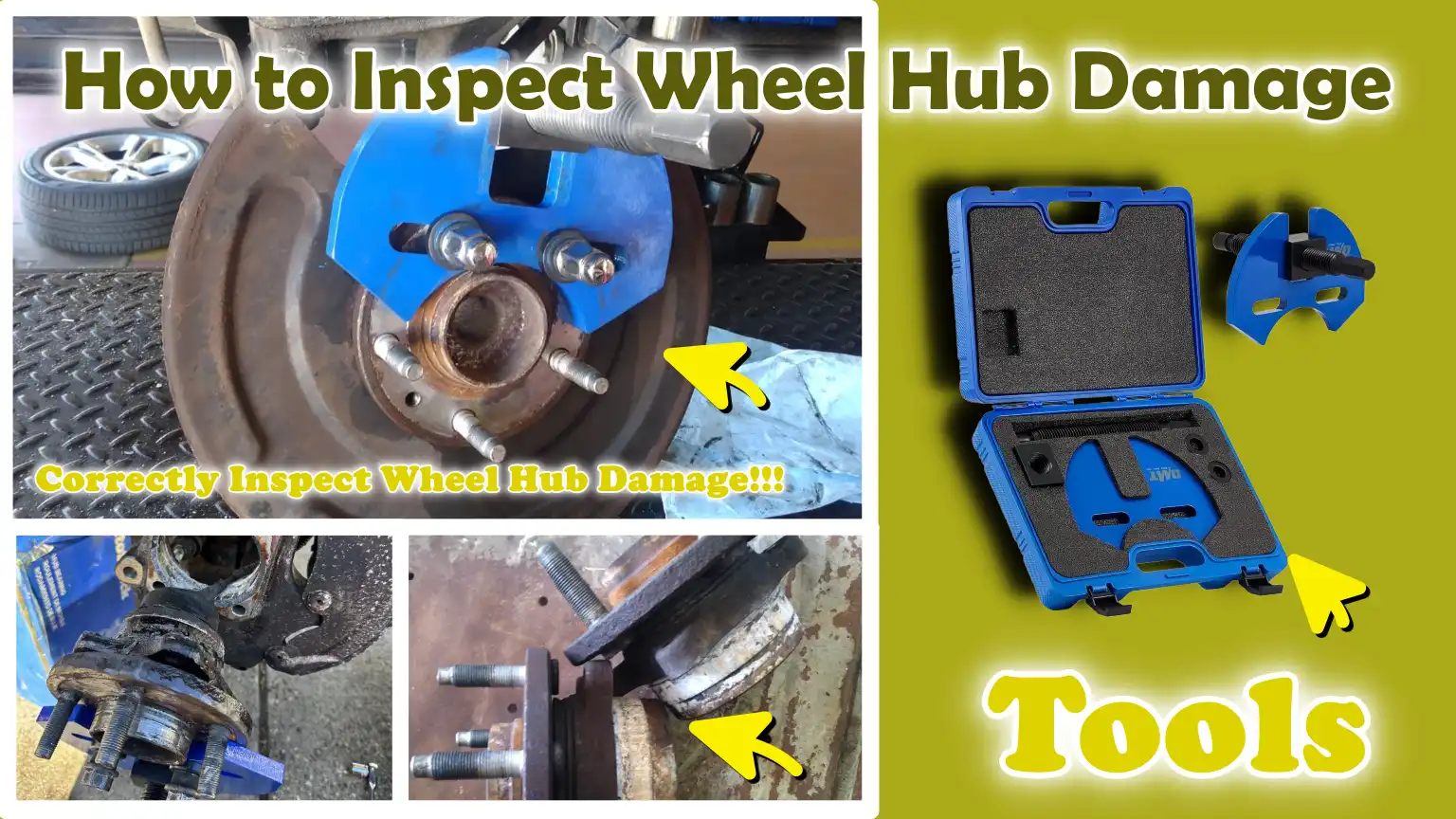
So, in this guide you’ll learn How to Inspect Wheel Hub Damage so that you can catch the problems early on and protect your tires and suspension parts before any dangerous road failures happens.
At First, Understand: What is a Wheel Hub?
A wheel hub is a central mechanical component that connects the wheel to the vehicle’s suspension system, allowing the wheel to rotate freely while remaining firmly attached to the car.
Simply put, it serves as a robust mounting point that holds everything together at the center of the wheel.
It supports the entire weight of the vehicle while simultaneously handling forces such as road shocks, potholes and the lateral pressure exerted during cornering.
Because it operates in such a high-stress environment, even the slightest defect or wear in the wheel hub can immediately compromise driving safety, steering control and the vehicle’s overall stability.
In modern vehicles, the wheel hub assembly often incorporates various advanced systems, making it even more critical for a comfortable and safe driving experience.
1. Understanding the Role of the Wheel Hub
The wheel hub fulfills multiple essential roles, each of which directly impacts how safely and comfortably a vehicle operates.
It connects the wheel to the suspension assembly; this means it acts as a bridge between the rotating wheel and the components that support the vehicle’s body.
It also supports the wheel bearings, which are responsible for allowing the wheel to rotate with minimal friction.
If the hub malfunctions, the bearings cannot remain properly seated in their position, potentially leading to issues such as noise, vibrations and irregular wheel rotation.
The wheel hub facilitates the smooth rotation of the wheels during various driving conditions such as: accelerating, braking and cornering, while simultaneously maintaining the vehicle’s stability.
In many modern vehicles, it also works in conjunction with ABS sensors; These sensors monitor wheel speed and prevent the wheels from locking up during sudden braking, thereby enhancing overall vehicle control and safety.
2. Key Components of the Wheel Hub Assembly
The wheel hub assembly consists of several interconnected components that function collectively as a single unit.
The hub flange is a flat mounting surface to which the wheel is attached; it is crucial that this surface remains perfectly flat to ensure the wheel rotates smoothly.
Wheel studs are threaded metal pins that, with the aid of lug nuts, securely fasten the wheel in place; any wear or damage to these studs can compromise the safety of the wheel.
Bearings are among the most critical internal components, as they minimize friction to facilitate the wheel’s free rotation while simultaneously supporting the vehicle’s substantial weight.
In many vehicles, an ABS tone ring or sensor is utilized to measure wheel speed and support the anti-lock braking system; these systems assist in maintaining vehicle control during sudden braking maneuvers.
Mounting bolts firmly anchor the entire assembly to the suspension system, ensuring that all components remain securely attached, even when the vehicle is traversing rough or uneven terrain.
3. Why Inspecting for Wheel Hub Defects is Essential
Inspecting for defects in the wheel hub is of paramount importance, as this component directly impacts both the vehicle’s safety and its performance.
When a wheel hub begins to fail, it can pose serious hazards to the vehicle’s operation.
These risks often develop gradually and frequently go unnoticed until the underlying internal issue has reached a critical stage.
Timely inspections help detect minor issues before they escalate into costly repairs or dangerous mechanical failures.
As the wheel hub supports the stability of the wheels, braking system and steering mechanism, any defect within it can simultaneously impact multiple systems.
Regular inspections ensure that the vehicle remains safe, stable and efficient during daily driving.
4. Safety Risks Associated with a Faulty Wheel Hub
A faulty wheel hub can create several serious safety hazards that directly compromise the driver’s control over the vehicle.
One of the early symptoms is wheel wobble, which causes the vehicle to feel unstable, particularly at high speeds.
As the defect worsens, steering control may deteriorate, making it difficult to drive in a straight line or react quickly while cornering.
When the hub prevents the wheel from rotating properly, braking can also become uneven; this results in the vehicle stopping irregularly or vibrating while coming to a halt or applying the brakes.
This issue can increase the vehicle’s stopping distance, thereby reducing the critical reaction time available during emergency situations.
In severe cases, continuing to drive with a faulty wheel hub can even lead to the wheel detaching, an extremely dangerous scenario that results in a complete loss of control over the vehicle.
5. Performance Issues Caused by Hub Defects
A faulty wheel hub not only compromises safety but also degrades vehicle performance in numerous ways.
A common consequence is uneven tire wear; this occurs because the wheel cannot rotate properly, resulting in irregular contact with the road surface.
This can shorten the lifespan of the tires and increase replacement costs.
Defective hubs also place excessive strain on the suspension system, subjecting other components to abnormal vibrations and loads for which they were not designed.
Brake rotor vibration is another prevalent issue; this manifests as an uneven sensation at the braking surface, caused by wheel misalignment or an unstable hub.
Over time, alignment issues can worsen, causing the vehicle to pull to one side or feel unbalanced while driving.
Furthermore, the engine may have to work harder to overcome the resistance generated by faulty wheel components, potentially leading to a significant decline in fuel efficiency over time.
Why It Is Important to Inspect for Wheel Hub Defects
Inspecting for wheel hub defects is crucial, as the wheel hub is one of the most critical components in any vehicle regarding safety and structural support.
It bears the entire weight of the vehicle while simultaneously allowing the wheel to rotate freely, even under heavy loads.
When this component begins to wear out or deteriorate, the defect often develops gradually, making it difficult to detect.
However, the adverse effects of such a defect can rapidly spread to the steering, braking, tire and suspension systems.
A properly functioning wheel hub keeps the wheel stable, aligned and securely attached.
Conversely, if even minor flaws are overlooked, it can compromise your control over the vehicle and lead to increased repair costs.
Regular inspections allow you to identify early warning signs such as: unusual noises, vibrations, or looseness, in a timely manner.
By doing so, you can prevent major mechanical failures and avoid dangerous situations while driving.
1. Safety Risks Associated with a Faulty Wheel Hub
When a wheel hub fails, the primary concern is safety.
This is because the condition of the wheel hub directly impacts the vehicle’s stability and your ability to maintain control while driving on the road.
One of the early warning signs is “wheel wobble”, a condition in which the wheel does not rotate smoothly or at a uniform speed, resulting in vibrations.
These vibrations can be felt through the steering wheel or the vehicle’s body, particularly when driving at high speeds.
As the defect worsens, you may lose control over the steering.
Consequently, driving in a straight line, safely negotiating turns, or maneuvering the vehicle effectively in emergency situations becomes difficult.
Braking performance can also become erratic, as the wheel no longer rotates smoothly or at a uniform speed.
Consequently, braking pressure is applied unevenly, resulting in reduced control over the vehicle while bringing it to a halt.
As a result, it takes longer for the vehicle to come to a complete stop – which is a phenomenon referred to as an increased ‘stopping distance’.
This can prove extremely dangerous in heavy traffic or in situations requiring sudden braking.
In severe cases, continuing to drive with a defective wheel hub can even lead to the wheel detaching from the vehicle.
This can cause the wheel to become dangerously loose and dislodge, creating a grave risk of accidents and potentially resulting in a complete loss of vehicle control.
2. Performance-Related Issues Caused by Hub Defects
A defective wheel hub not only poses a safety hazard but also gradually degrades the vehicle’s overall performance and operational efficiency.
A common issue is ‘tire wear.
‘ This occurs because the tire tread (surface) does not wear down uniformly, as the wheel is no longer rotating in a perfectly straight and stable manner.
This reduces the lifespan of the tires and increases the cost of replacement.
It also places excessive strain on the suspension system; this is because the system is forced to absorb the irregular vibrations and stresses generated by the faulty hub.
Over time, this can accelerate wear and tear on other components of the suspension system as well.
Brake rotor vibration is another common issue, wherein the braking system feels unstable or inconsistent due to the wheel not being properly seated and rotating irregularly.
The frequent result of this is that braking becomes less smooth and less effective.
Wheel alignment can also be compromised, as a faulty hub alters the wheel’s interaction with the suspension and the road surface, causing the vehicle to drift or pull to one side while driving.
Finally, fuel efficiency may decrease, as increased friction, poor wheel balance and higher rolling resistance force the engine to work harder, leading to a gradual increase in fuel consumption under normal driving conditions.
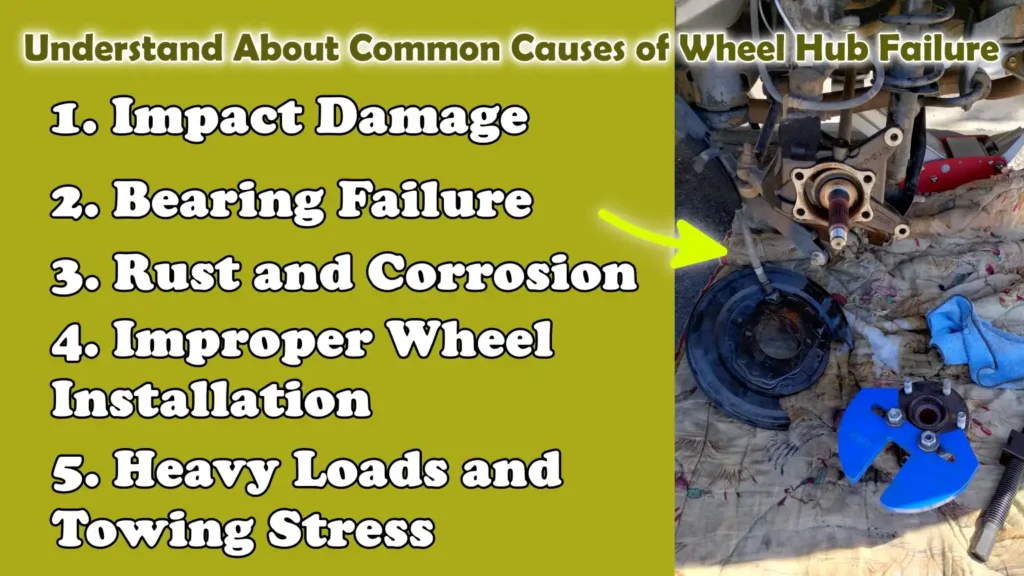
Understand About Common Causes of Wheel Hub Failure
Wheel hub failure typically does not occur suddenly under normal driving conditions.
In most cases, it is a gradual process that develops over time, driven by repetitive stress, poor maintenance, or adverse road conditions; these factors gradually weaken internal components such as bearings, studs and mounting surfaces.
Because the wheel hub supports the vehicle’s entire weight while simultaneously handling the stresses of rotation, braking and steering, even minor impacts or rough surfaces can gradually lead to severe wear and tear.
Understanding these primary causes helps drivers prevent premature failure, thereby avoiding costly repair bills and unsafe driving situations.
1. Impact Damage
The most common cause of wheel hub failure is a sudden and forceful impact, which subjects the hub assembly to immense stress within a very short period.
When a vehicle hits a pothole, the wheel is abruptly jolted upward; this can damage the bearings or slightly warp the hub, thereby disrupting the wheel’s rotation.
Striking a curb, whether while parking or turning, as it can also exert uneven pressure on the hub flange and wheel studs, potentially compromising wheel alignment or causing cracks to develop over time.
Road debris such as: rocks, metal fragments, or uneven surfaces, as it can also cause repeated minor impacts that gradually weaken the structural integrity of the hub.
In severe instances, such as during accidents, a forceful collision can inflict direct damage upon the wheel hub, resulting in immediate failure or long-term instability.
2. Bearing Failure
Wheel bearings are an essential component of the wheel hub assembly and their failure is the primary cause of hub malfunction.
Bearings require proper lubrication to minimize friction; when this lubrication is depleted due to wear and tear or a lack of maintenance, metal components begin to grind against one another, generating heat and producing audible noise.
Water intrusion is another significant issue, as moisture entering the bearing area washes away the grease and initiates corrosion within the assembly.
This impedes the wheel’s rotation and increases its rotational resistance.
Excessive heat accumulation, often resulting from long-distance travel, hauling heavy loads, or insufficient lubrication, as it can also damage the bearing surfaces, preventing the wheel from rotating smoothly and ultimately leading to hub failure.
3. Rust and Corrosion
Rust and corrosion are slow yet serious contributors to wheel hub failure, particularly in regions where vehicles are exposed to moisture, rain, or road salts.
During the winter season, exposure to road salts can accelerate the corrosion process within the metal components of the hub, thereby compromising its structural integrity over time.
Moisture accumulating from rain, washing, or humid environments can seep into minute cracks, leading to internal corrosion that remains invisible from the outside.
If left unaddressed such as: through a lack of regular cleaning or inspection of wheel components, the corrosion can spread, damaging both the hub’s surface and its internal mechanisms; ultimately, this impacts the wheel’s stability and safety.
4. Improper Wheel Installation
Improper wheel installation is another major cause of hub damage, a cause that often goes unnoticed until a problem manifests.
Overtightened lug nuts can exert excessive pressure on the hub flange, creating stress that can eventually lead to cracks or deformation of the hub over time.
Uneven tightening of lug nuts can create an imbalance, resulting in an uneven distribution of pressure across the hub and wheel assembly, which subsequently causes vibrations while driving.
Improper wheel fitment, particularly when the wheel does not precisely match the hub’s size or design, as it can compromise alignment and accelerate wear on both the studs and bearings, thereby reducing the overall lifespan of the hub system.
5. Heavy Loads and Towing Stress
The constant stress associated with excessive weight and heavy-duty usage can significantly shorten the lifespan of a hub.
When a vehicle carries a load exceeding its rated capacity, the hubs and bearings are forced to bear loads beyond their limits, leading to increased heat and friction within the assembly.
Frequent towing also imposes constant stress, particularly during acceleration, braking and cornering, subjecting the hub components to sustained pressure.
Off-road conditions such as: driving over rough terrain, gravel roads, or uneven surfaces, inflict repetitive shocks and vibrations upon the hubs, gradually compromising their structural integrity; this results in accelerated wear over time and increases the likelihood of hub failure.
Know, Common Symptoms of a Faulty Wheel Hub
Wheel hub failure typically develops gradually and its early signs often manifest as subtle changes in sound, steering feel, braking feel and tire condition.
As the wheel hub is directly connected to the wheel bearings, suspension and braking system, any malfunction within it produces symptoms that alter the vehicle’s handling and its grip on the road.
Recognizing these early warning signs is crucial, as it helps identify problems before they escalate into serious safety hazards or result in complete wheel failure.
1. Unusual Noises
The earliest and most common sign of a faulty wheel hub is the presence of unusual noises emanating from the wheel area.
Grinding sounds often indicate that the wheel bearing inside the hub has worn out, causing metal components to rub against one another without proper lubrication.
Humming or buzzing sounds that intensify as vehicle speed increases may also signal worn bearings or internal defects within the hub assembly, particularly if the noise becomes more pronounced while driving at highway speeds.
A “clicking” sound while turning the vehicle is another significant symptom; this can occur when worn hub components shift out of position under pressure, specially during turns, when the directional forces acting on the wheel change.
2. Steering-Related Issues
A faulty wheel hub often impacts the steering system as well, given the hub’s critical role in maintaining wheel stability and proper alignment.
Vibration in the steering wheel is a common symptom, particularly at higher speeds, and typically occurs when a worn hub or bearing prevents the wheel from rotating smoothly and uniformly.
The vehicle pulling to one side can also be a symptom; this occurs when the hub fails to maintain proper wheel alignment, resulting in an imbalance in rolling resistance between the two wheels.
A loose-feeling steering wheel can be another indicator, where the driver senses a loss of control or stability, particularly when turning corners or changing lanes, because the wheel’s movement is no longer precise.
3. Issues Related to Wheel Movement
Physical irregularities in the wheel’s movement or rotation are a definitive sign of a faulty hub.
Whether the vehicle is being driven or the wheel is being manually inspected while the car is lifted, a distinct “wobble” is often visible; this indicates that the hub is failing to hold the wheel firmly in place.
Excessive “wheel play” signifies that the wheel is exhibiting unnecessary side-to-side or up-and-down movement; this typically points to worn-out bearings or a defect within the hub assembly.
Irregularities in movement may also be felt when rotating the wheel by hand; the wheel will not spin freely and due to internal wear and tear, it may feel stiff or gritty when turning.
4. Braking-Related Symptoms
A faulty wheel hub can also compromise braking performance, as the hub and the brake rotor are closely interconnected.
Uneven wheel rotation can cause vibrations in the brake pedal, leading to improper brake contact when bringing the vehicle to a stop.
If the system receives erroneous signals regarding wheel speed, the ABS warning light may illuminate, this often happens when the hub or the ABS tone ring becomes defective.
Vibration in the rotor during braking is another common symptom; In this scenario, the erratic movement of the wheel, caused by issues with the hub, induces vibrations in the steering wheel or brake pedal.
5. Signs of Tire Wear
The condition of the tires often serves as an indicator of the wheel hub’s condition, as improper wheel rotation directly impacts the tire’s contact with the road surface.
Uneven tire tread wear is a common symptom; due to the wheel’s lack of proper stability, one section of the tire wears down more rapidly than another.
‘Feathering’, a pattern in which the edges of the tire feel smooth on one side and rough on the other, as it can also occur when a faulty hub causes the wheel to be misaligned.
Rapid tire wear is another warning sign; constant vibrations, imbalance and the improper rotation resulting from a defective wheel hub cause the tires to wear out significantly faster than usual.
Tools
| Tool | Why It Is Needed | How to Use It |
|---|---|---|
| Flashlight | This helps you clearly identify cracks, rust, leaks and defects in the tight areas of the wheel where light typically does not reach. | For improved visibility, direct the light around the wheel hub, behind the wheel and near the suspension components while slowly rotating the wheel. |
| Gloves | This protects your hands from sharp metal edges, grease, dirt and hot brake components. | To avoid cuts or contamination, put these on before touching the wheel, hub, or brake components. |
| Jack and Jack Stands | This safely lifts the vehicle, allowing the wheel to be inspected without any load pressure. | Position the jack beneath the correct lifting points, raise the vehicle and secure it with a jack stand before checking the wheel for any movement. |
| Lug Wrench | This removes the lug nuts, allowing the wheel to be detached for a comprehensive inspection of the entire hub assembly. | Loosen the lug nuts in a cross pattern before lifting the vehicle and then completely remove the wheel once the vehicle has been raised. |
| Pry Bar | This helps check for looseness or “play” – excessive clearance within the suspension and hub components. | Apply gentle pressure near the wheel hub to detect any abnormal looseness or movement in the connected components. |
| Dial Indicator | This measures minute wheel movements or “hub runout” that are invisible to the naked eye. | Mount the device near the hub and slowly rotate the wheel to check for any uneven movement or wobble. |
| Torque Wrench | This ensures that the lug nuts are tightened correctly, in accordance with the manufacturer’s specifications. | To prevent unnecessary stress on or damage to the hub, tighten the lug nuts uniformly in a star pattern using the correct torque level. |
| Mechanic’s Stethoscope | This helps detect internal bearing noise that may not be easily audible from the outside. | While the wheel is rotating, position the probe near the wheel hub to listen for any grinding, humming, or rough noises. |
| Bearing Grease Inspection Tools | This helps assess the condition of the lubrication inside the bearing assembly, allowing for the detection of dryness or contamination. | Whenever possible, by disassembling or inspecting the bearing assembly, check the quality and color of the grease, as well as for the presence of any dust or water. |
How to Ensure Safety Before Inspection
Before inspecting a wheel hub for faults, safety must always be given top priority.
This is because you will be working around heavy components and lifting the vehicle, a task that, if not properly secured, can result in serious injury.
Even a simple wheel inspection can be hazardous if the vehicle shifts, slips, or falls while in a lifted position.
The wheel hub assembly is connected to both the suspension and braking systems; therefore, any sudden movement could damage components or cause an accident.
Adhering to proper safety protocols ensures that the inspection is accurate, controlled and free from hazards.
1. Park the Vehicle Properly
The first step is to park the vehicle on a level surface.
This is crucial because lifting a vehicle on uneven ground can render it unstable, thereby increasing the risk of it slipping or shifting out of place.
A level surface ensures that the vehicle’s weight is distributed evenly, a critical factor when checking for wheel movement or lifting a specific section of the vehicle.
Whenever you are working around the wheels, the parking brake should always be engaged to prevent the vehicle from rolling.
This provides an additional layer of safety, particularly when a wheel has been partially lifted or removed.
“Wheel chocks” are the blocks designed to secure the wheels and it should also be placed in front of or behind the wheels that remain in contact with the ground.
These simple blocks prevent the vehicle from moving forward unintentionally and are specially important when working on an incline or while inspecting wheel hubs, situations where vehicle stability is paramount.
2. Safely Lift the Vehicle
When lifting the vehicle, it is essential to use the correct “jack points”.
These are robust structural points specifically designed by the manufacturer to safely support the vehicle’s weight.
Placing a jack in the wrong location can result in damage to the vehicle’s body or cause the vehicle to slip and fall off the jack.
Once the vehicle has been lifted, it is crucial to firmly position jack stands at the correct support points.
This is because jack stands are engineered to keep the vehicle stable for extended periods during inspections, whereas a standard jack is designed solely for the purpose of lifting the vehicle.
To maintain the vehicle’s balance and prevent it from shifting, jack stands should always be placed on firm and stable surfaces.
Furthermore, relying solely on a hydraulic jack is not a prudent practice.
This is because the hydraulic pressure within the jack may gradually dissipate, or its internal mechanism could fail suddenly, causing the vehicle to drop abruptly.
Jack stands serve as a safety backup, ensuring that the vehicle remains completely stable while you inspect the wheel hubs for any defects, looseness, or unusual noises.
How to Inspect Wheel Hub Damage – Clear & Easy Steps
Caution and a systematic approach are essential when inspecting wheel hubs, as the hub constitutes a critical component of vital systems such as steering, braking, suspension and wheel bearings.
Proper inspection aids in identifying early signs of malfunction before they escalate into hazardous driving conditions or costly repairs.
Each step outlined below focuses on simple yet effective checks, designed to uncover hidden issues through visual cues, motion tests, audible indicators and an assessment of component condition.
1. Visual Inspection of the Wheel Hub
The first step involves a thorough visual inspection of the wheel hub area, as many types of damage can only be detected through close-range observation.
Cracks on the hub surface serve as a serious warning sign, indicating structural weakness that could worsen under the stresses of driving.
Rust accumulation often signals prolonged exposure to moisture or road salt, which can gradually weaken metal components and degrade performance.
A bent hub flange can cause uneven wheel rotation, leading to vibrations and misalignment.
Damaged wheel studs may appear loose, bent, or missing, conditions that directly compromise wheel safety.
Grease leakage around the hub area often points to bearing failure or a defective seal, indicating that internal lubrication is diminishing and friction is increasing.
2. Check for Wheel Play
The next step is to check for wheel play, which helps detect any looseness within the hub or bearing system.
To perform this “wiggle test,” grasp the tire at the 12 o’clock and 6 o’clock positions, then gently push and pull to check for any movement.
A properly functioning wheel should feel stable, exhibiting almost no movement.
Excessive play typically indicates worn bearings, a loose hub assembly, or potential suspension issues that are compromising the wheel’s stability.
Even slight play can worsen over time; therefore, early detection is crucial for safety.
3. Spin the Wheel by Hand
Spinning the wheel by hand reveals issues that might not be apparent during a static inspection.
The wheel should rotate smoothly, without any resistance or noise.
A grinding sound during rotation often signals internal bearing damage, where metal components are rubbing against one another.
Rough rotation suggests that the wheel is not spinning uniformly, a condition that may be caused by internal wear or contamination.
Resistance during rotation indicates a faulty hub or bearing, likely due to rust, a lack of lubrication, or internal damage.
4. Inspect the Wheel Bearings
Wheel bearings are among the most critical components of the hub assembly and their condition directly impacts the smoothness of the wheel’s rotation.
The scent of burnt grease may indicate overheating caused by excessive friction within the bearings.
Discovering metal fragments inside or around the hub area is a definitive sign of internal wear and the breakdown of metal surfaces.
A gritty sensation within the bearing while spinning the wheel suggests that the internal rolling elements are no longer smooth.
Discoloration of surrounding metal components due to heat may indicate that the bearing is operating under excessive thermal stress, often a sign of an impending major mechanical failure.
5. Inspect the Wheel Studs
Wheel studs are responsible for securely anchoring the wheel in place; therefore, their condition is paramount for safety.
Cross-threading occurs when lug nuts are not installed correctly, damaging the threads and compromising the integrity of the connection.
Studs can become bent due to impacts or overtightening, thereby diminishing their ability to firmly secure the wheel.
Worn threads make it impossible to properly tighten the wheel, creating a serious safety hazard.
Missing studs significantly compromise wheel stability, a critical issue that must be rectified immediately before operating the vehicle.
6. Check for Hub Runout
Hub runout refers to minute movements or vibrations within the wheel hub that are imperceptible without the aid of precision measuring instruments.
Using a dial indicator helps quantify the lateral movement that occurs as the wheel is slowly rotated.
Detecting excessive hub runout indicates that the hub is not perfectly aligned, which can lead to vibrations, uneven braking and premature tire wear.
Even a slight deviation from normal movement can signal serious internal damage, potentially compromising driving stability.
7. Inspect ABS Components
Modern wheel hubs are often equipped with ABS sensors and tone rings, which are crucial for safe braking.
Damaged sensor wiring can disrupt communication with the ABS system, potentially triggering warning lights or compromising braking control.
The accumulation of dirt around the sensor can interfere with obtaining accurate readings of wheel speed.
Cracks in the tone ring can generate erroneous signals, thereby affecting the ABS system’s response during braking.
Furthermore, corrosion can obstruct or weaken sensor signals, diminishing the effectiveness of safety systems.
8. Inspect Brake Components Surrounding the Hub
The brake components located near the wheel hub can also provide indications of hub-related faults.
Uneven rotor wear often suggests that the wheel is not rotating in a perfectly stable manner, an issue that may stem from problems within the hub or bearings.
Vibrations in the brake caliper during braking indicate that the mounting surface is unstable; this condition is frequently linked to irregularities within the hub itself.
Brake pad wear patterns can also reveal imbalances, where, due to improper wheel alignment or issues with hub rotation, the pad on one side wears down faster than the pad on the other.
Collectively, these signs help confirm whether the wheel hub is negatively impacting braking performance and the vehicle’s overall safety.
So, How to Distinguish Wheel Hub Malfunctions from Other Issues
Accurately identifying a wheel hub malfunction is crucial, as many vehicle issues can appear similar at first glance, particularly those involving wheel bearings, suspension components, or tires.
As all these parts are interconnected and work in unison to stabilize the wheel, even a minor defect in one component can manifest symptoms identical to those of another.
Understanding these distinctions helps prevent misdiagnosis, unnecessary repairs and wasted money, while also ensuring that the root cause of the problem is addressed in a timely manner.
1. Wheel Hub vs Wheel Bearing Issues
Wheel hub and wheel bearing issues are often conflated, as these components are directly linked and exhibit many overlapping symptoms.
In both instances, symptoms may include humming or grinding noises, vibrations in the steering wheel and erratic wheel movement while driving.
These issues typically intensify at higher speeds or when cornering, making it difficult to pinpoint the actual problem without a thorough inspection.
The key distinction lies in the fact that the wheel bearing is, in essence, an integral part of the hub assembly itself; this means that a bearing failure often originates internally, from within the hub, and gradually propagates outward.
A faulty bearing typically produces a persistent rumbling or humming sound that intensifies with increasing speed, whereas a defective hub may also exhibit visible external signs, such as cracks, surface irregularities, or issues with the wheel studs.
Simply put, bearing issues are primarily internal in nature and manifest as audible noises, whereas wheel hub malfunctions often involve visible structural defects in addition to sound.
2. Wheel Hub vs Suspension Issues
Wheel hub problems can often mimic suspension issues, as both affect the vehicle’s balance, steering control and stability.
Suspension components such as: ball joints, tie rods and control arms, help keep the wheels aligned and stable on the road; consequently, when these parts become worn, the vehicle may pull to one side, feel loose, or experience vibrations while driving.
Symptoms of ball joint issues typically include knocking sounds when driving over potholes and a sensation of looseness in the steering, particularly when turning.
Tie rod problems frequently result in steering misalignment, which can make the vehicle difficult to handle or cause it to feel uncontrollable, even on straight roads.
Issues with the movement of control arms lead to improper wheel positioning, resulting in poor handling and vibrations.
However, wheel hub malfunctions are directly linked to the rotation of the wheels, manifesting as grinding noises, wheel wobbling and uneven rotation, whereas suspension issues relate to directional control and the absorption of road shocks, rather than the rotation of the wheels themselves.
3. Wheel Hub vs Tire Issues
Wheel hub malfunctions are sometimes mistaken for tire-related problems, as both can cause vibrations, uneven wear and instability while driving.
Tire imbalance is one of the most common causes of steering wheel vibration; however, unlike a faulty hub, it typically does not produce grinding or humming noises emanating from the wheel assembly.
Bent wheels can also mimic hub-related issues, as they too result in wobbling and uneven rotation; however, in such instances, the problem lies within the rim itself rather than the hub assembly.
Tire defects such as: uneven construction, internal damage, or tread separation, as it can also manifest as vibrations or a pulling sensation while driving.
The key distinction is that tire-related issues are typically visible on the rubber surface or are detected during wheel balancing, whereas a faulty wheel hub affects the internal rotating mechanism and often leads to persistent noise, excessive heat generation, or looseness in the wheel structure.
Signs Shows That You Need to Replace Your Wheel Hub Immediately
A wheel hub typically does not fail all at once; however, when the damage reaches a critical level, it begins to exhibit clear warning signs that should never be ignored.
At this stage, the hub’s internal bearings, mounting surfaces, or structural housing have already deteriorated.
This means that continuing to drive could very quickly result in the wheel becoming completely unstable.
These symptoms are serious because they indicate that the wheel hub is no longer safe and must be replaced immediately to prevent the risk of a major mechanical failure or accident.
1. Loud Grinding Noises
Loud grinding noises are the strongest indication that the wheel hub has sustained severe damage.
This sound typically originates from within the bearing assembly, where metal components are grinding directly against one another due to a lack of lubrication or bearings that have completely worn out.
As the vehicle’s speed increases, this noise often intensifies, as the friction increases in tandem with the rotational velocity.
Simply put, this means that the smooth-rotating mechanism inside the hub has broken down and the metal components are now in direct contact; if left unreplaced, this could very quickly lead to the complete destruction of the hub.
2. Excessive Wheel Wobble
Excessive wheel wobble is a dangerous sign indicating that the wheel is no longer being securely supported by the hub assembly.
This occurs when excessive looseness (or “play”) develops within the hub’s internal bearings or structural housing, causing the wheel to wobble unevenly as it rotates.
The driver may experience severe vibrations in the steering wheel, or at high speeds, the wheel itself may even appear to be visibly shaking.
This situation is particularly dangerous because it compromises the vehicle’s stability, steering control and braking performance, making it difficult to operate the car safely.
3. Visible Cracks
Visible cracks on or around the wheel hub serve as a serious structural warning sign.
These cracks are typically caused by prolonged stress, heavy loads, collision damage, or metal fatigue.
Once cracks appear, the hub is no longer strong enough to securely hold the wheel under normal driving pressures.
When stress is applied, particularly during braking or cornering, even small cracks can propagate rapidly, significantly increasing the risk of sudden mechanical failure.
This is one of the most critical indicators that the wheel hub requires immediate replacement.
4. ABS Malfunction
An ABS malfunction can also be an indication of damage to the wheel hub, as modern ABS systems rely on sensors and “tone rings” that are often mounted directly within the hub assembly itself.
When a problem arises inside the hub, these sensors may transmit erroneous signals or cease functioning entirely, causing the ABS warning light to illuminate on the dashboard.
This implies that the anti-lock braking system will be unable to function correctly during emergency braking, resulting in reduced vehicle control and increased stopping hazards.
In many instances, repairing the wheel hub is necessary to restore proper ABS functionality.
5. Heat or Smoke Near the Wheel
The emission of heat or smoke from the vicinity of the wheel is one of the most alarming signs of a failing wheel hub.
This typically occurs when the internal bearings become excessively worn, generating significant friction during rotation.
This friction generates intense heat, which can damage surrounding components and, at times, even result in visible smoke.
This condition indicates that the wheel hub is on the verge of complete failure and could break at any moment, rendering it unsafe to drive the vehicle even for a short distance.
Read More:
- How to Replace Broken Wheel Stud
- How to Remove Stuck Lug Nuts
- How to Torque Lug Nuts Correctly
- How to Check Wheel Lug Torque
- How to Install Directional Tires Properly
- How to Identify Directional Tires Correctly
- How to Choose Tires for Snow Driving
- How to Choose Tires for Wet Roads
- How to Check Tire Load Rating
- How to Store Tires Properly Long Term
- How to Prevent Tire Dry Rot
- How to Fix Tire Bulge Issue
- How to Inspect Tire Inner Sidewall Damage
- How to Fix TPMS Sensor Not Detected
- How to Relearn TPMS Without Scan Tool
- How to Reset Tire Pressure Monitoring System Manually
- How to Check Tire Pressure Sensor Battery
- How to Seal Bead Leak in Tire
- How to Use Tire Plug Kit Correctly
Can You Drive with a Bad Wheel Hub?
A faulty wheel hub is one of those automotive issues that should never be ignored or dismissed as a minor inconvenience, as it directly impacts how safely the wheel rotates and how securely it remains attached to the vehicle.
Simply put, the wheel hub is responsible for holding the wheel in place and allowing it to rotate freely, even while supporting the entire weight of the vehicle, so any defect in it compromises this critical connection.
Even if the vehicle appears to drive normally at first, driving with a bad hub is extremely risky, as the problem typically worsens with every mile traveled.
The internal bearings may already be worn out, the mounting points may be unstable, or the wheel itself may have a slight looseness that could suddenly escalate without warning.
What makes this particularly dangerous is that the failure does not always occur gradually; it can suddenly worsen during routine driving maneuvers such as: turning corners, applying the brakes, or driving at high speeds.
1. The Short Answer
No, it is not safe to drive with a bad wheel hub, as it can fail suddenly, potentially leading to a loss of control over the wheel, compromised braking performance, or the wheel detaching completely from the vehicle.
2. Why Is It Risky?
It is risky because a faulty wheel hub compromises the structural integrity of the entire wheel assembly, which includes the bearings, studs and braking system.
As the defect progresses, the wheel may cease to rotate properly or lose its correct alignment with the suspension system.
This creates instability that is most acutely felt when accelerating, cornering, or braking.
As the wheel hub bears both the vehicle’s weight and the stress imposed by road shocks, any weakness in this component compromises overall vehicle control and heightens the risk of sudden mechanical failure.
3. Potential Consequences
When the internal bearings fail completely, “wheel lockup” may occur; this causes the wheel to abruptly cease rotating freely, creating a risk of sudden loss of control while driving.
Another severe consequence is the catastrophic failure of the bearing, wherein its internal components completely disintegrate; this is often accompanied by loud grinding noises, excessive heat generation and extreme instability in the wheel.
The braking system may also sustain damage, as a faulty hub affects the alignment and rotation of the brake rotor, resulting in uneven braking, vibration, or diminished braking efficiency.
The most critical consequence of this is a significantly heightened risk of an accident, as a defective wheel hub can lead to a loss of steering control, wheel wobble, or, in the most severe instances, the partial or complete detachment of the wheel while the vehicle is in motion.
How to Protect Wheel Hubs from Damage
The primary method for protecting wheel hubs from damage is to minimize the stress placed on the wheel assembly and to adopt proper driving and maintenance habits.
As the wheel hub bears the entire weight of the vehicle and facilitates the wheel’s smooth rotation via its bearings and studs, minor errors such as: hitting potholes at high speeds or improper wheel installation, as it can gradually lead to wear, vibration, or premature failure.
Effective preventive measures help extend the lifespan of the hubs, enhance driving safety and reduce the need for costly repairs involving the suspension, tires and braking systems.
Along with this, there’s research that shows that defective wheel hub bearing actually generates really strong mechanical vibrations signals and distinct acoustic noise that increase with the speed and the load as well, so these are the early warning signals that are really important as they appear before any visible damage that makes the vibration and noise analysis a reliable early inspection method as well, that means that drivers may first notice humming or chattering sounds way before the hub completely fails, which is why early inspection is really important to maintain the safety during drive.[¹]
1. Drive Carefully on Rough Roads
Driving cautiously on rough roads is the most effective way to protect wheel hubs from damage, as sudden impacts are a leading cause of bearing and hub failure.
Avoiding potholes is crucial; striking a pothole at high speed generates a severe shock that travels directly from the wheel to the hub assembly, potentially causing component deformation or internal bearing damage.
Slowing down when approaching potholes mitigates this impact and allows the wheel to traverse uneven surfaces more smoothly, thereby preventing undue stress on the hub and surrounding suspension components.
2. Tighten Lug Nuts Correctly
Tightening lug nuts correctly plays a vital role in protecting the wheel hub, as uneven or excessive tightening can result in an unbalanced distribution of pressure across the hub flange.
Using a torque wrench ensures that lug nuts are tightened precisely according to the manufacturer’s specified measurements, thereby guaranteeing that pressure is distributed evenly across the wheel mounting surface.
Adhering to the manufacturer’s instructions is crucial, as every vehicle has specific torque requirements designed to secure the wheel safely without subjecting the hub, studs, or bearings to excessive stress.
3. Perform Regular Maintenance
Regular maintenance helps detect early signs of wear in the wheel hubs before they escalate into serious issues.
Inspecting the bearings is vital, as worn or dry bearings, if left unaddressed, as it can quickly lead to overheating, grinding noises and eventual hub failure.
Checking the brakes also aids in identifying hub-related problems, as uneven rotor wear or vibrations may indicate hub instability.
Tire rotation ensures even wear across all wheels, thereby reducing the uneven pressure placed on any single hub and maintaining balanced wheel performance over time.
4. Avoid Overloading the Vehicle
Avoiding vehicle overloading is absolutely essential, as excess weight places undue stress on the wheel hubs and their internal components.
Adhering to load limits ensures that the hubs and bearings are not subjected to loads exceeding their capacity, thereby preventing the generation of excessive heat and premature wear.
It is crucial to minimize the stress placed on a vehicle during towing, as hauling heavy loads subjects the wheels to constant pressure, particularly during acceleration, braking, or cornering, which can gradually weaken the hub assembly and reduce its lifespan.
Conclusion – How to Inspect Wheel Hub Damage
So, whenever the wheel hub starts to fail, then it slowly affects everything around it such as: tire wear to steering control and even it doesn’t shows any obvious warning signs at first.
As the wheel hub bears the entire weight of the vehicle and houses critical components such as: bearings, studs and ABS sensors, even a minor defect can gradually escalate into major problems, including vibrations, uneven tire wear, steering instability and braking malfunctions.
Most importantly, wheel hub issues typically manifest gradually, beginning with faint noises, slight wobbling, or subtle changes in steering feel, yet these early symptoms often represent the best opportunity to avert costly repairs or dangerous mechanical failures.
Regular inspections, cautious driving on rough terrain, proper wheel installation and routine maintenance can significantly extend the lifespan of the wheel hubs and shield the entire wheel system from unnecessary stress.
Now, that’s it from this guide and you can comment down below for more info.
Frequently Asked Questions
FAQ 1: What is a wheel hub and why is it important?
The wheel hub is the central component that connects your wheel to the vehicle, allowing the wheel to rotate freely while simultaneously supporting the entire weight of the vehicle. It also houses the wheel bearings, secures the wheel studs and is often integrated with the ABS system. It is crucial because it directly impacts driving safety, steering control, braking performance and tire longevity. If a wheel hub fails, all of these systems can become unstable and unsafe.
FAQ 2: What are the early signs of a failing wheel hub?
The early signs of a failing wheel hub are typically very subtle and can be difficult to detect. You might notice a faint humming or grinding sound coming from one of the wheels, feel a slight vibration in the steering wheel, or observe uneven tire wear, meaning the tire is wearing down more in certain spots than in others. Some drivers also sense a slight looseness in the wheel or hear “clicking” sounds when turning corners. If these early symptoms are ignored, they often worsen over time.
FAQ 3: Can a bad wheel hub affect steering?
Yes, a bad wheel hub can affect steering because it helps keep the wheel stable and properly aligned. When the hub or its bearings begin to fail, the wheel cannot rotate smoothly; this can lead to vibrations, cause the vehicle to pull to one side, or make the steering feel loose. This makes controlling the vehicle even more difficult, particularly at high speeds or while turning.
FAQ 4: What kind of sounds does a bad wheel hub make?
A faulty wheel hub typically produces sounds such as grinding, humming, or growling. As the vehicle’s speed increases, this noise often intensifies and its pitch or intensity may change while turning corners. This occurs because the bearings inside the hub have worn out or lack proper lubrication, causing the metal components to grind against one another.
FAQ 5: Is it safe to drive with a faulty wheel hub?
No, it is not safe to drive with a faulty wheel hub. Even if the vehicle remains operational, the defect can deteriorate rapidly, leading to serious issues such as wheel wobbling, braking difficulties, or, in severe cases, the complete detachment of the wheel from the vehicle. Driving in such a condition significantly increases the risk of an accident; therefore, the problem should be inspected and repaired as soon as possible.
FAQ 6: Why do wheel hubs fail?
Wheel hubs typically fail due to impact damage, wear and tear, or a lack of proper maintenance. Common causes include driving over potholes, traveling on rough or poorly maintained roads, water or dust ingress into the bearings, corrosion caused by moisture or road salt, improper wheel installation and hauling heavy loads. Over time, these factors weaken the hub and compromise its functional integrity.
FAQ 7: How do you identify a faulty wheel hub?
To identify a faulty wheel hub, you can listen for any unusual noises, feel for vibrations and check for excessive looseness (play) in the wheel. A common diagnostic method is the “wiggle test,” in which you safely lift the vehicle and attempt to manually shake the wheel. If the wheel feels loose or produces a noise when shaken, it may indicate a fault in the hub or bearing. For a more detailed inspection, mechanics can use tools such as a ‘dial indicator’ to measure any movement or imbalance with greater precision.
FAQ 8: Can a faulty wheel hub cause tire wear?
Yes, a faulty wheel hub can cause tires to wear unevenly or prematurely. When a hub malfunctions, the wheel does not rotate at a uniform speed, resulting in uneven contact with the road surface. This can cause the tire to wear down on one side, develop ‘feathering patterns,’ or experience rapid tread depletion; all of which reduce the tire’s lifespan and compromise the vehicle’s stability.
FAQ 9: How long does a wheel hub last?
A wheel hub can last for a considerable amount of time, often 100,000 kilometers or more, depending on the type of roads you drive on and the quality of the vehicle’s maintenance. However, if you frequently drive on rough roads, carry heavy loads, or if the bearings are exposed to water or dust, or suffer from a lack of lubrication, their lifespan can be significantly reduced. Regular inspections help extend the life of the wheel hubs.
FAQ 10: What happens if a wheel hub fails completely?
If a wheel hub fails completely, the wheel may become unstable or cease to rotate properly. This can result in severe vibrations, loss of steering control, brake failure, or even the wheel detaching from the vehicle. This is an extremely dangerous situation that typically requires immediate repair or necessitates towing the vehicle.
References:
[1] Experimental characterization of mechanical vibrations and acoustical noise generated by defective automotive wheel hub bearings
https://www.researchgate.net/publication/257725037_Experimental_characterization_of_mechanical_vibrations_and_acoustical_noise_generated_by_defective_automotive_wheel_hub_bearings
Hello Folks, Dean Shali here to help you out to solve the problems with your lovely vehicle, as i have lots of experience and knowledge about automotive industry as i woks directly with the customers and repair vehicles and i love to help the people to keep their cars safe and running smoothly.