
Written By: Dean Shali
Fact Checked By: Sabré Cook
Reviewed By: Tamara Warren
Every time you stops your vehicle by pressing that brake level, then it leaves microscopic brake particles behind that eventually turns that clean and good looking wheels into dark and rough textured one.
Basically, brake dust is the mix of burnt carbon fibers, tiny metallic shavings from the brake rotors, adhesive materials from the brake pads and microscopic contaminants that are sticks to the wheels after having high-friction braking process.
Now-a-days, it is seen way more frequently with the heavier SUVs, performance cars and even daily-driven city vehicles, as they actually produces even more brake dust because braking system have to work harder than any other vehicle.
Even, you can’t clean it with some harsh acid cleaners, rough brushes and improper washing methods as it scratches that alloy wheels, strip the protective coatings and leaves permanent stains behind as well.
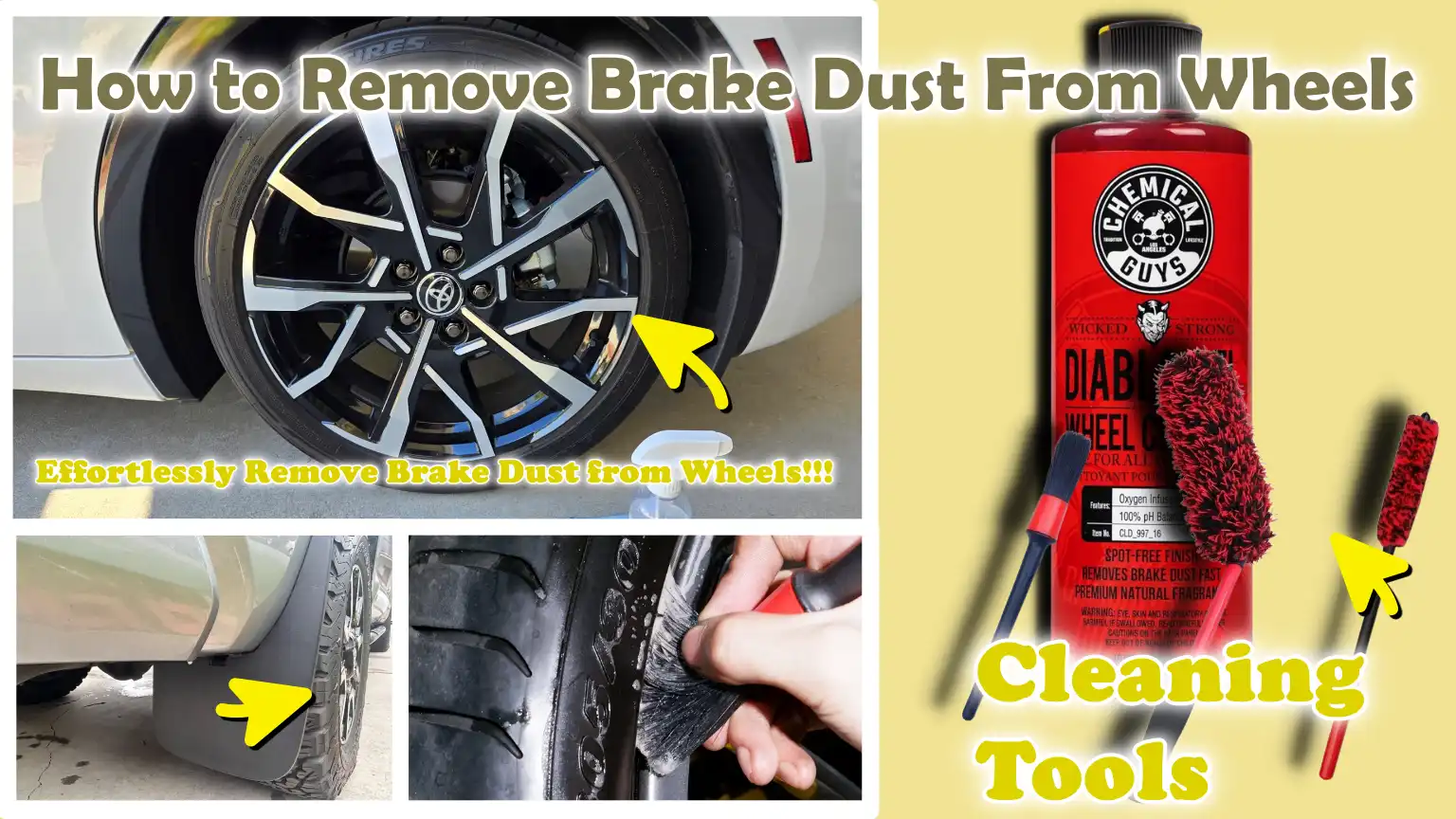
Now, that’s the guide that shows you How to Remove Brake Dust From Wheels so that you can achieve clean and really great finish as well.
Understand, What is Brake Dust?
Brake dust is a fine, dark-colored powder that is generated every time your vehicle slows down or comes to a stop.
It is not ordinary road grime; rather, it is a mixture of tiny particles produced directly by the braking system itself.
These particles originate from the brake pads and brake rotors, which constantly rub against each other whenever the brake pedal is depressed.
Over time, this friction causes minute fragments to break off and accumulate on the wheels.
Although it may appear harmless at first glance, brake dust is chemically active and contains substances that can gradually bond with metal and painted surfaces.
This is why wheels often begin to look black or dirty again shortly after being washed.
1. Understanding the Source of Brake Dust
Brake dust is generated within the braking system when friction is utilized to reduce the vehicle’s speed.
When you press the brake pedal, the brake pads clamp tightly onto the spinning brake rotors.
This creates controlled friction, the very force responsible for slowing the vehicle down.
However, this friction also causes slight wear on the surfaces of both the pads and the rotors.
The particles released by this wear disperse into the air surrounding the wheel and eventually settle as dust.
The amount of dust generated depends on your driving style, the weight of the vehicle, the materials used to manufacture the brakes and the frequency with which you apply the brakes, particularly in stop-and-go traffic.
Understanding the Friction Between Brake Pads and Rotors
Brake pads are composed of composite materials designed to withstand heat and pressure, while rotors are typically made of cast iron or similar metal alloys.
When these two surfaces come into contact with each other, the resulting friction generates a significant amount of heat.
This heat helps to slow the vehicle down; however, in this process, tiny particles from both materials also wear away.
These particles are extremely small and easily disperse throughout the entire wheel assembly.
As the wheels are located in close proximity to the braking system, this residual material tends to accumulate primarily on them; this is why the buildup of brake dust is a very common occurrence, even on vehicles that otherwise appear spotless.
Metallic vs Ceramic Brake Dust
Different types of brake pads produce different types of dust.
Due to their higher metal content, metallic brake pads typically generate a denser, darker-colored dust.
This type of dust has a somewhat coarse texture and can adhere very firmly to the surface of the wheels.
On the other hand, ceramic brake pads produce a lighter, finer dust that is generally less visible, although it too can accumulate over time.
Ceramic dust is often easier to clean; however, if any type of dust is left uncleaned, it can bond tightly to the wheel’s finish.
This distinction primarily affects how quickly the wheels become dirty and, subsequently, how difficult they are to clean.
Why Modern Performance Brakes Generate More Dust
Modern performance and heavy-duty braking systems are engineered to meet the demands of higher speeds, heavier vehicles and more rapid deceleration requirements.
To achieve this capability, they utilize materials capable of withstanding extreme heat and pressure.
As a side effect of this process, these materials often generate a significantly larger amount of brake dust.
Performance cars, SUVs and trucks typically generate more dust because they require heavier braking force to come to a stop.
When driving in the city, where frequent braking is unavoidable, this dust accumulates even more rapidly.
This is why the wheels on certain vehicles require cleaning more often than others.
2. Why Brake Dust Is Harmful
Brake dust is not merely a cosmetic issue.
Over time, it can compromise both the aesthetic appearance and the structural integrity of the wheels.
Its particles are so minute that they settle into the microscopic pores present on the surfaces of metal, paint and clear coats.
If left uncleaned, these particles gradually bond with the wheel’s finish, making them increasingly difficult to remove.
In some instances, particularly when combined with moisture, heat and road grime, they can inflict long-term damage.
Alloy Wheels Are Prone to Staining
Alloy wheels are particularly susceptible to staining caused by brake dust.
When dust is not removed on a regular basis, it can leave behind deep blemishes or permanent discoloration on the wheel’s surface.
This occurs because the metal particles contained within the brake dust can react with the wheel’s protective coating.
Once this staining process begins, a simple wash is often insufficient to restore the wheel’s original luster, necessitating the use of more rigorous cleaning methods.
Can Damage the Clear-Coat Finish
Most modern wheels feature a clear coat layer that protects the underlying metal or paint.
Brake dust can gradually degrade this layer, particularly when exposed to rain or moisture.
Over time, this can lead to issues such as corrosion or minor scratches.
Once this protective layer is compromised, the wheel becomes more vulnerable to dust and environmental contaminants, causing its condition to deteriorate rapidly.
Heat + Moisture Can “Bake” Dust onto Wheels
When heat and moisture combine, removing brake dust becomes extremely difficult.
After driving, the friction generated by braking causes the wheels to heat up.
If moisture, whether from rain or washing, is present at that very moment, dust particles can adhere even more firmly to the surface.
As the wheel cools down, this mixture can “bake” onto the surface, forming a stubborn layer that cannot be easily removed using standard washing methods.
This is precisely why choosing the right timing and employing the correct cleaning techniques are crucial.
The Risks of Prolonged Neglect
If brake dust is left uncleaned for an extended period, it can cause permanent damage to the wheels.
Over time, this buildup becomes thicker and chemically more reactive, making it even harder to remove; this may necessitate the use of harsh cleaning methods that could potentially damage the wheel’s surface.
Prolonged neglect can leave wheels looking dull and faded, result in permanent staining, cause corrosion around the rims and lug nuts and even diminish the vehicle’s resale value.
Regular cleaning is not merely about keeping the wheels looking good; it is also essential for protecting the wheel’s metal structure and extending its lifespan.
Common Symptoms of Excessive Brake Dust
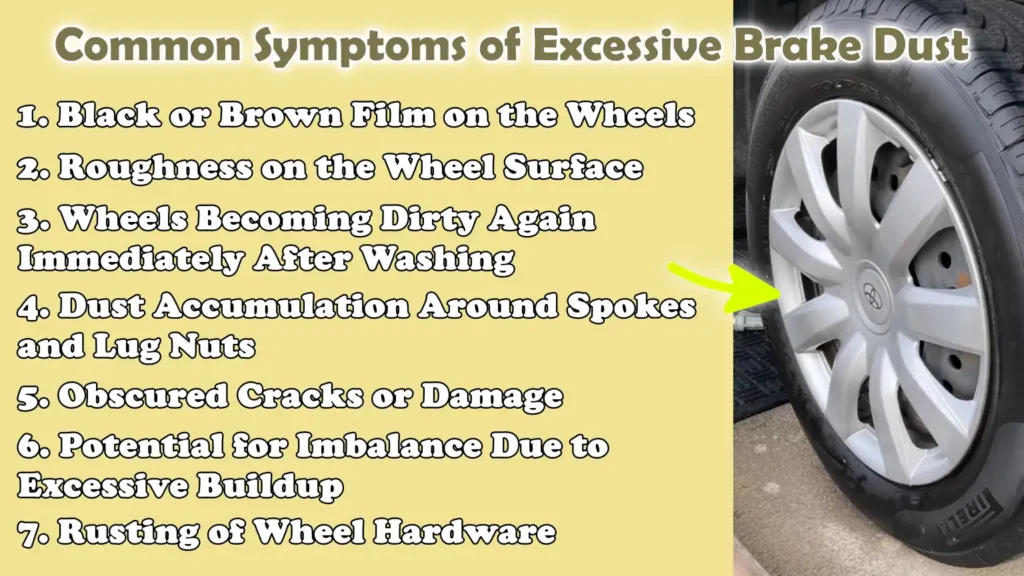
Brake dust accumulates gradually, but it leaves behind specific tell-tale signs that become even easier to identify as the buildup increases.
These symptoms are crucial because they serve not only as indicators of external grime but also as early warnings regarding the stress being placed on the wheels and potential lapses in maintenance.
Understanding each symptom helps drivers identify the problem early and protect their wheels from long-term damage.
1. Black or Brown Film on the Wheels
The clearest indication of brake dust accumulation is the formation of a black or brown film on the wheel’s surface.
This occurs when microscopic brake particles, comprising metal fragments and carbon residue, combine with heat and moisture to adhere firmly to the wheel.
Instead of the wheel’s original luster or color, the surface appears dull, dark and gritty.
Over time, this layer thickens and cannot be easily removed by a standard wash; this signals that the dust has begun to bond with the wheel’s finish.
2. Roughness on the Wheel Surface
When brake dust begins to embed itself within the wheel’s surface, the surface often feels rough or gritty to the touch.
This roughness is caused by tiny metal particles settling on top of, or slightly penetrating, the protective surface layer.
A clean wheel should feel smooth when touched, whereas a dirty wheel feels uneven and slightly coarse.
This is a critical warning sign, as it indicates that the grime is no longer confined solely to the outermost layer and may require deep-cleaning methods to remove.
3. Wheels Becoming Dirty Again Immediately After Washing
Another common symptom is that the wheels become dirty again very quickly after being washed.
Even after a thorough cleaning, the brake system continues to generate dust whenever the vehicle slows down.
If any residue or grime is already present on the wheel, new particles adhere to it much more easily, causing the wheel to become dirty again very quickly.
Due to this process, it may appear as though the wheels were never fully cleaned in the first place, specially when driving in stop-and-go traffic.
4. Dust Accumulation Around Spokes and Lug Nuts
Brake dust often accumulates most heavily in the intricate and tight areas of the wheel such as: around the spokes, rims and lug nuts.
These areas tend to trap airflow, heat and moisture, making it easier for dust to settle and adhere there.
Over time, these hidden crevices often become the dirtiest parts of the wheel, as they are difficult to access during a standard wash.
Such dust accumulation also serves as an indication that the cleaning process is not effectively reaching all the critical surfaces of the wheel.
5. Obscured Cracks or Damage
Excessive accumulation of brake dust can obscure critical components of the wheel, making it difficult to identify cracks, dents, or early signs of structural damage.
This is particularly hazardous, as regular inspection of the wheels is essential to ensure safety.
When layers of dust become thick, they act as a mask over the surface, hiding minor issues that could escalate into major problems if left unaddressed.
Therefore, keeping your wheels clean is paramount, not only for their aesthetic appeal but also to ensure the effectiveness of safety inspections.
6. Potential for Imbalance Due to Excessive Buildup
In some rare but possible instances, an excessive and uneven accumulation of brake dust, combined with dirt and moisture, as it can create a slight imbalance in the wheel.
Although brake dust alone is not heavy enough to cause a major issue, its uneven distribution around the wheel can create a minor weight imbalance.
Over time, this can lead to issues such as minor vibrations or uneven tire wear, particularly at high speeds.
This does not constitute an immediate mechanical failure, but rather highlights a long-term maintenance concern.
7. Rusting of Wheel Hardware
Brake dust often traps moisture around sensitive components, such as lug nuts and mounting points.
When moisture remains in prolonged contact with metal surfaces, it initiates oxidation and leads to premature rusting.
Initially, this rust may manifest as small spots of discoloration; however, if left uncleaned, it can gradually spread.
Once rust accumulates around the wheel hardware, it becomes difficult to remove and it can negatively impact both the aesthetic appeal of the wheel and the structural integrity of its long-term durability.
Why Wheel Types and Cleaning Methods Matter
Different types of wheels are constructed from varying materials and surfaces and this directly influences how brake dust should be cleaned.
Although brake dust itself is consistent across all vehicles, its interaction with the wheel can vary significantly depending on the wheel type.
Some wheels are more sensitive to chemicals, others are more prone to staining and some may even develop rust if not cleaned correctly.
Understanding the specific type of wheel is crucial, as using the wrong cleaner or method can result in permanent damage, a loss of luster, or the degradation of the protective coating over time.
1. Alloy Wheels
Alloy wheels are the most common type of wheels found on modern cars.
They are typically composed of a mixture of aluminum and other metals, making them lightweight and contributing to improved performance and fuel efficiency.
However, alloy wheels are sensitive to harsh chemicals, particularly acidic cleaners.
Acid-based products can damage the clear protective coating present on the wheel’s surface; with repeated use, this can lead to a loss of shine, discoloration, or even surface corrosion.
For this reason, it is recommended to use pH-balanced cleaners and soft-bristled brushes to safely remove brake dust from alloy wheels.
2. Chrome Wheels
Chrome wheels feature chrome plating that provides a brilliant, mirror-like shine.
Although they possess a highly polished appearance, they are susceptible to damage caused by dirt and improper cleaning techniques.
Brake dust can create tiny pits or stains on the chrome plating.
Furthermore, if not dried thoroughly after washing, these wheels can develop unsightly water spots.
Once chrome is damaged, it is difficult to repair; therefore, gentle cleaning and proper drying techniques are essential to maintain the integrity of the finish.
3. Painted Wheels
Painted wheels feature a layer of paint topped with a clear coat, which protects the surface while providing color and shine.
Brake dust can adhere to this clear coat and, without regular cleaning, can gradually dull the finish.
Although painted wheels are more durable than chrome wheels, careful cleaning is still necessary to avoid scratching the protective layer.
Using soft microfiber materials and wheel-safe cleaners helps preserve the coating, preventing color fading or staining over time.
4. Matte or Satin Wheels
Matte and satin wheels feature a non-glossy finish that offers a modern and understated aesthetic.
These finishes are more delicate than glossy wheels, as they lack a robust, high-gloss clear coat.
Brake dust and fingerprints are easily visible on these surfaces.
Harsh cleaners, waxes, or polishing products can alter their original matte appearance, creating shiny spots that detract from their beauty.
Cleaning these wheels requires mild products specifically formulated for matte finishes to ensure their original look is preserved.
5. Steel Wheels
Compared to other types of wheels, steel wheels are more straightforward and robust; they are often found on older vehicles, trucks, or as spare tires.
Cleaning them is generally easy, as they lack the delicate finishes such as: chrome or matte coatings, found on other types of wheels.
However, if the protective paint layer on steel wheels becomes compromised, or if moisture remains on the surface for an extended period, they can rust very rapidly.
When brake dust comes into contact with water, it can accelerate the rusting process on exposed metal surfaces; therefore, despite their inherent durability, regular cleaning and drying of these wheels are essential.
Tools
| Tools | Why It Is Needed | How to Use It |
|---|---|---|
| pH-Balanced Wheel Cleaner | It removes brake dust without damaging painted, chrome, or alloy surfaces. | Spray it evenly onto cool wheels, let it sit for a short while, then rinse off or agitate lightly. |
| Microfiber Towels | It dries wheels without scratching them and helps safely remove residual dust. | Use it after washing to thoroughly dry the wheels and prevent water spots. |
| Soft Wheel Brush | It loosens accumulated brake dust on the wheel surface without causing scratches. | Dip it into the cleaner and gently scrub the wheel face, spokes and tight crevices. |
| Wheel Barrel Brush | It cleans those hidden interior areas where brake dust tends to accumulate the most. | Insert it into the wheel barrel and carefully scrub the inner surfaces using the cleaner. |
| Bucket With Clean Water | It helps rinse dirt from the brushes and prevents the grime from spreading back onto the wheels. | Use it to rinse your brushes frequently during cleaning to maintain their effectiveness. |
| Hose or Pressure Washer | It removes loose dirt and brake dust prior to scrubbing. | Rinse the wheels before and after cleaning to safely remove surface contaminants. |
How to Remove Brake Dust From Wheels – Effortless Method
Properly removing brake dust isn’t just about making your wheels look clean; it’s about protecting the wheel’s surface from long-term damage caused by heat-bonded metal particles, road grime and chemical residues.
Removing brake dust becomes significantly more difficult when it is allowed to accumulate for too long, specially after being exposed to the intense heat generated by repeated braking.
The correct cleaning procedure ensures that the dust is thoroughly dissolved and removed without scratching the wheel or damaging its protective coating.
1. Allow the Wheels to Cool Down
You should always allow the wheels to cool down before cleaning them, as they become quite hot during driving and braking.
When water or cleaning chemicals are sprayed onto a hot wheel, it can lead to uneven drying, accelerated chemical reactions, or surface staining.
Chemical stains occur when cleaning agents dry too quickly on a hot surface, leaving behind marks that are difficult to remove.
Allowing the wheels to cool ensures that cleaning products work evenly and safely without damaging the wheel’s finish.
2. Rinse Away Loose Dirt and Dust
Before applying any cleaner, it is essential to remove loose dirt and accumulated surface brake dust using water.
The rinsing should be performed in a manner that allows water to flow freely across the wheel’s surface, ensuring that dirt washes away rather than becoming trapped in the intricate inner sections.
A strong stream of water such as: that from a hose or a pressure washer, helps dislodge particles trapped within the spokes and rims.
This step reduces the need for vigorous scrubbing later on and prevents scratches caused by loose particles during the cleaning process.
3. Apply the Wheel Cleaner Correctly
A pH-balanced wheel cleaner should be applied evenly to the wheel’s surface while the wheel is still cool and slightly damp.
Using the correct amount is crucial; too little cleaner will not effectively remove brake dust, while using too much results in waste and makes the rinsing process more difficult.
The cleaner should be allowed to dwell on the surface for a short period so that dirt and brake particles can dissolve.
It is vital not to let the product dry on the wheel, as dried spots can leave stains or create an uneven finish.
4. Scrub with a Soft Brush
Once the cleaner has had sufficient time to do its work, use a soft brush to gently loosen and remove the brake dust.
The face of the wheel should be cleaned first, as it is the most visible section and the area where surface dust is most likely to accumulate.
Brake dust often accumulates heavily between the spokes; therefore, careful brushing helps dislodge these trapped particles.
Due to airflow, a significant amount of dust also accumulates on the inner barrel of the wheel; this area should be thoroughly cleaned using a long-handled brush.
Dust frequently gathers around the lug nuts; gently brushing these areas in a circular motion removes the grime without damaging the threads or the finish.
5. Remove Stubborn Brake Dust
When brake dust has been allowed to accumulate over a long period, standard cleaning methods may not be sufficient.
In such cases, an iron remover can be used.
This product operates through a chemical reaction that specifically targets iron particles found in brake dust.
Upon application, it reacts with these embedded metal particles, causing them to dissolve so they can be easily rinsed away.
For particularly stubborn areas, a clay bar may be used following proper lubrication.
Claying is necessary only when contaminants have become deeply embedded within the surface.
Lubrication is crucial as it prevents friction between the clay and the wheel, thereby minimizing the risk of scratching while removing embedded particles.
6. Rinse Thoroughly
Following the cleaning and chemical treatment, it is essential to rinse the wheel completely to remove any residual cleaner, loose dust and dissolved grime.
If traces of dirt remain, they can result in streaks or hazy spots on the wheel surface once it dries.
It is important to inspect hidden areas such as: behind the spokes and around the lug nuts, as cleaning products and dust often tend to accumulate in these spots.
A thorough rinse ensures that the surface is completely clean and ready for drying and protection.
7. Dry the Wheels Thoroughly
Thoroughly drying the wheels is a crucial final step, as any residual water left on the surface, particularly if it contains minerals, as it can leave behind water spots.
Allowing them to air-dry is not advisable, because as the water evaporates, minerals and dirt accumulate on the wheel’s surface.
The best approach is to use a clean microfiber towel to gently wipe and absorb the water from every section of the wheel.
Paying close attention even to the smallest crevices ensures that no moisture remains anywhere, thereby keeping the wheel’s finish clean, smooth and protected for the long term.
So, How to Remove Caked-On Brake Dust
Caked-on brake dust is one of the most stubborn forms of grime that accumulates on wheels, as it no longer merely sits on the surface.
It is repeatedly subjected to heat, pressure and moisture, causing its particles to bond firmly with the wheel’s finish.
Over time, what begins as ordinary brake dust transforms into a hard, crusty layer that feels rough to the touch, appears darker in color and cannot be removed using standard washing methods.
To remove it, it is essential to understand why it forms and to employ safe yet effective cleaning techniques capable of dislodging the grime without damaging the wheel’s surface.
And, there’s even scientific studies that confirms that the brake dust is largely composed of iron-based particles such as: iron oxides which is formed from the brake rotor war, so these are the particles that are generated through the high friction and heat during the braking, which is why they causes microscopic metallic fragments that detaches and oxidize as well, so once they gets deposited on the wheels, then these iron particles can chemically bond with the wheel surface, specially when they gets to the contact with moisture and heat cycles, that’s why brake dust becomes way more harder to remove over the period of time and often they requires chemical cleaners such as: iron removers to break the metallic bonding of theirs before any mechanical cleaning.[¹]
1. Why Does Brake Dust Accumulate on Wheels?
Brake dust accumulates on wheels primarily due to heat cycles.
Every time you drive and apply the brakes, a significant amount of heat is generated within the wheel assembly, particularly during city driving or heavy braking.
This heat causes the brake particles to soften and adhere even more tightly to the wheel’s surface.
As the wheel cools down, these particles harden once again and become locked in place.
Another major contributing factor is a lack of attention to cleaning, allowing the dust to sit on the wheels for weeks or months.
Over time, layers of dust build up and evolve into a stubborn crust.
Metallic contamination also plays a role, as the iron particles present in brake dust can chemically bond with clear-coated surfaces, making them even more difficult to remove.
2. Best Methods for Removing Heavy Buildup
Iron Fallout Removers
Iron fallout removers are among the most effective products for eliminating stubborn brake dust buildup.
These are specially formulated chemical cleaners that react with the iron particles present in brake dust.
Upon application, they break down metallic contaminants and loosen them from the wheel’s surface.
Thanks to this chemical reaction, the dust can be rinsed away with water without the need for vigorous scrubbing.
These products are particularly beneficial for wheels that have not been cleaned for a long time, or those bearing deep, clearly visible stains.
Wheel-Safe Degreasers
Wheel-safe degreasers help remove oil residues, road grime and layers of softened brake dust.
Although they are not as aggressive as harsh acid-based cleaners, they remain highly effective at breaking down heavy buildup.
These products work by loosening the bond between the dirt and the wheel’s surface, making it easier to remove contaminants during the washing and scrubbing process.
When used correctly, they are safe for most wheel finishes and help prepare the surface for a deep clean.
Repeated, Gentle Cleaning
If dirt buildup is excessive, a single cleaning session is often insufficient.
Through repeated, gentle cleaning, accumulated layers of dust can be gradually removed without causing damage to the wheel.
This process involves applying a cleaner, gently scrubbing the surface, rinsing and repeating these steps as necessary.
The goal is to gradually weaken the bond between the dust and the wheel, rather than attempting to forcibly remove it all at once, as doing so could damage the wheel’s finish.
Removing Contaminants with a Clay Bar
The clay bar method for removing contaminants is employed when brake dust has become deeply embedded within the wheel’s surface.
A clay bar physically lifts and extracts stubborn particles that standard cleaners fail to remove.
To prevent scratching or marring, this technique must always be performed using proper lubrication.
As the clay glides across the surface, it draws out fine debris, leaving the wheel smoother and cleaner.
For optimal results, this method is typically performed following a standard chemical cleaning process.
3. What Not to Do
Scraping with Metal Tools
Using metal tools to scrape away caked-on brake dust is extremely risky.
While it may appear to be a quick fix, it can easily scratch, chip, or permanently damage the wheel’s finish.
Metal tools can also strip away the protective coating, leaving the wheel more vulnerable to future corrosion and staining.
Even minor scratches can serve as entry points for moisture and dirt, exacerbating the problem over time.
Using Household Cleaners
Household cleaners are not formulated for wheel finishes; they can be overly harsh or chemically incompatible.
Many cleaners contain acids, ammonia, or abrasive agents that can strip away or discolor the wheel’s glossy topcoat (clear coat).
Although using these products may seem convenient, they often cause long-term damage, the cost of repairing which can far exceed the cost of simply addressing the original brake dust issue.
Applying Excessive Force While Scrubbing
Another common mistake when cleaning stubborn brake dust is scrubbing too vigorously.
Applying excessive force does not make the cleaning process any more effective; rather, it increases the risk of scratching the wheel’s surface and dulling its shine.
Brake dust should be removed using the right chemicals and a gentle touch; instead of relying solely on physical force, you should let the chemicals do most of the work.
Read More:
- How to Clean Alloy Wheels Properly
- How to Upgrade Wheels Safely
- How to Check Wheel Offset Compatibility
- How to Fix Wheel Wobble Issue
- How to Diagnose Wheel Wobble at Speed
- How to Inspect Wheel Hub Damage
- How to Replace Broken Wheel Stud
- How to Remove Stuck Lug Nuts
- How to Torque Lug Nuts Correctly
- How to Check Wheel Lug Torque
- How to Install Directional Tires Properly
- How to Identify Directional Tires Correctly
- How to Choose Tires for Snow Driving
- How to Choose Tires for Wet Roads
- How to Check Tire Load Rating
- How to Store Tires Properly Long Term
- How to Prevent Tire Dry Rot
- How to Fix Tire Bulge Issue
- How to Inspect Tire Inner Sidewall Damage
Know, The Best Home Remedies for Removing Brake Dust
Home cleaning methods for brake dust can be useful in certain situations, particularly for light soiling or routine maintenance.
However, brake dust consists of heat-baked metal particles, carbon residues and road grime, meaning that over time, it can adhere firmly to the surface of the wheels.
Therefore, while simple household solutions can help remove surface dirt, they are generally less effective than professional wheel cleaners when dealing with heavy or caked-on brake dust.
To avoid damaging the wheels’ finish, it is crucial to understand when and how to use these methods safely.
1. Dish Soap and Warm Water
Dish soap mixed with warm water is one of the safest and most widely used home cleaning methods for light brake dust.
Dish soap works by breaking down grease and loosening surface dirt, while the warm water helps to soften the grime so that it can be easily wiped or rinsed away.
This method is most effective when the brake dust is fresh and has not yet firmly bonded to the wheel’s surface.
It is a safe option for routine cleaning, as it is gentle on painted, alloy and clear-coated wheels.
However, it is not as effective at removing long-standing or baked-on brake dust.
Safe Scenarios for DIY Cleaning
DIY cleaning methods such as: using dish soap and water, work best when wheels are cleaned frequently and brake dust is not allowed to accumulate in heavy amounts.
These methods are ideal for weekly or daily washes, particularly for vehicles that do not generate excessive brake dust.
This method is safe even for delicate wheel finishes, as it does not involve the use of any harsh chemicals.
However, if the wheels already bear deep stains, have a rough texture, or are covered in long-accumulated grime, simple household solutions alone will not suffice; in such cases, a safe, more potent cleaner specifically formulated for wheels will be necessary.
2. Baking Soda Paste
A baking soda paste is another home-based cleaning option that can help remove light brake dust.
It is prepared by mixing a small amount of water with baking soda to form a thick paste.
Baking soda acts as a mild abrasive, helping to loosen surface grime without being overly harsh, provided it is used with care.
It can be gently applied to the affected areas and scrubbed with a soft cloth or brush.
After application, it should be rinsed thoroughly to ensure no residue remains.
While it can remove light stains, it is not particularly effective at completely eliminating heavy or caked-on brake dust.
Mild Cleaning Capabilities
Baking soda’s cleaning power is considered mild because it relies on gentle abrasion rather than a chemical reaction.
This makes it safe for frequent use, but less effective against brake dust that has bonded with the metal or become baked onto the surface due to heat.
It works best on minor discoloration or surface grime, rather than on deeply embedded dirt.
Excessive use of baking soda or vigorous scrubbing can dull the finish of sensitive surfaces; therefore, it should always be used with caution and in moderation.
Proper Application
When using a baking soda paste, it should always be applied to a cool wheel surface to prevent any adverse reactions or premature drying.
A soft cloth or a soft-bristled brush should be used to gently spread the paste over the soiled areas.
The key is to allow the paste sufficient time to lift the dirt from the surface without applying excessive pressure.
After cleaning, the wheel should be rinsed thoroughly to ensure that no residue remains.
If the baking soda is not completely washed off, it may leave a white residue on the surface.
3. Risks of Cleaning with Vinegar
Vinegar is sometimes recommended as a household cleaner, but using it on wheels carries certain risks.
Vinegar is acidic; while it can dissolve certain types of dirt, it can also damage the protective layers present on alloy, painted, or chrome wheels.
Repeated or aggressive use of vinegar can dull the finish, cause discoloration, or compromise the integrity of the protective coating.
Over time, it may also react adversely with metal surfaces, thereby increasing the risk of corrosion.
Due to these risks, vinegar is not considered a safe or sustainable solution for removing brake dust.
Why Vinegar Can Damage Surfaces
Wheel surfaces are designed with protective coatings that shield them from moisture, heat and grime.
Acidic substances, such as vinegar, can gradually break down these protective layers.
Once the protective coating is compromised, brake dust and road grime can adhere more easily to the wheel’s surface, making future cleaning even more difficult.
This is why professional detailing products are typically pH-balanced rather than acidic.
4. Are Homemade Cleaners Effective?
Homemade cleaners can be helpful in certain specific situations, but they are not a definitive solution for removing brake dust.
Their primary advantages are that they are inexpensive, easy to prepare and, when used correctly, generally safe for light-duty cleaning tasks.
However, their effectiveness is limited because they lack the chemical potency required to break down the metallic and heat-baked particles typically found in brake dust.
Professional wheel cleaners are specifically formulated to dissolve these particles safely and more effectively.
Pros and Cons Compared to Professional Wheel Cleaners
Homemade cleaners are cost-effective and readily available, making them useful for quick maintenance and for removing light surface grime.
When used correctly, they also pose a very low risk of causing immediate damage.
However, their cleaning power is limited, particularly when dealing with stubborn brake dust that has been repeatedly exposed to heat and has accumulated over a long period.
In contrast, professional wheel cleaners are engineered to chemically target brake dust and, when used correctly, remain safe for the wheel’s finish.
Consequently, they are more effective than most home remedies for deep cleaning, provide longer-lasting protection and restore the wheel’s original luster.
Learn, Common Mistakes Made When Cleaning Brake Dust
Cleaning brake dust may seem like a simple task, but many drivers make mistakes that actually damage the wheel surfaces or exacerbate problems over time.
Brake dust contains fine metallic particles that, due to heat, moisture and the passage of time, adhere firmly to the wheels.
Consequently, improper cleaning methods can lead to stains, corrosion, or scratches.
Understanding these common errors helps preserve the wheels’ finish and ensures that the cleaning process is both safe and effective.
1. Misusing Acid-Based Wheel Cleaners
One of the most common mistakes is using acid-based wheel cleaners without taking proper precautions.
Acid-based products can be potent enough to rapidly remove heavy brake dust; however, if overused or left on for too long, they can also damage the protective coating.
Misuse can result in a loss of shine, discoloration, or a weakening of the clear coat.
Even if a product is labeled as “safe,” excessive use or improper application timing can still cause damage to the wheel surfaces.
For this reason, it is generally recommended to use pH-balanced cleaners for routine maintenance.
2. Cleaning Wheels in Direct Sunlight
Cleaning wheels in direct sunlight can lead to serious issues, as the heat accelerates the drying rate of cleaning chemicals.
When wheel cleaners dry too quickly, they can leave behind stains, streaks, or uneven spots on the surface.
Sunlight also causes the wheels themselves to heat up, making it difficult for cleaning products to work effectively.
The result is often incomplete cleaning and visible residue left on the surface.
It is always safer to clean wheels in a shaded or cool area, where cleaning products can work evenly and effectively.
3. Using a Single Bucket for the Entire Car
Using the same bucket for both the wheels and the car body is another common mistake that can lead to damage.
Wheels accumulate heavy brake dust, pebbles and road grime, contaminants that are far more abrasive than the general dirt found on the rest of the car.
When this same water and these same cleaning tools are used on the car body, these abrasive particles can transfer to the painted surfaces, resulting in scratches.
Therefore, to ensure a safe and thorough cleaning (detailing) process, it is essential to use separate buckets or tools specifically designated for cleaning the wheels.
4. Neglecting the Inner Wheel Barrels
Many people clean only the visible outer surfaces of their wheels while neglecting the inner barrels.
However, due to airflow and the design of the braking system, a significant amount of brake dust accumulates on the inner surfaces of the wheels.
Over time, this hidden grime becomes thick and hard, making it even more difficult to remove.
Neglecting this area not only compromises the overall cleanliness but, if moisture gets trapped, can also lead to further dirt buildup and, in the long run, rust formation.
Proper wheel cleaning should always include cleaning the inner barrels as well.
5. Scrubbing Too Hard
Scrubbing too vigorously while attempting to remove brake dust is a major mistake.
Although brake dust may appear to be stubbornly adhered, vigorous scrubbing does not solve the problem; instead, it often leads to new damage.
Applying excessive pressure can scratch the wheel’s finish, wear away the protective coating and leave the surface more vulnerable to future damage from dirt and grime.
The correct approach involves using cleaning agents specifically formulated to loosen brake dust, allowing it to be safely removed with a soft-bristled brush.
6. Allowing Chemicals to Dry on the Wheels
Allowing wheel cleaners or other chemical agents to dry on the surface is one of the most damaging mistakes one can make.
When cleaning products dry, they leave behind a thick residue that can stain or mar the wheel’s finish.
This risk is particularly high when the wheels are hot or when cleaning is performed in warm weather.
Removing dried chemicals later can also be difficult, often requiring more aggressive cleaning methods that may inflict further damage upon the surface.
To avoid this, thoroughly rinse the chemicals off with water before they have a chance to dry completely.
Can Brake Dust Damage Your Brakes?
Brake dust is primarily a by-product of the braking system, rather than a direct cause of brake failure; however, if allowed to accumulate excessively, it can impact both brake performance and longevity.
It is generated through the natural wear and tear of brake pads and rotors; therefore, the presence of a small amount is normal and expected.
Nevertheless, when excessive dust accumulates around the wheels, calipers and brake components, it can hinder proper heat management, increase the risk of corrosion and complicate visual inspections of the braking system.
Over time, these indirect effects can lead to a reduction in braking efficiency and an increased need for maintenance.
1. Impact on Brake Components
Brake dust consists of fine metallic particles and carbon-based materials shed from the brake pads.
When it settles around brake components, it combines with moisture and road grime to form a sticky residue that adheres to the surfaces of the calipers, rotors and wheels.
While this does not result in immediate brake failure, it can gradually compromise the smooth operation of these components and their ability to dissipate heat.
In some instances, excessive dust accumulation can make it difficult for technicians to accurately assess brake wear, potentially delaying the detection of worn pads or uneven rotor surfaces.
2. Concerns Regarding Heat Accumulation
Brakes naturally generate high temperatures during use, particularly during city driving or under heavy braking conditions.
A thick layer of brake dust surrounding the wheel can slightly obstruct airflow and trap heat near the brake components.
Although brakes are designed to withstand heat, proper cooling is essential to maintain consistent and optimal performance.
When heat is not dissipated efficiently, the rate at which brake pads and rotors wear down can increase significantly over time.
This issue is particularly common in vehicles where excessive brake dust accumulates, as well as in vehicles subjected to frequent stop-and-go driving conditions.
3. Risk of Corrosion
Another serious indirect consequence of brake dust is its tendency to trap moisture and grime against metal surfaces.
When brake dust comes into contact with water, whether from rain, car washes, or ambient humidity, it can create a mildly corrosive environment.
This is specially true for exposed metal components, such as rotors, calipers and wheel hardware.
Over time, this can lead to surface rust or oxidation, particularly if the vehicle is not cleaned regularly.
While a small amount of superficial rust on rotors is often normal and temporary, prolonged exposure to moisture-laden brake dust can significantly heighten the risk of corrosion in the long run.
4. When to Inspect Brake Pads and Rotors
Regular inspection of brake pads and rotors is crucial for safe driving; however, when excessive brake dust accumulates, identifying early signs of wear often becomes difficult.
Generally, brake components should be inspected during routine maintenance, or, for daily-driven vehicles, at least every few months.
If brake dust is accumulating rapidly, or if the wheels appear visibly dirty even after cleaning, it may be an indication that the brake pads are wearing down faster than normal.
Drivers should also pay attention to noises, vibrations, or changes in stopping distance when applying the brakes, as these indicators are more reliable signs of brake wear than merely the accumulation of brake dust.
Conclusion – How to Remove Brake Dust From Wheels
So, brake dust actually messes the appearance and even later if treatment is due then it starts to affect the braking system on every day driving.
It consists of actual brake material such as: metal particles, carbon residue and heat-worn compounds, and is not merely ordinary dust that can be easily overlooked.
When left uncleaned, it gradually builds up, becoming increasingly difficult to remove; furthermore, through repeated exposure to heat and moisture, it can bond firmly to the wheel’s surface.
Over time, this can dull the wheels’ luster, cause staining, lead to corrosion within crevices and complicate maintenance tasks, often necessitating more aggressive cleaning methods.
The key takeaway is that if brake dust is addressed promptly and correctly from the outset, it can be effectively controlled.
Regular cleaning, utilizing safe products, gentle tools and proper techniques, prevents this buildup from becoming entrenched.
A few simple habits such as: washing your wheels frequently, using pH-balanced cleaners, avoiding vigorous scrubbing and protecting your wheels with sealants or coatings, as it can significantly mitigate long-term damage.
In many instances, wheels do not deteriorate suddenly; rather, they degrade gradually due to neglect and improper cleaning practices.
So, that’s it from this guide about How to Remove Brake Dust From Wheels and you can comment for more related info.
Frequently Asked Questions
FAQ 1: What is brake dust and why does it accumulate on wheels?
Answer: Brake dust is a thin layer of fine, dark-colored particles formed by the natural wear and tear of brake pads and rotors every time you slow down or stop your car. When brake pads exert pressure on the rotors, friction generates heat, causing a small amount of material to gradually wear away. These tiny particles disperse around the wheel and adhere to the surface due to heat and static charge. Over time, this dust becomes increasingly visible and can make the wheels look dirty, even immediately after washing them.
FAQ 2: Is brake dust harmful to wheels?
Answer: Brake dust is not immediately harmful, but if left to accumulate for an extended period, it can cause damage. Because it contains tiny metal particles and carbon residue, it can bond firmly to the wheel’s surface when exposed to heat and moisture. This can lead to staining, a loss of shine and in some cases, even minor corrosion on unprotected surfaces. Regular cleaning prevents these issues and keeps the wheel surfaces in good condition.
FAQ 3: How often should I clean brake dust off my wheels?
Answer: For most daily-driven cars, cleaning the wheels once every one to two weeks is usually sufficient to prevent brake dust from accumulating. If you drive in heavy traffic or dusty environments, or if you use your brakes frequently, you may need to clean them more often. Performance cars and vehicles equipped with softer brake pads often require weekly cleaning, as they tend to generate more dust. Its primary objective is to prevent dust from accumulating over extended periods and adhering to the wheel’s surface.
FAQ 4: What is the safest way to remove brake dust?
Answer: The safest method for removing brake dust involves using a pH-balanced wheel cleaner, along with a soft-bristled brush and a microfiber towel. First, the wheel should be rinsed with water to dislodge any loose dust; then, the cleaner should be applied and allowed to dwell for a short period. Subsequently, gentle brushing helps remove the dust without scratching the surface. Finally, a thorough rinse with water followed by drying completes the process. This method preserves the wheel’s finish while effectively removing dirt and grime.
FAQ 5: Can household cleaners remove brake dust?
Answer: While household cleaners can remove light surface dirt, they are not formulated to tackle brake dust. Brake dust contains metallic particles that adhere very strongly to wheels and most household cleaners are not effective enough to break this bond. Furthermore, some household products may contain harsh chemicals that can damage the wheel’s coating or cause discoloration. For safe and effective cleaning, it is always recommended to use cleaners specifically designed for wheels.
FAQ 6: Why do my wheels get dirty so quickly after cleaning?
Answer: Wheels can get dirty quickly because brake dust is continuously generated every time you drive. If you drive in stop-and-go traffic or apply the brakes frequently, fresh dust will accumulate on the wheels shortly after cleaning. In some cases, residual grime or incomplete cleaning can also cause dust to adhere more rapidly. Applying a wheel sealant or ceramic coating to your wheels can help slow down the rate at which dust accumulates.
FAQ 7: Can brake dust leave permanent stains on wheels?
Answer: Yes, if brake dust is left uncleaned for an extended period, it can leave permanent stains on the wheels. When the dust comes into contact with heat, moisture and road grime, it bonds to the wheel’s surface and penetrates beneath its protective coating. The result is deep-seated stains that are difficult to remove through ordinary washing. The best way to prevent permanent marks and keep your wheels looking brand new is to clean them regularly.
References:
[1] Iron Oxide and Hydroxide Speciation in Emissions of Brake Wear Particles from Different Friction Materials Using an X-ray Absorption Fine Structure
https://www.mdpi.com/2073-4433/15/1/49
Hello Folks, Dean Shali here to help you out to solve the problems with your lovely vehicle, as i have lots of experience and knowledge about automotive industry as i woks directly with the customers and repair vehicles and i love to help the people to keep their cars safe and running smoothly.