
Written By: Dean Shali
Fact Checked By: Sabré Cook
Reviewed By: Tamara Warren
You should be aware of the fact that: you should look into that small load index on your tire’s sidewall as it literally holds the key to safety, stability and long tire life as well.
Even, each tire literally caries a precise share of the total weight whenever the vehicle moves on the road.
Basically, tire load rating actually tells you exactly how much weight a tire can safely support at the correct pressure and if you exceed that damn limit then it can cause tire failure as well.
Also, there’s studies and safety data that shows that overloaded or improperly rated tires literally run hotter, wears in way more faster than others and they are more likely to fail under the stressful situations like at the highway speeds etc.
Along with this, most of the time drivers just never worries about that number and never check this number, even though it is clearly printed on the tire’s sidewall.
So, in this guide you’ll learn How to Check Tire Load Rating so that you can understand them and confidently match your tires to your vehicle’s requirements, that’s how you can achieve safe journey.
So, What is a Tire Load Rating?
A tire load rating indicates the maximum weight that a tire can safely support when inflated to the correct pressure.
Each tire is designed with a specific weight limit based on its construction, the materials used, its size and its internal structural integrity.
This rating is crucial because the tires bear the entire weight of the vehicle, including passengers, cargo, fuel and any towed load.
If the weight placed on the tires exceeds their designed capacity, excessive heat can build up inside them; they may wear out prematurely, lose their balance, or even suffer a sudden blowout at high speeds.
Tire manufacturers carefully test load ratings under controlled conditions to ensure that the tire can safely withstand the stresses of normal driving.
Therefore, selecting the correct load rating is essential not only for performance but also for braking capability, steering control, ride comfort and overall road safety.
Even a tire that appears robust may be dangerous if its load rating is insufficient for the weight of the vehicle it is supporting.
1. What is the difference between Load Rating and Load Index?
Many drivers assume that load rating and load index are the same thing; however, while they are closely related, they are distinct concepts.
The load rating refers to the tire’s total weight-carrying capacity, whereas the load index is the numerical code used to represent that capacity.
The load index is typically printed on the tire’s sidewall, located near the tire size specifications.
For example, in a tire code such as 225/65R17 102H, the number 102 represents the load index.
This number corresponds to a specific maximum weight value, as outlined in a standard load index chart.
The higher the load index number, the greater the weight the tire can safely support.
This system helps manufacturers, mechanics and drivers quickly determine whether a particular tire is suitable for a specific vehicle.
Understanding this distinction is crucial, as many people mistakenly focus solely on tire size while overlooking the load index; however, for safe driving, it is essential that both of these factors align with the specific requirements of the vehicle.
2. How Does a Tire’s Load Rating Relate To Its Maximum Weight Capacity?
Every tire has a maximum weight limit and the tire load rating is precisely what defines that limit.
As a vehicle’s total weight is distributed across its four tires, each individual tire must be robust enough to safely support its specific share of that weight.
For instance, if a tire’s load index indicates a weight-bearing capacity of up to 1,874 pounds, provided it is properly inflated, each tire can safely support that specific amount of weight.
When this capacity is aggregated across all four tires, it determines the vehicle’s total weight-carrying capacity.
However, this capacity can only be fully utilized if the tires are inflated to the recommended pressure levels.
Underinflation reduces a tire’s load-bearing capacity and generates excessive heat, thereby increasing the risk of tire damage and blowouts.
This consideration is particularly critical for trucks, SUVs, heavy-duty vehicles, or cars used for towing purposes.
Selecting the correct tire load rating ensures that the tires can safely handle the vehicle’s weight, whether the vehicle is accelerating, braking, cornering, or traveling long distances, without being subjected to excessive stress.
Understand, Why Tire Load Rating Matters?
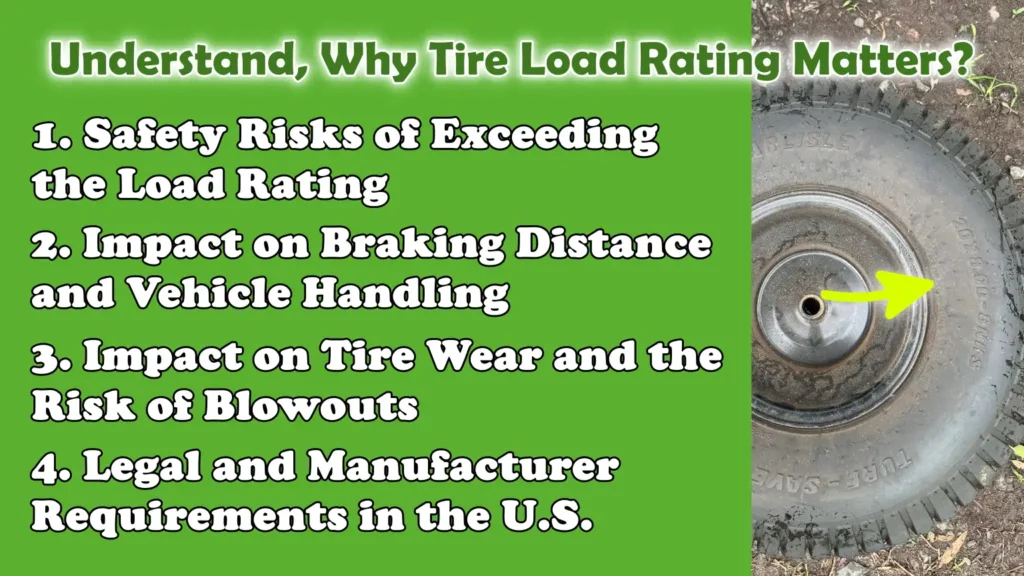
Tire load rating matters because it directly impacts how safely a vehicle can carry weight during daily driving.
Tires are the only components of a vehicle that remain in contact with the road; therefore, their ability to properly handle weight is crucial for the vehicle’s stability, braking, steering response and overall control.
Every vehicle is designed with a specific weight limit and the tires must possess the capacity to handle that weight without being subjected to excessive stress.
When drivers overlook tire load ratings, they increase the likelihood of tire overheating, uneven wear, compromised vehicle handling and sudden tire failure.
Many people focus solely on tire size, but the load rating is equally important, as even a correctly sized tire can be unsafe if its weight-carrying capacity is insufficient.
Tires with the appropriate load rating help maintain superior road grip, balanced performance and safe driving conditions in both normal and emergency situations.
1. Safety Risks of Exceeding the Load Rating
Exceeding a tire’s load rating poses serious safety risks because the tire is forced to carry a weight greater than its designed capacity.
When excessive stress is placed on the tire’s structure, its internal components flex excessively, generating heat.
Heat is a tire’s greatest enemy, as it weakens the tire over time and significantly increases the risk of sudden tire failure.
Overloaded tires may appear normal initially, but internal damage often accumulates gradually before any external warning signs become visible.
Drivers may experience reduced vehicle stability, particularly when cornering, changing lanes, or braking suddenly.
In severe cases, the tread (the outer layer of the tire) on overloaded tires may separate, or the tires could suffer a complete blowout at highway speeds, creating a risk of losing control of the vehicle.
This risk is further exacerbated during hot weather, long-distance travel, or when carrying heavy cargo and passengers.
The correct tire load rating helps ensure that the tires remain robust enough to safely withstand the stresses of daily driving.
2. Impact on Braking Distance and Vehicle Handling
Tire load ratings have a profound impact on braking performance and vehicle handling, as overloaded or under-rated tires fail to maintain proper contact with the road surface when subjected to stress.
When a tire carries a load exceeding its capacity, its shape distorts more than usual, compromising its stability and reducing the precision of steering response.
This can result in increased braking distances, as the tires struggle to establish adequate grip on the road surface during deceleration.
A vehicle equipped with overloaded tires may feel sluggish in its response when cornering or maneuvering to avoid obstacles, particularly at high speeds.
In emergency situations, even a slight reduction in tire stability can make it difficult for the driver to maintain control of the vehicle.
Tires with the appropriate load rating are designed to distribute weight evenly and maintain consistent contact with the road surface, thereby enhancing traction, steering precision and braking capability.
This is particularly crucial for SUVs, trucks and vehicles used for towing, as heavier vehicles exert greater pressure on their tires during acceleration, cornering and braking.
3. Impact on Tire Wear and the Risk of Blowouts
Using tires with an incorrect load rating can significantly accelerate tire wear and substantially increase the risk of a blowout.
When carrying excessive weight, tires flex excessively during operation, generating considerable friction and heat within the tire’s internal structure.
This heat weakens the rubber and internal plies, potentially leading to rapid tread wear, sidewall failure and structural damage to the tire.
In many instances, the center or edges of the tread may wear unevenly because the tire is unable to distribute the load effectively.
During long journeys, drivers may experience vibrations, reduced ride comfort, or even detect a distinct odor of burning rubber.
As the tire weakens, the risk of a blowout rises significantly, particularly at highway speeds, where heat accumulates rapidly.
A tire blowout is a hazardous event, as it occurs suddenly and can result in an immediate loss of vehicle control.
Adhering to the correct tire load rating ensures that the tire operates within safe pressure limits, thereby extending its lifespan, promoting even wear and enabling it to perform more reliably across various driving conditions.
4. Legal and Manufacturer Requirements in the U.S.
In the United States, vehicle manufacturers establish specific requirements regarding tire load ratings to ensure that the vehicle complies with federal safety standards and performs correctly under normal driving conditions.
These requirements are typically displayed on a label affixed to the driver-side door and are detailed in the owner’s manual.
Tire manufacturers and vehicle engineers carefully calculate the appropriate load capacity based on the vehicle’s weight, suspension design, passenger capacity and intended usage.
Using tires with a load rating lower than the specified standard can adversely affect safety systems, handling performance and warranty coverage.
In some instances, the use of incorrect tires can even lead to legal or insurance-related complications following an accident, particularly if investigators determine that the vehicle was being operated with unsafe tire specifications.
Commercial vehicles and towing setups often face even more stringent load-related requirements, as the tires are subjected to additional stress.
Adhering to the load ratings specified by the manufacturer enables drivers to comply with safety guidelines while also ensuring that the vehicle performs as intended in real-world driving conditions.
Know, Where to Find the Tire Load Rating on Your Tire?
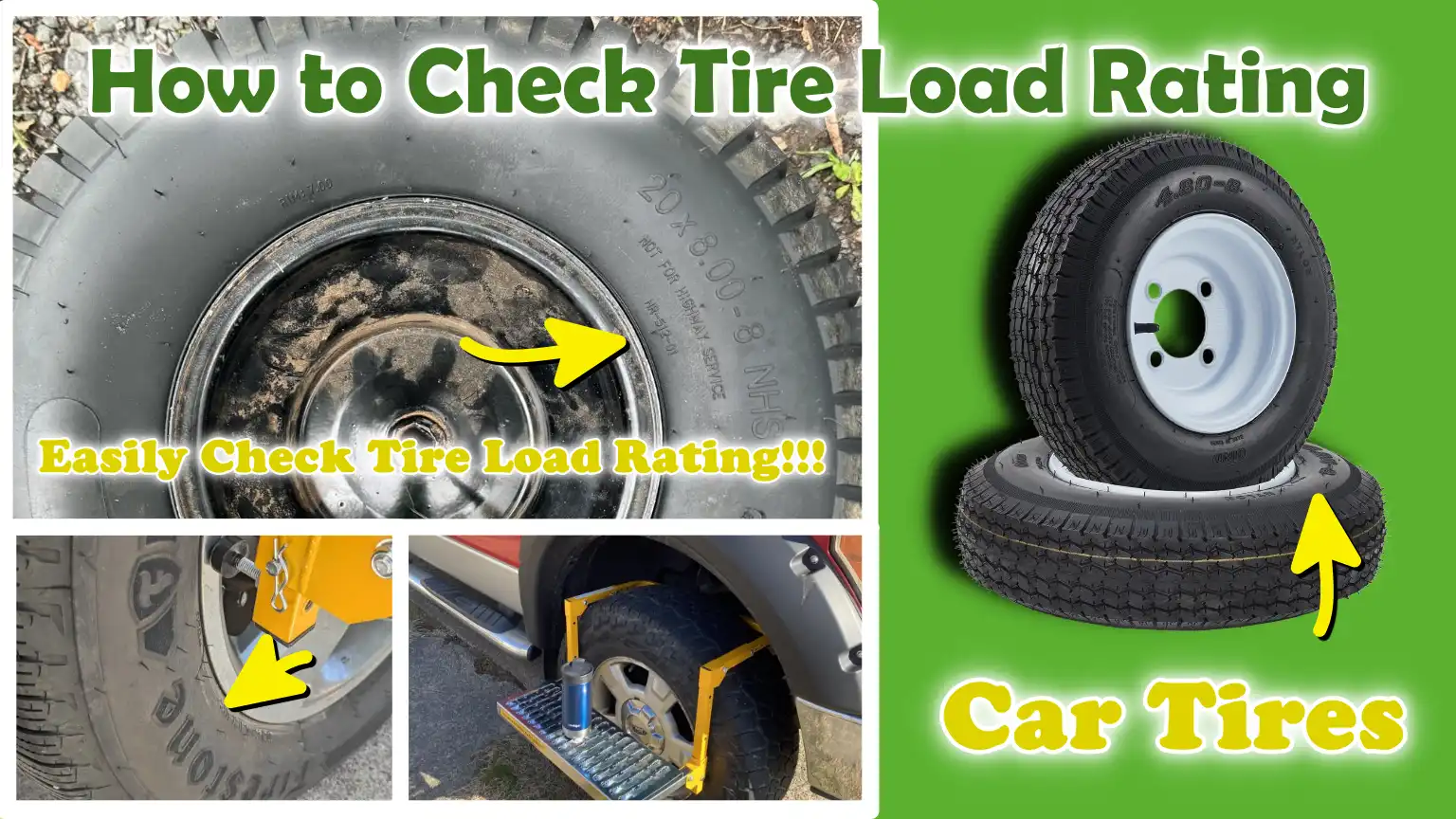
The tire load rating is printed directly on the tire’s sidewall, the outer section of the tire located between the tread (the tire’s surface) and the wheel rim.
Every modern tire features an extensive combination of letters and numbers that provides critical information regarding the tire’s size, construction, speed capability and weight-carrying capacity.
Many drivers never pay attention to these markings, even though they contain some of the most vital safety-related information about the tire.
The load rating is neither hidden inside the tire nor stored electronically anywhere; manufacturers clearly imprint it on the sidewall so that drivers, tire shop staff and mechanics can quickly identify whether the tire meets the vehicle’s requirements.
In most cases, this information is molded directly into the rubber and appears as raised black lettering.
If the tire is dirty or worn, reading these markings becomes easier by cleaning the sidewall with water and examining it carefully under good lighting.
Understanding where these markings are located helps drivers avoid purchasing incorrect replacement tires and ensures that the vehicle can safely carry passengers, cargo and everyday driving loads.
1. Understanding Tire Sidewall Markings
Tire sidewall markings are designed to provide detailed technical information regarding how the tire was constructed and the conditions it was built to withstand.
These markings include the tire’s width, aspect ratio (height-to-width ratio), construction type, wheel diameter, load index and speed rating.
Each part of the code serves a specific purpose and helps determine whether the tire is suitable for a particular vehicle.
The numbers and letters may appear confusing at first, but they follow a standard format used throughout the tire industry.
For instance, the tire width indicates how wide the tire is in millimeters, while the aspect ratio clarifies the height of the sidewall relative to the tire’s width.
The letter denoting the construction typically indicates a ‘Radial’ construction, the most common type used in passenger vehicles today.
Moving further along the code, drivers will find the load index and speed rating, which are particularly crucial for safety and performance.
These markings help ensure that the tire can properly support the vehicle’s weight, maintain stability and function correctly under various driving conditions.
2. A Detailed Explanation of a Common Tire Code
A typical tire code might look something like this: 225/65R17 102H; and every part of this sequence carries a specific meaning.
The number 225 indicates the tire’s width in millimeters, measured from one sidewall to the other.
The number 65 represents the aspect ratio, meaning that the height of the sidewall is 65 percent of the tire’s width.
The letter ‘R’ signifies Radial construction; this relates to the tire’s internal design and is utilized in most modern vehicles as it enhances the tire’s durability, ride comfort and fuel efficiency.
The number 17 indicates the wheel diameter in inches, meaning that this tire is designed to fit onto a 17-inch wheel.
Following this section come the load index and speed rating.
In this example, the number 102 is the load index, while the letter ‘H’ denotes the speed rating.
Together, these numbers and letters help determine whether the tire is suitable for the vehicle’s weight and operational requirements.
Correctly understanding this code is vital, as selecting the wrong tires can adversely affect safety, handling and tire longevity.
3. Where is the Load Index Located?
The load index appears near the end of the tire code, typically immediately preceding the letter that indicates the speed rating.
In a tire code such as 225/65R17 102H, the number 102 represents the load index.
This number is of critical importance, as it specifies the maximum weight the tire can safely support when inflated to its recommended pressure.
Many drivers inadvertently overlook this figure, focusing solely on the tire size; however, the load index is one of the key specifications directly linked to tire safety.
The load index itself does not denote the actual weight in pounds or kilograms; rather, it is a numerical code that corresponds to a specific weight value listed in a load index chart.
For instance, a load index of 102 corresponds to a maximum load-carrying capacity of 1,874 pounds per tire, provided the inflation pressure is correct.
A higher number signifies that the tire is capable of safely supporting a greater load.
Knowing exactly where to locate the “load index” helps drivers ensure that their tires comply with the vehicle manufacturer’s specifications and can safely handle daily driving demands without undue strain or overheating.
How to Check Tire Load Rating – Easy Guide
Checking a tire’s load rating is a crucial aspect of tire safety, as it helps ensure that your tires can safely support the total weight of your vehicle.
Many drivers never check this information, even though it directly impacts vehicle stability, braking performance, tire longevity and overall driving safety.
Fortunately, checking a tire’s load rating is simple, provided you understand how to interpret the information printed on the tire’s sidewall.
Every tire features a standard code that provides details regarding its size, construction, speed capability and load-carrying capacity.
By following the correct steps, drivers can quickly determine whether their tires meet the standards set by the vehicle manufacturer and avoid the hazards of overloading, issues that frequently lead to tire overheating, uneven wear, or blowouts.
1. Locate the Tire Sidewall Code
The first step is to locate the tire sidewall code printed on the exterior of the tire.
This code is molded directly into the rubber itself and typically appears as a long alphanumeric (containing both letters and numbers) sequence.
You can gain a clearer view of the front tires’ sidewalls by turning the steering wheel slightly, or you can locate the code by carefully examining the outer surface of each tire.
In some instances, the entire code may be printed on only one side of the tire; therefore, if it is not visible from the outside, you may need to check the inner sidewall.
The characters are typically embossed (raised) within the black rubber, which can sometimes make them difficult to read in low-light conditions.
If the tire is dirty, covered in road dust, or slightly worn, cleaning the sidewall with water and a cloth makes it much easier to read the markings.
Using a flashlight or direct sunlight can also help make smaller lettering appear more distinct.
On older tires, reading the code can be difficult due to fading colors and cracks; this may also serve as an indication that the tire is aging and requires closer inspection.
Drivers should avoid guessing the digits, as selecting even a single incorrect number could lead to choosing the wrong replacement tire or result in a misunderstanding regarding the tire’s load-carrying capacity.
2. Identify the Load Index Number
Once the sidewall code becomes visible, the next step is to identify the ‘Load Index’ number within that sequence.
In a standard tire code such as: 225/65R17 102H, the number 102 indicates the ‘Load Index.’
This number is typically located at the end of the code, immediately preceding the ‘Speed Rating’ letter.
The speed rating is represented by a single letter such as: H, T, V, or W, whereas the load index is always a numerical value.
Many drivers make mistakes when reading this section; they often confuse the ‘Wheel Diameter’ number or the speed rating with the load index.
For instance, some people mistakenly assume that the number 17 in the code represents the tire’s ‘load capacity’ (weight-carrying ability), when in reality, it indicates the wheel diameter in inches.
Others may mistake the speed rating letter itself for part of the load rating.
It is crucial to carefully identify the correct number, as the load index is the sole factor that determines how much weight a tire can safely support.
Even tires that appear identical in appearance may have different load indices depending on their construction and intended application.
3. Convert the Load Index into Load Capacity
Once the load index number has been identified, the next step is to convert it into the tire’s actual weight-carrying capacity.
The load index, in itself, is not a direct measurement of weight.
Instead, it corresponds to a standard chart used throughout the tire industry.
For example, a load index of 102 indicates that, provided the tire is inflated to the correct pressure, it can support a maximum weight of 1,874 pounds per tire.
Higher numbers denote a greater weight-carrying capacity, while lower numbers indicate a lesser capacity.
Load index charts are essential because they help drivers understand the true meaning behind these numerical codes.
In the United States, a tire’s weight-carrying capacity is typically expressed in pounds, whereas many international charts also display this value in kilograms.
As 1 kilogram is approximately equal to 2.2 pounds, drivers may sometimes face both units of measurement listed side-by-side.
Understanding the distinction between pounds and kilograms is particularly beneficial when comparing tire specifications or reviewing information provided by manufacturers from different countries.
It is also crucial to remember that a tire can only achieve its full load-carrying capacity when it is inflated to the specific air pressure recommended by the manufacturer.
Underinflation reduces a tire’s safe load-carrying capacity and leads to the generation of excessive heat within the tire.
4. Compare with Your Vehicle’s Requirements
Once the tire’s load-carrying capacity has been determined, the next step is to compare it against the specifications recommended by the vehicle manufacturer.
The easiest way to access this information is by checking the sticker located on the driver-side door frame, typically found on the interior side of the door.
This sticker provides essential details regarding the correct tire size, inflation pressure and load-related specifications.
Vehicle manufacturers carefully determine these specifications based on factors such as the vehicle’s weight, suspension design, passenger capacity and anticipated driving conditions.
Comprehensive information regarding tires can also be found in the Owner’s Manual; this may include recommendations for towing, carrying heavy loads, or using winter tires.
Drivers should never assume that just any tire of a specific size will be safe for their vehicle, as tires of the same physical dimensions may possess different load-carrying capacities (Load Indices).
Using tires with a load capacity lower than the recommended limit can compromise the vehicle’s stability, increase braking distances and place excessive stress on the tire’s structural integrity.
To ensure safe vehicle operation, effective braking and long-term tire durability, it is absolutely essential to match the tire’s load-carrying capacity with the specifications prescribed by the vehicle manufacturer.
5. Ensure All Tires Are Identical
The final step is to verify that the load-carrying capacity of all four tires is either identical or approved by the manufacturer.
It is crucial that all tires are uniform, as mixing different types of tires can adversely affect the vehicle’s stability, traction, steering responsiveness and braking performance.
If the load-carrying capacity of a single tire is lower than that of the others, it runs the highest risk of being subjected to excessive load; this increases the likelihood of uneven wear, excessive heat generation, or sudden failure.
This situation becomes even more hazardous during emergency maneuvers or while driving at high speeds, as balanced tire performance is critical for maintaining full control of the vehicle in such moments.
Drivers should inspect each tire individually, as replacement tires are not always identical to the vehicle’s original equipment (OE) tires.
In some instances, previous owners or tire shops may have installed tires with differing load capacities without informing the driver.
Even if the tires appear visually identical, the markings on their sidewalls can reveal significant differences in their load-carrying capabilities.
Using tires with matching load capacities ensures that the vehicle’s weight is distributed evenly across all tires, thereby maintaining safe operation under various road and weather conditions.
So, How to Determine Your Vehicle’s Required Load Rating?
Determining your vehicle’s required tire load rating is crucial, as the correct load capacity helps ensure that the vehicle remains stable, safe and properly balanced under normal driving conditions.
Every vehicle is designed to handle a specific weight limit, which encompasses the combined weight of passengers, fuel, cargo and, in some cases, towing loads.
Tire manufacturers and automotive engineers collaborate to determine the specific tire specifications necessary to safely support this weight.
Many drivers assume that any tire of the correct size will suffice; however, tire size alone does not guarantee a safe load capacity.
Two tires of the exact same size can have vastly different load ratings depending on their internal construction and intended application.
Using tires with a load rating lower than that recommended by the manufacturer can place excessive strain on the tires, compromise handling performance and increase the risk of overheating or tire failure.
The best way to avoid these issues is to verify your vehicle’s official load rating requirements before replacing or upgrading your tires.
1. Information Provided on the Door-Mounted Label
The easiest and most reliable place to find your vehicle’s required tire load rating is on the tire information label located inside the driver-side door frame.
This label is affixed by the vehicle manufacturer and contains essential tire and safety information specifically tailored to that particular vehicle model.
It typically includes the recommended tire size, tire pressure, seating capacity and sometimes additional details regarding weight distribution and cargo limits.
Vehicle manufacturers calculate these specifications following extensive testing to ensure that the tires can safely support the vehicle during acceleration, braking, cornering and highway driving.
The information provided on the label affixed to the door frame is crucial, as it directly specifies the exact tire specifications approved by the vehicle manufacturer.
This includes the correct load-carrying capacity required to ensure safe performance.
Many modern vehicles are finely tuned to optimize ride comfort, handling, fuel efficiency and braking performance; consequently, using tires with an incorrect load rating can adversely affect these systems.
Drivers should always compare the load index inscribed on the tire’s sidewall with the information provided on the label to ensure that the tire meets, or exceeds, the manufacturer’s minimum requirements.
Even if a tire fits correctly onto the wheel, it may still be unsafe if its load rating (weight-carrying capacity) is insufficient for the vehicle’s weight.
2. Information from the Owner’s Manual
The owner’s manual provides even more detailed information regarding your vehicle’s tire requirements and serves as one of the best resources for understanding recommendations related to the correct load rating.
Unlike the sticker on the door frame, the owner’s manual often explains why specific tire characteristics are necessary and how they impact the vehicle’s performance.
This may include information pertinent to different vehicle trim levels, optional wheel sizes, towing packages, recommendations for winter tires, or driving conditions involving heavy loads.
This information is particularly useful for SUVs, pickup trucks and vehicles used for hauling cargo or towing trailers, as such situations place additional stress on the tires.
The manual may also explain how tire pressure and load-carrying capacity work in conjunction with one another.
Many drivers do not realize that a tire’s load rating is directly linked to maintaining the correct air pressure (inflation).
Even a tire with the appropriate load index can become unsafe if it is underinflated, as low pressure compromises the tire’s ability to safely support the vehicle’s weight.
Owner’s manuals often include load and inflation charts that assist drivers in determining the correct pressure settings for various driving conditions.
Carefully reviewing this information helps prevent issues associated with overloading and ensures that the vehicle performs exactly as intended by the manufacturer.
3. Considerations Regarding OEM vs Aftermarket Tires
When assessing tire load rating requirements, it is crucial to understand the distinction between OEM and aftermarket tires.
OEM stands for ‘Original Equipment Manufacturer,’ referring to the tires that the vehicle manufacturer initially installs on the vehicle.
These tires are specifically selected to align with the vehicle’s weight, suspension system, handling characteristics and safety standards.
OEM tires are designed to deliver balanced performance across various parameters such as: ride comfort, fuel efficiency, braking, traction and durability.
Consequently, the original load ratings are chosen with meticulous care to precisely meet the vehicle’s specific requirements.
Aftermarket tires are replacement tires produced by other manufacturers and they may offer distinct performance attributes such as: enhanced off-road traction, sportier handling, or longer-lasting tread life.
However, drivers must exercise caution when selecting aftermarket tires, as the load ratings of certain options may be lower than those of the original tires, even if the tire size appears to be identical.
This can compromise safety, particularly for larger vehicles or those that regularly transport heavy loads.
In some instances, drivers may intentionally opt for tires with higher load ratings to accommodate towing, hauling cargo, or transporting additional passengers.
The use of tires with higher load ratings is generally considered acceptable, provided that the tire size and other specifications remain compatible with the vehicle.
The most critical rule is to never install tires with a load rating lower than the minimum threshold specified by the manufacturer; doing so can jeopardize safety, place excessive strain on the tires and negatively impact the vehicle’s overall performance.
Know, Common Mistakes During checking Tire Load Rating to Avoid Them Easily
Many tire-related problems arise not because drivers completely neglect tire safety, but rather because they fail to properly understand the essential details regarding tire specifications.
A tire’s ‘load rating’ is one such safety aspect that is frequently overlooked, despite having a direct impact on how safely a vehicle can carry weight during daily driving.
Minor errors made while selecting or inspecting tires can lead to excessive heat buildup, diminished braking performance, uneven tire wear and an increased risk of tire failure.
Many drivers focus solely on the tire’s size or appearance, failing to realize that the tire’s internal structure and load-carrying capacity are equally important.
Understanding these common mistakes helps drivers avoid unsafe situations, extend the lifespan of their tires and maintain their vehicle’s overall performance.
1. Confusion Between Speed Rating and Load Rating
One of the most common mistakes drivers make is confusing the speed rating with the load rating; this occurs because both of these indicators appear together within the codes inscribed on a tire’s sidewall.
In a tire code such as: 225/65R17 102H, the number ‘102’ represents the ‘load index,’ while the letter ‘H’ denotes the ‘speed rating.
‘ The load index indicates the maximum weight a tire can safely support, whereas the speed rating specifies the maximum speed at which the tire is designed to operate safely under optimal conditions.
Many people mistakenly assume that the speed rating also reflects the tire’s structural durability or load-carrying capacity; however, these are two entirely distinct metrics.
Due to this misconception, drivers often install tires that satisfy their speed requirements but lack the necessary load-carrying capacity for their specific vehicle.
A tire may be capable of sustaining high speeds, yet its load rating might fall short of the vehicle’s specific demands.
This situation becomes particularly hazardous for SUVs, trucks, or vehicles frequently used to transport multiple passengers or heavy cargo; this is because, even during routine driving, the tires may be subjected to loads exceeding their designated capacity.
Understanding the distinction between these two ratings helps drivers select tires that can safely support the vehicle’s weight while simultaneously delivering optimal performance tailored to their specific driving conditions.
2. Mixing Different Types of Tires
Mixing different types of tires is another major error that can adversely affect a vehicle’s safety and handling.
Different tire types may vary in their load ratings, tread patterns, sizes, speed ratings, or overall construction.
Even if tires appear visually identical, significant differences may exist in their internal structure and load-bearing capabilities.
When the load-carrying capacity of one tire is lower than that of the others, it may be subjected to stress beyond its limits, thereby increasing the risk of overheating, uneven wear, or sudden failure.
Mixing different tire types can also compromise a vehicle’s handling, as the vehicle’s weight is not distributed evenly across all four wheels.
Drivers may face issues such as reduced stability while cornering, sluggish steering response, vibrations, or uneven braking performance.
Modern vehicles are engineered with meticulous precision to operate optimally when equipped with a balanced set of tire specifications; Therefore, mismatched tires can compromise the effectiveness of traction control systems, anti-lock braking systems and overall vehicle stability.
This issue becomes even more critical in wet weather, during sudden braking situations, or while driving on highways, conditions where balanced traction (grip) is absolutely essential.
Ensuring that the specifications of all four tires are identical, or properly approved, helps enhance safety, ride quality and tire longevity.
3. Overlooking Load Capacity When Changing Wheels
Many drivers replace their wheels for the sake of a better aesthetic or improved performance, yet they often overlook the impact this has on the tires’ load-bearing capacity.
Larger wheels frequently necessitate tires of different dimensions and not every new tire offers a load-bearing capacity equivalent to that of the original equipment tires.
Some aftermarket tires prioritize sporty handling or a stylish appearance, often at the expense of load-bearing capacity.
Drivers frequently assume that a larger wheel inherently delivers superior performance; however, wheel size alone does not determine the maximum load a tire can safely support.
When replacing wheels, it is crucial to ensure that the new tires meet or exceed the manufacturer’s original specifications regarding load-bearing capacity.
Installing tires with insufficient capacity can place excessive strain on the tire sidewalls, particularly when cornering, braking, or carrying heavy loads.
Fitting low-profile tires alongside larger wheels can compromise ride comfort and increase the risk of damage when driving over potholes or on rough roads.
When selecting new tires, one should always prioritize safe load-bearing capacity, adhere to recommended tire pressure guidelines and ensure compatibility with the vehicle’s suspension and braking systems.
Neglecting these factors can create safety hazards, even if the new tires appear visually appealing.
4. Overloading Vehicles Despite the Appearance of Robust Tires
Many drivers harbor the misconception that a tire, simply because it looks wide, thick, or features an aggressive tread pattern, as it can safely support heavy loads.
In reality, a tire’s external appearance does not determine its actual load-bearing capacity.
A tire’s true strength depends on its internal structure, the materials used in its construction and its certified load rating.
Even tires that appear robust can pose safety risks if subjected to loads exceeding their designed capacity.
This mistake is common in trucks, SUVs and vehicles used for road trips, towing, or hauling cargo, as drivers often subject their tires to excessive loads without checking the weight limits.
Overloading a vehicle places immense strain on the tires and generates excessive heat within the rubber structure.
Over time, this heat weakens the tire and increases the likelihood of tread separation, sidewall damage, or a tire blowout.
Drivers may notice certain warning signs, such as sagging suspension, reduced fuel efficiency, sluggish braking, or tires becoming unusually hot after driving.
However, overloaded tires do not always exhibit immediate or obvious symptoms, making this issue particularly dangerous.
Adhering to the weight limits established by the manufacturer and regularly checking the tires’ load ratings ensures that the tires can safely support the vehicle under actual driving conditions without being subjected to unnecessary stress.
What Happens If You Use the Wrong Load Rating?
Using an incorrect tire load rating can lead to serious issues that impact safety, tire durability, vehicle handling and long-term operating costs.
A tire load rating is not merely a technical number printed on the tire’s sidewall; rather, it indicates the maximum weight the tire is designed to safely support.
When a tire lacks the specific load capacity required for a particular vehicle, its internal structure is subjected to stress exceeding its designed limits.
This excessive stress generates increased heat, weakens internal materials and compromises the tire’s ability to function safely during braking, cornering and highway driving.
Many drivers fail to recognize this problem immediately, as the tires may appear normal from the outside.
However, internal damage to the tire often occurs gradually, long before any external warning signs become visible.
Over time, using an incorrect load rating can shorten the tire’s lifespan, increase the risk of dangerous failure and potentially lead to legal or insurance-related complications following an accident.
1. Reduced Tire Lifespan
The most significant consequence of using an incorrect load rating is accelerated tire wear and a reduction in the tire’s overall lifespan.
Tires carrying a load exceeding their specified capacity undergo greater flexing during operation, which generates increased friction and heat within the tire’s internal structure.
Excessive heat is highly detrimental, as it gradually weakens the rubber compounds and internal reinforcing layers over time.
Consequently, the tire tread may wear out much faster than expected, particularly during highway driving or when the vehicle regularly carries heavy loads of passengers and cargo.
Drivers may also observe uneven tire wear patterns, as tires carrying excessive loads struggle to distribute weight uniformly across the contact patch.
In some instances, the center of the tire wears out rapidly due to overinflation, while in other cases, the edges wear down faster due to excessive pressure on the sidewalls.
Common issues associated with incorrect load ratings also include premature tire aging, sidewall cracking and a reduction in ride comfort.
Frequent tire replacements increase the long-term cost of vehicle ownership and diminish overall driving efficiency.
The correct load rating helps the tire maintain its proper shape, temperature and performance characteristics, thereby allowing it to last longer under normal driving conditions.
2. Increased Risk of Tire Blowouts
Using tires with an incorrect load capacity significantly increases the risk of a tire blowout, particularly when driving at high speeds or in hot weather.
When a tire is subjected to excessive weight, its sidewalls flex excessively with every rotation.
This repetitive flexing generates heat within the tire so rapidly that it cannot dissipate safely.
Heat is one of the primary causes of tire failure, as it weakens the internal bonding agents that hold the tire’s components together.
As the internal temperature rises, the risk of tread separation, sidewall failure, or sudden deflation increases dramatically.
A tire blowout is particularly dangerous because it often occurs without warning and can instantly compromise vehicle control.
When driving at highway speeds, drivers may face issues such as sudden pulling, loss of steering stability, or rapid tire deflation.
Heavier vehicles such as: SUVs, trucks and vehicles towing trailers, face an even greater risk, as their tires operate under higher pressure levels.
Long road trips, poor road conditions, underinflation and heavy cargo loads can exacerbate this problem.
The correct load rating helps ensure that the tires can safely support the vehicle’s weight without generating excessive heat or sustaining structural damage.
3. Poor Handling and Braking
An incorrect tire load rating can adversely affect a vehicle’s handling and increase the distance required to bring it to a stop.
Tires are meticulously engineered to maintain constant contact with the road surface while simultaneously supporting the vehicle’s weight.
When a tire is subjected to a load exceeding its normal limits, its structural integrity is compromised; this results in reduced road traction and negatively impacts steering precision.
Drivers may perceive reduced stability while cornering, experience sluggish responsiveness during lane changes, or find the vehicle significantly more difficult to control in emergency situations.
Braking capability is also diminished, as overloaded tires struggle to maintain adequate grip on the road during sudden stops.
It may take longer for the vehicle to come to a complete halt, particularly on wet or slippery surfaces, where traction is already compromised.
This becomes even more hazardous when driving at high speeds on highways, where the increased stopping distance significantly heightens the risk of a collision.
An insufficient load capacity can also negatively impact ride comfort, as overloaded tires absorb road shocks differently, potentially leading to increased vibrations or a sensation of instability.
Vehicles equipped with tires of incorrect load ratings often feel less balanced overall, especially when carrying passengers or cargo.
Maintaining the correct tire load rating helps ensure proper handling, predictable steering response and safe braking capabilities across various driving conditions.
4. Warranty and Insurance Issues
Using tires with incorrect load ratings can sometimes lead to complications regarding warranty coverage and insurance claims, particularly if a tire failure results in an accident or causes mechanical damage to the vehicle.
Vehicle manufacturers determine precise tire requirements based on extensive engineering and safety testing.
If drivers install tires with a load rating lower than that specified by the manufacturer, they may inadvertently violate the company’s guidelines.
In some instances, tire-related damage may not be covered under warranty if the manufacturer determines that the tires failed to meet the necessary standards.
Post-accident insurance investigations often involve an assessment of the vehicle’s condition, including tire specifications, particularly in cases involving tire failure or a loss of vehicle control.
If investigators discover that the vehicle was being operated with unsafe tires or tires with an incorrect load rating, this can lead to complications regarding insurance claims or the determination of liability.
Stricter regulations often apply to commercial vehicles and towing operations, as the use of tires with an incorrect load capacity can pose a serious threat to road safety.
Even in the absence of legal action, using an incorrect load rating can significantly increase repair costs due to excessive strain on the suspension system, uneven tire wear, or the need for frequent tire replacements.
Adhering to the tire load ratings specified by the manufacturer helps drivers maintain their safety, comply with warranty terms and mitigate the risk of unnecessary financial burdens.
Tips for Choosing the Right Tire Load Rating
Selecting the correct tire load rating is one of the most critical decisions for ensuring the safety, performance and longevity of any vehicle.
A tire load rating determines the maximum weight that each individual tire, when properly inflated, as it can safely support; choosing a tire with insufficient capacity can pose serious risks to driving safety.
Many drivers focus solely on tire size, tread pattern, or price while overlooking the load rating, despite its direct impact on braking, handling, vehicle stability and resistance to overheating.
The ideal tire is one that meets or exceeds the load requirements specified by the vehicle manufacturer, while also aligning with the driver’s actual usage patterns.
A tire with the appropriate load rating helps distribute weight evenly, maintain excellent road grip and minimize the structural stress placed on the tire during daily driving.
Understanding how driving habits, weather conditions, towing requirements and tire pressure influence load capacity can empower drivers to make safer and more reliable decisions regarding their tires.
1. When to Increase the Load Rating
In certain situations, upgrading to tires with a higher load rating can be a prudent and practical decision, particularly for vehicles that regularly carry heavy loads or tow trailers.
Tires on trucks, SUVs, vans and commercial vehicles often face increased stress due to cargo, passengers, towed loads, or long-distance highway driving.
A higher load rating signifies that the tire has been engineered to safely support greater weight and it typically features a more robust internal structure capable of handling increased pressure more effectively.
Drivers who frequently tow campers, boats, utility trailers, or heavy cargo can benefit from tires with higher load ratings, as acceleration, braking and cornering while towing place increased stress on the rear tires.
Vehicles that regularly transport tools, supplies, or heavy items can also gain improved durability and stability from tires with a higher load capacity.
In hot weather, higher-rated tires can sometimes handle excessive heat more effectively due to their robust construction.
However, drivers should never install tires with a load rating lower than that specified by the vehicle manufacturer, as lower-capacity tires may overheat or wear out prematurely under heavy use.
While increasing the load rating can enhance durability and stability, it remains essential to ensure that the tires are compatible with the vehicle’s wheel size, suspension system and recommended tire pressure.
2. Considerations Based on Weather or Usage
Driving conditions and seasonal weather variations can also influence which tire load rating is most appropriate for a specific vehicle.
Varying weather conditions place different types of stress on tires; drivers who frequently face snow, heavy rain, rough roads, or extreme temperatures should consider how these factors impact tire performance.
For instance, winter tires are manufactured using softer rubber compounds that remain flexible even in cold temperatures; however, they still require the appropriate load rating to safely support the vehicle’s weight during icy or snowy driving conditions.
Vehicles used for long-distance travel, driving in mountainous terrain, or off-road excursions often carry additional luggage and passengers, thereby increasing the total load placed on the tires.
In such situations, drivers must ensure that the tire’s load rating can comfortably handle the additional weight without generating excessive heat.
High summer temperatures also place extra stress on tires, as road surfaces become extremely hot, causing the internal temperature of the tires to rise rapidly.
Under heavy usage, heavily loaded tires face an increased risk of tread wear, sidewall damage, or tire blowouts when exposed to extreme heat conditions.
Drivers who alternate between sets of summer and winter tires should always verify that both sets meet the load rating specifications recommended by the manufacturer.
Some performance-oriented tires may prioritize handling or traction, resulting in load capacities that differ from those of standard all-season tires.
Aligning the tire’s load rating with the vehicle’s actual usage helps enhance safety, durability and overall driving confidence throughout the year.
3. Maintaining Correct Tire Pressure
A tire’s load rating and its inflation pressure are closely interconnected, as even a tire with the correct load rating can become unsafe if it is not properly inflated.
Tire manufacturers determine a tire’s maximum load-carrying capacity based on a specific inflation pressure level.
When a tire is underinflated, it cannot support the vehicle’s weight as effectively because its sidewalls flex excessively.
This excessive flexing generates heat within the tire, increasing the risk of premature wear, reduced fuel efficiency and tire blowout.
Maintaining the correct tire pressure ensures that the vehicle’s weight is distributed evenly across the tire’s entire contact patch, thereby improving vehicle stability, steering responsiveness and braking performance.
Drivers should regularly check their tire pressure using a reliable pressure gauge, as tire pressure naturally fluctuates due to changes in temperature and weather conditions.
Even a slight drop in pressure can significantly compromise a tire’s load-carrying capacity, particularly under heavy driving conditions.
Information regarding the correct tire pressure for a specific vehicle can typically be found on a sticker located on the driver-side door frame or within the owner’s manual.
Drivers should adhere to the pressure recommendations specified by the vehicle manufacturer rather than relying solely on the maximum pressure limit printed on the tire’s sidewall.
Overinflating tires can also lead to problems, as it reduces the tire’s contact area with the road surface and can result in uneven tread wear.
Properly matching a tire’s load rating with the correct inflation pressure ensures that the tires can safely support the vehicle’s weight, while also maintaining reliable performance, extending tire life and enhancing overall driving safety.
Now, Time of Learning Expert Tips for Safety and Performance
Tire safety and performance depend on far more than just selecting the correct tire size.
Even high-quality tires can wear out prematurely or become unsafe if they are not properly maintained and matched to the specific requirements of the vehicle.
A tire’s load rating, inflation pressure, condition and overall balance, all work in tandem to keep the vehicle stable and secure on the road.
Many tire-related failures occur because drivers overlook simple maintenance practices that could have prevented issues such as excessive heat buildup, uneven tire wear, or sudden blowouts.
By adopting certain expert-level safety habits, drivers can extend tire lifespan, save fuel and minimize the risk of dangerous tire-related incidents during daily commutes or long-distance travel.
Also, there’s even scientific research on the tire dynamics that shows that tire loading conditions strongly influences the vehicle handling and steering stability as well, so studies on the intelligent tire technology have demonstrated that changes in the tire load directly affects the slip angle behavior, which is closely connected to the braking control, traction and cornering the performance, so this actually means that incorrect tire load rating does not only increase the wear and overheating risks, but it can also reduce the driver’s ability to control the vehicle safely during the sudden maneuvers.[¹]
1. Always Maintain the Correct Load Rating and Proper Inflation Pressure
One of the most critical rules regarding tire safety is understanding that simply having the correct load rating is not sufficient unless the tire also maintains the proper inflation pressure.
Tire manufacturers calculate a tire’s load-carrying capacity based on specific inflation pressure levels; this means that even a tire with the correct rating can become unsafe if it is underinflated.
When tires are underinflated, they flex excessively while the vehicle is in motion, generating significant heat within their internal structure.
Over time, this heat weakens the tire and increases the risk of tread separation, sidewall damage and blowouts, particularly when driving on highways or in hot weather conditions.
Maintaining the correct inflation pressure ensures that the tire retains its proper shape and maintains full contact with the road surface.
This improves steering response, braking performance, road grip and the vehicle’s overall balance.
When tire air pressure is too low, the tire wears out rapidly along its outer edges; conversely, when air pressure is too high, it wears out rapidly along the center of the tire’s tread.
Incorrect air pressure can also negatively impact fuel efficiency, as the tires generate increased rolling resistance against the road surface.
Drivers should regularly check their tire pressure using an accurate pressure gauge, ideally when the tires are cold which means before driving.
The recommended air pressure for tires is typically listed on a sticker located on the driver’s-side door frame or in the vehicle’s owner’s manual; this information should always be prioritized over the maximum pressure rating printed on the tire’s sidewall.
Maintaining the correct air pressure, while also adhering to the appropriate load rating, ensures that the tires can safely support the vehicle’s weight while simultaneously minimizing structural stress on the tires.
2. Inspect Tires Before Long Journeys or Hauling Heavy Loads
Checking your tires before embarking on long journeys or hauling heavy loads is the simplest way to enhance driving safety and prevent tire-related issues.
During long drives on the highway, friction and sustained speed generate continuous heat within the tires; this heat intensifies further when the vehicle is carrying passengers, luggage, cargo, or towing equipment.
Tires that are already under stress, due to factors such as low air pressure, worn treads, or an incorrect load rating, are at a significantly higher risk of failure under such demanding driving conditions.
Before embarking on a long journey, drivers should inspect all four tires to check for any signs of uneven wear, sidewall cracks, bulges, cuts, embedded objects, or insufficient tread depth.
Tire pressure must also be carefully checked, as even a slight drop in pressure can reduce the tire’s load-carrying capacity and generate excessive heat.
Drivers towing trailers or transporting heavy cargo should pay particular attention to their rear tires, as these often bear the brunt of the load.
In many instances, tire-related issues develop gradually and exhibit no obvious symptoms during short daily drives; however, during high-speed highway travel under heavy loads, these latent tire weaknesses can manifest rapidly.
Inspecting the spare tire is equally crucial, as many drivers tend to completely overlook it until an emergency arises.
A spare tire with low pressure, or one suffering from “dry rot”, will fail to function safely when needed.
Regularly inspecting tires prior to challenging journeys helps drivers identify potential issues in a timely manner, thereby significantly reducing the risk of dangerous tire failures while away from home.
3. Whenever possible, replace tires in sets
Replacing a complete set of tires simultaneously is generally the best way to maintain a vehicle’s balanced handling, traction and overall stability.
Over time, tires gradually wear down; even slight variations in tread depth or load ratings can impact how the vehicle responds during braking, cornering and acceleration.
When only a single tire is replaced, the new tire may possess significantly deeper tread and different traction characteristics compared to the older ones.
This imbalance can affect steering responsiveness and lead to an uneven distribution of weight within the vehicle.
Having a matching set of tires also ensures the proper functioning of modern safety systems such as: anti-lock braking systems, traction control and all-wheel-drive systems.
These systems rely on uniform tire rotation speeds and balanced traction levels to maintain vehicle stability.
Mismatched tires can sometimes confuse these systems, particularly when driving in wet weather, icy conditions, or emergency situations.
All-wheel-drive vehicles are particularly sensitive to tire discrepancies, as uneven tire sizes or tread wear can place excessive strain on drivetrain components.
When replacing a full set of tires is not financially feasible, drivers should at least replace tires in pairs on the same axle, ensuring that the new tires meet the correct load ratings and adhere to the manufacturer’s guidelines.
Regularly rotating tires also helps maintain uniform tread wear and extends the overall lifespan of the tires.
Keeping tires as consistent as possible enhances safety, ride comfort, braking consistency and the vehicle’s long-term performance.
Read More:
- How to Store Tires Properly Long Term
- How to Prevent Tire Dry Rot
- How to Fix Tire Bulge Issue
- How to Inspect Tire Inner Sidewall Damage
- How to Fix TPMS Sensor Not Detected
- How to Relearn TPMS Without Scan Tool
- How to Reset Tire Pressure Monitoring System Manually
- How to Check Tire Pressure Sensor Battery
- How to Seal Bead Leak in Tire
- How to Use Tire Plug Kit Correctly
- How to Repair Tubeless Tire Puncture
- How to Locate a Nail in a Tire
- How to Fix Slow Tire Air Leak
- How to Detect Tire Sidewall Damage
- How to Check Tire Tread Depth at Home
- How to Bleed ABS System Properly
- How to Replace Rusted Brake Lines
- How to Inspect Brake Lines for Rust
- How to Flush Contaminated Brake Fluid
Conclusion – How to Check Tire Load Rating
When you understand tire load rating then these are enough to prevent most of the avoidable risks before they become really dangerous one.
Each tire is engineered to support a specific amount of weight; utilizing the correct load rating ensures optimal vehicle handling during braking, cornering, highway driving and when transporting passengers or cargo.
Many tire-related issues faced by drivers such as: uneven wear, overheating, reduced fuel efficiency, unstable handling, or sudden blowouts, are frequently caused by an incorrect load capacity or improper tire inflation pressure.
What makes this matter even more critical is that these problems typically develop gradually over time; consequently, drivers often fail to recognize these warning signs until the tire has already become unsafe.
Understanding how to check a tire’s load rating empowers drivers with greater control over their vehicle’s safety and long-term performance.
By learning to decipher the codes inscribed on the tire sidewall, identifying the load index, cross-referencing it with the vehicle manufacturer’s recommendations and maintaining proper tire inflation pressure, drivers can mitigate many common tire-related hazards.
This knowledge proves invaluable during daily commutes, long-distance road trips, towing operations, hauling heavy loads, or when purchasing new tires.
Even if two tires appear nearly identical in appearance, their actual weight-bearing capacities can differ significantly, precisely why carefully checking the load rating is so essential.
Selecting the appropriate tire load rating also contributes to safeguarding other vehicle components.
Tires that safely and effectively manage their designated load place less strain on the suspension, steering system, brakes and drivetrain components.
This enhances driving comfort, maintains consistent handling and boosts overall driving confidence; furthermore, it extends tire lifespan and ensures even tire wear.
Now, you can ask all the related questions below.
Frequently Asked Questions
FAQ 1: What is a Tire Load Rating?
Answer: A tire load rating indicates the maximum weight a tire can safely support when inflated to the correct air pressure. Each tire is manufactured with a specific weight limit based on its internal structure, rubber strength and overall design. This rating helps ensure that the tire can safely support the combined weight of the vehicle, passengers, cargo and any additional weight incurred during driving. If a tire carries a load exceeding its rating, it may overheat, wear out prematurely, lose stability, or even fail suddenly. The tire load rating is crucial because it directly impacts braking performance, steering control, ride comfort and overall driving safety.
FAQ 2: How do I check my tire load rating?
Answer: You can check your tire load rating by examining the tire’s sidewall. Every tire sidewall features a printed code that includes the tire size, load index and speed rating. For example, in a tire code such as 225/65R17 102H, the number 102 represents the load index. This number indicates the tire’s weight-carrying capacity. You can then cross-reference this number with a tire load index chart to determine the maximum weight the tire can safely support. A sticker located on the driver-side door frame, as well as the owner’s manual, can also help you confirm the correct load rating required for your specific vehicle.
FAQ 3: Are tire load ratings and load indexes the same thing?
Answer: Tire load ratings and load indexes are closely related, but they are not exactly the same thing. The load index is a numerical code printed on the tire’s sidewall, whereas the load rating indicates the actual weight, expressed in units of weight (such as pounds or kilograms), that the tire can support. For instance, a load index of 102 corresponds to a specific weight-carrying capacity, measured in pounds or kilograms. The higher the load index number, the greater the tire’s weight-carrying capacity. Understanding these two terms helps drivers select tires that align with their vehicle’s safety requirements.
FAQ 4: What happens if a tire’s load rating is too low?
Answer: If a tire’s load rating is insufficient for the vehicle, the tire may be subjected to excessive stress under normal driving conditions. This generates excessive heat within the tire, which gradually weakens its internal structure over time. Consequently, the tires may experience premature wear, sidewall damage, reduced traction, or sudden blowouts. Vehicles equipped with tires that have an inadequate load capacity may feel unstable during braking, cornering, or highway driving. In severe cases, overloaded tires can fail suddenly without any specific warning. Therefore, using tires with the correct load rating is crucial for safe driving.
FAQ 5: Can I use tires with a load rating higher than the specified rating?
Answer: Yes, in most cases, it is acceptable to use tires with a load rating higher than the minimum rating specified by the manufacturer. Tires with a higher load rating are designed to safely support heavier loads and often feature a more robust internal structure. This can be beneficial for towing, hauling heavy cargo, or regular long-distance driving. However, it is essential to ensure that the tire size, wheel specifications and overall compatibility with the vehicle are correct. Due to their robust sidewalls, certain tires with higher load ratings may provide a slightly firmer ride experience. Drivers should strictly avoid using tires with a load rating lower than the manufacturer’s recommendation. However, using tires with a slightly higher load rating is generally considered safe.
FAQ 6: Where can I find the correct tire load rating for my vehicle?
Answer: The correct tire load rating for your vehicle can typically be found on a sticker located on the driver-side door frame. This sticker contains essential information, such as the correct tire size, tire pressure and load-related specifications. The owner’s manual also provides comprehensive information regarding tires and may include additional recommendations for towing, hauling cargo, or driving in winter conditions. Adhering to the load rating specified by the manufacturer ensures that the vehicle operates safely under normal driving conditions.
References:
[1] Tire Slip Angle Estimation based on the Intelligent Tire Technology
https://arxiv.org/abs/2010.06803

Hello Folks, Dean Shali here to help you out to solve the problems with your lovely vehicle, as i have lots of experience and knowledge about automotive industry as i woks directly with the customers and repair vehicles and i love to help the people to keep their cars safe and running smoothly.