Written By: Dean Shali
Fact Checked By: Sabré Cook
Reviewed By: Tamara Warren
You need to understand that: a tire does not always failed in sudden way, as sometimes it can quietly loses its strength one breath of air at a time.
Even, you can deal with the slow tire air leak as it is the most common and easily ignored vehicle problems, as there’s studies in automotive safety that shows that even with the small drop in the tire pressure that can literally reduce the fuel efficiency, increase that damn tire wear and significantly affect the braking and handling performance as well.
As well as, in real-world conditions: a tire can actually lose the air gradually through the tiny punctures, weak valve stems, rim corrosion or poor bead sealing as well and these all things even without any visible damage on the surface and that’s why it becomes really difficult for drivers to notice until the problem actually becomes serious one.
Also, we all knows that instant flat tire gives immediate warning, but the problem is with the gradual and slow tire leak as it often works quietly without any notice for over days or even weeks that’s how it weakens the structure of the tire as well.
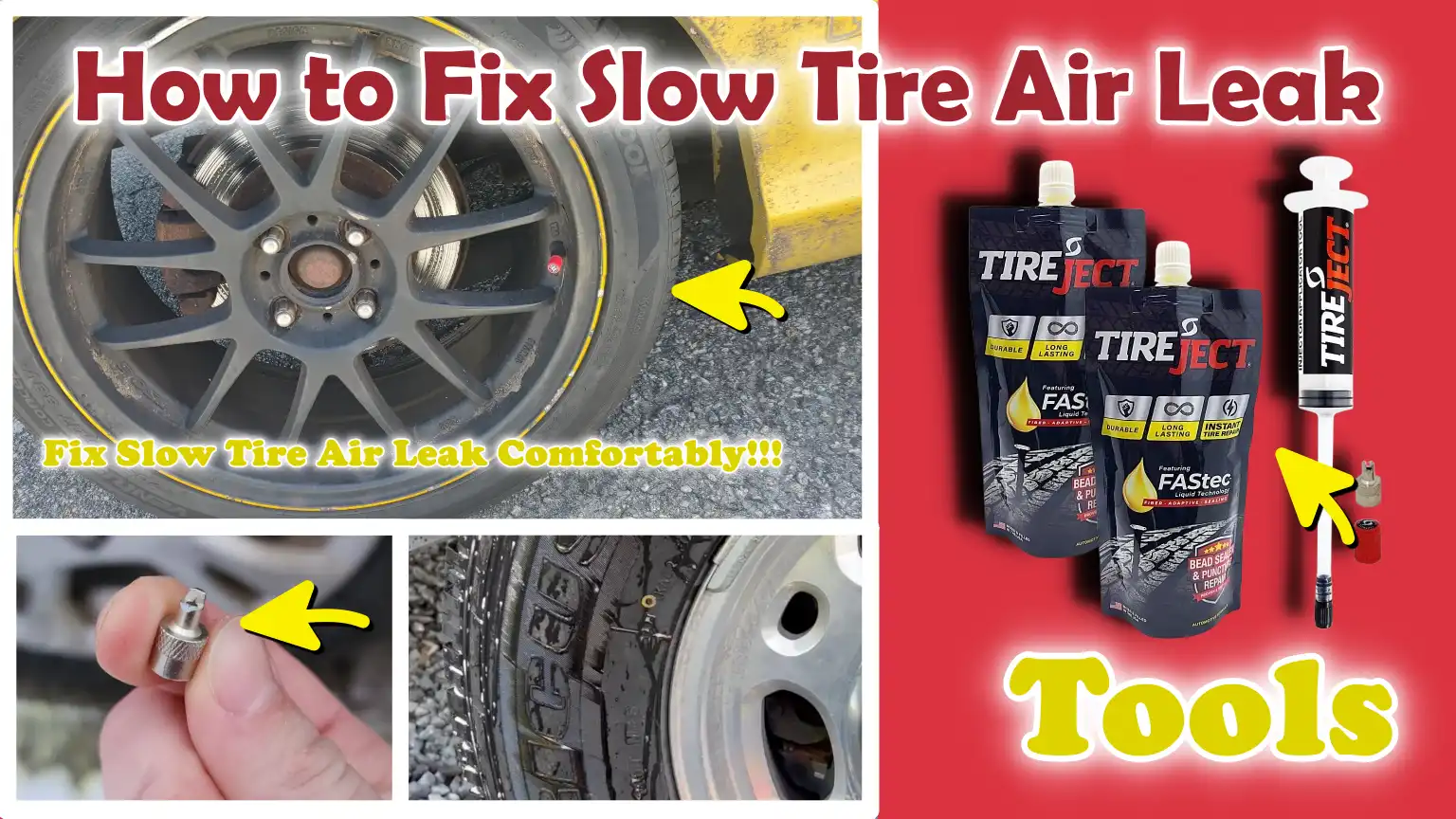
Now, in this guide you’ll learn How to Fix Slow Tire Air Leak so that you can restore both safety and efficiency as well.
Why Do Tires Lose Air Gradually?
Air leaks gradually from a tire when it finds a minuscule escape route.
This passage can form due to the way the various components of the tire and wheel system interface with one another.
Tires are designed to safely contain pressurized air; however, over time, this seal may weaken due to minor wear and tear, friction, or changes in weather conditions.
This issue of gradual air loss is particularly troublesome because it does not result in a sudden blowout; instead, the air pressure simply diminishes slowly over time.
This impacts fuel efficiency, tire longevity and vehicle safety, yet, it often goes unnoticed in its early stages.
Identifying the root cause is important, as the repair method varies depending on the type of leak and simply reinflating the tire repeatedly does not resolve the underlying issue.
1. Punctures Caused by Nails or Debris
One of the most common causes of gradual air loss is a small puncture in the tire tread (the surface of the tire that makes contact with the road); this is typically caused by a nail, screw, or piece of sharp debris lying on the road.
These objects can become embedded in the tire, creating a small hole through which air seeps out very slowly rather than escaping all at once.
In many cases, the object remains lodged within the tire’s rubber, further slowing the rate of air loss and making the leak difficult to detect.
Drivers often only realize that something is amiss when they find themselves having to reinflate their tires every few days.
Even if a puncture is small, it compromises the structural integrity of the tire; if not repaired properly, the puncture can enlarge over time.
2. A Faulty or Aged Valve Stem
The valve stem is the small component through which you inflate the tire; it plays a important role in sealing and retaining air within the tire.
Over time, exposure to heat, sunlight and general wear and tear can cause cracks to form in rubber valve stems, a process often referred to as “dry rot.
” In some instances, the valve core (the internal mechanism) may become loose or worn out, resulting in a slow but steady air leak.
Because this component is so small and often goes unnoticed, many drivers neglect to inspect it; nevertheless, it is a very common cause of gradual tire pressure loss.
A faulty valve stem can usually be repaired quite easily; however, if left unaddressed, it can lead to a persistent air leak from the tire.
3. Rust on the Wheel Rim
A tire does not retain air solely by virtue of its own structure; it also relies on the tight seal formed between the tire’s “bead” (edge) and the metal wheel rim.
Over time, particularly in environments involving moisture, dirt, or road salts, rust or corrosion can develop along the edges of the rim.
This rough surface prevents the tire from seating properly, allowing air to slowly escape from the contact area.
This type of leakage is more prevalent in older wheels and can be difficult to detect without a close inspection.
Properly resolving this issue often requires cleaning and resealing the rim.
4. Faulty Bead Seal
The bead is the edge of the tire that fits snugly against the rim, creating an airtight seal.
If this seal is not perfectly intact, air can gradually escape.
This can occur if the tire was not mounted correctly, if dirt or debris became lodged during installation, or if the tire has aged and lost some of its elasticity.
Over time, the rubber can harden, making it difficult for the bead to maintain a strong seal.
Even a minuscule gap at this junction can lead to a continuous loss of air; therefore, proper tire installation and maintenance are important.
5. Temperature Fluctuations
Occasionally, what appears to be a slow air leak is actually a natural fluctuation in tire pressure caused by changes in temperature.
The air inside the tire contracts when it cools, resulting in a drop in pressure, and expands when it heats up.
For instance, a temperature drop of approximately 10 degrees Fahrenheit can reduce tire pressure by about 1 to 2 PSI.
This does not constitute a genuine leak; however, it may mimic one because the tire appears to be low on air, particularly in the morning or during cold weather.
Understanding this distinction helps drivers avoid confusion, allowing them to focus on identifying actual leaks rather than mistaking normal pressure variations for a problem.
How to Confirm a Slow Tire Leak?
Confirming a slow leak in a tire is important, as many tire-related issues initially present similar symptoms, yet require entirely different solutions.
A slow leak typically involves a gradual loss of air over time, rather than the sudden deflation associated with a puncture.
This means you will need to employ simple yet precise methods to verify that air is indeed escaping and to pinpoint its exact source.
While it is normal for a tire to lose a small amount of air naturally over several weeks, a significant drop in air pressure within just a few days, or the recurring illumination of a warning light, is a clear indication of a leak.
By combining regular air pressure checks, careful visual inspections and a few basic diagnostic techniques, you can quickly identify this issue and prevent more serious consequences, such as uneven tire wear, handling difficulties, or complete tire failure.
1. Check Tire Pressure Regularly
The first and most reliable method for confirming a slow leak is to check the tire pressure using a tire pressure gauge.
This device provides a precise reading of the air volume inside the tire, information that is far more accurate than mere visual estimation or checking the pressure by hand.
If you observe that the tire pressure is consistently dropping over a short period, for instance, if you find yourself needing to refill the air every few days, this is a definitive sign of a slow leak, rather than just normal air loss.
For the most accurate results, tire pressure should be checked when the tires are “cold,” as driving causes tires to heat up, which increases the internal air pressure and can lead to inaccurate readings.
Conducting regular checks allows you to identify patterns in air loss and detect a leak before it escalates into a major problem.
2. Visual Inspection
If you know where to look, a careful visual inspection often reveals clear signs of a slow air leak.
You should examine the tire’s tread (upper surface) to ensure that no nails, screws, or sharp objects are embedded in it, as these are the most common causes of slow leaks (punctures).
You should also check the tire’s sidewalls for any cracks, cuts, or bulges, as these may indicate internal damage or weak spots in the tire where air could escape.
Additionally, inspect the valve stem (the air-filling tube) for dryness, cracks, or accumulated dirt, as even a minor defect in this component can lead to an air leak.
Although not all types of leaks are visible to the naked eye, this inspection is quick to perform and can sometimes pinpoint the problem immediately without the need for further investigation.
3. The Soap-and-Water Test
The soap-and-water test is one of the simplest and most effective methods for confirming a slow leak and identifying its exact location.
This method works because when air passes through a liquid solution, it creates visible bubbles.
By mixing a small amount of soap into water and spraying or applying it to the tire’s surface, including the tread, sidewalls, valve stem and rim edges, you can observe bubbles forming.
Even very minute leaks, which are invisible to the naked eye, will consistently produce bubbles at the site of the leak.
This test is widely used because it is easy to perform, inexpensive and highly accurate in detecting slow air leaks.
4. The Immersion Method – Advanced
The immersion method is a more advanced and highly precise technique for confirming and pinpointing slow leaks, frequently employed in professional settings.
In this method, the tire is submerged in a tank or large vessel filled with water; as air escapes from the tire, it generates a stream of bubbles that clearly reveals the exact location of the leak.
This technique is particularly useful when the leak is very minute or difficult to detect using other methods.
It can also identify leaks in specific areas such as: the bead or the inner liner, that are typically challenging to inspect.
Although it requires greater effort and specialized equipment, it remains one of the most reliable methods for detecting even the tiniest air leaks.
How to Identify the Exact Source of the Leak
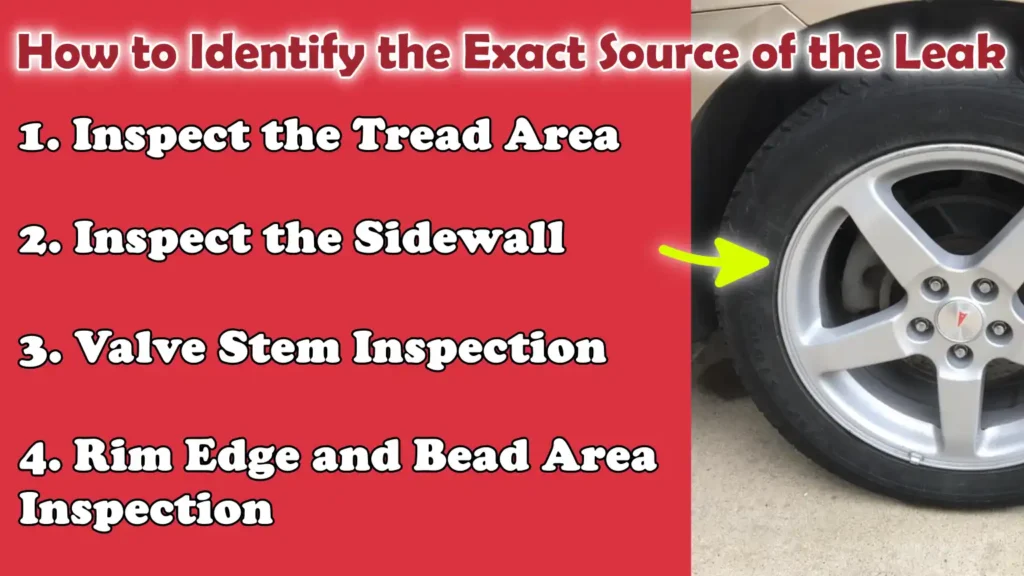
Locating the precise source of a slow leak in a tire is the most critical step to take before attempting any repairs; repairing the wrong spot wastes time and fails to resolve the actual problem.
A tire contains several sealing points, including the tread, sidewall, valve system and the bead area (where the tire meets the rim).
Depending on the type of damage, wear, or installation issue, air can escape from any of these locations.
As some leaks are very minute and difficult to detect, a systematic inspection is essential.
By carefully examining every major component where a leak is likely to occur, drivers can identify the true cause of the pressure loss and select the appropriate repair method rather than relying on guesswork.
1. Inspect the Tread Area
The tread area is the part of the tire that comes into direct contact with the road, which is why it is the most common site for punctures and slow leaks.
During the inspection, the tire should be rotated slowly to reveal any nails, screws, glass shards, or other sharp objects lodged within the grooves and rubber blocks.
Sometimes, the object remains embedded in the tire, partially plugging the hole and allowing air to escape very slowly, making the leak difficult to detect.
Even a small puncture in the tread can lead to a gradual and steady loss of pressure over time.
As punctures in the tread can often be repaired, provided they fall within the designated repair zone, detecting them early can prevent the unnecessary replacement of the tire.
2. Inspect the Sidewall
The sidewall is the flexible outer section of the tire situated between the tread and the wheel rim; damage to this area is typically more severe than damage to the tread.
During an inspection, the sidewall should be examined closely to detect any cracks, cuts, scrapes, bulges, or blisters.
Cracks may result from tire aging, exposure to sunlight, heat, or drying out, while cuts can occur through contact with hazardous objects present on the road or pavement.
Bulges or blisters are particularly dangerous, as they often indicate internal structural damage caused by the breakage of the cords embedded within the tire.
Unlike punctures in the tread, damage to the sidewall is generally not considered safe to repair; therefore, if a leak is detected in this area, replacing the tire is often the safer option.
3. Valve Stem Inspection
The valve stem is a small yet critical component responsible for allowing air to be pumped into the tire and subsequently sealing it inside.
Because it is exposed to heat, moisture, dust and varying road conditions, it can deteriorate much faster than many drivers might anticipate.
During an inspection, particular attention should be paid to visible cracks in the rubber, loose valve cores, bent stems, or damaged threads at the valve cap attachment point.
In some instances, air leaks directly from the valve core itself rather than from the outer stem.
Applying a soapy solution to this area will immediately reveal rising bubbles if a leak is present.
As valve-related leaks are common and typically inexpensive to repair, it is always beneficial to inspect this component carefully.
4. Rim Edge and Bead Area Inspection
The rim edge and bead area constitute the interface where the tire forms an airtight seal with the wheel; issues arising in this specific region are frequently the cause of slow, mysterious air leaks.
During inspection, particular attention should be paid to the outer edge of the wheel, the area where the tire meets the rim, to detect any rust, wear, accumulated debris, dents, or other such defects that could compromise the seal.
Older metal rims are particularly susceptible to rust; rusting causes the surface to become rough, preventing proper contact between the tire bead and the wheel.
The bead itself should also be examined for signs of cracks, deformation, or improper seating.
Repairing leaks in this area and re-establishing an airtight connection often requires cleaning, resealing, or having the tire remounted by a professional.
How to Fix Slow Tire Air Leak – Quick & Effective Method
To properly resolve the issue of a slow tire leak, it is essential to first identify the precise cause and apply the appropriate repair method for that specific problem.
Tires are inflated under pressure; therefore, if even a minuscule puncture or defect exists anywhere, air will continuously escape over time.
Re-inflating the tire may serve as a temporary stopgap solution, but it does not address the root cause of the problem.
A proper repair not only restores the tire’s ability to retain air but also ensures safe driving, even tire wear and improved fuel efficiency.
The specific repair method to be employed depends on the source of the leak, whether it originates from a puncture, the valve stem, the rim, or the tire bead area.
Understanding these distinct scenarios allows you to avoid unsafe or merely temporary repairs.
1. Repairing Punctures Caused by Nails or Minor Leaks
When a slow leak is caused by a nail embedded in the tire tread (the surface that contacts the road) or a small puncture, it can often be repaired, provided that the damage falls within the “safe repair zone.”
In such instances, a “plug kit” is frequently used as an immediate, temporary fix.
This method involves inserting a rubber strip into the puncture from the exterior of the tire to seal the leak.
While this technique is useful in emergency situations, it does not always effectively seal the tire’s internal structural layers.
A more reliable and permanent solution involves applying a “patch” to the interior of the tire.
For this procedure, the tire must be separated from the wheel and the puncture must be sealed from the inside.
This method repairs the tire’s structural integrity more effectively and minimizes the risk of air leaking from the same spot in the future.
2. Repairing or Replacing the Valve Stem
If air is leaking from the valve stem, the repair process is typically simple, yet it is important.
Sometimes, the issue is caused by a loose “valve core” located inside the valve stem.
This can be tightened using a small valve tool to stop the air leak.
However, if the valve stem itself is cracked, weakened, or deteriorated due to age and exposure to heat, it should be replaced entirely.
Rubber valve stems can wear out over time, while metal valve stems may develop sealing issues if not properly maintained.
Replacing a faulty valve stem restores the tire’s seal and stops persistent air leaks with minimal cost and effort.
3. Preventing Rim Leaks
Air leaks occurring between the tire and the rim are typically caused by rust, corrosion, or dirt accumulation along the rim’s edge.
These factors prevent the formation of an airtight seal between the tire and the rim.
To rectify this, it is necessary to remove the tire so that the rim’s edge can be thoroughly cleaned, using the appropriate tools, to remove rust and debris.
Once the surface is smooth again, a “bead sealer” can be applied to enhance the airtight connection between the tire and the rim.
This process helps restore a proper seal and is particularly important for older wheels, where corrosion is more common.
Proper sealing ensures that air cannot escape from the contact area.
4. Reseating the Tire Bead
If the bead seal is compromised or not seated correctly, the tire may gradually lose air, even in the absence of any visible damage.
In such a situation, the tire must be completely deflated and then reinflated so that the bead can properly reseat itself against the rim.
During this process, a lubricant is often applied to the bead area to facilitate its smooth sliding into place and to establish a robust seal.
Subsequently, the correct air pressure is applied to fully seat the tire.
This procedure restores proper contact between the tire and the wheel, thereby ensuring that the air remains sealed inside and preventing any further leakage.
So, When to Replace a Tire Instead of Repairing It?
Not every tire that is slowly losing air can, or should, be repaired, as certain types of damage compromise the structural integrity and safety of the tire.
A tire is composed of multiple layers of rubber and internal cords that provide its shape and strength; when these layers are damaged beyond a certain threshold, repair methods such as plugs or patches cannot restore the tire’s original reliability.
Driving on a damaged tire increases the risk of sudden tire failure, particularly at high speeds or when carrying heavy loads.
Understanding when replacing a tire is the safer option helps prevent accidents, improves vehicle stability and ensures that the tire performs as intended under normal driving conditions.
1. Large Punctures and Sidewall Damage
Large punctures or any damage to the tire’s sidewall constitute a primary reason to replace the tire rather than repairing it.
The sidewall is a flexible component that withstands the constant flexing and pressure experienced during driving; however, it lacks the structural rigidity found in the tire’s tread area.
Consequently, repairs performed on the sidewall often fail to effectively retain air pressure over time.
Even a small cut or puncture in this area can propagate and lead to a sudden tire blowout.
Large punctures in the tread area, those falling outside the limits of safe repair, also compromise the tire’s internal structure; in such cases, even if the puncture is temporarily sealed, the tire remains unreliable.
2. Air Leaking from Multiple Spots on a Single Tire
When a tire begins to leak air from multiple locations, it often signals that the tire’s overall structural integrity has deteriorated.
Multiple punctures or leak points compromise the tire’s structural strength, making it increasingly difficult to maintain proper air pressure consistently.
Even if each individual leak can be repaired, the cumulative effect of multiple repairs often increases the risk of tire failure and diminishes its operational efficiency.
A frequently repaired tire becomes less reliable on the road, which can adversely affect the vehicle’s handling and braking capabilities.
In such instances, replacing the tire is generally the safer and more practical solution.
3. Excessive Tire Tread Wear
The depth of the tire tread plays a important role in generating traction, displacing water and maintaining overall road grip.
When the tread becomes excessively worn, the tire loses its ability to maintain proper contact with the road surface, particularly in wet or slippery conditions.
A worn tire becomes more susceptible to punctures, as the protective layer of rubber becomes too thin to adequately shield the internal layers.
Even if a slow leak can be repaired, a tire with insufficient tread depth cannot deliver safe performance and should be replaced.
Most safety standards recommend replacing a tire once its tread depth reaches a minimum threshold, as reduced tread depth directly impacts braking distance and vehicle control.
4. Structural Defects or Bulges
Internal structural defects within a tire constitute one of the most serious hazards; in such situations, the tire must always be replaced.
Such defects often manifest as a bulge or bubble on the tire’s sidewall or tread surface, indicating that the internal cords have weakened or snapped.
These cords are essential for maintaining the tire’s structural integrity and shape; once compromised, the tire can no longer safely withstand the pressures and stresses faced during road use.
Incidents such as hitting potholes or striking curbs can cause these bulges to form, significantly increasing the risk of sudden tire failure.
As this type of damage cannot be repaired, replacing the tire remains the only safe option.
Know, Difference Between Temporary Measures vs Permanent Solutions
When dealing with a slow tire leak, it is important to understand the distinction between temporary measures and permanent solutions, as not every repair offers the same level of safety or durability.
Temporary measures are designed to immediately halt air leakage, allowing you to drive for a short distance; however, they do not fully restore the tire’s internal structure or sealing integrity.
Conversely, permanent solutions address the root cause of the leak and ensure that the tire can safely retain air over the long term under normal driving conditions.
Knowing which type of remedy to apply, and when, helps prevent issues such as recurring leaks, uneven tire wear and the risk of sudden tire failure while driving.
1. Tire Sealants
Tire sealants are liquid compounds injected into the tire through the valve stem.
They spread internally and, as air escapes, form a seal that temporarily closes minor punctures.
These products are highly useful in emergency situations, as they can be applied quickly and easily without the need to remove the tire from the wheel.
However, they do not constitute a permanent solution, as they fail to repair the tire’s internal structure and their effectiveness may diminish over time.
In some instances, sealants can also create an imbalance within the tire or complicate subsequent professional repairs.
While they can help you reach a repair shop safely, they should not be regarded as a definitive, permanent fix.
2. Plugs vs Patches – A Comparison
Tire plugs and tire patches are two common methods of repair; however, they function differently and offer varying levels of reliability.
Plugs are inserted into the puncture site from the outside, acting as a filler to prevent air from escaping.
This method is fast and convenient, particularly for roadside repairs; however, it does not completely seal the tire’s inner liner.
In contrast, a patch is applied from the inside of the tire after it has been removed from the wheel.
By adhering to the inner surface, it creates a stronger and more complete seal.
Because it completely covers the damaged area from the inside, a patch is generally considered a more permanent and secure solution than a plug.
In many professional repairs, a combination of both methods is used to ensure maximum sealing capability and durability.
3. Why Professional Repair Is Safer
Professional tire repair is considered safer because it involves trained technicians who follow proper procedures and utilize specialized tools to thoroughly inspect, repair and test the tire.
They do not merely fix visible external leaks; they also inspect for hidden internal damage such as: weakened cords or internal wear, which may not be apparent from the outside.
Professional repair typically involves removing the tire, inspecting it from the inside, applying a patch using correct techniques and ensuring that the tire is properly remounted and balanced.
This level of meticulous care helps restore the tire’s ability to safely retain air pressure, thereby reducing the risk of future leaks or sudden tire failure.
While temporary fixes may save time initially, professional repair offers long-term reliability and provides peace of mind while driving.
Read More:
- How to Detect Tire Sidewall Damage
- How to Check Tire Tread Depth at Home
- How to Bleed ABS System Properly
- How to Replace Rusted Brake Lines
- How to Inspect Brake Lines for Rust
- How to Flush Contaminated Brake Fluid
- How to Check Brake Fluid Contamination Level
- How to Fix Brake Bias Issues
- How to Test Brake Proportioning Valve
- How to Replace a Brake Light Switch
- How to Diagnose Brake Light Switch Failure
- How to Fix Intermittent ABS Activation
- How to Clean ABS Wheel Speed Sensor
- How to Diagnose ABS Sensor Wiring Issues
- How to Test Electronic Brake Module (EBCM)
- How to Fix Parking Brake Dragging
- How to Adjust Parking Brake Cable
- How to Check Parking Brake Cable Tension
- How to Fix Brakes Dragging While Driving
- How to Diagnose Brake Dragging Issue
- How to Fix Internal Master Cylinder Leak
How to Prevent Future Slow Air Leaks Easily
Preventing slow air leaks in tires is far easier and more effective than repairing them after they occur, as most leaks originate from minor issues that worsen over time.
Tires are constantly subjected to road stress, temperature fluctuations and environmental factors; this means that without regular inspection, problems can arise even in well-maintained tires.
By adopting simple maintenance habits and understanding how daily driving affects your tires, you can minimize the likelihood of air leaks, extend tire lifespan, maintain optimal fuel efficiency and ensure safe driving.
The primary objective of prevention is to keep tires properly sealed, protect them from damage and maintain them within the correct pressure range at all times.
1. Regular Tire Pressure Checks
Regularly checking tire pressure is the most effective method for preventing slow leaks from going unnoticed and escalating into major problems.
Over time, tires naturally lose a small amount of air; however, a sudden or recurring drop in pressure often signals an underlying issue that requires immediate attention.
Using a reliable tire pressure gauge and checking the tires when they are cool ensures accurate readings.
Maintaining the recommended pressure level in your tires preserves their structural integrity, reduces stress on the rubber and prevents uneven wear, thereby significantly lowering the risk of leaks.
2. Avoiding Potholes and Road Debris
Road conditions play a important role in tire health; Avoiding potholes, sharp objects and debris on the roads significantly reduces the likelihood of tire punctures and damage to their internal structure.
Driving into a pothole can compromise a tire’s internal integrity or weaken its sealing surfaces, while sharp debris such as: nails or shards of glass, as it can penetrate the tire tread (surface) and lead to slow air leaks.
Driving cautiously, maintaining a safe speed and remaining alert to road hazards help protect tires from these common causes of air leakage.
3. Seasonal Tire Checks
Changes in weather affect tire performance far more than many drivers realize; the primary reason for this is the direct impact that temperature has on tire pressure.
Tire pressure decreases in cold weather and increases in hot weather; if tires are not properly adjusted to suit the prevailing weather conditions, these fluctuations in pressure can place excessive stress on the tires.
Regularly checking your tires during seasonal transitions helps detect cracks, hardening of the rubber, or pressure variations that could eventually lead to leaks.
Inspecting your tires at least once every season allows you to identify minor issues early on, before they escalate into major problems.
4. Proper Mounting and Balancing
Properly mounting and balancing tires is important for preventing air leaks and ensuring even tire wear.
If a tire is not seated correctly on the rim, the bead will fail to seal properly, resulting in a gradual loss of air.
Improper balancing leads to uneven air pressure distribution, causing the tire to wear out rapidly and develop weak spots.
Professional tire installation ensures that the tire is seated correctly, securely sealed and properly balanced for rotation, all factors that help prevent air leaks over time.
5. Keeping Valve Caps in Place
Although valve caps may appear to be small and insignificant components, they play a important role in protecting the valve stem from dust, moisture and dirt.
In the absence of a cap, debris can enter the valve, potentially leading to gradual air leakage or damage to the valve core.
Valve caps serve as a secondary seal, helping to retain air within the tire and preventing external contaminants from interfering with the valve’s operation.
Keeping them securely in place is a simple step that provides an extra layer of protection against gradual air loss.
Learn, How to Safely Drive with a Slowly Leaking Tire
Exercising extreme caution is essential when driving with a tire that is slowly losing air, as even a slight, gradual drop in air pressure can significantly alter your vehicle’s handling, braking and responsiveness on the road.
As tire pressure decreases, the “contact patch”, the area where the tire meets the road, expands, generating increased heat and friction within the tire.
Over time, this excessive heat can damage the tire’s internal structure and heighten the risk of a sudden blowout, particularly during long-distance journeys or while driving at high speeds.
Although a slow leak may not appear immediately dangerous, it compromises vehicle stability, increases stopping distances and can lead to uneven tire wear.
If you suspect that a tire is leaking, adhering to basic driving safety protocols can help mitigate the risks until the issue is properly resolved.
And, there’s even scientific research that clearly shows that correct tire pressure actually plays a important role in safety and performance, so whenever a slow leak reduces that pressure, then it literally increases the heat inside the tire and affects the braking and handling, that’s why you need to detect and fix those slow leaks in terms to maintain the safe driving conditions.[¹]
1. Monitoring the Tire Pressure Warning Light
The tire pressure warning light serves as one of the most critical indicators that something is amiss and should never be ignored.
This system is designed to alert you when tire pressure drops below a safe threshold, often before the tire even appears visually underinflated.
If this light illuminates repeatedly, or remains lit even after the tire has been reinflated, it is a definitive sign that the tire is slowly losing air.
Supplementing this warning system with regular manual checks of your actual tire pressure ensures that you are not relying solely on guesswork.
Paying close attention to this warning allows you to take appropriate action in a timely manner and prevent the situation from escalating into a more serious hazard.
2. Avoiding High-Speed Driving
Driving at high speeds places immense stress on your tires, particularly on a tire that is already losing air.
As speed increases, the tire undergoes greater flexing and generates more heat; this accelerates the deterioration process and heightens the risk of a blowout.
Furthermore, an underinflated tire is unable to maintain its structural integrity, thereby compromising the vehicle’s control and stability at high speeds.
Maintaining a moderate speed reduces the strain on the tires and affords you better control over the vehicle.
This simple measure, provided the tire is losing air only gradually, as it can significantly mitigate the risk of a sudden blowout.
3. Avoiding Long-Distance Travel Until Repairs Are Complete
Driving long distances with a tire that is slowly losing air can be hazardous, as the problem may gradually worsen without any immediate warning.
Over time, the combined effects of continuous air loss, rising heat and the stress imposed by contact with the road can severely weaken the tire, potentially leading to a sudden blowout.
Rather than undertaking long journeys under such uncertain conditions, it is safer to limit your driving to short trips and check the tire pressure frequently.
Before relying on a tire for any long-distance travel, it is always best to have the leak repaired as soon as possible.
Addressing this issue in a timely manner ensures that the tire functions reliably and minimizes the likelihood of a sudden vehicle breakdown on the road.
Conclusion – How to Fix Slow Tire Air Leak
You actually need to fix those tire leaks, instead of refilling again and again.
Tires are designed to maintain a precise level of air pressure to support the vehicle’s weight, ensure proper road contact and provide stability for handling, braking and fuel efficiency.
When air leaks slowly, even in small amounts, it alters the tire’s performance characteristics; this leads to excessive heat buildup within the tire, uneven tread wear and reduced vehicle control, particularly during braking or cornering.
The problem of a slow leak becomes even more dangerous because it often goes unnoticed until the air pressure drops to an unsafe level; this can result in a sudden tire failure or a complete blowout at the most inopportune moment.
Most importantly, a slow tire leak should never be ignored, nor should it be dismissed as merely a minor nuisance that can be resolved simply by frequently refilling the air.
Identifying the root cause of the problem, whether it is a small puncture, a faulty valve, a corroded rim, or a defective bead seal, enables you to undertake the appropriate repairs and restore the tire to its full functional capacity.
By conducting regular tire inspections and performing timely repairs, you can prevent this issue from escalating and extend the lifespan of your tires.
Now, that’s all from this guide about How to Fix Slow Tire Air Leak and if you still have questions then just comment down them below.
Frequently Asked Questions
FAQ 1: Why does air leak slowly from a tire?
Answer: A slow air leak from a tire is typically caused by minor issues that allow air to escape gradually rather than all at once. The most common causes include: a small puncture caused by a nail or sharp object, a faulty or worn-out valve stem, corrosion on the wheel rim, or a compromised seal at the junction between the tire and the rim. In some instances, fluctuations in temperature may create the illusion that a tire is leaking air, when in reality, the tire pressure is simply dropping due to cold weather. Identifying the actual cause is important, as the method for fixing the problem varies depending on the specific issue.
FAQ 2: How can I tell if my tire is leaking air slowly?
Answer: If you notice that your tire pressure is dropping over the course of a few days, or if you find yourself needing to refill your tires with air frequently, it is a sign that your tire is experiencing a slow leak. Additionally, there are other indicators, such as: the tire pressure warning light illuminating repeatedly, the vehicle pulling slightly to one side while driving, or one tire appearing visibly flatter (underinflated) compared to the others. A simple and reliable way to confirm this is to regularly check your tire pressure using a gauge to determine if the pressure is consistently dropping without any obvious cause.
FAQ 3: Can I drive on a tire that is slowly leaking air?
Answer: Yes, you can drive on a tire that is slowly leaking air for a short period; however, ignoring this issue for an extended period is not safe. Driving on an underinflated tire generates excessive heat inside the tire, reduces your control over the vehicle and can lead to uneven tire wear or even a sudden blowout. It is best to drive cautiously, avoid high speeds and have the issue repaired as soon as possible to prevent any damage or potential hazards.
FAQ 4: How can I pinpoint exactly where the tire is slowly leaking air?
Answer: The most effective method for locating a slow air leak in a tire is to use a solution of soap and water. When you apply this solution to the tire’s surface, bubbles will begin to form at the precise spot where the air is escaping. You should carefully inspect the tire’s tread (surface), sidewalls, valve stem and the edges of the rim. If the problem is more severe, you can submerge the tire in water to detect even the smallest puncture, as the bubbles will clearly reveal the location of the leak.
FAQ 5: Is plugging a tire a permanent solution for a slow air leak?
Answer: Plugging a tire is generally considered a temporary or short-term fix. While it can quickly stop an air leak and is useful in emergency situations, it does not completely seal the tire’s internal structure. For a more reliable and long-lasting repair, applying a patch from the inside of the tire is recommended, as this properly seals the damaged area and restores the structural integrity of the tire.
FAQ 6: When should I replace a tire instead of repairing it?
Answer: You should replace a tire when the damage is located on the sidewall, the puncture is excessively large, or the tire is leaking air from multiple spots. Tires with severely worn treads, cracks, or bulges should be replaced, as such conditions compromise the structural integrity of the tire. Repairing such tires is unsafe and can increase the risk of tire failure while driving.
FAQ 7: Do tire sealants actually work for slow leaks?
Answer: Tire sealants can serve as a quick and temporary fix by sealing small punctures from the inside; however, they are not designed for long-term use. They do not repair the actual damage and their effectiveness may diminish over time. In some cases, they can even make proper repairs more difficult later on. They are best used solely to safely reach a repair shop.
FAQ 8: How often should I check my tire pressure to prevent leaks?
Answer: It is advisable to check your tire pressure at least once a month and definitely before embarking on a long journey. Regular checks allow you to detect slow leaks early, before they escalate into major problems. To obtain an accurate reading, always check the pressure when the tires are cold and compare it against the recommended pressure specifications for your vehicle.
References:
[1] Tire Pressure Monitoring [Applications of Control]
https://www.researchgate.net/publication/3207920_Tire_Pressure_Monitoring_Applications_of_Control
Hello Folks, Dean Shali here to help you out to solve the problems with your lovely vehicle, as i have lots of experience and knowledge about automotive industry as i woks directly with the customers and repair vehicles and i love to help the people to keep their cars safe and running smoothly.