Written By: Dean Shali
Fact Checked By: Sabré Cook
Reviewed By: Tamara Warren
The tire can look perfectly fine on the outside and still be really dangerously weak on the inside of the tire.
Basically, the sidewall is the flexible outer layer that actually supports the tire’s shape, as it literally absorbs road shocks and helps them to maintain air pressure in stable way, but unlike the tread: as it has very little reinforcement against the sharp impacts, curb strikes or long-term aging effect such as: dry rot.
And, what makes it even more dangerous is that sidewall actually damage often develops it silently, small cracks may form from the UV exposure, low pressure weakens internal cords and a hidden bulge can signal internal structural failure long before having a visible blowout happens.
Additionally, there’s studies in the tire engineering that shows that once the internal cords of a sidewall are actually compromised, that’s how the tire loses its ability to safely carry the load and this failure can happen in sudden way, specially at the higher speeds or under heavy weight.
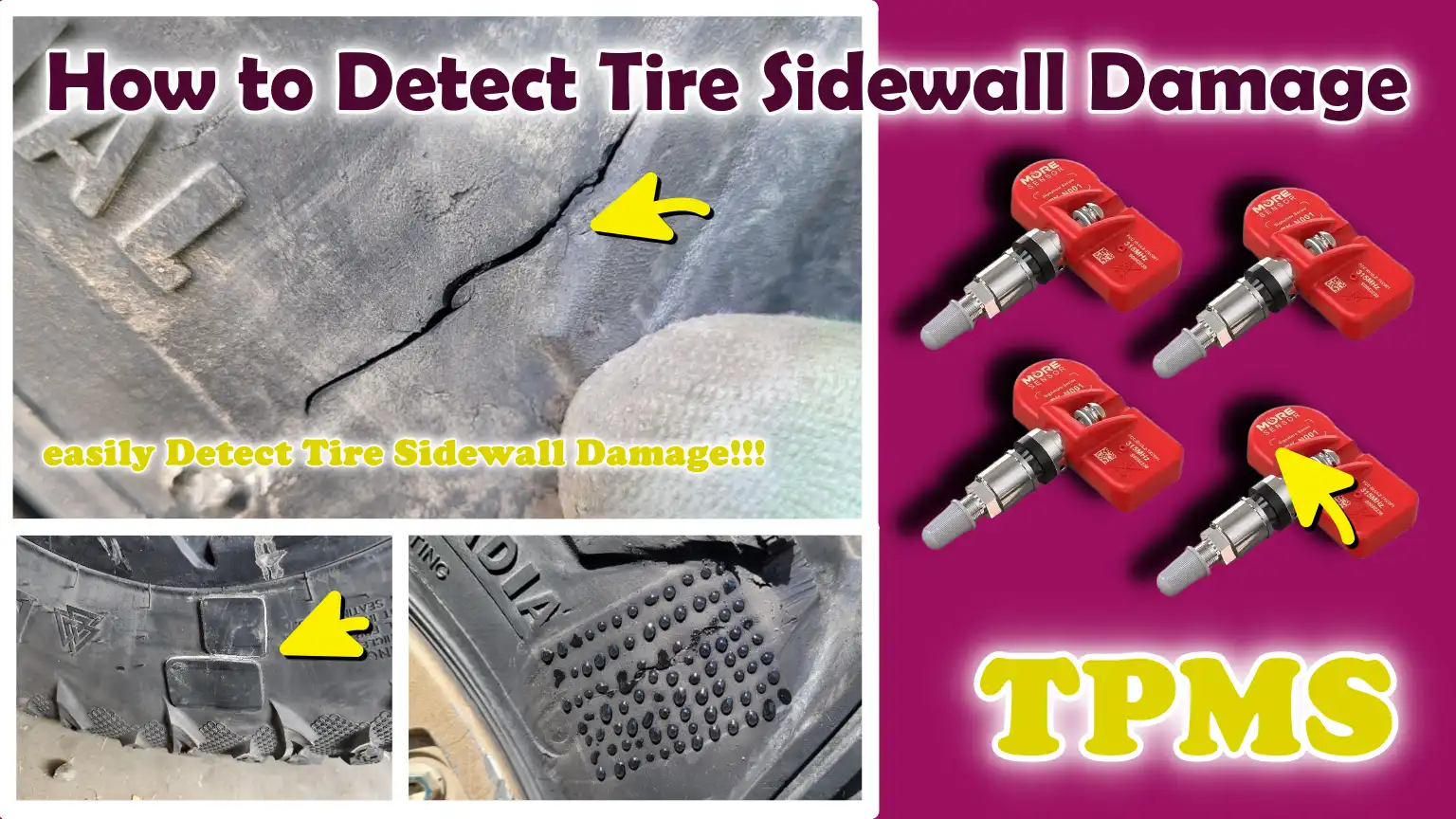
That’s why, in this guide you’ll learn How to Detect Tire Sidewall Damage so that you can safely reduce that chance of unexpected tire failure and improve the overall driving control.
Know, What is Tire Sidewall Damage?
Tire sidewall damage refers to any injury sustained by the outer portion of the tire, specifically, the section situated between the tire tread (the part of the tire that makes contact with the ground) and the wheel rim.
Although this part of the tire may appear insignificant, it plays a important role in maintaining the tire’s structural integrity, flexibility and its ability to withstand the pressures faced during driving.
The sidewall retains the air inside the tire, supports the vehicle’s weight and absorbs shocks from the road.
When this section is compromised, the tire can lose its structural integrity very rapidly, significantly increasing the risk of sudden tire failure.
Unlike tread wear, which occurs gradually over time, sidewall damage can become dangerous very quickly and often presents no clear warning signs.
1. Know About Tire Sidewall
The tire sidewall is the smooth outer surface located on the side of the tire that connects the tread to the rim.
It is composed of multiple layers of rubber and reinforcing cords, which provide the tire with necessary structural strength while maintaining the flexibility required to absorb shocks and irregularities from the road surface.
It is this flexibility that enables the tire to maintain proper contact with the road surface and ensures a comfortable driving experience.
Furthermore, the sidewall protects the tire’s internal structure, including the cords responsible for supporting the vehicle’s weight.
Being thinner and more flexible than the tread section, it is more susceptible to damage caused by impacts and environmental factors.
2. What is the Difference Between Tread Damage and Sidewall Damage?
From the standpoint of safety and repair, there is a significant difference between tread damage and sidewall damage.
The tread is the thick, patterned section of the tire that comes into direct contact with the road; it is designed to wear down gradually over time.
Minor punctures in the tread can often be safely repaired, provided certain specific conditions are met.
The sidewall, on the other hand, is not designed to withstand direct physical trauma in the same way.
Even a small cut, crack, or bulge in the sidewall can compromise the structural integrity of the entire tire.
This is because, while the vehicle is in motion, the sidewall constantly flexes and changes shape; consequently, any damage to this area can spread rapidly or worsen significantly.
For this reason, damage to the sidewall is generally considered far more serious than damage to the tread.
3. Why Can’t Sidewalls Be Safely Repaired in Most Cases?
In most instances, sidewalls cannot be safely repaired because they are simultaneously responsible for withstanding constant flexing, internal air pressure and the weight of the vehicle.
As the tire rotates, the sidewall flexes and changes shape with every revolution, placing immense stress on any damaged area.
If there is a cut or crack, or if the internal cords have snapped, merely repairing the outer surface does not restore the tire’s original structural strength.
This means that the damaged section could fail at any moment without warning, particularly at high speeds or under heavy loads.
Safety standards adopted by organizations such as the National Highway Traffic Safety Administration (NHTSA) explicitly advise against repairing sidewall damage, stating that in most situations, replacing the tire is the safest course of action.
4. Common Causes of Tire Sidewall Damage
Tire sidewall damage typically results from everyday driving conditions, situations that many drivers face regularly but may not fully appreciate the potential impact of.
The most common cause is striking potholes; this can generate a sudden and forceful impact that damages the internal structure of the sidewall, even if no visible marks are initially apparent on the exterior.
Driving too close to curbs can also cause the sidewall to scuff or sustain cuts, particularly while parking or negotiating sharp turns.
Road debris such as: sharp stones, metal fragments, or broken glass, as it can strike the sidewall, leading to cuts or punctures.
Furthermore, driving on underinflated tires places excessive strain on the sidewall, as it is forced to flex beyond its normal limits; over time, this can cause the tire to overheat and develop cracks.
Overloading a vehicle beyond its weight capacity has a similar effect, as it subjects the sidewall to pressures far exceeding its structural limits, thereby increasing the likelihood of weakening and failure.
Why is Early Detection of Tire Sidewall Damage Important?
Early detection of damage to a tire’s sidewall is one of the most critical safety checks a driver can perform.
This is because such defects often begin gradually but can escalate very rapidly.
As a vehicle is driven, the sidewall constantly flexes and changes shape.
This means that even a minor crack, cut, or internal weakness can worsen with every passing mile.
Unlike many other vehicle malfunctions, which often provide gradual warning signs, sidewall damage can reach a critical stage without any obvious prior indication.
Research and safety guidelines from organizations such as the National Highway Traffic Safety Administration (NHTSA) have established that tire-related failures are a well-known cause of road accidents.
The simplest way to mitigate this risk is through immediate inspection.
By detecting damage in its early stages, drivers can take necessary corrective measures before the structural integrity of the tire is compromised.
This helps in maintaining vehicle control, preventing sudden failures and ensuring a completely safe driving experience.
1. The Risk of Sudden Tire Blowouts at High Speeds on Highways
The most significant danger associated with sidewall damage is a sudden tire blowout, particularly when the vehicle is traveling at high speeds.
The function of the sidewall is to maintain the internal air pressure of the tire, which, in turn, supports the entire weight of the vehicle.
If the structural integrity of the sidewall is compromised, it may be unable to withstand the immense pressure generated by high speeds and heat.
When driving at high speeds on a highway, significant heat builds up inside the tire due to friction and continuous rotation.
This causes the internal air pressure to rise even further.
If there is a hidden crack in the sidewall or any damage to the internal structure, this increased pressure can cause the tire to burst instantly.
A tire blowout at high speeds can lead to a sudden and rapid loss of vehicle control, making it extremely difficult to steer the vehicle in the correct direction or bring it to a safe stop.
Early detection of such defects significantly reduces the likelihood of this dangerous situation arising.
2. Impact on Vehicle Handling and Braking
A defect in the sidewall directly affects how the vehicle performs and responds on the road.
A sound and robust tire maintains its structural integrity and establishes a firm grip on the road surface.
However, if the sidewall becomes compromised, the tire may flex unevenly or weaken in certain areas.
This can result in sluggish steering response, noticeable vibrations felt inside the cabin, or a sense of instability in the vehicle, particularly when cornering.
Braking performance may also deteriorate, as the tire may be unable to maintain consistent traction on the road surface.
In emergency situations, even a slight delay in response or a reduction in road traction can increase the distance required to bring the vehicle to a halt and diminish the driver’s control.
Early detection of defects ensures that the tires function as intended, thereby maintaining vehicle stability during both routine driving and sudden maneuvering situations.
3. Safety Considerations for Passengers
A sidewall defect is not merely a mechanical issue; it poses a direct safety threat to every passenger inside the vehicle.
A tire can burst without any prior warning, potentially placing the lives of passengers in grave danger, specially if the incident occurs at high speeds or amidst heavy traffic.
Loss of vehicle control, sudden swerving, or diminished braking capability, all these factors can significantly heighten the risk of an accident.
Even at low speeds, defective tires can cause a vehicle to become stranded in a hazardous location.
By regularly inspecting tire sidewalls and promptly replacing worn-out tires, drivers can substantially mitigate these risks and ensure a safe environment for their passengers.
4. Saving Money by Avoiding Major Accidents
Ignoring damage to a tire’s sidewall can lead to complications that prove far more costly than simply replacing a single tire.
When a tire suffers a sudden blowout, it can inflict damage upon other vehicle components such as: the wheel rims, suspension parts, or even the vehicle’s bodywork.
In some instances, this may result in towing fees or the expense of unexpected emergency repairs.
By detecting defects early, drivers can have issues rectified before they escalate into serious problems, thereby avoiding these additional costs.
Replacing a defective tire in a timely manner is far less expensive than repairing the damage caused by a complete tire blowout; in this regard, regular vehicle inspections serve not only as a precautionary safety measure but also as a prudent financial decision.
Know, Types of Sidewall Damage – A Visual Inspection
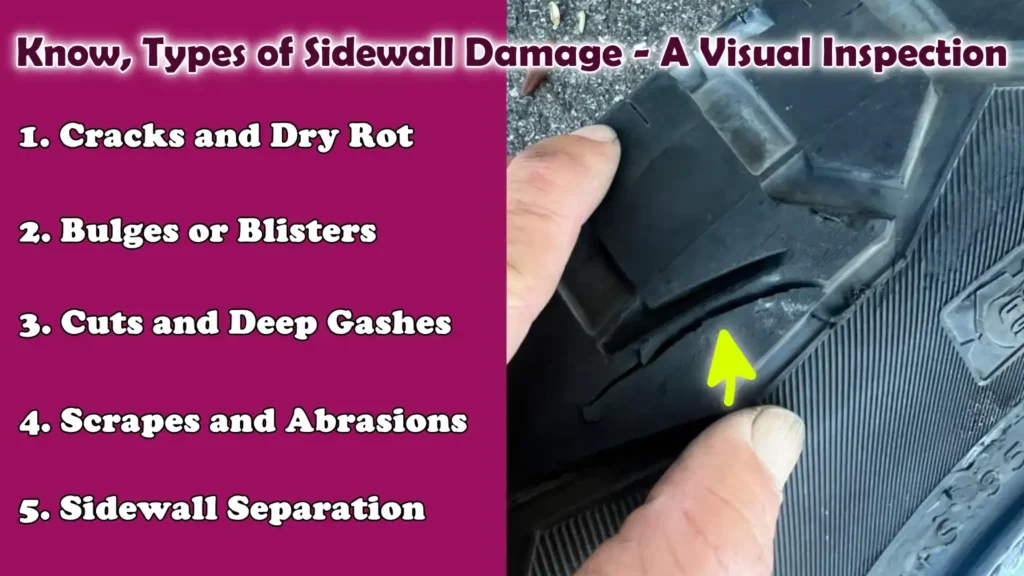
Tire sidewalls can sustain damage in various ways and each type of damage provides important clues regarding the overall condition of the tire.
Learning to visually identify these signs helps drivers determine whether the damage is minor or poses a serious safety risk.
As the sidewall is constantly subjected to pressure and stress, even minor visible changes can point to deeper, underlying issues.
A careful examination of its texture, shape and surface condition can reveal early warning signs that are often overlooked during daily use.
1. Cracks and Dry Rot
The appearance of cracks on the tire sidewall is one of the most common indicators of tire aging and wear.
Small surface cracks may appear as fine lines on the rubber; these are often caused by prolonged exposure to sunlight, wind and temperature fluctuations.
Over time, the rubber loses its elasticity and begins to dry out, a condition known as “dry rot.”
While very fine cracks may not pose an immediate threat, deeper cracks that spread or widen can compromise the structural integrity of the sidewall.
When cracks become deep enough to penetrate the internal layers, the tire loses its strength, significantly increasing the risk of a blowout or structural failure under pressure.
Extreme heat, cold weather and prolonged periods of inactivity can accelerate this process, making regular inspections absolutely essential.
2. Bulges or Blisters
The appearance of a bulge or blister on the sidewall is a clear indication of damage to the tire’s internal structure and should always be treated with the utmost seriousness.
This occurs when the tire’s internal cords, responsible for maintaining the tire’s shape and structural integrity, snap or become weakened.
Consequently, the internal air pressure exerts outward force, resulting in a visible bulge or swelling on the surface.
Such damage is often caused by driving into a pothole or striking a solid object.
A bulge signals that the tire can no longer properly maintain its structural integrity and the risk of sudden tire failure or a blowout becomes significantly high.
As the internal support system has already been compromised, this type of damage cannot be safely repaired, making the immediate replacement of the tire absolutely necessary.
3. Cuts and Deep Gashes
Cuts and deep gashes on the sidewall can range from minor surface abrasions to punctures that penetrate deep into the rubber.
Shallow surface cuts may affect only the outer layer and pose no immediate threat; however, deeper cuts can reach the tire’s internal cords, which provide the tire with its structural strength.
One way to assess the severity of the damage is to examine the depth of the cut and determine whether any internal components are visible.
If the tire’s internal cords are exposed, or if the cut appears wide and deep, the tire is no longer safe for use.
Due to the constant flexing and stretching of the sidewall while driving, even minor cuts can enlarge over time; therefore, it is important to monitor them closely and replace the tire if necessary.
4. Scrapes and Abrasions
Scrapes and abrasions typically occur when the tire rubs against curbs, rough surfaces, or the edges of the road.
These marks often manifest as scuffed or rough patches on the sidewall.
In many instances, minor abrasion is merely superficial and causes no damage to the tire’s internal structure.
However, deeper scratches can strip away layers of rubber and reduce the sidewall’s thickness, thereby weakening it and rendering it more susceptible to pressure and impact.
It is important to closely inspect the affected area to determine whether the damage is confined to the surface or extends deeper into the tire’s structural composition.
If the rubber appears significantly worn or uneven, it may indicate a compromise in the tire’s structural integrity.
5. Sidewall Separation
Sidewall separation is a less common but extremely serious form of damage in which the tire’s internal layers begin to detach from one another.
This condition is referred to as ‘delamination’ and can result from manufacturing defects, wear and tear caused by prolonged use, or repetitive stress.
Signs of separation may include unusual bulging of the tire, surface irregularities, or areas where the sidewall appears to lift away or distort in shape.
Unlike surface-level damage, this type of issue affects the tire’s internal bonding and can lead to sudden and catastrophic tire failure without any specific prior warning.
Because it is difficult to detect in its early stages and poses a significant safety risk, any indication of sidewall separation should be considered a compelling reason to replace the tire immediately.
How to Detect Tire Sidewall Damage – Easy Way
Properly inspecting a tire’s sidewall is a simple, yet important habit.
It allows you to detect any potential damage before it becomes hazardous.
The sidewall withstands air pressure, supports the vehicle’s weight and constantly flexes and changes shape while driving; therefore, if minor issues are overlooked in their early stages, they can quickly escalate into major problems.
A thorough visual inspection requires no specialized tools, but it does demand close attention to detail and consistent vigilance.
By adopting a clear, step-by-step approach, you can identify early warning signs such as: cracks, bulges, cuts, or hidden weaknesses, and take necessary action before the tire becomes unsafe for use.
1. Prepare for the Inspection
To begin, park your vehicle on a level, stable surface so that the tires rest in their natural position, making them easier to inspect.
This ensures that you can observe the true shape of the sidewall without any distortion that might otherwise be caused by uneven ground.
Turn the steering wheel so that the front tires angle outward; this will allow you to easily view the entire surface of the sidewall.
Adequate lighting is essential, as dim lighting can make it difficult to spot small cracks or subtle surface irregularities.
Natural daylight is ideal, but a bright flashlight can also help you clearly discern fine details on the rubber surface.
2. Conduct a Visual Inspection
A proper visual inspection entails examining the entire circumference of each tire, not just the section that is immediately visible to you.
Move the vehicle forward slowly, or shift it slightly forward or backward if necessary, so that you can inspect every section of the tire.
Pay close attention to any cracks in the rubber that resemble fine lines; additionally, look for any bulges or blisters, which may indicate structural defects within the tire’s interior.
Give special attention to any cuts, scrapes, or unusual changes in color, as these could signal a weakening of the tire material.
Even the slightest alteration in the tire’s texture or appearance can serve as an early warning sign of a major internal issue; therefore, inspect the tire’s surface with great care and do not rush through this process.
3. Perform a Touch Test
After completing the visual inspection, gently run your hand over the tire’s sidewall to detect any irregularities that might be difficult to spot with the naked eye.
The tire’s surface should feel smooth and uniform; therefore, if you feel any rough patches, soft spots, or protrusions, this could indicate internal damage or structural weakness within the tire.
A bulge may feel like a slight swelling beneath the surface, while a soft spot could indicate that the tire’s internal structure has been compromised.
This step is important because certain types of damage often begin to develop internally before becoming visible on the exterior of the tire.
4. Check Tire Pressure
Checking tire pressure is an essential part of the sidewall inspection, as incorrect pressure places excessive strain on this specific area of the tire.
Using a reliable pressure gauge, ensure that the tire pressure aligns with the specifications recommended by the manufacturer.
When a tire is underinflated, the sidewall is typically forced to flex more than usual; this generates excessive heat within the tire, which can ultimately lead to cracking or damage to its internal structure.
Conversely, if a tire is overinflated, it becomes excessively rigid, thereby increasing the risk of damage should it strike an obstruction.
Maintaining the correct tire pressure reduces the stress placed on the sidewalls and extends the overall lifespan of the tire.
5. Inspect Both the Inner and Outer Sidewalls of the Tire
Many drivers inspect only the outer sidewall of a tire because it is easily visible; however, the inner sidewall is equally important and is often overlooked.
Any damage to the inner section of the tire can go undetected for a prolonged period, particularly when that section faces the underside of the vehicle.
To clearly view the inner sidewall, take a moment to look underneath the vehicle or move the vehicle slightly forward or backward.
Doing so ensures that no hidden cracks, cuts, or bulges escape your notice.
A comprehensive inspection always involves examining both sides of the tire to facilitate an accurate assessment and ensure complete safety.
Understand About Some Warning Signs While Driving
When a tire’s sidewall becomes compromised, the issue is not always clearly visible while the vehicle is stationary; however, it often becomes evident through changes in the car’s handling and responsiveness while driving.
The sidewall plays a important role in maintaining the vehicle’s balance, absorbing shocks and preserving the tire’s structural integrity under pressure.
When it becomes weakened or damaged, the tire is unable to perform these functions effectively.
Consequently, certain symptoms begin to manifest while driving, symptoms that should never be ignored.
Recognizing these warning signs in a timely manner allows you to safely pull over, inspect the tire and avert a major accident such as: a tire blowout or a complete loss of vehicle control.
1. Vibrations or Unusual Shaking
One of the early indicators of a compromised sidewall is the sensation of vibrations or shaking while driving.
This occurs when the tire fails to maintain its smooth and uniform shape as it rotates.
A weakened or damaged sidewall can create an imbalance, rendering the tire unable to maintain consistent contact with the road surface.
As the vehicle’s speed increases, these vibrations may intensify and become more distinctly perceptible through the steering wheel or the vehicle’s floor.
Although vibrations can stem from various other causes such as: unbalanced wheels, persistent or sudden-onset vibrations warrant immediate investigation, as they may signal a serious structural defect within the tire.
2. Pulling to One Side
If your vehicle begins to drift or pull toward one side without any input from the steering wheel, it may be an indication that one of the tires is not functioning correctly.
Due to a defect in the sidewall, the internal air pressure within the tire may become unevenly distributed, or the structural integrity of the tire may be compromised, thereby impairing its ability to maintain a firm grip on the road.
As a result of this imbalance, the vehicle may begin to pull toward the side where the defective tire is mounted.
Driving under such conditions can be quite difficult and fatiguing, particularly on straight roads, and the risk of losing control of the vehicle during sudden turns or while braking increases significantly.
3. Thumping Sounds
While driving, a rhythmic thumping or pulsating sound serves as a warning signal that should never be ignored.
This sound typically occurs when a bulge, crack, or irregular deformation develops on the tire’s sidewall.
As the tire rotates, the defective section repeatedly strikes the road surface, producing a distinct “thumping” sound.
As the vehicle’s speed increases, this sound becomes more rapid and pronounced.
Such a sound usually indicates a serious structural defect within the tire; therefore, it is important to have it inspected immediately to prevent further damage or a sudden tire failure.
4. Sudden Pressure Loss
A sudden drop in tire pressure is one of the most critical indicators of a sidewall defect.
This can occur when air begins to escape rapidly through a crack, cut, or weak point in the tire.
In some instances, the pressure may decrease gradually; however, in other cases, particularly if the defect worsens while the vehicle is in motion, the pressure can plummet very rapidly.
When tire pressure drops, the tire is unable to adequately support the vehicle’s weight, thereby increasing the risk of damage to the rim and a loss of vehicle control.
For safety purposes, it is absolutely essential to constantly monitor tire pressure and take immediate action in response to any sudden fluctuations.
5. Steering Instability
Steering instability refers to the sensation experienced when a vehicle fails to respond accurately or consistently to steering inputs.
This can occur when a tire’s sidewall has been compromised and is unable to maintain its proper structural integrity under load.
Consequently, the tire’s traction diminishes, making the vehicle difficult to handle, particularly when negotiating turns or driving at high speeds.
Drivers may perceive the steering as feeling loose, sluggish in its response, or generally erratic in its performance.
In such situations, maintaining safe control of the vehicle becomes significantly challenging, thereby increasing the risk of accidents.
Addressing this issue in a timely manner restores the vehicle’s handling capabilities, resulting in a more stable and secure driving experience.
Know, When Does Sidewall Damage Becomes Actually Dangerous?
Sidewall damage becomes dangerous when it compromises the tire’s structural integrity or its ability to maintain air pressure.
The sidewall bears the vehicle’s weight and undergoes constant flexing and bending as the tire rotates; this means that any weakness in this area can deteriorate rapidly during normal driving.
Unlike the gradual wear of the tread (the tire’s upper surface), sidewall damage can lead to sudden and catastrophic tire failure without significant warning.
It is important to understand when damage has escalated from a minor issue to an unsafe level, as driving on a compromised sidewall increases the risk of sudden air loss, loss of vehicle control and a complete tire blowout.
1. Guidelines Regarding the Depth of Damage
The depth of the damage is one of the most critical factors in determining its severity.
Very faint marks or shallow scratches that affect only the outer rubber may not immediately compromise the tire’s structural integrity, but they should still be monitored closely.
The danger increases significantly when a crack or cut becomes deep enough to penetrate the layers beneath the surface.
The sidewall is constructed from strong materials that provide structural support to the tire; once these layers are compromised, the tire can no longer function safely.
Any damage that appears wide, deep, or jagged should be considered a serious concern, as continued use is likely to cause it to deteriorate further.
2. Replace Immediately If Internal Cords Are Visible
If you can see the tire’s internal cords or threads, it is no longer safe to use the tire under any circumstances.
These cords form the primary load-bearing structure that holds the tire together, enabling it to support weight and maintain its shape.
When these cords become visible, it indicates that the protective layers of rubber have already worn away.
At this stage, the tire has lost a significant portion of its structural integrity and the risk of sudden failure, particularly under stress or while driving at high speeds, increases significantly.
Immediate replacement is the only safe course of action, as continuing to drive, even for a short distance, as it can lead to a tire blowout.
3. Driving with Bulges on the Sidewall is Unsafe
Any bulge or bubble on the sidewall is the clearest indication of internal structural damage to the tire.
This occurs when the internal cords within the tire snap or weaken, allowing the internal air pressure to push outward and create a raised protrusion.
Even if the tire remains inflated, that compromised section becomes extremely fragile and cannot withstand the normal stresses of driving.
Bulges often develop in tires after hitting potholes or striking solid objects.
This serves as a warning sign that the tire’s internal structure has been compromised.
Driving on a tire with a bulge is extremely dangerous, as it may burst without any warning; therefore, it must be replaced immediately.
4. Industry Standard: Sidewall Repairs Are Rarely Feasible
A widely accepted rule within the tire industry is that, in most cases, damage to the sidewall should not be repaired.
The reason for this is that the sidewall is constantly flexing and expanding, subjecting any repaired area to continuous stress.
A repair cannot fully restore the tire’s original structural integrity or internal composition.
Safety guidelines issued by organizations such as the National Highway Traffic Safety Administration (NHTSA) emphasize that while certain types of damage to the tire tread can be safely repaired, damage to the sidewall typically necessitates the replacement of the entire tire.
Adhering to this rule ensures that tires remain reliable and minimizes the risk of sudden failure on the road.
Can a Tire Sidewall Be Repaired?
In most real-world scenarios, a tire’s sidewall cannot be safely repaired, even if the damage appears minor from the outside.
The sidewall is not merely a layer of rubber; it is a flexible structure designed to flex with every rotation while simultaneously withstanding high internal air pressure and supporting the entire weight of the vehicle.
When this section sustains a cut, a crack, or becomes compromised, its internal structure, which provides the tire’s strength, may already be damaged beyond repair.
Unlike the tread area, which is thicker and more rigid, the sidewall lacks the material density or structural integrity required to ensure a durable repair.
For this reason, most tire experts agree that when a sidewall is damaged, replacing the tire is the only safe and long-lasting solution.
1. Why Is Repair Generally Not Recommended?
Repairing sidewall damage is generally not recommended because, while the vehicle is in motion, the damaged area is subjected to constant tension and flexing.
This continuous movement places significant stress on any patch or sealant applied to the area, potentially causing the repair to fail without warning.
Even if a patch manages to hold air for a time, it cannot restore the original strength of the internal cords responsible for supporting the vehicle’s weight.
Over time, exposure to heat, pressure and road impacts can further weaken the compromised section, thereby increasing the risk of sudden air loss or a catastrophic tire blowout.
Simply put, while a repaired sidewall may appear sound on the surface, its underlying structural integrity remains compromised and unsafe.
2. Safety Standards and Industry Guidelines
The safety standards adopted within the tire industry strongly advise against repairing damage to a tire’s sidewall.
Organizations such as the National Highway Traffic Safety Administration explicitly state that while certain types of tread damage may be repairable under controlled conditions, damage to the sidewall necessitates tire replacement.
These guidelines are grounded in extensive testing and real-world data, which reveal how sidewalls perform under stress.
As the sidewall is constantly subjected to tension and compression, any repairs performed on this section cannot meet the safety standards essential for safe driving.
Adherence to these standards helps mitigate the risk of accidents caused by tire failure.
3. The Distinction Between Temporary Measures and Permanent Solutions
When addressing tire damage, it is important to understand the distinction between temporary measures and permanent solutions.
Temporary measures such as: sealants or external patches, may temporarily halt air leaks and assist in moving the vehicle to a safe location during an emergency.
However, these measures neither restore the internal structural integrity of the sidewall nor reinstate its original strength.
A permanent solution entails restoring the tire to a condition where it can safely withstand the stresses of pressure, load and speed; yet, once the sidewall has sustained damage, achieving this is simply not possible.
For this reason, replacing the tire is considered the only reliable, safe and long-term solution.
So, When to Replace Tires?
Knowing when to replace tires is important for safety, as damage to the sidewall can escalate rapidly, and often without clear warning, posing a serious hazard.
The sidewall maintains air pressure, supports the vehicle’s entire weight and constantly flexes during driving; this means that any structural weakness can suddenly lead to tire failure.
Unlike the normal wear and tear of the tire tread (surface), which occurs gradually, sidewall damage can reach a dangerous level very quickly.
Replacing tires at the appropriate time ensures proper vehicle handling, braking and overall stability, whereas delaying replacement increases the risk of a blowout, loss of vehicle control and further damage to the vehicle.
1. Bulges or Bubbles
Any bulge or bubble on the sidewall is a clear indication that the tire’s internal cords have been compromised.
This typically occurs after hitting a pothole or striking a solid object, which weakens the tire’s internal structure and allows the internal air pressure to exert force outward.
Even if the tire remains inflated, that compromised section becomes severely weakened and cannot withstand the stresses of normal driving.
Such damage can lead to sudden, unannounced tire failure, particularly at high speeds.
Any tire exhibiting a bulge should be replaced immediately, as it is no longer safe to use.
2. Deep Cuts
Deep cuts on the sidewall are dangerous because they can penetrate to the tire’s inner layers, which provide structural support.
If a cut extends deeper than the tire’s outer rubber, it can severely compromise the tire’s ability to maintain air pressure and support the vehicle’s weight.
In some instances, the internal cords of the tire may become visible; this indicates that the tire has lost a significant portion of its structural strength.
Even if a cut appears minor from a distance, its depth is what matters most.
Any deep cut should be considered a serious issue and necessitates immediate tire replacement.
3. Excessive Cracking
Cracks in the sidewall, particularly when they are numerous or deep, signal that the rubber is aging and losing its elasticity.
Over time, exposure to sunlight, air and temperature fluctuations can cause the rubber to dry out and crack.
While very fine, superficial cracks may not pose an immediate threat, extensive cracking on the sidewall indicates that the tire’s material is deteriorating.
As the tire constantly flexes while the vehicle is in motion, these cracks can deepen, eventually leading to tire failure.
In such cases, replacing the tire is the safest option.
4. Sidewall Punctures
A puncture in the sidewall constitutes one of the most serious types of damage, as it directly compromises the tire’s ability to retain air.
Unlike punctures occurring in the tread area (the upper surface of the tire), sidewall punctures cannot be safely repaired, as that specific section is subjected to constant pressure and flexing.
Even if the air is leaking slowly, the tire’s structural integrity is compromised.
Driving on a tire with a sidewall puncture increases the risk of sudden air loss and complete tire failure.
To ensure safe driving, it is imperative to replace the tire immediately.
5. Why Delaying Tire Replacement Is Dangerous
Delaying tire replacement after discovering damage to the sidewall can lead to problems far more serious than the cost of a new tire.
A weakened sidewall can fail at any moment, particularly under conditions of extreme heat, high speeds, or heavy loads, posing a risk of a sudden tire blowout.
Should such an event occur, it can lead to a loss of vehicle control, increased braking distances and a heightened risk of an accident.
Furthermore, a damaged tire can inflict damage upon other vehicle components such as: the wheel rims or suspension system, thereby significantly escalating repair costs.
Replacing a damaged tire as soon as possible is not merely a matter of routine maintenance; it is a critical safety measure that safeguards both the driver and the passengers.
Know, Common Mistakes of Tire Sidewall Damage
Understanding damage to a tire’s sidewall involves not only knowing what to look for but also avoiding common mistakes that can turn a minor issue into a serious safety hazard.
Many drivers overlook early warning signs or harbor misconceptions regarding safety, thereby increasing the likelihood of sudden tire failure.
The sidewall is a section of the tire subjected to immense stress; it constantly endures flexing, pressure and load-bearing forces.
Consequently, if minor damage goes unaddressed, it can deteriorate rapidly.
Avoiding these common mistakes helps maintain the tire’s structural integrity, enhances driving safety and minimizes the risk of sudden tire failure.
1. Ignoring Minor Cracks
One of the most common mistakes is overlooking minor cracks on the sidewall, as they often appear harmless at first glance.
These cracks typically develop due to tire aging, exposure to sunlight and temperature fluctuations, which cause the rubber to lose its elasticity over time.
While very fine surface cracks may not pose an immediate threat, they often serve as the first indication of rubber degradation.
As the tire continuously flexes during driving, these cracks can deepen and propagate across the entire sidewall, thereby compromising the tire’s structural integrity.
Regular inspections, and timely tire replacement when cracks become significant, as it can prevent far more serious problems.
2. Driving on a Bulging Tire
Driving on a tire that exhibits a bulge or bubble in the sidewall is a critical error that can lead to sudden tire failure.
A bulge indicates that the tire’s internal cords have been compromised, a condition typically caused by hitting potholes or striking hard objects.
This creates a weak spot where internal air pressure exerts outward force, rendering the tire unstable.
Even if the vehicle appears to drive normally for a short while, the risk of a blowout is extremely high.
Continuing to use such a tire is dangerous for both the driver and passengers, particularly at high speeds, and the safest course of action is to replace the tire immediately.
3. Assuming That All Types of Damage Can Be Repaired
Another common mistake is assuming that every type of tire damage can be repaired using the same method.
While certain types of damage to the tire tread (the surface) can be repaired under specific conditions, damage to the sidewall is an entirely different matter.
The sidewall constantly flexes and bears the weight of the vehicle, meaning that a repair cannot fully restore its original structural integrity.
Many drivers rely on temporary fixes or assume that a minor cut or puncture can be remedied with a simple patch; however, doing so can lead to tire failure later on.
Safety guidelines issued by organizations such as the National Highway Traffic Safety Administration clearly state that damage to the sidewall should not be repaired; instead, replacing the tire is typically required.
4. Failing to Inspect the Inner Sidewall
Neglecting to inspect the inner sidewall is another oversight that frequently results in undetected damage.
Most drivers inspect only the outer side of the tire, as it is easily visible; however, the inner sidewall faces inward toward the vehicle and often remains hidden from view.
Just like the outer section, this part is also susceptible to cracks, cuts, or bulges, particularly after striking an object or following prolonged use.
If this area is not inspected regularly, damage may go unnoticed until it reaches a critical stage.
A comprehensive inspection should always cover both the inner and outer sidewalls to ensure that no hidden damage is overlooked and that the tire remains safe for use.
Read More:
- How to Check Tire Tread Depth at Home
- How to Bleed ABS System Properly
- How to Replace Rusted Brake Lines
- How to Inspect Brake Lines for Rust
- How to Flush Contaminated Brake Fluid
- How to Check Brake Fluid Contamination Level
- How to Fix Brake Bias Issues
- How to Test Brake Proportioning Valve
- How to Replace a Brake Light Switch
- How to Diagnose Brake Light Switch Failure
- How to Fix Intermittent ABS Activation
- How to Clean ABS Wheel Speed Sensor
- How to Diagnose ABS Sensor Wiring Issues
- How to Test Electronic Brake Module (EBCM)
- How to Fix Parking Brake Dragging
- How to Adjust Parking Brake Cable
- How to Check Parking Brake Cable Tension
- How to Fix Brakes Dragging While Driving
- How to Diagnose Brake Dragging Issue
- How to Fix Internal Master Cylinder Leak
Have Some Tips for Protecting Sidewalls from Damage
Rather than attempting to repair a tire sidewall after it has already sustained damage, it is far easier, and safer, to prevent the damage from occurring in the first place.
Although sidewalls are designed to be flexible, they are not entirely indestructible; over time, exposure to pressure, impacts and weather conditions can cause them to weaken.
By adopting a few simple maintenance habits and driving with caution, you can significantly reduce the likelihood of cracks, bulges, or structural damage to the sidewalls.
Consistent care not only enhances safety but also extends the lifespan of your tires and helps maintain consistent vehicle handling and braking performance.
Plus, according to the NHTSA tire safety data: tire-related issues are actually leading cause of highway crashes and sidewall failures often occur due to the underinflation or prior structural damage as well, that’s why you need to detect those cracks, bulges and cuts in early way to prevent sudden blowouts while driving.[¹]
1. Maintain Correct Tire Pressure
Maintaining the correct air pressure in your tires is one of the most critical steps in safeguarding their sidewalls.
When a tire is underinflated, the sidewall flexes excessively while driving, generating increased heat and stress within the rubber.
Over time, this constant strain can lead to cracks, structural deterioration, or even internal damage to the tire.
Overinflating tires can also be detrimental, as it causes the tire to become overly rigid and unable to properly absorb impacts, thereby increasing the risk of cuts or bulges.
Regularly checking your tire pressure with a reliable gauge, and keeping it within the recommended range, helps the sidewall retain its proper shape and structural integrity.
2. Avoid Potholes and Curbs
Potholes and curbs are among the most common causes of sidewall damage, as they deliver sudden and forceful impacts that the tire is unable to fully absorb.
Driving into a pothole at high speed can damage the internal structure of the sidewall, even if no immediate external signs are visible.
Similarly, scraping a tire against a curb while parking can wear down the outer layer of rubber or cause cuts.
By driving cautiously, slowing down on rough roads and maintaining a safe distance from curbs, you can significantly reduce the risk of such damage.
3. Do Not Overload Your Vehicle
Every tire is designed to handle a specific weight limit; exceeding this limit places excessive strain on the sidewalls.
When a vehicle is loaded beyond its capacity, the sidewalls are forced to bear a load far greater than their designed capability.
This leads to increased internal stress and heat buildup within the tires while driving.
Consequently, this heightens the risk of premature tire wear, structural weakening, cracking, or failure.
Adhering to the vehicle’s specified weight limit ensures that the tires operate under safe conditions and that the pressure exerted on the sidewalls remains within acceptable limits.
4. Park Your Vehicle Properly to Prevent ‘Dry Rot’
Parking your vehicle correctly plays a important role in preventing ‘dry rot’, a common cause of sidewall cracking.
When a vehicle remains stationary and unused for extended periods, particularly when exposed to direct sunlight or extreme temperatures, the rubber can dry out and lose its elasticity.
Exposure to ultraviolet (UV) rays and air can accelerate this process, leading to the formation of visible cracks on the sidewalls.
Parking the vehicle in a shaded or covered area, keeping the tires clean and occasionally moving the car slightly forward or backward, to prevent constant pressure from bearing down on a single spot, as it can help maintain the condition of the rubber and protect it from premature deterioration.
5. Regular Inspections
Regular inspection is the simplest and most effective method for protecting sidewalls from serious damage.
By frequently examining your tires, you can identify early warning signs such as: minor cracks, cuts, or surface irregularities, before they escalate into hazardous issues.
Inspections should involve both a visual examination of the tires and a careful tactile inspection of the sidewalls to detect any hidden problems.
Identifying issues at an early stage allows you to take necessary corrective measures in a timely manner, whether that involves adjusting tire pressure to prevent further damage or replacing the tire before it fails completely.
Consistent inspection ensures that your tires remain safe, reliable and always ready for daily driving.
How Often Should You Check Your Tire Sidewalls?
Regularly checking your tire sidewalls is a important safety habit, as damage to this area can develop gradually, potentially leading to a sudden tire failure later on without any major prior warning.
The sidewall is under constant stress because it supports the vehicle’s weight and undergoes tension with every rotation; this means that minor issues such as: cracks, cuts, or internal weaknesses, as it can worsen over time.
Regular inspections allow you to detect these issues early, before they compromise the vehicle’s handling, braking, or overall safety.
Consistent checks also extend the lifespan of your tires and reduce the likelihood of sudden vehicle breakdowns, making this a simple yet highly effective part of vehicle maintenance.
1. Monthly Inspections
For most drivers, adopting a habit of monthly inspections is a sound practice, as it allows you to monitor the condition of your tires over time and ensures that no issues go unnoticed.
During a monthly inspection, you can spot early signs of damage, such as minor cracks, surface wear, or slight deformations in the tire’s shape.
As tires are exposed daily to sunlight, heat and varying road conditions, even normal usage can gradually take a toll on the sidewalls.
Checking your tires once a month helps you keep track of these changes and enables you to take necessary action before minor issues escalate into major problems.
It also provides an opportunity to check your tire pressure, which is directly linked to the health of the sidewalls and the overall performance of the tires.
2. Before Long Journeys
Checking your tire sidewalls is particularly important before embarking on a long journey, as such trips subject the tires to prolonged, continuous stress.
Long-distance driving often involves higher speeds, heavier loads and increased heat buildup within the tires; all these factors can exacerbate any pre-existing defects.
A minor crack or weak spot, which might not cause any issues during short trips, could prove dangerous during a long journey.
By inspecting your tires before setting out, you can ensure they are in good condition and minimize the risk of a breakdown or tire failure, specially when you are far removed from any assistance.
3. After Hitting a Pothole or Curb
You should always inspect your tire sidewalls after hitting a pothole or curb, as such impacts can cause immediate or delayed damage to the tire.
Even if the tire appears perfectly fine at first glance, a forceful impact can compromise the internal structure of the sidewall, or create minor cuts and bulges that may only become visible later.
Sometimes, the damage is not immediately apparent and only manifests after the vehicle has been driven for some time.
Inspecting your tires immediately following such incidents helps you detect any issues early on, allowing you to determine whether the tire remains safe for continued use or requires replacement.
Conclusion – How to Detect Tire Sidewall Damage
Basically, with the few minutes of inspection you can prevent a moment of loss of control and protect your tire sidewall quiet effectively.
The primary reason for this is that its warning signs are not always obvious or immediately visible.
The sidewall is not merely a simple rubber surface; it is a critical structural component of the tire, responsible for maintaining air pressure, supporting the vehicle’s weight and absorbing the constant shocks transmitted from the road.
When this section sustains cracks, cuts, bulges, or internal damage, the tire can lose its structural integrity without warning and fail suddenly, particularly at high speeds or under heavy loads.
Therefore, early detection of damage is not merely helpful; it is absolutely essential for safe driving.
Learning to identify the various types of sidewall damage, recognizing warning signs while driving and knowing when a tire needs to be replaced can truly make a significant difference in preventing accidents and vehicle breakdowns.
Many tire safety recommendations, including those endorsed by organizations such as the National Highway Traffic Safety Administration, explicitly emphasize that sidewall damage is rarely repairable and must always be treated with the utmost seriousness.
Now, you can comment for more information regarding this guide.
Frequently Asked Questions
FAQ 1: What is tire sidewall damage and why is it so serious?
Answer: Tire sidewall damage refers to any crack, cut, bulge, or weakness in the side section of the tire. This section is critical because it maintains air pressure and supports the vehicle’s weight, all while constantly flexing during driving. Unlike the tread, the upper part of the tire, which is thicker and designed to withstand wear and tear, the sidewall is more flexible and susceptible to damage. This makes it particularly dangerous, as even a minor issue can compromise its structural integrity and lead to sudden tire failure. Therefore, sidewall damage typically requires more immediate attention than most other tire-related issues.
FAQ 2: How can I identify if my tire’s sidewall is damaged?
Answer: You can detect sidewall damage by carefully visually inspecting and physically touching the tire. Look for cracks, bulges, cuts, or any unusual textures on the sidewall. Cracks may appear as thin lines, while bulges resemble swollen areas caused by internal structural defects. You should also run your hand over the tire’s surface to feel for any soft spots or uneven textures. Additionally, pay attention while driving, as vibrations, the vehicle pulling to one side, or unusual noises can also signal a problem with the sidewall.
FAQ 3: Is it safe to drive with a damaged sidewall?
Answer: In most cases, it is not safe to drive with a damaged sidewall. The sidewall is under constant pressure and undergoes continuous flexing; therefore, any existing weakness can deteriorate rapidly. A compromised sidewall can fail suddenly, specially at high speeds, potentially leading to a blowout and a loss of vehicle control. Even if the damage appears minor, it is far safer to have the tire inspected, and replaced if necessary, rather than taking the risk.
FAQ 4: Can tire sidewall damage be repaired?
Answer: Tire sidewall damage typically cannot be safely repaired. This is because the sidewall is constantly flexing while simultaneously supporting the weight of the vehicle, rendering any repair unreliable. While minor punctures in the tread can sometimes be fixed, sidewall damage compromises the structural integrity of the tire. Even if a temporary repair successfully stops an air leak, it cannot restore the tire’s original strength. Therefore, replacing the tire is usually the only safe solution.
FAQ 5: How does tire sidewall damage occur?
Answer: Sidewall damage typically results from everyday driving conditions. Driving over potholes is a common cause of damage to the tire’s internal structure, as it subjects the tire to a sudden and severe impact. Driving too close to curbs can also cause scrapes or cuts on the sidewall. Sharp objects lying on the road can also result in cuts or punctures to the tire. Furthermore, low tire pressure places excessive strain on the sidewall, while overloading the vehicle can cause the internal air pressure to exceed safe limits. Over time, exposure to sunlight and heat can also cause the rubber to crack and weaken.
FAQ 6: What does a bulge in the tire sidewall mean?
Answer: A bulge in the sidewall is a serious warning sign. This indicates that the internal cords of the tire have snapped or sustained damage. Consequently, the internal air pressure exerts outward force, resulting in a clearly visible bulge. Even if the tire remains inflated, its internal structure has already been compromised. A bulging tire can burst suddenly and without warning; therefore, it must be replaced immediately and the vehicle should not be driven.
References:
[1] National Highway Traffic Safety Administration, Tires
https://www.nhtsa.gov/vehicle-safety/tires
Hello Folks, Dean Shali here to help you out to solve the problems with your lovely vehicle, as i have lots of experience and knowledge about automotive industry as i woks directly with the customers and repair vehicles and i love to help the people to keep their cars safe and running smoothly.