Written By: Dean Shali
Fact Checked By: Sabré Cook
Reviewed By: Tamara Warren
Basically, a tire blowout is not just simple a tire gets flat, as it is a rapid air-pressure failure that can instantly change how a vehicle steers, brakes and balances.
And, when front ire blowouts then it usually causes a strong pull through the steering wheel, while the rear blowouts are often felt through the seat and body of the car.
So, the most dangerous moment is not that blowout itself, but how the driver actually reacts on it.
Because, sudden braking, over-steering or jerking the wheel can actually shift the weight sharply and make the car to spin, roll or cross the lanes as well.
That’s why, NHTSA specially advice that you should keep both hands on the wheel, maintain the control first then easing off the accelerator before moving off the road.
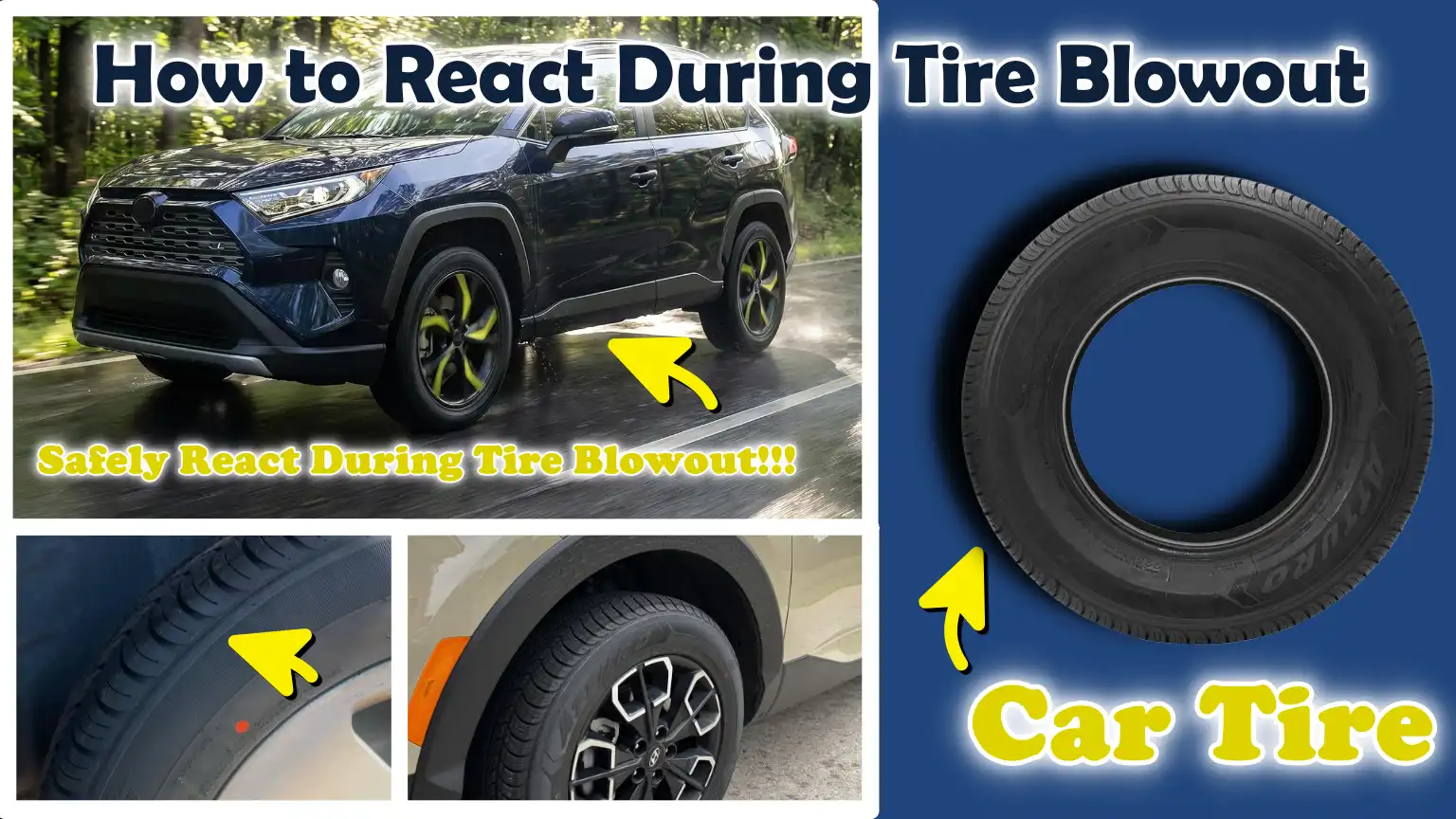
Also, in this guide you’ll learn How to React During Tire Blowout so that you can easily handle the situation and stay in control.
So, What Happens When a Tire Blows Out?
1. Sudden Air Loss vs Gradual Puncture
A tire blowout involves the rapid, and almost instantaneous, loss of air pressure.
This is typically caused by excessive heat, underinflation, damage resulting from impact with an object, or a structural failure within the tire at high speeds.
Unlike a gradual puncture, where air leaks out slowly and the driver may detect a drop in pressure over time, a tire blowout occurs in a matter of seconds or even less.
This sudden failure means the tire can no longer maintain its structural integrity and the vehicle’s balanced contact with the road is immediately compromised.
While a gradual puncture allows for some degree of vehicle control and provides warning signs, a tire blowout causes the vehicle to lose its equilibrium almost instantly.
This is why the event feels so violent and unexpected while driving.
2. What Does It Feel Like to Drive When a Front Tire Blows Out?
When a front tire blows out, the driver typically feels a strong, sudden pull on the steering wheel toward the side where the tire has failed.
This occurs because the front tires are responsible for steering the vehicle; consequently, any loss of balance in them has a direct and immediate impact on the vehicle’s handling.
The steering may feel heavy, uneven, or suddenly unresponsive and the vehicle may begin to drift to one side without any steering input.
Vibration in the steering wheel is also common, as the tire rim may come into direct contact with the road surface once the air has escaped.
At high speeds, this creates a rapid sensation of losing directional control, even if the vehicle is technically still moving forward.
3. What Does It Feel Like to Drive When a Rear Tire Blows Out?
When a rear tire blows out, the vehicle’s handling characteristics differ because the rear tires primarily serve to maintain the vehicle’s stability rather than to steer it.
Instead of feeling a strong tug on the steering wheel, the driver may perceive the rear end of the vehicle becoming unstable or drifting slightly to one side, creating the sensation that the vehicle is sliding or wobbling.
Initially, the feel of the steering wheel may seem largely normal, which can delay the driver’s realization of the problem.
However, the vehicle’s body may feel unstable, particularly when accelerating or changing lanes.
In SUVs or vehicles with a high center of gravity, this instability may be felt more acutely, as the weight distribution in such vehicles is affected more rapidly.
4. Signs Indicating That You Are Already Experiencing This Problem
A tire blowout often begins with a loud, sudden “bang,” immediately followed by vibrations or jolts felt throughout the entire vehicle.
It may feel as though the vehicle is pulling to one side or decelerating without the brakes being applied.
Drivers may also hear unusual noises emanating from a specific wheel, or feel intense vibrations through the vehicle’s floorboard or steering wheel.
In some instances, the friction between the damaged tire and the road surface may even produce the smell of burning rubber.
These signs typically manifest within just a few seconds; therefore, recognizing them immediately is crucial for maintaining safe control of the vehicle.
5. Why the Steering May Suddenly Pull to the Left or Right
During a tire blowout, the sensation of the steering pulling is caused by the unequal resistance between the blown-out tire and the remaining intact tires.
When a tire loses air, the drag on that side increases, while the remaining tires continue to rotate normally.
Due to this imbalance, the vehicle begins to pull toward the compromised tire.
When traveling at high speeds on a highway, even a slight difference in tire pressure can alter the vehicle’s direction; however, a tire blowout creates a massive and sudden disparity in force.
This is why the vehicle may abruptly veer to the left or right, and precisely why it is absolutely crucial to maintain a firm grip on the steering wheel until the vehicle’s speed decreases and it regains stability.
Stay Calm and Grip the Steering Wheel Firmly
1. Why Holding with Both Hands is Essential
In the event of a tire blowout, the most critical priority is maintaining control of the vehicle; this begins with how you grip the steering wheel.
Using both hands provides stability and minimizes the likelihood of “over-correcting”, that is, making sudden, forceful steering movements, specially if the vehicle begins to pull to one side or swerve.
At high speeds on a highway, even a slight adjustment to the steering can significantly alter the vehicle’s trajectory; therefore, a balanced grip helps you withstand the shock of a blowout without losing your intended direction.
Many safety guidelines, including those found in “defensive driving” training programs, emphasize keeping both hands on the steering wheel, as this enhances the precision of your reactions and reduces the risk of panic-induced errors that frequently lead to accidents.
2. Keeping the Vehicle Straight
When a tire blows out suddenly, the vehicle tends to pull toward the side where the tire has failed due to uneven resistance.
The primary objective is to keep the vehicle as straight as possible while allowing it to gradually decelerate on its own.
This entails resisting the urge to wrestle with the steering wheel and instead applying steady, controlled pressure to maintain your direction.
Staying on a straight path helps prevent the vehicle from drifting into adjacent lanes or into oncoming traffic.
At high speeds, vehicle stability is already compromised; therefore, even the minor corrections necessary to keep the vehicle aligned with the road must be executed very gently and gradually.
3. Common Mistake: Jerking the Steering Wheel
One of the most dangerous reactions during a tire blowout is abruptly jerking the steering wheel.
This typically occurs when a driver panics upon hearing the loud noise of the blowout or feeling the vehicle suddenly pull sharply to one side.
Sudden and drastic steering inputs can instantly destabilize the vehicle, as they further disrupt its balance, which has already been compromised by the blown tire.
Instead of regaining control, the vehicle may suddenly veer in the opposite direction or begin to “fishtail” (where the rear end of the vehicle begins to sway back and forth).
This reaction is particularly hazardous on highways, where high speeds amplify the impact of even minor steering adjustments, significantly increasing the risk of the vehicle drifting completely out of its lane.
4. Why Overcorrection Causes the Vehicle to Leave Its Lane
Overcorrection occurs when a driver, reacting to the initial pull caused by a tire blowout, turns the steering wheel too far in one direction and then rapidly turns it back in the opposite direction.
This creates a oscillating motion within the vehicle, causing it to sway from side to side, which can escalate rapidly, specially at high speeds.
Each attempted correction amplifies the vehicle’s momentum, making it increasingly difficult to stabilize.
This back-and-forth motion can cause the vehicle to drift out of its lane or, if tire traction has been significantly compromised, may even cause the vehicle to spin out completely.
The safest approach is to make small, controlled steering adjustments rather than drastic ones, allowing the vehicle to gradually stabilize as its speed decreases.
Do Not Brake Hard
1. Why Does the Vehicle’s Weight Shift Dangerously When Braking?
When a tire blows out, the vehicle automatically becomes unstable because one tire suddenly loses its ability to support the load and maintain traction on the road.
If you brake hard at this moment, the vehicle’s weight shifts rapidly forward; this increases the pressure on the front tires while causing the rear tires to become unbalanced.
This sudden forward shift of weight can make controlling the vehicle even more difficult, specially if a front tire has blown out.
Rather than rectifying the situation, hard braking can exacerbate the existing instability, increasing the likelihood of the vehicle skidding or pulling even more violently to one side.
2. What Happens If the Brakes Lock Up During a Tire Blowout?
If the brakes are applied too forcefully, particularly in older vehicles lacking modern stability systems, the wheels may lock up or lose their grip on the road.
When a tire is already compromised, locked brakes can cause the rim to drag unevenly across the road surface, generating vibrations and erratic movements.
This can also compromise steering ability, as a locked wheel fails to respond properly to steering inputs.
At high speeds on a highway, this loss of control becomes even more critical; instead of decelerating in a controlled manner, the vehicle may skid.
3. What is the Difference Between Braking Hard and Decelerating in a Controlled Manner?
Braking hard involves pressing the brake pedal immediately and forcefully, resulting in a rapid reduction in the vehicle’s speed and a sudden forward shift of its weight.
On the other hand, decelerating in a controlled manner entails gradually lifting one’s foot off the accelerator and applying the brakes with light, steady pressure only after the vehicle has stabilized.
The key distinction lies in the smoothness of this action.
Controlled deceleration allows the tires that are still functioning properly to maintain their grip on the road, whereas sudden braking further destabilizes the vehicle’s already compromised balance.
In the event of a tire blowout, slowing down gradually is far safer, as it provides the driver with sufficient time to stabilize the vehicle before bringing it to a complete halt.
4. Why Can the Instinctive Reaction to Brake Worsen the Situation?
When something feels amiss with a vehicle, the natural human instinct is to apply the brakes immediately.
However, in the case of a tire blowout, this instinctive reaction can actually exacerbate the danger.
Sudden braking may cause the vehicle to pull even more violently toward the side where the tire has blown out, or, if tire grip is uneven, it may cause the vehicle to skid.
This can also diminish the driver’s ability to effectively control the vehicle, as their focus shifts from maintaining directional control to simply bringing the vehicle to a stop.
Investigations into numerous accidents involving tire blowouts have revealed that improper braking during the initial few seconds is often the primary contributing factor, it is precisely this action that transforms a routine tire malfunction into a catastrophic accident involving a complete loss of vehicle control.
First and Foremost – Stabilize the Vehicle
1. Maintain Direction
When a tire blows out, the primary priority is not to immediately slow down or stop, but rather to stabilize the vehicle and maintain its forward trajectory.
At highway speeds, the vehicle already possesses significant forward momentum and a sudden tire failure creates an imbalance among the wheels.
If the driver continues to steer the vehicle in a straight line, the risk of drifting into another lane or completely losing control is significantly reduced.
At this stage, stability depends on resisting sudden movements and focusing entirely on maintaining a steady path on the road until the vehicle naturally begins to decelerate.
2. Gently Counter-steer
Counter-steering involves making small, cautious adjustments to the steering wheel to counterbalance the drag caused by the blown-out tire.
If the vehicle begins to drift to one side, a slight correction in the opposite direction helps guide it back into a straight line.
The key here is gentleness; as the vehicle is already unstable, sudden and forceful steering inputs can exacerbate the situation.
At high speeds, even minor steering adjustments have a profound effect; therefore, the goal is not to wrestle with the vehicle, but to guide it back onto the correct path in a controlled manner.
Making smooth steering adjustments helps the remaining intact tires maintain their contact with the road surface.
3. Allow the Vehicle to Stabilize Naturally
Immediately following a tire blowout, the vehicle often experiences a period of vibration and instability as air escapes from the damaged tire and its rim may partially come into contact with the road.
During this phase, rather than making sudden and hasty decisions, it is crucial to allow the vehicle to stabilize on its own.
As the speed gradually decreases, the imbalance becomes less severe and controlling the vehicle becomes easier.
Attempting immediate corrections or applying the brakes too abruptly can interfere with this natural stabilization process and increase the risk.
By allowing the vehicle to slow down gradually while maintaining control, its handling capabilities return to normal.
4. How Long Does it Typically Take to Stabilize?
In most situations involving a tire blowout at highway speeds, the most severe instability lasts for only a few seconds, typically until the vehicle has slowed down sufficiently for the remaining tires to regain better traction and balance on the road.
This does not imply that the situation has instantly become safe, but rather that as the speed diminishes, the violent pulling and vibration experienced by the vehicle typically subside.
The exact timing depends on factors such as speed, the type of vehicle and which tire has failed; however, in many cases, provided the driver maintains control and avoids sudden braking or steering inputs, the vehicle begins to show clear signs of stabilizing after traveling only a short distance.
Gradually Lift Your Foot Off the Accelerator
1. Why Can Suddenly Lifting Your Foot Off the Accelerator Disrupt the Vehicle’s Balance?
When a tire blows out, suddenly and completely lifting your foot off the accelerator can cause an abrupt shift in the vehicle’s balance, specially at high speeds.
The vehicle is still moving forward rapidly and the sudden change in engine power can cause the vehicle’s weight to shift abruptly onto the front tires.
If one of the tires is already compromised, this sudden shift can make the vehicle even more unstable, creating a sensation that the car is pulling to one side or wobbling.
In some instances, particularly in rear-wheel-drive vehicles or when driving at high speeds, suddenly lifting off the accelerator can even cause a slight jolt, which may compromise your control over the vehicle during a critical moment.
2. How Do You Safely Reduce Speed?
The safest method for reducing speed after a tire blowout is to gradually ease pressure on the accelerator, allowing the vehicle to slow down naturally without any sudden changes in engine power.
This ensures that the remaining intact tires maintain their grip on the road, enabling the vehicle to decelerate in a controlled manner.
The objective is not to bring the vehicle to an immediate halt, but rather to reduce its speed gradually enough to make it easier to handle.
This controlled reduction in speed helps keep the steering stable and prevents additional instability caused by abrupt changes in the engine or drivetrain.
3. Simple Methods for Reducing Speed
Simple methods for reducing speed involve ensuring that any change in velocity occurs gradually rather than abruptly.
This entails slowly lifting your foot off the accelerator, rather than jerking it away, and utilizing the natural resistance generated by the engine to assist in slowing the vehicle down.
In many vehicles, doing so helps maintain the vehicle’s balance more effectively, as it prevents any sudden shifts in weight distribution.
Keeping the steering wheel straight while decelerating also aids in maintaining stability; by slowing down gradually while keeping the vehicle aligned in a straight line, the car can come to a stop in a safer and more controlled manner, even after a tire blowout.
4. What Should You Do If You Are Driving at High Speeds on a Highway?
When driving at high speeds on a highway, gradually lifting your foot off the accelerator becomes even more critical, as the vehicle possesses significant momentum and events unfold very rapidly.
Decelerating gradually provides the driver with ample time to bring the vehicle down to a safe speed.
Making any sudden maneuvers at high speeds can exacerbate the instability caused by a tire blowout, making it difficult to keep the vehicle within its lane.
By gradually easing off the accelerator and allowing the vehicle to slow down naturally, harnessing the forces of aerodynamic drag and rolling resistance, the driver reduces the vehicle’s speed while simultaneously maintaining the stability necessary to bring the car to a safe and controlled stop.
Move to a Safe Location Only After Regaining Control of the Vehicle
1. When to Move to the Shoulder – Roadside
After a tire blowout, you should only steer toward the shoulder once the vehicle has stabilized somewhat.
This means that the most severe pulling, vibrations and jolts have subsided and the vehicle is traveling in a relatively straight line.
At that point, the driver can begin to gradually steer away from the main roadway toward the shoulder.
Timing is critical; if the vehicle is still unstable and you attempt to change direction too soon, the risk of losing control or drifting into an adjacent lane increases significantly.
2. Choosing the Safest Side of the Road
In most driving situations, particularly on highways, the safest side of the road is typically the right-hand shoulder, as this allows the vehicle to exit the flow of traffic and causes minimal disruption to fast-moving vehicles.
However, this decision should always be based on identifying the most open and hazard-free space available.
The primary objective is to maintain a safe distance from moving traffic, rather than prioritizing personal convenience.
A stable location such as: a wide shoulder or an emergency lane, is always safer than a narrow or winding section of the road.
3. Avoiding Sudden Lane Changes
Attempting to change lanes abruptly after a tire blowout can be extremely dangerous, as the vehicle is already struggling with uneven tire pressure and reduced traction.
Sudden, rapid movements can destabilize the vehicle once again and heighten the risk of colliding with surrounding traffic.
Instead, any maneuver toward the shoulder should be slow, steady and controlled.
The goal is to shift your position gradually, rather than making a sudden directional change that the compromised tire cannot safely handle.
4. Monitoring Surrounding Traffic
Before moving toward the shoulder, it is essential to observe and anticipate the movements of other vehicles in your immediate vicinity.
It is possible that a vehicle is approaching rapidly from behind and the driver may not immediately realize that your vehicle is involved in an emergency situation.
Keeping an eye on surrounding traffic can help prevent accidents while changing lanes.
Even while grappling with a difficult situation such as: a tire blowout, monitoring the movement of nearby vehicles is crucial for making timely and safe decisions.
5. Using Mirrors Before Proceeding
Before moving toward the roadside/shoulder, mirrors play a vital role in ensuring that the path alongside and behind the vehicle is clear.
A quick yet careful glance reveals whether there is another vehicle in the adjacent lane.
As fast-approaching traffic can often be hidden within “blind spots” (areas of the vehicle that are not directly visible), relying solely on looking straight ahead is insufficient for making a decision.
Using mirrors before maneuvering allows the driver to confirm that there is sufficient safe space to execute the move, thereby avoiding the need to force other drivers to suddenly alter their course.
Immediately Turn On Hazard Lights
1. Why Visibility Is So Crucial
When a tire blows out, the most critical safety measure is to make your vehicle as visible to others as possible, as quickly as possible.
Hazard lights significantly increase the likelihood that nearby drivers will recognize that your vehicle is in distress, specially if your vehicle’s movement is erratic or slower than the flow of normal traffic.
When driving at high speeds on a highway, drivers following behind you have only a few seconds to react; therefore, making your vehicle stand out helps mitigate the risks associated with rear-end collisions or sudden lane changes.
When your control over the vehicle becomes compromised, visibility serves as an essential safety shield.
2. Warning Approaching Traffic
Hazard lights serve as a clear signal to approaching vehicles that something is amiss and that your vehicle may not be traveling at a normal speed or in a normal manner.
This warning provides other drivers with extra time to slow down, change lanes safely, or increase the distance between their vehicle and yours.
In the event of a tire blowout, handling your vehicle may become erratic for a brief period; alerting others to this situation through visual signals helps prevent misunderstandings on the road.
Without this signal, other drivers might assume that driving conditions are normal, thereby increasing the risk of accidents when changing lanes or decelerating.
3. This Is Specially Important at Night
At night, the importance of hazard lights is greatly amplified because visibility is already reduced.
Due to the glare from other vehicles’ headlights, the general darkness of the road and limited peripheral vision, it becomes difficult for drivers to detect sudden changes occurring ahead.
In such situations, hazard lights emit a bright, flashing signal that stands out clearly amidst normal traffic lights.
This helps other drivers react in a timely manner and reduces the likelihood of high-speed rear-end collisions, incidents that are particularly common in low-light conditions.
4. Precautions on High-Speed Roads
On highways and high-speed roads, the use of hazard lights is crucial, as traffic approaches at very high speeds, leaving other drivers with very little time to react.
If a tire blows out, your vehicle may suddenly decelerate or veer toward the side of the road; hazard lights immediately signal this erratic behavior.
While you are attempting to stabilize your vehicle and slow it down, these lights also help vehicles following behind you maintain a safe distance.
In a high-speed environment, providing advance warning is the most effective way to prevent secondary accidents caused by sudden hazards on the road.
Come to a Complete and Safe Stop
1. When It Is Safe to Brake Gently
After a tire blowout, applying the brakes gently is safe only once the vehicle has already stabilized and its speed has decreased significantly.
At this stage, the violent pulling and vibration caused by the damaged tire typically subside and the vehicle responds to steering inputs in a more predictable manner.
Applying light, steady pressure to the brakes helps further reduce the vehicle’s speed without causing sudden weight shifts that could compromise control once again.
The guiding principle is that brakes should be used solely to assist a vehicle that is already slow and stable, not to fight against an unstable vehicle traveling at high speeds.
2. Choosing a Parking Location
Once the vehicle has slowed sufficiently, the objective is to bring it to a complete stop in a location that is as far removed from moving traffic as possible.
An ideal stopping spot is typically a wide shoulder or an emergency lane, where the vehicle can be kept completely isolated from the flow of traffic.
The vehicle should be parked in a straight line, rather than at an angle toward the road, as a straight orientation minimizes the risk of collision with passing vehicles and ensures greater stability once the vehicle is stationary.
Selecting a clear, open space helps ensure that safety is maintained even after the immediate emergency has passed.
3. Avoid Stopping in a Moving Lane
Stopping in an active traffic lane after a tire blowout is extremely dangerous, as other drivers do not anticipate facing a stopped or slow-moving vehicle in their path.
Even if controlling the vehicle proves difficult, the absolute top priority must always be to steer the vehicle out of the main flow of traffic before bringing it to a complete stop.
Remaining in a moving lane significantly increases the risk of a rear-end collision, specially on highways, where vehicles approach at high speeds.
The safest course of action is always to reach a shoulder or a safe exit area before coming to a complete stop.
4. Stopping on a Curve vs Stopping on a Straight Road
Stopping on a straight section of the road is safer than stopping on a curve, as visibility is clearer for both you and approaching drivers.
On straight roads, other vehicles can spot your hazard lights and your stopped vehicle from a greater distance, giving them more time to react.
On curves, visibility is reduced and a stopped vehicle may remain hidden until the very last moment, thereby increasing the risk of a collision.
If possible, it is always better to continue driving slowly, rather than coming to a sudden, complete stop, until you reach a straight and clearly visible section of the road.
So, What to Do After the Vehicle Comes to a Stop
1. Remain Inside the Vehicle If Traffic Is Heavy
Once the vehicle has come to a complete stop following a tire blowout, your primary priority should be your safety, specially if you are on a busy road or highway.
In heavy traffic conditions, it is often safer to remain inside the vehicle with your seatbelt fastened, as stepping out near high-speed traffic increases the risk of being struck.
Modern safety advice for roadside emergencies suggests that you remain safely inside the vehicle until it is absolutely safe to exit.
While you assess your immediate surroundings and the flow of traffic, the vehicle itself can serve as a temporary protective shield.
2. Exit on the Safe Side
If conditions permit you to exit, always do so from the side of the vehicle that is away from traffic, typically the passenger side (in countries where traffic flows on the left).
This minimizes the risk of being struck by passing vehicles and reduces the danger of accidentally stepping into moving traffic.
Once you have exited, remain close to the vehicle, but avoid standing between the vehicle and the flow of traffic.
The objective is to remain alert to your surroundings while minimizing the time spent in areas where you are directly exposed to potential hazards.
3. Inspect the Tire for Damage
Once your safety is assured, visually inspect the blown-out tire to assess the extent of the damage.
In most cases, a blown-out tire will be completely deflated and will exhibit obvious tears or signs of separation from the rim.
Occasionally, the tire’s sidewall may be completely shredded, or the rubber tread (surface) may have completely detached from the wheel.
This inspection helps you determine whether the tire can be repaired or if it requires complete replacement.
It also provides essential information to roadside assistance providers, enabling them to bring the appropriate tools for the job.
4. Call for Roadside Assistance When Necessary
If the tire has sustained severe damage, or if you are unsure how to replace it safely, contacting a roadside assistance service is the safest option.
On highways, at night, or in poorly lit areas, seeking professional help becomes crucial, as working in close proximity to moving traffic can be hazardous during such times.
Providing your precise location and clearly describing the situation helps the assistance team reach you quickly and fully prepared.
Even if you have a spare tire available, it is safer to call for assistance if the immediate surroundings of the vehicle are unsafe.
5. When to Install a Spare Tire
A spare tire should only be installed when the vehicle is parked in a safe and stable location, one that is away from moving traffic, and where you have sufficient space to work without risk.
Before attempting to change the tire, it is also essential to ensure that the vehicle has come to a complete stop and is situated on level ground.
If conditions are unsafe, it is better to wait for professional assistance rather than attempting to change the tire yourself on the roadside.
Once it is safe to proceed, the spare tire should be used solely as a temporary measure until a proper replacement tire can be installed.
Know, Difference Between Front Tire Blowout vs Rear Tire Blowout
1. Difference in Steering Sensation
When a front tire blows out, the sensation experienced by the driver differs significantly from that felt during a rear tire blowout.
The primary reason for this is that the front tires bear the sole responsibility for controlling the vehicle’s steering direction.
When a front tire blows out, the steering wheel typically becomes heavy and the vehicle begins to pull sharply toward the side where the blowout occurred.
This happens because the intact tire on the opposite side continues to rotate normally, while the blown-out tire creates substantial resistance.
Conversely, a rear tire blowout does not have as direct an impact on the steering; consequently, the steering wheel may initially feel largely normal.
However, the driver can identify this change through vibrations or jolts felt in the vehicle’s body rather than through the steering wheel itself.
2. Difference in Vehicle Behavior
The vehicle’s behavior depends on whether a front or rear tire has blown out.
In the event of a front tire blowout, the vehicle begins to drift or pull sharply in the direction of the blown-out tire, as the steering balance is immediately compromised.
The driver may feel as though the vehicle is attempting to change direction without any steering input.
When a rear tire blows out, the rear section of the vehicle often feels unstable, as if it is wobbling or sliding sideways.
This occurs because the rear tires are responsible for maintaining the vehicle’s stability and balance; consequently, their failure diminishes the vehicle’s ability to track straight on the road, particularly at high speeds or when changing lanes.
3. Which is More Difficult to Control?
Generally, handling a front tire blowout is considered more difficult in the initial moments, as it has a direct and immediate impact on steering control.
While attempting to keep the vehicle moving in a straight line, the driver experiences the startling sensation of the vehicle suddenly and rapidly pulling to one side.
A rear tire blowout is undoubtedly a dangerous situation; however, its effect on steering is not felt with the same degree of suddenness.
Nevertheless, it can induce severe instability, particularly in larger vehicles such as SUVs or trucks.
The difficulty involved in regaining control of the vehicle depends on several factors, including the vehicle’s speed, road conditions and the driver’s ability to react swiftly to manage the situation.
4. Why is the Response Largely the Same?
Although the sensation experienced during a front tire blowout differs from that of a rear tire blowout, the correct response remains largely the same.
This is because, in both scenarios, the primary objective is to maintain control of the vehicle and gradually reduce its speed.
In either situation, sudden braking or abrupt steering inputs can further destabilize the vehicle.
The driver should focus on keeping the vehicle moving in a straight line, lift their foot off the accelerator and allow the vehicle to slow down before bringing it to a complete stop in a safe location.
This consistent approach proves effective because it prioritizes maintaining the vehicle’s stability, regardless of which tire has blown out, and provides the driver with sufficient time to safely regain full control of the vehicle before bringing it to a complete halt.
Know, What Causes Tire Blowouts?
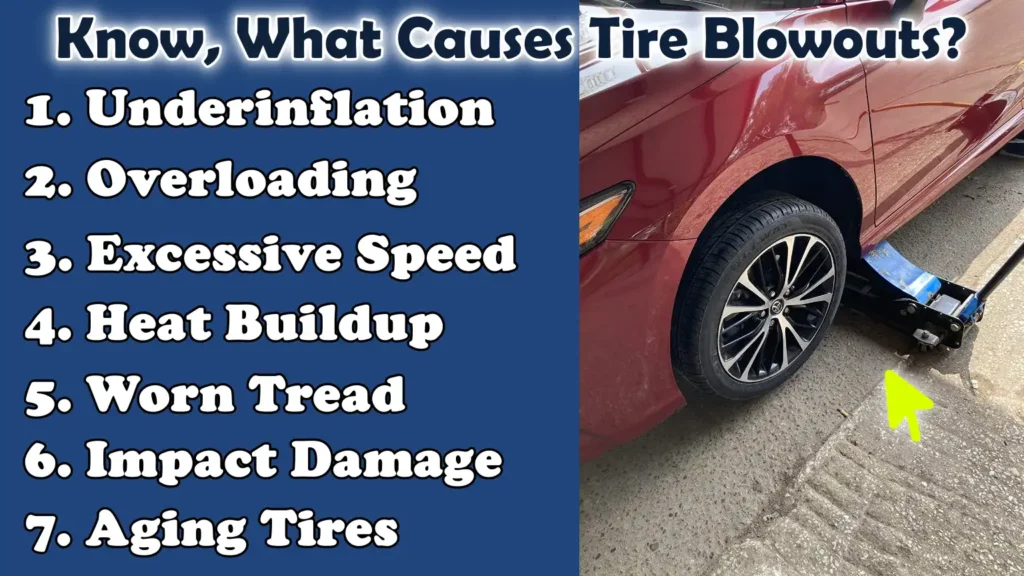
1. Underinflation
One of the most common causes of tire blowouts is driving with low tire pressure.
When a tire is underinflated, a larger section of it flexes and distorts excessively while rolling, generating significant heat within the rubber.
This heat gradually degrades the structural integrity of the tire, particularly at highway speeds, where the tire is already under constant stress.
Over time, the tire’s sidewalls become increasingly vulnerable to failure; in severe cases, the tire may blow out suddenly as it can no longer withstand the combined stress of the load and the heat.
2. Overloading
Overloading occurs when a vehicle carries a weight that exceeds the tire’s safe load-carrying capacity.
Every tire has a specific load rating (weight limit) and when this limit is exceeded, the tire flexes more than usual.
This excessive flexing increases internal pressure and heat, thereby weakening the tire’s inner layers.
Even if the tire appears intact from the outside, overloading can gradually compromise its structure, significantly increasing the risk of a blowout, specially during long journeys or while driving at high speeds.
3. Excessive Speed
Driving at high speeds places increased stress on tires, as they rotate faster and generate more heat due to friction with the road surface.
At higher speeds, tires also have less time between rotations to dissipate heat, causing the internal temperature of the rubber to rise.
This combination of speed and heat can push a compromised tire beyond its safe operating limits.
If a tire already harbors a minor defect or is underinflated, excessive speed can rapidly exacerbate that weakness, potentially leading to a sudden tire blowout.
4. Heat Buildup
Heat is one of the most significant factors behind tire blowouts.
Tires naturally heat up while driving; however, under conditions such as low air pressure, excessive load, or high speeds, temperatures can rise beyond safe limits.
Prolonged exposure to high temperatures weakens both the rubber and the internal structure of the tire.
In hot weather, this effect is further amplified as the road surface contributes additional heat to the tire, thereby increasing the risk of structural failure.
5. Worn Tread
Worn tires compromise a tire’s ability to maintain traction on the road and also diminish the overall structural integrity of the tire.
As tires wear down, the protective layer of rubber becomes thinner, increasing their susceptibility to punctures and heat-related damage.
A worn tire is unable to distribute pressure evenly across its entire surface, resulting in localized areas of weakness; when these areas are subjected to stress, the likelihood of failure increases.
This is why driving on tires with poor grip or severely worn tread significantly elevates the risk of a sudden blowout, particularly at high speeds.
6. Impact Damage
Impact damage occurs when a tire strikes a pothole, a curb, or a sharp object with significant force.
Even if the tire does not blow out immediately, its internal structure may sustain damage.
This hidden damage can include the snapping of internal cords or a weakening of the tire’s sidewall, issues that are not visible from the outside.
Over time, these weak spots deteriorate further, as the tire constantly heats up and flexes while the vehicle is in motion; eventually, the tire may burst suddenly without any prior warning.
7. Aging Tires
As time passes, tires naturally degrade, even if they have not been subjected to heavy use.
As the rubber ages, it becomes harder and less flexible, thereby diminishing its capacity to withstand pressure and heat.
Tiny cracks may also develop in the tire’s sidewalls, compromising the structural integrity of the tire.
Most safety experts recommend replacing tires after a few years, even if their treads (the tire’s surface pattern) still appear to be in good condition, because the risk of sudden tire failure increases significantly simply due to aging, even under normal driving conditions.
Read More:
So, How to Prevent Tire Blowouts
1. Check Tire Pressure Every Month
The most effective way to prevent a tire blowout is to check your tire pressure regularly, as maintaining the correct air pressure ensures the structural integrity of the tire while driving.
When tires are underinflated, they generate excessive heat and wear out more rapidly, particularly during long journeys or highway driving.
Checking the pressure at least once a month, and prior to any long trip, ensures that all four tires are evenly supporting the vehicle’s weight.
Proper inflation also improves fuel efficiency and vehicle handling, thereby reducing unnecessary stress on the tires.
2. Establish a Tire Inspection Routine
Even before obvious signs of tire damage appear, a simple inspection routine can help identify early warning signs.
Closely examining each tire, looking for cuts, bulges, or uneven wear, as it can reveal hidden issues that might otherwise go unnoticed while driving.
Minor visual changes in a tire often indicate underlying internal damage or alignment issues.
Regular inspections allow you to catch these problems in time, enabling you to repair or resolve them before a dangerous situation arises at high speeds.
3. Avoid Overloading
Every tire is designed to support a specific maximum weight; exceeding this limit places immense strain on its structural integrity.
Overloading creates excessive internal tension within the tire, generating heat and weakening its inner layers.
Even if a tire appears normal on the outside, carrying excessive weight can gradually lead to internal damage.
Keeping your vehicle within its specified weight capacity preserves the tire’s structural strength and significantly reduces the risk of a sudden blowout while traveling.
4. Rotate Your Tires Regularly
Rotating your tires ensures that all tires wear evenly over time.
As front and rear tires are subjected to varying amounts of pressure and friction, they wear down at different rates.
Regular tire rotation balances this wear pattern, preventing any single tire from wearing out significantly faster than the others.
Even tire wear improves vehicle stability and reduces the likelihood of sudden tire failure, often caused by excessive stress on a single tire, specially during long-distance or highway driving.
5. Replace Old Tires
Over time, tires naturally deteriorate, even if they haven’t been used extensively.
As the rubber ages, it becomes harder and more brittle, diminishing its ability to withstand heat and road stress.
Small cracks may develop in the tire’s sidewall and its internal structure can weaken without any visible external signs.
It is crucial to replace tires that are several years old, even if their tread depth appears adequate, as age alone can significantly increase the risk of a sudden tire blowout.
6. Inspect the Sidewalls for Any Damage
The sidewall is one of the most critical components of a tire, as it supports the vehicle’s weight and absorbs road shocks.
Any damage to the sidewall such as: cuts, bulges, or cracks, as it can quickly lead to tire failure, as this area is constantly subjected to flexing stress.
Unlike damage to the tread, sidewall damage typically cannot be safely repaired.
Regularly inspecting this area helps identify serious hazards that could result in a sudden tire blowout while driving.
7. Use TPMS Correctly
The Tire Pressure Monitoring System, or TPMS, alerts drivers when tire pressure drops too low.
However, it should not be viewed as a substitute for manual checks, as it often issues a warning only after the pressure has already dropped significantly.
It is crucial to understand TPMS alerts and take immediate action upon them; nevertheless, conducting regular manual checks alongside this ensures the highest level of safety.
When utilized correctly, TPMS serves as an early warning system, helping to prevent situations that could lead to tire failure.
Know, Common Mistakes Drivers Often Make When a Tire Blows Out
1. Braking Immediately
One of the most common and dangerous mistakes made during a tire blowout is slamming on the brakes immediately the moment the incident occurs.
This reaction is natural, as the loud bang and sudden loss of control can induce panic; however, braking hard at this juncture can actually worsen the situation.
When a tire has already failed, the vehicle becomes unbalanced and sudden braking causes the vehicle’s weight to shift rapidly forward.
This can exacerbate the vehicle’s tendency to pull toward one side, compromise its stability and, in some cases, cause the vehicle to skid rather than slow down in a controlled manner.
Safety experts consistently advise that our primary priority should be maintaining control over the vehicle, rather than bringing it to an immediate halt.
2. Jerking the Steering Wheel
Another serious error is reacting by suddenly jerking the steering wheel when the vehicle begins to pull toward the side of the blown-out tire.
A tire blowout already disrupts the balance of forces between the wheels and sudden steering inputs further amplify this instability.
This can cause the vehicle to swerve abruptly in the opposite direction or even drift into an adjacent lane.
At high highway speeds, even a minor adjustment to the steering can have a profound impact; therefore, forcefully turning the steering wheel significantly increases the risk of losing complete control over the vehicle.
Instead of reacting abruptly, making gradual and gentle corrections to the steering is a far safer approach.
3. Removing One Hand from the Steering Wheel
Some drivers, upon experiencing a tire blowout, instinctively loosen their grip or attempt to maintain control using only one hand; However, this compromises the vehicle’s stability at precisely the moment when absolute control over it is most critical.
The steering wheel may suddenly pull to one side or vibrate violently; when steering with only one hand, making the necessary corrections to maintain the vehicle’s direction becomes extremely difficult.
Using both hands helps manage sudden shifts in force and ensures more precise control over the steering.
Losing a firm grip on the steering wheel delays reaction times and increases the risk of the vehicle veering off course.
4. Changing Lanes Too Abruptly
Attempting to change lanes rapidly or head toward the road shoulder without first stabilizing the vehicle is another dangerous mistake.
A tire blowout temporarily compromises the vehicle’s traction and balance; consequently, a sudden turn to one side can destabilize the vehicle even further.
Rapid lane changes also heighten the risk of colliding with surrounding traffic, particularly if other drivers cannot anticipate that your vehicle is about to make a sudden maneuver.
The safest approach is to initially maintain your current direction, gradually reduce your speed and attempt to turn only once the vehicle feels more stable.
5. Stopping in an Unsafe Location
Stopping immediately after a tire blowout, specially if you are in an active traffic lane or on a curve, poses a significant hazard.
Other drivers may not have sufficient time to react to a stopped or slow-moving vehicle, thereby increasing the likelihood of a rear-end collision.
Extra caution is required on high-speed roadways, where the safest option is almost always to continue moving slowly until you can reach a safe shoulder or a designated emergency pull-off area.
Choosing a stopping location that is clearly visible and open significantly reduces the risk of secondary accidents.
6. Ignoring Warning Signs
In many instances, a tire provides certain warning signs before bursting such as: vibrations, pulling, strange noises, or sudden changes in vehicle handling.
Ignoring these early symptoms increases the likelihood of a sudden failure at high speeds, when there is very little time available to react.
Paying attention to changes in tire behavior, air pressure warnings, or unusual vehicle movements can sometimes give the driver an opportunity to slow down and prevent the tire from bursting completely.
Staying alert to these early warning signs is a crucial part of preventing dangerous roadside emergencies.
So, Does this Differ for SUVs, Trucks and Sedans?
1. The Risk of SUV Rollovers
In certain situations, a tire blowout in an SUV can be more dangerous because SUVs have a higher center of gravity compared to sedans.
This means the vehicle sits naturally higher and is less stable when turning suddenly to one side.
If a tire blowout causes the vehicle to pull abruptly to one side or begin swerving at highway speeds, its tall structure increases the risk of it rolling over or flipping, particularly if the driver attempts to make sudden, rapid steering corrections.
Therefore, in an SUV, it is crucial to remain calm, maintain control of the vehicle and avoid making any sudden corrective maneuvers in the event of a tire failure.
2. Changes in Pickup Truck Handling
Pickup trucks react differently to tire blowouts because their design is often optimized for hauling cargo and the structure of their rear section can impact the vehicle’s stability.
When a tire fails, specially a rear tire, the truck may feel unbalanced or pull more violently to one side, as its rear section is often loaded with heavy or shifting cargo.
Empty pickup trucks can also behave unpredictably, as the reduced weight on their rear tires results in diminished tire grip.
Consequently, compared to smaller cars, pickup trucks become more susceptible to sudden changes in speed or direction.
3. Impact on Loaded Vehicles
When SUVs or trucks are loaded with passengers or cargo, the impact of a tire blowout is significantly amplified.
The additional weight increases the stress on all the tires; if a single tire blows out, the resulting imbalance within the vehicle is felt even more acutely.
A heavily loaded vehicle also takes longer to decelerate, meaning that the duration for which the vehicle remains unstable following a tire blowout may be prolonged.
Due to the heavy weight, a greater distance may be required to bring the vehicle to a complete stop and its responsiveness may be diminished; in such situations, maintaining full control over the steering and gradually reducing speed becomes even more critical for safety.
4. The Impact of Tire Size
Larger tires, typically found on SUVs and trucks, as it can alter the experience of a tire blowout, as they carry higher air pressure and are designed to support heavier loads.
When these tires blow out, the impact of the sudden air loss and the structural failure of the tire can feel significantly more intense.
However, larger tires also possess a larger contact patch with the road surface, which can sometimes aid in maintaining a certain degree of vehicle control, provided the driver reacts appropriately.
Smaller tires, such as those fitted on sedans, may react more rapidly; however, depending on speed and road conditions, they can lose their stability very quickly.
5. Differences in Weight Distribution
How a vehicle’s weight is distributed plays a pivotal role in how different vehicles react in the event of a tire blowout.
Sedans typically feature a lower center of gravity and a more balanced weight distribution; consequently, if the driver reacts correctly, stabilizing a sedan after a tire blowout is generally easier.
Conversely, SUVs and trucks often exhibit an uneven or top-heavy weight distribution, which can exacerbate the vehicle’s instability and the severity of its swaying motion during a tire blowout.
If the vehicle’s weight is not distributed equally across all four tires, a blown tire creates even greater imbalance, making it all the more critical to correct the steering.
Understanding these differences clarifies why the experience of a tire blowout can vary depending on the type of vehicle.
Know, Some Advice from Driving Experts
In recent engineering reviews on the tire burst behavior show that driver reaction actually plays a decisive role in post-blowout safety outcomes, even though tire failure causes immediate loss of stability, also studies actually confirms that vehicles that can often remain controllable if proper corrective actions are taken, so the research about the modern stability systems and controlled steering inputs significantly reduces the accident severity, that’s why panic actually makes this blowout dangerous and that often becomes main cause of crash escalation as well.[¹]
1. Guidance on Defensive Driving
Driving experts consistently emphasize defensive driving, which they consider the foundation for safely controlling a vehicle, particularly when facing emergencies such as a tire blowout.
Defensive driving involves remaining alert to road conditions, maintaining a safe speed and being prepared for sudden changes in the vehicle’s behavior.
In the context of a tire blowout, experts stress that a driver’s ability to avoid panic and maintain steady control is far more critical than the initial mechanical failure itself.
A calm and controlled reaction minimizes the likelihood of the vehicle overcorrecting, skidding, or drifting out of its lane.
2. Highway Safety Practices
Highway safety practices become even more critical because vehicles travel at high speeds, leaving very little time to react.
Experts advise maintaining an adequate distance from the vehicle ahead, avoiding sudden lane changes and always remaining aware of potential “escape routes” such as: the road shoulder or an exit lane.
In the event of a tire blowout, these habits help create the necessary space to handle the situation effectively.
Highway safety also relies heavily on visibility and situational awareness, as high-speed traffic can turn even a minor error into a serious collision, specially when other drivers do not have sufficient time to react.
3. Preparation for Emergencies
Experts strongly advise drivers to prepare for emergencies before they occur, rather than reacting blindly once they arise.
This includes understanding how a vehicle behaves when a tire fails, knowing the location of the spare tire and tools and keeping emergency supplies such as: warning triangles or reflective gear, within easy reach.
Being prepared also entails mentally rehearsing the correct responses such as: gripping the steering wheel firmly and avoiding sudden braking.
Preparation reduces panic, as the driver already possesses a mental blueprint of the actions they need to execute.
4. Why Practice Is Essential
Practice is crucial because real-life emergencies unfold so rapidly that there is absolutely no time for slow, deliberate reasoning or for learning through “trial and error”.
When a driver has practiced reacting to emergencies, or at the very least, mentally reviewed them, their mind is better equipped to respond instinctively in stressful situations.
In the event of a tire blowout, every single second is precious; even the slightest hesitation can lead to a major error such as: slamming on the brakes suddenly or jerking the steering wheel violently.
Practicing safe responses builds “muscle memory,” making it possible to maintain better control over the vehicle even in difficult circumstances.
5. The Importance of Driver Education
Driver education plays a pivotal role in reducing accidents caused by tire blowouts and other sudden mechanical failures.
While many drivers master the basics of driving, they are often not fully trained to handle emergency situations.
Professional driving instruction teaches drivers how vehicles react under pressure, how shifts in weight affect vehicle control and how to safely regain control if traction is lost.
This knowledge helps drivers understand that panic-driven reactions are often far more dangerous than the mechanical failure itself.
Excellent training fosters better decision-making abilities, particularly in high-risk scenarios such as a tire blowout on a highway.
Conclusion – How to React During Tire Blowout
Basically, whenever tire blowout in the middle of the road, then it does not automatically means complete loss of control, as it demands the right response within the seconds.
In most cases, the vehicle does not immediately spin out of control.
Instead, it enters a brief yet critical phase where the vehicle’s stability is compromised and the driver’s decisions determine the ultimate outcome.
Research on road safety and highway driving behavior consistently demonstrates that panic-driven actions such as: slamming on the brakes or jerking the steering wheel violently, are the primary factors that transform a manageable tire blowout incident into a serious accident.
The safest outcome invariably relies on a calm and composed approach rather than panic.
Keeping both hands on the steering wheel, maintaining a straight course and gradually reducing speed allows the vehicle an opportunity to stabilize itself.
Once the vehicle’s stability is restored, steering it toward a safe location (such as the roadside) and bringing it to a controlled stop significantly mitigates the risk.
So, that’s all about this guide and you can comment for more information.
Frequently Asked Questions
FAQ 1: If a tire blows out, what should I do first?
Answer: When a tire blows out, the very first thing you should do is remain calm and maintain control of the steering wheel. Grip it firmly with both hands and try to steer the vehicle in a straight line. Do not panic or make any sudden movements, as this could cause the vehicle to pull to one side or swerve violently. In the initial few seconds, your primary objective is not to stop the vehicle immediately, but rather to keep it stable so that it slows down on its own.
FAQ 2: Should I apply the brakes immediately after a tire blows out?
Answer: No, you should not apply the brakes hard immediately after a tire blows out. Braking hard can cause the vehicle’s weight to shift suddenly to one side, making it even more difficult to control. It also increases the risk of the vehicle skidding or pulling to one side, specially if you are traveling at high speeds. Instead, you should slowly lift your foot off the accelerator and allow the vehicle to gradually lose speed. You should only apply the brakes gently once you feel that the vehicle has become more stable.
FAQ 3: How can I tell if it is a front tire or a rear tire that has blown out?
Answer: If a front tire blows out, you will typically feel a strong pull on the steering wheel toward the side where the tire has failed. The steering may feel heavy and the vehicle may veer more sharply in that direction. A rear tire blowout often presents a different experience; initially, the steering may feel normal, but the rear end of the vehicle may feel unstable, as if it is wobbling or sliding. In either case, you may hear a loud bang and feel intense vibrations.
FAQ 4: Is it safe to continue driving after a tire blows out?
Answer: It is not safe to continue driving normally after a tire blows out. However, you may need to drive at a reduced speed for a short distance to reach a safe location or a stopping point. You should only do this if the vehicle remains stable enough for you to maintain control. Driving at normal speeds can be extremely dangerous, as a blown-out tire is unable to properly support the vehicle’s weight.
FAQ 5: Why does a vehicle pull to one side when a tire blows out?
Answer: A tire blowout creates an uneven resistance among the tires. The speed of the vehicle decreases on the side where the tire has blown out, while the remaining tires continue to rotate normally. Due to this imbalance, the vehicle begins to pull toward the side with the damaged tire. At high speeds, this pull is felt even more intensely and may feel sudden; therefore, maintaining a firm grip on the steering wheel is crucial.
FAQ 6: Can a tire blowout cause a vehicle to roll over?
Answer: Yes, a tire blowout can sometimes cause a vehicle to roll over, particularly with high-profile vehicles such as SUVs or vans. This typically occurs when the driver makes a sudden steering maneuver or applies the brakes abruptly. The risk increases significantly when the vehicle is traveling at high speeds or is heavily loaded. Keeping the steering wheel straight and avoiding sudden movements significantly reduces the likelihood of a rollover.
FAQ 7: At what speed is it most dangerous to drive after a tire blowout?
Answer: Driving at high speeds after a tire blowout is extremely dangerous because the vehicle possesses greater momentum and kinetic energy. At highway speeds, even a minor error in steering or braking can lead to a rapid and complete loss of vehicle control. Therefore, it is essential to react correctly while maintaining control of the vehicle. The faster the vehicle is traveling, the more carefully and gently the driver should use the steering wheel and brakes.
References:
[1] A review of research on tire burst and vehicle stability control
https://journals.sagepub.com/doi/10.1177/00368504241272478
Hello Folks, Dean Shali here to help you out to solve the problems with your lovely vehicle, as i have lots of experience and knowledge about automotive industry as i woks directly with the customers and repair vehicles and i love to help the people to keep their cars safe and running smoothly.