
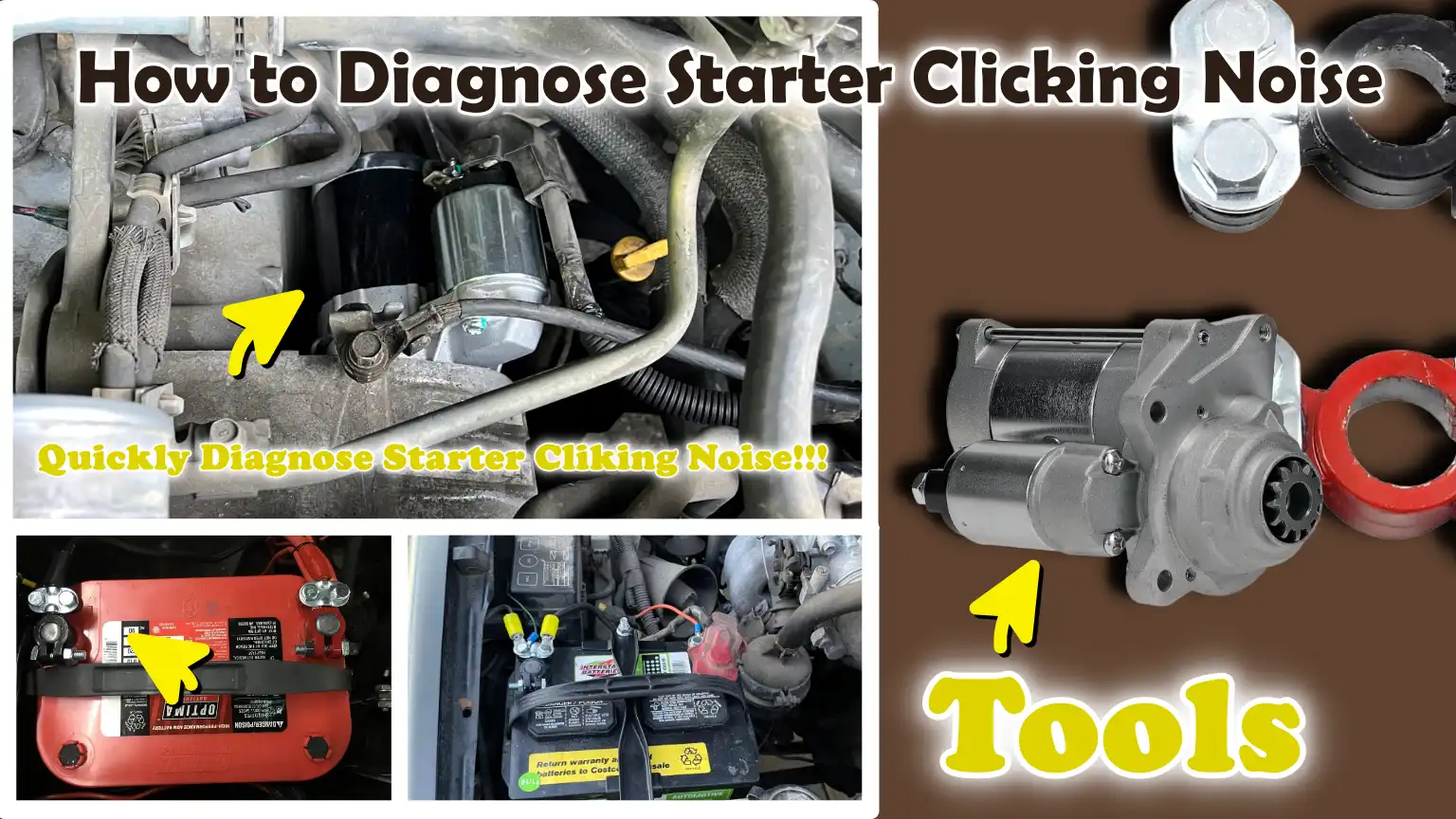
Written By: Dean Shali
Fact Checked By: Sabré Cook
Reviewed By: Tamara Warren
It is often seen that many no-start problems begins with as simple as “CLICKING NOISE” that drivers hears days or even weeks before complete starter failure.
Basically, whenever you turn that damn key or press the start button, then it is the battery that actually sends the electrical power to the starter solenoid: which then activates the starter motor to crank the engine.
But, the thing is: if there’s not enough voltage, poor cable contact or internal wear inside the starter, then the system may only produce a annoying click instead of turning the engine on.
Most of the time, this thing happens because of the batteries actually lose their strength over the period of time, specially after 3 to 5 years of use and even corrosion at the battery terminals can increase the resistance enough to block the proper current flow even when lights still work normally.
So, in this guide you’ll learn How to Diagnose Starter Clicking Noise: in which you’ll diagnose starter clicking by checking the battery voltage under the load, then it is the cable condition that needs to be checked, then there’s starter relay response and solenoid engagement as well, as those clicking sound can come through all of those things and that’s why diagnosis is important as it tells you about the really thing which is actually failing.
Understand, What Does a Clicking Starter Sound Like?
The sound of a clicking starter is the noise a vehicle makes when you attempt to start its engine, but it fails to crank as expected.
Instead of the engine turning over, you may hear a single distinct “click,” or in some cases, a rapid succession of clicking sounds.
This typically indicates that the starter system is receiving the signal to engage, but something is preventing the engine from starting.
This sound often points to an issue with the battery power, the wiring, or the starter motor itself.
It serves as a crucial warning sign, as many problems related to engine starting initially manifest through this specific symptom.
1. Definition of a Clicking Starter During Ignition
The phenomenon of a clicking starter during ignition occurs when the starter system responds to the turning of the key or the pressing of the “start” button, but the engine fails to begin cranking.
This clicking sound typically originates from the activation of the starter solenoid or relay.
Under normal operating conditions, this process occurs silently, or at least too faintly to be heard, just moments before the engine begins to crank.
However, when a malfunction occurs, the clicking sound becomes clearly audible because the starting sequence halts precisely at this stage.
This indicates that, although the system is attempting to function, it is unable to complete the full process required to start the engine.
2. What Is the Difference Between a Normal Starter Engagement and an Abnormal Clicking Sound?
A normal starter engagement means that the engine begins to crank immediately upon turning the key.
In such a scenario, you might not hear a distinct “click” sound from inside the cabin, as the loud noise of the engine cranking often drowns out that specific click.
Conversely, the phenomenon of an unusual clicking sound typically occurs when the engine remains motionless and only the “click” itself is audible.
A single click may indicate that the starter solenoid is failing to engage fully.
A rapid, continuous clicking sound often signals that the battery has become too weak to provide the necessary power to crank the engine.
3. Why Does This Sound Occur When Turning the Key or Pressing the “Start” Button?
This sound occurs because, when you attempt to start the vehicle, electrical power is transmitted from the battery to the starter system.
The starter relay and solenoid receive a signal and attempt to activate the starter motor.
If the battery is weak or the electrical connections are compromised, the starter motor will be unable to crank the engine.
Essentially, the “click” is the audible result of the solenoid attempting, but failing, to engage.
As starting the vehicle requires the highest surge of electrical power, even a slightly weak battery can trigger this issue.
4. Systems Involved in Starter Operation
The starter system comprises several components that work in unison to start the engine.
The battery supplies electrical power; the ignition switch sends the “start” signal; and the relay transmits that signal to the starter solenoid.
The solenoid then connects the battery’s power directly to the starter motor, thereby cranking the engine.
The ground cable and its associated wiring complete this electrical circuit.
If any of these components fail, the starter may simply emit a “click” sound instead of cranking the engine.
5. A Basic Introduction to the Starter Relay, Solenoid, Battery and Starter Motor
The battery stores the electrical energy required to start the vehicle.
The starter relay is a small switch that sends the command to the solenoid to “start”.
The solenoid is a more robust switch that directly connects the battery’s power to the starter motor.
Subsequently, the starter motor cranks the engine, thereby allowing it to start.
If any of these components fail or lose power, the engine will not start and you will hear nothing other than a “click”.
Know, Common Types of Clicking Sounds from the Starter
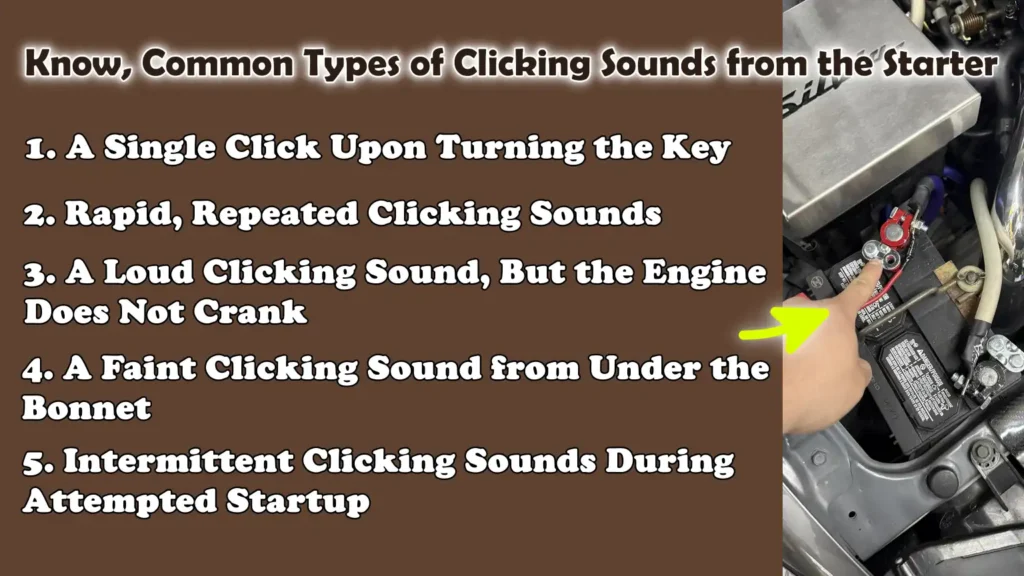
The clicking sounds emanating from a starter depend on which specific component of the starting system is malfunctioning.
The exact nature of the sound often provides useful clues, as different faults produce distinct clicking patterns.
A weak battery, poor cable connections, a faulty starter solenoid, or a failing starter motor, all of these can generate clicking sounds, but they may differ in their speed, intensity and consistency.
Carefully listening to the type of clicking sound is one of the initial steps a mechanic takes to diagnose a “no-start” condition (failure of the engine to start).
The location of the sound, as well as whether or not the engine is attempting to crank (turn over), as it can also aid in identifying the root cause of the problem.
1. A Single Click Upon Turning the Key
A single click typically indicates that the starter solenoid is receiving power, but the starter motor is failing to turn over the engine.
This often occurs when the battery holds sufficient charge to activate the solenoid, but lacks the necessary amperage (current) to spin the starter motor.
It can also happen if there is internal wear within the starter motor or if its electrical connections are loose.
In many cases, the dashboard lights remain illuminated, yet the engine remains completely silent.
A single click should not be ignored, as the underlying issue often worsens significantly until the component fails completely.
2. Rapid, Repeated Clicking Sounds
A rapid, repeated clicking sound is one of the most common symptoms of a weak battery.
This sound occurs when the battery voltage drops too low while attempting to start the engine.
The starter solenoid rapidly cycles on and off because it is unable to receive sufficient power to remain continuously engaged.
This produces a rapid clicking sound, which may persist as long as the ignition key is held in the “start” position.
This phenomenon frequently occurs in cold weather, or when the battery is old, discharged, or has poor terminal connections.
3. A Loud Clicking Sound, But the Engine Does Not Crank
A loud clicking sound, accompanied by a failure of the engine to crank, typically indicates a problem with the starter solenoid or the starter motor itself.
This sound suggests that the solenoid is attempting to supply power to the motor, but the motor is failing to respond.
This can happen if the starter motor’s brushes are worn out, its internal components are damaged, or it has become mechanically jammed.
In some instances, the engine may eventually start after several attempts; this often implies that the starter is beginning to fail.
This type of clicking sound usually originates from the lower section of the engine bay, where the starter is mounted.
4. A Faint Clicking Sound from Under the Bonnet
A faint clicking sound coming from under the bonnet often indicates that the starter relay is activating, but a strong electrical signal is failing to reach the starter motor.
This can be caused by loose wiring, corrosion on the battery terminals, a poor ground connection, or a faulty relay.
Pinpointing the source of this clicking sound can be somewhat challenging, as it may emanate from the area where the fuse box is located.
Although this sound may seem insignificant, it can nevertheless prevent the engine from starting.
Electrical testing is typically required to accurately identify the specific location of the fault within the electrical circuit.
5. Intermittent Clicking Sounds During Attempted Startup
An intermittent clicking sound implies that the noise occurs only occasionally, while at other times, the vehicle starts up normally.
This often points to loose electrical connections, worn battery terminals, or a starter motor that functions only sporadically.
Factors such as heat, vibration and weather fluctuations can sometimes trigger this issue, while at other times, it may resolve itself.
Many drivers recognize this problem just as the vehicle is approaching the point where it will no longer start at all.
An intermittent clicking sound serves as a crucial warning signal, as it often indicates an incipient malfunction that can be repaired before the vehicle leaves you stranded on the road.
Know, The Common Causes of a ‘Clicking’ Sound from the Starter
A ‘clicking’ sound from the starter typically indicates that the starting system is receiving the command to engage, but a specific component is preventing the engine from starting.
This can be caused by insufficient electrical power, poor connections, faulty components, or a mechanical obstruction within the engine itself.
In many vehicles, the most common culprit is low battery power; however, various other components can also produce this same symptom.
The ‘clicking’ sound itself is merely a symptom; therefore, it is essential to inspect the entire starting circuit to identify the root cause.
Understanding these common causes helps prevent the unnecessary replacement of components that are not actually defective.
1. Weak or Discharged Car Battery
A weak or discharged battery is the most common cause of a ‘clicking’ sound from the starter.
While the battery may possess sufficient power to operate headlights or the radio, starting the engine requires a significantly more intense surge of electricity.
Most engines demand a massive burst of electrical energy simultaneously and an aging battery may fail to deliver the necessary output during the starting process.
This often manifests as a rapid, repetitive ‘clicking’ sound, as the starter solenoid repeatedly attempts to engage and disengage.
Batteries typically degrade over time due to temperature fluctuations and frequent short trips, which prevent them from fully recharging.
2. Corrosion on Battery Terminals
Corrosion on the battery terminals can impede the flow of electricity, even if the battery itself is fully charged.
The accumulation of white, green, or blue deposits on the terminals increases electrical resistance, thereby reducing the amount of power reaching the starter.
Consequently, while the starter may emit a “click” sound, it fails to receive the sufficient power required to crank the engine.
Corrosion is a common occurrence in older batteries and in vehicles exposed to moisture.
Cleaning the terminals often restores a proper connection, thereby providing an immediate solution to this issue.
3. Loose Battery Cable Connections
Loose battery cables can disrupt the strong electrical current flow necessary to start the engine.
If a cable is not securely tightened, the flow of electricity can be severely restricted, or even completely interrupted, precisely at the moment the starter requires power.
This often manifests as an audible “click” or a series of intermittent clicking sounds.
This issue can occur at the battery terminals, or at the points where the cables connect to the starter and the ground point.
Even the slightest looseness can generate enough resistance to prevent the engine from starting.
4. Faulty Starter Solenoid
The starter solenoid acts as a heavy-duty switch that connects the battery’s power to the starter motor.
If it malfunctions, it may produce a “click” sound but fail to deliver the necessary power to the motor.
Over time, due to repeated use and exposure to heat, the internal contacts within the solenoid can wear out.
This often presents as a sharp, distinct “click,” yet the engine fails to turn over.
A faulty solenoid may operate intermittently, making it difficult to diagnose the underlying problem.
5. Faulty Starter Motor
A defective starter motor may emit a “click” sound even when receiving power, but fails to rotate internally.
This can be caused by worn-out brushes, defective armature components, or internal electrical faults.
The starter motor is subjected to significant stress and gradually wears down over time.
In many cases, lightly tapping the starter motor causes it to function again for a short while; this often confirms that the motor has worn out internally.
If the motor is failing, it typically requires replacement.
6. Faulty Ignition Switch
The ignition switch sends the initial signal that activates the starter system.
If it becomes worn or develops an internal electrical fault, it may fail to consistently transmit a strong signal.
This can lead to issues such as a “clicking” sound, delayed starting, or a complete lack of response.
Problems with the ignition switch are less common than battery-related issues, but their symptoms can be quite similar.
As the switch ages, these problems often become more severe.
7. Faulty Starter Relay
The starter relay controls the flow of electricity to the starter solenoid.
If the relay fails, it may still produce a “clicking” sound but fails to deliver the necessary power to fully engage the starter.
A relay can fail due to worn internal contacts or exposure to heat or moisture.
Sometimes, swapping the relay located in the fuse box with another relay of the same type can help diagnose the source of the problem.
A failing relay may cause intermittent starting issues before failing completely.
8. Faulty Engine Ground Connection
The engine ground cable completes the electrical circuit between the battery and the engine.
If this connection is loose, corroded, or damaged, current cannot flow properly.
Due to the incomplete circuit, the starter may produce nothing more than a ‘click’ sound.
Ground-related issues are often overlooked because the battery itself may appear to be in good condition.
Inspecting the ground cable is crucial, as even a healthy battery cannot start the engine without a proper return path.
9. Wiring Issues in the Starting Circuit
Faulty wiring can prevent power from reaching the starter system.
Over time, due to aging and vibration, wires can become frayed, broken, burnt, or loose.
Defective wiring can lead to a voltage drop, meaning the starter receives less power than required.
This often manifests as an intermittent ‘click’ sound or the engine failing to start altogether.
Diagnosing wiring issues can be challenging, as the fault may be hidden within the insulation or connectors.
10. Excessive Load on the Starter Due to a Seized Engine
In rare instances, the engine itself may seize up and become unable to rotate.
When this occurs, the starter attempts to crank but fails to turn the engine over; this results in a ‘click’ sound or places an extremely heavy electrical load on the starter.
This issue may stem from internal engine component failure, low oil levels, or a mechanical malfunction.
Although the battery and starter may appear to be in good working order, the engine itself could be seized.
If the crankshaft cannot be turned manually, the problem is far more likely to be mechanical rather than electrical.
Tools
| Tools | Why It Is Needed | How to Use It During Starter Click Diagnosis |
|---|---|---|
| Digital Multimeter | This is one of the most essential tools, as the “click” sound often heard from the starter is frequently caused by low battery voltage or poor electrical flow. A multimeter helps diagnose the condition of the battery and the charging voltage and also verifies whether power is actually reaching the starter circuit. | Set the device to measure DC voltage. Touch the red probe to the positive battery terminal and the black probe to the negative terminal. Check the voltage at two points: before attempting to start the vehicle and while someone is turning the ignition key. A healthy battery typically registers around 12.6 volts when the engine is off. A significant drop in voltage during cranking often indicates a problem with the battery or its connections. |
| Battery Terminal Cleaner | Corrosion on the battery terminals can impede electrical flow and cause the starter to emit a “click” sound, even if the battery is fully charged. Cleaning the terminals restores proper electrical contact. | Disconnect the battery, then use a cleaner to remove any white or green corrosion from both the battery posts and the cable ends. Continue cleaning until the bare metal underneath becomes visible. Reconnect the cables securely and test the starter again. |
| Wrench Set | During the starter diagnostic process, it is often necessary to tighten the battery cables, starter wiring and ground connections. Loose connections are a common cause of the “click” sound. | Use the correct size socket or wrench to tighten the battery clamps, starter mounting bolts and ground cable bolts. Ensure that the connections are firm, but be careful not to overtighten the battery terminals. |
| Test Light | A test light immediately indicates whether or not power is reaching the starter relay, solenoid, or ignition circuit. It is a very useful tool for quickly diagnosing electrical circuits. | Connect the clip to a good metal ground point. While turning the ignition, touch the probe to the wire you are testing. If the light illuminates, it means that power is reaching that specific location. If it does not light up, there may be an issue with the wiring or the switch. |
| Safety Gloves | Checking the starter often involves handling battery terminals, sharp metal edges and hot engine components. Gloves protect your hands from injury and corrosion. | Be sure to wear gloves before handling battery connections, cables, or starter components. This is particularly beneficial when working around corroded terminals or underneath the vehicle. |
| Owner’s Manual | The locations of the starter relay, fuses and battery components vary from one vehicle to another. The owner’s manual helps you identify the correct components and the layout of the fuse box. | Before beginning your inspection, consult the manual to locate the starter relay, fuse diagrams, battery information and necessary safety precautions. |
| Jumper Cables | Jump-starting helps confirm whether a “clicking” sound is being caused by a weak battery. If the engine starts after jump-starting, there is a strong likelihood that the problem lies with the battery or the charging system itself. | Connect the jumper cables, in the correct sequence, to a functioning battery and to your vehicle’s battery. Attempt to start the vehicle. If the starter operates correctly after jump-starting, it is highly probable that the battery is low on power. |
| Flashlight | Many starter components are located in the lower section of the engine bay, making them difficult to see. By using a flashlight, you can clearly inspect the cables, terminals and wiring for any signs of damage. | Using a flashlight, check the starter mounting, battery cable, ground strap, corrosion and loose wiring, particularly in the dark areas near the engine block. |
Easily, Ensure Safety Before Diagnosis
Before diagnosing a clicking sound coming from the starter, safety is paramount, as the starter system involves high electrical currents and moving engine components.
A minor error while inspecting the battery or starter could pose a risk of sparks, burns, or the vehicle moving unexpectedly.
As diagnosing the starter often requires turning the ignition key while inspecting components, it is crucial to ensure that the vehicle is stable and secure before beginning.
Taking a few simple precautions helps prevent injury and ensures a more accurate diagnosis.
1. Park on Level Ground
Always park the vehicle on level ground before inspecting the starter system.
This eliminates the risk of the vehicle rolling unexpectedly during the inspection.
Parking on sloped roads or uneven terrain increases the risk of the vehicle moving, specially if the transmission is not fully engaged.
A level surface also makes it easier to inspect under the hood and safely access the battery connections.
2. Engage the Parking Brake
Fully engage the parking brake before beginning any diagnostic work.
This prevents the vehicle from moving should the starter suddenly activate or if the transmission is not properly secured.
This is particularly important for manual-transmission vehicles, as the vehicle may lurch forward or backward unexpectedly during start-up tests.
The parking brake provides an extra layer of safety during tests that require repeatedly turning the ignition key.
3. Turn Off Accessories
Before conducting the inspection, turn off the headlights, air conditioning, radio and all other electrically powered accessories.
These devices draw power from the battery and can affect voltage readings during testing.
As starter issues are often linked to low battery voltage, minimizing additional electrical load yields more accurate diagnostic results.
This also prevents unnecessary battery drain during repeated attempts to start the vehicle.
4. Wear Safety Gloves
Safety gloves help protect against injury while working around battery terminals and engine components.
Corrosion on the battery can cause skin irritation and sharp metal edges under the hood can cause cuts.
Wearing gloves also improves your grip when handling cables or tools.
They are particularly useful when inspecting the starter, specially when working in tight spaces where your hands may come into contact with rough surfaces.
5. Keep Hands Away from Moving Parts
When someone is turning the ignition key, keep your hands, tools and loose clothing clear of belts, pulleys and fans.
If the engine suddenly starts, these moving parts can begin rotating instantly.
This can result in serious injury within a matter of seconds.
Whenever the starter is engaged, always maintain a safe distance from the engine’s moving parts.
6. Avoid Short Circuits at Battery Terminals
Never allow metal tools to simultaneously touch both battery terminals.
Doing so can directly cause a short circuit, potentially resulting in sparks, battery damage, or a risk of burns.
Even a standard 12-volt car battery can instantly discharge a massive amount of current.
Always handle tools with caution and if you are removing battery cables, disconnect the negative terminal first.
7. Ensure the Vehicle is in ‘Park’ or ‘Neutral’
Before initiating any testing, ensure that a vehicle with an automatic transmission is in ‘Park’ and a vehicle with a manual transmission is in ‘Neutral.’
This prevents the vehicle from moving should the starter suddenly engage the engine.
Many diagnostic tests for the starter require turning the ignition key multiple times; therefore, you should verify the transmission’s position each time.
This simple step helps prevent accidents and makes the testing process significantly safer.
How to Diagnose Starter Clicking Noise – Working Methods
1. Listen to the Type of Clicking Sound
The first step in diagnosing a clicking sound originating from the starter is to carefully listen to the noise produced when you attempt to start the vehicle.
The nature of the clicking sound often indicates whether the problem lies with the battery, the starter solenoid, the wiring, or the starter motor itself.
Mechanics typically begin their investigation here, as the audio pattern provides initial clues even before any tools are utilized.
Paying attention to the frequency of the clicking, the specific location from which the sound emanates and the behavior of the dashboard lights can help you quickly pinpoint the root cause of the issue.
This simple preliminary check can save time and prevent the unnecessary replacement of components that are still functioning correctly.
Distinguish Between a Single Click and Rapid, Continuous Clicking
Listen carefully while turning the ignition key or pressing the start button.
A single click typically indicates that the starter solenoid is engaging, but the starter motor is failing to spin.
This scenario may occur if the starter unit itself is failing, or if the battery lacks sufficient power to handle the electrical load required to crank the engine.
Conversely, a rapid, continuous clicking sound often signifies that the battery voltage has dropped too low to sustain the operation of the starter motor.
Consequently, the solenoid repeatedly cycles on and off, producing the rapid clicking noise.
This specific clicking pattern is the easiest way to determine where to begin your diagnostic process.
Identify the Source of the Sound
Attempt to pinpoint the specific location from which the clicking sound is originating.
Clicking sounds originating from the vicinity of the engine, or from under the hood, often point to an issue with the starter solenoid or the starter motor itself.
Conversely, clicking sounds coming from the area of the fuse box may indicate that the starter relay is engaging.
In some vehicles, if the relay is mounted near the cabin, the clicking sound may appear to be coming from inside the dashboard.
Knowing the location of the components helps in identifying exactly which part is generating the noise, thereby avoiding unnecessary troubleshooting.
Check if the Engine is Cranking
Pay close attention to whether or not the engine is actually cranking while the clicking sound is occurring.
If the engine is cranking slowly, the battery may still retain some residual power, even if it is insufficient to fully start the vehicle.
If the engine does not crank at all, the cause could be a completely discharged battery, a faulty starter motor, or a poor electrical connection.
Even the slightest movement of the engine can provide helpful clues for diagnosing the problem.
Understanding this distinction is crucial, as the underlying causes for an engine failing to crank at all versus cranking slowly are typically different.
Observe the Dashboard Lights
Keep an eye on the dashboard lights while attempting to start the vehicle.
If the lights dim significantly or go out completely, it may indicate a weak battery or a poor cable connection.
Conversely, if you hear only a ‘click’ from the starter but the lights remain bright, it suggests that the battery likely retains sufficient charge and the issue may lie with the starter motor or the relay.
The flickering of lights can also be an indication of voltage fluctuations.
The condition of the dashboard lights helps determine whether the electrical system is experiencing a power shortage when starting the vehicle.
2. Check the Battery Voltage
Checking the battery voltage is one of the most crucial steps in diagnosing the issue of a ‘clicking’ sound coming from the starter, as the battery serves as the primary power source for the entire starting system.
A ‘clicking’ sound from the starter can occur even when the lights, radio and dashboard appear to be functioning correctly, because starting the engine requires significantly more electrical power than most other systems in the vehicle.
Often, the cause of a ‘clicking’ starter is a battery that looks normal on the surface but fails to deliver the necessary power when placed under load.
Measuring the voltage helps confirm whether the battery is in good condition or if the starting issue originates there.
Measure the Battery’s ‘Resting Voltage’
To begin, check the battery voltage with the engine turned off and the vehicle left stationary for at least a few minutes.
Use a digital multimeter; place the red probe on the battery’s positive terminal and the black probe on the negative terminal.
This reveals the battery’s ‘resting voltage,’ which helps provide an estimate of its charge level.
A healthy, fully charged battery typically has a voltage of approximately 12.6 volts.
If the reading falls below this level, the battery may lack the necessary power to properly start the engine.
Compare the Reading to the Normal Range
Once you have taken the measurement, compare the reading against the battery’s standard voltage range.
A reading of approximately 12.6 volts generally indicates that the battery is fully charged.
A reading of around 12.4 volts often suggests that the battery is half-charged, while a reading of 12.2 volts or lower may indicate that the battery is weak.
A reading hovering around 12.0 volts often signifies that the battery’s charge has dropped significantly low.
Even a slight drop in voltage matters, as the starter motor requires a significant amount of electrical power; low voltage can cause the starter to emit a ‘clicking’ sound while failing to actually turn over the engine.
Recognize the Symptoms of a Weak Battery
A drop in battery voltage is often accompanied by other specific symptoms.
The engine may crank slowly, dashboard lights may dim when the ignition key is turned, or the starter may emit a rapid, continuous ‘clicking’ sound.
These symptoms become more pronounced in cold weather, as low temperatures slightly reduce the battery’s cranking power.
Batteries can also weaken over time, particularly after three to five years of use.
These symptoms help confirm whether the clicking sound coming from the starter is, in fact, due to low battery power.
Check the State of Charge
To assess the battery’s condition, observe whether its voltage remains stable or if it experiences a sudden and significant drop when the engine is started.
Ask another person to turn the ignition key while a multimeter is connected to the battery.
If the voltage drops below 9.6 volts while the engine is cranking, the battery may be weak, even if its resting voltage appears normal.
This test is crucial because some batteries display a normal voltage while at rest but fail to perform when a high power output is required.
Checking the state of charge helps distinguish between battery-related issues and faults within the starter motor or the vehicle’s wiring system.
3. Check the Battery Terminals
When the starter emits a ‘click’ sound but the engine fails to start, the battery terminals are among the very first physical components that should be inspected.
If the connections at the terminals are loose, even a perfectly good battery may fail to start the vehicle.
The starter motor requires a substantial amount of current and if the terminals do not make proper contact, that power cannot reach the starter.
In many cases, the symptoms of a minor terminal issue are identical to those caused by a faulty battery or a defective starter.
By carefully inspecting the terminals, the root cause of the problem can often be identified before resorting to the replacement of expensive components.
Check for Corrosion Buildup
Inspect both battery terminals for signs of corrosion; this typically appears as a white, blue, or green powdery substance accumulated around the metal connections.
This buildup forms when battery acid fumes react with the metal, creating electrical resistance that impedes the flow of electricity.
Corrosion obstructs the electrical current and can prevent the necessary power from reaching the starter.
Even a small amount can impact the starting process, as the starter requires significantly more power than the vehicle’s lights or electronics.
Corroded terminals are often the common culprit behind a scenario where the starter clicks rapidly, yet the vehicle fails to start.
Check the Tightness of the Terminals
The battery terminals must fit firmly and securely onto the battery posts, without any movement or play.
If a terminal is loose, the electrical connection may be compromised; consequently, when the starter suddenly draws a surge of current, the connection may fail.
The result often manifests as a distinct “click” sound, as the starter solenoid receives some power, enough to engage, but not enough to actually turn over the engine.
Gently wiggle the cables by hand.
If any cable moves or rotates, it needs to be tightened.
Loose terminals can also cause intermittent starting issues; sometimes the vehicle starts easily, while at other times you hear nothing but a “click”.
Check for Cable Defects
Closely inspect the battery cables for cracks, broken strands, melted insulation, or signs of wear.
A defective cable may provide sufficient power for minor system functions, but it can fail under the heavy load required to start the engine.
Pay particular attention to the cable terminals, where the internal wires often corrode.
In some vehicles, the outer casing of the cable may appear intact, yet the wires inside could be compromised.
This hidden defect can lead to a voltage drop, causing the starter to repeatedly make a “clicking” sound.
Clean Connections as Needed
If corrosion or dirt is present, clean the battery posts and cable terminals before proceeding with further diagnostics.
Disconnect the negative terminal first, followed by the positive terminal.
Use a battery terminal cleaner or a wire brush until the metal surfaces are clean and shiny.
Reconnect the terminals and tighten them securely, starting with the positive side.
Clean connections facilitate better current flow; if poor contact was the root cause of the issue, cleaning the connections may resolve the “clicking” problem immediately.
4. Test the Battery Under Load
When the engine is off, the battery may display a normal voltage reading; however, when you attempt to start the vehicle, it may fail to crank.
This occurs because the resting voltage merely indicates the stored charge, whereas load testing reveals whether the battery can actually deliver sufficient power under actual starting conditions.
The starter motor requires a substantial amount of current, often several hundred amperes, even if only for a brief duration.
A weak battery may be capable of powering the lights and electronics, but it will fail when the starter demands full power.
Testing the battery under load is one of the most reliable methods to confirm whether the clicking sound is, in fact, originating from the battery itself.
Have someone else turn the key while you measure the voltage
With the engine off, connect a digital multimeter to the battery terminals.
Place the red probe on the positive terminal and the black probe on the negative terminal.
Ask a second person to turn the ignition key to the “Start” position while you monitor the voltage reading.
This reveals how the battery performs under the actual demands of starting the vehicle.
It is the most effective method for identifying a battery that appears to hold a charge but is unable to handle the load.
Observe the voltage drop
Note how much the voltage drops when the key is turned.
A slight drop is normal, as the starter motor draws a significant amount of current.
However, if the voltage drops sharply the moment the starter clicks, the battery may be weak.
A sudden, substantial drop often indicates that the battery is unable to sustain sufficient power to keep the starter motor engaged.
This is a common cause of rapid, repetitive clicking sounds.
Identify a Weak Battery
A weak battery will often exhibit specific symptoms during this test, even if it appears to be in normal condition while at rest.
The engine may fail to start, the starter may merely click and the dashboard lights may appear quite dim.
As a battery ages, its cranking power diminishes, particularly after several years of use or in cold weather.
If the voltage drops excessively during the starting process, the battery may no longer be capable of starting the vehicle normally.
This confirms that the battery is a probable cause of the issue.
Compare with Normal Load Values
In most passenger vehicles, a healthy battery typically maintains a voltage of over 9.6 volts during cranking.
If the reading drops below this threshold while attempting to start the vehicle, the battery may be discharged or defective.
Although these values may vary slightly depending on the specific vehicle and ambient temperature, a significant drop in voltage is generally a warning sign.
Comparing the readings against normal load values helps distinguish between a battery-related problem and issues involving a faulty starter, relay, or wiring.
5. Check the Starter Relay
The starter relay is a small yet critical component of the starting system, as it controls the electrical signal that activates the starter solenoid.
When you turn the key or press the start button, the relay closes an internal switch and sends power to the starter.
If the relay malfunctions, the starter may emit a distinct “click,” make a faint sound, or fail to operate at all.
As relay issues can mimic the symptoms of a faulty battery or starter, checking the relay is a crucial step before replacing larger components.
In many vehicles, a defective relay can cause intermittent starting difficulties, a problem that often becomes progressively worse over time.
Locate the Relay in the Fuse Box
The starter relay is typically located in the fuse box situated under the hood; however, in some vehicles, it may be found within the interior fuse panel.
Its exact location depends on the specific vehicle model, making it essential to consult the owner’s manual or the fuse box diagram.
Relays are generally small, square components grouped together with other electrical relays.
Identifying the correct relay ensures that you do not waste time troubleshooting the wrong circuit.
Once you have located the relay, you can proceed to check whether it is functioning correctly when the vehicle is started.
Listen for the Relay’s “Click”
Ask someone to turn the ignition key while you gently rest your finger on the starter relay.
A properly functioning relay will typically emit a faint “click” sound when it receives the signal to start the vehicle.
Feeling or hearing this “click” indicates that the ignition switch is, at the very least, successfully sending a signal to the relay.
If no “click” sound is heard, the problem may lie with the ignition switch itself, a fuse, or the wiring leading to the relay.
If you do hear the “click,” but the starter fails to engage, the relay itself may be internally defective.
Swap with a Matching Relay
An easy way to diagnose the issue is to swap the starter relay with another identical relay located within the same fuse box, provided, of course, that such a matching relay is available.
Many vehicles utilize identical relays for systems such as the horn or air conditioning.
By using a matching relay, you can quickly pinpoint the source of the problem without the need for any specialized tools.
If the engine starts after swapping the relay, there is a very high probability that the original starter relay was indeed faulty.
This method works because relay failures are often caused by issues with their internal contacts, defects that are not visible upon external inspection.
Verify Operation
After testing or replacing the relay, re-test the vehicle by turning the ignition key.
Pay close attention to any changes in the clicking sound and observe whether the engine cranks normally.
If the starter begins to function, it is highly likely that the relay was the source of the problem.
If there is no change in the vehicle’s behavior, the issue may lie with the starter solenoid, the battery cables, or the starter motor itself.
Verifying the relay’s operation helps narrow down the problem to the control side of the starting circuit before proceeding with more in-depth diagnostics.
6. Check the Starter Solenoid
The starter solenoid is the component that connects battery power to the starter motor and pushes the starter gear into the engine’s flywheel.
It functions like a heavy-duty electrical switch and is often mounted directly onto the starter motor itself.
When it fails, you may hear a distinct “click” sound, but the engine will not start.
This is a common reason for a clicking sound coming from the starter, as the solenoid receives the signal to activate but fails to deliver sufficient current to the motor.
Checking the solenoid helps determine whether the problem lies within the starter assembly itself or elsewhere in the starting circuit.
Listen Carefully Near the Starter Assembly
The starter is typically located near the lower section of the engine, where it connects to the transmission bell housing.
Ask someone to turn the ignition key while you listen closely near the starter assembly.
If you hear a distinct “click” sound coming from that area, it often indicates that the solenoid is engaging.
If the clicking sound is coming directly from the starter itself, yet the engine still fails to crank, it suggests that the solenoid is likely functioning, but the motor is unable to spin.
Identifying the source of the sound helps determine whether the issue lies within the starter unit or with the relay or battery.
Check the Power Feed
The starter solenoid receives its power directly from the battery, delivered via a thick cable connected to the battery’s positive terminal.
Inspect this cable for any signs of looseness, corrosion, or damage.
If this cable fails to make proper contact, you may still hear a clicking sound from the solenoid, but the starter motor will not receive sufficient power to operate.
Ensure that the cable connection to the solenoid is securely tightened and free of corrosion.
A weak power feed is a common cause of the “single-click, no-start” issue.
Check the Signal Wire
The solenoid also features a small signal wire that carries the start command from the ignition system.
When the key is turned to the “Start” position, power should flow through this wire.
Using a test light or a multimeter, you can verify whether voltage is reaching this wire during the starting process.
If no signal is detected, the issue may lie with the ignition switch, the starter relay, or the wiring.
If a signal is present, yet the starter still only produces a clicking sound, the solenoid itself may be faulty.
Confirm Solenoid Activation
To ensure that the solenoid is activating, check whether a distinct clicking sound is audible each time the key is turned.
A sharp click often indicates that the internal plunger is moving.
If the clicking sound is faint, delayed, or entirely absent, the solenoid’s internal contacts may be worn out, or there may be a mechanical obstruction.
In some instances, the solenoid activates, but its internal contacts fail to transmit full power to the starter motor.
Confirming activation helps determine whether the solenoid is functioning correctly or if it requires replacement.
7. Check Ground Connections
Ground connections are a critical component of the starting system, as they complete the electrical path returning to the battery.
Many drivers focus solely on the battery’s positive cable; however, without a robust ground connection, the starter cannot function correctly.
If the ground path is weak, corroded, or loose, the starter may emit a ‘click’ sound but will fail to crank the engine.
This occurs because electrical current is unable to flow fully through the circuit.
Ground-related issues are common and often overlooked, particularly in older vehicles, where corrosion and deterioration can compromise connection points.
Check the Engine Ground Cable
The engine ground cable connects the engine block to the battery’s negative terminal or the vehicle’s chassis.
This cable serves to return the starter current back to the battery after it has passed through the starter motor.
If this cable is loose, broken, or corroded, the starter will not receive the necessary current, even if the battery is fully charged.
Inspect the cable for corrosion, broken strands, or damaged insulation.
A faulty engine ground can manifest symptoms that closely mimic those of a weak battery or a defective starter.
Check Chassis Grounds
Chassis grounds connect the negative side of the battery to the vehicle’s body.
These grounds support the electrical system and help complete circuits between various components.
If these connection points become compromised due to corrosion or looseness, electrical resistance increases.
This can reduce the current reaching the starting system and lead to symptoms such as clicking sounds.
Inspect the grounding points where cables attach to metal surfaces; look for signs of corrosion, dirt, or loose bolts.
Tighten Loose Ground Connections
When attempting to start the engine, a loose ground connection can interrupt the starter current.
Even a slightly loose bolt can create enough resistance to prevent the starter from functioning properly.
Inspect all visible ground cables and tighten them securely.
Pay particular attention to both the battery’s negative connection and the engine grounding strap.
Tightening loose ground connections often instantly resolves the issue of a “clicking” starter, and frequently, this requires no replacement of parts.
Check for Continuity
A continuity test determines whether the ground cable is effectively conducting electrical current.
To perform this test, set a multimeter to its continuity or resistance mode.
Place one of the multimeter’s probes on the battery’s negative terminal and the other on the engine block or a designated ground point.
A proper connection should exhibit very low resistance.
High resistance is often an indication of corrosion, loose connections, or a faulty cable.
This test helps confirm whether the “clicking” issue is indeed caused by a fault within the ground circuit.
8. Check the Starter Motor
If the battery, terminals, relay and ground connections appear to be in good condition, the next step is to inspect the starter motor itself.
The starter motor is the component responsible for physically rotating the engine when starting the vehicle.
It draws a significant amount of current and operates under a heavy load every time the vehicle is started; consequently, it naturally experiences wear and tear over time.
A failing starter motor may emit a distinct ‘click’ sound, indicating that power is reaching the unit, but the motor is unable to rotate.
Checking the starter helps confirm whether the problem lies in the power supply or is caused by an internal fault within the starter motor itself.
Check if Power is Reaching the Starter
Begin by verifying whether battery power is successfully reaching the starter motor when the ignition key is turned.
The thick battery cable connected to the starter should carry full battery voltage.
Use a multimeter to check the terminal voltage while someone is turning the ignition key.
If the correct voltage is reaching the starter but the engine is not cranking, the starter motor itself may be faulty.
This diagnostic process helps rule out wiring or relay-related issues before proceeding to replace the motor.
Check Current Consumption
The starter motor draws a very high amount of current while cranking, often significantly more than any other system in the vehicle.
If the motor is worn out or internally seized, it may draw either excessive or insufficient current.
Checking the current consumption can reveal whether the starter is functioning correctly.
Excessive current consumption often indicates that the starter motor has failed or has become mechanically seized.
Conversely, a distinct ‘click’ sound accompanied by low current consumption may suggest that the motor is failing to engage properly.
Tapping the Starter – A Temporary Diagnostic
A common temporary diagnostic method involves gently tapping the exterior of the starter with a tool while someone turns the ignition key.
This procedure should be performed with caution and solely for diagnostic purposes, not as a permanent solution.
In some worn-out starters, this tapping action dislodges internal brushes that have become jammed, thereby allowing the motor to function briefly.
If the engine starts after tapping, it is often an indication that the starter motor is nearing the end of its service life.
Although this method can confirm the presence of internal wear, it should not be considered a long-term solution.
Diagnosing Internal Starter Faults
Internal starter malfunctions can stem from worn brushes, faulty armature windings, defective bearings, or a jammed internal shaft.
As a vehicle is used, these components naturally undergo wear and tear over time.
Symptoms of such issues include a distinct “click” sound even when the engine fails to start, intermittent starting, or the engine only firing up after multiple attempts.
If power and control signals are reaching the starter, yet it fails to spin, there is a high probability that its internal components are failing.
In most cases, the entire starter unit must be replaced, as performing internal repairs is often not a practical option for many vehicles.
9. Check the Ignition Switch Signal
The ignition switch initiates the entire cranking process by sending the first electrical signal to the starter circuit.
When you turn the key or press the start button, the switch instructs the relay and the starter solenoid to activate.
If that signal is weak, delayed, or missing, the starter may merely emit a “click” sound or fail to respond at all.
Although issues related to the battery and starter are more common, a faulty ignition switch can produce identical symptoms.
Checking the signal output from the switch helps confirm whether the start command is actually reaching the rest of the system.
Verify the Signal Reaching the Starter Circuit
When the key is turned to the “Start” position, the ignition switch should send power to the starter relay or solenoid.
This signal is typically transmitted via a small control wire.
A test light or multimeter can be used to verify whether voltage is present during the startup sequence.
If no signal is detected, the starter circuit will not function correctly, even if the battery and starter are in good condition.
Verifying this signal helps distinguish between issues related to the switch and internal faults within the battery or starter.
Test the Key Position Output
Turning the key to the “Start” position should consistently produce a clear electrical output.
Over time, the internal contacts within the ignition switch can wear out, particularly in older vehicles that have seen extensive use.
This wear can lead to poor connections, delayed response, or a complete failure to transmit the signal.
Testing the key position output involves confirming that a steady flow of power is being transmitted the very moment the key reaches the “Start” position.
If there is any irregularity in the signal, the switch itself may be failing internally.
Identify a Faulty Switch
A failing ignition switch might make a ‘clicking’ sound one day and fail to respond at all the next.
Some vehicles may only start after turning the key multiple times, a potential indication that the internal contacts within the switch have worn out.
Other signs include a sudden loss of power to accessories, dashboard lights flickering erratically, or the key feeling loose.
If the battery voltage is normal and starter tests yield positive results, the likelihood of a faulty ignition switch increases.
Detecting this fault early can prevent situations where the vehicle fails to start altogether.
Check the Associated Wiring
The ignition switch connects to the starter circuit via a network of wires and connectors.
Over time, these wires may become loose, damaged, or corroded.
A broken connector or a faulty wire can interrupt the start signal, even if the switch itself is functioning correctly.
Inspect the wiring near the steering column, fuse box and relay area to identify any loose plugs or damaged insulation.
Wiring-related issues can mimic the symptoms of a faulty ignition switch, making it essential to inspect both components.
10. Rule Out the Possibility of an Engine Mechanical Lock
If the battery, wiring, relays and starter all appear to be functioning correctly, yet the vehicle still produces only a ‘click’ sound, the issue may be mechanical.
In some cases, the engine itself is unable to rotate, preventing the starter from cranking it.
This condition is referred to as a mechanical lock or a “seized engine”.
Although less common than electrical faults, this situation can still result in the same ‘click’ sound, as the starter attempts to turn the seized engine, but fails to do so.
It is crucial to rule out this possibility, as simply replacing electrical components will not resolve the underlying issue of a mechanically seized engine.
Attempt to Rotate the Crankshaft Manually
One method for diagnosing an engine lock is to manually rotate the crankshaft.
This is typically accomplished by ensuring the engine is turned off and using a wrench on the crankshaft pulley bolt.
If the engine rotates manually, it suggests that the internal components are likely intact and the problem may still lie within the starter system.
Conversely, if the crankshaft refuses to turn, the engine may have seized.
This check helps confirm whether the engine itself is resisting rotation by the starter.
Check for a Seized Accessory
Occasionally, the engine itself has not seized; rather, an accessory connected via the drive belt has become jammed.
Components such as the alternator, air conditioning compressor, or power steering pump can seize, placing excessive mechanical load on the engine.
This can result in the starter emitting a ‘click’ sound or struggling significantly to turn the engine.
Inspecting these belt-driven accessories can help uncover hidden causes of mechanical obstruction.
If an accessory is seized, it will feel jammed or heavy when you attempt to rotate it by hand.
Ensure the Engine Rotates Freely
After checking the crankshaft and accessories, verify that the engine rotates freely.
When turned by hand, it should spin without requiring excessive force.
It is normal to feel some resistance due to engine compression, but it should not feel completely seized.
If the engine rotates freely, the starter will be able to crank it, provided it is receiving full power from the battery.
This confirms that the issue is more likely electrical than mechanical.
Ensure the Starter Is Not Under Excessive Load
If the starter is subjected to excessive load, which can occur if the engine is seized or accessories are stuck, it may produce a distinct “click” sound.
In such a scenario, the starter receives power but is unable to overcome the resistance.
This may result in a loud “click” or a drop in battery voltage, while the engine fails to turn over at all.
If the engine can be rotated by hand and the accessories are also spinning correctly, it indicates that the starter is not under excessive load caused by a mechanical obstruction.
This final check helps confirm whether the “click” sound is a symptom of a faulty starter or simply a consequence of the engine failing to rotate.
Know, The Symptoms That Help Identify the Cause
A ‘clicking’ sound coming from the starter can be caused by a variety of different issues and specific symptoms often help pinpoint exactly which component is failing.
Diagnosing the problem based solely on the sound is not always possible, as a weak battery, a faulty starter, wiring defects, or grounding issues can all produce a ‘clicking’ noise.
The vehicle’s behavior, before, during and after the ‘click’ occurs, provides crucial clues for understanding the root cause of the problem.
Paying close attention to these symptoms simplifies the diagnostic process and often helps avoid the unnecessary replacement of unrelated components.
Many mechanics utilize these indicators to quickly determine whether the issue is electrical, mechanical, or related to the condition of the battery.
1. Dimming Dashboard Lights During Startup
If the dashboard lights dim significantly when the key is turned, it may indicate a weak battery or excessive resistance within the battery connections.
The starter draws a substantial amount of current; consequently, if the battery is weak, a sudden drop in voltage occurs.
This voltage drop reduces the power supplied to the vehicle’s interior lights and displays.
In many instances, the combination of dimming lights and a ‘clicking’ sound serves as a definitive sign that the battery is unable to provide the necessary power to start the vehicle.
This scenario can also occur if the battery terminals are loose or corroded.
2. Engine Fails to Start – Does Not Crank
If the engine fails to start at all, and only a ‘clicking’ sound is heard, it indicates that the starter system has failed before it could even engage to turn over the engine.
This can be caused by a completely depleted battery, a faulty starter solenoid, a defective starter motor, or a major fault within the wiring system.
An engine failing to start implies that it is not receiving sufficient electrical power from the starter to turn over.
This symptom helps distinguish between issues related to the starting system versus those involving the fuel or ignition systems, as the engine fails to even reach the initial stages of the starting process.
3. A Rapid, Repeated ‘Clicking’ Sound
A rapid, repeated clicking sound is typically an indication of low battery voltage.
The starter solenoid rapidly switches on and off because the battery voltage drops too low to sustain a continuous connection.
This often manifests as a rapid succession of clicking noises.
This usually occurs when the battery is discharged, aged, or has lost its capacity to hold a charge.
A rapid clicking sound is the clearest indication that the battery should be the first component to be inspected.
4. Clicking Sounds After Sitting Overnight
If the vehicle primarily makes a clicking sound after sitting overnight, the battery may be slowly losing its charge while parked.
This can be attributed to an aging battery, improper charging, or a ” parasitic electrical drain”, a leakage that gradually depletes the battery over time.
Low nighttime temperatures can also impact battery performance, particularly in older batteries.
If the vehicle starts easily later in the day, it often signals that the problem lies specifically with the battery.
This symptom typically manifests before the battery fails completely.
5. Starting After a Jump-Start
If the engine starts normally after using jumper cables, the battery is often the root cause of the problem.
A jump-start provides additional power from another battery, enabling the starter to crank normally.
This typically indicates that the starter motor itself is functioning correctly.
If the battery charge remains low even after driving the vehicle, it may indicate that the alternator is not charging properly.
This symptom is one of the most definitive signs of a fault within the battery or the charging system.
6. Clicking Sounds in Cold Weather
Cold weather diminishes battery performance because the chemical reactions occurring inside the battery slow down at lower temperatures.
This means that an aging battery can lose enough power overnight to produce a clicking sound when you attempt to start the vehicle in the morning.
In cold weather, thickened engine oil also increases the effort required to crank the engine.
The combination of reduced battery output and increased engine resistance heightens the likelihood of hearing a clicking sound.
This symptom often manifests first during the winter season, particularly when the battery is nearing the end of its lifespan.
7. Intermittent Starter Operation
If the starter works sometimes but at other times produces only a clicking sound, the issue may stem from loose connections, a worn-out starter motor, a faulty relay, or a defective solenoid.
Intermittent issues often surface before a specific component fails completely.
Factors such as heat, vibration and the movement of the vehicle on the road can temporarily disrupt electrical connections.
Consequently, the vehicle may start normally on many occasions.
So, How to Diagnose a Fault
A ‘clicking’ sound emanating from the starter system can originate from several different components; therefore, before replacing any part, it is crucial to precisely identify which specific component is actually at fault.
The battery, the starter solenoid and the starter motor are the three most common culprits, although their symptoms often overlap significantly.
The best method for determining which component is defective is to carefully observe the vehicle’s behavior while attempting to start it and to correlate your observations.
Certain simple indicators such as: dimming lights, the specific nature of the ‘clicking’ sound and the manner in which the engine cranks, as it can aid in pinpointing the exact source of the problem.
Understanding these nuances saves time, reduces repair costs and prevents the unnecessary replacement of components that are still functioning correctly.
1. Signs of a Faulty Battery
The most common cause of a ‘clicking’ sound from the starter is a weak battery.
Common symptoms include: a rapid, repetitive clicking sound; dimming dashboard lights; slow engine cranking; or the vehicle starting only when given a ‘jump-start’.
The battery may still be capable of powering the lights and the radio, as these systems require significantly less electrical power compared to the starter motor.
Most batteries degrade gradually over time; depending on weather conditions and usage patterns, many batteries begin to develop issues after approximately three to five years of service.
If there is a significant drop in voltage when the ignition key is turned, the battery may lack the necessary electrical power to drive the starter motor.
If you hear a ‘click’ sound after leaving your vehicle parked overnight, this is a common indicator, as weak batteries tend to lose their charge rapidly when the vehicle remains stationary.
2. Signs of a Faulty Starter Solenoid
A faulty starter solenoid often produces a distinct and sharp ‘click’ sound but fails to actually start the engine.
This implies that while the solenoid is receiving the signal to ‘start,’ it is unable to transmit full electrical power from the battery to the starter motor.
In some instances, the ‘click’ is audible every time, yet the engine remains completely motionless.
This issue may appear even more severe when the engine is hot, as heat can adversely affect the solenoid’s internal contacts.
If the battery is in good condition and the starter is receiving a signal, yet you hear nothing but a ‘click,’ there is a very high probability that the solenoid itself is defective.
If the solenoid’s contacts are worn and make only intermittent connections, you may experience occasional difficulties in starting the vehicle.
3. Signs of a Faulty Starter Motor
A faulty starter motor often emits a ‘click-like’ sound, even when the starter is receiving full power from the battery, but the motor fails to spin.
This can be attributed to worn brushes, defective internal windings, or general mechanical wear and tear.
The engine may eventually start after several attempts, or sometimes after lightly tapping the starter; this is often an indication of internal wear.
In many cases, a faulty starter motor produces only a ‘click’ sound and the engine fails to turn over.
If both voltage and a signal are present at the starter and all connections are securely fastened, the motor itself is typically the component at fault.
This is a common occurrence in older vehicles, where the starter wears out after years of continuous use.
Read More:
If You Hear a ‘Clicking’ Sound Coming From the Starter, Can You Still Drive the Car?
A ‘clicking’ sound from the starter does not always mean that the car will immediately stop running; however, it is certainly an indication of a problem within the starting system, which could cause the vehicle to fail to start at any moment.
The starter is used solely to crank the engine; therefore, once the engine is running, the car can generally be driven normally.
However, if the underlying cause is a weak battery, loose connections, or a failing starter, the engine may not restart once it has been turned off.
This makes the problem even more troublesome, as it could leave you stranded in a parking lot, at your workplace, or on the side of the road.
The safest course of action is to identify the root cause of the problem before resuming regular driving.
1. Can the Car Still Start for a While?
Even if the starter is making a ‘clicking’ sound, the car may still start for a period, specially if the problem has only recently begun.
Some vehicles may start after several attempts, as a weak battery can recover a small amount of charge during the brief intervals between starting attempts.
Other vehicles may start when the weather is slightly warmer, or after the car has been driven long enough for the battery to regain some charge.
If the issue stems from loose connections or a failing starter, the component may function intermittently before failing completely.
The fact that the car occasionally starts does not mean the system is functioning correctly; it typically indicates that a specific component is on the verge of failure.
2. The Risk of Complete Failure to Start
If the ‘clicking’ sound emanating from the starter is ignored, it often leads to a situation where the car refuses to start at all.
The battery may continue to discharge, the starter solenoid could fail completely, or the internal components of the starter motor might cease functioning entirely.
Many drivers only take notice of the ‘clicking’ sound a few days or weeks before the engine stops starting altogether.
Once this occurs, particularly if the starter motor itself has failed, even jump-starting the vehicle may prove futile.
As the starting system relies on a network of interconnected components, a single weak link can quickly compromise the entire process.
3. Situations Where Driving Becomes Unsafe
If your vehicle repeatedly emits a ‘clicking’ sound and only starts after multiple attempts, driving it is unsafe.
This situation becomes even more hazardous when you are traveling through desolate areas, heavy traffic, or locations where an engine stall could leave you stranded.
Furthermore, if the battery is not charging properly, a weak battery can adversely affect other electrical systems within the vehicle.
If the engine requires frequent jump-starting, the vehicle should not be relied upon for long-distance travel.
The primary risk lies not in the act of driving itself, but rather in the attempt to restart the vehicle after it has been parked.
4. The Importance of Immediate Repairs
Addressing repairs promptly allows you to avoid potential complications, towing expenses and the inconveniences associated with a sudden vehicle breakdown.
If the problem is diagnosed early, simply replacing the battery or cleaning the cables often proves to be a much easier and more cost-effective solution.
Delaying repairs can make the diagnostic process even more difficult, as repeated failed attempts to start the engine may cause further damage to the battery or lead to the starter motor overheating.
Conducting an initial inspection also helps determine whether the issue is purely electrical or stems from a mechanical obstruction within the engine.
Resolving the problem promptly enhances the vehicle’s reliability and significantly reduces the likelihood of sudden starting failures.
What are the Temporary Fixes for a Clicking Starter
When a starter makes a clicking sound, it is sometimes possible to get the vehicle running by employing certain temporary measures; however, these methods do not resolve the underlying issue.
These techniques are primarily used to move the vehicle to a safe location or to get it to a repair shop.
A clicking sound often indicates a fault in the battery, wiring, relay, or the starter itself, meaning the problem could recur at any moment.
Temporary fixes are effective only when the fault is minor or intermittent.
Although they offer a short-term solution, a proper diagnosis and repair should be performed as soon as possible.
1. Jump-Starting the Battery
Jump-starting is one of the most common temporary fixes, as many issues associated with a clicking starter stem from low battery power.
Connecting jumper cables to another functioning battery provides the starter system with the additional current it requires.
If the engine starts normally after a jump-start, it often indicates that the battery is weak, discharged, or not charging properly.
This method allows for a quick determination of whether or not the problem is battery-related.
However, if the battery requires repeated jump-starting, it is crucial to address the root cause of the problem, as there is a risk that the vehicle may eventually fail to start at all.
2. Cleaning the Battery Terminals
Dirty or corroded battery terminals can obstruct the flow of electricity and cause a clicking sound, even if the battery itself holds a charge.
Cleaning the battery posts and cable ends removes corrosion, thereby reducing electrical resistance.
This often improves the flow of current to the starter.
In some cases, simply cleaning the terminals is sufficient to get the engine running immediately.
This serves as a simple temporary fix, particularly when corrosion is clearly visible around the battery connections.
3. Tightening Cable Connections
Loose battery cables or starter connections can interrupt the flow of electricity, specially when the starter suddenly requires a surge of high current.
Tightening these connections improves electrical contact and can eliminate the clicking sound.
Inspect the cables connected to both battery terminals, as well as those connected to the starter and the ground point.
A loose connection can behave intermittently, working sometimes and failing others, making it difficult to pinpoint the actual problem.
If poor contact is indeed the root cause, tightening the connections can temporarily restore proper electrical flow.
4. Gently Tapping the Starter
Gently tapping the starter with a tool can sometimes coax a worn-out starter motor into working for a short while.
This action may dislodge stuck brushes or temporarily improve the internal electrical contacts.
If the engine starts after tapping the starter, it often indicates that the starter is on the verge of failure.
This method should be used solely as a quick diagnostic check or an emergency workaround.
It is not a permanent repair and typically signals that the starter will need to be replaced in the near future.
5. Recharging the Battery
If the battery has discharged, but everything else is functioning correctly, recharging it can restore the power necessary to start the engine.
A battery charger can bring the voltage back to a normal level and help the starter function properly once again.
This remedy is particularly effective when the battery has discharged due to lights being left on or because the vehicle was left parked for an extended period.
However, if the battery discharges rapidly again after being recharged, it may indicate a fault in the vehicle’s charging system or suggest that the battery has reached the end of its useful life.
Recharging the battery helps confirm whether the “clicking” sound is indeed a result of a low charge level.
6. Temporarily Swapping the Relay
If a fault in the starter relay is suspected, the vehicle can often be restarted by temporarily swapping it with another compatible relay.
This can frequently be accomplished by utilizing a similar relay located elsewhere within the fuse box.
If the engine starts after the relay has been swapped, there is a strong probability that the original relay is defective.
This provides a simple method for identifying a faulty relay without immediately having to purchase a new part.
Nevertheless, the defective relay should be properly replaced, as a failing relay could cease functioning without warning at any moment.
What are the Permanent Repair
When the clicking sound emanating from the starter is caused by a faulty component rather than a temporary issue, a permanent repair is necessary.
Jump-starting the vehicle or tightening connections may resolve the problem for a short while; however, if the defective component is not repaired, the clicking sound will typically recur.
The appropriate repair depends on identifying exactly which component within the starter circuit is at fault.
In many vehicles, the issue stems from a bad battery, faulty cables, or a defective starter; nevertheless, it is crucial to perform proper diagnostic tests before replacing any part.
Identifying the root cause of the problem prevents recurring starting failures and ensures long-term reliability.
As well as, there’s literally research on the automotive starting systems that actually shows that diagnosing a starter clicking noise should begin with the battery and power connections as starter actually requires high current for a short period, as engineering studies note that even minor voltage loss from corrosion or loose the cables can prevent the starter motor from engaging fully, that makes the battery and terminal testing one of the most reliable first diagnostic steps as well.[¹]
1. Battery Replacement
A weak battery that fails a load test typically requires replacement.
Most car batteries gradually lose their cranking capacity after several years of service, even if they remain capable of powering lights and accessories.
A new battery restores the correct voltage and amperage levels required by the starter.
When a vehicle repeatedly emits a clicking sound, specially if it starts normally after being jump-started, replacing the battery is often the definitive solution.
For reliable starting performance, it is essential to select a battery with the correct physical dimensions and Cold Cranking Amps (CCA) rating.
2. Terminal Cleaning and Replacement
Battery terminals that have become severely corroded or physically damaged may require more than just a simple cleaning.
If the metal clamps are worn, broken, or fail to tighten securely, they often need to be replaced.
New terminals improve electrical conductivity and minimize voltage drop.
This repair is crucial because poor contact at the terminals can manifest symptoms identical to those of a faulty battery.
Replacing a defective terminal resolves the issue of repetitive clicking caused by excessive electrical resistance within the connection.
3. Replacing the Starter Relay
If testing confirms that the starter relay is failing to transmit power correctly, it must be replaced.
Relays can be internally defective, even if they still produce an audible clicking sound.
Replacing the relay restores the proper flow of signals to the starter solenoid.
This is generally a straightforward repair, as the relay is often simply plugged into the fuse box.
It is one of the easiest and most reliable methods for resolving clicking sounds caused by faults within the control circuit.
4. Replacing the Solenoid
If the starter solenoid clicks but fails to deliver full power to the starter motor, it may require replacement.
Repeated exposure to high electrical currents causes the internal contacts to degrade over time.
In some vehicles, the solenoid can be replaced independently, whereas in others, it is an integral component of the complete starter assembly.
Installing a new solenoid re-establishes a reliable electrical connection between the battery and the starter motor.
This repair is typically performed when the engine fails to start and only a loud clicking sound is heard.
5. Replacing the Starter Motor
A worn-out starter motor generally requires complete replacement, as its internal components often deteriorate over time due to repeated use.
The brushes, bearings and internal windings can wear out, preventing the motor from rotating.
If voltage is reaching the starter but the engine still fails to start, the fault often lies within the motor itself.
Replacing the starter allows the engine to start normally and eliminates the clicking sound caused by internal mechanical faults.
This is a common repair in older vehicles.
6. Wiring Repair
Faulty wiring can interrupt the power supply anywhere within the starter circuit.
Broken wires, burnt connectors, or internal corrosion can reduce the voltage reaching the starter.
Wiring repair may involve replacing defective components, repairing connectors, or cleaning contact points.
This is crucial because hidden wiring issues can cause intermittent clicking sounds that are difficult to diagnose.
Proper wiring repair restores the complete electrical flow and improves the system’s reliability.
7. Ground Cable Replacement
A damaged or corroded ground cable can prevent the starter from completing its electrical circuit.
Even if the battery is strong, a poor ground connection can impede current flow and generate a clicking sound.
Replacing the ground cable restores the proper return path for the starter current.
This repair is often necessary in older vehicles where the cables have deteriorated or the internal wires have broken.
A solid ground connection is essential for the starter to function correctly.
8. Ignition Switch Repair
If the ignition switch is not consistently sending a start signal, it may need to be repaired or replaced.
The internal contacts within the switch wear down over time and may eventually cease to activate the starter circuit.
This can result in a clicking sound, a delay in starting the vehicle, or the vehicle failing to start altogether.
Resolving this issue typically requires replacing the worn-out switch assembly.
Once repaired, the start signal reaches the relay and solenoid correctly, allowing the vehicle to start reliably once again.
Conclusion – How to Diagnose Starter Clicking Noise
So, whenever a car clicks instead of starting first, then this sound is usually the first warning sign that you need to pay attention towards starter otherwise there could be the situation of no-start at all on the middle of the journey.
In many vehicles, this issue stems from a weak battery, loose battery connections, corroded terminals, or a defective starter component.
This sound is significant because the starter system relies on a robust electrical current and even a slight drop in voltage or a poor connection can prevent the engine from starting.
Many drivers continue to hear this ‘click’ for days or weeks before the vehicle suddenly fails to start.
The most effective approach to diagnosing a clicking starter involves first investigating the most common culprits.
Checking the battery voltage, performing a load test, inspecting the terminals and listening carefully to the clicking sound often help in quickly pinpointing the root cause of the problem.
A single ‘click’ often points to an issue with the starter solenoid or the starter motor, whereas a rapid, repetitive clicking sound typically signals diminished battery capacity.
Monitoring the dashboard lights, checking the ground cables and inspecting the relays can also aid in distinguishing between various types of malfunctions.
So, that’s all about this guide and you can ask related questions as well.
Frequently Asked Questions
FAQ 1: How do you diagnose a clicking sound coming from the starter?
Answer: Diagnosing a clicking sound from the starter typically begins with checking the battery, as low battery power is the most common cause. First, listen to the nature of the clicking sound, is it a single click, or a rapid, repetitive clicking?, and observe whether the engine is attempting to turn over. Next, use a multimeter to check the battery voltage, inspect the battery terminals for corrosion and ensure that the cables are securely tightened. If the battery is functioning correctly, inspect the starter relay, solenoid, ground connections and the starter motor itself. Following these steps helps determine whether the issue is electrical, connection-related, or internal to the starter unit.
FAQ 2: Why does my starter click, but the engine won’t start?
Answer: A clicking sound from the starter indicates that the starting system is attempting to engage, but something is preventing the engine from turning over. This often occurs when the battery lacks sufficient power to spin the starter motor. The cause could also be loose battery cables, corroded terminals, a faulty starter solenoid, or a worn-out starter motor. The clicking sound typically occurs when the solenoid attempts to activate, but the motor fails to receive the necessary current to crank the engine. The exact cause depends on whether the clicking sound is a single click, a rapid series of clicks, or an intermittent sound.
FAQ 3: Is a clicking sound from the starter always caused by a bad battery?
Answer: No, a clicking sound from the starter is not always caused by a bad battery, although that is one of the most common causes. This same sound can also be caused by a faulty starter relay, defective wiring, a weak ground cable, a failing ignition switch, or a defective starter motor. In some rare instances, a mechanically seized engine can also produce a clicking sound, as the starter is unable to turn the engine over. For this reason, the battery should be checked first; however, other components should also be inspected before replacing any parts.
FAQ 4: Can a clicking sound come from the starter even if the battery appears to be fine?
Answer: Yes, a clicking sound can occur even when the battery appears to be completely normal. The battery may be capable of powering the lights, radio and dashboard systems, but it may fail when the starter requires a sudden, powerful surge of current. Some batteries display a normal voltage reading when the engine is off, but their voltage drops significantly when an attempt is made to start the engine. This is why load testing is essential. A battery may look fine on the surface, yet still be too weak to properly power the starter.
References:
[1] An overview of automobile starting system faults and fault diagnosis methods
https://www.researchgate.net/publication/274701478_An_overview_of_automobile_starting_system_faults_and_fault_diagnosis_methods
Hello Folks, Dean Shali here to help you out to solve the problems with your lovely vehicle, as i have lots of experience and knowledge about automotive industry as i woks directly with the customers and repair vehicles and i love to help the people to keep their cars safe and running smoothly.