Written By: Dean Shali
Fact Checked By: Sabré Cook
Reviewed By: Tamara Warren
A well managed tires rarely explodes without showing some warning signs, as there could be small damage or hidden problems that can lead to the tire blowouts because of highway speed can even increase the internal temperature as well.
And, a tire blowout at the high speed is really scary and one of the most dangerous failures a driver can face, as it doesn’t give you proper time to react on it, but the cause usually begins long before the tire bursts.
There’s no doubt, that tires are actually built to carry the full weight of a vehicle also it handles the heat, friction, road impacts and constant flexing of the rubber at every rotation as well.
Also, at the highway speeds, a passenger vehicle tire can rotate hundreds of times every minutes and each of those rotation literally creates heat inside the tire structure.
So, whenever that tire is underinflated, overloaded, too old or damaged from potholes or road debris, then those heat actually rises much more faster way and it literally weakens the internal cords that are responsible to hold the tire together.
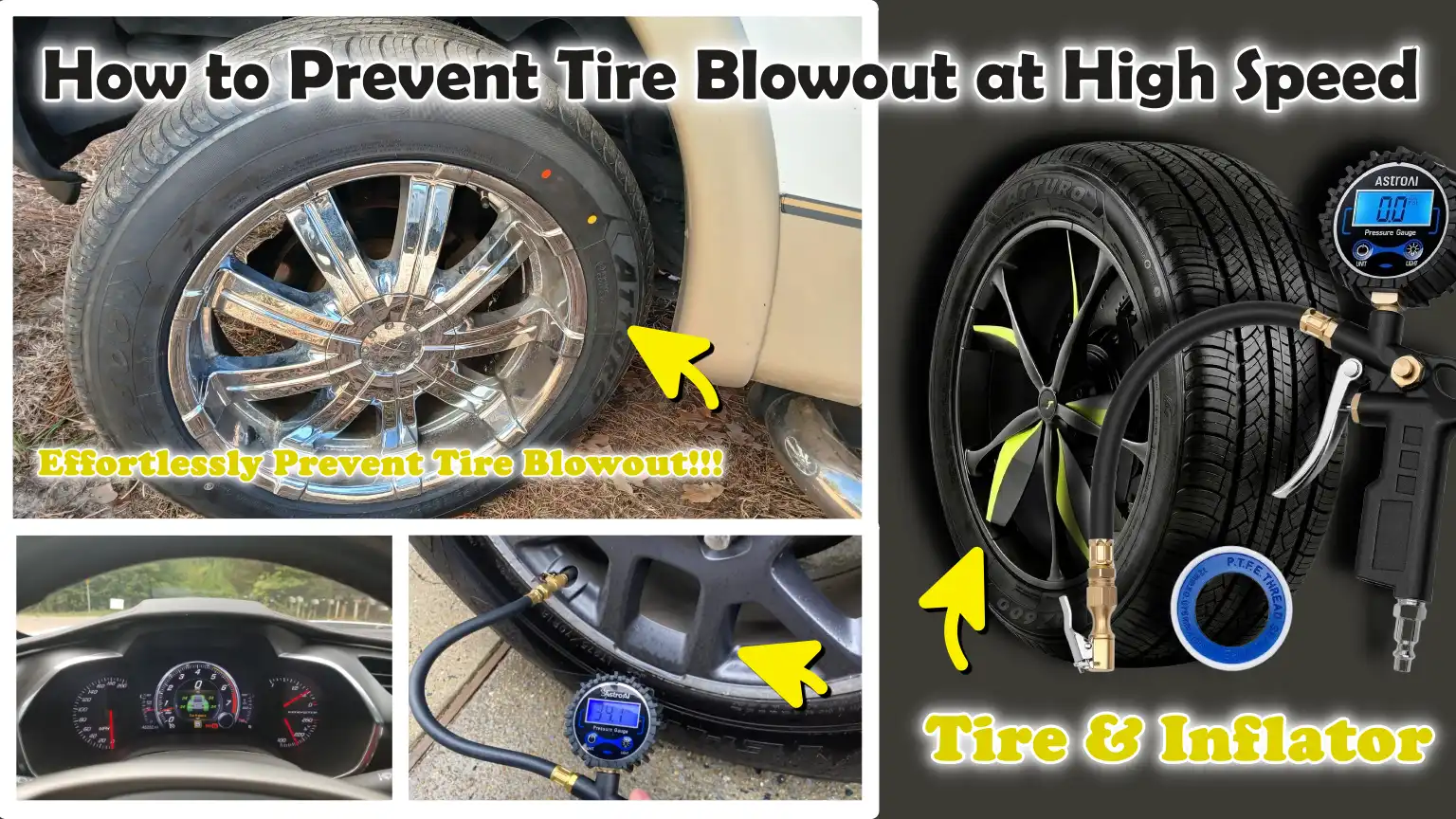
That is why, you should learn How to Prevent Tire Blowout at High Speed so that you can prevent it with simple routine checks that actually takes only a few minutes.
Why Do Tires Blow Out at High Speeds?
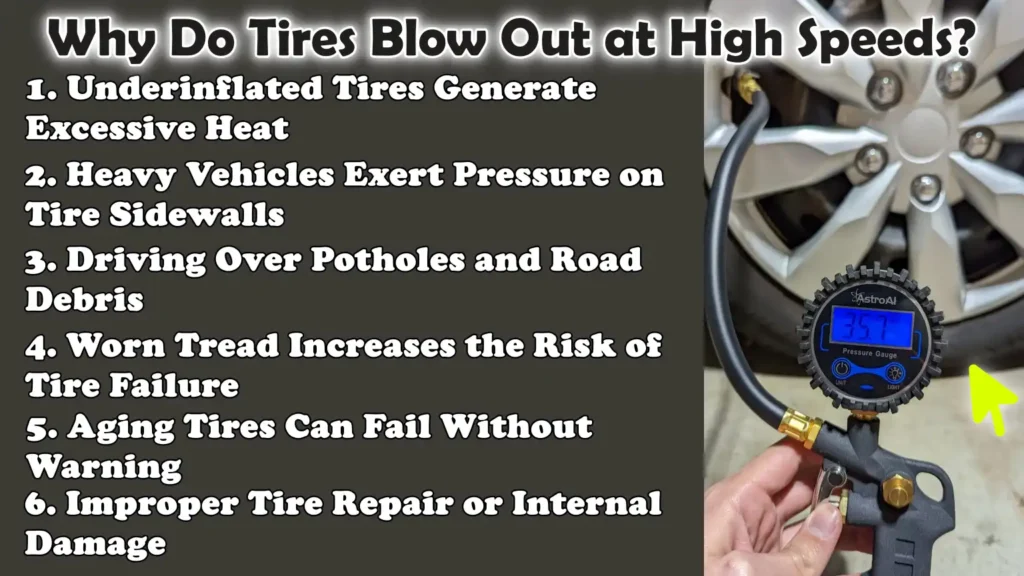
Tire blowouts at high speeds typically occur because the tire has already deteriorated before the rupture takes place.
Tires are designed to support the vehicle’s weight, absorb road shocks and maintain stability while rotating thousands of times over long distances.
At highway speeds, heat builds up rapidly inside the tire because the rubber at the “contact patch”, the area where the tire meets the road, is constantly flexing.
If a tire is underinflated, has internal damage, features aged rubber, is excessively worn, or is subjected to an overload, its structural integrity may be compromised; ultimately, the internal air pressure causes the tire to burst.
Many tire blowouts do not happen suddenly or without warning.
They often begin with subtle warning signs that a driver might overlook such as: vibrations, uneven tire wear, cracks, or a recurring loss of air pressure.
By understanding the root causes of tire blowouts, we can prevent dangerous accidents before they occur.
1. Underinflated Tires Generate Excessive Heat
One of the most common causes of tire blowouts on highways is underinflation; this happens because, when a tire lacks sufficient air pressure, it flexes excessively while rolling.
With every rotation, the tire’s sidewalls (sides) bend and compress.
When the air pressure is too low, the tire flexes beyond its intended limits, creating friction between the layers of rubber.
This friction generates heat, and heat is a tire’s greatest enemy.
As the internal temperature of the tire rises, the inner layers of rubber and steel belts begin to separate.
This weakens the tire from the inside out, even if it appears to be in perfect condition on the outside.
At high speeds, heat accumulates even more rapidly because the tire rotates more frequently, leaving it with less time to cool down.
This is why, during long-distance highway travel, even a slight under-inflation of the tires can prove dangerous.
2. Heavy Vehicles Exert Pressure on Tire Sidewalls
Every tire has a specific ‘Maximum Load Capacity’ (Load Rating); this means it can safely support only a predetermined weight.
When a vehicle carries passengers, cargo, or a towing load exceeding this set limit, the excess weight places undue stress on the tire’s sidewalls.
Although tire sidewalls are inherently flexible, under excessive load, they are forced to flex more severely with every rotation.
This generates increased heat and internal stress within the tire.
Overloaded tires may appear normal at first, but after covering long distances, specially in hot weather, their internal structural integrity can become compromised.
The combination of excessive weight and high speed significantly increases the risk of sidewall blowouts or tire failure.
Many instances of tire blowouts during family road trips occur precisely because the weight of luggage, equipment, or a trailer places a burden on the tires that exceeds their rated capacity.
3. Driving Over Potholes and Road Debris
Impacts sustained on the road can damage a tire, even if the damage is not immediately visible.
Striking a pothole at high speed can cause the tire to become pinched between the wheel rim and the road surface.
This can result in the rupture of the internal cords within the tire’s sidewall or damage to the belts located beneath the tread.
Driving over nails, metal objects, glass, or sharp debris can also compromise the structural integrity of the tire.
Sometimes, a tire does not puncture immediately, leading the driver to believe that no damage has occurred.
However, as the tire rotates at high speeds, this hidden internal damage can gradually worsen.
A tire damaged by a pothole may subsequently develop bulges, exhibit vibrations, or suffer a sudden, catastrophic failure, as its internal structure has already been compromised.
4. Worn Tread Increases the Risk of Tire Failure
The tread is the part of the tire that comes into contact with the road surface.
It provides grip, helps displace water and protects the tire’s inner layers.
When the tread becomes excessively worn, the tire loses its ability to safely handle varying road conditions.
Worn tires also overheat more rapidly, as there is less rubber remaining to absorb friction and dissipate heat.
If the tread wears unevenly, certain sections of the tire are subjected to greater stress than others.
This can create weak points within the tire that are highly susceptible to failure, particularly at high speeds.
Tires with shallow tread depth may also face an increased risk of puncture, as their protective rubber layer becomes thinner.
Before posing a risk of sudden blowout, a worn tire often exhibits warning signs such as skidding, increased braking distances and reduced traction on wet surfaces.
5. Aging Tires Can Fail Without Warning
A tire can become unsafe simply due to age, even if it retains sufficient tread depth.
Over time, the rubber undergoes changes; it gradually dries out, hardens and loses its elasticity.
Exposure to heat, sunlight and air accelerates this process.
As the rubber ages, tiny cracks may begin to appear on the sidewalls or within the tread grooves.
Although these cracks may seem minor, they serve as an indication that the structural integrity of the tire is deteriorating.
The internal bond between the rubber and the steel belts also weakens with age.
This means that an old tire can fail suddenly, particularly at highway speeds, where heat and internal pressure are at their highest.
Many drivers focus solely on tread depth, overlooking the fact that a tire’s age can also render it unsafe.
6. Improper Tire Repair or Internal Damage
A tire that has been repaired incorrectly may fail under the immense pressure exerted at highway speeds.
Minor punctures can often be repaired safely, but only if the repair is performed correctly, from the inside, and utilizing approved methods.
Temporary plug repairs, sidewall patches, or repairs to damage located near the tire’s shoulder may not be able to withstand the heat and pressure generated during driving.
Internal damage is particularly dangerous because it may not be visible during a cursory inspection.
A tire may appear perfectly sound from the outside, even while its internal belts have begun to separate internally.
This can lead to issues such as vibration, wobbling, or sudden tread separation.
If a tire has been driven on after sustaining a puncture, even for a short distance, its sidewall may have suffered permanent structural damage.
At high speeds, this hidden weak point can quickly lead to a catastrophic accident, such as a sudden tire blowout.
So, Why Does the Risk of a Tire Blowout Increase at High Speeds?
At high speeds, tire-related issues become significantly more dangerous because the stress placed on every part of the tire increases rapidly within a very short timeframe.
A tire that might seem perfectly fine while driving in the city can become unsafe on the highway, as the rubber heats up rapidly, internal air pressure fluctuates and the impact of road shocks becomes far more intense.
As tires rotate, they undergo constant flexing; this continuous movement generates heat within the layers of rubber and steel that constitute the tire’s structure.
At lower speeds, the tire has sufficient time to cool down between each rotation.
However, at highway speeds, a tire rotates hundreds of times per minute, causing heat to accumulate continuously.
If a tire is already compromised, whether due to age, underinflation, pre-existing damage, or wear and tear, high speeds can push it beyond its safe operating limits.
This is precisely why numerous tire blowouts occur during long-distance highway journeys, particularly in hot weather or when the vehicle is heavily loaded.
1. Tire Temperatures Rise Rapidly on the Highway
When a vehicle travels at highway speeds, its tires generate heat due to their continuous contact with the road surface.
With every rotation, the rubber flexes at the point where it meets the ground; this flexing creates internal friction.
As speed increases, the tire rotates more frequently within a given period, resulting in the generation of greater heat.
This heat accumulates within the tire’s sidewalls and beneath the tread, even if the ambient air temperature remains moderate.
This factor becomes particularly critical during long journeys, as tires can remain hot for hours on end.
If a tire is underinflated, overloaded, or already in poor condition, the rate at which heat accumulates accelerates significantly.
Excessive heat weakens the rubber and can cause the internal steel belts to delaminate.
Once these internal layers begin to deteriorate, the tire may burst suddenly.
In fact, many instances of tire blowouts on highways are the direct result of heat-induced damage caused by driving on compromised tires for extended periods.
2. High Speeds Increase Friction and Pressure
As speed increases, the tire faces greater friction, as it covers a longer distance on the road in a shorter amount of time.
The faster the tire rotates, the harder the rubber must work to maintain traction and support the vehicle.
This leads to an increase in internal tire pressure.
As the tire heats up, the air inside it also warms up, which can further elevate the internal pressure.
While minor fluctuations in pressure during driving are normal, a damaged or defective tire cannot safely withstand this heightened pressure.
A tire with aged rubber, poor repairs, or hidden sidewall defects is prone to bursting when both pressure and temperature rise simultaneously.
Driving at high speeds also amplifies the impact of potholes and road shocks.
A pothole that might cause only minor damage to a vehicle at low speeds could inflict severe structural damage at highway speeds, simply because the resulting impact force is far more intense.
3. A Sudden Tire Blowout Disrupts Vehicle Balance
At high speeds, a tire blowout fundamentally alters the vehicle’s ability to maintain its balance and stability on the road.
Every tire plays a crucial role in supporting the vehicle and maintaining control during steering, braking and cornering.
When a tire suddenly loses air pressure, the vehicle’s weight shifts rapidly toward that side.
This can cause the steering wheel to pull suddenly and violently in one direction, particularly if a front tire has blown out.
The driver may perceive that the vehicle is drifting, vibrating, or tilting to one side.
Maintaining the vehicle’s balance becomes difficult because the blown-out tire is no longer able to provide adequate support.
Due to this sudden loss of balance, the vehicle may veer out of its lane or run off the road.
Larger vehicles such as: SUVs, pickup trucks and vans, as it can be even more challenging to control; owing to their higher center of gravity, the risk of rolling over increases significantly in the event of a tire blowout.
4. Increased Stopping Distance in Emergencies
A tire blowout increases the distance required to bring the vehicle to a complete stop, as the proper contact between the vehicle and the road surface is compromised.
Braking is most effective when all tires maintain uniform traction on the road.
If a single tire suddenly blows out, the traction and stability at that specific corner of the vehicle are disrupted.
The blown-out tire may drag along the road, collapse, or shed its tread, thereby diminishing the vehicle’s braking capability.
This situation becomes even more critical at high speeds, as a greater distance is required to bring the vehicle to a halt under such circumstances.
For instance, stopping a vehicle traveling at highway speeds requires a significantly greater distance compared to a normal, routine stop.
Check Tire Pressure Regularly
The simplest and most effective way to prevent a tire blowout at high speeds is to check your tire pressure regularly.
Air pressure supports the vehicle’s weight, maintains the tire’s shape and helps ensure that the tire’s contact patch (tread) remains evenly engaged with the road surface.
When tire pressure is too low, the tire’s sidewalls flex excessively while driving, generating a significant amount of heat inside the tire.
This excessive heat can weaken the rubber and the internal steel belts, thereby increasing the risk of sudden tire failure.
Conversely, when the pressure is too high, the tire becomes rigid; this can reduce traction (grip) and cause the center of the tread to wear out prematurely.
Both of these conditions negatively impact safety, handling, fuel efficiency and tire longevity.
Many instances of tire failure occur because pressure levels are neglected for weeks on end, or are checked only after a warning light has illuminated.
A quick pressure check takes just a few minutes and can help prevent dangerous tire damage while driving on the highway.
1. Use the Manufacturer-Recommended PSI
Every vehicle is designed to operate within a specific tire pressure range, a figure determined by the vehicle’s weight, suspension system and tire size.
PSI stands for ‘Pounds per Square Inch,’ a unit of measurement that indicates the air pressure inside a tire.
The correct PSI is typically listed on a sticker located inside the driver-side door frame or within the vehicle’s owner’s manual.
This figure is far more critical than the maximum PSI printed on the tire’s sidewall.
The number printed on the sidewall indicates the maximum pressure the tire can withstand, it is not the recommended pressure for daily driving.
Using the PSI recommended by the manufacturer ensures that tires distribute weight evenly, maintain proper contact with the road and generate significantly less heat.
Incorrect pressure can lead to accelerated tire wear, diminished braking performance and an increased risk of tire blowouts during long journeys.
2. Check Tire Pressure When Tires Are Cold
Tire pressure should always be checked when the tires are cold, as the heat generated by driving increases the air pressure inside them.
As a tire rotates, it naturally heats up; even a short drive can raise the pressure enough to yield an inaccurate reading.
This may lead the driver to believe the pressure is correct, whereas, in reality, the tire was underinflated prior to driving.
“Cold tires” refers to tires on a vehicle that has been stationary for several hours or has been driven only for a very short distance.
Measuring pressure under these conditions yields the most accurate results.
Ambient temperature also affects tire pressure; air contracts in cold weather and expands in warm weather, so seasonal changes can cause fluctuations in PSI levels.
Regularly checking tire pressure during cold weather helps drivers detect drops in pressure before dangerous heat accumulation occurs during highway travel.
3. Adjust Pressure for Heavy Loads and Long Journeys
When a vehicle carries a full complement of passengers, luggage, or cargo, or is towing a load, the tires are subjected to immense stress.
This increased weight places greater tension on the tire sidewalls and generates additional heat while driving.
This becomes particularly critical during long highway journeys, as the tires remain under constant pressure for extended periods and do not have adequate opportunity to cool down.
Some vehicles require slightly different tire pressure settings when carrying heavy loads; this information can typically be found in the owner’s manual or on a sticker located on the driver’s-side door jamb.
Checking tire pressure before embarking on a road trip is particularly crucial, as the combination of underinflated tires and heavy cargo is a common cause of tire blowouts.
Even if the tires appear normal, hidden stress accumulates during long journeys; maintaining the correct pressure ensures that the tires can safely handle that load.
4. Do Not Rely Solely on the TPMS Warning Light
Tire Pressure Monitoring System (TPMS) warning lights are helpful, but they should not replace manual tire inspections.
TPMS is designed to alert the driver when tire pressure drops below a certain threshold; however, by the time a warning appears, the tire pressure may have already dropped significantly.
In many vehicles, this system activates only when the pressure falls low enough to trigger the sensors, meaning that damage may have already begun.
TPMS also cannot immediately detect slow leaks and some systems may not provide accurate pressure readings unless the vehicle is equipped with advanced monitoring features.
Furthermore, sensors can malfunction or provide delayed readings.
The most accurate method for checking tire condition remains a manual pressure gauge.
Utilizing both TPMS and regular manual pressure checks offers the best protection, as it helps identify issues before they become severe enough to trigger a warning.
Check Tire Tread Before Driving on the Highway
The tire tread is the part of the tire that comes into contact with the road and it plays a crucial role in preventing tire blowouts at high speeds.
The tread helps the tire maintain traction on the road, displace water, prevent skidding and protect the internal rubber and steel layers of the tire.
When the tread becomes excessively worn, the tire’s grip diminishes and it loses its ability to effectively dissipate heat.
This increases stress on the internal structure, particularly when driving on highways, where the tire remains under constant pressure for extended periods.
Worn tread can also heighten the risk of punctures, as there is less rubber remaining to absorb road shocks.
Many drivers check their tire pressure but overlook the fact that tread condition is equally vital for safety.
Checking the tread before driving on the highway helps detect hidden wear that could otherwise lead to overheating, loss of control, or a sudden tire blowout.
1. Accurately Measure Tread Depth
Tread depth indicates how much usable rubber remains on the tire.
As the tread wears down, the tire loses its ability to maintain a strong grip on both dry and wet road surfaces.
Reduced tread depth also diminishes the tire’s capacity to dissipate heat, a critical factor during long highway journeys.
Although a tread depth gauge provides the most precise measurement, many drivers also utilize simpler methods, such as the wear indicators located within the tire grooves.
As the tire wears down, these small raised bars eventually become flush with the tire’s surface.
Measuring only a single section of the tire is insufficient, as tread wear can vary across the entire surface.
It is advisable to inspect the inner edge, the central section and the outer edge of the tire.
One section of a tire may appear to be in good condition, while another section has become dangerously thin.
Taking regular measurements helps detect potential problems before the tire becomes unsafe for use.
2. Pay Attention to Wear Patterns
Uneven tread wear is often an indication of mechanical issues that can increase the risk of a tire blowout.
Tires are designed to wear evenly across their entire surface.
If one side wears down faster than the other, it may signal poor wheel alignment, improper inflation, or suspension problems.
Wear in the center section often occurs when a tire is consistently overinflated, whereas wear on both edges may indicate low air pressure.
Cupping, or patchy wear, can be a sign of worn suspension components or wheel imbalance.
These patterns are critical because they create weak spots that heat up rapidly when driving at highway speeds.
An uneven surface can also compromise steering, braking and stability.
Even if the tire maintains good grip in certain areas, the weakest point is the most likely to fail first.
Identifying these patterns in a timely manner helps prevent major safety hazards.
3. Replace Tires Before They Reach Unsafe Limits
Waiting until a tire is completely worn out increases the risk of a blowout, specially at high speeds.
Many drivers delay replacing their tires because the tire appears to still be usable; however, visible tread depth alone does not always accurately reflect the tire’s true condition.
When tread depth becomes too shallow, the tire is unable to generate proper traction, dissipate heat effectively, or adequately protect itself against road hazards.
Shallower tread depth also implies that the underlying steel belts are situated closer to the road surface, thereby increasing the risk of punctures and internal tire damage.
Tires should be replaced before they become legally non-compliant or physically unsafe.
In real-world driving conditions, particularly on highways, replacing tires proactively enhances safety, as it significantly reduces the risk of hydroplaning, overheating and sudden tire failure.
When weighed against the potential costs resulting from a tire blowout or an accident, replacing tires in advance is generally the more economical option.
4. Inspect Both Front and Rear Tires
Many drivers pay greater attention to their front tires because they are easier to see and directly influence steering; however, the rear tires are equally important.
A rear tire blowout can be particularly dangerous, as it may cause the vehicle to swerve suddenly to one side or lose its balance.
Depending on the type of vehicle, its drivetrain configuration and driving habits, front and rear tires may wear out at different rates.
For instance, in front-wheel-drive vehicles, the front tires often wear out more rapidly, while the rear tires may deteriorate without any obvious warning.
A tire that appears to be in good condition from one side may, in reality, be worn down along its inner edge, damage that becomes visible only upon close inspection.
Inspecting all four tires ensures that no damaged or worn-out tire goes unnoticed.
Before embarking on a highway journey, a comprehensive inspection should include checking both the front and rear tires for tread depth, sidewall condition, visible cuts and signs of uneven wear.
Do Not Overload Your Vehicle
Overloading a vehicle places increased pressure on the tires and while it is a major, yet often overlooked, cause of tire blowouts at high speeds, it is frequently ignored.
Every vehicle is designed to carry a specific weight limit, which includes passengers, luggage, tools, roof-mounted cargo and any items being towed behind the vehicle.
When this limit is exceeded, each tire is subjected to pressure exceeding its designated capacity.
Due to the excessive weight, the tire’s sidewalls flex more with every rotation, generating significant internal heat.
This heat is dangerous because it weakens the rubber and steel cords within the tire’s structural framework.
This issue becomes even more critical on highways, where tires remain under constant pressure for extended periods, leaving them with little opportunity to cool down.
Overloaded tires may appear normal from the outside, but internally, they may already be severely overheated.
Whether during daily commutes or long-distance journeys, the most effective way to minimize the risk of a tire blowout and extend the lifespan of your tires is to avoid overloading your vehicle.
1. Know Your Vehicle’s Load Capacity
Every vehicle has a maximum load capacity; this figure indicates the maximum total weight that the vehicle can safely carry.
This calculation includes the driver, passengers, luggage, fuel and any additional accessories installed on the vehicle.
Information regarding the vehicle’s load capacity is typically printed on a label located inside the driver-side door frame and it is determined based on the design of the vehicle’s suspension, brakes and tires.
Many drivers focus solely on the weight of their luggage, forgetting that people, coolers, tools and even roof-mounted racks all contribute to the total weight.
Exceeding a vehicle’s weight limit places excessive strain on the tires and alters the vehicle’s handling characteristics.
The steering may feel heavy, the stopping distance required to bring the vehicle to a halt may increase and the tires may heat up rapidly.
Before loading cargo into a vehicle, it is essential to determine its weight-carrying capacity; this ensures that the tires are not subjected to a load exceeding their capabilities.
2. Understand Tire Load Ratings
A tire’s load rating is distinct from the vehicle’s overall weight-carrying capacity.
Each tire possesses a specific load rating, which indicates the maximum weight a single tire can safely support when properly inflated.
This rating is typically printed on the tire’s sidewall as part of the tire size specifications.
This information is crucial because, even if the vehicle itself is capable of supporting a certain weight, the load rating of the installed tires must also be commensurate with that weight.
Using tires with a load capacity lower than that specified by the manufacturer can pose a serious safety risk.
When subjected to a load exceeding its specified rating, a tire may experience excessive deflection, generate excessive heat and even suffer a sudden blowout, particularly at high highway speeds.
Drivers who install tires with incorrect specifications may not realize that they have compromised their safety margins.
Matching the correct load rating ensures that the tires can safely handle the vehicle under real-world driving conditions.
3. Balance the Load Properly
How weight is distributed within a vehicle is just as important as the total weight being transported.
Improperly distributed cargo can result in an unbalanced load, where an excessive amount of weight accumulates on one side or on a specific axle, thereby placing undue strain on particular tires.
For instance, placing heavy items in one corner of a trunk or along one side of a pickup bed can place significantly more weight on a single rear tire compared to the others.
This improper load distribution generates excessive pressure and heat within that tire’s sidewall.
It can also adversely affect steering, suspension balance and braking performance.
Balanced loading entails distributing weight equally across both sides and, whenever possible, positioning heavy items low and toward the center of the vehicle.
This minimizes the stress placed on individual tires, ensuring that the vehicle remains stable while driving on highways, changing lanes, or applying sudden brakes.
4. Reduce Pressure During Long-Distance Travel
Long-distance driving exacerbates the effects of heavy loads, as the tires remain under continuous stress for hours on end.
During short, local trips, tires have the opportunity to cool down between journeys; however, on highways, they often remain hot throughout the entire trip.
If the vehicle is overloaded, heat accumulates rapidly and becomes trapped within the tire’s internal structure.
This can weaken the internal belts and significantly increase the risk of a tire blowout.
Drivers often overload their vehicles, whether for vacations, carrying luggage, or transporting cargo, without adjusting tire pressure or verifying the total weight of the load.
How to Inspect Tires for Any Signs of Damage
To avoid a tire blowout at high speeds, checking the condition of your tires, specifically for both visible and hidden damage, is one of the most critical steps you can take.
The structural integrity of a tire can be compromised long before a puncture occurs and many dangerous issues originate within the tire itself, where they are not easily detected.
Road impacts, heat, aging and improper repairs can weaken the rubber and the internal steel belts.
At highway speeds, a compromised tire is subjected to immense stress as it spins rapidly, heats up and constantly bears the full weight of the vehicle.
A small crack or cut that appears harmless during city driving can evolve into a serious risk of tire failure during a long-distance highway journey.
Carefully inspecting your tires before driving helps you detect problems early, thereby preventing incidents such as sudden deflation, tread separation, or sidewall blowouts.
1. Check the Sidewalls for Cracks
The sidewall is the outer section of the tire and it flexes every time the tire rotates.
Because it is constantly flexing, it is often the first part to show signs of aging or damage.
Small cracks in the sidewall are frequently caused by rubber degradation, prolonged exposure to sunlight, heat and disuse over time.
These cracks may appear as fine lines, particularly near the rim or between the raised lettering on the tire.
While very fine surface cracks can develop as a tire ages, deep or spreading cracks serve as a warning sign that the rubber is drying out and losing its elasticity.
When sidewalls become brittle, they are less effective at absorbing road shocks and are more prone to bursting under pressure.
Driving at high speeds exacerbates this situation, as the sidewall heats up and flexes rapidly.
A compromised sidewall should always be inspected, as it may indicate that the tire is no longer safe for use.
2. Check for Bulges and Blisters
A bulge or blister on a tire typically signals that its internal structure has been compromised.
This often occurs after hitting a pothole or curb, or after sustaining a sharp impact on the road.
Although the outer rubber may appear intact, the internal cords within the sidewall may have snapped; this allows the internal air pressure to exert outward force, creating a swollen area.
This serves as a critical warning sign, as the tire has already lost its structural integrity.
Over time, this bulge can expand and burst suddenly, particularly when driving on highways, where heat and internal pressure are elevated.
Even a small blister on the tire’s sidewall should never be ignored, as it indicates that the tire no longer possesses full structural strength.
The damaged section of the tire is weaker than the rest of the tire and may burst at high speeds without any significant prior warning.
3. Check for Cuts and Embedded Objects
Cuts, punctures and embedded objects within the tire tread (the part that makes contact with the road) can create hidden damage that gradually worsens over time.
Sharp objects such as: nails, screws, glass, or metal shards, as it can embed themselves in the tread and gradually weaken the tire’s inner layers.
Some objects do not cause an immediate loss of air pressure, making the problem difficult to detect.
A tire may maintain its air pressure for several days while internal damage continues to worsen unnoticed.
Cuts on the sidewall (the side of the tire) are particularly serious, as damage to the sidewall typically cannot be safely repaired.
Due to the immense stress placed on tires while driving at highway speeds, even minor cuts can expand into major structural failures.
It is crucial to inspect both the tread and the sidewalls for any foreign objects embedded in the rubber.
If a screw or nail remains lodged in the tire, it may temporarily seal the puncture; however, the movement and flexing that occur while driving can cause the hole to enlarge, potentially leading to a sudden blowout or damage to the tire’s internal belts.
Checking for these signs helps identify potential issues before they escalate into dangerous situations.
4. Inspect Previously Repaired Areas
Before driving on the highway, be sure to carefully inspect any previously repaired tires.
Not all repairs are created equal and an improperly repaired tire can fail due to heat and pressure.
A safe repair typically involves fixing the puncture from the inside of the tire using proper patching techniques.
Temporary plug repairs, sidewall repairs, or repairs to damaged shoulder areas are more prone to failure, as these sections of the tire experience significant stress while driving.
Check the repaired area for slow air leaks, visible defects, or unusual wear around the patched section.
A tire that was driven on after sustaining a puncture may have internal sidewall damage, even if it was subsequently patched.
At highway speeds, repaired areas are subjected to increased stress as the tire heats up and the rubber undergoes constant flexing.
If a repaired tire exhibits vibration, loses air pressure, or shows any visible changes around the repair site, be sure to have it inspected by a specialist before continuing to drive.
How to Replace Old Tires on Time
Replacing old tires in a timely manner is crucial, as tire age can pose a safety risk, even if the tire tread still appears to be in good condition.
Many drivers assess a tire’s condition solely based on its tread depth; however, the rubber itself undergoes changes over time.
Tires are composed of rubber compounds, fabric plies and steel belts, all of which gradually deteriorate with age.
Heat, oxygen, sunlight, moisture and prolonged vehicle inactivity, all these factors impact the tire’s materials.
As a tire ages, its rubber becomes harder and less flexible.
This diminishes the tire’s ability to absorb road shocks, dissipate heat and maintain structural integrity, even at high speeds on the highway.
A tire may appear perfectly sound on the outside, yet its internal structure may have already compromised.
Old tires should be replaced before their age becomes a safety hazard; doing so helps prevent sudden tire blowouts, particularly during long-distance journeys and in hot weather.
1. Understand Tire Age Limits
Tires do not last forever, even if they have seen very little use.
The rubber in a tire begins to age from the very day it is manufactured, not from the day it is installed on a vehicle.
Over time, the flexibility and bonding strength of the tire’s internal materials diminish.
The steel belts and rubber layers are fused together through a robust manufacturing process; however, as the tire ages, these bonds gradually weaken.
This deterioration can lead to the separation of internal tire components, thereby increasing the risk of a tire blowout at high speeds.
A severely aged tire will be unable to safely withstand heat or heavy loads.
For this reason, a tire’s age is often viewed separately from its tread depth.
Many drivers continue to use old tires simply because their tread still appears deep; however, age-related deterioration can occur even before the tread shows signs of wear.
Checking a tire’s age is just as important as checking for physical wear and tear.
2. Locate the DOT Date Code
The United States Department of Transportation (DOT) date code helps determine exactly when a tire was manufactured.
This code is printed on the tire’s sidewall and typically consists of four digits at the end.
The first two digits indicate the week of manufacture, while the last two digits represent the year of manufacture.
For example, if a code ends with “2423,” it means the tire was manufactured during the 24th week of the year 2023.
This code is crucial because many tires remain stored in warehouses for extended periods before being sold; consequently, by the time you have them installed on your vehicle, they may be significantly older than you anticipate.
Drivers often overlook this fact, assuming that a tire they have just purchased was recently manufactured.
By checking the DOT code, you can easily determine a tire’s actual age.
This allows you to avoid driving on tires that are nearing the end of their safe service life.
3. Why Do Low-Mileage Tires Still Age?
A tire can become unsafe even if the vehicle is driven very sparingly.
Low mileage does not halt the aging process of a tire, as the passage of time and environmental factors continuously impact the rubber material.
The sidewalls (sides) of tires on a vehicle that remains stationary for long periods may actually deteriorate more rapidly, as that specific section of the tire remains under constant, unshifting pressure.
Exposure to sunlight, heat and weather elements can cause the rubber to dry out and develop tiny cracks.
Even if tires are stored indoors, they are not entirely immune to the aging process, as oxygen naturally induces chemical changes within the rubber over time.
People often overlook the tires on cars, trailers, or spare wheels that see very little use, simply because their tread depth remains substantial.
However, these tires carry a higher risk of sudden failure due to internal hardening or structural separation.
If a tire’s age is disregarded, a tire with low mileage can lull you into a false sense of security.
4. Signs That Old Tires Need Replacing
Old tires often exhibit warning signs before failing, although these signs can sometimes be subtle.
Common indicators include cracks in the sidewall, hardening of the rubber, the appearance of small cracks between the tread grooves, vibrations felt while driving at highway speeds, frequent loss of air pressure, or bulges appearing on the tire’s surface.
The tire may also feel less stable when cornering or braking.
In some instances, a tire may appear normal visually but begin to emit strange noises while driving, a sign that its internal structure is deteriorating.
If a tire displays any of these warning signs, it cannot be considered safe or reliable for highway driving.
If the rubber has aged to the point where it has lost its inherent elasticity, even tires with deep tread can fail.
Read More:
How to Maintain Proper Wheel Alignment
Maintaining proper wheel alignment is crucial for preventing tire blowouts, as alignment directly impacts the uniformity of the tire’s contact with the road surface.
Wheel alignment involves adjusting the angles of the wheels according to the vehicle manufacturer’s specifications to ensure that all tires roll straight and distribute the vehicle’s load correctly.
When alignment issues arise, one or more tires may sit slightly askew, tilted inward or outward, or may drag against the road surface rather than rolling freely.
This generates excessive friction, causes uneven wear on the tire tread and leads to a significant buildup of heat.
At highway speeds, even minor alignment issues can become critical; because the tires are rotating rapidly, any uneven contact subjects the tire to continuous, intense stress over many miles.
While poor alignment is unlikely to cause an immediate tire blowout in a single day, over time it weakens the tires and can cause internal damage, thereby significantly increasing the risk of sudden tire failure.
1. Improper Alignment Causes Uneven Tire Wear
When wheel alignment is compromised, the tire tread fails to maintain uniform contact with the road surface.
A specific edge of the tire may bear a disproportionate amount of pressure compared to the rest of the tire, causing that particular section to wear down more rapidly.
This results in uneven tread depth across the tire’s surface, which reduces road grip and generates excessive heat in the worn areas.
Wear on the inner edge of a tire is often easily overlooked, as it remains invisible until the wheels are turned or the underside of the vehicle is inspected.
A tire with uneven wear may appear to be in good condition on the outside, yet it remains unsafe for highway driving.
As the worn section becomes thinner, it weakens and becomes less capable of withstanding heat, road shocks and heavy loads.
Over time, this increases the risk of tread separation or a tire blowout, particularly during long-distance travel.
2. Steering Pulling to One Side Can be an Indication of Excessive Stress On The Tires
When a vehicle pulls to one side while driving, it often signals an alignment issue; however, it can also indicate that the tires are under excessive stress.
When alignment is incorrect, one tire may experience greater rolling resistance compared to the others.
Consequently, the vehicle may drift slightly to the left or right, even when traveling on a straight road.
To keep the vehicle centered on the road, the driver may have to hold the steering wheel at a slight angle.
This constant need for correction implies that the affected tires are not rolling naturally and may be subjected to excessive strain.
This increased resistance generates heat and can accelerate tread wear.
At higher speeds, this stress intensifies further, as the tires are already under a heavy load.
The issue of steering pulling to one side should never be ignored, as it may serve as an early warning sign that the tires are not wearing evenly and that their safety is being compromised.
3. Tire Alignment Extends Tire Life
Proper alignment ensures that tires wear evenly and remain cool during operation.
When all four wheels are correctly aligned, the tread maintains contact with the road exactly as designed, thereby distributing the load uniformly across the entire surface of the tire.
This minimizes excessive wear on any single edge and reduces structural stress within the tire.
Tires that wear evenly typically last longer and provide superior traction during braking and cornering.
Proper alignment also enhances fuel efficiency, as the tires rotate with less resistance.
The most significant benefit, particularly in terms of preventing tire blowouts, is the reduction in heat buildup.
Heat weakens both the rubber and the internal steel belts; therefore, anything that reduces friction can effectively improve tire safety.
Maintaining alignment according to proper standards safeguards both the longevity of the tires and the vehicle’s stability on the highway.
4. When to Schedule an Inspection
A wheel alignment check should be performed whenever there are indications that the vehicle is not handling normally.
Common signs include the steering pulling to one side, uneven tire wear, a steering wheel that is off-center, vibrations, or the vehicle drifting to one side after hitting a pothole or striking a curb.
Road impacts can subject suspension components to such severe shocks that the alignment is altered, even if no visible damage is apparent.
Driving on the highway for extended periods with poor alignment can cause tires to wear out rapidly, specially in hot weather.
It is also beneficial to check the alignment after installing new tires, as wear patterns on the fresh tread can be easily monitored right from the start.
Regular inspections allow for the early detection of issues before they place excessive stress on the tires.
How to Rotate Tires at Recommended Intervals
Tire rotation is an essential maintenance step because tires on a vehicle do not wear down at the same rate across all positions.
Front tires often wear differently than rear tires because, depending on the vehicle’s design, they may be required to handle steering duties, engine power, or greater braking pressure.
Over time, this uneven wear can create weak spots in one or two tires, while the remaining tires remain in better condition.
At high highway speeds, this disparity matters, as a heavily worn tire typically heats up faster and carries a higher risk of failure.
Rotating tires involves moving them to different positions on the vehicle so that the wear is distributed more evenly across all four tires.
This helps maintain uniform tread depth, reduces the load placed on any single tire and minimizes the risk of a blowout caused by one tire wearing out significantly faster than the others.
1. Helps Even Out Tread Wear
Different wear patterns develop at various wheel positions on a vehicle.
In many vehicles, the front tires wear out faster because they handle steering duties and often bear the brunt of braking forces.
In front-wheel-drive vehicles, the front tires also transmit engine power to the road, accelerating wear even further.
Rear tires may wear more slowly, but they can still age and develop internal issues.
Rotating tires gives each tire the opportunity to operate in different positions, thereby distributing the workload and ensuring more uniform tread wear.
Maintaining uniform tread depth is crucial, as it ensures that all tires maintain consistent traction on the road.
Uneven tread wear can cause a specific tire to overheat rapidly, particularly during long-distance highway travel.
When wear is balanced, each tire distributes the pressure exerted by the road more evenly, thereby enhancing safety when driving at high speeds.
2. Reduces the Stress Placed on Individual Tires
A tire that remains in the same position for an extended period may be subjected to a specific type of stress for thousands of miles.
For instance, a front tire constantly endures the lateral forces associated with sharp turns, the burden of braking, or the pressure resulting from the road’s camber.
Over time, this persistent stress can cause that specific tire to deteriorate more rapidly than the others.
Rotating the tires prevents any single tire from being subjected to the same repetitive stresses continuously.
By changing the tires’ positions, the stress on each tire varies, thereby minimizing the risk of excessive wear occurring at any specific location.
This also reduces the likelihood of a single tire becoming significantly weaker than the others.
On highways, a tire that endures prolonged, localized stress faces an increased risk of overheating or failure.
Tire rotation distributes this stress evenly across all tires, thereby extending their lifespan and ensuring their safe operation.
3. Improved Handling and Stability
Maintaining uniform tread depth across all four tires ensures that the vehicle remains more stable while driving.
If one tire becomes significantly more worn than the others, its grip (traction) may become uneven.
This can impact steering response, braking balance and tire traction on wet surfaces.
In sudden emergency situations at high speeds, uneven tire grip can make it difficult to maintain control of the vehicle.
When tires are rotated, they tend to wear more uniformly; this means the vehicle’s response is more predictable when changing lanes, taking turns, or braking suddenly.
Balanced tires also reduce vibration and provide a more comfortable driving experience.
Good handling becomes even more critical when a driver needs to swerve suddenly to avoid road debris or take immediate evasive action while driving on a highway.
Regular tire rotation helps ensure safe vehicle control by ensuring that all tires perform consistently.
4. The Right Time for Tire Rotation
The ideal timing for tire rotation depends on the specific vehicle, the type of tires used and driving conditions; however, performing this task at regular intervals is crucial, as uneven tire wear can begin even before it becomes visually apparent.
Waiting until significant signs of wear become visible before rotating the tires can result in excessive deterioration of a single tire.
Vehicles driven primarily on highways, rough terrain, or while carrying heavy loads experience tire wear differently than those typically driven on city streets.
Drivers who frequently brake hard or regularly transport heavy cargo may find that their front tires wear out more rapidly.
Rotating tires at regular intervals prevents excessive wear on any single tire, thereby reducing the risk of a tire blowout.
It is also crucial to inspect the tread, sidewalls and air pressure of the tires every time they are rotated, as this process makes it easier to identify hidden signs of wear.
Avoid Driving on Poor Roads
By avoiding poor roads, you can significantly reduce the likelihood of a tire blowout, as many instances of tire failure are linked to damage that is not immediately visible.
Tires are designed for standard road conditions; however, sudden impacts caused by potholes, broken pavement and sharp debris can compromise their internal structure.
A tire may withstand the initial shock and even maintain its air pressure, often leading drivers to believe that no problem exists.
In reality, its internal cords or steel belts may have already been weakened.
At high speeds, this hidden damage becomes even more hazardous, as the tire heats up, rotates rapidly and remains under constant load.
Roads with poor surfaces inflict repeated impacts, causing the tire to gradually deteriorate over time.
By driving cautiously on poor roads and inspecting your tires following any significant impact, you can prevent many sudden tire blowouts on the highway.
1. Potholes Can Weaken Tire Structure
Potholes can inflict severe damage upon a tire, as it strikes forcefully against the edge of the pothole and the wheel rim.
This collision can compress the tire with such force that its sidewall is compromised or its internal cords snap.
Even if the tire does not suffer an immediate puncture, its internal layers may have already sustained damage.
The tire’s outer rubber can hide this damage, making the tire appear normal upon a cursory visual inspection.
A forceful impact with a pothole can also bend the wheel, disrupt the vehicle’s alignment and cause the tire to wear unevenly on one side, factors that contribute to further tire deterioration over time.
When traveling at high speeds on the highway, a tire that has previously sustained damage from a pothole may begin to vibrate, develop a bulge in its sidewall, or suddenly blow out, as its compromised section is no longer capable of safely withstanding the heat and pressure.
2. Sharp Debris Can Cause Hidden Damage
Sharp debris such as: nails, screws, metal shards, broken glass and fragments of damaged vehicle parts, as it can cut or puncture a tire.
While some objects cause an immediate loss of air pressure, others may only partially penetrate the tire’s tread (surface) and remain embedded there.
In such instances, the tire pressure does not drop immediately, making it easy to overlook the damage.
However, as the tire rotates and flexes, the embedded object can gradually cut deeper into the rubber.
This can damage the steel belts located beneath the tread and compromise the tire’s internal structural integrity.
When driving at high speeds on the highway, even a minor puncture can prove dangerous, as the damaged area expands under the influence of heat and pressure.
If a tire runs over a sharp object, it should always be inspected closely, as internal damage may persist even after the immediate road incident has passed.
3. Construction Zones Increase the Risk
The risk of tire failure often increases within construction zones, as the road surface is typically uneven and may be strewn with loose materials.
The roadway may be littered with sharp gravel, exposed metal, broken concrete, tools, or scattered nuts and bolts.
Temporary lane shifts may also force vehicles to travel over rough surfaces or unfinished roadways.
These areas present a heightened risk of damage resulting from cuts, punctures and impacts with objects.
Construction debris can become lodged in the grooves of the tire tread and, as the vehicle is driven, gradually work its way deeper into the tire’s internal structure.
In some instances, tire damage may occur without any audible cues or an immediate drop in air pressure.
Drivers who frequently travel through construction zones should inspect their tires more often, as repeated exposure to debris increases the risk of compromising the tire’s internal integrity, which could subsequently lead to a tire blowout.
4. Why Immediate Inspection After an Impact Is Essential
It is crucial to inspect a tire immediately following a forceful impact with an object on the road, as continuing to drive can exacerbate any pre-existing damage.
Even after striking a pothole, a curb, or debris, the tire may appear normal for some time.
However, as the tire rotates and heats up, internal damage can spread further.
A broken cord within the sidewall may gradually cause a bulge to form on the exterior surface.
A minor puncture can enlarge, eventually leading to a loss of air pressure.
Delaying an inspection subjects the tire to continued stress, potentially allowing a minor issue to escalate into a dangerous accident.
A proper inspection should include checking for sidewall bulges, cuts, cracks, unusual vibrations and air pressure levels.
Early detection of damage can prevent subsequent accidents such as: sudden tire blowouts, particularly when driving on highways, where tires are subjected to immense stress.
Safe Driving in Hot Weather
The risk of tire blowouts increases during hot weather, as heat affects both the air inside the tire and the structural integrity of the rubber.
While driving, tires naturally heat up due to friction with the road surface and the constant flexing and expanding of their sidewalls.
When the ambient temperature is already high, tires start off at a higher temperature and heat up to dangerous levels much more rapidly.
This situation is particularly critical on highways, where tires rotate continuously at high speeds and carry heavy loads for extended periods.
Heat can weaken aging rubber, exacerbate hidden internal defects within the tire and place excessive stress on underinflated tires.
Tires that perform without issue during short, routine trips within the city may fail during long highway journeys in the summer, as their internal temperatures can rise to dangerous levels during such trips.
Safe driving in hot weather entails understanding how heat impacts tire condition and conducting additional tire inspections both before embarking on a journey and while en route.
1. Heat Increases Tire Temperature
In the summer, the temperature of the road surface can be significantly higher than the ambient air temperature, as dark-colored asphalt absorbs sunlight.
This means that the tires must contend not only with hot air but also with an extremely hot road surface.
As the tire rotates, friction generated against the road creates additional internal heat.
The combined effect of road heat and the continuous flexing of the tire’s structure can cause tire temperatures to rise substantially, particularly during long-distance travel.
Initially, high temperatures cause the rubber to soften; however, repeated exposure to heat can weaken the bond between the rubber and the internal steel belts embedded within the tire.
As a result, the tire’s tread may separate, or the sidewall may become damaged.
Old tires, under-inflated tires and tires carrying excessive loads are particularly susceptible to overheating during the summer months, as they already generate higher levels of internal friction.
Regularly inspecting your tires during hot weather helps mitigate this risk.
2. Long Highway Journeys Increase Tire Stress
Tires experience increased stress during long highway journeys, as they are subjected to continuous weight and heat for extended periods.
When driving within the city, frequent stops at traffic lights or shorter travel distances provide tires with more opportunities to cool down.
However, on the highway, the vehicle remains in constant motion, allowing tires to retain heat for several hours.
This stress on the tires is further exacerbated if the vehicle is loaded with passengers, luggage, or other heavy cargo.
Prolonged exposure to heat can aggravate any latent defects within the tire such as: weakened belts or aged sidewalls, causing them to deteriorate further.
During long trips, a slow air leak can also pose a significant danger, as reduced tire pressure leads to increased heat generation.
This is precisely why many tire-related issues tend to occur during road trips.
It is crucial to prepare your tires before embarking on a journey and to monitor them throughout the trip, specially during hot weather.
3. Check Your Tires While Refueling
During long journeys, stopping to refuel provides an excellent opportunity to inspect the condition of your tires.
As the tires are constantly bearing the weight of the vehicle while in motion, any signs of damage or defects become much more apparent once the vehicle comes to a complete stop.
A cursory visual inspection can reveal issues such as low pressure, bulges in the sidewalls, cuts, or uneven tire wear, problems that might otherwise have gone unnoticed before the journey began.
It is also beneficial to check for objects lodged in the tire treads and to look for signs of abnormal heat, for instance, if one tire feels significantly hotter to the touch compared to the others.
While tire-related decisions should not be based solely on heat levels, a quick check during a stopover can help identify potential problems before they escalate into dangerous situations.
Catching an issue while refueling can prevent a tire blowout on the highway, a scenario in which maintaining control of the vehicle becomes extremely difficult.
4. Reduce Driving Speed During Extreme Heat
During days of extreme heat, reducing vehicle speed alleviates the stress placed on the tires, as speed directly influences the rate at which heat accumulates within them.
The faster a tire rotates, the greater the tension generated in its sidewalls and the higher the internal friction produced.
At very high speeds, even a tire in good condition can overheat significantly.
If a tire is already underinflated, has developed cracks due to aging, or harbors hidden damage, this additional heat can push it beyond its safe operating temperature limits.
Driving at a slightly slower pace reduces the strain on the tires and helps prevent temperatures from rising during long-distance travel.
This practice is particularly beneficial when the road surface is extremely hot, the vehicle is heavily loaded, or the tires are aged.
Furthermore, driving at a slower speed provides the driver with more time to react immediately to any warning signs such as: tire vibrations or a pulling sensation in the steering.
Do Not Ignore Tire Vibrations
Tire vibrations should never be ignored, as they are often one of the earliest indicators that a serious issue is developing within the tire or wheel system.
A vehicle should generally feel smooth when driven at a consistent speed, particularly on well-maintained roads.
If vibrations begin to manifest in the seat, floorboard, or steering wheel, it could signify that the tire is not wearing evenly, the wheel balance is compromised, or the internal structure of the tire has sustained damage.
At high speeds, even minor vibrations can intensify significantly, as the wheel rotates at a rapid pace and the forces acting upon it multiply exponentially as speed increases.
While vibrations do not invariably mean that a tire is on the verge of bursting, they frequently signal conditions that, if left unaddressed, could heighten the risk of a tire blowout.
Paying close attention to changes in vehicle handling can help identify tire-related issues before they escalate into dangerous situations.
1. Vibrations May Indicate Internal Damage
A tire may harbor internal damage even if it appears completely normal from the outside.
The interior of a tire consists of layers of rubber, fabric and steel belts that work together to maintain the tire’s shape and structural integrity.
If these layers begin to delaminate (separate from one another), the tire’s shape may become slightly distorted as it rotates.
This frequently results in vibrations that become more pronounced as the vehicle’s speed increases.
Common causes for such damage include striking potholes, previous punctures, tire aging, or driving for a distance on a flat tire.
Drivers may initially perceive only a slight vibration at specific speeds; however, as the damage progresses, these vibrations can become significantly more severe.
The separation of internal layers is dangerous because, despite the structural integrity of the tire being compromised, it may still retain air pressure.
At high highway speeds, this weakened area can suddenly overheat and fail.
Any vibration occurring without an apparent cause should always be investigated, as it may be the sole early warning sign of a significant internal issue.
2. Unbalanced Tires Accelerate Wear
Wheel balancing helps ensure that the tire and wheel rotate at a uniform speed.
If a wheel is unbalanced, one section becomes heavier than the others, causing the tire to bounce slightly as it rotates.
This constant movement leads to uneven wear on the tire tread (surface) and places excessive strain on suspension components.
While the impact may seem negligible at low speeds, it intensifies significantly on the highway.
Specific sections of an unbalanced tire may wear down faster than others, creating thin spots that also generate heat rapidly.
Over time, this increases the likelihood of tire failure.
Drivers often perceive vibrations only at specific speeds, leading them to frequently overlook the underlying issue.
However, continuously driving on unbalanced tires gradually weakens them and can significantly reduce their safe service life.
3. Check for Steering Vibrations
If the steering wheel shakes while driving, it is often an indication that the front tires or wheels require inspection.
Steering vibrations can be caused by tire imbalance, uneven wear, bent wheels, or faulty suspension components.
As the front tires directly influence the steering system, any issues involving them are typically first felt through the steering wheel.
Vibrations may intensify during acceleration, while braking, or upon reaching specific speeds on the highway.
This should not be ignored, as the underlying issue could cause further damage to the tire.
An unevenly worn tire may lose an excessive amount of rubber in a specific area, generating excessive heat and compromising the integrity of the tread.
Steering vibrations can also be an indication of a bulge or internal crack within the front tires.
Timely inspection helps identify the root cause before it escalates into a serious hazard, such as a loss of vehicle control or a tire blowout.
4. Early Diagnosis Prevents Tire Blowouts
Promptly identifying the cause of tire vibration can prevent various types of tire failure, as most issues tend to worsen over time.
Minor vibrations may stem from something as simple as a slight imbalance; however, if left unaddressed, this can lead to uneven wear and place excessive stress on the tire.
If the issue involves internal damage, continued driving can further deteriorate the tire’s condition, potentially leading to a blowout caused by the combined effects of heat and load stress.
Early detection of the problem allows the driver to correct wheel alignment, rebalance the wheels, safely repair the damage, or replace the tire before a dangerous situation arises.
Driving at high speeds places immense stress on any compromised tire; therefore, taking immediate action is crucial.
If the vehicle begins to vibrate abnormally, it often serves as a major warning sign.
Taking immediate action can preserve the tire, improve vehicle handling and significantly reduce the risk of a sudden blowout while driving.
Do Suspension Component Service
The suspension system plays a crucial role in preserving tires, as it determines how the tires maintain contact with the road.
Many drivers assume that tire failure is solely attributable to the tires themselves; however, the condition of the suspension also significantly influences the stress placed on the tires during daily driving.
The suspension assembly comprises shocks, struts, springs, control arms and other associated components, all of which work in unison to absorb impacts and maintain vehicle stability.
When these components become worn, the tires may bounce excessively, fail to properly support the vehicle’s weight, or lose proper contact with the road surface.
This generates increased friction and heat, particularly when driving at highway speeds.
Over time, this can lead to accelerated tire wear and potential structural failure.
Keeping suspension components in good working order ensures that tires wear evenly, remain cool and remain safe even at high speeds.
1. Worn Shocks Increase Tire Stress
Shock absorbers help regulate how much a tire moves after absorbing an impact.
When shocks become worn, the tire may bounce repeatedly instead of remaining firmly planted on the road.
This repetitive bouncing places excessive strain on the tire’s tread and sidewalls.
It also disrupts the tire’s continuous contact with the road, which can adversely affect the vehicle’s handling and stability.
At high speeds, this bouncing becomes particularly hazardous, as each bounce subjects the tire to increased physical stress and can lead to uneven wear.
Furthermore, this constant up-and-down motion generates excessive heat inside the tire, as the sidewalls flex beyond their normal limits.
If the tire is subjected to continuous shocks and impacts, it can wear out rapidly; moreover, if the tire pressure is low or the tire is significantly aged, the risk of a tire blowout increases even further.
2. Faulty Suspension Causes Uneven Tire Contact
A properly functioning suspension system maintains uniform contact between the tire and the road surface.
If suspension components become worn or damaged, the tire may tilt slightly or exert excessive pressure on a specific section of the tread.
This prevents proper contact between the tire and the road surface.
Consequently, one section of the tire bears a significantly heavier load compared to the rest, leading to accelerated wear in that specific area.
When driving at highway speeds, this compromised section of the tire thins out and generates excessive heat.
Improper contact also diminishes the tire’s grip (traction), as the entire surface area of the tread fails to engage with the road as it was designed to do.
This can adversely affect both braking and steering performance.
Although the tire may appear visually fit for use, the structural integrity of its internal construction, compromised by uneven wear, as it can weaken a specific section to such an extent that the risk of a blowout increases significantly.
Suspension-related issues often develop gradually; therefore, signs of tire deterioration may become apparent before the driver even notices any significant changes in the vehicle’s handling or driving dynamics.
3. Suspension Affects Heat Distribution
Tires naturally generate heat as they rotate; however, the condition of the suspension system influences how that heat is distributed across the tire tread.
When suspension components function correctly, the tire maintains uniform contact with the road and the vehicle’s load is distributed evenly across the entire contact patch.
This ensures uniform heat distribution.
Conversely, if the suspension system is worn or defective, the load on the tire may shift unevenly toward one edge, or the tire may bounce erratically.
Consequently, instead of dissipating across the tread, heat accumulates in specific localized areas.
A tire that repeatedly overheats in a single section faces an increased risk of tread separation or internal structural damage.
This is particularly critical during long highway journeys, where tires remain hot for extended periods.
Uneven heat distribution can gradually weaken a tire, even if it appears normal from the outside.
4. Regular Inspections Enhance Safety
Regular inspections of the suspension system can prevent tire-related issues from becoming severe.
Symptoms of suspension malfunction may include excessive bouncing over potholes, uneven tire wear, steering instability, nose-diving during braking, or the vehicle leaning to one side while cornering.
Some problems go undetected until signs of abnormal wear begin to appear on the tires.
Inspecting shock absorbers, struts and related components during a tire service or alignment check can help facilitate early detection of such issues.
This is crucial because suspension problems often cause gradual damage to the tires over many kilometers of driving.
By the time the driver notices a change in handling, weak points have already developed within the tires.
Maintaining the suspension in good condition ensures a comfortable ride, improves braking control and extends the lifespan of the tires, while also reducing the risk of a tire blowout when driving at high speeds.
Know, The Best Driving Habits to Prevent Tire Blowouts
Good driving habits play a crucial role in preventing tire blowouts, as the manner in which a vehicle is driven directly impacts the stress placed upon the tires.
Even a brand-new tire can wear out prematurely or sustain damage if subjected to frequent rapid acceleration, driven on rough roads, subjected to sudden braking, or forced to carry heavy loads at high speeds.
Tires constantly bear the entire weight of the vehicle while simultaneously managing the stresses associated with cornering, braking and absorbing road shocks.
At highway speeds, even minor driving errors can cause tire temperatures to rise rapidly, thereby exacerbating pre-existing weaknesses and rendering the tires significantly more hazardous.
Safe driving minimizes heat generation, preserves the structural integrity of the tires and affords the driver more time to react to potential hazards faced on the road.
While proper tire maintenance is undoubtedly essential, it is ultimately one’s driving habits that often determine whether a compromised tire will safely withstand the pressure or suffer a catastrophic failure.
1. Avoid Sudden and Rapid Acceleration
Sudden and rapid acceleration places excessive stress on the tires, as it subjects the tire’s tread and internal belts to immense strain within a very short timeframe.
When the accelerator is depressed forcefully, the drive tires are required to transmit a surge of engine power directly to the road surface.
This action increases friction, which can cause tire temperatures to rise rapidly, particularly when the vehicle is carrying passengers or heavy cargo.
When driving at high speeds, tires may momentarily lose their grip (traction) on the road and slide slightly on uneven or wet surfaces; this causes them to wear out and deteriorate more rapidly.
Over time, repeated instances of high-speed driving can weaken the tire’s tread and result in uneven wear patterns.
If a tire is already underinflated or has sustained internal damage, this additional stress significantly increases the likelihood of tire failure.
Driving at a moderate pace reduces this stress and helps the tires maintain consistent and stable contact with the road surface.
2. Drive Slowly on Uneven Roads
Uneven roads inflict greater damage on tires, as the irregular surfaces subject them to repeated shocks and impacts.
Potholes, broken pavement, sharp edges and loose gravel can weaken tires over time.
Driving at high speeds on such uneven roads intensifies these impacts, as the tires strike obstacles with greater force.
This can result in damage to the tire’s sidewall, breakage of internal cords, or even a bent wheel rim.
Occasionally, a tire may not immediately exhibit visible signs of damage, even though its internal structure has already been compromised.
Reducing vehicle speed gives the tires more time to safely negotiate rough patches on the road and mitigates the severity of the impact.
It also improves driver control, making it easier to steer clear of road debris.
Driving slowly on poor roads helps prevent the kind of latent damage to tires that could eventually lead to a blowout while driving on a highway.
3. Maintain a Safe Distance
Maintaining a safe distance helps protect your tires, as it provides the driver with more time to spot and avoid hazards on the road.
On highways, objects such as metal fragments, tire debris, pieces of wood and sharp rubble often appear unexpectedly.
If a vehicle is following too closely, the driver may not have sufficient time to react, as their line of sight is obstructed by the vehicle ahead.
This increases the likelihood of directly striking debris, which can result in a punctured or damaged tire.
Maintaining a safe distance also helps avoid situations requiring sudden braking or abrupt steering maneuvers, actions that place immense stress on the tires.
Keeping adequate space around your vehicle generally improves overall control and reduces the risk of tire damage caused by road hazards.
This is a simple habit that can prevent many tire-related emergencies.
4. Reduce Speed When Carrying Heavy Loads
When a vehicle carries heavy cargo, transports a large number of passengers, or tows a load, its tires are forced to work harder because they must support a greater weight.
This additional weight places increased stress on the tire sidewalls and generates heat with every rotation.
At high speeds, this heat accumulates very rapidly; if the load approaches the tire’s maximum weight capacity, the tire may fail.
Reducing speed while driving with a heavy load alleviates the strain on the tires, as they rotate less rapidly, thereby allowing them slightly more time to dissipate heat.
This practice is particularly crucial during long-distance journeys, in hot weather conditions, or when driving on older tires.
The combination of heavy loads and high speeds is a common cause of tire blowouts on highways; even if a tire appears to be in good condition externally, its internal temperature can rise to dangerous levels.
When a vehicle is carrying a load, driving at a slightly reduced speed enhances tire safety, minimizes wear and tear and significantly lowers the risk of sudden tire failure.
Understand, Warning Signs That a Tire May Soon Blow Out
A tire rarely fails without warning, as in many cases, a tire provides clear indications before blowing out; however, these signs are often overlooked because the vehicle still feels fine to drive.
Tires gradually weaken due to heat, aging, external damage, low air pressure, or internal wear and tear.
As the structural integrity of the tire diminishes, it begins to exhibit symptoms indicating that its rubber or internal belts are no longer safe.
These warning signs may appear days or even weeks before a tire blowout occurs.
Timely recognition of these signs can prevent sudden tire failure, specially when driving on highways, where high speeds cause heat and pressure inside the tire to rise rapidly.
By paying attention to changes in air pressure, tire appearance, sounds and vehicle handling, drivers can identify a hazardous tire before it creates an emergency situation.
1. Frequent Loss of Air Pressure
A recurring loss of air pressure is the most common indication that a serious internal issue is developing within a tire.
It is natural for tires to lose a small amount of air over time; however, if a specific tire requires frequent inflation while the others remain stable, it may signal a puncture, a faulty valve, a leak at the wheel seal, or internal damage to the tire’s sidewall.
A slow leak poses a significant danger because the driver may remain unaware that the tire is continuously losing air and continues to drive.
When air pressure drops, the tire’s sidewalls flex excessively, causing heat to build up inside the tire.
Over time, this heat weakens the rubber and can even damage the internal steel belts.
A tire that repeatedly loses air should never be ignored, specially before embarking on a long highway journey, as the constant stress placed upon it could lead to a sudden tire failure.
2. Visible Bulges in the Sidewall
A visible bulge in the tire’s sidewall is a serious warning sign, as it often indicates that the tire’s internal structure has been compromised.
This bulge appears when the internal cords within the sidewall snap, allowing the air pressure to push the outer rubber outward.
This can occur after striking a pothole, a curb, or debris lying on the road.
The tire may still hold air, leading people to underestimate the severity of the damage; however, in reality, that weakened section of the tire has already failed internally.
Such a bulge is a clear indication that this specific area of the tire can no longer withstand the internal air pressure uniformly.
When driving at high speeds on a highway, the combination of rising heat and the repeated flexing of the sidewall can cause the bulge to rupture suddenly, often without any specific prior warning.
Any bulge visible on a tire should be treated as a definitive sign that there is an imminent risk of tire failure and that it requires immediate inspection by a specialist.
3. Cracks on the Rubber Surface
Cracks on the tire’s surface are typically an indication that the rubber is aging and losing its elasticity.
These cracks often appear on the sidewalls or within the grooves of the tread.
Over time, exposure to sunlight, heat, weather fluctuations and general aging can cause small cracks to develop on the surface; However, large or deep cracks can be an indication that the tire material is drying out and becoming brittle (prone to breaking easily).
As the rubber hardens, it becomes less capable of absorbing shocks while driving and less effective at facilitating safe cornering.
This increases the likelihood of a sidewall blowout or tread separation.
The appearance of cracks on older tires is particularly concerning, as even a healthy tread cannot fully guarantee the safety of a tire whose rubber has deteriorated with age.
Surface cracks should be taken seriously, specially before driving on a highway.
4. Excessive Road Noise
A tire that suddenly begins to generate significantly more noise may be signaling a hidden internal issue.
While road noise can stem from various causes, an unusual hum, thud, or resonant sound emanating from a specific tire often indicates uneven tread wear, damage to the internal belts, or some form of separation within the tire’s internal structure.
As the tire rotates, its damaged section may make contact with the road surface in an irregular manner, producing sounds that were not present previously.
This noise may intensify at specific speeds and its pitch or intensity may even shift while cornering.
Many drivers overlook this issue because the tire still appears to be functional; however, unusual sounds are often a sign that the tire is no longer wearing down in a normal and uniform manner.
The presence of vibrations, in addition to excessive road noise, serves as a major warning sign that the tire requires inspection before continuing to drive on the highway.
5. Vehicle Pulling to One Side
If a vehicle is pulling to one side, it may indicate that a tire is not functioning properly.
This could be caused by low air pressure, uneven tread wear, internal defects, or a weakened sidewall.
When a tire is unable to support the vehicle’s weight evenly, the vehicle may drift to the left or right while traveling on a straight road.
The driver may be forced to hold the steering wheel at a slight angle to maintain their lane.
This situation places additional strain on the tires, as the compromised tire may be subjected to excessive pressure or increased resistance.
This strain intensifies at higher speeds, causing the faulty tire to heat up rapidly.
A vehicle pulling to one side can also be a symptom of a tire alignment issue; however, if this occurs suddenly, the tires should be inspected immediately.
Any change in the vehicle’s ability to track in a straight line is often an early warning sign that a tire is under stress and at risk of imminent failure.
What to Do If a Tire Blows Out While Driving
A tire blowout while driving can be a frightening experience, specially at high speeds on a highway, but the initial few seconds are critical, as the driver’s reaction often determines whether or not the vehicle remains under control.
When a tire blows out, the vehicle may suddenly pull to one side, the steering may feel heavy and a loud bang may be heard, followed by flapping or grinding noises.
A blown tire immediately alters the vehicle’s weight distribution, which can render the steering unstable.
People typically panic and slam on the brakes or make sudden turns; however, doing so can exacerbate the situation, as it shifts the entire weight of the vehicle onto the damaged tire.
The safest approach is to remain calm, prioritize maintaining control over the vehicle’s direction and gradually reduce speed.
Learning these steps before an emergency occurs can help minimize panic and enhance safety.
1. Grip the Steering Wheel Firmly
The very first step after a tire blowout is to grip the steering wheel firmly.
A blowout often causes the vehicle to pull toward the side where the tire failed, as that specific wheel suddenly loses its structural support.
If a front tire blows out, the steering wheel may jerk violently, making it difficult to control.
Gripping the steering wheel firmly with both hands helps keep the vehicle moving in a straight line.
It is crucial to avoid making sudden steering adjustments, as overcorrection could cause the vehicle to veer into another lane or run off the road.
A firm grip allows the driver to keep the vehicle centered and provides the necessary time to react safely.
In the critical seconds immediately following a blowout, maintaining a straight path is safer than attempting to make sudden changes in direction.
2. Do Not Brake Hard
Applying sudden, forceful brakes immediately after a tire blowout can significantly increase the risk of losing control of the vehicle.
When brakes are applied abruptly, the entire weight of the vehicle shifts forward.
This places immense pressure on the front tires, making the vehicle even more difficult to handle if a front tire has blown out.
If a rear tire has blown out, sudden braking can cause the rear end of the vehicle to sway or skid.
Braking can also cause further damage to the blown-out tire, potentially rendering the vehicle even more unstable.
Reducing speed is essential, but braking too hard or too quickly can cause the vehicle to spiral out of control.
The safe approach is to first maintain control of the vehicle and allow it to slow down naturally; once the vehicle has stabilized, apply the brakes gently.
3. Gradually Lift Your Foot Off the Accelerator
Gradually lifting your foot off the accelerator helps to slow the vehicle down in a controlled manner.
This reduces the vehicle’s speed and eliminates the need for hard braking (which causes sudden weight shifts).
As the vehicle slows down, steering becomes easier to manage and the pressure on the damaged tire is reduced.
The objective is to smoothly reduce the vehicle’s speed while keeping it moving in a straight line.
Abruptly releasing the accelerator or braking hard can cause the vehicle to swerve or wobble, particularly when driving at high speeds.
Gradually lifting your foot off the accelerator gives the driver more time to assess the situation and maneuver the vehicle to a safe location to bring it to a stop.
This is one of the safest methods for regaining control of a vehicle following a tire blowout.
4. Move to a Safe Spot on the Side of the Road
Once the vehicle has slowed down and stabilized, gently steer it toward the side of the road or another safe location.
You should avoid making sudden lane changes, as the vehicle may still be unstable.
Using your turn signals alerts nearby drivers to your intentions; This is crucial because a blown-out tire can rapidly decelerate the vehicle, potentially creating a hazard for oncoming traffic.
The safest place to stop is on a wide shoulder of the road, well away from the flow of traffic.
If you are on a busy highway, moving the vehicle as far away from the active lanes as possible reduces the risk of a secondary collision.
Once the vehicle has come to a complete stop, turning on your hazard lights alerts other drivers that your vehicle is disabled.
5. Inspect the Tire Before Proceeding
After safely bringing the vehicle to a halt, the tires should be inspected before resuming the drive.
A tire blowout can cause damage not only to the tire itself but also to other components of the vehicle.
The wheel rim, suspension, brake lines and body panels surrounding the affected tire are all susceptible to damage.
Occasionally, the outer layer of the tire, known as the ‘tread’, detaches before the vehicle comes to a complete stop, thereby damaging adjacent parts.
Resuming the drive without a proper inspection can exacerbate the damage or create a risk of losing control of the vehicle once again.
If a tire is completely flat, blown out, or has detached, the vehicle should not be driven on it, as doing so can very quickly inflict severe damage upon the wheel rim.
A spare tire should be installed only if it is in good condition and properly inflated.
Inspecting the damaged tire also helps in identifying the root cause of the failure such as: a puncture, a sidewall rupture, or excessive wear, thereby aiding in the prevention of similar problems in the future.
Know, Common Mistakes That Can Cause Tire Blowouts
Tire blowouts rarely occur without warning.
In most cases, they are the result of long-standing habits that gradually weaken the tire until it is no longer capable of withstanding the combined stresses of heat, pressure and road friction.
A tire is designed to operate safely only when it is properly inflated, remains within its specified age limit, is not subjected to excessive loads and undergoes regular inspection.
When any of these conditions are neglected, the tire’s internal structure begins to deteriorate.
At high speeds, this structural weakness becomes even more dangerous, as heat accumulates rapidly and the tire remains under constant pressure.
Many drivers view a tire blowout as a sudden, unpredictable event; however, they are typically preventable and are often the result of minor maintenance oversights that compound over time.
There’s even modern tire research that shows that internal tire damage often develops long before any visible signs that appears on the surface, as there’s repeated heating, heavy loading and road impacts that can slowly weaken internal cords and bonding layers, so that kind of hidden damage that can continue to spread over the period of time, so eventually it can lead to the sudden structural failure when the tire is exposed to the highway-speed stress.[¹]
1. Driving on Underinflated Tires
Driving on underinflated tires is one of the most common causes of tire blowouts, as low air pressure alters the way the tire supports the vehicle’s weight.
Instead of the weight being supported by the internal air pressure, the tire’s sidewalls flex excessively with every rotation.
This excessive flexing generates internal friction, causing heat to build up inside the tire.
Heat is a major contributor to tire failure, as it degrades the rubber compound and can damage the internal steel belts.
This problem is exacerbated on highways, where the tire rotates continuously at high speeds, leaving insufficient time for it to cool down.
Even a slight reduction in air pressure can significantly increase tire wear and the mechanical stress placed upon it.
Many drivers fail to notice a drop in their tire pressure until the pressure becomes critically low; therefore, from a safety perspective, it is crucial to check your tire pressure regularly.
2. Neglecting Tire Age
Overlooking the age of a tire is a major mistake, as rubber naturally begins to deteriorate over time, even if the tire has not been heavily used.
Exposure to sunlight, oxygen, heat and weather conditions causes the rubber to gradually harden and lose its elasticity.
As a tire ages, small cracks may develop in its sidewalls or tread (the tire’s outer surface) and the internal bonding between its various layers weakens.
Consequently, the tire becomes less capable of withstanding road shocks and heat.
The tire tread may still appear to have plenty of life left in it, yet the tire itself may be compromised due to internal aging.
At high highway speeds, older tires face an increased risk of sudden failure because they are no longer able to absorb flex and stress as intended by their design.
Therefore, it is always essential to check a tire’s age in addition to inspecting the condition of its tread.
3. Delaying Tire Replacement
Delaying tire replacement increases the risk of a tire blowout, as worn-out tires have less rubber remaining to protect their internal structure.
As the tread wears thin, the tire’s grip diminishes and it becomes unable to dissipate heat effectively.
A thin tread also heightens the likelihood of punctures and leaves the tire more vulnerable to road shocks.
Many drivers continue to use tires that are technically “still usable,” yet safety is compromised long before the tire is completely worn out.
Worn-out tires can exhibit uneven wear, reduced traction and increased stopping distances, all of which are indicators of compromised safety.
On highways, delaying tire replacement becomes particularly hazardous because worn tires heat up rapidly and face a heightened risk of blowout under sustained pressure.
4. Overloading During Travel
Overloading a vehicle places excessive strain on the tires, as each tire is forced to bear a load exceeding its designated capacity.
This causes the sidewalls to flex excessively, leading to increased internal heat buildup while driving.
When a vehicle is overloaded, even properly inflated tires can become unsafe for long-distance travel.
This issue becomes even more critical during highway journeys, as the tires are subjected to prolonged, continuous pressure.
Overloading also compromises braking and handling capabilities, thereby increasing the likelihood of sudden, extreme stress being placed on the tires during emergency situations.
Many instances of tire blowouts during travel occur because the combined weight of luggage, passengers, or cargo exceeds the vehicle’s safe weight limit, often without adjusting tire pressure or verifying the load capacity.
5. Neglecting Regular Inspections
Failure to inspect tires regularly allows minor issues to go unnoticed until they escalate into serious problems.
Routine inspections help identify early warning signs such as uneven wear, cracks in the sidewalls, bulges, embedded objects, or slow air leaks.
These issues often develop gradually and may not be apparent while driving.
Without inspection, a tire can gradually weaken and potentially blow out while traveling at highway speeds.
Regular checks also help ensure proper tire inflation, one of the most critical factors in preventing heat buildup.
Neglecting inspections is tantamount to ignoring the early warning signs that could prevent a tire blowout.
Conducting a simple visual inspection and verifying tire pressure before long journeys or weekly drives can significantly reduce the risk of sudden tire failure.
Conclusion – How to Prevent Tire Blowout at High Speed
Yes, you need to actually understand about the tire health as it is the most important parts of safe driving, specially at the high speed.
Most instances of tire failure are linked to a few fundamental problems, such as low air pressure, worn treads, tire aging, internal damage, overloading, or a lack of regular inspections.
When tires are not properly maintained, heat becomes a primary risk factor, particularly when driving on highways, where tires are in constant rotation and subjected to continuous load.
This heat gradually weakens both the tire’s rubber compound and its internal steel structure, until the tire is no longer capable of safely maintaining its structural integrity.
Most importantly, tires often begin to exhibit warning signs long before a failure occurs; however, these signals are effective only if they are recognized and addressed in a timely manner.
Safe driving entails more than just controlling your speed; it also involves understanding how tires behave under the influence of pressure, heat and load.
Regularly checking tire pressure, tread condition, wheel alignment and any visible damage can significantly reduce the risk of sudden tire failure.
Certain simple habits such as: avoiding vehicle overloading, reducing speed on rough roads and promptly replacing aged tires, as it can also make a substantial difference in overall safety.
A properly maintained tire not only lasts longer but also performs more reliably in emergency situations.
Now, that’s all about this one and you can comment for more queries.
Frequently Asked Questions
FAQ 1: What is a tire blowout and why is it so dangerous at high speeds?
Answer: A tire blowout refers to the sudden bursting of a tire or a rapid loss of air pressure while driving. This becomes significantly more dangerous at high speeds because the vehicle’s balance is instantly disrupted, leaving the driver with very little time to react or regain control of the vehicle. When a tire blows out on a highway, the vehicle may suddenly pull to one side, making it extremely difficult to steer or manage. The faster the vehicle is traveling, the more severe the impact of the blowout will be, thereby increasing the risk of losing control of the vehicle.
FAQ 2: What are the most common causes of a tire blowout?
Answer: The most common causes include: low tire pressure, worn-out tires, aged tires, overloading the vehicle, damage to the tire caused by potholes or road debris and improper tire maintenance. Heat is also a major contributing factor, as prolonged driving at high speeds causes heat to build up inside the tire. When these issues combine, the structural integrity of the tire is compromised and under pressure, it may suddenly burst.
FAQ 3: Can low tire pressure really cause a tire blowout?
Answer: Yes, low tire pressure is indeed one of the primary causes of tire blowouts. When a tire lacks sufficient air pressure, it flexes or deforms more than usual while in motion. This excessive flexing or deformation generates heat within the tire; extreme heat weakens both the tire’s rubber and its internal steel belts. On a highway, this heat accumulates rapidly and can lead to a sudden tire blowout.
FAQ 4: How often should I check my tire pressure?
Answer: You should check your tire pressure at least once every two weeks, and definitely before embarking on any long journey. The best time to check is when the tires are cold, that is, when the vehicle has not been driven for several hours. Regular checks allow you to detect slow air leaks or gradual pressure loss in time, thereby preventing potential major hazards.
FAQ 5: How do I know when my tires have become too old to be safe for use?
Answer: As tires age, they can become unsafe, even if their tread appears to be in good condition. Some signs of tire aging include: the appearance of small cracks on the tire sidewall, the rubber becoming hard or brittle and a loss of elasticity. Most tire manufacturers recommend replacing tires after approximately six to ten years, depending on usage and road conditions. You can determine the tire’s date of manufacture by checking the DOT code printed on the sidewall.
References:
[1] A Comprehensive Review of Safety Tire Research
https://www.mdpi.com/2075-4442/13/8/357
Hello Folks, Dean Shali here to help you out to solve the problems with your lovely vehicle, as i have lots of experience and knowledge about automotive industry as i woks directly with the customers and repair vehicles and i love to help the people to keep their cars safe and running smoothly.