
Written By: Dean Shali
Fact Checked By: Sabré Cook
Reviewed By: Tamara Warren
Literally, when you try to understand the “LANGUAGE OF YOUR VEHICLE”, then it gives clear-cut warning signs before the battery fails, but the thing is you need to know how to recognize them easily.
Because, rarely a car battery fails without showing any warning signs and that affects the critical systems such as: ignition system, fuel injection system, sensors and onboard electronics as well.
So, as the battery weakens, then you may notice slower engine cranking, dim or flickering lights or intermittent starting problems as well; that actually indicated that there’s reduced voltage and declining performance as well.
Just for the information: the automotive batteries typically last between 3 to 5 years of lifespan, so just check the battery after that.
Now, in this guide you’ll learn How to Diagnose Weak Battery Symptoms, so that you can easily identify whether the battery is truly weak or you can prevent that from happen in future.
How a Car Battery Works – Know The Basics
A car battery serves as the primary source of power when the engine is off and the moment you turn the key or press the start button, it initiates all electrical operations.
It stores energy in chemical form and converts it into electrical energy to power the starter motor; the starter motor then cranks the engine, enabling it to start.
Furthermore, the battery supplies power to the ignition system, fuel injectors and the critical control units responsible for managing the engine’s starting and running functions.
Even after the engine has started, the battery continues to act as a stabilizer, supporting the vehicle’s electrical system and helping to maintain a steady voltage, while the alternator takes over the task of generating electricity.
If the battery fails to function correctly, the engine cannot start reliably and various electronic systems may also fail to operate properly.
1. The Battery’s Role in Engine Starting and Electronics
When you start your car, the battery delivers a powerful surge of electricity to the starter motor, a component that requires significantly more energy than any other part of the vehicle.
This process is completed in just a few seconds, yet it demands robust voltage and current.
Beyond starting the engine, the battery also powers the lights, infotainment system, sensors, power windows and safety features, whether the engine is off or when there is a high demand for electricity.
In modern vehicles, the role of the battery has become even more critical, as their sophisticated electronic systems rely on a stable power supply to function correctly.
If the battery becomes weak, these systems may behave erratically; symptoms may include dimming lights, sluggish operation of other accessories, or the appearance of system-related warning messages.
2. What is the difference between a weak, a dead and a failing battery?
A ‘weak battery’ is one that is still functional, but has experienced a diminished capacity to store charge or deliver power effectively; this often manifests as sluggish engine cranking or occasional difficulty in starting the engine.
Conversely, a ‘dead battery’ retains no usable charge whatsoever and is completely incapable of starting the engine; such a situation typically necessitates a ‘jump start’ or a battery replacement.
A ‘failing battery’ is one that is nearing the end of its service life; in this state, its internal components have degraded to such an extent that it is unable to consistently hold a charge, even after being recharged.
The primary distinction among these three is that a ‘weak battery’ provides warning signs yet may continue to function for some time; whereas a ‘dead battery’ ceases to function entirely; and a ‘failing battery’ becomes unreliable and is liable to fail completely at any moment.
3. Typical Lifespan – 3 to 5 years
Most car batteries are designed to last between three and five years under normal driving conditions, although their actual lifespan is contingent upon various real-world factors.
Elevated temperatures can accelerate internal chemical reactions, leading to premature battery degradation, while extreme cold conditions can diminish the battery’s power-delivery capacity during engine startup.
Frequent short trips prevent the battery from achieving a full charge, resulting in a gradual decline in its overall capacity over time.
Driving habits, vehicle type and electrical load also play a significant role in determining the ultimate longevity of a battery.
For precisely this reason, to avoid sudden and unexpected malfunctions, regular inspections and the timely detection of problems are essential specially when the battery is approaching the end of its estimated lifespan.
Know, About The Common Symptoms of a Weak Battery
A weak car battery typically provides clear warning signs before failing completely; however, these signs are often overlooked because the car still starts intermittently.
As the battery’s capacity to store and deliver power diminishes, it impacts both the engine starting process and the vehicle’s electrical system.
These symptoms manifest because the voltage drops below the level required for normal operation, particularly when power demand is at its peak, such as during engine startup.
Recognizing these early signs is crucial, as it allows you to identify the problem before it results in a complete failure, a situation where the car refuses to start at all.
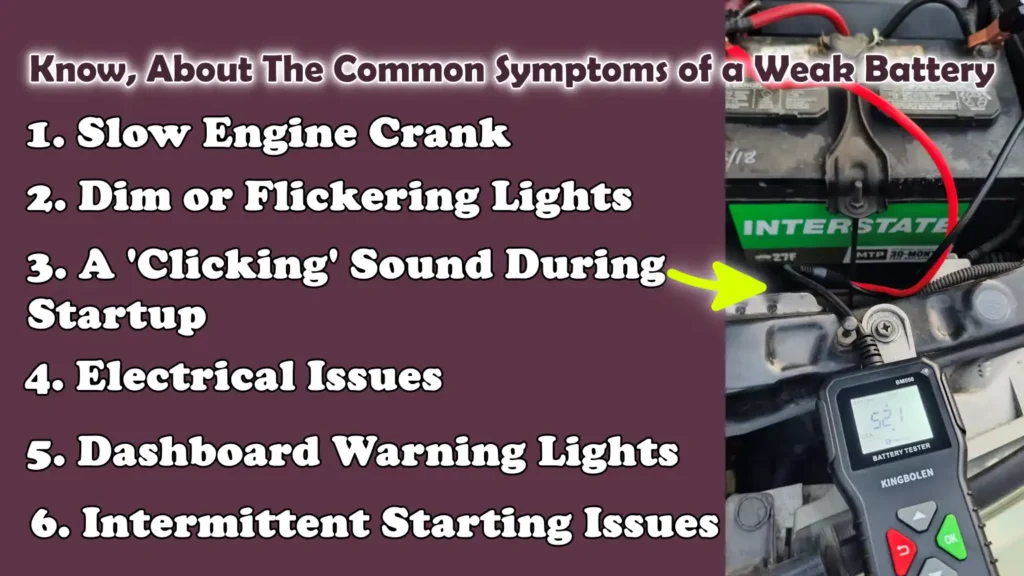
1. Slow Engine Crank
One of the most common and easily recognizable signs of a weak battery is a slow engine crank.
When you attempt to start the car, the engine turns over more slowly than usual because the battery is unable to supply the necessary power to the starter motor.
Instead of starting quickly and effortlessly, the sound of the engine cranking appears sluggish and weak.
You may also hear grinding or straining sounds, indicating that the engine is struggling to turn over; this signals that the battery’s voltage is dropping under load.
This symptom often appears in the early stages of battery deterioration and tends to worsen over time as the battery continues to weaken.
2. Dim or Flickering Lights
Dim or flickering lights are another clear indication that the battery is failing to provide a consistent power supply.
The headlights may appear dimmer than usual, particularly when the engine is turned off or idling.
When you attempt to start your car, the interior lights often dim significantly because the battery diverts most of its limited power to the starter motor.
Flickering lights can also be an indication of unstable voltage; this typically occurs when the battery is losing its ability to maintain a consistent charge.
This symptom is easy to recognize and is often one of the earliest visible signs of a weakening battery.
3. A ‘Clicking’ Sound During Startup
A ‘clicking’ sound when turning the key or pressing the start button usually indicates that the battery lacks the necessary power to fully engage the starter motor.
Rapid, repetitive clicking sounds often occur when the battery voltage is extremely low, causing the starter relay to repeatedly switch on and off.
Conversely, a single ‘click’ may suggest that the battery retains slightly more power, though it is still insufficient to crank the engine.
These sounds are a definitive sign that the battery is failing to deliver the required current, particularly during vehicle startup, when power demand is at its peak.
4. Electrical Issues
A weak battery can also trigger a variety of electrical issues within the vehicle, as modern cars rely heavily on stable voltage to function correctly.
Power windows may operate more slowly than usual and systems such as infotainment screens may become sluggish, freeze, or suddenly restart.
Other electronic components, such as: the central locking system, sensors, or dashboard displays, may also fail to function properly.
These issues arise because the battery is unable to maintain the consistent power supply required to support multiple systems simultaneously.
5. Dashboard Warning Lights
A warning light illuminating on the dashboard related to the battery or charging system is another critical indicator that should not be ignored.
This light typically signals an issue with the battery, the alternator, or the entire charging system.
While it does not always imply that the battery itself is defective, this indicator frequently appears when the battery is not charging properly or when voltage levels fall outside the normal operating range.
If this warning light appears in conjunction with other symptoms, it is a definitive sign that the battery or charging system requires inspection.
6. Intermittent Starting Issues
Intermittent starting problems are a common, and often frustrating, symptom of a weak battery.
The vehicle may start normally on one occasion, yet fail to start the next time, even if the conditions remain exactly the same.
This occurs because a weak battery sometimes retains just enough charge to crank the engine, but that charge is rapidly depleted after use.
Factors such as temperature fluctuations, the interval between driving sessions and electrical load can influence this behavior.
This inconsistency is often a clear indication that the battery is nearing the end of its service life and requires immediate inspection or replacement.
Know, Causes of a Weak Car Battery
A car battery becomes weak when it fails to store or deliver the electrical power necessary to meet the vehicle’s demands.
This typically occurs gradually, as the chemicals within the battery’s internal components begin to degrade; however, it can also result from external factors that diminish its charging capacity or increase its power consumption.
Understanding the root causes is crucial, as a weak battery does not always imply that it has reached the end of its lifespan.
In many instances, the issue is linked to how the car is being used, the condition of its electrical connections, or a fault within the charging system.
Identifying the precise cause allows you to resolve the problem effectively without unnecessarily replacing the battery.
1. Age and Natural Wear
Over time, every car battery’s ability to store a charge diminishes as the chemicals within its internal cells naturally begin to degrade.
The internal plates gradually deteriorate and the chemical reactions responsible for generating electricity become less efficient.
This process is irreversible and constitutes the primary reason why most car batteries last only three to five years.
As a battery ages, it continues to function but delivers reduced power, particularly during engine startup, when the demand for electricity is at its peak.
A gradual decline in performance, longer engine cranking times and unreliability are all common indicators of this natural aging process.
2. Parasitic Drain – Power Consumption by Electronic Components
Parasitic drain occurs when electrical components continue to consume power even after the vehicle has been switched off.
Modern vehicles are equipped with various systems, such as: clocks, alarms and control modules, that continuously draw a small amount of power; this is considered normal operation.
However, if a fault develops, such as: a faulty relay, a stuck switch, or a poorly connected accessory, it can draw excessive power, gradually draining the battery completely, whether overnight or over the course of a few days.
Repeatedly discharging the battery in this manner weakens it over time and diminishes its capacity to hold a full charge, leading to recurring difficulties in starting the vehicle.
3. Corroded or Loose Terminals
Battery terminals play a crucial role in transmitting electrical power from the battery to the vehicle.
If the terminals are corroded or improperly connected, the flow of electricity is impeded.
Corrosion typically manifests as a white or bluish powdery substance surrounding the terminals; acting as an insulator, it obstructs the flow of electrical current.
Loose connections can also cause intermittent interruptions in the power supply, leading to starting difficulties and other electrical malfunctions.
Even if the battery itself is in good condition, poor terminal connections can cause it to perform as if it were a weak or failing battery.
4. Extreme Temperatures – Effects of Heat and Cold
Temperature has a profound impact on both battery performance and lifespan.
Excessive heat accelerates the chemical reactions occurring within the battery, leading to premature degradation and the evaporation of the electrolyte, factors that cause long-term damage to the battery.
Conversely, cold temperatures slow down these internal chemical reactions, thereby reducing the battery’s power output capacity.
This is why starting an engine can be difficult in cold weather, particularly if the battery is already in a weakened state.
Repeated exposure to extremely high temperatures can significantly shorten a battery’s lifespan and negatively impact its overall reliability.
5. Short Driving Trips – Incomplete Charging
Due to short driving trips, the battery does not have sufficient time to fully recharge after the engine has been started.
Every time you start the car, a significant amount of energy is consumed; the alternator requires a substantial amount of driving time to replenish that energy.
If the car is used primarily for short-distance travel, the battery remains undercharged, which gradually diminishes its capacity and degrades its overall performance over time.
This issue is common among city drivers, where frequent stops and short trips prevent the battery from charging properly.
6. Faulty Alternator
The function of the alternator is to recharge the battery and power the vehicle’s electrical system while the engine is running.
If the alternator is not functioning correctly, the battery will not receive a full charge, even if the battery itself is brand new.
Consequently, the battery’s power gradually depletes, causing it to weaken.
Symptoms of a faulty alternator include dimming lights while driving, illuminated dashboard warning lights and frequent battery discharge.
In such cases, simply replacing the battery will not resolve the issue unless the underlying fault within the alternator is repaired.
How to Diagnose Weak Battery Symptoms – Beginner Friendly Guide
To accurately identify a weak battery, it is essential to adopt a simple yet systematic approach to ensure you do not confuse it with other issues, such as: an alternator malfunction or excessive power consumption.
Many battery-related problems appear similar on the surface; however, performing specific tests yields clear and measurable results that help you pinpoint the root cause of the actual problem.
By following these steps sequentially, utilizing simple tools and visual inspections, you can progress from a preliminary check to more precise diagnostic testing.
This method eliminates the need for guesswork and ensures that you are addressing the actual issue, rather than unnecessarily replacing components.
1. Visual Inspection
The first step is to conduct a careful visual inspection, as many battery-related problems can be identified without the use of any tools.
Begin by checking the battery terminals for corrosion; this often appears as white, powdery, or light-blue crystalline deposits around the metal connections.
Such buildup can impede the flow of electricity and degrade the battery’s overall performance.
Next, inspect the battery casing for any signs of bulging, swelling, or cracks; these indicate internal damage or overheating and generally suggest that the battery is no longer safe or reliable.
Furthermore, ensure that the battery cables are securely tightened and not loose, as even a slightly loose connection can hinder engine starting and disrupt the flow of electricity.
This preliminary inspection can quickly reveal issues that might otherwise be mistakenly attributed solely to a weak battery.
2. Battery Voltage Check – Multimeter Test
Using a multimeter to check the battery’s voltage is one of the most reliable methods for determining its current condition.
When the engine is off, the voltage of a fully charged battery in good condition typically hovers around 12.6 volts.
If the reading is closer to 12.4 volts, the battery is slightly weak; and if it drops to 12.2 volts or lower, it indicates that the battery has become significantly weak and may struggle to start the engine.
When the engine is running, the voltage should rise to between 13.7 and 14.7 volts; this indicates that the alternator is charging the battery properly.
If the voltage does not reach this range, it may mean that the problem lies not with a weak battery, but rather with the charging system itself.
3. Cranking Voltage Test
The cranking voltage test reveals how the battery performs under load, that is, when it is under strain while starting the engine.
During cranking, a slight drop in voltage is natural, as the starter motor requires a significant amount of electrical power to engage.
However, in a healthy battery, the voltage should not drop below approximately 9.6 volts.
If the voltage drops significantly below this threshold, it indicates that the battery is unable to handle the load and has likely become weak or is deteriorating.
This test is crucial because a battery may display a normal voltage reading while idle, yet fail at the very moment it is needed most, specifically, when starting the engine, when the demand for power is at its peak.
4. Load Testing
Load testing is a more advanced method used to measure how effectively a battery can deliver power when placed under stress.
In this test, a controlled load is applied to the battery, while simultaneously monitoring the impact this has on its voltage.
A healthy battery will maintain a consistent voltage throughout the test, whereas a weak battery will exhibit a rapid decline.
Load testing can be performed using a dedicated battery tester, or it can typically be carried out at most auto repair shops or parts stores.
This method provides a reliable assessment of the battery’s condition and is frequently used to determine whether the battery requires replacement.
5. Checking for Parasitic Drain
Parasitic drain occurs when electrical components continue to draw more power than normal even after the car has been turned off, causing the battery to gradually discharge over time.
A common symptom of this is a weakened or completely dead battery after the vehicle has been left parked overnight or for a few days.
Basic testing involves checking whether any lights, accessories, or systems remain active even when the vehicle is switched off.
A more precise method involves using a multimeter to measure the amount of current being drawn from the battery, a figure that should typically be very low.
If the drain exceeds expected levels, it can deplete the battery, even if the battery itself is in good condition.
6. Alternator Output Test
The alternator output test verifies whether the battery is charging properly while the engine is running.
If the alternator is not supplying sufficient power, even a new battery can become weak.
With the engine running, the voltage should typically fall between 13.7 and 14.7 volts.
If the reading drops below this range, it may indicate that the alternator is not charging the battery effectively.
Conversely, if the voltage is excessively high, it could signal overcharging, a condition that can also damage the battery.
This test is crucial as it helps pinpoint the true source of the problem: whether it lies with the battery itself or with the charging system.
Tools
| Tool Name | How to Use It | Why It Is Needed |
|---|---|---|
| Multimeter | Set the device to DC voltage mode; connect the red probe to the positive terminal and the black probe to the negative terminal. Observe the voltage reading on the screen with the engine off and then check it again with the engine running. | This provides a clear and accurate reading indicating whether the battery is in good condition, weak, or not charging properly. |
| Battery Load Tester – Optional | Connect the device to the battery terminals, apply a load according to the device’s instructions and observe how much the voltage drops during the test. | This demonstrates how the battery performs under actual starting conditions, helping to confirm whether the battery is genuinely weak. |
| Wire Brush or Terminal Cleaner | Disconnect the battery cables and gently rub the terminals and cable ends until clean metal is visible; then, reconnect them securely. | Clean terminals ensure proper power flow and prevent false indications of a weak battery. |
| Safety Gloves and Glasses | Wear gloves and safety goggles before handling the battery, specially during cleaning or inspection. | This protects against injuries caused by battery acid, sparks, or debris, thereby ensuring the safety of the procedure. |
Voltage Chart – Meaning and Use
| Battery Condition | Voltage Level | What It Means | How to Use This Reading | Why It Is Important |
|---|---|---|---|---|
| Fully Charged | Around 12.6V | The battery is robust and holds a full charge. | With the engine off, use a multimeter to measure the voltage and confirm that it is approximately 12.6V. | This confirms that the engine is starting properly and that all electrical systems are functioning correctly. |
| Slightly Weak | Around 12.4V | The battery has lost some of its charge, but it is still operating normally. | Check the voltage before starting the car; if it is around 12.4V, consider recharging it soon. | This helps detect early signs of battery weakness before they lead to starting difficulties. |
| Weak Battery | Around 12.2V | The battery lacks sufficient power to deliver consistently good performance. | Check the voltage and observe whether the engine is struggling to start or cranking slowly. | This serves as a warning that the battery may fail soon and may require recharging or replacement. |
| Dead or Discharged | 12.0V or lower | The battery has very little, or perhaps no, usable power remaining. | If the voltage is 12.0V or lower, attempt to recharge the battery or jump-start the vehicle. | This prevents a situation where the car fails to start and confirms that the battery is no longer capable of functioning properly. |
When to Replace and When to Recharge the Battery
Deciding whether to recharge or replace a battery depends on its overall condition, age and its ability to effectively store and supply power.
A battery can lose its charge due to several common reasons, such as: leaving the lights on or not driving the car for an extended period, but this does not always mean the battery is permanently ruined.
However, if the internal components of the battery have worn out, recharging will only provide a temporary fix and the problem will eventually recur.
Understanding the distinction between a temporary loss of charge and a permanently failed battery can save you from wasting money on repeated recharges or unnecessary replacements.
1. When Recharging the Battery Is Sufficient
Recharging the battery is sufficient when its overall condition remains good, but it has lost its charge due to usage or external factors.
For instance, if the car has been parked for a long time, or if the lights or other accessories were left on, the battery may discharge; however, internally, it may still be sound.
In such cases, recharging the battery restores its proper functionality.
A battery that retains its charge after being recharged, and maintains a normal voltage level (typically around 12.6 volts with the engine off), is still fit for use.
If the car starts normally after charging and the charge does not deplete rapidly again, it is a clear indication that the battery does not need to be replaced.
2. Signs That the Battery Must Be Replaced
The battery must be replaced when it fails to retain a charge or provide sufficient power, even after being fully charged.
Common signs include slow engine cranking, a recurring need for jump-starts and a rapid drop in voltage levels following a recharge.
External signs, such as: a swollen battery case, cracks, or fluid leakage, also indicate that the battery has deteriorated internally and cannot be repaired.
If a battery is more than three to five years old and is experiencing persistent performance issues, it is likely nearing the end of its lifespan.
In such cases, recharging the battery will not resolve the problem, as its internal chemical composition has already degraded.
3. Cost vs Risk Analysis
When deciding between recharging and replacing a battery, it is essential to strike a balance between cost and reliability.
Recharging the battery is a more economical and time-efficient solution, and indeed beneficial if the battery is in good condition, but relying on a weak or deteriorating battery carries the risk of sudden vehicle breakdown.
This can result in greater losses in the form of wasted time, towing expenses, or other inconveniences.
While replacing a battery entails a higher upfront cost, it ensures reliable performance and peace of mind, particularly when the existing battery is old or no longer trustworthy.
Ultimately, the right decision depends on the frequency of the issue and the level of reliability required for your daily driving needs.
How to Prevent Battery-Related Issues
Preventing problems associated with battery degradation is far easier and less expensive than dealing with a sudden battery failure.
This depends largely on your daily habits and routine maintenance.
A car battery performs best when it is fully charged, clean and utilized in a manner that preserves its natural charging cycle.
Many battery issues do not stem from internal defects, but rather from daily usage patterns that gradually compromise the battery’s health over time.
By adhering to a few basic guidelines, you can extend your battery’s lifespan, maintain its reliable performance and avoid inconveniences such as your vehicle failing to start unexpectedly.
1. Regular Driving Habits
Regular driving plays a crucial role in keeping a battery healthy, as the alternator requires sufficient time to recharge the battery after the engine has been started.
When you drive for longer distances, the battery receives a full charge, which helps maintain its capacity and performance.
Short trips, particularly frequent short trips, do not provide the battery with enough time to replenish the energy expended during the starting process, causing the battery to gradually weaken over time.
Consistent driving habits, including occasional long-distance trips, help keep the battery properly charged and minimize the risk of it becoming undercharged.
2. Cleaning the Terminals
Keeping the battery terminals clean is essential for maintaining a strong and stable electrical connection.
Over time, corrosion can accumulate around the terminals, potentially disrupting the flow of electricity between the battery and the vehicle.
This can lead to issues such as sluggish starting or diminished performance of electrical components, even if the battery itself is in good condition.
Regular cleaning removes this buildup, ensuring that the battery can supply power efficiently.
Clean connections also facilitate accurate readings when assessing the overall health of the battery.
3. Preventing Complete Discharge
To preserve the internal health of the battery, it is crucial to prevent it from undergoing a “complete discharge” (i.e., allowing it to run completely flat).
A battery becomes completely discharged when its power level drops to a critically low point, for instance, when lights or other accessories are left on for extended periods while the vehicle’s engine is off.
Repeated instances of complete discharge can damage the battery’s internal components and diminish its capacity to retain a charge.
While an occasional discharge may not immediately cause a major failure, frequent complete discharges significantly shorten the battery’s lifespan.
Keeping the battery charged, and ensuring that all electrical accessories are switched off when the engine is not running, helps prevent this issue.
4. Periodic Inspections
Periodically inspecting the battery allows you to monitor its condition and detect potential problems before they escalate or lead to battery failure.
Checking the battery voltage with a multimeter, or having it tested by a professional at regular intervals, helps you determine whether the battery is charging properly.
As a battery ages, such inspections become even more critical, as its performance may gradually decline without any obvious warning signs.
Regular inspections provide clear insights into the battery’s health, enabling you to determine the appropriate time to recharge, maintain, or replace it.
Read More:
- How to Test Battery Cold Cranking Amps
- How to Check Car Battery Voltage with Multimeter
- How to Check Parasitic Battery Drain
- How to Replace a Starter Motor
- How to Check Car Battery Health with a Multimeter
- How to Fix Car Not Starting
Know About Common Diagnostic Mistakes to Avoid
Identifying a weak battery might seem simple, but many drivers, and even novices, make common mistakes that lead to incorrect conclusions and unnecessary repairs.
Battery-related issues often mimic other problems within the charging or electrical systems; therefore, careful inspection and a thorough understanding of all the components involved are crucial.
By avoiding these errors, you can save money, prevent recurring malfunctions and ensure that you are addressing the root cause of the problem rather than merely treating its symptoms.
The foundation of accurate diagnosis lies not just in checking the battery itself, but in examining all of its associated components.
And, a car battery actually works through a chemical process that actually produces electricity which is needed to start the engine, but over the time; this process becomes less effective, which reduces the battery’s ability to hold and deliver power, so this shows that even basic function helps you to explain why batteries weaken and show symptoms such as: slow starting and dim lights as well.[¹]
1. Blaming the Battery Instead of the Alternator
One of the most common mistakes is assuming that the battery is at fault when, in reality, the alternator is the culprit.
When the engine is running, the alternator is responsible for recharging the battery; if it ceases to function, the battery will gradually discharge, regardless of how new it may be.
When a car fails to start, many people replace the battery; however, if the alternator is not functioning correctly, even a brand-new battery will quickly discharge.
It is essential to check the charging voltage while the engine is running to ensure that the alternator is generating sufficient power.
2. Ignoring Corrosion
Ignoring corrosion on the battery terminals is another mistake that can lead to an incorrect diagnosis.
Corrosion acts as a barrier between the battery and the vehicle’s electrical system, thereby impeding the flow of electricity.
Its symptoms may include slow starting, dim lights, or interruptions in the electrical supply, issues that are often mistakenly attributed to a weak battery.
If the battery connections are dirty or loose, even a perfectly functional battery can appear to be defective.
Before testing or replacing a battery, it is always essential to clean the terminals and ensure that the connections are secure.
3. Skipping Load Testing
Skipping a load test can result in an incomplete diagnosis; while a battery may appear healthy when tested in a resting state, it could actually fail under real-world driving conditions.
A simple voltage check reveals only the battery’s current charge level, not its capacity to deliver power effectively when needed.
Load testing simulates actual vehicle starting conditions, thereby revealing whether the battery can handle high electrical demands.
Without this test, it is easy to assume that the battery is in good condition, whereas in reality, it may be weak or prone to failure under heavy loads.
4. Misinterpreting Voltage Readings
Misinterpreting voltage readings is another common mistake that leads to confusion regarding a battery’s health.
Many people perform a single voltage check and assume the battery is fine without fully understanding the correct reference ranges.
For instance, a reading of approximately 12.2 volts may appear normal at first glance, but in reality, it indicates that the battery is weak.
Similarly, failing to check the voltage while starting the engine or while the engine is running can allow serious internal battery issues to go undetected.
For an accurate assessment, it is crucial to understand the significance of each specific voltage level and to test the battery under various operating conditions to obtain a comprehensive picture of its health.
Conclusion – How to Diagnose Weak Battery Symptoms
You need to know that difference between a smooth start and a frustrating breakdown begins with the battery condition, so you need to understood, tested and maintained it at the right time.
No battery ceases to function abruptly; typically, it offers prior warning signs, such as: slow cranking, dimming lights, or difficulty starting.
These symptoms can be confirmed through a few simple yet reliable diagnostic tests.
By checking voltage levels, observing the battery’s performance under load and ensuring that the charging system is functioning correctly, you can accurately determine whether the battery is weak, discharged, or suffering from some other internal issue.
It is also crucial to remember that every instance of starting difficulty does not necessarily mandate a battery replacement; similar issues can stem from other causes, such as corrosion, frequent short-distance driving, or a faulty alternator.
By adopting a systematic, step-by-step diagnostic approach, you avoid unnecessary expenses and ensure that the true root cause of the problem is addressed.
Furthermore, regular maintenance and good driving habits play a pivotal role in preventing battery-related issues before they even arise.
Keeping battery terminals clean, avoiding complete discharge of the battery and conducting periodic inspections can significantly extend the battery’s lifespan and enhance its reliability.
As most batteries have a finite lifespan, recognizing when their performance begins to deteriorate allows you to plan for a timely replacement, thereby avoiding the inconvenience of a sudden vehicle breakdown.
Now, that’s all from this guide about How to Diagnose Weak Battery Symptoms, also you can ask questions.
Frequently Asked Questions
FAQ 1: How can I tell if my car battery is weak or completely dead?
A weak car battery typically retains some residual power, but it lacks the necessary energy to properly start the engine. You may notice the engine cranking slowly, the lights appearing dim, or the car starting intermittently, sometimes it starts and other times it doesn’t. On the other hand, a completely dead battery retains absolutely no usable power and the car will not start at all. In most cases, when you attempt to start the car, you may hear only a faint “click,” or perhaps no sound whatsoever. The best way to confirm this distinction is to check the battery’s voltage. A weak battery will register a low voltage, though it will be above zero, whereas a completely dead battery will show very little to no voltage at all.
FAQ 2: Can a weak battery still start a car?
Yes, a weak battery can indeed start a car, but it is unreliable. It might function correctly once, only to fail the next time, as it lacks the capacity to store the energy required for repeated starting attempts. This is why many people get confused; the car sometimes starts normally, but then suddenly struggles to start or fails completely, on a subsequent attempt. A weak battery is unpredictable; therefore, to avoid getting stranded on the road, you should have it inspected as soon as possible.
FAQ 3: What are the early signs of a weak battery?
The early signs of a weak battery typically include slow engine cranking and dim lights. When you attempt to start the car, the engine may take longer than usual to turn over, indicating that the battery is struggling to deliver the necessary power. You may also notice that your headlights or interior lights are not shining as brightly as they used to, particularly while the engine is cranking. These early warning signs are crucial because they manifest before the battery fails completely.
FAQ 4: How long can you drive with a weak battery?
As long as the engine is running, you can continue driving with a weak battery because the alternator continuously supplies power to the vehicle. However, the real risk arises when you turn off the engine, as the battery may not retain sufficient charge to restart the car. A weak battery can leave you stranded at any moment specially after a brief stop or in cold weather conditions. Rather than hoping it will last a little longer, it is always best to diagnose the issue and have it repaired as soon as possible.
FAQ 5: Can a weak battery recharge itself?
When the engine is running, a weak battery can recharge to some extent because the alternator supplies it with power. However, if the battery is old or worn out, it will not be able to hold a charge effectively, even after being recharged. This means it may quickly lose its power again. Recharging is only beneficial if the battery is in good internal condition. If the battery repeatedly loses its charge, it likely needs to be replaced.
FAQ 6: Can a faulty alternator exhibit symptoms similar to those of a weak battery?
Yes, a faulty alternator can indeed exhibit symptoms that closely resemble those of a weak battery. If the alternator is not charging properly, the battery will gradually lose its power and become weaker over time. This can lead to difficulties in starting the vehicle, dimming lights and frequent battery discharge. Therefore, to ensure that you are addressing the actual underlying issue, it is essential to inspect the charging system in addition to the battery itself.
FAQ 7: How often should I check my car battery?
It is a good idea to check your car battery at least once every few months, specially if it is more than two to three years old. Regular checks allow you to detect early signs of battery weakness before it fails completely. You should also check the battery if you notice symptoms such as difficulty starting the vehicle or other electrical issues. Frequent checks help you better understand the battery’s condition, enabling you to plan for its repair or replacement at the appropriate time.
FAQ 8: Why does a battery weaken so quickly?
A battery can weaken quickly due to various factors, such as extreme temperatures, frequent short trips, leaving lights or other accessories switched on, or a fault within the charging system. Corrosion on the battery terminals and “parasitic drain” (unnecessary power consumption) caused by electrical components can also degrade battery performance. These factors either prevent the battery from charging properly or deplete its power more rapidly than usual.
References:
[1] wikipedia.org, Lead–acid battery
https://en.wikipedia.org/wiki/Lead%E2%80%93acid_battery

Hello Folks, Dean Shali here to help you out to solve the problems with your lovely vehicle, as i have lots of experience and knowledge about automotive industry as i woks directly with the customers and repair vehicles and i love to help the people to keep their cars safe and running smoothly.