
Written By: Dean Shali
Fact Checked By: Sabré Cook
Reviewed By: Tamara Warren
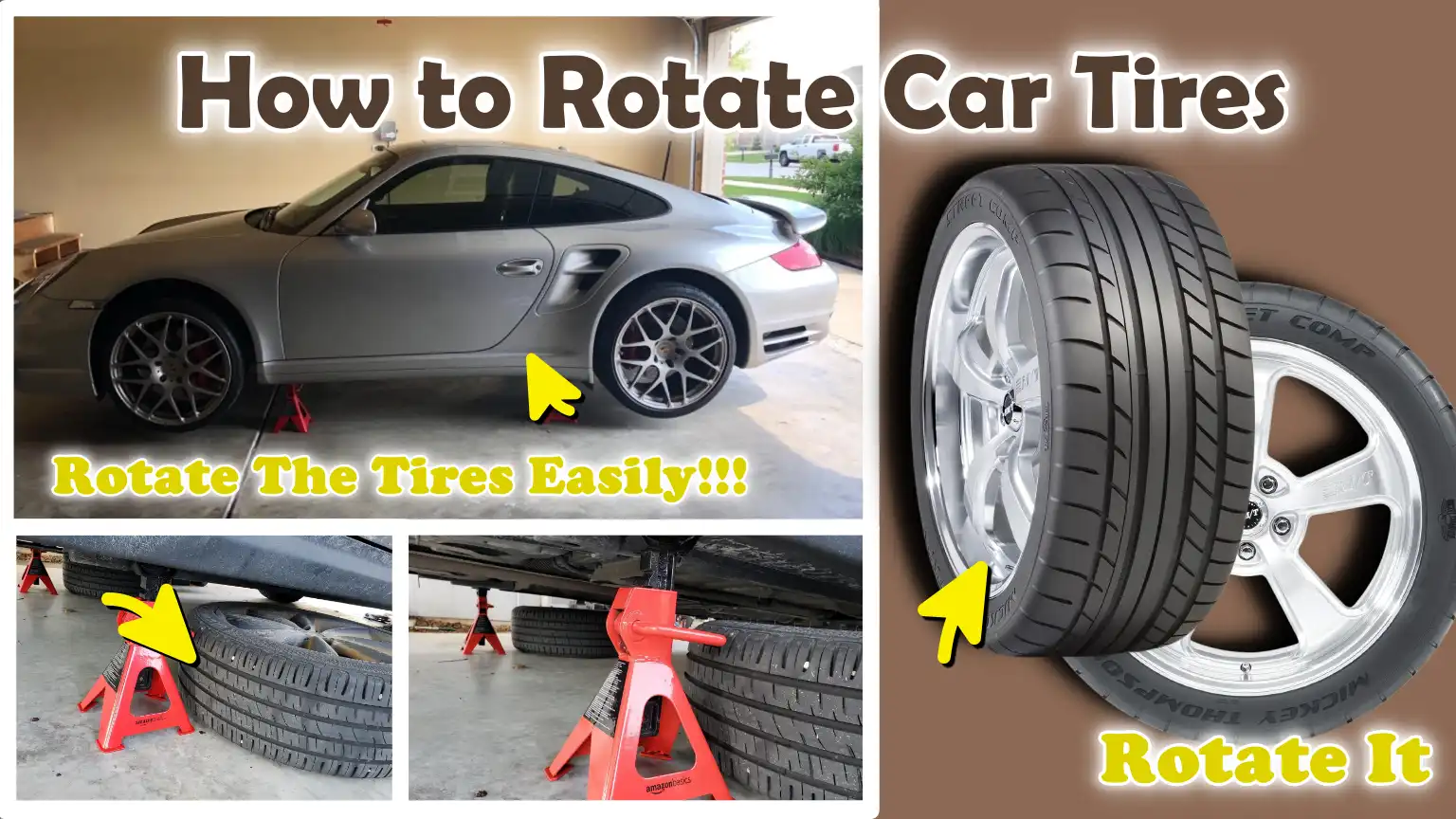
Your tires works really really hard; there’s not doubt about that, but you need to help them by rotating them at the regular time interval to prevent uneven tire wear and last much longer than usually does.
This is important, as this is the actual thing that directly touched the road, that’s why you need to make them evenly wear, so that your safety, handling and overall driving performance won’t get compromised in all means.
Also, tires are the ones that wear down unevenly as different wheels carry different kinds of loads and performs different kinds of tasks while running.
Just take an easy example: in the front-wheel-drive vehicles the front tires actually wear faster as they handle the steering, acceleration and most of the braking forces as well.
Even, there’s organizations such as: National highway Traffic Safety Administration and the Rubber Manufacturers Association that gives importance to the tire maintenance in terms of tire rotation in regular way, as it actually plays an important role to maintain traction and prevent any premature tire wear as well.
In simple way: tire rotation actually means that you need to move each tire to the different position on the vehicle so that the all tires wear in even way over the period of time and usage.
So, what’s the point to do this all things: when tire wears evenly then they can actually last thousands of miles longer, which definitely provides better grip on the wet or slippery roads and helps you to maintain the stable steering and braking performance as well.
That’s why, in this guide you’ll know How to Rotate Car Tires, so that you can easily rotate without having bad effect on the driving experience as well.
What Is Tire Rotation?
Tire rotation is a regular vehicle maintenance process that helps ensure that all tires wear evenly over time.
Because each tire on a car performs slightly different functions, they don’t wear at the same rate.
Some tires handle more steering force, while others handle more engine power or braking pressure.
Over thousands of miles of driving, this difference can cause some tires to lose tread faster than others.
Tire rotation solves this problem by periodically moving each tire to a different position on the vehicle.
By changing positions, each tire is exposed to different driving forces, helping to balance wear across all four tires.
Automotive experts and tire manufacturers typically recommend tire rotation every 5,000 to 8,000 miles, which often coincides with the regular oil change interval.
When performed regularly, this simple maintenance step helps maintain tire tread depth, improve vehicle stability and ensure more balanced and predictable tire wear.
1. Definition of Tire Rotation
Tire rotation is the process of moving each tire from one wheel position to another in a specific pattern to ensure more uniform wear.
For example, based on the specified rotation pattern, front tires may be rotated backward, rear tires forward, or diagonally.
This process does not replace the tires themselves, but simply changes where they are mounted on the vehicle.
The purpose of tire rotation is to ensure that no tire wears more than the others.
When all tires wear at the same rate, vehicle traction, braking performance and steering control remain balanced.
Regularly rotating tires is one of the most effective ways to extend the usable life of a set of tires and maintain consistent driving performance.
2. Why Tires Wear Out Evenly
Tires don’t wear out evenly because different wheels handle different forces while driving.
Weight distribution, engine power, steering movement and braking pressure all affect how quickly tire tread wears out.
Road conditions, driving habits and vehicle design also play a role.
For example, rapid acceleration, hard braking, or sharp turns can increase the rate at which some tires lose tread.
Without regular rotation, some tires can wear out significantly more than others, reducing traction and shortening tire life.
Front-Wheel Drive Wear Patterns
In front-wheel drive vehicles, the front tires generally wear out faster than the rear tires.
This is because the front wheels perform multiple functions simultaneously.
They are responsible for steering the vehicle, transmitting engine power to the road and handling most of the braking force.
Because of this, the front tires experience more friction with the road surface.
Over time, this increased workload causes the front tire tread to wear faster than the rear tires.
Rotating the tires distributes this wear evenly across all four wheels.
Rear-Wheel Drive Wear Pattern
In rear-wheel drive vehicles, the rear tires receive engine power and propel the vehicle.
This means the rear tires handle most of the acceleration force, while the front tires primarily focus on steering and braking.
Because of this difference, rear tires can wear faster under certain driving conditions, specially when accelerating or carrying heavy loads.
Regular tire rotation ensures that the rear tires don’t wear faster than the front tires, maintaining balanced tire performance.
All-Wheel Drive Wear Patterns
All-wheel drive vehicles send power to all four wheels, improving traction and stability on varying road surfaces.
Even though power is distributed to all tires, they may not wear evenly.
Differences in weight distribution, steering force and braking pressure can cause some tires to wear faster than others.
In many all-wheel drive systems, maintaining consistent tire wear is crucial, as large variations in tire tread depth can impact drivetrain performance.
Regular tire rotation helps maintain consistent tread depth across all tires, improving vehicle operation and preventing unnecessary stress on mechanical parts.
3. Benefits of Regular Tire Rotation
Even Tread Wear
One of the main benefits of tire rotation is that tread wear remains even across all tires.
When tires wear evenly, they maintain consistent traction with the road surface.
This improves braking performance and makes the vehicle easier to control in varying driving conditions, such as rain or rough roads.
Extends Tire Life
Regular tire rotation can significantly extend the life of a set of tires.
When one tire wears out faster than the others, the entire set may need to be replaced earlier than expected.
By evenly distributing wear, tire rotation allows drivers to use all four tires to their full potential before replacement is necessary.
Improved Fuel Efficiency
Properly maintained tires can also help improve fuel efficiency.
Tires with a consistent tread pattern run smoother and create less friction on the road.
When the engine doesn’t have to work as hard to propel the vehicle, fuel consumption may improve slightly over time.
Improved Handling and Safety
Balanced tire wear helps maintain stable steering and predictable vehicle handling.
When all four tires have similar tread depth and grip, the car responds more accurately to steering inputs and braking.
This balance improves overall driving safety, specially when making sudden stops or driving on wet or slippery roads.
Regular tire rotation helps ensure that each tire continues to provide reliable traction and support for safe driving.
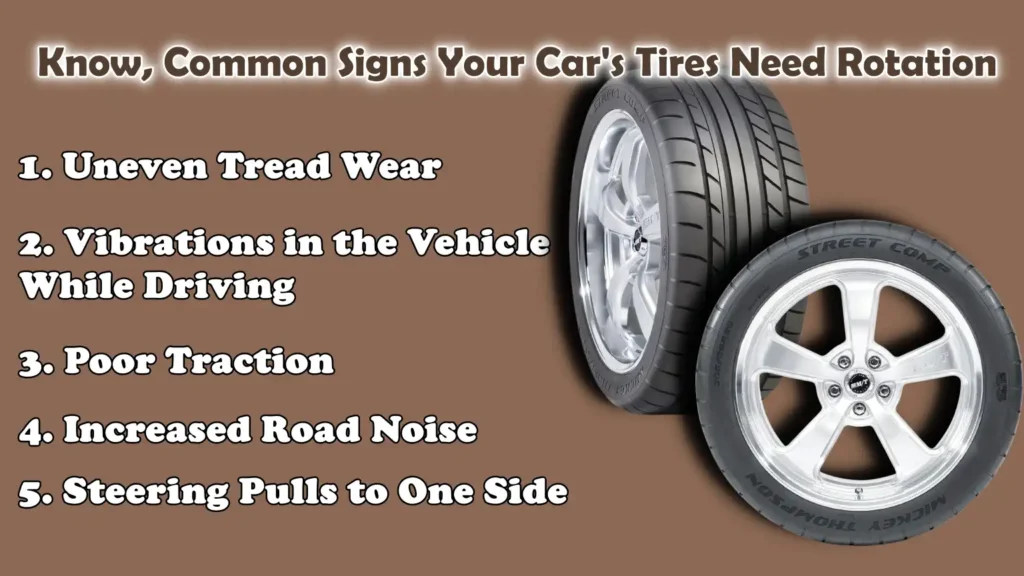
Know, Common Signs Your Car’s Tires Need Rotation
Tires gradually wear down with each drive and this wear pattern can provide important information about tire condition and maintenance.
When tires are left in the same place for extended periods, differences in weight distribution, braking pressure and steering force cause some tires to wear faster than others.
Recognizing the early signs that your tires need rotation can help prevent uneven tread wear, reduce the risk of tire failure and extend tire life.
Drivers who pay attention to these warning signs can detect problems early and keep their vehicles running smoothly and safely.
Tire manufacturers and automotive experts generally recommend regular tire rotation, but certain symptoms may indicate that tires need to be rotated more frequently to maintain proper traction, balance and stability.
1. Uneven Tread Wear
Uneven tread wear is one of the most common and visible signs that tires need rotation.
The tread is the patterned rubber surface that touches the road and provides grip for braking, turning and accelerating.
Over time, some tires may lose tread faster than others because they experience more pressure and friction during driving.
For example, in many vehicles, the front tires bear more of the engine’s weight and are responsible for steering, so they often wear out faster than the rear tires.
If you look closely at the tire surface and notice that some tires appear more worn than others, or if the tread depth varies, it could be a sign that the tires haven’t been rotated recently.
Rotating tires helps distribute wear more evenly so that all tires maintain a consistent tread depth and maintain a strong grip on the road.
2. Vibrations in the Vehicle While Driving
Unusual vibrations while driving can also be a sign that the tires need to be rotated.
When tires wear unevenly, they can lose their balanced shape, causing the vehicle to vibrate slightly at certain speeds.
Drivers often notice this vibration through the steering wheel, floor, or seat when driving on smooth roads.
Although vibrations can sometimes be caused by wheel imbalance or suspension problems, uneven tire wear is a much more common cause.
When tires are rotated regularly, the wear pattern becomes more balanced, helping to maintain smooth contact between the tires and the road surface.
This can reduce unwanted vibrations and improve the overall driving experience.
3. Poor Traction
Poor traction is another sign that tire rotation may be necessary.
Traction refers to how well tires grip the road surface during acceleration, braking and cornering.
When tires wear unevenly, some tires may lose tread depth faster than others, reducing their ability to maintain firm contact with the road.
Drivers may notice this problem when the vehicle skids slightly during acceleration, takes longer to stop when braking, or feels less stable when cornering.
This problem can be more noticeable in wet or slippery conditions, where proper tread depth is essential for road grip.
Regular tire rotation helps ensure even tread wear, allowing all four tires to maintain good traction and contributing to safer driving conditions.
4. Increased Road Noise
A noticeable increase in road noise can sometimes be a sign of uneven tire wear, which may require tire rotation.
As tires wear unevenly, the tread pattern can create a uneven surface, increasing road noise.
When driving at medium or high speeds, drivers may hear a humming-like vibration or a louder-than-normal tire noise.
This sound is often more pronounced on smooth roads, where tire noise is more easily heard.
Road noise can occur for a variety of reasons, but uneven tire wear is a common culprit.
Rotating tires helps balance the wear pattern and can reduce excessive tire noise over time, resulting in a quieter and more comfortable driving experience.
5. Steering Pulls to One Side
When a vehicle begins to pull slightly to one side while driving on a straight road, it could be a sign of uneven tire wear, which could benefit from tire rotation.
If one tire has significantly more or less tread than the other, this can cause an imbalance in traction, which can affect vehicle handling.
Drivers may have to constantly adjust the steering wheel to keep the vehicle driving straight.
While steering pull can sometimes be caused by wheel alignment issues or differences in tire pressure, uneven tire wear is also a common cause.
Rotating tires gives each tire a different position on the vehicle, which helps balance the wear pattern and can improve overall steering stability.
Regular tire rotation, along with proper tire pressure checks and alignment maintenance, helps keep the vehicle driving straight and responding properly to steering inputs.
How Often Should You Rotate Your Car Tires?
Knowing how often you should rotate your car tires is an essential part of maintaining tire performance, safety and long-term durability.
Tire rotation doesn’t need to be done very often, but it should be done at regular intervals to ensure even wear across all four wheels.
When tires are left in the same place for extended periods, some are subjected to more pressure, friction and workload than others.
This uneven workload can cause some tires to lose tread faster, reducing the life of the entire set.
Regular tire rotation helps prevent this problem by distributing wear across all tires.
By rotating tires at the correct intervals, drivers can maintain balanced traction, improve driving comfort and reduce the likelihood of premature tire replacement.
Understanding recommended mileage intervals, following manufacturer advice, aligning tire rotation with routine service and recognizing factors that affect tire wear all help determine the best rotation schedule for your vehicle.
1. General Mileage Recommendation – 5,000 To 8,000 miles
Automotive experts typically recommend replacing car tires every 5,000 to 8,000 miles.
This range is often recommended because it balances tire wear before excessive wear occurs on the tread.
Many vehicles reach this mileage range within just a few months of normal driving, making it the right time for regular maintenance.
When tires are rotated within this mileage range, each tire rotates on a different part of the vehicle before significant wear occurs.
For example, a tire that previously handled steering forces at the front of the vehicle may shift to the rear where the workload is different.
This process helps maintain consistent tread depth across all four tires.
Regular tire rotation within this mileage range can extend tire life by thousands of miles and help maintain safe traction on both dry and wet roads.
2. Manufacturer’s Advice
Vehicle manufacturers often provide specific tire rotation recommendations in the owner’s manual.
These recommendations are based on the vehicle’s design, weight distribution, drivetrain type and suspension system.
Some manufacturers may recommend changing tires at specific mileage intervals, such as every 6,000 or 7,500 miles, while others may recommend replacement during regular service visits.
It’s important to follow the manufacturer’s guidance, as it is designed to meet the vehicle’s engineering specifications.
In some cases, certain vehicles with specialized tire setups or performance tires may have slightly different rotation schedules.
Consulting the owner’s manual helps ensure that tire rotation is performed in accordance with the vehicle’s scheduled maintenance plan, which helps protect both tire performance and overall driving safety.
3. Rotation During an Oil Change
Many drivers find it easier to change their tires when they change the engine oil.
Oil changes are typically performed every 5,000 to 7,500 miles, depending on the type of oil used and the vehicle’s maintenance schedule.
Because this mileage range closely matches the recommended tire rotation interval, combining the two services can simplify regular vehicle maintenance.
Performing tire rotation during an oil change helps drivers remember when the tires were last rotated and ensures regular service.
This method also saves time because the vehicle has already been serviced, making it easier for mechanics or owners to perform the rotation without scheduling additional maintenance visits.
4. Factors Affecting Rotation Frequency
Many factors can affect how often tires should be rotated.
Driving habits play a significant role in tire wear patterns.
Frequent hard braking, rapid acceleration, or sharp turns can accelerate tire tread wear.
Road conditions also affect tire wear.
Regular driving on rough roads, uneven pavement, or areas with numerous potholes can cause tire wear faster.
Vehicle type and drivetrain configuration also affect rotation frequency.
Front-wheel drive vehicles often put more stress on the front tires, while rear-wheel drive vehicles may wear out the rear tires more quickly during acceleration.
All-wheel drive systems deliver power to all tires, but they require regular rotation to maintain balanced tread depth.
Additionally, hauling heavy loads or towing a trailer can put more stress on some tires.
For these reasons, some drivers may benefit from rotating their tires more frequently than typically recommended to maintain even wear and maintain tire performance.
Let’s, Understand About Tire Rotation Patterns
Tire rotation patterns determine how tires will perform.
Different vehicles require different rotation patterns because the forces applied to tires vary depending on the drivetrain and tire design.
Factors such as steering load, engine power delivery, braking force and vehicle weight distribution affect how quickly each tire wears out.
Using the correct rotation pattern allows tires to be positioned where they are subjected to different driving forces, helping to balance wear across all four tires.
This process allows each tire to share the workload over time, rather than one pair wearing out faster than the others.
Choosing the correct tire rotation pattern also helps maintain proper traction, smoother handling and more predictable braking performance.
Automotive technicians and tire manufacturers recommend following the rotation pattern that best suits the vehicle’s drivetrain system and tire design, so that tread wear is as uniform as possible.
1. Forward Cross Pattern – For FWD Vehicles
The forward cross pattern is typically used for vehicles with front-wheel drive systems.
In these vehicles, the front wheels do most of the work, as they are responsible for a large portion of the steering, acceleration and braking forces.
Because of this, the front tires often wear faster than the rear tires.
The forward cross pattern helps balance this wear by moving the front tires to the rear position and switching them from one side of the vehicle to the other.
At the same time, the rear tires move forward but generally remain on the same side of the vehicle.
This rotation pattern ensures that each tire experiences both forward and reverse driving conditions over time.
By sharing the load more evenly, this pattern helps slow uneven tread wear and extends tire life in front-wheel drive vehicles.
2. Rearward Cross Pattern – For RWD and AWD Vehicles
The rear cross pattern is generally recommended for rear-wheel drive and many all-wheel drive vehicles.
In rear-wheel drive systems, the rear tires transmit the engine’s power to the road, which means they often wear faster during acceleration.
In this rotation pattern, the rear tires move to the front position and switch sides of the vehicle, while the front tires move to the rear position and remain on the same side.
This pattern allows the tires that previously handled acceleration forces to be placed in positions where they are subjected to different loads, such as steering and braking.
By distributing these forces across all four tires, the rear cross pattern helps maintain balanced tread wear and improves overall tire performance.
This pattern is also useful for many all-wheel drive vehicles because it helps maintain uniform tread depth across all tires, which is essential for proper drivetrain operation.
3. X-Pattern Rotation
X-pattern rotation is another method used to achieve uniform tire wear, specially when all four tires are the same size and type.
In this pattern, each tire rotates diagonally across the vehicle to the opposite corner position.
For example, the front left tire moves to the rear right position and the front right tire moves to the rear left position.
The rear tires move in the same diagonal direction.
This rotation pattern allows each tire to occupy a completely different position across the vehicle, helping to balance the wear pattern caused by steering force, braking pressure and vehicle weight distribution.
X-pattern rotation is often recommended for vehicles where a more balanced wear pattern is desired across all tires, specially when the tires are non-directional and interchangeable.
4. Front-to-Back Pattern – For Directional Tires
Directional tires are designed to rotate in only one direction because their tread pattern is designed to keep water away from the tire surface in wet driving conditions.
These tires often have arrows on their sidewalls indicating the correct direction of rotation.
Because directional tires must rotate in a single direction, they cannot be moved from one side of the vehicle to the other during rotation.
Instead, they are moved directly from the front axle to the rear axle on the same side of the vehicle.
This is known as a front-to-back rotation pattern.
Although this pattern does not change the side of the tire, it allows the tires to experience different driving loads between the front and rear positions.
This helps reduce uneven tread wear while maintaining the correct rotation direction required for directional tire design.
5. Side-to-side pattern – For Staggered Setups
Some vehicles use a staggered tire setup, which means the tires on the front and rear axles are different sizes.
This configuration is often found on performance vehicles, where wider rear tires provide greater traction during acceleration.
Because the front and rear tires are different sizes, they cannot be swapped between axles during rotation.
Instead, tires can only be moved from one side of the vehicle to the other on a single axle.
This method is known as a side-to-side rotation pattern.
Switching tires from the left side to the right side of the vehicle can balance the wear pattern somewhat, specially if the vehicle turns in one direction more often than the other.
Although staggered tire setups limit the available rotation patterns, side-to-side rotation can help maintain more consistent tread wear and tire performance over time.
Tools
| Tool / Equipment | Why It Is Needed | How to Use It Properly |
|---|---|---|
| Car Jack | When rotating tires, it’s important to raise the wheels off the ground so they can be removed and moved to different locations. Without lifting the car, it’s impossible to safely remove the wheels. | Place the jack under the vehicle’s designated jack point, which is usually listed in the owner’s manual or on the car’s frame. Slowly rotate or pump the jack until the tire is lifted off the ground. Lift the wheel only to safely remove it. |
| Jack Stands | A car jack is for lifting, not for holding the car for extended periods. Jack stands prevent the car from falling and greatly reduce the risk of accidents when working under or around the car. | After jacking up the car, place jack stands under a sturdy frame point. Lower the car slowly until the weight is safely on the stand. Always check for stability before removing the tire. |
| Lug Wrench or Impact Wrench | Lug nuts secure the wheel to the vehicle’s hub. To rotate the tire, these nuts must be loosened and removed so the wheel can be removed from the car. Without this tool, the wheel cannot be removed. | Before fully lifting the car, use a lug wrench to slightly loosen each lug nut. After lifting the wheel, remove the nuts completely and remove the tire. When reinstalling the wheel, retighten the lug nuts in a star pattern to maintain consistent pressure. |
| Torque Wrench | Correct torque is essential for wheel safety. If the lug nuts are too loose, the wheel may move or come off. If they are too tight, they may damage the wheel studs or make them difficult to remove in the future. | After reinstalling the wheel, use a torque wrench to tighten each lug nut according to the vehicle manufacturer’s torque specifications. Tighten in a star pattern to ensure the wheel stays in place. |
| Wheel Chocks | When a vehicle is being lifted, even the slightest movement could cause it to slip or roll. Wheel chocks hold the vehicle firmly in place and increase safety during tire rotation. 5.2 Before lifting the vehicle, place wheel chocks near the tires that will be on the ground. For example, if lifting the front wheels, place the chocks behind the rear wheels to prevent them from moving. | Before lifting the vehicle, place wheel chocks near the tires that will be on the ground. For example, if lifting the front wheels, place the chocks behind the rear wheels to prevent movement. |
| Gloves for Safety | Tire rotation involves handling heavy wheels, metal parts and tools. Gloves protect hands from dirt, grease, sharp edges and minor injuries and also improve grip on tools and tires. | Wear gloves before beginning the tire rotation process. They help maintain a firm grip when loosening lug nuts, lifting tires and safely handling tools during maintenance work. |
Necessary Safety Precautions Before Rotating Tires
Before rotating a car’s tires, it’s crucial to take proper safety precautions to avoid accidents and ensure the job is done correctly.
Tire rotation requires raising the vehicle, removing heavy wheels and working near the car’s mechanical parts.
Neglecting basic safety steps can lead to slips, falls and injuries.
Properly preparing the vehicle creates a stable working environment and makes the tire rotation process safe and easy.
Automotive technicians always take certain safety precautions before lifting or removing tires.
These precautions help stabilize the car, protect vital parts and ensure the tires are installed correctly after rotation.
1. Park on a Level Place
One of the most important safety steps is to park the vehicle on a level and solid surface before rotating the tires.
A flat surface helps balance the vehicle and reduces the risk of movement during lifting.
If the vehicle is parked on a slope, uneven ground, or soft soil, it may slide when lifted with a jack.
This movement can destabilize the vehicle and increase the risk of slipping off the jack or jackstands.
A smooth concrete driveway or garage floor is generally the safest place to rotate tires.
A flat surface also helps distribute the vehicle’s weight evenly, making lifting easier and safer.
2. Apply the Parking Brake
Engaging the parking brake helps prevent the vehicle from moving during tire rotation.
The parking brake works by locking the rear wheels so the vehicle cannot roll forward or backward.
Even minor movements can be dangerous when lifting a car, so applying the parking brake provides greater stability.
Drivers should always apply the parking brake before lifting and keep it on until the tire rotation process is complete.
This simple step helps ensure the vehicle remains firmly in place during the maintenance process.
3. Use Wheel Chocks
Wheel chocks are safety devices used during work that help prevent the vehicle from rolling.
They are typically wedge-shaped blocks placed on the ground in front of the tires.
When a vehicle is being lifted, the weight distribution changes, which can sometimes cause the car to move slightly.
Wheel chocks prevent this movement by restraining the tires and keeping the vehicle securely in place.
For example, if the front tires are being lifted, the chocks should be placed behind the rear tires.
If the rear tires are being lifted, the chocks should be placed in front of the front tires.
This extra step greatly improves vehicle stability and helps prevent sudden movements.
4. Never Rely on a Jack Alone
Car jacks are primarily designed to lift a vehicle, not to secure it for long periods of time.
Relying solely on a jack while working on a vehicle can be dangerous, as the jack can lose pressure or shift position.
If this happens, the vehicle could suddenly tip over.
To avoid this danger, always use a sturdy support tool called a jackstand after lifting the vehicle.
Once the car is jacked up, the jackstand should be placed under a fixed support point on the vehicle’s frame.
The vehicle should then be carefully lowered so that its weight rests on the jackstand.
This provides firm support and makes the workspace safer when removing and installing tires.
5. Follow Torque Specifications
After rotating the tires and reinstalling the wheels, it’s important to tighten the lug nuts according to the correct torque specifications provided by the vehicle manufacturer.
Torque refers to the correct tightening force applied to the lug nuts.
If the lug nuts are too loose, the wheel may move while driving, which can be dangerous.
If they are tightened too much, the wheel studs or threads may be damaged, making wheel removal difficult.
Using a torque wrench helps ensure the lug nuts are properly tightened so the wheel is securely attached to the vehicle.
Proper torque also helps keep the wheel level on the hub, ensuring driving stability and safe operation after tire rotation is complete.
How to Rotate Car Tires – Easy Beginner’s Friendly Guide
Tire rotation is a simple but essential maintenance task that helps balance tire wear and improve overall vehicle safety.
Each tire is subjected to different forces while driving, including steering pressure, braking force, engine power and vehicle weight.
Over time, these forces cause some tires to wear faster than others.
Regular tire rotation allows each tire to rotate across different parts of the vehicle, helping to distribute wear more evenly.
This process can extend tire life, maintain proper traction on the road and improve driving stability.
Following a clear and careful step-by-step process ensures that tire rotation is done safely and correctly.
1. Park the Vehicle Safely
The first step to tire rotation is to park the vehicle in a safe and stable location.
The car should be parked on a flat, solid surface, such as a driveway, garage floor, or level sidewalk.
A flat surface helps prevent the car from rolling or sliding while lifting.
After parking the car, turn off the engine and apply the parking brake to secure the car in place.
This step is important because even the slightest movement while removing the wheels can cause the car to become unstable.
2. Loosen the Lug Nuts
Before lifting the car, slightly loosen the lug nuts that hold the wheels in place.
Lug nuts are very tightly tightened and it is easier and safer to loosen them when the tire is touching the ground.
A lug wrench or impact wrench is usually used for this task.
Each lug nut should be turned just enough to break the tight seal, but they should not be removed completely at this stage.
Loosening them quickly prevents the wheel from rotating while lifting the car.
3. Raise the Car Using a Jack
Once the lug nuts are loosened, the car can be raised using a car jack.
The jack should always be placed under the correct lifting points specified by the vehicle manufacturer.
These points are usually along the car’s frame or near the wheels and are designed to safely support the car’s weight.
Then, slowly raise the jack until the tires are completely off the ground.
Raising the car slowly helps maintain balance and prevents sudden movements.
4. Secure the Car With Jack Stands
Once the car is lifted off the jack, it should be supported using jack stands.
Jack stands are sturdy metal supports that safely support the vehicle’s weight while you work.
The stands should be placed under the vehicle’s strongest frame points and the car should be slowly lowered onto them so that the weight is securely on the stands.
This step is crucial, as a jack alone should never be relied upon to support the vehicle for extended periods.
5. Remove the Wheels
Once the vehicle is safely supported, the lug nuts can be completely removed.
Each lug nut should be carefully removed and placed in a safe place to prevent damage.
After removing the nuts, the wheel can be pulled directly from the wheel hub.
Car wheels can be heavy, so they should be handled carefully and placed in a stable position on the ground.
6. Rotate the Tires According to the Pattern
At this stage, the tires are moved to their new positions based on the rotation pattern specified for the vehicle.
The correct pattern depends on the type of drivetrain and tire design.
For example, front-wheel drive vehicles often use a cross-forward rotation pattern, while rear-wheel drive vehicles may use a cross-forward rotation pattern.
Directional tires typically rotate from front to back on the same side of the vehicle.
Following the correct rotation pattern helps balance the wear on each tire.
7. Reinstall the Wheels
After each tire is installed in its new position, the wheels can be put back on the vehicle.
The wheel should be aligned with the wheel hub and the lug nuts should be reinstalled on the studs.
First, hand-tighten the lug nuts to secure the wheel in place.
Hand-tightening ensures the nuts are properly threaded and prevents damage to the wheel studs.
8. Tighten the Lug Nuts in a Star Pattern
Once the lug nuts are on the wheel, they should be tightened in a star-shaped pattern rather than in a circular order.
Tightening in a star pattern means tightening one lug nut, then moving to the nut directly opposite it.
This method helps distribute pressure evenly across the wheel and ensures that the wheel sits flat on the hub.
Even pressure helps prevent wheel vibration and improves driving stability.
9. Lower the Vehicle
After the wheels are reinstalled and the lug nuts are slightly tightened, the vehicle can be lowered back to the ground.
A jack is used to raise the car slightly so that the jack stands can be safely removed.
After removing the stands, the jack is slowly lowered until the tires are touching the ground again.
Lowering the vehicle slowly helps maintain control and avoids sudden movements.
10. Properly Torque the Lug Nuts
The final step is to use a torque wrench to tighten the lug nuts to the correct torque specification.
Torque refers to the correct amount of tightening force needed to secure the wheel securely.
Each vehicle manufacturer provides a recommended torque value to ensure the wheels are properly secured without damage.
To maintain consistent pressure, the lug nuts should be retightened in a star pattern.
Proper torque ensures the wheel remains firmly attached to the vehicle and helps maintain safe driving conditions after the tire rotation is complete.
Know, Tire Rotation Patterns for Different Drivetrains
Different vehicles use different drivetrain systems and each drivetrain affects how power is transmitted to the wheels.
Because of this, tires on some wheels experience greater stress, friction and workload than others.
Tire rotation patterns are designed to balance this uneven workload, exposing tires to new areas where they face different driving forces.
When the correct rotation pattern is used for a specific drivetrain, all tire treads wear at a similar rate.
This helps maintain better traction, smoother driving and longer tire life.
Understanding how each drivetrain system affects tire wear helps drivers choose the right rotation pattern and maintain their vehicle more effectively.
1. Front-Wheel Drive Vehicles
Front-wheel drive vehicles send engine power to the front wheels, which means the front tires perform multiple tasks simultaneously.
These tires handle steering, acceleration and most of the braking force.
Because of these responsibilities, front tires often wear faster than rear tires.
Over time, this increased workload can cause the front tire tread to become significantly thinner than the rear tires.
To balance this wear, a front tire rotation pattern helps distribute the stress more evenly.
Regularly rotating the tires in a pattern designed for front-wheel drive vehicles keeps the tread in the same position on both front and rear tires throughout their life.
This helps prevent front tire wear and ensures consistent traction and performance across all tires.
2. Rear-Wheel Drive Vehicles
In rear-wheel drive vehicles, engine power is transmitted to the rear wheels rather than the front.
This means that the rear tires are responsible for propelling the vehicle forward during acceleration.
The front tires handle most of the steering and braking forces, while the rear tires absorb most of the engine’s power.
Because of this difference, the rear tires often experience greater stress during acceleration, specially when the vehicle is carrying a heavy load or accelerating rapidly.
Over time, the tread on the rear tires can wear out faster than the tread on the front tires.
Tire rotation helps correct this imbalance.
It moves the rear tires to the front position and allows the front tires to experience the forces previously felt by the rear tires.
This rotation process helps distribute the workload among all four tires and maintains a more balanced wear pattern.
3. All-Wheel Drive Vehicles
All-wheel drive vehicles send power to all four wheels, improving traction and stability in varying driving conditions such as rain, snow, or rough roads.
Even though power is distributed to all tires, tire wear may not be uniform due to differences in steering force, braking pressure and weight distribution.
In many vehicles, the front tires still handle steering and may wear slightly more than the rear tires.
Regular tire rotation is crucial for all-wheel drive systems because large differences in tread depth between tires can affect how the drivetrain system functions.
When one tire has significantly more or less tread than the others, drivetrain parts may have to work harder to compensate for the difference in rotational speed.
Regular tire rotation helps maintain consistent tread depth across all four tires and contributes to smooth and efficient operation of the all-wheel drive system.
4. Four-Wheel Drive Vehicles
Four-wheel drive vehicles are often designed for off-road use, towing and rough terrain.
These vehicles can distribute engine power to both the front and rear axles when needed, specially when driving on loose surfaces like mud, sand, or snow.
Because four-wheel drive vehicles are often used in difficult conditions, their tires can be subjected to heavy loads and increased traction forces.
Off-road driving, uneven terrain and the vehicle’s heavy weight can all cause tire wear, depending on how the vehicle is used.
Regular tire rotation helps distribute this wear evenly across all tires.
This is specially important for vehicles that frequently switch between two-wheel drive and four-wheel drive modes.
Balancing the tread depth on all tires helps maintain traction, protect drivetrain parts and ensures the vehicle performs reliably in both normal and difficult driving conditions.
Understand, Tire Rotation for Special Types of Tires
Not all tires are designed the same and some require specific rotation methods to maintain their performance and safety.
Standard tires can often be rotated using multiple rotation patterns, but some tire designs have structural features that limit the number of rotations.
These specialized tires are designed for specific purposes, such as improved traction in wet conditions, improved performance at high speeds, or the ability to continue driving after a puncture.
Due to these special features, the rotation process must follow certain rules to prevent tire damage or reduced performance.
Understanding how to properly rotate these specialized tires helps balance tread wear, maintain the tire’s design features and ensure safe operation on the road.
1. Directional Tires
Directional tires are designed to rotate in only one direction.
The tread pattern on these tires typically features a V-shaped or arrow-shaped design that helps push water away from the tire when driving on wet roads.
This design improves traction and reduces the risk of hydroplaning, which occurs when water accumulates between the tire and the road surface.
Because the tread pattern is designed to work in a specific direction, directional tires have arrows on their sidewalls that indicate the correct direction of rotation.
When rotating directional tires, they cannot be moved from one side of the vehicle to the other, as this would cause them to rotate in the wrong direction.
Instead, they are rotated from the front axle to the rear axle on the same side of the vehicle.
This front-to-back rotation helps balance tire wear while maintaining the correct direction for which the tire was designed.
2. Staggered Tires
Staggered tire setups are commonly found on performance cars and sports vehicles, where the rear tires are wider than the front tires.
Wider rear tires provide greater traction during acceleration, specially in vehicles with powerful engines.
Because the front and rear tires are different sizes, they cannot be interchanged between axles during turns.
Trying to move a larger rear tire to the front or a smaller front tire to the rear will result in improper fit on the wheel or suspension system.
Because of this, tire rotation options are limited for staggered setups.
The most common method is to move the tires from one side of the vehicle to the other on the same axle if they are non-directional.
This helps balance the wear and tear caused by side-to-side rotation, cornering, or rough roads.
In some staggered setups with directional tires, rotation may not be possible at all, making regular tire inspections even more important.
3. Performance Tires
Performance tires are designed to provide good grip, responsive handling and stability at high speeds.
These tires often use a special rubber compound and tread pattern that improves traction during fast driving, sharp cornering and rapid acceleration.
Due to their softer rubber compound, performance tires can wear out faster than standard tires, specially when driven at high speeds.
Regular tire rotation is crucial for these tires as it helps distribute the wear and tear caused by intense braking forces, steering pressure and acceleration loads.
However, the rotation pattern used for performance tires depends on whether the tires are directional, non-directional, or part of a staggered setup.
Following the correct rotation pattern ensures consistent handling qualities and reliable performance throughout their life.
4. Run-Flat Tires
Run-flat tires are specially designed tires that allow a vehicle to continue driving for a short distance even after losing air pressure due to a puncture.
These tires have strong sidewalls that support the vehicle’s weight even when the tire is partially or completely deflated.
This design allows drivers to travel short distances, typically around 50 miles, at low speeds so they can reach a safe place or repair center without having to immediately change the tire on the side of the road.
Due to their robust construction, run-flat tires can be heavier and wear differently than standard tires.
Tire rotation is necessary to maintain consistent tire wear, but the rotation pattern should be specified by the vehicle manufacturer.
In many cases, run-flat tires can be rotated just like standard tires, if they are the same size and type on all four wheels.
Regular rotation maintains consistent tread wear and maintains tire performance in both normal and emergency driving conditions.
Read More:
Common Mistakes to Avoid When Rotating Tires
Tire rotation is a simple maintenance task, but small mistakes during this process can negate the benefits of tire rotation or even pose a safety hazard.
Tires bear the vehicle’s entire weight and play a vital role in traction, braking performance and vehicle stability.
If tire rotation is performed incorrectly, it can lead to uneven tire wear, wheel vibration, reduced fuel efficiency, or impaired vehicle handling.
Many drivers attempt to rotate tires at home but may overlook important steps like using the right support equipment or properly tightening lug nuts.
Understanding the most common mistakes helps ensure safe and effective tire rotation.
Avoiding these mistakes ensures even tire wear, protects wheel components and ensures reliable performance on the road.
1. Incorrect Tire Rotation
A common mistake is using the wrong rotation pattern for your vehicle.
Different vehicles require different tire rotation patterns based on their drivetrain system and tire design.
For example, front-wheel drive vehicles typically use a front cross-rotation pattern, while rear-wheel drive vehicles often use a rear cross-rotation pattern.
Directional tires also have specific rotation limitations because they are designed to rotate in only one direction.
If tires are rotated incorrectly, uneven wear patterns can worsen rather than improve.
Using the correct rotation pattern ensures that each tire experiences different driving forces over time, leading to even wear and increased tire life.
2. Not Using Jack Stands
Another common mistake is relying solely on a car jack when working on a vehicle.
A car jack is designed to lift a vehicle, but it’s not meant to support the full weight of a car for extended periods.
Hydraulic jacks can lose pressure or slip slightly, causing the vehicle to suddenly drop.
Without proper support, this can create a dangerous working environment.
Jack stands provide strong and stable support by holding the vehicle firmly in place after it’s been lifted.
After jacking up the vehicle, always transfer the weight to the jack stands before removing the wheels.
This safety measure protects both the worker and the vehicle.
3. Ignoring Torque Specifications
Another common mistake is not tightening the lug nuts to the correct torque specifications during tire rotation.
Lug nuts must be tightened with the correct amount of force to ensure the wheel is securely attached to the vehicle.
If the lug nuts are too loose, the wheel may move or slip while driving, damaging wheel parts and posing a serious safety hazard.
If lug nuts are overtightened, they can damage the wheel studs or threads, making it difficult to remove the wheel in the future.
Using a torque wrench helps ensure the correct amount of force is applied, as recommended by the vehicle manufacturer.
Proper torque also helps ensure the wheel is properly seated on the hub, improving stability and reducing the risk of vibration.
4. Not Checking Tire Pressure
After rotating tires, some drivers forget to check and adjust tire pressure.
Tire pressure is crucial for maintaining proper contact between the tire and the road surface.
When tires are reinstalled, the recommended air pressure may vary depending on the vehicle’s weight.
For example, on some vehicles, the front tires may require a slightly different pressure than the rear tires.
If tire pressure is too low, the tire can wear faster at the outer edges, reducing fuel efficiency.
If the pressure is too high, the center of the tread can wear out faster, making the ride less comfortable.
Checking tire pressure after rotation helps ensure that all tires are inflated to the correct level for balanced wear and safe driving.
5. Forgetting to Check Tire Condition
Another important step that drivers sometimes overlook is checking the condition of the tires during the rotation process.
Tire rotation provides a great opportunity to closely examine the tread and sidewalls of each tire.
Drivers should look for uneven wear, cracks in the rubber, embedded objects like nails or small stones and any bulges or damage to the sidewalls.
These issues could indicate alignment problems, suspension issues, or the need for tire replacement.
Early detection of tire damage can prevent sudden tire failure and improve overall driving safety.
Early inspections during tire rotations help identify problems before they become more serious or cost more to fix.
Should You Rotate Your Tires Yourself or Go to a Mechanic?
Tire rotation is a regular vehicle maintenance task that can be performed at home or by a professional mechanic at a repair shop.
Both options have their own advantages, depending on the driver’s experience, available tools and comfort level with basic car maintenance.
Regular tire rotation maintains even tread wear, improves traction and can extend the life of a tire set.
However, the decision to rotate your tires yourself or go to a professional service center depends on several practical considerations.
Some drivers prefer the convenience and accuracy of professional service, while others prefer to perform the rotation themselves to save money and learn more about their vehicle.
Understanding the differences between these two methods helps drivers decide which option is best for their situation.
1. DIY Tire Rotation
Doing tire rotation yourself can be a practical option for drivers who have basic mechanical knowledge and the right tools.
The tire rotation process primarily involves safely lifting the vehicle, removing the wheels, transporting the tires to their new locations and properly reinstalling them.
For many car owners, performing this maintenance task at home can help them better understand the condition of their tires and identify early signs of wear or damage.
DIY tire rotation allows drivers to inspect other parts, such as brake components, wheel studs and suspension areas, while removing the wheels.
However, it’s important to perform this process carefully and follow all safety precautions, including using jack stands and tightening the lug nuts to the correct torque specifications.
2. Cost Savings
A major advantage of rotating tires at home is the potential cost savings.
Professional tire rotation services typically charge a small service fee and while the cost isn’t excessive, it can add up over time if performed multiple times a year.
By performing the rotation yourself, drivers can avoid paying these service charges.
Once you purchase the necessary tools, future tire rotations can be performed without additional labor costs.
This can save money over the lifetime of your vehicle by properly caring for your tires.
3. Essential Tools
Performing tire rotation at home requires several basic tools commonly used in automotive maintenance.
A car jack is needed to raise the vehicle and jack stands provide secure support while removing the wheels.
A lug wrench or impact wrench is used to loosen and remove the lug nuts holding the wheels in place.
A torque wrench is needed to tighten the lug nuts to the correct level after reinstalling the wheels.
It is also recommended to use wheel chocks to prevent the vehicle from rolling when lifting it.
Having these tools ensures that the tire rotation process is performed safely and correctly.
4. Professional Tire Rotation
Professional tire rotations are performed by trained automotive technicians with experience working with a variety of vehicles.
Service centers and repair shops typically have specialized equipment that allows technicians to quickly lift vehicles and properly rotate tires.
Because professionals perform this service regularly, they are familiar with the correct rotation patterns, torque specifications and safety procedures.
In addition to tire rotation, many service centers also inspect tires for uneven wear, damage, or alignment issues that can impact tire performance.
For drivers who prefer convenience or lack the necessary tools, professional tire rotation can be a reliable and effective option.
5. Average Service Cost
Professional tire rotation is generally cheaper than many other vehicle maintenance services.
At many repair shops, tire rotation typically costs between twenty and fifty dollars, depending on the location and type of vehicle.
Some automotive service centers even offer free tire rotations if you purchase tires from them.
Additionally, many dealerships and maintenance centers offer tire rotation as part of routine service packages, such as oil changes or scheduled maintenance visits.
Because this service is relatively quick and inexpensive, many drivers choose professional rotation for convenience and peace of mind.
6. When Professional Help Is Recommended
Although many drivers can perform tire rotations at home, there are some situations where professional assistance may be a better option.
Vehicles with complex tire setups, such as staggered tires or special performance tires, may require specific rotation methods best understood by experienced technicians.
Professional service may also be recommended if the driver lacks the proper tools or a safe place to lift the vehicle.
Additionally, if tire wear, vibration, or steering problems are noticed, a professional technician can inspect the vehicle to determine if alignment or suspension issues may be the cause.
In such situations, choosing professional tire rotation helps ensure that the tires are properly serviced and any mechanical problems are corrected.
How to Maintain The Tires for Longer Period of Time
Proper tire maintenance involves more than just tire rotation.
Tires constantly bear the vehicle’s full weight, as well as braking, steering, acceleration and road friction.
Because of these responsibilities, tires gradually wear out and their condition can significantly impact vehicle safety, fuel efficiency and driving comfort.
Regular maintenance keeps tires functioning properly and helps drivers detect problems before they become serious.
Simple checks like monitoring tire pressure, checking tread depth, maintaining proper wheel alignment and ensuring wheel balance can significantly improve tire life and driving stability.
When these maintenance procedures are performed consistently, tires maintain better traction, the vehicle rides more smoothly and the risk of unexpected tire problems is greatly reduced.
And, according to the U.S. National Highway Traffic Safety Administration: the regular tire rotation actually lead to the even tread wear and also contributes to the improved fuel efficiency and great vehicle handling as well. Even, NHTSA recommends to consult to the vehicle owner’s manual for the ideal rotation interval, which is often around every 5,000 to 8,000 miles and also you should always do earlier rotation to maximize the tire life and safety of yourself.[¹]
1. Check Tire Pressure Regularly
Maintaining proper tire pressure is one of the most important steps in tire maintenance.
Tire pressure refers to the amount of air inside a tire, which supports the vehicle’s weight and keeps the tire in its proper shape on the road surface.
When tire pressure is too low, the outer edges of the tire are subjected to greater load, causing it to wear faster than the edges.
Low pressure can also increase rolling resistance, forcing the engine to work harder and reducing fuel efficiency.
When tire pressure is too high, more pressure is placed on the center of the tread, which can cause tire wear faster.
Incorrect pressure can also affect braking distance and vehicle handling.
For these reasons, it’s important to regularly check tire pressure using a tire pressure gauge.
Most vehicle manufacturers recommend checking tire pressure at least once a month and before long trips.
Keeping tires inflated to the recommended level helps balance tread wear and ensure safe driving.
2. Check Tread Depth
Tread depth indicates the depth of the grooves on the tire’s surface.
These grooves play a vital role in helping tires grip the road and drain water on wet roads.
As tires wear over time, tread depth gradually decreases.
When tread depth becomes too shallow, the tire loses its ability to maintain grip, specially on wet or slippery roads.
This increases the risk of hydroplaning, which occurs when a layer of water prevents the tire from making proper contact with the road surface.
Regularly checking tread depth helps drivers determine when tires are safe to use and when they should be replaced.
Many experts recommend replacing tires when the tread depth reaches approximately 2⁄32 inches, as traction is significantly reduced at this level.
Regular inspections also help drivers identify uneven tread patterns, which may indicate alignment or suspension problems.
3. The Importance of Wheel Alignment
Wheel alignment refers to the angle and position of the wheels in relation to the vehicle’s suspension and the road surface.
Proper alignment ensures that the wheels are oriented in the correct direction and parallel to each other.
When wheel alignment is correct, tires make even contact with the road, resulting in smooth driving and balanced tread wear.
However, alignment can gradually change due to factors such as hitting potholes, driving over curbs, or normal wear of suspension parts.
When alignment is incorrect, tires may tilt slightly or turn inward or outward, causing uneven tread wear and causing the vehicle to pull to one side while driving.
Incorrect alignment can also reduce fuel efficiency and make steering feel less stable.
Periodic wheel alignment checks ensure even tire wear and maintain proper vehicle handling.
4. Benefits of Wheel Balancing
Wheel balancing ensures that the weight of the tire and wheel assembly is evenly distributed around the axle.
Even slight variations in weight can cause the wheel to rotate unevenly, causing vibrations when driving at certain speeds.
When a wheel is unbalanced, the tire may bounce slightly while rotating, causing uneven tread wear and increased stress on suspension components.
Wheel balancing is usually performed by placing the wheel on a special machine that identifies heavy spots around the tire and wheel.
Small weights are then placed on the wheel rim to balance the assembly.
Properly balanced wheels help reduce vibration, provide a comfortable ride and ensure even tire wear.
Maintaining proper wheel balance also helps protect suspension components and makes driving easier over long distances.
Conclusion – How to Rotate Car Tires
Tire Rotation is must to be done as it is literally the strategy to keep your vehicle safe, also your tires lasts longer than usual and you’ll be able to maintain that smooth driving experience forever.
Because, by regularly rotating tires, drivers ensure that all four tires wear evenly, improving traction, handling and braking stability.
Proper tire rotation also helps maintain fuel efficiency, reduces the risk of uneven wear and extends the overall life of a tire set, saving money in the long run.
Whether performed at home with the right tools or by a professional mechanic, it’s crucial to follow the prescribed rotation pattern, torque specifications and safety precautions.
Furthermore, tire rotation, along with other maintenance procedures like checking tire pressure, tread depth, maintaining wheel alignment and balancing the wheels, further enhances vehicle safety and driving comfort.
Regular attention to these procedures ensures that tires perform optimally in all driving conditions and prevents unexpected road problems.
Ultimately, tire rotation isn’t just a maintenance task; This is an essential step to protect your investment, improve driving safety and ensure a smoother, more reliable ride.
So, that’s all from How to Rotate Car Tires guide and you can ask related queries in the comment section below.
Frequently Asked Questions
FAQ 1: What is tire rotation and why is it important?
Tire rotation is a process in which each tire on a vehicle is moved from one position to another in a specific pattern. This is done to ensure that all four tires wear evenly over time. Different tires experience different forces depending on their position. For example, the front tires of a front-wheel drive car handle most of the steering, braking and engine power, so they wear out faster than the rear tires. By rotating tires, all tires share the workload, which increases their life, improves traction, facilitates handling and also helps save fuel. Regular rotation is one of the easiest ways to keep your car safe and your tires last longer.
FAQ 2: How often should I rotate my car tires?
Most experts recommend tire rotation every 5,000 to 8,000 miles, or approximately every six months for typical drivers. However, the exact timing may vary depending on the vehicle manufacturer’s advice and your driving habits. Vehicles that tow heavy loads, frequently travel on rough roads, or operate at high speeds may require more frequent tire rotations. Some drivers rotate tires during routine maintenance, such as oil changes. Following a regular rotation schedule helps prevent uneven tire tread wear, which can affect handling and tire life.
FAQ 3: What are the signs that my tires need rotation?
If the tread is wearing unevenly or more on one side than the other, your tires may need rotation. Other signs include vibrations while driving, poor traction on wet or slippery roads, increased road noise and a slight pull on one side of the steering wheel. Recognizing these signs early can prevent uneven wear from becoming a major problem. Regular inspections during tire rotations help identify these problems before they impact safety or require premature tire replacement.
FAQ 4: Can I rotate my tires myself, or should I go to a mechanic?
If you have basic mechanical knowledge and the right tools, such as a car jack, jack stands, lug wrenches, torque wrenches and wheel chocks, tire rotation can be done at home. Doing it yourself can save money and give you the opportunity to inspect your tires for damage. However, some tires, such as directional, staggered, or run-flat tires, may require specific rotation methods. Professional mechanics have the tools and experience to rotate tires safely and correctly. If you’re unsure, don’t have the right tools, or want to thoroughly inspect your tires, alignment and suspension before rotating them, it’s best to see a mechanic.
FAQ 5: What tools do I need to safely rotate tires at home?
Necessary tools include a car jack to lift the vehicle, jack stands to safely support it, a lug wrench or impact wrench to remove and reinstall the lug nuts, a torque wrench to tighten the lug nuts to the correct specifications, wheel chocks to prevent the car from moving and gloves to protect your hands. Using the right tools keeps the rotation process safe, reduces the risk of accidents and can prevent damage to the tires, wheels, or vehicle.
FAQ 6: What are the different tire rotation patterns?
Tire rotation patterns depend on the vehicle’s drivetrain and tire type. For front-wheel drive cars, a forward cross pattern is typically used, in which the front tires rotate from front to back and alternately from side to side. Rear-wheel drive vehicles often use a rear cross pattern. All-wheel drive vehicles benefit from patterns that maintain consistent tread depth across all four tires. Directional tires should rotate from front to back on the same side, while a staggered tire setup allows rotation only from side to side. Using the correct pattern ensures balanced tread wear, improved traction and longer tire life.
FAQ 7: Why is tire pressure important after rotation?
Tire pressure is the amount of air inside a tire and supports the car’s weight, helping to maintain proper contact with the road. When tires rotate, the weight distribution can change depending on their new position. Incorrect tire pressure can lead to uneven tire wear, reduced fuel efficiency and impact handling. Low pressure wears the edges of tires faster, while high pressure wears the center of the tread faster. Checking and adjusting tire pressure after rotation ensures even tire wear, safer driving and improved fuel economy.
FAQ 8: How does wheel alignment affect tire wear?
Wheel alignment refers to the correct angle and position of the wheels in relation to the car’s suspension and road surface. Incorrect alignment can cause tires to tilt in the wrong direction, causing uneven tread wear and causing the vehicle to pull to one side. Proper alignment ensures that tires meet the road evenly, improving handling and tire performance.
References:
[1] June Is Tire Safety Month
https://www.nhtsa.gov/press-releases/june-tire-safety-month
Hello Folks, Dean Shali here to help you out to solve the problems with your lovely vehicle, as i have lots of experience and knowledge about automotive industry as i woks directly with the customers and repair vehicles and i love to help the people to keep their cars safe and running smoothly.