
Written By: Dean Shali
Fact Checked By: Sabré Cook
Reviewed By: Tamara Warren
Whenever “Relay” fails then it actually behaves like there’s multiple problems at once, even experienced drivers and mechanics confuses while finding the actual culprit.
Because, whenever car suddenly refuses to start, then most of the people immediately think that there’s a dead battery or having a faulty starter motor, but even the ignition relay can cause this exact thing as well.
Basically, relay acts like a smart electrical gatekeeper inside your vehicle, that even controls the flow of power from the battery to the really important systems such as: ignition switch circuit, fuel pump, engine control unit and starter activation path as well.
Simply, the Ignition Relay is the component that “TELLS” your vehicle when it is allowed to wake up and start working.
Yes, there are really similar symptoms that failing relay causes such as: weak batteries, faulty ignition switches or starter motor issues, that’s why it becomes really confusion till you check all of them one by one.
Because of the heat, vibration, corrosion or having internal wear these things can weaken the relay’s switching ability that’s why it causes inconsistent electrical flow.
That’s why, in this guide you’ll learn How to Diagnose Ignition Relay Failure so that you can identify whether the ignition relay is truly the source of the failure this time or you have to focus on one part of a larger electrical issue from now.
So, What is an Ignition Relay?
1. Know About an Ignition Relay
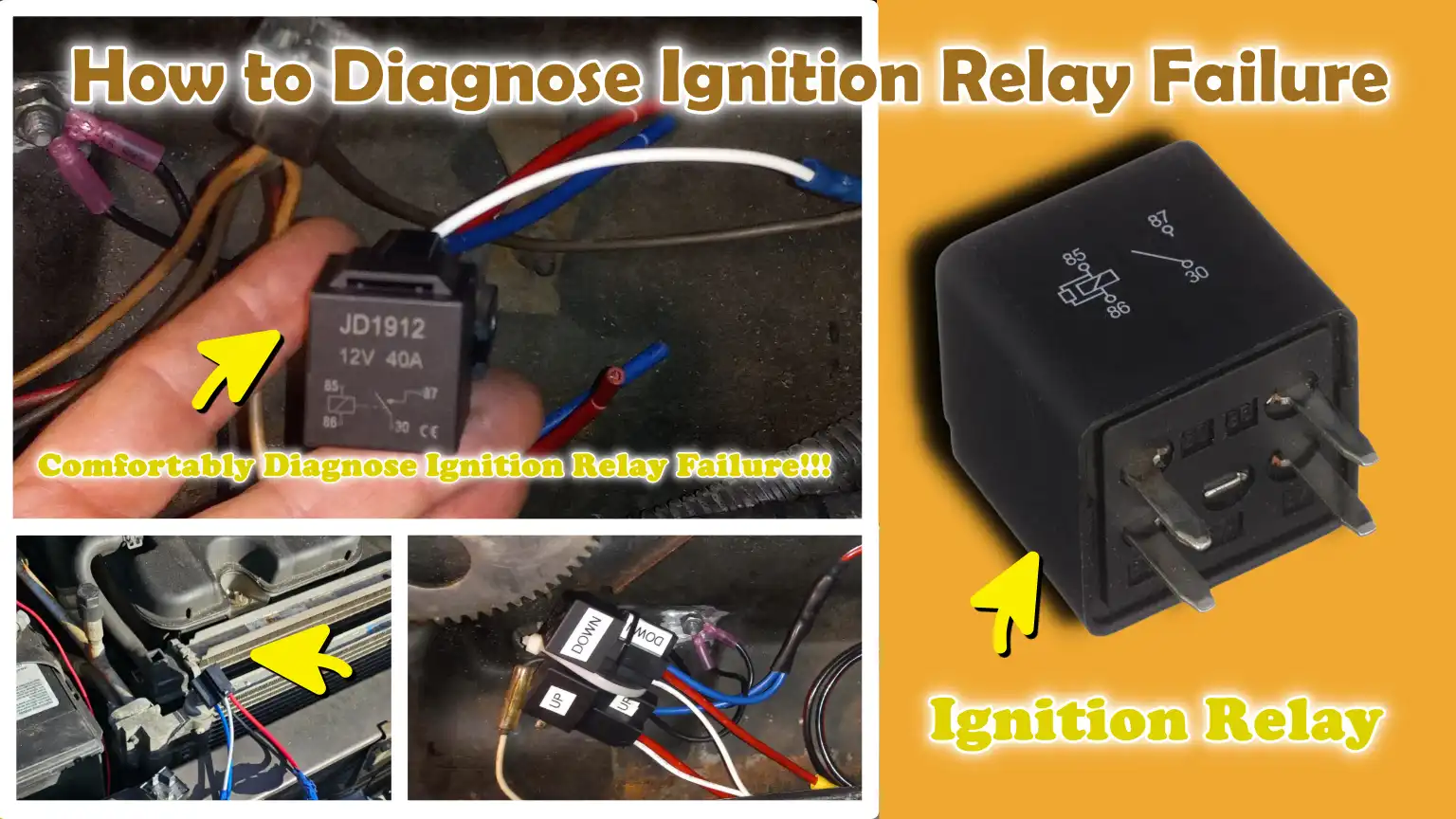
An ignition relay is a small electrical switch located within a vehicle that controls the flow of high-current electricity by utilizing a low-current signal received from the ignition key or the ‘push-to-start’ button.
Simply put, it is not a component that generates electricity; rather, it functions as a control gate.
It allows power to flow from the battery to the engine’s essential systems only when the driver turns the key or presses the start button.
This is crucial because modern vehicles are equipped with sensitive electronic systems that cannot handle the high electrical load coming directly from the ignition switch.
2. How It Functions as a Switch Between the Ignition Key and the Electrical System
When you turn the ignition key to the “ON” or “START” position, a small electrical signal is sent to the ignition relay’s coil.
This coil generates a magnetic field, causing the metal contacts located inside the relay to close.
As soon as these contacts close, they allow the high-current electricity flowing from the battery to pass through the relay and reach the vehicle’s ignition and starting circuits.
When the key is released or turned off, the signal ceases, the magnetic field dissipates and the relay’s contacts open once again, thereby interrupting the flow of electricity.
This switching action occurs very rapidly and is repeated every time you start or shut off the engine.
Because the relay handles the task of switching the high current itself, rather than relying directly on the ignition switch, it prevents the ignition switch from wearing out prematurely and reduces the electrical strain placed on the vehicle’s wiring system.
3. Its Role in Powering Ignition Components such as the Fuel Pump, ECU and Starter Circuit
The ignition relay plays a crucial role in activating several systems essential for operating the engine.
Once energized, it supplies power to the Engine Control Unit (ECU).
The ECU functions like a computer, managing fuel injection, ignition timing and data received from various sensors.
It also assists in activating the fuel pump, ensuring that fuel is delivered from the fuel tank to the engine at the correct pressure.
In many vehicles, it also supports the starter circuit; it transmits power to the starter solenoid, thereby engaging the starter motor to crank the engine.
If the ignition relay fails or weakens, the power supply to any of these systems may be interrupted.
Symptoms of such an issue may include a failure of the engine to start (a “no-crank” condition), an absence of sound from the fuel pump, or the engine shutting down completely.
Given its critical function, even a minor fault in the relay can prevent the entire vehicle from operating correctly.
Know, The Symptoms of a Faulty Ignition Relay
1. Engine Fails to Start
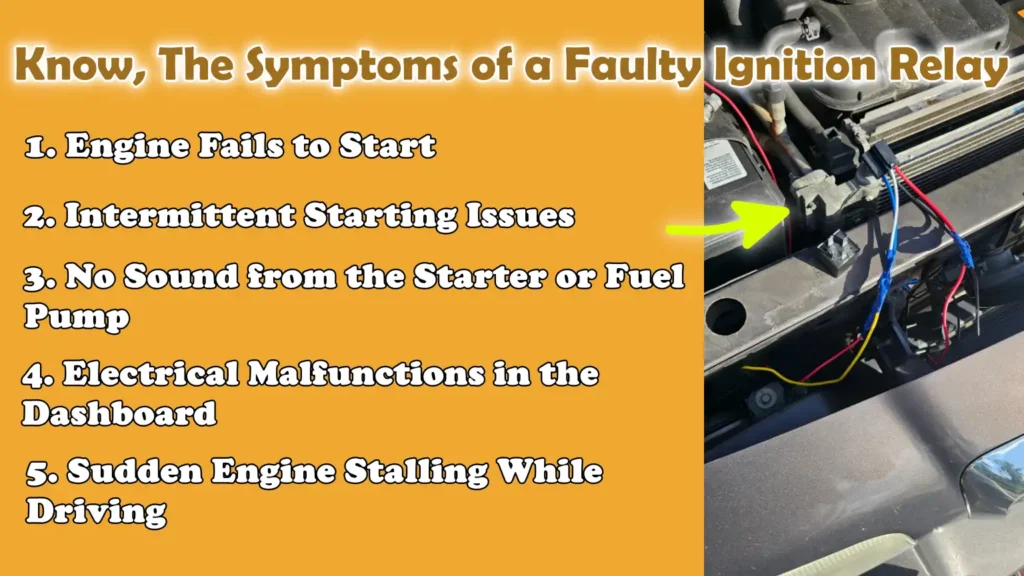
One of the most common symptoms of a faulty ignition relay is the engine failing to start at all; in such a scenario, when you turn the key or press the start button, the engine does not crank (turn over) whatsoever.
In this situation, the battery may be fully charged, yet the electrical signal fails to properly reach the starter circuit via the relay.
This occurs because the internal contacts (contact points) within the relay may have worn out, burned out, or become stuck in an open position, thereby interrupting the flow of current.
Consequently, the driver hears no sound, or perhaps only a faint ‘click’, even though other electrical systems, such as the lights or infotainment system, may be functioning normally.
This makes diagnosing the problem difficult, as it does not always manifest as a typical battery issue; in reality, the ignition system simply fails to engage.
2. Intermittent Starting Issues
Another distinct symptom is irregularity or inconsistency in the starting process; the vehicle may start normally at times, but at other times, without any apparent pattern, it may suddenly refuse to start.
This typically happens when the relay contacts become partially degraded or weak, allowing electrical current to flow only under specific conditions, such as during temperature fluctuations or vibrations.
For instance, the vehicle might start in the morning but struggle to start later in the day; alternatively, it may only start after several attempts.
Diagnosing this type of fault is particularly challenging because the system has not failed completely; Drivers often begin to suspect components such as: the battery or the ignition switch, that have absolutely no connection to the actual problem.
However, the true culprit is often the erratic performance of the relay, which fails to maintain a stable electrical connection.
3. No Sound from the Starter or Fuel Pump
When the ignition relay malfunctions, you will hear absolutely no sound whatsoever when you turn the ignition key to the ‘ON’ or ‘START’ position.
Typically, when the system is functioning correctly, you would hear a faint ‘whirring’ sound as the fuel pump activates, or a distinct ‘click’ as the starter relay engages.
When the ignition relay fails, this electrical activation simply does not occur; consequently, the fuel pump does not turn on and the starter circuit receives no power.
The result is complete silence, which is often the strongest indication that the relay or its control circuit is not functioning properly.
Even if the battery is fully charged, the failure of the relay to engage prevents power from reaching all the other components connected to it.
4. Electrical Malfunctions in the Dashboard
In some instances, a weak or failing ignition relay can trigger erratic electrical behavior within the dashboard and systems linked to the ignition.
This may manifest as flickering warning lights, a sudden loss of power to the instrument cluster, or the abrupt resetting of electronic systems while attempting to start the vehicle.
These issues arise because the relay is responsible for delivering a stable supply of power to numerous circuits that rely on the ignition power source.
When a relay’s contacts become worn or overheat, they intermittently make and break contact, resulting in irregularities in the voltage supply.
This erratic flow of electricity affects sensitive electronic modules, causing the dashboard to behave unpredictably, even if the battery itself has no internal issues.
5. Sudden Engine Stalling While Driving
An even more serious symptom of a faulty ignition relay is the sudden stalling of the engine while the vehicle is in motion; this occurs when the relay’s connection is momentarily interrupted, causing it to cease supplying power to critical engine systems.
As the relay facilitates the delivery of power to the Engine Control Unit (ECU) and the fuel system, even a momentary disruption in the electrical supply can cause the engine to shut down completely.
In such instances, the vehicle may restart after the engine has cooled down or after a few minutes have elapsed; this serves as a strong indication that the issue lies with the electrical relay rather than with any internal mechanical fault within the engine.
This specific symptom is particularly hazardous because it can manifest without any prior warning, often occurring even under normal driving conditions, thereby underscoring the critical importance of identifying and promptly rectifying relay-related issues to prevent them from leading to a complete system failure.
Know, Common Causes of Ignition Relay Failure
1. Wear and Tear Over Time
The most common cause of ignition relay failure is simply aging over time.
Inside the relay are small metal contacts that open and close every time the engine is started or shut off.
After thousands of such cycles, these contacts naturally wear down; their smooth surfaces erode, or tiny pits form on them due to repeated electrical arcing (sparking).
As this metal degrades, the relay may function intermittently but becomes less reliable, resulting in a weak or erratic electrical supply.
This gradual wear is normal in all vehicles and is the primary reason why relays are classified as “consumable parts” rather than “lifetime components”.
2. Overheating of Relay Contacts
Heat is another major factor that can cause an ignition relay to fail.
When excessive current flows through the relay, or when the temperature inside the engine bay becomes extremely high, the internal metal contacts can overheat.
This heat can cause the metal surfaces to pit, warp, or weaken, rendering them unable to establish a proper electrical connection.
Over time, excessive heat can also degrade the insulation within the relay, reducing its operational efficiency and increasing the likelihood of failure under heavy electrical loads.
Vehicles frequently driven in hot climates or heavy traffic conditions are at a higher risk of this type of failure, as the relay is constantly exposed to elevated temperatures.
3. Corrosion or Looseness in Relay Socket Connections
The ignition relay does not operate in isolation; It relies on a secure connection with its corresponding socket located inside the fuse box.
If the metal terminals within the socket become loose, dirty, or corroded, the electrical connection becomes unstable.
Corrosion can occur due to age, exposure to moisture, or even slight dampness, leading to increased electrical resistance within the circuit.
This resistance can cause a voltage drop, preventing the relay from activating properly, or from activating at all.
Even if the relay itself is in good condition, poor contact within the socket can manifest symptoms identical to those of a faulty relay, potentially causing confusion during the troubleshooting process.
4. Electrical Overload or Short Circuit
Another serious cause of ignition relay failure is an electrical overload or a short circuit, which can occur anywhere within the vehicle’s wiring system.
If a connected component draws more current than the relay is rated to handle, it places excessive strain on the internal contacts, potentially causing them to burn out or weld themselves together.
Similarly, a short circuit can result in a sudden surge of high current, leading to immediate relay failure.
In modern vehicles, electrical loads are meticulously balanced; therefore, any modification, a faulty aftermarket accessory, or a wiring issue can push the relay beyond its safe operating limits, significantly increasing the risk of failure.
5. Moisture or Water Damage in the Fuse Box
The ingress of moisture into the fuse box is another common, yet often overlooked, cause of ignition relay failure.
Water or moisture can enter the fuse box due to compromised seals, improper car washing techniques, or prolonged exposure to humid environments.
Once moisture reaches the relay terminals, it can lead to corrosion, oxidation, or even short circuits between the electrical contacts.
This adversely affects the relay’s operational efficiency and can lead to electrical issues that are difficult to diagnose such as: intermittent starting or a sudden loss of ignition power.
Over time, repeated exposure to moisture significantly reduces the lifespan of both the relay and its surrounding electrical components.
Tools
| Tools | Why It Is Needed | How To Use It In Diagnosis |
|---|---|---|
| Multimeter | This helps confirm whether the relay is receiving power and if it is switching correctly. | Set the device to voltage or resistance mode, then probe the relay terminals to check for continuity across the power input, output and coil. |
| Test Light | This instantly indicates, without any complicated settings, whether power is reaching the relay or the fuse. | Clip the device to ground, then touch the relay terminal or fuse point to determine if current is present when the ignition is switched on. |
| Vehicle Service Manual or Wiring Diagram | This aids in identifying the correct location of the relay, the wire colors and the circuit flow. | Use this tool to locate the ignition relay, understand the pin layout and trace the flow of power during testing. |
| Replacement Relay – For Testing | This helps confirm whether the original relay is defective, requiring no advanced tools to do so. | Replace the suspected faulty relay with this one and check if the car starts or if a specific electrical function begins working again. |
| Fuse Puller or Basic Hand Tools | These tools facilitate easy access to various components without causing damage to the fuse box or wiring. | Use a fuse puller to carefully remove relays and fuses during inspection and testing. |
How to Diagnose Ignition Relay Failure – Best Procedure
1. Locating the Ignition Relay
The first step in diagnosing an ignition relay issue is to pinpoint its exact location within the vehicle.
In most cars, the ignition relay is housed inside the fuse box, which may be situated either under the hood near the engine or inside the cabin beneath the dashboard.
The vehicle’s service manual, or the diagram printed on the fuse box cover, proves invaluable here, as it clearly illustrates the precise location and labeling of the relay.
Identifying the correct relay is critical; modern vehicles often contain numerous relays that appear visually identical but serve different systems and selecting the wrong relay can lead to an incorrect diagnosis.
2. Visual Inspection
Once the ignition relay has been located, the next step is to perform a careful visual inspection.
This involves removing the relay and examining it closely for any signs of external damage such as: burn marks, melted plastic casing, corrosion, or rust on the metal pins.
Loose or bent pins can also prevent proper electrical contact with the socket.
These visible signs often point to overheating or poor connections, which are common causes of relay failure.
Even slight discoloration can be an indication of internal damage that might otherwise go undetected without further testing.
3. Listening for the Relay’s ‘Click’
A simple yet effective diagnostic technique involves listening for the relay’s distinctive ‘click’ sound while turning the ignition key to the ‘ON’ or ‘START’ position.
This ‘click’ occurs when the internal coil within the relay receives power and closes the contact switch.
If no “click” is heard, it generally indicates that the relay is not receiving power, the coil itself is defective, or there is a fault within the control circuit.
However, merely hearing a “click” does not necessarily mean that the relay is functioning correctly; even if the coil is receiving power, the internal contacts may still be faulty.
4. The Swap Test Method
The swap test is one of the easiest and most reliable methods for confirming a faulty ignition relay.
In this method, the suspected relay is swapped with an identical relay from another, less critical, system in the vehicle (such as the horn or AC relay).
If the vehicle starts normally after swapping the relay, it is a definitive indication that the original relay is defective.
This method is widely used because it requires no specialized tools and provides immediate, concrete information regarding the condition of the relay.
5. Testing the Relay with a Multimeter
Testing with a multimeter is a more technical and precise method for determining the condition (or “health”) of a relay.
First, the coil’s resistance is measured to ensure that the internal coil is neither open (broken) nor shorted.
Next, a continuity test is performed to verify whether the relay switches correctly when power is applied.
A healthy relay should display the correct resistance value and allow current to flow when activated.
If the readings do not change when the relay is triggered, it indicates an internal fault.
This step is particularly useful when the relay shows no visible external damage yet fails to function properly.
6. Checking the Relay’s Power Supply
Even if the relay itself is in good condition, it will not function if it is not receiving the correct voltage.
This step involves checking the input and output terminals of the relay socket using a multimeter or a test light.
The objective is to ensure that the ignition switch is supplying power to the relay and that the relay is correctly transmitting that power onward.
If power is present at the input but absent at the output, there is a very high probability that the relay is faulty.
If there is absolutely no power at all, the issue may lie within the ignition switch, the wiring, or the fuse circuit.
7. Inspection of Related Fuses and Wiring
The final step is to inspect all fuses and wiring associated with the ignition relay circuit.
A blown fuse can completely prevent power from reaching the relay, creating the impression that the relay itself has failed, when, in reality, it has not.
Faulty, worn, or loose wiring can also interrupt the flow of electricity and lead to intermittent issues.
Carefully inspecting these components ensures that the problem is not actually originating from another part of the electrical system.
This step is crucial because the symptoms of a faulty relay often closely resemble those of fuse or wiring issues; a thorough inspection helps prevent misdiagnosis.
So, How to Distinguish Between a Faulty Relay and Other Issues
1. Symptoms: Battery vs Ignition Relay
Both a weak battery and a faulty ignition relay can cause difficulties in starting a vehicle; however, the vehicle’s behavior typically differs in each case.
When the issue lies with the battery, you will often observe slow cranking, dim headlights, faint dashboard lights and an overall noticeable decline in electrical supply, as the battery is unable to provide the necessary power to the system.
Conversely, a faulty ignition relay often causes the vehicle to stop functioning suddenly and completely; the vehicle will not start at all, even if the lights, horn, or radio are working correctly.
This occurs because the battery is indeed supplying power, but the relay prevents that power from reaching the ignition and starting circuits.
Understanding this distinction can save you from unnecessarily replacing a perfectly good battery when the actual problem lies with a small switching component located inside the fuse box.
2. Symptoms: Starter Motor vs Relay
The starter motor and the ignition relay are closely interconnected; however, a careful examination reveals that the symptoms of their failure are not identical.
If the starter motor is at fault, turning the key may produce a loud, distinct “click,” or a rapid succession of “click-click” sounds; in some instances, the engine may attempt to crank very slowly or make only a faint attempt to turn over.
This happens because the relay is successfully transmitting power, but the starter motor itself fails to convert that electrical energy into mechanical motion.
On the other hand, when the ignition relay is faulty, there is typically no loud “click” sound emanating from the starter system and the engine makes absolutely no attempt to start, as electrical power effectively fails to reach the starter motor.
Understanding this distinction is crucial, as it enables you to identify whether the issue lies with a mechanical component or a high-amperage motor, or if the fault resides within the low-power switching mechanism housed inside the relay itself.
3. Signs of a Faulty Ignition Switch vs a Faulty Relay
Although the ignition switch and ignition relay work in tandem, they fail in distinct ways and can be differentiated based on their respective symptoms.
When the ignition switch fails, turning the key may feel loose or erratic, or the key may elicit absolutely no response whatsoever; furthermore, multiple electrical systems may fail simultaneously, as this switch is responsible for initiating the primary control signal.
In some instances, the dashboard lights may fail to illuminate entirely, or they may flicker on and off intermittently when the key is slightly nudged.
However, when the problem lies with the ignition relay, the ignition switch typically feels normal and successfully transmits the signal; yet, the relay fails to process that signal and energize the power circuit.
This implies that while the dashboard and other electrical accessories may function normally, the engine itself refuses to start.
Recognizing this distinction helps determine whether the issue lies within the driver input system or within the subsequent electrical switching stage.
Know, Some Temporary Fixes and Workarounds
1. Tapping the Relay to Temporarily Restore Contact
In certain situations, the internal contacts within a failing ignition relay may have become worn or slightly stuck, thereby disrupting the proper flow of electricity.
A temporary, and very short-term, stopgap measure involves gently tapping the exterior of the relay while it remains seated in the fuse box.
This mild physical impact can sometimes cause the internal metal contacts to momentarily reconnect, thereby restoring the electrical flow and allowing the vehicle to start.
This occurs because the vibration can temporarily dislodge or reseat weak or corroded contact surfaces inside the relay.
However, this cannot be considered a permanent repair and is effective only when the relay is already on the verge of failure.
If the vehicle successfully starts using this method, it is a definitive indication that the relay has failed internally and requires immediate replacement.
2. Using a Spare Relay for Replacement
One of the most reliable temporary solutions is to replace the suspected faulty ignition relay with an identical spare relay borrowed from another non-essential system within the vehicle.
Many vehicles utilize identical relays for components such as the horn, air conditioning, or lighting systems, making such a swap possible for diagnostic or emergency purposes.
When the spare relay is installed, it takes over the switching function and, assuming the original relay was indeed faulty, restores the proper flow of electricity to the ignition system.
This method is widely used because it requires no specialized tools and allows for immediate confirmation of the problem.
If the engine starts normally after the swap, it is a clear indication that the original relay is no longer reliable and should be permanently replaced.
3. Considerations Regarding Emergency Jump-Starting – If Applicable
When a vehicle fails to start, jump-starting is often viewed as a potential solution; however, it is crucial to understand that this method is effective only when the issue stems from low battery voltage, rather than a faulty ignition relay.
In the event of a defective relay, even a fully charged or jump-started battery will be unable to crank the engine, as the electrical pathway leading to the ignition and fuel systems remains interrupted.
Nevertheless, in complex scenarios where the battery is weak and the relay is also unstable, jump-starting can temporarily boost the system voltage sufficiently to allow the relay to function for a brief period.
While this may occasionally result in the engine starting, it does not resolve the underlying issue associated with the relay itself.
Therefore, if the results of a jump-start are inconsistent, or if it works only sporadically, it often signals a problem related to electrical switching (such as a weak ignition relay) rather than a completely dead battery.
Read More:
Know, Some Permanent Solutions of Ignition Relay Failures
1. Replacing the Ignition Relay
The most straightforward and reliable permanent solution for a faulty ignition relay is to replace the defective unit with a new, high-quality component that precisely matches the specifications of the original part.
As relays are electromechanical components that wear out over time due to heat, electrical loads and repeated switching cycles, their internal contacts typically cannot be repaired once they have failed.
A new relay restores proper switching between the ignition signal and the high-current circuits that power the engine systems.
Ensuring correct fitment is crucial, as using a relay of the wrong type or rating can lead to recurring malfunctions or even electrical damage.
Once replaced, provided the relay was indeed the root cause of the problem, the ignition system should begin to operate stably and consistently.
2. Cleaning the Relay Socket Contacts
In many cases, the relay itself is not the sole source of the problem; the socket into which it is inserted can also be a contributing factor to persistent electrical issues.
Over time, dust, corrosion, moisture, or oxidation can accumulate on the metal terminals inside the fuse box socket, increasing resistance and weakening the electrical connection.
Carefully cleaning these contacts is a critical permanent step, as even a brand-new relay will fail to function correctly if the connection points are dirty or loose.
Using an appropriate electrical contact cleaner, and ensuring that the pins fit securely and remain free of corrosion, helps restore a strong and stable electrical current.
This step enhances reliability and prevents intermittent starting problems in the future, issues that are often mistakenly attributed to a faulty relay.
3. Rectifying the Underlying Electrical Issues Causing Relay Damage
For a truly lasting repair, it is essential to identify and resolve why the ignition relay failed in the first place.
If the relay failed due to an electrical overload, a short circuit, faulty wiring, or unstable voltage, simply replacing it may lead to recurring failures.
Issues such as compromised wiring insulation, faulty ignition switch signals, or excessive current draw from connected components must be diagnosed and repaired to safeguard the new relay.
In some vehicles, aftermarket accessories or poorly executed electrical modifications can also place an excessive load on the circuit, thereby shortening the relay’s lifespan.
By rectifying these fundamental electrical issues, the entire ignition system becomes more stable, significantly reducing the likelihood of future relay failures and ensuring long-term reliability.
How to Prevent and Maintain the Ignition Relay
As well as, there’s study that shows that ignition relay failure is often caused by the internal contact damage such as: arc erosion and contamination buildup as well, so these are the microscopic changes that actually increases the resistance inside the relay: which leads to the weak or inconsistent electrical switching in the ignition system over the period of time.[¹]
1. Regular Inspection of the Fuse Box
Regular inspection of the fuse box is the most effective way to prevent ignition relay malfunctions, thereby avoiding “no-start” issues in the vehicle.
The fuse box acts as a central hub where relays, fuses and all electrical connections converge.
Over time, early signs of malfunction may appear such as: loose terminals, discoloration, or signs of heat damage.
By conducting periodic inspections, you can identify minor issues such as: a loosely seated relay or the onset of corrosion, before they escalate into major electrical failures.
This simple habit helps maintain a steady flow of power to the ignition system and minimizes sudden, unexpected starting problems.
2. Keeping the Electrical System Clean and Dry
Moisture and dirt are two hidden enemies of a vehicle’s electrical components, particularly relays and their sockets.
When water or moisture enters the fuse box area, it can lead to corrosion on metal contacts, increased electrical resistance and erratic switching within the relays.
Keeping the electrical system clean and dry ensures that the flow of electricity remains smooth and uninterrupted.
This involves avoiding direct exposure to water while washing the vehicle and ensuring that the protective covers and seals surrounding the fuse box are securely closed.
A clean and dry environment for the electrical system significantly extends the lifespan and reliability of the ignition system components.
3. Avoiding Overloads on Aftermarket Wiring
Aftermarket electrical accessories such as: auxiliary lights, audio systems, or charging devices, as it can place excessive strain on a vehicle’s electrical system if they are not installed correctly.
When excessive current is drawn from the ignition relay system, or from circuits connected to or situated near it, it can generate excessive heat within the relay’s internal contacts, potentially leading to their premature failure.
This electrical overload can gradually degrade the relay, resulting in unexpected starting issues or, potentially, the complete failure of the relay.
Ensuring that all aftermarket wiring is properly fused and installed with appropriate load distribution helps protect the ignition relay from unnecessary stress, thereby keeping the electrical system balanced and safe.
4. Periodic Replacement of Relays in Older Vehicles
In older vehicles, the likelihood of relay failure naturally increases due to prolonged use, temperature fluctuations and the internal wear and tear of mechanical contacts.
Even if a relay appears to be functioning, its operational efficiency may diminish over time; this can sometimes lead to difficulties in starting the vehicle or delays in system response.
In high-mileage vehicles, periodically replacing the ignition relay serves as a preventive measure to avoid sudden vehicle breakdowns.
As replacing a relay is significantly less expensive than replacing major engine or electrical components, replacing them before they fail completely is a prudent approach to vehicle maintenance.
This practice ensures consistent ignition performance and minimizes the risk of situations where the vehicle suddenly fails to start.
So, When to Go for the Professional Help
1. Complex Electrical Faults Beyond the Relay
In some cases, ignition problems are not caused by the relay itself, but rather by deeper electrical faults that are difficult to identify without advanced diagnostic tools.
Modern vehicles utilize complex wiring networks and multiple control modules; consequently, a malfunction in one part of the system can have an unexpected impact on how the ignition functions.
If basic tests such as: swapping the relay, checking fuses and testing with a multimeter, fail to pinpoint the problem, it may indicate faulty wiring, poor grounding, or hidden short circuits within the electrical system.
Diagnosing these issues often requires professional diagnostic equipment to accurately trace voltage flow and pinpoint the exact location of the fault.
2. ECU-Related Ignition Issues
The Engine Control Unit (often referred to as the ECU) plays a critical role in managing ignition timing, fuel delivery and overall system synchronization.
If the ECU fails to send the correct signal to the ignition relay, or is receiving incorrect data from sensors, the vehicle may fail to start, even if the relay itself is functioning properly.
ECU-related malfunctions can stem from software glitches, internal electronic failures, or interruptions in communication between various modules.
As the ECU is a sensitive and expensive component, diagnosing or repairing it requires specialized tools and technical expertise.
In such situations, professional diagnostics become essential to avoid replacing unnecessary parts and to ensure the proper calibration of the system.
3. Vehicle Fails to Start Even After Replacing the Relay
If the ignition relay has already been replaced with a functional part, yet the vehicle still refuses to start, it clearly indicates that the root cause of the problem lies elsewhere within the ignition or power distribution system.
This could involve a faulty ignition switch, a defective wiring harness, a blown main fuse, a poor ground connection, or issues within the fuel or starter circuits.
When the vehicle fails to start even after ruling out the relay as the source of the problem, seeking professional assistance becomes essential, as repeatedly replacing parts based solely on guesswork can result in a waste of both time and money.
A trained technician can systematically perform electrical diagnostics to pinpoint the root cause of the issue and restore the system to proper working order.
Conclusion – How to Diagnose Ignition Relay Failure
So, when you understand the behavior of relay then it actually helps you to separate the real mechanical damage from the simple electrical switching problems.
It regulates the flow of electricity to essential engine components.
When functioning correctly, the relay facilitates seamless coordination between the ignition switch, fuel system, ECU and starter circuit, ensuring that the engine starts without any delay or interruption.
However, when it begins to fail, whether due to wear and tear, heat damage, corrosion, or electrical overload, the symptoms can be quite perplexing.
Often, these symptoms closely resemble those of other issues, such as a weak battery or a faulty starter motor.
Therefore, understanding the comprehensive diagnostic process is essential; accurately identifying the problem helps avoid unnecessary repairs and saves both time and money.
By carefully observing symptoms, testing the relay, verifying the power supply and inspecting the associated wiring, one can determine whether the ignition relay is, in fact, the root cause of the issue.
In most cases, replacing a faulty relay is a simple and inexpensive solution; however, to ensure the vehicle’s long-term reliability, it is also vital to address any underlying electrical issues and maintain a clean, dry and stable environment around the fuse box.
So, that’s all from this one and you can ask queries for this guide.
Frequently Asked Questions
FAQ 1: What is an ignition relay and why is it important?
Answer: An ignition relay is a small electrical switch that controls the flow of power from the battery to essential engine systems when you turn the key or press the start button. It is crucial because it uses low-power signals from the ignition switch to safely manage high-power circuits such as: the fuel pump, ECU and starter system. Without it, the engine would not receive the necessary electrical activation to start properly and run smoothly.
FAQ 2: What are the most common symptoms of a faulty ignition relay?
Answer: The most common symptoms include the engine failing to start at all (where the engine doesn’t even crank), intermittent starting issues (where the car starts sometimes but not others) and a complete lack of sound from the fuel pump or starter system. In some cases, dashboard lights may flicker, or the engine may suddenly shut off while driving. These symptoms occur because the relay fails to provide a consistent power supply to the ignition circuits.
FAQ 3: Can a faulty ignition relay drain the battery?
Answer: A faulty ignition relay typically does not directly drain the battery; however, it can cause electrical issues that lead to unpredictable system behavior. In some instances, if the relay gets stuck in the “on” position, it may keep certain circuits active for longer than necessary, which can gradually impact battery performance. However, the primary causes of a drained battery are usually faulty wiring, lights left on, or other electrical components, rather than the relay itself.
FAQ 4: How can I determine whether the problem is caused by the relay or the battery?
Answer: If the battery is weak, you will typically notice that the engine cranks slowly, the lights appear dim and the entire electrical system feels underpowered. If the ignition relay is faulty, the car often fails to respond when the key is turned, even if the lights and other electronics appear to be functioning normally. An easy way to diagnose this is to attempt to jump-start the car or to swap the relay with an identical replacement. If jump-starting yields no results, but the car starts after replacing the relay, it is highly probable that the relay itself is the root cause of the problem.
FAQ 5: Can I drive with a faulty ignition relay?
Answer: Driving with a faulty ignition relay is unsafe, as the relay could fail at any moment, causing the engine to shut down abruptly. This failure can occur while driving, while the vehicle is idling (stationary), or when attempting to restart the car, depending on the severity of the relay’s condition. As the relay controls the power supply to critical engine systems, ignoring this issue significantly increases the risk of getting stranded or experiencing a sudden vehicle breakdown.
FAQ 6: How much does it cost to replace an ignition relay?
Answer: The ignition relay is generally one of the most affordable electrical components in a vehicle. While the cost may vary depending on the vehicle model and location, in most cases, the part itself is significantly cheaper than the engine or other major electrical components. Labor costs are also typically low, as replacing a relay is generally a quick and simple task; often, it simply involves directly swapping out the relay located inside the fuse box.
References:
[1] Failure analysis of the electromagnetic relay contacts
https://www.sciencedirect.com/science/article/abs/pii/S1350630715301151
Hello Folks, Dean Shali here to help you out to solve the problems with your lovely vehicle, as i have lots of experience and knowledge about automotive industry as i woks directly with the customers and repair vehicles and i love to help the people to keep their cars safe and running smoothly.