
Written By: Dean Shali
Fact Checked By: Sabré Cook
Reviewed By: Tamara Warren
So, when your batteries got overcharging issue, then it is not causes sudden huge damage; instead of this it usually slows down electrical imbalance that grows worse over the time.
Basically, every modern vehicle really depends on a carefully balanced electrical system and at the center of that system is the “ALTERNATOR”.
So, it has really simple job: to convert the mechanical energy from the engine into the electrical power and that’s how it keeps the beloved battery fully charged at a safe voltage, which is usually around 13.8 to 14.5 volts in the most of the passenger cars.
But, the thing got problematic when this balance is gets disturbed and the alternator actually begins to produce too much voltage than needed, this is the condition known as the “OVERCHARING”: and by the result it can be really destructive as well.
Even, there’s studies in the automotive electrical engineering and service manuals that clearly shows that sustained overvoltage can literally shorten the battery life, damage some sensitive electronic control units and actually causes excessive heat buildup inside the battery.
Yes, at first there’s small warning signs such as: flickering headlights, a burning smell near the engine bay or a battery that seems to fail at repeated time intervals even after replacement as well.
So, most of the time these symptoms got misunderstanding and that leads to the unnecessary battery changes while the real issues actually continues to damage the system.
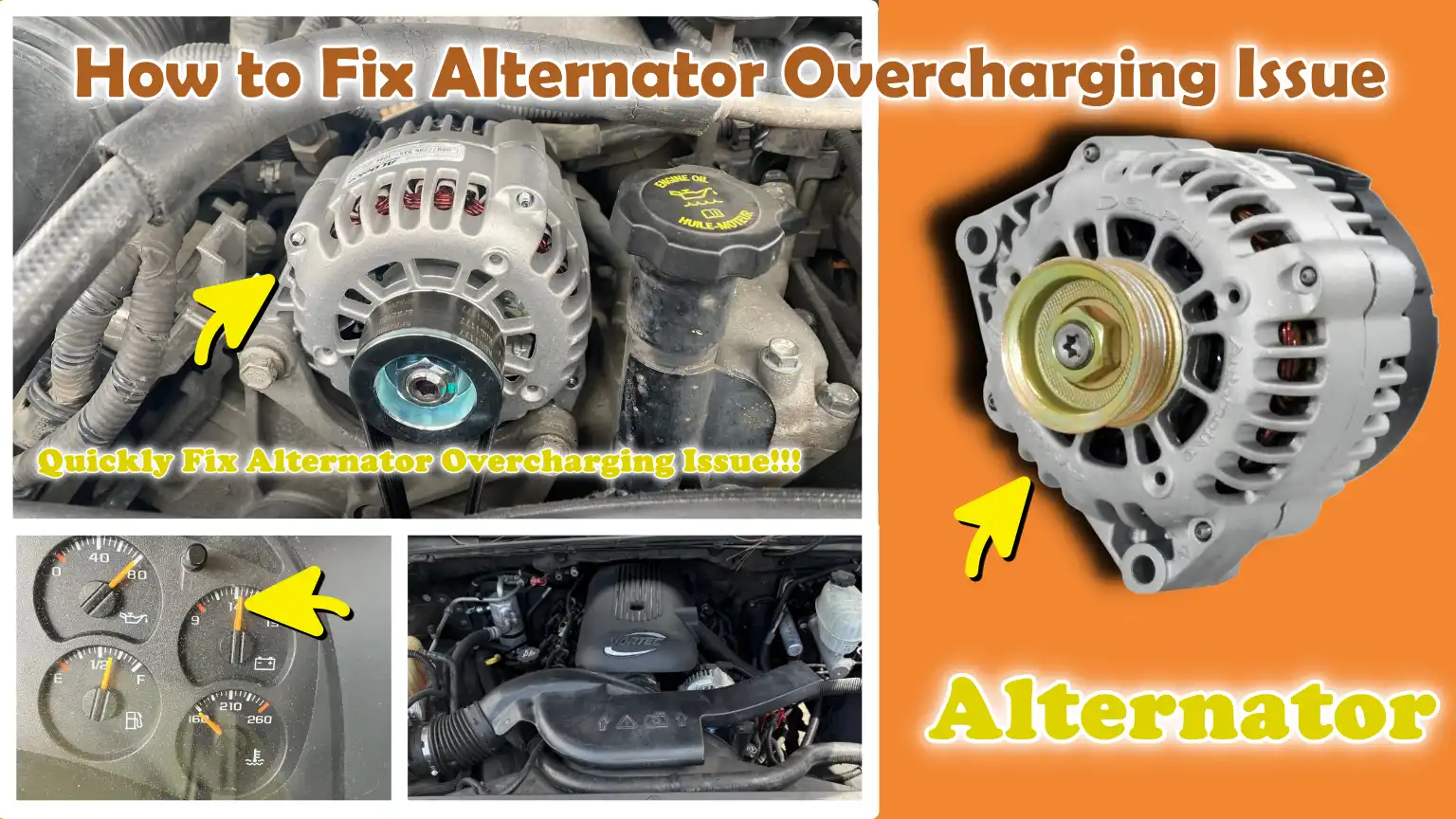
Now, that’s the proper guide about How to Fix Alternator Overcharging Issue so that you can diagnose and fix the root cause by identifying it with multimeter or whether the faults lies in the voltage regulator, wiring or alternator itself.
Symptoms of an Overcharging Alternator
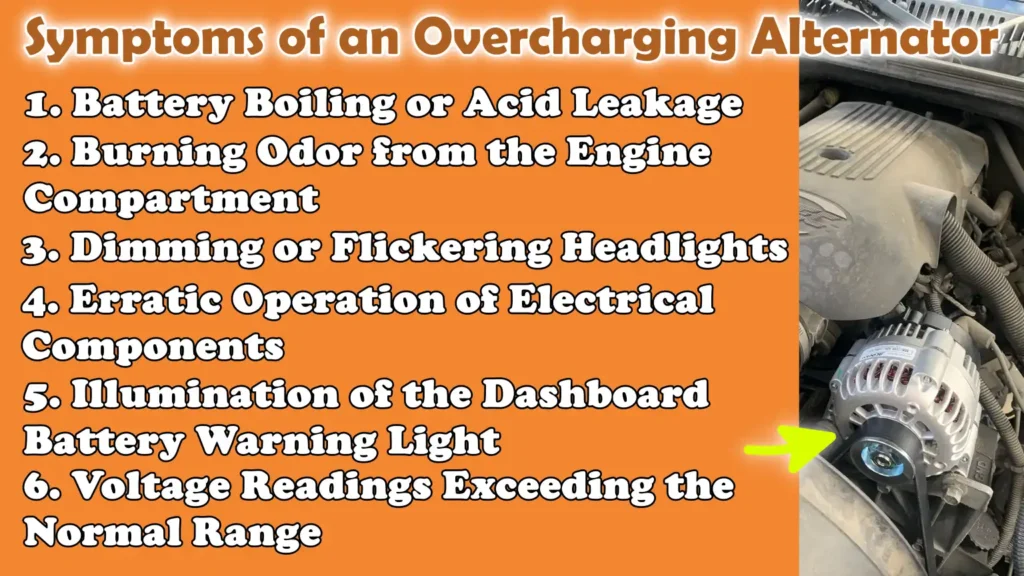
1. Battery Boiling or Acid Leakage
One of the most serious symptoms of an overcharging alternator is excessive battery overheating, which causes the electrolyte to boil or results in visible acid leakage.
In a normal system, the alternator maintains a stable battery voltage; however, when the voltage rises excessively, typically exceeding the safe charging limit, the battery begins to heat up internally.
This excessive heat causes the liquid electrolyte inside the battery to vaporize or bubble, which can lead to battery swelling, damage to internal plates and, in severe cases, total battery failure.
Vehicle electrical systems are designed to operate within a controlled voltage range; therefore, even a slight but persistent overvoltage can significantly reduce the battery’s lifespan.
2. Burning Odor from the Engine Compartment
A burning odor emanating from the engine compartment is another serious warning sign, often indicating electrical stress caused by overcharging.
This odor typically results from overheating battery components, melting wire insulation, or excessive load placed on the alternator itself.
When the voltage regulator malfunctions, the alternator may continuously supply voltage exceeding the required level, forcing electrical components to operate beyond their safe temperature limits.
Over time, this can degrade the wiring harness and connectors, producing a strong burning smell that should never be ignored.
3. Dimming or Flickering Headlights
Flickering headlights, or lights behaving erratically, as it can be an indication of an unstable voltage output from the alternator.
In a properly functioning system, the voltage remains stable, ensuring consistent illumination.
However, when overcharging occurs, the resulting voltage fluctuations can confuse the electrical system, causing lights to suddenly dim, brighten, or begin to flicker.
This happens because lighting systems in modern vehicles rely heavily on a stable electrical input and any deviation from normal voltage levels directly impacts their performance.
4. Erratic Operation of Electrical Components
Modern vehicles are equipped with sensitive electronic systems, such as infotainment units, sensors, power windows and ECU-controlled functions.
When an alternator overcharges, these components may begin to behave unpredictably.
Drivers may observe systems resetting, warning lights suddenly illuminating, or controls failing to function correctly.
This occurs because excessive voltage disrupts the normal operation of electronic control modules; these modules are designed to operate within strict voltage limits to ensure stability and safety.
5. Illumination of the Dashboard Battery Warning Light
The illumination of the battery warning light on the dashboard is often one of the earliest indicators of a problem within the charging system, including overcharging.
Although many people assume this light merely signals a weak battery, it actually serves to alert the driver to any abnormal condition related to the charging process.
When the voltage exceeds normal operating levels, the vehicle’s monitoring system detects irregularities in the charging circuit and triggers the warning light.
Ignoring this signal allows the electrical system to continue operating under these conditions, potentially leading to damage.
6. Voltage Readings Exceeding the Normal Range
The most accurate method for confirming an overcharging alternator is to measure the voltage using a multimeter.
In most passenger vehicles, when the engine is running, the normal charging voltage typically ranges between approximately 13.8 and 14.5 volts.
If the reading consistently exceeds around 14.8 volts, it is a definitive indication of a fault within the voltage regulation system.
The underlying cause could be a defective voltage regulator, damaged alternator diodes, or wiring issues that hinder proper feedback control.
Consistently high voltage is hazardous, as it gradually degrades the battery and places undue strain on the entire electrical system over time.
Know, Common Causes of Alternator Overcharging
1. Faulty Voltage Regulator
The most common cause of alternator overcharging is a faulty voltage regulator.
This small yet critical component regulates the voltage output generated by the alternator, keeping it within a safe operating range.
In most modern vehicles, the regulator is integrated directly into the alternator assembly itself.
When this component fails, it is unable to properly regulate the output voltage, causing the alternator to continuously generate excessive voltage.
Over time, this leads to battery overheating, fluid depletion and damage to the vehicle’s sensitive electronic components.
2. Faulty Alternator Diodes
Alternator diodes are responsible for converting the AC power generated by the alternator into DC power, the form of electricity utilized by the vehicle.
When these diodes fail or function intermittently, they can disrupt the smooth flow of electricity.
This can result in an unstable power output, including sudden voltage spikes, which may manifest as symptoms of overcharging.
Practically speaking, faulty diodes can also generate excessive heat within the alternator itself, further exacerbating electrical instability and negatively impacting charging accuracy.
3. Poor Grounding or Wiring Issues
A vehicle’s charging system relies heavily on proper grounding and secure electrical connections.
If ground wires are loose, corroded, or damaged, the alternator may receive inaccurate information regarding the battery’s charge level.
This can confuse the regulation system, leading to an incorrect voltage output.
Similarly, faulty wiring within the charging circuit can interfere with the signals exchanged between the alternator, the battery and the control modules, resulting in irregular or excessive charging behavior.
4. Improper Alternator Installation or Incorrect Replacement Part
Using an incorrect alternator model or installing a replacement part that is incompatible with the vehicle can lead to overcharging issues.
Different vehicles require specific voltage output limits and regulation systems.
If an alternator with incorrect specifications is installed, it may fail to align with the vehicle’s electrical requirements.
This mismatch can cause the system to supply excessive voltage, particularly if the calibration of the internal regulator does not correspond to the vehicle’s design.
5. ECM or Charging System Control Failure – Modern Vehicles
In modern vehicles, the Engine Control Module (ECM) plays a critical role in managing the charging system.
It communicates with the alternator to adjust the voltage output based on engine load, battery status and electrical demand.
If the ECM or its associated control software malfunctions, it may send incorrect signals to the alternator.
Consequently, voltage regulation can become erratic, leading to issues such as overcharging.
Although such occurrences are rare, accurately diagnosing such faults typically requires advanced diagnostic tools and procedures.
6. Corroded or Loose Battery Terminals Affecting Regulation Feedback
The charging system relies on accurate feedback from the battery to maintain the correct voltage levels.
If the battery terminals are corroded, loose, or dirty, the alternator may receive inaccurate voltage readings.
As a result, the system may misinterpret the battery’s condition and continue to overcharge it.
Even a thin layer of corrosion can increase resistance within the circuit, disrupting the balance of the entire charging system and potentially leading to overcharging issues over time.
Tools
| Tools | Why It Is Needed | How to Use It |
|---|---|---|
| Digital Multimeter | This is the most essential tool for checking for alternator overcharging, as it measures the precise voltage levels within the battery and charging system. It helps determine whether the voltage is excessively high or falls within the safe operating range. | Set the multimeter to DC voltage mode. Place the red probe on the battery’s positive terminal and the black probe on the negative terminal. Start the engine and observe the reading to see if the voltage falls within the normal range. |
| OBD2 Scanner – For Modern Vehicles | This tool is required to read error codes from the vehicle’s computer system. In modern cars, the Engine Control Module monitors charging performance and stores a fault code whenever a malfunction occurs. | Plug the scanner into the OBD2 port, which is typically located under the dashboard. Turn on the ignition and scan for any error codes related to the charging system or voltage. Analyze the codes to determine whether the issue is electrical in nature or related to a sensor. |
| Battery Load Tester – Optional | This device is used to assess how effectively the battery performs under actual operational load. A weak battery can sometimes exhibit misleading symptoms that mimic those of an overcharging alternator. | Connect the tester to the battery terminals. Apply the load according to the instructions and observe the resulting voltage drop. A healthy battery should maintain a stable voltage under load without any sudden or significant dips. |
| Basic Hand Tools – Wrenches, Sockets | These tools are essential for removing battery terminals, tightening connections and inspecting the alternator’s mounting hardware or wiring. Loose connections are a common cause of malfunctions within the charging system. | Use the correct size wrench or socket to safely remove the battery terminals or the alternator’s mounting bolts. Before working on any electrical component, always disconnect the battery first to prevent accidental short circuits. |
| Safety Gloves and Eye Protection | These precautions are essential to protect your hands and eyes from electrical sparks, acid spills, or accidental contact with moving engine parts during inspection. | Wear gloves before touching battery or alternator components. Use safety goggles to protect your eyes while checking the battery’s condition or working in the engine bay, thereby preventing injuries caused by acid or debris. |
How to Diagnose Alternator Overcharging Issues
1. Check Battery Voltage – Engine Off
The first step in diagnosing an alternator overcharging issue is to measure the battery voltage while the engine is completely shut off.
This provides a clear indication of the battery’s true condition, unaffected by the alternator.
A healthy car battery, when fully charged and at rest, typically displays a reading between 12.4 and 12.7 volts.
If the reading is significantly lower, it may indicate that the battery is weak or discharged.
Although this step does not directly confirm overcharging, it is crucial because a weak battery can affect how the charging system operates and may lead to inaccurate results during subsequent tests.
2. Check Charging Voltage – Engine Running
The next step is to check the voltage while the engine is running; this helps you understand how the alternator performs under load.
At idle speed, the charging voltage in most vehicles should typically fall between approximately 13.8 and 14.5 volts.
As the engine RPM increases, the voltage should remain stable within this safe range.
If the voltage consistently rises above approximately 14.8 volts, it is a clear indication of overcharging.
This is one of the most critical tests, as it directly reveals whether the alternator is supplying excessive power to the system.
3. Inspect the Voltage Regulator
The voltage regulator is responsible for controlling the amount of voltage generated by the alternator; therefore, inspecting it is a vital part of the diagnosis process.
In many modern vehicles, the regulator is integrated directly into the alternator assembly itself, whereas older systems may utilize an external unit.
When a regulator begins to fail, it loses its ability to properly adjust the output voltage.
Common symptoms include unstable voltage readings, sudden voltage spikes, or consistently high charging levels.
A faulty regulator is one of the most common causes of overcharging, as it directly controls the electrical balance of the entire charging system.
4. Check Alternator Wiring and Grounding
Proper wiring and grounding are essential for the alternator to function stably.
Loose connections, damaged wires, or corroded terminals can disrupt the flow of electrical signals between the battery, the alternator and the vehicle’s body.
When grounding points become compromised, the alternator may receive inaccurate information regarding the battery’s charge level, potentially leading to battery overcharging.
During a thorough inspection, particular attention should be paid to the battery terminals, the ground straps connecting to the engine block and the wiring harness leading to the alternator, as even minor faults in these components can compromise voltage regulation.
5. Check Battery Condition
A weak or deteriorating battery can sometimes mimic, or even exacerbate, problems within the charging system.
If the battery suffers from internal defects, sulfation, or aged cells, it will be unable to accept a charge properly, forcing the alternator to work harder than usual.
This can confuse the regulation system and result in erratic charging behavior.
In some instances, receiving incorrect feedback from the battery may cause the alternator to increase its output, creating a situation that appears to be overcharging.
Checking the battery’s condition ensures that the issue is not, in fact, caused by a faulty battery rather than the alternator itself.
6. Scan for ECU or PCM Codes
In modern vehicles, the Engine Control Module (ECU) or Powertrain Control Module (PCM) plays a crucial role in managing the charging system.
Scanning for error codes helps determine whether the vehicle’s computer has detected any anomalies in the charging process.
Fault codes related to voltage regulation, alternator performance, or battery sensor signals can provide vital clues regarding the root cause of the problem.
Furthermore, if the ECU is issuing incorrect commands or misinterpreting sensor data, this can also lead to an overcharging condition.
This step is particularly important in newer vehicles, where electronic control systems are intricately integrated with the alternator.
How to Fix Alternator Overcharging Issue – Effective Method
1. Replace a Faulty Voltage Regulator
The most common and effective solution for an alternator overcharging problem is to replace the faulty voltage regulator.
This component controls the alternator’s output voltage and ensures that it remains within a safe range for the battery and the vehicle’s electronics.
When it malfunctions, the alternator may continuously generate excessive voltage, potentially causing the battery to overheat and leading to electrical damage.
In modern vehicles, the regulator is typically mounted directly inside the alternator itself; this means that, in many cases, either the internal regulator module must be replaced or the entire alternator assembly needs to be swapped out.
Once the new regulator is installed, the charging system should return to a stable voltage level and cease overcharging the battery.
2. Replace the Alternator – If Necessary
If the alternator itself suffers from internal defects such as: worn diodes, faulty windings, or a completely failed regulation system, then replacing the entire unit becomes necessary.
This step is often required when the overcharging issue is severe or persists despite initial repair attempts.
Selecting the correct alternator is crucial, as different vehicles require specific voltage outputs and compatibility with their respective electrical systems.
Installing an incorrect alternator can perpetuate the problem or create new electrical issues.
A properly matched alternator restores correct charging functionality and ensures a stable power supply for the entire system.
3. Repair or Replace Wiring
Another common cause of imbalances within the charging system involves wiring-related issues, which must be carefully inspected during the repair process.
A faulty wiring harness, corroded connectors, or loose terminals can disrupt the voltage feedback loop between the alternator and the battery.
Due to this inaccurate feedback, the alternator may overcharge because it fails to receive precise information regarding the battery’s charge level.
Repairing faulty wiring, replacing worn connectors and cleaning corrosion from the terminals helps restore the proper flow of electricity.
Tight and clean ground connections are particularly crucial, as proper grounding plays a vital role in stabilizing voltage regulation throughout the entire system.
4. Replace or Reprogram the ECU – In Very Rare Cases
In modern vehicles, the Engine Control Unit (ECU) or Powertrain Control Module (PCM) can influence how the alternator charges the battery.
It transmits signals that adjust the voltage output based on engine load, battery condition and electrical demand.
In very rare instances, if the ECU’s software becomes corrupted or the module itself malfunctions, it may send erroneous signals, potentially leading to overcharging issues.
When this occurs, the repair process may involve reprogramming the ECU or replacing the entire module.
Such issues are uncommon, but they require advanced diagnostic tools for confirmation, as they involve the vehicle’s electronic control systems rather than its mechanical components.
5. Replace the Battery – If Defective
A defective or weak battery can also be the root cause of recurring charging problems; if the battery is not functioning correctly, it should be replaced.
A deteriorating battery is unable to properly accept and retain a charge, which can confuse the alternator and result in charging irregularities.
In some cases, the system may respond by increasing its voltage output, a reaction that mimics the symptoms of overcharging.
Replacing the battery ensures that the charging system receives proper feedback and operates within normal parameters.
A good battery is essential for maintaining balance throughout the entire electrical system and preventing future overcharging issues.
How to Maintain Vehicle Alternator
1. Regular Battery Voltage Checks
Regularly checking the battery voltage is the easiest and most effective way to prevent alternator overcharging issues before they become severe.
The voltage of a healthy battery, when at rest (not in use), should typically fall between 12.4 and 12.7 volts; and when the engine is running, the charging system voltage should generally remain between 13.8 and 14.5 volts.
By periodically monitoring these values, you can promptly identify early signs of abnormal charging before any damage occurs to the battery or the electrical system.
Minor voltage fluctuations, which often go unnoticed, as it can eventually escalate into major malfunctions; therefore, regular checks help catch problems in their early stages, when they are much easier and less expensive to repair.
2. Cleaning Terminals and Grounding Points
Clean and securely fastened electrical connections are essential for a stable charging system.
Due to engine vibrations and exposure to the external environment, corrosion and dirt can gradually accumulate on battery terminals and grounding points, or these connections may loosen over time.
This increases electrical resistance within the circuit, which can confuse the charging system and negatively impact the alternator’s ability to regulate voltage.
Regularly cleaning the terminals and ensuring that ground cables are securely attached maintains proper electrical continuity between the battery, the alternator and the vehicle’s body.
This simple maintenance step significantly reduces the likelihood of voltage imbalances and overcharging conditions.
3. Checking Belt Tension and Alternator Condition
To generate electricity, the alternator relies on a drive belt connected to the engine; therefore, it is crucial that the belt is in good condition and properly tensioned.
If the belt is too loose, it may slip, leading to unstable alternator operation.
Conversely, if it is too tight, it can place undue stress on the alternator bearings, causing them to wear out prematurely.
Over time, a worn or damaged belt can adversely affect the smooth operation of the alternator, potentially resulting in irregular voltage output.
Regular inspections for cracks, signs of wear and proper tension ensure that the alternator functions efficiently and that charging performance remains stable.
4. Using Alternator Parts with Correct OEM Specifications
In modern vehicles, maintaining precise voltage control requires the use of alternator parts that meet exact OEM specifications.
Different vehicles are designed with specific electrical requirements and their alternators are calibrated to meet those exact needs.
If a replacement part is used that is incompatible with the vehicle or of poor quality, it may generate incorrect voltage or fail to integrate properly with the vehicle’s electrical system.
This can lead to overcharging, undercharging, or long-term electrical instability.
Choosing a part with the correct OEM specifications ensures that the alternator operates within the parameters established by the manufacturer, thereby protecting the battery and sensitive electronic components from potential damage.
Read More:
Know, The Common Mistakes to Avoid During Fixing Alternator Overcharging Issue
Additionally, there’s automotive research from SAE that shows that alternator systems that can produce the harmful voltage spikes when regulation fails, specially under the fault conditions, so these transient overvoltages actually confirms why a faulty voltage regulator is one of the most important causes of overcharging and that’s why proper regulation is really important to protect the modern vehicle electronics.[¹]
1. Ignoring Early Signs of Voltage-Related Issues
One of the most common and costly mistakes is ignoring the early warning signs of a charging system problem.
Symptoms such as flickering headlights, a faint burning odor, or an intermittent warning light on the dashboard are often early indicators that the alternator is generating unstable or excessive voltage.
Many drivers dismiss these issues as minor annoyances and continue driving without investigation; however, in reality, overcharging problems often gradually worsen over time.
If left unaddressed, this can lead to battery failure, reduced battery lifespan and even damage to the vehicle’s sensitive electronic components.
Early detection is crucial, as it allows minor issues to be resolved before they escalate into major electrical failures.
2. Replacing the Battery Without Checking the Alternator
Another common mistake is replacing the battery without properly checking the alternator.
Although a weak or defective battery is often blamed for starting issues or electrical malfunctions, the actual culprit may be an overcharging alternator, which was the root cause of the battery’s premature failure.
If the alternator remains defective after installing a new battery, the new battery will also fail prematurely.
Proper diagnosis is essential, as the alternator and battery function together as an integrated system; replacing only one component without checking the other can lead to recurring problems and unnecessary expenses.
3. Installing the Wrong Alternator Model
Using the wrong alternator model is another serious error that can create an imbalance within the charging system.
Every vehicle is designed with a specific alternator output range and regulation system, tailored to meet its unique electrical load requirements.
If an incorrect or mismatched alternator is installed, it may generate voltage levels that are either excessively high or highly unstable for the system.
This mismatch can lead to issues such as overcharging, excessive heat generation, or fluctuations in electrical performance.
Even minor discrepancies in specifications can impact how the vehicle utilizes electrical power; therefore, it is crucial to always use genuine OEM parts or components approved by the manufacturer.
4. Neglecting Grounding Issues
Poor or weak grounding is often overlooked, yet it plays a critical role in alternator performance.
The charging system relies on proper grounding to maintain a stable electrical feedback loop between the alternator, the battery and the vehicle’s body.
If ground connections are loose, corroded, or broken, the alternator may receive inaccurate signals regarding the battery’s charge level.
Consequently, it may unnecessarily increase its voltage output, thereby creating a potential risk of overcharging.
Many individuals focus solely on the alternator while neglecting the grounding points; however, even a minor fault in the grounding system can compromise the entire charging system and lead to persistent electrical problems.
When to Go for Professional Help
1. Persistent Overvoltage Even After Repairs
If the charging system continues to indicate high voltage even after replacing common faulty components such as: the voltage regulator, alternator, or battery, it is a definitive sign that the underlying issue is far more complex than a standard mechanical failure.
In a properly functioning system, the voltage should stabilize after a faulty component is replaced and generally remain within safe limits while the engine is running.
When overvoltage persists, it often implies the presence of an internal electrical or communication fault that requires a more in-depth investigation.
At this stage, professional diagnostic tools are essential for detecting hidden faults that cannot be identified using standard testing methods.
2. Electrical Faults Related to the ECU
Modern vehicles rely heavily on the Engine Control Unit (ECU) to manage the alternator and the entire charging system.
If the ECU malfunctions, faces a software error, or receives incorrect readings from sensors, it may send erroneous signals to the alternator, resulting in improper voltage regulation.
Diagnosing such issues is extremely difficult without advanced scanning equipment and specialized technical expertise in automotive electronics.
A professional technician can access manufacturer-level diagnostic data, analyze control signals and determine whether the ECU is functioning correctly or requires reprogramming or replacement.
As the ECU serves as a central hub for numerous vehicle systems, improper tampering with it can trigger a cascade of additional problems; therefore, seeking expert assistance in such situations is absolutely crucial.
3. The Need for Complex Wiring Diagnostics
When a problem stems from hidden wiring faults, intermittent connections, or damage within the internal wiring harness, pinpointing the root cause becomes nearly impossible without the aid of professional diagnostic tools and specialized expertise.
In modern vehicles, electrical wiring systems are often highly intricate, with multiple circuits sharing common pathways and connectors.
A minor nick in the wiring, corrosion inside a connector, or a subtle short circuit can induce voltage instability, a condition that visually mimics an alternator overcharging.
Professionals utilize specialized equipment to perform continuity tests, voltage drop analyses and circuit tracing in order to precisely locate the source of the fault.
As these issues are not always readily apparent during routine inspections, expert-level diagnostics are frequently required to resolve the problem safely and accurately.
Conclusion – How to Fix Alternator Overcharging Issue
So, electrical stability actually depends on the delicate balance that is why having properly functional alternator is really important.
When the alternator generates voltage exceeding safe limits, typically surpassing standard charging thresholds, it places constant strain on the battery, wiring and sensitive electronic components.
Over time, this can lead to battery swelling, reduced battery lifespan, sensor malfunctions and even the failure of critical systems such as lighting and engine control modules.
A crucial point to understand is that overcharging rarely occurs without an underlying internal cause.
It is typically triggered by a faulty voltage regulator, loose wiring connections, defective alternator components, or, in some modern vehicles, erroneous signals received from the control unit.
Fortunately, this issue can be diagnosed systematically using simple tools such as: a multimeter, and basic troubleshooting techniques.
By assessing the condition of the battery, measuring charging voltage and inspecting wiring and grounding points, the root cause of most problems can be clearly identified.
In many instances, simply replacing a defective regulator or the alternator itself is sufficient to restore the system’s proper balance.
Now, that’s all from this guide and you can comment down below.
Frequently Asked Questions
FAQ 1: What is the problem of alternator overcharging in a car?
Answer: The problem of alternator overcharging occurs when the alternator generates a voltage higher than what is necessary to safely operate the vehicle and charge the battery. In most cars, when the engine is running, the safe charging range typically falls between 13.8 and 14.5 volts. When the voltage consistently remains above this level for an extended period, it is referred to as overcharging. This condition can gradually degrade the battery by increasing its internal heat and it can also adversely affect sensitive electrical components such as sensors, lights and control modules. The primary causes are typically a faulty voltage regulator, wiring issues, or a defect within the alternator itself.
FAQ 2: What are the most common symptoms of alternator overcharging?
Answer: The most common symptoms include flickering headlights or headlights that occasionally appear excessively bright, a burning smell emanating from the engine compartment and a battery that appears swollen or is leaking fluid. Some drivers may also observe erratic behavior within the electrical system, such as warning lights suddenly illuminating or electronic devices abruptly resetting. Another clear indication is the frequent failure of the battery, even after it has been replaced. These symptoms arise because the electrical system is being subjected to excessive voltage stress over a prolonged period.
FAQ 3: Can a bad battery cause alternator overcharging?
Answer: A bad battery does not directly cause overcharging, but it can confuse the charging system. If the battery is weak or defective, it may be unable to accept a charge properly. In some instances, the alternator continues attempting to charge it more aggressively, creating the impression that the system is overcharging. However, in most real-world scenarios, the root of the problem lies within either the alternator or the voltage regulator. Therefore, before replacing any component, it is always advisable to inspect both the battery and the alternator simultaneously.
FAQ 4: How do I check if my alternator is overcharging?
Answer: The easiest way to check is by using a digital multimeter. First, measure the battery voltage while the engine is off. Then, start the engine and take another measurement across the battery terminals. If the reading rises above approximately 14.8 volts and remains at that level, it is a definitive sign of overcharging. A healthy system should remain stable within safe limits, even if the engine speed increases. If the voltage continues to rise excessively, it is likely that either the voltage regulator or the alternator itself is faulty.
FAQ 5: Is it safe to drive with an overcharging alternator?
Answer: Driving with an overcharging alternator for an extended period is not safe. Even if the vehicle remains operational, the excessive voltage can gradually damage the battery and other electrical components. In some cases, this can generate excessive heat or cause critical electronic components such as: the ECU, to fail. If the problem is severe, it is best to have it inspected immediately, as continuing to drive could significantly increase future repair costs.
FAQ 6: Why does an alternator typically overcharge?
Answer: The most common cause is a faulty voltage regulator, which is responsible for controlling the amount of voltage generated by the alternator. Other causes include defective alternator diodes, poor grounding, loose wiring connections, or the use of an incorrect alternator model that is incompatible with the vehicle’s electrical system. In modern vehicles, charging-related irregularities can sometimes also stem from malfunctions within the ECU or the vehicle’s control system.
FAQ 7: How is an overcharging alternator repaired?
Answer: The method for resolving this issue depends entirely on its root cause. If the voltage regulator is faulty, replacing it typically resolves the problem. If the alternator itself is defective, it may need to be replaced entirely. Wiring-related issues should be resolved by cleaning or replacing poor connections and repairing grounding points. In some cases, the ECU may need to be reprogrammed or replaced. Proper diagnosis is essential to ensure that the correct component is repaired, thereby preventing the accidental replacement of incorrect parts.
References:
[1] Transient Overvoltages in Alternator Systems
https://saemobilus.sae.org/papers/transient-overvoltages-alternator-systems-730043

Hello Folks, Dean Shali here to help you out to solve the problems with your lovely vehicle, as i have lots of experience and knowledge about automotive industry as i woks directly with the customers and repair vehicles and i love to help the people to keep their cars safe and running smoothly.