
Written By: Dean Shali
Fact Checked By: Sabré Cook
Reviewed By: Tamara Warren
If you need to jump-start your vehicle after sitting for only one night, then it can have some hidden electrical drain, weak charging or battery is already near the end of its life.
Because, a car battery doesn’t fail overnight without any warning, but there are signs from past days or even weeks earlier, but if you ignore them for so long then it seems suddenly refuses to start in the mornings.
Even though, modern vehicle actually uses small amounts of electricity even when parked because there’s security modules, clocks, memory settings and computer controls that needs to work continuously.
Yes, this is really small draw, but when a battery is already weak, an accessory is draining power or the charging system is not working in best way, then this small demand can become more than enough to leave the battery empty by sunrise.
As well as, cold weather also slows the chemical reaction inside the battery, while the heat speeds up internal wear and fluid loss that why both seasons are risky enough for overnight failure as well.
So, if your are facing confusion patterns such as: car starts after the driving flawlessly, then dies after sitting overnight, which is why you need to learn How to Prevent Car Battery From Dying Overnight so that you can understand the real reasons and maintain the reliable charge every fresh morning.
Know, Why Car Batteries Die Overnight?
1. Normal Battery Discharge vs Abnormal Drain
Normal Battery Discharge When the Car is Parked
Every car battery gradually loses a small amount of charge, even when the engine is turned off.
This is normal because modern vehicles are never truly “off”.
Systems such as the car’s security alarm, keyless entry receiver, clock, radio memory, ECU memory and sometimes GPS or telematics modules continuously consume very small amounts of electricity.
In a properly functioning vehicle, this slow consumption of energy is expected and does not hinder the car’s ability to start, even if it has been parked for several days.
The battery is specifically designed to handle this minor load, ensuring that sufficient power remains to start the engine.
What is Considered a Normal ‘Parasitic Draw’?
The small amount of electricity consumed by a parked car is referred to as ‘parasitic draw,’ and in a properly functioning vehicle, this is typically very low.
In most passenger cars, a normal parasitic draw is usually measured in milliamperes, a very low level of current that keeps memory systems active without rapidly draining the battery.
When everything is functioning correctly, this draw is balanced by a healthy battery, which is fully recharged by the alternator while the vehicle is being driven.
This is why a car that is driven regularly faces no difficulty in starting, even though it is continuously consuming a small amount of electricity while parked.
When Battery Drain Becomes a Problem Overnight
Battery drain becomes a genuine problem, often manifesting overnight, when electricity consumption exceeds normal levels, or when the battery is already weak and unable to handle even minor electrical loads.
If a car struggles to start after sitting idle for just a single night, or if it repeatedly requires a “jump-start,” this typically signals an issue within its electrical system.
This can occur if an electronic component fails to shut off, if aftermarket devices are continuously drawing power, if there is a fault in the wiring, or if the alternator is failing to properly charge the battery while the vehicle is in operation.
In some instances, an aging battery may also drop below the necessary voltage threshold overnight if there is any extraneous power consumption.
In such a scenario, this ceases to be a case of normal discharge; instead, it becomes an abnormal drain that requires investigation, for unless this underlying issue is resolved, it will only worsen over time, thereby gradually diminishing the car’s overall reliability.
2. Common Causes of Overnight Battery Drain
Interior Lights Left On
The simplest and most common reason for a car battery draining overnight is leaving the interior lights on.
Many cars feature dome lights, reading lights, or footwell lights, which can remain illuminated if their switches are left in the wrong position or if a door sensor fails to send the correct signal.
Although each individual bulb does not consume a significant amount of power, keeping them lit for several hours can significantly deplete the battery, specially if the battery is already weak or not fully charged.
Trunk, Glove Box, or Under-Hood Lights Left On
Certain lights within a car can be easily overlooked because they are hidden.
Trunk lights, glove box lights and under-hood lights can remain active if their latch switches are faulty or if their respective compartments are not fully closed.
These small bulbs can slowly drain the battery over the course of the night; they continue to draw power even when the driver assumes that everything has been switched off.
This type of battery drain is more prevalent in older vehicles or cars equipped with defective switches.
Faulty Alternator Diode
The alternator is responsible for charging the battery while the engine is running; however, it contains internal diodes that regulate the flow of electricity.
If a diode fails, it can allow electricity to flow in the reverse direction when the car is turned off.
This reverse current gradually drains the battery overnight, even while the vehicle is parked.
A faulty alternator diode is a hidden issue that often leads to recurring battery drain problems without any obvious warning signs.
Weak or Aging Battery
As a battery ages, its capacity to retain a charge naturally diminishes due to internal chemical wear and degradation.
Most car batteries last approximately three to five years, depending on usage and weather conditions.
As a battery weakens, it may no longer be able to store enough energy to meet even the normal electrical demands of sitting idle overnight.
This means that even a minor electrical drain, which would have no effect on a new battery, could completely drain a weak battery by morning.
Corrosion on Battery Terminals
Battery terminals connect the battery to the car’s electrical system; when corrosion forms on these connections, it increases electrical resistance.
This reduces the efficiency of the charging process and can cause the power supply to become unstable.
Over time, corrosion prevents the battery from fully recharging while the vehicle is being driven, thereby increasing the likelihood of it draining completely overnight.
In some cases, corrosion can obstruct the proper flow of current, creating the false impression that the battery itself has failed.
Loose Battery Cable Connections
If the battery cables are not securely attached, the connection between the battery and the vehicle can become unstable.
This can occasionally lead to power interruptions or prevent the battery from charging properly while the vehicle is in operation.
Loose connections can also cause the battery to discharge gradually, even when the vehicle is parked.
If even a single battery terminal is slightly loose, it can generate enough resistance to make starting the vehicle difficult the following morning.
Aftermarket Electronics
Modern cars often have aftermarket devices installed after purchase; if these are not installed correctly, they can significantly increase the battery’s power consumption.
If the wiring for these accessories is not executed properly, they may fail to shut down completely when the vehicle is turned off, resulting in a continuous drain on the power supply.
Even small devices, if left running, can gradually deplete the battery’s charge overnight.
Dash Cams, Alarms, Stereos and GPS Trackers
Devices such as dash cams, security alarms, upgraded stereo systems and GPS trackers are frequently responsible for draining a vehicle’s battery overnight.
Many of these systems require a continuous or standby power supply to function correctly.
If they are not connected to a proper power management system, they continue to draw power even when the vehicle is switched off.
This issue is particularly common in cars that are not driven daily; in such vehicles, even a slight, continuous power drain can quickly deplete the battery.
Electrical Shorts and Hidden Faults
Sometimes, the cause of a drained battery is not immediately apparent.
A short circuit within the wiring system or a hidden electrical fault can lead to a continuous battery drain even after the vehicle has been shut down.
These issues can be difficult to diagnose, as they often manifest only under specific conditions such as: fluctuations in the vehicle’s interior temperature or vibrations.
Identifying such hidden faults often requires an inspection by an expert, as they typically do not involve standard, easily recognizable components.
The Impact of Extreme Temperatures on Battery Performance
Temperature plays a crucial role in the health and performance of a battery.
Cold weather slows down the chemical reactions occurring within the battery, thereby reducing its power-delivery capacity; conversely, hot weather can accelerate internal degradation, shortening the battery’s lifespan.
In both scenarios, the risk of sudden battery failure increases, as the battery is unable to handle normal electrical loads as efficiently as it would at standard temperatures.
Understand, Common Signs Shows That Your Car Battery Is Discharging While Parked
1. The Car Starts Fine After Being Driven, But Struggles To Start After Sitting Overnight
One of the most common early signs of a battery discharging overnight is that, while the car starts immediately after you have just driven it, it struggles to start, or fails to start altogether, after sitting idle overnight.
This occurs because driving the vehicle allows the battery to recharge slightly via the alternator, providing it with just enough power to crank the engine once.
However, if the battery has an internal fault or is weak, its charge gradually drains away while the vehicle remains parked.
This issue becomes evident the following morning when the energy stored in the battery is insufficient to crank the engine.
2. Hearing a ‘Click’ Sound When Turning the Key
When you attempt to start your vehicle and hear a distinct ‘click’ sound, it often indicates that the battery lacks sufficient power to engage the starter motor.
The starter relay attempts to activate, but the battery voltage is too low to complete the process.
This is a definitive sign that the battery has discharged overnight or is no longer capable of holding a charge effectively.
This symptom is often more pronounced when the vehicle has been left parked for several hours or overnight.
3. Dim Headlights in the Morning
If your headlights appear dimmer than usual when you start the car in the morning, it is often an indication of low battery voltage.
When a battery is partially discharged, it is unable to simultaneously supply full power to all of the vehicle’s electrical systems.
Consequently, the lights may appear dim, specially during startup, until the alternator begins to recharge the system.
If this occurs frequently after leaving the vehicle parked overnight, it is a clear indication that the battery is draining while the car is stationary.
4. Flickering Dashboard Lights
Flickering dashboard lights are another sign of unstable or insufficient electrical power.
When the battery is weak or partially discharged, it struggles to maintain a steady voltage, particularly during engine startup.
As a result, dashboard lights and indicators may flicker or behave erratically for a few seconds.
This symptom often manifests alongside slow engine cranking or a distinct sense of weakness when attempting to start the vehicle in the morning.
5. Frequent Need for a ‘Jump-Start’
If your vehicle repeatedly requires a ‘jump-start’ (starting the car with the aid of another vehicle) after being parked overnight, it is a definitive sign that the battery is either failing to hold a charge properly or is draining while the vehicle is stationary.
Under normal circumstances, a healthy battery should not require external assistance to start the engine.
A recurring need for jump-starts typically points to a ‘parasitic electrical drain’ (unnecessary power consumption), a deteriorating battery, or a fault within the charging system that prevents the battery from fully recharging while the vehicle is in operation.
6. Illuminated Battery Warning Light on the Dashboard
The battery warning light on the dashboard is linked not only to the battery itself but to the vehicle’s entire charging system.
When this light illuminates, it may indicate that the alternator is not charging properly or that the system voltage is unstable.
If this warning light appears in conjunction with difficulty starting the vehicle after it has been parked overnight, it indicates that the battery is not receiving a full charge while the vehicle is running, or that the battery is losing power while the vehicle is switched off.
7. Electronic Systems Resetting Overnight
When electronic settings such as: radio presets, the clock time, or infotainment memory, reset overnight, it is a definitive sign that the battery voltage dropped significantly while the vehicle was parked.
These systems rely on a continuous, albeit minimal, supply of power to maintain their memory.
If the battery discharges excessively, even if only for a brief period, the electronic settings may completely reset by morning.
8. Slow Engine Cranking After Being Parked for an Extended Period
Slow engine cranking is one of the most reliable early warning signs of a weak or failing battery.
Instead of spinning rapidly, the engine cranks sluggishly and struggles to start.
This occurs because the starter motor requires a powerful surge of electricity and a partially discharged battery is unable to deliver this power effectively.
If this issue arises specifically after the vehicle has been parked overnight or for several hours, it is a clear indication that the battery is discharging while the vehicle is not in use.
How to Prevent Car Battery From Dying Overnight – Best Method
Not only this, there’s research that actually shows that if even one system fails to enter in proper sleep mode, even it can create a continuous parasitic load that slowly drains out the battery overnight, that’s why many cars with “No Obvious Issue” can still wake up with the dead battery as well.[¹]
1. Turn Off All Lights Before Exiting the Car
One of the simplest, yet most crucial preventive measures is ensuring that all of the car’s lights are completely turned off before locking the vehicle.
If the headlights are left on, they are a primary culprit behind battery drainage; however, many cars also feature dome lights, reading lights and cargo area lights, which can inadvertently remain on due to a misplaced switch or a faulty door sensor.
Although modern cars often come equipped with auto-shutoff features, these do not always function correctly in every situation; therefore, it is prudent to perform a visual check before exiting the vehicle to ensure that no lights have been left on.
Even a small light left on for just a few hours can drain a weak battery to the point where the car fails to start the following morning.
2. Ensure That Doors, the Trunk and the Hood Are Fully Closed
The car battery can also drain overnight if a door, the trunk, or the hood is not fully closed.
This occurs because many vehicles rely on latch switches to signal to the system that all entry points are secure.
If a latch sensor is faulty, or if a component is left even slightly ajar, certain electrical circuits may remain active, leading the system to perceive that the vehicle is still in use.
This can cause interior lights or control modules to remain partially active, resulting in a gradual depletion of the battery’s power.
Lights hidden within the glove box, trunk, or engine compartment can also remain on unnoticed; therefore, it is a good habit to ensure that every part of the vehicle is securely closed.
3. Drive the Car for a Sufficient Duration to Fully Recharge the Battery
Typically, a car battery does not get fully recharged during short trips.
In fact, during short journeys, the alternator often lacks sufficient time to replenish the energy expended during engine startup, and the truth is, starting the engine is the single most power-intensive task for the battery.
Engaging in frequent short trips can gradually deplete the battery’s overall charge over time, thereby increasing the risk of the battery going completely flat overnight.
Driving continuously for extended periods provides the alternator with the opportunity to restore the battery to a healthy charging state.
Frequent stop-and-go driving also compromises charging efficiency, as the engine does not run at a steady speed for long enough to allow the battery to fully recharge.
4. Inspect the Battery Regularly
Regular battery inspection is crucial, as it allows you to identify signs of weakness before the battery fails completely.
A healthy car battery typically maintains a consistent voltage even when the engine is switched off; however, if the battery voltage drops significantly after the vehicle has been parked overnight, it may indicate that the battery is aging or suffering from an internal fault that is causing a gradual loss of power.
It is essential to check the battery’s condition every few months, particularly for older batteries or vehicles used primarily for short trips.
Signs indicating the need for a battery replacement include: slow engine cranking, a recurring need for jump-starts, or a noticeable drop in voltage after the vehicle has been parked.
Identifying these issues in a timely manner can help prevent sudden breakdowns.
5. Clean the Battery Terminals
Battery terminals play a vital role in transmitting electrical power to the vehicle; Corrosion on these terminals can interrupt the flow of electricity, preventing the battery from charging properly.
Over time, a white or blue layer of corrosion may accumulate around the connection points, increasing electrical resistance and diminishing the battery’s ability to retain a charge.
This often leads to situations where the battery appears completely ‘dead’ in the morning, even if it still retains some residual charge.
Carefully cleaning the terminals restores proper contact and improves charging efficiency; furthermore, applying grease or a terminal spray as a protective measure helps slow down the corrosion process in the future.
6. Tighten Battery Connections
Loose battery connections are another common, yet often overlooked, reason why a vehicle may fail to start after sitting overnight.
If the battery cables are not firmly attached, the connection may become weak or intermittent; this prevents the battery from charging properly while driving and hinders the delivery of full power when attempting to start the vehicle.
In some instances, a loose terminal can make the battery appear completely ‘dead,’ as the electrical system fails to receive the necessary current to function.
Ensuring that the clamps are tightened securely guarantees a stable flow of electricity and helps prevent sudden failures overnight caused solely by loose connections.
7. Disconnect Unnecessary Accessories
Many modern issues related to rapid battery drain are caused by accessories that continue to consume power even when the car is turned off.
Items such as phone chargers, OBD diagnostic devices, USB adapters, dash cameras and Bluetooth accessories continue to draw a trickle of power if left plugged in.
Although each device consumes very little electricity individually, their combined usage over several hours can significantly deplete the battery’s charge, particularly in older or weaker batteries.
Removing unnecessary accessories when parking the vehicle ensures that no additional strain is placed on the electrical system overnight.
8. Connect a Battery Maintainer
A battery maintainer, often referred to as a “trickle charger”, is particularly beneficial for vehicles that are not driven daily or that remain parked for extended periods.
It keeps the battery at its optimal charge level by delivering a controlled, low-amperage current.
This prevents the battery from overcharging while simultaneously ensuring that it remains fully charged.
It helps mitigate the risk of the battery discharging overnight and, over time, extends the overall lifespan of the battery.
This device is specially effective for cars that sit idle for several days, as it counteracts the slow, natural discharge that occurs when a vehicle remains parked for a prolonged duration.
So, How to Determine Why the Battery Is Discharging Overnight
1. Check for Obvious Electrical Loads
The first step in identifying the cause of an overnight battery discharge is to carefully inspect for simple, obvious culprits that are often overlooked.
Many battery-related issues stem from items such as interior lights, headlights, or small accessory lights that remain illuminated even after the vehicle has been parked.
Furthermore, it is essential to verify whether any connected devices such as: phone chargers, dash cams, USB adapters, or other electronic accessories, continue to draw power even after the ignition has been switched off.
Although these loads may seem insignificant, they can gradually drain the battery over several hours, particularly if the battery is already weak or not fully charged.
A quick visual scan, both inside and outside the vehicle, can sometimes instantly reveal the source of the problem without the need for any specialized diagnostic tools.
2. Check the Battery Voltage
Checking the battery voltage helps determine whether the battery is effectively retaining its charge even when the vehicle is turned off.
A healthy, fully charged car battery will maintain a stable voltage reading for several hours after the engine has been shut down.
If the voltage drops significantly by morning, it indicates that either the battery is losing its charge internally, or a component within the vehicle is continuously drawing power from it.
Comparing a voltage reading taken at night with one taken in the morning is the simplest method to confirm whether the battery has indeed discharged overnight.
This technique helps distinguish between discharge caused by normal battery aging and discharge resulting from an electrical fault, making it easier to pinpoint whether the problem lies with the battery itself or with another system within the vehicle.
3. Check for ‘Parasitic Draw’ – Excessive Power Consumption
A ‘parasitic draw’ test is used to measure how much power a vehicle is consuming even when it is turned off.
This test is performed using a ‘multimeter,’ which is connected in ‘series’ with the battery to measure the flow of current.
In a normal vehicle, this consumption should be very low, as most systems enter a ‘sleep mode’ after the car has been parked.
If the reading is higher than expected, it indicates that something is continuously drawing power.
This could be a ‘module’ that is failing to shut down, a fault in the wiring, or an accessory that has been left on.
Identifying this excessive consumption confirms that the battery is not failing on its own, but rather that a component within the vehicle is discharging it.
4. Remove Fuses One by One
If a ‘parasitic draw’ (unnecessary power consumption) is confirmed, the next step is to identify which ‘circuit’ is causing the problem; this is accomplished by removing the fuses one by one.
Each fuse controls a distinct electrical system within the vehicle and when the specific faulty fuse is removed, the excessive power consumption typically returns to a normal level.
This helps to isolate the problematic component such as: the lighting system, infotainment unit, or a control module.
This procedure should be performed with care to avoid damaging any electrical components; nevertheless, it remains one of the most effective methods for detecting a hidden battery discharge.
It helps to pinpoint the exact source of the problem without the need for guesswork.
5. Check Alternator Output
When the engine is running, the alternator plays a crucial role in keeping the battery charged; However, if a fault develops within it, it can also become a hidden source of battery discharge.
In some instances, a defective alternator diode may allow current to flow in the reverse direction when the vehicle is switched off, causing the battery to slowly discharge overnight.
Checking the alternator’s output helps ensure that it is properly charging the battery while the vehicle is running and correctly maintaining voltage levels when the engine is turned off.
If the alternator is not functioning correctly, the battery may never reach a full charge, thereby increasing the likelihood of difficulty starting the vehicle the following morning, even in the absence of any other underlying issues.
Understand, How Weather Affects Overnight Battery Life
1. Cold Weather Issues
Cold weather has a profound impact on how a car battery functions, as it slows down the internal chemical reactions responsible for generating electricity.
As temperatures drop, the battery’s capacity diminishes and it produces less current, even if it is fully charged.
Furthermore, engine oil thickens, making it more difficult to crank the engine; this means the starter motor requires significantly more power to start the car.
This combination of reduced battery output and increased power demand for starting often results in the engine cranking slowly, or failing to start altogether, in the morning.
In cold conditions, a battery that seems perfectly fine during the day can weaken overnight, as its available power output drops significantly alongside the falling temperatures.
2. Hot Weather Issues
Hot weather has a different, yet equally damaging, effect on a car battery.
High temperatures can cause the fluid inside the battery to evaporate rapidly, thereby reducing its ability to store and efficiently deliver energy.
Heat also accelerates internal chemical degradation, meaning the battery ages more quickly, even if the car has not been driven extensively.
Over time, this diminishes the battery’s ability to hold a charge and increases the likelihood of it discharging overnight.
In many cases, batteries exposed to prolonged heat may appear normal initially, but their capacity gradually declines, increasing the risk of sudden failure after the car has been left parked overnight.
3. Weather-Specific Maintenance Tips
As weather conditions change, it is essential to adopt specific maintenance practices tailored to the prevailing weather in order to ensure the reliability of your car battery throughout the year.
During the winter, it is crucial to ensure that the battery is fully charged, as cold temperatures reduce its available power and even a slightly weak battery can fail overnight.
Keeping the terminals clean and properly charging the battery prior to cold nights can help prevent starting-related issues.
In the summer, regular inspections are essential, as heat accelerates battery wear and can cause internal damage over time.
Checking for corrosion, ensuring secure connections and periodically monitoring the battery’s health help maintain consistent and optimal performance.
Adjusting maintenance practices according to the season ensures that the battery remains robust and minimizes the risk of sudden, overnight failure.
Know, The Best Habits for Keeping Your Battery Healthy
1. Start and Drive Regularly
A car battery remains healthiest when it is in constant use, as regular driving allows the alternator to fully recharge it.
When a car sits idle for an extended period, the battery gradually loses its charge; this occurs due to natural self-discharge and the operation of small, active electrical systems.
Starting and driving the car every few days helps maintain stable charge levels and prevents the battery from weakening due to inactivity.
This habit is particularly crucial for vehicles that are not used daily, as prolonged periods of idleness are one of the most common reasons for a car failing to start in the morning.
2. Avoid Frequent Short Trips
Short trips can be detrimental to a car battery because the engine does not run long enough for the alternator to fully replenish the power consumed during startup.
Starting the engine requires a significant surge of electricity and if the vehicle is driven only for very short distances, the battery may never fully recover that energy.
Over time, frequent short trips lead to a gradual depletion of the charge, which accumulates and further weakens the battery.
This is why vehicles used primarily for short errands, rather than long-distance travel, often begin to show signs of battery failure much sooner.
3. Keep the Battery Charged
A fully charged battery operates more efficiently and carries a lower risk of sudden failure.
When the battery’s charge level drops too low, it becomes less effective at meeting standard electrical demands and may discharge much faster than expected.
Driving the vehicle regularly, or utilizing external charging methods to keep the battery properly charged, helps maintain the stability of its internal chemistry.
A well-charged battery reduces the strain on the alternator and enhances the overall reliability of the vehicle’s starting system, particularly in the morning, when the engine requires the greatest amount of electrical power.
4. Check Once a Month
Checking the battery once a month helps identify early signs of potential issues before they lead to sudden failure.
Inspecting the battery area for corrosion, loose connections, or signs of wear and tear can prevent hidden problems from escalating into major complications such as: the battery suddenly dying overnight.
Regular checks also help detect subtle changes in how the vehicle starts, which often serve as indicators that the battery is aging or losing capacity.
By identifying these issues in a timely manner, necessary steps can be taken before the battery reaches a point where it is no longer capable of retaining the charge required to reliably start the vehicle.
5. Replace Old Batteries Before They Fail
Over time, car batteries naturally degrade due to internal chemical changes (chemical aging); typically, depending on usage patterns and weather conditions, this process runs its course within just a few years.
An aging battery may function adequately during the day but could suddenly fail after the vehicle has been parked overnight, as it becomes unable to retain a sufficient charge.
Replacing a battery before it fails completely is a prudent measure, as it helps prevent sudden breakdowns and significantly reduces the risk of getting stranded on the road.
Early detection of age-related degradation is essential for maintaining the overall reliability of the vehicle.
6. Protect Terminals from Corrosion
Battery terminals are crucial for the proper flow of electricity; corrosion on these connections can disrupt both the charging process and the power supply.
Over time, corrosion accumulates and creates resistance, thereby reducing the overall efficiency of the electrical system.
This can lead to a situation where the battery fails to charge fully while driving and discharges rapidly when the vehicle is parked.
Keeping the terminals clean and secure ensures a stable connection and helps prevent unnecessary battery discharge overnight caused by poor contact.
7. Monitor Electrical Accessories
Modern vehicles are often equipped with numerous electrical accessories which, if not managed properly, can gradually impact the battery’s lifespan.
Devices such as chargers, dash cams and aftermarket electronics can continue to draw power even when the vehicle is switched off.
Monitoring these accessories ensures that no device inadvertently drains the battery while the vehicle is parked.
Disconnecting unused accessories reduces the “parasitic load” on the battery and helps maintain a stable charge overnight, a practice that is particularly important for older vehicles with weaker electrical systems.
8. Park Your Vehicle Properly When Leaving It Idle for Extended Periods
When a vehicle remains unused for an extended period, the manner in which it is parked significantly impacts the health of its battery.
For vehicles that sit idle for days or weeks, the charge level naturally begins to deplete; therefore, parking the vehicle correctly becomes crucial.
Parking the vehicle in a safe, dry and stable location helps minimize external stress on the battery.
If the vehicle is to remain out of use for a prolonged duration, utilizing a battery maintainer or periodically starting the engine helps preserve the battery’s charge level.
Proper parking reduces the risk of “deep discharge”, a primary cause of battery failure that often manifests when an attempt is made to restart the vehicle.
Know, Common Mistakes That Cause a Battery to Fail Overnight
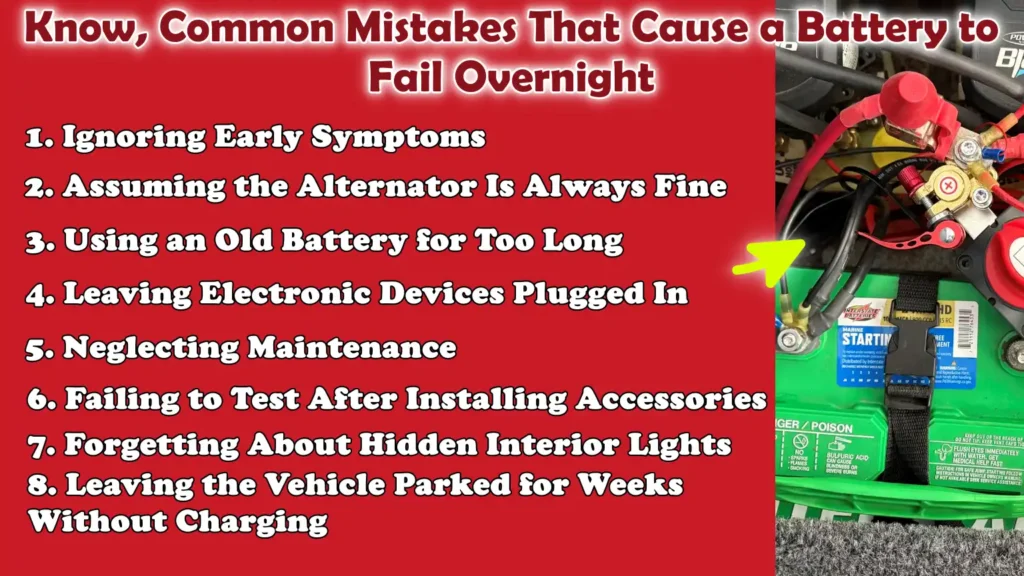
1. Ignoring Early Symptoms
One of the most common mistakes drivers make is ignoring the early warning signs of a weakening battery.
Symptoms such as a sluggish engine start, dimming lights while starting the car, or the occasional need for a jump-start are often dismissed as minor issues.
In reality, these signs usually indicate that the battery is already struggling to hold a charge.
When these early warnings are ignored, the battery continues to deteriorate until it is no longer capable of withstanding even a standard overnight discharge, resulting in a sudden battery failure the following morning.
2. Assuming the Alternator Is Always Fine
Many people assume that if their car is running, the alternator must be functioning correctly; however, this is not always the case.
A weak or failing alternator may generate enough power to keep the car running, but it may fail to fully recharge the battery.
Over time, this results in the battery never fully recovering, even after the car has been driven.
When the car is parked overnight, the battery lacks the necessary stored energy to restart the engine, creating the misleading impression of a sudden battery failure, when in fact, the underlying problem has been developing for weeks.
3. Using an Old Battery for Too Long
Car batteries have a finite lifespan and due to internal chemical wear and tear, they gradually lose their capacity to store energy.
Continuing to use a battery that is several years old increases the risk of sudden failure, as older batteries are unable to effectively handle the normal “parasitic load” (a minor electrical drain) as efficiently as newer batteries can.
Even a minor electrical leak, which might have no noticeable effect on a new battery, as it can completely discharge an older battery, specially when the car remains parked overnight.
4. Leaving Electronic Devices Plugged In
Leaving phone chargers, USB adapters, dash cams, or other electronic devices plugged in can cause the battery to discharge gradually, even when the ignition is turned off.
Some accessories continuously draw “standby power” (electricity consumed while remaining in a ready state), which can have a significant negative impact on the battery over the course of several hours.
Although each device individually consumes very little power, their combined effect can be sufficient to completely drain the battery overnight, particularly in vehicles that are not driven daily.
5. Neglecting Maintenance
Neglecting basic battery maintenance is another major cause of sudden battery failure.
The accumulation of dust and dirt, corrosion on the terminals and loose connections can all collectively compromise the efficiency of the electrical system.
When maintenance is overlooked, the battery fails to fully recharge while driving and its power begins to deplete rapidly once the vehicle is parked.
Over time, this increases the likelihood that you will wake up in the morning only to find that the battery is completely dead, often without any clear prior warning.
6. Failing to Test After Installing Accessories
Aftermarket accessories can place considerable strain on a vehicle’s electrical system; however, many drivers forget to test the battery after installing them.
Devices such as upgraded sound systems, tracking units, or modified lighting fixtures can increase “parasitic drain” (unnecessary power consumption) if they are not wired correctly.
Without proper testing, this hidden power consumption often goes unnoticed and can gradually drain the battery overnight.
Regularly testing the system after installing new electronic devices ensures that the electrical balance remains stable and secure.
7. Forgetting About Hidden Interior Lights
Hidden interior lights often go unnoticed because they are not easily visible when exiting the vehicle.
Lights located inside the glove box, trunk, or footwells may remain lit due to a faulty switch or a compartment that has been left slightly ajar.
These small lights can drain the battery in just a few hours, specially if the battery is already weak.
Forgetting to check these lights is a minor yet common oversight that can lead to sudden complications such as: the vehicle failing to start in the morning.
8. Leaving the Vehicle Parked for Weeks Without Charging
Leaving a vehicle parked for an extended period without starting or charging it causes the battery to gradually self-discharge over time.
Even when the vehicle is turned off, minor electrical systems continue to consume power, causing the battery’s charge level to slowly deplete.
If the vehicle remains unused for weeks, this slow discharge can become significant enough that, by the time the vehicle is needed again, the battery is completely dead.
This is one of the most common reasons why a car battery suddenly fails after the vehicle has been left idle for a prolonged period.
Read More:
So, When to Replace the Battery
1. Age-Related Warning Signs
Car batteries do not last forever, as their internal chemical composition gradually deteriorates over time.
Most car batteries typically last between three and five years; however, this depends on your driving habits, weather conditions and maintenance practices.
As a battery ages, its ability to hold a charge diminishes.
This means it may function adequately during short trips, but could struggle to start the vehicle after sitting idle overnight.
If a battery is already quite old and begins to show signs of difficulty starting, or if its performance becomes erratic, it is usually a definitive indication that you should consider replacing it before it fails completely.
2. Voltage Limits
Battery voltage is the most reliable metric for assessing its overall health.
A fully charged and healthy car battery typically maintains a stable “resting voltage” after the engine has been turned off for several hours.
If the voltage consistently drops below normal levels after the vehicle has been parked overnight, it signals that the battery is no longer capable of effectively holding a charge.
When the voltage becomes unstable, or fails to return to normal levels even after driving, it indicates that the battery’s internal capacity is weakening.
This is often one of the earliest and most easily measurable signs that the battery needs to be replaced before a sudden failure occurs.
3. Repeated Overnight Discharge
If a vehicle repeatedly loses power overnight and requires a “jump-start” (assistance from another battery) to get running, even after you have ruled out other potential causes of power drain, the battery itself is often the primary culprit.
Under normal circumstances, a healthy battery should possess sufficient capacity to start the vehicle, even if it has been sitting idle for several days.
When a battery discharging overnight ceases to be a one-off occurrence and becomes a recurring pattern, it typically indicates that the battery is no longer capable of effectively retaining stored energy.
This persistent malfunction is a definitive sign that, rather than attempting repeated repairs, replacing the battery is the more reliable solution.
4. Cracked or Swollen Casing
Any form of wear, tear, or damage to the battery’s outer casing is a clear indication that it requires immediate replacement.
Cracks in the casing can allow the battery’s internal acid to leak out, potentially causing further damage to the battery and creating safety hazards.
Swelling or bulging in the battery casing is typically caused by increased internal pressure resulting from heat or overcharging.
These conditions disrupt the battery’s internal chemical balance and compromise its ability to safely store electrical energy.
A battery exhibiting visible external damage is not only unreliable but may also be unsafe to use; in such instances, replacing the battery is the only appropriate course of action.
5. Failure to Function Even After a Full Charge
Occasionally, a battery may appear to be fully charged, yet fail to start the vehicle after sitting idle overnight.
This occurs when the battery’s internal cells have deteriorated and are no longer able to effectively store energy, even if the charging system indicates that the battery is at full capacity.
In such cases, the battery rapidly loses its stored energy the moment the engine is switched off.
If this issue persists even after charging the battery or driving the vehicle for an extended period, it signifies that the battery is no longer functioning correctly and requires replacement.
6. Recommendation for Professional Inspection
When battery-related issues recur frequently or become difficult to diagnose, a professional inspection provides the most accurate and definitive assessment.
By measuring the battery’s load capacity, charging performance and internal resistance, mechanics can determine whether the battery remains fit for use.
These tests are more reliable than simply checking the voltage, as they reveal how the battery performs under actual operating conditions, particularly during vehicle startup.
If a professional inspection reveals that the battery’s capacity has diminished or its performance falls below par, replacing the battery is the safest and most effective course of action to prevent issues such as sudden battery failure at night or future vehicle breakdowns.
Understand, When You Should Consult a Mechanic
1. Repeated Battery Discharge Even After Replacement
If a newly installed battery continues to discharge overnight, the problem likely lies not with the battery itself, but elsewhere within the vehicle’s electrical system.
A healthy, new battery should typically be able to hold its charge without any issues; therefore, repeated discharge indicates that something is continuously drawing power or preventing the battery from charging properly.
In such cases, it is essential to have the vehicle inspected by an expert, as the issue is often hidden within the wiring, control modules, or charging-related components, problems that are difficult to identify without specialized tools.
2. Undetected ‘Parasitic Electrical Drain’
Occasionally, a vehicle may suffer from excessive “parasitic electrical drain” (unnecessary power consumption) that goes unnoticed during routine inspections and basic testing.
When this occurs, the problem may stem from a complex electronic module that fails to shut down completely, or from a wiring fault that manifests only under specific conditions.
If routine checks and fuse inspections fail to reveal the issue, a mechanic can perform advanced diagnostic tests using specialized equipment to pinpoint the actual source of the power drain with greater precision.
3. Suspected Alternator Malfunction
If an alternator malfunction is suspected, seeking expert assistance is crucial, as the alternator plays a vital role in both recharging the battery and supplying power to the vehicle while the engine is running.
A faulty alternator may allow the vehicle to operate for a limited time; however, it will fail to recharge the battery effectively, leading to repeated battery discharge, which often occurs overnight.
In some instances, internal faults within the alternator can cause electricity to flow in the reverse direction; Consequently, the battery continues to discharge gradually even when the vehicle is turned off.
A mechanic can test the alternator’s output by applying an electrical load to the vehicle to ensure that it is functioning correctly.
4. Burning Odor or Overheating Wiring
A burning smell, the scent of melting plastic, or excessively hot wiring is a serious warning sign that should never be ignored.
These symptoms often indicate electrical resistance (an obstruction to current flow), a short circuit, or an excessive load on specific components, conditions that can damage both the battery and other vehicle systems.
If these issues are not addressed immediately, the battery may discharge very rapidly, or a major safety hazard could arise.
Whenever such symptoms appear, it is crucial to have the vehicle inspected by a mechanic immediately to prevent further damage or potential electrical hazards.
5. Frequent Need for Jump-Starts
If your vehicle requires frequent jump-starts, specially after sitting overnight, it is a definitive sign of a significant fault within the vehicle’s electrical or charging system.
Under normal circumstances, a healthy battery should not require repeated external assistance (such as a jump-start).
Repeated jump-starting places excessive strain on both the battery and the alternator, potentially exacerbating internal issues over time.
A mechanic can diagnose whether the problem stems from a deteriorating battery, a “parasitic drain” (unnecessary power consumption), or a fault within the charging system.
6. Persistent Warning Lights
When warning lights on the dashboard remain continuously illuminated, or flicker intermittently, it often signals an issue within the vehicle’s electrical or charging system.
Specifically, the battery warning light may indicate issues related to the alternator, voltage fluctuations, or a failure of the battery to charge properly.
If these lights persist even after an initial inspection, it signifies that the problem is not merely transient but requires a professional diagnosis.
A mechanic can pinpoint the root cause of the issue by reading error codes and inspecting the system, thereby preventing a complete battery failure.
Conclusion – How to Prevent Car Battery From Dying Overnight
Basically, overnight battery drain is not just caused by the single problem, as there could be mix of small electrical behaviors that can become serious only when you ignore them for long time.
In many cases, the root cause is not the battery itself, but rather a combination of minor factors such as: undercharging, parasitic electrical drains, poor connections, or normal wear and tear resulting from age and temperature fluctuations.
Modern vehicles continue to consume a small amount of electricity even when parked; consequently, a robust electrical system is specifically designed to handle this load without difficulty.
However, if the battery is already weak or a specific vehicle component is drawing excessive power, even this minor load can be sufficient to completely drain the battery by morning.
Understanding how and why a battery discharges overnight helps prevent sudden failures and the unexpected need for a jump-start.
Simple habits such as: ensuring that lights are turned off, checking for parasitic electrical drains, keeping battery terminals clean and driving the vehicle long enough to allow the battery to recharge, as it can significantly reduce the risk of battery failure.
Furthermore, regular inspections and early diagnostic checks make it easier to identify potential issues before they escalate into serious problems.
Now, that is all from this guide about How to Prevent Car Battery From Dying Overnight, also you can comment down below.
Frequently Asked Questions
FAQ 1: Why does my car battery discharge overnight, even when everything is turned off?
Answer: A car battery can lose its charge overnight because modern cars are never truly “off.” Small systems such as: the alarm, clock, ECU memory and keyless entry, continuously draw a small amount of power. This is normal. However, if the battery is weak or old, or if something is drawing excessive power such as: a faulty light, accessory, or a wiring issue, the battery can lose a significant amount of charge while the car is parked. In such cases, starting the engine in the morning becomes difficult.
FAQ 2: How long should a car battery last under normal circumstances?
Answer: Most car batteries last approximately three to five years, depending on usage, driving habits and weather conditions. Batteries can deteriorate faster in hot weather, whereas regularly driving for long distances can extend a battery’s lifespan. If the battery is used primarily for short trips or is left unused for extended periods, its lifespan may be reduced. As a battery ages, the likelihood of it losing charge overnight and causing difficulty in starting the car increases.
FAQ 3: Can short trips cause a battery to discharge overnight?
Answer: Yes, making frequent short trips can gradually lead to battery-related issues. Starting a car consumes a significant amount of energy and if the trip is very short, the alternator does not have sufficient time to fully recharge the battery. Over time, this results in a state of chronic undercharging. When the car remains parked overnight, the battery may not have enough energy left to start the engine the following morning, specially if the battery is already aging.
FAQ 4: How can I determine whether my battery is draining overnight or if it has simply become weak?
Answer: If your car starts up fine after being driven, but struggles to start after sitting overnight, it usually indicates that the battery is either draining overnight or has become weak. Symptoms include slow cranking in the morning (the engine taking longer to turn over), a clicking sound when attempting to start the vehicle, dimming lights, or the need for a jump-start after the car has been parked for some time. A weak battery loses its charge quickly, whereas a “drain” (electrical leakage) implies that a component within the car continues to consume power even when the engine is turned off. Monitoring the battery’s voltage overnight or performing a “parasitic draw test” helps pinpoint the root cause of the problem.
FAQ 5: Can leaving lights or accessories on really drain the battery overnight?
Answer: Yes, leaving lights or accessories on can drain a battery in just a few hours. Interior lights, headlights, trunk lights, or dash cams, if left on, as it can gradually consume enough power to completely discharge the battery. Smaller devices, such as phone chargers or USB adapters, can also contribute to this if they continue to draw power after the vehicle has been turned off. This is the most common, and easily avoidable, reason for a dead battery in the morning.
References:
[1] Parasitic Battery Drain Problems and AUTOSAR Acceptance Testing
https://saemobilus.sae.org/articles/parasitic-battery-drain-problems-autosar-acceptance-testing-07-11-02-0013
Hello Folks, Dean Shali here to help you out to solve the problems with your lovely vehicle, as i have lots of experience and knowledge about automotive industry as i woks directly with the customers and repair vehicles and i love to help the people to keep their cars safe and running smoothly.