
Written By: Dean Shali
Fact Checked By: Sabré Cook
Reviewed By: Tamara Warren
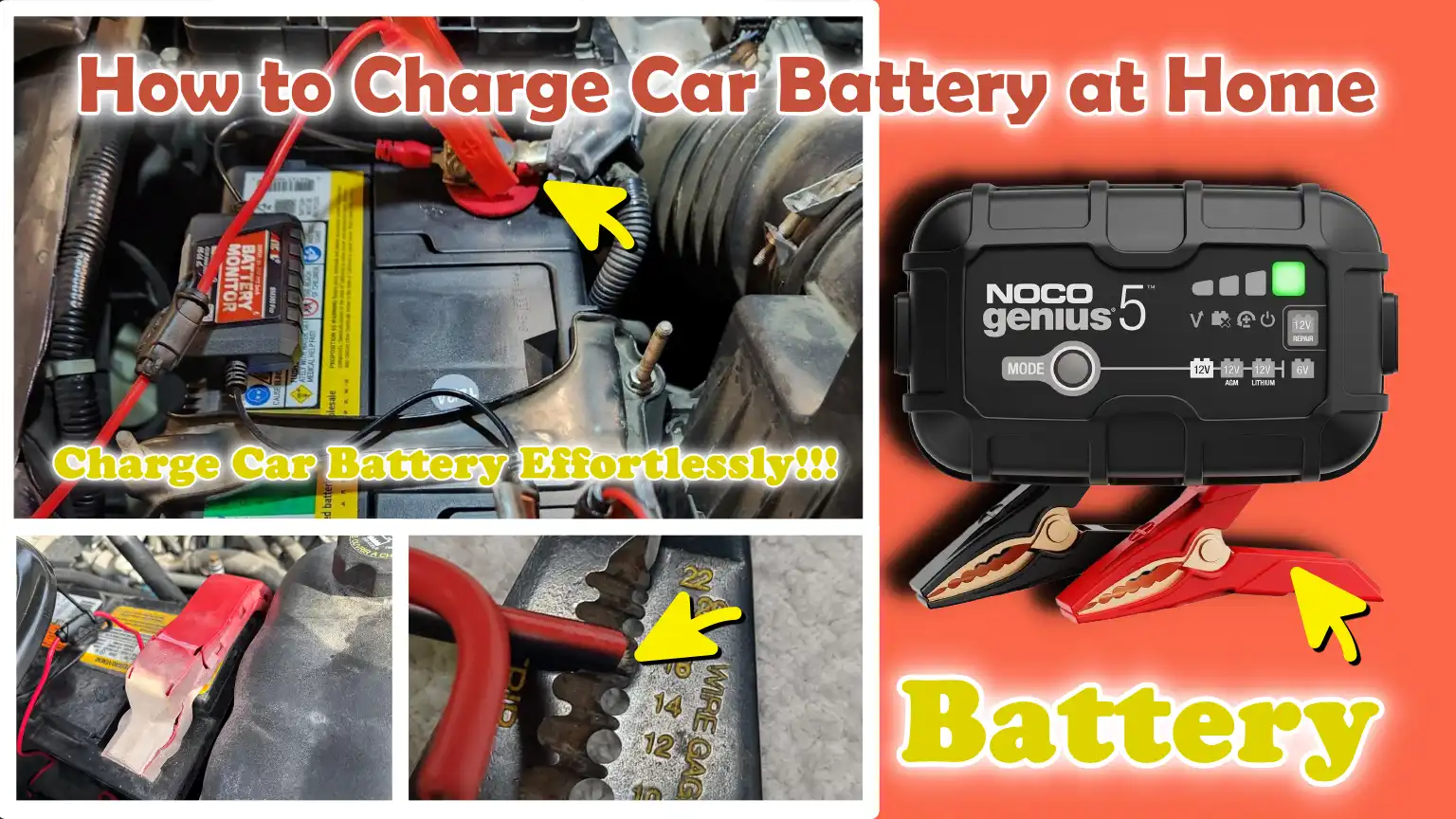
Before you just “REPLACE” your battery, you just need to recharge it in the right way, even this guide tells you how to do it at HOME only.
As, most of the cars uses a 12-volt lead-acid battery that actually stores electrical energy to start the engine and power essential systems such as: lights, ignition and onboard electronics as well.
But you need to know that, on average: a car battery literally lasts between 3 to 5 years, but don’t leave lights or other electronic accessories on as it can drain the battery much faster way.
Not only this, many drivers literally assume that a dead battery needs immediate replacement, but in many cases: it can be safely recharged at home by using the right method and equipment as well.
Now, in this guide you’ll learn How to Charge Car Battery at Home, so that you can easily prevent unexpected breakdowns and gives more control over your vehicle maintenance as well.
Know, How a Car Battery Works?
A car battery functions by storing electrical energy in chemical form and releasing it as electricity when your car requires it.
Inside the battery, there are lead plates and a liquid known as an electrolyte; this is typically a mixture of water and sulfuric acid.
When you turn the ignition key or press the start button, a chemical reaction occurs within the battery, generating electricity.
This electricity flows to the starter motor, which then cranks the engine to life.
The battery also powers essential systems such as: lights, the radio, sensors and the onboard computer, particularly when the engine is switched off.
While the car is running, the battery continues to play its role by helping to stabilize the voltage, thereby ensuring that all electronic components function correctly.
Understanding this fundamental mechanism helps you appreciate why a fully charged and well-maintained battery is crucial for the reliable performance of your vehicle.
1. The Basic Function of a 12V Lead-Acid Battery
A 12-volt lead-acid battery is designed to deliver a steady flow of electricity to crank the engine and support the car’s various electrical systems.
It is referred to as a 12-volt battery because it typically consists of six individual cells, each generating approximately 2.1 volts of power; collectively, these cells provide sufficient power to start most vehicles.
The primary function of this battery is to deliver a powerful, short-duration surge of electricity to start the engine.
Once the engine is running, the battery continues to serve as a backup power source, ensuring that systems such as headlights, dashboard electronics and safety features continue to operate without interruption.
It also stores any excess electricity generated while the car is running, allowing it to be utilized later whenever needed.
This balance between storing and supplying power is precisely what makes the 12-volt battery an indispensable component of every petrol and diesel-powered vehicle.
2. The Role of the Alternator vs the Battery
While the battery and alternator work in tandem, they perform distinct functions.
The primary role of the battery is to start the engine and provide power when the engine is switched off.
Conversely, once the engine has started, the alternator takes over the operation.
It generates electricity by harnessing the engine’s rotational energy and supplies power to all of the car’s electrical systems.
Furthermore, it recharges the battery, ensuring it remains ready to start the engine the next time it is needed.
If the alternator is functioning correctly, the battery remains charged under normal driving conditions.
However, should the alternator fail or weaken, the battery will gradually lose its charge, as it is no longer being replenished.
This is why a properly functioning charging system relies on the seamless, synchronized operation of both the battery and the alternator.
3. Why Does a Battery Discharge?
A car battery can lose its charge due to several common factors, many of which are frequently overlooked.
Leaving headlights, interior lights, or other accessories switched on while the engine is off is one of the most common causes of battery discharge.
Extreme weather conditions also play a significant role; in severely cold temperatures, the chemical reactions occurring within the battery slow down, whereas excessive heat can damage internal components and reduce the battery’s overall lifespan.
Short trips and infrequent driving can prevent the alternator from fully recharging the battery, leading to a gradual depletion of the battery’s power over time.
Furthermore, even when a battery is not in use, it continues to discharge automatically; this means that if a car remains parked for an extended period, its battery may weaken or completely lose its charge.
Understanding these factors helps drivers take simple steps to avoid sudden battery failure and maintain their vehicle’s performance consistently.
Know, Common Signs That Your Car Battery Needs Charging
Before a car battery fails completely, it typically provides several clear warning signs; recognizing these signals in a timely manner can save you from getting stranded on the road.
As the battery’s charge begins to deplete, it becomes unable to provide the necessary power to start the engine or operate the electrical system effectively.
This often manifests as subtle, yet noticeable, changes in your car’s behavior.
These signs appear because the battery’s voltage drops below the level required for normal operation.
A healthy car battery typically maintains a voltage of approximately 12.6 volts when fully charged; however, as it weakens, its voltage drops, thereby impacting the car’s starting capability and overall electrical performance.
Understanding these symptoms allows you to take timely action and recharge the battery before it becomes completely useless.
1. Slow Engine Cranking
One of the most common and easily identifiable signs of a weak battery is slow engine cranking.
When you start your car, the starter motor requires a powerful surge of electricity to rapidly turn over the engine.
If the battery is weak, it cannot deliver the necessary power, causing the engine to crank more slowly than usual.
Instead of the sound of a quick, seamless start, you may hear the engine struggling or straining to turn over.
This occurs because the battery’s voltage has dropped, preventing it from supplying the high current required to engage the starter motor.
Slow engine cranking often serves as an early warning sign; it indicates that while the battery still retains some charge, it requires immediate recharging to prevent it from failing completely.
2. Dim Headlights and Electrical Issues
Another clear indication of a weak or discharged battery is dim headlights or issues with electrical components.
The headlights may appear less bright than usual, specially when the engine is off or while the car is being started.
You may also notice that interior lights are dim, power windows are moving up and down slowly, or the radio and dashboard systems are not functioning correctly.
These issues arise because the battery is unable to provide the consistent voltage required to power these systems effectively.
Modern cars rely heavily on electronics; therefore, even a slight drop in battery power can lead to significant performance-related problems.
If several electrical components appear weaker than usual, it is often a sure sign that the battery needs to be recharged.
3. A ‘Clicking’ Sound When Turning the Key
Hearing a ‘clicking’ sound when turning the ignition key or pressing the start button is a very common symptom of a weak battery.
This sound typically originates from the starter solenoid; the solenoid attempts to engage the starter motor but fails to receive the necessary electrical power to fully activate it.
Instead of the engine turning over, you hear a rapid succession of clicks or a single distinct click.
This occurs because the battery possesses enough power to activate the solenoid, but not enough to crank the engine.
In many cases, this indicates that the battery has become severely discharged and requires immediate recharging.
Ignoring this warning sign can quickly lead to a situation where the car fails to start at all.
4. Dashboard Warning Lights
Warning lights on the dashboard can also signal a problem related to the battery or the charging system.
Many cars feature a battery-shaped warning light that illuminates when there is a fault in the charging system.
This light may turn on while driving or when starting the vehicle.
Generally, this indicates that the battery is not charging properly, a situation that can arise due to a weak battery, a faulty alternator, or loose connections.
In some instances, other warning lights may also illuminate, as low battery voltage can adversely affect the car’s electronic control systems.
It is crucial to pay attention to these warning lights, as they often serve as the earliest indication that something is amiss and that the battery may require charging or further inspection.
Tools
| Tool/Equipment | Why It Is Needed | How to Use It Properly |
|---|---|---|
| Battery Charger – Trickle Charger or Smart Charger | This is the primary tool used to safely recharge your car’s battery. A trickle charger delivers a charge at a slow and steady rate, which is beneficial for the battery’s longevity. A smart charger is more advanced; it automatically adjusts the charging speed and stops charging once the battery is fully charged, thereby helping to prevent overcharging. | First, ensure that the charger is set to 12 volts. Connect the red clamp to the positive terminal and the black clamp to the negative terminal. Once connected, plug in the charger and turn it on. Allow the battery to charge fully, then turn off the charger before removing the clamps. |
| Safety Gloves and Goggles | These items protect your hands and eyes from battery acid, sparks and dirt. Car batteries contain acid, which can cause injury if it comes into contact with your skin or eyes. Wearing safety gear while working reduces the risk of injury. | Put on gloves and goggles before touching the battery. Keep them on throughout the entire charging process. Avoid touching your face while working and wash your hands thoroughly once you have finished. |
| Socket Wrench – If Removing Battery | If you need to disconnect or remove the battery, you will require a socket wrench to loosen and tighten the battery terminal nuts. This tool helps you safely detach the battery without damaging the connectors. | Using the wrench, first loosen the negative terminal, followed by the positive terminal. When reconnecting, attach the positive terminal first and then the negative one. Ensure that the connections are secure, but be careful not to overtighten them. |
| Clean Cloth or Wire Brush | This tool is used to clean dirt, grease, or corrosion from the battery terminals. Clean terminals help improve the flow of electricity, making the charging process more efficient and safe. | Gently wipe the terminals with a dry cloth, or use a wire brush to remove rust. Ensure that the battery is not connected to any power source while cleaning. Clean surfaces ensure a strong and stable connection for charging. |
Know, Types of Car Battery Chargers
Car battery chargers are designed to restore power to a battery, but not all chargers operate in the same way.
The primary difference between various types of chargers lies in the speed at which they deliver power and how they regulate the charging process.
Choosing the right charger is crucial, as using the wrong type can either result in excessively long charging times or lead to battery damage caused by overcharging.
Most modern car batteries are of the 12-volt lead-acid type and require a controlled, steady flow of electricity to charge safely.
Some chargers provide a slow and steady charge, while others utilize smart technology to automatically adjust their power output.
Understanding the different types of chargers helps you select the safest and most effective option for your specific situation, whether you require routine maintenance or a quick solution in an emergency.
1. Trickle Chargers
A trickle charger is designed to charge a car battery very slowly over an extended period.
It typically delivers a low current, which helps maintain the battery’s charge without placing undue stress on the battery or generating excessive heat.
This type of charger is best suited for vehicles that are not used frequently such as: seasonal cars or backup vehicles, as it prevents the battery from naturally discharging over time.
The slow charging process helps preserve the battery’s internal components and can extend its overall lifespan.
However, a trickle charger typically does not shut off automatically once charging is complete; therefore, it is essential to monitor the process to prevent overcharging.
It is best used when you have ample time available and your objective is to maintain the health of an already functional battery, rather than to rapidly recharge a completely depleted one.
2. Smart Charger
A smart charger is a more modern and safer option that utilizes internal electronics to automatically regulate the charging process.
It can detect the battery’s condition, adjust the charging speed and halt charging once the battery is fully charged.
This prevents overcharging, one of the primary causes of battery damage.
Many smart chargers also feature distinct charging stages such as: soft start, bulk charge and maintenance mode, which facilitate efficient charging while safeguarding the battery’s internal structure.
Thanks to these features, smart chargers are user-friendly and ideal even for beginners, as they require minimal supervision.
They serve as an excellent choice for both routine charging and long-term battery maintenance, making them one of the most highly recommended options for home use.
3. Portable Battery Charger or Jump Starter
A portable battery charger, often referred to as a jump starter, is primarily used when your car’s battery has become too weak to start the engine.
Unlike traditional chargers, instead of slowly recharging the battery, it delivers a rapid surge of power to crank the car.
These devices are compact and lightweight, making them easy to carry with you; furthermore, they do not require a second vehicle to operate, making them invaluable during unexpected roadside emergencies.
However, a jump starter does not fully recharge the battery; it merely provides the necessary power to get the engine running.
After using one, it is essential to properly recharge the battery using a standard charger or to drive the car long enough for the alternator to replenish the battery’s charge.
Thus, while portable chargers serve as a convenient backup tool, they do not constitute a comprehensive solution for maintaining the overall health of the battery.
Know, Common Safety Precautions Before Charging
Properly charging a car battery is generally safe; however, it involves electricity and chemicals that can be hazardous if basic precautions are ignored.
A standard car battery contains sulfuric acid and releases hydrogen gas, which is highly flammable, during the charging process.
Even a minor error, such as a spark or an incorrect connection, can result in serious damage or injury.
Therefore, it is crucial to take a few simple safety steps before you begin.
These precautions help protect you from electric shocks, burns and accidents, while also safeguarding your car’s electrical system from potential damage.
Understanding and adhering to these safety measures ensures that the charging process remains controlled, efficient and risk-free.
1. Work in a Well-Ventilated Area
Always charge a car battery in a location with a good flow of fresh air, such as an open garage or an outdoor space.
During the charging process, the battery releases hydrogen gas, which is invisible and can accumulate in enclosed or poorly ventilated areas.
If this gas builds up in high concentrations in one spot, it can explode upon contact with a spark or an open flame.
Good airflow helps to rapidly disperse the gas, thereby reducing the risk of a dangerous buildup.
Working in a well-ventilated area also ensures your comfort and safety, preventing you from inhaling any harmful fumes emitted by the battery.
2. Avoid Sparks and Open Flames
Keeping sparks and open flames away from the battery is one of the most critical safety rules.
As hydrogen gas is highly flammable, even a small spark can ignite it.
Sparks can be generated if the charger clamps are connected incorrectly, if metal tools accidentally touch both terminals simultaneously, or if the charger is switched on before a proper connection has been established.
To mitigate this risk, always attach the charger clamps before plugging in the charger and switch the charger off before removing them.
Never smoke or use open flames in the vicinity while the battery is charging.
Exercising caution regarding connections and avoiding careless actions can prevent serious accidents.
3. Check the Battery for Any Damage or Leaks
Before charging, always inspect the battery for any visible signs of damage.
Look for cracks in the battery casing, leaking fluid, or signs of excessive corrosion around the terminals.
Charging a damaged battery is unsafe, as it may leak acid or rupture under pressure, posing a risk of injury.
Battery acid is highly corrosive and can damage skin, clothing and the surrounding components of the vehicle.
If you observe any signs of leakage or swelling in the battery, it is best to replace it rather than attempting to charge it.
A brief initial inspection can help you avoid using a battery that is already compromised.
4. Ensure Correct Voltage Settings
Using the correct voltage setting on your charger is crucial for safe and effective charging.
Most standard car batteries operate at 12 volts and the charger should be set accordingly.
Using a voltage that is too high can cause the battery to overheat, damage its internal components and increase the risk of premature failure.
Conversely, using incorrect settings prevents the battery from charging properly and reduces its overall lifespan.
Many modern chargers automatically detect the correct voltage; nevertheless, it is crucial to double-check the settings before initiating the charging process.
Ensuring the correct settings helps maintain battery health and prevents potential damage during charging.
How to Charge Car Battery at Home – Easy Method
Charging a car battery at home is a simple process, provided it is performed in the correct sequence; however, every step is crucial to ensure safety and achieve the desired results.
A steady and controlled flow of electricity is essential to recharge a standard 12-volt car battery without causing damage.
If a step is skipped or executed incorrectly, it can prevent the battery from charging properly, cause electrical malfunctions, or even pose a safety hazard.
Adopting a clear, step-by-step approach ensures that the battery charges fully, maintains its overall health and continues to function reliably.
This process is designed with beginners in mind, involving simple tasks that keep both you and your vehicle safe.
1. Turn Off the Car and Remove the Keys
Before doing anything else, ensure that the car is completely turned off and the keys have been removed from the ignition.
This guarantees that no electrical current flows through the system while you are working.
Leaving the car running or in ‘accessory mode’ can create a risk of sparks or short circuits when connecting the charger.
Turning everything off ensures that the battery is isolated from the rest of the system and is safe to handle.
2. Locate the Battery
Next, locate the battery within your vehicle.
In most cars, the battery is situated under the hood, typically near the engine.
However, in some vehicles, it may be located in the trunk or even under a seat.
Knowing the exact location of the battery allows you to easily access its terminals and prepare for the charging process.
Always ensure that you have sufficient space and lighting to work safely around the battery.
3. Inspect the Battery
Before connecting any charger, carefully inspect the battery for any visible defects or issues.
Look for signs of white or green deposits (corrosion) on the terminals, cracks in the battery casing, or any evidence of fluid leakage.
Corrosion can obstruct the proper flow of electricity, while cracks or leaks can render the charging process unsafe.
If the battery appears damaged, it is best not to charge it; instead, consider replacing it.
Taking a moment to inspect it helps prevent accidents and ensures that the battery charges correctly.
4. Disconnect the Battery – Optional, but Recommended
Disconnecting the battery is not always strictly necessary, but it is recommended for added safety, specially for beginners.
Start by removing the negative terminal first; this is usually marked with a ‘minus’ (–) sign.
Next, remove the positive terminal.
This sequence is crucial as it minimizes the risk of a short circuit.
Disconnecting the battery isolates it from the car’s electrical system, thereby preventing any complications during the charging process.
5. Connect the Charger
Now, attach the charger clamps to the battery terminals.
Connect the red clamp to the positive terminal and the black clamp to the negative terminal.
Ensure that the clamps are secure and not loose, as a poor connection can interrupt the charging process.
Correct connection is vital, as reversing the clamps can damage both the battery and the charger.
6. Configure the Charger
Set the charger to the correct voltage, which is typically 12 volts for most car batteries.
Then, select the charging speed or amperage.
Slow charging is generally preferable because it charges the battery more evenly and helps extend its lifespan.
Although fast charging can be quicker, it may generate heat and place greater stress on the battery.
Choosing the appropriate settings ensures safe and efficient charging.
7. Begin Charging
Once everything is properly connected and configured, plug in the charger and switch it on.
The charger will begin supplying power to the battery.
During this stage, the chemical reactions occurring within the battery start replenishing the stored energy.
Ensure that the charger is placed on a stable surface and that the cables remain unobstructed throughout the entire process.
8. Monitor the Charging Process
Periodically monitor the charging process.
Charging times may vary depending on the condition of the battery and the type of charger being used, typically ranging from a few hours to a full day.
Some chargers feature indicators that signal when the battery is fully charged.
Monitoring the process allows you to prevent overcharging and ensures that everything is functioning as expected.
9. Power Off and Disconnect
Once the battery is fully charged, switch off the charger and unplug it before removing the clamps.
This step is crucial to prevent sparking.
Remove the negative clamp first, followed by the positive clamp.
Following this sequence minimizes the risk associated with electrical contact and ensures a safe procedure.
10. Reconnect and Test the Battery
If you had previously disconnected the battery, reconnect it, attach the positive terminal first, followed by the negative terminal.
Ensure that both connections are firm and secure.
Once this is done, start the car to check if the battery is functioning properly.
If the car starts easily and quickly, it is a good indication that the battery has successfully charged and is ready for use.
How Long Does It Take To Charge a Car Battery?
The time required to charge a car battery depends on several specific factors.
Understanding these factors allows you to set realistic expectations and avoid making mistakes.
A standard 12-volt car battery does not charge instantly, as safely replenishing its energy requires a steady and controlled flow of electricity.
In most cases, the charging process can take anywhere from 4 to 24 hours.
This duration depends on the type of charger used, the size of the battery and its current state of discharge.
Charging too rapidly can generate excessive heat and shorten the battery’s lifespan, whereas slow and steady charging is generally safer and more effective.
Knowing which factors influence charging time helps you select the appropriate method and ensures that the battery is fully charged without sustaining any damage.
1. Based on the Charger’s Amperage
The charger’s amperage, that is, the amount of electrical current delivered by the charger, plays a crucial role in determining how quickly the battery will charge.
A charger with higher amperage delivers a stronger current and can charge the battery more rapidly, whereas a low-amperage charger charges the battery slowly and gently.
For instance, a charger set to 2 amps might take a full day to charge a battery, whereas a 10-amp charger could complete the task in just a few hours.
However, for the sake of the battery’s health, slow charging is generally preferable, as it generates less heat and facilitates the internal chemical reactions within the battery more smoothly.
Rapid charging can be useful in emergency situations, but it should not be used on a daily basis, as it can ultimately reduce the battery’s overall lifespan over time.
2. Battery Capacity – Ah Rating
Battery capacity, measured in Ampere-hours, or Ah, tells you how much energy a battery can store.
A higher Ah rating means the battery can store more charge; however, it also implies that it will take longer to fully recharge.
For instance, when using the same charger, a 50 Ah battery will charge faster than a 70 Ah battery because it has a smaller total capacity to fill.
This is akin to filling a small container versus a large one, where the larger container naturally takes more time to fill.
Understanding your battery’s capacity allows you to estimate charging times more accurately and select the appropriate charger to suit your specific needs.
3. State of Charge
The battery’s current charge level is another critical factor influencing how long it takes to recharge.
A battery that has been only slightly discharged will charge significantly faster than one that has been completely depleted.
For example, if a battery’s charge level has dropped by only 20 to 30 percent, it may take just a few hours to return to full capacity.
However, if the battery is completely drained, the process can take considerably longer, sometimes requiring a full day to recharge if a slow charger is being used.
Furthermore, batteries that have been deeply discharged may initially charge at a slower pace, as the internal chemical reactions require some time to stabilize.
Being aware of the battery’s current state enables you to better plan the charging process and avoid rushing it, thereby enhancing the battery’s performance and extending its lifespan.
How to Charge Without Removing the Battery
Charging a car battery without removing it from the vehicle is a common and convenient practice, particularly for modern cars.
In most cases, this is entirely safe, provided that the correct procedures are followed and the battery is in good condition.
Modern vehicles are designed to allow for in-vehicle charging and many battery chargers are engineered to operate safely even while the battery remains connected.
This method saves both time and effort, as it eliminates the need to disconnect cables or manually lift the battery out, a task that can be heavy and cumbersome.
However, it is crucial to understand when this method is appropriate and what precautions must be taken to safeguard both the battery and the vehicle’s sensitive electronic systems.
1. When It Is Safe
Charging the battery without removing it is safe when the battery is free of defects and the vehicle’s electrical system is functioning correctly.
If there are no visible cracks, leaks, or excessive corrosion and the battery terminals are clean and securely connected, you can generally charge it while it remains installed in the vehicle.
This method is also safe when using modern “smart” chargers, as these devices automatically regulate voltage and current levels, thereby minimizing the risk of overcharging.
Most vehicles can handle this process without any issues, specially when the ignition is turned off and all electrical accessories are not in use.
Under these conditions, the battery can be charged effectively without being removed from the vehicle.
2. Risks and Precautions
While charging the battery in situ is convenient, it does entail certain risks that require careful handling.
One of the primary concerns is the potential for sudden voltage spikes; if the battery charger is not used correctly, voltage fluctuations can adversely affect the vehicle’s electronic systems.
Furthermore, if the clamps are attached or removed incorrectly, there is a risk of sparks occurring.
To mitigate these hazards, always ensure that the vehicle is completely switched off; securely attach the clamps before turning on the charger and remove them only after the charger has been switched off.
Ensure that the charging area is well-ventilated, as gases may be emitted from the battery during this process.
Avoid touching both battery terminals simultaneously with metal tools, as this could result in a short circuit.
By observing these simple precautions, you can make the charging process both safe and smooth.
3. Considerations for Modern Vehicles
Modern vehicles are equipped with advanced electronic systems such as: sensors, control units and onboard computers, that rely on stable voltage.
Therefore, it is essential to use a charger that delivers clean and regulated power, such as a smart charger.
Some newer vehicles may also feature a Battery Management System (BMS), which monitors the battery’s health and charge level.
In such vehicles, it is crucial to strictly adhere to the manufacturer’s recommendations to ensure that these systems remain undisturbed.
In certain instances, it may be preferable to utilize specific connection points or grounding methods rather than connecting directly to the battery terminals.
Understanding these nuances enables you to charge the battery in modern vehicles safely and without disruption, while also ensuring that all electronic systems continue to function correctly.
Know, Common Mistakes to Avoid During Charging Car Battery at Home
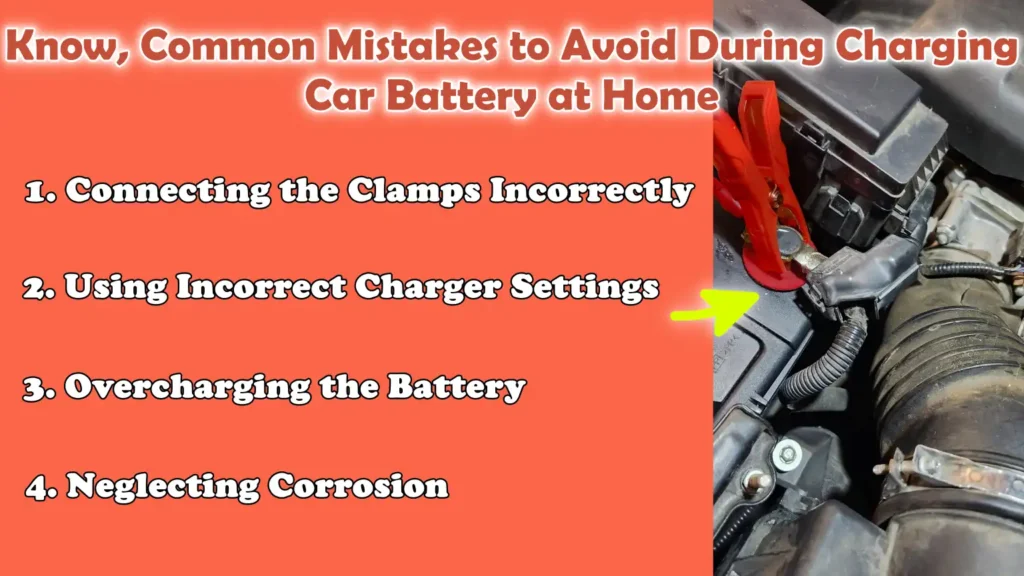
Charging a car battery at home is a straightforward task; however, minor errors can prevent the battery from charging properly, cause damage to it, or create safety hazards.
A car battery operates within a specific voltage and current range and any mistake in the connections or settings can disrupt this delicate balance.
Many issues such as: the battery failing to charge properly, discharging prematurely, or failing completely, are often the result of improper usage rather than an internal defect within the battery itself.
Understanding these common mistakes allows you to avoid unnecessary damage, extend the battery’s lifespan and ensure that the charging process remains both safe and effective.
1. Connecting the Clamps Incorrectly
One of the most serious mistakes is connecting the charger’s clamps to the wrong terminals.
Every car battery has a positive terminal and a negative terminal and it is crucial to match them correctly with the charger’s clamps.
If the connections are reversed, it can cause sparks, damage the charger, or even harm the battery and the vehicle’s electronics.
This occurs because electricity flows in the wrong direction, a current flow that the system was not designed to handle.
Before turning on the charger, always double-check that the red clamp is connected to the positive terminal and the black clamp to the negative terminal.
Correct connections ensure a safe flow of electricity and prevent avoidable damage.
2. Using Incorrect Charger Settings
Using incorrect charger settings is another common issue that impacts both charging performance and the overall health of the battery.
Most car batteries require a 12-volt setting; Selecting an excessively high voltage can cause the battery to overheat and damage its internal components.
In addition to voltage, correctly setting the charging current, or amperage, is equally important.
While a high current can charge the battery quickly, it may generate excessive heat and stress; conversely, a current that is too low can significantly prolong the charging time and prevent the battery from reaching a full charge.
Proper configuration of the charger ensures that the battery receives the correct amount of power in a controlled manner, a prerequisite for safe and efficient charging.
3. Overcharging the Battery
Overcharging occurs when a battery continues to draw power even after it has reached a full charge.
This can lead to overheating, depletion of electrolytes and internal damage, thereby reducing the battery’s lifespan.
In some instances, overcharging can even cause the battery to swell or leak, rendering it unsafe for use.
This typically happens with basic chargers that lack an automatic shut-off mechanism once the battery is fully charged.
To prevent this, it is essential to monitor the charging process or use a “smart charger” equipped with an automatic shut-off feature.
Proper timing and control of the charging process help maintain the battery’s health and prevent long-term damage.
4. Neglecting Corrosion
The issue of corrosion on battery terminals is often overlooked, yet it can have a significant impact on the charging process and the battery’s overall performance.
It typically manifests as a white or green powdery substance around the terminals, formed by chemical reactions between the battery acid and the metal components.
Corrosion acts as a barrier that impedes the flow of electricity; Consequently, the battery fails to charge properly or deliver power efficiently.
If left unaddressed, this corrosion can cause permanent damage to the terminals and cables.
Cleaning the terminals prior to charging ensures a strong and stable connection, thereby enhancing charging efficiency and guaranteeing that the battery performs as expected.
Read More:
- How to Revive Dead Car Battery Safely
- How to Fix Battery Not Holding Charge
- How to Diagnose Weak Battery Symptoms
- How to Test Battery Cold Cranking Amps
- How to Check Car Battery Voltage with Multimeter
Can You Charge a Car Battery Without a Charger?
It is possible to restore some power to a car battery without using a traditional charger; however, it is crucial to understand that these methods do not fully charge the battery in the same controlled manner.
A proper battery charger delivers a steady and regulated flow of electricity over time, helping to safely replenish the battery’s stored energy.
In contrast, alternative methods primarily provide a quick boost to start the engine, rather than performing a complete recharge.
Once the engine is running, the car’s alternator begins generating electricity and gradually recharges the battery; however, this process depends on driving time and may not be sufficient to fully restore a completely discharged battery.
While these methods are useful in emergency situations, they should not be considered a substitute for proper charging if you wish to maintain the long-term health of the battery.
1. Using Jumper Cables and Another Car
Using jumper cables in conjunction with another vehicle is one of the most common methods for starting a car with a weak or completely discharged battery.
In this method, a running vehicle supplies power to the discharged battery via cables connecting the two batteries.
This enables the starter motor to crank the engine, thereby starting the car.
Once the engine is running, the alternator initiates the process of recharging the battery.
However, this recharging process is typically slow and if the battery is severely discharged, it may not be sufficient.
It is necessary to drive the car for a significant period, often at least 20 to 30 minutes, to allow the alternator to replenish a substantial amount of charge in the battery.
While this method is effective for starting the car, it does not serve as a comprehensive solution for fully recharging the battery.
2. Using a Portable Jump Starter
A portable jump starter is a compact device that stores electrical energy and can deliver a powerful surge of power to start a car without the need for a second vehicle.
It functions similarly to jumper cables but offers greater convenience as it does not rely on another car.
When connected to the battery, it provides sufficient current to rapidly crank the engine.
Once the car starts, the alternator takes over and begins recharging the battery.
Just like jumper cables, a portable jump starter does not fully recharge the battery.
It is primarily designed for emergency use; therefore, to fully restore the battery, it is essential to properly charge it afterward or drive the vehicle for a while.
3. Risks Associated with Alternative Methods
Although these methods are effective, they can pose certain risks if not used with caution.
Incorrect cable connections can result in sparks, short circuits, or damage to the vehicle’s electrical system.
There is also a risk of sudden voltage spikes, which can adversely affect the sensitive electronic components found in modern vehicles.
Furthermore, if the battery is not properly recharged following these methods, and one relies solely on them, recurring battery-related issues may arise, as the battery may never reach a full charge.
If the battery is old or defective, these methods may not work at all and could potentially worsen the situation.
Understanding these risks allows you to utilize these alternative methods safely and recognize when a proper battery charger or a new battery is required.
How to Care for Your Car Battery After Charging
Charging your car battery is just one part of keeping it in good condition.
Proper care after charging is what truly ensures that the battery remains reliable over the long term.
A typical car battery can last anywhere from 3 to 5 years; however, without proper maintenance, its lifespan can be significantly shortened.
Due to internal chemical reactions, a battery’s charge naturally diminishes over time; if it is not kept at an adequate charge level, it may weaken or fail completely.
A few simple habits such as: driving the vehicle regularly, keeping connections clean and using the right tools, as it can make a significant difference.
These measures help maintain the battery’s charge more effectively, ensure a consistent power supply and reduce the risk of sudden failure.
Additionally, there’s research that shows that these batteries actually operates through the stable chemical reactions that literally allows efficient energy storage and delivery, which is essential for starting the engines and powers the vehicle electronics as well, also their high recyclability rate also makes them one of the most environmentally managed battery types in use today, that shows that long-term importance performance in the automotive industry.[¹]
1. Regular Driving Habits
The simplest way to care for your battery after charging is to drive your car regularly.
When the engine is running, the alternator generates electricity while simultaneously recharging the battery.
However, during short trips, the alternator often does not have enough time to fully recharge the battery, specially if the battery was already significantly discharged to begin with.
Longer trips provide the battery with the opportunity to fully recharge and retain that charge, which is crucial for its overall health.
If a car is left unused for an extended period, the battery will gradually lose its power due to natural self-discharge, potentially causing it to weaken.
Ensuring that the car is driven frequently, and for a reasonable duration, helps keep the battery active and prevents it from losing charge unnecessarily.
2. Keeping Terminals Clean
Keeping battery terminals clean is crucial for ensuring proper electrical flow and optimizing overall battery performance.
Over time, chemical reactions between the battery acid and the metal components can lead to corrosion on the terminals.
This corrosion typically manifests as a white or green powdery substance and can obstruct the flow of electricity, making it more difficult for the battery to charge and deliver power.
If the terminals are not clean, the battery may fail to function correctly, even after being fully charged.
Regularly inspecting and cleaning the terminals ensures a strong and reliable connection between the battery and the vehicle.
This improves charging efficiency, reduces strain on the battery and helps prevent difficulties in starting the vehicle.
3. Using a Battery Maintainer
A battery maintainer is a useful device that helps keep a battery fully charged over extended periods, particularly when the vehicle is not in frequent use.
Unlike standard battery chargers, a maintainer delivers a low, continuous current, ensuring that the battery maintains an optimal charge level without the risk of overcharging.
This helps prevent the battery from discharging due to inactivity and ensures that it remains ready for use at any time.
Battery maintainers are particularly beneficial for vehicles that remain parked for weeks or months, as they prevent the battery from fully discharging and help extend its overall lifespan.
Using a battery maintainer is a simple and effective way to maintain the long-term health of your battery with minimal effort.
When to Replace the Battery Instead of Recharging It
Recharging a car battery can resolve many starting issues, but it is not always the right solution.
A battery has a finite lifespan, as the chemical components within it gradually degrade over time.
When this occurs, the battery can no longer properly store or supply power, regardless of how many times it is recharged.
Most standard car batteries last between 3 and 5 years under normal conditions; however, factors such as harsh weather, frequent short trips and improper maintenance can shorten their lifespan.
Knowing when to replace a battery, rather than attempting to recharge it, as it can save you time, prevent sudden breakdowns and ensure that your car starts reliably every time.
1. Battery Age – 3 to 5 Years
Battery age is one of the most critical factors in determining whether to replace or recharge a battery.
As a battery ages, its internal plates wear down and the chemical reactions occurring within it begin to weaken.
This diminishes the battery’s capacity to hold a full charge and to deliver the strong surge of power required to start the engine.
Even if an old battery can still accept a charge, it may not be able to retain that charge for very long.
In most cases, once a battery has been in use for approximately 3 to 5 years, a noticeable decline in performance becomes apparent.
Replacing an aging battery at the appropriate time can prevent sudden failures and ensure consistent, reliable performance.
2. Frequent Failure
If a battery requires frequent recharging or repeatedly fails to start the car, it is a clear indication that it is no longer reliable.
A healthy battery should maintain its charge during normal use and start the car without any issues.
Frequent failure often indicates that the battery’s internal structure has deteriorated and it is no longer capable of storing electrical energy effectively.
Continuously recharging such a battery is merely a temporary stopgap and does not resolve the underlying issue.
In such cases, replacing the battery, rather than constantly recharging it, is a superior and more reliable solution.
3. Failure to Retain Charge
A battery that fails to retain its charge is no longer functioning correctly and should be replaced.
This means that even after being fully charged, the battery’s power drains rapidly when the vehicle is not in use; furthermore, it struggles to restart the engine even after a short period of inactivity.
This problem typically stems from internal defects within the battery such as: worn-out plates or low electrolyte levels, which are irreparable.
Once a battery reaches this state, recharging it will not restore its performance.
Replacing the battery ensures that your vehicle is equipped with a stable and reliable power source, capable of powering and maintaining all of its electrical systems.
Conclusion – How to Charge Car Battery at Home
Yes, most of the time: car battery problems are really preventable when you actually understand the basics and act early as well.
The car battery serves to start the engine and power all electrical systems; therefore, keeping it properly charged and well-maintained is crucial for the vehicle’s reliable performance.
Many common starting issues stem not from major mechanical failures, but rather from a weak or discharged battery; this means that, with the right approach, these problems can often be easily resolved right at home.
By understanding how a battery functions, recognizing early warning signs and adopting proper charging techniques, you can avoid unnecessary expenses and minimize the risk of getting stranded on the road.
It is also vital to remember that safety and proper technique play a pivotal role in the charging process.
Using the correct charger settings, establishing proper connections and avoiding common mistakes, all these measures contribute to the safety of both you and your vehicle.
Furthermore, regular maintenance such as: keeping the battery clean, driving the vehicle frequently and using a battery maintainer when necessary, as it can extend the battery’s lifespan and enhance its performance.
Now, that’s all from this guide about How to Charge Car Battery at Home, now you can comment for more information as well.
Frequently Asked Questions
FAQ 1: What is the safest way to charge a car battery at home?
The safest way to charge a car battery at home is to use a high-quality smart charger and carefully follow the correct procedures. First, ensure that the car is turned off and that the surrounding area is well-ventilated. Connect the charger clamps correctly, the positive clamp to the positive terminal and the negative clamp to the negative terminal. Only switch on the charger once everything has been properly connected. Using a smart charger is highly recommended because it automatically regulates the charging process and shuts off automatically once the battery is fully charged; this prevents overcharging and protects the battery from damage. Throughout this entire process, always take precautions to avoid creating sparks and prioritize safety above all else.
FAQ 2: How long should I charge my car battery?
The charging time depends on the battery’s current state of discharge, its size and the type of charger you are using. Generally, it can take anywhere from 4 to 24 hours for a car battery to fully charge. A slow charger takes longer but is better for the battery’s health, whereas a fast charger works quickly but can generate more heat. If your battery is only slightly discharged, it may recharge within just a few hours; however, if the battery is completely drained, it will take significantly longer to recharge. For best results, it is essential not to rush the process and to allow the battery to charge fully.
FAQ 3: Can I charge a car battery without removing it?
Yes, in most cases, you can charge a car battery without removing it from the vehicle. Modern vehicles are designed with this in mind and most chargers operate safely even when the battery remains connected to the car. However, you must ensure that the car is completely switched off and that none of its electrical systems are in use. It is also essential to use a smart charger to avoid voltage-related issues. If the battery is damaged or leaking, it should not be charged in its current condition; instead, it should be replaced.
FAQ 4: What happens if I connect the charger incorrectly?
Connecting the charger incorrectly can lead to serious problems. If the positive and negative clamps are reversed, sparks may fly, the charger could be damaged and the battery or the car’s electrical system could sustain damage. In some cases, this can blow fuses or ruin sensitive electronic components within the car. Therefore, it is crucial to double-check all connections before switching on the charger. To ensure safe charging, always connect the red cable to the positive terminal and the black cable to the negative terminal.
FAQ 5: Can a completely dead car battery be recharged?
Yes, a completely dead car battery can often be recharged, although this depends on its condition. If the battery is still in good shape and not too old, a slow and steady charge can bring it back to life. However, if the battery has been dead for a long time or has internal defects, it may not be able to hold a charge even after being recharged. In such cases, replacing the battery is the better option. Charging works best when the battery is merely discharged, rather than damaged.
FAQ 6: Is it okay to charge a car battery overnight?
If you are using a smart charger, charging a car battery overnight is generally safe. Smart chargers automatically stop charging once the battery is full, thereby preventing overcharging. If you are using a basic charger that lacks an automatic shut-off feature, it is not advisable to leave it unattended for extended periods, as this can lead to the battery overcharging and becoming damaged. Before deciding to leave a charger plugged in overnight, always verify the specific type of charger you are using.
References:
[1] LEAD-ACİD BATTERY
https://www.researchgate.net/publication/357913548_LEAD-ACID_BATTERY

Hello Folks, Dean Shali here to help you out to solve the problems with your lovely vehicle, as i have lots of experience and knowledge about automotive industry as i woks directly with the customers and repair vehicles and i love to help the people to keep their cars safe and running smoothly.