
Written By: Dean Shali
Fact Checked By: Sabré Cook
Reviewed By: Tamara Warren
Most of the time slow cranking problems are electrical, but the real challenge is to find the exact thing where the power loss begins.
Also, drivers thinks that batter is always the problem here, but in reality having slow engine cranking can be caused by many other things such as: hidden cable corrosion, poor ground connections, starter motor wear, charging system faults, thick engine oil or even internal mechanical resistance inside the engine itself can cause this.
Because, modern vehicles literally relies heavily on stable voltage and high electrical current during startup and even a small drop in voltage can dramatically reduces the starter performance.
That’s why, there’s could have some symptoms such as: dim headlights while starting the vehicle, dragging crank sounds, clicking noises or weak cold-weather starts as well.
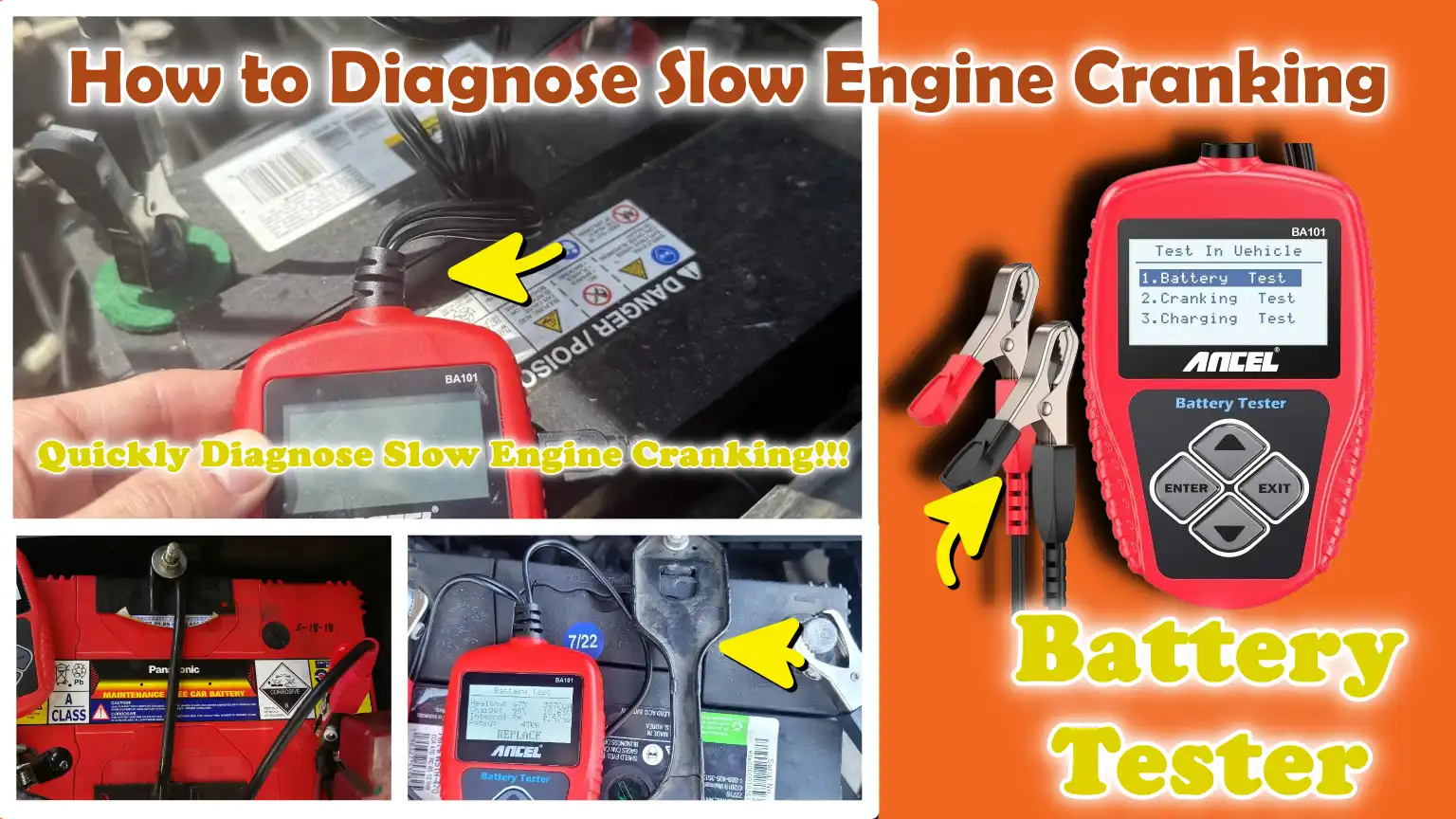
Now, in this guide you’ll learn How to Diagnose Slow Engine Cranking, so that you can find out the real causes by the warning signs and proven solutions by testing voltage and starter inspection to the alternator checks as well.
So, What Is Slow Engine Cranking?
Slow engine cranking occurs when the engine rotates more slowly than usual during the starting process.
Instead of firing up quickly, the engine spins at a reduced speed and produces a weak or labored sound while cranking.
This typically indicates that the starter motor is not receiving sufficient power to rotate the engine properly.
In many vehicles, the problem of slow cranking worsens over time; if the root cause is not identified early on, it can eventually lead to a situation where the vehicle fails to start at all.
1. Understand About Slow Crank Condition
The Engine Spins Slowly
A slowly spinning engine is one of the most obvious signs of slow cranking.
When you turn the key or press the start button, the engine’s sound may seem sluggish, labored, or strained.
Typically, the starter motor should spin the engine rapidly enough to initiate combustion within just a few seconds.
When cranking speed drops, the engine struggles to start because proper compression, fuel delivery and ignition timing, all of which depend on the engine rotating at the correct speed, are compromised.
A weak battery, a worn-out starter and poor cable connections are among the most common causes of slow cranking.
The Starter Sounds Weak or Labored
A weak or labored sound coming from the starter usually indicates that the starter motor is straining under the electrical load.
Drivers often describe this sound during startup as a grinding, dragging, or unusually heavy noise.
This can happen when the battery voltage is low or when the internal components within the starter begin to wear out.
Corrosion on battery terminals and faulty cables can also impede the flow of electricity, forcing the starter motor to work harder than usual.
Dashboard lights may dim during cranking
Dimming dashboard lights during startup are often an indication that the battery is under excessive strain.
When the starter motor demands a heavy surge of power, a weak battery or poor electrical connections may fail to maintain a stable voltage.
As the voltage drops, the lights dim further while the engine is cranking.
This symptom is very common in vehicles with aging batteries, issues in the charging system, or excessive resistance within the starting circuit.
The vehicle may start after a delay, or it may not start at all
Some vehicles exhibiting symptoms of slow cranking may eventually start after a few seconds, while others may fail to start altogether.
In the early stages, the engine might crank slowly on cold mornings or after sitting overnight.
As the problem progresses, the starter may become unable to spin the engine fast enough to achieve proper ignition.
Ignoring slow-cranking symptoms for too long can eventually lead to a situation where the vehicle refuses to start at all.
2. Common symptoms of a slow-starting engine
The problem of a slow-starting engine typically develops gradually and many drivers recognize minor warning signs before a major breakdown occurs.
These symptoms often point to faults in the battery, starter motor, charging system, or electrical wiring.
Recognizing these early signs can help prevent costly repairs and sudden breakdowns.
Taking longer than usual to start
If a vehicle takes longer than usual to start, it may be experiencing a slow-starting issue.
Instead of starting immediately, the engine continues to crank for several seconds before firing up.
This often occurs because the starter motor is unable to maintain sufficient speed due to low voltage or an electrical obstruction.
Clicking or Grinding Sounds from the Starter
Clicking or grinding sounds during startup are common warning signs of a malfunction within the starter system.
Rapid clicking sounds may indicate low battery voltage, while grinding sounds often point to a weak starter motor or a poor electrical connection.
These sounds should never be ignored, as underlying issues typically worsen over time.
Dimming Headlights During Startup
Dimming headlights during startup usually indicates that the battery is unable to provide an adequate electrical supply.
This symptom is more common in vehicles with a weak battery or issues within the charging system.
Excessive dimming may also signal that a failing starter motor is drawing too much current.
Battery Warning Light
The battery warning light on the dashboard may illuminate when the alternator fails to properly charge the battery.
Without proper charging, the battery gradually loses power and becomes unable to maintain the normal cranking speed required to start the engine.
Many drivers mistakenly replace the battery first, when the actual problem may lie with the alternator.
Battery Warning Light
When the alternator is not properly charging the battery, the battery warning light on the dashboard may illuminate.
If the battery fails to charge adequately, its power gradually diminishes, rendering it unable to maintain the necessary cranking speed required to start the engine.
Many drivers mistakenly replace the battery first, whereas the actual issue may lie with the alternator.
Burning Odor Near the Starter
A burning smell emanating from the vicinity of the starter may indicate that electrical components are overheating.
This can occur when the starter motor is drawing excessive current or is subjected to repeated strain during the starting process.
If this issue persists over time, the accumulation of heat can damage the wiring, starter windings and electrical insulation.
Intermittent Starting Issues
Intermittent starting problems are quite common when the engine cranks slowly (slow cranking).
Depending on factors such as battery charge, ambient temperature, or the quality of electrical connections, the vehicle may start normally one day but crank very sluggishly the next.
These erratic symptoms often make diagnosing the problem difficult; however, they typically serve as an indication that electrical components have begun to deteriorate.
Know, The Main Causes of Slow Engine Starting
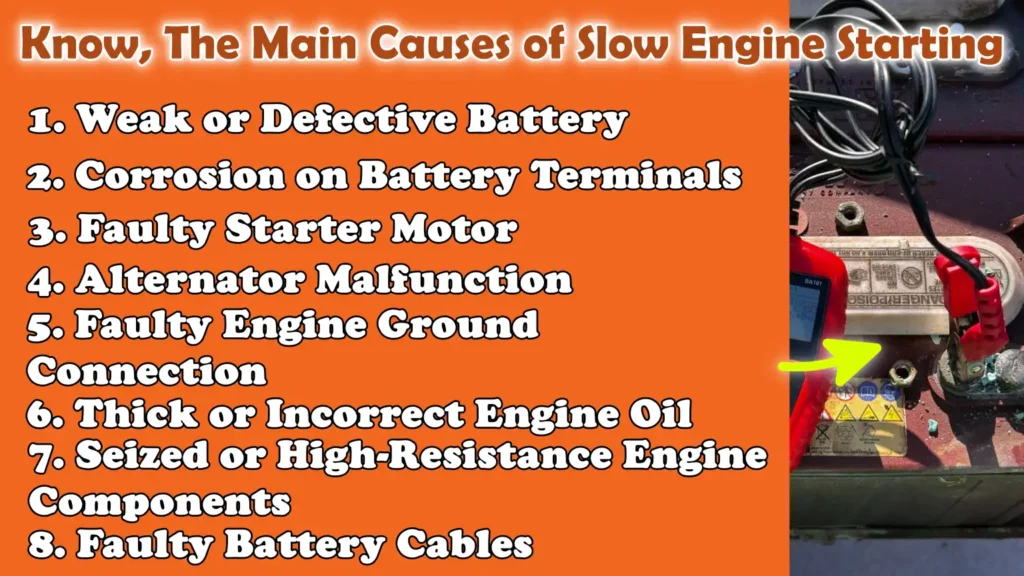
The problem of a slow-starting engine typically arises when the starter motor is unable to crank the engine at its normal speed.
This often occurs because something is either diminishing the electrical supply or creating resistance that hinders the engine’s rotation.
Modern vehicles require a robust battery, clean electrical connections, a properly functioning charging system and an engine that rotates without obstruction to start correctly.
Even a minor fault in any one of these components can reduce the engine’s cranking speed, making it difficult to start the vehicle.
Understanding the root causes of a slow-starting engine is crucial, as many drivers replace the wrong parts without proper diagnosis, a mistake that not only wastes money but also leaves the original problem unresolved.
1. Weak or Defective Battery
The most common cause of a slow-starting engine is a weak or defective battery.
When the engine is started, the battery delivers a powerful surge of electricity to the starter motor; if the battery is weak, the starter will not receive the necessary power to crank the engine effectively.
The capacity of most car batteries gradually diminishes over time due to repeated charge-and-discharge cycles.
Heat, cold weather, short trips and leaving electrical accessories switched on can also degrade battery performance over time.
A battery’s efficiency naturally decreases in cold temperatures, which is why many vehicles start slowly on winter mornings.
A weak battery may possess enough power to illuminate the lights and dashboard, but it may lack the strength to handle the heavy electrical load required to crank the engine.
2. Corrosion on Battery Terminals
Corrosion on the battery terminals is another major cause of slow engine starting issues.
Corrosion typically appears as a white, green, or blue powdery layer surrounding the battery posts and cable connections.
This layer creates resistance to the flow of electricity, thereby hindering the electrical current traveling between the battery and the starter motor.
Even if the battery itself is in good condition, corrosion prevents the necessary power from reaching the starter.
Loose battery terminals can cause a similar problem, as a poor connection interrupts the flow of electricity when attempting to start the engine.
Often, issues that appear to be major engine starting problems can be easily resolved simply by cleaning and tightening the battery connections.
3. Faulty Starter Motor
A faulty starter motor can also cause the engine to start slowly, even if the battery is fully charged.
The function of the starter motor is to spin the engine rapidly enough to initiate the combustion process within the engine cylinders.
The starter contains several internal components such as: brushes, an armature, bearings and windings, that wear out over time due to heat and repeated use.
As the starter weakens, starting the engine becomes more difficult and grinding, scraping, or straining noises may be heard during the starting process.
In some cases, the starter may overheat and fail intermittently; this means the vehicle might start normally at times, while at other times it cranks very slowly.
4. Alternator Malfunction
A faulty alternator can indirectly cause slow cranking, as it prevents the battery from charging properly while the engine is running.
The alternator supplies power to the vehicle and recharges the battery once the engine has started.
If the alternator’s output weakens, the battery will gradually lose its charge until it is no longer capable of providing the power required for normal cranking.
Many drivers replace the battery without realizing that the root cause of the problem actually lies with the alternator.
Symptoms of an alternator malfunction may include dim headlights, the illumination of the battery warning light, sluggish operation of power-driven components and frequent battery discharge.
5. Faulty Engine Ground Connection
A poor engine ground connection can lead to severe starting issues, as the proper functioning of the electrical system depends on the integrity of the entire electrical circuit.
The ground connection facilitates the return flow of electrical current from the starter motor back to the battery.
If the ground strap becomes loose, corroded, or damaged, electrical resistance increases, thereby reducing the current flow during starting.
This can cause the starter motor to crank slowly, even if both the battery and the starter are in good condition.
Ground-related issues are often overlooked during inspections, as the connections may appear normal on the outside while being corroded internally.
6. Thick or Incorrect Engine Oil
Thick or incorrect engine oil can increase internal engine resistance and make cranking the engine significantly more difficult, particularly in cold weather.
At low temperatures, engine oil naturally thickens; if the oil’s viscosity is too high for the prevailing weather conditions, the starter motor must exert excessive force to rotate the engine’s internal components.
Modern engines are designed to utilize a specific grade of oil recommended by the manufacturer, as proper oil flow is crucial for both adequately lubricating engine parts and successfully starting the engine.
Using oil that is too thick can slow down the engine’s cranking speed and place undue strain on the battery and starter system.
7. Seized or High-Resistance Engine Components
Engine components that are seized or exhibit excessive resistance can also slow down the cranking speed by increasing the physical effort required to rotate the engine.
A slightly seized pulley, worn bearings, internal engine component interference, or a malfunction in other belt-driven accessories, these are some of the issues that can generate significant resistance during engine startup.
When internal engine resistance increases, the starter motor is forced to draw more electrical current to handle the increased load.
This often manifests as slow cranking, even if the battery and starter system appear to be functioning correctly on the surface.
Issues related to mechanical resistance are less common than electrical problems; however, if left unaddressed, they can evolve into serious complications over time.
8. Faulty Battery Cables
Defective battery cables can impede the flow of electricity and create hidden resistance within the starting system.
Over time, the wires inside a cable can deteriorate, break, suffer heat damage, or develop loose connections, issues that are not always visible from the outside.
A cable may appear to be in good condition externally, yet harbor significant corrosion beneath its insulation.
As the internal resistance of the cable increases, the starter motor is unable to draw full power from the battery during cranking.
The symptoms of this condition often manifest as slow engine cranking, dim lights, excessive cable overheating, or recurring difficulties in starting the engine.
Accurately identifying a faulty cable often requires “voltage drop testing,” as diagnosing the problem solely through visual inspection is not always possible.
Tools
| Tools | Why It Is Needed | How to Use It |
|---|---|---|
| Digital Multimeter | A digital multimeter is one of the most essential tools for diagnosing slow-cranking engine problems, as it measures battery voltage, charging voltage and electrical continuity. The cause of slow cranking is often low voltage, poor charging, or excessive resistance within the starting system; a multimeter helps pinpoint these issues accurately, rather than relying solely on guesswork. It is also useful for detecting weak batteries, poor ground connections, faulty cables and problems related to alternator charging. | Set the multimeter to DC voltage mode, place the red probe on the battery’s positive terminal and place the black probe on the negative terminal. A healthy battery typically displays a voltage reading of approximately 12.6 volts when the engine is off. While cranking, the voltage should generally remain above 10 volts. Once the engine is running, you can also use this device to check the alternator’s charging output. |
| Battery Load Tester | A battery load tester verifies whether the battery can handle the heavy electrical demand required to start the engine. Many batteries display normal voltage readings in a resting state but fail under load because they are unable to supply sufficient current to the starter motor. This device helps confirm whether the battery is truly in good condition or if it has become internally weak. | Connect the tester’s clamps to the battery terminals in accordance with the device’s instructions. The tester applies a controlled electrical load to the battery, simulating the conditions that occur while the engine is being started. If the voltage drops significantly during the test, the battery may be weak or deteriorating, even if it is still capable of powering lights and other accessories. |
| Wire Brush | A wire brush is required to remove corrosion, dust and dirt from battery terminals and cable connections. Corrosion increases electrical resistance and impedes the flow of current between the battery and the starter motor. Even a small amount of corrosion can reduce starting power and make it difficult to start the engine. | Before cleaning, safely disconnect the battery terminals. Using a wire brush, scrub away corrosion from the battery posts, cable clamps and grounding points until clean metal becomes visible. After cleaning, firmly reattach the terminals to ensure optimal electrical contact and current flow. |
| Socket Set | A socket set is essential, as many battery terminals, starter bolts, ground straps and electrical connections are fastened with nuts and bolts that require the correct tools to loosen and tighten. Loose connections are a common cause of low voltage and slow cranking. | Use the correct size socket to loosen or tighten battery clamps, ground connections, starter mounting bolts and cable brackets. Always avoid overtightening, as excessive force can damage battery terminals or strip the threads. |
| Jumper Cables | Jumper cables help determine whether a slow-starting engine is caused by a weak battery. If the engine starts properly after receiving power from another battery, the original battery may be weak, discharged, or failing. Jumper cables are also useful for jump-starting a vehicle in an emergency. | First, connect the positive cable to the positive terminals of both batteries, then connect the negative cable to a sturdy ground point on the disabled vehicle. Start the second vehicle (the donor car) and allow its engine to run for a few minutes before attempting to start the other vehicle’s engine. Always follow proper safety protocols to avoid sparks. |
| OBD2 Scanner – Optional | An OBD2 scanner is not strictly essential, but it is a useful tool, as some modern vehicles store fault codes related to battery voltage, the charging system, the starter circuit, or engine sensors, all of which can affect how the vehicle starts. It can also assist in identifying underlying electrical or engine management issues. | Connect the scanner to the vehicle’s OBD2 diagnostic port; this is typically located under the dashboard, near the steering column. Turn on the ignition and scan for any stored fault codes. By reviewing the code information, identify which electrical or charging system components may be malfunctioning and contributing to the slow-starting issue. |
How to Diagnose Slow Engine Cranking – Easy Guide
Accurately diagnosing a slow-starting engine is crucial, as many starting-related issues stem from internal electrical faults that are easily overlooked without proper inspection.
A slow start does not always indicate a faulty battery; rather, the problem could lie with the starter motor, alternator, battery cables, engine grounds, thickened oil, or even an internal mechanical obstruction within the engine itself.
Conducting a systematic, step-by-step inspection helps pinpoint the root cause of the issue, thereby preventing the unnecessary replacement of parts.
A thorough diagnosis can also help avert major complications such as: a complete failure to start, and minimize expensive future repair costs.
1. Observe the Engine’s Behavior During Startup
The first step is to carefully listen to and observe how the engine behaves during the starting process.
A healthy engine typically starts quickly and effortlessly, emitting a strong, consistent sound.
If the engine cranks slowly, sounds strained, struggles to turn over, or takes longer than usual to start, there may be a fault within the starting system.
Rapid, repetitive “clicking” sounds often indicate low battery voltage, whereas a single “click” may point to an issue with the starter motor or its connections.
“Grinding” sounds could signal a fault in the starter gear or indicate underlying internal mechanical problems.
Paying close attention to these sounds is vital, as changes in the engine’s behavior during startup often provide early clues regarding the nature of the underlying issues.
2. Check the Battery Voltage
The battery should always be the first component to be checked, as it is the most common cause of an engine starting slowly.
When the engine is off, the voltage of a fully charged car battery typically hovers around 12.6 volts.
If the voltage drops too low, the starter motor will not receive the necessary power to properly crank the engine.
During startup, the battery voltage should ideally remain above 10 volts.
A significant drop in voltage may indicate that the battery is weak or nearing the end of its lifespan.
Cold weather can also adversely affect battery performance; low temperatures slow down the chemical reactions occurring inside the battery, making it even more difficult to start the engine.
3. Inspect the Battery Terminals and Cables
The battery terminals and cables should be carefully inspected for signs of corrosion, looseness, or any physical damage.
Corrosion typically appears as white, green, or blue deposits around the battery posts and can obstruct the flow of electricity to the starter motor.
Loose connections can cause a voltage drop while starting the vehicle, resulting in an unstable flow of power.
Hidden corrosion may also be present inside the battery cables, which is not always visible from the outside.
Faulty cables increase electrical resistance and degrade cranking performance, even if the battery itself is in good condition.
4. Perform a Battery Load Test
A battery load test confirms whether the battery can handle the high electrical demand required to crank the engine.
Some batteries may display normal voltage readings in a resting state but fail under load, as they are no longer capable of supplying sufficient current.
During testing, the battery is subjected to simulated cranking conditions to evaluate its actual performance.
If the voltage drops significantly during the load test, the battery may be internally weak, even if the lights and other accessories still appear to be functioning normally.
5. Check the Alternator Output
The alternator should be checked to ensure that it is properly charging the battery once the engine is running.
A faulty alternator can gradually drain the battery over time, eventually leading to slow cranking and recurring difficulties in starting the vehicle.
Most properly functioning alternators generate a charging voltage of approximately 13.5 to 14.5 volts while the engine is running.
If the charging voltage is too low, the battery will never be able to fully recharge, resulting in reduced starting power the next time you attempt to start the vehicle.
6. Check the Starter Motor Operation
If the battery and charging system appear to be functioning correctly, yet the engine is still cranking slowly, the starter motor should be inspected.
A worn-out starter motor may struggle to turn over the engine, as its internal brushes, bearings, or windings can degrade over time due to wear and heat.
A failing starter motor often emits grinding or buzzing sounds; these noises may intensify as the unit heats up.
In some instances, the starter draws excessive current but generates insufficient power to turn the engine over; this places undue strain on both the battery and the vehicle’s electrical system.
7. Check the Ground Connections
Ground connections are critical, as electricity must return to the battery through the vehicle’s grounding system to complete its circuit.
Loose, corroded, or damaged ground straps can impede the flow of electricity and create significant electrical resistance during engine startup.
Faulty ground connections often manifest symptoms that closely resemble those of a weak battery or a defective starter.
Many vehicles feature an engine block ground, a chassis ground and a battery ground; each of these should be carefully inspected to ensure they are free of corrosion and securely fastened.
8. Check the Condition of the Engine Oil
The condition of the engine oil can have a direct impact on the engine’s cranking speed, as thick oil increases internal friction between engine components.
In cold weather, engine oil naturally thickens, making it even more difficult for it to circulate throughout the engine.
If the oil viscosity (thickness) is excessively high, whether due to weather conditions or a failure to follow the manufacturer’s recommendations, the starter motor must exert significantly greater force to turn the engine.
Dirty or degraded oil can lose its lubricating properties, leading to increased friction and making it difficult to start the engine.
Using the correct grade of oil improves cold-weather starting performance and reduces the strain placed on the starter system.
9. Check for Any Mechanical Obstructions in the Engine
If the electrical components appear to be functioning correctly, yet the engine is still cranking slowly, you should check for any mechanical obstructions within the engine.
A seized pulley, a faulty bearing, a defective accessory, or internal engine components binding against one another can make it physically difficult to rotate the engine.
As this resistance increases, the starter motor is forced to draw higher electrical current to overcome the additional load.
A slightly seized alternator pulley, binding internal engine parts, or a malfunctioning belt-driven accessory, all of these factors can cause the engine to crank slowly.
Issues related to mechanical obstructions are less common than electrical faults; however, if left unaddressed for an extended period, they can escalate into serious problems.
How to Perform a Voltage Drop Test
Voltage drop testing is one of the most accurate methods for diagnosing slow-cranking issues, as it helps detect hidden electrical resistance within the starting system.
Many starting-related problems are caused by faulty cables, loose connections, corroded terminals, or poor grounding points, issues that cannot always be identified through visual inspection alone.
Even if the battery voltage appears normal, excessive resistance can prevent sufficient electrical current from reaching the starter motor.
Voltage drop testing measures the loss of voltage that occurs as current flows through the circuit during engine cranking.
In a properly functioning starting system, electrical resistance should be minimal, allowing the battery’s maximum power to reach the starter motor efficiently.
A high voltage drop reading typically indicates an obstruction in the electrical flow somewhere within the circuit.
This test is commonly performed by professional technicians, as it is faster and more reliable than replacing parts based on guesswork.
1. Positive Side Voltage Drop Test
The positive side voltage drop test checks for resistance between the battery’s positive terminal and the starter motor’s positive connection.
This section of the circuit carries a heavy volume of electrical current directly from the battery to the starter during engine cranking.
To perform this test, a digital multimeter is set to DC voltage mode.
The red probe is placed on the battery’s positive terminal, while the black probe is connected to the starter motor’s positive terminal or main power connection.
Next, the engine is cranked while simultaneously monitoring the voltage reading on the meter.
If the reading is excessively high, it indicates that the flow of current is being impeded by electrical resistance somewhere along the positive side of the circuit.
Common causes for this include corrosion on the battery terminals, loose cable connections, faulty wiring, internal cable corrosion, or dirty connection points.
Due to excessive resistance, the starter motor is forced to work harder despite receiving less usable power; this often results in the engine starting slowly or weakly.
2. Negative-Side Voltage Drop Test
The negative-side voltage drop test evaluates the ground side of the starting circuit.
Many drivers focus solely on the battery’s positive cable; however, proper grounding is equally critical, as electrical current must return to the battery via the engine block and chassis grounds.
To perform this test, the multimeter’s red probe is connected to the starter motor housing or engine block, while the black probe is placed on the battery’s negative terminal.
Subsequently, the engine is cranked while monitoring the voltage reading.
If the voltage drop becomes excessive, it typically indicates a poor ground connection, a loose ground strap, rust, corrosion, or a faulty ground cable.
Ground resistance is a very common, yet often overlooked, cause of slow engine starting, as ground connections may appear sound externally, even if corrosion is present beneath the mounting surfaces.
A poor ground can also manifest through symptoms such as dim lights, weak starter performance and intermittent electrical issues.
3. Acceptable Voltage Drop Values
Acceptable voltage drop values are crucial, as they help determine whether the starting circuit is functioning efficiently.
In most vehicles, the positive-side voltage drop during cranking should typically remain below approximately 0.5 volts.
The negative-side ground circuit should also remain below approximately 0.2 to 0.3 volts under normal operating conditions.
Readings exceeding these values typically indicate excessive electrical resistance somewhere within the system.
An excessive voltage drop can significantly compromise the performance of the starter motor, even if the battery itself is fully charged.
For instance, if excessive voltage is lost due to faulty cables or a poor ground connection, the starter motor will not receive sufficient power to properly crank the engine.
Minimizing voltage drop is crucial, as the starter motor draws a very high current during startup, particularly in cold weather, when battery performance naturally diminishes.
Accurate voltage drop testing helps to quickly identify hidden electrical issues and prevents the unnecessary replacement of the battery or starter motor, which might otherwise still be functioning correctly.
How to Identify the Slow Cranking in Cold Weather
Slow cranking in cold weather is a very common occurrence, as low temperatures impact both the battery and the engine simultaneously.
Many vehicles that start easily in warm weather may struggle to start on winter mornings, because the starting system is forced to work harder despite receiving reduced power.
Consequently, issues such as a weak battery, poor connections and a worn-out starter become much more apparent under cold conditions.
1. Why do engines crank slowly in winter?
Reduced Battery Capacity
In cold temperatures, a car’s battery generates less power because the chemical reactions occurring within it slow down.
This means the battery cannot supply the full cranking current required by the starter motor.
Even a healthy battery may seem sluggish in winter, while older batteries can cease functioning entirely in extremely low temperatures.
Thickening of Engine Oil
As temperatures drop, engine oil naturally becomes thicker.
Thickened oil does not flow easily; therefore, the starter motor must exert greater force to turn over the engine.
If the oil is too thick for winter use, the engine will feel slow and heavy during cranking, even if the battery is in good condition.
Increased Strain on the Starter
The cold metal components inside the engine create greater resistance during startup.
In low temperatures, turning over bearings, pistons and other rotating parts becomes more difficult.
This places increased strain on the starter motor, which, in winter, is already receiving reduced power from the battery.
2. Tips for Diagnosing Issues in Cold Weather
Testing the Battery at a Stable Temperature
A weak battery may behave differently in cold weather; therefore, testing it under stable conditions helps reveal its true capacity.
If possible, allow the battery to warm up slightly and then check its voltage and cranking performance.
This helps distinguish between a genuine battery fault and a temporary weakness caused by temperature fluctuations.
Using the Correct Oil Grade for Winter
Using the appropriate engine oil is crucial for ensuring easy vehicle starting in cold weather.
A thinner oil, specifically formulated for winter conditions, flows more freely and reduces internal resistance within the engine during cranking.
This assists the starter motor in turning the engine over more rapidly, thereby reducing the strain on both the battery and the starting system.
Read More:
Know, Common Diagnostic Mistakes to Avoid
Diagnosing engine problems involving slow cranking can often be prone to error, as various components of the starting system may exhibit similar symptoms.
Drivers, and even inexperienced mechanics, sometimes replace parts based on guesswork rather than performing proper diagnostic tests.
This leads to unnecessary expenses, while the root cause of the problem remains unresolved.
Understanding these common mistakes can help you avoid wasting money and ensure that the actual issue is correctly resolved right from the start.
1. Replacing the Battery Too Hastily
One of the most common mistakes is immediately replacing the battery without performing proper diagnostic tests.
Although a weak battery can indeed cause slow cranking, it is not always the actual culprit.
Many batteries discharge due to alternator issues, poor connections, or parasitic electrical drains.
In such cases, installing a new battery will not resolve the slow-cranking issue, as the new battery will also quickly lose its charge.
Proper voltage and load testing should always be conducted before deeming a battery defective.
2. Overlooking Ground Connections
Another major mistake is overlooking ground connections, as they often appear to be in good condition upon visual inspection.
The engine and electrical system rely on a robust ground path to complete their circuits.
If a ground strap is loose, corroded, or compromised beneath the connection point, it creates excessive resistance and restricts the flow of current to the starter motor.
This can manifest symptoms that closely resemble those of a weak battery or a faulty starter.
Many issues involving slow engine cranking can actually be resolved simply by cleaning or tightening the ground connections, rather than by replacing major components.
3. Neglecting Alternator Issues
When troubleshooting slow-cranking issues, many people overlook checking the alternator.
While the engine is running, the alternator is responsible for recharging the battery; if it malfunctions, the battery will gradually lose its charge.
A failing alternator may allow the vehicle to operate for some time, making it difficult to identify the problem initially.
Eventually, the battery will lack sufficient charge to deliver the high burst of power required to start the engine.
In such scenarios, simply replacing the battery will not resolve the issue, as the new battery will also quickly discharge.
4. Misdiagnosing Mechanical Engine Problems
Another serious error is assuming that all slow-cranking issues are electrical in nature, when in reality, some may be mechanical.
If the engine’s internal components generate excessive resistance, the starter motor must exert greater force to turn the engine over.
Issues such as tight bearings, failing pulleys, or incorrect engine oil viscosity can make it physically difficult for the engine to rotate.
This additional load reduces the engine’s cranking speed, even if the battery, starter and alternator are all functioning in good condition.
Without checking for mechanical resistance, technicians may mistakenly replace electrical components while failing to address the true root cause of the problem.
How to Prevent Slow Engine Cranking
The problem of slow engine cranking can often be averted through regular care and simple maintenance of the vehicle’s electrical and mechanical systems.
As most cranking-related issues develop gradually over time, paying proactive attention to critical components such as: the battery, alternator, engine oil and electrical connections, significantly reduces the likelihood of facing starting difficulties.
A well-maintained starting system is not only reliable but also guards against sudden failures, particularly in cold weather or after periods of prolonged vehicle use.
As well as, there’s research that clearly shows that during the engine cranking, a battery actually experiences a rapid voltage drop which is caused by the high starter current demand, even when a battery is not fully faulty, then its voltage can temporarily fall below the normal operating levels, so that actually makes voltage drop testing as it is really important diagnostic method because it literally helps you to identify the weak battery performance and hidden internal resistance that is not visible during the normal testing as well.[¹]
1. Regular Battery Maintenance
Regular battery maintenance is the most effective method for preventing slow cranking issues.
A vehicle’s battery gradually loses its power capacity due to repeated charging cycles, exposure to heat and frequent short trips; during these short trips, the battery does not receive sufficient time to fully recharge.
Keeping the battery clean and fully charged helps preserve its cranking power.
Periodic checks of the battery’s health are also crucial; even if a weak battery can still power lights and electronics, it may be unable to handle the heavy load required to start the engine.
Regular inspections allow for the detection of early signs of battery weakness before they escalate into major engine-starting failures.
2. Use the Correct Engine Oil
Using the correct engine oil plays a pivotal role in preventing slow cranking issues, specially during a “cold start” (starting a cold engine).
If the engine oil is excessively thick (viscous), it creates internal resistance within the engine, making it difficult for the starter motor to turn the engine over rapidly.
Vehicle manufacturers recommend using specific oil grades tailored to ambient temperatures, as proper oil flow reduces internal engine friction.
New and clean oil flows more easily than old or dirty oil; over time, old or dirty oil can thicken, thereby reducing engine efficiency during the starting process.
Choosing the correct oil ensures that the engine cranks smoothly and places less strain on the battery and starter.
3. Periodically Inspect the Charging System
The charging system, particularly the alternator, should be inspected regularly to ensure that the battery is charging properly while the engine is running.
If the alternator’s output is weak, the battery will gradually lose its charge, even if it appears to function normally during short trips.
Over time, this diminishes cranking power and leads to difficulties in starting the engine.
Periodically checking the charging voltage ensures that the electrical balance within the system is maintained.
A healthy charging system keeps the battery fully charged and ensures the vehicle is always ready to start reliably.
4. Secure Electrical Connections
Securing electrical connections is crucial, as even slight corrosion or looseness can create resistance, thereby affecting cranking speed.
To ensure a smooth flow of electricity, battery terminals, ground straps and cable connections must be kept clean and tightly fastened.
Moisture, dirt and corrosion can gradually accumulate and reduce conductivity (the capacity for electrical flow), resulting in the starter motor failing to receive adequate power.
Regular inspection and cleaning of these connections help ensure a robust electrical flow under all conditions, maintain stable voltage and ensure consistently reliable engine starting performance.
Conclusion – How to Diagnose Slow Engine Cranking
So, to solve this slow engine cranking issue then you need to first understand how every component in the system actually works together as just replacing parts hear and there don’t make any sense otherwise.
In most instances, this problem stems from a lack of electrical power, excessive resistance, or an increased mechanical load, preventing the starter motor from turning the engine over at its normal speed.
While a weak battery is frequently the culprit, it is by no means the sole cause.
Issues such as corroded terminals, poor ground connections, a faulty alternator, defective cables, thickened engine oil, or internal engine resistance can also contribute to slow cranking.
Crucially, all these components function in concert; a deficiency in any single part can adversely affect the entire system.
Understanding the proper diagnostic procedure eliminates the need for guesswork and prevents the unnecessary replacement of components.
Many drivers replace the battery or starter without first verifying voltage levels, charging output, or the integrity of electrical connections, a habit that frequently results in the recurrence of the very same problem.
Adopting a systematic and methodical approach ensures that the true root cause of the issue is identified, rather than merely treating the symptoms.
As well as, you can comment down below for more information.
Frequently Asked Questions
FAQ 1: What does it mean when an engine cranks slowly?
Answer: A slowly cranking engine means that when you attempt to start the vehicle, the engine turns over more sluggishly than usual. Instead of spinning rapidly and smoothly, the starter motor may emit a weak or strained sound and the engine takes longer to fire up. This typically indicates that the starter system is not receiving sufficient power, or that there is excessive resistance within the engine or the electrical system.
FAQ 2: What are the most common causes of a slowly cranking engine?
Answer: The most common causes include a weak or aging battery, corroded or loose battery terminals, a faulty starter motor, or a failing alternator that is unable to properly charge the battery. In some instances, a poor ground connection or defective battery cables can also impede the flow of electricity. In cold weather, thickened engine oil, or internal engine resistance, as it can also make it difficult for the engine to turn over during startup.
FAQ 3: Can a bad battery cause an engine to crank slowly?
Answer: Yes, a bad battery is one of the most common causes of a slowly cranking engine. A weak battery cannot deliver sufficient power to the starter motor, particularly in cold weather when battery performance naturally diminishes. Even if the battery holds enough charge to power lights and other electronics, it may lack the necessary amperage (electrical strength) required to properly crank the engine.
FAQ 4: How can I tell if my starter motor is bad?
Answer: A faulty starter motor often produces sounds such as grinding, buzzing, or sluggish rotation when you attempt to start the engine. In some cases, you may hear only a distinct “click,” but the engine fails to turn over. If the battery and its connections are in good condition, yet the engine still cranks slowly or intermittently, there may be a fault within the starter motor itself.
FAQ 5: Can alternator problems cause the engine to crank slowly?
Answer: Yes, a failing alternator can eventually cause the engine to crank slowly because, while the engine is running, it fails to properly recharge the battery. Consequently, the battery’s charge gradually depletes until it no longer possesses sufficient power to crank the engine vigorously. If the alternator is weak, you may also notice dimming lights or see the battery warning light illuminate on the dashboard.
FAQ 6: Why does my car start slowly in cold weather?
Answer: Cars often start slowly in cold weather because low temperatures reduce the battery’s capacity and thicken the engine oil. In cold conditions, the battery generates less power and starting the engine becomes more difficult because the thickened oil creates increased resistance between the engine’s internal components. This places greater strain on the starter system, resulting in the car starting slowly.
References:
[1] Cranking Capability Estimation Algorithm Based on Modeling and Online Update of Model Parameters for Li-Ion SLI Batteries
https://www.mdpi.com/1996-1073/12/17/3365
Hello Folks, Dean Shali here to help you out to solve the problems with your lovely vehicle, as i have lots of experience and knowledge about automotive industry as i woks directly with the customers and repair vehicles and i love to help the people to keep their cars safe and running smoothly.