
Written By: Dean Shali
Fact Checked By: Sabré Cook
Reviewed By: Tamara Warren
If there’s no crank no start condition, then this is the most misunderstood car problems as many drivers just assume that the engine itself has failed miserably, but in reality this issue often begins with the vehicle’s electrical starting system as well.
Now-a-days, cars actually relies on dozens of connected components that works together in perfect manner every single time you presses that damn start button or turn the key on such as: the battery, starter motor, ignition switch relays, fuses, immobilizer system, sensors, wiring and onboard computers as well.
That’s why, even one small part in this chain fails, then the engine may not crank at all.
Also, it is seen in many cases that the warning signs actually appears days or even weeks earlier through the dim dashboard lights, slow starting, random clicking sounds, intermittent cranking or key detection problems that most of the people just ignore them.
Even, there’s automotive service data that shows that weak batteries and poor electrical connections are the most commonly found causes of no-crank conditions, specially during the cold weather condition when battery power naturally drops and engines actually requires more energy to start the vehicle.
And, that’s the proper guide about How to Diagnose No Crank No Start Condition so that you can properly diagnose the actual matter, as it simplifies the entire diagnostic process so that you can perform practical testing methods and understand exactly what causing a no-crank no start condition.
Understand, What Does “No Crank, No Start” Mean?
A “No Crank, No Start” condition means that when you turn the key or press the start button, the engine does not turn over.
The starter motor fails to rotate the engine; consequently, the vehicle cannot initiate the normal starting process.
This issue is distinct from a “Crank, No Start” condition, in which the engine does turn over normally but still fails to start.
In most cases, “No Crank” issues are caused by battery problems, a faulty starter motor, a defective relay, bad wiring, or a malfunction in the anti-theft system.
Understanding this distinction helps drivers diagnose the problem more accurately and avoid replacing parts unnecessarily.
1. The Engine Does Not Turn Over When the Key Is Turned
When the engine does not turn over at all, it generally means that the starter motor is not receiving sufficient electrical power, or that the starter itself has failed.
The battery supplies a high-amperage current to the starter, enabling it to rotate the engine during the starting process.
If the battery is weak, the cables are loose, or there is an issue with the wiring, the engine may remain completely stationary.
Sometimes, this issue is also caused by a faulty ignition switch, a poor ground connection, or a defective safety switch that prevents the starter from functioning correctly.
2. The Starter Motor Remains Silent or Makes Only a “Click” Sound
A silent starter motor often points to electrical issues within the starting circuit.
This problem may stem from a faulty starter relay, a blown fuse, a defective ignition switch, or a malfunction in the immobilizer system.
In other instances, instead of the engine turning over, drivers may hear a single “click” or a series of rapid “clicking” sounds.
A continuous “clicking” sound typically occurs when the battery voltage drops significantly under load.
A single “click” may indicate a faulty starter solenoid or a loose connection.
These sounds serve as crucial warning signals, helping to pinpoint the root cause of a starting-related issue.
3. Dashboard Lights May Illuminate or Dim
When troubleshooting a problem, the dashboard lights can provide useful clues.
Dim or flickering lights often point to a weak battery or poor electrical connections.
However, in some vehicles, the dashboard lights may still illuminate normally even if the engine fails to start.
This is because the lights require significantly less power compared to the starter motor.
A slightly weak battery might be able to power the vehicle’s electronics, but it fails when the starter motor demands a sudden surge of current.
Cold weather, aging batteries and corroded terminals are common causes of such issues.
4. The Vehicle Fails to Start at All
When a vehicle fails to start entirely, its starting system is unable to complete the necessary sequence to crank the engine.
Modern vehicles rely on a complex network of interconnected components, including the battery, ignition switch, starter relay, starter motor, wiring, sensors and anti-theft systems.
If any of these components malfunctions, the entire system can shut down.
Some vehicles may display warning lights or flashing security indicators, while others may show no obvious signs at all.
Proper diagnosis is essential, as replacing parts based on guesswork can quickly become a costly endeavor.
Know, The Symptoms of a ‘No Crank’ Condition
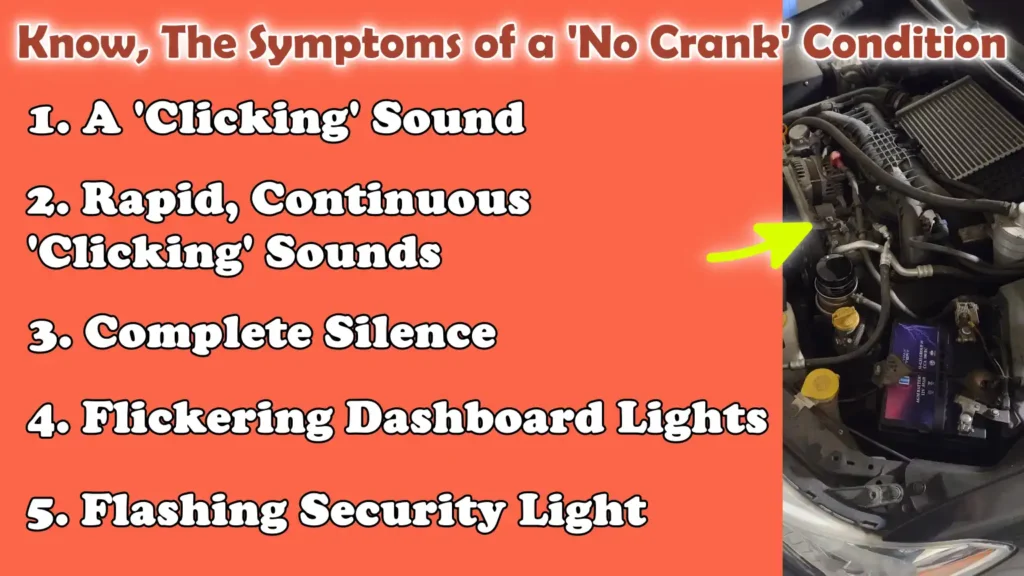
A true ‘no crank’ condition occurs when, despite turning the key or pressing the start button, the engine fails to turn over at all.
The vehicle simply fails to initiate the normal cranking process required to start the engine.
This type of issue is typically associated with the battery, starter motor, starter relay, ignition switch, wiring, or anti-theft system.
In many vehicles, symptoms begin to manifest before a complete failure occurs; therefore, recognizing these warning signs can help drivers detect the problem early and avoid getting stranded unexpectedly.
1. A ‘Clicking’ Sound
A ‘clicking’ sound during startup typically indicates that the starter solenoid is attempting to engage, but the engine is failing to crank properly.
This often happens because the battery lacks sufficient power to turn the starter motor, or because the starter motor itself is failing internally.
Loose battery terminals, corrosion in cable connections, faulty grounding points, or a defect in the starter wiring can also be the cause of this symptom.
In some cases, this ‘clicking’ sound originates from the starter relay rather than the starter motor.
Over time and due to exposure to heat, starter components often degrade, particularly in high-mileage vehicles.
A ‘clicking’ sound should never be ignored, as it often escalates into a major ‘no start’ (complete failure to start) issue later on.
2. Rapid, Continuous ‘Clicking’ Sounds
Rapid, continuous ‘clicking’ sounds are one of the most common indicators of a weak or discharged battery.
A ‘clicking’ sound occurs when the starter relay repeatedly switches on and off because the battery voltage drops excessively under load.
Modern starter motors require a significant amount of electrical power to crank the engine, particularly in cold weather.
If the battery is unable to maintain a stable voltage, the power supply reaching the relay is repeatedly interrupted, resulting in a sharp ‘clicking’ sound.
Corroded battery terminals, damaged battery cables, or a faulty ground connection can also cause a voltage drop and produce these exact symptoms, even if the battery itself is otherwise in good condition.
3. Complete Silence
When there is absolutely no sound during the vehicle starting process, the issue may lie with the ignition switch, starter relay, a blown fuse, the neutral safety switch, the clutch switch, or the immobilizer system.
In such a scenario, the electrical signal may not be reaching the starter motor at all.
Some modern vehicles will not allow the engine to crank (attempt to start) until their anti-theft system recognizes the key or completes its security checks.
A completely silent ‘no-crank’ situation (where the engine does not turn over at all) can also be caused by faulty wiring, a defective control module, or a completely dead battery.
Checking whether the dashboard lights, headlights and other electronic accessories are still functioning can help pinpoint the potential cause of the problem.
4. Flickering Dashboard Lights
Flickering dashboard lights are often an indication that the electrical supply is unstable while attempting to start the vehicle.
This typically occurs when the starter motor attempts to engage, causing a sudden drop in battery voltage.
A weak battery, a faulty charging system, loose terminals, or a poor ground connection are typically the root causes of this issue.
In some instances, when the key is turned, the lights may dim significantly or even go out completely for a brief moment.
This occurs because the starter motor requires a much higher electrical current than the vehicle’s standard electronics.
The flickering of the lights serves as a crucial warning sign, indicating that the starter system is struggling to crank the engine, before the vehicle eventually fails to start altogether.
5. Flashing Security Light
A flashing security light often signals an issue within the immobilizer or anti-theft system.
In modern vehicles, electronic chips embedded within the key or key fob are used to verify whether the driver is authorized to operate the vehicle; only then is the engine permitted to crank or start.
If the system fails to properly recognize the key, it may completely disable the starter motor.
A weak key fob battery, a faulty transponder chip, a defective ignition sensor, or a communication glitch within the vehicle’s security system, any of these conditions can trigger this problem.
In many cars, the engine remains completely silent while the security light on the dashboard continues to flash.
Recognizing this symptom is critical, as many drivers mistakenly replace the battery or starter, when the actual issue lies within the anti-theft system.
The Difference Between ‘No Crank’ and ‘Crank, No Start’
Many drivers use the terms “no crank, no start” and “crank, no start” interchangeably; however, in reality, these are two entirely distinct issues involving different components of the vehicle.
Understanding this distinction is crucial, as misdiagnosing the problem can lead to wasted time, unnecessary repairs and the replacement of expensive parts.
A ‘no crank’ condition means that when the key is turned or the start button is pressed, the engine does not rotate at all.
In this scenario, the starter motor fails to turn over the engine, preventing the vehicle’s starting sequence from even beginning.
A ‘crank, no start’ condition is different because, in this instance, the engine rotates normally but still fails to fire up on its own.
This typically indicates that the starter motor is functioning correctly, but another system such as: the fuel supply, ignition spark, air intake, timing, or engine management, has malfunctioned.
1. Know the Difference With Some Examples
An easy way to grasp this distinction is to listen carefully to the sounds coming from the engine while attempting to start the vehicle.
In a ‘no crank’ situation, the driver might hear a single ‘click,’ a rapid series of ‘clicks,’ or complete silence, while the engine remains entirely motionless.
For example, a dead battery, a faulty starter motor, a defective ignition switch, or a bad starter relay, all of these can completely prevent the engine from cranking.
In a ‘crank, no start’ situation, the engine rotates normally, sounding as though it is just about to fire up, yet it ultimately fails to start.
For instance, due to a faulty fuel pump, a defective crankshaft sensor, a bad ignition coil, or a lack of fuel pressure, the engine may crank, that is, it may turn over, but fail to start.
This distinction is crucial because determining whether or not the engine is turning over helps immediately identify which systems should be inspected first.
2. Why Many People Get Confused Between These Two Issues
Many people get confused between these two issues because, in both scenarios, the ultimate outcome is the same: the vehicle fails to start.
Drivers often focus solely on the final result rather than paying attention to whether or not the engine is actually cranking.
In modern vehicles, diagnosing the problem becomes even more difficult; features such as push-button start systems, quiet cabins and advanced electronics tend to mask the sounds drivers typically hear when starting a car.
A weak battery might prevent the engine from cranking properly, whereas an anti-theft system could abruptly disable the starter entirely; consequently, the symptoms rarely appear identical or can seem baffling.
Inexperienced drivers sometimes assume that every instance of a no-start condition is caused by the battery, whereas in reality, “crank-no-start” issues (where the engine cranks but fails to fire) are often linked to the fuel or ignition systems.
Learning to recognize the sounds and behavior of the engine during startup is one of the most valuable skills for accurate diagnosis, as it enables one to quickly distinguish between problems related to the electrical starter and those involving the fuel or engine systems.
Tools
| Tools | Why It Is Needed | How to Use It |
|---|---|---|
| Digital Multimeter | A digital multimeter is one of the most essential tools for diagnosing vehicle no-start issues, as it measures battery voltage, electrical continuity (the absence of interruptions in current flow) and the functionality of the charging system. Often, a vehicle fails to start, a condition known as a “no-crank” situation, because the battery voltage has dropped too low, or because electrical power is not reaching the starter motor properly. Rather than relying on guesswork, this tool helps verify whether the battery, alternator, wiring, or starter circuit are functioning correctly. | Set the multimeter to DC voltage, then connect the red probe to the battery’s positive terminal and the black probe to the negative terminal. With the engine turned off, a healthy battery typically displays a voltage reading of approximately 12.6 volts. If the voltage drops significantly while attempting to start the vehicle, there may be an issue with the battery or the starter system. |
| Battery Tester | A battery tester assesses the overall health of the battery and its ability to start the engine under load. Sometimes, a battery’s voltage may appear normal, yet it fails to perform when the starter motor suddenly demands a surge of current. This tool helps identify weak batteries before they fail completely. | Connect the tester’s clamps to the battery terminals and follow the instructions displayed on the screen. The tester places a load on the battery to determine whether it can sustain the electrical power required to start the engine. |
| Jumper Cables | Jumper cables help confirm whether the actual cause of a vehicle’s failure to start is, in fact, a weak or defective battery. These cables allow you to temporarily draw power from another running vehicle or an external battery to help start your engine. | First, connect the positive jumper cable to the positive terminals of both batteries; next, firmly attach the negative cable to a metal surface (a ground point). Start the running vehicle first and then, after waiting a short while, attempt to start the vehicle that is failing to start. |
| OBD2 Scanner | An OBD2 scanner reads ‘trouble codes’ (diagnostic codes) stored within the vehicle’s computer system. In modern vehicles, issues such as sensor malfunctions, immobilizer problems, or communication errors can prevent the vehicle from starting, problems that are not visible to the naked eye. | Plug the scanner into the OBD2 port; this port is typically located under the dashboard, near the steering wheel. Turn on the ignition and scan for any ‘fault codes’ related to the battery, starter, ignition system, or anti-theft system. |
| Test Light | A ‘test light’ allows you to quickly verify whether power is reaching fuses, relays, switches and wiring connections. This tool is highly useful for identifying blown fuses and diagnosing faults within the starter circuit. | Clip the ground wire to a metal surface and touch the tip of the probe to the specific electrical point you wish to test. If the light illuminates, power is present at that location. |
| Socket Set | A socket set is required to remove battery terminals, starter mounting bolts, covers and other components during inspection and repair procedures. Many electrical components cannot be properly inspected without the aid of basic hand tools. | Select the correct socket size and use a ratchet to securely loosen or tighten the bolts. Always disconnect the battery before removing any major electrical components. |
| Wire Brush or Battery Terminal Cleaner | Corrosion on the battery terminals is a very common cause of “no-crank” issues (failure to start), as it obstructs the flow of electricity between the battery and the starter system. Cleaning the terminals improves both the electrical connection and starting performance. | Disconnect the battery terminals and use a wire brush or cleaning tool to scrub away the corrosion until the metal surfaces are clean and shiny. Afterward, securely reconnect the terminals. |
| Owner’s Manual | The owner’s manual provides essential information regarding fuse locations, warning lights, battery specifications, relay diagrams and starting procedures specific to your vehicle model. This helps prevent confusion during the diagnostic process. | Use the manual to locate the fuse box, identify warning symbols, verify battery specifications and follow the manufacturer-approved troubleshooting instructions for your vehicle. |
The Most Common Causes of a ‘No Crank, No Start’ Condition
A ‘no crank, no start’ issue typically occurs when electrical power fails to flow correctly through the starting system.
Modern vehicles rely on a complex array of components, including the battery, starter motor, relays, switches, wiring, sensors and security systems, all of which must function in unison.
If even one of these essential components fails, the engine may not crank at all.
Some issues develop gradually over time, while others manifest suddenly and without warning.
Understanding the most common causes makes it easier for drivers to diagnose the problem and avoid unnecessarily replacing parts.
1. Dead or Weak Battery
A dead or weak battery is the single most common cause of a ‘no crank, no start’ condition.
It is the battery that supplies the heavy electrical current required to spin the starter motor and crank the engine.
If the battery voltage drops too low, the starter cannot function properly.
As a battery ages, its capacity naturally diminishes, particularly after three to five years of service.
Factors such as cold weather, leaving lights on, frequent short driving trips and faults within the charging system can exacerbate this deterioration.
Common symptoms include slow cranking, a clicking sound, dim dashboard lights, or complete silence when attempting to start the vehicle.
2. Corrosion on Battery Terminals
Corrosion on the battery terminals can interrupt the flow of electricity between the battery and the starting system.
This corrosion typically appears as a white, blue, or green powdery substance surrounding the battery connections.
Even a small amount of corrosion increases electrical resistance, thereby reducing the power reaching the starter motor.
Similar issues can arise if the battery terminals are loose, as this creates an unstable electrical connection.
In many vehicles, simply cleaning the battery terminals and properly tightening the connections is enough to get the vehicle starting normally again.
3. Faulty Starter Motor
When you attempt to start your vehicle, it is actually the starter motor that is responsible for turning over the engine.
If the starter motor fails internally, the engine will be unable to crank, even if the battery is fully charged.
Starter motors tend to wear out over time because they are required to operate under heavy electrical and mechanical loads.
Engine heat, oil leaks and high mileage can all cause damage to their internal components.
Common symptoms include a distinct “click” sound when attempting to start, intermittent starting issues (where the car starts sometimes but not others), a grinding noise, smoke emission, or complete silence when the ignition key is turned.
4. Faulty Starter Relay
The starter relay functions as an electrical switch that transmits power from the battery to the starter motor.
If the relay fails, the starter motor never receives the necessary signal to engage the engine.
Relays can fail due to heat, moisture, electrical overloads, or simply normal wear and tear over time.
A faulty relay may manifest as a clicking sound, intermittent starting difficulties, or a complete failure of the starter system.
In some vehicles, a faulty relay can be quickly diagnosed by swapping it with an identical relay from another system within the vehicle.
5. Blown Fuse
A blown fuse can interrupt the electrical supply to critical components of the starting system.
Modern vehicles feature numerous fuses associated with the ignition system, starter circuit, fuel system and engine computer.
If any of these fuses blow, the vehicle’s engine may fail to start altogether.
Fuses typically blow due to electrical overloads, short circuits, faulty wiring, or defective components.
When a vehicle fails to start, checking the fuse box is often the quickest and easiest way to diagnose the problem.
6. Faulty Ignition Switch
The ignition switch sends an electrical signal that activates the starting system when the key is turned or the start button is pressed.
If the switch fails internally, the starter motor never receives the command to crank the engine.
Worn electrical contacts, aging and repeated use can eventually cause the ignition switch to fail.
Symptoms often include dashboard lights flickering erratically, accessories suddenly losing power, or complete silence when attempting to start the vehicle.
7. Faulty Neutral Safety Switch
Vehicles equipped with automatic transmissions feature a neutral safety switch, which prevents the engine from starting unless the transmission is in either ‘Park’ or ‘Neutral’.
If this switch malfunctions or becomes misaligned, the vehicle will fail to start, even if the battery and starter are functioning correctly.
Occasionally, slightly shifting the gear selector, or attempting to start the vehicle in ‘Neutral’ rather than ‘Park’, as it can temporarily resolve this issue.
This problem is particularly common in older vehicles, where components within the transmission linkage have become worn.
8. Faulty Clutch Safety Switch
Vehicles with manual transmissions are equipped with a clutch safety switch, which prevents the engine from starting unless the clutch pedal is fully depressed.
If this switch fails, the starting system cannot detect that the clutch pedal has been engaged, resulting in the starter motor being completely disabled.
Loose connections at the switch, worn pedal components, or faults within the wiring are typically the primary causes of this issue.
Drivers may observe that pressing the clutch pedal firmly or repeatedly temporarily alters the vehicle’s starting behavior.
9. Immobilizer or Anti-Theft System Issues
Modern vehicles are equipped with immobilizer systems designed to prevent theft; these systems allow the engine to start only when a specific, programmed key is used.
If the system fails to recognize the key or detects a security breach, it can completely disable the starter motor.
A weak key fob battery, a faulty transponder chip, a defective ignition sensor, or communication errors between system modules can all prevent the engine from starting.
Flashing security indicator lights on the dashboard, or warning messages related to the key, are common signs of issues within the immobilizer system.
10. Loose Ground Connection
Ground connections complete the electrical circuit necessary to power the starter motor.
If a ground wire becomes loose, corroded, or damaged, the flow of electricity through the system is disrupted.
Faulty grounding can manifest in a variety of confusing symptoms, such as clicking sounds, flickering lights, slow cranking, or the starter failing to engage at all.
Engine vibrations, moisture and corrosion can cause ground connections to weaken over time.
Inspecting and tightening ground wires is a crucial step in diagnosing starter system problems.
11. Faulty Alternator
When the engine is running, the alternator charges the battery.
If the alternator fails, the battery’s power gradually depletes until it no longer holds sufficient charge to start the engine.
Many drivers replace the battery, whereas the actual problem lies within the charging system.
Common symptoms of a faulty alternator include dimming headlights, an illuminated battery warning light, malfunctioning electrical accessories and frequent battery discharge.
Even with a faulty alternator, the vehicle can be driven for a short while after being jump-started; however, once the battery’s charge runs out, the vehicle will not start again.
12. Faulty Starter Wiring
The starter wiring transmits high-amperage electrical current between the battery, relay, ignition system and starter motor.
Faulty wiring can interrupt this electrical flow and prevent the engine from starting.
Over time, wires can weaken or break due to heat, vibration, corrosion, rodent damage and abrasion.
Loose connectors and faulty insulation can sometimes cause intermittent starting difficulties, meaning the engine starts sometimes but not others, and these issues often manifest suddenly.
It is crucial to carefully inspect the wiring system, as identifying defective wires can sometimes be difficult through visual inspection alone.
How to Diagnose The Vehicle By Check Battery Voltage – Method 1
When diagnosing a ‘no crank, no start’ issue (where the engine fails to start), checking the battery voltage is the first and most critical step.
During engine startup, the battery supplies power to the starter motor, ignition system, relays, sensors and the engine computer.
If the battery voltage drops too low, the starter motor will not receive the necessary electrical power to properly crank the engine.
Many ‘no crank’ issues occur because the battery is weak, discharged, old, or unable to hold a charge effectively.
Even if dashboard lights or the radio are still functioning, the battery may fail to crank the engine due to the heavy electrical load required for the starting process.
1. Normal Battery Voltage Range
A healthy, fully charged car battery typically maintains a voltage of around 12.6 volts when the engine is turned off.
This voltage level indicates that the battery holds sufficient stored energy to properly operate the starter motor under normal conditions.
Most automotive batteries operate within a specific voltage range and even a slight drop in voltage can negatively impact engine starting performance.
Cold weather, aging batteries, short driving trips and power consumption by accessories can gradually deplete the battery’s voltage over time.
Batteries tend to weaken gradually before failing completely; therefore, checking the voltage regularly is essential for detecting potential issues early on.
2. Symptoms of Low Voltage
When battery voltage is low, various issues may arise during the engine starting process, depending on the extent to which the battery has weakened.
Common symptoms include slow cranking, rapid clicking sounds, dim headlights, flickering dashboard lights, reduced power to electrical accessories, or complete silence when attempting to start the engine.
In cold temperatures, batteries naturally lose some of their cranking power, further increasing the likelihood of weak batteries failing.
Some vehicles may start normally one day but fail completely the next, as battery performance fluctuates based on temperature and electrical load.
Low voltage can also confuse the vehicle’s onboard computer, potentially triggering warning lights or causing electronic malfunctions.
3. How to Test with a Multimeter
A digital multimeter is one of the best tools for accurately assessing the condition of a battery.
To test the battery, set the multimeter to DC voltage, connect the red probe to the battery’s positive terminal and connect the black probe to the negative terminal.
For the most accurate reading, the engine should remain off during the test.
If possible, allow the vehicle to sit for a while before testing, as vehicles that have been driven recently may show slightly elevated voltage readings for a short period.
Monitoring the voltage while attempting to crank the engine can also help identify batteries that fail under heavy load, even if their voltage appears normal in a resting state.
4. What the Battery Readings Mean
12.6V – In Good Condition
A reading around 12.6 volts typically indicates that the battery is fully charged and in good condition.
At this level, the battery should generally provide sufficient power to vigorously engage the starter and reliably start the engine.
12.4V – Slightly Discharged
A reading around 12.4 volts typically indicates that the battery is slightly discharged.
The vehicle can usually still start, but the battery’s performance has begun to deteriorate.
At this stage, starting the vehicle may become more difficult in cold weather or when there is a heavy electrical load.
Below 12V – Weak or Faulty
A reading below 12 volts generally suggests that the battery is weak, severely discharged, or failing.
At this voltage level, the starter motor may crank very slowly, emit repeated “clicking” sounds, or fail to operate at all.
If the battery voltage repeatedly drops below 12 volts even after charging, further inspection, or replacement, of the battery or charging system may be required.
How to Diagnose The Vehicle By Checking Battery Terminals and Cables – Method 2
Battery terminals and cables transmit power from the battery to the starter motor and the vehicle’s other electrical systems.
If these connections are dirty, loose, or corroded, the starter motor may not receive sufficient current to properly crank the engine.
This is one of the most common causes of a “no-crank, no-start” condition, as the starter motor requires a significant amount of power to engage.
1. Signs of Corrosion
Corrosion on the battery typically appears as a white, blue, or green powdery substance surrounding the battery terminals.
This buildup forms over time due to chemical reactions occurring between battery acid, moisture and the metal connections.
Corrosion increases electrical resistance and reduces the amount of current flowing through the starting system.
Even a small amount of corrosion can weaken the electrical flow, potentially leading to clicking sounds, slow cranking, dimming lights, or a complete failure of the starter motor.
Corrosion issues are more prevalent in older vehicles and in regions characterized by high humidity or fluctuating temperatures.
2. Symptoms of Loose Terminals
Loose battery terminals create unstable electrical connections that can abruptly interrupt the flow of power during start-up.
Common symptoms include flickering dashboard lights, sudden clicking sounds, intermittent starting, slow cranking, or a complete loss of power when the ignition key is turned.
In some vehicles, the car may start normally one moment but refuse to start at all the next, simply because engine vibrations cause a loose terminal to shift slightly out of place.
Loose terminals pose a risk to the electrical system, as they can eventually lead to sparking, excessive heat generation and charging-related issues.
3. How Poor Connections Disrupt Starter Current
To crank the engine properly, the starter motor requires an electrical current of hundreds of amperes (amps).
Poor battery connections increase electrical resistance, thereby reducing the amount of current reaching the starter.
This explains why headlights or dashboard lights may function normally, yet the engine refuses to crank.
Small electronic devices consume very little power, whereas the starter motor requires a significantly more powerful flow of current.
Corroded terminals, faulty cables, or weak ground connections can disrupt this electrical flow and prevent the starter from functioning correctly.
4. How to Properly Clean Battery Terminals
Properly cleaning battery terminals helps restore the flow of electricity and improves the vehicle’s starting performance.
Battery cleaning should always be performed with caution, as batteries contain acid and continuously generate an electrical current.
Disconnect the Negative Terminal First
Before beginning any cleaning or repair work, the battery’s negative terminal should always be disconnected first.
This minimizes the risk of accidental sparking or electrical short circuits while working in the vicinity of the battery.
The negative terminal is typically marked with a minus sign and is connected to the vehicle’s ground.
The Cleaning Process
After disconnecting the terminals, use a wire brush or a battery terminal cleaner to remove rust, dirt and oxidation from both the battery posts and the cable ends.
Continue cleaning until the metal surfaces appear clean and shiny.
If there is excessive corrosion, an additional cleaning solution or a terminal cleaning spray may be required.
While cleaning, carefully inspect the battery cables for any cracks, swelling, or severe damage caused by corrosion.
Secure Reconnection
Once the cleaning is complete, reconnect the positive terminal first, followed by the negative terminal.
Ensure that the terminals fit snugly and do not wiggle when touched.
Loose terminals can lead to difficulties in starting the vehicle, even after cleaning.
Once properly reconnected, provided that poor battery connections were the primary cause of the starting issue, many vehicles will immediately regain their normal starting capability.
How to Diagnose The Vehicle By Paying Attention to Starter Motor Sounds – Mehtod 3
When diagnosing a “no crank, no start” condition, the sounds emanating from the starter motor can provide crucial clues.
The sound heard when turning the ignition key or pressing the start button often helps identify exactly which specific component of the starting system is at fault.
Modern starting systems rely on the precise coordination of the battery, starter relay, starter motor, ignition switch, wiring and ground connections.
If any of these components fail, the sounds typically associated with the starting process will change.
Paying close attention to these sounds such as: a single “click,” complete silence, or sluggish cranking sounds, as it can significantly accelerate the diagnostic process and potentially prevent the unnecessary replacement of parts.
1. A Single “Click”
A single “click” sound typically indicates that the starter solenoid or starter relay is attempting to engage, but the engine is failing to crank properly.
This often occurs when the battery is weak and unable to deliver the necessary current to the starter motor under heavy load.
A faulty starter relay can also produce a single “click,” as it fails to transmit full power to the starter.
A poor ground connection is another common cause; if the grounding point is loose, corroded, or damaged, the electrical circuit cannot be properly completed.
In some vehicles, a single “click” may also be heard if the starter motor itself has failed internally, while the engine remains completely silent.
Over time, due to heat, vibration and general wear and tear, the internal components of the starter motor gradually deteriorate, particularly in high-mileage vehicles.
2. A Rapid, Continuous ‘Clicking’ Sound
The most common cause of a rapid, continuous ‘clicking’ sound is low battery voltage.
This sound occurs when the battery lacks sufficient power to keep the starter relay continuously engaged.
As the voltage drops, the relay repeatedly switches on and off, resulting in a rapid ‘clicking’ sound during the starting attempt.
The issue of a weak battery is exacerbated in cold weather, as low temperatures naturally reduce the battery’s cranking power (the force required to turn over the engine).
Corrosion on the battery terminals, loose cables, faulty wiring, or a malfunction in the charging system can also lead to low voltage and produce this type of rapid clicking sound.
In many cases, a rapid clicking sound is a clear indication that the battery requires immediate inspection.
3. No Sound at All
If absolutely no sound is heard when attempting to start the vehicle, it generally implies that the starter motor is not receiving an electrical signal.
This can be caused by a faulty ignition switch, a defective starter circuit, a blown fuse, a bad relay, or a broken wiring connection.
Some modern vehicles will even completely disable the starter if their anti-theft or immobilizer systems detect a security-related anomaly.
In such situations, the dashboard security light may illuminate, while the engine remains completely silent.
A faulty neutral safety switch or clutch safety switch can also interrupt the starter signal, resulting in a complete absence of sound when attempting to start the vehicle.
Checking whether the dashboard lights, headlights and other electrical components are still functioning can help pinpoint the potential cause of the problem more accurately.
How to Diagnose The Vehicle By Checking the Starter Relay – Method 4
The starter relay is a small yet critical electrical component within the starting system.
Its function is to transmit electrical power from the battery to the starter motor whenever the ignition key is turned or the start button is pressed.
If the relay is not functioning correctly, the starter motor will never receive the necessary electrical signal to crank the engine.
Many “no-crank, no-start” issues arise because, over time, the relay weakens, fails, overheats, or its internal components become worn out.
As the relay must repeatedly handle electrical current every time the vehicle is started, its internal contacts can degrade after years of use.
1. Relay Location
The starter relay is typically located under the hood, inside the fuse and relay box; however, in some vehicles, it may also be found within the interior fuse panel.
Most fuse box covers feature a diagram that indicates the exact location of the starter circuit relay.
The owner’s manual can also be helpful in quickly identifying the correct location of the relay.
Starter relays are generally small, square or rectangular components that plug directly into the fuse box.
In many vehicles, multiple relays may look identical, making it easier to diagnose and replace them in the event of a malfunction.
2. How Relays Work
A starter relay functions as an electrical switch controlled by a low-amperage signal current.
When the ignition switch sends power to the relay, the relay closes its internal circuit connection, thereby allowing a high-amperage current to flow from the battery to the starter motor.
Due to this design, the ignition switch is not required to directly handle the heavy electrical load necessary to start the engine.
Inside the relay are small electrical contacts and an electromagnetic coil that activates when it receives power.
Over time, due to heat, vibration, corrosion and repeated electrical usage, these internal components can wear out.
A failing relay may still produce an audible “click,” but it might fail to properly transmit the necessary electrical power to the starter motor.
3. Replacement Method
The simplest way to test a starter relay is to swap it with another identical relay located within the fuse box.
Many vehicles utilize identical relays for systems such as the horn, air conditioning, or cooling fans.
If the engine begins to crank normally after swapping the relay, it indicates that the original starter relay is indeed defective.
This method is quick and easy, as it requires no specialized diagnostic tools.
However, to avoid any electrical issues or malfunctions, the replacement relay must be an exact match for the original.
4. Testing with a Multimeter
A multimeter can be used to determine whether the relay is receiving power and if it is properly transmitting that power.
First, the battery voltage should be checked to ensure that the electrical system has sufficient power to allow for an accurate diagnosis.
Subsequently, the relay’s terminals can be tested for voltage, continuity and proper activation.
When the ignition is turned to the “Start” position, the relay should receive a control signal from the ignition circuit and allow the battery voltage to flow to the starter motor.
If the relay receives the signal but fails to properly transmit the power, there is a strong possibility that the relay has failed internally.
Testing with a multimeter is more accurate than guessing, because some faulty relays fail only intermittently and may not always immediately exhibit clear symptoms.
How to Diagnose The Vehicle By Checking the Functionality of the Starter Motor – Method 5
The starter motor is responsible for rotating the engine during startup, thereby initiating the combustion process.
When the ignition key is turned or the start button is pressed, the starter motor draws power from the battery and spins the engine rapidly enough for it to begin running under its own power.
If the starter motor fails, the engine may not crank at all, even if the battery is fully charged.
Every time the vehicle is started, the starter motor is subjected to significant electrical and mechanical stress; consequently, heat, vibration, oil leaks and general wear and tear gradually damage its internal components over time.
Many issues related to the starter manifest intermittently before the unit fails completely.
1. Signs of a Failing Starter
A failing starter motor often exhibits several warning signs before ceasing to function entirely.
Common symptoms include clicking sounds, slow cranking, intermittent starting, grinding noises, or complete silence when attempting to start the vehicle.
Sometimes the vehicle starts normally one moment but fails to start the next; this occurs because worn internal components within the starter intermittently lose proper electrical contact.
Heat radiating from the engine can also adversely affect a weak starter, potentially exacerbating the problem after the vehicle has been driven for an extended period.
In some instances, the starter may continue to spin for a brief moment even after the engine has started, which can lead to long-term damage to the flywheel and starter gear.
2. Voltage Drop Testing
Voltage drop testing helps determine whether electrical power is reaching the starter motor properly.
Even if the battery voltage appears normal, the actual current reaching the starter may be diminished due to faulty cables, loose terminals, or poor ground connections.
During a voltage drop test, a multimeter measures the extent to which the voltage drops when the starter attempts to crank the engine.
An excessive voltage drop typically indicates issues related to resistance within the battery cables, terminals, or ground connections.
This test is highly valuable because many starting-related problems stem from poor electrical conductivity rather than the complete failure of a specific component.
3. Starter Tapping Test
The starter tapping test is a simple, temporary method sometimes used to identify worn components inside the starter.
While attempting to start the engine, lightly tapping the body of the starter motor with a tool can sometimes temporarily restore internal electrical connections.
If the engine suddenly begins to crank after tapping the starter, it may indicate that the internal brushes or armature have become worn or stuck.
This method is not a permanent solution for the starter, but it helps confirm that the fault indeed lies within the internal components of the starter motor.
This tapping technique should be used with caution, as applying excessive force could damage the starter housing or surrounding components.
4. Symptoms of a Faulty Starter
Intermittent Starting
Intermittent starting is one of the most common symptoms of a failing starter motor.
The vehicle may start properly on some days, yet fail to start at all on others.
The connection between the starter’s worn electrical contacts can fail at any moment, particularly as the cumulative effects of heat and vibration take their toll on the internal components over time.
Grinding Noise
A grinding noise during startup typically occurs when the starter gear fails to engage properly with the engine’s flywheel.
A worn starter gear, damaged flywheel teeth, or a misaligned starter, any of these could be the underlying cause of this noise.
Ignoring a grinding sound can eventually lead to damage to both the starter and the flywheel, significantly increasing repair costs.
Burning Smell
A burning smell emanating from the vicinity of the starter may indicate that electrical components are overheating or drawing excessive current.
A faulty starter sometimes draws an excessive amount of power while attempting to crank the engine, causing heat to build up within the motor and its associated wiring.
A burning smell can also be caused by damaged wiring insulation.
Smoke from the Starter Area
Smoke coming from around the starter is a serious warning sign that should never be ignored.
Smoke typically results from overheated wires, internal electrical short circuits, excessive electrical resistance, or the starter motor drawing an abnormally high amount of current.
Attempting to start the vehicle under such conditions can cause further damage to the wiring, battery cables, relays and other surrounding electrical components.
How to Diagnose The Vehicle By Checking Fuses and Fusible Links – Method 6
Fuses and fusible links protect a vehicle’s electrical system from damage caused by excessive current, short circuits, or electrical overloads.
When a vehicle fails to start (a condition referred to as a “no-crank, no-start” situation), a blown fuse or a broken fusible link can completely interrupt the flow of power to the starter motor, ignition system, starter relay, or engine computer.
Modern vehicles feature numerous distinct fuses associated with the starting system; if even a single one of these fuses fails, the engine will be unable to crank properly.
As fuse-related issues are often simple and inexpensive to resolve, checking them early in the diagnostic process saves time and helps prevent the unnecessary replacement of major components, such as the starter motor or ignition switch.
1. Essential Starting System Fuses
Several critical fuses are directly linked to the starting system and engine operation.
These may include the starter fuse, ignition fuse, ECM (or ECU) fuse, fuel system fuse, starter relay fuse and security system fuse.
The exact location of these fuses varies depending on the vehicle model, but they are typically housed within a fuse box, situated either under the hood or beneath the dashboard.
Consulting the owner’s manual or the fuse box diagram helps identify which specific fuses control the starting system.
Some vehicles are also equipped with larger fusible links, often connected directly to the battery cable, to safeguard high-current circuits against severe electrical damage.
2. How Blown Fuses Interfere with Cranking
A fuse functions by breaking an electrical circuit when excessive current flows through it.
This mechanism protects the vehicle’s wiring and electrical components from potential hazards such as overheating or fire.
If a fuse associated with the starting system fails, electrical power cannot properly reach the starter relay, ignition switch, or starter motor.
Consequently, when you turn the key, the engine may remain completely silent or fail to crank.
Fuse failure is often caused by short circuits, faulty wiring, defective electrical components, water intrusion, or improper repairs.
If you do not address the root cause of the fault before replacing a blown fuse, the new fuse may also fail shortly thereafter.
3. Visual Inspection vs Multimeter Test
The quickest method for checking a fuse is a visual inspection, as the metal strip inside the plastic casing of many failed fuses will appear broken or melted.
Signs of burning or discoloration may also be visible around a defective fuse.
However, visual inspection is not always entirely reliable, as some failed fuses may appear intact on the outside while having failed internally.
Using a multimeter or a test light to check the fuse’s continuity and electrical flow is a more accurate method.
When testing with a multimeter, with the ignition switched on, proper voltage should be present on both sides of the fuse.
If power reaches one side but not the other, it is likely that the fuse has failed internally.
When diagnosing a “no-crank” (engine failure to start) issue, combining electrical testing with a visual inspection yields the most accurate results.
How to Diagnose The Vehicle By Checking the Ignition Switch – Method 7
The ignition switch is one of the primary control points within a vehicle’s starting system.
Its function is to route electrical power from the battery to essential systems such as: the starter relay, ignition system, fuel system, dashboard electronics and engine computer, whenever the key is turned or the start button is pressed.
If the ignition switch develops an internal fault, the starter motor will fail to receive the necessary signal to crank the engine.
Modern ignition switches handle a constant flow of electricity; consequently, factors such as heat, vibration, wear on internal contacts and prolonged use can cause the switch to gradually deteriorate over time.
A failing ignition switch can manifest a variety of confusing electrical symptoms, as it simultaneously affects multiple vehicle systems.
1. Symptoms of a Faulty Ignition Switch
A failing ignition switch can prevent the engine from cranking, either intermittently or completely, depending on the extent of the wear on its internal contacts.
Common symptoms include complete silence when attempting to start the vehicle, sudden loss of electrical power, accessories abruptly shutting off, the engine stalling while driving, or difficulty turning the ignition key smoothly.
In some vehicles, the dashboard lights may appear to function normally, yet the engine fails to crank because the signal intended for the starter relay never reaches its destination.
Occasionally, the vehicle will only start after the key has been turned multiple times, as the worn internal contacts within the switch struggle to establish a consistent electrical connection.
These issues typically worsen gradually over time, rather than presenting themselves as a sudden, catastrophic failure.
2. Clues from Dashboard Behavior
When troubleshooting potential issues related to the ignition switch, the behavior of the dashboard instruments can provide vital clues for diagnosis.
If the dashboard lights flicker, suddenly go out, repeatedly reset, or behave erratically when the key is turned, it suggests that the ignition switch may not be providing a consistent supply of electrical power.
In some vehicles, the radio, warning lights, climate controls, or instrument cluster may cease to function while attempting to start the engine.
In other instances, the security light or “Check Engine” light may remain illuminated abnormally, as the ignition system fails to communicate properly with the vehicle’s onboard computer.
Paying close attention to how the dashboard responds during the starting process can help distinguish between issues related to the ignition switch and those stemming from the battery or starter motor.
3. How to Check Ignition Output Voltage
Checking the ignition output voltage helps verify whether the ignition switch is properly powering the starter circuit.
A digital multimeter is typically used to perform this test.
Once it has been confirmed that the battery is functioning correctly, the output wire of the ignition switch can be tested while the key is held in the “Start” position.
During starting attempts, the switch should transmit battery voltage to the starter relay or control circuit.
If the ignition switch is receiving power from the battery but fails to deliver the correct output voltage, the switch may be internally worn or defective.
Conducting a voltage test is crucial, as many ignition switch malfunctions are caused by issues within its internal electrical contacts, faults that cannot be detected merely by visually inspecting the exterior of the switch.
How to Diagnose The Vehicle By Checking the Transmission Safety Switch – Method 8
The transmission safety switch is designed to prevent the engine from starting under unsafe conditions.
These switches are a critical safety feature found in vehicles equipped with both automatic and manual transmissions.
Their function is to ensure that the vehicle does not lurch forward unexpectedly when the engine is started.
If one of these switches malfunctions, the starter motor never receives the necessary signal to crank the engine, even if the battery and starter are functioning correctly.
Issues related to the safety switch are often overlooked during diagnostics, as many drivers assume the problem lies with the battery or the starter.
1. Issues Related to the Neutral Safety Switch
Vehicles with automatic transmissions utilize a neutral safety switch to ensure that the engine only cranks when the transmission is in the ‘Park’ or ‘Neutral’ position.
If the switch becomes worn, defective, dirty, or misaligned, the vehicle will fail to start.
In many cases, the transmission may visually appear to be in the ‘Park’ position, yet the switch internally fails to recognize the correct gear position.
Heat, vibration, moisture and worn shift linkage components typically exacerbate this issue over time.
2. Automatic Transmission Issues
A faulty neutral safety switch can cause intermittent starting problems; for instance, the vehicle may start normally one moment but fail to start the next.
The driver may notice irregularities in the gear indicator display, or they may discover that the vehicle only starts when the gear selector is positioned in specific spots.
Occasionally, slightly nudging the gear selector can temporarily re-establish the electrical connection within the switch.
Faulty wiring near the transmission assembly can also disrupt the flow of signals between the switch and the starter circuit.
As automatic transmissions rely heavily on electronic communication, even a slight misalignment of the switch can prevent the vehicle from starting completely.
3. Attempt to Start in the ‘Neutral’ Position
A simple diagnostic method is to attempt to start the vehicle in the ‘Neutral’ position rather than the ‘Park’ position.
If the engine starts successfully in ‘Neutral,’ it indicates that the neutral safety switch or the shift linkage is worn out or misaligned.
This test works because the switch contains separate internal contacts for the ‘Park’ and ‘Neutral’ positions.
However, during this test, the vehicle must always be kept fully secured with the brakes applied to prevent it from accidentally rolling forward or backward.
While this method can help confirm the problem, it remains essential to have the vehicle properly inspected and subsequently repaired.
4. Clutch Safety Switch Issues
Vehicles equipped with manual transmissions feature a clutch safety switch, which prevents the engine from starting until the clutch pedal is fully depressed.
This safety feature mitigates the risk of the vehicle lurching forward unexpectedly.
If the switch malfunctions, the starting system may interpret that the clutch pedal is not being depressed, even if it actually is.
Consequently, the starter motor fails to engage and the engine does not start.
5. Inspecting Manual Transmissions
The symptoms of a faulty clutch safety switch can be quite similar to those of a weak battery or a defective starter motor.
When attempting to start the vehicle, the driver may experience complete silence, even if all dashboard lights are illuminating correctly.
Worn clutch pedal bushings, loose switch mountings, faulty wiring, or defective internal contacts within the switch are typically the primary causes of this issue.
In some vehicles, pressing the clutch pedal firmly or repeatedly may temporarily restore starter functionality, as the internal contacts within the switch can degrade over time and cease to function properly.
6. Checking the Clutch Pedal Switch
Checking the clutch pedal switch typically involves verifying whether the switch opens and closes correctly when the clutch pedal is depressed.
A multimeter can be used to confirm whether electrical continuity changes as expected when the pedal is pressed.
If the switch fails to transmit the correct signal, the starter relay will not engage.
A physical inspection is also crucial, as loose mounting brackets, bent pedal components, or faulty connectors can prevent the switch from functioning correctly, even if the switch itself is electrically sound.
How to Diagnose The Vehicle By Diagnosing the Immobilizer or Security System Issues – Method 9
Modern vehicles utilize immobilizers and security systems to prevent theft by blocking the engine from starting without proper authorization.
These systems communicate with the key, key fob, ignition system, Body Control Module and Engine Control Unit before activating the starter motor or fuel system.
If the system detects a fault or fails to recognize the programmed key, it can completely disable the vehicle’s ability to crank or start.
An immobilizer-related “no-crank” condition (where the engine fails to crank) is very common in newer vehicles, as modern security systems rely heavily on electronic communication between multiple control modules.
Even if the battery and starter are fully functional, the engine may refuse to crank if the security system does not grant authorization.
1. Meaning of a Flashing Security Light
A flashing security light is one of the primary warning signs of an immobilizer issue.
This light typically appears on the dashboard in the shape of a key, a lock, or a car icon, depending on the vehicle manufacturer.
When the security light flashes continuously while attempting to start the vehicle, it may indicate that the vehicle is failing to properly recognize the programmed key.
In many cars, the immobilizer system completely disables the starter motor to prevent potential theft.
Some systems may also cut off fuel injection or ignition spark, even if the engine is otherwise cranking normally.
A flashing security light helps indicate that the problem likely lies with the anti-theft system rather than the battery or starter motor.
2. Issues Related to the Key Transponder
In most modern car keys, a small electronic transponder chip is embedded within the head of the key or inside the key fob.
When the vehicle is being started, this chip sends a coded signal to the immobilizer system.
If the transponder malfunctions, loses its programming, or fails to communicate properly, the vehicle’s engine will be unable to start.
Physical damage, exposure to water, dropping the key, or internal electronic faults, all of these factors can adversely affect the transponder’s functionality.
In some instances, a spare key may work perfectly, while the faulty key fails to start the vehicle.
A weak car battery or general electrical issues can also occasionally interfere with the transponder’s communication.
3. Symptoms of a Faulty Key Fob
A faulty key fob can cause a variety of starting and security-related issues in vehicles equipped with a “push-button start” system.
Common symptoms include a delay in key recognition, the appearance of warning messages on the dashboard, intermittent difficulty in starting the vehicle, or a complete failure to recognize the key even when it is present inside the cabin.
A weak key fob battery is one of the most common culprits, as it can make it difficult for the vehicle to consistently detect the key’s signal.
Malfunctioning buttons, faults in the internal circuit board, moisture intrusion, or other electronic defects can also negatively impact the key fob’s performance.
Some vehicles feature emergency backup starting methods that allow the engine to be started even when the key fob battery is low.
4. ECU Communication Issues
Before the immobilizer system grants permission for the vehicle to start, it is essential that it establishes proper communication with the Engine Control Unit (ECU), Body Control Module, ignition system and other electronic modules.
If communication between these systems is interrupted, the engine will be unable to start.
Low battery voltage, faulty wiring, blown fuses, module malfunctions, or software glitches can disrupt this communication process.
In some instances, warning lights or messages may appear on the dashboard indicating a failure to recognize the key, while the starter motor fails to engage.
Modern vehicles rely heavily on computerized communication networks; consequently, an electrical issue within a single module can sometimes trigger starting-related problems throughout the entire system.
5. Common Symptoms of Immobilizer-Related Issues
Immobilizer-related problems often manifest as specific warning signs that help distinguish them from common battery or starter malfunctions.
Promptly recognizing these symptoms can prevent the unnecessary replacement of mechanical components that are otherwise functioning correctly.
Engine Will Not Start
The most common symptom of an immobilizer issue is a “no-crank” condition, wherein the engine remains completely silent despite attempts to start it.
Even if the battery, starter motor and other electrical components appear to be functioning properly, the security system completely blocks the starter signal because it has not granted permission to start the vehicle.
Flashing Security Light
When you start your vehicle, if the security light is blinking, it generally indicates that the immobilizer system is unable to properly recognize the key.
The vehicle will not start until a signal is received from the correct key.
If the light continues to blink persistently, it is a definitive sign that the issue lies not with the starter motor, but rather with the anti-theft system.
“Key Not Detected” Message
In many modern vehicles, when the connection between the key (key fob) and the vehicle is interrupted, a “Key Not Detected” message, or a similar warning, appears.
This is often caused by a weak key battery, a faulty transponder chip, electronic interference, or a malfunction within the vehicle’s internal receiver.
When this message appears, the engine may fail to start altogether, even if all other systems are functioning correctly.
How to Diagnose The Vehicle By Scanning for Diagnostic Trouble Codes – Method 10
Modern vehicles utilize multiple computers and electronic control modules to continuously monitor the starting system.
When a problem is detected, the vehicle stores Diagnostic Trouble Codes in its computer’s memory to assist in identifying the specific fault.
In a “no crank, no start” scenario, scanning for these codes can yield crucial information that might not be discoverable through a physical inspection alone.
Today, many starting-related issues involve sensors, communication networks, security systems, relays, or electronic modules, components that cannot be accurately diagnosed without electronic scanning.
Using an OBD2 scanner eliminates the need for guesswork, allowing the driver or technician to focus on the specific system responsible for the problem.
1. The Importance of OBD2 Scanning
OBD2 scanning is essential because many of today’s problems within the starting system are electronic in nature rather than mechanical.
Even if the battery and starter motor appear to be functioning normally, the vehicle’s computer may disable the cranking function due to a faulty sensor, a security system issue, a communication error, or a module malfunction.
An OBD2 scanner retrieves stored fault codes from the Engine Control Unit and other electronic modules connected to the vehicle’s network.
Some issues do not immediately trigger a visible warning light; nevertheless, the associated codes remain stored in the system’s memory.
Performing a quick scan early in the diagnostic process can prevent the unnecessary replacement of functional components and save time in pinpointing the problem.
Furthermore, stored historical codes can hold the key to resolving many intermittent “no crank” issues, even if the vehicle has temporarily resumed starting normally.
2. Common Starting System Codes
Starting system codes often point to issues related to the battery, starter relay, ignition switch, crankshaft sensor, or charging system.
Low-voltage codes are very common, as a weak battery can disrupt communication between multiple electronic systems simultaneously.
Starter relay circuit codes may appear when the relay fails to activate properly or if the wiring within the starter circuit becomes faulty.
Ignition switch codes can also be generated when the vehicle’s computer detects abnormal voltage levels or the absence of a startup signal.
In some vehicles, sensor-related codes can indirectly prevent the engine from cranking, as the control module is unable to verify safe operating conditions during the startup process.
3. Body Control Module Codes
The Body Control Module (BCM) controls numerous electronic functions related to vehicle security, key recognition, lighting, push-button start systems and communication between various modules.
If this module faces a communication-related issue or an electrical fault, the starting system may cease to function entirely.
Body Control Module codes can indicate wiring issues, low-voltage problems, a faulty module, or interruptions in communication between different control units.
Modern vehicles rely heavily on data communication networks; therefore, a malfunction in a single module can sometimes impact multiple systems simultaneously.
Diagnosing these issues without a scanner is often difficult, as many symptoms may not appear to be interconnected at first glance.
4. Immobilizer-Related Codes
Immobilizer-related codes help identify issues associated with the anti-theft system, key transponders, key fobs, ignition receivers, or the security communication network.
If the immobilizer system fails to properly recognize a programmed key, it can completely prevent the starter from engaging.
Common immobilizer codes may indicate that the key has not been recognized, that there is an interruption in communication between various modules, that the key signal is weak, or that there is a fault within the security system itself.
In many vehicles, these codes appear even when no apparent mechanical issue is present.
Scanning for immobilizer codes is crucial, as many drivers mistakenly replace the battery, starter, or ignition switch, whereas the actual problem lies within the security system.
How to Diagnose a ‘No Crank, No Start’ Problem in Cold Weather
Cold weather is one of the most common reasons why vehicles suddenly develop a ‘no crank, no start’ (engine fails to turn over or start) issue.
Low temperatures affect almost every component of the starting system, particularly the battery, engine oil, starter motor and electrical connections.
During winter, significantly more effort is required to turn over (crank) the engine, while the electrical power supplied by the battery simultaneously diminishes.
This makes starting the vehicle difficult, even for cars that typically start without any trouble in warmer weather.
Aging batteries, worn-out starters, weak charging systems and thickened engine oil, all tend to expose their inherent weaknesses more clearly in cold temperatures, as the starting system comes under immense strain.
1. Decline in Battery Performance During Winter
As temperatures drop, a vehicle’s battery naturally loses some of its cranking power (the force required to turn over the engine).
In cold weather, the chemical reactions occurring within the battery slow down, thereby reducing its capacity to generate electricity.
Furthermore, the starter motor requires more power to turn over a cold engine and to overcome the resistance caused by thickened engine oil.
This is why many weak batteries fail during the winter, even if they were functioning adequately just moments before.
Common symptoms include slow cranking, rapid clicking sounds, dimming dashboard lights, or a complete absence of sound when attempting to start the vehicle.
Batteries that are already old, partially discharged, or internally weak are the ones that struggle the most to start in freezing temperatures.
2. The Impact of Thickened Engine Oil
In cold weather, engine oil becomes thicker and heavier, making it difficult for the starter motor to turn over the engine.
Thickened oil creates increased resistance within the engine, as moving parts require greater force to rotate properly.
Due to this heightened resistance, both the battery and the starter motor face a heavier electrical load when attempting to start the vehicle.
Vehicles using engine oil with an incorrect viscosity (thickness) for winter temperatures may experience very slow cranking, or the engine may fail to start altogether.
Older engines, particularly those containing dirty or degraded oil, as it can be even more challenging to start in extremely cold weather.
3. Issues Associated with Frozen Batteries
In extreme cold, weak or discharged batteries may partially freeze internally.
When a battery’s charge level drops significantly, its electrolyte (acid) becomes more susceptible to freezing.
A frozen battery may rupture internally, lose its ability to hold a charge, or fail completely during an attempt to start the vehicle.
Symptoms of a frozen battery include a swollen battery casing, extremely low voltage readings, an inability to accept a charge, or total electrical failure.
Attempting to jump-start or rapid-charge a frozen battery can sometimes be hazardous, as the battery may have already sustained internal damage.
4. Starter Issues in Cold Weather
Cold weather can have a direct impact on the performance of the starter motor.
Factors such as the thickening of internal starter motor lubricants, increased electrical resistance, wear and tear on internal components and weak electrical connections become particularly evident during the winter season.
A starter motor already suffering from internal wear struggles to function properly in cold weather, as the battery delivers reduced power precisely when the engine requires greater cranking force.
Loose battery terminals, poor ground connections and faulty cables also generate additional resistance, a condition that is further exacerbated in cold weather.
In many instances, cold weather exposes latent weaknesses within the starter system that were already developing prior to the onset of winter.
Read More:
How to Diagnose Intermittent “No-Crank” Issues
Diagnosing intermittent starting problems is often more difficult than diagnosing complete “no-start” issues, because the vehicle sometimes starts normally, while at other times it refuses to start at all.
Due to this inconsistency, drivers may assume the problem has resolved itself, whereas, in reality, the underlying fault still persists.
These intermittent starting difficulties typically occur because electrical components become weak, overheat, loosen, or become unstable over time.
Heat, vibration, moisture, corrosion and worn electrical contacts frequently trigger these unpredictable “no-start” scenarios.
Carefully observing when the problem occurs such as: during hot weather, after a long drive, or on a cold morning, as it can provide crucial clues for diagnosing the issue.
1. Starter Failure Caused by Heat
Starter failure caused by heat is a very common issue in older or high-mileage vehicles.
The starter motor is situated near the engine and exhaust system, where temperatures can become extremely high after the vehicle has been driven.
As heat builds up inside the starter, internal electrical resistance increases and worn components may cease to function correctly.
A weak starter may operate normally when the engine is cold, but it can fail completely once the vehicle reaches its normal operating temperature.
Drivers often notice that the engine fails to start after stopping to refuel, shop, or run errands, yet the vehicle starts normally again once it has cooled down.
Over time, heat can also degrade the electrical contacts within the starter solenoid and the motor itself.
2. Loose Wiring Connections
Loose wiring connections can cause intermittent starting issues, as vibrations generated during driving can destabilize the electrical current.
Slight movements in the wiring, battery terminals, starter cables, or ground connections can temporarily interrupt the flow of power reaching the starter system.
In some instances, the vehicle may suddenly start normally after shifting the gear selector, opening the hood, or reconnecting the battery terminals, simply because the loose connection has shifted slightly back into place.
Corrosion, moisture, faulty connectors and aging wiring are common culprits behind unstable electrical connections.
Diagnosing these issues can be challenging, as a connection may appear normal during an inspection, yet fail intermittently while the vehicle is actually in operation.
3. Intermittent Immobilizer Malfunctions
Modern immobilizer systems can also trigger intermittent starting failures when the communication link between the key, key fob, security module and engine computer becomes unstable.
Weak key fob batteries, faulty transponder chips, electrical interference, or glitches in software communication can cause the security system to abruptly prevent the engine from starting.
The driver may occasionally observe a flashing security light or see intermittent warning messages such as “Key Not Detected”.
In many cases, the vehicle will start normally after locking and unlocking the doors, using a spare key, or simply waiting a few minutes.
These intermittent security-related issues are becoming increasingly common in modern vehicles, as starting systems now rely heavily on electronic communication.
4. Faulty Relay
A faulty starter relay often causes intermittent starting issues because its internal electrical contacts gradually wear down over time.
Heat, vibration, moisture and repeated electrical usage can weaken the relay’s contacts, leading to an irregular power supply to the starter motor.
Sometimes the relay functions normally, while at other times it fails to deliver sufficient current to crank the engine properly.
During failed start-up attempts, drivers may hear a clicking sound or observe that the vehicle only starts after turning the key multiple times.
As relays are relatively inexpensive and easy to inspect, checking the starter relay is a crucial step when diagnosing intermittent starting problems.
Understand, Why Vehicle Fails to Start Even After Battery Replacement
Many drivers are baffled when their vehicle fails to start even after installing a new battery (a situation often referred to as a “no-crank, no-start” condition).
While a weak battery is indeed one of the most common causes of starting difficulties, modern vehicles rely on a multitude of electronic systems.
These systems can prevent the engine from starting even after a battery replacement.
Improper battery installation, loose electrical connections, active security systems, glitches in the computer reset process, or faults within the charging system, all these factors can render the vehicle unresponsive.
Particularly in newer models, replacing a battery is no longer merely a mechanical task, as numerous electronic modules must properly re-establish communication with one another once power is restored.
1. Issues Related to Battery Registration
In certain modern vehicles, installing a new battery requires a specific procedure known as “battery registration” or “battery programming”.
This is specially common in luxury and newer vehicles that utilize advanced charging systems controlled by the engine’s onboard computer.
The vehicle continuously monitors the battery’s age, charging patterns and electrical load.
If the new battery is not properly registered, the charging system may continue to apply the settings configured for the old battery, settings that are incompatible with the newly installed unit.
This can lead to a variety of issues, such as charging malfunctions, illuminated warning lights, poor battery performance, or the vehicle failing to start altogether.
Battery registration is typically performed using a professional diagnostic scan tool capable of communicating directly with the vehicle’s computer.
2. Loose Terminals
The most common reason for a vehicle failing to start immediately after a battery replacement is loose battery terminals.
Even the slightest looseness in a connection can interrupt the flow of the high-amperage electrical current required to engage the starter motor.
Although dashboard lights and the radio may continue to function normally, this is because these smaller electronic components require significantly less power compared to the vehicle’s starter system.
When attempting to start the vehicle, drivers may face symptoms such as clicking sounds, flickering lights, intermittent starting attempts, or a complete lack of response from the vehicle.
Corrosion, loose connections, damaged cable ends, or improperly seated terminals, all of these factors can compromise the integrity of the electrical connections.
After replacing a battery, it is always essential to carefully verify that the terminals are securely tightened.
3. Issues Related to ECU Reset
Disconnecting the battery for a period of time cuts off power to the Engine Control Unit (ECU) and other electronic modules.
After reconnecting the battery, some vehicles may experience temporary communication or reset-related issues as the systems relearn their operating parameters.
In some instances, the engine computer may lose its idle settings, throttle calibration, key synchronization, or communication links with other modules.
Until the system completes its relearning process, issues such as illuminated warning lights, rough idling, electronic glitches, or difficulty starting the engine may occur.
Furthermore, a momentary voltage drop during battery installation can confuse sensitive control modules, potentially leading to temporary difficulties in starting the engine.
4. Activation of Anti-Theft Systems After Battery Disconnection
After the battery has been disconnected, many vehicles automatically activate their security or immobilizer systems.
If the anti-theft system fails to properly recognize the key after power is restored, it may completely disable the starter motor.
When attempting to start the engine, the driver may observe a flashing security light, see a “Key Not Detected” message, or receive no response whatsoever from the engine.
A weak key fob battery, a loss of key synchronization, or a communication fault within the module are common causes of this issue following a battery replacement.
In some vehicles, locking and unlocking the doors, using a spare key, or resetting the security system may help restore the vehicle to a drivable state.
What Does It Mean Won’t Crank, Won’t Start, But the Lights Turn On
Many drivers are puzzled when their headlights, dashboard lights, radio, or other electrical accessories function perfectly fine, yet the engine refuses to crank.
This situation is quite common because the starter motor requires significantly more electrical current than the vehicle’s minor internal electronics.
The battery may possess sufficient power to run the lights and accessories, but it may lack the heavy current necessary to turn over the starter motor.
Modern starting systems also rely on the proper functioning of relays, ignition switches, wiring, safety switches and security systems before the starter will engage.
This is why a vehicle can experience a complete “no-crank” issue despite having adequate electrical power.
1. Why Lights May Still Turn On Even When the Starter Fails
A vehicle’s lights and electronics consume far less electrical power compared to the starter motor.
To effectively turn over the engine, the starting system often requires hundreds of amperes of current, specially in cold weather or when the engine oil has thickened.
Headlights, dashboard lights and the radio may continue to operate even when the battery voltage has dropped too low to power the starter.
A weak battery, corroded terminals, loose cables, faulty wiring, or a poor ground connection can restrict current flow to such an extent that the starter fails to engage, while smaller electrical components continue to function.
This disparity in power requirements is one of the primary reasons drivers mistakenly assume their battery is in good condition, simply because the lights are still on.
2. Starter Solenoid Issues
The starter solenoid is an electrical component connected to the starter motor that controls the flow of battery current to the starter.
When the key is turned or the start button is pressed, the solenoid activates and sends a powerful surge of electrical power to the starter motor.
If the solenoid becomes worn, overheats, or sustains internal damage, the starter may fail, even if the rest of the electrical system is functioning correctly.
Common symptoms include a distinct ‘click’ sound, intermittent cranking, or complete silence when attempting to start the vehicle.
Over time, factors such as heat, age, vibration and repeated use cause the internal contacts within the solenoid to gradually wear down.
3. Voltage Drop Under Load
Voltage drop under load is a very common cause of a ‘no-crank’ condition (failure of the engine to start), even if the vehicle’s lights are illuminated.
Although the battery may show adequate voltage in a resting state, the voltage can drop suddenly and significantly when the starter motor demands a heavy surge of current.
This is often caused by weak battery cells, corroded terminals, faulty cables, or excessive electrical resistance within the starting circuit.
During starting attempts, the voltage may drop so low that the starter motor cannot function properly, even if the lights were working perfectly just moments before.
Checking for voltage drop using a multimeter helps in diagnosing these issues more accurately, as many electrical faults only manifest under high-load conditions.
4. Checking the Relay and Ignition Switch
The starter relay and ignition switch also play a crucial role in activating the starter motor.
The ignition switch initiates the command to start, while the starter relay facilitates the delivery of battery power to the starter motor.
If either of these components fails, the engine may remain completely silent, even if the dashboard lights and other accessories continue to function normally.
Worn ignition switch contacts, poor relay connections, blown fuses, or weak electrical signals can disrupt the starter circuit without affecting smaller electronic components.
Diagnosing these issues often involves monitoring voltage flow, listening for the audible “click” of the relay, checking for electrical continuity and, in modern vehicles, scanning for fault codes.
What Does It Mean Cranking but Not Starting – Clicking Sound
When an engine cranks but fails to start, a clicking sound typically indicates that the starter system is attempting to engage but is unable to deliver the necessary power to fully crank the engine.
This clicking noise often results from the starter relay or starter solenoid rapidly switching on and off, while the starter motor fails to turn over the engine.
This issue is very common in vehicles with a weak battery, poor electrical connections, faulty cables, or a defective starter component.
The nature of the clicking sound can also help in diagnosing the root cause of the problem.
A single click may suggest a fault within the starter or solenoid, whereas a rapid, repetitive clicking sound usually points to low battery voltage or poor electrical flow within the starter system.
1. Weak Battery
The most common cause of a clicking sound during startup is a weak battery.
The battery may possess sufficient power to illuminate dashboard lights and operate accessories, but it lacks the necessary amperage (electrical strength) to properly drive the starter motor.
When the starter attempts to engage, the heavy electrical load causes the battery voltage to drop suddenly, resulting in the relay or solenoid clicking repeatedly.
Cold weather, an aging battery, issues with the charging system and leaving electrical accessories switched on, all these factors can weaken a battery over time.
In many cases, if the battery is indeed the primary culprit, jump-starting the vehicle will allow it to start normally again, at least for the time being.
2. Faulty Starter Solenoid
When starting the engine, the function of the starter solenoid is to transmit power directly from the battery to the starter motor.
If the solenoid becomes worn or suffers internal damage, it may produce a clicking sound but fail to deliver the necessary electrical current to the starter motor.
Consequently, the engine fails to start, even if the battery holds sufficient voltage.
Over time, exposure to heat, vibration, moisture and repeated electrical cycling causes the internal contacts within the solenoid to wear out.
In some vehicles, starting difficulties may occur intermittently, as the solenoid often functions erratically before failing completely.
An engine that fails to crank, accompanied by a loud clicking sound, is a common symptom of a faulty starter solenoid.
3. Poor Electrical Grounding
Proper electrical grounding is essential for the starter to function correctly, as the electrical circuit connecting the battery, starter motor, engine and chassis must be fully complete.
Loose or corroded ground connections increase electrical resistance, thereby reducing the amount of current reaching the starter.
Poor grounding can manifest as clicking sounds, dim dashboard lights, slow engine cranking, or a complete failure of the starter system.
Ground-related issues are particularly common in older vehicles that have been exposed over time to moisture, road salt, dust and engine vibration.
If ground connections deteriorate, the engine will fail to start properly, even if both the battery and the starter motor are in good condition.
4. Faulty Battery Cables
Faulty battery cables can disrupt the flow of electricity between the battery and the starter motor.
Corrosion often accumulates at the cable ends or around the battery terminals, where moisture and battery acid degrade the metal components over time.
As electrical resistance increases, the starter motor fails to receive sufficient power; instead of cranking the engine, it merely produces a clicking sound.
In some instances, a cable may appear to be in good condition externally, yet its internal wiring could be heavily corroded.
A faulty cable can also generate excessive heat, cause a voltage drop and lead to intermittent difficulties in starting the engine, problems that frequently become more pronounced in cold weather or when there is a high demand for electrical power.
How to Prevent “No Crank, No Start” Issues
Preventing a “no crank, no start” (engine failure to start) issue is typically far easier and less expensive than diagnosing and repairing the vehicle after it has completely broken down.
Most starter system failures develop gradually over time such as: a weakening battery, corroded electrical connections, worn starter components, or diminished charging system performance.
Through regular maintenance and timely inspections, drivers can identify warning signs before the vehicle fails to start.
As modern vehicles rely heavily on electrical systems and electronic communication, even minor issues, if ignored for too long, as it can eventually prevent the engine from starting.
Additionally, there’s study in Applied Sciences that shows that when you monitors the magnetic field behavior inside the starter motor then it literally helps to identify the wear, electrical resistance changes and operational faults early on, even researchers found out that advanced starter diagnostics actually improves the accuracy of no crank no start troubleshooting as many starter problems begins gradually before full failure happens, that’s why testing the starter system is really important while diagnosing the vehicle.[¹]
1. Regularly Inspect the Battery
The best way to avoid a sudden “no crank” situation is to perform regular inspections of the battery.
Car batteries naturally degrade over time and many begin to show signs of weakness during starting such as: slow cranking, long before they fail completely.
Checking the battery’s voltage and load performance helps drivers identify a weak battery before they get stranded on the road.
Cold weather, short trips, extreme heat and high electrical demand can all rapidly shorten a battery’s lifespan.
Under normal driving conditions, most car batteries last approximately three to five years, although poor maintenance and extreme temperatures can significantly reduce this lifespan.
2. Cleaning Battery Terminals
Keeping the battery terminals clean is crucial for maintaining a strong flow of electricity within the starting system.
Corrosion around battery terminals increases electrical resistance and limits the amount of power reaching the starter motor.
Even a small amount of corrosion can lead to issues such as slow cranking, clicking sounds, dimming lights, or intermittent starting problems.
Regularly cleaning the terminals ensures a stable electrical connection and reduces the risk of voltage drop during startup.
Secure and clean battery connections also improve the performance of the charging system and help protect sensitive electronic components.
3. Do Not Leave Electronic Devices On
Leaving headlights, interior lights, charging devices, the radio, or other electronic accessories turned on while the engine is off can cause the battery to discharge gradually.
Modern vehicles feature various electronic systems that continue to draw a small amount of power even after the engine has been shut off.
If additional accessories remain active for an extended period, the battery may discharge to such an extent that it becomes impossible to start the engine later.
Repeatedly allowing the battery to discharge completely also reduces its overall lifespan, as this places strain on its internal cells over time.
Drivers who frequently make short trips should pay particular attention to this, as the alternator may not have sufficient time to fully recharge the battery between trips.
4. Charging System Maintenance
When the engine is running, the charging system keeps the battery fully charged.
A weak alternator, a slipping drive belt, faulty wiring, or poor electrical connections can gradually diminish the battery’s charging capacity and eventually lead to a no-start situation.
Many drivers repeatedly replace their batteries without realizing that the root cause of the problem actually lies within the charging system itself.
Common warning signs include dim headlights, an illuminated battery warning light, sluggish operation of electrical components and frequent battery discharge.
Regular inspections of the charging system help ensure that the battery receives the correct voltage and remains in good condition for an extended period.
5. Replace Aging Batteries in a Timely Manner
Replacing aging batteries before they fail completely is the surest way to avoid getting stranded on the road due to a sudden failure to start.
Although old batteries may appear normal on the surface, their starting power often diminishes gradually, particularly in cold weather or when subjected to heavy electrical loads.
Many batteries fail without any specific warning signs as their internal plates begin to deteriorate.
Drivers who experience issues such as delayed starting, a frequent need for jump-starts, flickering lights, or weak electrical performance should consider having their battery tested or replaced immediately.
Replacing a battery proactively is generally far more convenient than getting stranded on the road when the vehicle suddenly refuses to start.
Conclusion – How to Diagnose No Crank No Start Condition
So, whenever your vehicle just refuses to crank at all, then there are many drivers that immediately fear something major failure have happened, but in reality: most of the no crank no start problems begins with small electrical issues that develops quietly over the period of time and negligence as well.
Modern vehicles rely on the proper functioning of the battery, starter motor, relays, ignition switch, wiring, safety switches, immobilizer system and engine computer to start successfully.
If even a single one of these components malfunctions, the electrical supply may be interrupted before it even reaches the starter motor.
For this reason, accurate diagnosis requires distinguishing between battery issues, starter malfunctions, wiring problems and failures within the anti-theft system.
One of the most beneficial skills for drivers to acquire is learning how to recognize early warning signs before a vehicle suffers a complete breakdown.
Slow cranking, clicking sounds, flickering dashboard lights, intermittent starting, illuminated safety warning lights and weak battery performance, all of these symptoms often begin to manifest well before the vehicle completely refuses to start.
By paying attention to these signals, drivers can avoid sudden breakdowns and the associated costs of towing services.
And, that’s it from this guide about How to Diagnose No Crank No Start Condition also you can comment for more info.
Frequently Asked Questions
FAQ 1: What does a ‘No Crank, No Start’ condition mean?
Answer: A ‘No Crank, No Start’ condition means that when the key is turned or the start button is pressed, the engine does not turn over at all. The starter motor either remains completely silent or simply makes clicking sounds instead of rotating the engine. This issue is distinct from a ‘Crank, No Start’ condition, in which the engine turns over (cranks) normally but still fails to start. In a true ‘No Crank’ scenario, the problem is typically related to the battery, starter motor, ignition switch, relays, wiring, or the anti-theft system.
FAQ 2: What is the most common cause of a ‘No Crank, No Start’ problem?
Answer: The most common cause is a weak or completely dead (defective) battery. The starter motor requires a significant amount of electrical power to turn the engine over and even a slight drop in battery voltage can prevent the engine from cranking. Corrosion on the battery terminals, loose battery cables, a faulty starter motor, a defective relay and poor ground connections are also very common causes. In modern vehicles, a malfunction in the immobilizer or security system can also prevent the engine from cranking at all.
FAQ 3: How can I determine if my battery is too weak to start the vehicle?
Answer: A weak battery often causes the engine to crank slowly, produces rapid clicking sounds, dims the headlights, causes the dashboard lights to flicker, or results in complete silence when an attempt is made to start the vehicle. You can check the condition of the battery using a digital multimeter. A good, fully charged battery typically displays a voltage reading of around 12.6 volts when the engine is turned off. If the voltage drops below 12 volts, the battery may be weak or discharged. In cold weather, weak batteries often fail more easily.
FAQ 4: Why does my car make a ‘clicking’ sound but fail to start?
Answer: Clicking sounds generally indicate that the starter relay or starter solenoid is attempting to engage, but the engine is failing to turn over properly. Rapid clicking sounds are typically caused by low battery voltage; when the power supply becomes unstable, the relay repeatedly switches on and off. A single loud ‘click’ may signal a faulty starter motor, a defective starter solenoid, a weak battery, or a poor electrical connection. Corrosion on the battery terminals and a loose ground wire can also cause clicking sounds.
FAQ 5: Can a bad starter cause a ‘no-crank, no-start’ issue?
Answer: Yes, a faulty starter motor is one of the most common causes of a ‘no-crank’ issue. It is the starter that is responsible for turning over the engine during the vehicle’s starting process. If the starter fails internally, the engine may remain completely motionless, even if the battery is fully charged. Common symptoms include clicking sounds, intermittent starting, grinding noises, smoke emitting from the vicinity of the starter, or complete silence when attempting to start the vehicle.
References:
[1] Using the Hall Effect for Monitoring the Starter Condition in Motor Vehicles
https://www.mdpi.com/2076-3417/8/5/747

Hello Folks, Dean Shali here to help you out to solve the problems with your lovely vehicle, as i have lots of experience and knowledge about automotive industry as i woks directly with the customers and repair vehicles and i love to help the people to keep their cars safe and running smoothly.