
Written By: Dean Shali
Fact Checked By: Sabré Cook
Reviewed By: Tamara Warren
If you turn your key, press that start button and then got to know that your car literally refuses to start at all, even though the battery is in perfectly good condition and engine was working perfectly fine yesterday.
Basically, this now-a-days modern vehicles often have this problem because of immobilizer system, which is basically an anti-theft technology which is designed to block the unauthorized engine startup.
So, these systems actually communicates with a coded transponder chip inside your key and even with a small signal failure, weak battery, damaged key fob or ECU communication issue can literally prevent the car from starting completely.
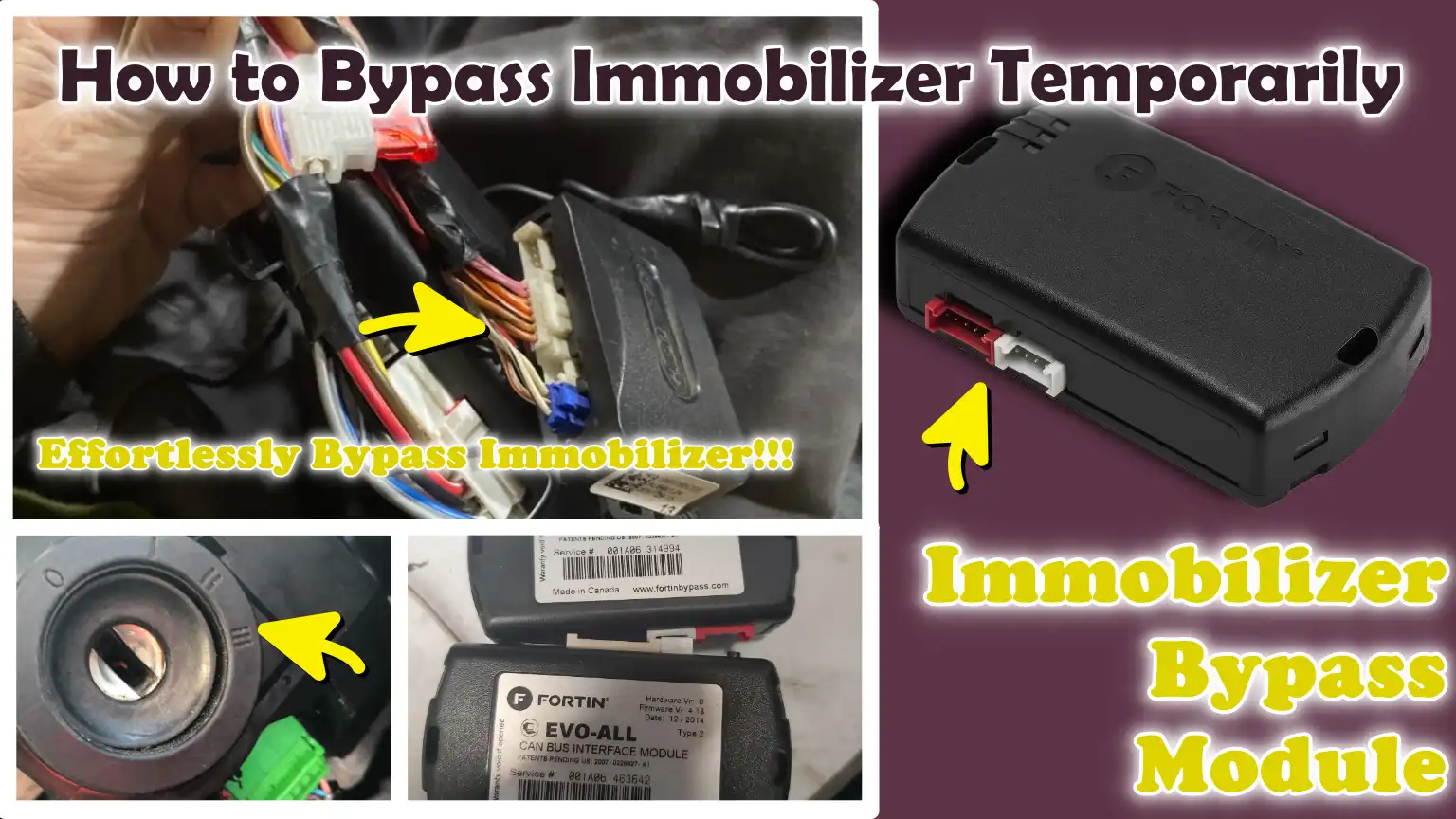
Which is why, we have come up with this guide about How to Bypass Immobilizer Temporarily, so that you can easily start your vehicle again during an emergency without causing any unnecessary damage to your vehicle and its system.
What is an Immobilizer System?
An immobilizer system is a built-in electronic anti-theft technology found in most modern vehicles.
It prevents the engine from starting until the correct digital key is detected.
Its usage surged significantly in the late 1990s and early 2000s, as studies by automotive security organizations demonstrated that the installation of immobilizers led to a substantial reduction in vehicle theft rates; in some regions, a decline of over 40 percent was observed in theft incidents.
This system operates silently in the background and has no impact on normal driving; however, if a malfunction occurs, it can completely block the ignition process, even if the vehicle has fuel, battery power and a functional starter.
Simply put, it acts as a security “handshake” between your key and your vehicle’s computer; if this handshake fails, the engine will not start.
1. How Does a Car Immobilizer Work?
Transponder Chip Communication
Inside the car key or “key fob” lies a small transponder chip containing a unique encrypted code.
When you insert the key or bring the fob close to the starting system, the vehicle emits a low-frequency radio signal to power and read this chip.
If the received code matches the code already stored in the vehicle’s memory, the system grants permission for the engine to start.
This entire process is completed in less than a second and is designed to prevent key cloning or the use of the key by an unauthorized individual.
ECU Authorization Process
The Engine Control Unit, often referred to as the ECU, acts as the primary security guard.
It compares the code received from the transponder chip with the encrypted data stored internally.
If the code is correct, the ECU sends a “start authorization” signal to the engine system.
If the code is missing or incorrect, the ECU completely blocks the start command.
This is why even a minor glitch in communication can prevent the entire vehicle from starting.
Disabling Fuel and Ignition
When the immobilizer is not fully confident in the key’s identity (authentication), it can disable critical engine functions, such as fuel injection and the ignition spark.
This means that the engine may ‘crank’ (turn over), but it will not actually start and run.
In many modern systems, the fuel pump relay or ignition coil circuit is electronically cut off to ensure that combustion (the burning process) cannot be initiated inside the engine.
Push-Button Start vs Traditional Key Systems
Traditional key systems rely on physically inserting the key and an antenna ring positioned around the ignition cylinder, whereas push-button start systems utilize proximity sensors that detect the key when it is inside or near the vehicle.
Push-button systems are more sensitive to weak key battery signals or interference; this is why errors such as “Key Not Detected” are more common in newer vehicles compared to older ignition systems.
2. Key Components of an Immobilizer System
Transponder Key
The transponder key is the primary authentication device; it contains a microchip that stores a unique security code.
Without a correctly programmed key, the vehicle will not allow the engine to start.
Immobilizer Antenna Ring
This is a small coil located around the ignition barrel or inside the start button area.
It sends and receives signals from the key’s transponder chip and plays a crucial role in detecting whether the correct key is present.
BCM, ECM, ECU
These electronic control modules act as the “brain” of the vehicle’s security system.
The Body Control Module manages security signals, the Engine Control Module handles engine functions and the ECU coordinates communication between them to allow the engine to start or to prevent it from doing so.
Key Fob Module
In smart key systems, the Key Fob Module contains a transmitter that sends an encrypted (secure) signal to the vehicle.
It relies heavily on a small internal battery; if that battery is weak, the signal strength may diminish, potentially leading to a failure in key recognition.
Starter Relay
The starter relay is an electrical switch controlled by the immobilizer system.
If authentication fails, the relay does not activate, thereby preventing the starter motor from cranking the engine.
Security Light
The security indicator located on the dashboard displays the status of the immobilizer.
A steady or flashing security light usually indicates that the system has not recognized the key or is actively preventing the engine from starting.
3. Signs That Your Immobilizer Is Active
Engine Cranks but Does Not Start
This is one of the most common signs: the starter motor turns the engine over, but the fuel supply or spark is interrupted, preventing the engine from firing up.
Flashing Security Light
A flashing security symbol on the dashboard typically indicates that the immobilizer system is active and has failed to recognize the key’s signal.
“Key Not Detected” Message
In vehicles equipped with a push-button start, this message appears when the system is unable to detect the key’s signal due to a weak battery, interference, or a synchronization error.
The Vehicle Starts, Then Immediately Shuts Down
This occurs when the engine briefly fires up, but the immobilizer cuts off the fuel or ignition supply just a second later because the authentication process was not successfully completed.
The Remote Key Suddenly Stops Working
When the key fails to lock or unlock the doors, and simultaneously, you experience difficulty starting the vehicle, it often signals a communication issue related to the transponder or the battery, which subsequently affects the entire immobilizer system.
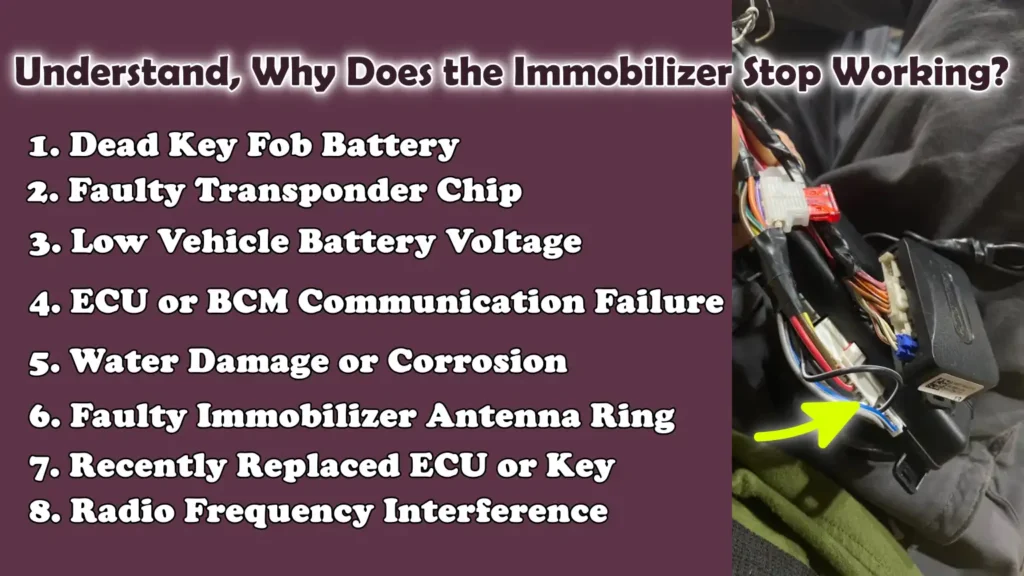
Understand, Why Does the Immobilizer Stop Working?
The immobilizer system is designed to be highly reliable; however, it relies on precise electronic communication between the key, sensors and the vehicle’s control module.
When any link in this chain is broken, the system may fail to recognize the key and, as a security measure, prevent the engine from starting.
In real-world scenarios, immobilizer issues are often not caused by a single major malfunction, but rather by minor electrical or communication glitches that disrupt the exchange of signals between components.
1. Dead Key Fob Battery
In modern push-to-start vehicles, one of the most common reasons for the immobilizer system to stop functioning is a dead or weak key fob battery.
Although the immobilizer chip embedded in the key does not always rely directly on the battery for its core function, the remote signal used for communication and unlocking the vehicle may become too weak for the vehicle to detect.
In many cases, the vehicle can still be unlocked manually, but it fails to recognize the key to start the engine, resulting in a “Key Not Detected” error message.
2. Faulty Transponder Chip
The transponder chip embedded in the key stores a unique encrypted code that the vehicle verifies before authorizing the engine to start.
If this chip becomes physically damaged, whether due to being dropped, exposed to excessive heat, or a manufacturing defect, the ECU is unable to read the correct signal.
Unlike traditional mechanical keys, even a slightly damaged chip can completely prevent the vehicle from starting, as the system requires a precise digital match.
3. Low Vehicle Battery Voltage
A weak or deteriorating vehicle battery can directly impact the performance of the immobilizer system, as modern security systems rely on stable voltage to communicate effectively.
When the voltage drops below normal operating levels, the ECU and BCM may reset or fail to correctly process the key authentication signal.
This is why immobilizer-related “no-start” issues often surface during cold weather or after the vehicle has been left parked and unused for an extended period.
4. ECU or BCM Communication Failure
The ECU and Body Control Module (BCM) work in tandem to verify the key’s identity and authorize the engine to start.
If a software glitch, internal malfunction, or a break in the communication lines between these modules occurs, the immobilizer may erroneously assume that an incorrect key is being used.
Such malfunctions often result in intermittent starting difficulties; sometimes the vehicle starts easily, while at other times it refuses to start.
5. Water Damage or Corrosion
Moisture intrusion into critical components such as: the ignition antenna, wiring harness, or control modules, as it can lead to corrosion over time.
Even minor corrosion or water damage can weaken electrical signals and disrupt communication between the key and the vehicle’s systems.
This issue is more prevalent in regions with high humidity, areas prone to flooding, or instances where water has accidentally entered the vehicle’s cabin.
6. Faulty Immobilizer Antenna Ring
The function of the immobilizer antenna ring is to read the signal from the transponder chip when the key is positioned near the ignition switch or the start button.
If this ring malfunctions or its connection is severed, the vehicle will be unable to recognize the key, even if the key itself is functioning perfectly.
In many instances, a “Key Not Recognized” error persists repeatedly, even when a correctly programmed key is being used.
7. Recently Replaced ECU or Key
After replacing the ECU or obtaining a new key, it is crucial to properly reprogram the immobilizer system to synchronize it with the new components.
If this synchronization process remains incomplete or is executed incorrectly, the system will treat the new key or ECU as unauthorized.
This is a very common reason why a vehicle fails to start following repair work or a key replacement service.
8. Radio Frequency Interference
Immobilizer systems rely on low-frequency signals, which can occasionally be disrupted by strong radio interference or electronic noise emitted by nearby devices.
Parking the vehicle in close proximity to high-voltage equipment, mobile signal boosters, or certain types of aftermarket electronic accessories can sometimes block or weaken the key’s signal.
Although this is a rare occurrence, it can temporarily prevent the vehicle from recognizing the key, even when the key itself is, in fact, functioning perfectly.
Can You Temporarily Bypass the Immobilizer?
A car’s immobilizer is designed as a security system, not merely as a simple electronic switch.
This means it is intentionally engineered to prevent the engine from starting without authorization, even if other systems, such as the fuel supply, ignition and battery, are functioning normally.
Consequently, a true “bypass”, in the literal sense of the word, is not always possible.
And even when it is possible, it typically depends on whether the issue stems from an actual security lock or merely a temporary interruption in communication.
In many real-world scenarios, what a driver refers to as a “bypass” is actually a minor troubleshooting or recovery procedure such as: re-establishing key recognition or resetting system communication, rather than completely disabling the entire security system.
1. When a Temporary Bypass Is Possible
A temporary bypass or recovery procedure may be possible in situations where the immobilizer system has not failed completely, but is instead malfunctioning due to communication or power-related issues.
For instance, during a roadside emergency, a weak key signal or low battery voltage might temporarily prevent the car from recognizing the key, even if the system itself is otherwise functioning normally.
In such cases, attempting to restore stable voltage or re-authenticate the key can sometimes allow the vehicle to restart, making it possible to drive it for a short distance.
Similarly, when the objective is simply to get the vehicle to a repair shop, temporary workarounds can prove useful, provided that the underlying problem is not related to a failure within the key’s encrypted (secure) authentication process.
Key recognition issues, often caused by a weak battery in the key fob, signal interference, or minor synchronization glitches, as it can sometimes be temporarily resolved without the need to reprogram the entire system.
This allows the engine to remain running long enough to drive the vehicle for a short distance.
2. When This Is Not Possible
In many modern vehicles, particularly those equipped with highly advanced security systems, a true bypass is not possible without proper diagnostic tools and authorized programming access.
Encrypted smart-key systems utilize “rolling codes” and robust authentication algorithms that cannot be overridden through simple resets or manual methods.
Advanced anti-theft modules embedded within the ECU and BCM are specifically designed to prevent any unauthorized modifications.
This means that if the system has rejected the key for security reasons, the engine will remain disabled until proper reprogramming is performed.
In newer vehicles, manufacturer-locked systems often require dealer-level software or secure online authentication protocols.
In such cases, attempting any form of temporary bypass proves not only futile but may also compromise the system’s overall security.
3. Risks of Bypassing the Immobilizer
Attempting to bypass an immobilizer, even on a temporary basis, carries significant risks, as this system is directly integrated with the vehicle’s core security and engine control systems.
One of the most substantial risks is an increased vulnerability to vehicle theft; weakening or tampering with the immobilizer makes it possible to start the vehicle easily, even without proper authorization.
Furthermore, there is a risk of damage to the ECU (Electronic Control Unit), particularly if incorrect wiring or unsafe methods are employed, which can result in the failure of this expensive control module.
In many instances, attempting unauthorized bypass methods can also void the manufacturer’s warranty, as it involves tampering with the factory security system.
Moreover, if any modifications are made to the vehicle, or if it sustains any damage, during unauthorized attempts to disable or bypass security features, insurance-related complications may arise, potentially hindering the settlement of insurance claims in the event of theft or electrical malfunctions.
How to Ensure Safety Before Bypassing a Temporary Immobilizer
Before attempting any temporary recovery or bypass method on an immobilizer system, it is crucial to understand that you are interacting with a core feature of the vehicle’s security and engine control architecture.
Modern immobilizers are directly integrated with the ECU and BCM; this means that even a minor error can impact vehicle starting, fuel supply, or electronic communication between various systems.
Therefore, safety precautions are not merely suggested guidelines; they are essential measures to prevent accidental damage, system lockouts, or costly repairs.
1. Verify Vehicle Ownership
The first and most critical step is to verify that you are the legal owner or an authorized user of the vehicle.
Immobilizer systems are specifically designed to prevent unauthorized use; therefore, any tampering with or troubleshooting of the system should only be performed on a vehicle to which you have authorized access.
This is not only a legal requirement in many jurisdictions but also a practical safety measure to ensure that security systems are not misused or improperly bypassed.
2. Safely Disconnect the Battery
If electrical diagnostics or troubleshooting are required, safely disconnecting the vehicle’s battery is often the safest initial step to prevent short circuits or accidental damage to control modules.
However, this must be done correctly: always disconnect the negative terminal first and ensure that all electrical systems have been powered down before touching any components.
As modern vehicles store memory data within their control modules, improper handling of the battery can sometimes trigger additional warning lights or cause systems to temporarily reset.
Therefore, it is essential to exercise extreme caution during this process.
3. First and Foremost, Utilize Methods Approved by the Manufacturer
Before attempting any manual troubleshooting, it is always safer to employ the methods recommended in the vehicle’s owner’s manual.
Many manufacturers provide specific procedures for starting the vehicle in an emergency, resynchronizing keys, or performing a system reset, instructions designed specifically to resolve immobilizer-related issues.
These methods have been tested to ensure compatibility with the vehicle’s electronic architecture, thereby minimizing the risk of damaging sensitive control modules or triggering a permanent security lockout.
4. Avoid Cutting Factory Wiring
In modern vehicles, factory wiring constitutes an integral part of a highly interconnected communication network that links the immobilizer, ECU, BCM and various other systems.
Cutting or altering these wires can disrupt critical signals and permanently compromise the vehicle’s ability to recognize its key or start properly.
While modifying the wiring may appear to be a temporary fix, it often leads to long-term electrical malfunctions that are far more expensive to repair than the original problem itself.
5. Keep Backup Keys Ready
Having a properly programmed spare key on hand significantly reduces both the time required for diagnosis and the associated risks.
In many instances of immobilizer-related failure, the actual issue lies not within the vehicle’s system, but rather with a specific key, which may have a weak transponder signal, a depleted battery, or a synchronization glitch.
A backup key is a safe and manufacturer-approved method, without resorting to any risky measures, to determine whether the problem lies with the key or the system.
How to Bypass Immobilizer Temporarily – Easy Steps
Temporarily bypassing an immobilizer does not imply completely disabling the security system; rather, it involves utilizing specific recovery techniques.
These techniques are employed when the system malfunctions, often due to weak signals, low voltage, or temporary synchronization errors, and the communication link between the key and the vehicle is severed.
These methods are typically used in emergency situations when the vehicle fails to start, even though its mechanical and electrical systems are functioning correctly.
In many instances, immobilizer issues do not indicate a permanent defect, but rather represent temporary electronic glitches.
The methods outlined below focus on safely re-establishing this broken connection.
1. Use a Spare Key
Using a spare key is the simplest and most reliable method for determining whether an immobilizer issue lies with the primary key or with the vehicle’s internal systems.
In this process, you insert the spare key into the ignition or place it in close proximity to the push-start button.
Next, turn the ignition to the ‘ON’ position, wait for the security indicator light to stabilize or turn off and then attempt to start the engine.
This method works because every programmed key contains a unique transponder chip.
If one chip malfunctions, the spare key can still successfully communicate with the ECU.
In many real-world scenarios, the spare key continues to function even when the primary key fails to operate due to wear and tear, exposure to moisture, or internal damage to the chip.
2. Reset the Immobilizer System
Generally, resetting the immobilizer can sometimes re-establish the communication link between the ECU and the key.
This situation typically arises when the problem is caused by temporary voltage fluctuations or a glitch within the system’s memory.
This process usually involves disconnecting the negative terminal of the battery.
Afterward, wait approximately 15 to 30 minutes to allow any residual electrical charge remaining within the control module to fully dissipate.
Then, reconnect the battery and turn on the ignition in the normal manner.
This method can prove effective because many immobilizer systems temporarily store the authentication status in ‘volatile memory’.
When the power supply is completely cut off, this memory is reset.
In vehicles with simpler immobilizer architectures, or those utilizing older ECU designs, such a reset is more likely to yield positive results compared to newer, encrypted systems.
3. Utilize the Emergency Key Re-learn Procedure
Some manufacturers incorporate built-in emergency ‘re-learn’ procedures into their vehicles.
These procedures facilitate the resynchronization of the vehicle with its key without the need for specialized diagnostic equipment.
This typically involves turning the key to the ‘ON’ position and leaving it there for 10 to 15 minutes, until the behavior of the security indicator light changes.
Subsequently, the ignition is turned off and an attempt is made to restart the vehicle.
During this process, the vehicle attempts to properly perform a ‘handshake’ (communication) with the transponder chip.
This method is commonly found in many mainstream vehicles, particularly in older Toyota, GM and Ford models, where basic immobilizer systems offer limited ‘self-recovery’ capabilities in instances of temporary de-synchronization.
4. Hold the Key Near the Immobilizer Antenna
The immobilizer antenna ring, typically located around the ignition barrel or within the push-start button assembly, is responsible for detecting the transponder signal transmitted by the key.
If the signal becomes weak due to a low battery or interference, holding the key in close proximity to this antenna can sometimes re-establish communication.
When attempting to start the engine, the driver may need to position the key directly against the ignition assembly or within a designated sensor zone.
A weak transponder signal is often caused by a low battery in the key fob, electromagnetic interference, or signal attenuation resulting from a physical obstruction or a fault in the antenna coil.
5. Replace the Vehicle’s Weak Battery or Jump-Start the Vehicle
A weak car battery is one of the most common, yet often overlooked, causes of immobilizer malfunctions, as modern security systems require a stable voltage supply to function correctly.
Symptoms of issues caused by low voltage include flickering dashboard lights, failure to properly detect the key and difficulty starting the vehicle.
The correct jump-start procedure involves safely connecting a booster battery or jump pack to restore the voltage to a normal level; subsequently, the immobilizer system is able to re-establish proper communication with the ECU, thereby allowing the engine to start.
Low voltage can disrupt data exchange between control modules, potentially causing the system to erroneously reject even valid keys, even if those keys are otherwise fully functional.
6. Use a Manual Key or Security Code
Some vehicles are equipped with a manual override system that requires the user to enter a PIN or security code by cycling the ignition on and off, or by pressing specific control buttons located on the dashboard.
This system is designed to serve as a backup, ensuring that the vehicle can still be started even if the transponder key fails completely.
The specific procedures for starting the vehicle in an emergency vary by manufacturer; however, they typically involve a sequence of repeatedly cycling the ignition on and off, corresponding to the digits of the security code.
The vehicle owner’s manual is the most reliable source for these instructions, as this specific procedure is highly specialized and differs for every brand.
This method works because, rather than relying on communication via the wireless key, the ECU can be temporarily instructed to accept authentication through a coded override sequence.
7. Temporarily Bypassing the Immobilizer Antenna Ring (Advanced)
The immobilizer antenna ring functions by generating a magnetic field, which powers and reads the transponder chip embedded within the key.
In certain advanced diagnostic scenarios, technicians can verify the system’s functionality by positioning the original key close to the sensor, thereby confirming whether the antenna is correctly reading the signals.
If the antenna ring is defective, the vehicle will be unable to detect the key, even if the key itself is in perfect working order.
It is crucial to understand that altering the wiring of this component or attempting to bypass it can be risky, as it is directly integrated into the vehicle’s security system and the ECU’s communication network.
Any form of improper tampering could result in the immobilizer becoming permanently locked or cause damage to the Electronic Control Module.
Read More:
How to Temporarily Bypass a Push-Button Start Immobilizer
Push-button start systems utilize a smart key and RFID-based communication to verify that the key is present inside the vehicle, or in very close proximity to it, before allowing the engine to start.
Unlike traditional ignition systems, this process involves no physical contact with the key; consequently, the car relies entirely on the strength of wireless signals and the encrypted authentication exchanged between the key, the vehicle’s immobilizer and its ECU.
When this communication fails, due to a weak key battery, signal interference, or a temporary system glitch, the vehicle may display a “Key Not Detected” message and refuse to start, even if the car itself is otherwise in perfect working order.
In many instances, this issue is not a permanent malfunction but rather a momentary interruption in communication, which can often be resolved by utilizing the vehicle’s built-in emergency recognition protocols.
1. Use the Backup Start Position for a “Dead Key Fob”
Many push-button start vehicles feature a backup start position, specifically designed for situations where the key’s battery has died or is too weak to transmit a sufficiently strong signal.
Using this method, the driver places the key within a designated emergency recognition zone, often located inside the center console, near the steering column, or within a marked slot, depending on the vehicle’s specific design.
The car employs a low-frequency backup reader capable of detecting the key’s transponder chip, even in the absence of active battery power within the key itself.
Once the system successfully identifies the correct chip, it allows the ignition process to proceed as normal.
This feature exists because manufacturers anticipate the possibility of battery failure; consequently, they design an alternative authentication method that facilitates emergency access while simultaneously ensuring continued security.
2. Hold the Key Against the Start Button
In many modern vehicles, particularly those utilizing proximity-based immobilizer systems, the start button itself houses an integrated RFID reader capable of communicating directly with the key over a very short distance.
When the key’s battery is low, or the signal is not strong enough to reach the vehicle’s internal antennas, holding the key directly against the start button can help the system detect the chip embedded within the key.
This works because, even when standard wireless communication fails, RFID signals can still transmit effectively over very short ranges.
Once the key is identified in this proximity-based mode, the ECU authorizes ignition and allows the engine to start normally.
3. Utilize the Hidden RFID Identification Zone
Some manufacturers install a hidden RFID identification zone inside the cabin, designed specifically for key recognition during emergencies.
Depending on the vehicle model, this location is typically situated near the base of the steering column, inside the glove compartment, or near the cup holders.
The purpose of this hidden reader is to ensure that, even if the main antenna system malfunctions or the key fob’s battery completely dies, the immobilizer can still recognize the transponder chip, provided the key is placed in the designated spot.
This system utilizes a short-range magnetic field to directly power the chip, thereby enabling the ECU to verify the key’s identity without relying on the strength of standard wireless transmission.
4. Brand-Specific Emergency Smart Key Procedures
Different automotive manufacturers, based on the design of their specific immobilizer architectures, employ slightly different methods to initiate an emergency start.
In many Toyota and Honda models, the system may permit the vehicle to start when the key fob is held in very close proximity to a specific zone on the start button; conversely, Ford and Nissan vehicles often rely on detection points located on the console or steering column.
Some Hyundai and Kia smart key systems utilize a ‘Direct Touch Start’ method, wherein backup authentication is triggered by holding the key directly against the ignition button.
BMW, Mercedes and other premium manufacturers generally employ more advanced encrypted systems, which may require the key to be placed in a specific designated slot or function only when the key is within the range of a particular sensor.
These variations exist because each manufacturer utilizes its own proprietary immobilizer encryption protocols and backup authentication methods; however, they are all grounded in the same fundamental principle, facilitating vehicle operation in an emergency without compromising the vehicle’s overall security.
Tools
| Tool Name | Why It Is Needed | How to Use It |
|---|---|---|
| OBD2 Scanner | It reads error codes stored within the car’s ECU and immobilizer system, helping to identify malfunctions related to communication or security. | Plug the scanner into the OBD2 port located under the dashboard, turn on the ignition and scan for codes related to security or engine-start issues. |
| Key Fob Battery Tester | It verifies whether the key fob battery possesses sufficient power to transmit a strong signal to the vehicle. | Remove the key fob battery and place it in a dedicated tester, or use a handheld tester to measure its voltage output. |
| Multimeter | It measures electrical voltage and continuity within the vehicle’s battery and immobilizer circuits. | Set the multimeter to DC voltage, connect the probes to the battery terminals or wiring points and check the readings. |
| Automotive Diagnostic Software | It provides advanced live data from the vehicle’s control modules, including the immobilizer status and key authentication logs. | Connect the car to a laptop or tablet using a diagnostic interface and then run the software to view real-time system data. |
| EEPROM Programming Tools | These tools are used to read and rewrite immobilizer memory data stored within the ECU or BCM. | Connect the tool to the ECU chip or module, read the stored data and, if necessary, reprogram or repair corrupted immobilizer information. |
How to Interpret the Immobilizer Error Codes
Immobilizer error codes are diagnostic signals stored within a vehicle’s computer system.
They assist in identifying why the engine is failing to start or why the key is not being recognized.
These codes are generated by the ECU, BCM, or immobilizer control unit whenever the system detects an issue related to key authentication, signal communication, or security verification.
Understanding these codes is crucial, as they directly indicate whether the problem lies with the key, the wiring, or a deeper electronic fault within the vehicle.
Although their precise meaning may vary slightly depending on the manufacturer, most immobilizer-related codes follow a standard pattern such as: P-codes for powertrain-related issues, B-codes for body control-related issues and U-codes for interruptions in network communication.
1. Common P-Code and B-Code Errors
P0513 is one of the most common immobilizer-related codes.
It typically indicates that the ECU is receiving an incorrect or unrecognized signal from the key, meaning the vehicle is unable to confirm the proper authentication of the key.
B2799 is primarily associated with a complete failure of the immobilizer system, particularly in vehicles utilizing advanced key coding.
It often signals that the ECU and the immobilizer are not properly synchronized.
U-codes denote errors occurring within the communication network between various modules.
This implies that the ECU, BCM, or immobilizer unit are unable to correctly exchange data through the vehicle’s internal communication system.
Failures in key authentication, even if not linked to a specific numerical code, typically occur when the transponder chip’s signal is weak or corrupted, or when it fails to match the security data stored in the ECU.
2. What Each Code Signifies
Each code associated with the immobilizer points to a specific stage in the security verification process where the system has failed.
A code such as P0513 typically indicates that the ECU has received a signal from the key but does not recognize it as valid.
The cause for this could be an incorrect key, a defective chip, or a mismatch in the programming.
Code B2799 often indicates that the immobilizer control module is unable to communicate properly with the ECU.
This suggests a deeper synchronization or module-level issue, rather than a simple key-related problem.
U codes indicate that the vehicle’s communication network, often referred to as the CAN bus, is experiencing disruptions.
This can impact multiple systems simultaneously, including the immobilizer.
“Key authentication failure” messages, which appear without a specific code, usually signify that the system is actively preventing the engine from starting because it is unable to verify the encrypted code stored within the transponder chip.
3. Which Errors Require Professional Repair?
While some immobilizer issues can be resolved through simple measures such as: replacing the key fob battery or resetting the system, certain error codes point to serious electronic or programming faults that require professional-grade equipment and expertise.
Codes like B2799, as well as recurring U codes, are often linked to synchronization issues between the ECU and the immobilizer module; these cannot be resolved without dealer-level diagnostic tools or specialized programming equipment.
Recurring instances of key authentication failure, even when a correct and functional key is being used, typically indicate a need to reprogram the immobilizer system or replace the control module.
If immobilizer errors persist in the vehicle after replacing the battery, inspecting the key and attempting a system reset, it is a strong indication that professional repairs are required to restore secure communication between the key and the vehicle’s control system.
How to Avoid Immobilizer Problems in the Future
The primary way to avoid issues related to the immobilizer is to maintain a stable power supply, protect electronic components and ensure that the key and the vehicle remain properly synchronized.
As immobilizer systems rely on constant communication between the key, the antenna and the vehicle’s control module, even minor issues such as: a weak battery, exposure to moisture, or signal interference, as it can disrupt the system.
Most immobilizer failures are not caused by sudden mechanical breakdowns, but rather by the gradual degradation of electronic components or preventable maintenance-related issues; therefore, by adopting a few simple precautions, the likelihood of future “no-start” situations can be significantly reduced.
Also, there’s research on the vehicle immobilizers that clearly shows that modern systems actually relies on encrypted RFID challenge-response authentication in terms to prevent from unauthorized engine start, also there’s studies from the University of Birmingham that shows that systems such as: Megamos Crypto actually uses 96-bit security keys embedded in vehicle transponder keys, that’s why these systems are actually designed to block the ignition unless the correct cryptographic response is received, that’s why you might be facing this issue because of its deeply security logic which is embedded into the modern ECU systems.[¹]
1. Replace the Key Fob Battery Regularly
The voltage of the key fob battery gradually diminishes over time and as the battery weakens, the signal transmitted to the vehicle also becomes weaker.
Even if the key can still successfully lock and unlock the doors, it may not always be able to transmit a signal strong enough to authorize the starting of a vehicle equipped with a “push-to-start” system.
Replacing the battery every one or two years ensures continuous communication with the immobilizer system and reduces the risk of sudden issues such as: a “Key not detected” error, particularly in cold weather, when battery performance naturally declines.
2. Keep a Programmed Spare Key on Hand
Keeping a properly programmed spare key on hand is the most effective way to avoid immobilizer-related emergencies.
Each key is individually coded to synchronize with the vehicle’s ECU; therefore, if a key malfunctions, gets lost, or loses its synchronization, an immediate diagnosis can be performed using a spare key to determine whether the issue lies with the key itself or with the vehicle’s internal systems.
Keeping a functional spare key on hand also helps prevent situations where a single faulty key completely locks the owner out of the vehicle, a common issue in modern cars that rely heavily on electronic authentication.
3. Protect Electronic Components from Moisture
Moisture is one of the most damaging factors for an immobilizer system, as even a small amount of dampness can compromise the wiring, antenna and control modules.
When water infiltrates critical components or electrical connectors, it can lead to corrosion over time, thereby weakening the signal communication between the key and the vehicle.
Protecting the key fob from rain, preventing water ingress into the vehicle’s cabin and ensuring that the electrical system remains dry are measures that help maintain stable communication among all immobilizer components and prevent major malfunctions in the future.
4. Maintain Stable Battery Voltage
A stable vehicle battery is crucial for the proper functioning of the immobilizer system, as the ECU, BCM and antenna systems all rely on a consistent voltage supply to process key authentication signals.
If the battery is weak, resulting voltage drops can cause control modules to reset or misinterpret key signals, leading to difficulties in starting the vehicle, symptoms that may appear to be a malfunction of the immobilizer system itself.
Regularly checking the battery’s condition and replacing it when its performance declines ensures that the immobilizer system receives a stable power supply and that the key is correctly recognized every time the vehicle is started.
5. Avoid Magnetic or Radio Frequency Interference
Immobilizer systems utilize low-frequency radio signals to facilitate communication between the key and the vehicle; this means they can occasionally be susceptible to strong electromagnetic or radio frequency interference.
Devices such as large electronic equipment, aftermarket signal boosters, or improperly installed accessories can sometimes disrupt the signals responsible for key recognition.
Keeping the key and the vehicle’s system away from sources that generate strong interference helps maintain clear communication between the transponder chip and the immobilizer antenna, thereby reducing the likelihood of temporary starting issues caused by signal disruption.
Conclusion – How to Bypass Immobilizer Temporarily
You need to understand this thing that: immobilizer system does not fail without any reason, as it reacts to the broken or unclear electronic signals and tries to prevent your car from unauthorized engine start.
Designed to prevent theft, it ensures that the engine starts only when a key containing the correct code is used.
Although this system is highly reliable, it can occasionally suffer from minor electronic glitches such as: a weak key fob battery, low vehicle voltage, a faulty transponder chip, or a communication interruption between the ECU and the immobilizer module.
These minor issues can suddenly trigger a severe “no-start” condition, even if the engine, fuel system and starter are otherwise functioning perfectly.
Fundamentally, this means that an immobilizer malfunction is typically not a mechanical breakdown, but rather an issue related to electronic verification, specifically, when the vehicle is unable to authenticate the legitimacy of the key being used.
Most temporary issues preventing a vehicle from starting often stem from very simple causes such as: a weak signal, synchronization errors, or power supply instability.
This is why performing a few basic checks such as: using a spare key, inspecting the vehicle’s battery condition, or following manufacturer-recommended reset procedures, as it can sometimes resolve the issue and allow the vehicle to restart without the need for major repairs.
And, if you still have unsolved queries in mind, please let us know in the comment section below.
Frequently Asked Questions
FAQ 1: What is an immobilizer system in a car?
Answer: An immobilizer system is an electronic anti-theft feature installed in modern cars. It prevents the engine from starting until the correct key or smart key is detected. It operates by utilizing a small transponder chip embedded within the key, which communicates with the vehicle’s ECU (Engine Control Unit). If the key’s code does not match the security data pre-stored in the car, the system disables the ignition, fuel supply, or starter functions. This means that even if the battery, fuel and starter are functioning correctly, the engine will not start without proper authorization.
FAQ 2: Why won’t my car start due to the immobilizer?
Answer: Typically, a car fails to start due to immobilizer-related issues when the system is unable to recognize or verify the key’s signal. This can occur due to a weak key fob battery, a faulty transponder chip, low car battery voltage, or a loss of communication between the ECU and the immobilizer module. In many cases, the security light on the dashboard will begin to flash, or a message such as “Key Not Detected” may appear. For security reasons, the system prevents the car from starting because it perceives the key as unauthorized.
FAQ 3: What are the symptoms of an immobilizer malfunction?
Answer: The most common symptoms include the engine cranking (turning over) but failing to start, the security light on the dashboard flashing, or the car starting briefly, usually for just a second, and then immediately shutting off. In vehicles equipped with a push-button start feature, you may also see a “Key Not Detected” warning. Occasionally, the doors may stop locking or unlocking via the remote key; this is also an indication that the immobilizer system is not receiving the correct signal from the key.
References:
[1] Dismantling Megamos Crypto: Wirelessly Lockpicking a Vehicle Immobilizer
https://research.birmingham.ac.uk/en/publications/dismantling-megamos-crypto-wirelessly-lockpicking-a-vehicle-immob/

Hello Folks, Dean Shali here to help you out to solve the problems with your lovely vehicle, as i have lots of experience and knowledge about automotive industry as i woks directly with the customers and repair vehicles and i love to help the people to keep their cars safe and running smoothly.