
Written By: Dean Shali
Fact Checked By: Sabré Cook
Reviewed By: Tamara Warren
So, if your car have proper fuel, power and a healthy engine, but even all of those things already but there’s one tiny electronic chip inside the key that can stop everything instantly and yes that is the most confusion no-start problems drivers has to face.
Basically, if there’s any security warning flashing on the dashboard, then the engine cranks for the second or just refuses to respond completely and within the moments you actually realize that your car’s immobilizer system has locked you out.
So, immobilizers are not actually mechanical problems at all, as these are the highly advanced electronic security systems which is designed to prevent vehicle theft as it actually blocks the fuel delivery, ignition or engine startup unless the correct coded key is detected.
Not only this, there’s studies from the global automotive security organizations that have shown that electronic immobilizers actually reduced vehicle theft rates in many countries after becoming the mandatory in modern vehicles.
Even though its usefulness about the enhanced security, also it can create the problem: when communication between the key, transponder chip, antenna ring or the engine control unit actually fails, then the vehicle may behave as if it is being stolen, even if you are the real owner.
As well as, having a weak battery, damaged key fob, faulty wiring connection, low vehicle voltage, water intrusion, ECU synchronization failure or even interference from the aftermarket electronics can trigger the immobilizer-related starting issues and it can happen without any kind of warning as well.
That’s why, in this guide you’ll learn How to Fix Immobilizer Issue in Car so that you can apply those practical fixes and bring your beloved vehicle back to the life.
So, What is a Car Immobilizer?
A car immobilizer is an electronic anti-theft system designed to prevent the engine from starting unless a key containing the correct code is present.
This system has become a standard feature in most modern vehicles, as it significantly reduces instances of car theft by preventing unauthorized engine startup.
Rather than relying solely on a physical key, the immobilizer utilizes encrypted digital communication between the key and the vehicle’s control system.
If the correct signal is not detected, the car may crank but will not start; alternatively, it may not respond at all.
This occurs because the immobilizer disables essential engine functions, such as the fuel supply or the ignition spark.
Simply put, even if the car’s mechanical components are functioning perfectly, the engine will not start if the digital security check fails.
1. How Does an Immobilizer System Work?
Key Chip/Transponder Communication
The key contains a small transponder chip that stores a unique electronic code.
When the key is inserted into the ignition, or, in vehicles equipped with smart-key systems, when the key is brought into proximity with the vehicle, this chip transmits a low-power signal to the car.
The vehicle is equipped with a receiver that reads this signal and verifies whether the code matches the authorized data pre-stored within its system.
If the codes match, the vehicle is permitted to start normally.
If the codes do not match, or if no signal is received, the immobilizer system immediately prevents the engine from starting.
This communication takes place in mere milliseconds and is entirely automatic; this is why drivers often face situations such as: the car failing to start, that occur suddenly and without any warning.
The ECU Authentication Process
The Engine Control Unit, often referred to as the ECU, acts as the brain of the vehicle’s starting system.
It receives signals from the immobilizer module and verifies whether the key code is valid.
This process is part of a “security handshake” that occurs between the various electronic modules within the car.
The ECU grants permission to activate fuel injection and ignition timing only after it has confirmed a successful authentication.
If the ECU does not receive this confirmation, it disables the engine’s functions, even if the starter motor is operational.
This is why malfunctions in the immobilizer system often manifest as engine-related problems, whereas, in reality, they are communication errors occurring within the vehicle’s electronic network.
Fuel and Ignition Lockout Systems
If authentication fails, the immobilizer activates a safety lockout mode that prevents the engine from starting.
This is achieved by cutting off the fuel supply, deactivating the ignition coils, or disabling the fuel injectors, depending on the specific design of the vehicle.
In some systems, the starter motor may still be able to crank the engine; however, without fuel or a spark, combustion cannot occur.
This lockout is a deliberate security measure designed to serve as the final line of defense against theft.
Consequently, issues related to the immobilizer often mimic the symptoms of a faulty fuel pump or ignition system, even when those specific components are functioning perfectly fine.
2. Key Components of the Immobilizer System
The immobilizer system consists of several interconnected electronic components that work together to verify identity and control access to the engine.
The transponder is the first element of this system; it contains a coded chip that communicates with the vehicle.
The immobilizer antenna ring is typically mounted around the ignition cylinder and acts as a signal receiver, reading the data transmitted by the key.
The ECU (Engine Control Unit) or PCM (Powertrain Control Module) makes the final decision by comparing the received signals against pre-stored security data and regulating engine operation.
The security module is responsible for managing encryption and synchronization between the vehicle’s various electronic systems.
In smart key systems, the internal battery within the key fob provides the necessary power for the key to communicate wirelessly with the vehicle; when this battery runs low, signal transmission may be interrupted, potentially causing difficulties in starting the vehicle or triggering warnings such as “Key Not Detected”.
3. Types of Car Immobilizer Systems
Passive Immobilizer
Passive immobilizers activate automatically without requiring any action from the driver.
As soon as the key is inserted into the ignition or its presence is detected near the vehicle, the system initiates its authentication process.
These systems are widely used in modern vehicles because they provide continuous security without the need for manual activation.
If the correct key is not present, the vehicle remains immobilized (disabled), even if other systems appear to be functioning correctly.
Active Immobilizer
Operating an active immobilizer requires the driver to take a deliberate action such as: pressing a button on a key fob or entering a code.
These systems were more common in older vehicles and certain commercial security setups.
They provide an extra layer of control because the system activates only when explicitly engaged; however, due to the convenience offered by passive systems, they are less common in modern passenger cars.
Smart Key and Push-Button Systems
Smart key systems represent the most advanced form of immobilizer technology.
In vehicles equipped with this technology, there is no need to insert a key into an ignition slot.
Instead, the car detects the presence of the key via radio-frequency communication.
When the driver presses the push-start button, the system verifies the key’s identity before authorizing the engine to start.
These systems are highly convenient; however, they are more susceptible to battery issues, signal interference and electronic malfunctions, which is why warnings such as “Key Not Detected” are faced more frequently in vehicles equipped with smart keys.
Know, Common Symptoms of Immobilizer Issues
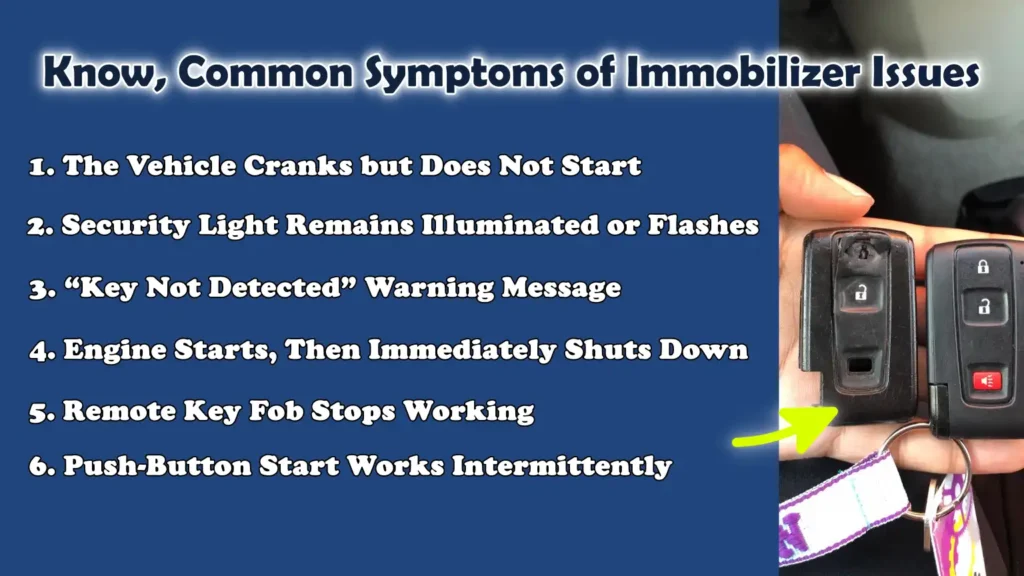
Immobilizer problems typically manifest as issues related to engine starting or communication failures, rather than as obvious mechanical malfunctions.
This is because the system is designed to silently prevent the engine from running whenever it fails to recognize a signal from the correct key.
In many modern vehicles, the immobilizer operates through encrypted communication between the key’s transponder, the antenna ring and the Engine Control Unit (ECU); consequently, even a minor disruption in this signal chain can result in unusual symptoms.
Drivers often mistakenly assume that the engine itself is at fault, whereas, in reality, the vehicle is failing to start due to a security-related glitch.
Understanding these symptoms can help you avoid unnecessary repairs and pinpoint the true source of the problem, typically an issue with the key, the battery, or the electronic communication system.
1. The Vehicle Cranks but Does Not Start
The most common symptom of an immobilizer-related issue is that the engine cranks normally but fails to start.
This occurs because the starter motor is functioning correctly, but the immobilizer has disabled either the fuel injection or the ignition spark.
The engine is physically turning over, but combustion cannot take place because the ECU has not authorized it.
Upon observing this symptom, drivers often suspect a faulty fuel pump or a problem with the ignition coils; however, when the issue stems from the immobilizer, these systems are typically functioning perfectly.
In reality, the key’s signal is simply not being accepted, leaving the engine in a “locked” (disabled) state.
2. Security Light Remains Illuminated or Flashes
Most vehicles are equipped with a security indicator light, often shaped like a key, that provides information regarding the status of the immobilizer system.
When this light remains continuously illuminated or flashes while attempting to start the vehicle, it typically indicates that the key has not been recognized.
Under normal operating conditions, once the system verifies the key, this light illuminates briefly and then turns off after the key authentication process is complete.
If the light remains continuously illuminated, it signifies that the immobilizer system is still active.
This issue may be caused by a weak key signal, low voltage in the vehicle’s battery, or a communication fault between the immobilizer module and the ECU.
3. “Key Not Detected” Warning Message
In vehicles equipped with a “push-button start” system, a “Key Not Detected” message directly implies that the vehicle is unable to read the signal from the “smart key”.
This often occurs when the key fob battery is low, the key is outside the vehicle’s signal detection range, or an obstruction is blocking the radio frequency signal.
In some instances, this issue may also stem from a malfunction in the vehicle’s receiving antenna or the smart key control module.
Even if the key is physically present inside the vehicle, the system will prevent the engine from starting until it successfully detects and authenticates the encrypted signal.
4. Engine Starts, Then Immediately Shuts Down
Another distinct symptom is when the engine briefly fires up, typically for just a second, and then immediately shuts down.
This occurs because the immobilizer initially permits ignition for a brief moment during the startup sequence; However, if it fails to complete this entire authentication process, it immediately cuts off the fuel supply.
The ECU may initially attempt to start the engine, but as soon as the security verification fails, it disables the engine functions necessary for continuous operation.
This behavior is a definitive indication of a malfunction in transponder communication or incorrect key programming.
This is one of the most misleading symptoms, as the engine appears to be running, yet it repeatedly stalls.
5. Remote Key Fob Stops Working
When the remote key fob ceases to lock or unlock the car, it may also signal issues related to the immobilizer system.
Although the remote locking system and the immobilizer system operate independently, they often rely on the same key fob electronics and battery.
A weak battery or a fault within the key’s internal components can simultaneously affect both systems.
In some instances, water damage or a defect in the key’s internal circuitry can prevent it from properly transmitting both remote and transponder signals, thereby making it difficult to start and access the vehicle.
6. Push-Button Start Works Intermittently
In vehicles equipped with smart keys, the push-button start system may sometimes function intermittently or fail without any prior warning.
This typically occurs when the system struggles to maintain a consistent connection with the key.
A weak key battery, signal interference, or unstable vehicle battery voltage, any of these factors could be at the root of this issue.
Occasionally, the vehicle may start easily one moment but fail to start the next, as the signal strength fluctuates.
This irregularity is a primary indication that the problem is electronic rather than mechanical; it often points to an incipient fault within the immobilizer or the smart-key system itself.
Why Do Immobilizer Problems Occur in Cars?
Immobilizer problems arise when the communication link between the car’s key and its security system is disrupted or ceases to function entirely.
Modern immobilizer systems rely on precise electronic signals transmitted between various components such as: the key’s transponder, the antenna ring, the immobilizer module and the ECU or BCM.
Even a minor interruption in the power supply, signal strength, or data matching process can cause the car to fail to recognize the correct key.
Because these systems are highly sensitive, issues can manifest suddenly and often mimic major engine malfunctions, even when the mechanical components are functioning perfectly.
1. Dead or weak key fob battery
A weak or dead key fob battery is the simplest and most common cause of immobilizer-related issues.
In smart key systems, the battery powers the signal that enables the car to detect and authenticate the key.
When the battery voltage drops, the signal becomes weak or unstable, causing the vehicle to repeatedly fail to recognize the key.
This can trigger warning messages such as “Key not detected” or result in intermittent starting difficulties, meaning the vehicle may start sometimes, but not consistently.
In many cases, simply replacing the small ‘coin-cell’ battery located inside the key fob is enough to restore the vehicle to proper working order.
2. Faulty transponder chip
The transponder chip embedded within the key contains a unique encrypted code that the car uses for authentication purposes.
If this chip sustains any physical damage such as: from being dropped, exposed to extreme heat, or infiltrated by water, it may cease transmitting the correct signal.
Unlike issues related to the battery, a faulty transponder chip cannot be fixed simply by replacing that specific component; typically, this requires the programming of an entirely new key.
When the chip malfunctions, the car fails to recognize the key whatsoever, even if the battery and all other remote functions are operating correctly.
3. Faulty Immobilizer Antenna Ring
In ‘Key-in’ (key-start) systems, the immobilizer antenna ring is typically situated around the ignition cylinder and serves to receive the transponder signal from the key.
If this component fails, the car is unable to properly read the key, even if the key itself is functioning correctly.
This may be caused by a defect in the internal coil, an electrical glitch, or a loose connection.
When the antenna ring malfunctions, the immobilizer system cannot complete the authentication process; consequently, the car will fail to start, or recurring security-related warning messages may appear.
4. Interruption in ECU or BCM Communication
The ECU (Engine Control Unit) or BCM (Body Control Module) is responsible for processing immobilizer authentication data and enabling engine functions, such as fuel injection and ignition.
If communication between these modules and the immobilizer system is interrupted, the car may fail to start, even if the correct key is being used.
This can occur due to software glitches, internal module malfunctions, or programming errors.
In such cases, diagnostic tools are often required to identify the specific error code and re-establish proper synchronization between the various modules.
5. Water Damage or Electrical Issues
Water intrusion is a serious cause of immobilizer failure, as these systems rely entirely on stable electronic signals.
Moisture can infiltrate the wiring harness, control modules, or connectors, leading to short circuits or signal interruptions.
Electrical issues such as: sudden voltage fluctuations or faulty circuitry, as it can also adversely affect the proper functioning of the immobilizer system.
Even minor corrosion resulting from exposure to moisture can disrupt communication between components and prevent the system from correctly recognizing the key.
6. Corroded Wiring or Loose Connections
The immobilizer system relies on a network of wiring connections to transmit low-voltage digital signals.
If these wires become compromised, due to corrosion, looseness, or physical damage, the signal may weaken or be lost entirely.
This often occurs in older vehicles, or in environments characterized by extreme heat, vibration, or high humidity.
A loose ground connection or a faulty connector can trigger intermittent immobilizer-related issues that manifest suddenly, making it difficult to diagnose the fault without a thorough inspection.
7. Incorrect or Unprogrammed Key
Using an incorrect or unprogrammed key is another common cause of immobilizer failure.
Each key is specifically coded to match the vehicle’s security system; without proper programming, the vehicle will fail to recognize it.
This often occurs when duplicate keys are not cut precisely or when a new key is not correctly synchronized with the vehicle’s ECU.
In such instances, the engine may crank but will not start, as the authentication process is immediately halted.
8. Low Vehicle Battery Voltage
Low voltage in the vehicle’s main battery can have a direct impact on the immobilizer’s performance, as these systems require a stable power supply to function correctly.
When the battery is weak, the ECU and the immobilizer module are unable to communicate effectively with one another, sometimes leading to difficulties in starting the vehicle or triggering security-related warnings.
This issue is particularly prevalent in cold weather or as the battery ages.
Restoring the battery voltage to the correct level often resolves immobilizer-related issues without the need for any further repairs.
9. Interference from Aftermarket Alarm Systems
If aftermarket alarm systems are not installed correctly, they can sometimes interfere with the vehicle’s factory-installed immobilizer system.
These systems may cause wiring faults, transmit erroneous signals, or disrupt the vehicle’s internal communication network.
Improperly integrated alarms can trigger false security alerts or cause the immobilizer to fail to recognize a valid key.
In some cases, it becomes necessary to remove the aftermarket system, or to properly reconfigure it, in order to restore the vehicle’s normal starting functionality.
How to Ensure Safety Before Diagnosing Immobilizer Issues
Before diagnosing immobilizer problems, it is essential to understand that these systems are directly linked to the vehicle’s anti-theft electronics and the Engine Control Module (ECM).
Unlike simple mechanical issues, if the immobilizer system is tampered with incorrectly, it may react unpredictably, sometimes resulting in a temporary lockout or triggering false security alerts.
Because these systems control critical functions such as fuel injection and ignition authorization, even a minor error during testing can exacerbate the problem or create confusion during the diagnostic process.
Adhering to proper safety precautions helps protect both the vehicle’s electronic systems and the user from unnecessary complications.
1. Park the Vehicle in a Safe Location and Disconnect the Battery if Necessary
The first step to ensuring safety is to park the vehicle in a secure, stable location where it cannot roll away or move unexpectedly.
Immobilizer systems are sensitive to voltage fluctuations; therefore, in certain diagnostic scenarios, it may be necessary to disconnect the battery to reset electronic modules or prevent accidental short circuits.
However, this should only be done after ensuring that all electrical systems have been switched off.
Disconnecting the battery can sometimes reset the communication link between the ECU and the immobilizer; however, it may also erase temporary memory settings, so this step should be taken with caution and only when deemed appropriate for the diagnostic procedure.
2. Use Manufacturer-Approved Keys
When working with immobilizer systems, it is mandatory to use the correct, manufacturer-approved key.
Each key contains a unique transponder code that is specifically programmed to match the vehicle’s ECU.
If an unprogrammed or aftermarket key is used, the immobilizer will fail to recognize it and the vehicle will be unable to start at all.
In some instances, the repeated use of an incorrect key can cause system confusion or prolong the time required for proper re-authentication.
Always ensure that the key being used is correctly programmed and fully compatible with the vehicle.
3. Avoid Applying Force to Ignition Components
When troubleshooting immobilizer issues, it is crucial to avoid applying force to any ignition components such as: the key cylinder, push-start button, or steering lock mechanism.
These systems are electronically controlled and applying physical force to them will not bypass the security checks.
Forcing these components can result in mechanical damage or damage to internal sensitive sensors, thereby exacerbating the problem.
If the ignition fails to engage, it typically indicates an electronic authentication issue rather than a mechanical obstruction; therefore, one should focus on analyzing electronic signals to diagnose the problem, rather than resorting to mechanical intervention.
4. Always Keep a Spare Key Handy
Keeping a spare key on hand is an essential precaution for diagnosing immobilizer-related issues.
A spare key allows for a quick determination of whether the problem stems from a faulty transponder chip or an error in the key’s programming.
If the spare key functions correctly, it generally implies that the original key is defective or that the system is failing to recognize it.
This simple method can save time and prevent unnecessary repairs or component replacements.
Furthermore, possessing a correctly programmed spare key mitigates the risk of the vehicle becoming completely locked out in the event of an immobilizer malfunction.
5. Understand the Risks of Anti-Theft Lockout
Immobilizer systems are designed to safeguard the vehicle.
If authentication attempts fail repeatedly, they enter an anti-theft lockout mode.
This means that if multiple attempts prove unsuccessful, the system may completely disable the engine for a certain period, even if the correct key is subsequently used.
Understanding this is crucial, as repeated incorrect actions while troubleshooting the issue can exacerbate the situation.
In some vehicles, you may be required to wait for a specific duration before the system permits a restart, or you may need to have the system reset by an expert using a diagnostic tool.
Being aware of this helps prevent the problem from inadvertently escalating and ensures that the troubleshooting process is conducted in a controlled and cautious manner.
Tools
| Tools | Why It Is Needed | How to Use It |
|---|---|---|
| OBD2 Scanner | This tool assists in identifying fault codes related to the immobilizer, as well as detecting communication anomalies between the key, the ECU and the immobilizer module. | Plug it into the OBD port located beneath the dashboard, switch on the ignition and scan for any stored or active error codes. |
| Multimeter | This device is used to assess battery health, wiring connections and signal flow within the immobilizer circuit. | Set it to voltage or continuity mode, then test the battery terminals, wiring and connectors to obtain accurate readings. |
| Spare Programmed Key | This step helps determine whether the issue lies with the primary key itself or with the vehicle’s internal systems. | Attempt to start the vehicle using the spare (backup) key; if it works, the primary key may be defective or may not have been programmed correctly. |
| Key Fob Battery | A weak battery is one of the most common causes of “Key Not Detected” errors or immobilizer malfunctions. | Carefully open the key fob, replace the battery with the correct type and ensure that both the remote access and starting functions are operating correctly. |
| Battery Charger | Low voltage can disrupt communication within the immobilizer system and prevent the key from being properly recognized. | Connect a charger to the vehicle’s battery terminals, follow the charger’s instructions and ensure the battery is fully charged before attempting to test the ignition again. |
| Wiring Diagram | This resource aids in diagnosing the immobilizer wiring, antenna ring circuit and ECU connections, thereby allowing for the precise identification of the root cause of the problem. | Use this as a reference guide when inspecting the wiring, connectors and grounding points within the immobilizer system. |
| Diagnostic Scan Tool | This tool is used for in-depth immobilizer diagnostics, key programming and verifying ECU communication. | Connect to the vehicle’s port, access the immobilizer or BCM module and read live data or perform relearn procedures. |
How to Fix Immobilizer Issue in Car – Easy Methods
Immobilizer-related issues can be somewhat confusing, as the engine often appears to be functioning perfectly fine, yet it fails to start.
The primary reason for this is that the system relies on rapid electronic communication between the key, the antenna ring, the immobilizer module and the ECU.
If any component in this chain ceases to function, the car may crank without starting or display a security warning.
This step-by-step guide outlines the most reliable method for diagnosing and resolving this issue through a series of simple checks, covering everything from common electrical glitches to complex system malfunctions.
1. Check the Car Battery Voltage
A weak car battery is one of the most common causes of immobilizer malfunctions; this is because the system requires a stable voltage to ensure proper communication between its various modules.
When the voltage drops too low, the ECU and the immobilizer are unable to complete their “security handshake,” preventing the car from starting or triggering the security warning light.
To check this, you can use a multimeter to measure the voltage across the battery terminals; a healthy, fully charged battery typically registers a voltage of approximately 12.6 volts when the engine is off.
If the reading is low, the battery should be charged or replaced before proceeding with further diagnostics, as many immobilizer issues resolve themselves once the correct voltage is restored.
2. Replace the Key Fob Battery
A weak battery inside the key fob can directly impact the signal strength required for the car to recognize the key.
Common symptoms include the appearance of a “Key Not Detected” message, intermittent difficulty in starting the car, or a reduction in the operating range of the remote locking function.
Replacing the small ‘coin cell’ battery located inside the key is often a quick and simple solution and it should always be one of the initial steps in the troubleshooting process.
After replacing the battery, some vehicles may require the key to be resynchronized; depending on the system’s design, this can often be accomplished simply by pressing the start button or inserting the key into the ignition.
In most cases, once full battery power is restored, signal transmission improves immediately and any issues related to key recognition are resolved.
3. Try the Spare Key
To determine whether the issue lies with the key itself or with the vehicle’s system, a second (spare) programmed key proves invaluable.
If the vehicle starts easily using the spare key, it is a clear indication that the original key’s transponder chip is faulty, its signal is weak, or there is an issue with its programming.
However, if the vehicle fails to start with either key, the problem likely lies with the vehicle’s immobilizer system or its communication with the ECU.
This simple comparison is the quickest method for pinpointing the root cause of the problem, and it requires no advanced diagnostic tools.
4. Check the Immobilizer Warning Light
The immobilizer or security warning light provides crucial information regarding the status of the system.
Typically, this light illuminates briefly when the vehicle is powered on and turns off once the key has been successfully verified.
If this light remains continuously lit or flashes repeatedly, it indicates that the system has failed to recognize the key’s signal.
A flashing light often signifies that the key verification process has failed, whereas a continuously lit light generally indicates that the immobilizer is actively preventing the engine from starting.
Interpreting these signals helps in quickly determining whether the issue is related to key recognition or if there is a major fault within the system.
5. Scan the Vehicle for Error Codes
By using an OBD2 scanner or a diagnostic tool, you can read the fault codes stored within the ECU and the Body Control Module.
Codes related to the immobilizer often point to a key mismatch, communication errors, or a lack of synchronization between the modules.
These codes help confirm that the problem is electronic in nature rather than mechanical.
In some instances, live data obtained from the ECU can reveal whether the system is actually recognizing the key or not.
If the system indicates an error in key programming or a communication interruption, it generally implies that there is a lack of proper synchronization between the immobilizer and the ECU.
6. Reset the Immobilizer System
1. Resetting by Disconnecting the Battery
Disconnecting the vehicle’s battery for a short period can sometimes resolve minor electronic glitches within the immobilizer system.
This causes the ECU and the immobilizer module to reboot once power is restored, allowing them to re-establish communication.
However, this method does not resolve persistent faults; it is effective only for rectifying minor electronic glitches.
2. Ignition Cycling Method
Some vehicles respond to a system reset, without the engine running, by cycling the key on and off in a specific sequence.
This helps the system re-establish communication with the transponder chip and resolve temporary authentication errors.
3. Door Lock Reset Procedure
In some cars, locking and unlocking the driver’s door using the key or remote can initiate a system reset procedure.
This method helps re-establish communication between the Body Control Module and the immobilizer system in vehicles where door lock signals are linked to security checks.
7. Reprogram the Key or Key Fob
When the immobilizer system stops recognizing the transponder code, it may be necessary to reprogram the key.
In some vehicles, basic “learning” procedures are available that can be performed via an ignition sequence or an onboard menu.
However, many modern cars require specialized diagnostic tools or dealer-level software for proper key programming.
If DIY methods prove unsuccessful, professional reprogramming is often required to fully restore communication between the key and the ECU.
8. Check the Immobilizer Antenna Ring
In key-in systems, the immobilizer antenna ring is typically located around the ignition cylinder and is responsible for reading the key’s transponder signal.
If this component malfunctions, the vehicle will fail to recognize the key, even if the key itself is fully functional.
Symptoms include repeated failures to start the vehicle and persistent security warnings.
Diagnostics typically involve checking for continuity and signal output; If the internal coil is damaged or failing to respond correctly, the component may need to be replaced.
9. Check Wiring and Connections
Wiring issues can disrupt communication between the immobilizer, the ECU and the antenna ring.
Common problem areas include loose connectors, corroded terminals, or damaged wiring near the steering column or fuse box.
Exposure to moisture can also lead to corrosion, thereby weakening electrical signals.
Checking grounding points is also crucial, as poor grounding can cause voltage instability and intermittent immobilizer malfunctions, issues that often manifest suddenly when attempting to start the vehicle.
10. Diagnose ECU or BCM Issues
The ECU (Engine Control Unit) or BCM (Body Control Module) plays a critical role in verifying key identification and enabling the engine to start.
If these modules malfunction or lose synchronization, the vehicle will fail to recognize any key, even if all other components are functioning correctly.
Interruptions in communication between these modules can also hinder the proper operation of the immobilizer system.
Symptoms of an ECU or BCM malfunction include: the vehicle failing to start despite the use of multiple keys, recurring fault codes and the persistence of immobilizer-related issues despite attempts to reset or reprogram the system.
In such cases, repairs typically require the use of advanced diagnostic tools or the assistance of a professional technician.
So, How to Reset an Immobilizer Without a Scan Tool
Resetting an immobilizer without a scan tool is sometimes possible in certain vehicles, particularly when the issue stems from temporary electronic glitches rather than a permanent hardware failure.
Modern immobilizer systems are designed with multiple layers of security; consequently, they do not readily permit easy bypassing or manual overriding.
Nevertheless, they may respond to certain simple reset procedures.
These methods help re-establish the connection between the key, the immobilizer module and the ECU.
While these techniques cannot repair physical hardware damage or wear and tear, they can effectively resolve issues related to low voltage, signal interference, or temporary synchronization errors.
1. Manual Key Reset Method
In some vehicles, manually resetting the key can help the immobilizer system re-recognize the key’s signal.
This typically involves inserting the key into the ignition and turning it to the ‘ON’ position, without actually starting the engine.
Subsequently, after waiting for a brief period, the key must be turned back to the ‘OFF’ position; this entire process is then repeated several times.
The objective of this procedure is to allow the immobilizer module an opportunity to re-identify the transponder chip and restart the authentication process.
A similar method can be attempted on systems equipped with a ‘push-button start’ feature, in this instance, one simply needs to press the ‘Start’ button without depressing the brake pedal.
Although this method does not work on all vehicles, it can occasionally resolve minor communication errors occurring between the key and the ECU.
2. Steering Lock and Ignition Reset
Some vehicles feature an electronic steering lock system that operates in conjunction with the immobilizer.
If the steering wheel is locked or under tension, the ignition system may fail to properly recognize the key.
In such situations, gently turning the steering wheel left and right while attempting to start the vehicle relieves the pressure on the locking mechanism, thereby allowing the ignition system to function correctly.
Additionally, turning the key completely to the ‘Off’ position, removing it and waiting a few moments before re-inserting it can help reset the ignition status.
This process assists the vehicle in resetting its internal security state and restarting the key authentication procedure.
3. Emergency Start Methods in Certain Vehicles
Some vehicles are designed with a built-in emergency start feature.
This feature proves useful when the smart key’s battery is low or when the immobilizer is unable to detect the key within its standard operating range.
In many ‘push-button start’ systems, placing the key fob directly over the ‘Start’ button, or over a specific backup sensor location, enables the vehicle to read the transponder chip embedded in the key via a short-range signal.
This method eliminates the need for robust remote communication and directly initiates the immobilizer authentication process.
In some older systems, inserting the key into a specific slot or holding it near the steering column can trigger an emergency recognition sequence, allowing the engine to start even if the standard recognition system is not functioning properly.
4. Manufacturer-Specific Limitations
Not all vehicles support a manual immobilizer reset and many modern systems are deliberately, for security reasons, designed in such a way that they cannot be bypassed at the user level.
Some manufacturers require specialized diagnostic tools or dealer-level software to reset or reprogram the immobilizer system in the event of a malfunction.
In such cases, repeated manual attempts will not alter the system’s status and the vehicle will remain locked until proper electronic reprogramming is performed.
It is also crucial to understand that different brands utilize distinct architectures for their immobilizer systems; therefore, a reset procedure that works for one vehicle may not necessarily work for another.
Due to these limitations, if initial reset attempts prove unsuccessful, it indicates that the underlying issue is more complex and requires professional diagnostic equipment to be properly resolved.
Read More:
How to Avoid Immobilizer Problems in the Future
The primary way to avoid issues related to the immobilizer is to safeguard the communication system between your key and the vehicle’s electronics.
As immobilizers rely on low-power signals, encrypted chips and a stable voltage supply, even minor issues such as: a weak battery, exposure to moisture, or physical damage, as it can compromise the system.
Many immobilizer malfunctions are not the result of sudden mechanical failures, but rather stem from electrical or signal deficiencies that develop gradually over time.
By adopting a few simple maintenance habits, drivers can significantly reduce the likelihood of “no-start” situations and avoid the need for costly repairs to the key or immobilizer module.
Even, there’s studies on the vehicle security systems that clearly shows that immobilizers dramatically increases the protection levels when you combine it with modern locking systems, as research shows that cars with the immobilizers can be up to 25 times harder to steal compared to the older vehicles, that’s why immobilizer communication failures are the really critical thing, as the system is literally designed to completely disable the engine operation unless you do confirm some proper authentication.[1]
1. Protect Your Keys from Damage
Car keys contain delicate electronic chips; these transponder chips can be damaged by being dropped, exposed to heat, or subjected to physical pressure.
If the internal chip breaks or becomes dislodged, the vehicle may completely stop recognizing the key, even if the key’s buttons remain functional.
Keeping your key in a protective case and handling it with care helps ensure consistent communication with the vehicle.
It is also crucial to protect the key from exposure to strong magnetic fields or extreme heat such as: leaving it on a hot dashboard, as such harsh conditions can gradually degrade the internal electronic components over time.
2. Replace Weak Batteries Immediately
A weak battery in the key remote (key fob) is the most common cause of immobilizer-related starting problems.
As the battery’s power begins to diminish, the signal transmitted to the vehicle becomes unstable; This can lead to a delay in key recognition, or in some cases, the vehicle may fail to recognize the key altogether.
Replacing the battery before it is completely depleted helps prevent situations such as the vehicle suddenly failing to start.
Many drivers overlook early warning signs such as: reduced remote range or intermittent operation, yet these are often the first indications that the immobilizer system may soon struggle to properly recognize the key.
3. Avoid Exposure to Water
Water is one of the most damaging elements for electronic key systems and immobilizer components.
Even a small amount of moisture can infiltrate the key remote or wiring connectors, leading to corrosion or short circuits.
Once corrosion begins, it can gradually degrade the signal exchange between the key and the vehicle.
It is crucial to keep your keys dry and protect them from rain, car washes, or humid environments.
If a key accidentally gets wet, it should be dried and inspected immediately to prevent any future damage that could compromise the functionality of the immobilizer.
4. Maintain Proper Vehicle Battery Voltage
The vehicle’s main battery plays a pivotal role in the operation of the immobilizer system, as the system requires a stable voltage to facilitate communication between the ECU, the immobilizer module and the key.
When the battery voltage drops too low, the system may be unable to complete the authentication process, even if the key itself is fully functional.
Regularly checking the battery’s condition and replacing it when it becomes weak helps prevent sudden malfunctions within the immobilizer system.
A stable power supply ensures that, during the vehicle startup process, all safety modules can communicate with one another correctly and without interruption.
5. Keep a Programmed Spare Key Handy
Keeping a programmed spare key on hand is the most effective way to prevent immobilizer-related issues from becoming a major hassle.
Having a spare key allows you to immediately verify whether your primary key has stopped working; this helps determine whether the problem lies with the key itself or with the vehicle’s system.
It also serves as a backup in case your original key gets lost, damaged, or suddenly stops functioning.
Keeping a properly programmed spare key ensures that, even if one key fails, you can still start the vehicle without the need for emergency reprogramming or towing services.
Conclusion – How to Fix Immobilizer Issue in Car
Basically, if modern cars fail to confirm the identity through their built-in security system, then they just won’t start the engine at all.
This synchronization relies on a chain of electronic checks involving the transponder key, the antenna ring, the immobilizer module, the ECU and, occasionally, the Body Control Module.
When any link in this chain is broken, whether due to a weak key battery, a faulty key, wiring issues, low voltage, or a software glitch, the vehicle, as a security measure, shuts down the engine.
This is why many drivers face peculiar symptoms, such as the engine cranking but failing to start, the security indicator light flashing, or a sudden “Key Not Detected” message appearing, even if the vehicle is otherwise mechanically sound.
Crucially, the diagnosis of immobilizer-related problems must always proceed in a logical sequence; it should begin with the simplest causes such as: the condition of the key battery and the health of the vehicle’s main battery, before moving on to inspect more complex components like the wiring, antenna ring and control modules.
In many instances, what appears to be a major engine malfunction turns out to be a minor electrical or signal-related issue that, once correctly identified, can be resolved almost immediately.
Now, if you still have queries in mind, then just comment down below for more information.
Frequently Asked Questions
FAQ 1: Why is my car cranking but failing to start due to the immobilizer?
Answer: When a car cranks but fails to start, it often indicates that the starter motor is functioning, but the immobilizer system is preventing the engine from running. This occurs because the car is unable to fully recognize the transponder signal transmitted by the key. Even though the engine is turning over, the immobilizer may cut off fuel injection or the ignition spark, thereby preventing combustion. This is a very common symptom when there is an issue with key recognition, low battery voltage, or a communication glitch between the key and the ECU.
FAQ 2: What does a flashing security light on my dashboard mean?
Answer: Typically, a flashing security light indicates that the immobilizer system has not accepted the key. Under normal circumstances, this light illuminates briefly and then turns off once the key has been verified. If it continues to flash continuously, it means the system remains in security lock mode and the authentication process has not been completed. This can be caused by a weak key fob battery, a faulty transponder chip, or a malfunction in the antenna ring or ECU communication.
FAQ 3: Can a weak car battery cause immobilizer-related problems?
Answer: Yes, a weak car battery is one of the most common, yet often overlooked, causes of immobilizer-related problems. The immobilizer system relies on a stable voltage supply to facilitate communication between the ECU, the immobilizer module and the key. When the battery voltage drops too low, the system may fail to correctly recognize the key or may reset unexpectedly. This can sometimes lead to issues such as the car failing to start, the security light flashing, or the appearance of messages like “Key not detected”, even if the key itself is functioning correctly.
FAQ 4: Why does my car indicate that the key was not detected, even though the key is actually inside the vehicle?
Answer: This typically occurs in vehicles equipped with a push-button start system when the signal emitted by the key fob is too weak or cannot be properly received. A weak battery in the key fob is the most common cause of this issue. However, it can also be caused by signal interference, a faulty antenna inside the vehicle, or an electronic malfunction within the smart key system. In some cases, placing the key closer to the start button or utilizing the emergency start position may temporarily resolve the problem.
FAQ 5: Can immobilizer-related issues prevent the car from starting altogether?
Answer: Yes, problems associated with the immobilizer system can indeed prevent the engine from starting at all. This is because the system is designed to disable the fuel supply and ignition until the correct key is detected. Even if the engine, battery and starter motor are in perfect working condition, the car will not start if the immobilizer system does not grant authorization. This is an inbuilt security feature designed to prevent theft.
References:
[1] The effectiveness of vehicle security devices and their role in the crime drop
https://journals.sagepub.com/doi/10.1177/1748895810392190

Hello Folks, Dean Shali here to help you out to solve the problems with your lovely vehicle, as i have lots of experience and knowledge about automotive industry as i woks directly with the customers and repair vehicles and i love to help the people to keep their cars safe and running smoothly.