
Written By: Dean Shali
Fact Checked By: Sabré Cook
Reviewed By: Tamara Warren
Most of the time: it is often seen that push start problems begins after replacing the battery as there’s control modules that may lose the synchronization with the smart key.
So, yeah push button start system actually looks really simple like: you have to press the brake, touch the button and then voila engine starts.
But there’s hell lot of things that single button press initiate chain of electronic communication, as the vehicle must detect the smart key, then verify the encrypted security code, then it has to confirm the brake switch input, then it checks the battery voltage and then it allows the immobilizer and engine control unit to communicate in correct way before that damn ignition is approved.
But, if there’s any one of those signals fails to deliver, then the car may refuse to start even though the battery and everything else seems good and the engine itself has no mechanical fault as well.
Basically, the problem often shows that it lost the synchronization between the key fob and the vehicle’s anti-theft system, so that can happen after having a dead battery, replacement of the key battery, installation of a new key, disconnecting the main battery or changing the control modules.
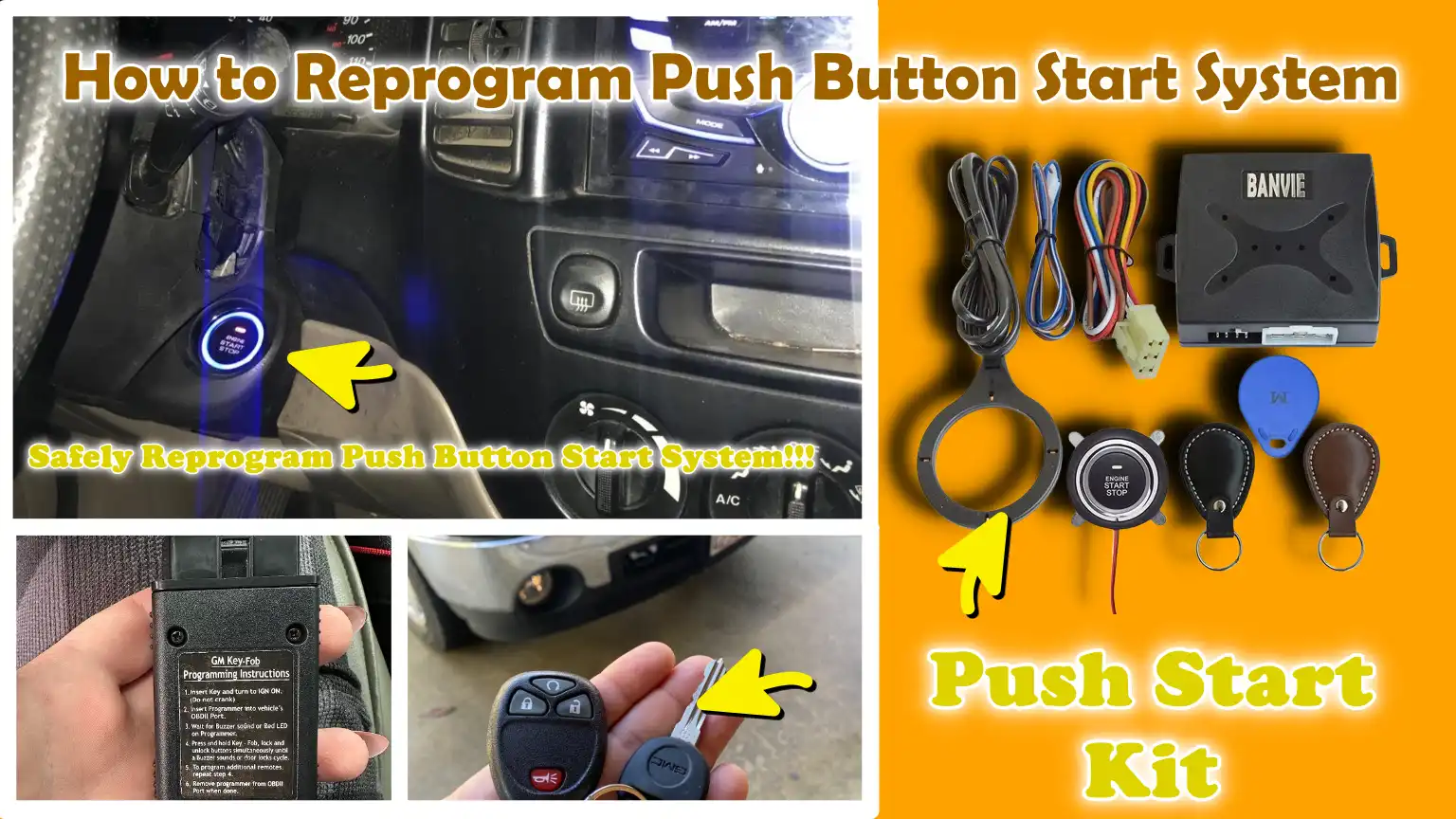
That is the reason, we have come up with this guide about How to Reprogram Push Button Start System, so that you can restore that safe starting without any guesswork.
Understand, What is a Push-Button Start System?
A push-button start system is a modern car ignition technology that utilizes an electronic starting process instead of a traditional metal key.
Rather than inserting a key into a slot and turning it, the driver simply needs to depress the brake pedal and press the start button.
Behind this simple procedure, the vehicle executes a complex series of electronic security checks, ensuring that the engine can only be started with the correct key.
This system has been widely adopted in modern vehicles as it enhances convenience, reduces mechanical wear on the ignition lock and bolsters security through encrypted communication between various electronic modules.
1. How the Start/Stop Button Works with the Immobilizer and Smart Key
When the driver presses the brake pedal and the start button, the car does not immediately start the engine.
First, the smart key fob transmits a low-frequency radio signal to the vehicle, which is picked up by antenna receivers located inside and around the car.
The system then verifies whether this signal matches the encrypted code stored within the immobilizer system.
The immobilizer is a built-in anti-theft system that prevents the engine from starting until the identity of the correct digital key is confirmed.
Once the immobilizer verifies the key’s identity, it sends an authorization signal to the Engine Control Unit (ECU), which then activates the starter system and the fuel injection process.
If any part of this verification process fails, the engine will not start, even if the battery and mechanical components are functioning perfectly.
2. Key Components Involved
Start Button Switch
The start button switch is the physical interface that the driver presses; However, unlike in older cars, this component does not function directly as a mechanical ignition switch.
Instead, it transmits an electronic signal to a control module.
This signal informs the vehicle that the driver is requesting to start the engine; however, the system will proceed only after completing a comprehensive security verification check.
Smart Key Fob
The smart key fob is a small wireless device containing a transponder chip that holds a unique, encrypted code.
When the key is located inside or in the immediate vicinity of the vehicle, the vehicle continuously detects and identifies this code.
The smart key fob is powered by a small battery; if this battery becomes weak or runs out of power, the system will be unable to properly recognize the key.
Antenna Receiver
The function of the antenna receiver is to capture the signal transmitted by the smart key fob.
It is typically installed inside the cabin, often near the door handles or the dashboard.
It relays the received signal to the vehicle’s control system, thereby enabling the system to verify the authenticity of the key.
If this receiver malfunctions or its calibration becomes compromised, the vehicle may display a “No Key Detected” message, even if the key is physically present inside the vehicle.
Body Control Module
The Body Control Module (BCM) acts as a central communication hub that manages various electronic systems within the vehicle, including the locking system, lighting and key recognition.
In a push-button start system, it plays a pivotal role in facilitating communication between the smart key, the immobilizer and the Engine Control Unit (ECU).
If the synchronization of this module is disrupted, for instance, following a battery disconnection or a software glitch, the starting system may cease to function correctly.
Immobilizer System
The immobilizer system is a security feature designed to prevent the engine from starting without proper authorization.
It operates by utilizing encrypted codes stored in both the key and the vehicle’s control system.
This system permits the engine to start only when these two codes match.
If the immobilizer fails to recognize the key, it prevents the fuel injection or starter from engaging, thereby completely disabling the vehicle, even if there are no mechanical faults present.
Brake Pedal Switch
The brake pedal switch is a small sensor that detects whether or not the driver is depressing the brake pedal.
This input serves as a critical safety prerequisite, without which the push-button start system will not authorize the engine to start.
If this switch malfunctions or transmits an erroneous signal, the vehicle will fail to recognize that the brakes are applied and the starting sequence will not proceed.
ECU Communication
The Engine Control Unit (ECU) functions as the vehicle’s primary engine computer.
Once all safety checks have been successfully completed, it receives a signal to start the engine from both the immobilizer and the Body Control Module.
Subsequently, it manages the fuel supply, ignition timing and the engine cranking process.
If communication between the ECU and other modules is interrupted, whether due to software glitches, wiring faults, or voltage fluctuations, the push-button start system may cease to function, even if all other components are operating correctly.
Understand, Why You Might Need to Reprogram Your Push-Button Start System
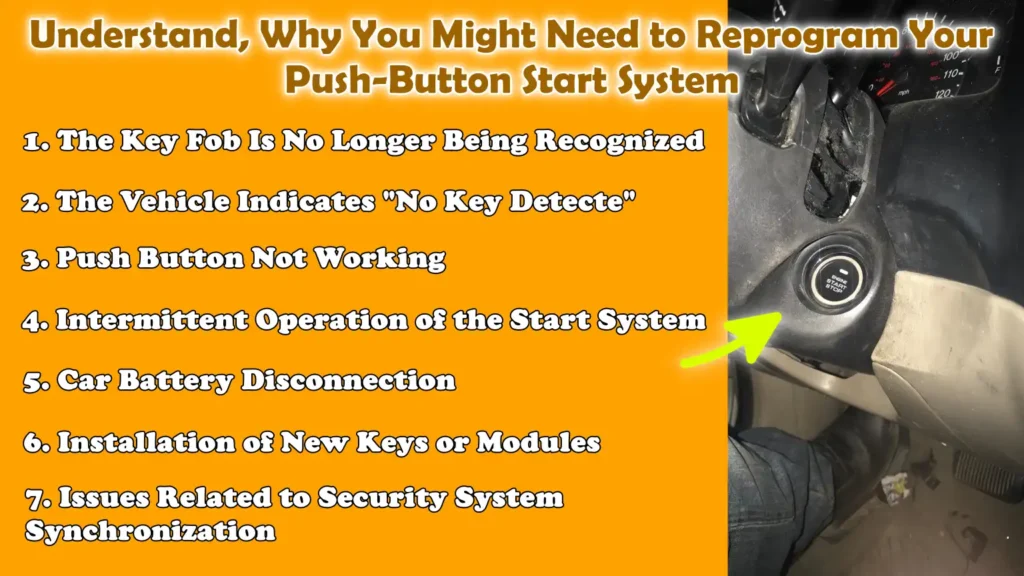
A push-button start system relies on constant digital communication between the smart key, the immobilizer system and the vehicle’s control modules.
Unlike older ignition systems, which depended on mechanical keys, modern vehicles utilize encrypted signals that must remain perfectly synchronized.
When this communication is disrupted, the vehicle may stop recognizing the key or refuse to start, even if there are no physical faults within the engine or starter system.
Reprogramming is often required to repair this broken digital connection and resynchronize all modules, thereby allowing the vehicle to safely initiate ignition once again.
1. The Key Fob Is No Longer Being Recognized
One of the most common reasons for reprogramming is when the vehicle completely stops recognizing the key fob.
This typically occurs when the key’s internal transponder signal weakens due to a failing battery or a malfunction within the internal chip.
In some instances, the vehicle may still be able to lock and unlock the doors, but it will not allow the engine to start because the immobilizer requires a robust authentication signal.
Reprogramming helps the vehicle and the key re-establish a secure “handshake” (mutual synchronization), allowing the system to verify the key’s identity once again.
2. The Vehicle Indicates “No Key Detected”
When the “No Key Detected” message appears on the dashboard, it signifies that the vehicle’s internal antenna receivers are failing to pick up a valid encrypted signal from the key fob.
This type of signal interference may be caused by low voltage in the key fob’s battery or by a temporary loss of synchronization between the smart key system and the Body Control Module.
In some vehicles, this issue may arise following a software update or a drop in voltage.
Reprogramming restores proper signal recognition, enabling the system to once again identify and authenticate the key.
3. Push Button Not Working
If nothing happens when the start button is pressed, it typically indicates a malfunction within the start authorization sequence.
The button itself is rarely the source of the problem, as it merely sends an electronic request to the control system.
Instead, the issue often stems from the immobilizer denying authorization, a failure to recognize the brake pedal signal, or the system’s inability to detect the key.
Reprogramming can reset the entire communication process, ensuring that the start request is processed correctly, from the initial input all the way through to the actual engine start.
4. Intermittent Operation of the Start System
Intermittent operation is a clear indication of unstable electronic communication within the push-to-start system.
The vehicle may start easily at times, yet fail to start at others, depending on factors such as key proximity, battery voltage, or signal strength.
This irregularity often signals a partial loss of synchronization between the key and the vehicle’s antenna network or Body Control Module.
Reprogramming helps stabilize communication by re-establishing this synchronization, thereby ensuring that the system operates reliably every time.
5. Car Battery Disconnection
Disconnecting or replacing the vehicle’s main battery is one of the most common causes of issues associated with push-button start systems.
When the power supply is interrupted, control modules may lose their stored memory or synchronization settings, these are the parameters that link the smart key system to the immobilizer.
After reconnecting the battery, the vehicle may require a “re-learn” or reprogramming procedure to restore proper communication functionality.
This is more common in vehicles equipped with advanced security systems, which reset key authentication protocols in the event of a voltage drop.
6. Installation of New Keys or Modules
Whenever a new smart key, Body Control Module, or immobilizer unit is installed, the system must be reprogrammed to recognize the new component.
Each key and module contains unique encrypted codes that must be registered within the vehicle’s security database.
Without this step, the vehicle will deem the new component “unauthorized” and disable the ignition.
Reprogramming ensures that the security identities of all components are synchronized and that they can communicate effectively with one another.
7. Issues Related to Security System Synchronization
A synchronization issue arises when the coordination of security data stored across the vehicle’s various electronic modules becomes disrupted.
This problem can be caused by software glitches, voltage fluctuations, or improper resetting following repairs.
When synchronization is interrupted, the immobilizer is unable to validate the key, even if the key is physically present in the vehicle and fully functional.
Reprogramming re-establishes synchronization among the smart key, the immobilizer and the Engine Control Unit, thereby enabling the vehicle to resume its secure start-up sequence.
Know, Common Symptoms of Push-Button Start Programming Issues
Push-button start programming issues typically manifest as clear warning signs before the system ceases to function entirely.
These symptoms arise because the vehicle is unable to correctly verify the smart key, brake input, or immobilizer authorization.
As modern ignition systems rely on encrypted electronic communication rather than mechanical contact, even a minor synchronization error can disrupt the entire starting process.
Understanding these symptoms helps determine whether the issue is related to reprogramming rather than a mechanical malfunction.
1. Dashboard Warning Light
When a key-related warning light appears on the dashboard, it typically indicates that the vehicle is having difficulty recognizing or verifying the smart key’s signal.
This light is part of the immobilizer system, which constantly checks for the presence of the correct encrypted key.
If the signal is weak, intermittent, or out of synchronization, the system immediately alerts the driver.
This warning often appears after a battery replacement, a dead key fob battery, or a module reset and it is one of the earliest indications that reprogramming may be required.
2. Engine Does Not Crank
When the engine fails to crank at all, it signals that the vehicle has not granted permission to start.
In push-button systems, the engine will only crank once the immobilizer confirms the identity of the key and the brake pedal signal has been verified.
If any part of this process fails, the ECU disables the starter motor.
This symptom often feels like a complete failure to start, even if the electrical system is still powering accessories normally.
3. The Button Changes Color, But the Engine Does Not Start
Many vehicles feature a light indicator on the push-button starter that changes color to display the status of the system.
If the button illuminates but the engine fails to start, it typically indicates that the system is stuck in an initial power mode and has not completed its safety checks.
This occurs when the vehicle receives a partial signal but is unable to complete the authentication process with the smart key or control module.
This is a strong indication of a communication failure between the electronic systems.
4. Needing to Hold the Fob Directly Against the Start Button
If the vehicle only starts when the key fob is held in very close proximity to the start button, it usually signals a weak or unstable signal emanating from the smart key.
Most systems utilize low-frequency backup detection surrounding the start button, allowing the transponder chip to be read directly in the event that standard wireless communication fails.
This behavior suggests a fault with the key’s battery, a defective antenna receiver, or an issue with the key’s registration, problems that may require reprogramming to restore normal range detection capabilities.
5. Accessory Mode Only
When the vehicle enters accessory mode but the engine fails to start fully, it indicates that while the electrical system is powering up, the immobilizer has not authorized ignition.
Accessory mode enables the operation of the radio, lights and infotainment system, but prevents the engine from cranking.
This is typically caused by a failure in key authentication, an issue with the brake signal, or an incomplete verification of the start sequence within the control module.
6. Multiple Attempts Required to Start
If you find yourself having to repeatedly press the start button to get the car running, it signals unstable communication between the smart key and the vehicle’s control system.
This inconsistency often occurs when the system partially recognizes the key but fails to maintain a stable, encrypted connection during the startup sequence.
Over time, this condition may worsen; if the synchronization issue is not resolved, it could eventually lead to a complete failure of the vehicle to start.
7. Security Lockout Message
A security lockout message appears when the immobilizer system detects repeated failed attempts to verify the key or identifies unusual communication patterns.
This serves as a protective measure designed to prevent unauthorized access.
During a lockout, the vehicle temporarily disables the starting function until the system is reset or proper key authentication is successfully restored.
This situation clearly indicates that diagnostic reprogramming or an immobilizer reset is required to restore normal vehicle operation.
Tools
| Tools | Why It Is Needed | How to Use It |
|---|---|---|
| Vehicle Owner’s Manual | This manual outlines precise reprogramming procedures tailored to your specific car model, as every manufacturer employs distinct security and reset protocols. | Before you begin, carefully read the section pertaining to key programming or the immobilizer system. Strictly adhere to the specific button sequences, timing and conditions prescribed for your vehicle. |
| Spare Key Fob | It is crucial to have a spare key on hand, as many vehicles require at least one functioning key to enter programming mode or to confirm successful pairing. | If instructed to do so, keep the spare key inside the vehicle throughout the entire process; once programming is complete, use it to verify that the system recognizes multiple keys. |
| New Battery for Key Fob | One of the most common reasons for key recognition failure is a weak battery; therefore, replacing it ensures that the signal remains strong and stable throughout the programming process. | Carefully open the key fob, replace the internal coin-cell battery with the correct type and test the key before initiating the reprogramming procedure. |
| OBD2 Scan Tool | This tool connects to the vehicle’s onboard computer system, providing access to functions related to immobilizer settings, fault codes and key registration in modern vehicles. | Plug the device into the OBD2 port located beneath the dashboard, turn on the ignition and follow the instructions provided within the software menu to access the key programming or immobilizer reset options. |
| Multimeter | A multimeter measures electrical voltage levels to ensure that both the car battery and the key system are receiving a stable power supply, a critical prerequisite for successful programming. | Set the device to DC voltage mode, check the car battery terminals and ensure that the voltage falls within the correct range before initiating the reprogramming process. |
| Battery Charger | A stable power supply is critical, as a drop in voltage during programming can disrupt communication between various modules, thereby creating a risk of system failure. | Connect a battery charger to the vehicle’s battery before beginning and keep it connected throughout the entire programming process to maintain a stable voltage level. |
| VIN-Specific Programming Instructions | These instructions are essential because, for security reasons, every vehicle utilizes a specific programming sequence linked to its Vehicle Identification Number (VIN). | Obtain the necessary instructions from the manufacturer or a repair database and strictly adhere to the step-by-step procedures that precisely match your specific VIN and model year. |
How to Ensure Safety Before Starting
Before attempting to reprogram a push-button start system, it is essential to carefully prepare the vehicle and its electrical system, as modern vehicles rely on sensitive electronic communication between numerous control modules.
Even a slight interruption in voltage, signal flow, or user input timing can result in programming failure or even trigger a security lockout.
These safety measures are designed to maintain the stability of the process, prevent system errors and ensure that the vehicle remains in a controlled and predictable state throughout the reprogramming procedure.
1. Park on Level Ground
Parking on level ground is crucial because it stabilizes the vehicle, ensuring that it does not shift from its position while you are working inside or around it.
Although push-button start systems are electronic, the transmission, braking systems and safety sensors still rely on a stable physical environment.
A level surface also facilitates consistent operation of the brake pedal, which, in many vehicles, is a prerequisite for authorizing the start or programming mode.
This minimizes the risk of the vehicle suddenly rolling or sensors providing erroneous readings during the process.
2. Engage the Parking Brake
Engaging the parking brake adds an extra layer of safety by locking the rear wheels, thereby preventing the vehicle from moving forward or backward.
Many push-start systems require an active brake signal before initiating any ignition or programming operation; therefore, engaging the parking brake ensures that the system receives confirmation that the vehicle is secured and that the starting process is being initiated intentionally.
It also prevents unnecessary strain on the transmission system, particularly in automatic vehicles, while you are performing electronic reset or key programming procedures.
3. Keep the Vehicle Battery Fully Charged
Ensuring that the vehicle’s battery is fully charged is one of the most critical prerequisites for successful reprogramming, as all control modules rely on a stable voltage supply to communicate effectively.
If the voltage drops during the programming process, the synchronization between the immobilizer, Body Control Module, or Engine Control Unit may be disrupted, potentially leading to programming failure or system malfunctions.
A weak battery can also interfere with the exchange of encrypted data between the key and the vehicle, which may permanently interrupt the pairing process for certain systems.
4. Have All Programmed Keys on Hand
It is essential to have all programmed keys available, as in many vehicles, the presence of existing keys is required to verify ownership before the system permits any changes to the programming.
To prevent unauthorized access, the system may demand authentication using a previously registered key.
If a necessary key is missing during this process, the vehicle may reject the programming mode or erase existing data associated with the keys.
Having all keys present ensures that the authentication process proceeds without interruption and that functional keys are not inadvertently locked out of the system.
5. Turn Off Accessories
Turning off all accessories such as: lights, air conditioning, infotainment systems and charging devices, helps reduce the electrical load on the vehicle.
During reprogramming, the system requires a stable power supply and uninterrupted communication between its various modules.
Excessive electrical load can cause voltage fluctuations, which may disrupt communication processes involving the immobilizer or the ECU.
Maintaining a clean electrical environment increases the likelihood of successful synchronization and reduces the risk of programming failure.
6. Confirm the Correct Procedure for Your Vehicle’s Make
It is crucial to confirm the correct procedure for your specific vehicle’s make and model, as push-button start systems are not standardized across all manufacturers.
Every brand employs distinct security protocols, timing sequences and diagnostic requirements.
Some vehicles allow for manual reprogramming via specific button sequences, while others necessitate the use of diagnostic scan tools and secure access codes.
Using an incorrect procedure can result in a security lockout or the erasure of key data; therefore, strictly adhering to the precise procedure outlined by the manufacturer ensures safe and successful reprogramming.
How to Reprogram Push Button Start System – Easy Steps
Reprogramming a push-button start system is a systematic process that re-establishes communication between the smart key, the immobilizer system and the vehicle’s control module.
Modern vehicles utilize encrypted signals and electronic verification; therefore, even a minor glitch in the data can prevent the engine from starting.
The objective of this process is to restore that lost synchronization so that the vehicle can correctly identify the key, confirm security authorization and allow for normal ignition.
Each step must be followed with extreme care, as skipping any stage or rushing through the process can lead to incomplete pairing or a system lockout.
1. First, Check the Key Fob Battery
Before initiating any reprogramming procedure, you should check the key fob’s battery, as this is the most common cause of signal failure.
A weak battery diminishes the strength of the transponder signal, causing the vehicle to misread the key or fail to detect it altogether.
Replacing a weak battery ensures that the key can transmit a stable and robust signal to the antenna receiver located inside the vehicle.
After replacing the battery, it is essential to test the key’s range by locking and unlocking the doors to verify that the signal is being transmitted correctly and consistently.
If the key’s signal remains weak at this stage, the reprogramming process is likely to fail, as the system relies on stable communication from the very beginning.
2. Perform a Basic System Reset
A basic system reset helps resolve temporary electronic glitches that may be disrupting communication between the key and the vehicle’s control module.
Turning the ignition to “Accessory Mode” activates the vehicle’s systems, without starting the engine, thereby preparing the Electronic Control Unit (ECU) for the reset process.
Disconnecting the vehicle’s battery for a brief period drains any residual electrical charge stored within the control modules, compelling them to restart and reload their system data.
Upon reconnecting the battery, the vehicle initiates a new startup sequence, during which the modules attempt to re-establish communication.
This reset can resolve minor synchronization issues caused by voltage drops or temporary software glitches.
3. Utilize the Manual Key Synchronization Process
Manual synchronization is used to pair a smart key directly with the vehicle without the need for any external equipment.
Depressing the brake pedal signals the system that a start request is being initiated, thereby activating the immobilizer verification process.
Pressing and holding the start button initiates communication between the key fob and the antenna receiver, allowing the system to detect the correct encrypted signal.
In many vehicles, a specific button sequence is required to complete the pairing process; this serves to verify ownership and prevent unauthorized individuals from operating the vehicle.
Once the correct signal is detected, the key becomes registered with the receiver and the system resumes basic communication among its various components.
4. Re-learn via Onboard Programming Mode
Entering the onboard programming mode places the vehicle in a specific state where it can add new key fobs or re-synchronize existing ones without the use of any external diagnostic tools.
Accessing this mode typically involves executing a specific sequence using the ignition or start button, which activates the immobilizer programming system.
Once in programming mode, the vehicle can recognize new or existing keys and initiate the pairing process.
The pairing or re-synchronization of the key fob ensures that its encrypted code is correctly stored within the vehicle’s memory.
Saving this pairing sequence completes the process, enabling the system to recognize the key during normal vehicle operation.
5. Reprogram Using a Diagnostic Scanner
In modern vehicles equipped with advanced security systems, the use of a diagnostic scanner is often required.
Connecting an OBD2 scanner provides direct access to the immobilizer and Body Control Module, where key registration functions are stored.
By navigating to the immobilizer menu, a technician can register a smart key by entering its unique identification code into the system’s database.
This step ensures that the vehicle officially recognizes that specific key as authorized to start the engine.
Clearing any security codes after programming resolves any stored errors or lockout conditions, allowing the system to function normally without any interruptions caused by previous failed attempts.
6. Verify the Entire Initialization Process
Following reprogramming, a comprehensive system test is essential to ensure that communication has been properly restored.
Locking and unlocking the doors helps confirm that the smart key is operating within its normal range and that wireless communication is stable.
Starting the engine multiple times ensures that the immobilizer is consistently authorizing ignition without any delays or errors.
Testing the range of the remote key confirms that the signal is strong and is being correctly recognized by all antenna receivers installed in the vehicle.
Finally, verifying that all warning lights have turned off confirms that the system has successfully completed synchronization and is once again functioning normally.
How to Reprogram Based on Specific Vehicle
The reprogramming process for push-button start systems is not uniform across all vehicles, as every manufacturer designs its own distinct security architecture, software logic and immobilizer communication system.
Although all modern vehicles utilize smart keys and encrypted signals, the specific methods for programming, resetting and synchronizing these systems can vary significantly depending on the brand and model year.
Some vehicles feature simple onboard key re-learn procedures, while others require advanced diagnostic tools and specific security access codes.
Understanding these differences is crucial, as employing an incorrect procedure can result in programming failure or a temporary system lockout.
1. Toyota Smart Key Systems
In Toyota Smart Key systems, the immobilizer and smart entry functions are highly integrated with the Body Control Module.
These systems often employ a structured key registration process, which, for newer models, may require a specific sequence of ignition cycles or the use of diagnostic tools.
Toyota vehicles typically store multiple key IDs within the system’s memory; reprogramming involves adding or re-registering these encrypted IDs to enable the vehicle to verify the owner’s identity.
If the system detects a discrepancy, it may prevent the vehicle from starting until proper synchronization is restored through the correct procedure.
2. Honda Start Button Reset
Honda’s push-button start systems often rely on a combination of smart key detection and brake pedal verification to authorize ignition.
In many Honda models, basic key synchronization can be performed using a manual sequence that detects the proximity of the smart key fob to the start button.
However, if the immobilizer loses its stored data, a scan tool may be required to reset and re-register the key.
Honda’s systems are sensitive to drops in battery voltage; therefore, even a weak car battery can interrupt the reprogramming process, potentially necessitating a full system reset.
3. Ford Intelligent Access System
Ford Intelligent Access systems utilize advanced encrypted communication between the smart key, the Body Control Module and the Engine Control Unit.
Many Ford vehicles require a specific programming mode, which is accessed either through an onboard menu or via a diagnostic scanner.
These systems often allow for the storage of only a limited number of keys and during the programming process, each key must be individually identified and confirmed.
If synchronization is lost, the system may enter a security state that prevents the engine from starting until proper re-authorization is successfully completed using the correct procedure.
4. Nissan Intelligent Key Re-learn
Nissan Intelligent Key systems are designed with a strong emphasis on immobilizer security; consequently, when reprogramming is required, they often demand precise “re-learn” procedures.
Some Nissan models feature manual key registration capabilities, while others require a professional scan tool to access the immobilizer control unit.
During the re-learn process, the system verifies the unique ID of the key fob and stores it in its memory to authorize engine starting.
If this process is interrupted or performed incorrectly, the vehicle may fail to recognize even those keys that were previously functional, until the system is properly reset.
5. Hyundai Smart Entry Programming
The Hyundai Smart Entry system incorporates both keyless access features and electronic immobilizer verification; in many models, a diagnostic tool is required to perform full key programming.
In some older models, it may be possible to perform onboard programming using a specific sequence of ignition and button operations; however, newer vehicles primarily rely on secure, ECU-based registration.
The system verifies encrypted key data and stores it within the vehicle’s control module.
If this data falls out of synchronization, the vehicle may prevent ignition until the correct programming procedure has been successfully completed.
6. Why Procedures Vary by Manufacturer and Model Year
Reprogramming methods vary because every manufacturer employs distinct security protocols, software generations and hardware configurations across different models and model years.
With the advancement of vehicle security technology, newer cars feature capabilities such as robust encryption, rolling security codes and enhanced immobilizer integration involving multiple control units.
Consequently, while a simple manual reset may be feasible for older vehicles, newer models necessitate the use of professional diagnostic tools and secure access authorization.
Variations in regional specifications, software updates and anti-theft regulations also influence the reprogramming process; therefore, it is essential to adhere to the precise procedures designed for each specific vehicle.
What to Do, When Reprogramming Does Not Work
In some cases, reprogramming the push-button start system does not resolve the issue, as the problem is not related to lost synchronization but rather to hardware malfunctions or deeper electronic glitches.
Modern push-start systems rely on several components working in tandem in real-time, including the key fob transmitter, antenna module, Body Control Module, immobilizer system and Engine Control Unit.
If any of these components become physically damaged or electronically defective, reprogramming alone will not restore proper functionality.
In such situations, the problem must be diagnosed at the component level rather than at the programming level.
1. Faulty Key Fob Transmitter
A faulty key fob transmitter indicates that the internal electronic chip embedded within the key is no longer transmitting a valid or stable signal.
This can occur due to internal circuit malfunctions, exposure to water, physical impact, or prolonged use with a completely depleted battery.
When the transmitter fails, the vehicle becomes unable to receive the correct encrypted code, even if reprogramming has been attempted.
In this scenario, the only viable solution is usually to replace the key fob and subsequently program the new unit to the vehicle.
2. Damaged Antenna Module
The antenna module is responsible for receiving signals from the smart key and relaying them to the vehicle’s control system for verification.
If this module becomes damaged or disconnected, the car cannot properly detect the key, even if the key itself is fully functional.
Damage may result from exposure to moisture, wiring issues, or internal electronic failure.
When the antenna module is inactive, attempts at reprogramming will prove unsuccessful, as the vehicle is fundamentally unable to physically receive the key’s signal.
3. Faulty Push-Start Button
A faulty push-start button can interrupt the ignition request signal that initiates the starting sequence.
Although the button itself does not directly start the engine, it sends a critical electronic command to the control module.
If the internal switch contacts become worn or damaged, the system may fail to correctly register the driver’s input.
This can create the impression that there is a programming issue; however, in reality, the start request signal never actually reaches the immobilizer or ECU for processing.
4. Immobilizer Control Failure
An immobilizer control failure occurs when the security system itself is not functioning properly.
The immobilizer is responsible for verifying the encrypted code transmitted by the smart key and either authorizing or preventing the engine from starting.
If this system fails due to an internal glitch, malfunction, or hardware damage, it may reject all keys, regardless of how many attempts have been made to program them.
Restoring normal functionality following such a failure often requires specialized diagnostic tools or the replacement of the entire module.
5. BCM Communication Issues
The Body Control Module (BCM) manages communication between various vehicle systems, including door locks, key recognition and start authorization.
If a communication fault develops within the BCM, it may be unable to transmit or receive data from the immobilizer or ECU.
This can lead to issues such as intermittent starting difficulties, occasional failure to recognize the key, or a complete loss of push-button functionality.
As the BCM acts as a central hub, any internal malfunction within it can prevent the reprogramming process from being successfully completed.
6. ECU Software Malfunction
An ECU software malfunction occurs when the Engine Control Unit contains corrupt data or experiences a software glitch, thereby disrupting normal communication with other vehicle systems.
The ECU is responsible for granting final authorization to start the engine after receiving signals from the immobilizer and the BCM.
If its software becomes unstable or corrupted, it may reject valid start commands or fail to respond to reprogramming attempts.
In such cases, the ECU may require reflashing, a software update, or professional reprogramming, utilizing manufacturer-specific tools, to restore proper functionality.
Read More:
Know, Common Mistakes While Reprogramming Push Button Start System
Reprogramming a push-button start system requires stable power, precise timing and perfect synchronization between the smart key, the immobilizer and the vehicle’s control modules.
Because these systems rely on precise electronic signals, even a minor error can cause the programming process to fail or trigger a security lockout.
Many issues that appear to be system malfunctions are, in reality, caused by minor user errors during the setup process.
Avoiding these mistakes increases the likelihood of successful reprogramming and eliminates the need to replace unnecessary components.
Plus, there’s NHTSA that shows that modern push button start systems relies on a wireless key fob that must be electronically verified before the engine can start, so that means that the ignition process is no longer mechanical but fully digital, that involves the authentication between the key and the vehicle’s security system, also different vehicles uses different electronic confirmation methods, that’s why reprogramming actually produces the widely across brands, so it is really important to have correct synchronization between the smart key and immobilizer system when issues occur after the battery changes or system resets as well.[¹]
1. Using a Weak Battery During Programming
Using a weak car battery during programming is one of the most common and critical errors.
Push-button start systems rely on stable voltage to power all control modules and ensure that they operate in unison.
If the battery voltage drops during this process, the synchronization between the immobilizer, the Body Control Module and the ECU can be disrupted, potentially leaving the programming incomplete or corrupting the key data.
Even if the system appears to function afterward, underlying instability may persist, leading to future difficulties in starting the vehicle.
2. Incorrect Button Press Sequence
An incorrect sequence of button presses can prevent the vehicle from entering programming mode or stop the key from synchronizing with the system.
Every manufacturer specifies a specific sequence and timing for pressing the brake pedal, the start button, or the buttons located on the remote key.
If this sequence is not followed precisely, the system may ignore the request or exit programming mode without saving any changes.
Therefore, strictly adhering to the correct procedure for the specific vehicle model is essential for a successful outcome.
3. Ignoring Stored Trouble Codes
Ignoring stored trouble codes is a major error, as these codes provide vital information regarding why the system is failing.
Whenever a synchronization issue arises, modern vehicles store fault data within the immobilizer, ECU and Body Control Module.
If these codes are not checked or cleared prior to reprogramming, the system may continue to operate in a compromised state and could reject attempts to program a new key.
Reading diagnostic codes helps identify whether the underlying issue is electronic, mechanical, or security-related.
4. Programming the Wrong Key
Attempting to program the wrong key can cause the vehicle to completely reject the new, or even the existing, key fob.
Each key possesses a unique encrypted ID that must match the security data stored within the vehicle.
If an incorrect or mismatched key is used, the system may overwrite the correct data or temporarily lock out all keys.
This error frequently occurs when multiple keys that appear identical are present; therefore, it is crucial to correctly identify the appropriate key before initiating the programming process.
5. Interrupting the Re-learn Process
Interrupting the re-learn process can leave the synchronization between the smart key and the vehicle’s control module incomplete.
During programming, the system undergoes a multi-stage process of verification and data exchange; prematurely halting this process can leave the system in an unstable state.
This may result in the key recognition process remaining incomplete, or the vehicle failing to start altogether.
It is essential to allow the entire process to complete without switching off the ignition or disconnecting the power supply.
6. Disconnecting the Battery Too Soon
Disconnecting the battery prematurely, whether during programming or immediately thereafter, as it can erase newly saved data or disrupt communication between the vehicle’s modules.
Modern vehicles often require a stabilization period following programming to allow the immobilizer, ECU and Body Control Module to save and confirm the new settings.
If power is cut off too soon, the system may revert to its previous state or enter a fault mode, potentially necessitating a repetition of the entire process.
Conclusion – How to Reprogram Push Button Start System
Basically, with most of the push button start problems, there’s hidden communication between the electronic system that is the issue rather than the engine damage.
When functioning correctly, this system enables the engine to start quickly and securely without the need for a physical key.
However, if even a single component within this network loses synchronization, the vehicle may refuse to start, display a key-related warning, or remain stuck in accessory mode.
In many real-world scenarios, the issue is not a mechanical failure but rather a disruption in digital communication, a problem that can often be resolved through proper reprogramming.
The critical takeaway here is that successful reprogramming requires precise diagnostics, stable voltage and strict adherence to the specific procedures prescribed for your vehicle.
Minor issues such as: a weak key fob battery or a temporary system glitch, are often easily resolved, whereas more significant problems such as: a faulty module or a communication breakdown, may necessitate the use of professional diagnostic tools.
Identifying symptoms early on helps prevent the unnecessary replacement of parts and significantly reduces repair costs.
Now, that’s all about this guide and you can comment down below your thoughts and your queries.
Frequently Asked Questions
FAQ 1: What is a push-button start system and how does it work?
Answer: A push-button start system is a modern car ignition system that utilizes an electronic smart key and a start button instead of a traditional physical key. When you press the brake pedal and push the start button, the car does not start immediately. First, it checks for a signal from a valid smart key; subsequently, the immobilizer system verifies a secure, encrypted code. If this code matches the code pre-stored within the car, the Engine Control Unit (ECU) authorizes the engine to start. If the system fails to detect the correct key or if communication fails, the car will not start, even if all other components are functioning correctly.
FAQ 2: Why isn’t my push-button start working despite having a good battery?
Answer: Even if the car’s battery is in good condition, the push-button start system may still fail, as the root cause of the problem is often electronic rather than mechanical. The most common reason for this is that the smart key is not being detected, or the immobilizer system is not synchronizing properly. This can occur due to a low battery in the key fob, signal interference, or a communication fault between the control modules. In some cases, the system may need to be reprogrammed to restore proper key recognition and enable the starting function.
FAQ 3: Why is my car displaying a “No Key Detected” message?
Answer: The “No Key Detected” message appears when the car fails to receive a valid signal from the smart key. This typically happens when the key fob’s battery is low, the key is located too far away from the car, or the antenna receiver is unable to properly pick up the signal. This can also occur if the synchronization of the smart key system is disrupted following a battery disconnection or an electrical system reset. In many cases, replacing the key fob’s battery or reprogramming the system can resolve this issue.
FAQ 4: Can a weak key fob battery prevent the car from starting?
Answer: Yes, a weak key fob battery can prevent the car from starting because the smart key is unable to transmit a sufficiently strong signal to the vehicle. The car requires a stable, encrypted signal to verify that the correct key is present. If the battery is too weak, the vehicle may fail to detect the key altogether, or it may only detect it when the key is held in very close proximity to the start button. Replacing the battery is typically the first and simplest step to resolve this issue.
FAQ 5: Do I always need to reprogram the push-button start system after replacing the battery?
Answer: Not always, although it may be necessary in some vehicles. Many modern vehicles retain their memory while the battery is being replaced, so no reprogramming is required. However, in some vehicles, disconnecting the battery can reset the communication link between the smart key, the immobilizer and the control modules. When this occurs, a ‘re-learn’ or reprogramming procedure may be required to re-establish proper synchronization within the system and allow the engine to start normally again.
FAQ 6: Why does my push-button start work sometimes, but not at other times?
Answer: Intermittent issues with the push-button start system typically indicate unstable communication between the smart key and the vehicle’s systems. The root cause of this issue could be a weak key fob battery, a faulty antenna receiver, or a control module that is in the early stages of failure. It may also occur due to signal interference or voltage fluctuations within the vehicle’s electrical system. Over time, this problem can worsen; therefore, it is crucial to have it diagnosed at an early stage, before it leads to a complete failure of the vehicle to start.
FAQ 7: Can I reprogram the push-button start system myself?
Answer: In some vehicles, basic reprogramming or key synchronization can be performed manually by pressing the button and executing specific ignition steps in a particular sequence. However, in many modern vehicles, completing this process requires a diagnostic scan tool and security access. The complexity of this task depends on the vehicle’s make, model and year. If the system utilizes advanced encryption, it is generally safer and more reliable to have the reprogramming performed by a professional.
References:
[1] Keyless Ignition Systems
https://www.nhtsa.gov/driver-assistance-technologies/keyless-ignition-systems
Hello Folks, Dean Shali here to help you out to solve the problems with your lovely vehicle, as i have lots of experience and knowledge about automotive industry as i woks directly with the customers and repair vehicles and i love to help the people to keep their cars safe and running smoothly.