
Written By: Dean Shali
Fact Checked By: Sabré Cook
Reviewed By: Tamara Warren
Yes, it is true that: a push start can fail even when your car batter works completely fine, as starting the vehicle actually depends on lot of connected electronic systems and they should all works together at the same moment to make that “STARTING” happen.
So, despite of that simple push once that damn button and your engine comes to life, but there’s lot of things behind that small button happens, as there’s literally complex chain of systems works together in seconds.
Basically, this smart key sends the correct encrypted signal, then the vehicle battery must supply the stable voltage, then there’s brake switch that must confirm that pedal input, then there’s starter relay that has to engage properly and there’s engine control module that must allow the ignition in proper way.
And, even if one part fails, then the car may refuse to start at all even when everything seems completely normal from the driver’s seat.
There are lot of causes of having no-reaction while pressing that damn button such as: a weak key fob battery, low car battery voltage, there could have damaged brake pedal switch, blown fuse, faulty start button or immobilizer issue as well that creates that same thing.
That’s why in this guide you’ll learn How to Fix Push Start Not Working, so that you can diagnose it and identify the exact cause and then go for fixes.
Understand, How the Push-Button Start System Works
The push-button start system is an electronic starting setup that utilizes a smart control system instead of a traditional metal ignition key.
Rather than turning a key, the driver simply presses a button; however, this seemingly simple action initiates a complex process of electronic checks within the vehicle.
This system allows the engine to start only after it has verified that several safety and security conditions have been properly met.
This includes confirming the driver’s identity, checking the vehicle’s readiness and ensuring that the electrical system possesses sufficient power to crank the engine.
1. A Brief Explanation of Key Fob Communication
The key fob is the primary and most critical component of this system.
It contains a small transponder chip that continuously emits a low-power, encrypted radio signal.
When you enter the vehicle, internal antennas detect this signal and compare it against the security code stored within the vehicle’s immobilizer system.
If the codes match, the vehicle recognizes that an authorized key is present.
If the signal is weak, interrupted, or the fob’s battery is low, the vehicle may fail to detect the key, often resulting in a “Key Not Detected” message or preventing the vehicle from starting altogether.
2. The Role of the Brake Pedal Switch, Battery, Immobilizer and Starter Circuit
In most push-start vehicles, the brake pedal switch serves as a crucial safety mechanism.
The system will not activate the starter until it has verified that the brake pedal has been fully depressed; this mitigates the risk of the engine starting unintentionally.
Additionally, the vehicle’s battery supplies the necessary electrical power to all control modules, sensors and the starter motor relay.
If the battery voltage is low, the system may partially activate, but it will be unable to complete the full engine-starting process.
The immobilizer system acts as a layer of anti-theft security, preventing the engine from starting until it receives a valid, encrypted signal from the key fob.
Even if the key successfully activates the dashboard, the immobilizer can still prevent the engine from turning over if it detects a malfunction or a communication error.
Once all conditions are met, the starter circuit activates a relay; this relay sends power to the starter motor, which physically cranks the engine to start it.
3. How Do Modern Starting Systems Differ From Traditional Ignition Keys?
Traditional ignition systems utilize a mechanical key that connects directly to the ignition switch and physically rotates electrical contacts to start the engine.
In contrast, modern push-button systems are entirely electronic and rely on multiple control modules that communicate with one another in real-time.
This makes them more secure, as they depend on encrypted signals rather than a simple metal key.
However, this also means there is a higher potential for malfunctions involving sensors, wiring, software logic and battery-dependent components.
While traditional systems often fail due to mechanical wear and tear, push-button systems can fail due to electrical, communication, or programming-related issues; this makes diagnosing faults more difficult, although, when performed correctly, it also yields more precise results.
Know, Common Signs Shows That Your Push-Start System Is Not Functioning Properly
When a push-button start system begins to fail, it typically does not stop working abruptly.
Instead, it exhibits specific warning signs that point to particular components within the starting system.
These signs are crucial because they help pinpoint the root cause of the problem, whether it lies with the key fob, the vehicle’s battery, the brake switch, the immobilizer system, or the starter circuit.
Understanding these early symptoms allows you to avoid unnecessary repairs and quickly identify and resolve the actual source of the issue.
1. Nothing Happens When the Start Button Is Pressed
One of the clearest indications is a complete lack of response when the start button is pressed.
There is no clicking sound, no activity on the dashboard and the engine fails to start.
This typically signals an issue with the vehicle’s battery, a faulty start button, a blown fuse, or a communication failure between the key fob and the car’s control module.
In many cases, the system simply fails to receive the correct signal to initiate ignition, resulting in no action occurring when the button is pressed.
2. Dashboard Lights Illuminate, But the Engine Does Not Start
Another common symptom is that while the dashboard and electronics power up normally, the engine still fails to start.
This indicates that the vehicle is receiving electrical power, but the starting process is stalling at a subsequent stage.
The problem could stem from a faulty brake pedal switch, a weak battery that fails under load, a defective starter relay, or an interruption caused by the immobilizer security system.
The system may provide accessory power but still prevent the engine from cranking.
3. “Key Not Detected” Warning
The “Key Not Detected” message is a definitive indication that the vehicle is unable to communicate properly with the key fob.
This can occur if the key fob’s battery is low, if an obstruction is interfering with the signal, or if the transponder chip inside the key has malfunctioned.
It may also be caused by interference from other electronic devices or by issues within the vehicle’s antenna system.
When this warning appears, the vehicle typically refuses to start completely as a safety precaution.
4. Multiple Presses Required to Start
If the engine only starts after pressing the start button multiple times, it is often a sign that a component within the system is failing.
This could be due to poor contact within the start button itself, a weak signal from the key fob, or voltage instability from the vehicle’s battery.
Over time, electrical connections or sensors can become unstable, causing the system to occasionally fail to recognize a valid start request.
This often serves as an early warning sign of an impending malfunction.
5. Intermittent Starting Issues
Intermittent starting issues can be particularly frustrating, as the vehicle may start normally at times, yet fail to start at others.
This inconsistency typically points to an unstable electrical or communication-related problem.
Common causes include a weak battery, loose wiring, a failing relay, or a sensor that malfunctions only under specific conditions.
Temperature fluctuations and vibrations can also affect these components, making the problem even more difficult to diagnose.
6. Engine Starts Only When Key Fob Is Moved
In some instances, the engine will only start when the key fob is brought into close proximity with the start button or placed in a specific location inside the vehicle.
This typically indicates that the key fob’s signal is weak or that the vehicle’s antenna is unable to pick it up properly.
This may be caused by a low key fob battery, a malfunction in the fob’s internal components, or reduced sensitivity in the vehicle’s receiver system.
It serves as a clear indication that the communication link between the key fob and the vehicle is unstable and requires attention.
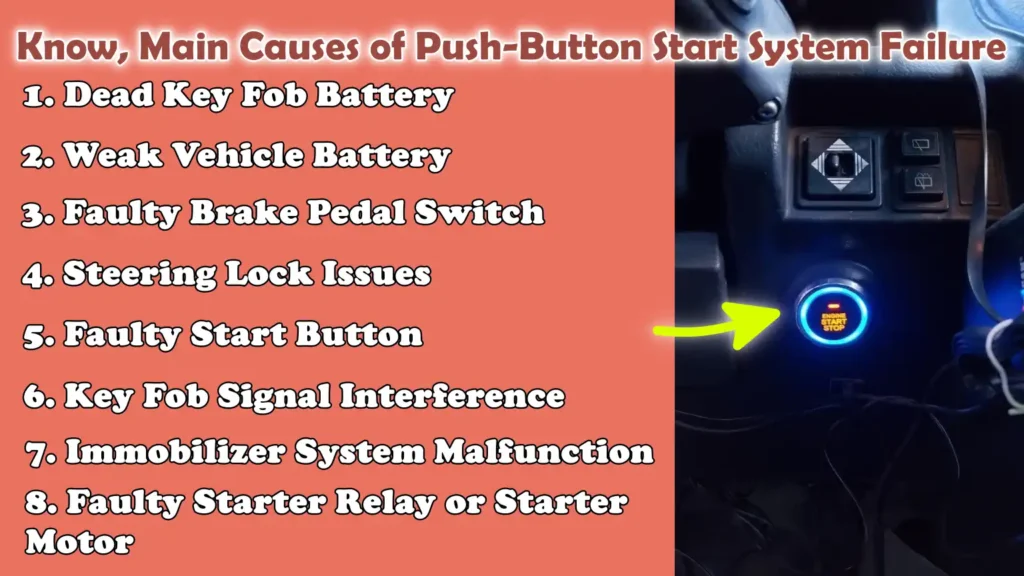
Know, Main Causes of Push-Button Start System Failure
A push-button start system relies on numerous electronic and mechanical components working together in a precise sequence.
If even a single one of these components malfunctions, the entire starting process can come to a halt.
Because these systems are interconnected, the symptoms of various internal issues often appear identical such as: the engine failing to start, receiving a “Key Not Detected” warning, or the start button failing to function at all.
Understanding each primary cause helps you accurately diagnose the problem, rather than relying on guesswork or blindly replacing parts.
1. Dead Key Fob Battery
A dead or weak key fob battery is one of the most common reasons why a push-button start system fails to operate.
The key fob transmits a low-power, encrypted signal to the vehicle; if the battery inside the fob is weak, the signal becomes too faint for the vehicle to detect.
This leads to issues such as delayed response, “Key Not Detected” warnings, or the vehicle failing to start altogether.
In many cases, the vehicle may still unlock remotely but refuse to start, as the starting process requires a stronger and more stable signal than simply unlocking the doors.
2. Weak Vehicle Battery
The vehicle’s battery plays a crucial role in powering the entire push-button start system.
If the battery is weak, it may possess sufficient power to operate the lights and electronics, but fail to deliver the necessary voltage for the ECU, fuel system and starter motor to function in unison.
Push-button start systems are highly sensitive to voltage drops; consequently, even a slightly discharged battery can trigger issues such as the engine failing to start or starting intermittently.
This issue is particularly prevalent in cold weather or after the vehicle has been left parked for an extended period.
3. Faulty Brake Pedal Switch
The brake pedal switch is a safety component that signals to the vehicle that you are depressing the brake pedal before starting the engine.
If this switch malfunctions or becomes dislodged, the system is unable to detect that the brakes are engaged.
Consequently, the push-to-start button will not activate the starter motor, even if all other systems are functioning correctly.
This often leads to confusion, as the dashboard lights may illuminate normally; however, due to the absence of the signal indicating that the brake has been depressed, the engine will not crank.
4. Steering Lock Issues
Modern vehicles are often equipped with an electronic steering lock system, designed to prevent the steering wheel from moving when the vehicle is turned off.
If this system develops a fault, it can prevent the vehicle from fully entering “start” mode.
In such cases, the vehicle may remain stuck in “accessory mode” and refuse to start.
This issue is typically caused by a faulty steering lock motor, a communication error, or a mechanical jam within the steering column assembly.
5. Faulty Start Button
Due to constant use, the start button itself may wear out over time.
Inside the button are small electrical contacts that register your input when the button is pressed.
If these contacts become worn, dirty, or damaged by moisture, the system will fail to receive the start signal.
This can result in erratic system behavior such as: requiring multiple presses to activate, or failing to respond at all.
In some instances, the button may only work when pressed at a specific angle; this indicates a malfunction within the internal contacts.
6. Key Fob Signal Interference
Key fob systems operate using radio-frequency communication, which can be susceptible to external interference.
In congested environments such as: parking garages, devices like mobile phones, wireless chargers, or other electronic systems can disrupt signal transmission.
When such interference occurs, the vehicle may have difficulty recognizing the key, even if the key fob’s battery is in good condition.
This can lead to intermittent starting issues or temporary “Key Not Detected” warnings, which typically disappear once the source of the interference is removed.
7. Immobilizer System Malfunction
The immobilizer system is a built-in security feature designed to prevent the engine from starting without proper authorization.
It functions by matching an encrypted code transmitted by the key fob against pre-existing security data stored within the vehicle.
If a communication error, software glitch, or data corruption occurs, the immobilizer can block the starting process, even if the correct key is being used.
This often results in the vehicle failing to start at all and security warning lights may illuminate on the dashboard.
8. Faulty Starter Relay or Starter Motor
The starter relay and starter motor are responsible for physically rotating the engine.
If the relay malfunctions, power fails to reach the starter motor; consequently, the engine does not crank even when an attempt is made to start the system.
A failing starter motor often emits a distinct “click” sound, yet it remains unable to start the engine.
This typically marks the final stage of the starting process; therefore, if a fault occurs at this juncture, starting the vehicle becomes completely impossible, even if all other systems are functioning correctly.
How to Ensure Safety Before Solving This Issue
Before beginning to diagnose a push-button start issue, it is essential to observe basic safety precautions, as modern vehicles contain sensitive electronic systems and mechanical components that may react unpredictably during testing.
A cautious and systematic approach not only prevents accidents but also safeguards the vehicle’s electrical system from damage.
Many starting problems involve the transmission, ignition circuits and battery systems; therefore, minor errors made during troubleshooting can lead to major complications or even result in the vehicle operating unsafely.
1. Park on Level Ground
Before commencing work on any starting issue, always park the vehicle on a level and stable surface.
A level surface ensures that the car does not suddenly roll away if the transmission is not fully engaged or if the electronic parking system behaves unexpectedly.
This is particularly crucial for vehicles equipped with push-button start systems, as they may cycle through various electronic modes during testing and stability minimizes the risk of unintended movement.
2. Engage the Parking Brake
The parking brake must always be fully engaged before troubleshooting begins.
This adds an extra layer of safety against vehicle movement, specially if the transmission system or brake sensors are being tested.
As push-start systems often rely on brake input to initiate starting, engaging the parking brake ensures that the vehicle remains secure, even if electrical components fail to function correctly during diagnosis.
3. Ensure the Transmission is in ‘Park’ or ‘Neutral’
For automatic vehicles, the transmission must be in ‘Park’; for manual vehicles, it must be in ‘Neutral’ prior to any testing or inspection.
The push-button start system is designed to prevent the engine from cranking until it detects the correct gear position.
If the gear position sensor is faulty or providing an incorrect reading, the vehicle may behave unpredictably.
Confirming the correct gear position helps eliminate false starting issues and ensures that the system is in a safe state before troubleshooting begins.
4. Keep the Key Fob Inside the Vehicle
During diagnosis, the key fob must remain inside the vehicle, as the push-start system relies on constant communication between the fob and the car’s receiver.
If the fob is outside or too far away, the system may display a “Key Not Detected” message, which can hinder accurate testing.
Keeping the key inside ensures that you are diagnosing actual mechanical or electrical issues within the vehicle, rather than signal range problems.
5. Disconnect the Battery Only When Necessary
The vehicle’s battery should be disconnected only when absolutely necessary, as it powers critical electronic control units such as the Engine Control Module and the immobilizer system.
Disconnecting it prematurely or unnecessarily can reset system memory, trigger warning lights, or create additional complications during the troubleshooting process.
When disconnecting the battery becomes necessary, ideally only after the root cause of the problem has been identified, it should always be done with caution to prevent any further electrical issues.
Tools
| Tools | Why It Is Needed | How to Use It |
|---|---|---|
| Digital Multimeter | This is used to measure the electrical voltage in the car’s battery and to verify whether the power levels are sufficiently strong for the push-start system to function correctly. | Set the multimeter to DC voltage, place the red probe on the battery’s positive terminal and the black probe on the negative terminal; then, read the voltage to assess the battery’s condition and identify any issues related to low power. |
| OBD2 Scanner | When the push-start system fails to operate due to a malfunction in the sensors, immobilizer, or communication system, this tool helps retrieve error codes from the car’s onboard computer system. | Connect the scanner to the OBD2 port located under the dashboard, turn on the ignition (or press the start button to enter accessory mode) and then read and record any fault codes displayed on the screen. |
| Spare Key Fob Battery | This is used to quickly identify and resolve issues related to weak or completely depleted key fob signals, one of the most common reasons why a push-start system may stop working. | Carefully open the key fob, replace the old battery with a new one of the same type and then press the start button again to verify whether the system is functioning normally. |
| Vehicle Owner’s Manual | This provides precise instructions tailored to your specific car model, including fuse locations, emergency starting procedures and methods for resetting the system. | To correctly identify components and follow the troubleshooting methods recommended by the manufacturer, refer to the section of the manual pertaining to the starting system, immobilizer, or electrical layout. |
| Fuse Puller | This tool is used to safely remove and inspect fuses, without damaging the fuse box or surrounding wiring, particularly when troubleshooting issues related to the starting system’s fuses. | Locate the fuse box; using a fuse puller, remove any fuses you suspect may be faulty. Visually inspect them for any broken metal strips and if necessary, replace them with fuses of the correct rating. |
| Basic Hand Tools | This category includes tools such as screwdrivers, pliers and small wrenches, which are used to access components like battery terminals, start button panels, or relay boxes. | Use the appropriately sized tool to carefully remove covers or connectors; ensure that no wires or clips are damaged during the inspection or repair process. |
| Battery Charger or Jump Starter | This is used to restore or boost a weak car battery, which is one of the most common reasons for a push-start system failing to operate. | Properly connect a battery charger or jump starter to the battery terminals, allow it to charge or provide a jump start and once the voltage has stabilized, attempt to start the vehicle. |
How to Fix Push Start Not Working – Great Methods
To resolve issues with a push-button start system, it is essential to adopt a careful, step-by-step approach, as the system relies on the simultaneous operation of several interconnected components.
If you inspect components in the wrong order, you may fail to identify the root cause of the problem or end up replacing parts that are still in good working condition.
The best strategy is to begin by checking for the simplest and most common causes first and then proceed to more in-depth electrical and mechanical diagnostics.
This helps you quickly pinpoint the actual source of the issue and avoid unnecessary repair expenses.
1. Check the Car Battery Voltage
The first and most critical step is to inspect the car battery, as low voltage is the most common culprit behind a malfunctioning push-to-start system.
A digital multimeter should be used to measure the battery’s voltage.
With the engine turned off, a healthy battery typically registers a voltage between 12.4 and 12.7 volts.
If the reading drops to 12 volts or lower, the battery may lack the necessary power to properly engage the starter system.
In many cases, simply recharging the battery or jump-starting the vehicle is sufficient to restore system functionality, particularly if the battery has been drained due to lights being left on or the vehicle remaining unused for an extended period.
2. Replace the Key Fob Battery
If the car battery is in good condition, the next step is to check the key fob’s battery, as a weak signal can prevent the vehicle from detecting the fob.
Common symptoms of this issue include a “Key Not Detected” warning, a delayed response when pressing the start button, or the need to press the button multiple times to engage the starter.
Replacing a key fob battery is a simple task; typically, it involves opening the fob’s casing, removing the old coin-cell battery and inserting a new one with the correct polarity.
After replacing the battery, you should immediately test the start function to confirm the signal strength.
3. Attempt to Start the Vehicle by Holding the Fob Against the Button
Many vehicles feature an emergency backup system designed to recognize the key fob even when its battery is weak.
By holding the fob directly against the start button, or placing it near a designated spot, a passive chip embedded within the vehicle can read it.
This works because the system utilizes short-range communication, which does not always require a battery-powered signal.
If the engine starts using this method, it confirms that the issue lies with the fob’s battery or a weak signal.
4. Press the Brake Firmly
The push-start system will not engage until it detects that the brake pedal has been fully depressed.
If the pressure is too light or inconsistent, the brake switch may fail to send the correct signal to the vehicle’s computer.
Consequently, the system may completely ignore the request to start.
Pressing the brake firmly ensures that the switch is fully activated, thereby eliminating starting issues caused by improper pedal engagement.
5. Check the Relevant Fuses
Fuses protect the electrical circuits that control the push-start system, including the starter relay and ignition module.
If a fuse blows, the system may cease to function entirely.
The fuse box typically contains fuses specifically labeled for the ignition or starting system.
A fuse puller can be used to remove and inspect each fuse; typically, a broken metal strip inside the fuse indicates a malfunction.
If a blown fuse is replaced with one of the correct rating, and provided there are no deeper underlying electrical issues, the system often resumes proper operation immediately.
6. Check the Brake Light Switch
The brake light switch is a simple yet critical component, as it verifies whether or not the brake pedal has been depressed.
A simple test involves checking to see if the brake lights illuminate when the pedal is pressed.
If the lights do not turn on, the switch may be faulty or may have become dislodged.
In many cases, replacing this switch allows the vehicle to start normally again, as the system finally receives the necessary brake signal required to engage the engine starter.
7. Scan for Trouble Codes
Using an OBD2 scanner helps identify hidden electronic or communication-related issues within the vehicle.
When connected to the diagnostic port, the scanner reads error codes stored in the vehicle’s computer system.
These codes can point to issues such as immobilizer malfunctions, faulty sensors, or voltage irregularities.
Some codes relate to electrical problems, while others indicate a lockout imposed by the security system.
This step is crucial, as it moves the troubleshooting process beyond mere guesswork to pinpoint the exact system responsible for the malfunction.
8. Check the Starter Relay
The starter relay controls the flow of electricity to the starter motor.
If the relay is faulty, the engine may fail to start, even if all other systems are functioning correctly.
A common symptom of a bad relay is a distinct “clicking” sound, while the engine itself fails to turn over.
In some cases, you can diagnose a faulty relay by swapping it with an identical relay from another system within the vehicle.
If the problem shifts to the other system or is resolved completely, it is likely that the relay itself is the source of the issue and needs to be replaced.
9. Check the Start Button
Due to repeated use, the start button can also wear out over time.
The button contains small internal electrical contacts that send a start signal when pressed.
If these contacts become dirty, worn, or damaged, the signal may fail to reach the control module properly.
This can result in intermittent system operation, for instance, the button may require multiple presses to work, or it may stop functioning entirely.
In some cases, checking for electrical continuity within the button can help determine whether it is still functioning correctly.
10. Reset the System
If no hardware faults are detected, resetting the system can sometimes resolve electronic glitches.
This is often accomplished by temporarily disconnecting the vehicle’s battery, which forces the control modules to reboot.
When power is restored, the ECU restarts and clears any temporary malfunctions.
In some vehicles, a “re-learn” procedure may also be required to ensure that the system properly re-recognizes the key fob and sensors.
This step can resolve software-related issues that are preventing the push-start system from functioning correctly.
Immediate Methods to Start Your Car When Push-Start Fails
When the push-button start system fails completely, there are still several emergency methods you can use to safely start your vehicle.
These methods are designed for situations where the key fob signal is weak, the car battery is low, or a minor glitch has occurred within the electronic system.
Most modern cars come equipped with built-in backup systems, as manufacturers anticipate that electronic malfunctions may occasionally occur.
Knowing these emergency methods can save you from getting stranded on the road and often allows you to restart your vehicle without the need for immediate repairs.
1. Using the Emergency Key Slot
Many vehicles equipped with a push-start system feature a hidden emergency key slot or backup detection area located inside the cabin.
This slot helps the vehicle recognize the key fob, even if the fob’s internal battery has completely died.
In most systems, the car utilizes a “passive chip” embedded within the key, which requires no electrical power to transmit its identification data.
When the key is placed inside this slot, or positioned in close proximity to it, the vehicle recognizes it and authorizes the engine to start.
This method proves invaluable when the key fob battery is completely depleted, or when the signal is not being received properly due to interference or a hardware-related issue.
2. Holding the Key Fob Directly Against the Start Button
Another common emergency method involves holding the key fob directly against the start button.
Many vehicles are designed with a “short-range backup reader” installed either directly behind the start button or immediately adjacent to it.
With the help of this feature, the car can identify the key through direct contact, even if standard wireless communication is not functioning.
This method is particularly useful when the key fob’s battery is low or its signal is unable to reach the vehicle’s antenna effectively.
If the system successfully identifies the key using this method, pressing the start button will typically cause the engine to start normally.
3. Jump-Starting the Battery
If the vehicle’s battery has become weak or is completely drained, the push-start system will often cease to function; this occurs because it lacks the necessary electrical power to energize the control modules and the starter motor.
Jump-starting provides the vehicle with a temporary external power supply, drawn either from another vehicle or from a portable jump starter.
This restores the voltage required to activate the electronic systems, thereby making it possible to start the engine.
Once the engine is running, the vehicle’s alternator begins to recharge the battery.
This method is one of the most effective solutions in situations where pressing the start button elicits no response, or when the dashboard lights appear dim or fail to illuminate at all.
4. Manual Override Methods
Some vehicles feature a “manual override” function, specifically designed to assist in starting the vehicle during emergencies.
This may involve using a hidden mechanical key, pressing the brake and the start button in a specific sequence, or utilizing backup starting procedures outlined in the owner’s manual.
In certain models, holding the key against a designated spot while pressing the start button, or inserting the physical key into a hidden slot, as it can temporarily bypass an electronic malfunction.
These methods vary from company to company, but they are designed to enable the driver to start the vehicle even if a part of the electronic system is not functioning correctly.
Following the correct override procedure ensures that the vehicle can be operated safely until it undergoes proper repairs.
Read More:
When the Problem Lies with the Key Fob
Often, when the push-button start fails to function, the actual issue does not lie with the car itself, but rather with the key fob.
The key fob is a small electronic device containing a battery, a radio transmitter and a transponder chip that communicates with the vehicle’s immobilizer system.
If any component of this internal system malfunctions, the car will be unable to recognize the key, even if every other system is operating perfectly.
This often manifests as a “Key Not Detected” warning, a complete lack of response from the start button, or intermittent difficulties in starting the engine.
Learning to identify key fob-related issues can help you avoid unnecessary repairs to the vehicle’s electrical system.
Plus, there’s research that shows that push start systems actually relies heavily on the ECU decision-making, so whenever the voltage drops or sensor signals are inconsistent, then the ECU can block the start process entirely, which is why weak batteries or faulty sensors often cause itnermittent or complete push start failure as well.[¹]
1. The Need for Reprogramming
Occasionally, a key fob ceases to function because its synchronization with the vehicle’s security system has been disrupted.
This can occur due to a weak battery, a reset of the electrical system, or a glitch within the system itself.
When this happens, the communication link between the car and the key fails to operate correctly, meaning the vehicle cannot verify the encrypted code transmitted by the key fob.
Reprogramming is the process used to re-establish this connection, thereby enabling the car to recognize the key once again.
In many instances, reprogramming requires specialized diagnostic tools or a specific procedure tailored to the vehicle’s make and model; this step often becomes necessary when multiple key-related issues arise simultaneously.
2. A Faulty Transponder Chip
Embedded within every key fob is a small transponder chip that stores a unique security code, a code essential for starting the vehicle.
If this chip sustains physical damage, is exposed to moisture, or malfunctions due to a fault in its internal circuitry, the car will be unable to verify the key at all.
Unlike a weak battery, a defective chip fails to transmit any functional signal, regardless of whether the key fob has power or not.
As a result of such a malfunction, the vehicle often refuses to start entirely; the car yields no response whatsoever, even if the start button is pressed or the key fob is held in close proximity to the vehicle.
3. Testing the Spare Fob
The simplest method to confirm whether the issue lies specifically with the key fob is to test the spare key (backup key).
If the spare key functions correctly while the primary key does not, it clearly indicates that the problem stems from a defect within the key fob itself.
This step is crucial, as it helps distinguish between key-related issues and potential faults within the vehicle’s electrical system.
Testing the spare fob is a standard diagnostic procedure, as it allows for a quick and reliable comparison without the need for specialized tools.
If both keys cease to function, there is a high probability that the issue is related to the vehicle’s receiver or immobilizer system.
4. When Key Replacement Is Necessary
A key (key fob) requires replacement when it has sustained irreparable internal damage, or when it fails to function correctly even after being reprogrammed and having its battery replaced.
This includes instances where the transponder chip has failed, the internal circuit board is defective, or there is an obstruction preventing the transmission of signals.
Key replacement is also necessary when the key has become excessively worn out due to daily use, or when water exposure has caused damage so severe that repair is no longer feasible.
In such cases, it is essential to program the new key to synchronize it with the vehicle’s security system; doing so ensures proper alignment with the system, allowing the vehicle to be started normally again using the push-button ignition.
What to Do, When the Problem Lies Within the Vehicle
Sometimes, the root cause of a push-button start issue is neither the key fob nor the battery, but rather the vehicle’s internal systems responsible for managing communication and power flow.
Modern vehicles rely on a network of Electronic Control Units (ECUs) that work in tandem, including the Body Control Module and the Start Control Module.
These systems manage signals received from the brake switch, key fob, immobilizer and starter circuit.
When one of these internal systems malfunctions, the vehicle may exhibit unusual symptoms such as: a failure to start (a “no-crank” condition), intermittent starting issues, or a complete lack of response from the start button, even if the battery and key fob are functioning correctly.
1. BCM Failure
The Body Control Module, often referred to as the BCM, is one of the vehicle’s primary electronic “brains”.
It governs a wide range of functions, including door locking mechanisms, ignition signals and inter-system communication.
If the BCM fails or develops a software or hardware glitch, it may be unable to transmit the signals necessary to initiate the engine start sequence.
Consequently, the push-start system may appear completely unresponsive (dead) or behave erratically.
As the BCM acts as a central coordinator for numerous systems, its failure can trigger multiple warning lights on the dashboard and disrupt the proper operation of various electrical components.
2. Start Module Malfunction
The function of the Start Module is to ensure that the correct engine-starting sequence is initiated only after all necessary safety prerequisites have been met.
This unit receives input signals from the brake switch, key fob and immobilizer and subsequently activates the starter relay.
If this module malfunctions, the vehicle may still recognize the key fob and power up its electronics, yet fail to start the engine.
In some instances, the system may attempt to initiate the starting sequence but immediately shut down due to erroneous internal commands.
Faults within the start module are often diagnosed using specialized scanning tools, as they typically involve complex communication errors occurring deep within the vehicle’s internal network.
3. Faulty Wiring
Defective wiring is another common, yet frequently overlooked, cause of push-to-start system failure.
The starting system relies on a network of electrical wires to transmit signals between sensors, control modules and the starter motor.
If any of these wires become severed, loose, or internally compromised, the signal fails to reach its intended destination.
This can result in intermittent starting issues, where the vehicle starts effortlessly at times, but refuses to start at others.
Wiring faults are often caused by wear and tear over time, vibration, damage inflicted by rodents or insects gnawing on the wires, or errors made during previous repair work.
4. Corrosion in Connectors
Electrical connectors play a crucial role in maintaining continuous contact between all components of the starting system.
Over time, exposure to moisture, heat and environmental factors can lead to corrosion forming inside these connectors.
When corrosion accumulates, it creates resistance, causing the electrical signal to weaken or its flow to be completely interrupted.
This can result in delayed starting, occasional failure to start, or the complete malfunction of the push-button starting system.
Corrosion issues are most prevalent in areas where water infiltrates the wiring such as: within the engine compartment or beneath the dashboard; in such instances, cleaning or replacing the damaged connectors is often necessary to restore the system to proper working order.
Conclusion – How to Fix Push Start Not Working
So, whenever a modern car refuses to start and if you totally understand that the system depends on a chain of signals rather than a single switch then you can solve the push start issue easily.
When this system fails, the cause is rarely attributable to a single factor.
In most instances, the issue begins with a minor glitch such as: a weak key fob battery, low vehicle voltage, or a malfunctioning sensor, and if these early warning signs are ignored, the problem can escalate into a major malfunction, commonly referred to as a “no-start” condition.
The key to resolving these issues lies in understanding that the vehicle invariably attempts to follow a specific “start sequence”: it must first recognize the key, verify that the brakes are engaged, validate safety protocols and only then supply power to the starter motor.
If any single link in this sequence is broken, the engine will not start.
Crucially, careful observation combined with a systematic approach to troubleshooting can save both time and money.
Symptoms such as a “Key Not Detected” warning, delayed response, or intermittent starting are not sudden, isolated occurrences; rather, they are indicators pointing to a specific, underlying fault within the system.
By systematically inspecting the battery, key fob, brake switch, fuses, relays and electronic modules in the proper sequence, the root cause of most push-start-related problems can be identified, often without the need to replace any unnecessary components.
And, that’s it from this guide about How to Fix Push Start Not Working and you can comment for more info.
Frequently Asked Questions
FAQ 1: Why isn’t my push-start working?
Answer: The push-start system may stop functioning when the vehicle is unable to complete its starting sequence. This typically occurs because the key fob is not being detected, the car’s battery is weak, or a specific safety condition such as: a signal from the brake pedal, is not being received. The system verifies several inputs before authorizing the engine to start; therefore, if even a single signal is missing, the entire process can be halted. In many cases, the issue is quite simple such as: a weak key fob battery or low vehicle voltage, but it can also be caused by a faulty brake switch, a blown fuse, or a communication failure between electronic modules.
FAQ 2: Can a dead key fob battery prevent the push-start from working?
Answer: Yes, a dead key fob battery can cause the push-start system to fail, as the car is unable to receive the wireless signal necessary to recognize the key. Although most key fobs contain a passive chip that can be detected even in emergency situations, a weak or dead battery often reduces the signal strength to a level where it cannot be detected under normal operating conditions. Consequently, messages such as “Key Not Detected” may appear, or pressing the start button may elicit no response. Replacing the key fob battery is one of the simplest and most common solutions to this problem.
FAQ 3: Why is my car displaying “Key Not Detected”?
Answer: The “Key Not Detected” message appears when the vehicle is unable to establish communication with the key fob. This can happen if the key’s battery is weak, the key is outside the detection range, or an obstruction is blocking the signal. This can also occur if there is a malfunction in the car’s antenna system or immobilizer. In some instances, holding the key closer to the start button or positioning it correctly within the vehicle’s cabin may temporarily resolve the issue.
FAQ 4: Will a weak car battery affect the push-start function?
Answer: Yes, a weak car battery is one of the most common causes of a push-start failure. Even if the lights and electronic accessories power on, the battery may lack the necessary power to complete the entire starting sequence. The push-start system requires a stable voltage supply to simultaneously activate the control modules, fuel system and starter motor. When the voltage drops, the system may fail to start the engine or may not function correctly, particularly in cold weather or when the vehicle has been left unused for an extended period.
FAQ 5: How do I reset the push-button start system?
Answer: The push-button start system can sometimes be reset by temporarily disconnecting the vehicle’s battery, allowing the electronic control units to reboot. Once the battery is reconnected, the system powers back up, which may resolve certain minor glitches. In some vehicles, a specific reset or “re-learn” procedure is required to enable the vehicle to re-recognize the key fob and sensors. However, performing a reset does not resolve all issues, specially in cases involving hardware-related malfunctions, such as a faulty relay or a broken sensor.
References:
[1] A novel approach to develop ECU based Automobile starting system using Labview for safe and reliable start
https://www.researchgate.net/publication/274701492_A_novel_approach_to_develop_ECU_based_Automobile_starting_system_using_Labview_for_safe_and_reliable_start
Hello Folks, Dean Shali here to help you out to solve the problems with your lovely vehicle, as i have lots of experience and knowledge about automotive industry as i woks directly with the customers and repair vehicles and i love to help the people to keep their cars safe and running smoothly.