
Written By: Dean Shali
Fact Checked By: Sabré Cook
Reviewed By: Tamara Warren
It is literally rising problem that key fob stops being detected even though it is inside the car and you need to understand that not always the battery is the problem.
Now-a-days, vehicles no longer only relies on the metallic key to start the engine, as most of the newer cars actually uses a smart key system: where the key fobs actually sends a coded radio signal to the car’s receiver so that the vehicle can easily verify when the correct key is nearby.
Without a doubt, this system actually improves the security and convenience, but it also creates a new type of problem as may drivers have to face: “KEY FOB NOT DETECTED” warning.
So, in many cases, it is seen that this issue begins with the simple symptoms such as: needing to press the stat button twice or more, standing closer to the car for unlocking it or seeing occasional warning messages before the engine stops starting at all.
Plus, if there’s a weak coin battery inside the fob then it can be the problem but not the only one you have to deal with, as there could have low vehicle battery voltage issue, interference from the phones or wireless devices issue, even a faulty push-button start switch, damaged receiver antennas or even immobilizer control module can prevent the car from recognizing the key.
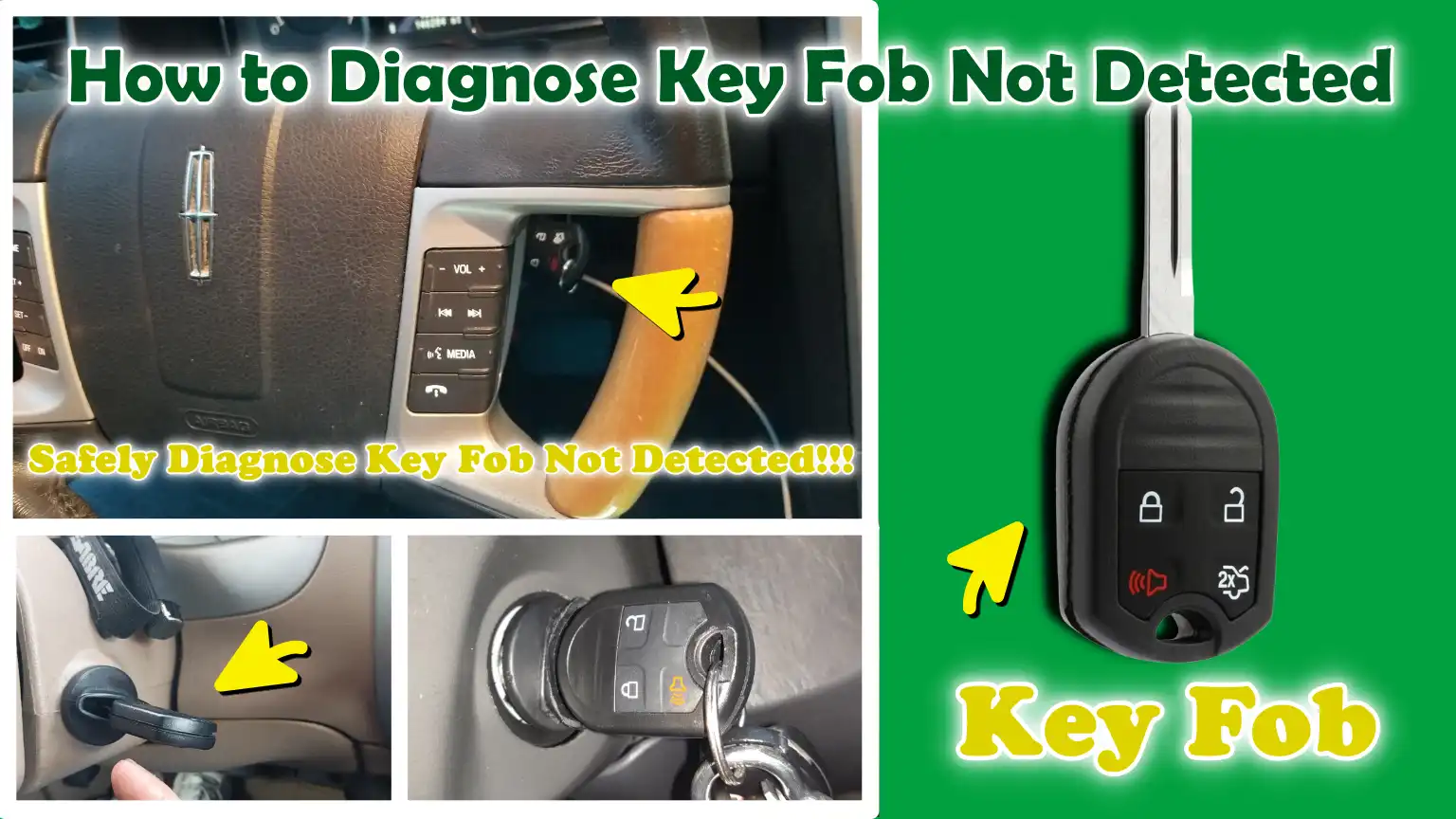
That’s why, that’s the guide that shows you How to Diagnose Key Fob Not Detected so that you can check for the known symptoms first and then test the spare key, inspect the battery voltage and just understand how the smart key system actually works, so that it becomes really easy thing to find the actual cause and fix them safely.
So, What Does “Key Fob Not Detected” Mean?
The “Key fob not detected” message indicates that the vehicle is unable to confirm the presence of your smart key inside or in the immediate vicinity of the cabin.
In modern push-button start systems, the key fob does not function like a traditional physical key.
Instead, it transmits a low-power radio frequency signal containing an encrypted code.
The vehicle is equipped with internal antennas, located in areas such as the cabin, doors and sometimes the trunk, that constantly listen for this signal.
Once the correct code is received and verified, the vehicle authorizes the engine to start.
If the signal is weak, obstructed, or entirely absent, the system assumes that the key is not present and, for security reasons, prevents the ignition from engaging.
Consequently, if the communication link between the fob and the vehicle is interrupted, even a fully functional key will be unable to start the vehicle.
1. How Do Modern Smart Key Systems Communicate with the Vehicle?
Smart key systems rely on a two-way authentication process between the key fob and the vehicle.
When you press the start button or touch a door handle, the vehicle transmits a low-frequency request signal.
The key fob responds with a unique, encrypted authentication code.
This transaction occurs within a matter of milliseconds, thereby verifying the key’s identity without the need to physically insert it into the ignition.
The functionality of this system depends largely on the strength of the battery inside the fob, the vehicle’s 12-volt battery and the condition of the receiver antennas positioned around the vehicle.
If any part of this communication chain is weak or compromised, the system fails to complete the authentication process, resulting in a “no detection” warning, even if the key is physically located inside the vehicle.
2. Why Does the “Key Fob Not Detected” Warning Appear on the Dashboard?
This warning appears on the dashboard when the vehicle’s immobilizer system fails to verify a signal received from a valid key within a specified timeframe.
This is a security feature designed to prevent the engine from starting without authorization.
The system is programmed to operate with extreme precision; this means that if there is even the slightest uncertainty regarding the signal, it will disable the ignition.
This issue can be caused by a weak key fob battery, electrical interference, a faulty receiver module, or low voltage in the car’s battery, which reduces the sensitivity of the vehicle’s internal electronics.
In some cases, this warning appears intermittently when a signal is partially received but is not strong enough to be fully verified; this often confuses drivers, as the key fob may still appear to function correctly for unlocking the doors.
3. Common Symptoms Drivers Observe Before Complete Failure
Before a complete failure in key recognition occurs, most vehicles exhibit early warning signs that are often overlooked.
These include a reduced range for unlocking doors, a delayed response when buttons are pressed and the need to stand closer to the vehicle than usual to operate it normally.
In some instances, the push-button start may only work after multiple attempts, or it may function only when the key is placed in a specific location inside the vehicle.
Dashboard warnings may initially appear only sporadically, but over time, they can begin to manifest consistently.
These symptoms typically indicate that either the key fob’s battery is running low, the vehicle’s battery voltage stability is deteriorating, or the communication signal between the key and the vehicle is becoming unstable.
Recognizing these early warning signs is crucial, as it helps prevent sudden situations where the vehicle fails to start.
4. The Difference Between Temporary Recognition Failure and Complete Key Fob Failure
A temporary recognition failure generally implies that there is no permanent fault within the system, but rather that it is experiencing a temporary interruption.
This can be caused by environmental factors such as a weak battery, signal interference, or the presence of strong radio frequency sources nearby.
In such cases, the key may continue to function intermittently and the issue is often resolved simply by replacing the battery or bringing the key closer to the start button.
A complete key fob failure is a more serious issue; it occurs when the internal circuitry, transponder chip, or the vehicle’s receiver system malfunctions or is no longer capable of communicating.
In this scenario, replacing the battery does not restore the vehicle’s functionality and the vehicle consistently fails to recognize any key, even a spare one.
Understanding this distinction is essential, as it helps avoid unnecessary key replacements and allows the troubleshooting process to be directed toward either simple remedies or a more in-depth electrical diagnosis.
Know, Common Signs Show That Your Vehicle Is Not Recognizing the Key Fob
1. The Push Button Start Does Not Work
When you press the start button and nothing happens, it usually means that the vehicle is not receiving a valid signal from the Key Fob.
The immobilizer system prevents ignition because it cannot verify whether the correct key is present inside the vehicle.
This is often one of the earliest and most easily identifiable signs that the key is not being recognized.
2. A Warning Message Appears on the Dashboard
When the vehicle repeatedly fails to recognize the encrypted signal sent by the Key Fob, a message such as “Key Not Detected” or “No Key Present” appears.
This system is designed to display this warning whenever the communication link between the key and the vehicle becomes weak, sluggish, or completely severed.
3. The Doors Unlock, But the Engine Does Not Start
In some instances, the Key Fob continues to function for unlocking the doors, yet the engine refuses to start.
This occurs because the door-unlocking system often requires a weaker confirmation signal compared to the Push Start system, whereas the Push Start system requires a higher level of authentication to initiate ignition.
4. The Key Is Recognized Only Intermittently, Even When It Is Inside the Cabin
Occasionally, the vehicle recognizes the key only sporadically, even when the key is physically present inside the cabin.
This irregularity typically points to a weak Key Fob battery, low signal strength, or a temporary disruption in the communication flow between the key and the vehicle.
5. The Key Is Recognized Only When Placed in a Specific Location
If the vehicle starts only when the key is placed in a specific spot such as: near the start button or on the center console, it indicates that the signal is too weak to be detected from a normal distance.
This system functions only when the key is in very close proximity to the receiver.
6. Sudden Flashing of the Security Indicator
A flashing security light on the dashboard signals that the immobilizer system is active but is failing to recognize the key’s signal.
This flashing serves as a protective response, indicating that the vehicle remains in anti-theft mode and will not allow the engine to start until the key is successfully recognized.
Why Is the Key Fob Not Being Detected?
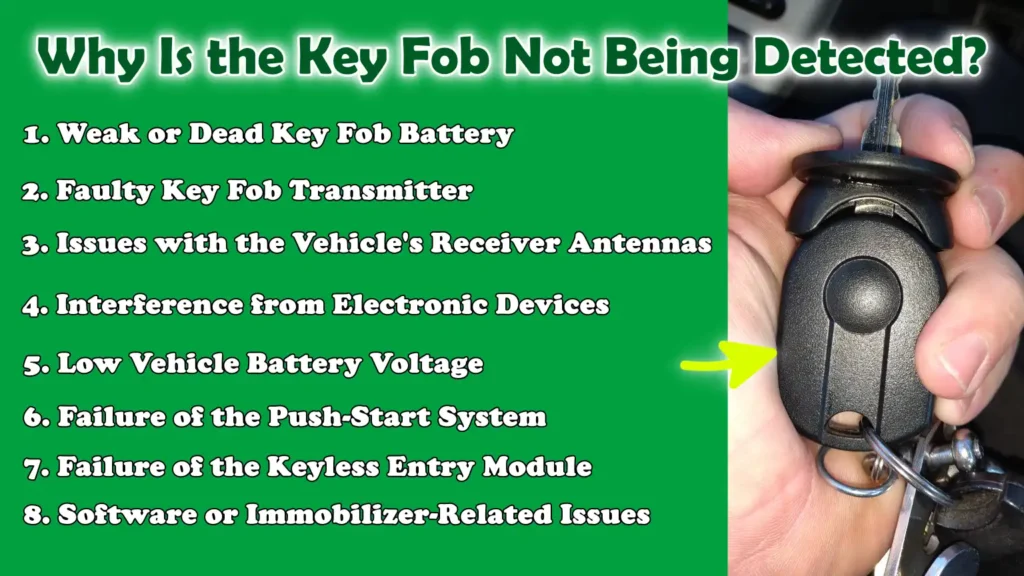
A key fob fails to be detected when the communication between the key and the vehicle’s smart entry system is broken, weakened, or blocked at any point within the signal chain.
Today’s “push-to-start” vehicles rely on a continuous exchange of encrypted radio signals between the fob and multiple receiver antennas located inside the vehicle.
If even a single component of this system malfunctions, the vehicle, as a security measure, will refuse to recognize the key.
The cause could be something as minor as a weak battery inside the key, or something as complex as a fault within the vehicle’s immobilizer system.
Understanding every potential cause helps in pinpointing the actual problem, rather than blindly replacing parts.
1. Weak or Dead Key Fob Battery
A weak or dead key fob battery is the most common reason for detection failure.
The key fob requires sufficient power to transmit a stable radio frequency signal to the vehicle.
When the battery voltage drops, the signal becomes weak or erratic and the vehicle may fail to recognize it, even if the key is physically located inside the vehicle.
Initially, the key may still function when held in very close proximity, but eventually, it will cease to work altogether.
If this is the sole issue, simply replacing the small “coin cell” battery will often restore the vehicle’s proper functionality.
2. Faulty Key Fob Transmitter
Inside the key fob lies a tiny electronic transmitter responsible for sending encrypted signals to the vehicle.
If this internal circuitry malfunctions, whether due to wear and tear, moisture exposure, physical impact, or a manufacturing defect, the fob may stop transmitting the correct data, even if the battery is brand new.
In such situations, the vehicle behaves as if no key is present at all, because the signal being transmitted is either incomplete or corrupted.
When such a malfunction occurs, the entire key fob unit often requires either repair or replacement.
3. Issues with the Vehicle’s Receiver Antennas
To capture the key fob’s signal, the vehicle utilizes multiple antennas, which are strategically positioned within the vehicle’s interior, as well as inside the doors and the trunk.
If any of these antennas fail, lose their connection, or malfunction, the vehicle may be unable to detect the signal, even if the key itself is functioning correctly.
This often results in intermittent key detection; for instance, the system might work in one specific location but fail to respond in another.
A faulty antenna system typically necessitates an electrical diagnostic check and in some cases, the replacement of a defective receiver module may be required.
4. Interference from Electronic Devices
Radio frequency interference can temporarily block or weaken the communication link between the key and the vehicle.
Devices such as smartphones, wireless chargers, metal objects, or even parking the vehicle in close proximity to a powerful radio tower can disrupt the signal.
In such scenarios, the key may work only intermittently, or function solely when held in very close proximity to the vehicle.
This is typically a temporary issue; once the vehicle is moved away from the source of interference, signal functionality often returns to normal without requiring any further intervention.
5. Low Vehicle Battery Voltage
A weak or failing 12-volt vehicle battery can have a direct impact on the keyless entry system.
Even if the battery retains sufficient power to operate the vehicle’s lights or other accessories, the electronic control modules responsible for recognizing the key may fail to function correctly under low-voltage conditions.
This can result in delayed engine starting, intermittent difficulties in key recognition, or the vehicle failing to start altogether.
In many instances, simply resolving the battery voltage issue resolves the problem, rendering any repairs to the key itself unnecessary.
6. Failure of the Push-Start System
The push-start button itself constitutes a critical component of the communication system; it is not merely a mechanical switch.
If the internal contacts or wiring within the start button assembly become faulty, the vehicle’s system may be unable to properly transmit or receive signals.
Consequently, the vehicle will fail to respond when the button is pressed, even if the key itself is functioning correctly.
Diagnosing this issue typically requires an inspection of the ignition switch circuit.
7. Failure of the Keyless Entry Module
The keyless entry module, often referred to in many vehicles as the Body Control Module (BCM), governs the communication link between the key and the vehicle’s internal systems.
Should this module fail, the entire smart key system may cease to function.
This represents a more serious issue, as it impacts various vehicle functions rather than being limited solely to the engine starting mechanism.
In such scenarios, even a fully functional key fob will remain unrecognized until the module is either repaired or reprogrammed.
8. Software or Immobilizer-Related Issues
Modern vehicles rely heavily on software to manage security and key authentication.
If a glitch, corrupted data, or a synchronization error occurs within the immobilizer system, the vehicle may fail to recognize even the correct key.
This can sometimes happen after a battery replacement or following an interruption in the power supply.
In such situations, the system may need to be reset or reprogrammed using diagnostic tools.
Although such issues are rare, they are a significant consideration, as their symptoms can mimic those of a hardware failure, even if all physical components are functioning correctly.
Tools
| Tools | Why It Is Needed | How to Use It |
|---|---|---|
| Spare Key Fob | This helps determine whether the problem lies with the key itself or with the vehicle’s system. | Attempt to start the vehicle using a spare key. If this works, the original key (key fob) may be defective, or its battery may be weak. |
| Coin Battery Replacement | Most key fobs stop functioning due to a weak or depleted battery. | Carefully open the key fob casing and replace the small internal coin-cell battery with the correct type; ensure that the battery polarity (positive and negative terminals) is oriented correctly. |
| Digital Multimeter | This measures voltage to assess the condition of the batteries in both the key and the vehicle. | Set the device to DC voltage mode and test the vehicle’s battery or other electrical points to verify that the voltage level falls within the correct range. |
| OBD2 Scanner | This reads error codes (diagnostic trouble codes) from the vehicle’s computer system. | Connect it to the OBD port located under the dashboard and scan for error codes related to the keyless entry or immobilizer system. |
| Owner’s Manual | This provides system-specific information tailored to your vehicle model. | Consult this resource for information such as the key battery type, emergency vehicle starting procedures and instructions for resetting the system. |
| Battery Terminal Cleaner | This removes corrosion that may obstruct the proper flow of electricity from the vehicle’s battery. | Gently clean both battery terminals to ensure a strong and stable electrical connection. |
| Small Screwdriver | This tool facilitates the safe opening of the key fob casing to allow access to its internal components. | Use this tool with caution to avoid damaging the key’s plastic casing or the internal circuit board. |
| Diagnostic Flashlight | It is useful for inspecting hidden or dimly lit areas, such as the fuse box and the space beneath the dashboard. | Use it to check the condition of fuses, wiring and the antenna while inspecting the vehicle in dimly lit areas. |
How to Diagnose Key Fob Not Detected – Easy Working Method
Properly diagnosing the “Key fob not detected” issue is crucial, as the problem could stem from the key fob itself, the car’s battery, the receiver system, or even electronic interference.
Modern push-to-start systems rely on rapid and encrypted (secure) communication between the key and various control modules located within the vehicle.
If, for any reason, this communication is interrupted, the vehicle, as a safety precaution, will disable the ignition (thereby preventing the engine from starting).
Proceeding in a systematic, step-by-step manner eliminates guesswork, making it easier to pinpoint the true cause of the problem without unnecessarily replacing parts.
1. Check the Dashboard for Warning Messages
The first step is to carefully observe the messages displayed on the dashboard, as they often provide direct clues regarding the nature of the problem.
Many vehicles display messages such as “Key not detected,” “No key present,” or “Key Fob battery low”; each message points to a specific type of malfunction.
Additionally, it is important to look for immobilizer or security-related icons, as these indicate that the vehicle’s anti-theft system is active and preventing the engine from starting.
You should also note whether the warning is persistent or intermittent; a persistent warning may signal a more serious internal issue, while an intermittent warning often suggests a weak signal or a battery-related problem.
2. Test with a Spare Key Fob
Using your spare key fob is the most reliable method for determining whether the issue lies with the key itself or with the vehicle’s internal systems.
If the secondary key functions correctly, it indicates that the battery in your primary key fob is low, the key fob itself is defective, or there is an issue with its internal components or transmitter.
If neither key works, there is a strong probability that the problem lies with the vehicle’s receiver system, battery voltage, or immobilizer module.
This simple comparison helps to quickly pinpoint the issue, thereby avoiding the unnecessary replacement of components that are actually functioning properly.
3. Replace the Key Fob Battery
A depleted “coin cell” battery, the small, flat battery located inside the key fob, is one of the most common reasons why a key is not detected.
To resolve this, carefully open the key fob’s casing using a small screwdriver; then, remove the old battery and replace it with the specific type recommended by the vehicle manufacturer.
It is crucial to insert the battery in the correct orientation; if installed upside down (with incorrect polarity), the key fob will not function at all.
After replacing the battery, test the key immediately, as simply changing the battery (which effectively resets the device) often restores the connection between the key fob and the vehicle.
4. Position the Key Fob Near the Start Button
Most vehicles feature an “Emergency Detection Zone” located near the Push Start Button, which allows the vehicle to detect the key fob even when its internal battery is low.
Placing the key fob directly against, or in very close proximity to, the Start Button helps determine whether the issue is being caused by a weak signal.
If the vehicle starts in this position, it generally indicates that the key fob’s battery is low or its signal range has diminished.
This diagnostic step is crucial, as it verifies whether the system is capable of detecting the key fob, even when it is in close proximity.
5. Check the Vehicle Battery Voltage
The vehicle’s 12-volt battery plays a pivotal role in powering the keyless entry system and its associated control modules.
If the battery voltage drops even slightly, the system may be unable to properly process the key’s signal.
To determine whether the battery is operating within its normal range, a standard voltage test can be performed using a digital multimeter.
Symptoms of a weak battery include slow engine cranking, dim lights, or, among other electronic malfunctions, a failure to detect the key.
In many instances, simply resolving the battery issue is sufficient to resolve the problem, without the need to even touch the key fob itself.
6. Check for Signal Interference
Electronic interference can temporarily disrupt the communication link between the key and the vehicle.
Devices such as mobile phones, wireless chargers, metal objects, or RFID-blocking accessories can attenuate the signal strength or block it entirely.
Parking the vehicle near sources that emit strong radio-frequency signals can, in some cases, also interfere with key detection.
To investigate this, try removing any nearby electronic devices and re-test the key in a different location.
If the issue is resolved, it indicates that interference was, in fact, the root cause of the problem.
7. Scan for Fault Codes
By using an OBD2 scanner, you can read the error codes stored within the vehicle’s Electronic Control Module.
These codes can directly point to issues present within the keyless entry system, Body Control Module, or immobilizer system.
Key-related malfunctions often manifest as communication errors or signal mismatch codes.
This step is crucial as it helps identify hidden electronic issues that are typically not detectable through visual inspection alone.
It also helps confirm whether the problem is hardware-related or software-related.
8. Check the Functionality of the Start Button
The push-start button is a critical component of the electronic ignition system; if it malfunctions internally, it can lead to difficulties in vehicle recognition.
When you press the button, listen for the audible click of a relay or observe the vehicle for any form of response.
If there is no response, it may indicate a fault within the start button circuit or the ignition control system.
If the ignition mode changes but the engine fails to start, it implies that the key recognition process is failing at the subsequent stage.
Checking the button helps confirm whether the issue lies within the input switch itself or elsewhere within the immobilizer system.
How to Tell If Your Key Fob Battery Has Died
A dead or weak key fob battery is one of the most common reasons why a vehicle displays a “key not detected” warning.
This issue typically begins gradually and eventually results in the device ceasing to function entirely.
The key fob utilizes a small “coin cell” battery to transmit a low-power, encrypted radio signal to the vehicle.
As the battery’s power begins to deplete, the signal becomes weaker and increasingly erratic.
This leads to communication difficulties between the key and the vehicle’s antenna, particularly when you are standing at a normal distance from the car or are seated inside it.
1. Reduced Locking Range
The first indication of a weakening key fob battery is a significant reduction in its effective locking and unlocking range.
Typically, a fully functional key fob should operate correctly even from a reasonable distance.
However, as the battery weakens, you may find yourself needing to stand much closer to the vehicle for it to respond.
This occurs because the signal strength diminishes, preventing it from traveling far enough to reliably reach the vehicle’s receiver.
Over time, this range shrinks even further, to the point where the key only works when held directly next to the door, or it may stop working altogether.
2. Delayed Unlocking
Another common symptom is a delay in the vehicle’s response when the lock or unlock button is pressed.
Instead of reacting instantly, the vehicle may take longer than usual to respond, or you may find yourself needing to press the button multiple times.
This delay is caused by the erratic nature of the signal emitted by a weak battery, which prevents the vehicle from properly recognizing the command on the first attempt.
In many cases, this serves as an early warning that the battery is nearing the end of its lifespan and should be replaced immediately to avoid sudden, unexpected malfunctions.
3. Recurring Issues with Push-Start Systems
When the key fob battery runs low, the push-start system often detects the key only intermittently.
You may observe that one moment the vehicle starts normally, but the very next moment it displays a “Key Not Detected” message, even if the key is physically located inside the vehicle.
This issue arises because the signal strength lacks the stability required for the vehicle’s immobilizer system to continuously authenticate the key’s identity.
Often, holding the key closer to the start button allows the vehicle to detect it temporarily; this is a definitive indication that the battery is running low.
4. Checking Battery Voltage
A more precise method to confirm a low key fob battery is to check its voltage using a small multimeter.
Most coin-cell batteries used in key fobs are designed to operate within a specific voltage range; when the voltage reading drops significantly below the normal threshold, the battery can no longer provide the stable power required to transmit a reliable signal.
Even if the key fob works occasionally, a low voltage reading indicates that the battery is nearing the end of its life and requires replacement.
This method helps determine whether the issue is genuinely battery-related or caused by another electronic malfunction.
5. Typical Battery Lifespan
Key fob batteries typically last between two and four years, depending on usage patterns, environmental conditions and the specific vehicle model.
Frequent use, repeated button presses, or exposure to extreme heat or cold can shorten the battery’s lifespan.
As a battery ages, its capacity to hold a charge gradually diminishes; consequently, battery-related issues often manifest initially as minor glitches, eventually leading to the device ceasing to function altogether.
Replacing the battery at the very first sign of declining performance is the most reliable way to avoid situations such as a vehicle suddenly failing to start.
So, How to Determine if the Problem Lies with the Car, Not the Key Fob
When a vehicle displays a “Key Fob Not Detected” warning, the issue does not always originate with the Key Fob itself.
Modern smart key systems rely on the seamless interaction of the key and various vehicle components such as: antennas, control modules, wiring and the push-to-start system, working in unison.
When the root cause of the problem lies within the vehicle, simply replacing the Key Fob or its battery will not resolve the issue; therefore, it is crucial to identify vehicle-related malfunctions through clear and consistent indicators.
1. The Spare Key Also Fails to Work
The most definitive sign that the problem lies with the vehicle is when the car fails to start even after using a second Key Fob.
As the two keys are distinct devices, the likelihood of both failing simultaneously is extremely low.
If neither key is detected, the issue typically resides within the vehicle’s receiver system, immobilizer, or power supply, rather than with the Key Fob itself.
This simple test helps to quickly distinguish between a key-related malfunction and deeper, system-wide issues within the vehicle.
2. The Warning Persists Even After Replacing the Battery
If the “Key Not Detected” warning persists even after replacing the Key Fob’s battery with a fresh one, it indicates that the problem is not related to the Key Fob’s internal power source.
If the issue were solely with the key, a properly installed new battery should have restored normal communication.
When the warning persists, it often points to vehicle-related issues such as: a weak car battery, a faulty antenna, or a malfunctioning control module that fails to recognize the signal, even if the signal itself is strong.
3. Symptoms of a Faulty Receiver Antenna
To capture the key’s signal, a vehicle utilizes multiple antennas that are strategically positioned in various locations such as: within the cabin, doors and trunk.
If one or more of these antennas malfunction, the car may exhibit erratic behavior, for instance, detecting the key only in specific areas or failing to detect it at all.
A common symptom is that the car functions correctly when the key is held in close proximity to the start button, yet fails to respond when the key is held at a normal distance.
This indicates that the receiver system is unable to properly capture the signal, serving as a clear indication of a vehicle-related fault.
4. Communication Faults in Vehicle Modules
In modern vehicles, a central control unit, often referred to as the ‘Body Control Module’ or ‘Immobilizer Module’, is employed to manage key authentication.
If this module malfunctions or loses communication with other vehicle systems, the car may completely cease to recognize the key.
In such scenarios, even fully functional keys will fail to work, as the vehicle is unable to properly process the incoming signals.
Resolving these issues typically requires diagnostic scanning to identify specific error codes that point to communication failures within the vehicle’s internal electronic network.
5. Power Faults in the Start Button
The ‘push-to-start’ button constitutes a critical component of the ignition control circuit.
If this button malfunctions or fails to receive the necessary electrical power, the vehicle will fail to respond, even if the key itself is functioning correctly.
In some instances, pressing the button may elicit no response whatsoever from the vehicle, or the ignition mode may simply fail to switch.
This could be an indication of a wiring issue, a faulty switch, or a failure of the necessary voltage to reach the ignition system.
When the start button itself is defective, the vehicle may behave as if the key is not present, even though, in reality, the key is functioning perfectly fine.
Know, Some Emergency Methods to Start the Car When the Key Fob Is Not Detected
When a car displays a “Key Fob Not Detected” warning, it generally means that the vehicle is unable to read the encrypted signal being transmitted by the key.
However, in many cases, the system itself incorporates specific emergency procedures that allow the engine to be started.
These methods exist because manufacturers understand that a key fob’s battery can die suddenly, or signal interference may occur without warning.
Understanding these backup techniques allows you to start the vehicle temporarily and avoid getting stranded, even if the underlying issue has not yet been fully resolved.
1. Hold the Key Against the Push-to-Start Button
Most modern vehicles feature a built-in emergency detection system near the Push-to-Start button, capable of reading the signal from a very weak or dead key fob when it is held in close proximity.
If the key fob’s battery is low, holding the key directly against, or very close to, the Start button helps the car’s receiver easily pick up that short-range signal.
This works because, when the key is placed within the strongest detection zone, even a weak battery can still transmit a faint signal.
Once the system detects the key in this position, the engine can typically be started in the normal manner; however, the battery inside the key fob should be replaced as soon as possible.
2. Use the Hidden Backup Key
Many “Smart Key” fobs contain a hidden mechanical key faced within their casing.
This backup key is designed for emergency situations where the electronic system has failed completely.
It can typically be extracted by pressing a small release button located directly on the key fob itself.
This mechanical key allows you to manually unlock the driver’s door, enabling you to gain access to the vehicle’s interior even if the electronic system is non-functional.
However, in vehicles equipped with a push-button start system, this key does not directly start the engine; instead, it facilitates entry into the cabin and, depending on the vehicle’s design, provides access to an internal emergency start function or the fuse panel.
3. Location of the Manual Key Slot
In some vehicles, particularly older models featuring a push-button start, there is a hidden key slot or “backup start area” located inside the cabin.
This slot is often faced on the steering column, inside the center console, or beneath a trim cover.
By inserting the key fob into this slot, the vehicle can directly read the chip embedded within the key, thereby eliminating the need to rely on potentially weak wireless signals.
This method is specifically designed for situations where the key fob’s battery has died or when a wireless signal cannot be detected.
Once the key is placed in this emergency slot, the vehicle’s engine can typically be started in the standard manner.
4. Location of the Emergency Reader
Even if no visible slot is present, many cars still feature a hidden emergency reader coil located at specific points such as: inside a cup holder, on the steering column, or on the dashboard.
The exact location varies by manufacturer and is typically detailed in the vehicle’s owner’s manual.
By positioning the key fob directly over this designated spot, the vehicle can identify the transponder chip using short-range induction rather than standard wireless communication.
This constitutes one of the most reliable backup methods, as it relies far less on the key fob’s battery strength compared to the system used during normal operation.
5. Model-Specific Overrides
Different vehicle security systems employ distinct methods for performing emergency overrides.
In some cars, you can start the engine by depressing the brake pedal and positioning the key near a specific sensor, whereas in others, you may need to press buttons in a particular sequence or hold the key fob against the start button for a few seconds.
These specific overrides, tailored to each individual model, are designed to address temporary authentication glitches while simultaneously maintaining security.
As every manufacturer designs its own proprietary system, it is essential to strictly follow the precise procedure outlined in the owner’s manual to safely start the vehicle in the event that the key fob is not recognized.
Read More:
So, When to Replace a Key Fob?
A key fob should be replaced when its internal components fail to communicate properly with the vehicle, even after you have attempted minor troubleshooting steps, such as replacing the battery or checking the signal.
Modern key fobs contain delicate electronic components such as: circuit boards, transmitters and transponder chips, that work together to transmit a secure and encrypted signal to the vehicle.
When any of these components malfunction, the vehicle may fail to fully recognize the key or may repeatedly display a “Key not detected” warning.
Recognizing the signs of irreparable damage can help you avoid the need for repeated repairs and ensures the safe and consistent operation of your vehicle.
Even, there’s research that shows that modern vehicles actually uses keyless entry systems where the key fob actually communicates with the car using encrypted radio frequency signals and a challenge-response authentication process as well, so research shows that this system literally depends on the multiple antennas inside the vehicle that continuously scans for a valid key signal before it allows the engine to start, but if this particular signal is weak, delayed or blocked then the immobilizer system automatically rejects the key as a security precautions, that’s how it shows “Key Not Detected” warning sign.[¹]
1. Internal Circuit Malfunction
An internal circuit malfunction occurs when the small electronic board housed inside the key fob becomes damaged or worn out.
This can happen due to dropping the key, general wear and tear over time, or a manufacturing defect.
When the circuit fails, the fob may stop transmitting the correct signal or may function intermittently.
Even after installing a new battery, the key may be unable to communicate with the vehicle because the internal pathways responsible for transmitting the signal are no longer functioning correctly.
In such cases, replacing the key is often the most reliable solution.
2. Water Damage
Water is one of the most damaging elements for a key fob, as its internal electronic components are not designed to withstand moisture.
If water penetrates the casing (cover), it poses a risk of short-circuiting, corrosion, or long-term damage to the transmitter and chip.
Minor incidents such as: getting caught in the rain or accidentally running the key through a washing machine, as it can gradually degrade the key’s functionality over time.
A water-damaged key fob may continue to function for a while after drying out; However, as corrosion begins to spread within the internal circuitry, the device often malfunctions once again.
3. Broken Buttons
The buttons located on a key fob are connected to tiny internal switches that transmit a signal when pressed.
If these buttons become worn out or break, the key will not function correctly, or it may require repeated pressing to activate.
In some instances, the button mechanism itself remains intact, yet it fails to consistently transmit a signal to the vehicle.
This renders the key’s operation unreliable; often, when repair is neither cost-effective nor a durable solution, the best course of action is to replace the key entirely.
4. The Impact of a Broken Casing on the Antenna
The outer casing (cover) of a key fob serves a dual purpose: it not only protects the internal electronic components but also supports the antenna structure, thereby facilitating signal transmission.
If the casing cracks or becomes loose, the internal components may shift out of place, resulting in diminished signal strength.
This can sometimes lead to difficulties in key recognition; in such situations, the vehicle may only be able to detect the key when it is brought into very close proximity.
Over time, the ingress of dust, moisture, or external pressure through these cracks can inflict further damage upon the internal components, ultimately making it necessary to replace the key to ensure the vehicle functions correctly.
5. Transponder Chip Failure
The transponder chip is the most critical component of a key fob, as it stores a unique security code that the vehicle uses to verify its identity.
If this chip malfunctions, the vehicle will not start at all, even if the battery and transmitter are functioning perfectly.
Such malfunctions are rarely faced; nevertheless, they are quite serious, as they directly impact the security authentication process.
When the transponder chip becomes defective or damaged, in most cases, the key cannot be reprogrammed; therefore, replacing the entire key becomes necessary to properly operate and start the vehicle.
Know, Some Mistakes to Avoid During Diagnosis of Key Fob
Diagnosing the “key fob not detected” issue requires a meticulous and logical approach, as the system relies on the simultaneous operation of several electronic components, including the key fob, the vehicle’s battery, antennas and control modules.
Many drivers make minor errors during the diagnostic process, leading to unnecessary repairs or wasted money.
Understanding what not to do is just as important as knowing the correct steps, as it helps you quickly pinpoint the root cause of the problem and avoid replacing components that are still functioning properly.
1. Replacing Expensive Components First
One of the most common mistakes is replacing expensive components such as: the keyless entry module, push-start system, or immobilizer unit, without first investigating the actual root cause of the problem.
In many cases, the actual issue is quite minor such as: a weak key fob battery or low voltage in the vehicle’s battery.
Replacing expensive parts without proper diagnosis can unnecessarily inflate repair costs while failing to resolve the underlying problem.
Proper diagnosis should always begin by checking for the simplest and most common causes and only then proceed to examine the more complex components.
2. Overlooking the Condition of the Vehicle’s Battery
Another major mistake is overlooking the condition of the vehicle’s 12-volt battery.
Even if the lights and other accessories appear to be functioning correctly, a weak battery can still trigger a “key not detected” error, as the electronic control modules require a stable voltage supply to operate properly.
When voltage drops, the system may be unable to process the signal correctly, potentially resulting in intermittent or persistent “Key Not Detected” warnings.
Checking the vehicle’s battery right at the beginning of the diagnostic process can prevent confusion and avoid the misconception that the key fob itself is the sole cause of the problem.
3. Assuming the Problem Always Lies with the Battery
Many people immediately assume that the key fob’s battery is the only cause of a “Key Not Detected” issue.
While this is a common culprit, the problem is not necessarily always related to the battery.
Other factors such as: signal interference, a faulty antenna, or software glitches, as it can also prevent the vehicle from recognizing the key.
Assuming that the battery is always at fault can delay an accurate diagnosis; consequently, this may lead to frequent and unnecessary battery replacements, while the actual underlying problem remains unresolved.
4. Failing to Check the Spare Key
Failing to check the spare key (fob) is another common mistake that slows down the troubleshooting process.
The spare key serves as a crucial point of comparison; it helps determine whether the issue lies with the key itself or with the vehicle’s internal systems.
If neither key works, there is a strong probability that the problem resides within the vehicle rather than with the keys.
Conversely, if only one key is malfunctioning, it is likely that the issue is specific to that particular key.
Overlooking this step often leads to confusion and misconceptions regarding the true root cause of the problem.
5. Failing to Scan for Fault Codes
Whenever communication is interrupted between the key and the immobilizer system, modern vehicles store “Diagnostic Trouble Codes” (fault codes) in their internal memory.
Failing to scan for these OBD-II fault codes is akin to overlooking crucial clues that could directly pinpoint a faulty component.
These codes can reveal issues within the Body Control Module, the antenna system, or the key recognition process itself.
Without examining these codes, the troubleshooting process becomes based merely on guesswork rather than on a systematic and logical investigation.
6. Using the Wrong Battery
Using the incorrect type of battery, or failing to install it properly within the key fob, is another common mistake that can lead to persistent issues with key recognition.
Even a slight discrepancy in voltage or battery size can impact the key’s functionality, as these devices are designed to meet very specific power requirements.
Furthermore, installing the battery incorrectly such as: reversing its polarity, as it can render the key completely inoperable.
To re-establish a reliable connection with the vehicle, it is essential to always use the correct type of battery and to ensure that it is installed in the proper orientation.
Conclusion – How to Diagnose Key Fob Not Detected
So, once you actually break down the system, then most of the key detection issues becomes really simple to understand and really easy to fix as well.
Modern push-to-start systems are highly secure and rely on the simultaneous operation of several components; these include the key fob’s battery, its internal transmitter, the vehicle’s antennas, the 12-volt car battery and the immobilizer control module.
If any of these components malfunctions or becomes weak, the system, as a security measure, may prevent the engine from starting.
Therefore, rather than making educated guesses or blindly replacing parts, it is crucial to accurately pinpoint the root cause of the problem.
By adopting a systematic, step-by-step approach, starting with simple checks such as inspecting the key fob’s battery and testing a spare key and then progressing to more in-depth diagnostics like checking the car battery’s voltage, identifying signal interference and scanning for fault codes, most issues can be accurately diagnosed without incurring unnecessary expenses.
Many drivers discover that the actual problem does not lie with the key itself, but rather with a very common issue such as: a low key fob battery or a weak signal.
That’s all from this one and you can comment for more info.
Frequently Asked Questions
FAQ 1: Why does my car display “Key Fob Not Detected” even though the key is inside the vehicle?
Answer: When your car displays “Key Fob Not Detected” while the key is actually inside the vehicle, it usually means that the car is not receiving a strong or clear signal from the key fob. This can occur if the key fob’s battery is low, the car’s battery is low, or if some obstruction is blocking the signal. In some cases, the key may be located too far away from the car’s receiver antenna; these antennas are typically positioned in specific locations, such as near the start button or inside the center console. Even though the key is physically present in the car, the vehicle will only start if it recognizes the encrypted signal transmitted by the key; therefore, any interruption in receiving this signal can trigger this warning message.
FAQ 2: Can the “Push Button Start” system stop working if the key fob’s battery dies?
Answer: Yes, if the key fob’s battery completely dies or becomes extremely weak, the “Push Button Start” system can indeed stop working. The key fob requires power to transmit a signal that the car can recognize. When the battery is completely depleted, no signal can be sent; consequently, the car interprets this as the key not being present inside the vehicle. In some cars, you may still be able to start the engine by holding the key fob in very close proximity to the start button; this is because, at such a short distance, a weak backup signal can sometimes still be detected. However, under normal circumstances, the “Push Button Start” system will cease to function once the battery has died.
FAQ 3: How do I start my car when it fails to recognize the key?
Answer: If your car is unable to recognize the key fob, many vehicle systems feature an ’emergency start’ procedure. In most cases, you can attempt to start the car by simultaneously pressing the brake and start buttons while holding the key fob directly against, or in very close proximity to, the start button. Some car cabins also feature a hidden slot or an “emergency reader area” specifically designed to house the key; placing the key here allows the vehicle to directly read the “transponder chip” embedded within the key. These backup methods are designed to function in situations where the key fob’s battery is low or the wireless signal is not being properly detected.
FAQ 4: Does the key fob need to be “reset” after replacing the battery?
Answer: In most cases, the key fob does not need to be “reset” after replacing its battery; this is because the fob is designed to automatically re-establish its connection with the vehicle as soon as it receives power again. However, in certain specific situations, particularly if the battery has remained completely discharged for an extended period, it may be necessary to re-synchronize the key with the vehicle. While this is a rare occurrence, it can happen with certain specific vehicle models. Generally, simply installing a new battery correctly and with the proper polarity is sufficient to restore the vehicle’s normal operation.
FAQ 5: Can a failing car battery affect key detection?
Answer: Yes, a weak or failing car battery can have a direct impact on key detection. Keyless entry systems, immobilizers and receiver antennas all rely on a stable voltage supply provided by the vehicle’s 12-volt battery. If the battery is weak, the system may be unable to properly process the key’s signal, potentially resulting in intermittent or persistent “Key Not Detected” warnings. Even if the vehicle’s other electrical systems are functioning correctly, the sensitivity of the key recognition system may be reduced; consequently, you may experience difficulty starting the vehicle until the battery is recharged or replaced.
References:
[1] Remote Entry Control and Immobilizer System Solutions
https://saemobilus.sae.org/papers/remote-entry-control-immobilizer-system-solutions-2000-01-1310
Hello Folks, Dean Shali here to help you out to solve the problems with your lovely vehicle, as i have lots of experience and knowledge about automotive industry as i woks directly with the customers and repair vehicles and i love to help the people to keep their cars safe and running smoothly.