
Written By: Dean Shali
Fact Checked By: Sabré Cook
Reviewed By: Tamara Warren
Without a doubt, no crank no start issue is one of the most frustrating problems and the thing is any drivers can face it because the vehicle suddenly refuses to turn over, even without any kind of warning.
But, you need to understand that: most of the time engine itself is not the problem at all, as most of the no crank conditions are caused by the electrical failures such as: having a weak battery, corroded terminals, bad starter motor, faulty ignition switch, damaged wiring or failed relay can cause this issue as well.
Plus, modern anti-theft systems and neutral safety switches have ability to prevent the engine from cranking properly.
This is why, we have come up with this guide about How to Fix No Crank No Start Issue, so that you can easily diagnose the problem and fix this problem without getting frustrated.
Know, Common Causes of the ‘No Crank, No Start’ Problem
The ‘no crank, no start’ problem occurs when the engine fails to turn over, even after turning the key or pressing the start button.
In most cases, this issue is not related to the engine itself, but rather to the battery, starter system, ignition system, wiring, or electrical connections.
Modern vehicles rely heavily on electrical power; consequently, a weak battery, a faulty relay, or even a loose cable can completely halt the starting process.
Understanding specific symptoms such as: clicking sounds, dim lights, or complete silence, significantly accelerates the process of diagnosing the root cause.
1. Faulty or Weak Battery
A weak or faulty battery is the most common cause of a ‘no crank’ situation, as the starter motor requires a robust electrical supply to turn over the engine.
When the battery voltage drops too low, the vehicle may emit clicking sounds, the dashboard lights may dim, or there may be absolutely no response.
Cold weather can significantly degrade battery performance, as low temperatures slow down the chemical reactions occurring within the battery.
Leaving headlights, interior lights, or accessories on overnight can also drain the battery to a level where the car is unable to start.
2. Corroded or Loose Battery Terminals
Corroded or loose battery terminals prevent electrical power from reaching the starter motor effectively.
Corrosion typically appears as a white, blue, or green powdery substance around the battery connections, creating resistance that obstructs the flow of electrical current.
In some instances, corrosion may form inside the cable itself, making it difficult to detect through visual inspection alone.
Loose battery clamps can also occasionally trigger a ‘no-crank’ issue, particularly when driving on rough roads or during periods of fluctuating temperatures.
3. Faulty Starter Motor
When you start your vehicle, the starter motor is responsible for cranking the engine.
If the starter fails, the engine will not crank, even if the battery is fully charged.
A common symptom of this is hearing only a single ‘click’ sound when you turn the key.
Starter failure due to heat is also a common occurrence, as high temperatures cause the internal components of the starter to expand and cease functioning properly.
Some vehicles may start normally in cold conditions but fail to start once the engine has warmed up.
4. Faulty Starter Relay
The starter relay acts as an electrical switch that transmits power from the battery to the starter motor.
If the relay fails, the starter never receives the necessary power to operate.
A faulty relay often leads to intermittent starting issues, sometimes the vehicle starts normally, while at other times it suddenly refuses to start.
A clicking sound emanating from the fuse box area can also be an indication of a faulty relay.
5. Blown Fuse
A blown fuse can interrupt essential electrical circuits within the starting system.
If the starter fuse blows, power cannot reach the starter motor; conversely, if the ignition or ECM fuse blows, the engine control system will be unable to function correctly.
Fuses typically blow due to electrical overloads, faulty wiring, or a short circuit occurring somewhere within the system.
6. Faulty Ignition Switch
When the key is turned, the ignition switch sends an electrical signal.
If the switch fails, the key may turn normally, but nothing happens afterward.
In some instances, the dashboard lights and accessories may continue to function, yet the starter fails to engage.
Worn contacts inside the ignition switch are a common cause of intermittent starting problems in vehicles.
7. Faulty Neutral Safety Switch
Vehicles equipped with automatic transmissions feature a neutral safety switch, which prevents the engine from starting unless the transmission is in ‘Park’ or ‘Neutral’ mode.
If this switch malfunctions, the vehicle will not start, even if everything else appears to be in working order.
A common workaround is to attempt to start the vehicle in ‘Neutral’ rather than ‘Park’; doing so can sometimes temporarily resolve the issue.
8. Immobilizer or Security System Issues
Modern vehicles utilize immobilizer systems to prevent theft; these systems function by recognizing a coded chip embedded within the ignition key.
If the system fails to recognize the correct key, the engine will not start.
A flashing security light on the dashboard is a common indicator of issues related to the immobilizer system.
A weak key battery, a faulty key chip, or a communication glitch within the system, any of these factors can trigger this problem.
9. Poor Ground Connection
Ground connections complete the electrical circuit between the battery, the engine and the chassis.
If a ground cable becomes loose, corroded, or damaged, electrical current cannot flow properly through the starting system.
Poor grounding often leads to issues such as voltage drops, slow cranking, flickering lights, or, occasionally, the engine failing to crank at all; these problems can be difficult to diagnose.
10. Engine Seizure – Rare but Serious
Engine seizure is a rare but serious cause of a “no-crank” condition (the engine failing to start).
This occurs when the engine’s internal components seize up due to overheating, a lack of oil, or a mechanical failure.
In many cases, a loud “click” is heard from the starter, but it fails to turn the engine over at all.
Mechanics often diagnose an engine seizure by attempting to manually rotate the crankshaft using a wrench.
Tools
| Tool | Why It Is Needed | How To Use It Properly |
|---|---|---|
| Multimeter | A multimeter is one of the most essential tools used to diagnose issues such as a “no-crank, no-start” condition (where the engine fails to start), as it measures battery voltage, current, continuity and circuit functionality. It aids with great precision in identifying a weak battery, voltage drops, faulty wiring, poor ground connections, blown fuses and charging system malfunctions. Many starting-related problems arise because the battery fails to supply the necessary voltage to the starter motor and a multimeter helps to quickly confirm this. | Before testing the battery, set the multimeter to DC voltage mode. Place the red probe on the battery’s positive terminal and the black probe on the negative terminal. With the engine turned off, a healthy battery typically displays a voltage reading of approximately 12.6 volts. A lower voltage reading may indicate that the battery is weak or has become completely discharged. This tool can also be safely used to inspect fuses, relays and starter wiring connections. |
| Battery Charger | A battery charger replenishes the power in batteries that have become weak or completely discharged. Many issues associated with a “no-crank” condition occur because the battery lacks the necessary charge to properly power the starter motor. Charging the battery before conducting further diagnostics can prevent the misdiagnosis of other components, such as the starter or alternator. | Connect the charger’s positive clamp to the battery’s positive terminal and the negative clamp to the negative terminal. Select the appropriate charging mode and allow the battery to fully charge before attempting to restart the vehicle. Generally, slow charging is safer and more beneficial for the battery than rapid charging. |
| Socket Set | During inspection or repair, a socket set is essential for loosening and tightening battery terminals, starter bolts, ground cables and other engine components. Loose electrical connections are a very common cause of a “no-crank” condition and sockets help ensure that these components are securely fastened. | Select the correct socket size before attempting to loosen or tighten any bolt. Use the ratchet with care to avoid damaging the threads or overtightening the components. A socket set is typically used when removing battery terminals to clean off corrosion, or when replacing a starter motor. |
| Jumper Cables | When a battery becomes too weak to start the engine, jumper cables provide temporary power from another vehicle or battery source. This helps determine whether the “no-crank” issue is caused by a discharged battery or by another problem within the starter system. | First, connect the positive cable to the positive terminals of both batteries. Then, carefully connect the negative cable to a grounded metal surface on the vehicle that is failing to start. Start the donor vehicle (the one providing assistance) first and allow the weak battery to charge for a few minutes before attempting to crank the engine. |
| Test Light | A test light quickly determines whether electrical power is reaching specific components, such as fuses, relays, switches and starter connections. When troubleshooting a “no-crank” issue, it is an invaluable tool for identifying a lack of power within an electrical circuit. | Connect the clip of the test light to a grounded metal surface and touch the probe to the electrical connection you are testing. If the light illuminates, it indicates that power is present in that section of the circuit. This tool is commonly used when testing starter fuses and ignition circuits. |
| Gloves | When working around a vehicle, gloves protect your hands from sharp engine components, battery acid, dirt, electrical burns and hot surfaces. The engine assembly contains numerous rough metal edges and high-temperature components that can cause injury during repairs. | Wear properly fitting mechanic’s gloves before handling battery terminals, wiring, or engine components. These gloves provide a secure grip while safeguarding your skin during both electrical and mechanical tasks. |
| Eye Protection | When diagnosing or repairing starter system issues, eye protection helps prevent injuries caused by battery acid, sparks, dust, rust particles and debris. Batteries can release hazardous chemicals and minute metal particles during inspection or charging procedures. | Wear safety glasses or specialized safety goggles before working near the battery, jumper cables, electrical connections, or moving engine parts. Proper eye protection significantly reduces the risk of serious eye injury during vehicle repairs. |
How to Fix No Crank No Start Issue – Working Method
Troubleshooting a ‘no crank, no start’ issue should always be approached step-by-step, as replacing parts without proper diagnosis often results in a waste of both time and money.
Most starting-related problems stem from low battery voltage, poor electrical connections, faulty starter components, blown fuses, or malfunctions within the ignition system.
A thorough inspection helps pinpoint the root cause of the problem, allowing you to avoid unnecessary repairs.
Furthermore, understanding how each component of the starting system functions makes it easier to recognize critical warning signs before the issue escalates into a major problem.
1. Check Battery Voltage
The battery should always be the first component you inspect, as it supplies the electrical power required to crank (turn over) the engine.
A healthy, fully charged car battery typically maintains a voltage of approximately 12.6 volts when the engine is off.
If the voltage drops too low, the starter motor may produce nothing more than a distinct ‘click’ sound or fail to operate at all.
Use a multimeter: place the red probe on the positive battery terminal and the black probe on the negative terminal.
A reading of less than approximately 12 volts often indicates that the battery is weak or discharged.
In cases of severely low voltage, the dashboard lights may flicker or go out completely when you attempt to start the engine.
2. Check Battery Terminals
The battery terminals must be clean, tight and free of corrosion, as poor electrical contact can impede the flow of current reaching the starter motor.
Corrosion typically appears as a white, green, or blue powdery substance around the battery connections, creating an obstruction within the electrical circuit.
Even if the battery clamps are merely loose, it can sometimes make starting the vehicle difficult.
Carefully cleaning the terminals using a battery brush or terminal cleaner helps restore proper electrical flow.
It is crucial to firmly tighten any loose clamps, as even a slight looseness in the connection can prevent the engine from cranking.
3. Attempt to ‘Jump Start’ the Vehicle
Jump-starting helps determine whether the battery has become too weak to properly crank the engine.
First, connect the positive terminals of both batteries using a positive jumper cable; next, firmly attach the negative cable to a grounded metal part of the disabled vehicle.
After allowing the weak battery to charge for a few minutes, attempt to restart the engine.
If the vehicle starts successfully, it often indicates that the issue does not lie with the starter motor, but is instead caused by a discharged battery, a fault in the charging system, or a battery in poor condition.
4. Listen to the Starter Sounds
The sounds produced while attempting to start the engine can provide vital clues regarding an internal issue.
A rapid, repetitive ‘clicking’ sound often points to a faulty starter motor or starter solenoid.
This continuous clicking typically signals low battery voltage, as the lack of power causes the starter relay to repeatedly cycle on and off.
Complete silence may indicate a faulty ignition switch, an issue with the relay, a blown fuse, a wiring problem, or a malfunction within the vehicle’s security system.
Listening carefully during the starting process can help expedite the identification of potential causes.
5. Check the Starter Relay and Fuse
The starter relay and fuse protect the electrical starting system and facilitate the delivery of power to the starter motor.
Most fuse boxes are located either beneath the dashboard or within the engine compartment.
If the starter fuse or ignition fuse has blown, the engine will not start at all.
In many vehicles, identical relays are used for different systems; therefore, you can temporarily swap the starter relay with another similar relay to determine whether the original starter relay is defective.
If the vehicle starts immediately after swapping the relay, it is highly probable that the original relay was indeed faulty.
6. Check the Starter Motor
It is crucial that the starter motor receives adequate voltage from the battery during the starting process.
Using a multimeter to check the voltage at the starter terminal ensures that power is reaching the starter correctly.
If voltage is present but the starter is not spinning (not cranking), there may be a fault within the starter motor itself.
Occasionally, a “tapping with a hammer” technique is attempted as a temporary workaround, as worn internal components of the starter may temporarily resume operation after being lightly tapped.
In more severe cases, it may be necessary to remove the starter from the vehicle and perform a “bench test” to verify its proper functionality.
7. Check the Functionality of the Ignition Switch
The ignition switch controls the power supply flowing to the various components of the starting system.
If nothing happens when you turn the key, the ignition switch may not be sending the correct signal to the starter relay or the starter motor.
Paying attention to the status of the dashboard indicators while turning the key can provide useful clues.
Flickering lights, non-functional accessories, or a sudden loss of power in specific key positions often point to a fault within the ignition switch.
Carefully checking the key in its various positions helps identify worn-out internal electrical contacts.
8. Check the Neutral Safety Switch
Vehicles equipped with an automatic transmission feature a neutral safety switch, which prevents the engine from starting unless the transmission is in the ‘Park’ or ‘Neutral’ position.
If this switch malfunctions, the engine will not start (crank), even if all other systems are functioning correctly.
A common diagnostic method is to shift the transmission into the ‘Neutral’ position and attempt to restart the vehicle.
Vehicles with a manual transmission utilize a ‘clutch safety switch,’ which requires the clutch pedal to be fully depressed before the engine can be started.
A fault in the clutch switch can also result in a “no-crank” condition, where the engine fails to start.
9. Check the Engine Ground Connection
Ground connections complete the electrical circuit between the battery, the engine and the chassis.
Poor grounding leads to a voltage drop, which diminishes starter performance and disrupts the flow of electrical current.
You should inspect the main chassis ground and engine ground straps to check for signs of corrosion, looseness, or any wiring defects, so that they can be repaired if necessary.
Symptoms of poor grounding often include dim lights, weak engine starting, malfunctioning electrical components, or the engine failing to start altogether.
Performing a voltage drop test using a multimeter can help detect hidden resistance within the ground connections.
10. Scan for Trouble Codes
In modern vehicles, whenever a fault is detected within their electrical or electronic systems, they store “Diagnostic Trouble Codes” in their internal memory.
With the aid of an OBD2 scanner, these codes, which are stored in the Engine Control Module, as it can be retrieved.
Codes related to the ignition system, immobilizer system, starter circuit, transmission position sensor, or communication interruptions can help quickly pinpoint the root cause of the problem.
Even if the engine fails to start, trouble codes can still be scanned via the diagnostic port in many vehicles.
How to Diagnose a “No Crank, No Start” Issue Based on Symptoms
Diagnosing a “No Crank, No Start” (engine failure to start) issue becomes significantly easier when you pay close attention to the symptoms observed while attempting to start the vehicle.
Sounds, warning lights, electrical behavior and dashboard activity can often indicate exactly which component of the starting system is malfunctioning.
Modern vehicles rely on the proper functioning of the battery, relays, fuses, wiring, starter motor, ignition system and security systems; consequently, a single faulty component can completely prevent the engine from starting.
Understanding these common symptoms helps drivers quickly identify the root cause of the problem and avoid replacing unnecessary parts.
1. No Crank and No Lights
If the engine fails to start and the dashboard lights, headlights and interior lights remain completely off, the issue is typically related to a complete interruption of the electrical supply.
In most cases, this occurs because the battery is completely discharged or has failed internally.
A completely depleted battery cannot provide the necessary voltage to power any of the vehicle’s internal electrical systems.
Loose battery cables, excessive corrosion, or damaged battery terminals can also completely block the flow of electricity.
Another potential cause is a blown main fuse or fusible link, which protects the vehicle’s primary electrical circuits.
If this fuse fails, absolutely no power reaches the ignition system, the fuse box, or the dashboard.
2. Clicking Sound, But Engine Does Not Start
A clicking sound heard while attempting to start the vehicle typically points to an insufficient electrical supply or internal issues within the starter system.
Rapid, repetitive clicking sounds are typically caused by a weak battery that lacks the necessary power to properly engage the starter motor.
The starter relay repeatedly cycles on and off because the voltage drops too drastically during the attempt to crank the engine.
A single, loud click may indicate a fault within the starter motor or the starter solenoid.
In some instances, the starter receives power, but worn or damaged internal components prevent it from cranking the engine.
Loose battery connections and poor grounding can also result in clicking sounds, even though the engine fails to start.
3. Complete Silence Following a Click
Complete silence immediately following a distinct click often signals a faulty starter solenoid or a poor electrical connection somewhere within the starter circuit.
The starter solenoid functions as a switch, connecting the battery’s power to the starter motor.
If the solenoid engages but the motor fails to spin, only a single “click” may be heard.
Loose battery terminals, a defective ground cable, corroded wiring, or weak electrical contacts can also prevent the necessary current from reaching the starter after the initial click.
This issue is particularly common in older vehicles, where starter components may be worn out or battery connections may have been neglected.
4. Lights Turn On, But Engine Does Not Start
If the dashboard lights, headlights and other accessories are functioning correctly, yet the engine still refuses to start, it indicates that the battery retains some remaining power.
In such a scenario, the problem typically lies with the starter relay, ignition switch, neutral safety switch, or the starter motor itself.
If the starter relay is faulty, it fails to deliver power to the starter, even if the rest of the vehicle’s electrical system is functioning correctly.
If the ignition switch is worn out, it may fail to send the proper signal to start the engine when the key is turned.
Vehicles equipped with automatic transmissions may also experience starting difficulties due to a defective neutral safety switch; this switch prevents the vehicle from starting in any gear position other than ‘Park’ or ‘Neutral.’
5. Flashing Security Light
If the security or immobilizer warning light is flashing, it indicates a malfunction within the anti-theft system.
Modern vehicles are equipped with immobilizer systems that communicate with a coded chip embedded in the key before allowing the engine to start.
If the system fails to properly recognize the key, the engine will not start.
A weak key battery, a defective transponder chip, a programming glitch, or a loss of communication between the key and the immobilizer module, any of these factors can trigger this issue.
Often, it may appear that the vehicle has ample electrical power, yet the engine still refuses to start; this occurs because the security system, designed to prevent theft, is actively blocking the starter motor from engaging.
So, How Weather Hinders Vehicle Starting
Weather plays a crucial role in a vehicle’s ability to start, as temperature directly impacts the battery, starter motor, engine oil, wiring and other electrical components.
Many drivers observe that on extremely cold mornings or scorching hot days, their vehicles suddenly begin to experience issues, either failing to start entirely or starting only with great difficulty.
Modern vehicles rely heavily on a robust electrical current and precise mechanical movement during the starting process; consequently, even slight fluctuations in temperature can make starting the vehicle quite challenging.
Aging batteries, worn-out starter motors, loose connections and older electrical components are more susceptible to changes in weather and are often the first parts to fail under extreme temperatures.
1. Starting Difficulties in Cold Weather
Cold weather is one of the most common causes of vehicle starting difficulties, as low temperatures significantly diminish battery performance.
Inside the battery, chemical reactions slow down at freezing temperatures, meaning the battery generates less electrical power during the starting process.
Simultaneously, the engine actually requires more power to start, as cold temperatures increase the internal resistance within the engine.
This combination often leads to issues such as slow cranking, rapid clicking sounds, dimming lights, or a complete failure to start on cold winter mornings.
In cold temperatures, engine oil becomes thicker and more viscous.
This thickened oil creates increased resistance within the engine, forcing the starter motor to exert greater effort to turn the engine’s internal components.
If the battery is weak or the starter motor is worn, the engine may fail to start altogether.
Older batteries typically face the most difficulties during cold weather, as their internal capacity naturally diminishes over time.
This is why many batteries fail during the winter months, even if they were functioning perfectly well during warmer weather.
2. Starting Issues in Hot Weather
Hot weather can also give rise to serious starting issues, particularly in vehicles equipped with an aging starter motor or those with a fault in the electrical system.
Elevated temperatures increase the heat within the engine compartment, which can adversely affect the starter’s performance and electrical resistance.
A common issue known as “heat soak” occurs when the starter motor absorbs excessive heat from the engine after the vehicle has been driven.
As the internal components of the starter heat up, electrical resistance increases, which can cause the starter to suddenly cease functioning properly.
In some vehicles, the engine starts normally in cold weather, but fails to start once it reaches its normal operating temperature.
Heat can cause faulty wiring to expand, thereby weakening electrical connections and increasing resistance within cables and relays.
Weak batteries also struggle to perform effectively in hot weather, as high temperatures accelerate the internal degradation process of the battery and cause the battery fluid to evaporate over time.
Repeated exposure to extreme heat can significantly shorten a battery’s lifespan and increase the risk of a sudden “no-crank” situation (where the engine fails to start).
Can a Faulty Alternator Prevent a Car from Starting?
Yes, a faulty alternator can eventually lead to a “no-crank, no-start” situation, as the alternator is responsible for keeping the battery charged while the engine is running.
Many drivers assume that the vehicle is powered solely by the battery; however, the charging system actually relies on the proper, collaborative functioning of both the battery and the alternator.
If the alternator fails, the battery’s charge will gradually deplete with every drive.
Eventually, the battery’s voltage drops too low to power the starter motor, rendering the engine completely unable to start.
In many cases, the vehicle may continue to run normally for some time before the battery becomes completely discharged.
1. The Relationship Between the Alternator and the Battery
The battery and the alternator are interconnected components of a vehicle’s charging system.
The battery provides the initial electrical power required to start the engine, while the alternator takes over this responsibility once the engine is running.
The alternator generates electricity through the rotation of the engine and feeds that power back to the battery; simultaneously, it powers the lights, sensors, onboard computer, fuel system and other electrically operated components.
If the alternator malfunctions, the battery alone cannot sustain the entire electrical system for an extended period.
A properly functioning alternator typically maintains the battery’s voltage between 13.5 and 14.5 volts while the engine is running.
If the charging voltage drops too low, the battery may gradually discharge even during normal driving conditions.
Over time, repeated undercharging weakens the battery and increases the risk of a sudden “no-start” situation, particularly in cold weather or when the vehicle has been left idle for several hours.
2. Symptoms of a Failing Alternator
The most common indication of an alternator malfunction is the illumination of the battery warning light on the dashboard while driving.
This warning light typically signals that the charging system is no longer capable of maintaining the correct voltage.
Other symptoms may include dimming headlights, flickering dashboard lights, sluggish power windows, slow operation of other electrical components, or the emission of strange buzzing or whining sounds from the engine area.
Frequent battery failure is also a major warning sign of a failing alternator.
Many drivers repeatedly replace their batteries without realizing that the alternator is, in fact, failing to properly charge the new battery.
In some instances, the vehicle may start normally after charging the battery or receiving a jump-start, but will subsequently shut down completely after being driven for a short period.
A faulty alternator can also cause voltage fluctuations, which disrupt various electrical systems within the vehicle and may ultimately prevent the engine from starting at all.
What are the Temporary Measures to Start a Car – When the Car Won’t Crank
Certain temporary measures can sometimes help start a vehicle that refuses to crank; these remedies may provide enough time to safely move the vehicle or drive it to a repair shop.
Although these methods do not offer a permanent solution to the underlying problem, they can help identify whether the issue lies with the battery, the starter motor, electrical connections, or the transmission safety system.
Many “no-crank” issues occur because electrical power is unable to flow properly through the starting system; temporary solutions often work by restoring voltage, improving connections, or temporarily coaxing worn-out components back into working order.
1. Jump Starting
Jump starting is one of the most common temporary solutions for a “no-crank” situation, as many starting-related problems stem from low battery voltage.
When a battery becomes weak or discharged, it is unable to supply sufficient power (electrical current) to turn over the starter motor.
Connecting jumper cables to another fully charged battery provides the starting system with the extra power it needs, allowing the engine to crank normally once again.
If the vehicle starts successfully after a jump start, the problem is often related to a weak battery, a fault in the charging system, a defective battery, or excessive electrical consumption.
However, if the engine still fails to crank even after a proper jump start, the issue likely does not lie with the battery, but rather with the starter motor, ignition switch, relays, wiring, or another electrical component.
2. Gently Tapping the Starter
If the internal components of the starter have worn out, gently tapping the starter motor with a tool can sometimes temporarily restore its functionality.
The starter motor contains internal electrical brushes and rotating parts that wear down over time.
In some cases, these worn parts can get stuck, preventing the starter from functioning correctly.
A light tap can temporarily dislodge these internal components, allowing the starter to engage once again.
This method is effective only in specific situations and should be performed with caution to avoid damaging other nearby components.
If tapping the starter causes the engine to crank, it indicates that the starter motor is on the verge of complete failure and should be replaced immediately, as there is a high probability that the issue will recur.
3. Shifting the Gear to Neutral
Vehicles equipped with an automatic transmission feature a ‘neutral safety switch,’ which prevents the engine from starting unless the transmission is in either ‘Park’ or ‘Neutral’.
If this switch becomes worn or misaligned, the vehicle may refuse to start, even if the transmission is in ‘Park’ and the rest of the starting system is functioning perfectly.
Attempting to restart the engine by shifting the transmission into Neutral can sometimes temporarily resolve this malfunction.
If the engine starts easily in Neutral but not in Park, the neutral safety switch or the transmission position sensor may need to be repaired or replaced.
This issue is particularly common in older vehicles, where the gear shifter components have worn out or the electrical switches have aged.
4. Cleaning Battery Connections
Dirty or corroded battery terminals can obstruct the proper flow of electricity to the starter motor.
Corrosion creates resistance, which weakens the voltage flow within the starting system, particularly during the moment of ignition when a strong surge of power is required.
Cleaning the battery terminals and cable connections can temporarily restore a robust electrical contact and improve the vehicle’s starting performance.
Corrosion typically manifests as a white, blue, or green powdery coating around the terminals.
Loose battery clamps can also impede electrical flow and cause similar issues.
Tightening and cleaning these connections often restores proper electrical flow, specially if the “no-start” issue is occurring intermittently.
5. Using a Portable Jump Pack
A portable jump pack functions similarly to traditional jumper cables; however, instead of relying on another vehicle, it utilizes a small, internal rechargeable battery.
These devices deliver a temporary, powerful surge of electricity directly to the vehicle’s battery during the starting attempt.
Portable jump packs are particularly useful in emergency situations, as they do not require the presence of a second vehicle.
Modern jump packs can provide sufficient starting power even when the vehicle’s battery is severely discharged.
If the engine starts easily after using a jump pack, the root cause is often related to the battery’s charge level, its overall condition, or a fault within the charging system.
Portable jump packs are rapidly gaining popularity due to their ease of use compared to traditional jumper cables.
Read More:
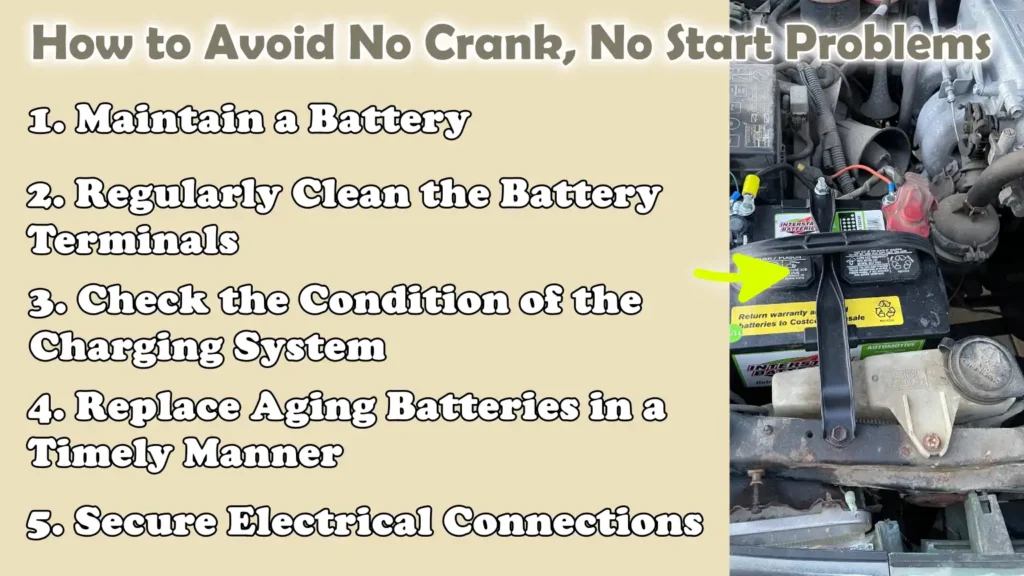
How to Avoid No Crank, No Start Problems
Preventing a “no crank, no start” issue is far easier and less expensive than dealing with a sudden vehicle breakdown later on.
Most starting-related problems develop gradually over time; they are often caused by a weak battery, corroded electrical connections, a faulty charging system, or worn-out electrical components.
Regular maintenance helps ensure that the battery, starter system, wiring and charging system function correctly and provide the necessary electrical power to start the engine.
Many drivers overlook minor warning signs such as: slow cranking, dim lights, or an occasional “clicking” sound, yet these symptoms often manifest long before a complete “no crank” failure occurs.
Even, there’s automotive engineering studies that shows that cold weather dramatically increases that starting system stress as battery power literally drops while engine resistance actually increases, as even research shows that many no crank conditions during the winter are actually linked to the weak batteries and improper engine oil viscosity, so that clearly shows about the importance of battery maintenance, voltage testing and using the correct engine oil are really important to prevent some cold-weather starting failures as well.[¹]
1. Maintain a Battery
The battery is the heart of the vehicle’s starter system, as it provides the electrical power required to crank the engine.
A weak battery struggles to deliver the necessary voltage to the starter motor, particularly in cold weather or when the vehicle has been left idle for an extended period.
Regularly checking the battery’s voltage and overall condition helps identify potential issues before the battery fails completely.
Most vehicle batteries gradually lose their capacity over time and exposure to extreme heat or cold can accelerate this internal wear.
Avoid leaving headlights, interior lights, chargers, or other accessories turned on when the engine is off, as this can gradually drain the battery and shorten its lifespan.
2. Regularly Clean the Battery Terminals
Keeping the battery terminals clean and corrosion-free is crucial to ensuring a strong electrical flow to the starter system.
Corrosion creates resistance to electrical current, thereby reducing the amount of power reaching the starter motor and other electrical components.
The appearance of white, blue, or green deposits around the terminals is a common sign of corrosion and these deposits should be cleaned off before the problem becomes severe.
Dirty battery connections can lead to issues such as slow cranking, clicking sounds, dim lights, or intermittent starting, even if the battery itself is in good condition.
Regular cleaning ensures proper electrical contact and improves overall starting reliability.
3. Check the Condition of the Charging System
When the engine is running, the charging system keeps the battery charged.
If the alternator fails to maintain the necessary charging voltage, the battery will gradually lose its power and may eventually become too weak to start the engine.
A properly functioning charging system typically maintains the battery voltage between approximately 13.5 and 14.5 volts while the vehicle is being driven.
Symptoms of a fault in the charging system may include the illumination of the battery warning light, dimming headlights, malfunctioning electrical accessories, or frequent battery discharge.
Regularly checking the alternator and charging voltage can help prevent sudden no-start situations caused by a depleted battery.
4. Replace Aging Batteries in a Timely Manner
Many starting-related problems occur because drivers wait too long to replace aging batteries.
Automobile batteries naturally degrade over time as their internal chemical components wear out.
Even if the vehicle is currently starting normally, an old battery can fail suddenly, particularly during extreme cold or hot weather, or when electrical demand is high.
Most car batteries begin to lose their reliability after several years of use.
Replacing an aging battery before it fails completely can prevent sudden breakdowns and also reduces the strain placed on the starter motor and charging system.
5. Secure Electrical Connections
Loose or corroded electrical connections can disrupt the flow of electricity within the starter system, leading to intermittent starting issues.
Connections at the battery terminals, ground cables, starter wiring and fuse box must be secure and free of corrosion or defects.
Due to vibrations experienced while driving, electrical connections can gradually loosen over time, particularly in older vehicles.
Weak or loose connections often result in voltage drops, thereby compromising the starter’s performance and overall electrical efficiency.
Regularly inspecting and tightening critical electrical connections ensures reliable starter performance and helps prevent many common electrical starting problems.
Conclusion – How to Fix No Crank No Start Issue
Basically, when a vehicle refuses to crank then it is usually warning sign about there might be some kind of electrical weakness long before having complete starting failure.
Modern vehicles rely heavily on a stable supply of electrical power during the starting process; this means that even minor issues such as: low battery voltage, corroded terminals, a faulty relay, loose ground wires, or a defective ignition switch, as it can completely prevent the engine from starting.
Carefully interpreting the symptoms is the most critical part of the diagnostic process, as specific sounds such as: a rapid “clicking” noise, a single loud “click,” dimming dashboard lights, or complete silence, often provide direct clues pointing to the actual cause of the problem.
Accurate troubleshooting should always begin with an inspection of the battery and the electrical system, as these components are responsible for supplying power to all the key parts involved in starting the vehicle.
By utilizing simple tools such as: a multimeter, jumper cables, or an OBD-II scanner, many starting-related issues can be diagnosed with precision, thereby eliminating the need to unnecessarily replace components.
Environmental conditions also play a significant role; cold temperatures can diminish battery performance, while excessive heat can increase electrical resistance and accelerate wear on the starter motor.
Also, you can comment down below and ask all kinds of queries related to this guide.
Frequently Asked Questions
FAQ 1: What does a ‘No Crank, No Start’ issue mean?
Answer: A ‘No Crank, No Start’ issue means that when you turn the key or press the start button, the engine does not rotate (crank) at all. In this situation, the starter motor fails to turn the engine over, preventing the normal starting process of the vehicle from initiating. This issue is distinct from a ‘Cranks but Won’t Start’ scenario; in that case, the engine does rotate, but it fails to actually fire up. A ‘No Crank’ problem is typically caused by electrical issues, such as a weak battery, a faulty starter motor, a defective ignition switch, damaged wiring, a blown fuse, or loose battery connections.
FAQ 2: What is the most common cause of a ‘No Crank, No Start’ issue?
Answer: The most common cause is a weak or completely dead battery. The starter motor requires a significant amount of electrical power to turn the engine over; if the battery voltage drops too low, the starter cannot function properly. Cold weather, an aging battery, corroded terminals, or leaving the lights on overnight, all of these factors can rapidly deplete the battery’s power. In many vehicles, attempting to start the engine with low battery voltage results in clicking sounds, dimming dashboard lights, or complete silence.
FAQ 3: Can a faulty starter cause a ‘No Crank’ situation?
Answer: Yes, a faulty starter motor is one of the primary causes of ‘No Crank’ issues. The starter motor is the specific component responsible for rotating the engine when you start the vehicle. If the internal components of the starter motor become worn out or defective, the engine may fail to turn over, even if the battery is fully charged. Common symptoms of a failing starter include a single “click” sound, intermittent starting, or complete silence when the key is turned.
FAQ 4: Why does my car make a “click” sound but fail to start?
Answer: “Clicking” sounds typically occur because the starter motor is not receiving sufficient power, or because the starter itself is failing internally. Repeated clicking is often an indication of a weak battery, as the voltage drops significantly when the system attempts to turn over the engine. A single, loud “click” may signal a faulty starter solenoid or a loose electrical connection. Loose battery terminals or a poor “ground connection” can also cause clicking sounds without the engine actually cranking.
FAQ 5: Can cold weather cause a “no-crank, no-start” issue?
Answer: Yes, cold weather is one of the most common causes of vehicle starting difficulties. Low temperatures reduce battery capacity and thicken the engine oil, requiring more power to crank the engine. Weak batteries often fail during the winter, as the chemical reactions within the battery slow down in cold weather. Aging starters and poor electrical connections can also exacerbate these issues in freezing temperatures.
FAQ 6: How can I tell if my battery has become too weak to start the car?
Answer: Symptoms of a weak battery often include slow cranking (the engine turning over sluggishly), dim headlights, flickering dashboard lights, repeated clicking sounds, or a complete loss of electrical power. The best way to check the condition of your battery is to use a multimeter. When the engine is off, the voltage of a healthy battery typically hovers around 12.6 volts. If the voltage drops significantly below 12 volts, the battery may no longer retain the power necessary to properly crank the engine.
FAQ 7: Can corrosion on battery terminals prevent a car from starting?
Answer: Yes, corrosion on battery terminals can completely prevent the engine from starting. Corrosion creates electrical resistance, which reduces the flow of electricity between the battery and the starter motor. Even if the battery is fully charged, dirty or loose terminals can prevent the necessary power from reaching the starter system. Cleaning the corrosion and tightening the battery clamps will often restore proper electrical flow.
FAQ 8: What does it mean if the lights turn on, but the engine won’t start?
Answer: If the lights and other accessories are still functioning properly, it indicates that the battery still retains some power. In such a situation, the problem is often related to the starter motor, starter relay, ignition switch, neutral safety switch, or the wiring. Even if the electrical system itself is operational, the starter system may not be receiving the necessary signal or power to crank the engine.
References:
[1] Cold Facts on Cold Starting
https://saemobilus.sae.org/papers/cold-facts-cold-starting-640147
Hello Folks, Dean Shali here to help you out to solve the problems with your lovely vehicle, as i have lots of experience and knowledge about automotive industry as i woks directly with the customers and repair vehicles and i love to help the people to keep their cars safe and running smoothly.