
Written By: Dean Shali
Fact Checked By: Sabré Cook
Reviewed By: Tamara Warren
You need to understand that most of the time parked battery problems are not just the random thing, as they usually come from really specific component that quietly using power even though engine is off.
It is true that modern vehicles uses a small amount of electricity even when it is parked, because they need to power the important systems such as: clock, alarm, keyless entry, memory settings and onboard computers as well.
So, those normal looking draw is actually small, as they usually measured in milliamps and a healthy battery can handle it for days or even weeks as well.
Plus, weak battery can also make this battery issue worse, as batteries age, they actually loses reserve capacity and become less able to support the normal standby loads as well.
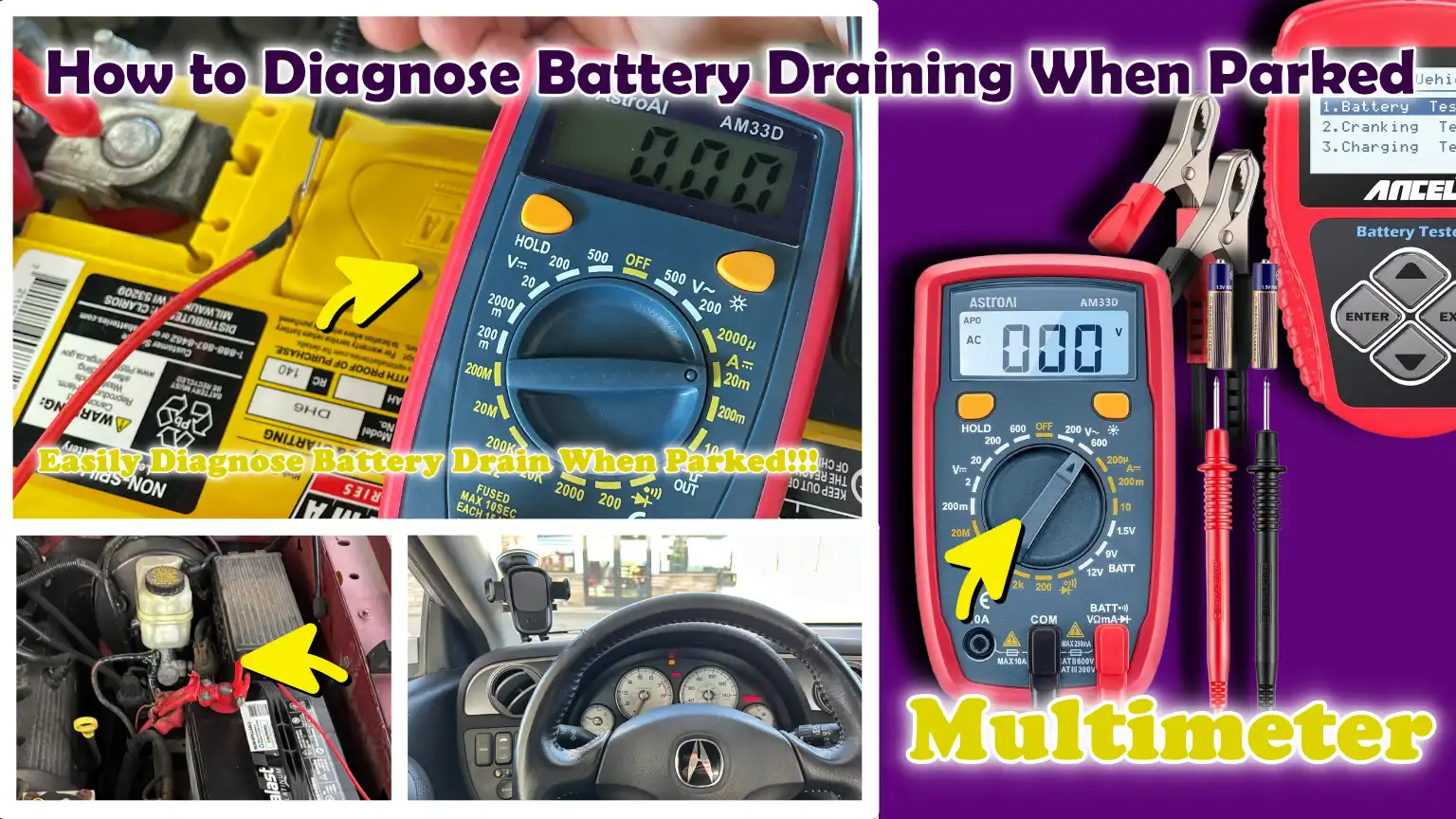
Now, in this guide you’ll learn How to Diagnose Battery Draining When Parked so that you can catch that symptoms early on and prevent from repeated no-start problems.
Know, Common Signs That Your Car Battery Is Discharging While Parked
1. The Car Starts Normally After Being Driven, but Struggles to Start After Sitting Idle for Some Time
A car battery may appear to function normally during the day because the engine’s charging system replenishes some of the electricity consumed while driving.
When the engine is running, the alternator sends power back to the battery and supplies power to the vehicle’s electrical system; this can temporarily mask the issue of the battery discharging.
This is why many vehicles start normally immediately after a trip but struggle to start after sitting idle overnight.
If the battery’s power continues to drain while the vehicle is parked, the engine may crank slowly in the morning, even if it was functioning perfectly just a few hours earlier.
This is often a sign that the battery is not discharging while the vehicle is being driven, but rather that something is drawing power after the engine has been switched off.
It may also indicate that the battery’s “reserve capacity” (remaining capacity) has diminished; this means it can no longer store sufficient energy to power the vehicle during extended periods of parking.
2. The Battery Completely Discharges After Sitting Unused Overnight or for a Few Days
A healthy 12-volt car battery typically retains enough charge to reliably start the vehicle even after several days of disuse (and in many cases, depending on the temperature and the vehicle’s onboard electronics, even after a few weeks).
If the battery completely discharges overnight, or shortly after the vehicle has been parked, it is often a sign that power consumption is higher than normal.
Modern vehicles constantly draw a small amount of “standby power” to maintain security systems, clock memory, engine computer memory and remote locking systems.
However, when a faulty module remains active, a relay gets stuck, or a light is inadvertently left on, power consumption can surge to such an extent that the battery discharges very rapidly.
If the battery repeatedly drains after the vehicle has been parked, one should always investigate for a hidden electrical drain, as repeated deep discharges can permanently shorten the battery’s lifespan.
3. Dimming Interior Lights During Startup
The dimming of interior lights while starting a vehicle is often the first indication that the battery voltage has dropped during the time the vehicle was parked.
Before the engine starts, the battery alone powers all of the vehicle’s electrical systems; therefore, if the interior lights (cabin lights) appear dim, it often signifies that the battery’s charge has depleted overnight.
This occurs because a drop in battery voltage reduces the power supplied to the lights, power locks, instrument panel and other electronics.
In many vehicles, the interior lights appear even dimmer when the starting issue becomes severe enough that the engine fails to crank over completely.
Drivers often overlook this symptom, yet it frequently manifests before the battery fails entirely.
If the lights appear dim only after the vehicle has been parked for several hours, and return to their normal brightness after the vehicle has been driven, it clearly indicates that the battery is discharging while the vehicle is stationary.
4. A ‘Clicking’ Sound When Turning the Key
A ‘clicking’ sound when turning the ignition key often occurs when the battery possesses sufficient power to activate the starter relay, but lacks the necessary energy to crank the starter motor.
The ‘click’ is typically caused by the starter solenoid engaging momentarily; however, when placed under load, the battery voltage drops so low that it is unable to start the engine.
This is a common symptom of a battery that has discharged overnight; while the battery may still retain some voltage, it lacks the amperage (current) required to crank the engine.
The use of electrical accessories can cause a slight discharge of the battery, leading this issue to manifest intermittently.
One morning, the engine starts without any difficulty; the next morning, only a ‘click’ is heard.
Repeated clicking sounds after parking the vehicle often indicate that the battery is losing its charge while the vehicle is stationary, a condition that should be investigated before replacing any components of the starter system.
5. Warning Lights Illuminating on the Dashboard After Starting
Warning lights may illuminate on the dashboard after starting the vehicle if the battery voltage drops excessively during cranking (the attempt to start the engine).
Modern vehicles rely on a stable voltage supply for their Engine Control Modules (ECMs), transmission systems, safety systems and sensors.
If the battery voltage dips while starting the vehicle, the onboard computer’s connection may be momentarily interrupted, or warning indicators may light up, even if those systems have not actually sustained any damage.
These may include the battery light, “Check Engine” light, traction control warning, or other alerts, which often turn off automatically once the vehicle begins to run.
Battery discharge while the vehicle is parked is often at the root of this problem, as the vehicle is forced to start each morning using a weakened battery.
The sudden voltage drop caused by the load of the starter motor can confuse sensitive electronics, causing warning lights to appear as early symptoms of a discharging battery rather than indicating a distinct mechanical issue.
6. Frequent Need for Jump-Starts
The frequent need for jump-starts is the clearest indication that the battery is losing its charge while the vehicle is parked.
If the charging system and general electrical systems are functioning correctly, a healthy battery should not require regular external charging.
If the vehicle repeatedly requires a jump-start after sitting idle for an extended period, it generally implies one of two things: either the battery has failed and no longer possesses the capacity to hold a charge, or there is a continuous load on the electrical system even after the vehicle has been switched off.
Many people immediately replace the battery; however, if the underlying cause of the power drain persists, the new battery is likely to suffer the same fate.
Furthermore, repeated jump-starting can gradually damage the battery over time, as frequent complete discharges lead to internal chemical degradation, thereby reducing its energy storage capacity.
Before replacing expensive components, the most effective way to identify the source of power depletion is often to check for a “parasitic draw” (power theft).
Know, The Common Causes of Battery Discharge When a Vehicle is Parked
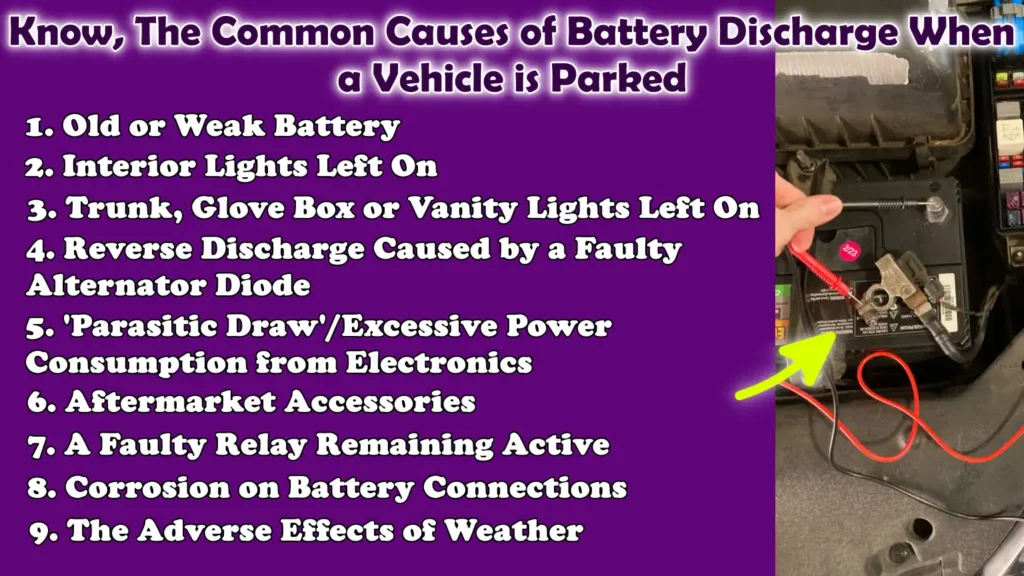
1. Old or Weak Battery
As a battery ages, its capacity to hold a charge naturally diminishes.
Most standard car batteries begin to weaken after approximately three to five years, depending on weather conditions and driving habits.
Even if the battery occasionally manages to start the vehicle, its internal plates may lack the capacity to store the energy required to maintain power while the vehicle remains parked for extended periods.
An aging battery may appear to function normally immediately after driving, but it can lose its charge very rapidly when the vehicle is not in use.
2. Interior Lights Left On
If interior lights remain illuminated after the vehicle has been parked, they can surreptitiously drain the battery.
If a door switch becomes stuck or a light switch is inadvertently left in the “on” position, the dome light, map lights, or reading lights may remain lit.
As these lights consume electricity continuously, they can gradually discharge the battery over several hours, particularly if they remain on throughout the night.
3. Trunk, Glove Box or Vanity Lights Left On
Small, hidden lights are a common cause of battery discharge because drivers often fail to notice them.
If the trunk latch switch malfunctions, the trunk light may remain lit; similarly, if the switches for the glove box or vanity mirrors do not close properly, their respective lights may stay on.
Although these lights consume less power compared to headlights, they can still drain the battery if they remain illuminated for several hours each day.
4. Reverse Discharge Caused by a Faulty Alternator Diode
A defective diode within the alternator can allow electricity to flow in the reverse direction when the engine is turned off.
Instead of charging the battery, the alternator slowly discharges it throughout the night.
Diagnosing this issue can be challenging, as the battery charges normally while the vehicle is being driven but gradually loses its power when parked.
5. ‘Parasitic Draw’/Excessive Power Consumption from Electronics
Modern vehicles continue to consume a small amount of electricity even after the engine has been switched off.
Systems such as alarms, clock memory and the engine computer typically draw very little power.
The problem arises when an electronic module fails to enter ‘sleep mode’ and, instead, remains active.
This excessive power consumption is referred to as ‘parasitic drain,’ and it can deplete the battery much faster than expected.
6. Aftermarket Accessories
Accessories installed after the purchase of a vehicle can often drain the battery if they are not installed correctly.
Common examples include dash cams, GPS trackers, stereo amplifiers, remote starters and USB chargers.
Some devices draw power continuously, even when the ignition is off, particularly if they are wired directly to the battery.
7. A Faulty Relay Remaining Active
A relay controls an electrical circuit by switching the power on and off.
If a relay gets stuck in the “on” position, it can continue to supply power to a system even after the vehicle has been parked.
This can cause fans, modules, or lights to run silently in the background, gradually draining the battery; diagnosing this issue without proper testing can be difficult.
8. Corrosion on Battery Connections
Corrosion on the battery terminals can interfere with proper charging and impede the flow of electricity.
The accumulation of a white or blue powdery substance around the battery posts increases electrical resistance, preventing the battery from charging fully.
A battery with a poor connection may appear to be discharged, even if it is otherwise in good condition, simply because it is not receiving a full charge while the vehicle is running.
9. The Adverse Effects of Weather
Both extreme heat and extreme cold impact battery performance.
Cold weather slows down the chemical reactions occurring within the battery, thereby reducing the amount of power available to start the vehicle.
Hot weather subjects the battery’s internal components to increased wear and tear; furthermore, due to the depletion of internal fluids and the accelerated degradation of chemicals, it can significantly shorten the battery’s lifespan.
Under conditions of extreme temperature, an already weakened battery can deteriorate very rapidly while the vehicle is parked.
Tools
| Tools | Why It Is Needed | How to Use It |
|---|---|---|
| Digital Multimeter | This is the most essential tool for diagnosing battery drain, as it measures both battery voltage and electric current. It helps confirm whether the battery is losing charge while the vehicle is parked and whether a hidden ‘parasitic draw’ (unnecessary power consumption) is occurring. Without it, identifying the root cause relies largely on guesswork. | With the engine turned off, set the device to DC voltage mode to check the battery’s condition. A healthy, fully charged battery typically registers a voltage of approximately 12.6 volts. When checking for parasitic draw, switch the device to amperage mode; to do this, connect it ‘in series’ between the battery cable and the battery terminal after turning off the vehicle. |
| Battery Charger | It is crucial to fully charge a discharged battery before attempting to diagnose it. Testing a low-charge battery can yield misleading results, as the battery may appear weak simply due to its already depleted state. Charging it beforehand ensures that the diagnostic results are more accurate. | Connect the charger clamps to the battery terminals and allow the battery to fully charge before beginning the diagnostic process. After charging, let the battery rest for a while; then, measure the voltage to determine whether the battery is capable of properly holding its charge. |
| Fuse Puller | A ‘fuse puller’ helps identify which specific circuit is draining the battery. Systematically removing fuses one by one, while simultaneously monitoring the current flow, is one of the most effective methods for pinpointing the exact cause of battery drain. | After connecting a multimeter to check for a parasitic draw, remove the fuses from the fuse box one by one. Keep a close watch on the current reading. If the reading suddenly drops, it indicates that the fuse you removed likely controls the specific circuit responsible for the battery drain. |
| Basic Hand Tools | Certain basic tools are required to remove battery terminals and covers and to access specific electrical components. Some causes of battery drain may be hidden beneath panels or behind covers. | Common tools include a wrench, a screwdriver and pliers. Using these tools, you can safely disconnect battery terminals, remove covers and inspect wiring, relays, or battery connections. |
| Battery Load Tester | At first glance, a battery may appear fully charged; however, it may fail to perform adequately when placed under load by the engine. This tool verifies whether the battery can deliver sufficient power when the starter motor suddenly demands a high surge of current. | Connect the tester to the battery and apply a “test load” according to the tester’s instructions. This reveals how much the battery’s voltage drops under load, thereby indicating whether the battery itself has become weak. |
| Safety Gloves | Car batteries contain acid and sparks may be generated during the inspection process. Gloves protect your hands from acid-related injuries, accidental contact and sharp components located within the engine bay. | Wear gloves before handling battery terminals, cables, or electrical components. They are particularly useful when cleaning corrosion or disconnecting the battery. |
| Notebook | Diagnosing a battery discharge issue often requires comparing readings taken at various stages of the troubleshooting process. Recording voltage and current measurements helps you monitor changes and avoid any confusion. | Record the battery’s resting voltage, current consumption readings, the numbers of any removed fuses and any changes observed during the inspection. This makes it easier to identify patterns and pinpoint the root cause of the problem. |
First, Check the Battery’s Condition
1. Check the Battery’s Age
Checking the battery’s age is one of the very first steps to take, as the performance of most car batteries tends to decline as they get older.
Under normal usage, many lead-acid batteries begin to weaken after approximately three to five years.
As a battery ages, its internal plates gradually deteriorate and its capacity to store energy diminishes.
Even if the car still starts, an aging battery left unused, particularly in cold or extremely hot weather, as it can lose its charge very rapidly.
2. Check the Date on the Battery Label
Most batteries feature a manufacturing date printed on a sticker, or a date code stamped on the top or side of the unit.
This date indicates the battery’s age and helps you determine whether the current issue stems from the battery simply being old.
A battery may look brand new on the outside, yet its service life could be nearing its end.
Checking the label is crucial, as a battery may have been installed years ago and still appear new, even though its ability to hold a charge has significantly diminished.
3. Measure the Resting Voltage
Measuring the resting voltage provides an initial snapshot of the battery’s condition before proceeding with a more in-depth inspection.
Use a digital multimeter with the engine turned off and all accessories such as: lights and the stereo, switched off.
A fully charged battery typically registers a voltage of approximately 12.6 volts.
If the reading is around 12.2 volts or lower, the battery may be partially discharged or showing signs of weakness.
However, while voltage alone cannot pinpoint the exact cause of a fault, it certainly indicates whether the battery retains sufficient charge to allow for further diagnostics.
4. Check the Battery After Letting the Vehicle Sit Overnight
Checking the battery immediately after driving may make it appear to be in good condition, as the alternator has just recharged it.
Checking the car after it has sat overnight provides more accurate information, as it reveals whether the battery is capable of retaining its charge even when the engine is off.
If the voltage drops significantly overnight, it could indicate that the battery is weak or that a component is draining its power while the vehicle is parked.
5. Check for Swelling or Leaks
Even before conducting any formal testing, visible external defects can signal that the battery is failing.
If the battery casing appears swollen or bulging outward, it often means that the battery has overheated internally, has been overcharged, or has sustained damage due to cold weather.
Leakage around the battery terminals may indicate the presence of cracks or an issue with internal pressure.
These signs often imply that the battery is no longer safe or reliable, even if it still retains some residual charge.
If the battery appears deformed upon visual inspection, it is generally advisable to replace it.
6. Check the Terminals for Corrosion
The battery terminals should be clean and securely connected.
Any white, blue, or green residue accumulating around the terminals is known as corrosion; this corrosion can obstruct the flow of electricity between the battery and the vehicle.
Corrosion increases electrical resistance, preventing the battery from charging properly and causing it to appear weak.
It is possible that the battery itself is internally sound; However, due to poor contact at the terminals, difficulties may arise in starting the vehicle and inaccurate readings may also be obtained during inspection.
How to Measure the Battery’s Resting Voltage
1. How to Properly Use a Multimeter
To measure the battery’s resting voltage, use a digital multimeter set to DC volts.
The engine must be off, the headlights must be off and the car should be left undisturbed for at least a few hours, ideally overnight, so that the battery settles completely into a resting state.
Touch the red probe to the battery’s positive terminal and the black probe to the negative terminal.
This reveals the battery’s open-circuit voltage, which is the easiest way to check the battery’s basic condition before conducting more in-depth electrical testing.
2. Voltage Range for a Healthy Battery
The resting voltage of a fully charged 12-volt car battery is typically around 12.6 volts.
A reading between approximately 12.6 and 12.8 volts is generally considered healthy and indicates that the battery holds a good charge.
This means the battery likely has sufficient stored energy to start the engine and support normal standby systems while the car is parked.
Although there may be slight variations depending on the temperature, this range generally indicates that the battery is in good condition.
3. Voltage Range Indicating a Weak Battery
A reading between approximately 12.2 and 12.4 volts often suggests that the battery has become slightly discharged or is beginning to weaken.
The battery may still be able to start the car, but it lacks the reserve power it ideally should possess.
This becomes even more apparent when the vehicle remains parked overnight, as normal standby systems continue to draw small amounts of power.
A weak battery falling within this range may face even greater difficulties if a hidden electrical drain is also present.
4. Voltage Readings Indicating Excessive Discharge
If the battery voltage reading is approximately 12.0 volts or lower, it is significantly discharged and may be unable to reliably start the engine.
A reading of approximately 11.8 volts or less often indicates that the battery has lost a substantial portion of its charge and may be approaching a “no-start” condition.
If the battery level remains at this point after the car has been parked, it may suggest either a significant “parasitic drain” (unnecessary power consumption) or that the battery is no longer capable of holding a charge effectively.
5. Why Checking Voltage is Essential Before Conducting Deeper Diagnostics
Checking the voltage is crucial because it reveals the condition of the battery before you proceed to inspect other components of the system.
If the battery is already weak, the results of tests designed to detect issues such as: parasitic draws or charging system malfunctions, may be inconclusive or misleading.
Starting with a voltage check helps distinguish between a battery-specific issue and a problem related to power consumption.
It also prevents the unnecessary replacement of components when the actual underlying issue is simply a weak battery that is no longer capable of storing sufficient electrical energy.
How to Perform a Parasitic Draw Test
1. What Does “Parasitic Draw” Mean?
Parasitic draw refers to the continuous discharge of electricity from the battery even after the engine has been turned off.
Every modern car consumes a certain amount of normal electrical power, as systems such as the clock, security system, radio memory and engine computer require a constant supply of electricity.
A problem arises when a specific circuit begins to consume an excessive amount of power.
This can occur if a control module fails to shut down, a relay remains energized, or a hidden light remains illuminated.
This excessive power consumption gradually drains the battery while the car is parked, even if everything appears to be turned off.
2. Acceptable Standby Current
Most vehicles draw a small amount of “standby current” when parked and this is considered normal.
In many passenger vehicles, the normal power consumption typically ranges between 20 and 50 milliamps after the car has fully shut down.
Some newer vehicles, equipped with more sophisticated electronics, may draw slightly higher power for a short period.
If the power consumption remains excessively high, for example, 100 milliamps or more, and persists for an extended duration, the battery can drain much faster than usual.
A high reading often indicates that a specific component remains active when it should be turned off – or be in “sleep mode”.
3. How to Safely Connect an Ammeter
A parasitic draw test is typically performed using the amperage function of a digital multimeter.
Instead of connecting the meter directly across the battery terminals, it must be connected in series.
This requires disconnecting one of the battery cables, usually the negative cable, and positioning the meter between the battery post and the disconnected cable so that the entire flow of electricity passes through the meter.
This arrangement allows the meter to accurately measure the precise amount of power being drawn from the battery while the car is turned off.
Connecting the meter incorrectly can blow the meter’s fuse or cause damage to the device itself.
4. Why Do Vehicle Modules Require a “Sleep Time”?
In many modern vehicles, not all electronic components shut down immediately after the ignition key is removed.
Computer modules may remain active for several minutes to complete system checks, save memory data, or manage security features.
During this period, power consumption may appear elevated, even in the absence of any internal faults.
Therefore, performing diagnostics too hastily can yield misleading results.
Before taking a final reading, the vehicle should be left undisturbed to allow these systems to enter “sleep mode”.
5. How Long Should You Wait Before Taking a Reading?
The necessary waiting time varies depending on the vehicle model; however, in many cars, it takes at least 20 to 45 minutes for all modules to shut down completely.
Some advanced vehicles may require even more time.
During this interval, opening a door, unlocking the vehicle, or switching on the lights can reactivate the modules, thereby restarting the entire shutdown sequence.
Waiting for a sufficient period is crucial, as the final reading should reflect only the true standby current, rather than any temporary system activity.
6. Common Mistakes Made During Testing
A common mistake is testing the battery before it is fully charged, as a weak battery can result in misleading readings.
Another error involves opening the doors during the test, which triggers the interior lights and activates the electronic modules.
Some individuals remove the meter before the vehicle has fully entered “sleep mode”.
A common mistake is connecting the meter directly to the battery terminals, rather than connecting it “in series” between the terminals, as this prevents an accurate measurement of the current and also poses a risk of damaging the meter.
For accurate testing, patience, correct connections and ensuring that the vehicle remains completely undisturbed throughout the entire process are essential.
How to Identify Which Circuit Is Draining the Battery
1. Removing Fuses One by One
Once it has been confirmed that the battery is experiencing a ‘parasitic draw’ (excessive power consumption), the next step is to pinpoint exactly which circuit is drawing such a high amount of power.
This procedure is typically performed while a digital multimeter is connected to measure the current and you proceed to remove the fuses one by one.
Each fuse controls one or more electrical circuits such as: interior lights, radio memory, door modules, or the charging system.
When the correct fuse is removed, the power consumption typically drops significantly.
This indicates that the battery-draining issue is linked to the specific circuit controlled by that fuse.
2. Recording Changes in Current
It is beneficial to note down the current readings both before and after removing each fuse.
Minor fluctuations are common; however, if there is a sudden and substantial drop in the current, it often signifies that the fault lies within that specific circuit.
Recording these readings helps prevent confusion, specially when multiple fuses are being tested.
Some vehicles have more than one fuse box and without proper notes, it is easy to forget which fuse removal resulted in a change in the readings.
Maintaining a clear, written record of the readings makes the troubleshooting process significantly more accurate.
3. Identifying the Faulty Fuse
The fuse whose removal results in the most significant drop in current is typically the one associated with the problem.
For instance, if the battery draw is 250 milliamperes and removing a specific fuse causes it to drop to 35 milliamperes, there is a very high probability that a fault exists within that particular circuit.
The fuse itself is rarely the cause of a malfunction.
Instead, a specific component connected to that circuit is typically drawing a continuous current.
The fuse simply helps narrow down the scope of the investigation, making it possible to identify the actual faulty component.
4. Understanding the Fuse Box Diagram
Every fuse box is accompanied by a diagram, which is typically located inside the fuse box cover or within the vehicle’s owner’s manual.
This chart indicates which specific system each fuse protects.
Understanding this diagram helps determine whether the suspected faulty circuit controls the lighting, power locks, radio, a control module, or another system.
Once the specific fuse number has been identified, the diagram makes it easy to determine which components should be inspected next.
5. Common Causes of Battery Drain – Circuits
Some circuits are more prone to causing battery drain than others.
Circuits controlling the vehicle’s interior lights frequently face this issue, as their switches can fail, causing the lights to remain continuously illuminated, a situation that often goes unnoticed.
If the radio system fails to shut down properly, it too can deplete the battery’s power.
Circuits associated with security systems, body control modules, power seat memory functions and charging systems are also frequently the primary culprits behind battery drain.
In many vehicles, “aftermarket accessories” (components installed after the vehicle was manufactured) connected to these circuits can also be hidden causes of battery drain.
6. Re-verification After Disconnection
Once a suspected circuit has been identified, the system should be re-tested after the problematic component has been repaired or disconnected.
This ensures that the battery drain issue has, in fact, been resolved.
Re-verification is crucial, as it often happens that multiple circuits operating simultaneously can collectively give rise to this issue.
Following the repair, the final current reading should return to the normal standby range; this indicates that the battery is now capable of properly retaining its charge, even when the vehicle is parked.
How to Check for Hidden Interior Lights
1. Dome Lights
Dome lights are one of the most common causes of battery drain, as they can remain lit even during the day and often go unnoticed.
If a door switch gets stuck or the light switch is left in the ‘manual on’ (always-on) position, the dome light can continue to draw power even after the car has been parked.
Even a small interior bulb, if left on for several hours, can completely drain a weak battery overnight.
Checking the cabin at night or peering through the windows can help ensure that the dome light is switching off properly.
2. Trunk Light
The trunk light often goes unnoticed because it only illuminates when the trunk is open; consequently, many drivers are unaware that it has remained on.
A faulty latch switch can prevent the light from turning off when the trunk is closed.
As the trunk remains closed, the light remains hidden and can continue to draw power from the battery for hours.
This is a common cause of sudden battery failure, particularly when the car is left parked overnight or over a weekend, resulting in a completely drained battery.
3. Glove Compartment Light
The glove compartment light is another hidden culprit behind battery drain.
It is controlled by a small switch that turns off the light when the compartment door is closed.
If that switch gets stuck or breaks, the light can remain continuously lit.
Because the glove box remains closed, this issue often goes unnoticed.
Although a small bulb may seem harmless, its continuous power consumption can gradually discharge the battery while the car is parked.
4. Under-Hood Service Light
Some vehicles are equipped with an under-hood service light, designed to provide illumination while working within the engine bay.
If the hood switch fails to disengage properly or the light remains active, it can continuously draw power, even when the car is parked.
As the hood is typically kept closed, this manner of battery drain often goes unnoticed.
While it may not deplete the battery immediately, over the course of several hours or days, it can discharge the battery to such a low level that starting the car becomes difficult.
5. Vanity Mirror Lights
The vanity mirror lights embedded within the sun visors are small, but if left on, they too can drain the battery.
These lights typically shut off automatically when the mirror cover is closed.
If the cover fails to close completely or the switch becomes stuck, the light may remain illuminated.
As the visor is usually folded upward, drivers often fail to notice the lit mirror, particularly during the daytime.
This hidden cause of battery drain frequently goes undetected during quick, routine vehicle checks.
6. Door Courtesy Lights
Door courtesy lights, typically located near the lower edge of the doors or inside the cabin, as it can remain lit if a door switch malfunctions or if a door latch fails to engage fully.
These lights are designed to switch off automatically as soon as all the doors are closed.
If one of these lights remains on, it can slowly drain the battery over the course of an entire night.
Furthermore, this issue can cause certain vehicle computer modules to remain active, thereby increasing overall power consumption and accelerating the rate at which the battery drains.
Read More:
How to Check for Reverse Drain in the Alternator
1. How Alternator Diodes Fail
The alternator converts engine power into electricity and utilizes diodes to transform AC power into DC power for the battery.
These diodes act like one-way gates, allowing electricity to reach the battery while the engine is running.
If a diode fails, electricity can leak back in the reverse direction through the alternator after the engine has been switched off.
This reverse flow gradually drains the battery while the car is parked, even if everything else appears to be turned off.
2. Symptoms of a Faulty Diode
A faulty alternator diode can drain the battery, a problem that may initially appear to occur suddenly.
The car might start normally after being driven, but by the next morning, the battery could be weak.
Other symptoms include dimming lights prior to starting, a recurring need for jump-starts and the battery going completely dead even after being fully charged.
In some cases, drivers may also hear a faint buzzing sound or feel the alternator heating up after the engine is turned off, as current continues to flow through the defective component.
3. Checking Charging Voltage
Checking the charging voltage helps determine whether the alternator is functioning correctly while the engine is running.
Use a digital multimeter to measure the battery voltage while the engine is idling.
In most properly functioning systems, the reading typically falls between 13.8 and 14.7 volts.
If the charging voltage is too low, the battery will not be able to fully recharge.
Conversely, if it is too high, the battery may overheat and fail prematurely.
A faulty diode may sometimes still yield normal charging voltage readings; therefore, further investigation may be required.
4. Checking for Overnight Backfeed
A common method for checking for alternator backfeed is to do so during a “parasitic draw test”.
If the current flow drops significantly upon disconnecting the alternator’s main power cable, it is likely that the alternator is leaking power back through a faulty diode.
Another indication is that the battery loses its charge overnight, even after all fuses have been checked.
This reverse drain from the alternator often occurs silently and does not trigger any warning lights.
5. When the Alternator Needs Replacement
If testing confirms that a diode is faulty, the alternator typically needs to be replaced, as in many vehicles, the diode pack is integrated directly into the alternator unit itself.
If the alternator continues to discharge the battery overnight, simply replacing the battery will not resolve the issue.
If a faulty alternator repeatedly discharges the battery, even a new battery can be damaged.
Once this is confirmed, replacing the alternator restores proper charging and prevents future problems, such as the battery discharging while the vehicle is parked.
How to Check Aftermarket Devices
1. Dash Cameras
If a dash camera remains active even after the engine has been switched off, it can drain the battery.
Many cameras are wired to include a ‘parking mode,’ which continues recording even when the car is parked.
While this feature can be useful, it also means the camera continues to draw power from the battery for several hours.
If the hardwire kit is not installed correctly or lacks ‘low-voltage protection,’ the battery could discharge overnight, specially if the battery is already weak.
2. Alarm Systems
Aftermarket car alarm systems often continuously draw power from the battery to monitor doors, detect motion and prevent unauthorized entry.
A properly installed alarm draws only a very small amount of ‘standby current’; however, a faulty control unit or wiring issues can significantly increase power consumption.
Older alarm systems are particularly notorious for draining batteries, as some units remain continuously active without ever entering a ‘low-power standby mode’.
3. GPS Trackers
GPS trackers can cause battery drain because they remain connected to the power supply even when the car is parked.
These devices frequently transmit location data, update via mobile networks and remain active at all times.
Some of these devices are installed by vehicle owners, fleet management companies, or financing institutions.
If a tracker transmits data frequently, it can gradually deplete the battery’s charge over time, particularly when the car remains parked for extended periods.
4. Audio Amplifiers
If an aftermarket car audio amplifier does not shut down properly, it can drain the battery.
Many amplifiers rely on a ‘remote signal wire’ to ensure that they automatically switch off when the ignition is turned off.
If this wire is not connected properly, the amplifier may remain active in the background.
Even if no music is playing, it can still draw enough power to drain the battery overnight.
5. USB Chargers
If a USB car charger is plugged into a port that remains active even after the engine is turned off, it can continuously draw power.
Some cars continue to supply power to their “accessory ports”, even when the vehicle is parked, to allow devices to charge.
Chargers equipped with built-in lights, voltage displays, or attached cables draw a small, yet constant, amount of power.
Over time, specially when the car remains stationary for extended periods, this can lead to battery discharge.
6. Remote Start Systems
Remote start systems introduce additional wiring into the vehicle’s ignition and electrical systems.
If not installed correctly, the “control module” may remain active and continuously draw power.
Some remote start systems also maintain a connection via cellular or radio signals to receive commands, thereby increasing “standby consumption”.
Improper installation is a common reason why these systems silently drain the battery.
7. OBD Devices
OBD scanners or plug-in trackers, which connect to the diagnostic port, as it can drain the battery if left plugged in continuously.
These devices often maintain communication with the car’s onboard computer and may remain active at all times.
Some devices even prevent specific modules from entering “sleep mode,” thereby increasing overall standby current consumption.
If battery-related issues arise after installing an OBD device, a crucial troubleshooting step is to temporarily remove the device to see if the problem resolves.
How to Check Battery Terminals and Grounds
1. Loose Terminal Clamps
Battery terminal clamps must fit tightly onto the battery posts, as they carry the full current required to start and charge the vehicle.
If a clamp is loose, the battery may fail to charge fully while driving and may be unable to deliver sufficient power during startup.
This can create the impression that the battery is discharging while the vehicle is parked, whereas the actual issue lies in poor electrical contact.
Loose connections can sometimes cause problems such as difficulty starting, flickering lights, or a distinct ‘click’ sound when turning the ignition key.
2. Corrosion Buildup
Corrosion around the battery terminals is a common cause of poor electrical performance.
It typically appears as a white, blue, or green powdery substance on the battery posts or cable ends.
This buildup creates resistance, slowing down the flow of electricity between the battery and the vehicle.
If corrosion obstructs proper charging or power delivery, even a perfectly good battery can appear weak.
Cleaning the terminals can often restore performance to normal levels without the need to replace the battery.
3. Ground Cable Issues
The battery’s negative cable connects the battery to the vehicle’s ground system.
If this cable is loose, damaged, or corroded, the battery will be unable to properly complete the electrical circuit.
This can result in slow cranking (sluggish starting), poor charging and erratic electrical behavior.
Ground cable issues often mimic the symptoms of a failing battery; the battery itself may possess adequate power, but that power cannot flow effectively through the system.
4. Chassis Ground Points
The battery is grounded to the vehicle’s body and engine through various metal grounding points.
These connection points serve to return current to the battery after it has powered the various electrical components.
If a ground point becomes corroded, loose, or dirty, electrical resistance increases.
This can adversely affect charging, starter operation and various electronic systems.
A poor ground connection can sometimes mimic the symptoms of a discharged battery, making the battery appear weak, when the actual issue is an obstruction in the flow of current.
5. Faulty Cables
Battery cables can deteriorate internally, even if they appear to be in good condition on the outside.
Factors such as heat, age, corrosion and vibration can cause the internal wires within the cables to fray or break, thereby reducing their current-carrying capacity.
A faulty cable may still transmit some power, but it is often insufficient to reliably start the vehicle.
The symptoms can resemble those of a discharged battery, particularly when the vehicle has been parked for some time and the battery’s charge has naturally diminished slightly.
6. Voltage Drop Testing
Voltage drop testing helps determine whether cables and connections are transmitting electricity properly.
This test utilizes a digital multimeter to measure the amount of voltage loss occurring within the cables while the engine is being started.
If a significant voltage drop is detected, it indicates excessive resistance within the cable or its connections.
This diagnostic procedure is highly valuable because, in many instances, symptoms resembling a rapidly discharging battery are not actually caused by a deficiency in the battery’s power-delivery capacity, but rather by faulty electrical connections.
Understand, How Temperature Affects Battery Discharge
1. Battery Discharge in Cold Weather
Cold weather reduces the amount of power delivered by a car battery.
Inside a lead-acid battery, as the temperature drops, chemical reactions slow down; this means the battery cannot release energy as easily.
A battery that seems perfectly fine in warm weather may suddenly cause problems in winter, as it has less available power to start the vehicle.
Furthermore, starting a cold engine requires more power, placing a greater strain on the battery.
Consequently, battery discharge, specially overnight, becomes much more pronounced during the colder months.
2. Battery Degradation in Hot Weather
Hot weather can damage a battery over time, even if the symptoms are not immediately apparent.
High temperatures increase internal heat and accelerate the process of chemical breakdown within the battery.
In traditional lead-acid batteries, heat can cause the battery fluid to evaporate rapidly, leading to a significant reduction in fluid levels.
As the internal fluid level drops, the battery plates begin to deteriorate, thereby reducing the battery’s overall capacity.
This means that a battery weakened by the summer heat may fail later on, while the vehicle is parked, even if it had been functioning normally prior to that.
3. Variations in Self-Discharge
All batteries gradually lose their charge on their own, even when they are not connected to a vehicle.
This phenomenon is known as “self-discharge”.
Temperature plays a crucial role in determining the rate at which this process occurs.
Warm temperatures typically accelerate self-discharge; this means that when a vehicle is parked, the battery loses its stored energy more rapidly.
In a healthy battery, this loss of energy is usually slow; However, in an aging or internally compromised battery, this depletion can occur very rapidly.
Consequently, starting the vehicle after it has been left parked for several days may become difficult.
4. Temperature Exposes a Weak Battery
Temperature often exposes a battery that was already weak but still functioning.
A battery nearing the end of its lifespan may perform adequately in mild weather, but it can suddenly fail on a cold morning or following a period of extreme heat.
This occurs because aging batteries lose their reserve capacity; consequently, temperature fluctuations have a more severe impact on them.
Although the battery itself may not be the sole issue, changes in weather often reveal internal weaknesses long before they would otherwise manifest on their own.
5. Seasonal Inspection Tips
It is beneficial to inspect the battery before significant changes in weather occur.
Prior to winter, checking the battery’s “resting voltage” (when the vehicle is off) and its starting performance helps detect internal weaknesses before the cold weather causes the battery to fail completely.
Following the hot summer months, checking for low fluid levels, battery swelling and voltage drops helps identify damage caused by heat exposure.
Using a digital multimeter before the seasons change allows for early detection of problems, thereby preventing issues such as the vehicle failing to start unexpectedly after being parked.
When the Problem Lies Within the Battery Itself
1. Internal Cell Short
A car battery consists of multiple internal cells; if a short circuit occurs within just one of these cells, the battery’s power can be completely depleted, even if no vehicle components are actively drawing power.
This happens when the plates inside the battery come into contact with one another or become damaged, creating an internal electrical pathway that drains the stored energy.
A battery with a shorted cell may appear to accept a charge for a while, but its voltage will drop rapidly after the vehicle is parked.
Symptoms may include weak cranking (difficulty starting the engine) and the battery repeatedly going dead, even if the vehicle’s charging system is functioning correctly.
2. Sulfation
Sulfation occurs when a battery remains in a partially discharged state for an extended period.
Lead sulfate crystals accumulate on the battery plates, thereby reducing its capacity to store energy.
This issue is common in vehicles that are not driven frequently or that remain parked for long durations.
When sulfation becomes severe, the battery may still register a voltage reading, but it loses the ability to retain a charge over time and struggles to start the engine.
This often leads to the misconception that a hidden electrical drain is drawing power from the battery, whereas, in reality, the problem lies within the battery itself.
3. Low Reserve Capacity
Reserve capacity refers to the duration for which a battery can continue to supply power before its voltage drops to a critically low level.
As a battery ages, this reserve capacity gradually diminishes.
The battery may possess sufficient power to start the vehicle immediately after a drive, but it may fail to do so after sitting overnight, as it no longer retains enough stored energy to power the vehicle’s standard standby systems.
Limited reserve capacity is the primary reason why some batteries appear to function normally during the day but falter after the vehicle has been parked for several hours.
4. Battery Failure Even After Being Fully Charged
A battery may appear to be fully charged, yet it can still fail to function.
Voltage readings merely indicate the battery’s surface charge, rather than its actual capacity to deliver power under load.
Some batteries may reach 12.6 volts after charging but are unable to sustain that charge for an extended period.
Conversely, with other batteries, the voltage drops rapidly the moment the starter motor places a load on them.
This explains why the battery charge indicator on the dashboard may appear normal, yet the car fails to start the following morning.
5. The Impact of Battery Age on Diagnostics
Battery age is a critical factor, as many symptoms of declining battery performance are, in reality, simply the result of normal wear and tear from daily use.
Most standard car batteries begin to lose their reliability after approximately three to five years.
Older batteries become more susceptible to temperature fluctuations, prolonged periods of inactivity (when the car is parked) and even minor electrical loads.
During the diagnostic process, assessing the battery’s age can help determine whether its failure is a natural consequence of aging or if the issue stems from an external electrical fault.
6. When Is the Best Time to Replace a Battery?
Generally, the optimal time to replace a battery is when it fails a load test, repeatedly discharges despite being fully charged, or exhibits signs of internal defects.
A battery load tester can be used to verify whether the battery is still capable of delivering the necessary power to start the vehicle.
If a battery is several years old and continues to discharge even after the entire electrical system has been checked, replacing it often saves time and eliminates the recurring hassle of the car failing to start.
How Long Should a Good Battery Hold Its Charge While Parked?
Plus, there’s research that shows that self-discharge actually incrases with higher temperatures and battery aging as well, which is why when you park your car then it may fail to start: not only because of some electrical drain but it is because the battery itself is losing stored energy over the period of time, so before checking for any hidden electrical drain, it becomes really important to understand that all lead-acid batteries literally lose the charge slowly but naturally.[¹]
1. Expectations for Overnight Parking
Generally, a good car battery should have no trouble starting the vehicle, even after being parked overnight.
Standard standby systems such as: the clock, security system and memory settings, consume very little power when the vehicle is parked.
If a fully charged battery goes flat after just a single night, it usually indicates either a fault within the battery itself or an abnormal electrical drain.
In a properly functioning vehicle, the battery is generally not expected to discharge overnight.
2. Expectations for One Week
A good battery in sound condition can typically start most vehicles even after sitting unused for about a week.
This depends on the age of the battery, weather conditions and the number of electronic systems that remain active while the engine is off.
A new battery with normal standby current consumption can usually accomplish this without any issues.
If the battery goes flat within just a few days, it often suggests that the battery’s capacity has diminished or that there is a hidden electrical drain.
3. Expectations for Two Weeks
Many vehicles equipped with a robust battery can still start after being parked for two weeks, specially if the battery is fully charged and the vehicle has no internal electrical faults.
However, the battery voltage may gradually drop, as standby systems continue to consume power throughout this entire period.
Older batteries often struggle within this timeframe, as they possess lower reserve capacity and may not perform as reliably after being parked for an extended duration.
4. Parking for One Month
Remaining parked for a full month can be challenging for many vehicles, particularly for newer models equipped with numerous electronic systems.
Although some high-quality batteries may still be able to start the engine after this period, the likelihood of success depends heavily on the battery’s overall condition and the vehicle’s standby current consumption.
If the battery is several years old, or if the ambient temperature is extremely high or low, the probability of the vehicle failing to start increases.
When a vehicle remains parked for an extended period, it is often beneficial to use a battery charger or maintainer to preserve the battery’s charge.
5. Factors Influencing Duration
The length of time a battery retains its charge while parked depends on the battery’s age, the ambient temperature, its state of charge and the electrical load.
A fully charged battery will last longer than a half-charged one.
Cold weather reduces the amount of power available to start the vehicle, while hot weather accelerates the battery’s degradation process.
Corrosion, improper charging and faulty cables can also reduce the duration for which the battery retains the power necessary to start the vehicle.
6. The Impact of Modern Vehicle Electronics
Modern vehicles consume more standby power than older cars because several systems remain active even when the vehicle is parked.
Security modules, keyless entry systems, memory seats, onboard computers and remote communication systems, all consume small amounts of electricity.
Although this power consumption is generally normal, it means that when a modern vehicle remains parked for an extended period, its battery discharges more rapidly than that of older vehicles, which featured fewer electronic components.
How to Prevent Battery Discharge While Parked
1. Drive Regularly
Driving regularly gives the alternator an opportunity to recharge the battery and replenish the power consumed during ignition.
On short trips, the battery does not fully recharge because a significant amount of current is drawn over a very short period during ignition.
Longer trips allow the charging system to bring the battery back to a nearly full charge.
If a vehicle remains parked and undriven for several days, the battery will gradually discharge due to normal standby systems; therefore, regular use helps prevent this gradual discharge.
2. Use a Trickle Charger
A trickle charger provides a small, controlled flow of current to ensure the battery remains fully charged even while the vehicle is parked.
This is particularly useful for vehicles that sit idle for weeks such as: seasonal cars or those driven only occasionally.
A high-quality charger monitors the battery’s voltage and delivers only the power necessary, thereby helping to prevent overcharging.
This can extend the battery’s lifespan and reduce the risk of the vehicle failing to start after a prolonged period of parking.
3. Disconnect Accessories
Accessories that remain plugged in can gradually drain the battery, even when the engine is turned off.
These include phone chargers, GPS devices, dash cams and plug-in diagnostic tools.
Some power outlets remain active even after the ignition is switched off, meaning connected devices continue to draw power.
Disconnecting these devices before parking the car minimizes unnecessary battery drain and helps preserve the charge.
4. Keep Terminals Clean
Clean battery terminals ensure a proper flow of electricity between the battery and the vehicle.
Corrosion creates resistance, which prevents the battery from fully recharging while the vehicle is being driven.
Even if the battery itself is in good condition, dirty terminals can make it appear weak or underperforming.
Checking for white or blue deposits and cleaning the connections helps improve charging efficiency and reduces the difficulty faced when trying to start the vehicle after it has been parked.
5. Replace Old Batteries
Most car batteries gradually lose their capacity after a few years.
An aging battery may function adequately during daily driving, but it can fail after a period of disuse.
Replacing an old battery before it fails completely can prevent the problem of the vehicle suddenly refusing to start.
This situation becomes even more critical when the battery struggles to function in cold weather or repeatedly loses its charge, even if it has passed routine minor tests.
6. Check the Charging System
If the battery’s charge continues to drain even while the vehicle is parked, it is crucial to inspect the charging system.
A weak alternator, faulty wiring, or a defective diode can prevent the battery from charging properly while the vehicle is running.
This means that the battery may not reach a full charge, even after long journeys.
Checking the system voltage with a digital multimeter helps determine whether the battery is receiving the correct charging levels.
7. Inspect Before Long-Term Parking
Checking the condition of the battery before leaving the vehicle parked for several days or weeks can help prevent future complications.
Ensure that all lights are switched off, accessories are unplugged and the battery is fully charged.
If the battery is old or the vehicle is equipped with numerous electronic devices, using a battery maintainer or completely disconnecting the battery may be beneficial.
A brief check performed before parking a vehicle for an extended period often saves the battery from failing when the vehicle is needed again.
Conclusion – How to Diagnose Battery Draining When Parked
So, whenever a car loses power when you park the vehicle so that clearly means you need to fix something so that you can no longer have to face no-start issues.
In many instances, the battery itself is not the root cause of the problem.
A parasitic electrical load, a faulty alternator diode, aging battery cells, a poor ground connection, or accessories that remain continuously active, all these factors can gradually drain the battery’s charge while the vehicle is parked.
As modern vehicles constantly draw power to support memory functions, security systems and control modules, even a slight increase in power consumption can deplete the battery to the point where the engine fails to start.
The most effective approach to diagnosing a battery discharge issue is to perform a few simple diagnostic checks first, rather than immediately replacing components.
Checking the battery’s age, measuring its resting voltage, conducting a standby current test and examining individual circuits via fuse testing, all these steps frequently help pinpoint the true source of the problem.
This step-by-step process prevents the wasteful expenditure of money on unnecessary repairs and helps determine whether the issue lies with the battery itself or with an associated component.
So, that’s it from this guide and you can comment for more.
Frequently Asked Questions
FAQ 1: Can a car battery discharge while the vehicle is parked, even if it is new?
Answer: Yes, even a new battery can discharge while the vehicle is parked. A new battery merely stores power; it cannot prevent other electrical issues within the vehicle. If a component continues to draw power even after the engine has been turned off such as: a light, a faulty relay, or an electronic module, even a brand-new battery can lose its charge. In many cases, simply replacing the battery does not resolve the issue, as the root cause lies within the vehicle’s electrical system itself.
FAQ 2: How much battery discharge is considered normal while a vehicle is parked?
Answer: Some degree of battery discharge is normal, as modern vehicles continuously supply power to systems such as clocks, alarms, keyless entry and memory settings. In many vehicles, the normal standby current, after all systems have been shut down, typically ranges between 20 and 50 milliamperes. This power consumption is so minimal that a healthy battery can usually maintain its charge for several days or weeks without discharging. However, if this power consumption is excessive, the battery may discharge much faster than expected.
FAQ 3: Can a faulty alternator discharge a battery overnight?
Answer: Yes, a faulty alternator can discharge a battery overnight. A common cause for this is a defective diode located inside the alternator. The function of a diode is to control the direction of electrical flow; however, if it fails, electricity can leak back through the alternator in the reverse direction after the engine has been turned off. This causes the battery to slowly discharge while the vehicle is parked, even if the alternator appears to be charging normally while the vehicle is being driven.
FAQ 4: How can I determine whether the problem lies with the battery or with a ‘parasitic draw’/unnecessary power consumption?
Answer: The easiest way to diagnose this is to check both the condition of the battery and its standby current consumption. A weak battery often fails because it is unable to hold a charge, even when nothing is actively discharging it. “Parasitic draw” refers to a situation where a component continues to consume electricity even after the vehicle has been turned off. Checking the “resting voltage” (voltage in the off state) and performing a “draw test” using a digital multimeter helps distinguish between these two scenarios. In many cases, the battery may be weak and there may also be a hidden “draw” (power consumption) within the vehicle; therefore, both should be checked.
FAQ 5: Will disconnecting the battery stop it from discharging?
Answer: Disconnecting the battery generally halts the discharge process, as doing so isolates the battery from the vehicle’s electrical system. If the battery continues to lose its charge even after being disconnected, it suggests that there may be an internal fault within the battery itself. Conversely, if the battery holds its charge properly when disconnected but drains completely once reconnected, it is highly probable that the problem lies elsewhere within the vehicle’s electrical system. This provides a simple method for determining whether the loss of charge is due to an internal battery defect or a problem with the vehicle.
References:
[1] Self-Discharging of Lead-Acid Batteries
https://www.researchgate.net/publication/237843229_Self-Discharging_of_Lead-Acid_Batteries

Hello Folks, Dean Shali here to help you out to solve the problems with your lovely vehicle, as i have lots of experience and knowledge about automotive industry as i woks directly with the customers and repair vehicles and i love to help the people to keep their cars safe and running smoothly.