
Written By: Dean Shali
Fact Checked By: Sabré Cook
Reviewed By: Tamara Warren
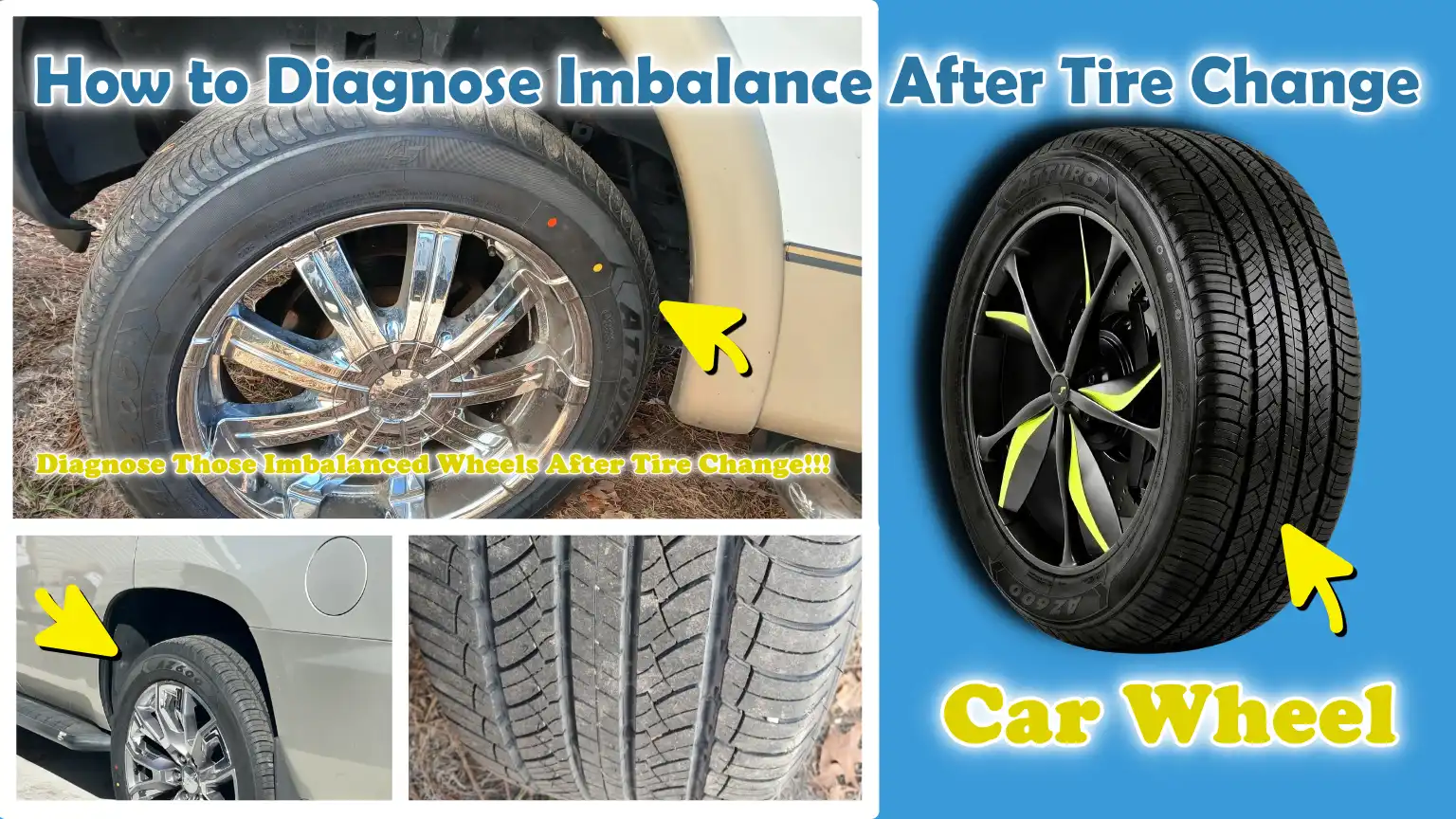
When you drive the very first mile after changing a tire that can reveal if there’s installation issues with that or not.
Basically, a tire change is meant to improve the overall ride quality, so if your car starts shaking soon after new tires are installed, then there’s something fishy in the wheel-&-tire setup.
As well as, in many cases: the cause is wheel imbalance, where a small uneven weight distribution literally makes the tire rotate unevenly at the speed.
Plus, wheels actually spin rapidly on the road, that’s why even a minor imbalance can create truly noticeable vibration through the steering wheel, seat or floor as well and you’ll see that specially at the highway speeds as well.
Many times, drivers actually mistake this for any alignment kind of issues, that’s why diagnosis is really important and that’s what you’ll learn in this guide How to Diagnose Imbalance After Tire Change.
So, What is Wheel Imbalance?
Wheel imbalance occurs when the distribution of weight around the tire and wheel is uneven, preventing the wheel from rotating in a perfectly circular motion.
Simply put, one section of the wheel becomes slightly heavier than the other; due to this minor discrepancy, the tire is unable to rotate smoothly when spinning at high speeds.
Even a very slight imbalance, sometimes amounting to just a few grams, as it can generate significant vibration, as the wheels on modern cars rotate at very high speeds on the road, often hundreds of times per minute.
At higher speeds, this irregular rotation manifests as a repetitive jarring sensation that travels through the suspension system to the steering wheel, seat, or floorboard.
This explains why many drivers experience no issues at low speeds but face severe vibrations once they reach highway speeds; as the wheel spins faster, the intensity of the imbalance increases.
This issue can become even more apparent after a tire change, whether new tires have been installed or existing ones have been remounted, because the wear patterns established during previous use are disrupted, thereby easily exposing underlying issues such as a slightly bent rim, structural defects within the tire, or a missing balancing weight.
Why Does Imbalance Occur After Changing Tires?
1. Improper Balancing During Installation
Wheel imbalance following a tire change is often caused by errors made during the balancing process.
When a tire is installed, it must be measured on a balancing machine so that any heavy spots can be counterbalanced by attaching small weights.
If this step is not executed correctly, the wheel will not rotate uniformly.
In some cases, balance weights are not placed in the correct locations, or an incorrect amount of weight is used.
Even a minor error during installation can generate vibrations at high speeds.
Another potential issue lies in machine calibration; if the balancing machine is not properly calibrated, it may provide inaccurate readings, thereby preventing proper balancing.
Occasionally, the final inspection is skipped or performed in haste, resulting in the wheel being reinstalled on the vehicle with a hidden imbalance left uncorrected.
2. Uneven Tire Seating
Another common cause is that the tire has not seated uniformly on the rim.
This can occur when the ‘bead’, the inner edge of the tire that rests against the wheel, fails to seat fully and evenly around the entire circumference.
When this happens, one section of the tire sits slightly higher or lower than the rest, leading to uneven rotation.
Uneven seating during installation can exacerbate this issue, particularly if the tire was not properly aligned (centered) during the mounting process.
Fluctuations in air pressure during the tire-seating procedure can also prevent the bead from securely locking into its correct position; this minor discrepancy often manifests as a noticeable vibration once the vehicle reaches higher speeds.
3. Issues Related to the Condition of the Wheel or Tire
Sometimes, the root of the problem lies not in the installation process itself, but rather in the inherent condition of the wheel or tire.
If a wheel has become bent due to driving over potholes or rough roads, it will not rotate in a perfectly circular motion, even if a new tire has been mounted on it.
Furthermore, manufacturing defects can lead to an uneven distribution of weight within the tire’s structure, thereby generating vibrations.
Another issue relates to an “out-of-round” tire, meaning the tire is not perfectly circular, which results in persistent vibrations with every rotation.
In some instances, rust or damage on the rim’s surface prevents the tire from seating properly; this disrupts the balance and causes the vehicle to vibrate.
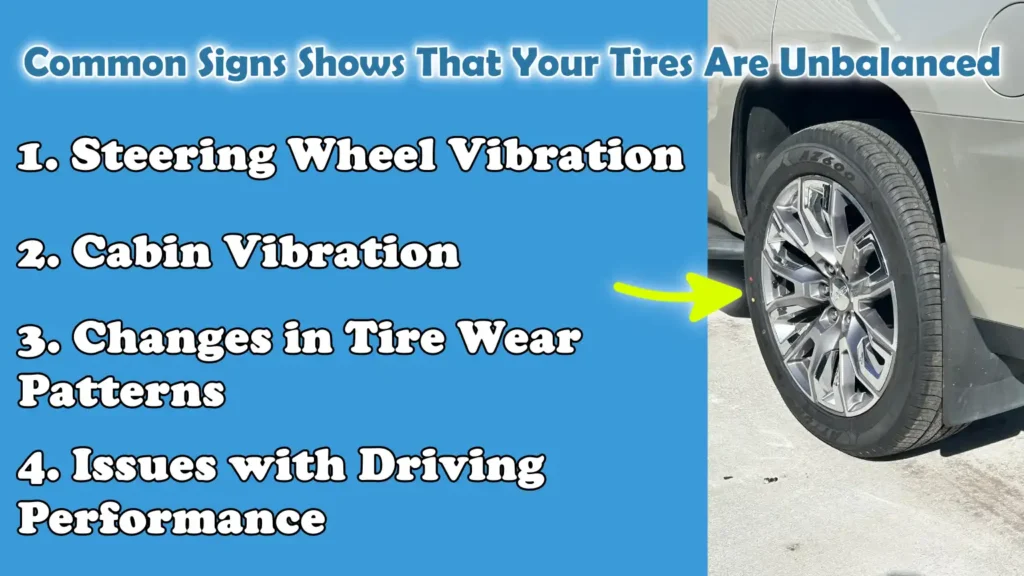
Common Signs Shows That Your Tires Are Unbalanced
1. Steering Wheel Vibration
The most common sign of unbalanced tires is a vibration felt in the steering wheel, particularly at high speeds.
This typically begins around highway speeds, as the wheel rotates so rapidly that even a slight discrepancy in weight creates a repetitive, oscillating force.
The vibration often feels mild at first, but as speed increases, it becomes more pronounced.
This is a key indicator that the issue is related to the rotation of the wheels rather than the road surface or an engine malfunction.
In most cases, this type of vibration is felt most intensely in the steering wheel because the imbalance lies in the front wheels.
These wheels directly control the steering and transmit the vibration directly to the driver’s hands.
2. Cabin Vibration
When the imbalance affects the rear wheels, the vibration is typically felt more within the cabin rather than in the steering wheel.
Drivers may feel vibrations in the seat or a slight tremor in the floorboard, which becomes more distinct at steady highway speeds.
In some instances, the rear of the vehicle may feel slightly unstable or wobbly, particularly on smooth roads, where the tire imbalance stands out more clearly than any irregularities in the road surface.
This type of vibration can compromise vehicle control, creating the sensation that the car is subtly shifting beneath you, even when you are driving in a straight line.
3. Changes in Tire Wear Patterns
Unbalanced tires often exhibit early signs of uneven wear, as the tire is unable to maintain consistent contact with the road surface.
Over time, this can lead to irregular wear of the tire tread (surface), where certain sections of the tire wear down faster than others.
Flat spots may appear on the tires, particularly if the imbalance causes repeated pressure to be exerted on a specific section of the tire as it rotates.
Another common pattern is ‘cupping,’ characterized by the formation of small depressions or wave-like shapes on the tire’s surface.
These wear-related issues reduce the lifespan of the tires and can exacerbate vibrations over time.
This creates a vicious cycle in which imbalance and wear continuously aggravate one another.
4. Issues with Driving Performance
Beyond vibrations and wear, tire imbalance can also significantly impact the overall driving experience.
While driving, specially at higher speeds, drivers may perceive a bouncing sensation in the vehicle; in such instances, the car may not feel completely stable, even on smooth roads.
The entire driving experience becomes less comfortable and long journeys can become unpleasant due to mild, irregular jolts.
In some cases, unbalanced tires can also lead to increased road noise, as the contact between the tire and the road surface becomes irregular.
A slight sense of instability may be felt even when driving in a straight line; even if the steering and alignment appear to be correct, the vehicle may not feel as stable or controlled as it typically would.
How to Detect Tire Imbalance After Changing Tires at Home
1. Start with a Speed Test
The first and most effective method for checking for wheel imbalance after changing a tire is to carefully observe how the vehicle behaves at various speeds.
Begin by driving at a low and steady speed, a speed at which the vehicle feels normal and typically exhibits no vibration.
Then, gradually and in a controlled manner, increase your speed, paying close attention to the specific point at which vibration begins.
Wheel imbalance often manifests within a very specific speed range where the vibration initiates, rather than occurring randomly across all speeds.
It is also crucial to note whether the vibration intensifies or remains constant as your speed increases; typically, vibration associated with imbalance increases with speed because the wheels are rotating faster, thereby amplifying the centrifugal force.
2. Identify Where the Vibration Is Felt
Once you have identified the specific speed range, the next step is to pinpoint the source of the vibration inside the vehicle.
If the steering wheel shakes more vigorously than the rest of the vehicle, the issue is typically associated with the front wheels.
Conversely, if the vibration is felt primarily through the driver’s seat or the floorboard, it often indicates a problem with the rear wheels.
In some instances, the entire vehicle chassis may feel slightly unstable; this could signal a more significant imbalance or suggest that multiple wheels are affected.
Identifying the source of the vibration is critical, as it helps determine whether the problem lies with the front set of tires or the rear set.
3. Visually Inspect the Wheels
After changing a tire, a simple visual inspection can reveal several clear signs of imbalance.
A key point to check is whether any wheel weights are missing, as these small weights are crucial for maintaining the wheel’s balance while it rotates.
It is also essential to carefully observe how the tire seats against the rim to ensure that it is seated uniformly all around.
Any uneven gaps or misalignment can lead to vibrations.
Any visible damage to the wheel such as: bending or dents, should also be inspected, as even a slight alteration in shape can disrupt its balance.
Furthermore, mud, stones, or debris lodged inside the wheel can create an uneven distribution of weight and contribute to vibrations at high speeds.
4. Check Tire Pressure
Tire pressure plays a pivotal role in how uniformly the tire makes contact with the road; incorrect pressure can sometimes manifest symptoms that closely mimic those of actual wheel imbalance.
It is essential to check every tire and ensure that its pressure aligns with the specifications recommended by the manufacturer.
Discrepancies in tire pressure can present symptoms resembling imbalance, as the tire’s shape changes under varying loads.
Excessive pressure can result in a harsher ride and increases the likelihood of vibrations, whereas low pressure can lead to vehicle instability and inconsistent contact between the tire and the road surface.
Carefully comparing the pressure across all four tires ensures that pressure-related anomalies are not mistakenly diagnosed as actual wheel imbalance.
Road Testing Method to Confirm Imbalance
1. Testing on a Smooth Road
Testing on a smooth road is one of the most reliable methods for confirming wheel imbalance after changing tires, as it eliminates most external factors such as potholes or rough surfaces.
This test should be conducted on a level, well-maintained road where the vehicle can travel at a steady speed without interruption.
As the speed increases, it is crucial to observe how the car behaves at different velocity levels and to note whether any vibrations occur and recur, within a specific speed range.
Wheel imbalance often produces a consistent and repetitive vibration pattern rather than random jolts; typically, this pattern becomes more pronounced as the vehicle’s speed increases.
Carefully observing this behavior helps distinguish between genuine wheel imbalance and temporary vibrations caused by road conditions.
2. Checking Steering Response
Another critical step is assessing how the steering system responds while driving at a steady speed.
By holding the steering wheel with a light, relaxed grip, it becomes easier to detect subtle vibrations or wobbling motions that might otherwise go unnoticed.
A balanced wheel setup should feel stable and smooth, with the steering wheel remaining steady even at high speeds.
If a slight wobble or persistent vibration is felt through the steering wheel, it often indicates an imbalance in the front wheels.
This test also helps confirm whether the issue is directly affecting the steering controls or if the vibration is originating from another part of the vehicle.
3. Clues from Rotation Patterns
Understanding the specific location within the vehicle where the vibration is originating helps in pinpointing the exact source of the imbalance.
If the front tires are affected, vibrations are typically felt more intensely in the steering wheel, as the front wheels directly control the vehicle’s direction.
If the rear tires are unbalanced, vibrations are more likely to be felt in the seat or floor area, creating a sensation of slight tremors in the rear section of the vehicle.
In some instances, the location of the vibration may shift, or it may feel as though it is distributed throughout the entire car; this could indicate that multiple wheels are affected or that the imbalance is particularly severe.
Paying close attention to how and where vibrations are felt during a road test provides strong clues for an accurate diagnosis.
How to Detect Wheel Imbalance
Plus, there’s scientific studies that clearly shows that wheel imbalance is not just a comfort issue but a mechanical stress factor that actually grows up with the speed, so whenever a tire has uneven mass distribution, then it literally creates repeated vibrations forces that travel through the suspension system, but because of time and usage this can also increase the wear tendency on the critical parts such as: wheel bearings and bushings, so that’s why you need to do early diagnosis after a tire change as it is really important, as it helps you to prevent from both driving discomfort and long-term mechanical damage as well.[¹]
1. Wheel Alignment Issues
Not all vibrations experienced after changing tires are caused by wheel imbalance; one of the most common culprits is a wheel alignment issue.
When the alignment is off, the vehicle often begins to pull to one side, even when you are attempting to drive straight on a level road.
You may also notice that the steering wheel is slightly off-center, even while the car is traveling in a straight line.
Unlike imbalance, which primarily causes speed-dependent vibrations, alignment issues typically affect directional control, making it difficult and less predictable to steer the vehicle straight during normal operation.
2. Suspension Issues
Another primary reason for symptoms resembling wheel imbalance is worn or damaged suspension components.
Worn shocks or struts fail to properly absorb road shocks, resulting in a bouncy or jarring ride that can easily be mistaken for vibration.
Damaged bushings can introduce excessive looseness into the suspension system, causing the vehicle to feel loose or unstable.
Loose components within the suspension can generate irregular movements as well as rattling noises.
In many cases, suspension issues are accompanied by noise, particularly when driving over rough or uneven surfaces.
This helps distinguish suspension-related problems from those caused by wheel imbalance, as imbalance typically does not produce any audible sounds.
3. Tire Defects
Sometimes, the issue lies not with the balance or alignment, but rather with a defect within the tire itself.
Internal belt separation, a condition in which the reinforcing belts inside the tire detach, as it can lead to irregular rotation due to structural changes occurring within the tire as it spins.
This results in vibrations that closely resemble those caused by imbalance, yet they do not follow the specific patterns typically associated with standard wheel balancing issues.
A bulge in the sidewall is another warning sign, often indicative of internal damage; this distorts the tire’s shape, thereby compromising its smooth rotation.
Tire runout, meaning the tire is not perfectly round, as it can generate recurring vibrations at certain speeds.
Structural issues within the tire, such as manufacturing defects or internal weaknesses, can cause the vehicle to feel unstable even after proper balancing; resolving these issues typically requires replacing the tire rather than merely making adjustments.
So, When to Rebalance Tires
1. Immediate Needs
If vibrations begin shortly after replacing tires, the tires should be rebalanced immediately, as this is a clear indication that something went wrong during the tire installation or balancing process.
If you experience vibrations during your very first drive, particularly within a specific speed range, it often points to a minor weight imbalance that was not properly corrected.
Another definitive sign is the absence of a wheel weight; as these small weights are essential for ensuring the tire rotates uniformly, the absence of even a single weight can cause significant vibration at highway speeds.
Speed-related vibration, which is consistently felt while driving at higher speeds, is also a key indicator that the wheel balance needs to be re-examined, as imbalances typically become more pronounced and perceptible as rotational forces increase.
2. The Need for Professional Inspection
In some cases, a simple inspection is insufficient and a professional assessment becomes necessary to pinpoint the true cause of the vibration.
If the problem persists even after performing basic checks such as: adjusting tire pressure and conducting a visual inspection, it usually implies that the imbalance is more complex or stems from an underlying internal issue.
A bent rim is one such instance, as even a slight deformation in the rim can prevent the wheel from rotating smoothly, a problem that cannot be resolved without specialized tools.
Expert inspection is also required to identify signs of a defective tire such as: structural irregularities or internal damage, as these issues cannot be resolved merely through balancing.
Another situation requiring professional assistance is the recurring failure of the balancing process; If a tire has been balanced multiple times yet vibration persists, it indicates that the underlying cause may be far more serious than a problem that can be resolved by minor adjustments in weight.
Read More:
How to Prevent Imbalance After Replacing Tires in the Future
1. Request Dynamic Balancing
Preventing wheel imbalance begins by ensuring that the correct balancing method is utilized during tire installation.
Requesting dynamic balancing is crucial, as it assesses how the tire behaves while rotating, rather than merely when it is stationary.
This method helps detect weight discrepancies of both the static and dynamic varieties; this means it can correct minor imbalances that might otherwise manifest as vibrations at higher speeds.
Proper balancing ensures that the tire rotates smoothly and significantly reduces the likelihood of vibrations occurring after installation.
2. Check the Wheel Weights Before Leaving the Shop
Before driving your vehicle out of the service center, it is essential to visually inspect each rim to ensure that the wheel weights are securely attached.
These small weights are precisely what correct the uneven distribution of weight within the tire and wheel assembly; therefore, if even a single weight is missing or has become dislodged, vibration issues may arise later on.
A quick visual check ensures that the weights are firmly attached and correctly positioned, thereby confirming that the balancing procedure was completed successfully.
3. Take a Test Drive Immediately After Replacing Tires
Taking a brief test drive immediately after replacing your tires is the most effective way to detect any imbalance right away.
Driving at various speeds allows you to determine whether any vibrations are felt at a specific velocity, a common indicator of improper balancing.
If any vibration is detected during this initial inspection, it is much easier to return to the shop and resolve the issue before it escalates or leads to uneven tire wear.
4. Re-Check the Balancing After the First Few Days
Even if everything appears to be in order immediately after the tires are installed, it is still beneficial to re-check the balancing after driving for a few days.
New tires tend to settle slightly into place after initial use; consequently, after some driving time, minor shifts may occasionally occur in the tire’s seating position or weight distribution.
A re-check ensures that everything remains stable and allows for the timely detection of any vibrations that could later impact the tire’s lifespan or driving comfort.
5. Use Reliable Equipment for Tire Servicing
The quality of the balancing depends significantly on the equipment used during the tire installation process.
Using reliable and properly calibrated machines for tire servicing minimizes the risk of obtaining inaccurate readings, which could lead to an imbalance.
Reliable equipment ensures that even the slightest discrepancies in weight distribution are detected and corrected with precision, resulting in a smoother and more stable driving experience after your tires have been replaced.
Know, Common Mistakes Made by Drivers
1. Ignoring Minor Vibrations
One of the most common mistakes drivers make is ignoring minor vibrations that occur after a tire change, assuming they will resolve on their own.
At certain speeds, even slight vibrations are often an early indication of a wheel balancing issue; as the tire is rotating unevenly, this problem typically worsens over time.
When these early warning signs are ignored, subsequent tire wear can accelerate and driving comfort may gradually diminish, making the issue more severe and difficult to rectify later on.
2. Confusing Balancing Issues with Alignment Problems
Many drivers confuse wheel balancing issues with alignment problems because both can affect how the vehicle handles on the road.
However, balancing issues typically manifest as vibrations that increase with speed, whereas alignment problems are generally associated with the car pulling to one side or the steering wheel being off-center.
Misdiagnosing these two issues often leads to unnecessary repairs that fail to address the actual problem; therefore, it is crucial to understand the distinction between them before taking any corrective action.
3. Driving for Too Long Before Investigation
Another mistake is continuing to drive for an extended period without investigating the issue once vibrations are felt.
Although the vehicle may still be drivable, driving for a prolonged time with an imbalance can lead to premature tire wear and place excessive strain on suspension components, such as shock absorbers and wheel bearings.
Over time, this can escalate a simple balancing issue into a major mechanical problem that will be significantly more expensive to repair.
4. Replacing Parts Without a Proper Diagnosis
Some drivers immediately replace suspension or steering components without first confirming the actual root cause of the vibrations.
This often occurs due to misinterpreting symptoms, leading to unnecessary expenses.
As issues related to suspension, tire defects and wheel alignment can present similar symptoms, it is crucial to accurately diagnose the problem first rather than prematurely assuming a major component failure.
5. Failing to Conduct a Road Test After Replacing Tires
Failing to conduct a road test after replacing tires is another common mistake that prevents the detection of underlying suspension issues.
Driving the vehicle for a short duration at various speeds helps determine whether the tires are properly balanced and if any complications arise under actual driving conditions.
Without this verification, minor fitting errors or imbalances may go unnoticed until they become more pronounced and adversely affect the vehicle’s performance on the road.
Conclusion – How to Diagnose Imbalance After Tire Change
Wheel imbalance following a tire replacement is not merely a minor inconvenience; rather, it serves as a clear indication that something is amiss within the wheel or tire system.
As tires rotate at high speeds, even a slight discrepancy in weight can generate persistent vibrations, negatively impacting steering control, ride comfort and tire longevity.
It is crucial to understand that most vibrations occurring after a tire change are not mere coincidences.
They typically stem from specific causes such as: improper tire seating, hidden defects within the wheel, or tire imperfections that only manifest after installation.
Identifying the root cause of the problem is paramount, as imbalance often begins subtly and worsens as the tire wears unevenly, eventually causing vibrations to resonate throughout the entire vehicle.
By carefully observing when the vibration begins, where it is felt and how it changes in relation to vehicle speed, drivers can distinguish between wheel imbalance and issues related to alignment or suspension.
Simple checks such as: inspecting wheel weights, verifying tire pressure and conducting a controlled road test, as it can reveal a great deal of information, even without the use of specialized equipment.
Furthermore, ignoring these early warning signs can lead to premature tire wear, reduced fuel efficiency and undue stress on suspension components, potentially turning a minor issue into a costly repair down the road.
So, that’s all about this guide and you can comment down for more info.
Frequently Asked Questions
FAQ 1: What does a tire imbalance feel like after replacing tires?
Answer: A tire imbalance typically feels like a persistent vibration that intensifies as the vehicle’s speed increases. Many drivers first notice this in the steering wheel at highway speeds, while others feel it through the seat or the floor, depending on which wheels are affected. It usually does not occur at low speeds, which is why detecting it immediately after a tire change can be somewhat difficult.
FAQ 2: Is it normal to feel vibrations after installing new tires?
Answer: You might notice a very slight difference for a short while, but a clearly perceptible or strong vibration is not normal. New tires should make the ride more comfortable, not rougher. If vibrations begin immediately, or start after driving a short distance, it is often an indication that the wheels were not properly balanced, or that the tire is not seated correctly on the rim.
FAQ 3: How can I tell if the problem is an imbalance or an alignment issue?
Answer: A wheel imbalance primarily causes vibrations, which worsen with speed and are typically felt in the steering wheel or the vehicle’s body. Alignment issues are different; they usually cause the vehicle to pull to one side, or cause the steering wheel to sit slightly off-center even when driving in a straight line. Simply put, an imbalance shakes the vehicle, whereas alignment affects the vehicle’s direction.
FAQ 4: Can a wheel imbalance resolve itself over time?
Answer: A wheel imbalance does not resolve itself. In fact, it tends to worsen over time, as the uneven forces persist with every rotation of the wheel. This can lead to uneven tire wear and place excessive strain on suspension components; therefore, rather than waiting, it is best to have this issue resolved as soon as possible.
FAQ 5: Why is vibration felt only at specific speeds?
Answer: Vibration is often felt only at specific speeds because the force generated by an imbalance increases as the wheel spins faster. At low speeds, this force is too minimal to be detected; however, as speed increases, the uneven weight distribution creates a persistent vibration that becomes more distinctly perceptible, particularly on smooth roads.
FAQ 6: Can new tires also be unbalanced?
Answer: Yes, new tires can indeed be unbalanced if the balancing procedure was not performed correctly during installation. Sometimes, the issue does not lie with the tire itself, but rather stems from missing or misplaced wheel weights, improper seating of the tire on the rim, or a calibration error in the balancing machine during the process.
FAQ 7: What should I check first if my car vibrates after replacing the tires?
Answer: First, you should check the tire pressure, the wheel weights and how the tire is seated on the rim. Next, by driving the vehicle for a short while at various speeds (taking a test drive), you can pinpoint exactly when the vibration begins. If everything appears to be in order yet the vibration persists, it usually becomes necessary to have the tires re-balanced by a professional.
FAQ 8: Is it safe to drive with unbalanced tires?
Answer: While it is generally possible to drive short distances with unbalanced tires, doing so for extended periods is not recommended. Over time, due to imbalance, tires may wear unevenly on one side, driving comfort may diminish and suspension components may be subjected to excessive stress. Therefore, it is always safer to have this issue rectified as soon as possible.
References:
[1] Real-Time Estimation of Wheel Imbalances for Chassis Prognosis
https://saemobilus.sae.org/papers/real-time-estimation-wheel-imbalances-chassis-prognosis-2010-01-0245
Hello Folks, Dean Shali here to help you out to solve the problems with your lovely vehicle, as i have lots of experience and knowledge about automotive industry as i woks directly with the customers and repair vehicles and i love to help the people to keep their cars safe and running smoothly.