Written By: Dean Shali
Fact Checked By: Sabré Cook
Reviewed By: Tamara Warren
A soft brake pedal is beyond the wear and tear thing, as it is the warning sign that your brake fluid is failing under the heat.
As, it is true that brake fluid actually transfers the force from your foot on the brake pedal into the pressure that actually stops the car.
But, unlike the many other fluids: the brake fluid must have to be withstand the extremely high temperatures generated during the braking process, specially in the situations such as: long downhill driving, towing heavy loads or repeated hard stops as well.
As well as, if the brake fluid reaches to its boiling temperature, then it literally turns into the vapor and unlike the liquid: the vapor compresses easily which leads to a soft or spongy brake pedal and that even reduces the stopping power and that’s the exact condition which is known as “BRAKE FADE”.
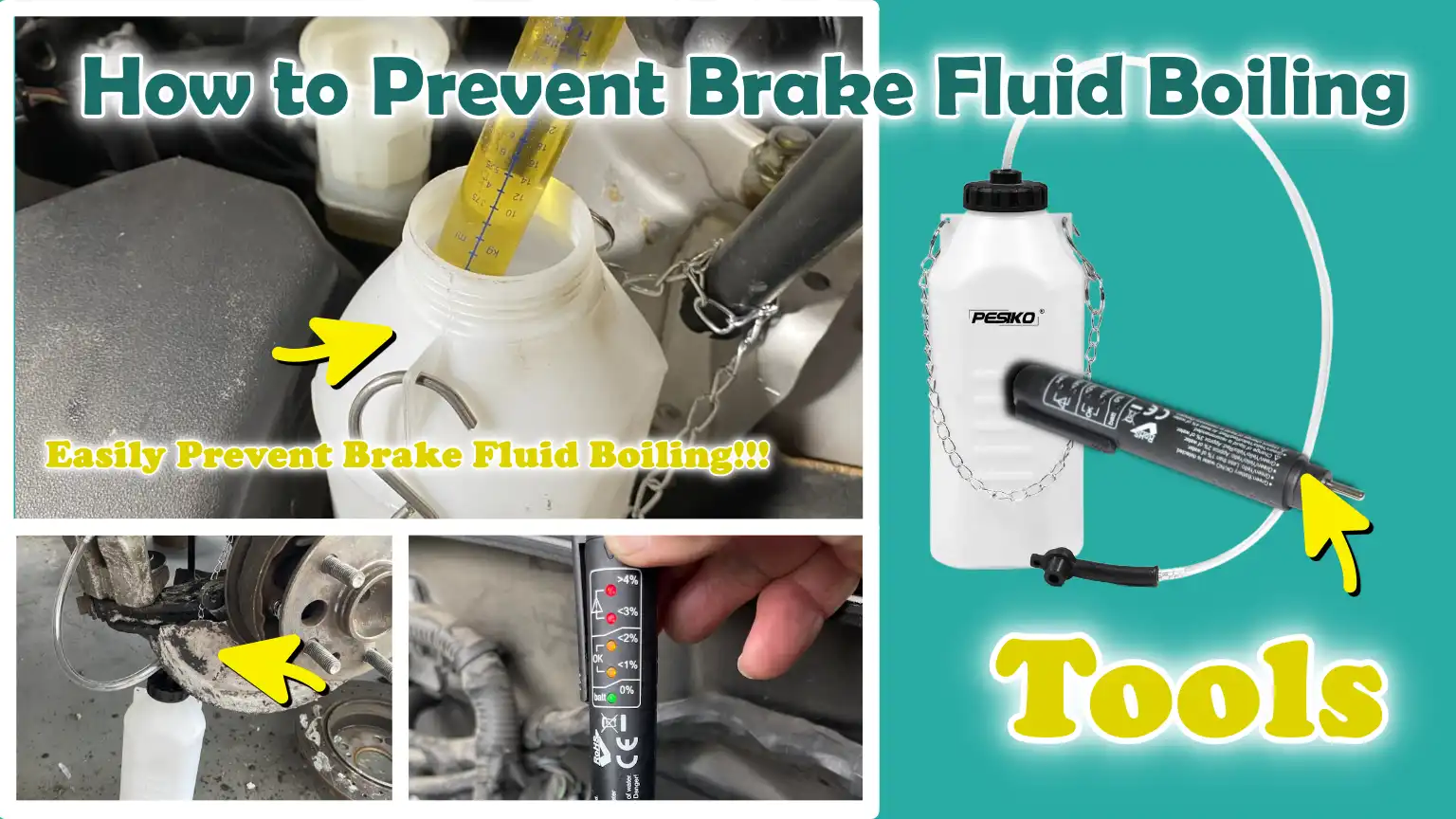
Now, with this guide you’ll learn How to Prevent Brake Fluid Boiling, as you can clearly understand how and wy brake fluid actually boils and recognize the early symptoms as well.
What is Brake Fluid Boiling?
1. Know, In Simple Terms
Brake fluid boils when the temperature inside your braking system becomes so high that the liquid brake fluid begins to convert into steam or gas.
This typically occurs when you need to apply heavy braking such as: while descending a long, steep incline, during repeated hard braking, or when the braking system is under continuous stress.
Brake fluid is specifically engineered to withstand high temperatures; however, it does have a limit, known as its ‘boiling point.’
Over time, brake fluid absorbs moisture from the air, which lowers its boiling point and makes it susceptible to boiling even under normal driving conditions.
When the fluid reaches this critical threshold, it can no longer remain in a stable liquid state and begins to form tiny bubbles of steam inside the brake lines.
The key distinction here lies in the fact that liquids such as: brake fluid, are incompressible, meaning they transmit force instantly and efficiently; whereas gases are compressible, meaning they can be compressed or squeezed.
This transition from a liquid to a gaseous state directly impacts how your braking system responds when you depress the brake pedal.
2. Why Is It Dangerous?
Brake fluid boiling is dangerous because it disrupts the fundamental operation of a hydraulic braking system.
When you depress the brake pedal, the system relies on fluid pressure to transmit force to the brake pads and slow the vehicle down.
However, if vapor forms inside the brake lines, this vapor can compress under pressure, rather than immediately transmitting the force forward.
The result is that when the brake pedal is depressed, it feels soft and spongy (compressible), or in some instances, it sinks completely down to the floorboard.
In severe cases, the brakes fail to function as expected, requiring a greater distance to bring the vehicle to a halt and diminishing the sense of control over the vehicle.
This condition is often referred to as ‘brake fade’; it can occur suddenly and without specific warning, particularly when temperatures are extremely high.
For precisely this reason, maintaining the quality and condition of the brake fluid is not merely a routine task; rather, it is absolutely essential for ensuring consistently reliable braking performance and complete safety while driving.
Why Does Brake Fluid Boil?
1. Excessive Heat Generated by Braking
Excessive heat is the most direct and common cause of brake fluid boiling.
Every time you depress the brake pedal, friction is generated between the brake pads and the rotors and this friction produces heat.
Under normal driving conditions, this heat remains manageable and dissipates quickly into the surrounding air.
However, in situations such as driving down long, steep inclines, the brakes are applied continuously, leaving them insufficient time to cool down.
Consequently, heat accumulates within the braking system and transfers into the brake fluid.
Aggressive driving such as: repeated hard braking at high speeds or driving on a racetrack, as it can raise temperatures even more rapidly, pushing the fluid beyond its safe operating limits.
When this heat exceeds the fluid’s boiling point, it begins to vaporize, thereby diminishing braking efficiency and increasing the risk of “brake fade” (a reduction in braking effectiveness).
2. Moisture Contamination
Moisture contamination is one of the most significant, yet often overlooked, causes of brake fluid boiling.
Most brake fluids used in modern vehicles are hygroscopic, meaning they naturally absorb moisture from the surrounding air over time, even if the braking system is completely sealed.
This moisture absorption process occurs through microscopic cracks, rubber hoses and during routine maintenance procedures.
As water mixes with the brake fluid, it significantly lowers the fluid’s boiling point.
For instance, even a very small amount of water can significantly lower the temperature at which the fluid begins to boil.
This means that even under normal braking conditions, the fluid can reach its boiling point much faster than expected, leading to the formation of vapor and a subsequent decline in braking performance without any clear warning.
3. Old or Degraded Brake Fluid
Brake fluid does not last forever; it gradually degrades when exposed to heat, oxygen and contaminants.
Over time, oxidation occurs, altering the fluid’s chemical composition and diminishing its capacity to withstand high temperatures.
Dust, debris and microscopic particles from the internal components of the brake system can also infiltrate the fluid, further compromising its effectiveness.
As the fluid ages, it loses its thermal stability, meaning it can no longer dissipate heat as efficiently as it did when it was new.
This increases the likelihood of it boiling under pressure, even in conditions where fresh fluid would typically perform without issue.
Regularly replacing brake fluid is essential for maintaining its original properties and ensuring reliable braking performance.
4. Low-Quality or Incorrect Type of Brake Fluid
Using low-quality brake fluid, or a type of fluid that is incompatible with your vehicle, as it can significantly heighten the risk of overheating during braking.
Different brake fluids are classified according to standards such as DOT ratings and each type possesses a specific boiling point and performance profile.
If a fluid with a low boiling point is used in a system that requires higher specifications, it will be unable to withstand the heat generated during braking.
Furthermore, mixing incompatible fluids can lead to chemical instability, resulting in reduced overall performance and unpredictable behavior when exposed to heat.
Some fluids are not designed to work together and mixing them can lower the effective boiling point or cause damage to internal components.
Selecting the correct, high-quality brake fluid, one that meets the manufacturer’s specifications, is essential for preventing excessive heat buildup and maintaining safe braking.
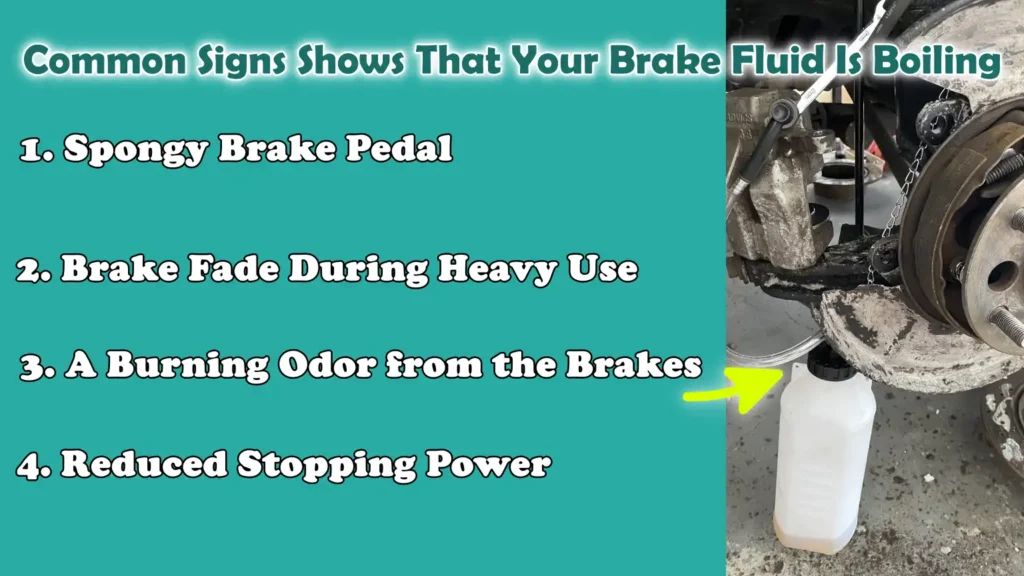
Common Signs Shows That Your Brake Fluid Is Boiling
1. Spongy Brake Pedal
One of the earliest and most noticeable signs of boiling brake fluid is a spongy or soft brake pedal.
When you depress the pedal, it may feel less firm than usual and may travel further down toward the floorboard before the brakes engage.
This occurs because the heat causes a portion of the brake fluid to vaporize, creating small gas bubbles inside the brake lines.
Unlike the fluid, these bubbles compress under pressure; this means that some of the force applied to your pedal is absorbed internally rather than being transmitted directly to the brakes.
Consequently, the braking response feels weak and sluggish.
This symptom often manifests during or immediately after heavy braking and may improve slightly as the system cools down; however, it should never be ignored, as it signals a serious compromise in braking capability.
2. Brake Fade During Heavy Use
Brake fade is another clear indication that your brake fluid may be boiling, particularly during demanding driving conditions.
This typically happens when you are driving down a long incline, towing a heavy load, or braking repeatedly at high speeds.
Initially, the brakes may feel normal; however, as the heat builds up, you may notice that it takes longer for the vehicle to slow down, even if you are applying the same amount of pressure to the pedal, or even more.
This gradual decline in braking performance is caused by the fluid overheating and vaporizing, which diminishes the system’s ability to maintain consistent hydraulic pressure.
If the heat continues to rise, brake fade can deteriorate rapidly, making it even more difficult to safely control the vehicle.
3. A Burning Odor from the Brakes
A sharp, burning smell emanating from the wheels or brakes is a warning sign that the braking system is overheating, a condition that can cause the brake fluid to boil.
This odor typically results from the brake pads, rotors and sometimes the fluid itself reaching excessively high temperatures.
While the odor alone does not definitively prove that the fluid has boiled, it indicates that the system is operating under extreme thermal stress and is approaching its critical limits.
If you detect this smell while driving, particularly on long descents or after heavy braking, it is a clear indication that the brakes require time to cool down.
Ignoring this warning sign can cause the brake fluid to exceed its boiling point, resulting in a sudden and severe loss of braking capability.
4. Reduced Stopping Power
A reduction in stopping power is one of the most serious and dangerous signs of boiling brake fluid.
You may notice that the car is not slowing down as quickly as it should, even when you are pressing the brake pedal firmly.
This occurs because the presence of vapor inside the brake lines prevents full hydraulic pressure from being applied to the brake components.
Simply put, the system becomes unable to generate the necessary force to effectively bring the vehicle to a halt.
This can significantly increase the vehicle’s stopping distance and make sudden-braking situations far more hazardous.
In severe cases, the brakes may feel almost completely ineffective, particularly after prolonged or continuous use.
It is absolutely essential to rectify this situation immediately, as it directly jeopardizes your ability to safely control and stop the vehicle.
Know, The Types of Brake Fluid and Their Boiling Points
1. DOT 3 vs DOT 4 vs DOT 5 vs DOT 5.1
Brake fluids are classified according to standards such as DOT 3, DOT 4, DOT 5 and DOT 5.1, with each type designed to handle varying levels of heat and performance requirements.
One of the most crucial distinctions to understand is the difference between the ‘dry boiling point’ and the ‘wet boiling point.’
The dry boiling point refers to the temperature at which new, fresh brake fluid begins to boil, whereas the wet boiling point refers to the temperature at which the fluid boils after having absorbed moisture over time, a scenario that represents a more realistic situation for most road-going vehicles.
DOT 3 fluid is commonly used in many everyday vehicles and features a moderate boiling point, making it suitable for general driving conditions.
DOT 4 fluid possesses a higher boiling point than DOT 3 and handles heat more effectively, making it a more appropriate choice for vehicles whose braking systems are subjected to greater stress.
DOT 5 fluid is distinct in that it is silicone-based and does not absorb moisture, thereby maintaining a stable boiling point; however, it is generally incompatible with systems designed for glycol-based fluids and is rarely used in standard passenger vehicles.
DOT 5.1 fluid, despite its nomenclature, is not silicone-based; it is similar to DOT 4 but features an even higher boiling point, making it highly suitable for high-performance applications or demanding operating conditions.
The primary difference in the performance of these fluids depends on how effectively they withstand heat and the extent to which their boiling point degrades over time due to moisture absorption.
2. Which brake fluid is best for withstanding heat?
The best brake fluid for withstanding heat depends on how the vehicle is used and the amount of stress placed on the braking system.
For general daily driving, a high-quality DOT 3 or DOT 4 fluid is usually sufficient, as it can handle the moderate temperatures generated during normal braking.
However, if the vehicle is operated under more demanding conditions such as: towing, driving in mountainous terrain, or driving in stop-and-go traffic, a more advanced fluid like DOT 4 or DOT 5.1 is often a superior choice, as it possesses a higher boiling point and offers better protection against heat buildup.
For high-performance driving such as: track driving or high-speed operation, it is crucial to use fluids with exceptionally high ‘dry’ and ‘wet’ boiling points to prevent the fluid from vaporizing under extreme temperatures.
It is also essential to always use a fluid that meets the specifications prescribed by the vehicle manufacturer; using the wrong type of fluid can negatively impact vehicle performance or lead to compatibility issues.
Choosing the right brake fluid is not merely a matter of performance; it is also about maintaining consistent braking capability, minimizing the risk of fluid boil-over and ensuring safety under all driving conditions.
How to Prevent Brake Fluid Boiling – Easy Steps
1. Use High-Quality Brake Fluid
Using high-quality brake fluid is the most crucial step in preventing it from boiling, as the fluid itself determines how much heat your braking system can safely withstand.
High-quality fluids are formulated with superior chemical stability and higher boiling points, meaning they do not vaporize even under heavy braking conditions.
Reputable brands typically adhere to strict manufacturing standards and clearly specify both their dry and wet boiling points, helping you select a fluid that will perform reliably over time.
A higher boiling point provides an extra layer of safety, particularly in situations where brakes generate excessive heat such as: during long drives, at highway speeds, or during sudden, hard braking maneuvers.
Choosing the right fluid isn’t just about performance; it directly impacts how stable and safe your braking system remains under pressure.
2. Flush the Brake Fluid Regularly
Regularly flushing and replacing your brake fluid is essential, as brake fluid absorbs moisture from the air over time.
This moisture lowers the boiling point and increases the likelihood of the fluid boiling, even under normal driving conditions.
Most manufacturers recommend replacing brake fluid every two to three years, although this timeframe may vary depending on driving conditions and the type of vehicle.
Fresh brake fluid restores the system’s original high boiling point and eliminates impurities such as: dirt and degraded particles, that can compromise performance.
Over time, old fluid becomes less stable under heat, increasing the risk of brake fade and reduced stopping power.
Keeping the fluid clean and fresh ensures that your braking system can maintain strong, consistent pressure precisely when you need it most.
3. Upgrade to a Fluid with a Higher DOT Rating – If Compatible
Upgrading to a brake fluid with a higher DOT rating can improve heat resistance, but this should always be done with compatibility in mind.
Fluids such as DOT 4 or DOT 5.1 typically have a higher boiling point than DOT 3, meaning they can withstand higher temperatures without vaporizing.
This makes them an excellent choice for drivers who face demanding braking conditions, such as driving in mountainous terrain or hauling heavy loads.
However, not all vehicles are designed to use every type of fluid; using the wrong fluid can damage seals, degrade system performance, or negatively impact long-term reliability.
It is always essential to follow the vehicle manufacturer’s recommendations and to upgrade the system only if it explicitly supports the change.
When done correctly, using a higher-quality fluid can significantly reduce the likelihood of boiling.
4. Avoid Prolonged Braking
Avoiding continuous or unnecessary braking is a simple yet highly effective way to prevent heat buildup within the braking system.
Continuous braking, that is, maintaining light pressure on the pedal for extended periods, generates constant friction and heat, causing temperatures to rapidly exceed safe limits.
Instead, employ proper braking techniques such as: applying firm pressure only when necessary and then releasing the pedal, to allow the brakes sufficient time to cool down between applications.
In hilly terrain, rather than relying solely on friction brakes, engine braking can be utilized to control speed, thereby helping to prevent overheating.
By minimizing the frequency and duration of braking, you reduce the total heat generated, which directly helps prevent the brake fluid from reaching its boiling point.
5. Enhance Brake Cooling
Improving the cooling capacity of your braking system can make a significant difference in preventing brake fluid from overheating.
Many modern vehicles utilize ventilated rotors, designed with internal channels that allow air to flow through easily and dissipate heat more effectively.
This helps maintain lower temperatures during repeated braking maneuvers.
In high-performance or demanding driving conditions, additional cooling measures such as: brake ducts, as it can be employed to channel fresh air directly to the brakes, further mitigating the issue of heat accumulation.
Enhanced cooling ensures that the heat generated during braking does not remain trapped within the system for prolonged periods, thereby helping to prevent the brake fluid from reaching dangerously high temperatures.
Effective cooling ensures consistent braking performance and reduces the thermal stress placed on all components of the braking system.
6. Maintain the Entire Braking System
A well-maintained braking system operates more efficiently and generates less unnecessary heat, thereby preventing the brake fluid from boiling.
Components such as brake calipers, pads and rotors must be in good condition to function correctly.
For instance, a seized caliper can keep the brake pad pressed against the rotor even when the brakes are not applied; this results in constant friction and heat generation.
Worn or uneven brake pads can also compromise contact efficiency, leading to elevated temperatures during use.
Keeping all components clean, properly lubricated and within recommended wear limits ensures that the system operates smoothly and does not generate excessive heat.
Regular inspections allow for the detection of minor issues before they escalate into major problems that could compromise braking performance.
7. Use Performance Brake Components – If Necessary
In situations where the braking system is subjected to extreme conditions such as: track driving, heavy towing, or frequent high-speed braking, standard components may not be sufficient to manage the heat generated.
Performance brake components are designed to maintain their effectiveness even at elevated temperatures.
For example, high-temperature brake pads are manufactured using materials capable of withstanding greater heat without degrading, while performance rotors are engineered to dissipate heat more efficiently.
The use of these components reduces the amount of heat transferred to the brake fluid, thereby lowering the risk of it boiling.
While these upgrades may not be essential for daily driving, they prove invaluable in challenging situations where strong and consistent braking is crucial for safety.
How Often Should You Change Your Brake Fluid?
1. Manufacturer Recommendations
Brake fluid should be changed at regular intervals because its performance gradually degrades over time, even if the vehicle has not been driven aggressively.
Most vehicle manufacturers recommend changing the brake fluid every two to three years, or within a specific mileage range, because the fluid naturally absorbs moisture from the air.
This moisture lowers the fluid’s boiling point and diminishes its ability to dissipate heat, thereby increasing the risk of brake fade and reduced stopping power.
These recommendations are based on real-world testing and are designed to ensure that the braking system remains safe and functions consistently.
Adhering to the manufacturer’s schedule is the most reliable method for preventing brake fluid from boiling.
2. Severe vs Normal Driving Conditions
Driving conditions have a direct impact on how quickly brake fluid degrades and how frequently it needs to be replaced.
Under normal driving conditions such as: routine driving on level roads involving moderate braking, the fluid can typically last for the full recommended service interval.
However, under severe driving conditions, the fluid can lose its effectiveness much more rapidly.
Situations such as stop-and-go traffic, driving on long descents, towing heavy loads, or frequent hard braking generate excessive heat within the braking system.
This additional heat accelerates the processes of moisture absorption and chemical breakdown, causing the boiling point to drop even more quickly.
Consequently, for vehicles operated under demanding conditions, brake fluid inspection and replacement should be performed more frequently to ensure that safe braking performance is maintained.
3. Warning Signs You Should Not Ignore
There are certain clear warning signs indicating that the brake fluid requires immediate replacement, rather than waiting for the scheduled service interval.
If the brake pedal feels soft or spongy, or depresses further than usual, it may signify that the fluid has absorbed excessive moisture or has begun to boil due to heat.
A reduction in stopping power, or an increase in stopping distance, are also definitive indicators that the fluid is no longer functioning correctly.
In some instances, the brake fluid in the reservoir may appear dark, cloudy, or dirty rather than clear, signaling contamination and degradation.
These signs indicate that the fluid’s boiling point has dropped and it can no longer effectively withstand heat.
At this stage, replacing the fluid is crucial for restoring proper braking response and ensuring safe driving.
Can You Drive After Brake Fluid Has Boiled?
1. Immediate Hazards
Driving after brake fluid has boiled is extremely dangerous, as the braking system is no longer able to generate strong and reliable hydraulic pressure.
When the fluid turns into vapor, it creates compressible gas bubbles within the brake lines; this means that the force applied by your foot is not fully transmitted to the brakes.
Consequently, the brake pedal often feels soft or spongy and the vehicle’s stopping capability is severely compromised.
In real-world driving scenarios, this can lead to increased stopping distances, delayed braking response, or even complete brake failure, precisely when you need your brakes the most.
This risk is further heightened when driving at high speeds, on steep inclines, or in emergency situations, conditions where strong and immediate braking is absolutely critical.
Even if the brakes appear to function to some extent, they are no longer reliable, making it unsafe to maintain control of the vehicle.
2. Temporary Recovery vs Permanent Damage
In some instances, braking performance may appear to improve after the system has cooled down, as the vapor trapped within the brake lines may revert to a liquid state.
This can create a false sense of security, as the brake pedal may temporarily feel normal again.
However, this temporary recovery does not indicate that the underlying problem has been resolved.
The fluid has already been subjected to extreme heat, which can permanently lower its boiling point and degrade its chemical composition.
The presence of moisture contamination and excessive heat can also accelerate wear and tear within the braking system.
If the fluid has degraded or become contaminated, the risk of it boiling over increases significantly, even under normal driving conditions.
This means that unless the underlying issue is resolved, the braking system could fail again without any warning.
3. When to Stop Driving
If you observe warning signs such as: the brake pedal feeling excessively soft or spongy, a drastic reduction in the vehicle’s stopping power, or the need to press the pedal much harder than usual to slow down, you must stop driving immediately.
These symptoms indicate that the braking system is not functioning safely and continuing to drive could place you and others at serious risk.
If possible, pull the vehicle over to a safe location and allow it to cool down; however, the vehicle should not be driven under normal circumstances until the braking system has been inspected.
The brake fluid may need to be replaced and other components should also be checked for heat-related damage or wear and tear.
Driving should only be resumed once the braking system has been fully repaired and is functioning correctly, ensuring that braking performance remains consistent and reliable.
Know, The Safe Driving Tips to Reduce Brake Heat
1. Techniques for Driving on Slopes
Driving on slopes is one of the most common situations where brake heat escalates rapidly; therefore, employing the correct techniques is crucial.
Rather than continuously depressing the brake pedal, it is preferable to engage a lower gear and utilize engine braking; this assists the engine in decelerating the vehicle, ensuring that the entire burden does not fall solely on the brakes.
This method minimizes the friction and heat generated on the brake pads and rotors.
Instead of keeping the brakes continuously engaged, applying them in short, firm intervals allows the system time to cool down between braking applications.
Prolonged, light braking can trap heat within the system, potentially raising temperatures to the point where the brake fluid begins to boil.
Maintaining proper control on a slope involves not only managing speed but also regulating heat, thereby ensuring that the braking system remains fully effective throughout the entire descent.
2. Best Practices for Towing
Towing significantly increases the vehicle’s total weight, meaning the braking system must work much harder to bring everything to a halt.
This additional load further intensifies the heat generated during braking, particularly on slopes or during sudden stops.
To mitigate brake heat while towing, maintaining a safe following distance is essential; this allows for gradual braking rather than requiring sudden, forceful brake applications.
Engaging a lower gear when descending slopes helps control speed and reduces the excessive strain placed on the brakes.
Vehicles equipped with trailer brakes should always ensure they are properly adjusted, as they assist in distributing the braking load and alleviating the pressure on the vehicle’s primary braking system.
Driving in a relaxed and controlled manner is paramount, as applying hard brakes while carrying a heavy load can cause temperatures to rise rapidly and increase the risk of the brake fluid overheating.
3. Braking Habits: City vs Highway Driving
Different driving environments influence the amount of heat generated within your brakes.
When driving in the city, stop-and-go traffic necessitates frequent braking; this can cause temperatures to rise gradually over time, particularly in heavy traffic conditions.
To prevent heat accumulation in such situations, it is beneficial to drive smoothly, anticipate stops in advance and avoid sudden braking whenever possible.
On the highway, the need to brake arises less frequently; however, when braking is required, the vehicle is often traveling at high speeds, a factor that can generate a significant amount of heat in a very short time.
While driving on the highway, maintaining a safe distance from other vehicles allows for gradual braking rather than sudden, forceful stops, thereby helping to keep temperatures under control.
Adapting your braking habits to suit your specific driving environment plays a crucial role in minimizing overall brake heat and preventing the brake fluid from reaching its boiling point.
Read More:
- How to Diagnose Brake Fluid Boiling
- How to Fix Brake Pedal Sinking Slowly
- How to Check Brake Pad Wear Sensor
- How to Measure Brake Pad Thickness Without Removing Wheel
- How to Replace Brake Pads
- How to Replace Brake Rotors
- How to Bleed Car Brakes
Understand, Common Mistakes to Avoid
Not only this, there’s study that clearly shows that brake fluid condition actually impacts braking safety, also even small drops in boiling point can reduce the stopping performance, also it is strongly supported that regular brake fluid checks and replacement as a key to prevent the step to avoid brake fluid boiling and maintain the reliable braking under the heat.[¹]
1. Mixing Different Types of Brake Fluid
Mixing different types of brake fluid is a common mistake that can lead to serious problems within the braking system.
Not all brake fluids are chemically compatible with one another and mixing them can alter how the fluid performs under heat and pressure.
For instance, some fluids are glycol-based while others are silicone-based; mixing them can result in reduced lubrication, damaged seals, or diminished resistance to boiling.
Even if the system appears to function correctly initially, the overall boiling point of the fluid mixture may drop, rendering it unable to handle heat as intended.
This increases the risk of “vapor lock” and “brake fade” (a reduction in braking effectiveness) during heavy use.
It is crucial to always use the specific type of brake fluid recommended by the vehicle manufacturer and to avoid mixing different fluids unless explicitly approved.
2. Ignoring Moisture Contamination
Brake fluid naturally absorbs moisture from the air over time; overlooking this fact is one of the primary causes of brake fluid degradation.
As moisture levels rise, the fluid’s boiling point drops significantly, greatly increasing the likelihood of it boiling, even under normal driving conditions.
This process occurs gradually and often without any obvious warning signs, which is why many drivers underestimate the associated risks.
Moisture can also cause corrosion inside brake lines and components, further compromising the overall performance of the braking system.
To prevent this hidden issue from becoming a safety hazard, regular inspection and timely replacement of the brake fluid are absolutely essential.
3. Neglecting Scheduled Maintenance
Ignoring the recommended maintenance intervals for brake fluid replacement can lead to a gradual yet severe deterioration in braking performance.
Over time, brake fluid degrades due to heat, oxidation and contamination from internal components.
When it is not replaced at the scheduled time, its heat-resistance capacity diminishes, significantly increasing the risk of it boiling.
Many drivers focus their attention on visible components such as: brake pads and rotors, while overlooking the fluid; however, the fluid plays a critical role in the overall functioning of the system.
Adhering to the service schedule recommended by the vehicle manufacturer ensures that the fluid remains in optimal condition and can effectively manage the heat generated during braking.
4. Using Cheap or Unverified Fluid
Using low-quality or unverified brake fluid can compromise the safety of the entire braking system, even if all other components are functioning correctly.
Cheap fluids may fail to meet proper safety standards, or their actual boiling point may be lower than the temperature advertised, rendering them unreliable under high-heat conditions.
Furthermore, they may degrade more rapidly or contain impurities that negatively impact performance over time.
In high-temperature situations, the risk of such fluids boiling is significantly higher, which inevitably leads to a reduction in braking efficiency.
Choosing a high-quality fluid from a reputable company ensures consistently good performance, superior heat resistance and enhanced safety.
Compared to the risks associated with brake failure, investing in the right brake fluid is a very modest expense.
Difference Between Professional vs DIY Brake Fluid Maintenance
1. When is DIY Safe?
Performing brake fluid maintenance yourself can be safe, provided you understand the process and carefully follow the correct steps.
Basic tasks such as: checking the brake fluid level, observing its color, or topping it up with the correct type of fluid, are simple and can easily be performed at home.
Even more complex procedures such as: completely replacing the brake fluid or bleeding the system, as it can be undertaken by an experienced individual using the right tools and maintaining cleanliness throughout the process.
It is crucial to prevent air from entering the brake lines during this procedure, as trapped air can compromise braking performance.
Cleanliness is also paramount, as even minute dust particles can adversely affect the system.
Using the specific brake fluid recommended by the manufacturer and ensuring that all components are properly sealed guarantees that the system will function exactly as intended.
If executed correctly, DIY maintenance can help sustain optimal braking performance and prevent the brake fluid from overheating or boiling.
2. When to Consult a Mechanic
There are certain situations where consulting a professional mechanic is the safer and more reliable option.
If you are not fully confident in your ability to bleed the brakes, or if the system exhibits specific symptoms such as: a spongy brake pedal, fluid leaks, or diminished braking power, you should have your vehicle inspected by a trained technician.
In newer vehicles equipped with modern braking systems such as: Anti-lock Braking Systems (ABS), properly replacing and bleeding the brake fluid often requires specific procedures and, at times, specialized tools.
A mechanic can also inspect for hidden issues such as: worn seals, seized calipers, or contaminants within the system, that are typically invisible to the naked eye.
Professional servicing ensures that the fluid is completely replaced, any trapped air is properly purged and the entire braking system is functioning safely and efficiently.
3. Cost Estimates
The cost of brake fluid maintenance depends on whether you perform the task yourself or opt for a professional service.
DIY maintenance is generally less expensive, as you only need to pay for the brake fluid and basic tools; this is an economical option for those who possess the necessary knowledge.
Having the brake fluid professionally replaced incurs a higher cost, as it includes labor charges, specialized equipment and a comprehensive inspection of the entire system.
However, this expense often proves to be a worthwhile investment, as it guarantees that the work is performed correctly and minimizes the risk of future complications.
When weighed against the potential costs associated with brake failure or major repairs, regular brake fluid maintenance is an extremely cost-effective option, and an essential investment in your vehicle’s safety and performance.
Conclusion – How to Prevent Brake Fluid Boiling
So, you need to keep your brake system well-maintained so that it can react faster and gives full control to you whenever you wanted.
The braking system relies entirely on a stable, high-quality fluid to transmit force rapidly and safely; once this fluid begins to degrade or boil, the entire system loses its reliability.
What makes this problem even more serious is that its warning signs such as: a spongy pedal feel or diminished braking power, often only appear once the fluid has already deteriorated.
Understanding its root causes, ranging from excessive heat to contamination caused by moisture, and recognizing early symptoms provides you with a distinct advantage in avoiding hazardous situations on the road.
Brake fluid maintenance is one of the simplest, yet most critical, steps one can take to ensure vehicle safety.
Regularly changing the fluid, using the correct type of fluid with a high boiling point when necessary and adhering to proper driving habits can significantly reduce the likelihood of brake fade or failure.
Small actions such as: avoiding continuous braking, controlling speed on steep inclines and keeping the entire braking system in good condition, help regulate heat and prevent the fluid from reaching its maximum temperature limits.
These preventive measures do not require advanced technical expertise, yet they make a profound difference in how your brakes perform under stressful conditions.
Ultimately, robust and reliable braking does not depend solely on hardware components like pads and rotors; rather, it begins with the condition of the fluid circulating within the system.
Neglecting brake fluid can give rise to numerous unforeseen hazards, whereas maintaining it in optimal condition ensures consistent braking power in both normal and challenging driving situations.
Now, that’s all from this guide about How to Prevent Brake Fluid Boiling, also you can comment for below for more.
Frequently Asked questions
FAQ 1: At what temperature does brake fluid boil?
Answer: The boiling temperature of brake fluid depends on the type of fluid and its condition. Fresh brake fluid, also referred to as ‘dry fluid’, has a higher boiling point. For example, standard DOT 3 fluid typically boils around 400°F, while DOT 4 and DOT 5.1 fluids can withstand temperatures of 450°F or even higher. However, as the fluid absorbs moisture over time, its boiling point decreases significantly. This is known as the ‘wet boiling point,’ and it can be substantially lower, sometimes by more than 100°F. This is why old or degraded brake fluid can easily boil, even under normal driving conditions.
FAQ 2: Can brake fluid boil during normal driving?
Answer: Yes, if the brake fluid is old, degraded, or unsuitable for the vehicle, it can boil even during normal driving. Under everyday conditions, the heat generated during braking is typically not intense enough to cause fresh fluid to boil. However, if the fluid has absorbed moisture or has degraded over time, its boiling point drops significantly. This means that even moderate braking, particularly in heavy traffic or on long downhill stretches, as it can overheat the fluid and generate vapor. Therefore, regular maintenance is essential, even if you do not engage in high-speed or aggressive driving.
FAQ 3: How can I tell if my brake fluid is overheating?
Answer: There are several signs indicating that your brake fluid is overheating. The most common sign is a brake pedal that feels soft or spongy, meaning it feels less firm than usual. You may also notice that it takes longer to bring the vehicle to a stop, or that the brakes feel weak after repeated application. In some cases, a burning smell may also emanate from the brakes, indicating that excessive heat is being generated. These symptoms often manifest during heavy braking or after driving on steep inclines. If you observe any of these signs, it is crucial to have your brake system inspected immediately.
FAQ 4: Does changing the brake fluid improve braking performance?
Answer: Yes, changing the brake fluid can significantly improve braking performance specially if the old fluid has degraded or become contaminated with impurities. Fresh brake fluid restores the proper hydraulic pressure required for firm and consistent braking. It also raises the fluid’s boiling point, which helps prevent issues caused by “vapor lock” (the formation of steam bubbles) under high-heat conditions. Many drivers report feeling a firmer brake pedal and experiencing more effective braking after changing their brake fluid. Although it may seem like a minor maintenance task, it plays a vital role in the overall functionality and safety of the braking system.
FAQ 5: Is DOT 4 brake fluid superior to DOT 3?
Answer: DOT 4 brake fluid is generally considered superior to DOT 3 because it has a higher boiling point. It is better suited for vehicles that require frequent braking such as: those driven in mountainous terrain, in heavy traffic, or at high speeds. However, whether it is truly “better” or not ultimately depends on the specific requirements of the vehicle in question. Some vehicles are specifically designed for DOT 3 fluid and using a different type of fluid without verifying compatibility is generally not recommended. When selecting a high-temperature-resistant fluid, it is always best to follow the manufacturer’s recommendations.
FAQ 6: Can I mix different types of brake fluids?
Answer: Mixing different types of brake fluids is generally not advisable unless it is explicitly stated that they are compatible with one another. Most glycol-based fluids such as: DOT 3, DOT 4 and DOT 5.1, are technically mixable; however, doing so can negatively impact the vehicle’s overall performance and lower the boiling point. Silicone-based DOT 5 fluid should never be mixed with other types of fluids, as this significantly alters their operational characteristics and can lead to system failure. Mixing fluids can make it difficult to predict braking performance, particularly under high-temperature conditions. The safest approach is always to use only the specific and correct type of fluid and to perform a complete fluid replacement (a fluid flush) whenever there is a change in specifications.
FAQ 7: How often should brake fluid be checked?
Answer: Brake fluid should be checked at least every few months or during routine vehicle maintenance. You can check the fluid level and color by visually inspecting the reservoir. If the fluid appears dark, cloudy, or dirty, it is time to replace it. Even if no obvious issues are visible, it is generally recommended to replace the entire fluid (perform a fluid flush) every two to three years. Regular inspections help detect early signs of contamination before they negatively impact braking performance.
References:
[1] Measurement of Brake Fluid Boiling Point
https://www.researchgate.net/publication/391853765_Measurement_of_Brake_Fluid_Boiling_Point
Hello Folks, Dean Shali here to help you out to solve the problems with your lovely vehicle, as i have lots of experience and knowledge about automotive industry as i woks directly with the customers and repair vehicles and i love to help the people to keep their cars safe and running smoothly.