Written By: Dean Shali
Fact Checked By: Sabré Cook
Reviewed By: Tamara Warren
You need to understand that, your brakes don’t just relies on the parts, as they also depends on a fluid that can fail under the extreme heat.
And, because brake fluid plays a critical role in how your car stops, so if it boils because of the high heat then it can cause sudden loss of braking performance that is serious issue to deal with at immediate effect.
Plus, modern braking systems actually relies on the “HYDRAULIC PRESSURE”, that clearly means that the fluid inside the brake lines must remain in liquid form to transfer force in effective way.
But, because of the repeated hard braking, long downhill driving, towing heavy loads or performance driving: the temperatures in the braking system can exceed hundreds of degrees.
So, whenever the brake fluid gets too hot, specially if it has absorbed moisture over the period of time, then its boiling point drops significantly.
Also, once it starts to boil, then it creates vapor bubbles and unlike liquid, the vapor actually compresses easily, which then leads to the soft or spongy brake pedal and that’s how it reduces stopping power as well.
That’s why, in this guide you’ll learn How to Diagnose Brake Fluid Boiling, so that you can maintain the pressure and prevent dangerous situations on the road.
Know, Why Does Brake Fluid Boil?
Brake fluid boils when the heat generated within the braking system exceeds the fluid’s safe thermal tolerance limit.
Your braking system operates using hydraulic pressure, which means it is essential for the fluid to remain in a liquid state to effectively transmit force from the brake pedal to the wheels.
Under normal driving conditions, the system manages heat effectively; however, in demanding situations such as: repeated hard braking, descending long slopes, towing heavy loads, or driving in extreme temperatures, heat can accumulate very rapidly.
When this heat surpasses the fluid’s boiling point, the fluid begins to vaporize.
This is a serious issue because vapor, unlike liquid, is compressible; this causes the brake pedal to feel soft or “spongy” when depressed, significantly reducing the vehicle’s stopping capability.
The primary causes of this problem include excessive heat accumulation, moisture contamination, the use of old or degraded fluid and the use of an incorrect type of brake fluid; all of these factors compromise the fluid’s resistance to boiling.
1. Heat Accumulation in the Braking System
Heat accumulation is the most direct and common cause of brake fluid boiling.
When you depress the brake pedal, the brake pads clamp down on the rotors and it is this friction that slows the vehicle down.
This friction generates a significant amount of heat and when the brakes are subjected to heavy use, temperatures can rise very rapidly.
The heat is not confined solely to the surface of the rotors; Rather, it extends to other components of the braking system such as: the calipers and eventually reaches the brake fluid contained within the system.
If the brakes are applied repeatedly without sufficient time to cool down such as: when driving on a long incline or in stop-and-go traffic, the heat continues to build up.
Over time, this heat can exceed the fluid’s boiling point, particularly if the fluid is not in good condition; this causes the fluid to vaporize, thereby reducing braking efficiency.
2. Moisture Contamination – Wet Boiling Point
Over time, brake fluid naturally absorbs moisture from the air because it is hygroscopic, meaning it attracts and absorbs water.
Even if the braking system is completely sealed, a small amount of moisture can still find its way in through rubber hoses, seals, or during routine maintenance.
As soon as water mixes with the brake fluid, it significantly lowers the fluid’s boiling point.
This is why brake fluid has two distinct ratings: a ‘Dry Boiling Point’ (when the fluid is new) and a ‘Wet Boiling Point’ (after it has absorbed moisture).
The wet boiling point is considerably lower, meaning the fluid will begin to boil at a much lower temperature than expected.
Even a slight amount of water contamination can have a profound impact; it increases the risk of vapor formation during heavy braking and compromises overall braking performance.
3. Old or Degraded Brake Fluid
Over time, brake fluid degrades due to exposure to heat, oxidation and contaminants.
As brake fluid ages, it loses its original properties and becomes less effective at withstanding high temperatures.
Over time, microscopic particles generated by the wear and tear of internal brake system components can accumulate within the fluid, further degrading its performance.
Aged brake fluid often darkens in color, a clear indication that it is no longer in good condition.
As its quality deteriorates, its boiling point also decreases, increasing the risk of the fluid boiling under pressure.
For this reason, it is crucial to replace brake fluid periodically, as fresh fluid maintains a higher boiling point and consistently delivers reliable braking performance.
4. Low-Quality or Incorrect Brake Fluid
Using the wrong type of brake fluid or fluid of inferior quality can also lead to issues involving fluid boiling.
Different types of brake fluids such as: DOT 3, DOT 4 and DOT 5, possess distinct boiling points and performance characteristics.
For instance, DOT 4 fluid generally has a higher boiling point than DOT 3, making it more suitable for vehicles that generate significant heat during braking.
If a vehicle requires high-quality fluid but is filled with a lower-grade alternative, that fluid may be unable to withstand the heat generated during braking operations.
Furthermore, low-quality fluid often fails to meet necessary standards and may degrade prematurely.
Using the specific brake fluid recommended by the vehicle manufacturer ensures that the braking system can effectively manage heat, thereby minimizing the risk of the fluid boiling, even in challenging conditions.
Know, The Key Symptoms of Boiling Brake Fluid
Boiling brake fluid is detected through changes in the feel of your brake pedal and the vehicle’s response when you attempt to bring it to a stop.
As the braking system relies on hydraulic pressure, any alteration in the fluid, particularly when it converts into vapor, has a direct impact on braking performance.
These symptoms often manifest during or immediately after periods of heavy braking, such as when driving on steep inclines, navigating heavy traffic, or driving in stop-and-go conditions.
A crucial point to note is that these issues do not always persist once the system has cooled down, making them easy to overlook.
A clear understanding of these symptoms allows you to identify the problem early and distinguish it from other braking-related issues, such as air trapped in the lines or worn-out components.
1. Soft or Spongy Brake Pedal
A soft or spongy brake pedal is one of the earliest and most noticeable symptoms of boiling brake fluid.
When you depress the brake pedal, it may feel less firm than usual and you may need to apply greater force to effectively slow the vehicle down.
This occurs because, as the brake fluid begins to boil, vapor bubbles start to form within it; unlike the fluid itself, which transmits force instantaneously, these vapor bubbles are compressible.
Consequently, the pedal feels soft and less responsive, particularly after repeated braking instances have caused heat to build up within the system.
2. Weakening Brakes After Repeated Use – Brake Fade
Brake fade refers to a gradual reduction in braking power following continuous or repeated use.
Initially, the brakes may function normally; however, as heat accumulates, their stopping power diminishes.
This phenomenon is frequently observed during long descents on slopes or in traffic conditions that necessitate frequent braking.
As the temperature of the brake fluid rises and approaches its boiling point, tiny vapor bubbles begin to form, compromising the system’s ability to maintain robust hydraulic pressure.
Consequently, the vehicle requires a greater distance to come to a complete stop and the brakes may not feel as effective as they should.
3. Brake Pedal Sinking to the Floor
In more severe instances, the brake pedal may travel significantly lower than usual, potentially sinking nearly to the floorboard.
This serves as a critical warning sign.
When an excessive amount of vapor accumulates within the brake fluid, this vapor compresses easily under pressure; this means that the force applied by your foot is not fully transmitted to the brakes.
Instead of generating strong braking force, the pressure is absorbed by the compressible vapor.
This can result in a drastic reduction in braking power, or even complete brake failure, particularly in high-temperature conditions.
4. Temporary Loss of Braking Functionality
A distinctive characteristic of brake fluid boiling is that the issue is often transient.
While braking performance may deteriorate significantly when the system is hot, the brakes typically resume proper operation once they are allowed to cool down.
This occurs because, as the temperature drops, the vapor bubbles revert to a liquid state, thereby restoring the necessary hydraulic pressure.
Although it may appear that the problem has resolved itself, it actually serves as a serious warning sign that the fluid has reached an unsafe temperature and requires immediate attention.
5. A Burning Odor Emitting from the Wheels
A burning odor emanating from the wheels is another indication that the braking system is overheating excessively, which can cause the brake fluid to boil.
This odor typically results from the extreme heat generated by friction between the brake pads and the rotors.
In some instances, it may also originate from overheated brake components themselves such as: the pads, rotors, or calipers.
If you detect this odor, particularly if it is accompanied by a noticeable decline in braking performance or a sensation of the brake pedal becoming soft, it is a definitive sign that the system is under severe thermal stress and that the brake fluid is either on the verge of boiling or has already begun to boil.
Difference Between Boiling Brake Fluid vs Other Brake Problems
From the driver’s seat, brake problems can often appear quite similar; consequently, many people mistake boiling brake fluid for a completely different issue.
The key distinction is that boiling brake fluid is directly linked to heat and typically occurs only after the brakes have been subjected to excessive or prolonged use.
Conversely, other brake-related issues often persist continuously and are not dependent on temperature.
Understanding the specific causes behind each problem allows you to avoid misdiagnosis and ensures that the root cause is addressed correctly.
Paying close attention to the symptoms, specifically when they appear, how long they last and whether they change after the system has cooled down, is the most effective way to differentiate between these distinct issues.
1. Air in the Brake Lines
Air trapped within the brake lines can cause the brake pedal to feel soft or spongy (compressible), a sensation quite similar to the symptoms of boiling brake fluid.
This occurs due to the same fundamental principle: air is compressible, whereas fluid is not.
However, the primary difference lies in the persistence of the symptom.
When there is air in the system, the pedal feels spongy at all times, regardless of whether the brakes are hot or cold.
This condition does not improve even after the system has cooled down.
In contrast, when brake fluid boils, the pedal typically feels soft only after heavy brake usage; once the system cools, the pedal often returns to feeling normal.
This temperature-dependent fluctuation is a definitive indication that the underlying issue is heat, rather than trapped air.
2. Brake Fluid Leaks
A leak in the brake fluid system compromises its functionality, as the total volume of fluid available to generate hydraulic pressure is reduced.
When fluid leaks, the brake pedal may feel soft or travel lower than usual (closer to the floor), because there is insufficient fluid remaining in the system to maintain the necessary pressure.
A clear and significant indication of a leak is a noticeable drop in the brake fluid level within the reservoir over time.
You may also observe fluid spots underneath the vehicle or around the brake components.
Unlike the issue of boiling fluid, a leak is a persistent problem that does not depend on heat or specific driving conditions; braking performance will remain impaired regardless of whether the system is hot or cold.
3. Worn Brake Pads or Rotors
Worn brake pads or defective rotors affect braking performance differently than the issue of boiling brake fluid.
Instead of the brake pedal feeling soft, you will often hear squealing or grinding noises and you may also experience vibrations or jolts when applying the brakes.
These issues arise not from fluctuations in hydraulic pressure, but rather from the depletion of friction material or irregularities in the rotor surfaces.
Although worn components can diminish the vehicle’s stopping power, they typically do not cause the brake pedal to feel spongy or unstable based on temperature.
The general feel of the braking remains largely consistent, though its effectiveness and smoothness are reduced.
4. Master Cylinder Malfunction
When you depress the brake pedal, the master cylinder is responsible for generating hydraulic pressure.
If an internal fault develops, the pedal may gradually sink toward the floor, even if you maintain constant pressure on it.
This occurs because, instead of flowing through the brake lines, the fluid bypasses the internal seals.
Unlike the issue of boiling brake fluid, this problem is not heat-related and does not resolve itself once the system cools down.
Under normal operating conditions, this issue of the pedal sinking will persist and recur repeatedly.
This is precisely what distinguishes it from the problem of boiling brake fluid; the latter primarily manifests at elevated temperatures and may temporarily disappear once the system cools down.
How to Detect & Diagnose Brake Fluid Boiling – Easy Way
To detect brake fluid boiling, it is essential to carefully observe the performance of the braking system under various conditions, particularly in hot weather.
The key is to compare how the brakes feel when they are cold versus how they feel after repeated use or exposure to high temperatures.
As brake fluid boiling is a heat-related issue, clear symptoms typically do not manifest during light or routine driving.
A proper diagnosis involves assessing the pedal feel, inspecting the condition of the fluid, measuring its moisture content and identifying any sources within the braking system that generate excessive heat.
By adopting a systematic approach, you can confirm whether the issue is indeed caused by brake fluid boiling, rather than by another problem exhibiting similar symptoms.
1. Replicate Driving Conditions – Safely
The first step is to observe how your brakes perform under heat-generating conditions, though this must always be done safely.
Attempt to drive in a controlled environment where you can apply the brakes repeatedly, such as in moderate, stop-and-go traffic or on a safe, downhill road.
As the brakes heat up, pay close attention to any changes in pedal feel or the vehicle’s stopping capability.
If the brake pedal begins to feel soft or braking power diminishes after repeated use, it indicates that heat is adversely affecting the system.
This step helps confirm whether the problem occurs specifically under high-temperature conditions.
2. Check Brake Pedal Feel
After testing under hot conditions, compare the feel of the brake pedal while the system is hot against how it feels when the system has completely cooled down.
When the vehicle has been stationary for a while, depress the brake pedal and observe how firm it feels.
Then, after driving the vehicle and applying the brakes repeatedly, check whether the pedal has become soft or spongy, or if you need to press it further down to bring the vehicle to a halt.
A clear distinction between cold and hot conditions is the boiling of the brake fluid; vapor forms only when the fluid’s temperature becomes excessively high.
3. Inspect the Condition of the Brake Fluid
Next, visually inspect the brake fluid contained within the reservoir.
Fresh brake fluid is typically clear or light-colored, whereas old or degraded fluid tends to darken over time.
Dark fluid is often an indicator of contamination, oxidation and compromised performance.
Furthermore, look out for any particulate matter or unusual appearance, which could signal internal wear-and-tear or debris within the system.
The degraded condition of the fluid lowers its boiling point and increases the likelihood of vapor formation during heavy braking.
4. Measure the Moisture Content in the Brake Fluid
Measuring the moisture content in the brake fluid provides a more accurate assessment of its overall condition.
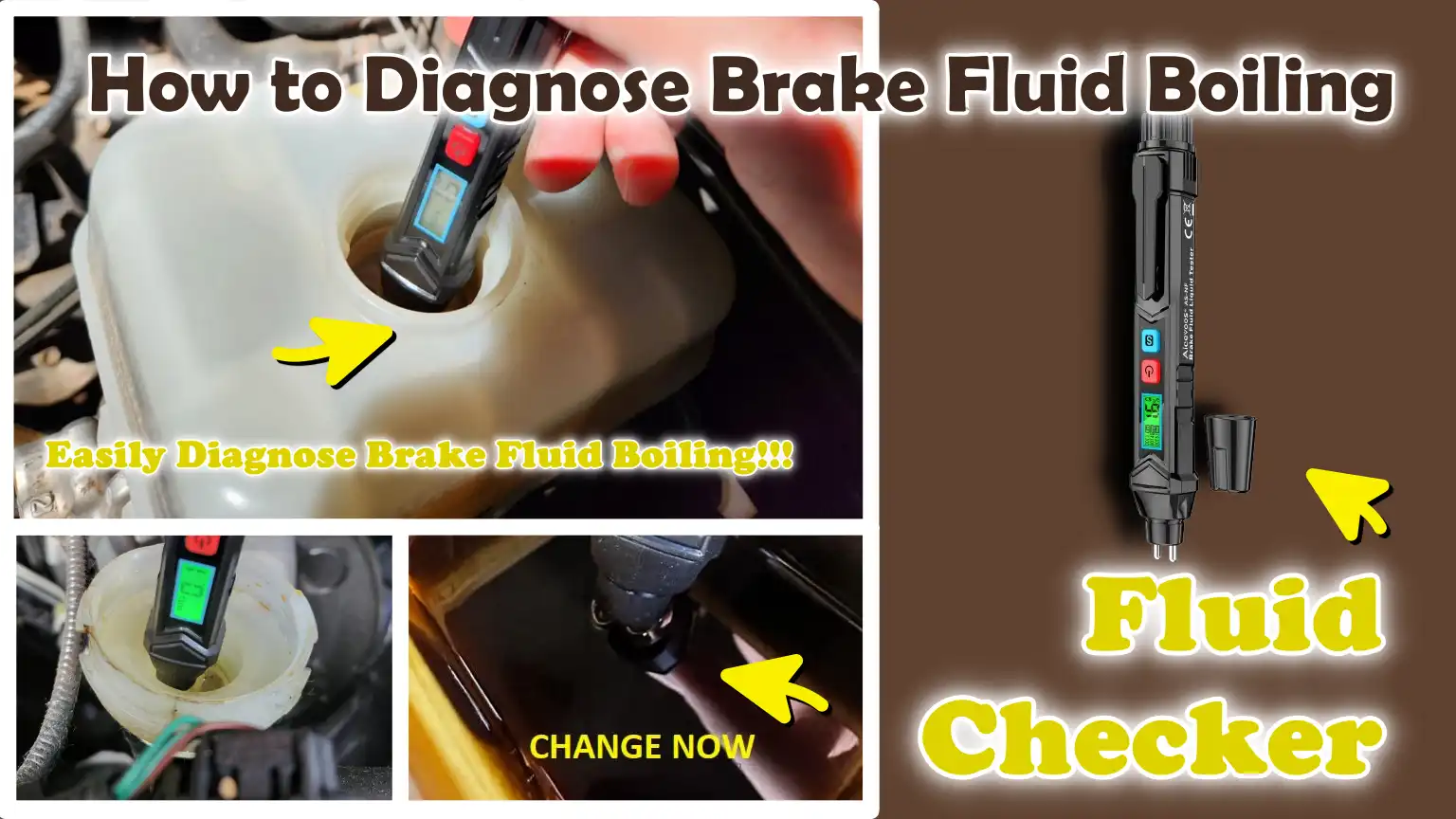
A brake fluid tester can be used to determine the extent of moisture absorption.
As brake fluid absorbs moisture from the air, even a small amount of water can significantly lower its boiling point.
Most testers indicate whether the moisture level falls within a safe range or if the fluid requires replacement.
Elevated moisture levels imply that the fluid will boil at a lower temperature, thereby increasing the risk of brake failure under high-pressure conditions.
5. Check the Brake Fluid Boiling Point – Advanced
For a more precise assessment, professional testing tools can measure the actual boiling point of the brake fluid.
This test is typically performed in a workshop and provides accurate information regarding whether the fluid still meets safe operating standards.
The measured boiling point can then be compared against the vehicle manufacturer’s original specifications.
If the boiling point falls significantly below the required standard, it confirms that the fluid has degraded and poses a risk of boiling under heavy braking conditions.
6. Inspect the Brake System for Heat Sources
It is also essential to inspect the brake system for any mechanical issues that may be generating excessive heat.
Components such as brake calipers should move freely; if they seize or stick, they can create constant friction and generate excessive heat.
Brake drag, where the pads fail to fully disengage from the rotors, as it can also generate unnecessary heat.
Furthermore, poor airflow around the brakes, whether due to design limitations or obstructions in ventilation, as it can hinder proper cooling.
Identifying and rectifying these sources of heat helps mitigate the risk of the brake fluid reaching its boiling point.
7. Verify the Brake Fluid Type
Finally, ensure that the correct type of brake fluid is being used in the vehicle.
Different brake fluids have varying boiling points and using a fluid of a lower grade than specified can render the system more susceptible to heat.
Consult the vehicle’s specifications to verify that the fluid meets the necessary standards such as: the correct DOT rating.
Additionally, review the service history to determine when the fluid was last replaced and to confirm that the correct type of fluid was indeed used.
Using a fluid that meets the precise specifications provides superior resistance to boiling and ensures more reliable braking performance, even under demanding conditions.
Tools
| Tool Name | Why It Is Needed | How to Use It Properly |
|---|---|---|
| Brake Fluid Tester – Moisture Meter | Brake fluid absorbs moisture over time and even a small amount of water can lower its boiling point, thereby increasing the risk of brake fade. | Switch on the tester and immerse its probe into the brake fluid reservoir. Wait for a reading or light indicator to appear. If it indicates excessive moisture, the fluid needs to be replaced. |
| Infrared Thermometer | This helps detect brake overheating, which is the primary cause of brake fluid boiling. | After driving, aim a thermometer at the brake rotor or caliper to check the temperature. Compare the readings on both sides of the vehicle. Excessively high or uneven readings may indicate brake overheating or a seized component. |
| Flashlight | Good lighting makes it easier to observe the color of the brake fluid and detect any impurities present within it, specially in confined spaces such as the engine bay. | Shine a light into the brake fluid reservoir to inspect its color and clarity. Additionally, use the light to check the brake lines, calipers and surrounding components for any signs of damage or leaks. |
| Gloves and Safety Gear | Brake fluid is corrosive and can cause harm to the skin, paintwork and eyes; therefore, safety is paramount during the inspection process. | Wear gloves before opening the reservoir or handling any brake components. Avoid spilling the fluid and if it comes into contact with your skin or any surface, clean it up immediately. |
Know, When Is Brake Fluid Most Likely To Boil?
Brake fluid is most likely to boil when the braking system is exposed to continuous or repeated heat and does not receive sufficient time to cool down.
The braking system converts the vehicle’s kinetic energy into heat through friction; under normal circumstances, this heat dissipates safely.
However, in certain specific driving conditions, heat accumulates so rapidly that it cannot dissipate effectively, causing the brake fluid to approach its boiling point.
If the fluid is old, has absorbed moisture, or is of the incorrect type, it will begin to boil at an even lower temperature.
These conditions often involve continuous braking, carrying heavy loads in the vehicle, or extremely high ambient temperatures; all of these factors place excessive strain on the braking system and diminish its ability to maintain consistent performance.
1. Driving in Mountains or on Long Slopes
Driving in mountainous terrain or on roads featuring long slopes is one of the most common scenarios where brake fluid can boil.
When descending a slope, drivers often apply the brakes continuously to control their speed, generating constant friction and heat.
Unlike the brief, intermittent braking typically required on flat roads, driving on slopes does not allow the brakes sufficient time to cool down.
Consequently, heat continuously builds up within the rotors and pads and eventually, this heat transfers into the brake fluid.
If engine braking is not utilized effectively, the braking system is forced to bear the entire workload, thereby increasing the likelihood of the fluid reaching its boiling point and resulting in “brake fade” (a reduction in braking effectiveness).
2. Towing or Hauling Heavy Loads
Towing a trailer or hauling heavy loads places additional strain on the braking system, as it must manage a greater mass to decelerate the vehicle.
This means that every time you apply the brakes, they are forced to work harder and generate more heat.
Due to the increased weight, a greater stopping distance and more braking force are required to bring the vehicle to a halt, particularly on inclines or during stop-and-go driving.
Over time, this excessive heat can raise the brake fluid’s temperature beyond safe limits.
If the fluid is not designed to withstand such high temperatures, it may begin to boil, thereby diminishing braking effectiveness at the very moment it is needed most.
3. Performance or Track Driving
Performance driving, or driving on a racetrack, creates extremely demanding conditions for the braking system.
In such scenarios, drivers apply the brakes repeatedly and forcefully at high speeds, generating immense heat within a very short timeframe.
Standard brake fluids may be unable to withstand such extreme heat, specially if they have already absorbed some moisture.
High-performance driving pushes the braking system to its absolute limits; without the appropriate fluid, specifically one with a high boiling point, vapor lock can occur very rapidly.
The result is a sudden and severe degradation in braking performance; this is why high-performance vehicles often require specialized brake fluids and more frequent maintenance.
4. Stop-and-Go Traffic in Hot Weather
Driving in heavy traffic, particularly during hot weather, as it can also increase the risk of the brake fluid boiling.
The repetitive nature of stop-and-go driving entails frequent braking, leaving very little time for the brakes to cool down between applications.
Elevated ambient temperatures exacerbate the heat already being generated by the braking system, making it difficult for the components to dissipate heat naturally.
Over time, this continuous accumulation of heat can raise the temperature of the brake fluid, particularly if the fluid is old or has absorbed moisture.
Although this scenario may not appear as severe as driving in mountainous terrain or engaging in performance driving, prolonged exposure to heat can compromise braking efficiency and lead to the brake fluid boiling.
How to Confirm the Diagnosis?
To verify that boiling brake fluid is indeed the root cause of the problem, careful observation and the elimination of other potential causes are essential.
The objective is to directly link the symptoms to heat and the condition of the fluid, rather than to any mechanical malfunction.
As the symptoms of various brake-related issues can be similar, the most reliable method for confirming this diagnosis is to observe how the braking system behaves under thermal stress, how it changes once it cools down and whether the fluid shows any signs of moisture contamination or degradation.
This clear correlation between heat and symptoms is crucial, as the symptoms of most mechanical issues such as: worn components or internal defects, typically persist at all times, rather than manifesting only when temperatures rise.
1. Symptoms Appear Only Under High-Heat Conditions
The primary indicator of boiling brake fluid is that the problem manifests only when the braking system becomes hot.
During normal or light driving, the brakes may feel perfectly fine, the pedal feels firm and stopping power remains normal.
However, under repeated braking such as: when descending a steep incline or driving in heavy traffic, the pedal may begin to feel soft (spongy), or the effectiveness of the braking system may diminish.
This distinct link between heat and symptoms is critical, as the symptoms of most mechanical problems such as: worn components or internal defects, typically persist at all times, rather than appearing only when temperatures rise.
2. Brake Performance Recovers After Cooling Down
Another key aspect of the confirmation process is that the braking system’s performance improves once it is given time to cool down.
When the vehicle is allowed to rest, the heat within the braking system dissipates and any vapor formed within the fluid reverts to its liquid state.
Consequently, the brake pedal often feels firm again and normal braking capability is restored.
This intermittent nature of the problem is a definitive indication that the brake fluid is boiling.
Conversely, issues such as air in the brake lines or a faulty master cylinder do not resolve themselves upon cooling; rather, they persist regardless of the temperature.
3. Confirming Moisture or Degraded Fluid
Inspecting the condition of the brake fluid provides direct evidence to confirm the diagnosis.
If the fluid appears dark or dirty, or if it has been in service for an extended period, it is likely degraded, resulting in a lowered boiling point.
The presence of moisture, which significantly compromises the fluid’s heat resistance, as it can be confirmed using a brake fluid tester.
Even a minor contamination with water can cause the fluid to begin boiling at a temperature significantly lower than its specified boiling point.
When the degraded condition of the fluid is corroborated by heat-related symptoms, it conclusively confirms that the root cause of the problem is, in fact, brake fluid boiling.
4. Absence of Leaks or Mechanical Faults
A thorough inspection of the braking system should reveal no signs of fluid leaks or mechanical malfunctions.
The brake fluid level should remain stable and no leaks should be visible around the hoses, calipers, or master cylinder.
Components such as brake pads, rotors and calipers must be in proper working condition and show no signs of abnormal wear or damage.
If no mechanical defects are detected and the observed symptoms align with behavioral patterns associated with heat, this further confirms that the issue stems not from the failure of a physical component, but rather from the brake fluid losing its effectiveness under high-temperature conditions.
Know, Easy Solutions for the Problem of Boiling Brake Fluid
To resolve the issue of boiling brake fluid, it is essential to address both the condition of the fluid itself and the heat generated within the braking system.
This problem rarely stems from a single cause; rather, it typically arises from a combination of factors, including degraded fluid, moisture contamination and excessive heat accumulation.
The objective of the correct solution is to restore the fluid’s thermal resistance and minimize the potential for heat buildup.
When implemented correctly, these measures enhance braking stability, mitigate the risk of “brake fade” (a reduction in braking effectiveness) and make driving safer under demanding conditions.
1. Replace the Brake Fluid – Flush the System
The most critical and effective solution is to completely drain the old brake fluid and replace it with fresh, high-quality fluid.
Over time, brake fluid absorbs moisture and degrades, which lowers its boiling point and increases the likelihood of it vaporizing under thermal stress.
Flushing the system removes the old fluid, trapped moisture and any contaminants that could compromise braking performance.
Fresh fluid restores the proper boiling point and ensures that hydraulic pressure is transmitted effectively.
Using brake fluid that meets, or exceeds, the specifications recommended by the vehicle manufacturer helps the system withstand higher temperatures and maintain reliable braking performance.
2. Use of Superior Brake Fluid
When a vehicle is subjected to heavy loads or driven under demanding conditions, using high-quality brake fluid can make a significant difference.
Different brake fluids have varying boiling points and premium-grade fluids are specifically formulated to withstand greater thermal stress.
For instance, a high-quality fluid can offer superior protection against boiling compared to standard fluids, particularly when vigorous braking is required, such as during towing, driving on mountainous terrain, or high-speed driving.
Selecting the appropriate fluid with a higher boiling point enhances safety and mitigates the risk of “brake fade,” specially in challenging driving situations.
3. Resolving Internal Heat-Related Issues
If excessive heat is being generated within the braking system due to a mechanical fault, simply replacing the fluid may not fully resolve the problem.
Worn brake pads or defective rotors can compromise braking efficiency and increase friction, thereby generating even more heat.
If a brake caliper becomes seized, the brake pads may remain in contact with the rotor, even when the brakes are not applied, resulting in continuous heat generation.
Inspecting and repairing these issues is crucial to ensure the proper functioning of the braking system.
Properly functioning components help regulate heat levels and prevent the brake fluid from reaching its boiling point.
4. Improve Driving Habits
Driving habits play a pivotal role in preventing brake fluid from overheating.
Frequent or aggressive braking can cause the temperature of the braking system to rise rapidly.
Utilizing engine braking, particularly on long and steep descents, reduces the strain on the brakes and helps control the vehicle’s speed without generating excessive heat.
Avoiding the habit of resting your foot lightly on the brake pedal for extended periods also prevents unnecessary heat accumulation.
By driving more gently and allowing the brakes time to cool down between applications, you can alleviate stress on the system and minimize the risk of the brake fluid boiling.
How to Prevent & Maintain Brake Fluid
Preventing brake fluid from boiling is far easier and safer than attempting to rectify the situation after it has deteriorated.
The fundamental principle is to maintain the brake fluid in good condition and to prevent unnecessary heat accumulation within the braking system.
As brake fluid absorbs moisture from the air over time and heat is invariably generated during braking, regular maintenance and proper driving habits play a crucial role in ensuring safe and consistent braking performance.
Several simple measures such as: timely fluid replacement, using the correct type of fluid, inspecting the braking system and avoiding excessive heat buildup, as it can significantly reduce the risk of brake fade and fluid boiling.
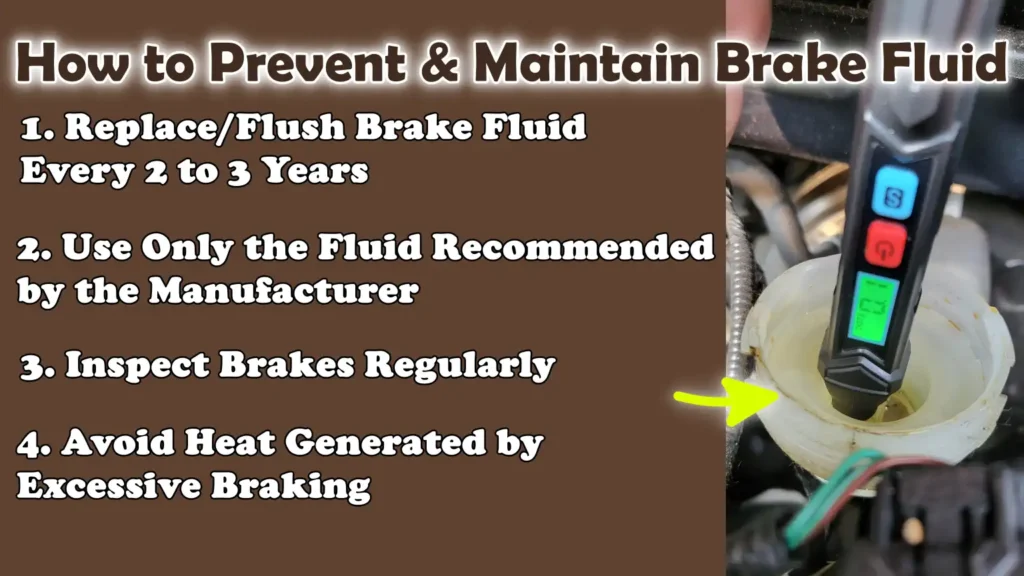
1. Replace/Flush Brake Fluid Every 2 to 3 Years
Brake fluid should be replaced at regular intervals, as it gradually absorbs moisture from the air, even if the system is completely sealed.
Over time, this moisture lowers the fluid’s boiling point, rendering it less effective at elevated temperatures.
Flushing the brake fluid every two to three years helps eliminate water contamination, debris and degraded fluid, replacing it with fresh fluid capable of effectively managing heat.
Regular fluid replacement ensures that robust hydraulic pressure is maintained within the braking system and minimizes the likelihood of vapor formation during strenuous braking.
2. Use Only the Fluid Recommended by the Manufacturer
Using the correct type of brake fluid is absolutely essential for optimal braking performance.
Different vehicles are designed to operate with specific types of fluids that meet particular temperature limits and performance standards.
Using a fluid that does not align with the manufacturer’s recommendations can lower its boiling point and diminish its capacity to withstand heat.
The selection of the recommended fluid is based on the design of the vehicle’s braking system and its anticipated operating conditions.
Adhering to this guideline ensures that the fluid can handle both normal and demanding driving conditions without boiling.
3. Inspect Brakes Regularly
Regular inspections of the braking system help identify issues before they escalate into serious problems.
Components such as brake pads, rotors, calipers and brake lines should be checked for signs of wear, tear, or any form of damage.
Worn or defective parts can increase friction and generate excessive heat, thereby raising the temperature of the brake fluid.
During inspections, paying attention to the color and level of the brake fluid also aids in the early detection of any contamination or deterioration.
Maintaining all components in good condition ensures that the braking system functions correctly and minimizes the likelihood of unnecessary heat accumulation.
4. Avoid Heat Generated by Excessive Braking
Managing heat while driving is the most effective method for preventing brake fluid from boiling.
Frequent or hard braking causes temperatures to rise rapidly and places significant strain on the entire braking system.
Adopting a gradual braking technique, maintaining a safe distance from other vehicles and allowing brief intervals between braking instances can help prevent heat buildup.
When descending a long slope, utilizing engine braking, rather than relying solely on the brake pedal, significantly reduces the load placed on the brakes.
By controlling the generation of heat, you can prevent the brake fluid from reaching its boiling point and maintain consistent braking performance.
Read More:
- How to Fix Brake Pedal Sinking Slowly
- How to Check Brake Pad Wear Sensor
- How to Measure Brake Pad Thickness Without Removing Wheel
- How to Replace Brake Pads
- How to Replace Brake Rotors
- How to Bleed Car Brakes
Know, The Common Mistakes to Avoid While Diagnosing Brake Fluid Boiling
Avoiding common mistakes is just as crucial as addressing the issue of boiling brake fluid.
Many drivers inadvertently make decisions that heighten the risk of brake failure or delay necessary inspections.
As a vehicle’s braking system relies on both the condition of the brake fluid and its mechanical performance, even minor errors can ultimately pose a serious threat to safety.
Understanding these common mistakes allows you to take timely corrective action, maintain consistent brake performance and avoid costly or hazardous situations.
Also, research about the brake fluid that shows that fluid near high-heat components such as: brake calipers actually becomes more contaminated and loses boiling resistance in way more faster than fluid in the reservoir, as this explains why brake fluid boiling often occurs under the heavy braking conditions, even when the fluid may appear normal during inspection.[¹]
1. Ignoring Early Signs of Brake Fade
One of the most common errors is ignoring early warning signs such as: the brake pedal feeling slightly soft or spongy, or a diminished ability to bring the vehicle to a halt after repeated braking.
Although these symptoms may seem minor at first, they often indicate that the brake fluid is overheating or has begun to degrade.
When these warning signs are ignored, the underlying issue can escalate rapidly, particularly in demanding driving conditions.
Addressing these problems early allows you to rectify the issue before brake fade or temporary brake failure occurs, outcomes that can be extremely dangerous in real-world driving scenarios.
2. Mixing Different Types of Brake Fluid
Another serious mistake is mixing different types of brake fluid without verifying their compatibility.
Not all brake fluids are designed to work together; mixing incompatible fluids can compromise braking performance and negatively affect the fluid’s boiling point.
Some fluids possess specific chemical properties; Mixing them can lead to braking malfunctions, reduced heat resistance, or even damage to internal components.
Using the specific type of fluid recommended for your vehicle ensures proper operation and maintains the expected performance of the braking system.
3. Assuming the System Contains Only Air
Many drivers assume that a soft or spongy brake pedal is always caused by the presence of air within the brake lines.
While the presence of air can indeed manifest in such symptoms, making this assumption can lead to incorrect repairs.
If the actual issue is related to boiling brake fluid, simply bleeding the brakes will not resolve the problem and the symptoms will reappear under high-heat conditions.
For an accurate diagnosis, it is crucial to observe whether the problem occurs specifically when the brakes are hot; this is a primary indicator of boiling fluid rather than trapped air.
4. Delaying Brake Fluid Replacement
Delaying the replacement of brake fluid is a common, yet risky practice.
Over time, brake fluid absorbs moisture and becomes contaminated, which lowers its boiling point and diminishes its effectiveness.
Many drivers overlook this fact because, under normal driving conditions, the fluid may appear to be functioning correctly.
However, during heavy braking, contaminated fluid can boil excessively and lead to brake failure.
Replacing the fluid at the recommended intervals ensures that it retains its heat-resistant properties and provides reliable braking performance when needed.
Conclusion – How to Diagnose Brake Fluid Boiling
So, basically your brakes may look and completely okay and well-manner but their true strength depends on the condition of the fluid inside.
Your braking system relies entirely on the fluid remaining in a liquid state to effectively transmit hydraulic pressure; the moment the fluid begins to boil, the system loses its ability to function correctly.
This is why issues such as a spongy brake pedal, a reduction in braking power after repeated use (known as “brake fade”), or an improvement in braking performance once the system has cooled down should never be ignored.
These are not sudden or spontaneous malfunctions; rather, they are clear indications that the fluid is no longer capable of handling heat in the manner for which it was designed.
The most crucial point to understand is that brake fluid does not last forever.
Over time, it absorbs moisture, its boiling point decreases and its performance gradually deteriorates, even if the vehicle feels completely normal during routine, light-duty driving.
This is precisely what makes brake fluid boiling so dangerous: it often manifests only when the system is under extreme stress, at the very moment when you need your brakes the most.
Accurately diagnosing the problem is essential, as this issue is frequently misattributed to incorrect causes such as: trapped air in the brake lines or worn-out components, leading to improper repairs.
The solution is straightforward, yet it must be taken seriously.
Replacing old fluid, using the correct type of fluid, addressing any mechanical issues related to heat generation and modifying your driving habits, collectively, these measures can fully restore the reliability of your braking system.
Regular maintenance and remaining alert to early warning signs are the most effective ways to prevent this problem.
Now, that’s it from this guide How to Diagnose Brake Fluid Boiling, also you can ask unsolved queries and questions below.
Frequently Asked Questions
FAQ 1: What is brake fluid boiling and why does it happen?
Answer: Brake fluid boils when the temperature inside the braking system exceeds the fluid’s boiling point. Brake fluid is designed to remain in a liquid state at all times so that it can efficiently transmit hydraulic pressure when you depress the brake pedal. However, heavy braking, such as while driving on long descents or during stop-and-go traffic, generates a significant amount of heat. If the fluid is old or has absorbed moisture, its boiling point drops considerably. When it boils, it turns into vapor; as vapor cannot effectively transmit hydraulic pressure, the brakes may become weak or fail to function properly.
FAQ 2: How can I tell if my brake fluid is boiling?
Answer: You can usually determine whether or not your brake fluid is boiling by observing how your brakes perform under high-heat conditions. Under repeated braking, the brake pedal may feel soft or “spongy” (yielding easily when pressed) and the vehicle may not stop as effectively as it should. In some cases, the pedal travel may be shorter than normal, or braking power may suddenly diminish. A key indicator is that this issue often resolves itself once the brakes have cooled down, suggesting that excessive heat is the underlying cause.
FAQ 3: What does a spongy brake pedal mean?
Answer: A spongy brake pedal indicates that there is an element within the braking system that is compressing itself rather than directly transmitting hydraulic pressure. This typically occurs when brake fluid boils and turns into vapor. Because vapor is compressible, it reduces the force reaching the brakes, causing the pedal to feel soft or unresponsive. However, a spongy pedal can also be caused by air trapped inside the brake lines; therefore, it is essential to verify whether this issue occurs only when the brakes are hot.
FAQ 4: Can brake fluid boil during normal driving?
Answer: In most normal driving situations, brake fluid does not reach its boiling point. However, this can still happen if the fluid is very old, has absorbed moisture, or if the vehicle is being driven under strenuous conditions such as: in heavy traffic during hot weather. This is more likely to occur in situations where heat builds up continuously, such as driving on long, steep inclines or hauling heavy loads.
FAQ 5: Why does brake performance improve after the brakes have cooled down?
Answer: Brake performance improves after cooling because, as the temperature drops, the vapor formed within the fluid reverts to its liquid state. Once the fluid returns to its liquid form, it is once again able to properly transmit hydraulic pressure throughout the entire braking system. This temporary improvement is a clear indication that the issue is related to heat and the condition of the fluid, rather than a permanent mechanical failure.
FAQ 6: How often should brake fluid be replaced?
Answer: Brake fluid should generally be replaced every two to three years, although this may vary depending on the specific vehicle and driving conditions. Over time, brake fluid absorbs moisture from the air, which lowers its boiling point and reduces its effectiveness. Regular replacement ensures that the fluid remains in good condition and can withstand high temperatures without boiling.
FAQ 7: What happens if I ignore boiling brake fluid?
Answer: Ignoring boiling brake fluid can pose a serious safety risk. As the problem worsens, confidence in braking performance diminishes, particularly during emergencies or periods of heavy use. The brake pedal may become excessively soft and in severe cases, the vehicle may fail to stop properly. This increases the risk of accidents and excessive heat can also cause damage to other brake components.
FAQ 8: Are boiling brake fluid and ‘brake fade’ the same thing?
Answer: Boiling brake fluid is one cause of ‘brake fade,’ but it is not the only one. ‘Brake fade’ is a general term used to describe a reduction in braking performance, typically caused by heat. This can result from overheating brake pads or rotors, or from the brake fluid boiling. When boiling fluid is the culprit, the primary issue is the formation of vapor within the system, which leads to a loss of hydraulic pressure.
FAQ 9: Can I fix the boiling problem without replacing the brake fluid?
Answer: In most cases, the problem of boiling brake fluid cannot be resolved without replacing the fluid. Once the fluid has absorbed moisture or degraded, its boiling point is permanently lowered. Flushing the system and refilling it with fresh, high-quality fluid is the most effective solution. Simply allowing the brakes to cool down may temporarily restore performance, but it does not resolve the underlying issue.
References:
[1] Measurement of Brake Fluid Boiling Point
https://www.researchgate.net/publication/391853765_Measurement_of_Brake_Fluid_Boiling_Point
Hello Folks, Dean Shali here to help you out to solve the problems with your lovely vehicle, as i have lots of experience and knowledge about automotive industry as i woks directly with the customers and repair vehicles and i love to help the people to keep their cars safe and running smoothly.