
Written By: Dean Shali
Fact Checked By: Sabré Cook
Reviewed By: Tamara Warren
Now-a-days, “ENGINE OIL DILUTION” is a growing issue in modern vehicles, specially in those which are equipped with turbochargers and gasoline direct injection systems.
Basically, it happens when unburned fuel leaks past the piston rings and mixes with the engine oil, that reduces its ability to properly lubricate the moving parts.
Also, there’s studies and field reports from the organizations such as: SAE International and American Petroleum Institute that have shown that even a small percentage of fuel contamination can significantly lower the oil viscosity, which then directly impacts engine protection.
This clearly means that all the critical components such as: bearings, camshafts and cylinder walls may wear faster than expected to be.
Even, there’s many drivers they don’t notice the problem early on because of the symptoms such as: slight fuel smell, a rising oil level or reduced performance seems nonthreatening situation.
But, if someone ignore this, then oil dilution can lead to the long-term engine damage, reduced in fuel efficiency and costly repairs are waiting ahead.
Now, in this guide you’ll learn How to Fix Engine Oil Dilution, so that you can easily identify, fix and prevent his issue in future.
Know, What is Exactly Engine Oil Dilution?
1. Definition and Basic Concept
Engine oil dilution is a condition in which unburned fuel mixes with the engine oil inside your car’s engine.
Engine oil is designed to create a protective layer between moving parts so that they do not rub directly against one another.
When fuel mixes with the oil, it thins and weakens the oil, thereby reducing its ability to protect the engine.
This is not an uncommon problem, particularly in modern engines that utilize advanced fuel systems.
Even a small amount of fuel can alter the properties of the oil, compromising its ability to provide lubrication, cooling and cleaning within the engine.
Over time, this can lead to increased wear on critical components such as pistons, bearings and camshafts, all of which are designed to operate with properly functioning engine oil.
2. How Does Fuel Enter the Engine Oil?
Fuel typically enters the engine oil through a process known as “blow-by,” which occurs inside the engine cylinders.
During normal operation, fuel and air are combusted to generate power; however, the fuel does not always burn completely.
A portion of this unburned fuel slips past the piston rings and travels down into the crankcase, where the engine oil is stored.
This condition is more common during “cold starts” (starting a cold engine), during short trips, or when the engine fails to reach its full operating temperature.
Furthermore, faulty fuel injectors can leak excess fuel into the cylinders, increasing the likelihood of fuel mixing with the oil.
Excessive “idling” (keeping the engine running while the vehicle is stationary) and worn piston rings can also allow a greater-than-normal amount of fuel to enter the system.
Modern engines equipped with high-pressure fuel systems are more susceptible to these conditions, which is why the problem of oil dilution is becoming increasingly common today.
3. The Difference Between Normal ‘Trace Dilution’ and Harmful ‘Dilution Levels’
The presence of a small amount of fuel in engine oil is considered normal, as engines are not completely sealed systems.
In most cases, during long journeys, when the engine reaches its optimal operating temperature, this small amount evaporates.
However, harmful dilution occurs when fuel begins to accumulate at a rate faster than it can evaporate.
This leads to several noticeable changes, such as a rise in the oil level, a strong odor of fuel and the oil appearing thinner than usual.
At this stage, the oil is unable to adequately protect the engine, leading to increased friction and wear within the engine components.
The key difference lies in the balance.
Normal ‘trace dilution’ remains at low levels and does not impact engine performance, whereas harmful dilution continues to increase and, over time, begins to damage engine parts.
Identifying this distinction early on is crucial, as dilution detected in its initial stages can often be rectified, whereas prolonged dilution can lead to severe engine problems.
Know, Common Causes of Engine Oil Dilution
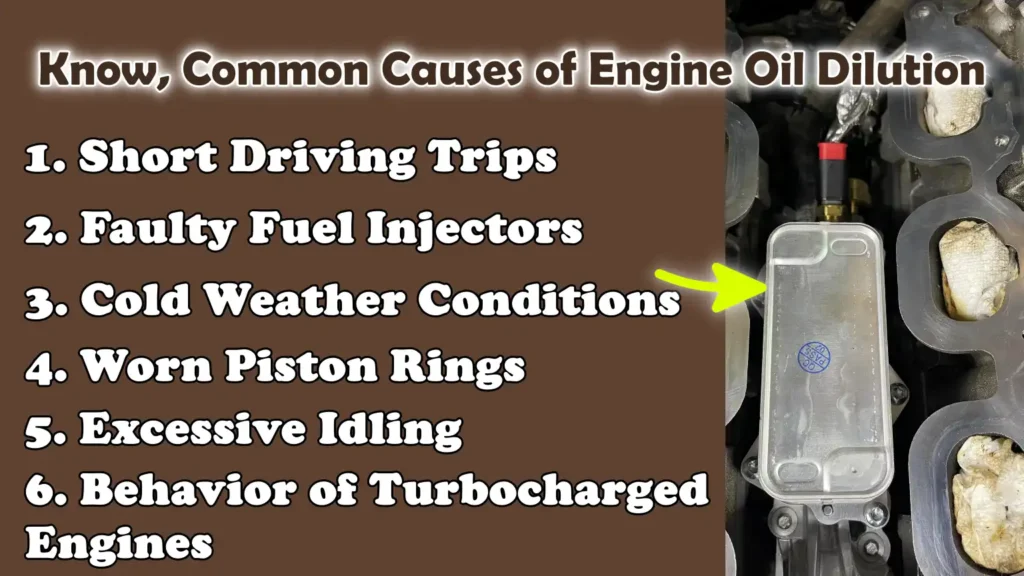
1. Short Driving Trips
Short driving trips, where the car is driven for only a few minutes at a time, are one of the most common causes of engine oil dilution.
During these trips, the engine does not reach its full operating temperature.
When the engine remains cold, the fuel inside the combustion chamber does not burn completely.
This unburnt fuel can seep past the piston rings and mix with the engine oil.
Due to frequent cold starts and regular short trips, fuel gradually accumulates in the oil over time, thereby slowly degrading its protective properties.
Engines used primarily for short errands or city driving are at a higher risk of experiencing this type of oil dilution.
2. Faulty Fuel Injectors
Fuel injectors are responsible for delivering the precise amount of fuel required for combustion within the engine.
If an injector is leaking, stuck open, or malfunctioning, it may allow an excessive amount of fuel to enter the cylinder.
When this excess fuel fails to burn completely, it can find its way into the crankcase and mix with the engine oil.
Faulty injectors are more common in engines equipped with high-pressure fuel systems; this issue often manifests as a sudden rise in the oil level accompanied by a strong odor of fuel.
Replacing or cleaning faulty injectors is crucial to prevent further oil contamination and to safeguard the engine’s internal components.
3. Cold Weather Conditions
Cold weather can also contribute to oil dilution, as low temperatures make it difficult for fuel to vaporize and burn completely.
During cold starts in winter, fuel may condense on the cylinder walls and gradually seep past the piston rings to mix with the oil.
This issue is exacerbated when the engine is not given sufficient time to warm up fully before driving.
Over time, repeated exposure to cold conditions leads to persistent fuel contamination, thereby reducing the oil’s viscosity (thickness) and its lubricating capabilities.
Cold weather, combined with short trips, further aggravates this problem, as the engine never reaches the temperature required to vaporize and burn off the small amounts of fuel mixed into the oil.
4. Worn Piston Rings
Piston rings are designed to seal the combustion chamber and prevent gases and fuel from entering the crankcase.
When these rings become worn or damaged, ‘blow-by’ gases, which contain unburned fuel, as it can leak past the rings and contaminate the engine oil.
This type of fuel contamination is far more severe than the minor traces of fuel typically observed during normal engine operation and it can lead to a progressively worsening problem of oil dilution.
High-mileage engines, or those that have not been properly maintained, are at a higher risk of experiencing piston ring wear.
It is crucial to rectify this mechanical wear; if leakage through the rings persists, simply changing the oil will not resolve the underlying issue.
5. Excessive Idling
Excessive idling is another contributing factor to engine oil dilution, as it causes the engine to operate at low temperatures for extended periods.
When the engine temperature remains low, the fuel does not burn completely and a portion of it can seep into and mix with the oil.
Repeated occurrences of this nature compromise the oil’s ability to protect the engine’s moving parts, thereby increasing the risk of premature engine wear.
Vehicles that remain in an idling (stationary) state for extended periods, whether in traffic or at stoplights, are particularly susceptible to this risk.
By minimizing unnecessary idling and allowing the engine to reach its full operating temperature, the issue of fuel dilution in the oil can be effectively mitigated.
6. Behavior of Turbocharged Engines
Due to their high-pressure fuel systems and modern combustion technologies, turbocharged engines are particularly sensitive to the problem of oil dilution.
The elevated pressures and temperatures inherent in these engines can sometimes cause fuel to bypass the combustion process more readily, resulting in fuel mixing with the engine oil.
Furthermore, modern turbo engines often feature smaller displacements and higher efficiency; this implies that any unburned fuel can have a more pronounced impact on the oil.
Therefore, it becomes crucial to regularly monitor both the oil level and its quality, particularly in vehicles driven in stop-and-go traffic or those frequently used for short trips.
Proper maintenance, including timely oil changes and engine inspections, helps prevent oil dilution from escalating into a serious issue in turbocharged engines.
Know, Common Signs and Symptoms of Oil Contamination
1. Rising Oil Level on the Dipstick
One of the earliest and clearest signs of engine oil contamination is observing a rising oil level when checking the dipstick.
Typically, the oil level remains relatively constant between oil changes; however, when fuel mixes with the oil, it increases the total volume of the oil.
This can lead the driver to the misconception that the engine is in good condition, whereas, in reality, the contaminated oil compromises its ability to lubricate critical engine components.
Regularly monitoring the oil level is crucial, as a sudden rise in the level may indicate that fuel is mixing with the oil so rapidly that it is unable to evaporate, a clear sign of an emerging issue that requires immediate attention.
2. Strong Odor of Fuel in the Oil
A strong odor of gasoline or fuel emanating from the engine oil is another distinct symptom of contamination.
Engine oil is formulated to be odorless; therefore, the presence of a fuel odor serves as a warning that the oil has become contaminated.
This odor is often detected during an oil change or while checking the dipstick, signaling that the oil’s protective properties have been compromised.
Ignoring this warning sign can lead to further oil contamination and, over time, result in gradual damage to engine components such as bearings, pistons and cylinder walls.
3. Thinning of the Oil
Contaminated oil loses its natural viscosity and becomes thinner than normal, thereby losing its ability to form a protective layer between the engine’s moving parts.
When fuel mixes with the oil, its viscosity (thickness) decreases; this means the oil flows more freely, but it is no longer able to effectively prevent friction.
Drivers may notice this change while checking the dipstick or by observing that the oil is dripping much faster than usual.
Diluted oil can accelerate engine wear, reduce fuel efficiency and cause the engine to overheat, as it becomes unable to effectively absorb and dissipate heat from the engine components.
4. Decline in Engine Performance
Fuel contamination in the engine oil can also have a detrimental effect on the engine’s overall performance.
The engine may feel less responsive, produce less power, or struggle to accelerate.
This occurs because the diluted oil cannot lubricate the engine parts as effectively as it should; this leads to increased friction and resistance within the engine.
Over time, this decline in performance becomes even more pronounced; if left unaddressed, it can lead to serious mechanical issues or increased fuel consumption.
5. Noise Caused by Engine Wear
As the engine oil thins out and begins to lose its protective properties, the stress caused by friction and wear on the engine’s internal components increases.
This often manifests as unusual noises emanating from the engine such as: ticking, knocking, or grinding sounds, particularly when accelerating or when the engine is under heavy load.
These noises serve as a clear warning that the engine is under strain and the oil is no longer providing the necessary protection.
To prevent permanent engine damage and avoid costly repairs, it is crucial to take immediate action and address this issue as soon as possible.
Why is Engine Oil Dilution Dangerous?
1. Diminished Lubrication Properties
Engine oil is designed to form a protective layer between the engine’s moving parts, preventing metal-to-metal contact that can generate friction and heat.
When fuel mixes with the oil, it reduces the oil’s viscosity (thickness) and its ability to lubricate effectively.
Diluted oil fails to establish an adequate protective film over engine components, leading to the generation of friction and heat.
This lack of lubrication accelerates wear on critical components such as: pistons, bearings and camshafts, thereby increasing the risk of their failure.
Maintaining the correct oil viscosity is vital for engine health and oil dilution compromises this essential function.
2. Accelerated Engine Wear and Tear
Diluted oil allows engine components to rub against one another more directly, resulting in accelerated wear and tear.
Over time, this can cause minor scratches, grooves and surface damage to critical parts.
This wear often occurs gradually and may not be immediately apparent, but it ultimately reduces the engine’s overall lifespan.
Engines suffering from persistent oil dilution issues may require major repairs much sooner than expected.
Regularly monitoring the condition of the oil and addressing dilution issues in a timely manner can prevent this accelerated damage.
3. Risk of Engine Damage or Total Failure
If the issue of oil dilution is left unaddressed, it can lead to severe engine damage or even total engine failure.
Due to a lack of lubrication, critical components may overheat, seize up, or fracture.
High-pressure components within the engine such as: turbochargers or high-performance cylinders, are particularly susceptible to the adverse effects of diluted oil.
If left unaddressed, this issue can lead to severe engine damage, a repair process that is both costly and time-consuming and often necessitates a complete engine replacement.
4. Reduced Fuel Efficiency
Diluted oil increases internal engine friction, forcing the engine to work harder to generate the same amount of power.
This inefficiency often manifests as a decline in fuel economy, as excess energy is wasted overcoming internal resistance.
Vehicles suffering from oil dilution typically exhibit a noticeable drop in miles per gallon, increased fuel costs and elevated carbon emissions.
Using clean oil with the correct viscosity ensures that the engine operates efficiently and maintains optimal fuel economy over the long term.
5. Impact on Emission Systems
Oil dilution can also have a detrimental effect on a vehicle’s emission control system.
Oil contaminated with fuel does not burn completely, leading to the generation of excessive amounts of harmful exhaust gases.
Components such as catalytic converters, oxygen sensors and particulate filters can be subjected to extreme stress, or even fail, due to the presence of excess fuel and insufficient lubrication.
Over time, this can result in elevated emission levels, failure during emission inspections and potentially legal repercussions, particularly in regions with strict environmental regulations.
Therefore, resolving the issue of oil dilution is crucial, not only for the health of the engine but also for ensuring compliance with environmental standards.
How to Detect Engine Oil Contamination
1. Visual Inspection
The easiest way to detect contamination in engine oil is through a careful visual inspection.
First, check the oil level on the dipstick.
If the level appears unusually high compared to previous checks, it may indicate that fuel has mixed with the oil.
Next, smell the oil.
Engine oil should have a normal or slightly oily scent; therefore, if you detect a strong odor of gasoline or fuel, it serves as a clear warning sign.
It is also helpful to observe changes in the oil’s consistency; if it appears thinner or more watery than usual, it is likely that contamination is occurring.
Visual inspection is a crucial first step, as it can alert the driver to a potential issue at an early stage, before it leads to a major engine malfunction.
2. Oil Analysis Testing
For a more precise assessment, professional oil analysis testing can be performed.
This involves sending a small sample of the engine oil to a laboratory to determine the exact amount of fuel present within it.
Oil analysis can also detect other impurities such as: coolant or metal particles, which may signal other hidden problems within the engine.
Laboratory technicians utilize chemical tests and spectrometry to analyze the extent of any changes in the oil’s composition.
This method is highly reliable and can detect fuel contamination in its early stages, allowing for preventive measures to be taken before any permanent damage is inflicted upon the engine.
3. OBD-II Diagnostics
Modern vehicles are equipped with OBD-II systems, which assist in identifying issues related to fuel delivery and overall engine performance.
By connecting an OBD-II scanner, you can check for error codes associated with faulty fuel injectors, engine misfires, or irregularities in fuel trim.
These codes may indicate that fuel is not reaching the engine properly, which can subsequently lead to issues such as fuel dilution in the oil.
OBD-II diagnostics are particularly useful as they enable drivers to detect internal problems that are not visible during a standard visual inspection.
This method helps identify the root cause of the issue rather than merely addressing its symptoms.
4. Professional Inspection
If a visual inspection, oil analysis, or OBD-II diagnostic check indicates a potential problem, it is prudent to consult a professional mechanic.
Experienced technicians can pinpoint the true cause of fuel dilution by thoroughly examining the fuel injectors, piston rings and engine seals.
They can also recommend the necessary corrective measures to resolve the issue such as: replacing injectors, flushing the engine, or repairing defective components.
A professional inspection ensures that the problem is accurately identified and effectively resolved, thereby minimizing the risk of recurring fuel dilution and protecting the engine from long-term damage.
How to Fix Engine Oil Dilution – Easy Steps
1. Change the Engine Oil Immediately
The first and most crucial step in resolving the problem of engine oil dilution is to change the oil immediately upon detecting the issue.
Using oil that is already contaminated with fuel cannot adequately protect your engine; therefore, replacing it restores essential lubrication and prevents further wear and tear.
Always use the specific engine oil recommended by the vehicle manufacturer, as it meets the necessary viscosity and performance standards.
High-quality synthetic oils are particularly effective, as they maintain their stability even under heat and pressure and resist the thinning effect caused by small amounts of residual fuel.
Regularly changing the oil and using the correct type of oil can significantly reduce the risk of long-term engine damage caused by dilution.
2. Repair Faulty Fuel Injectors
Fuel injectors are a common cause of oil dilution, as leaking or malfunctioning injectors allow excess fuel to enter the combustion chamber.
To resolve this issue, the injectors may need to be cleaned if they are clogged or slightly contaminated.
In more severe cases, replacing the injectors becomes necessary to restore proper fuel delivery.
Ensuring that the injectors are functioning correctly prevents fuel from mixing with the oil, thereby addressing the root cause of the dilution and helping to maintain the engine’s efficiency and longevity.
3. Improve Driving Habits
Short trips and frequent “cold starts” (starting a cold engine) contribute significantly to engine oil dilution.
Undertaking long journeys while maintaining good driving habits allows the engine to reach its full operating temperature; this burns off uncombusted fuel and reduces the likelihood of fuel entering the engine oil.
Operating the vehicle consistently at its normal operating temperature also ensures that the oil circulates properly and functions effectively, thereby preserving its protective properties and extending the engine’s lifespan.
4. Minimize Excessive Idling
Excessive idling keeps the engine running at low temperatures for extended periods, preventing fuel from burning completely and increasing the risk of oil dilution.
Minimizing idle time such as: avoiding unnecessary waiting with the engine running, allows the engine to operate at its optimal temperature and helps keep the oil clean.
By reducing idling, you minimize the accumulation of unburnt fuel in the oil and protect the engine from gradual wear and tear.
5. Inspect and Replace Piston Rings – If Necessary
Worn piston rings allow fuel to leak from the combustion chamber into the engine oil, which is a common cause of severe dilution.
If engine wear is identified as the root cause of the problem, it may be necessary to have the piston rings inspected and replaced by a professional mechanic.
This is a complex repair, but it is essential for preventing recurring oil contamination.
Replacing worn piston rings restores the integrity of the engine’s seals, prevents fuel from entering the oil and ensures the engine’s long-term reliability.
6. Update ECU Software
Some modern vehicles are equipped with an Electronic Control Unit (ECU); if the software governing these units becomes outdated, it can lead to fuel delivery issues.
Manufacturers periodically release software updates designed to adjust fuel injection timing or resolve combustion-related issues that contribute to oil dilution.
Updating the ECU can prevent excess fuel from entering the oil and improves overall engine performance, making it a simple yet effective measure for resolving the problem of oil dilution.
7. Use the Correct Engine Oil Grade
Selecting the correct engine oil grade is crucial for preventing and managing oil dilution.
An oil that meets the manufacturer’s viscosity and performance standards ensures proper lubrication even in the presence of minor fuel contamination.
Using the wrong grade of oil can exacerbate the effects of dilution, causing the oil to thin out too rapidly and fail to provide adequate protection to the engine’s moving parts.
Always choose oils certified by recognized standards organizations and consider using synthetic oils for superior stability and greater resistance to fuel contamination.
How to Prevent Engine Oil Dilution
1. Change the Oil Regularly
The most effective way to prevent engine oil dilution is to change the oil at scheduled intervals.
Fresh oil possesses the correct viscosity, additives and protective properties necessary to shield the engine from friction, heat and contaminants.
Over time, even a minute amount of fuel seeping into the oil can compromise its effectiveness.
Therefore, regular oil changes ensure that diluted oil does not accumulate within the engine.
Adhering to the oil change schedule recommended by the manufacturer keeps the engine running smoothly and minimizes the risk of damage caused by dirty or degraded oil.
2. Use High-Quality Fuel
Using high-quality fuel helps prevent oil dilution, as clean fuel burns completely and leaves behind fewer residues.
Poor-quality or adulterated fuel increases the likelihood of unburned fuel entering the oil, particularly in modern engines equipped with highly sensitive fuel systems.
Choosing fuels that meet established standards reduces the potential for incomplete combustion; this keeps both the engine and the oil in better condition, ensuring sustained performance and reliability over the long term.
3. Avoid Frequent Short Trips
Short trips and frequent “cold starts” (starting the engine from a cold state) are primary causes of oil dilution, as the engine does not reach its full operating temperature.
During these short trips, the fuel does not burn completely, resulting in small amounts of unburned fuel mixing into the oil.
Supplementing short trips with occasional longer drives helps maintain proper combustion and allows the engine to reach a temperature at which any residual fuel present in the oil evaporates.
Planning longer trips or consolidating several short errands into a single journey reduces the risk of oil dilution and ensures that the oil continues to perform at its optimal level.
4. Maintain Proper Engine Temperature
Keeping the engine at its correct operating temperature is crucial for preventing oil dilution.
Engines that run too cold or frequently remain in an idling state fail to burn fuel completely, thereby increasing the likelihood of fuel entering the oil.
Maintaining the proper engine temperature ensures efficient combustion and allows the oil to retain its protective properties.
Monitoring the cooling system, which includes the radiator, thermostat and other components, helps the engine reach and maintain the correct temperature, thereby safeguarding the oil against dilution and contamination.
5. Follow the Manufacturer’s Maintenance Schedule
Adhering to the vehicle manufacturer’s maintenance schedule is essential for preventing oil dilution.
Regular inspections of fuel injectors, pistons, rings and engine seals help detect early signs of issues that could lead to fuel contamination.
Scheduled maintenance involves changing the oil and filters, inspecting the cooling system and implementing other preventive measures that preserve the engine’s operational efficiency.
Following the recommended service intervals ensures that the engine remains in peak condition, thereby minimizing the risk of oil dilution and extending the lifespan of both the engine and its components.
Special Considerations for Modern Engines
1. Gasoline Direct Injection (GDI) Engines
Gasoline Direct Injection engines are particularly susceptible to engine oil dilution because fuel is injected directly into the combustion chamber at extremely high pressure.
This precise fuel delivery process can sometimes result in small amounts of unburnt fuel seeping past the piston rings and mixing with the oil specially during short trips or frequent cold starts.
GDI engines often operate under conditions of high pressure and fluctuating temperatures; this means that even slight fuel contamination can significantly compromise the oil’s viscosity (thickness) and lubricating properties.
To ensure proper engine protection in GDI-equipped vehicles, regular checks of oil levels and quality, along with timely oil changes, are essential.
2. Hybrid Vehicles and Oil Dilution Issues
Hybrid vehicles, which combine a gasoline engine with an electric motor, face unique challenges that increase the risk of oil dilution.
As the gasoline engine in a hybrid vehicle often operates intermittently or for short durations at lower temperatures, the fuel may not burn completely before entering the crankcase.
Over time, this can lead to a gradual accumulation of fuel in the oil, particularly during stop-and-go driving in urban environments.
To prevent long-term engine wear in hybrid vehicles, it is crucial to take certain preventive measures, such as regularly checking the oil, using the correct oil grade and strictly adhering to the manufacturer’s recommended maintenance schedule.
3. Turbocharged Engines
Turbocharged engines operate under conditions of extreme pressure and temperature, placing significant stress on both the engine’s performance and its internal components.
In these engines, the high-pressure fuel delivery system sometimes allows fuel to escape from the combustion chamber, resulting in the fuel mixing with the engine oil.
Turbocharged engines are particularly sensitive to oil dilution, as diluted and contaminated oil fails to adequately lubricate the turbo bearings and other high-speed components.
Maintaining proper oil quality, specifically, changing the oil regularly, using the synthetic oil recommended by the manufacturer and monitoring engine performance, is crucial to prevent severe engine damage and to extend the lifespan of turbocharged engines.
Estimated, Cost of Repairing Engine Oil Dilution
Not only this, there’s scientific research that shows that fuel dilution does more than just thin engine oil; but it literally alters its chemical structure and accelerates degradation, as 2026 study that found out that even modest levels of fuel in oil 3% to 5% significantly reduces the viscosity and strip away vital additives that protects the engine parts, that makes the engines more prone to wear and friction losses as well.[¹]
1. Cost of an Oil Change
The first and most essential expense associated with rectifying engine oil dilution is the cost of the oil change itself.
Depending on the type of oil used, the cost of a standard oil change can range from $40 to $100 for conventional oils, while high-quality synthetic oils, recommended for modern engines, may cost between $70 and $150.
Using the correct oil grade is crucial for restoring proper lubrication and protecting the engine from further damage.
Compared to the major repairs that may result from prolonged oil dilution, regular oil changes serve as a relatively inexpensive preventive measure.
2. Cost of Injector Repair or Replacement
If faulty fuel injectors are identified as the cause of the oil dilution, repairing or replacing them may be necessary.
The cost to clean a clogged injector can range from $50 to $150 per injector, while the cost for a complete replacement, depending on the vehicle’s make and model, as it can range from $200 to $600 per injector.
Timely maintenance of injectors prevents fuel from leaking into the oil, thereby safeguarding engine components and reducing the likelihood of costly future repairs.
Addressing injector-related issues early on is far more economical than waiting until the engine sustains severe damage.
3. Cost of Engine Repair – Worst-Case Scenario
In severe cases, where oil dilution has gone unnoticed, critical engine components such as piston rings, bearings, or turbochargers can sustain significant damage.
The cost of major engine repairs or a complete engine replacement can range from $2,500 to $7,000 or more, depending on the type of engine, labor rates and the availability of parts.
These substantial costs underscore the importance of identifying problems and implementing corrective measures at an early stage, as minor repairs and timely oil changes can avert the need for such expensive repairs.
4. Cost Comparison Table
A comparison of the costs associated with preventive and corrective measures clearly highlights the financial benefits of early intervention.
Changing the oil or servicing injectors is relatively inexpensive and can protect the engine from long-term damage, whereas ignoring oil dilution can lead to complete engine failure, a scenario that may necessitate repairs costing thousands of dollars.
Understanding these cost-related aspects helps vehicle owners make informed decisions regarding maintenance, thereby further emphasizing the importance of monitoring oil condition and promptly addressing issues related to fuel dilution.
Read More:
- How to Detect Engine Oil Contamination
- How to Flush Engine Oil System
- How to Change Transmission Fluid
- How to Check Transmission Fluid
- How to Check Coolant Level
- How to Replace a Radiator Fan
- How to Fix a Coolant Leak
Understand, When to Consult a Mechanic?
1. Persistent Fuel Odor in the Oil
A persistent smell of fuel in the engine oil is a clear indication that fuel is mixing with the oil to a dangerous degree.
While a faint odor may occasionally be present during short trips, a strong or persistent fuel smell suggests an underlying internal issue that requires professional attention.
Mechanics can pinpoint the source of this contamination, by inspecting fuel injectors, piston rings and other components, thereby preventing further damage to the engine.
Addressing the issue of a persistent fuel odor in the oil in a timely manner prevents accelerated engine wear and helps avoid costly repairs.
2. Rapid Increase in Oil Level
If the engine oil level rises rapidly during an inspection, it may be because fuel is mixing with the oil at such a rate that it is unable to evaporate.
This is a serious symptom, as it directly compromises the oil’s viscosity (thickness) and lubricating properties.
To accurately diagnose the cause of a rapid increase in oil level, mechanics can perform various diagnostic tests, including fuel injector checks, “blow-by” gas analysis and oil analysis.
Timely intervention ensures that the engine continues to operate safely and protects critical components from long-term damage.
3. Engine Warning Lights
Modern vehicles are equipped with sensors that trigger engine warning lights whenever issues related to fuel supply or combustion arise.
Warning indicators such as: the “Check Engine Light”, as it can signal conditions that may lead to the dilution of engine oil.
If you observe these lights illuminated on your dashboard, you should immediately have the vehicle inspected by a professional.
Mechanics can utilize OBD-II diagnostics to read fault codes, identify faulty injectors, or detect abnormal fuel trim levels.
Paying immediate attention to warning lights helps prevent minor issues from escalating into major engine failures.
4. Performance-Related Issues
A noticeable decline in engine performance such as: sluggish acceleration, delayed throttle response, or the presence of unusual noises, may indicate that the oil’s lubricating capacity has diminished due to thinning, resulting in increased friction between the engine’s internal components.
Persistent performance issues should be investigated by a qualified mechanic who can inspect the engine and assess the oil’s quality to determine whether repairs such as: injector servicing or an oil change, are necessary.
Timely detection and resolution of performance-related symptoms help maintain engine efficiency, fuel economy and long-term reliability.
Conclusion – How to Fix Engine Oil Dilution
Engine Oil is literally the lifeline of your car, but even small amounts of fuel contamination can quietly shorten the life if you ignore this completely.
When fuel mixes with the engine oil, it reduces viscosity, weakens lubrication and increases friction on critical components such as pistons, bearings and camshafts.
Modern engines, particularly those equipped with turbochargers, gasoline direct injection systems, or hybrid setups, are specially susceptible to this problem; consequently, its early detection and prevention become even more crucial.
Regular oil changes using high-quality oils recommended by the manufacturer, proper driving habits, timely maintenance of fuel injectors and monitoring engine temperature are all practical measures to prevent this issue.
Addressing engine oil dilution promptly not only protects your engine from long-term damage but also ensures optimal performance, fuel efficiency and longevity.
Now, that’s it from this guide from How to Fix Engine Oil Dilution, now you can ask more questions.
Frequently Asked Questions
FAQ 1: What is Engine Oil Dilution?
Engine oil dilution occurs when fuel leaks into the engine oil and mixes with it. Typically, the function of engine oil is to lubricate moving parts, reduce friction and keep the engine clean. When fuel enters the oil, it thins the oil, making it less effective at protecting the engine. Over time, this can lead to increased wear on pistons, bearings and other internal components. Dilution can occur gradually particularly in modern engines used for short trips or those featuring advanced fuel systems and may not be immediately apparent.
FAQ 2: What Causes Engine Oil Dilution?
The primary causes of oil dilution include short driving trips where the engine does not fully warm up; faulty fuel injectors that leak excessive fuel; cold weather, which prevents fuel from burning completely; worn piston rings that allow fuel to enter the oil; excessive idling; and certain specific operating characteristics of modern engines, such as turbocharged or Gasoline Direct Injection (GDI) engines. All of these conditions allow fuel to mix with the oil, thereby diminishing its ability to protect the engine.
FAQ 3: What Are the Signs of Oil Dilution?
You can often detect oil dilution by observing certain warning signs. If the oil level on the dipstick suddenly rises, it is possible that fuel has mixed with the oil. A strong odor of fuel when checking the oil is another clear indication. Diluted oil also tends to feel thinner than normal. You may observe a decline in engine performance, sluggish acceleration, or unusual noises such as: ticking or knocking sounds, because the oil is failing to adequately protect the engine.
FAQ 4: Why is oil dilution dangerous?
Oil dilution is dangerous because it compromises the lubrication upon which the engine relies. Diluted oil increases friction between moving parts, leading to accelerated wear and tear. It can also cause the engine to overheat, reduce fuel efficiency and in severe cases, result in engine damage or total engine failure. Furthermore, diluted oil can negatively impact the emission control system, potentially increasing harmful emissions and damaging components such as the catalytic converter. To avoid costly repair bills, it is crucial to address the issue of oil dilution in its early stages.
FAQ 5: How can I detect engine oil dilution?
The first step is a visual inspection. Check the oil level and smell the oil; if the oil is contaminated with fuel, it will often emit a gasoline-like odor and the oil level may appear higher than normal. You can determine the exact percentage of fuel present in the oil by having it analyzed at a laboratory. OBD-II diagnostics can help identify issues within the fuel system or injectors that are contributing to the oil dilution. If these checks reveal any problems, or if symptoms persist, it is best to consult a professional mechanic for a comprehensive inspection.
FAQ 6: How do I fix the problem of engine oil dilution?
Correcting the issue of oil dilution begins with an immediate oil change; use the specific oil grade recommended by the manufacturer; ideally, opt for a high-quality synthetic oil. If fuel injectors are leaking, they should be cleaned or replaced. Improving driving habits such as: taking longer trips to allow the engine to reach its full operating temperature and avoiding unnecessary prolonged idling, helps prevent future oil dilution. In severe cases, worn piston rings may need to be replaced and some vehicles may require an ECU software update. Using engine oil with the correct viscosity (thickness) is crucial for maintaining engine protection.
FAQ 7: Are modern engines more prone to oil dilution?
Yes, modern engines such as: Gasoline Direct Injection (GDI) engines, turbocharged engines and hybrid systems are more susceptible to this issue. GDI engines inject fuel directly into the cylinders at very high pressure, increasing the likelihood of unburnt fuel mixing with the oil. Hybrid engines often operate at lower temperatures or in an intermittent manner, which can allow fuel to enter the oil. Turbocharged engines operate under extreme pressure, which can significantly amplify the adverse effects of even trace amounts of fuel present in the oil. These engines require careful monitoring and regular maintenance to prevent oil dilution.
FAQ 8: How can I prevent engine oil dilution?
Measures to prevent oil dilution include: performing regular oil changes using high-quality oil, using clean fuel that burns efficiently, avoiding frequent short trips, maintaining the engine’s proper operating temperature and adhering to the manufacturer’s recommended maintenance schedule. These steps ensure that the oil retains its protective properties and minimizes the risk of fuel contamination. Consistent monitoring is the simplest and most cost-effective way to keep your engine safe.
References:
[1] Fuel Dilution in Hybrid Engine Oils: Correlation Between Viscosity Loss and FTIR Spectral Shifts in Modern Combustion Systems
https://www.mdpi.com/1996-1073/19/1/50
Hello Folks, Dean Shali here to help you out to solve the problems with your lovely vehicle, as i have lots of experience and knowledge about automotive industry as i woks directly with the customers and repair vehicles and i love to help the people to keep their cars safe and running smoothly.