Written By: Dean Shali
Fact Checked By: Sabré Cook
Reviewed By: Tamara Warren
When washing the vehicle doesn’t changes the dullness at all, then the problem is demanding solution of that oxidation thing.
Yes, this faded car paint literally caused by the process called “OXIDATION”, where constant exposure to the sunlight, heat and air for long period of time, slowly but steadily breaks down the protective clear coat on your car.
As well as, UV-rays also has the role to play, as it actually weakens this outer layer that causes the surface to lose its shine very much and that’s why it feels like rough and appear dull or chalky type of thing even after washing.
Plus, there’s environmental factors such as: pollution, bird droppings, acid rain and road grime that can speed up this damage if the paint is not protected at all.
Now, you need to know that modern automotive paints are actually designed with the multiple layers such as: a base color coat and a clear coat and when you wanted to restore that shine then it literally means you have to correct the top layer rather than replacement of the entire paint.
That’s why, in this guide you’ll learn everything about How to Restore Faded Car Paint as the recommended process improves the gloss and even protect it from future damage as well.
Why Does Car Paint Fade?
Car paint fading is a common issue for vehicle owners.
This occurs gradually due to various factors that damage the protective layers present on your car’s surface.
Understanding these causes allows you to take the appropriate steps to restore and protect your paintwork.
1. Damage from UV Rays and Oxidation
The most common cause of paint fading is prolonged exposure to sunlight, specifically ultraviolet (UV) rays.
UV rays gradually break down the “clear coat”, the uppermost protective layer of your car’s paint.
When the clear coat degrades, the underlying paint loses its luster and begins to appear faded or chalky.
Many people mistake this dullness for dust or dirt; however, oxidation is a chemical process that, if left unaddressed, can cause permanent damage to the surface.
Unlike dirt, which can be removed simply by washing, oxidized paint requires polishing or repair to restore its original shine.
2. Environmental Pollution
Environmental elements also play a significant role in the fading of car paint.
Pollution, acid rain, bird droppings and road salts contain chemicals that attack the paint surface over time.
Repeated exposure, even if minor, as it can weaken the clear coat and lead to paint fading.
In particular, bird droppings and tree sap are acidic in nature; if not removed immediately, they can leave permanent stains.
Vehicles parked outdoors without any protection are more susceptible to these pollutants, which gradually degrade their glossy finish.
3. Improper Washing Techniques
The way you wash your car can also have a significant impact on the longevity of its paintwork.
Using harsh chemicals, abrasive sponges, or dirty towels for cleaning can cause scratches or damage to the clear coat.
Automatic car wash machines equipped with stiff brushes can inflict microscopic scratches on the paint, causing it to fade at an accelerated rate.
Over time, repeated improper washing degrades the paint’s smooth surface, rendering it more susceptible to oxidation and environmental damage.
If the correct washing techniques and products are not utilized, even well-intentioned cleaning efforts can inadvertently cause harm to the paintwork.
4. Lack of Protection
When paint is left unprotected, it naturally begins to fade much more rapidly.
Waxes, paint sealants and ceramic coatings serve as a protective barrier between the paint and damaging elements such as: UV rays and pollutants.
Without these protective layers, the clear coat is directly exposed to sunlight, dust and moisture, thereby accelerating the paint-fading process.
Regular protection not only slows down the oxidation process but also simplifies cleaning and helps the car retain its luster for many years to come.
How to Assess the Severity of Paint Fading
Understanding the extent to which your car’s paint has faded is crucial before attempting any repairs.
The severity of fading can range from a slight reduction in gloss to significant deterioration of the clear coat; recognizing this distinction helps you select the appropriate method to restore the car’s shine without causing further damage.
1. Mild Fading
Mild fading occurs when the car’s paint loses a small portion of its original luster, yet still feels smooth to the touch.
This type of fading is typically caused by the gradual and cumulative effects of prolonged exposure to sunlight and environmental elements over time.
The color may appear slightly dull or muted, but the clear coat remains intact.
Cars with mild paint fading can often be quickly restored using gentle methods such as: light polishing or mild paint restoration products, without the need for harsh treatments.
2. Moderate Fading
Moderate fading is visually more apparent and is typically accompanied by a distinct roughness on the paint surface.
Early signs of oxidation may be visible on the clear coat, causing the paint to appear chalky or hazy.
This level of fading is generally caused by exposure to UV rays, environmental pollutants and improper car washing techniques.
Restoring cars with moderate paint fading requires more thorough preparation, including washing, claying and careful polishing, to remove layers of oxidation and restore the paint’s depth and luster.
3. Severe Fading
Severe fading occurs when the clear coat has deteriorated significantly or begins to peel, exposing the underlying base coat.
In this condition, the paint may appear rough, flaky, or uneven; if not properly rectified, it can lead to even more extensive damage.
Severe fading is often the result of years of neglect, excessive exposure to UV rays and a lack of protective care.
Repairing the paint in this state can be challenging and professional assistance or specialized products may be required to prevent permanent damage to the vehicle and restore its original luster.
Tools
| Tool / Material | Why It’s Needed | How to Use |
|---|---|---|
| Car Wash Soap – pH-Balanced | Removes dust and dirt without stripping away wax or damaging the paintwork. | Dilute with water according to the instructions. Wash the car using a soft sponge or microfiber cloth, then rinse thoroughly and dry. |
| Microfiber Towels | Gentle on paint; helps prevent scratching. | Use to dry the car after washing, or to wipe off polish or wax. Avoid using coarse cloths to prevent the formation of swirl marks. |
| Clay Bar Kit | Removes stubborn contaminants such as tar, tree sap and environmental fallout. | Apply a clay lubricant to the surface, then gently rub the clay bar over the paint until the surface feels smooth. Afterward, wipe away any remaining residue. |
| Polishing Compound | Restores shine by removing oxidation and minor scratches. | Apply a small amount to a foam pad or microfiber applicator. Work in small sections using circular motions. Wipe away excess polish with a clean towel and buff to a shine. |
| Dual-Action Polisher – Optional but Recommended | Makes the polishing process easier, faster and more uniform. | Attach a foam pad, apply the polish and run the polisher over the panel using overlapping motions. Compared to hand polishing, this method reduces the risk of uneven results. |
| Foam Pads | Helps apply polish or wax evenly. | Use with polish or wax, whether with a handheld applicator or a machine polisher. Replace or clean the pad regularly to prevent scratching the paint. |
| Wax or Paint Sealant | Protects polished paint and enhances its shine. | Apply a thin, even layer of the product to the polished surface. As per the product instructions, allow it to dry until it appears slightly hazy, then wipe and buff to a shine using a clean microfiber towel. |
| UV Protectant | Protects the paint from damage caused by sunlight and slows down the process of color fading. | Spray or apply onto waxed or polished paint surfaces. Reapply periodically to maintain protection. |
How to Restore Faded Car Paint – Easy Process
Restoring faded car paint is a meticulous task that requires close attention to every detail and the application of proper techniques.
Executing each step correctly ensures that the paint’s original luster is restored without causing any further damage.
This section outlines the entire process, offering practical advice in simple, easy-to-understand language.
1. Thoroughly Wash the Car
Before beginning any restoration work, it is crucial to ensure that the car is completely clean.
Washing removes accumulated dirt, dust and other surface contaminants that could scratch the paint during the polishing process.
To minimize the risk of scratching, the “two-bucket method” is highly recommended.
Fill one bucket with soapy water to rinse your sponge or wash mitt and fill the second bucket with clean water to wash the car itself.
Begin washing the car from top to bottom, rinsing your mitt frequently throughout the process.
After washing, dry the car with a clean microfiber towel to prevent water spots.
2. Remove Contaminants Using a Clay Bar
Even after washing, tiny particles such as: tar, tree sap, or industrial fallout, may remain embedded in the paint.
These particles can be gently removed using a clay bar, leaving the car’s surface smooth and ready for polishing.
Spray a small section of the car’s surface with clay lubricant, then glide the clay bar over the paint in straight lines.
Wipe away any remaining impurities using a microfiber towel.
This step is crucial; if polish is applied directly over impurities embedded in the paint, it can cause scratches and diminish the effectiveness of the polishing process.
3. Assess the Condition of the Paint
Before polishing, it is essential to inspect the car’s paintwork very closely.
Check for scratches, swirl marks and the extent of paint oxidation (fading).
Assessing the severity of the damage helps you determine the appropriate amount of polish or compound to use and whether hand polishing will suffice or if a machine polisher is required.
Identifying problem areas in advance ensures that every section of the car receives the correct treatment, thereby maintaining color uniformity and maximizing the paint’s shine.
4. Apply Polishing Compound – Pre-Polishing
Polishing removes the uppermost, oxidized layer of the paint, thereby restoring both its color and shine.
You can apply the compound by hand using a foam pad, or, for faster and more uniform results, use a dual-action polisher.
To ensure complete coverage, work on small sections at a time.
Apply the product according to the manufacturer’s instructions, using either circular or back-and-forth motions.
Once the oxidized layer has been removed, wipe away any residue with a clean microfiber towel to reveal a smooth, glossy surface.
5. Apply Finishing Polish – Optional
To achieve a flawless, mirror-like finish, a finishing polish can be applied following the initial compound treatment.
This stage renders the paint surface even smoother, eliminates minor imperfections and enhances both its depth and gloss.
Unlike standard polishing compounds, a finishing polish features a lighter consistency and can be applied using a foam pad or by hand, leaving the paint silky-smooth and ready for protection.
6. Apply Wax or Sealant
Following the polishing process, the paint requires protection.
Wax or a paint sealant creates a protective layer over the clear coat, preserving the shine and acting as a barrier against UV rays, pollution and dirt.
Apply a thin, even coat to the polished surface.
Allow it to cure briefly, until it appears slightly hazy, as specified in the product instructions; then, using a microfiber towel, buff it to a shine, revealing a long-lasting, glossy finish.
This step is crucial for maintaining the restored appearance of the paint and preventing it from fading in the future.
7. Final Buffing and Inspection
The final stage involves a meticulous inspection to ensure that the paint restoration process is complete and uniform.
Remove any residual product, check for missed spots and verify that the paint finish is consistent and glossy.
A final buffing with a clean microfiber towel enhances the overall shine and smoothness.
Completing this step ensures that the restored paint not only looks magnificent but is also fully protected and ready to withstand environmental elements.
How to Restore Faded Car Paint – Alternative Methods for Specific Situations
Although standard methods such as: washing, claying and polishing, are effective in most cases where paint has faded, certain specific situations may require additional techniques or the assistance of a professional.
Understanding these alternative methods allows you to select the appropriate solution based on the severity of the paint fading and the specific condition of your vehicle.
1. Using Rubbing Compounds for Severe Oxidation
In cases where the paint has undergone significant oxidation and standard polishing fails to restore its shine, a rubbing compound can be utilized.
Rubbing compounds are more abrasive than standard polishes; they are designed to remove the deeper layers of a damaged clear coat, as well as to strip away accumulated oxidation from the surface.
It is crucial to use them with caution, as applying excessive pressure or using them too frequently can thin out the paint layer.
Apply a small amount of the compound to a foam pad or a dual-action polisher, work on small sections at a time and wipe away the residue.
This method is effective for cars that still appear dull or chalky even after regular polishing.
2. Using Paint Restoration Kits
Paint restoration kits offer a convenient option for those who may not possess professional detailing tools.
These kits typically include a polish or compound, applicator pads, microfiber towels and sometimes a wax or sealant.
The advantage of using a kit is that it contains pre-selected products that are safe for most vehicle paint finishes, along with easy-to-understand instructions.
By following the provided instructions step-by-step, even beginners can effectively remove oxidation without damaging the paint, restore color depth and achieve a brilliant shine.
3. When to Repaint
There are certain situations where restoration alone is insufficient, particularly when the clear coat has completely deteriorated or has begun to peel.
Severe fading, flaking, or separation of the paint layer exposes the original paint underneath; in such cases, the surface cannot be repaired using polishes or compounds.
Under these circumstances, repainting may be the only viable solution to achieve a uniform and glossy finish.
Repainting involves applying a new base coat and clear coat, a task typically performed by professionals.
Recognizing when restoration is no longer effective saves you from wasted effort and ensures that the car’s aesthetic appeal is properly restored.
Know, Common Mistakes So That You Can Avoid Them?
Restoring faded car paint can yield excellent results; however, mistakes made during this process can lead to damage or diminish the effectiveness of the treatment.
Knowing what to avoid ensures that your paint restoration efforts enhance the paint’s finish rather than harming it.
Outlined below are some of the most common mistakes car owners make, along with an explanation of how these errors impact the paint’s finish.
1. Not Washing the Car Before Polishing
One of the biggest mistakes is beginning to polish the car without first washing it thoroughly.
When dirt, dust and other contaminants present on the surface are rubbed against the paint using a polish or compound, they act like sandpaper, creating fine scratches and swirl marks.
Washing the car beforehand removes these particles, allowing the polish to work on the oxidized layer without damaging the underlying paint.
A clean surface ensures that the paint restoration process is both safe and effective.
2. Using Too Much Compound
Applying an excessive amount of polish or rubbing compound can be detrimental to your car’s paint.
Using an overly large quantity of product makes it difficult to apply evenly; it can accumulate in certain areas, leading to excessive polishing in specific spots.
Overuse can thin out the “clear coat” (the protective layer atop the paint), thereby reducing its ability to shield the paint from UV rays and environmental damage.
Using the correct amount ensures consistent results and preserves the structural integrity of the paintwork.
3. Applying Incorrect Pressure
Applying the right amount of pressure while polishing is crucial.
Applying excessive pressure can damage the clear coat, whereas applying too little pressure will fail to effectively remove oxidation.
When polishing by hand, one should use smooth and uniform strokes; when using a machine, it is essential to follow the product instructions regarding speed and pressure.
Understanding how to apply the correct amount of force ensures that the oxidized layer is removed without damaging the underlying paint layer.
4. Failing to Seal the Paint Afterward
A common mistake made after performing paint correction is failing to apply a wax or sealant, which significantly reduces the longevity of the repair effort.
Although polishing removes the damaged outer layer of paint, it also leaves the paint exposed to UV rays, dirt and environmental contaminants.
Sealing the paint with wax or a protective coating preserves its shine and acts as a barrier to protect the paint from fading, oxidation and environmental pollutants.
Skipping this step means the paint will deteriorate rapidly, rendering all the hard work invested in the paint correction process futile.
5. Using Household Cleaners
Many people attempt to save time by using household cleaning products such as: dish soap, bleach, or ammonia-based cleaners, on their car’s paint.
These products are not formulated for automotive paint; using them can strip away protective layers, damage the clear coat, or cause the paint to fade.
Using products specifically designed for cars ensures that the paint remains safe during the cleaning and preparation stages of the correction process.
The right cleaning supplies protect both the paint itself and its restored luster.
How Long Does Paint Restoration Last?
The lifespan of a paint restoration depends on several factors, such as the quality of the restoration process itself, the type of protection applied afterward and how well the vehicle is maintained.
With proper care, the longevity of restored paint can be significantly extended, whereas neglect or exposure to harsh weather conditions can reduce its durability.
1. Depends on Protection and Care
After restoring faded paint, applying a protective layer such as: wax, a paint sealant, or a ceramic coating, is crucial.
These products shield the clear coat from UV rays, pollution and moisture, thereby slowing down the natural fading process of the paint.
Regular washing with pH-balanced car soaps, the use of microfiber towels and the avoidance of harsh chemicals also help preserve the restored shine.
Vehicles parked in shaded or covered areas are less susceptible to the effects of sunlight; consequently, their finish typically lasts longer than that of cars parked outdoors continuously.
Maintenance is paramount, as even the finest restoration will not endure for long if the paint is repeatedly subjected to harsh weather without any protection.
2. Typical Lifespan with Proper Care
When a restoration is executed correctly and followed by consistent care and protection, the results, when using traditional waxes or sealants, as it can last anywhere from six months to two years.
Modern coatings, such as ceramic coatings, can extend this durability to five years or even longer, depending on the specific product used and the prevailing environmental conditions.
Regular maintenance, which includes washing the vehicle every two weeks, reapplying protective layers as needed and promptly removing contaminants like bird droppings or tree sap, ensures that the paint remains glossy and smooth.
With proper care, a restored car can maintain a showroom-like finish for years, saving both time and money compared to repeated repainting.
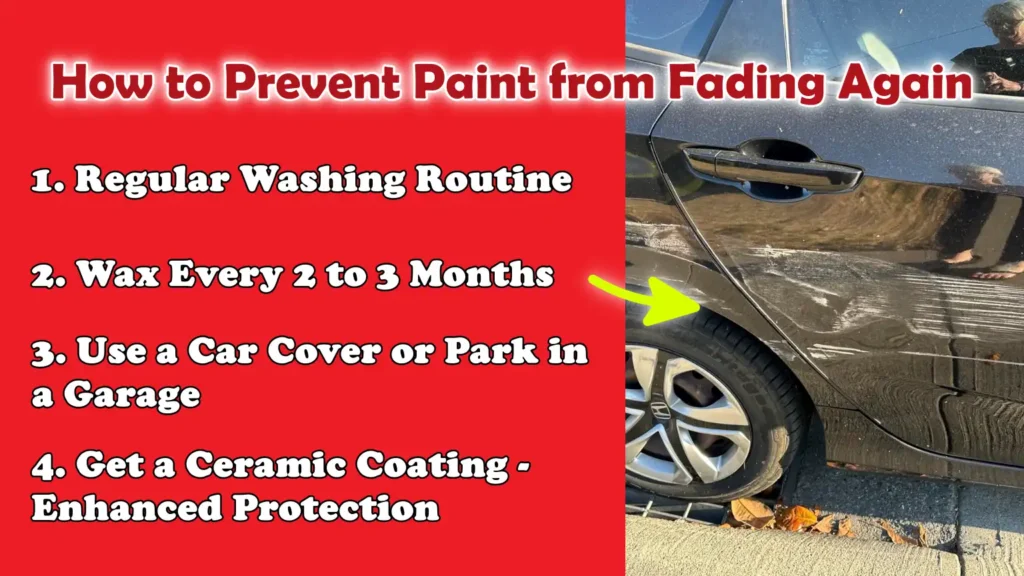
How to Prevent Paint from Fading Again
Restoring faded paint is just one part of maintaining your car’s aesthetic appeal.
Subsequently, safeguarding the paint and adopting a routine maintenance regimen are crucial for preserving its luster for years to come.
The tips outlined below focus on preventing oxidation, damage caused by UV rays and environmental degradation, while simultaneously maintaining the paint’s smooth and glossy finish.
Not only this, there’s scientific studies on the automotive coatings that demonstrated that the exposure to the environmental conditions: specifically UV-A light and atmospheric contaminants that can chemically alter the clear coat and causes the colour fading, roughness and loss of gloss over the time, that explains that chemical processes behind oxidation and paint degradation that car owners usually observes.[¹]
1. Regular Washing Routine
The most effective method for preventing paint fade is to wash your car regularly.
If dirt, dust, pollutants and road grime are allowed to remain on the car’s surface for extended periods, they can gradually damage the paint’s uppermost layer (the clear coat).
Washing your car at least once every two weeks, using a pH-balanced car soap and clean microfiber towels, removes this grime without scratching the paint surface.
Thoroughly rinsing the car and drying it with a soft towel prevents water spots and prepares the surface for additional protective measures, such as wax or sealants.
2. Wax Every 2 to 3 Months
Applying a wax or paint sealant every two to three months creates a protective shield against UV rays, environmental contaminants and moisture.
Wax forms a layer that reflects sunlight, thereby slowing down the processes of oxidation and color fading.
Regular waxing ensures that this protective barrier remains intact, safeguarding both the beauty and the longevity of the paint.
Even after polishing, if a protective layer of wax is not applied, the risk of the paint fading over time remains.
3. Use a Car Cover or Park in a Garage
Parking your car in a shaded area or a garage significantly reduces the risk of exposure to direct sunlight, the primary cause of paint fading.
For those who park outdoors, a car cover is an excellent option, shielding the paint from UV rays, dust, bird droppings and tree sap.
Minimizing exposure to these elements slows down the oxidation process, ensuring the paint remains smooth and glossy.
By providing continuous protection against the sun and grime, the results of any paint correction work are preserved for a much longer duration.
4. Get a Ceramic Coating – Enhanced Protection
For superior and long-lasting protection, a ceramic coating acts as a robust protective shield that bonds directly with the paint’s uppermost layer (the clear coat).
Unlike wax, a ceramic coating can last for several years and offers enhanced protection against UV rays, chemical stains and minor scratches.
It renders the surface hydrophobic (water-repellent), making it significantly easier to wash away dust and dirt.
Applying a ceramic coating after paint correction preserves the paint’s luster, reduces maintenance requirements and significantly slows down the rate of future paint fading.
This is an ideal solution for those seeking professional-grade protection combined with long-term durability.
Know, Estimated Cost Breakdown
Understanding the costs associated with repairing faded car paint helps vehicle owners make informed decisions regarding the most practical and effective approach.
Costs can depend significantly on whether you choose a DIY (Do-It-Yourself) method, opt for professional detailing, or decide to have the entire vehicle repainted.
Each option has its own benefits, limitations and long-term implications for the car’s appearance and resale value.
1. DIY (Do-It-Yourself) Approach: Costs
Repairing faded paint at home can be significantly more economical than hiring a professional.
The primary expenses include car wash soap, microfiber towels, a clay bar kit, polishing compounds, foam pads, wax or sealant and some optional tools such as a dual-action polisher.
On average, the total cost of a DIY paint repair project ranges from $50 to $150, depending on the quality of the products used.
Although this method requires time, patience and meticulous attention to detail, it offers an opportunity to restore your car’s shine at a fraction of the cost of professional services.
By following step-by-step instructions and using the right materials, anyone can achieve results that rival professional-quality work.
2. Professional Detailing: Costs
Professional detailing services offer more advanced equipment, expert techniques and high-quality products, resulting in longer-lasting and more consistent results.
Depending on the size of the vehicle, the severity of the paint fading and the specific services involved, the cost of professional paint correction or repair services typically ranges from $200 to $600.
Some premium services, which may include multi-stage polishing, ceramic coating, or specialized treatments, as it can cost upwards of $1,000.
Although this is a more expensive option, professional detailing saves time, minimizes the risk of errors and delivers a finish that is difficult for most DIY enthusiasts to achieve on their own.
3. Cost Comparison: Repainting
Repainting becomes necessary when a car’s clear coat (the outermost layer) has deteriorated significantly or has begun to peel.
Repainting the entire vehicle is the most expensive option; it typically costs between $1,500 and $5,000, depending on the quality of the paint, labor rates and the size of the vehicle.
While repainting makes a car look brand new, it requires a significant investment of both money and time.
In contrast, properly restoring the paint, whether you do it yourself or hire a professional, is a cost-effective alternative.
It largely restores the paint’s original luster and protective qualities without the need to repaint the entire vehicle; for this reason, many car owners prefer to choose this option.
Difference Between DIY vs Professional Restoration
The decision to fix your car’s faded paint yourself or to hire a professional depends on your budget, your skill level and the condition of the paint.
Both approaches have their own advantages and disadvantages and understanding them allows you to make the right choice for your vehicle.
1. Pros and Cons of DIY Restoration
DIY restoration allows car owners to save money and maintain direct control over the entire process.
By utilizing common tools such as microfiber towels, clay bars, polishing compounds and waxes, you can restore your car’s shine at a significantly lower cost compared to professional services, typically ranging between $50 and $150.
The primary advantage is that it is cost-effective and flexible; you can work at your own pace and reapply protective coatings whenever necessary.
However, the effectiveness of DIY restoration relies heavily on the application of proper techniques.
Mistakes such as: using excessive compound, applying uneven pressure, or skipping certain steps, as it can damage the paint or yield inconsistent results.
Furthermore, DIY methods can be time-consuming and physically demanding and achieving a professional-level shine without specialized tools such as: a dual-action polisher or advanced finishing products, as it can be challenging.
2. When to Seek Professional Help
Professional restoration is recommended when the paint exhibits significant oxidation, deep scratches, or signs of localized clear coat failure.
Experts employ multi-stage polishing techniques, high-quality compounds and advanced equipment to ensure uniform results and a long-lasting shine.
Professional services are also an excellent option for larger vehicles or for owners who desire reliable, consistent results without the risk of causing damage.
Although it can be somewhat expensive, ranging from $200 to $600 for standard services and even more for more complex tasks, professional restoration saves time, minimizes the margin for error and extends the lifespan of the restored paintwork.
Seeking professional assistance becomes even more essential when you have a deep emotional attachment to your car, intend to resell it, or when the paint has faded so severely that DIY methods are insufficient to fully resolve the issue.
Read More:
- How to Polish Car Headlights
- How to Remove Scratches from Car Paint
- How to Wax Car By Hand
- How to Wash Car Properly
Conclusion – How to Restore Faded Car Paint
Don’t let your vehicle’s paint faded in dark, as in this guide you can learn proper method so that you can prevent paint fade from permanently dull car.
Paint fading is a natural process caused by UV rays, environmental contaminants and a lack of proper maintenance; however, in most cases, it can be effectively remedied through careful restoration.
By following a step-by-step process, which includes thorough washing, decontamination, polishing and protective sealing, car owners can revive their vehicle’s original luster and shield it from future damage.
The choice between DIY methods and professional services depends on the severity of the paint fading, your desired results and your budget.
While DIY repairs can save money and offer the satisfaction of a hands-on project, professional detailing provides access to superior equipment, consistent results and long-lasting protection.
Regular maintenance, including washing, waxing and, when necessary, ceramic coating, ensures that the restored paint remains glossy and smooth for years to come.
Now, that’s it from this guide about How to Restore Faded Car Paint and you can ask more questions in comment box.
Frequently Asked Questions
FAQ 1: Why does car paint fade?
Car paint fades primarily due to the effects of sunlight and the surrounding environment. The ultraviolet (UV) rays emitted by the sun gradually degrade the “clear coat”, as the uppermost protective layer of the paint. Over time, oxidation occurs, causing the surface to appear dull or chalky. Pollution, acid rain, bird droppings, road salt and even improper car washing techniques can accelerate the paint fading process. Cars that are parked outdoors without protection or that do not receive regular maintenance are more likely to lose their paint’s luster.
FAQ 2: How can I tell if my car’s paint has faded slightly, moderately, or severely?
Slight fading typically manifests as a mild dullness, while the surface still feels smooth to the touch. Moderate fading indicates visible oxidation on the paint and a rough surface texture, causing it to appear chalky or hazy. Severe fading occurs when the clear coat has worn away or begins to peel, exposing the underlying base paint. Severely damaged cases cannot be fully restored merely by polishing; such instances may require professional assistance or a complete repaint of the vehicle.
FAQ 3: Can I fix faded paint myself at home?
Yes, faded paint can often be restored at home using the right tools and techniques. You will need items such as pH-balanced car wash soap, microfiber towels, a clay bar kit, polishing compounds, foam pads, wax or sealant and optionally a dual-action polisher. By carefully performing tasks such as washing, claying, polishing and sealing, you can restore the shine to most cars. However, in cases of severe fading or peeling paint, professional assistance may be required.
FAQ 4: What is the difference between using a polishing compound and a rubbing compound?
Polishing restores shine by removing light oxidation and minor surface imperfections. It is generally safe to use in most cases of paint fading. Rubbing compound is more abrasive and is used to correct heavier oxidation or deeper imperfections. It removes a significant portion of the damaged clear coat which can effectively repair even severely faded paint but it must be used with extreme caution to avoid thinning the paint layer excessively. Polishing is a safer option for beginners, whereas rubbing compounds are best suited for experienced individuals or professionals.
FAQ 5: Should I apply wax to my car after paint correction?
Yes, applying wax or a paint sealant after paint correction is highly recommended. While polishing removes the oxidized layer, it leaves the underlying paint exposed to UV rays and environmental contaminants. Wax or sealant creates a protective barrier that preserves the shine, prevents color fading and makes future car washes easier. For long-term protection, wax should be reapplied every two to three months; alternatively, for more robust and multi-year protection, a ceramic coating can be applied.
FAQ 6: How long does paint correction last?
The longevity of a paint correction depends on the type of protective layer applied and how well the car is maintained. With proper washing, waxing and the occasional application of protective coatings, restored paintwork can last anywhere from six months to two years. More modern protective measures, such as ceramic coatings, can last up to five years. Regular maintenance such as: washing the car every two weeks and promptly removing dirt and dust ensures that the car’s restored shine endures for a long time.
FAQ 7: Should I perform paint restoration myself, or should I seek professional help?
Performing paint restoration yourself (DIY) is more cost-effective and if executed carefully using the right products and techniques, it can yield excellent results. This approach is best suited for mild to moderate paint fading issues and for individuals willing to invest the necessary time and effort. However, when the paint is severely faded, the clear coat is damaged, or you desire guaranteed and uniform results, it is advisable to have the paint restored by a professional. Professionals utilize specialized tools, multi-stage polishing processes and high-quality products to deliver long-lasting shine and protection.
References:
[1] Effects of Environmental Conditions on Degradation of Automotive Coatings
https://www.researchgate.net/publication/221910027_Effects_of_Environmental_Conditions_on_Degradation_of_Automotive_Coatings
Hello Folks, Dean Shali here to help you out to solve the problems with your lovely vehicle, as i have lots of experience and knowledge about automotive industry as i woks directly with the customers and repair vehicles and i love to help the people to keep their cars safe and running smoothly.