
Written By: Dean Shali
Fact Checked By: Sabré Cook
Reviewed By: Tamara Warren
Basically, Central Locking Systems are designed to make your car actually safe, secure and easy to operate with, but whenever they stop working in elegant way by turning into a frustrating and sometimes risky ones, then it becomes headache and safety hazard.
And, there’s studies and automotive service reports that actually shows that most of the central locking failures are caused by the small number of issues such as: having a weak key fob battery, a faulty door lock actuator, blown out fuses or if there’s wiring damage inside the door.
So, when it happens then you’ll notice some clear warning signs such as: doors are not locking properly or not unlocking at all, only one door is failing to respond properly, there’s strange clicking sounds without any movement of door or the remote working inconsistently.
Actually, these are the clear cut symptoms of having problem with central locking system and it could go even worse as it could locked out of your own car or leave it unsecured during journey.
But, the good thing is that you can easily fix this issue as they are not that complex as they actually seems, so in this guide you’ll learn How to Fix Central Locking Not Working: that includes how to identify the exact cause based on symptoms and how to fix the problem practically.
Understand, How the Central Locking System Works?
1. Key Fob or Remote
The key fob, also referred to as a remote, is a small, handheld device used to remotely lock and unlock your car.
When you press a button, it transmits a low-power radio signal to your vehicle.
This signal contains a message embedded with a unique code, ensuring that only your specific car responds to it, thereby helping to prevent theft.
Inside the key fob is a small battery; when this battery runs low, the signal may fail to reach the car effectively, potentially resulting in a delayed response or no response at all.
Modern systems also feature a “rolling code” function, meaning the signal changes every time you press the button, further enhancing security.
If your central locking system is acting intermittently, working sometimes but not others, the key fob is often the first component you should check, as it is one of the most common and easily remedied causes of such issues.
2. Door Lock Actuators
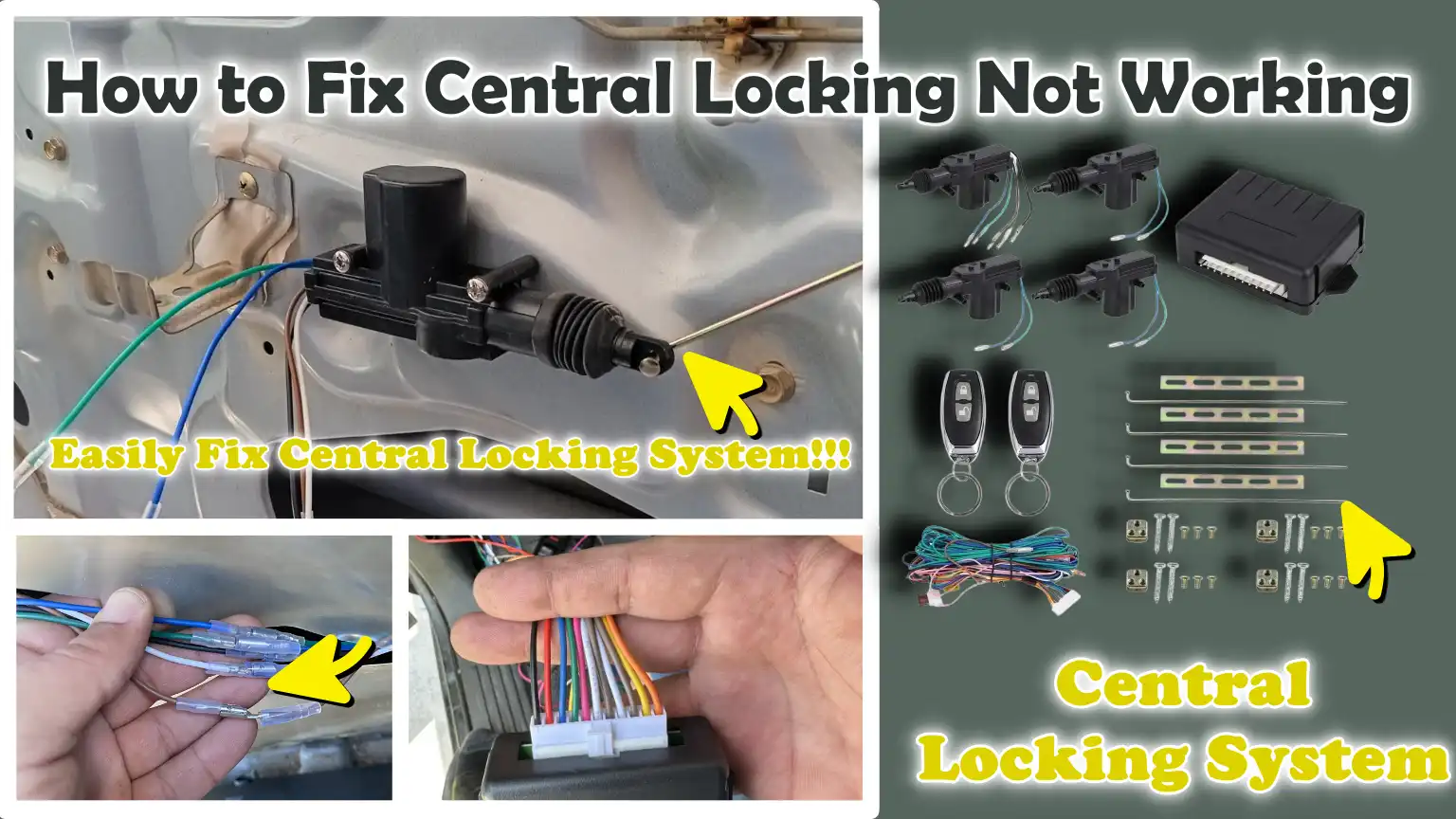
Door lock actuators are small electric motors installed inside each of the car’s doors; these are the components that actually perform the task of locking and unlocking the doors.
When the system receives a signal, these actuators activate a set of gears and rods connected to the locking mechanism.
The distinct “click” sound you hear when pressing the remote is generated by this very movement.
Over time, these actuators can malfunction due to repeated use, dust accumulation, or moisture ingress within the door assembly.
When an actuator begins to fail, you may notice that a specific door is unresponsive while the other doors continue to function correctly; alternatively, you might hear a clicking sound, yet observe no actual movement or locking action occurring within the door mechanism.
This serves as a definitive indication that the actuator has weakened or failed and may require repair or replacement.
3. Control Module – Body Control Module
The control module, often referred to as the ‘Body Control Module’ or BCM, acts as the central locking system’s brain.
It receives signals from the key fob or door switches and subsequently determines the appropriate course of action.
Upon interpreting a command, it transmits electrical signals to the door lock actuators to engage or disengage the door locks.
Depending on the vehicle model, the BCM may also govern other functions, such as interior lighting, the alarm system and, in some instances, power windows.
If the BCM malfunctions, the entire central locking system may cease to operate, behave erratically, or respond incorrectly.
Although issues related to the BCM are less frequent than other types of faults, they tend to be more complex and often necessitate a comprehensive diagnostic examination.
4. Wiring and Relays
Together, the wiring and relays form an electrical network that interconnects all the components of the central locking system.
The wires transmit power and signals between the key components, while the relays function as switches that regulate the flow of electricity.
In vehicles, the wiring typically runs through flexible rubber conduits situated between the doors and the vehicle’s body; over time, these components may experience wear and tear or sustain damage.
Broken or loose wires can disrupt signal transmission, causing the doors to stop functioning entirely or to operate improperly.
Relays can also fail, preventing power from reaching the actuators.
Such electrical issues are common in older vehicles and often lead to problems that are initially difficult to diagnose.
5. A Simple Explanation of Signal Flow During Locking or Unlocking
When you press the lock or unlock button on your key fob, it transmits a coded signal to your car.
The control module receives this signal and verifies its validity and authorization.
Once confirmed, it sends power to the door lock actuators via the vehicle’s wiring system and relays.
The actuators then engage the internal locking mechanisms within each door, causing them to lock or unlock simultaneously.
This entire process is completed in a mere fraction of a second, which is why the central locking system appears to respond instantaneously.
If any component of this entire sequence such as: the remote signal, control module, wiring, or actuators, malfunctions or faces an issue, the system will fail to operate correctly; the specific symptoms will depend on exactly which component has been affected.
Know, the Common Symptoms of a Faulty Central Locking System
1. Doors Failing to Lock or Unlock at All
When none of the doors respond to the remote or the central locking switch, it usually indicates that the problem lies not with a single component, but with the entire system.
In many cases, this occurs because the key fob (remote) battery has completely drained, a fuse has blown, or the main control unit governing the locking system has malfunctioned.
This can also happen if the car’s battery is weak, as the central locking system requires electrical power to operate.
This symptom is significant because it demonstrates that no signal or power is reaching the system whatsoever; this implies that the issue is likely electrical rather than mechanical.
The root cause of the problem can often be quickly identified by simply checking the condition of minor components, such as the battery and fuses.
2. Only One Door Failing to Operate
If only a single door fails to lock or unlock while the remaining doors function correctly, the problem is typically confined to that specific door.
This is most often caused by a fault in the door lock actuator, a small motor responsible for driving the locking mechanism.
Over time, actuators can fail due to constant use or exposure to dust and moisture.
Another common cause is damaged or loose wiring inside the door panel, particularly within the flexible section where the wires flex each time the door is opened and closed.
This symptom is helpful because it clearly indicates that the main system is operational and the issue is isolated to a single component.
3. Intermittent Remote Functionality
When the remote functions intermittently, working sometimes but failing at other times, it typically signals a weak signal rather than a complete failure of the entire system.
The most common cause for this is a weak or depleted battery inside the key fob, which reduces the strength of the signal reaching the car.
Interference from nearby electronic devices or physical obstructions can also impact signal strength.
In some instances, the remote’s buttons or internal circuitry may be defective, preventing it from functioning correctly.
This symptom often manifests before the system fails completely, thereby serving as an early warning that repairs are required.
4. The Lock/Unlock Sound Is Audible, but the Door Does Not Move
If you hear a “click” or “whirring” sound while attempting to lock or unlock the doors, yet the doors themselves do not move, it generally indicates that the system is receiving the signal but is unable to execute the command.
This is typically caused by a weak or faulty actuator, the component responsible for providing the necessary force to operate the locking mechanism.
This issue can also arise if there is an accumulation of dust, rust, or an obstruction within the door lock assembly that prevents it from moving freely.
In some cases, the linkage connecting the actuator to the lock mechanism may be loose or broken.
This symptom is significant because it suggests that, while the electrical components are operational, there is an underlying mechanical issue within the system.
5. The Locks Function Manually but Not via the Remote
If you are able to lock and unlock the doors using a physical key or the manual switches located inside the vehicle, but the remote fails to work, the issue typically lies not with the locks themselves, but rather with the signal transmission or the control system.
This often points to problems such as a defective key fob, a weak battery in the remote, or a malfunction in the receiver unit responsible for picking up the remote’s signal.
This could also be due to issues within the control module, which processes commands received from the remote.
This symptom clearly indicates that the mechanical components of the lock are functioning correctly and the problem lies in the electronic communication aspect of the system.
Know, The Main Causes of Central Locking Problems
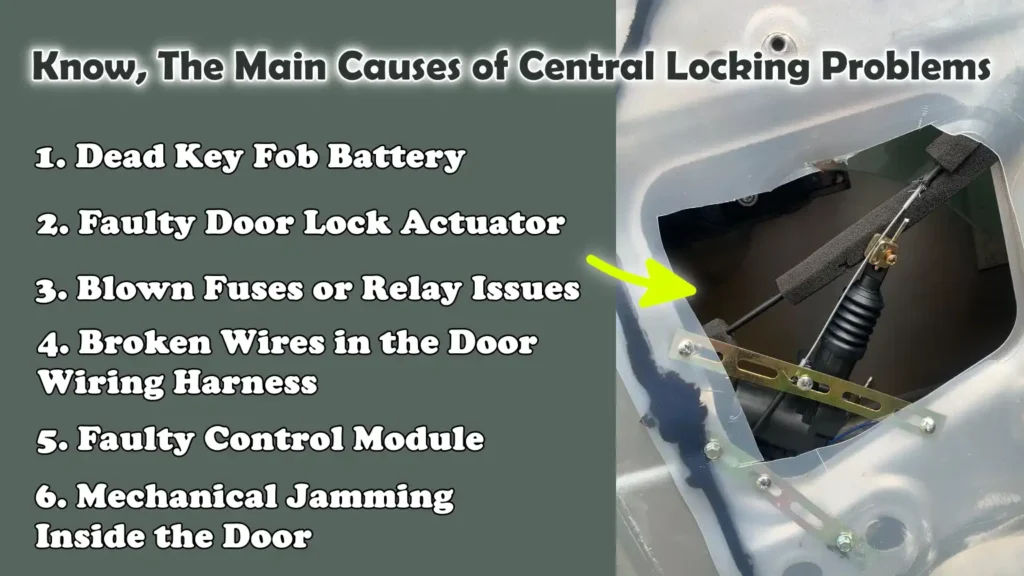
1. Dead Key Fob Battery
A dead or weak key fob battery is the most common reason for a central locking system failing to function correctly.
The key fob relies on a small ‘coin cell’ battery to transmit radio signals to the car; when the power in this battery runs out, the signal weakens or ceases entirely.
Consequently, when you press the lock or unlock button, the system may respond with a delay, or not at all, or its effective operating range may be significantly reduced.
In many instances, the central locking system itself is functioning perfectly, but it simply fails to receive the strong signal required to activate.
As key fob batteries typically last anywhere from one to three years, depending on usage frequency, the first and simplest solution to this problem is often to replace the battery.
2. Faulty Door Lock Actuator
The door lock actuator is the component located inside each door panel that physically drives the locking mechanism; it essentially functions as a small electric motor.
Over time, these actuators can wear out due to repeated use, internal motor failure, or exposure to dust and moisture.
When an actuator becomes weak or malfunctions, the corresponding door may fail to lock or unlock, or it may respond sluggishly or erratically.
In some cases, you may hear a distinct ‘click’ sound without any accompanying movement; this indicates that the actuator is attempting to engage but lacks the necessary power to do so.
As each door is equipped with its own separate actuator, a malfunction typically affects only a single door initially, although similar symptoms may subsequently manifest in other doors as well.
3. Blown Fuses or Relay Issues
Fuses and relays are essential components of the electrical system that safeguard and regulate the flow of power reaching the central locking system.
Fuses are designed to interrupt the circuit in the event of a sudden surge in current, thereby preventing damage to other internal components of the system.
If the fuse associated with the central locking system blows, the entire system may cease to function.
Relays, on the other hand, act as electrical switches that toggle the power supply on and off.
If a relay fails, power cannot reach the actuators, the components directly responsible for physically locking and unlocking the doors, even if all other parts of the system are functioning correctly.
As these components are relatively inexpensive and easy to inspect, they play a crucial role in the initial troubleshooting process.
4. Broken Wires in the Door Wiring Harness
Wiring plays a vital role in interconnecting all the components of the central locking system; if a wire within the harness breaks or sustains damage, it can disrupt communication or the flow of electricity between different parts of the system.
One of the most common locations for wiring-related issues is the door harness, a bundle of wires that passes through a flexible rubber conduit situated between the car’s body and the door.
These wires flex every time the door is opened and closed; over time, this repetitive flexing can cause the wires to fray or break internally.
Several symptoms may manifest, such as a specific door failing to lock or unlock, intermittent locking issues, or, in some cases, the entire system ceasing to function altogether.
Diagnosing wiring problems can be challenging because the damage is often hidden; nevertheless, this remains a common cause of central locking malfunctions, particularly in older vehicles.
5. Faulty Control Module
The control module, often referred to as the Body Control Module, governs the entire central locking system by receiving signals and transmitting commands to the actuators.
If this module malfunctions, it can lead to erratic behavior, such as doors spontaneously locking and unlocking, delayed responses, or a complete system failure.
Although issues related to the control module are less common than simpler causes such as: a dead battery or a blown fuse, they can still occur due to electrical faults, water damage, or defects within the internal circuitry.
Diagnosing this specific issue typically requires specialized diagnostic equipment, as this module is responsible for coordinating various functions throughout the entire vehicle.
6. Mechanical Jamming Inside the Door
Mechanical jamming occurs when the physical components within the door lock mechanism become stuck or their movement is obstructed.
This can result from an accumulation of dirt, corrosion, a lack of lubrication, or wear and tear on internal parts (such as rods and linkages).
When the mechanism is unable to move freely, even a fully functional actuator cannot properly lock or unlock the door.
The result is often that excessive force is required to manually operate the door, its movement becomes restricted, or it ceases to function entirely.
Tools
| Tool Name | Why It Is Needed | How to Use It |
|---|---|---|
| Screwdrivers – Flathead and Phillips | These are some basic tools used to remove the screws that fasten door panels, fuse boxes and small components in place. Without them, you cannot access the internal components of the central locking system. | Select the appropriate screwdriver based on the type of screw head. To remove a screw, turn it slowly in a anti-clockwise direction. Keep all removed screws in a safe place so that you can reinstall them later. Apply gentle pressure to avoid damaging the screws or surrounding components. |
| Multimeter | A multimeter helps you verify whether electricity is reaching the various parts of the system. It is extremely useful for diagnosing issues such as faulty wiring, defective switches, or a lack of voltage reaching the actuators. | Set the multimeter to voltage mode. Place the probes (test leads) on the specific points you wish to test, such as wires or connectors. If the device displays a reading, power is present. If no reading appears, there may be a break or fault somewhere in the circuit. Always proceed with caution and avoid directly touching exposed metal components. |
| Replacement Fuse | A fuse protects the system from electrical damage. If excessive current flows through the circuit, the fuse blows, causing the system to stop functioning. In many cases, simply replacing a blown fuse is enough to immediately restore the central locking system to working order. | Locate the fuse box by consulting your car’s owner’s manual. Identify the specific fuse associated with the central locking system and remove it using your fingers or a fuse puller. Inspect the fuse to check if the internal metal filament is broken. Replace it only with a new fuse of the exact same amperage rating; never use a fuse with a higher rating. |
| Trim Removal Tools | These tools are used to safely remove door panels and interior trim without causing any damage. Using common tools, such as screwdrivers, can result in broken clips or scratched surfaces; therefore, trim tools are a safer alternative. | Gently insert the trim tool between the panel and the door frame. Apply light pressure to disengage the clips one by one. Work slowly around the edges to prevent any clips from breaking. This allows you to cleanly detach the panel and reuse it without any damage. |
| Electrical Contact Cleaner | This cleaner is used to remove dirt, dust and moisture from electrical connectors. Dirty contacts can impede the flow of electricity, causing the central locking system to malfunction or fail completely. | Spray a small amount of cleaner onto the connectors or terminals. Allow them to dry for a few seconds before reconnecting them. Avoid using an excessive amount of liquid. This improves electrical contact and restores the proper flow of signals. |
How to Fix Central Locking Not Working – Beginner Friendly Steps
1. Check the Key Fob Battery
Signs of a Drained Battery
A weak or dead key fob battery is one of the most common and easily identifiable issues within a central locking system.
As the battery power begins to deplete, the signal transmitted by the remote also weakens, meaning your car may not be able to receive it properly.
You may notice that the doors do not respond at all, or they only respond when you are standing very close to the vehicle.
Sometimes, you may have to press the button multiple times before it works, or you might experience a significant delay in response.
In some cars, the remote may be able to unlock the vehicle but fail to lock it, or it may only function when pointed in a specific direction.
These are clear early warning signs indicating that the battery is no longer capable of transmitting a strong enough signal.
As a key fob battery’s power diminishes gradually over time, this issue can sometimes appear quite suddenly, even if everything was working perfectly just moments before.
How to Replace Key Fob Battery
Replacing a key fob battery is a simple process that requires no technical expertise, though it should be performed with care to avoid damaging the remote.
Most key fobs feature a small slot or seam that you can gently pry open using a flat object or your fingernail.
Inside, you will find a small, round “coin cell” battery, the type typically used in car remotes.
Before removing the battery, it is crucial to note its orientation, specifically which side is facing upwards, as the remote will not function if the new battery is inserted incorrectly.
Once the old battery has been removed, replace it with a new one of the exact same type and size; using an incorrect battery will prevent the remote from functioning properly.
Ensure that the battery is properly seated and that its contacts are clean; subsequently, close the case firmly to prevent dust or moisture from entering.
Test After Replacement
After replacing the battery, it is crucial to test the key fob to confirm that the issue has been resolved.
Stand at a normal distance from your car and press the ‘Lock’ and ‘Unlock’ buttons to check if the doors respond immediately.
The response should be instantaneous and consistent; there should be no delay, nor should it be necessary to press the buttons repeatedly.
You can also test from a slightly greater distance to see if the signal range has improved; this is a good indication that the new battery is functioning correctly.
If the central locking system still does not work after replacing the battery, it may indicate a different underlying issue such as: a faulty remote, a problem with the signal receiver, or a malfunction in another component of the system.
However, in many cases, simply replacing the battery fully restores the system’s functionality, thereby resolving the problem quickly and effectively.
2. Perform a Manual Locking Test
Use the Key or Door Switch
The manual locking test is one of the simplest and most essential checks, as it helps you determine whether the basic locking system is still functioning correctly.
In this test, instead of using the remote, you insert the key into the door lock or utilize the lock/unlock switch located inside the car.
When you turn the key in the door or press the switch, you directly engage the locking system without relying on any remote signal.
If all the doors lock and unlock smoothly during this test, it indicates that the internal mechanical components and most of the electrical system are functioning properly.
You should pay close attention to how the locks move, do they move freely, or do they feel stiff?
, and whether all the doors respond simultaneously.
If you notice any hesitation or delay in their movement, it could be a sign of dirt, rust, or a lack of lubrication within the locking system.
Helps Distinguish Between Electrical and Mechanical Issues
This test is highly beneficial because it enables you to clearly identify whether the problem is electrical or mechanical.
If the locks function perfectly when using the key or door switch, but fail to work when using the remote, the issue likely lies with the remote signal, the key fob’s battery, or the signal receiver system.
Conversely, if the locks fail to work even when using the key or switch, the problem is most likely located within the door itself such as: a broken actuator, a jammed mechanism, or faulty wiring.
This step saves you time and effort by preventing you from wasting time troubleshooting the wrong components.
By determining whether the issue lies with the signal or the actual locking mechanism, you can proceed directly to the correct solution rather than relying on guesswork or unnecessarily replacing parts.
3. Check and Replace a Blown Fuse
Locate the Fuse Box
The fuse box houses all of your car’s electrical safety components; it is typically found under the dashboard on the driver’s side, or within the engine compartment.
Every car features a clearly labeled fuse box layout, often depicted on the cover or detailed in the owner’s manual, to assist you in identifying the correct fuse for each specific system.
The central locking system has its own dedicated fuse, as it requires protection against sudden electrical overloads.
Locating the fuse box is the first and most critical step, because until you visually inspect the fuse yourself, you cannot determine whether the problem stems from a blown fuse.
To avoid any electrical hazards, it is absolutely essential to switch off the car’s ignition before opening the fuse box.
Identify the Central Locking Fuse
Upon opening the fuse box, you will see a series of small fuses arranged in rows; each of these fuses is responsible for a specific function, such as the lights, horn, or power windows.
You must locate the fuse labeled ‘Central Locking,’ ‘Door Locks,’ or, in some instances, ‘Body Control.’
While the specific label may vary depending on the vehicle model, the diagram printed on the fuse box cover or the information provided in the owner’s manual will serve as your guide.
Identifying the correct fuse is crucial, as checking the wrong fuse can lead to confusion and a waste of time.
Central locking fuses typically resemble a small, colored plastic casing containing a thin metal strip; each color corresponds to a specific ‘power rating.’
How to Inspect and Replace a Fuse
To inspect a fuse, you can carefully extract it using your fingers or a small ‘fuse puller,’ and then visually examine the metal strip located inside.
If the strip appears broken or burnt, it indicates that the fuse has failed and is no longer allowing electricity to flow through it.
A faulty fuse prevents power from reaching the central locking system, resulting in the door locks becoming completely inoperative.
To verify this conclusively, you can use a ‘multimeter’ to test whether current is flowing through the fuse.
When replacing a fuse, it is crucial to use a new fuse with the exact same rating; using a fuse with a higher rating can damage the system and pose a safety risk.
After installing the new fuse, securely close the fuse box and re-test the central locking system.
In many instances, simply replacing a faulty fuse is sufficient to restore the system’s functionality; however, if the new fuse also blows, it may indicate a more significant underlying electrical issue that requires further investigation.
4. Check the Door Lock Actuator
Symptoms of a Faulty Actuator
A faulty door lock actuator typically exhibits clear signs that are easy to identify if you observe carefully.
One of the most common symptoms is that a specific door fails to lock or unlock, while the other doors function normally, this occurs because each door is equipped with its own independent actuator.
When you press the remote control, you may also hear a “click” or “whirring” sound emanating from inside the door panel; yet, the locking mechanism itself remains motionless.
This indicates that the internal motor is attempting to run but lacks sufficient power to do so.
In some instances, the lock may move very sluggishly, get stuck midway, or operate intermittently, particularly in cold or dusty environments.
Over time, actuators tend to degrade, as they contain small electric motors and plastic gears that can wear out due to regular use, exposure to moisture, or the ingress of dust into the door assembly.
These symptoms clearly indicate that the root of the problem lies within the door mechanism itself, rather than with the remote control or the fuse.
Basic Door Lock Actuator Diagnostic Method
To determine whether the actuator is functioning correctly, you can perform a simple check without the need for any specialized tools.
First, press the lock and unlock buttons and listen carefully to the sounds coming from the door.
If you hear a sound but observe no movement in the door lock, it suggests that the actuator has weakened or that its internal mechanism has jammed.
Conversely, if absolutely no sound is heard, it may indicate that the actuator is not receiving power; This issue may stem from a wiring problem or the complete failure of the actuator unit.
You can compare the movement of the malfunctioning door with that of a fully functional door to better discern the differences in sound and motion.
For a more precise diagnosis, you can use a multimeter to check whether power is reaching the actuator when you press the remote or switch.
If power is present but the actuator remains unresponsive, this confirms that the actuator itself is defective.
Replacement Process of Door Lock Acutator
Replacing a door lock actuator requires removing the door panel to access the internal components; however, if performed carefully, this is a relatively straightforward task.
Once the panel has been removed, the actuator is typically attached to the door lock mechanism via screws and connected via a wiring plug.
Before removing the actuator, it is essential to carefully disconnect its wiring and note the exact position in which it was installed.
The replacement actuator must be of the correct type and fit precisely to ensure smooth operation.
After installing the new actuator, all connections should be securely tightened and the door panel should be properly reinstalled.
Once everything is back in place, it is crucial to test the system to ensure that the lock is now functioning consistently and without any interruptions.
Although replacement requires more effort than minor repairs, it is often the most appropriate solution when the actuator has failed completely.
5. Check the Door Wiring
Common Causes of Wire Breakage
The wiring located inside a car door is subjected to constant movement every time the door is opened and closed.
Due to this repetitive flexing, this area becomes one of the most common locations for wire breakage.
The most affected section is where the wires pass from the car body into the door through a flexible rubber sleeve, often referred to as a “rubber boot.”
Inside this boot, multiple wires transmit power and signals to components such as the door lock actuator, window motor and switches.
Over time, these wires can become brittle due to stress, aging, or temperature fluctuations; they may crack internally or snap completely.
When this occurs, the central locking system for that specific door may cease to function, operate intermittently, or behave erratically.
This type of issue is particularly common in older vehicles and, if not properly diagnosed, is often mistakenly attributed to a faulty actuator.
How to Inspect the Rubber Boot Wiring
To inspect the wiring, you must carefully access the rubber boot situated between the door and the car body.
Gently pull back or slide the rubber cover to expose the wires housed inside.
It is crucial to perform this step with caution to avoid causing further damage.
Once the wires are visible, inspect them closely for any signs of damage such as: cracks in the insulation, exposed metal, kinked wires, or completely severed wires.
Occasionally, the damage may not be visible from the outside; therefore, gently manipulating the wires while simultaneously testing the locking system can help identify loose or faulty connections.
If the central locking system begins to function after the wires are nudged, it is a definitive indication that an internal wire is broken or a connection is faulty.
This simple check can immediately confirm whether the issue lies within the wiring or with another component.
Repair Door Wiring
Repairing faulty wiring requires meticulous attention to ensure a robust and durable connection.
If a wire is broken, the severed ends should be carefully stripped to expose the clean metal and then properly reconnected.
It is crucial that the connection is tight and secure to ensure an uninterrupted flow of electricity.
Following the reconnection, it is essential to apply appropriate insulation to the repaired section to protect it from moisture and prevent future damage.
Keeping the wires slightly slack, rather than pulling them taut, inside the rubber boot helps prevent future wire breakage.
Once the repair is complete, the rubber cover should be reinstalled in its proper position to shield the wires from dust, water and repetitive movement.
Properly repaired wiring can fully restore the functionality of the central locking system and prevent recurring issues in the future.
6. Check the Central Locking Switch
Inspection of the Dashboard or Door Switch
The central locking switch is the button located inside your car that allows you to simultaneously lock or unlock all the doors; it is typically situated on the driver’s door panel or the dashboard.
This switch operates by sending an electrical signal to the control module, which, in turn, activates the door lock actuators.
When this switch ceases to function correctly, you may observe that pressing it elicits no response, it works intermittently, or it requires excessive force to activate.
In some instances, the switch may successfully lock the doors but fail to unlock them, or there may be a significant delay in its response.
Checking this switch is crucial, as it helps determine whether the issue lies within the internal control system or is confined solely to the input device itself.
If the remote control is non-functional while the switch operates perfectly, there is a high probability that the problem lies with the key fob or signal transmission.
Conversely, if neither the switch nor the remote is working, it may indicate a more significant electrical issue.
Cleaning or Replacement
Over time, dirt, dust and moisture can accumulate inside the switch, disrupting proper electrical contact and potentially causing the switch to cease functioning entirely.
Cleaning the switch often restores its functionality without the need for replacement.
This process typically involves carefully removing the switch panel and applying a small amount of “electrical contact cleaner” to the internal contacts.
Following the cleaning procedure, the switch should be tested again to ensure that it is operating correctly.
If the switch remains non-functional even after cleaning, its internal components may be worn out, a common occurrence after years of continuous use.
In such cases, replacing the switch is the most effective solution.
Installing a new switch ensures proper signal transmission and guarantees the reliable operation of the central locking system.
Once the switch has been replaced, pressing the button should elicit an immediate and consistent response from the central locking system, thereby confirming that the issue has been resolved.
7. Inspect the Central Locking Switch
Inspection of the Switch Located on the Dashboard or Door
The central locking switch is the button located inside your car that allows you to simultaneously lock or unlock all the doors; it is typically situated on the driver’s door panel or the dashboard.
This switch functions by sending an electrical signal to the control module, which, in turn, activates the door lock actuators.
When this switch begins to malfunction, you may observe that pressing it yields no result, it operates intermittently, or it requires excessive force to activate.
In some instances, the switch may successfully lock the doors but fail to unlock them, or it may exhibit a delayed response.
Inspecting this switch is crucial, as it helps determine whether the root cause of the problem lies within the internal control system or simply within the input device itself.
If the remote control is non-functional while the switch operates perfectly, there is a high probability that the issue lies with the key fob or signal transmission.
Conversely, if neither the switch nor the remote is working, it may indicate a more significant problem within the vehicle’s electrical system.
Cleaning or Replacement
Over time, dirt, dust and moisture can accumulate inside a switch, disrupting proper electrical contact and causing the switch to cease functioning correctly.
Cleaning the switch often restores its functionality without the need for a complete replacement.
This process typically involves carefully removing the switch panel and applying a small amount of “electrical contact cleaner” to the internal contacts.
Following the cleaning procedure, the switch should be re-tested to ensure that it responds correctly.
If the switch still fails to work after cleaning, it may be worn out internally, a condition that can result from years of continuous use.
In such cases, replacing the switch is the best solution.
A new switch ensures proper signal transmission and reliable operation.
Once the switch has been replaced, the central locking system should respond immediately and consistently when the button is pressed, thereby confirming that the issue has been resolved.
How to Fix Mechanical Issues in Door Locks
1. Dirt, Rust, or Jammed Linkage
Inside every car door, there are small metal components such as: rods, levers and joints, that connect the lock mechanism to the handle and the actuator.
For the locking system to function correctly, it is essential that these parts are able to move freely.
Over time, dust, moisture and grime can infiltrate the interior of the door and accumulate on these components, creating friction and hindering their movement.
In humid or rainy weather conditions, these metal parts may also develop rust, causing them to stiffen or seize up completely.
When this occurs, you may notice that the lock is difficult to operate, moves sluggishly, or fails to function at all during the locking or unlocking process.
Occasionally, the actuator may emit a sound, yet the lock remains stationary because the linkage has jammed.
This type of issue is mechanical, rather than electrical, and typically develops gradually rather than occurring suddenly.
2. Cleaning and Lubrication Steps
Cleaning and proper lubrication are simple yet highly effective methods for restoring the smooth operation of the locking system.
To accomplish this, it is typically necessary to remove the door panel to gain access to the internal components.
Once the parts are exposed, any accumulated dirt or dust should be carefully removed and any areas affected by rust should be gently cleaned to facilitate smoother movement.
Following the cleaning process, the appropriate lubricant should be applied to all moving joints, rods and latch points to ensure that they move freely and without obstruction.
Lubrication reduces friction and helps prevent future corrosion by creating a protective layer on metal surfaces.
It is crucial to use the correct amount of lubricant; applying too much can lead to excessive dust accumulation, while applying too little fails to provide adequate protection.
Once the cleaning and lubrication tasks are complete, the locking system should be tested to verify that all components are moving freely and responding promptly.
3. When Component Replacement is Necessary
In some instances, cleaning and lubrication alone may not fully resolve the issue, particularly when internal components are worn, bent, or damaged.
If a linkage is broken, a latch is heavily corroded, or the locking system repeatedly jams despite proper maintenance, component replacement becomes essential.
Worn-out parts cannot function correctly, thereby compromising the overall performance of the locking system and increasing the likelihood of recurring malfunctions.
Replacing defective components restores the system’s reliability and prevents the development of further issues.
If the lock jams repeatedly or ceases to function, it is also critical to consider replacing the entire lock assembly, as a compromised assembly can jeopardize the vehicle’s security and safety.
A properly functioning mechanical system is paramount; even if the electrical components are in perfect working order, the locks will not function correctly if the internal mechanical mechanism is compromised.
Read More:
- How to Fix Power Windows Not Working
- How to Fix a Blown Fuse in a Car
- How to Fix Car Electrical Problems
- How to Pass a Car Emissions Test
Know, Estimated Repair Costs of Fixing Central Locking System
1. Key Fob Battery Replacement Cost
The key fob battery is one of the least expensive components of the central locking system to replace.
Whenever an issue arises, this is often the first item that should be checked.
These small ‘coin cell’ batteries are readily available and typically cost only a few dollars.
As replacing the battery requires no specialized tools or professional expertise, most car owners can do it themselves in just a few minutes.
Consequently, this is the most economical and straightforward repair task; in many cases, it completely resolves system issues without the need for any further repairs.
Furthermore, as the power output of these batteries naturally diminishes over time, replacing them regularly can help prevent sudden malfunctions in the locking system.
2. Fuse Replacement Cost
Replacing a fuse is another very low-cost repair task, as fuses are designed to protect the electrical system and are easy to replace.
The cost of a single fuse is usually negligible and it can be replaced quickly without any professional assistance.
Most vehicles feature a clear diagram of the fuse box layout, making it easy to locate and replace a specific fuse.
If the central locking system suddenly stops working, this repair is often sufficient to restore its functionality.
However, if the fuse blows again immediately after being replaced, it may indicate an underlying electrical fault within the system, which could subsequently increase the total repair cost.
3. Actuator Replacement Cost
Replacing a door lock actuator is considered a moderately expensive repair task, as the total cost encompasses both the price of the replacement part and the labor required for its installation.
As each door is equipped with its own dedicated actuator, the final cost depends on the number of doors that have malfunctioned.
The actuator itself is significantly more expensive than simple components like fuses or batteries and accessing it typically requires removing the door panel and interior trim components.
The total cost may increase due to technician fees, as this task is time-consuming and must be performed with great precision.
Although this is not the most inexpensive repair job, it is nonetheless a worthwhile investment, and often becomes a necessity, when one or more doors cease to function.
4. BCM Repair Costs
Repairing or replacing the Body Control Module (BCM) is one of the most expensive procedures within the central locking system, as it is a complex electronic unit that governs numerous vehicle functions.
The high cost is attributed to the advanced technology utilized within this module and the requirement for specialized diagnostic tools.
In some instances, the module may require “reprogramming” rather than complete replacement; however, even this procedure necessitates professional-grade equipment and specialized expertise.
As the BCM impacts various vehicle systems, a malfunction within it can trigger a wide range of issues; consequently, a thorough and accurate diagnosis is absolutely essential before commencing any repair work.
5. Breakdown of Labor Costs
Labor costs (service fees) can vary significantly depending on the specific repair method and the complexity of the underlying problem.
Simple tasks such as: replacing a battery or fuse, typically incur no labor charges, as these procedures can often be performed by the vehicle owner at home.
More complex tasks such as: replacing an actuator or troubleshooting electrical faults, require more time and technical expertise, thereby increasing the associated labor costs.
In professional workshops, labor costs are often calculated based on the actual time spent on the job; consequently, repairs that require removing door panels or involve extensive electrical diagnostics tend to be more expensive.
Understanding the distinction between simple and complex repairs helps you decide whether to attempt the repair yourself or seek professional assistance, a decision that can ultimately save you both time and money.
Understand, When You Should Go For Professional Help
1. Multiple Door Malfunctions
When more than one door stops locking or unlocking simultaneously, it generally indicates that the problem lies not merely with a single component, but with the entire main system.
This could point to an issue with the central control unit, common wiring, or the power supply, a problem that affects all the doors at once.
Unlike a malfunction in a single door, which is often caused by a faulty actuator, malfunctions in multiple doors signal a deeper electrical issue that requires specialized diagnostic tools.
A professional technician can quickly pinpoint the problem using diagnostic equipment and wiring diagrams, thereby avoiding the unnecessary replacement of parts.
2. Burning Odor
If you detect a burning smell emanating from the vicinity of the doors, dashboard, or fuse box, it is a serious warning sign that must not be ignored.
This odor often indicates overheating wires, a short circuit, or faulty electrical components.
Continuing to use the system under these conditions can lead to further damage or even pose a safety risk.
Diagnosing such electrical issues without the proper knowledge is both difficult and unsafe; therefore, it is best to immediately stop using the system and have it inspected by a professional.
Timely inspection can help avoid costly repair bills and protect other components of the vehicle’s electrical system.
3. BCM or Wiring Complexity
Diagnosing issues related to the Body Control Module (BCM) or complex wiring systems is no easy task without specialized tools and expertise.
The BCM governs numerous vehicle functions; consequently, symptoms of a malfunction within this unit may manifest erratically, affecting not only the central locking system but also various other vehicle operations.
Diagnosing wiring-related issues can be challenging, as the damage is often hidden within the control panel or hidden beneath the insulation.
Professionals utilize advanced diagnostic scanners and testing methodologies to pinpoint the exact fault with precision, thereby eliminating the need for guesswork.
Such meticulous examination is crucial; failure to identify the root cause of the malfunction can lead to unnecessary repairs and inflated costs.
4. No Response Even After Basic Repairs
If you have already inspected and repaired basic components such as: the key fob battery, fuses, actuators and visible wiring, yet the central locking system remains unresponsive, it is a clear indication that the underlying issue is far more complex.
At this stage, attempting further troubleshooting without the appropriate tools can lead to confusion or inadvertently cause additional damage.
A professional mechanic can conduct a comprehensive assessment of the system to uncover hidden faults, reset electronic modules if necessary and ensure that the repairs are executed correctly.
Seeking expert assistance at this juncture saves time, prevents recurring malfunctions and guarantees that the system is restored to a safe and reliable working condition.
How to Prevent & Maintain Central Locking After Fixing It
Not only this, there’s dedicated research about the central locking system as these are not just about having convenience but it is actually critical security component in modern vehicles, plus research also shows that the advanced locking mechanisms combined with the electronic control units can significantly reduces theft risks as it actually allows only authorized access to it, that’s why it is really important to fix central locking issues in quick fashion, otherwise a faulty system can literally compromise both safety and vehicle security very badly.[¹]
1. Regularly Replace the Key Fob Battery
Although the key fob battery may seem like a minor component, it plays a crucial role in ensuring the reliability of your central locking system.
Over time, the battery gradually loses its power, diminishing the strength of the signal transmitted to your car.
This can lead to delayed responses, reduced operating range, or even a complete system failure without any prior warning.
Replacing the battery at regular intervals, typically every one to two years, depending on usage, helps maintain a strong and consistent signal.
This simple maintenance step can prevent sudden locking issues and ensures that your remote functions correctly exactly when you need it most.
2. Prevent Water Intrusion into the Doors
Water is the most common culprit behind long-term damage to the internal components of car doors, as it can adversely affect both electrical and mechanical parts.
When water seeps into the door cavity, it can cause corrosion on metal parts, degrade electrical connectors and damage the actuator motors.
The result is often doors that feel heavy to open, jammed locks, or, over time, a complete failure of the entire system.
To prevent this, it is essential to ensure that the door seals are in good condition and that the windows are securely closed during rain or while washing the car.
Preventing water from entering the door interiors safeguards the internal components and extends the overall lifespan of the central locking system.
3. Lubricate the Locks Periodically
Regular lubrication is essential to ensure that the locking system continues to operate smoothly and without interruption.
The interior of the door houses various moving components such as: rods, linkages and latches, and for the system to function correctly, it is imperative that these parts are able to move freely.
If not properly lubricated, these components can dry out, generate friction and eventually seize up.
Applying the appropriate lubricant at regular intervals minimizes wear and tear, prevents corrosion and ensures the continued smooth operation of the system.
This simple step not only enhances performance but also reduces the strain placed on the actuator, thereby extending its lifespan.
4. Handle Wiring with Care
The wiring routed within the doors and throughout the vehicle serves to transmit signals and electrical power to the central locking system; therefore, it must be handled with extreme care.
These wires are often routed through areas subject to constant movement such as: the space between the door and the car body, which increases the risk of damage.
Excessive pulling, bending, or stretching of the wires can cause internal damage that is not always visible from the outside.
When working in the vicinity of these areas, it is crucial to handle the wiring carefully and avoid subjecting it to unnecessary stress.
Keeping the wiring in good condition ensures stable electrical connections and helps prevent many common issues associated with the central locking system.
Conclusion – How to Fix Central Locking Not Working
So, now you have understood that rarely central locking problems appears without any warning, as they literally build up through small signs that are easy to miss, but not now as you know all about them.
In many instances, a problem begins as a minor glitch such as: a weak key fob battery, a blown fuse, or a minor wiring fault, and gradually manifests through distinct symptoms, such as doors failing to operate, delayed locking responses, or the emission of strange noises.
Understanding how this system functions and recognizing these early warning signs proves to be a significant advantage, as it allows you to address the issue before it becomes costly or inconvenient.
By employing simple diagnostic methods such as: testing the remote, checking the fuses, or attempting manual locking, you can quickly pinpoint the root cause of the problem, thereby saving both time and money.
It is also crucial to remember that a central locking system is a complex interplay of electrical and mechanical components working in unison; consequently, a malfunction in any single component can impact the entire system.
For this reason, rather than relying on guesswork or indiscriminately replacing parts to diagnose an issue, it is always best to adopt a systematic, step-by-step approach to troubleshooting.
While many issues can be resolved at home using basic tools and careful inspection, more complex problems such as: a faulty control module or hidden internal wiring damage, typically require the expertise of a professional to ensure that the repairs are executed safely and correctly.
Now, that’s it from this guide about How to Fix Central Locking Not Working, if you still have questions: just comment down below.
Frequently Asked Questions
FAQ 1: Why is my central locking system not working at all?
If your central locking system is completely non-functional, the issue is typically related to a power or signal failure. The most common causes for this include a dead key fob battery, a blown fuse, or a weak car battery. When the system does not receive adequate power or the correct signal, it is unable to activate the locks. In some instances, the problem may also stem from a faulty control module or defective wiring, which disrupts communication between the various components. The best way to begin troubleshooting is to check the key fob battery and the fuses, as these are simple steps that often resolve the issue quickly.
FAQ 2: Why is only one car door failing to lock or unlock?
When only a single door is malfunctioning, the problem is usually isolated to that specific door. The most common culprit is a faulty door lock actuator, which is a small motor responsible for driving the locking mechanism. Over time, these actuators can wear out or weaken, particularly due to regular use. Another potential cause could be broken wiring inside the door panel, specifically at the points where the wires flex as the door opens and closes. As the remaining doors are functioning correctly, the issue typically does not lie within the main central locking system itself.
FAQ 3: Why does my key fob work sometimes but not others?
If your key fob is functioning intermittently, it usually indicates that the battery inside the remote is running low. A weak battery diminishes the signal strength, meaning the car may not consistently receive the commands sent by the fob. You may notice that it works more reliably when you are standing close to the car or when you press the button multiple times. Other potential causes include worn-out buttons inside the remote or signal interference from nearby electronic devices. Replacing the battery is the easiest and most effective first step.
FAQ 4: Why do I hear a clicking sound, but the doors do not lock?
Hearing a clicking sound without the locks actually moving usually indicates that the system is receiving the signal, but the mechanical action is not being completed. This is often caused by a weak or failing door lock actuator, which lacks sufficient power to move the locking mechanism. It can also occur if the internal door lock mechanism has become jammed due to dirt, rust, or a lack of lubrication. In such cases, the electrical components are functioning correctly, but the physical components are failing to move properly.
FAQ 5: Can I drive my car if the central locking system is not working?
Yes, you can still drive your car even if the central locking system is not working; however, this may compromise both convenience and security. You may have to manually lock and unlock each door individually, which can be inconvenient specially in busy or crowded areas. More importantly, if the locks are not functioning correctly, your vehicle may not be fully secure. To avoid issues such as leaving doors unlocked or accidentally locking yourself out of the car, it is best to have this problem repaired as soon as possible.
FAQ 6: How much does it cost to fix central locking problems?
The cost depends on the root cause of the problem. Minor tasks, such as replacing a key fob battery or a fuse, are relatively inexpensive and can often be performed at home. Replacing a door lock actuator is a more costly repair, as it involves the expense of both the replacement parts and the labor required for installation. More complex repairs such as: fixing control module issues or repairing wiring, as it can be significantly more expensive because they require both time and specialized expertise to resolve. Quickly identifying the root cause of the problem helps keep repair costs as low as possible.
FAQ 7: What is a door lock actuator and how does it fail?
A door lock actuator is a small electric motor located inside each door, responsible for locking and unlocking the door. It receives signals from the control system and operates the locking mechanism. Over time, due to repeated use, dust, or moisture, the motor and its internal gears can wear out. When it begins to fail, you may notice issues such as sluggish door operation, the door failing to lock properly, or a specific door ceasing to function entirely. This is a common component that eventually requires replacement in many vehicles.
FAQ 8: Why does my car keep locking and unlocking itself?
If your car begins to lock and unlock on its own, the cause may be a malfunction within the control system or the electrical wiring. A faulty control module can send erroneous signals, or defective wiring can lead to a short circuit, causing the locks to open and close spontaneously. Occasionally, a defective door switch or key fob may also repeatedly transmit signals without any buttons being pressed. This issue should be diagnosed as soon as possible, as it can compromise the security of your vehicle.
References:
[1] VEHICLE THEFT DETECTION AND LOCKING SYSTEM
https://www.researchgate.net/publication/360771504_VEHICLE_THEFT_DETECTION_AND_LOCKING_SYSTEM
Hello Folks, Dean Shali here to help you out to solve the problems with your lovely vehicle, as i have lots of experience and knowledge about automotive industry as i woks directly with the customers and repair vehicles and i love to help the people to keep their cars safe and running smoothly.