
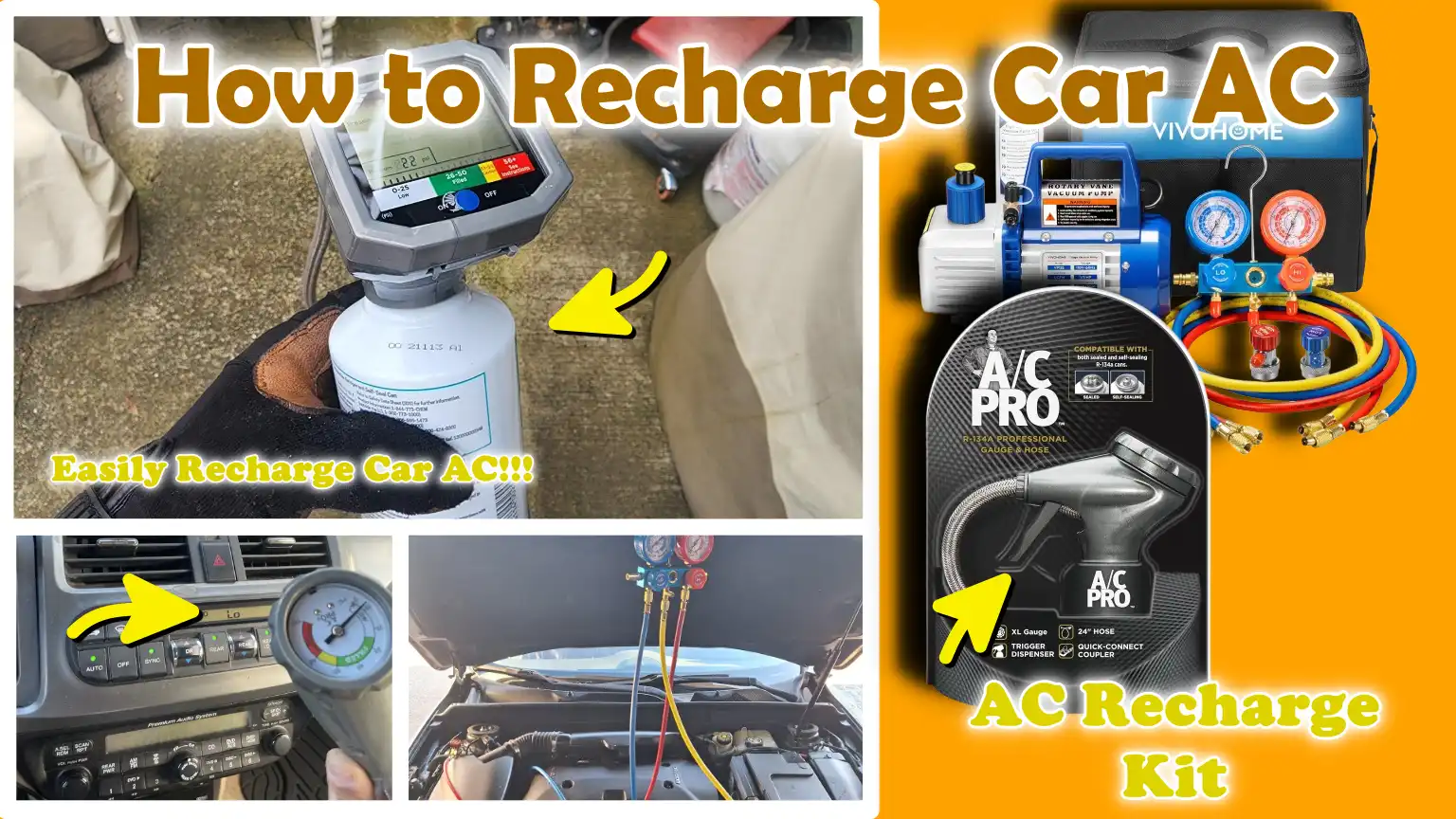
Written By: Dean Shali
Fact Checked By: Sabré Cook
Reviewed By: Tamara Warren
You need to do top-up of refrigerant if you feel your AC now settled to weak airflow, warm air and making some strange noises, that eventually makes rides really uncomfortable in hot weather.
So, how does AC works at the first place?
The Answer Is: The AC works by circulating a refrigerant through the system, which actually absorbs the heat from the cabin and expels it outside the world and that’s how you can feel that chill in the hot Beverly Hill.
But over the time, the refrigerant level can be dropped because of the constant leaks or normal wear, that literally causes weak airflow, warm air from the vents, abnormal and irritating noises and even it can frost the pipes as well.
So, you need to understand How to Recharge Car AC, so that you can actually restore its cooling efficiency and prevent the damage to the critical components such as: compressor and condenser of AC.
Now, At First Understand About the Car AC System
A car’s air conditioning system is designed to remove heat and humidity from inside the cabin, ensuring you feel cool and comfortable even in extreme heat.
It operates on a simple scientific principle: heat always flows from a warmer area to a cooler one.
The AC system draws heat out of the air inside your car and expels it, which is why the air blowing from the vents feels cool.
This process relies on a ‘closed-loop system’ that utilizes a special fluid known as a ‘refrigerant.’
Furthermore, the system comprises several essential components that work continuously in tandem whenever the AC is switched on.
When all components are functioning correctly and the refrigerant levels are optimal, the system can cool the cabin quickly and efficiently.
However, even a slight shortage of refrigerant or a minor malfunction in a single component can compromise cooling performance.
Therefore, before attempting to recharge the AC, it is crucial to understand how the system operates.
1. How a Car AC Works
A car AC system primarily consists of four essential components: the compressor, the condenser, the expansion device and the evaporator.
All these components are interconnected via a network of pipes filled with refrigerant.
The process begins at the compressor, which draws power from the engine.
The compressor pressurizes the refrigerant gas, transforming it into a hot, high-pressure gas.
This hot gas then flows into the condenser (typically located at the front of the vehicle).
Here, the gas releases its heat into the surrounding outside air, cools down and condenses into a liquid.
Subsequently, the liquid refrigerant passes through an expansion valve or an orifice tube.
At this stage, its pressure drops abruptly, causing it to become extremely cold.
This cooled refrigerant then flows into the evaporator (located inside the dashboard), where it absorbs heat from the air within the car’s interior.
As the refrigerant absorbs this heat, it transitions back into a gaseous state.
Meanwhile, the air passing over the evaporator cools down and is circulated into the cabin through the vents.
This cycle continues continuously; therefore, as long as the system functions correctly, your car remains cool.
2. The Role of Refrigerant
Refrigerant is the most critical component of a car’s AC system, as it is the substance that actually extracts heat from the cabin.
If the refrigerant is not present in the correct quantity, the system cannot effectively absorb and expel heat.
Consequently, cooling performance diminishes, or the vents may even begin to blow warm air.
Over time, minor leaks, worn-out seals, or the continuous operation of the system can cause refrigerant levels to drop.
Even a slight depletion in refrigerant can lead to a significant decline in cooling capacity.
Therefore, to ensure optimal AC performance, and to protect components such as the compressor from damage caused by overheating or a lack of lubrication, maintaining the correct refrigerant level is absolutely essential.
Most modern cars utilize refrigerants such as R134a or the newer R1234yf.
R134a has been widely used for many years and is renowned for its reliable cooling performance, whereas R1234yf is a newer variant designed to be more environmentally friendly and to have a lower impact on global warming.
It is crucial to use the specific type of refrigerant recommended for your car, as using the wrong refrigerant can damage the system and reduce its efficiency.
Basic Signs Shows That Your Car’s AC Needs a Recharge

A car’s air conditioning system typically provides clear warning signs when refrigerant levels drop or when cooling performance begins to deteriorate.
These signs should not be ignored, as low refrigerant levels not only diminish cooling capacity but can also cause damage to critical components, such as the compressor.
As the AC system operates as a sealed unit, refrigerant does not “run out” like fuel; if its level is low, it often indicates a minor leak somewhere within the system or a gradual depletion of refrigerant over time.
Recognizing these early symptoms allows you to take timely action, restore proper cooling and avoid costly repairs.
Understanding these signs in simple terms makes it easier for any car owner to determine exactly when their AC system requires a recharge.
1. Weak or Warm Air Flow from the Vents
One of the most common and easily identifiable signs is that the air flowing from the vents is no longer as cold as it used to be.
Instead of feeling cool and crisp, the air may feel slightly warm, or merely lukewarm, even when the AC is set to its lowest temperature.
This typically occurs because the system lacks sufficient refrigerant to effectively absorb heat from the cabin air.
When refrigerant levels are low, the cooling cycle becomes compromised, making it difficult for the system to extract and dissipate heat.
In many cases, the airflow itself may still feel strong; however, the lack of cold air clearly points to a cooling-related issue rather than a malfunction in the blower fan.
2. Strange Noises or Unusual Odors
Unusual noises or strange odors emanating from the AC system can also be an indication that something inside the unit is not functioning correctly.
You may hear sounds such as “hissing” (resembling breathing) or “bubbling,” which often signal that refrigerant is escaping from the system through a minor leak.
In some instances, low pressure may cause the compressor to repeatedly attempt to cycle on and off, producing a distinct “clicking” sound.
Unpleasant odors such as: a musty or chemical-like smell, may arise when the system is failing to cool effectively or when moisture has accumulated inside the evaporator.
While such odors can sometimes be attributed to dirty filters, they may also occur when the AC system is under excessive strain due to low refrigerant levels.
3. Frost or Ice Buildup on AC Components
The formation of frost or ice on AC pipes or components is another serious warning sign, one that is often overlooked.
When refrigerant levels are low, the system’s internal pressure drops; this causes certain components, particularly the evaporator or the surrounding pipes, to become extremely cold.
Due to this extreme cold, moisture present in the air freezes and accumulates on these surfaces in the form of ice, resulting in visible frost or ice buildup.
Although this might give the impression that the system is cooling exceptionally well, it is, in reality, a sign that the system is unbalanced and failing to operate correctly.
This condition can obstruct airflow and lead to reduced cooling within the cabin.
4. AC Clutch Failure to Engage
The AC clutch is a small yet critical component that connects the compressor to the engine, enabling the compressor to begin operating when the AC is switched on.
If the refrigerant level drops too low, the system pressure may fall below a safe threshold, preventing the AC clutch from engaging at all.
This functions as an internal safety mechanism designed to protect the compressor from potential damage.
When this occurs, you may observe that the AC fails to turn on and there is no change in the engine’s sound when you attempt to activate it.
In some instances, the clutch may attempt to engage but immediately disengages again, indicating unstable pressure within the system.
This serves as a clear indication that the system may require recharging or further inspection.
How to Ensure Safety Before Recharging Car AC
Recharging a car’s AC system may seem simple, but it involves handling refrigerants.
This is a pressurized chemical that can cause harm if not handled correctly.
It is crucial to observe proper safety precautions to protect yourself, your vehicle and the environment.
AC systems operate under extremely high pressure; even a minor error can lead to personal injury, leaks, or damage to expensive components such as the compressor.
Understanding these precautions in simple terms will help you perform the recharging process safely and correctly specially if you are doing it for the first time.
1. Wear Safety Gloves and Goggles
When refrigerant is released from the system, it becomes extremely cold; this means that if it comes into contact with your hands, it can cause skin irritation or injuries such as frostbite.
Safety gloves protect your skin from direct contact, while goggles shield your eyes from sudden splashes or escaping gas.
As refrigerant is stored under pressure, it can escape rapidly if a connection is not secure; even a small amount entering the eyes can be dangerous.
Wearing basic safety gear ensures that you can work with confidence and without the risk of injury.
2. Ensure the Engine is Off and Cool
Before beginning any work on your car’s AC system, it is essential to ensure that the engine is turned off and has completely cooled down.
Accidentally touching a hot engine poses a risk of burns and working around moving engine parts can be unsafe.
Allowing the engine to cool also stabilizes the pressure within the AC system, making it safer to connect the recharging kit.
Starting with a cool engine reduces the risk of sudden pressure fluctuations and provides you with greater control throughout the entire process.
3. Work in a Well-Ventilated Area
To avoid inhaling refrigerant gas, always recharge your AC in an open or well-ventilated space.
Although modern refrigerants are designed to be safe, inhaling them in large quantities can still lead to dizziness, respiratory distress, or irritation.
Working in an area with good airflow ensures that if gas is accidentally released, it dissipates quickly into the air rather than accumulating in your immediate surroundings.
This simple step significantly minimizes health risks and makes the entire process safer and more comfortable.
4. Avoid Overcharging and Understand Its Risks
Adding too much refrigerant is one of the most common mistakes and it can be even more detrimental than having too little refrigerant.
Overcharging increases the internal pressure within the AC system, which can actually reduce cooling performance rather than improving it.
It also places excessive strain on the compressor, creating a risk of overheating, internal damage, or even complete system failure.
In some cases, excessive pressure can lead to leaks or cause seals and hoses to deteriorate.
Therefore, it is crucial to add refrigerant gradually and monitor the pressure using a gauge to ensure that the levels remain within the limits specified for your vehicle.
Tools
| Tool / Material | Why It Is Needed | How to Use It (Simple Explanation) |
|---|---|---|
| AC Recharge Kit- With Gauge and Hose | This is the primary tool used to refill refrigerant in an AC system. The gauge helps you monitor the pressure, ensuring that you neither overfill nor underfill the system with refrigerant. | First, connect the hose to your car’s low-pressure port. Next, attach the refrigerant can to the kit. Start the car, turn on the AC and, while keeping an eye on the gauge, slowly release the refrigerant to ensure the pressure remains within a safe range. |
| Refrigerant – Correct Type | Refrigerant is the cooling gas responsible for extracting heat from inside your car. Without it, the AC cannot produce cold air. Using the correct type of refrigerant is crucial for both the safety and performance of the system. | Consult your car’s owner’s manual to identify the specific type of refrigerant required; typically, this will be R134a or R1234yf. Connect the refrigerant can to the recharge kit and slowly introduce the refrigerant into the system while closely monitoring the pressure levels. |
| Safety Gloves and Goggles | These items protect your hands and eyes from the refrigerant; if refrigerant comes into contact with your skin or eyes, it can be extremely cold and cause injury. | Wear gloves and safety goggles before connecting or disconnecting any part of the AC system. Keep them on throughout the entire recharge process to prevent any potential injuries. |
| Thermometer – Truly Optional | This tool helps you assess your AC system’s cooling efficiency by measuring the temperature of the air flowing from the vents. It confirms whether or not the recharge process was successful. | With the AC system running, place the thermometer near the AC vent. To observe any improvement in cooling performance, compare the temperature readings taken before and after the recharge. |
How to Recharge Car AC – Easy & Beginner Friendly Steps
Recharging a car’s AC system is a meticulous task that requires close attention to detail and patience to achieve optimal results.
The objective is to restore the refrigerant to its proper level, enabling the system to efficiently dissipate heat and deliver cool air to the cabin.
As the system operates under pressure, it is crucial to execute every step in the correct sequence to prevent leaks, overcharging, or damage to components such as the compressor.
When performed correctly, recharging can enhance cooling performance, reduce strain on the system and extend the lifespan of AC components.
Understanding each step in simple terms helps ensure that even novices can perform this task safely and accurately.
1. Locate the Low-Pressure Port
The first and most critical step is locating the low-pressure port, as this is the only safe point for connecting the AC recharge kit.
The low-pressure port is typically situated on a thicker pipe located between the compressor and the evaporator; it is often marked with an “L” or features a blue cap.
It is specifically designed to accommodate the recharge hose, allowing the connector to attach with ease.
Conversely, the high-pressure port is located on a thinner pipe and typically features a red cap; this port must never be used for recharging, as the pressure at this point is extremely high, posing a significant safety hazard.
Identifying the correct port ensures that the process proceeds safely and helps prevent serious damage or injury.
2. Check the Current Refrigerant Level
Before adding any refrigerant, it is essential to check the current level to determine the required quantity.
This is accomplished using the pressure gauge included with the AC recharge kit, which displays the internal pressure of the system.
When the AC is running, the gauge reading helps you determine whether the refrigerant level is low, normal, or excessively high.
Some kits also feature color-coded zones, making the interpretation of the readings even easier.
A low reading generally indicates that the system requires recharging, whereas a normal reading may suggest that the actual issue lies elsewhere.
Checking the levels beforehand helps prevent the unnecessary overfilling of refrigerant and ensures that the system remains properly balanced.
3. Connect the Recharge Kit
Once the correct port has been identified and the level check is complete, the next step is to properly connect the recharge kit.
The hose must be firmly attached to the low-pressure port until an audible “click” is heard; this ensures that a proper seal has been established.
A loose connection can lead to refrigerant leakage, which is both unsafe and detrimental to the system’s efficiency.
After connecting the hose, the refrigerant can should be attached to the kit in accordance with the provided instructions.
During this stage, it is crucial to keep the connections secure and stable to prevent gas loss and ensure a smooth flow into the system.
4. Add Refrigerant Gradually
To prevent the system from becoming overcharged, refrigerant should always be added slowly and cautiously.
With the engine running and the AC set to maximum cooling, the refrigerant is released in small increments while keeping a close watch on the gauge.
This step-by-step approach allows the refrigerant to settle properly and circulate throughout the entire system.
As the refrigerant enters, the pressure reading on the gauge will rise and the air flowing from the vents will begin to feel cooler.
Injecting an excessive amount of refrigerant too rapidly can cause the pressure to rise beyond safe limits, potentially reducing cooling efficiency and damaging components.
Refilling gradually and in a controlled manner ensures that the system safely reaches the correct operating level.
5. Monitor AC Performance
While adding refrigerant, it is essential to continuously monitor how the AC is performing.
The easiest way to do this is to feel the air flowing from the vents or to use a thermometer to measure the temperature.
As the system reaches the correct level, the airflow should become significantly cooler and consistent.
Additionally, the pressure gauge readings should remain within the specified range.
If the air becomes cold but the pressure rises excessively, it indicates that you should stop adding refrigerant.
Monitoring both temperature and pressure helps ensure optimal cooling performance without the risk of overcharging the system.
6. Safely Disconnect the Kit
Once the correct refrigerant level has been reached, the final step is to safely disconnect the recharge kit.
The flow of refrigerant should be stopped and the hose must be carefully detached from the low-pressure port to prevent a sudden release of gas.
Once removed, the protective cap should be replaced on the port and tightened securely to prevent dirt ingress or leaks.
Keeping the system properly sealed ensures that it continues to function correctly.
What To Do After Recharging Car AC
Once the car’s AC has been recharged, it is crucial to verify how effectively the system is functioning and to ensure that everything is operating correctly.
While recharging restores the refrigerant levels, proper testing helps confirm that the cooling cycle is balanced and that there are no underlying issues such as: leaks or pressure irregularities.
For the AC system to function optimally, it requires appropriate pressure levels, adequate airflow and securely sealed connections.
Dedicating a few extra minutes to this inspection after recharging can help you avoid future complications, enhance cooling performance and ensure that the system continues to operate reliably for the long term.
1. Run the AC for 10–15 Minutes and Check the Airflow and Temperature
Once the recharging process is complete, the engine should be kept running for at least ten to fifteen minutes and the AC should be operated at its maximum cooling setting.
This allows the refrigerant to circulate fully through the compressor, condenser and evaporator, thereby helping the system stabilize.
During this time, you should check the airflow coming from the vents and gauge the air temperature.
The air should feel consistently cool and uniform, indicating that the system is functioning properly.
If you are using a thermometer, the temperature at the vents should be significantly lower than it was prior to the recharge.
This step confirms that the correct amount of refrigerant has been added and that the cooling process is working as expected.
2. Check for Leaks or Unusual Noises
Even after a successful recharge, it remains essential to check the system for any signs of leaks or unusual noises.
A refrigerant leak is one of the most common causes of reduced cooling capacity; these leaks typically occur at hose connections, seals, or joints.
You may notice a faint hissing sound, an oily residue near fittings, or a gradual decline in cooling performance over time, all of which can be indicators of a leak.
Additionally, listen carefully for any unusual noises emanating from the compressor, such as clicking, rattling, or sounds of the unit cycling on and off repeatedly.
These sounds may signal a pressure imbalance or internal strain within the system.
Identifying these signs early helps prevent further damage and ensures that a refrigerant recharge lasts for an extended period.
3. Tips for Maintaining AC Efficiency
Properly maintaining your car’s AC system after a recharge ensures that it continues to operate efficiently and minimizes the likelihood of future issues.
Running the AC regularly, even during the colder months, helps keep the internal seals lubricated and prevents refrigerant loss.
Keeping the cabin air filter clean maintains proper airflow, thereby improving cooling performance and reducing the strain on the system.
Parking your car in shaded areas or using a sunshade helps keep the cabin temperature down, allowing the AC to cool the interior more quickly without having to work as hard.
It is also beneficial to avoid running the AC at its maximum setting for extended periods when unnecessary, as this can place excessive strain on the compressor.
Adopting these simple habits can enhance cooling efficiency, extend the lifespan of the system and ensure a comfortable driving experience.
Read More:
- How to Check Coolant Level
- How to Fix a Coolant Leak
- How to Fix Car Overheating
- How to Flush a Radiator
Know, Common Mistakes to Avoid During Recharging the Car AC
Recharging a car AC system can be highly effective if executed correctly; however, minor errors can compromise cooling performance or even damage critical components.
Many issues arise not because the task itself is inherently difficult, but because basic precautions are overlooked or the work is performed in haste.
As an AC system operates under pressure and relies on the correct type and precise quantity of refrigerant, paying close attention to detail is paramount.
Understanding the most common mistakes in simple terms helps you avoid costly repairs, enhances cooling efficiency and ensures that the system remains safe and reliable for long-term use.
As well as, there’s advanced research conducted on automotive AC systems that shows that both refrigerant type and quality directly influences the cooling efficiency and energy performance as well, So whenever the refrigerant level is correct; then the system can operate in smooth way all across the different temperatures and driving conditions. That actually shows that why you need to be really accurate and careful about the AC recharging, as it is really essential for long-term performance and reliability as well.[¹]
1. Overcharging the AC System
One of the most common errors is adding an excessive amount of refrigerant, under the mistaken belief that doing so will improve cooling.
In reality, overcharging increases the internal pressure within the system, making it difficult for the refrigerant to circulate properly.
This can result in diminished cooling performance, undue strain on the compressor and even overheating of internal components.
In some instances, excessive pressure can damage seals, hoses, or the compressor itself.
AC systems are designed to operate within a specific pressure range; therefore, it is crucial to add refrigerant gradually and stop once the correct level is reached.
2. Using the Wrong Type of Refrigerant
Using the incorrect type of refrigerant can cause severe damage to the AC system and significantly degrade its performance.
Different vehicles are designed to utilize specific types of refrigerants such as: R134a or R1234yf, and these types possess distinct chemical properties and pressure requirements.
If the incorrect refrigerant is used, it may fail to circulate properly, be unable to cool effectively and could even cause damage to seals or internal components.
This can also lead to contamination within the system, making future repairs even more difficult and costly.
Always consulting the vehicle’s owner’s manual and using the correct refrigerant ensures that the system functions properly and remains reliable for the long term.
3. Ignoring Leaks Before Recharging
Another major mistake is recharging the AC system without first checking for leaks.
If there is a leak in the system, the newly added refrigerant will gradually escape again and cooling issues will resurface shortly thereafter.
Over time, wear and tear can cause leaks to develop in hoses, connections, or seals.
Simply adding more refrigerant without repairing the leak is merely a temporary fix and can result in a waste of both time and money.
Detecting and repairing leaks before recharging ensures that the system remains sealed and maintains optimal cooling performance over the long haul.
4. Failing to Wear Safety Gear
Neglecting basic safety gear such as: gloves and goggles, may seem harmless, but it can be dangerous when working with refrigerants.
The refrigerant inside an AC system is stored under pressure and when released, it becomes extremely cold; contact with it can cause skin irritation or injury.
It can also be harmful if it comes into contact with the eyes.
Without proper safety measures, even a minor error committed during connection or disconnection procedures can lead to an accident.
Wearing basic safety gear ensures that this process is not only effective but also safe for the individual performing the work.
When You Should Consult to the Mechanics Rather Than DIY
Recharging a car’s AC system can resolve many common cooling-related issues, but it is not always a complete solution for every problem.
Some issues run deeper and may involve mechanical failures, hidden leaks, or electrical malfunctions, problems that cannot be fixed merely by a simple recharge.
Modern car AC systems are quite complex and operate under high pressure; this means that if they are not handled correctly, damage can occur or safety risks may arise.
It is crucial to know when to abandon the DIY (Do-It-Yourself) approach and seek professional assistance to ensure your vehicle remains safe, to avoid unnecessary expenses and to guarantee that the system is repaired correctly.
A trained technician possesses the right tools, knowledge and equipment to diagnose and fix problems that might not be apparent during a routine inspection.
1. Persistent AC Issues Even After Recharging
If your car’s AC fails to cool effectively even after the correct amount of refrigerant has been added, it is a clear indication that the problem runs much deeper than a mere refrigerant deficiency.
The air may remain warm, the cooling might be inconsistent, or the AC unit may shut down after running for a short period.
Such symptoms could stem from a deeper internal issue, such as a seized component, a faulty sensor, or internal wear and tear.
Repeatedly recharging the AC without identifying the root cause of the problem can lead to excessive pressure buildup within the system and result in further damage.
In such cases, a professional inspection is required to pinpoint the actual cause of the issue and ensure that it is repaired correctly.
2. Complex System-Related Issues
Some AC problems involve components that are difficult to repair without the proper tools and expertise.
The compressor, the system’s core component, can fail due to wear and tear, overheating, or a lack of lubrication; replacing it requires specialized technical expertise.
Leaks can also be minuscule and difficult to detect; identifying them often necessitates specialized equipment, such as leak detectors or dye testing kits.
Electrical faults such as: faulty wiring, defective relays, or sensor malfunctions, can prevent the AC unit from starting up or operating correctly.
Such issues cannot be resolved using standard tools and mishandling them can lead to further damage; therefore, seeking professional assistance is absolutely essential.
3. Legal Aspects of Handling Refrigerants
Handling refrigerants is not merely a technical matter; it is also a legal and environmental responsibility.
Refrigerants are chemical substances that, if released into the atmosphere, can cause environmental harm, particularly older types of refrigerants, which contribute to global warming.
In many jurisdictions, regulations and laws have been established to govern the safe storage, use and disposal of refrigerants.
Professional technicians undergo training to adhere to these regulations and to utilize the appropriate equipment to recover and recycle refrigerants without releasing them into the environment.
Attempting to repair major leaks or dispose of refrigerants without proper knowledge can result in legal repercussions, in addition to causing environmental damage; therefore, seeking the assistance of experts when necessary is the safer and more responsible course of action.
How to Keep Your Car’s AC in Good Condition
Maintaining your car’s air conditioning system in proper working order is not difficult, but it requires regular attention and the adoption of a few simple habits.
A well-maintained AC system cools the cabin faster, consumes less energy and lasts longer without requiring expensive repairs.
As the system operates by managing pressure, airflow and heat transfer, even minor issues such as: low refrigerant levels or airflow obstructions, can significantly compromise its performance.
Taking preventive measures ensures consistent cooling performance, protects critical components like the compressor and guarantees that your driving experience remains comfortable in all weather conditions.
Understanding these tips in simple terms makes it easy for any car owner to properly care for their AC system.
1. Regularly Check Refrigerant Levels
Refrigerant is the primary medium that enables the AC system to extract heat from inside the car; therefore, maintaining the correct level is crucial.
Over time, refrigerant levels can gradually deplete due to minor leaks or general wear and tear on seals and connections.
When levels drop, the AC begins to blow warm or weak air and the compressor is forced to work harder, which can lead to its premature failure.
Periodically checking refrigerant levels allows you to identify potential issues early on and maintain optimal cooling efficiency.
If you notice any decline in your AC’s performance, it is advisable to have the system inspected and, if necessary, recharged.
2. Clean or Replace the Cabin Air Filter
The cabin air filter plays a crucial role in maintaining both airflow and air quality inside the car.
It filters out dust, dirt and pollutants before they can enter the cabin through the air vents.
When the filter becomes dirty or clogged, it restricts airflow, causing the AC to feel weak, even if the system itself is functioning correctly.
This also places excessive strain on the blower motor and, overall, diminishes the AC’s performance.
Cleaning or replacing the cabin air filter at regular intervals ensures proper airflow, improves cooling efficiency and provides passengers with clean air.
3. Avoid Running the AC Continuously in ‘Recirculation Mode’
‘Recirculation Mode’ is beneficial because it reuses the air already present inside the car, allowing the cabin to cool down more rapidly.
However, continuous use of this mode can degrade air quality and increase humidity levels within the cabin.
Over time, this can lead to the development of unpleasant odors and a general decline in passenger comfort.
Furthermore, if fresh air is not allowed to enter periodically, it can place unnecessary strain on the AC system.
Switching between ‘Fresh Air’ mode and ‘Recirculation’ mode helps maintain a balance, improves air quality and allows the system to operate more efficiently.
4. Park Your Vehicle in Shaded Areas to Reduce the AC’s Workload
Parking your vehicle in direct sunlight can significantly raise the cabin temperature, sometimes making it even hotter than the outside air.
When you start the vehicle, the AC has to work much harder to expel this excess heat; This increases the load on the system and extends the time required to cool the cabin.
Parking your vehicle in shaded areas or using a sunshade helps keep the interior temperature low, enabling the AC to cool the cabin more quickly while consuming less energy.
This simple habit reduces the strain on the compressor and extends the overall lifespan of the AC system, while also keeping your vehicle more comfortable.
Conclusion – How to Recharge Car AC
Yes, it is 100% true that: well maintained car AC system is really helpful during the hottest journey as it made comfortable and enjoyable experience otherwise you can be in some serious discomfort in that hot weather.
When your AC begins blowing warm air, emitting strange noises, or showing signs of diminished performance, it often indicates that the refrigerant levels have dropped or that the system requires attention.
Recharging a car’s AC is a practical and cost-effective solution, provided it is executed correctly, as it restores the cooling cycle and enables the system to effectively extract heat from the cabin.
Understanding how the AC system operates, recognizing early warning signs and adhering to proper recharging procedures can save you from costly repairs and long-term damage.
Furthermore, safety and precision are paramount, as AC systems operate under high pressure and utilize chemical refrigerants that must be handled with extreme caution.
Avoiding common mistakes such as: overcharging the system, using the wrong type of refrigerant, or ignoring leaks, ensures that the system remains balanced and delivers optimal performance.
Regular maintenance, including checking refrigerant levels, keeping filters clean and using the AC system correctly, helps extend the lifespan of critical components such as the compressor and condenser.
Now, that’s all about this guide on How to Recharge Car AC, even now you can comment down below for more information regarding this guide.
Frequently Asked Questions
FAQ 1: What does it mean to recharge a car AC?
Recharging a car AC means adding more refrigerant to the air conditioning system so that it can cool effectively again. Refrigerant is the cooling fluid that absorbs heat from inside the car and releases it to the outside. Over time, due to minor leaks or general wear and tear, the level of this fluid can drop, resulting in reduced cooling performance. Recharging restores the refrigerant level to the correct amount, allowing the AC system to function properly once more.
FAQ 2: How do I know if my car AC needs a recharge?
You can identify that your car AC needs a recharge if it begins blowing air that feels warmer or less cool than usual. Other symptoms include: failing to cool properly even when set to the maximum setting, emitting strange noises (such as a ‘hissing’ sound), or the AC cycling on and off frequently. In some cases, you may even observe ice forming on the AC pipes or notice a delay before cooling begins. These symptoms generally indicate that the refrigerant level has dropped.
FAQ 3: Can I recharge my car AC myself at home?
Yes, you can recharge your car AC at home using a recharge kit; however, this requires careful handling and adherence to proper procedures. You must identify the correct port, use the appropriate refrigerant, and monitor the pressure using a gauge. It is crucial to work slowly and safely, as the system operates under pressure. If done correctly, this can save you money; however, if you are unsure, it is safer to seek assistance from a professional.
FAQ 4: How long does a car AC recharge last?
A car AC recharge can last anywhere from one to several years, depending on the condition of the system. If the system is completely sealed and free of leaks, the refrigerant should last for a long time. However, if there is a leak, the cooling efficiency will eventually diminish again. Regular inspections help ensure that the system is functioning correctly.
FAQ 5: What type of refrigerant is used in my car?
Most cars use either R134a or R1234yf refrigerant. Older vehicles typically use R134a, whereas newer vehicles are designed for R1234yf, which is more environmentally friendly. The correct type of refrigerant for your vehicle is usually specified in the owner’s manual or indicated under the hood. Using the wrong type of refrigerant can damage the system; therefore, it is crucial to use the correct refrigerant.
FAQ 6: What happens if I put too much refrigerant into my car’s AC system?
Overcharging the system with refrigerant can increase internal pressure and reduce the AC’s ability to cool effectively. It can also place excessive strain on the compressor, potentially causing it to overheat or suffer mechanical failure. In some cases, overcharging can lead to leaks within the system or damage to various components. For these reasons, refrigerant should always be added gradually while simultaneously monitoring the system pressure.
FAQ 7: Is a low refrigerant level always caused by a leak?
In most cases, a low refrigerant level is caused by a minor leak somewhere within the system. An AC system is designed as a completely sealed unit; therefore, the refrigerant should not deplete over time in the same way that fuel does. However, minor leaks can develop in hoses, seals, or joints over time, causing the refrigerant level to gradually decrease. Before refilling the refrigerant, it is crucial to detect and repair any leaks to ensure the AC continues to function correctly for the long term.
FAQ 8: How long does it take to refill the refrigerant in a car’s AC system?
If everything proceeds smoothly, refilling the refrigerant in a car’s AC system typically takes between 15 and 30 minutes. This process involves connecting the kit, slowly introducing the refrigerant, and monitoring the system’s operation. However, if you are performing this task for the first time, or if you are carefully diagnosing a specific issue, the process may take longer.
FAQ 9: Should the car be running while refilling the AC refrigerant?
Yes, the car’s engine should be running while refilling the AC refrigerant; additionally, the AC system itself should be turned on and set to the maximum cooling setting. This allows the refrigerant to circulate properly throughout the entire system. It also enables you to simultaneously monitor both the pressure and the cooling performance, thereby ensuring that the AC has been refilled correctly.
References:
[1] Performance Characteristics of Automobile Air Conditioning Using the R134a/R1234yf Mixture
https://www.mdpi.com/1099-4300/22/1/4

Hello Folks, Dean Shali here to help you out to solve the problems with your lovely vehicle, as i have lots of experience and knowledge about automotive industry as i woks directly with the customers and repair vehicles and i love to help the people to keep their cars safe and running smoothly.