
Written By: Dean Shali
Fact Checked By: Sabré Cook
Reviewed By: Tamara Warren
Most of the time, having random no-start problems are caused by some hidden battery related issues, starter can be the culprit, faulty wiring or sensor failure as well.
As well as, there are few car problems that are more confusion, as if your engine starts perfectly one day and literally refuses to start the next time.
Then, these kinds of intermittent starting issues often shows slow cranking, random clicking sounds, flickering of dashboard lights or if engine suddenly starts behaving like a crap.
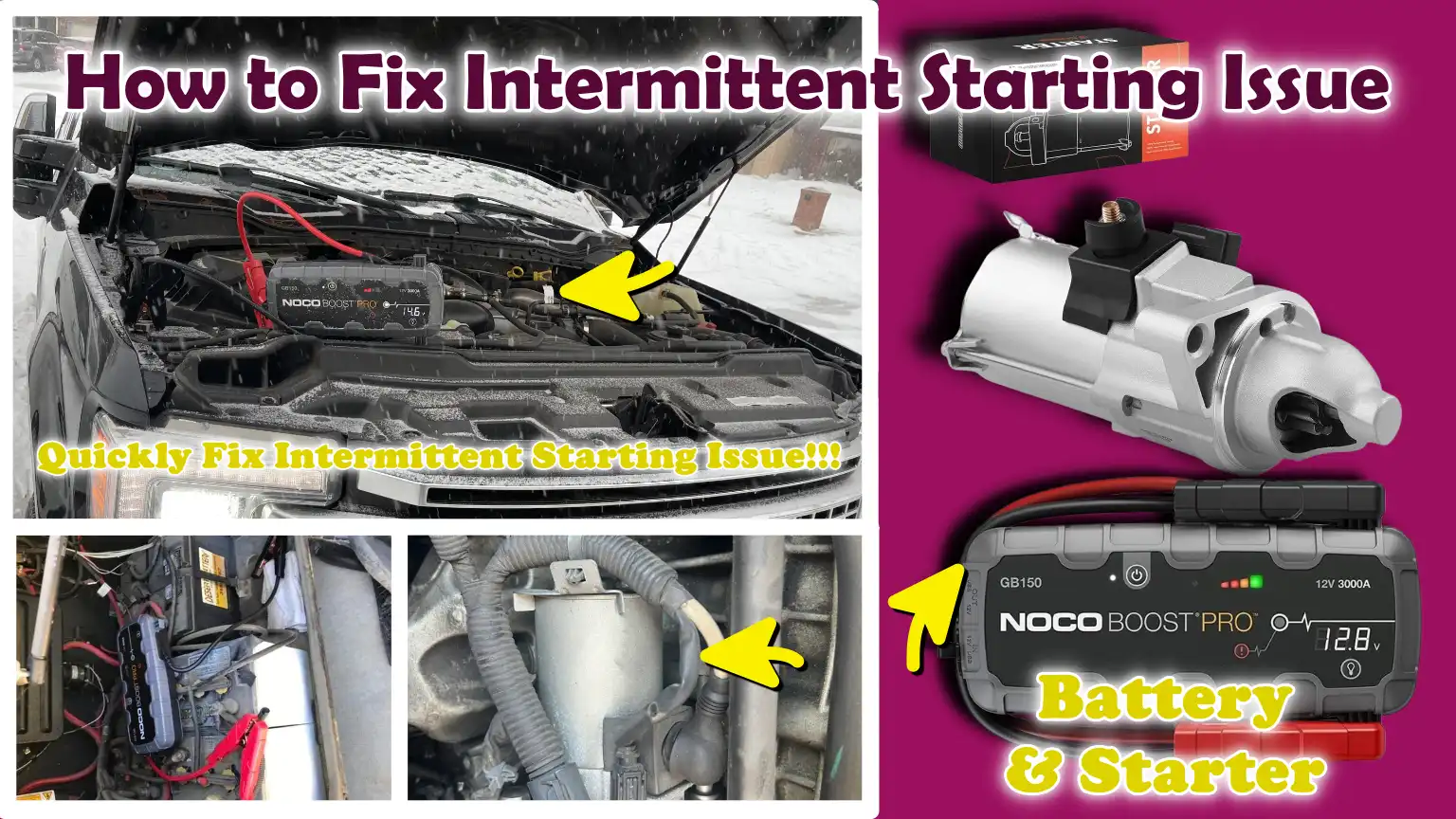
Which is why, in this guide you’ll learn How to Fix Intermittent Starting Issue, so that you can solve this issue in quick fashion with perfection.
So, What is an Intermittent Starting Issue?
An intermittent starting issue is a problem where a vehicle sometimes starts properly, but at other times fails to start.
Unlike a complete failure to start, this issue manifests sporadically, making it difficult to diagnose.
Drivers may observe certain symptoms before the engine starts such as: slow cranking, clicking sounds, delayed starting, or flickering dashboard lights.
Most intermittent starting issues are linked to a weak battery, a failing starter, loose wiring, a faulty ignition switch, fuel supply problems, or defective sensors.
Heat, corrosion and worn-out electrical components can also suddenly trigger this problem.
Know, About Intermittent Starting Issue
An intermittent starting issue implies that the vehicle’s behavior varies each time you attempt to start it.
Sometimes, the engine starts without any difficulty.
At other times, due to low battery voltage or a weak starter motor, the engine cranks slowly.
In other instances, caused by electrical glitches, faulty relays, or poor wiring connections, the vehicle may fail to start altogether.
Identifying these symptoms in a timely manner can prevent sudden vehicle breakdowns and help avoid costly repairs in the future.
Know, The Common Symptoms of Intermittent Starting Problems
1. Failure to Start Occasionally – Sudden No-Start Situation
A ‘sudden no-start situation’ occurs when the vehicle fails to respond at all, even after turning the key or pressing the start button.
The dashboard lights may illuminate normally, but the engine will not crank (turn over) in the slightest.
This issue is typically caused by a weak battery, a faulty starter motor, a defective ignition switch, a bad relay, or loose electrical connections.
In many vehicles, heat and vibration can temporarily disrupt the flow of electricity, causing this problem to manifest intermittently.
2. Engine Cranks but Does Not Start
Occasionally, the engine cranks normally yet refuses to start.
This usually indicates that while the starter motor is functioning correctly, the engine is not receiving fuel, spark, or the proper sensor signals.
Common causes for this include a failing fuel pump, a defective crankshaft position sensor, ignition coil issues, or a malfunction within the immobilizer system.
If this underlying issue is ignored, the symptoms will often worsen over time.
3. A ‘Clicking’ Sound When Starting
A ‘clicking’ sound during startup is one of the most common warning signs of starting difficulties.
A single ‘click’ may point to a faulty starter solenoid or a poor electrical connection, whereas a rapid, continuous clicking sound typically signals a weak battery or a low-voltage issue.
Corrosion on the battery terminals and faulty wiring can also produce clicking sounds during the starting process.
4. Flickering Dashboard Lights
Flickering dashboard lights during startup typically occur when the battery voltage becomes unstable.
This can be caused by a weak battery, a failing alternator, loose battery terminals, or a poor ground connection.
Electrical resistance within faulty wiring can also cause the lights to appear dim or to flicker when attempting to start the engine.
5. Vehicle Starts Only After Multiple Attempts
Some vehicles do not start on the first attempt but eventually fire up after turning the key several times.
This often happens when the starter motor, fuel pump, ignition switch, or relays begin to fail intermittently.
In many cases, failing electrical components temporarily re-establish contact after repeated attempts.
6. Starts Fine When Cold, But Not When Hot
If a vehicle starts easily when cold but struggles to start once it has warmed up, the cause is often a heat-related component failure.
Elevated engine temperatures can adversely affect the starter motor, crankshaft sensor, ignition module and fuel delivery system.
As these components heat up, their internal electrical resistance increases, making it difficult to start the vehicle.
7. Starts Fine in the Morning, But Struggles Later
Some vehicles start perfectly in the morning but begin to experience starting difficulties after being driven during the day.
Common causes for this include a weak charging system, overheating electrical components, a failing alternator, or low battery voltage.
Heat and prolonged engine operation tend to expose underlying issues within the electrical system more clearly.
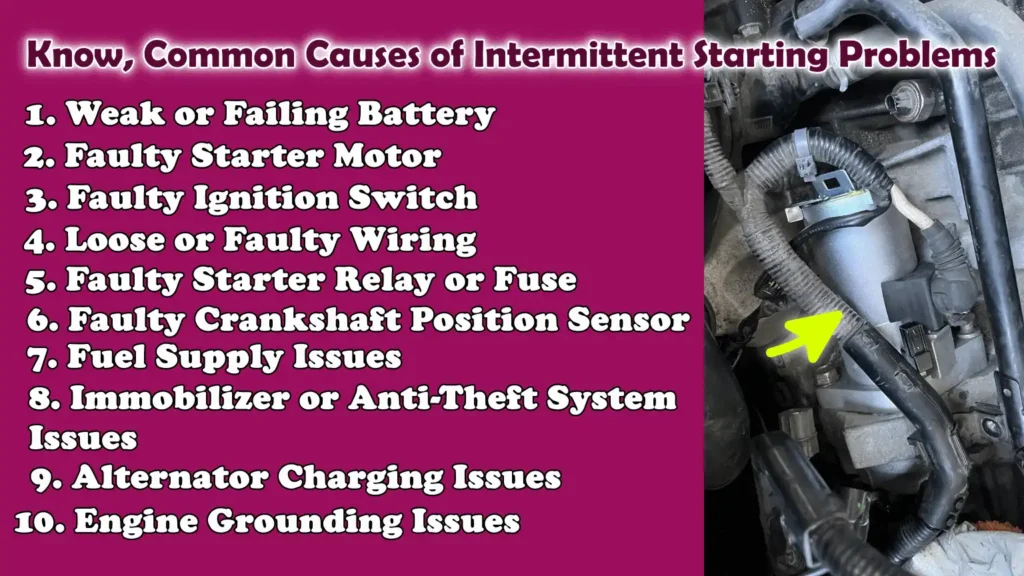
Know, Common Causes of Intermittent Starting Problems
1. Weak or Failing Battery
A weak or failing battery is one of the most common causes of intermittent starting problems.
Modern vehicles require a stable voltage to power the starter motor, fuel system, ignition system and engine computer during startup.
If the battery voltage drops too low, the engine may crank slowly, emit repeated “clicking” sounds, or fail to start altogether.
Internal battery defects can also disrupt the starting process, as faulty cells within the battery may function intermittently, working sometimes and failing at others.
Loose battery terminals, as well as corrosion accumulated around the terminals, can obstruct the flow of electricity and increase electrical resistance, preventing sufficient power from reaching the starter system.
2. Faulty Starter Motor
The starter motor is responsible for rotating (cranking) the engine during startup.
When the starter begins to fail, it may operate erratically, leading to intermittent starting issues.
A worn starter solenoid may fail to engage properly every time, resulting in “clicking” sounds or the engine failing to crank at all.
“Heat soak” (heat-related) issues are also common in older starter motors, as the elevated engine temperature following a drive can increase internal electrical resistance.
In some instances, faulty electrical components within the starter may temporarily cease functioning, only to resume normal operation later.
3. Faulty Ignition Switch
A faulty ignition switch can interrupt the flow of electricity to critical components of the starter system.
Inside the switch, there are electrical contacts that wear down over time due to repeated use.
When these contacts deteriorate, the flow of electricity during startup can become erratic.
This may cause the vehicle to lose power while cranking, fail to start altogether, or result in the dashboard lights suddenly going out.
Diagnosing ignition switch issues is often challenging, as the symptoms can manifest abruptly and without any prior warning.
4. Loose or Faulty Wiring
Loose or faulty wiring is another major cause of intermittent starting problems.
The starter system relies on numerous electrical connections between the battery, starter motor, ignition switch, relays and the Engine Control Module.
Issues with the ground cable can impede the flow of electricity and cause voltage instability during startup.
Broken wiring or defective connectors within the starter relay circuit can temporarily interrupt the electrical path, particularly when exposed to heat, moisture, or vibration.
Even a minor fault in the wiring can prevent the engine from starting properly.
5. Faulty Starter Relay or Fuse
The starter relay and fuse regulate the flow of electricity to the starter motor.
A faulty relay may occasionally get stuck or fail to deliver a consistent supply of power during the starting process.
This often leads to intermittent issues, where the vehicle starts perfectly fine at times, yet fails to start at all on other occasions.
Problems with fuse connections can also result in unstable electrical contact within the fuse box, making the vehicle’s starting behavior unpredictable.
6. Faulty Crankshaft Position Sensor
The crankshaft position sensor monitors the engine’s rotation and transmits essential data to the Engine Control Unit (ECU).
If the ECU fails to accurately detect crankshaft rotation, it may disable fuel injection and ignition timing, thereby preventing the engine from starting.
When a crankshaft sensor malfunctions, the vehicle often experiences intermittent starting issues, sometimes it starts and other times it does not.
This occurs because the internal electronic components may temporarily cease functioning, particularly when the engine becomes excessively hot.
7. Fuel Supply Issues
Fuel supply issues prevent the engine from receiving the necessary fuel required for combustion.
If the fuel pump is weak, it may struggle to maintain the requisite fuel pressure during startup, specially when the vehicle is already warm.
A faulty fuel pump relay can abruptly cut off power to the pump, causing the vehicle to suddenly fail to start.
Furthermore, a clogged fuel filter can restrict fuel flow, making it increasingly difficult to start the engine over time.
8. Immobilizer or Anti-Theft System Issues
Modern vehicles are equipped with immobilizers and anti-theft systems designed to prevent unauthorized engine starting.
If the key’s transponder fails to establish proper communication with the vehicle’s security system, the ECU may disable fuel injection or ignition functions.
A flashing security light on the dashboard is a common indicator of an immobilizer malfunction.
In many instances, issues such as a defective key, a faulty receiver, or glitches in electronic connections can also lead to intermittent starting problems.
9. Alternator Charging Issues
When the engine is running, the alternator keeps the battery charged.
If the alternator fails to charge the battery properly, the battery voltage gradually drops after the vehicle has been driven.
This often leads to intermittent starting difficulties; although the vehicle may start normally after being charged, the problems tend to recur later as the voltage declines.
Low charging output can also adversely affect multiple electrical systems simultaneously.
10. Engine Grounding Issues
Proper grounding is essential for stable electrical performance.
Poor chassis grounding can significantly increase electrical resistance and restrict current flow within the starting system.
When grounding points become loose, corroded, or damaged, the starter motor and other components fail to receive the necessary power to function correctly.
Grounding-related issues often manifest as peculiar symptoms that tend to worsen over time.
Tools
| Tools | Why It Is Needed | How to Use It |
|---|---|---|
| Multimeter | A multimeter is one of the most essential diagnostic tools, as it measures battery voltage, charging voltage, electrical resistance and power flow. It helps identify weak batteries, voltage drops, faulty wiring, poor grounds and charging system issues. Many intermittent starting problems are caused by unstable voltage, which cannot be detected without proper testing. | Set the multimeter to DC voltage mode and connect the probes to the battery terminals. A healthy battery typically displays a voltage of approximately 12.6 volts when the engine is off. During cranking, the voltage should generally remain above 9.6 volts. This tool can also be used to check the alternator’s charging output, as well as for electrical continuity in wires and grounds. |
| Battery Tester | A battery tester evaluates the overall condition and cranking capability of a battery under load. Some batteries may show normal voltage readings but may be internally defective when placed under stress. This tool helps detect weak or faulty battery cells, which often cause sudden, unexpected starting problems. | Connect the tester’s clamps to the battery terminals and follow the instructions provided with the tester. This tool applies a simulated starting load to the battery to determine whether it can maintain sufficient voltage during engine cranking. If the voltage drops too low, the battery may need to be replaced. |
| OBD2 Scanner | An OBD2 scanner reads the trouble codes stored within the vehicle’s computer system. Intermittent starting problems are often linked to faulty sensors, ignition issues, fuel system malfunctions, or immobilizer glitches, conditions that trigger specific diagnostic codes. Even if the ‘Check Engine’ light is not currently illuminated, stored or pending codes can still help identify underlying issues. | Connect the scanner to the vehicle’s OBD2 port; this is typically located under the dashboard, near the steering wheel. Turn on the ignition and scan for any stored or pending trouble codes. Check for any codes related to crankshaft sensors, the fuel system, the ignition system, battery voltage, or the anti-theft system. |
| Test Light | A test light quickly verifies whether electrical power is reaching specific circuits and components. It is useful for detecting blown fuses, faulty relays, defective switches and wiring issues. This tool is particularly helpful when inspecting starter circuits and fuse boxes. | Connect the test light’s clip to a reliable ground source and touch the probe to the electrical connection you are testing. If the light illuminates, power is present in that circuit. If the light does not illuminate, there may be a fault in the wiring, a blown fuse, or a defective electrical component. |
| Jumper Cables | Jumper cables are used to temporarily supply power to a vehicle from another battery when its own battery is weak or discharged. This helps determine whether the difficulty in starting the vehicle is due to low battery voltage. These cables also prove invaluable in emergency situations when a vehicle fails to start. | Connect the positive and negative clamps to the corresponding terminals on both vehicles’ batteries. First, start the vehicle that is functioning properly and allow it to charge the weak battery for a few minutes; only then should you attempt to start the vehicle that is failing to start. Always adhere to proper safety protocols to prevent damage caused by sparks or electrical hazards. |
| Wire Brush | A wire brush is essential for cleaning corrosion and dirt from battery terminals, ground connections and electrical contacts. The presence of corrosion increases electrical resistance, which can reduce the amount of power reaching the starter motor and other systems. Clean electrical connections facilitate better voltage flow and improve the vehicle’s starting performance. | Disconnect the battery terminals before cleaning. Use a wire brush to remove corrosion, rust and dirt from the battery posts, cable terminals and grounding points. After cleaning, firmly reattach the terminals to ensure proper electrical contact. |
How to Diagnose Intermittent Starting Problems
1. Check the Battery Voltage
The battery should be the first component checked, as low voltage is often a common cause of intermittent starting issues.
A healthy, fully charged battery typically registers a voltage of approximately 12.6 volts when the engine is off.
If the voltage is significantly lower than this, the battery may lack sufficient power to properly operate the starter motor and the engine’s electronics.
During cranking, the battery voltage should generally remain above 9.6 volts.
If the voltage drops too low during starting, the battery may be weak, internally defective, or unable to properly handle the electrical load.
2. Inspect the Battery Terminals and Cables
The battery terminals and cables should be carefully inspected for signs of corrosion, looseness, or any form of damage.
Corrosion increases electrical resistance, thereby reducing the flow of current reaching the starter motor.
Loose terminals can create an unstable electrical connection, often due to vibration or temperature fluctuations, leading to intermittent starting problems.
Ground wires are equally critical, as a poor or weak ground connection can disrupt voltage flow throughout the entire starting system.
3. Observe the Starter’s Operation
The sounds produced during the starting process can provide vital clues regarding the nature of the problem.
A single “click” sound often points to a faulty starter solenoid or a weak electrical connection.
Rapid, repetitive clicking sounds typically indicate low battery voltage or loose battery terminals.
A complete absence of sound may signal a defective ignition switch, faulty wiring, a relay issue, or a total failure of the starter circuit.
Slow cranking typically occurs when the battery is weak or the starter motor is not functioning correctly internally.
4. Check the Starter Motor
If the engine struggles to crank or occasionally fails to start, the starter motor should be inspected.
A voltage drop test determines whether sufficient electrical power is reaching the starter during cranking.
Excessive resistance within the cables or connectors can adversely affect the starter’s operation.
Sometimes, a “tap test” is employed, as lightly tapping a faulty starter can temporarily restore internal electrical contact.
A bench test involves removing the starter from the vehicle to verify whether it functions correctly when supplied with direct power.
5. Scan for Trouble Codes
An OBD2 scanner can detect trouble codes stored within the engine’s computer system.
Often, intermittent engine starting issues are caused by faulty sensors, ignition-related problems, immobilizer malfunctions, or fuel supply issues, all of which trigger diagnostic codes.
Pending codes are particularly important, as they can signal potential problems before the “Check Engine” light illuminates permanently.
During the diagnostic process, even minor glitches can provide valuable information.
6. Check the Fuel Supply
For the engine to start properly, the fuel system must generate adequate pressure.
When the ignition is switched on, the fuel pump typically emits a faint buzzing sound from the vicinity of the fuel tank.
If this sound is absent, the fuel pump or its relay may not be functioning correctly.
Checking the fuel pressure reveals whether the pump is capable of maintaining sufficient pressure while the engine is cranking.
A weak fuel pump or a clogged fuel filter are often the primary culprits behind difficulties faced when starting the engine.
7. Verify the Functionality of the Ignition Switch
The ignition switch is responsible for delivering electrical power to the various components required to start the engine.
If the dashboard lights flicker, dim, or go out when the key is turned, the internal electrical contacts within the ignition switch may be worn out.
Difficulty turning the key, a delay in the electrical system powering up, or a sudden loss of power while attempting to start the engine are also common signs of a faulty ignition switch.
8. Inspect the Alternator
When the engine is running, the alternator keeps the battery charged.
A properly functioning alternator typically generates a charging voltage of approximately 13.5 to 14.5 volts while the engine is in operation.
If the charging voltage is too low, the battery may gradually lose its charge while driving, potentially leading to difficulties in starting the engine later on.
Symptoms of a discharged battery often become more apparent at night, or after using headlights, air conditioning, or other electrical accessories.
9. Inspect the Crankshaft Position Sensor
The crankshaft position sensor assists the engine computer in detecting engine rotation and controlling ignition timing and fuel injection.
When this sensor begins to fail, the ECU may stop sending fuel or spark signals, preventing the engine from starting.
Heat-related failures are common, as the internal electronic components may cease to function when the engine heats up.
In some vehicles, when the sensor fails, RPM signal readings also stop being recorded when an attempt is made to start the engine.
10. Check the Immobilizer System
Modern immobilizer systems prevent unauthorized engine starting by communicating with the key’s transponder.
If the security light flashes or remains illuminated while attempting to start the engine, the immobilizer may not be properly recognizing the key.
A faulty transponder chip, a defective receiver, or a communication glitch can prevent the engine from starting, even if all other systems are functioning correctly.
Sometimes, testing with a spare key can help quickly determine whether or not the issue is related to the anti-theft system.
How to Fix Intermittent Starting Issue – Working Method
1. Clean and Tighten Battery Connections
Dirty or loose battery connections are one of the simplest and most common causes of intermittent starting problems.
Corrosion around the battery terminals increases electrical resistance and reduces the amount of power reaching the starter motor.
Before cleaning, you should always disconnect the negative battery terminal first to minimize the risk of an electrical short circuit.
Corrosion and dirt can be removed from the battery posts and cable ends using a wire brush or a terminal cleaning tool.
After cleaning, the terminals must be tightened securely, as loose connections can cause a sudden voltage drop during starting.
Applying a terminal protection spray or dielectric grease can slow down future corrosion and help maintain better electrical contact over time.
2. Replace a Weak Battery
A weak battery may be able to power lights and accessories, but it might not be able to handle the heavy electrical load required to start the engine.
It is crucial to replace the battery with one of the correct size and Cold Cranking Amperage (CCA) rating, as modern vehicles require stable voltage for their engine computers, sensors and electronic systems.
Installing a battery with incorrect specifications can lead to charging and starting issues.
Some newer vehicles also require a battery registration or system reset procedure after replacement to ensure that the charging system has properly adjusted to the new battery.
3. Repair or Replace Faulty Wiring
Faulty wiring can interrupt electrical flow and cause starting problems that are difficult to diagnose.
Ground straps are particularly critical, as they provide a return path for the electrical current flowing between the engine, chassis and battery.
Corroded or broken ground straps can lead to voltage drops and compromise starter performance.
Cleaning connectors is also essential, as moisture, dirt and oxidation can damage electrical contacts over time.
Repairing faulty wiring and tightening loose connectors can restore a steady flow of power throughout the entire starting system.
4. Replace the Starter Motor
A failing starter motor may crank slowly, emit a repetitive ‘clicking’ sound, or suddenly cease functioning due to internal wear.
Worn starter brushes, a defective armature, or a failing starter solenoid are common culprits behind intermittent starting issues.
Heat-related starter failures are also common, as internal resistance increases when the engine is hot.
Replacing the starter typically involves disconnecting the battery, detaching electrical connections, unbolting the old unit and securely installing the new starter unit in its place.
5. Replace the Starter Relay or Fuse
The starter relay and fuse regulate the flow of electricity to the starter motor.
A relay that intermittently sticks can interrupt the consistent supply of power to the starter.
Temporarily swapping the relay located in the fuse box with another identical relay can sometimes help pinpoint the root cause of the problem.
Checking the fuse is equally important, as corroded terminals or a partially blown fuse can disrupt electrical contact and cause intermittent difficulties in starting the vehicle.
6. Replace a Faulty Ignition Switch
A faulty ignition switch can prevent power from reaching the critical components required to start the vehicle.
Common symptoms include: flickering dashboard lights, intermittent power loss, difficulty turning the key, or the engine failing to start repeatedly.
The ignition switch contains internal electrical contacts that wear out over time due to repeated use.
Replacing the ignition switch may require disassembling the steering column and carefully reconnecting the electrical connectors and locking mechanisms.
7. Replace the Fuel Pump or Fuel Relay
A weak fuel pump may fail to generate sufficient fuel pressure during startup, causing the engine to crank but fail to start.
Common symptoms of a faulty fuel pump include: buzzing or whining sounds coming from the fuel tank, hesitation during acceleration, delayed starting, or intermittent difficulty in getting the vehicle to start.
A faulty fuel pump relay can also cause intermittent interruptions in the power supply reaching the pump.
Replacing a defective pump or relay restores proper fuel pressure and improves the reliability of the engine’s starting performance.
8. Replace the Crankshaft Position Sensor
The crankshaft position sensor assists the engine computer in monitoring engine rotation and controlling fuel injection and ignition timing.
If the sensor malfunctions, the ECU may cease sending spark or fuel signals, preventing the engine from starting.
Most crankshaft sensors are mounted on the crankshaft pulley, the transmission bell housing, or inside the engine block.
After replacing the sensor, some vehicles may require an ECU “re-learning” procedure to ensure the engine computer correctly recognizes the new sensor.
9. Reprogram or Repair the Immobilizer
Immobilizer systems utilize electronic communication between the key’s transponder and the engine computer to authorize engine starting.
If this communication fails, the ECU may completely disable the ignition or fuel supply.
If the transponder chip malfunctions or loses synchronization with the vehicle, the key often requires reprogramming.
In some vehicles, following a battery replacement or electrical system repair, an anti-theft reset procedure may also be necessary to allow the engine to start normally.
10. Resolve Charging System Issues
Problems with the charging system can cause the battery to discharge gradually, leading to frequent or intermittent difficulties in starting the engine.
A faulty alternator may fail to generate the necessary charging voltage required to keep the battery fully charged while the vehicle is running.
Replacing the alternator restores charging capacity and prevents the battery from repeatedly discharging.
It is also crucial to inspect the drive belt, as a loose, cracked, or slipping belt can reduce the alternator’s rotational speed and diminish its charging output, particularly when the electrical load is high.
Read More:
Know, The Intermittent Starting Problems Based on Symptoms
1. The Car Starts Sometimes, But Not Always
A car that starts intermittently, sometimes, but not reliably, typically suffers from an unstable issue within its electrical or fuel system.
In many cases, the battery voltage may be low, the starter motor may be wearing out, or electrical connections may have come loose due to vibration and temperature fluctuations.
This symptom is common in vehicles with aging wiring, corroded battery terminals, weak relays, or a failing ignition switch.
Because the vehicle still starts occasionally, many drivers continue to ignore these early warning signs until the problem escalates into a complete “no-start” situation.
2. The Car Makes a ‘Click’ Sound, But Does Not Start
Hearing a ‘click’ sound while attempting to start the car usually indicates that the starter system is not receiving sufficient electrical power.
A single ‘click’ often points to a faulty starter solenoid or a failing starter motor, whereas a rapid, repetitive clicking sound is typically caused by a weak battery or loose battery connections.
Corroded terminals, faulty ground cables and poor electrical contacts can also prevent sufficient current from reaching the starter motor.
In some instances, the engine may eventually start after several attempts, as the electrical connection temporarily re-establishes itself.
3. The Engine ‘Cranks’ But Does Not Start
When the engine cranks normally but fails to start, it implies that the starter motor is functioning correctly; however, the engine is not receiving the necessary fuel, spark, or proper sensor signals.
Common causes for this include a faulty fuel pump, a clogged fuel filter, a defective crankshaft position sensor, a bad ignition coil, or an issue within the immobilizer system.
Modern engines rely heavily on the interplay of various sensors; consequently, a single malfunctioning sensor can completely disable the fuel injection or ignition timing systems.
4. The Car Starts Only When Cold
A vehicle that starts normally when cold but struggles to start once it has warmed up often suffers from a heat-related component failure.
As temperatures rise, components such as the starter motor, ignition module, crankshaft position sensor and fuel pump may cease to function correctly.
The heat causes the internal electrical resistance within these failing components to increase, thereby degrading their performance.
This symptom is quite common in older vehicles and typically becomes more pronounced during hot weather or after long journeys.
5. The Car Starts Only After a Waiting Period
Some vehicles do not start immediately but will only fire up after a waiting period of a few minutes.
This often occurs because overheated electrical components resume functioning, albeit temporarily, once they have cooled down.
A weak fuel pump, a failing crankshaft sensor, an overheating starter motor and issues within the ignition system are common causes for this delayed starting behavior.
In many instances, the engine is able to start normally again once its internal temperature has dropped slightly.
6. The Car Suddenly Refuses to Start
A sudden failure to start is typically an indication of unstable electrical connections or issues within the charging system.
Loose battery terminals, faulty wiring, poor grounding, a weak alternator, or a defective ignition switch can disrupt the sudden surge of voltage required to start the vehicle.
When attempting to start the engine, drivers may observe certain symptoms such as: dimming dashboard lights, malfunctioning electrical accessories, or a complete loss of power.
These issues often manifest suddenly, as heat, vibration and moisture gradually degrade electrical connections over time.
7. The Key Must Be Turned Multiple Times to Start the Vehicle
A vehicle that requires the key to be turned multiple times before starting often suffers from aging electrical components or issues with the fuel supply.
A faulty ignition switch, a weak fuel pump, a defective starter relay and poor battery connections are common causes of this symptom.
In some vehicles, repeatedly turning the key temporarily re-establishes electrical contact or allows fuel pressure to build up gradually, eventually enabling the engine to start.
If this symptom is ignored, the vehicle may eventually fail to start altogether.
Intermittent Starting Issue Chart – Symptoms vs Possible Causes Table
| Symptom | Possible Cause | Why It Happens | How to Check It |
|---|---|---|---|
| Rapid Clicking During Startup | Weak Battery | Generally, when the battery lacks the necessary voltage to properly operate the starter motor, a rapid clicking sound is heard. The starter relay repeatedly cycles on and off because the battery’s power drops significantly during cranking. Corroded terminals or loose battery cables can also impede the flow of electricity, resulting in these same symptoms. | Check the battery voltage using a multimeter. A healthy battery should typically register a voltage of around 12.6 volts when the engine is off. Inspect the battery terminals for corrosion or looseness and if possible, test the battery under load. |
| No Crank Condition | Faulty Starter Relay | A faulty starter relay may fail to deliver power to the starter motor. Consequently, when you turn the ignition key or press the start button, the vehicle remains completely unresponsive. Relay-related issues are often intermittent, as the internal contacts may occasionally stick or lose connection. | While attempting to start the vehicle, listen carefully for the clicking sound of the relay coming from the fuse box. If a similar and compatible relay is available, try swapping it out; additionally, inspect the relay terminals for signs of heat damage or corrosion. |
| Engine Cranks But Will Not Start | Weak or Failing Fuel Pump | The engine may crank normally, but if the fuel pump fails to generate sufficient fuel pressure, the engine will not start. Weak fuel pumps often fail intermittently, particularly when the vehicle heats up. Low fuel pressure prevents proper combustion from occurring within the engine cylinders. | Turn on the ignition and listen for the faint priming sound of the fuel pump coming from the vicinity of the fuel tank. Use a fuel pressure tester to determine whether the fuel pump is maintaining adequate fuel pressure while the vehicle is starting. |
| Random Starting Failure | Faulty Ignition Switch | The ignition switch controls the flow of electricity to the starter system, fuel system and engine electronics. Worn internal contacts can sometimes interrupt the electrical current, potentially leading to difficulties in starting the vehicle. During cranking, the dashboard lights may flicker or go out completely. | Keep an eye on the dashboard lights while turning the key. If the power cuts out intermittently, or if the key feels loose or is difficult to turn, the ignition switch may be failing internally. |
| Security Light Flashing | Immobilizer Or Anti-Theft System Problem | Modern immobilizer systems prevent the engine from starting until the vehicle properly recognizes the key’s transponder. If communication between the key and the engine computer is interrupted, the fuel injection or ignition process may be completely disabled. | Pay attention to the security indicator light while attempting to start the vehicle. If you have a spare key, try using it instead. If the vehicle starts with the spare key, your original transponder key may be defective or improperly programmed. |
How to Avoid Intermittent Starting Problems
Plus, there’s electrical system that literally plays a major role in vehicle starting performance, even NHTSA research also shows that wiring faults, grounding problems and unstable electrical connections can actually interrupts the important vehicle systems unexpectedly, as many intermittent starting problems actually develops just because of something somewhere that small electrical failures slowly increase the resistance and that’s how it reduces the voltage flow thourghout the starting system.[¹]
1. Battery Maintenance Tips
Proper battery maintenance is the most effective way to prevent intermittent starting problems.
Modern vehicles rely heavily on a stable battery voltage to power the starter motor, ignition system, fuel injectors and engine computer during startup.
A weak battery may be able to power lights and other accessories, but it can fail when subjected to the heavy cranking load required to start the engine.
Regularly checking battery voltage, keeping the battery fully charged and replacing aging batteries before they fail can significantly enhance the vehicle’s starting reliability.
Extreme heat and cold weather can also degrade battery performance over time; therefore, seasonal battery testing is essential to ensure the vehicle’s long-term reliability.
2. Regular Electrical Inspections
Electrical inspections help identify worn wiring, loose connections and faulty components before they escalate into major starting issues.
Over time, vibrations, moisture, engine heat and road debris can gradually degrade the wiring and connectors within the starter system.
Minor electrical faults often begin as intermittent issues and eventually lead to complete system failure.
Regularly inspecting the starter wiring, relays, fuse box, ignition switch and grounding points can help prevent sudden no-start situations and avoid costly repairs in the future.
3. Keeping Terminals Corrosion-Free
Corrosion on battery terminals is a common cause of voltage drops and poor starter performance.
Corrosion creates electrical resistance, which reduces the amount of power reaching the starter motor and other critical systems.
Even the slightest trace of corrosion can weaken the electrical current to such an extent that the vehicle may, at times, fail to start altogether.
Regularly cleaning the battery terminals and cable ends helps maintain a strong electrical connection and stable voltage.
Applying protective grease or terminal spray after cleaning can also help slow down the corrosion process in the future.
4. Fuel System Maintenance
A properly functioning fuel system is essential for reliable engine starting.
A weak fuel pump, a clogged fuel filter, or poor-quality fuel can cause starting difficulties, particularly in hot weather or after long journeys.
Replacing the fuel filter at the service intervals recommended by the manufacturer helps maintain proper fuel pressure and prevents blockages within the system.
Keeping an adequate amount of fuel in the tank also helps reduce the strain on the fuel pump, as the pump relies on the fuel itself for cooling and lubrication while operating.
5. The Importance of Regular Inspections
Regular inspections help detect hidden issues before they escalate into a complete failure to start.
Many modern vehicles store internal diagnostic trouble codes even before a warning light illuminates on the dashboard.
Conducting regular scans with an OBD-II scanner allows for the early detection of sensor malfunctions, charging system issues, ignition irregularities and fuel delivery problems.
Preventive diagnostics are particularly crucial, as intermittent starting issues often develop gradually and may only manifest under specific temperature or driving conditions.
Early detection can lead to cost savings, reduce the risk of vehicle breakdown and enhance the vehicle’s overall reliability.
Conclusion – How to Fix Intermittent Starting Issue
It is frequently noticed that most of the time this annoying intermittent starting problems actually begins with a small electrical faults that slowly becomes larger and more expensive as the time passes.
What makes these issues even more challenging is that their symptoms often manifest suddenly, leading many drivers to replace vehicle components without first identifying the root cause of the problem.
In most cases, the issue is linked to the battery, starter motor, ignition system, wiring, fuel delivery system, sensors, or charging system.
Minor electrical glitches such as: loose battery terminals, poor ground connections, or corroded wiring, as it can also disrupt the engine starting process and trigger sudden no-start situations.
Understanding the symptoms is one of the most crucial steps in accurately diagnosing the problem.
A clicking sound may indicate an issue with the battery or starter, whereas an engine that cranks but fails to start often points to a fault in the fuel delivery system or sensors.
Starting difficulties caused by heat are typically associated with the starter motor or crankshaft position sensor, while a flashing security light may signal a malfunction within the immobilizer system.
And, that’s all about this guide on How to Fix Intermittent Starting Issue, also you can ask all the related questions below in the comment section.
Frequently Asked Questions
FAQ 1: Why does my car sometimes have trouble starting?
Answer: This intermittent starting issue typically occurs because a specific component within the starting system, rather than failing completely, occasionally ceases to function. The most common causes include a weak battery, a faulty starter motor, loose battery terminals, defective wiring, a bad ignition switch, a failing fuel pump, a weak alternator, or a faulty crankshaft position sensor. Heat, vibration, moisture and corrosion can also affect electrical connections, creating conditions where the car occasionally fails to start. Because this problem is intermittent, diagnosing it can be difficult without a comprehensive inspection of the battery voltage, starter system, fuel supply and engine sensors.
FAQ 2: Can a weak battery cause intermittent starting issues?
Answer: Yes, a weak battery is one of the most common causes of intermittent starting problems. Even if the lights and other accessories are still functioning, the battery may lack the necessary power to properly drive the starter motor while cranking the engine. Low battery voltage can result in slow cranking, clicking sounds, flickering dashboard lights, or the car failing to crank at all. In many cases, aging batteries fail to perform effectively in cold weather or after the vehicle has been left parked for an extended period.
FAQ 3: Why does my car make a clicking sound but fail to start?
Answer: A clicking sound typically indicates that the starter system is not receiving the necessary electrical power. Rapid, repetitive clicking sounds often point to a weak battery, loose battery terminals, or corrosion within the cable connections. On the other hand, a single clicking sound may indicate a faulty starter motor or a defective starter solenoid. In some vehicles, a bad relay or a poor ground connection can also prevent the starter from functioning correctly.
FAQ 4: Why does my engine crank but fail to start?
Answer: If the engine cranks normally but does not start, it implies that the starter motor is operational, but the engine is not receiving fuel, spark, or the correct sensor signals. Common causes for this include a failing fuel pump, a clogged fuel filter, a defective ignition coil, a faulty crankshaft position sensor, or an issue within the immobilizer system. Modern vehicles rely heavily on electronic sensors; therefore, a single malfunctioning sensor can prevent the engine from starting.
FAQ 5: Why does my car start easily when cold but fail to start when hot?
Answer: This typically occurs because certain electrical components fail to function properly at elevated temperatures. The starter motor, crankshaft position sensor, ignition module and fuel pump are components that are particularly susceptible to the effects of heat. As the engine temperature rises, electrical resistance within worn components also increases, thereby hindering their ability to function correctly. Heat-related starting issues are more prevalent in older vehicles.
FAQ 6: Can a faulty alternator sometimes cause starting difficulties?
Answer: Yes, a defective alternator can gradually discharge the battery by failing to charge it properly while the engine is running. Once the battery is recharged, the vehicle may start normally; however, as soon as the battery voltage drops again, starting problems may suddenly resurface. Symptoms of alternator problems often include dim lights, the illumination of the battery warning light, poor performance of electrical accessories and frequent battery discharge.
FAQ 7: How can I tell if my starter motor is failing?
Answer: Common symptoms of a failing starter motor include slow cranking, clicking sounds, grinding noises, a sudden failure to crank, or the engine starting only after multiple attempts. Some starters perform worse when the engine is hot, as internal electrical resistance increases with rising temperature. If tapping on the starter motor causes the engine to start, even if only temporarily, it indicates that the starter motor is worn out internally.
References:
[1] Hydrogen Fuel Cell Vehicle Electrical Protective Barrier Option: Fuel System Safety
https://www.nhtsa.gov/sites/nhtsa.gov/files/812134-hydrogenfuelcellvehelecprotbaroptfuelsyssfty.pdf
Hello Folks, Dean Shali here to help you out to solve the problems with your lovely vehicle, as i have lots of experience and knowledge about automotive industry as i woks directly with the customers and repair vehicles and i love to help the people to keep their cars safe and running smoothly.