
Written By: Dean Shali
Fact Checked By: Sabré Cook
Reviewed By: Tamara Warren
Without a doubt, having slow cranking engine is really annoying startup problem as you have to inspect many things such as: car battery, corroded battery terminals, weak ground connections, a failing starter motor, charging system issues, damaged cables or even thick engine oil during the cold weather time.
Also, there are symptoms such as: dim dashboard lights, repeated clicking sounds, sluggish morning starts or an engine that turns over much slower than normal before finally starting.
And, the difficult and annoying part is to find out what is the actual component that is creating this problem, as if you just replace the random parts then it is just the waste of money without fixing the actual problem at all.
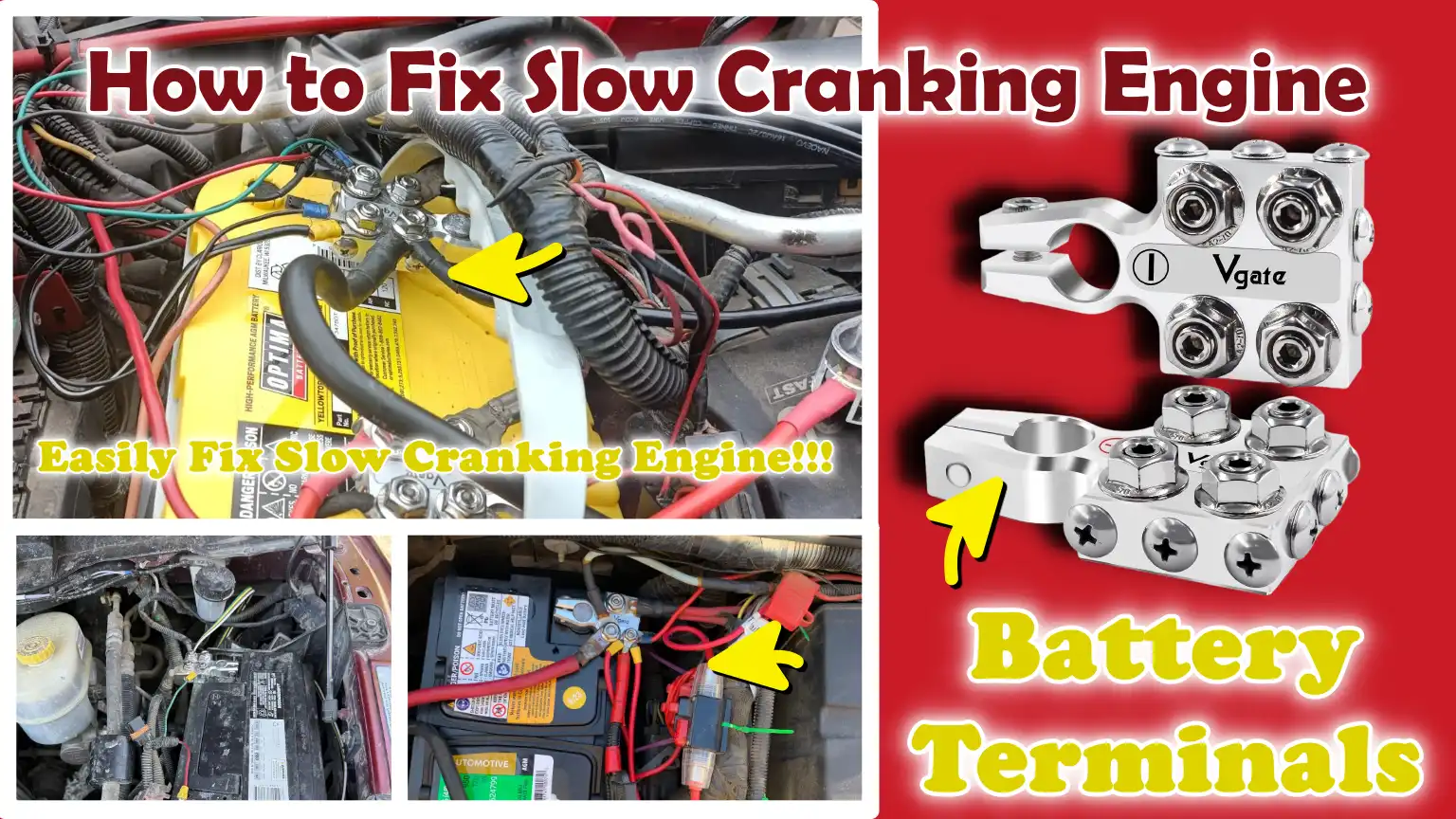
Which is why, we have come up with this guide on How to Fix Slow Cranking Engine, so that you can find out first by the warning signs and diagnose the issue with accurate testing methods and then restore that reliable engine starting performance properly.
Let’s Understand First, What is a Slow-Cranking Engine?
A “slow-cranking engine” refers to a condition where, when you attempt to start the vehicle, the engine turns over (rotates) more slowly than usual.
In a properly functioning car, the battery supplies a strong electric current to the starter motor, causing the engine to spin rapidly enough for combustion (the ignition process) to begin within just a few seconds.
When there is an issue with the battery, starter motor, wiring, grounding, or charging system, the engine loses this momentum and struggles to rotate during the starting process.
Understanding this is crucial, as slow cranking often serves as an early warning sign that precedes a complete failure of the engine to start.
1. Definition of Slow Cranking
Slow cranking means that the starter motor is unable to rotate the engine at the proper speed, either because it is not receiving sufficient electrical power, or because it is facing excessive resistance.
Typically, a fully charged car battery delivers approximately 12.
6 volts of power when the engine is off; this level is sufficient to ensure rapid and unhindered cranking.
When the voltage drops, or when resistance increases within the cables or connections, the starter motor cannot operate at its full potential; consequently, the engine turns over very slowly.
2. What Does Normal Cranking Sound Like?
The sound of a normally cranking engine is smooth, steady and consistent.
The engine spins rapidly, without any hesitation or obvious signs of struggle, and typically starts within just a few seconds.
The sound remains uniform throughout this entire process, indicating that the battery, starter motor and their associated wiring are all working together correctly.
3. Symptoms of a Slow-Cranking Condition
Slow Engine Rotation
The engine cranks significantly slower than usual and it often sounds as though it is struggling or straining to start.
Clicking Sounds
Instead of the engine turning over, you may hear a rapid clicking sound; this is often an indication of low battery power or a weak electrical current flow.
Dimming Dashboard Lights
When starting the vehicle, the interior and dashboard lights dim or fade; this indicates that the battery voltage is dropping under load.
Delayed Engine Start
The engine takes longer than usual to start, even if it eventually does fire up; this is a sign of slow cranking speed.
Battery-Related Warning Indicators
A warning light related to the battery or charging system may illuminate on the dashboard; this could signal poor battery performance or an issue within the charging system.
The Most Common Causes of Slow Engine Cranking
The problem of slow engine cranking typically occurs when the starting system fails to deliver sufficient electrical power, or when there is excessive internal resistance within the engine itself, making it difficult to turn over.
The starting system relies on a delicate balance between the health of the battery, clean electrical connections, a robust starter motor and the proper mechanical operation of the engine.
If any of these components fail, the engine will crank slowly and starting it will become a challenge.
In most cases, this issue develops gradually; consequently, drivers often recognize the problem of slow cranking before the starting system fails completely.
1. A Weak or Deteriorating Battery
A weak or deteriorating battery is the most common cause of slow engine cranking, as the battery serves as the primary source of the initial electrical energy required to activate the starter motor.
A healthy battery should maintain a voltage of approximately 12.6 volts when fully charged; however, as it ages or its capacity diminishes, it becomes unable to deliver sufficient current under load.
Consequently, the starter motor begins to spin sluggishly, particularly when the engine is cold or the vehicle has been left idle for an extended period.
Even if the vehicle’s lights illuminate, the battery may no longer possess the necessary power to crank the engine effectively.
2. Corrosion on Battery Terminals
Corrosion on the battery terminals impedes the flow of electricity, thereby reducing the power reaching the starter motor.
This corrosion often manifests as a white or green powdery buildup on the terminals.
Even a minor obstruction in the electrical path can significantly impact the engine’s cranking speed, as the starter motor requires a strong surge of current to engage.
Poor contact at the terminals leads to a voltage drop, causing the engine to crank slowly or intermittently during the starting process.
3. Faulty Starter Motor
A faulty starter motor can also be the cause of an engine cranking slowly, specially if its internal components (such as brushes, bearings, or the armature) have become worn out.
Over time, the motor’s efficiency diminishes, preventing it from effectively converting electrical energy into powerful mechanical rotation.
Consequently, the engine turns over very slowly, or repeated attempts are required to get it started.
In some instances, the starter may draw excessive current, further depleting the available power.
4. Faulty Starter Solenoid
A faulty starter solenoid can interrupt the flow of electrical current traveling from the battery to the starter motor.
The solenoid acts as a “high-power switch”; when it weakens, it fails to fully engage the starter.
The result is that the engine either turns over only slightly or engages belatedly, making it difficult for the engine to crank properly.
Occasionally, this issue is accompanied by a distinct “clicking” sound, this occurs because the solenoid is attempting to engage but is unable to complete the electrical circuit.
5. Poor Ground Connection
A poor ground connection compromises the overall efficiency of the starting system, as a complete electrical circuit is essential for the proper flow of current.
If the ground cable connecting the engine to the chassis is loose, corroded, or damaged, current cannot flow back to the battery effectively.
This leads to increased electrical resistance and a drop in voltage, causing the engine to crank slowly and diminishing the starter’s performance.
6. Thick or Incorrect Engine Oil
Using engine oil that is excessively thick or of the incorrect type increases internal resistance within the engine’s moving parts, making it even more difficult for the starter motor to turn the crankshaft.
This problem is exacerbated during cold weather, when the oil naturally becomes thicker.
If the wrong grade of oil is used, the engine may seem sluggish when starting, as the starter motor has to work harder than usual to rotate the internal engine components.
7. Weak Alternator Charging System
A weak alternator charging system negatively impacts the health of the battery over time, as the alternator is responsible for recharging the battery while the engine is running.
If the alternator is not charging properly, the battery gradually loses its power and becomes unable to provide the necessary current to crank the engine.
This often results in the engine starting slowly or sluggishly, particularly after short trips, when the battery does not have sufficient time to fully recharge.
8. Parasitic Battery Drain
Parasitic battery drain occurs when a vehicle’s electrical components continue to draw power even after the engine has been switched off.
This causes the battery to discharge gradually, either over the course of a full night or within just a few hours.
Common causes include faulty relays, interior lights being left on, or malfunctioning electronic modules.
When the battery becomes discharged, it is unable to provide the necessary power to crank the engine in the morning, resulting in the engine turning over very slowly.
9. Seized or High-Resistance Engine Components
Engine components that are seized or exhibit excessive resistance require greater force to rotate.
This can be attributed to internal engine wear, a lack of lubrication, or a mechanical malfunction.
When the engine itself becomes difficult to turn over, the starter motor is forced to exert immense effort, even if the battery and electrical system are functioning perfectly.
Consequently, the engine cranks very slowly or struggles to start.
10. Battery Performance Issues in Cold Weather
Cold weather diminishes a battery’s capacity by slowing down the chemical reactions occurring within it.
This reduces the electrical current output from the battery, making it difficult for the starter motor to crank the engine.
Furthermore, engine oil thickens at low temperatures, increasing internal resistance within the engine components.
The combination of these two factors makes the issue of a slow-cranking engine, particularly during winter or in the early morning, even more prevalent.
Know, Some Warning Signs Before a Slow-Cranking Problem Worsens
The problem of slow cranking typically does not manifest suddenly.
In most vehicles, it develops gradually, as the battery weakens, electrical resistance increases, or the starter motor begins to wear out.
The vehicle often provides early warning signs indicating that something within the starting system is not functioning correctly.
These signs are crucial because they help you identify the issue before it escalates into a complete “no-start” situation.
Understanding these early symptoms can help you avoid sudden breakdowns and costly repairs.
1. Intermittent Slow Starting
Intermittent slow starting occurs when the engine occasionally starts normally, while at other times, without any specific pattern, it cranks very slowly.
This is typically an indication of a weak battery, loose connections, or early signs of wear in the starter motor.
This irregularity suggests that the system is failing to function properly under certain conditions such as: after the vehicle has been parked overnight, or when the battery is under a heavy load.
This is often one of the very first warning signs to appear.
2. Burning Odor While Starting
Detecting a burning odor while starting the vehicle is a serious warning sign that should not be ignored.
This can be caused by excessive load on the starter motor, overheating wiring, or high electrical resistance within the system.
When the starter exerts force to turn the engine, it draws more current than usual, causing its internal components to heat up rapidly.
This heat can produce a faint burning odor, resembling burnt electrical insulation or rubber, which may be perceptible while the engine is cranking or immediately thereafter.
3. A Grinding Noise from the Starter
A grinding noise during startup is typically an indication that the starter gear is failing to engage properly with the engine’s flywheel.
This can occur if the starter motor is worn out, misaligned, or defective.
The grinding sound suggests that metal components are not meshing smoothly; if the engine is repeatedly started under these conditions, it can lead to further damage.
This often serves as an early warning sign that the starter motor is on the verge of failure.
4. Flickering Interior Lights During Startup
Flickering interior lights while starting the vehicle indicate that the battery voltage is dropping rapidly when the starter motor activates.
This happens when the battery is weak or when there is excessive resistance within the electrical system.
As the starter motor draws a significant amount of current, any weakness in the battery or wiring manifests as instability in the vehicle’s interior lighting.
This is a clear indication that the electrical system is under strain.
5. Repeated Battery Discharge
If the battery repeatedly loses its charge, it implies that either it is not recharging properly or its charge is being depleted due to another underlying issue within the vehicle.
The cause could be a faulty alternator, a parasitic power drain (unintended power consumption), or an aging battery that is no longer capable of storing sufficient energy.
When this occurs, the engine often cranks slowly and eventually, the battery drains completely.
The recurring need for a jump-start is a definitive sign that there is a fault within the system.
6. The Vehicle Starts Easily After a Jump-Start
If the vehicle starts very easily after receiving a jump-start, it generally indicates that the battery alone is unable to provide sufficient power.
A jump-start temporarily supplies additional voltage from an external source, enabling the starter motor to function properly.
However, if this issue recurs frequently, it implies that the battery is weak, the alternator is failing to charge effectively, or there is a hidden electrical leak.
This serves as a primary indicator that there is a serious, underlying problem within the starting system.
Tools
| Tools | Why It Is Needed | How To Use It |
|---|---|---|
| Digital Multimeter | Measures the battery voltage and verifies whether sufficient power is reaching the starter motor. This helps confirm the health of the battery and the condition of the charging system. | Set the device to DC voltage mode; place the red probe on the battery’s positive terminal and the black probe on the negative terminal. Take voltage readings both when the engine is off and during cranking. A healthy battery typically displays a voltage of approximately 12.6V at rest. |
| Battery Terminal Cleaner | Removes corrosion from the battery terminals, which obstructs the flow of electricity and slows down the cranking process. | Disconnect the battery, spray or apply cleaner to the terminals, gently scrub until the metal is clean and then securely reconnect the battery. |
| Socket and Wrench Set | Used to tighten or remove battery cables, starter bolts and ground connections; loose connections can lead to poor contact and voltage drops. | Select the correct socket size and securely tighten or loosen the battery terminals and grounding bolts, taking care not to overtighten them. |
| Battery Charger | Fully charges a weak or discharged battery, thereby enabling an accurate diagnosis. Batteries with low charge levels often lead to misdiagnosis. | Connect the red clamp to the positive terminal and the black clamp to the negative terminal; plug in the charger and allow the battery to fully charge before re-testing it. |
| Jumper Cables | Helps temporarily start a car with a weak battery, thereby confirming that the slow-cranking issue is indeed caused by the battery itself. | Connect the positive terminal to the positive terminal of the other vehicle and connect the negative terminal to a grounded metal part of the car being tested. Next, start the other vehicle (the donor vehicle) and then attempt to start the car with the weak battery. |
| Wire Brush | Cleans corrosion, dirt and oxidation from the terminals and ground points, thereby improving electrical connections and reducing resistance. | Scrub the battery posts and cable ends until the clean metal underneath becomes visible; then, securely reconnect them. |
| Scan Tool – Optional | Reads error codes from the car’s computer system to identify potential issues related to the electrical system, charging, or sensors that may be preventing the car from starting. | Plug it into the OBD port located under the dashboard, turn on the ignition, read the stored codes and check for any malfunctions related to the battery, alternator, or starter. |
Ensure Safety Before Diagnosis the Vehicle
Before beginning the diagnosis of an engine that is cranking slowly, safety is paramount, as you will be working with high-voltage electrical currents and moving engine components.
A car battery may appear small, but it is capable of delivering a powerful electric shock; if not handled correctly, it can generate sparks, pose a burn hazard, or cause significant damage.
By taking a few simple precautions, you can ensure your personal safety and protect the vehicle’s electrical system from any sudden damage.
These steps are routinely followed in professional workshops, as even a minor error during diagnosis can lead to a short circuit or personal injury.
1. Properly Turn Off the Ignition
Properly turning off the ignition means ensuring that the key has been removed, or the start button has been completely switched off, before touching any electrical components.
This step prevents the engine from cranking unexpectedly or the electrical system from activating while you are working.
In modern vehicles, certain systems may remain active for a short period; therefore, waiting a few seconds after turning off the ignition ensures that all electrical activity has ceased before you begin the diagnostic process.
2. Safely Disconnect the Battery
Safely disconnecting the battery is one of the most critical steps, as it interrupts the flow of electricity throughout the entire system.
Typically, the negative terminal is disconnected first to minimize the risk of a short circuit.
This prevents sudden sparking should a tool accidentally come into contact with the vehicle’s metal components.
Furthermore, disconnecting the battery protects sensitive electronic components from sudden voltage fluctuations while you are inspecting or repairing the starter system.
3. Avoid Sparks Near the Battery
Avoiding sparks near the battery is crucial, as car batteries generate hydrogen gas, which can be flammable under certain conditions.
The occurrence of sparks near terminals or exposed connections can create a hazardous situation.
This is why metal tools must be handled with care and should never be allowed to touch both terminals simultaneously.
During diagnostics, it is also essential to keep the workspace free from open flames or heat sources.
4. Work on a Cold Engine
Working on a cold engine reduces the risk of burns and makes it safer to inspect components such as the starter motor, belts and surrounding wiring.
After driving, the engine compartment can become extremely hot and touching metal parts may result in injury.
Allowing the engine to cool down also makes handling tools easier, thereby enhancing both comfort and safety during the inspection process.
5. Wear Gloves and Safety Goggles
Wearing gloves and safety goggles protects you from electrical contact, injuries caused by sharp metal edges and sudden exposure to fluids.
Gloves improve your grip when handling battery terminals and cables, while eye protection shields you from corrosion particles or debris that may be dislodged during the cleaning or inspection of connections.
These basic safety accessories significantly reduce the risk of injury during the inspection process.
How to Fix Slow Cranking Engine – Great Method
1. Check the Battery Voltage
The first and most crucial step in diagnosing a slow-starting engine is to check the battery voltage, as the battery serves as the primary power source for the starter motor.
A healthy battery should provide sufficient power to vigorously crank the engine; even a slight drop in voltage can result in the engine starting slowly.
This check allows you to quickly determine whether the battery is strong, weak, or failing, before you proceed to inspect other components such as the starter or alternator.
How to Check the Battery Using a Multimeter
To check the battery using a multimeter, set the device to DC voltage mode and connect the red probe to the positive terminal and the black probe to the negative terminal.
With the engine turned off, the reading displayed on the screen indicates the battery’s “resting voltage” (the voltage under no load).
This simple test helps you gauge the battery’s current charge level without even starting the vehicle.
A stable reading suggests that the battery is in good condition, whereas an unstable or low reading indicates that the battery is struggling to crank the engine effectively.
Normal Battery Voltage Readings
A normal, fully charged car battery should register a voltage of approximately 12.6 volts when the engine is off.
This level signifies that the battery holds sufficient stored energy to properly start the engine.
If the reading drops to around 12.2 volts, the battery is only partially charged and issues with the engine starting slowly may begin to emerge.
If the voltage falls below 12.0 volts, the battery is generally considered weak or discharged and it may struggle significantly to start the engine.
When the engine is running, the voltage should typically rise to between 13.5 and 14.7 volts; this indicates that the alternator is properly charging the battery.
Signs Indicating the Need for Battery Replacement
If the battery consistently displays low voltage even after being charged, or if it fails to retain its charge overnight, it may require replacement.
Another key indicator is if the engine cranks slowly, even when the battery is fully charged.
External signs such as: swelling of the battery casing, corrosion, or fluid leakage, also suggest that the battery is deteriorating.
In many cases, a weak battery leads to recurring difficulties in starting the vehicle, particularly in cold weather, because it is unable to deliver sufficient power to the starter motor under load.
2. Inspect Battery Terminals and Cables
After checking the battery voltage, the next crucial step is to inspect the battery terminals and cables; for if the electrical connections are loose or compromised, even a perfectly good battery will fail to function correctly.
The starter motor requires a substantial amount of current to crank the engine and this current must flow through clean, secure connections.
If there is any resistance within the cables or terminals, the voltage will drop under load, resulting in a sluggish engine start.
This step is vital because many instances of slow engine cranking are not caused by a faulty battery, but rather by minor connection issues, problems that are often overlooked.
How Corrosion Affects Engine Starting
Corrosion on battery terminals acts as a form of resistance, disrupting the proper flow of electricity between the battery and the starter system.
It typically manifests as a white, green, or blue powdery substance accumulating around the metal connections.
Even a thin layer of corrosion can significantly increase resistance, thereby reducing the amount of current reaching the starter motor.
As the starter requires a very high current to crank the engine, any reduction in current flow can result in a weak or slow engine start.
Over time, corrosion can even spread into the cable ends, exacerbating the problem and making it difficult to detect through visual inspection alone.
Properly Cleaning Battery Terminals
Cleaning the battery terminals is a simple yet highly effective method for restoring proper electrical flow.
This process involves safely disconnecting the battery and removing dirt and corrosion from both the battery posts and the cable ends until a clean, bare metal surface becomes visible.
This ensures maximum contact between the battery and the cables, allowing current to flow without any interruption.
When the connection is clean, the starter motor once again receives full power; this often results in an immediate improvement in engine cranking speed, provided that the root cause of the problem was indeed corrosion.
Regular cleaning also helps prevent future engine starting issues caused by the gradual accumulation of dirt and grime over time.
Checking for Loose Battery Connections
Loose battery connections can also be a cause of slow engine cranking, as they disrupt the flow of electrical current during the starting process.
Even if the terminals appear clean, a slightly loose cable can create a blockage at the very moment the starter requires maximum power.
This can lead to issues such as voltage drops, flickering lights, or weak engine starting.
To check for this, it is essential to ensure that both the positive and negative terminals are securely tightened and do not shift from their position even when tugged gently.
A secure connection guarantees that the battery can provide a consistent supply of power to the starter motor, a crucial prerequisite for starting the engine smoothly and reliably.
3. Check the Starter Motor
After confirming that the battery and its connections are in good condition, the next step is to inspect the starter motor, as this is the component that actually rotates the engine during startup.
The starter motor draws a significant amount of electrical power to turn the engine’s crankshaft; if it becomes weak or faulty, the engine will crank slowly, even if the battery is fully charged.
Over time, internal wear and tear such as: worn brushes, weak windings, or failing bearings, as it can diminish its operational efficiency.
Checking the starter motor helps determine whether the issue lies with the electrical supply or if there is a mechanical fault within the starter itself.
Symptoms of a Failing Starter
A failing starter motor often exhibits clear warning signs before it fails completely.
A common symptom is slow or labored cranking, where the engine struggles significantly to turn over, even if the battery is in good condition.
Another indicator is intermittent starting issues, where the vehicle starts normally at times but struggles to start on other occasions, despite no change in the battery’s condition.
You may also hear a grinding noise during startup, which suggests that the starter gear is not engaging properly with the engine’s flywheel.
In some cases, the starter may overheat after repeated attempts to start the vehicle, indicating that it is drawing excessive current but failing to generate sufficient power to turn the engine.
Starter ‘Clicking’ vs Slow Cranking
Distinguishing between a starter that merely makes a ‘clicking’ sound and one that cranks slowly involves two distinct symptoms that help pinpoint the root cause of the problem.
A distinct ‘click’ sound typically occurs when the starter solenoid attempts to engage, yet insufficient power reaches the motor; this is often caused by a weak battery or poor electrical connections.
The result is a repetitive ‘clicking’ sound, but the engine itself fails to turn over.
Conversely, slow cranking indicates that the starter motor is engaging, but it is rotating the engine very sluggishly.
This usually signals a weak starter motor, internal wear and tear, or excessive resistance within the electrical circuit.
Understanding the distinction between these two scenarios helps in diagnosing whether the issue lies with the power supply or with the internal operation of the starter motor itself.
Starter Voltage Drop Test
The Starter Voltage Drop Test is used to measure the amount of electrical energy being lost between the battery and the starter motor while the engine is being cranked.
This test is crucial because, even if the battery displays a normal voltage reading in a resting state, the actual power reaching the starter may be diminished due to resistance within the cables or internal connections.
During this test, voltage is measured while the engine is cranking to detect any significant voltage drop.
A substantial voltage drop indicates faulty wiring, corroded connections, or internal resistance within the starter motor.
This test helps ensure that the starter is receiving the necessary current to operate at its full potential, rather than power being dissipated before it even reaches the motor.
4. Check the Engine Ground Connection
Checking the engine ground connection is a crucial step in diagnosing slow-cranking issues, as a car’s electrical system functions only when the circuit is complete.
Electricity flows from the battery to the starter motor, but it must also return to the battery via a robust ground connection.
If this return path is weak, corroded, or loose, the starter motor will not receive full power, even if the battery and cables appear to be in good condition.
This often leads to problems such as slow cranking, dimming lights during startup, or the engine failing to start properly.
In many vehicles, various electrical issues are actually caused by poor grounding rather than a faulty battery.
The Importance of Engine Grounding
Engine grounding is essential because it completes the electrical circuit required for the starter motor to function correctly.
The starter demands a significant amount of power and any obstruction in the ground path will immediately compromise its performance.
A weak ground connection creates a voltage drop, meaning the starter receives less power than it requires.
Consequently, the engine cranks slowly or struggles to start.
Proper grounding ensures a consistent flow of electricity and protects other electrical components from the voltage fluctuations that occur during startup.
Common Locations of Ground Straps
Ground straps are typically found connecting the engine block to the vehicle’s chassis, the battery’s negative terminal to the body frame and sometimes between the transmission and the frame.
These straps are designed to provide a direct, low-resistance path for the flow of electricity.
Over time, exposure to heat, vibration and moisture can cause these straps to loosen, corrode, or deteriorate.
When any of these ground points becomes compromised, the starter motor often fails to receive full electrical power; this leads to issues such as slow cranking or intermittent starting, symptoms that can be difficult to diagnose without proper inspection.
How to Clean and Tighten Ground Connections
Cleaning and tightening ground connections involves removing corrosion, dirt, or rust from both the metal contact points and the cable terminals to ensure proper electrical flow.
A strong metal-to-metal contact is essential for the ground system to function correctly.
If a connection is loose, tightening it securely restores the proper flow of electricity to the starter motor.
In many cases, simply cleaning and tightening the ground points immediately improves cranking speed, as this eliminates hidden resistance within the electrical circuit.
Regularly inspecting ground connections also helps prevent future starting issues and ensures consistently optimal engine performance.
5. Check the Alternator
Checking the alternator is a crucial step in diagnosing slow cranking issues, as the alternator is responsible for recharging the battery while the engine is running.
If the alternator is weak or failing, the battery cannot fully recharge; this means its ability to deliver a sudden surge of power during startup gradually diminishes.
Over time, this leads to recurring slow cranking problems, particularly after short trips, when the battery does not have sufficient time to complete its charging cycle.
A properly functioning alternator ensures that the battery remains in good condition and is ready to supply adequate current to the starter motor whenever the engine is started.
How the Alternator Affects the Starting Process
Although the alternator does not directly crank the engine, it plays a vital role in maintaining the battery’s strength.
While the engine is running, the alternator powers all of the vehicle’s systems while simultaneously replenishing the energy stored in the battery.
If the alternator’s output is weak, the battery will gradually lose its charge, even if it appears to be in good condition on the surface.
A depleted charge means that during the next attempted start, the battery will be unable to supply sufficient current to the starter motor, resulting in slow cranking or the engine turning over very sluggishly.
Simply put, a failing alternator will gradually weaken the battery to the point where starting difficulties begin to arise.
Charging System Voltage Test
The charging system voltage test helps determine whether the alternator is producing the correct output while the engine is running.
This test is performed by starting the engine and measuring the battery’s voltage.
The voltage of a properly functioning charging system should generally fall between 13.5 and 14.7 volts, indicating that the alternator is effectively charging the battery.
If the reading drops below this range, it implies that the battery is not receiving an adequate charge; conversely, if the reading is excessively high, it may signal that the battery is being overcharged.
In either scenario, there is a risk of battery damage, which can adversely affect the engine’s starting performance.
When troubleshooting issues related to slow cranking, this test is considered one of the most reliable methods for assessing the condition of the alternator.
Signs of a Failing Alternator
A failing alternator often begins to exhibit certain early warning signs before it fails completely.
One common indicator is the intermittent illumination of the battery warning light on the dashboard, even if the battery has been recently replaced or recharged.
Another sign is the dimming of headlights while driving, or malfunctions in other electrically powered systems.
In some instances, the vehicle may start normally at first, but face difficulty restarting after being driven for a short period; this suggests that the battery is not recharging properly.
You may also observe that electrical accessories fail to function correctly when the engine is under a heavy electrical load such as: when the air conditioning or infotainment system is active.
These symptoms often point to the fact that the alternator is no longer capable of providing a consistent charging current to the system.
6. Check the Condition of the Engine Oil
The step of checking the engine oil’s condition is often overlooked, yet it is crucial, specially when you are troubleshooting a slow-starting engine.
This is because, during startup, the starter motor must rotate all of the engine’s internal components.
If the engine oil is excessively thick, old, or unsuitable for the prevailing ambient temperature, it increases the internal resistance within the engine.
This makes it difficult for the starter motor to turn the crankshaft, resulting in a slow start, even if the battery and electrical system are functioning perfectly.
Engine oil acts as a lubricant; however, when its quality degrades or it becomes too thick, it generates increased friction, thereby slowing down the entire starting process.
Why Does Thick Oil Delay Startup?
Thick oil delays startup because it increases friction between the engine’s moving parts such as: the pistons, bearings and crankshaft surfaces.
When the oil becomes excessively thick, particularly in cold weather, it does not flow easily during startup, creating a resistance that the starter motor must overcome.
This additional load slows down the cranking speed, making the engine feel heavy or sluggish during startup.
In severe cases, even with a fully charged battery, the starter may struggle to turn the engine because the mechanical resistance inside the engine has become excessively high.
The Importance of Correct Oil Viscosity
Using oil with the correct viscosity is essential, as every engine is designed to operate with oil of a specific thickness.
This ensures that engine components receive adequate lubrication during startup without facing excessive resistance.
If the oil is too thick, it places an increased load on the engine during startup and slows down the cranking process.
Conversely, if the oil is too thin, it fails to provide adequate protection to engine components under conditions of high heat and pressure.
Manufacturers specify the correct viscosity to maintain a balance between engine protection and ease of rotation, particularly during a “cold start” (starting a cold engine), when the oil naturally becomes thicker.
Adhering to the recommended grade ensures reliable engine starting performance and reduces the strain placed on the starter motor.
Oil-Related Advice for Cold Weather
Cold weather significantly impacts engine oil, as low temperatures cause the oil to thicken and its flow rate to slow down.
This increased viscosity makes it even more difficult to turn over the engine; consequently, slow cranking is a common occurrence when starting a vehicle in winter or early in the morning.
In regions with cold climates, manufacturers often recommend using lower-viscosity oils that flow easily even at low temperatures.
These oils reduce friction during engine startup and assist the starter motor in turning over the engine more efficiently.
Choosing the appropriate winter-grade oil ensures consistent and excellent engine starting performance, even when temperatures drop significantly.
7. Perform a Voltage Drop Test
Performing a voltage drop test is a crucial step in diagnosing slow-cranking issues, as it helps you identify hidden resistance within the starting circuit.
This resistance is not apparent during a standard check of the battery’s voltage.
Even if the battery displays a normal voltage reading in its resting state, the engine may still crank slowly if resistance is present in the cables, terminals, or ground path.
This test is conducted while the engine is actively cranking, as this is the moment when the starter motor draws the highest amount of current.
By measuring the voltage drop across different sections of the circuit, you can pinpoint exactly where power is being wasted and why the starter is not receiving its full power supply.
Positive Cable Voltage Drop
The positive cable voltage drop test measures the amount of power being lost between the battery’s positive terminal and the starter motor during cranking.
A slight drop is considered normal; however, if the drop is excessive, it indicates the presence of resistance within the positive cable such as: internal corrosion within the wire, loose connections, or faulty terminals.
As the starter requires a very high current, even a minor obstruction in the positive path can significantly reduce cranking speed.
This test helps confirm whether the battery’s power is truly reaching the starter motor at full strength or if it is being diminished along the way.
Ground Side Voltage Drop
The ground side voltage drop test measures the resistance present in the return path, that is, the circuit leading from the engine block back to the battery’s negative terminal.
The ground circuit is just as critical as the positive side, as a complete electrical loop is essential for the proper flow of current.
If the ground strap or the engine-to-chassis connection is corroded, loose, or damaged, the starter will not receive full electrical power.
This often manifests as slow cranking, dim lights, or irregularities in the engine starting process.
Checking the ground side helps uncover hidden issues that are typically not visible to the naked eye.
Acceptable Voltage Drop Values
Acceptable voltage drop values help determine whether the starting circuit is operating efficiently or wasting excessive power.
In a properly functioning system, the voltage drop on both the positive and ground sides should be minimal during cranking.
If this drop is excessive, it indicates the presence of resistance within that section of the circuit, which negatively impacts the starter’s performance.
When the values on both sides fall within the normal range, it confirms that the electrical path is robust, suggesting that the slow cranking issue is likely caused by another component such as: the battery or the starter motor itself.
Interpreting these values correctly is crucial for accurate diagnosis and for avoiding the unnecessary replacement of components.
8. Scan for Trouble Codes
Scanning for trouble codes is a crucial final step in diagnosing slow-cranking issues, as modern vehicles rely heavily on electronic control systems to manage engine starting, fuel delivery and charging functions.
While slow cranking is often caused by mechanical or electrical faults such as: a failing battery or starter, fault codes may also be stored within the Engine Control Unit (ECU) that point to deeper systemic problems.
By using a scan tool, you can uncover hidden information that is not visible to the naked eye.
This includes issues related to sensors, voltage regulation, or communication between various modules, factors that can indirectly impact the engine’s starting performance.
Can a Faulty Sensor Cause Slow Cranking?
Faulty sensors typically do not directly cause slow cranking; however, they can disrupt the engine starting process, creating the sensation that the engine is cranking slowly.
For instance, a defective crankshaft position sensor can confuse the Engine Control Unit (ECU) and delay ignition timing, making it appear as though the engine is cranking sluggishly or struggling to start.
Similarly, if engine sensors provide inaccurate temperature readings, this can adversely affect fuel delivery during startup, placing additional strain on the system.
Although sensors are rarely the primary cause of slow cranking in most cases, they can certainly influence how smoothly and quickly the engine responds during the starting sequence.
Common Codes Related to Engine Starting
Common trouble codes associated with engine starting issues often point to internal problems, such as malfunctions within the charging system, battery voltage levels, or the starter circuit.
These codes may indicate low system voltage, a weak battery, or irregular signals received from various components involved in the engine starting process.
When these codes appear, it signifies that the vehicle’s computer has detected an electrical anomaly within the system that could potentially impact cranking speed.
Although these codes do not always pinpoint the exact faulty component, they help determine whether the starting issue stems from a fault in the power supply, wiring, or control system.
When ECU-Related Issues Affect Engine Starting
ECU-related issues can affect engine starting when the Engine Control Unit fails to properly manage the signals required for ignition and fuel delivery.
If the ECU receives incorrect voltage or develops an internal fault, the engine may not respond immediately during cranking, causing the starting process to feel sluggish or erratic.
In rare instances, software glitches or communication failures between various modules can also result in a delayed engine response.
When diagnostics confirm that other components such as: the battery, starter and wiring, are functioning correctly, further examination of the ECU by a specialist may be necessary to resolve the engine starting issue.
Read More:
So, How to Fix Slow Cranking in Cold Weather
Cold weather is one of the most common causes of slow cranking, as it simultaneously impacts both the battery and the engine.
When temperatures drop, the chemical reactions occurring inside the battery slow down, thereby reducing its capacity to generate a strong electrical current.
Concurrently, engine oil thickens, increasing the engine’s internal resistance and making it more difficult for the starter motor to turn the crankshaft.
Due to this combined effect, the engine requires greater effort to start; this is why, on cold mornings, engines often struggle to fire up or crank sluggishly, even if they were functioning perfectly fine the previous day.
1. Battery Performance in Freezing Temperatures
Battery performance diminishes in freezing temperatures because the internal chemical processes responsible for generating electricity become slower and less efficient.
Simply put, when a battery gets cold, it loses a portion of its cranking power, a reduction that can sometimes be quite significant, depending on the temperature.
This reduced output means the starter motor receives less current, resulting directly in a slower engine cranking speed.
In extreme cold, even a healthy battery may feel weak, while older batteries are affected even more severely, often exhibiting symptoms of slow cranking or delayed starting in the morning.
2. Using an Engine Block Heater
Engine block heaters help mitigate cold-weather starting issues by pre-warming the engine’s coolant and internal metal components before the engine is started.
When the engine is already warm, the oil flows more freely and internal resistance is reduced, allowing the starter motor to turn the engine over more rapidly.
This reduces the strain placed on both the battery and the starter motor during the starting process.
In extremely cold conditions, using a block heater makes a noticeable difference in the engine’s starting speed and also helps prevent unnecessary, repetitive strain on the electrical system.
3. Winter Battery Maintenance Tips
Maintaining your battery during the winter is crucial, as cold weather places additional strain on the electrical system.
Keeping the battery fully charged is the most effective way to avoid slow-cranking issues; this is because, in low temperatures, a partially charged battery loses its power much more rapidly.
It is also essential to ensure that the battery connections are clean and securely tightened, as loose or corroded terminals create increased resistance in cold weather.
Regular inspections ensure that the battery can deliver full current precisely when the engine needs it most, thereby reducing the likelihood of the engine cranking slowly or failing to start altogether on cold mornings.
4. Best Oil Grades for Starting Engines in Winter
Using the correct oil grade for starting an engine in winter is vital, as low temperatures cause oil to thicken and create resistance within the engine.
Low-viscosity oils are designed to flow more easily in cold conditions, thereby reducing the strain placed on the starter motor during cranking.
When the oil flows freely, the engine turns over more easily, resulting in a quick and effortless start.
Choosing the right oil grade for winter ensures that the engine remains well-lubricated while also facilitating easy cranking, even in freezing weather.
How to Diagnose Slow Cranking When the Battery Is Healthy
When a vehicle exhibits slow cranking, even if the battery is fully charged and tests as healthy, the problem typically lies in other components of the starting system that fail to properly conduct or utilize electrical power.
The battery is merely one part of the circuit; the starter motor relies on a clean flow of electricity, robust connections and minimal mechanical resistance within the engine itself.
In many real-world scenarios, drivers unnecessarily replace the battery, while the actual issue remains hidden within the starter, the wiring, or the engine itself.
The objective of proper diagnosis is to pinpoint exactly where the electrical power is being diminished or wasted after leaving the battery.
1. Hidden Faults in the Starter Motor
A hidden fault in the starter motor occurs when the unit is technically operational, yet its performance capacity is compromised due to internal wear and tear.
Over time, components such as brushes, bearings and windings begin to degrade; this causes the motor to draw excessive current but fail to generate the necessary torque (rotational force) required to turn over the engine.
The result manifests as slow cranking, even if the battery itself is robust.
Initially, a failing starter may not present any obvious symptoms; however, when placed under strain, particularly during cold starts or after the vehicle has been left sitting for an extended period, it struggles to perform its function.
This type of fault often progresses gradually until, eventually, the engine fails to start at all.
2. High-Resistance Cables
Cables with excessive electrical resistance can cause slow cranking by restricting the volume of electrical power reaching the starter motor.
Even if the battery is fully charged, faulty or corroded cables act as resistors, impeding the flow of electricity.
This resistance causes a drop in voltage, meaning the starter receives less power than is required to turn the engine over at its normal speed.
This issue is often hidden within the cable insulation or at the connection points, making it difficult to detect without a thorough inspection.
As the resistance increases, the cranking becomes progressively slower and more erratic.
3. Mechanical Resistance in the Engine
Mechanical resistance in the engine occurs when the internal components require more force than usual to rotate.
This can be caused by thick oil, worn parts, a lack of lubrication, or internal mechanical issues within the engine.
As the internal resistance within the engine increases, the starter motor must exert greater effort to turn the crankshaft, resulting in slow cranking, even if the electrical system is otherwise functioning correctly.
When this type of problem arises, the engine often feels “heavy” or difficult to turn over during starting, particularly in cold weather.
4. Identifying a Faulty Ground Strap
A faulty ground strap can slow down cranking by creating resistance in the return path of the electrical current flowing back from the engine to the battery.
Without a solid ground connection, the circuit remains incomplete and the starter motor does not receive its full power supply.
The effects of this issue often manifest as slow cranking, dim lights, or erratic behavior during startup.
To diagnose this problem, one should inspect the ground strap connecting the engine to the chassis to check for looseness, corrosion, or visible physical damage.
Even a slight obstruction in the ground path can significantly impair the starter’s performance, potentially leading one to suspect a different electrical fault.
How to Prevent and Maintain the Slow Cranking Engine
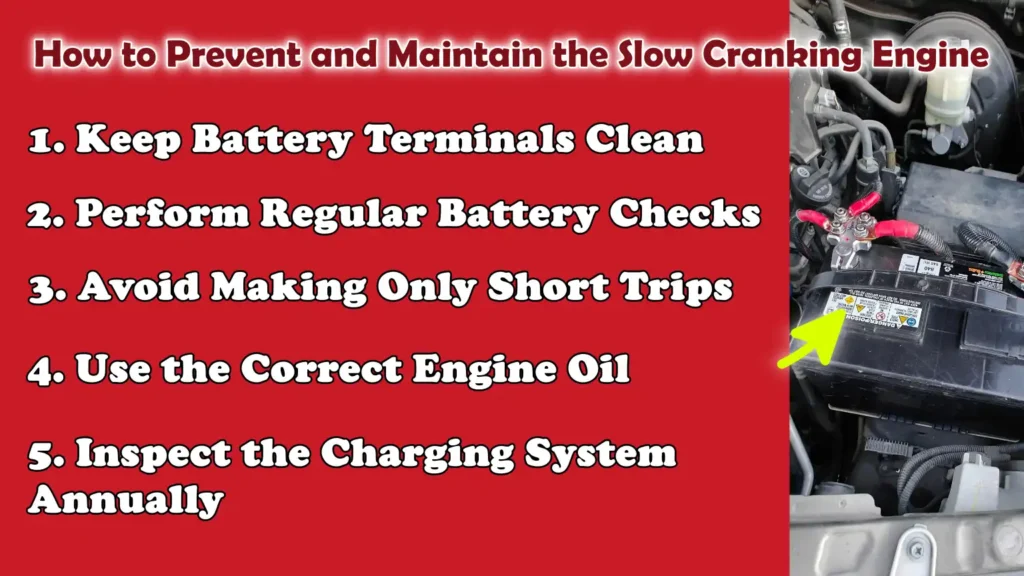
Rather than fixing a slow-cranking issue after it has already occurred, it is far easier and more cost-effective to prevent it from happening in the first place, as most underlying causes develop gradually over time.
A vehicle’s starting system relies on a healthy battery, clean electrical connections, proper engine lubrication and a stable charging system.
When these components undergo regular maintenance, the engine starts without difficulty and the starter motor is not subjected to excessive strain.
By performing a few simple, routine checks, you can significantly reduce the risk of slow cranking, particularly in older vehicles or during adverse weather conditions.
Also, there’s SAE engineering standard that shows that even if the maximum recommended voltage drops then it literally allows the starter motor circuits for automotive starting systems, which is why it directly related to the slow cranking diagnosis as there’s excessive voltage drop actually reduces the starter motor performance and causes weak engine rotation as well.[¹]
1. Keep Battery Terminals Clean
Keeping battery terminals clean is crucial, as the accumulation of corrosion or dirt creates resistance that impedes the flow of electricity.
Even a thin layer of grime on the terminals can reduce the amount of current reaching the starter motor, potentially leading to slow-cranking issues.
Clean terminals ensure that electricity flows smoothly and efficiently from the battery to the engine without any interruption or loss.
Regular cleaning also helps protect the cables from long-term damage and improves the overall efficiency of the electrical system when starting the vehicle.
2. Perform Regular Battery Checks
By performing regular battery checks, you can detect signs of weakness even before they begin to cause difficulties in starting the vehicle.
Over time, a battery’s ability to hold a charge gradually diminishes, even if the vehicle still appears to start normally.
By monitoring the battery’s voltage and load performance, you can identify early warning signs of failure before the battery gives out completely.
By doing so, you can decide to replace the battery before it becomes too weak to reliably start the engine, specially in cold weather or when the engine is under heavy load.
3. Avoid Making Only Short Trips
It is crucial to avoid making only short trips, as driving short distances does not give the alternator sufficient time to fully recharge the battery.
When the battery is not fully charged, its capacity gradually diminishes over time, which can lead to difficulties in starting the vehicle.
Driving for slightly longer distances helps maintain the battery charge at an optimal level and keeps the electrical system balanced.
Regularly undertaking slightly longer journeys ensures that the battery remains in good condition and is ready to deliver full power when starting the engine.
4. Use the Correct Engine Oil
Using the correct engine oil is vital, as the oil’s viscosity (thickness) affects how easily the engine turns over during startup.
If the oil is too thick or unsuitable for the prevailing temperature, it creates increased resistance within the engine.
This forces the starter motor to work harder and can result in difficulties when starting the vehicle.
Using the correct grade of oil allows engine components to move freely and reduces the strain placed on the starting system, particularly when starting the vehicle in cold weather.
5. Inspect the Charging System Annually
Inspecting the charging system every year ensures that the alternator is effectively maintaining the health of the battery.
If the alternator is weak or malfunctioning, the battery will not fully recharge while driving, causing its power output to gradually decline.
Ultimately, this can lead to difficulties in starting the vehicle and may cause the engine to crank sluggishly.
Regular inspections allow for the timely detection of charging-related issues and ensure that the battery remains in good condition, thereby guaranteeing that the engine will always start reliably.
Conclusion – How to Fix Slow Cranking Engine
Just, understand that if your vehicle has healthy engine then it won’t hesitate at all, instead of this it responds instantly when the system is in balance.
In most instances, this problem develops gradually; it is often caused by a weak battery, hidden corrosion on the terminals, poor grounding, or a starter motor that has worn out over time.
In some situations, the issue is not electrical at all, but rather mechanical such as: the use of excessively thick engine oil or increased internal resistance within the engine during cold starts.
The significance of a slow-cranking issue lies in the fact that it typically manifests before the engine reaches a complete “no-start” condition.
This means it offers you an early opportunity to rectify the problem before you end up stranded on the road.
The key to effectively resolving this issue lies in understanding how each component of the system interacts with the others.
The battery provides the initial electrical power; the cables and grounds transmit that power; the starter motor converts that electrical energy into rotational motion; and the engine itself must be able to turn over smoothly without excessive resistance.
If even a single one of these components malfunctions, the entire system slows down.
This is precisely why precise troubleshooting is far more effective than simply replacing parts indiscriminately.
And, if you still have queries and questions related to this guide, just let us known by commenting below this guide.
Frequently Asked Questions
FAQ 1: Why does my engine crank slowly when I try to start my car?
Answer: The problem of “slow cranking” typically occurs when the starter motor is not receiving sufficient power, or when turning the engine over is more difficult than usual. The most common cause of this is a weak or partially discharged battery; however, it can also be caused by corrosion on the battery terminals, loose electrical connections, a faulty starter motor, or poor grounding. In some cases, thick engine oil or cold weather can increase the internal resistance of the engine, making it difficult for the starter to crank the engine rapidly. Slow cranking often serves as an early warning sign that something within the starting system is not functioning correctly.
FAQ 2: Can a bad battery cause the engine to crank slowly, even if the lights are working?
Answer: Yes, a bad battery can indeed cause the engine to crank slowly, even if the lights and electronics appear to be functioning normally. This happens because lights require significantly less power than the starter motor; the starter motor requires a large surge of current to turn the engine over. A weak battery may be capable of powering the lights, but it may fail to handle the heavy electrical load required to start the engine. This is why a vehicle may appear electrically sound, yet still exhibit slow cranking or difficulty starting.
FAQ 3: What does it mean when my car makes a ‘clicking’ sound but won’t start?
Answer: A ‘clicking’ sound during startup typically indicates that the starter solenoid is attempting to engage, but sufficient electrical power is not reaching the starter motor. This is often caused by a weak battery, poor connections, or corroded terminals. In some cases, a faulty starter motor itself can be the source of a ‘clicking’ sound. The key point is that the system is attempting to start the engine, but the available power is insufficient to complete the process.
FAQ 4: Can alternator problems cause the engine to crank slowly?
Answer: Yes, a weak alternator can indirectly cause the engine to crank slowly. When the engine is running, the alternator is responsible for charging the battery. If it is not functioning correctly, the battery will gradually discharge over time. Even if the battery is new, if the alternator is failing, the battery will eventually become weak. The result is reduced power during start-up, causing the engine to crank slowly, particularly after driving or after the vehicle has been parked overnight.
FAQ 5: Why is an engine cranking slowly more noticeable in cold weather?
Answer: An engine cranking slowly is more noticeable in cold weather because low temperatures affect both the battery and the engine oil. In cold conditions, the battery generates less current because its internal chemical reactions slow down. Additionally, the engine oil thickens, increasing resistance within the engine’s internal components. These two factors combine to place greater strain on the starter motor, resulting in the engine cranking slowly.
FAQ 6: Can the starter motor itself cause the engine to crank slowly, even if the battery is in good condition?
Answer: Yes, if the starter motor is failing, the engine may crank slowly, even if the battery is fully charged and functioning correctly. Over time, the internal components of the starter such as: the brushes or windings, as it can wear out. When this occurs, the starter becomes unable to efficiently convert electrical energy into powerful mechanical rotation. Consequently, the engine cranks slowly or struggles to start, even if the battery itself is not the source of the problem.
FAQ 7: How can I determine whether a slow-cranking engine is caused by the battery or the starter?
Answer: An easy way to pinpoint the cause is to observe the symptoms that appear while attempting to start the engine. If the battery is weak, you may notice certain signs such as: dim lights, slow cranking, or an improvement in engine performance after a jump-start. If the starter is at fault, the battery may be strong; yet, the engine will still crank slowly or intermittently, even if the battery is fully charged. Checking the battery voltage and performing a starter test or voltage drop test helps accurately identify the true underlying cause.
References:
[1] J541_199610 VOLTAGE DROP FOR STARTING MOTOR CIRCUITS
https://saemobilus.sae.org/standards/j541_199610-voltage-drop-starting-motor-circuits
Hello Folks, Dean Shali here to help you out to solve the problems with your lovely vehicle, as i have lots of experience and knowledge about automotive industry as i woks directly with the customers and repair vehicles and i love to help the people to keep their cars safe and running smoothly.