
Written By: Dean Shali
Fact Checked By: Sabré Cook
Reviewed By: Tamara Warren
You need to keep this in mind that: your car only starts after it passes the multiple electronic safety checks.
The “Push Button Start System” looks really simple when we looks from the outside, but from inside it is carefully coordinated network of sensors, control modules and security checks that must all agree before a modern car will even think about the starting.
It is not just like the older vehicles that relies on the direct mechanical key to turn the ignition switch, as today’s keyless systems heavily depends on the electronic communication between the key fob, brake pedal switch, Body Control Module (BCM), Engine Control Unit (ECU) and even the starter circuit as well.
So, even with the small disruption in this chain that can literally stop the engine from cranking completely.
In fact, most of the time “NO START” cases are not caused by the broken engine part at all, but by the low voltage in the car battery, having a weak key fob signal or a faulty sensor that simply fails to confirm a safety condition such as: pressing the brake pedal as well.
Not only this, modern vehicles are also designed with the immobilizer security systems that intentionally blocks the ignition if authentication fails somehow, which is why a driver may see warnings such as: “Key Not Detected” even though the key is inside the car properly.
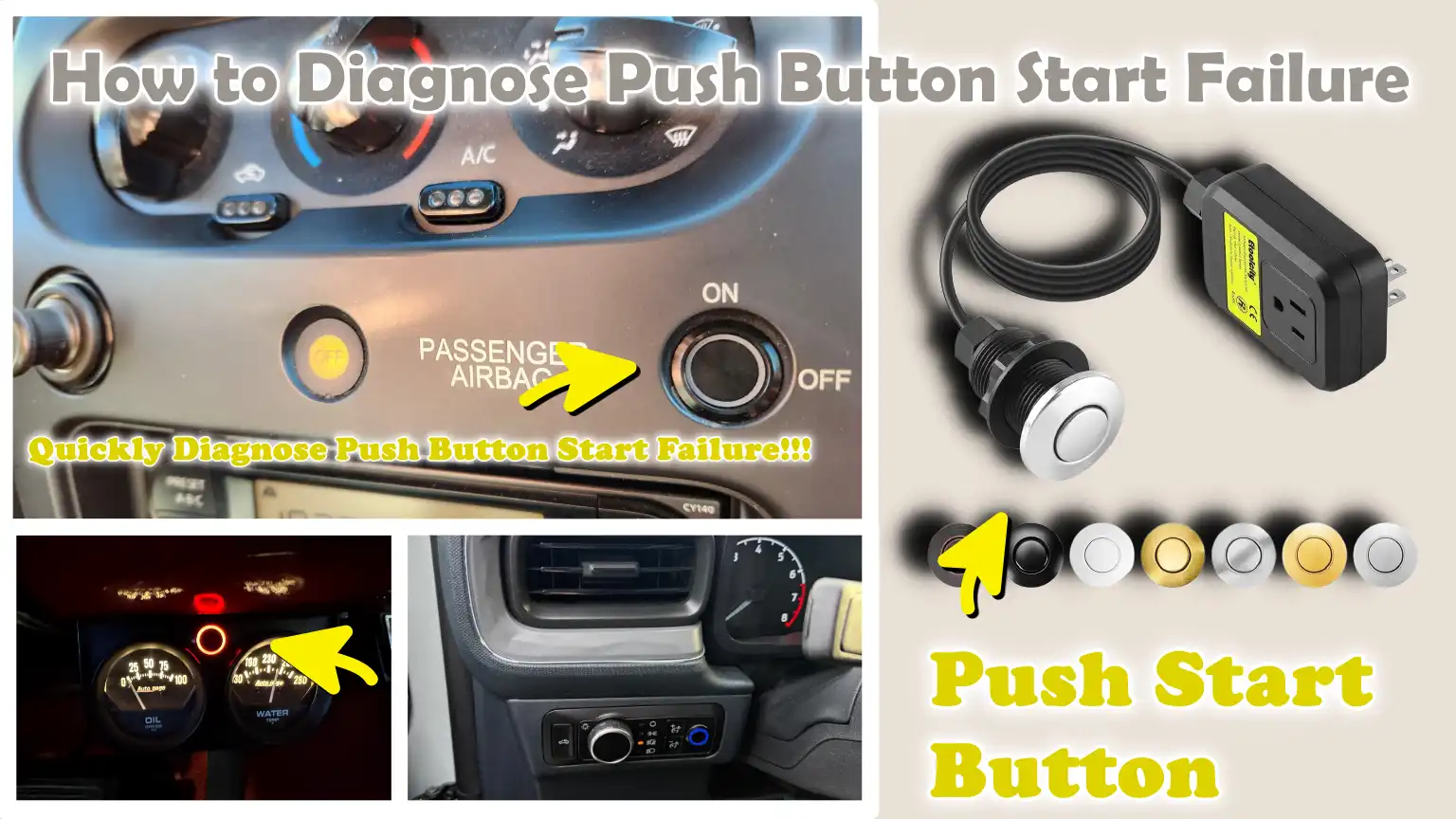
Because, these systems are highly interconnected, that’s why we have come up with this guide about How to Diagnose Push Button Start Failure so that you can understand how power, signals and permissions flow through the vehicle.
Know, What a Push-Button Start System Actually Does
A push-button start system may seem like a simple alternative to turning a key; however, in reality, it is a digital ignition process controlled by a network of interconnected electronic components.
In older vehicles, turning the key activated an ignition switch that sent power directly to the starter motor.
In today’s keyless vehicles, the button itself does not directly start the engine.
Instead, pressing the button sends a request to several control modules and the engine only starts once all safety and security checks have been successfully completed.
This is why a push-button start system may fail to function even when there are no internal faults with the engine, battery, or starter motor.
A malfunction in a sensor, switch, or communication signal can halt the entire process.
Understanding how these components interact is the first step in diagnosing why a vehicle fails to respond when the start button is pressed.
1. Smart Key or Key Fob
A smart key, often referred to as a key fob, is an electronic device that helps the vehicle identify an authorized driver.
Inside the fob is a small chip, known as a transponder, which transmits a coded signal to the vehicle.
This code must match specific parameters established by the vehicle’s security system.
If the signal is absent, weak, or incorrect, the vehicle will not authorize the engine to start.
A weak coin-cell battery inside the key fob is the most common cause of issues with push-button start systems.
Even if the doors unlock successfully, the battery may still be too weak to transmit the signal required for proper ignition authentication.
Many drivers are unaware that the key fob and the engine security system are directly interconnected.
2. Antenna Modules
Antenna modules are installed at specific locations within the vehicle’s cabin, typically near the start button, to detect the presence of the key fob.
These antennas continuously scan for encrypted signals transmitted by the smart key.
When you enter the vehicle and press the button, the vehicle verifies whether the key is indeed inside the cabin and within the designated range.
If the antennas fail to detect a signal, the system may display a warning such as “Key Not Found”.
This can occur due to a faulty antenna, signal interference, defective wiring, or placing the key near devices that disrupt radio communication.
These antennas are critical components, as the engine will not start until the vehicle confirms the presence of the key.
3. Brake Pedal Switch
The brake pedal switch is one of the components of a push-button start system that is often overlooked.
Before the engine can be started, the vehicle must verify that the brake pedal is depressed.
In most vehicles equipped with an automatic transmission, this serves as a built-in safety requirement.
The brake switch electronically confirms this condition.
If the switch malfunctions, the vehicle may perceive that the brake pedal is not depressed, even if it actually is.
In such instances, pressing the start button may elicit no response.
A simple indicator of a faulty brake switch is when the brake lights fail to illuminate upon depressing the pedal.
This switch is frequently the culprit behind vehicle starting issues, problems that people often mistakenly attribute to the battery or the starter motor.
4. Start Button Assembly
The start button assembly is the actual button that the driver presses; internally, however, it functions as an electrical input device.
Rather than directly supplying power to the starter motor, it sends a low-voltage signal to the vehicle’s control system.
Over time, the button may wear out, its internal contacts may degrade, or it may cease sending the correct signal.
In some instances, the button’s indicator light may appear to be illuminated, yet its internal mechanism could still be defective.
As the button merely transmits a command, diagnosing it requires verifying whether or not the signal is successfully reaching the control module.
A faulty button can render the entire system inoperable, even if the remainder of the ignition system is functioning correctly.
5. Body Control Module – BCM
The Body Control Module, often referred to as the BCM, serves as the primary electronic manager for many of a vehicle’s functions.
It controls operations such as lighting, locking, alarms, keyless entry and push-button engine starting.
When the start button is pressed, the BCM verifies whether the key has been recognized, if the brake pedal is depressed and if the vehicle is in the correct gear.
If all these conditions are met, the BCM sends an authorization signal to start the engine.
If any of these conditions are not met, the BCM blocks the request.
Because it monitors numerous systems, even minor glitches in the BCM’s software or communication protocols can prevent the vehicle from starting.
Essentially, it acts as the decision-maker before the ignition sequence is initiated.
6. Engine Control Unit – ECU
The Engine Control Unit, or ECU, manages the engine’s operation and fuel delivery.
Once the BCM approves the start request, the ECU receives this command and assumes responsibility for the starting process.
It activates the necessary engine sensors to manage fuel injection, ignition timing and the combustion process.
If the ECU does not receive the proper start signal, the engine will either fail to crank, or, even if it does crank, it will not start.
In modern vehicles, fault codes are stored whenever a communication error occurs; therefore, scanning the ECU during diagnostics is highly beneficial.
It is the ECU that translates the approved start request into the actual mechanical action of starting the engine.
7. Starter Relay and Starter Motor
The starter relay functions as an electronic switch that controls the high-amperage current flowing to the starter motor.
The relay receives a low-voltage signal from the control module, which closes its internal circuit, thereby allowing battery power to reach the starter motor.
The starter motor then physically rotates the engine’s crankshaft to initiate the combustion process.
If the relay fails, the engine may not crank at all.
If the starter motor fails, a distinct ‘click’ sound may be heard from the relay, yet the engine remains silent.
These components handle heavy electrical loads; consequently, they frequently fail due to wear and tear, heat exposure and aging.
This lies at the root of many issues associated with push-button start systems, even in instances where the security system has already granted permission to start the engine.
8. How the Signal Flow Works – From Button Press to Engine Start
When the driver enters the vehicle, the antenna module begins scanning for a signal from the smart key.
Once the system confirms that the key is present inside the vehicle, it awaits confirmation from the brake pedal switch, indicating that the brake pedal is depressed.
When the start button is pressed, it sends a request to the BCM (Body Control Module).
The BCM verifies security authorization, brake input and the transmission’s gear position.
If all conditions are met, the BCM sends an authorization signal to the ECU (Engine Control Unit).
Subsequently, the ECU activates the starter relay.
The relay then channels a high-amperage electrical current from the battery to the starter motor.
The starter motor rotates the engine’s crankshaft, generating combustion through the combination of fuel and spark.
If any single step in this sequence fails, the engine may not respond at all, may merely emit a ‘click’ sound, or may display a warning message.
This entire process illustrates just how crucial it is, when troubleshooting a faulty push-button start system, to systematically inspect each step rather than indiscriminately replacing parts.
Know, Common Symptoms of Push-Button Start Failure
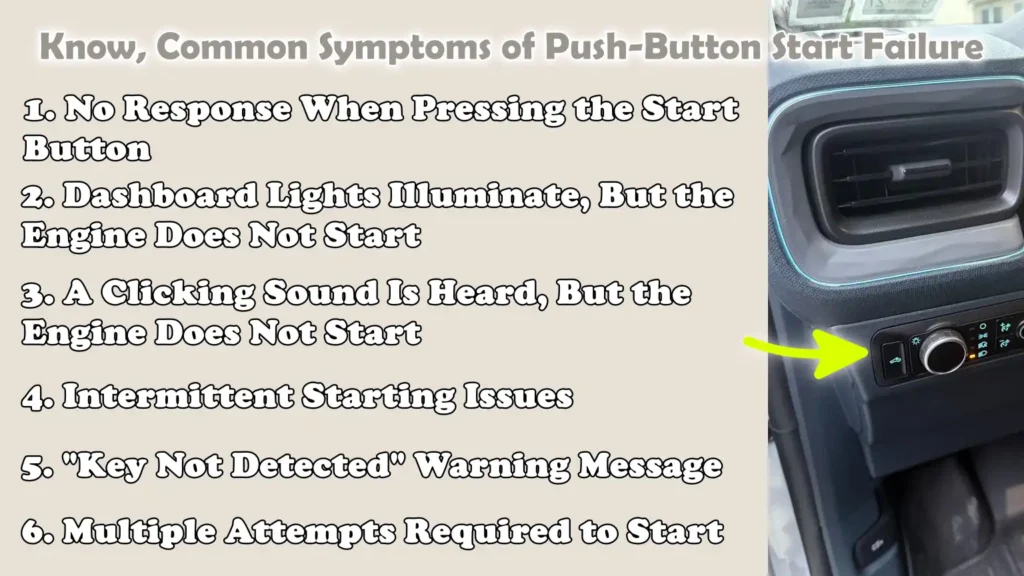
Push-button start issues often begin with subtle warning signs before the system ceases to function entirely.
As modern vehicles rely on electronic communication, a single faulty component can disrupt the starting process.
These symptoms typically indicate which specific part of the system is failing such as: the battery, key fob, brake switch, relay, or starter motor.
Paying attention to these signs helps in diagnosing the problem before a component requires replacement.
1. No Response When Pressing the Start Button
If nothing happens when you press the start button, it usually means the system is unable to detect one of the prerequisites required to initiate the starting sequence.
The vehicle may not be recognizing the key fob, the brake switch may not be confirming the pedal input, or the battery may be too weak to supply power to the control module.
In some cases, the internal contacts within the start button itself may have worn out.
Complete silence typically indicates that the start request never reached the starter circuit.
2. Dashboard Lights Illuminate, But the Engine Does Not Start
When the dashboard lights turn on but the engine fails to start, it may indicate that the battery has sufficient power to run the electronics, but lacks the amperage required to engage the starter motor.
This often points to a weak battery, corroded terminals, a faulty starter relay, or a defective starter motor.
Essentially, while accessory power is available, the high-current cranking system is failing.
This symptom is commonly observed in vehicles with aging batteries.
3. A Clicking Sound Is Heard, But the Engine Does Not Start
A clicking sound typically indicates that the starter relay or solenoid is attempting to engage.
This occurs when the system receives a request to start but is unable to fully crank the engine.
Low battery voltage is a very common cause of this issue, as the starter motor requires significantly more electrical power than the dashboard electronics.
Loose battery cables or a failing starter motor can also produce similar symptoms.
4. Intermittent Starting Issues
If the vehicle starts sometimes but not others, the problem is often linked to the electrical system or sensors.
A weak key fob battery, loose battery terminals, a faulty brake switch, or wiring defects, all of these factors can cause irregularities in the starting process.
Intermittent problems are often more difficult to diagnose because the fault may not manifest during testing.
Precisely identifying when the problem occurs such as: after rain or after the car has been parked overnight, as it can help pinpoint the root cause of the issue.
5. “Key Not Detected” Warning Message
The “Key Not Detected” warning indicates that the vehicle is unable to confirm the presence of an authorized smart key inside the cabin.
This may be caused by a weak key fob battery, a fault in the antenna module, or signal interference that is disrupting communication.
In some vehicles, holding the key close to the start button can temporarily resolve issues caused by a weak signal.
This symptom typically points to a problem with key recognition rather than a fault in the starter motor itself.
6. Multiple Attempts Required to Start
If the engine starts only after pressing the start button multiple times, the system may be struggling to verify the signal or facing difficulties due to low voltage.
It is possible that the brake switch is not functioning correctly, the key fob signal is weak, or the internal components of the start button have worn out.
Repeated attempts often imply that, after several tries, the system finally receives the correct signal.
This symptom should not be ignored, as the problem typically worsens over time.
Know, Some Safety and Preparation to Proper Diagnosis
Before attempting to diagnose a problem within a push-button start system, proper preparation is essential for both safety and accuracy.
Modern starting systems involve electrical circuits, safety interlocks and moving engine components; therefore, skipping basic preliminary checks can lead to misdiagnosis or create unsafe conditions.
A few simple initial steps can prevent the vehicle from moving unexpectedly and expedite the process of identifying the actual fault.
1. Ensure the Vehicle is in ‘Park’ or ‘Neutral’
Most push-button start systems allow the engine to crank only when the transmission is in ‘Park’ or ‘Neutral’.
This function is controlled by the ‘Park/Neutral Position Sensor,’ which prevents the vehicle from moving suddenly while starting.
If the gear selector is not fully engaged in ‘Park,’ the system may prevent the vehicle from starting, even if all other components are functioning correctly.
Sometimes, firmly engaging the lever into ‘Park’, or attempting to shift it into ‘Neutral’, as it can help determine whether this specific sensor is the root cause of the problem.
2. Verify that the Parking Brake is Engaged
Engaging the parking brake during diagnosis adds an extra layer of safety.
If the engine were to start unexpectedly while the system is being tested, the vehicle would remain secure, thereby minimizing the risk of unintended movement.
This precaution becomes even more critical if the transmission position sensor is faulty and the gear display does not accurately indicate the selected gear.
Engaging the parking brake helps ensure the safety of both the driver and anyone else in the immediate vicinity.
3. Ensure the Battery is Not Completely Discharged
Push-button start systems rely on a stable battery voltage to power the control modules, sensors and starter relays.
If the battery becomes completely discharged, the vehicle may appear entirely lifeless and unresponsive.
Even if the interior lights are illuminated, the battery may still be too weak to crank the engine.
A healthy battery typically maintains a voltage of approximately 12.6 volts when the engine is off; lower voltage levels can lead to starting difficulties or trigger erroneous warning messages.
4. Keep a Spare Key Fob Handy
Keeping a spare key fob on hand is the easiest way to diagnose key-related issues.
If the primary key has a weak battery, a defective chip, or a communication glitch, the vehicle may still start normally using the spare key.
This helps quickly determine whether the problem lies with the vehicle itself or with the key fob.
Many issues associated with push-button start systems, particularly those that arise suddenly, are often caused by a weak key fob battery.
5. Tools
With the aid of a few simple tools, diagnosing problems becomes much easier and more accurate.
A multimeter can be used to check battery voltage, fuses and electrical continuity.
An OBD-II scanner can read fault codes stored in the vehicle’s computer, often revealing issues related to the immobilizer, brake switch, or control modules.
Even basic diagnostic tools can prevent unnecessary parts replacement and save time during the troubleshooting process.
How to Diagnose Push Button Start Failure – Effective Method
Diagnosing a push-button start system should be performed in a specific sequence, as the symptoms of various faults often overlap.
A weak battery, a faulty key fob, a defective brake switch, or an issue with the starter, any of these problems can prevent the engine from starting.
By performing the simplest checks first, you can avoid unnecessarily replacing components that are in good working order.
Proceeding step-by-step also makes it easier to pinpoint whether the fault lies within the security system, the electrical circuitry, or the mechanical starter system.
1. First, Check the Key Fob
The key fob should always be the first item to be checked, as the vehicle cannot start until it recognizes an authorized key.
Even if the key fob’s battery is weak, allowing the doors to unlock, it may fail to function during the engine starting sequence.
This occurs because initiating the start-up process requires a strong and stable signal.
Replacing the small battery located inside the key fob is often the simplest solution.
By using a spare key, you can quickly determine whether the issue lies with the primary key.
If the vehicle starts normally using the spare key, the problem is typically related to the primary key’s battery or its internal chip.
This eliminates the possibility of a fault within the vehicle itself, thereby saving time.
This is one of the quickest diagnostic checks available.
If the key is present inside the vehicle’s cabin, the vehicle should recognize it.
If a “Key Not Recognized” message appears, the issue may stem from a weak signal, a defective key, or a faulty antenna.
Placing the key in close proximity to the start button can sometimes resolve this issue.
If performing this action resolves the issue, it suggests that the key’s signal may be weak.
2. Check the Condition of the Car Battery
Before the engine starts, the car battery supplies power to all electronic modules.
If the voltage drops too low, control modules may shut down or fail to function correctly.
A healthy battery, when the vehicle is at rest (in a resting state), typically reads approximately 12.6 volts.
A voltage significantly lower than this can lead to difficulties in starting the vehicle.
The battery’s condition should also be checked under a ‘load’ condition.
While a battery may display normal voltage in an idle state, the voltage can drop significantly when starting the engine (during cranking).
This explains why, in some cars, the lights turn on, but the engine fails to start.
A drop in voltage during startup is a common indication that the battery is internally weak.
The battery terminals should also be inspected.
Loose clamps or corrosion can disrupt the flow of electricity.
The accumulation of a white or green powdery substance on the terminals increases electrical resistance, thereby reducing the power reaching the starter motor.
Cleaning and tightening the terminals often resolves this issue, allowing the engine to start normally.
3. Check the Brake Pedal Switch
The brake pedal switch ensures that the brake pedal is depressed before the engine can be started.
This safety mechanism prevents the vehicle from moving forward unintentionally.
If this switch malfunctions, the car may fail to respond at all when the start button is pressed.
A simple way to check this is to observe the brake lights.
If the brake lights do not illuminate when the pedal is pressed, the brake switch may be faulty.
The vehicle relies on this specific signal to authorize the ignition process (engine startup).
In fact, this small switch is often the culprit behind “engine won’t start” issues in vehicles equipped with push-button ignition systems.
4. Check the Functionality of the Start Button
Over time, the start button itself can experience wear and tear.
Its internal electrical contacts may degrade or fail to transmit the correct signals.
Even if the electrical contacts have failed, the internal illumination within the button may still remain lit.
Pressing the button should elicit a clear response from the dashboard.
If no visible change occurs, the button may not be sending any command at all.
In some vehicles, the signal output can be verified using a multimeter.
This helps ensure that the switch is functioning correctly.
5. Check the Starter Relay and Fuse Box
When the control system grants permission to start, the starter relay sends power from the battery to the starter motor.
If the relay fails, the engine will not start.
Depending on the nature of the fault, you may hear a clicking sound, or there may be no sound at all.
If it is safe to do so and the vehicle’s layout permits it, the relay can often be tested by swapping it with another relay of the same type found in the fuse box.
If the engine starts after this swap, it is likely that the original relay is defective.
This is a common diagnostic procedure in many vehicles.
The fuses should also be checked.
A blown ignition or starter fuse can disrupt the entire system.
Even if the battery is in good condition, a faulty fuse prevents power from reaching critical components.
6. Check the Key Recognition System
The key recognition system consists of antennas and receivers that communicate with the key fob.
If this system malfunctions, the vehicle cannot verify that an authorized key is present inside the cabin.
This typically results in a warning message and the engine fails to respond.
Antenna malfunctions can be caused by damaged wiring, a faulty control module, or signal interference.
Sometimes, the key only works when held in very close proximity to the start button.
This usually indicates a weak battery inside the key fob or a faulty receiver within the vehicle.
7. Scan for Error Codes
Modern vehicles store fault codes when they fail to start.
An OBD-II scanner can detect hidden issues that are not apparent from external symptoms alone.
This makes the diagnostic process faster and more accurate.
Whenever possible, the scan should include both the BCM (Body Control Module) and the ECU (Engine Control Unit).
These modules often store fault codes related to the immobilizer, communication errors and the brake switch.
Some faults appear only in stored memory and do not trigger any warning lights on the dashboard.
It is particularly important to check for codes related to key recognition, starter control, or transmission status.
By reading these codes, one can quickly identify which system is preventing ignition.
8. Check the Neutral Safety Switch
The neutral safety switch ensures that the transmission is in the ‘Park’ or ‘Neutral’ position.
If this sensor malfunctions, the vehicle may mistakenly assume it is ‘in gear,’ thereby preventing it from starting.
This serves as a built-in safety feature.
A common symptom of this issue is that the engine will only start if the gear shifter is nudged slightly.
Attempting to start the vehicle in ‘Neutral’ rather than ‘Park’ can help diagnose this problem.
This issue is particularly observed in older automatic vehicles, where the gear shifter sensors have become worn out.
9. Check the Starter Motor and Solenoid
When starting the vehicle, it is the starter motor that actually cranks the engine.
If it ceases to function, the engine will not start, even if all electronic systems are operating correctly.
Once the proper functioning of the control systems has been verified, checking the starter motor becomes the final step in the troubleshooting process.
Paying attention to clicking sounds can be helpful.
A single click often indicates that the solenoid is attempting to engage, but the starter motor is unable to spin.
If you hear a rapid, repetitive clicking sound, it generally indicates that the battery power is low or that there is a fault in the electrical connections.
When attempting to start the vehicle, the voltage at the starter should also be checked.
If voltage is reaching the starter but the motor is not rotating, there is a strong possibility that the starter unit itself is defective.
This confirms that the problem is either mechanical in nature or lies within the internal components of the starter assembly.
Know, Some Advanced Electrical Diagnostics
If basic checks fail to identify the problem, the fault may lie deeper within the electrical system.
Today’s push-button start systems rely on wiring, ground connections and computer communication to function correctly.
A faulty wire or a weak electrical connection can halt the entire starting process, even if the battery, key fob and starter motor appear to be in good condition.
Advanced diagnostics help uncover hidden faults that are often overlooked during basic inspections.
1. Wiring Harness Inspection
The wiring harness transmits power and communication signals between the start button, BCM (Body Control Module), ECU (Engine Control Unit), sensors and the starter relay.
If a wire is broken, loose, or damaged, the signal cannot reach its intended destination.
This can result in a no-start condition, even if all the individual components are functioning properly.
Wiring faults are often caused by heat, vibration, moisture, or damage to the insulation inflicted by rodents.
Inspect the areas around the battery, fuse box and beneath the steering column for cracked insulation, exposed copper wires, or loose connectors.
A faulty harness can cause intermittent starting issues, meaning the vehicle starts only sporadically, particularly after driving on rough roads or following heavy rainfall.
2. Ground Connection Testing
Ground connections complete electrical circuits and allow current to flow back to the battery.
If a ground cable becomes loose or corroded, voltage levels may drop when the electrical system is placed under load.
This can cause the push-button start system to fail, even if the battery voltage appears to be within the normal range.
Primary ground connections are typically established between the battery, the vehicle’s chassis and the engine block.
Rust, corrosion, or loose bolts can increase electrical resistance.
Symptoms of this may include clicking sounds, dimming lights, or the sudden appearance of warning messages on the dashboard.
A poor ground connection is often overlooked because it can affect multiple systems simultaneously.
3. Testing for Voltage Drop in the Circuit
Voltage drop testing reveals whether power is being lost as it travels through wires or connections.
A wire may appear intact on the outside, but its internal resistance can impede the flow of power.
This test provides a more accurate assessment compared to simply checking the battery voltage.
When the start button is pressed, a multimeter is used to measure power loss across the cables, terminals and ground connections.
A significant drop in voltage indicates that resistance is obstructing the flow of current.
This is a common issue associated with aging battery cables, corroded terminals and faulty connectors.
It helps identify hidden electrical obstructions that prevent the starter motor from receiving full power.
4. BCM Communication Issues
The BCM (Body Control Module) manages the push-button start sequence and communicates with other modules via the vehicle’s data network, commonly referred to as the CAN bus.
This network transmits digital messages between the keyless entry system, ECU, transmission module and security systems.
If communication fails, the BCM may prevent the vehicle from starting.
Faults within the CAN bus can stem from poor wiring, low voltage, module failure, or communication interruptions.
Symptoms often include a “no-crank” condition (the vehicle failing to start), illuminated warning lights, various electrical malfunctions, or erratic starting behavior.
Diagnosing and resolving these issues typically requires a scan tool capable of reading data from the body control systems.
When BCM communication fails, the vehicle will not start, even if all its mechanical components are functioning properly.
Understand, Most Common Causes of Push-Button Start Failure
Push-button start systems can fail for a variety of reasons, but some causes occur far more frequently than others.
Most “no-start” cases are linked to a lack of electrical power, a faulty safety switch, or communication issues between the key fob and the control module.
Understanding the most common causes accelerates the diagnostic process, as the problem typically stems from one of a few predictable faults.
1. Weak or Faulty Vehicle Battery
A weak battery is the most common cause of push-button start system failure.
Modern vehicles require a constant supply of battery power, not only to crank the engine but also to power the BCM, ECU, immobilizer and key recognition systems.
If the battery voltage drops too low, the system may not even attempt to initiate the starting sequence.
Even if the dashboard lights illuminate, the starter motor may fail to engage, as cranking the engine requires a significantly higher amount of power.
Batteries often degrade gradually, particularly after several years of use, in cold weather, or when subjected to frequent short trips.
If the battery voltage falls below normal operating levels, various control modules may shut down or display erroneous warning messages.
Therefore, checking the battery is the first step in the diagnostic process.
2. Faulty Brake Switch
A faulty brake switch is another very common culprit, as push-button start systems require confirmation that the brake pedal has been depressed before allowing the engine to start.
If the switch malfunctions, the vehicle’s computer interprets this as the brake pedal not being pressed, thereby halting the ignition process.
This can occur even if the pedal feels completely normal when depressed.
A faulty brake switch often exhibits a clear, tell-tale symptom: when the pedal is depressed, the brake lights fail to illuminate.
Because it is a small and inexpensive component, it is frequently overlooked, even though it can completely prevent the engine from starting.
3. Dead Key Fob Battery or Signal Issues
Before allowing the vehicle’s engine to start, the key fob must transmit a valid signal.
If the battery inside the key fob becomes weak, the signal may not reach the receiver properly.
Even if the doors still unlock, the vehicle may fail to recognize the key when an attempt is made to start the engine.
Signal issues can also stem from interference, faulty internal electronics within the fob, or a defective antenna receiver located inside the vehicle.
“Key not detected” warnings often point directly to this specific issue.
Using a second (spare) key is often a quick way to determine if this is, indeed, the problem.
4. Faulty Starter Relay
The starter relay controls the flow of battery power to the starter motor.
When the start button is pressed, and all necessary conditions are met, the relay completes the circuit, enabling the starter to crank the engine.
If the relay fails, the engine may refuse to start, even if both the battery and the key system are functioning correctly.
A faulty relay can result in the engine remaining completely silent or emitting a distinct “click” sound.
Relays wear out due to repeated use and exposure to heat, meaning they can fail suddenly and without warning.
Swapping it with an identical relay is often a quick and effective method for diagnosing the problem.
5. Starter Motor Failure
The starter motor initiates the combustion process by physically cranking (rotating) the engine.
If this component fails, the engine cannot start at all, regardless of how perfectly the vehicle’s electronics are functioning.
This typically occurs after years of use, as every time the engine is started, the motor is subjected to high electrical currents and significant mechanical stress.
A failing starter motor may produce a distinct ‘clicking’ sound, cause the engine to crank sluggishly, or stop rotating entirely.
In many instances, electrical power successfully reaches the starter, yet the internal motor fails to rotate.
This confirms that the issue is mechanical rather than electronic.
6. Immobilizer or BCM Communication Failure
The immobilizer and BCM manage security-related authorizations.
The immobilizer verifies the validity of the key, while the BCM checks for all necessary prerequisites before granting permission to start the engine.
If communication between these two systems is interrupted, even if all visible components appear to be functioning correctly, the vehicle may prevent ignition (starting).
These malfunctions often manifest as warning messages, flickering security indicator lights, or a sudden failure of the engine to start.
Low battery voltage, faulty wiring, or interruptions in CAN bus communication can disrupt these systems.
As the nature of this fault is digital, scanning the vehicle often reveals the root cause of the problem much faster than manual inspection.
Know, Some Immediate Fixes You Can Try Right Now
Certain issues associated with push-button start systems can be resolved without removing any components or utilizing specialized tools.
As many problems stem from weak signals, low voltage, or poor electrical connections, performing a few simple checks can often restore the vehicle to normal starting operation.
These immediate fixes are particularly useful in situations where the vehicle suddenly refuses to start; they help diagnose the issue before a more in-depth investigation becomes necessary.
Additionally, push button start systems do not operate such as: traditional ignition keys and according to the U.S. safety regulator, these are the systems that actually requires electronic confirmation between the key fob and vehicle before cranking begins, so that actually means a no-start problem may come from a failed signal, not a failed engine part, so when you understand this sequence helps to diagnose the fault logically as well.[¹]
1. Replace the Key Fob Battery
The key fob battery should be one of the very first things you check, as the vehicle relies on the key’s signal to authorize the engine starting process.
A weak battery may possess sufficient power to unlock the doors, but it might lack the strength to transmit the robust signal required to engage the ignition.
This is a common occurrence, as maintaining continuous communication between the key and the vehicle’s receiver is essential for starting the engine.
Replacing this small, coin-sized battery is both easy and inexpensive.
Many key fobs utilize a CR2032 battery or a similar small cell.
Once the battery has been replaced, the vehicle will likely recognize the key immediately.
This simple step resolves many sudden issues, such as the “Key not detected” error message.
2. Jump-Start the Vehicle
A weak vehicle battery may have enough power to illuminate the dashboard lights, but it might lack the necessary strength to crank the engine.
Push-button start systems require sufficient voltage to simultaneously power the BCM, ECU, security system and starter motor.
If the battery voltage drops too low under load, the engine will fail to start.
By using jumper cables or a portable jump starter, the necessary voltage can be restored, allowing the vehicle to be tested.
If the engine starts after a jump-start, it indicates that the battery may be weak, discharged, or nearing the end of its lifespan.
This is the quickest method to determine whether the “no-start” issue is related to the battery.
3. Firmly Press the Brake Pedal When Starting the Vehicle
Before the vehicle can start, the brake pedal switch must verify that the pedal is depressed.
If the switch is worn out or misaligned, a light press may not trigger it correctly.
In such cases, the system may fail to recognize the input received from the start button.
Firmly pressing the brake pedal can sometimes establish better contact, allowing the signal to reach the BCM (Body Control Module).
If the engine only starts when significant pressure is applied to the pedal, it suggests that the brake switch is failing.
This serves as a common, temporary workaround until the switch can be replaced.
4. Try the Spare Key
Using the spare key (key fob) allows you to quickly determine whether the problem lies specifically with the primary key.
The chip inside the key may be defective, the internal battery may be weak, or the signal strength may have diminished.
If the spare key works, it indicates that the vehicle generally does not have any mechanical faults.
This diagnostic step is particularly useful when the vehicle suddenly, and without any prior warning, begins having trouble starting.
It can confirm key-related issues within a matter of seconds, thereby avoiding unnecessary troubleshooting of the battery or starter system.
5. Cleaning Battery Terminals
The high current required to start a vehicle flows through the battery terminals.
Corrosion on the terminals can impede the flow of electricity and create obstructions.
This can lead to issues such as clicking sounds, a weak starter, or the vehicle failing to start altogether.
White, blue, or green deposits around the terminals are signs of corrosion.
Cleaning the terminals and tightening the cable connections improves electrical contact.
In many cases, the symptoms of poor terminal contact closely resemble those of a completely dead battery, leading people to believe the battery is defective, when, in reality, the battery is functioning perfectly fine.
When to Go for Professional Help
Some issues with a push-button start system can be resolved through simple checks, but certain malfunctions require professional diagnostic equipment and in-depth electrical testing.
Today’s keyless systems utilize encrypted communication, control modules and networked wiring, components that cannot always be accurately diagnosed using only standard tools.
If standard troubleshooting methods fail to resolve the issue, a professional diagnosis can prevent unnecessary parts replacement and save valuable time.
1. Recurring “Key Not Detected” Errors
If your vehicle repeatedly displays a “Key Not Detected” warning, even after you have replaced the key fob battery or attempted to use a spare key, it is highly probable that the problem lies within the vehicle’s own detection system.
This could involve the antenna module, receiver circuitry, or security programming.
Diagnosing these specific components often requires specialized scan tools and system-specific diagnostic procedures.
A technician can verify whether the vehicle is properly receiving the key signal and determine if the immobilizer system is correctly recognizing the key’s unique code.
Persistent issues with key recognition generally indicate that the underlying problem runs much deeper than a mere dead key fob battery.
2. Engine Fails to Start Even After Checking Relays and Battery
If the vehicle’s battery is fully charged and checks of the starter relays confirm they are functioning correctly, yet the engine still refuses to start, the fault may lie within the control circuitry or the starter assembly itself.
In such situations, a more in-depth investigation is often required to ensure that the starter motor is receiving the proper voltage during the ignition sequence.
A professional technician can safely perform load testing, voltage drop checks and direct testing of the starter circuit.
This approach is particularly beneficial because many “no-start” issues stem from hidden electrical faults that are typically not easily identifiable through a mere visual inspection.
3. Faults Related to the BCM or Immobilizer
The Body Control Module (BCM) and the immobilizer determine whether the vehicle is authorized to start.
If either of these systems malfunctions, the vehicle may completely disable the ignition, even if the battery, starter and key fob are functioning correctly.
Diagnosing these faults often requires manufacturer-level scan tools.
Professional diagnosis is crucial, as BCM and immobilizer systems rely on stored codes, encrypted communications and software data.
In some vehicles, a fault may necessitate reprogramming or module synchronization.
These repairs typically cannot be performed correctly without specialized equipment.
4. Potential Faults in Electrical Wiring
If the problem occurs intermittently, varies with changes in temperature, or manifests only under specific conditions, it may indicate an underlying issue within the wiring.
Damaged wires, loose connectors, or hidden corrosion can disrupt the flow of electrical current or communication signals.
Detecting these faults is often challenging, as the wiring may appear to be in perfect condition upon external inspection.
A technician can pinpoint the exact fault by testing the circuit’s continuity, resistance and voltage.
Repairing wiring-related issues is often the most time-consuming part of the repair process, as a single faulty connection can render the entire push-button start system inoperable.
Read More:
Conclusion – How to Diagnose Push Button Start Failure
So, now you have understood that even the most advanced ignition system still depends on a few basic signals that works together and make the vehicle running thing happens.
Modern vehicles rely on a series of electronic checks before the engine can start, including key recognition, brake pedal input, battery voltage, control module authorization and starter engagement.
If even a single component within this entire chain fails, the entire system may cease to function, even if the engine itself is in perfect working order.
Therefore, without proper diagnostic testing, one should not simply assume that a “no-start” issue is solely due to a faulty battery or starter.
The most effective method for diagnosing a push-button start system malfunction is to inspect the system in the exact sequence in which the vehicle initiates the starting process.
First, verify that the key has been successfully recognized.
Next, check the battery voltage, the operation of the brake switch and the functionality of the associated relays.
Finally, confirm that the starter is receiving power and that the control modules are authorizing the “start” command.
Now, that’s it about this one and you can ask all kinds of queries below.
Frequently Asked Questions
FAQ 1: Why isn’t my push-button start working, even though the doors still unlock using the key fob?
Answer: This typically indicates that, while the key fob battery may have sufficient power to unlock the doors, it lacks the power required to transmit the strong signal necessary to start the engine. Unlocking the doors requires only a weak signal, whereas starting the vehicle necessitates a continuous and secure exchange of signals between the key fob and the car. This issue can stem from a weak key fob battery, signal interference, or a faulty receiver within the vehicle. Replacing the key fob battery is often the first and simplest step to resolve this problem.
FAQ 2: Can a weak car battery cause the push-button start to stop working?
Answer: Yes, a weak car battery is one of the most common causes of issues related to the push-button start system. In modern vehicles, battery power is required to activate various systems, including the keyless entry module, body control module, security system and starter relay, before the engine can even begin to start. Even if the dashboard lights illuminate, the battery may not possess sufficient power to crank (turn over) the engine. Therefore, checking the battery voltage is one of the initial diagnostic steps to identify the issue.
FAQ 3: Why do I hear a ‘click’ sound coming from my car when I press the push-button, but the engine fails to start?
Answer: A ‘click’ sound typically indicates that the starter relay or starter solenoid is attempting to engage, but the engine is failing to turn over. This often occurs when the battery is weak, the battery terminals are corroded, or the starter motor itself is failing. A “click” sound indicates that the start command has reached a component within the system, but insufficient power is reaching the starter motor. This symptom often points to an issue with the power supply rather than a problem with the key fob itself.
FAQ 4: What does the “Key not detected” message mean in a vehicle equipped with a push-button start?
Answer: This message indicates that the vehicle is unable to verify the presence of a valid key inside the cabin. This may occur because the key fob battery is low, the chip inside the key is defective, or the vehicle’s antenna system is failing to pick up the signal. In some cases, holding the key closer to the start button may provide a temporary workaround. If this warning persists even after using a spare key, the issue may lie with the receiver or the security system.
FAQ 5: How can I determine if a faulty brake switch is preventing my vehicle from starting?
Answer: The brake switch signals to the vehicle that the brake pedal is being depressed; in many push-button start systems, pressing the brake is a mandatory prerequisite for starting the vehicle. If the switch malfunctions, the vehicle may fail to respond when the start button is pressed. A simple diagnostic step is to press the brake pedal and check whether the brake lights illuminate. If the lights remain off, the switch may not be transmitting the necessary signal required to start the vehicle.
FAQ 6: Can a faulty starter relay cause issues with a push-button start system?
Answer: Yes, the starter relay plays a crucial role in transmitting electrical power from the battery to the starter motor. If the relay fails, the engine may not start, even if the battery, key fob and brake switch are all functioning correctly. Some faulty relays may produce a “click” sound, while others may remain completely silent. To determine whether a relay is faulty, it is often tested by swapping it with an identical relay located within the fuse box.
FAQ 7: Why does my push-button start system work intermittently, that is, sometimes it functions correctly and other times it does not?
Answer: Recurring difficulties in starting the vehicle typically point to an intermittent electrical or communication-related issue. Common causes include a weak battery, loose battery terminals, a failing brake switch, faulty wiring, or a weak signal from the key fob. As this is an intermittent problem, meaning it can appear and disappear unpredictably, it may manifest only during cold weather, after the vehicle has been left parked overnight, or when the battery voltage drops. Precisely identifying the specific circumstances under which this issue occurs makes it significantly easier to pinpoint the root cause of the problem.
References:
[1] Keyless Ignition Systems
https://www.nhtsa.gov/driver-assistance-technologies/keyless-ignition-systems
Hello Folks, Dean Shali here to help you out to solve the problems with your lovely vehicle, as i have lots of experience and knowledge about automotive industry as i woks directly with the customers and repair vehicles and i love to help the people to keep their cars safe and running smoothly.