Written By: Dean Shali
Fact Checked By: Sabré Cook
Reviewed By: Tamara Warren
Without any doubt, your car should move freely when you release that brake, but if it doesn’t then something is already working against your vehicle.
Yes, brakes are intended to slow you down but only when you ask them to, then the release of that thing instantly let your vehicle move freely again.
But when the brakes start dragging, then they quietly break that basic intention behind it, also instead of releasing fully: they continues to creates that unwanted friction even when your foot is completely off the pedal.
So, this constant contact between brake pads and rotors literally generates the heat far beyond the normal levels and that heat actually spreads quickly through the entire braking system as well.
Not only this, there’s studies in automotive engineering that shows that excessive brake heat is literally one of the leading causes of rotor warping, braking fluid breakdown and premature component failure as well.
And, in the real driving conditions: even a slight drag can increase that rolling resistance, that forces your engine to work harder and reduces the fuel efficiency by a noticeable margin.
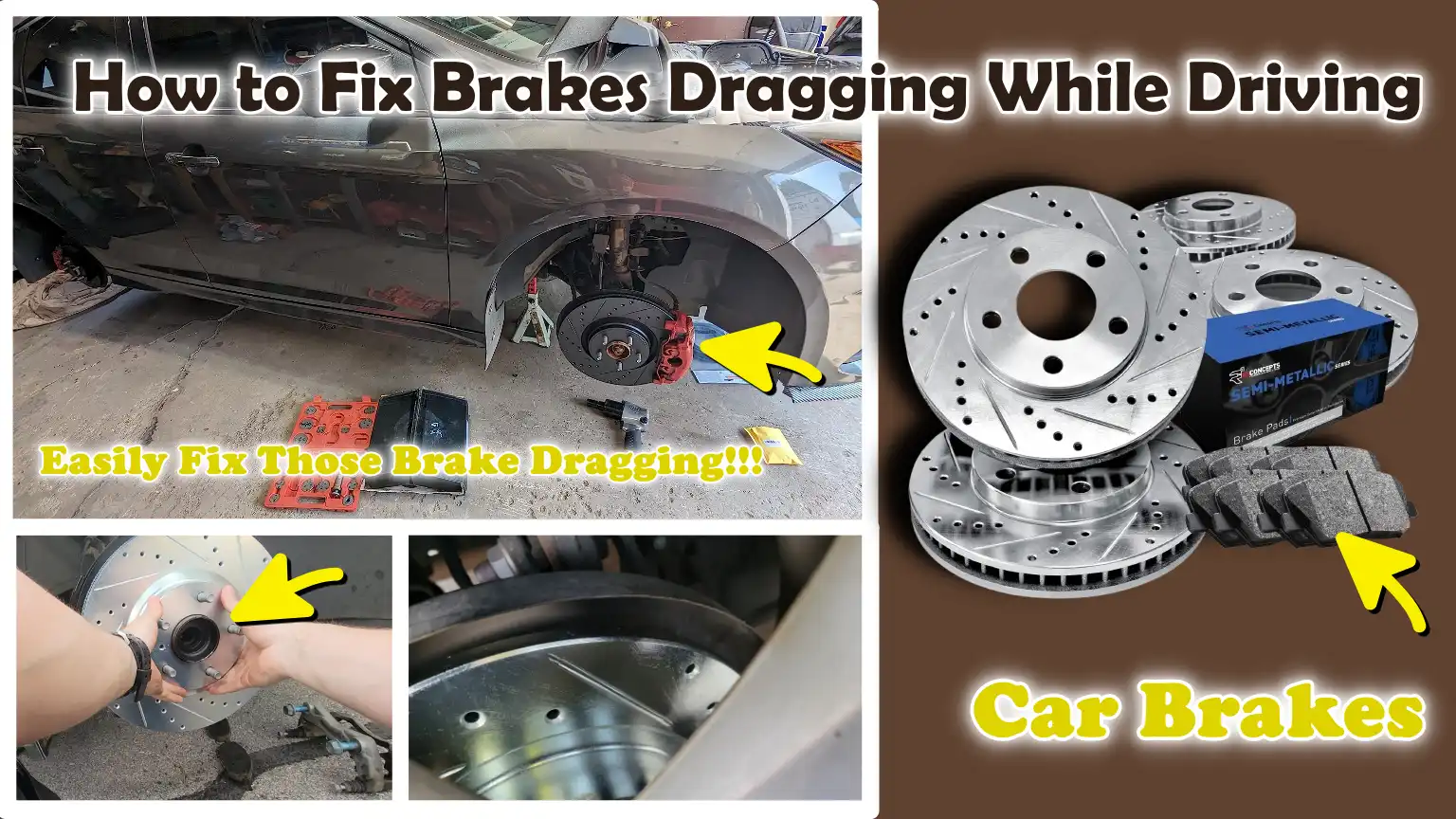
Now, in this guide you’ll learn How to Fix Brakes Dragging While Driving so that you can recognize those early warning signs and understand what is really happening inside your braking system and take the necessary steps then.
Know, About the Common Symptoms of Brake Dragging
1. The Vehicle Pulling to One Side
When the brake on a specific wheel drags (or sticks), it generates significantly more friction on that side compared to the other wheels.
Due to this imbalance, the vehicle automatically begins to pull toward the side where the brake is dragging.
Simply put, one wheel is slowing down faster than the others, causing the vehicle to slightly alter its direction without any input from you.
This is not merely a steering issue; rather, it is a clear indication that the braking force is not being distributed evenly across all wheels.
Over time, this can lead to uneven tire wear, excessive strain on suspension components and compromised vehicle control, particularly during sudden braking situations.
2. A Burning Odor Emanating from the Wheels
A burning smell coming from one or more wheels is one of the most easily identifiable symptoms of brake dragging.
This odor typically occurs when the brake pads remain in constant contact with the rotors, generating excessive heat.
Friction produces heat and when this friction persists without interruption, the temperature can rise very rapidly.
In many cases, this heat becomes so intense that it can scorch the brake pad material, burn off accumulated dust, or damage other nearby components.
If left unaddressed, this can result in damage to the rotor surface, degradation of the brake fluid and an increased risk of brake failure while driving.
3. Excessive Heating of a Specific Wheel
If, after driving for a while, you carefully inspect your wheels and notice that one particular wheel feels significantly hotter than the others, it is often a clear indication of “brake drag.”
Under normal circumstances, brakes generate heat only when they are applied and that heat should be distributed evenly across all wheels.
However, when a specific brake remains partially engaged, or “drags”, it continuously generates heat, even during normal driving.
This constant accumulation of heat can warp the brake rotor, reduce braking efficiency and shorten the lifespan of brake components.
In severe cases, it can generate enough heat to damage other adjacent components, such as the wheel bearings.
4. Increased Fuel Consumption – Reduced Mileage
Brake drag increases “rolling resistance” (the friction that opposes the vehicle’s forward motion), meaning your engine has to work harder to propel the vehicle forward.
Even a slight increase in friction can have a significant cumulative impact on fuel consumption over time.
To overcome this resistance, the engine burns more fuel, resulting in reduced mileage (fuel efficiency) compared to normal driving conditions.
Many drivers do not immediately associate poor fuel efficiency with brake-related issues; however, in reality, brake drag can significantly compromise a vehicle’s efficiency, particularly during city driving, where the vehicle is frequently in motion.
5. Stiff Brake Pedal or Failure to Return
If the brake pedal feels stiff or does not return easily after being depressed, it may be an indication that the internal pressure within the braking system is not being released properly.
This issue can stem from problems such as a faulty master cylinder, clogged brake hoses, or stuck caliper pistons.
When hydraulic pressure becomes trapped within the system, the brake pads remain pressed against the rotors even after the brake pedal has been released.
This not only results in brake drag but also makes the braking experience feel abnormal and less effective.
For the brakes to function correctly, both the proper application and the subsequent release of hydraulic pressure are absolutely essential.
6. Vehicle Deceleration Without Braking
The clearest indication of brake drag is when the vehicle begins to slow down on its own, even when you are not depressing the brake pedal.
This occurs because the brake pads remain in slight contact with the rotors, creating constant resistance.
You may feel as though something is pulling the vehicle backward, or you might notice that the vehicle’s speed drops much more rapidly than usual when you lift your foot off the accelerator.
This symptom directly impacts driving performance and can make the vehicle feel sluggish.
Furthermore, it places unnecessary strain on the engine and transmission, as they are forced to work against the constant braking force being applied.
Know, The Main Causes of Brake Dragging
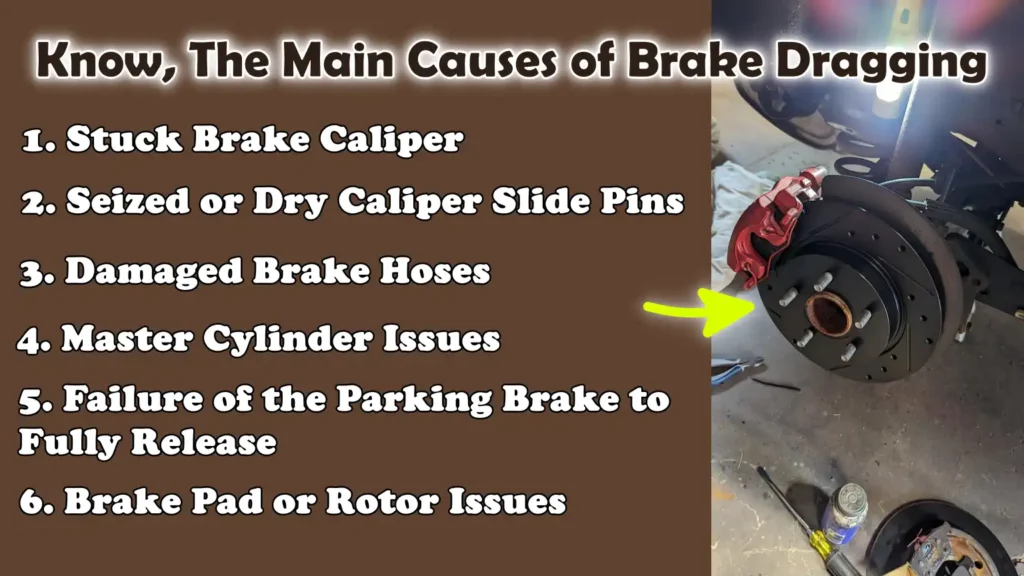
1. Stuck Brake Caliper
A stuck brake caliper is one of the most common and serious causes of brake dragging.
The caliper is designed to press the brake pads against the rotor when you apply the brakes and to release them immediately when you lift your foot off the pedal.
However, over time, due to heat, moisture and dirt, the caliper piston can seize up or lose its ability to move freely.
This typically occurs because the rubber seals wear out, allowing dirt to enter and causing internal corrosion.
When the piston fails to retract properly, the brake pads remain in contact with the rotor, even when the brakes are not being applied.
This constant contact generates continuous friction, leading to excessive heat buildup, rapid pad wear and compromised driving performance.
In many real-world scenarios, a stuck caliper can prevent the brakes from engaging effectively, resulting in reduced vehicle stability and making the vehicle difficult to control.
2. Seized or Dry Caliper Slide Pins
Caliper slide pins play a crucial role in ensuring that the brake pads engage and disengage uniformly.
These pins allow the caliper to slide smoothly back and forth as the brake pedal is pressed and released.
If the lubrication on the slide pins diminishes, or if they become compromised by dirt and rust, they can become stiff or seize completely.
A lack of proper grease is a very common issue, particularly if regular brake maintenance has been neglected.
Rust exacerbates this problem by creating obstructions that hinder movement.
When the slide pins are unable to move freely, the caliper fails to properly release one side of the brake pads, resulting in uneven pressure and brake dragging.
This causes one brake pad to wear out faster than the other and generates constant friction against the rotor, even during normal driving.
3. Damaged Brake Hoses
A damaged brake hose is a less obvious, yet critical, cause of brake dragging.
Brake hoses are designed to transport pressurized hydraulic fluid from the master cylinder to the calipers.
Over time, due to age, heat and chemical degradation, the inner lining of the hose can weaken, swell, or collapse.
When this occurs, the hose may allow fluid to flow toward the caliper when the brake pedal is depressed; however, when you release the pedal, it may obstruct the fluid’s return flow.
This creates a situation where pressure remains trapped within the caliper, keeping the brake pads pressed against the rotor.
Because this issue is internal, it is often difficult to detect without a proper inspection; nevertheless, it can lead to persistent brake drag and excessive heat generation.
4. Master Cylinder Issues
The master cylinder is responsible for generating and regulating hydraulic pressure within the braking system.
When functioning correctly, it sends pressure to the brakes when you depress the pedal and releases that pressure when you let go.
However, internal defects such as: worn seals or a clogged return port, as it can prevent the pressure from fully dissipating.
This is referred to as “residual pressure,” and it keeps the braking system partially engaged even when it should be fully disengaged.
Internal faults within the master cylinder can also disrupt the pressure balance between individual wheels, thereby exacerbating the problem.
Consequently, the brake pads remain in light contact with the rotors, resulting in constant friction, increased heat and reduced braking efficiency.
5. Failure of the Parking Brake to Fully Release
The parking brake system is designed to keep a vehicle stationary when parked, typically by engaging the rear brakes.
However, if the parking brake cable becomes excessively tight, corroded, or damaged, it may fail to fully disengage even after the brake lever has been released.
This issue is more prevalent in vehicles frequently exposed to moisture or those that are not driven regularly.
When the cable fails to retract to its original position, it keeps the rear brakes partially engaged.
This creates a “dragging” effect on the rear wheels, which is not always immediately perceptible, but can lead to accelerated brake wear, excessive heat generation and reduced fuel efficiency.
Over time, this constant drag can cause the brake shoes or pads within the rear braking system to deteriorate prematurely.
6. Brake Pad or Rotor Issues
Problems related to the brake pads or rotors can also be a cause of brake drag.
Warped rotors, often damaged by excessive heat or improper cooling, create an uneven surface that prevents the brake pads from releasing properly.
This can result in intermittent or continuous contact between the pads and the rotor.
Improper installation of brake pads is another common issue; this includes misalignment, missing hardware, or a lack of proper lubrication at contact points.
When the pads are unable to move freely within the caliper bracket, they may remain stuck in a compressed position.
Tools
| Tool/Material | Why It Is Needed | How to Use It |
|---|---|---|
| Jack and Jack Stands | These are used to safely lift and support your car off the ground, allowing you to access its wheels and brakes. Relying solely on a jack while working underneath a car is unsafe, as it can fail without warning. Jack stands provide stable support and minimize the risk of injury. | Position the jack beneath the correct lifting point on your car and slowly raise it. Once the car is lifted, place the jack stands beneath sturdy support points and lower the car onto them. Always ensure that the car is stable before beginning any work. |
| Lug Wrench | A lug wrench is required to loosen and remove the wheel nuts, enabling you to take off the wheel and access the brake components. Without removing the wheel, you cannot inspect or repair issues related to brake dragging. | Use the wrench to loosen the lug nuts before lifting the car, as this prevents the wheel from spinning. Once lifted, completely remove the nuts and take off the wheel. When reinstalling, tighten the nuts evenly. |
| Brake Cleaner | Brake cleaner is used to remove dirt, grease, brake dust and debris from brake components. Clean parts operate more smoothly and help prevent sticking or uneven movement, issues that can lead to brake dragging. | Spray the cleaner directly onto the brake components, such as the calipers, rotors and pads. Allow it to flush away the grime and then let it dry. Avoid touching the cleaned surfaces with dirty hands to ensure they remain free of contaminants. |
| High-Temperature Brake Grease | This grease is specifically formulated to withstand the intense heat generated by the brake system. This lubricant facilitates the smooth movement of moving parts such as: slide pins and contact points, preventing them from seizing or wearing out prematurely. | Apply a thin layer of grease to the caliper slide pins and the metal contact points where the brake pads interface. Do not apply grease to the brake pad surfaces or the rotor, as this can compromise braking efficiency and pose a safety risk. |
| Socket Set | A socket set is required to remove and reinstall the bolts that securely fasten brake components such as: the caliper and bracket, in place. Different components require sockets of varying sizes. | Select the correct socket size for each specific bolt and use a ratchet to loosen or tighten it. To avoid damaging the bolts, turn the tool gently and apply consistent pressure. Keep the removed bolts organized to ensure they are reinstalled in their original locations. |
| Replacement Parts – If Needed | Some issues related to brake dragging cannot be resolved solely through cleaning or lubrication. To restore the system to proper working order, it may be necessary to replace worn or damaged components, such as brake pads, calipers, or hoses. | Identify any defective components during the inspection process and replace them with new, identical parts. Follow the correct installation procedures for each component and ensure that all fasteners are securely tightened. After replacing the parts, test the brakes to verify that the issue has been resolved. |
How to Fix Brakes Dragging While Driving – Method that Works
1. Identify the Stuck Wheel
The first and most crucial step is to pinpoint exactly which wheel is causing the problem.
A stuck brake issue typically affects one specific wheel more severely than the others; identifying the correct wheel right at the outset saves both time and effort later on.
After safely lifting the vehicle, manually spin each wheel by hand.
A properly functioning wheel should spin easily and without obstruction, although you may feel a slight drag due to normal contact with the brake pads.
If a wheel is difficult to turn, stops abruptly, or does not spin freely, it is highly likely that this is the wheel that is sticking.
This simple “spin test” works because it directly reveals the amount of friction present, unaffected by engine power or road resistance.
In many cases, the sticking wheel may also feel significantly hotter than the others, further confirming that it is the root cause of the problem.
2. Inspect the Brake Caliper
Once the problematic wheel has been identified, the next step is to carefully inspect the brake caliper.
The caliper’s function is to apply and release pressure on the brake pads; therefore, any malfunction in this component can easily lead to a stuck brake.
Check to see if the caliper piston is moving freely or if it has seized in place.
A seized piston is often caused by an accumulation of dirt or rust inside the caliper, or by worn-out seals.
Additionally, check the brake pads for any signs of uneven wear.
If one brake pad has become significantly thinner than the other, it indicates that the caliper is not applying or releasing pressure evenly.
Due to this uneven movement, one pad remains in constant contact with the rotor, generating continuous friction and heat.
3. Inspect and Lubricate the Slide Pins
Caliper slide pins facilitate the smooth movement of the brake assembly and ensure that equal pressure is applied to both sides of the rotor.
If these pins become dry or corroded, the caliper will be unable to return to its normal resting position after the brakes are applied.
Carefully remove the slide pins and inspect them for dirt, rust, or old, caked-on grease.
Thoroughly clean them using a brake cleaner and a cloth.
After cleaning, apply a thin, even coat of high-temperature brake grease to the pins before reinstalling them.
Proper lubrication ensures smooth movement and allows the caliper to fully disengage, a crucial step in preventing brake drag and uneven wear.
4. Inspect the Brake Hoses
The brake hoses contain hydraulic fluid under pressure; any internal defect within the hose can prevent this pressure from releasing properly.
Carefully inspect the exterior of the hose for any signs of damage, such as bulges, cracks, or surface abrasions.
However, many issues can exist inside the hose that are not visible from the outside.
A defective hose can act like a one-way valve, allowing fluid to flow into the caliper but preventing it from flowing back out properly.
This traps pressure within the system, causing the brake pads to remain clamped against the rotor.
To diagnose this issue, observe whether the brakes release slowly, or fail to release at all, after the brake pedal is depressed.
If the pressure does not dissipate quickly, the brake hoses may need to be replaced.
5. Inspect the Brake Pads and Rotors
For the braking system to function correctly, the brake pads and rotors must be in good condition and properly installed.
Worn, damaged, or incorrectly installed pads can bind or fail to retract to their original position.
Check the pads for uneven wear, cracks, or “glazing” (a shiny, hardened surface caused by excessive heat).
Additionally, inspect the rotors for warping, scoring, or uneven surfaces.
A warped rotor can exert uneven pressure on the pads and prevent the brakes from releasing smoothly.
If any component is worn beyond its service limit or is damaged, it should be replaced.
During installation, ensure that all components fit correctly and can move freely within their mounts without any obstruction.
6. Inspect the Parking Brake System
The parking brake system typically affects the rear wheels and can be a hidden cause of brake binding.
Check the tension of the parking brake cable and ensure that it has not become seized due to rust or debris.
If the cable does not fully retract after being released, it can keep the rear brakes slightly engaged at all times.
This constant engagement generates friction and heat, even while driving under normal conditions.
Ensure that the parking brake lever or pedal returns to its resting position and that the rear brake components can move freely and without obstruction.
7. Check the Master Cylinder
The master cylinder regulates the flow and release of hydraulic pressure within the braking system.
If it fails to release this pressure properly, the brakes may remain partially engaged.
This condition is referred to as ‘residual pressure.’ To detect this, observe the behavior of the brake pedal after depressing it.
If it appears slow to return to its original position, or if the brakes do not disengage immediately, there may be an internal issue with the master cylinder.
In some instances, a clogged return port or a worn seal can cause pressure to become trapped within the system.
Testing helps determine whether the problem is mechanical, originating within the wheel assembly, or hydraulic, stemming from the main system.
8. Reassemble and Test Drive
Once all inspections and repairs are complete, carefully reassemble all components, ensuring that everything is tightened according to the correct specifications.
Proper tightening is critical; loose parts can lead to noise or malfunction, while overtightened parts can restrict movement.
Once the vehicle is back on the ground, perform a short and controlled test drive.
Pay close attention to the vehicle’s handling, specifically, whether it moves forward without resistance and whether any previous symptoms (such as pulling to one side, excessive heat, or hesitation) have been eliminated.
A successful test drive confirms that the brakes are now disengaging properly and that the issue of brake dragging has been resolved.
How to Prevent Brake Dragging in the Future
Also, there’s studies that shows that brake rotors can literally reach temperatures between 400°C to 500°C during normal braking conditions, so at these temperatures: both of the rotors and brake pad materials actually experiences high mechanical and thermal stress, so this continuous exposure literally weakens materials, increases the wear and significantly raises the risk of brake failure over the period of time and usage.[¹]
1. Regular Brake Inspections
The most effective way to prevent brake dragging before it even begins is to conduct regular brake inspections.
Over time, exposure to heat, friction, dust, dirt and moisture causes brake components to naturally wear down.
By inspecting your brakes at regular intervals, you can identify early warning signs such as: uneven pad wear, slight resistance in wheel rotation, or minor leaks within the system.
These subtle warning signs often manifest long before a serious problem develops.
In real-world driving scenarios, many brake-related issues begin as minor anomalies that gradually worsen over time.
A simple inspection allows you to catch problems in their nascent stages; this not only enhances safety but also reduces repair costs by preventing damage to critical components like rotors and calipers.
2. Proper Component Lubrication
A brake system relies on numerous moving parts that must slide freely and return to their original positions after every application of the brakes.
Components such as caliper slide pins, pad contact points and hardware clips require proper lubrication to function correctly.
Without lubrication, these parts can dry out, seize up, or corrode, particularly when exposed to water and road grime.
This resistance to movement is a primary cause of brake dragging, as it prevents the brake pads from fully retracting to their resting position.
It is essential to use high-temperature brake grease, as standard grease cannot withstand the intense heat generated during braking.
Applying a thin, uniform layer of the correct grease ensures that components move freely, wear is minimized and brake performance remains consistent over time.
3. Change Brake Fluid Periodically
Brake fluid plays a crucial role in transmitting hydraulic pressure from the brake pedal to the braking components.
However, brake fluid is “hygroscopic” (moisture-absorbing); this means that, over time, it absorbs moisture from the air.
As moisture levels rise, the fluid’s effectiveness diminishes and its boiling point drops.
This can lead to internal corrosion in components such as the master cylinder and calipers, increasing the risk of parts seizing or pressure failing to release properly.
Old or contaminated brake fluid can also cause erratic brake operation.
Changing the brake fluid at recommended intervals helps maintain proper hydraulic pressure, prevents internal damage and ensures that the system returns to its resting position correctly after every application.
4. Prevent Brake Overheating
Excessive heat is a primary cause of brake component failure or the onset of “brake drag.”
Although brake components are designed to withstand high temperatures, prolonged or extreme heat can damage critical parts.
Situations such as continuous braking while driving on inclines, aggressive driving, or repeated hard braking can cause temperatures to rise above normal levels.
This heat can warp rotors, harden brake pads and degrade internal caliper seals, creating a risk of brake seizure.
Driving habits play a significant role in preventing such issues.
Utilizing engine braking while descending slopes, maintaining a safe distance to avoid sudden stops and allowing the brakes to cool down between periods of heavy use can significantly minimize heat accumulation.
Proper heat management ensures that all components continue to function correctly and helps prevent long-term damage.
Read More:
- How to Diagnose Brake Dragging Issue
- How to Fix Internal Master Cylinder Leak
- How to Test Brake Master Cylinder Pressure
- How to Replace Brake Booster
- How to Fix Brake Booster Vacuum Leak
- How to Test Brake Booster Functionality
- How to Lubricate Brake Caliper Pins Properly
- How to Rebuild Brake Caliper at Home
- How to Check Brake Caliper Piston Movement
- How to Resurface Brake Rotors at Home
- How to Fix Brake Rotor Runout
- How to Check Brake Disc Runout
- How to Prevent Brake Fluid Boiling
Understand, When to Replace vs Repair Brake Components
1. Signs That Component Replacement Is Necessary
Knowing when to replace a brake component, rather than attempting to repair it, is crucial for both safety and long-term reliability.
In many cases, minor issues such as: dry slide pins or superficial surface grime, as it can be resolved through cleaning and lubrication; however, certain problems necessitate the complete replacement of the component.
For instance, if a brake caliper piston has seized due to internal corrosion or a compromised seal, it will not function correctly even after cleaning.
Brake pads that are excessively worn, cracked, or hardened by exposure to heat cannot generate the stopping power required to halt the vehicle and must be replaced.
Rotors exhibiting deep grooves, an uneven surface, or runout (lateral deviation) exceeding safe limits will continue to generate vibrations and compromise braking efficiency, even if other components have been repaired.
If a brake hose is collapsed or a component is leaking, it serves as a clear indication that replacement is required, as these issues directly compromise hydraulic pressure.
Simply put, if a component cannot move freely, seal properly, or withstand the heat and pressure for which it was designed, replacing it remains the safest and most effective course of action.
2. Cost vs Safety Considerations
Many drivers attempt to save money by opting to repair components rather than replacing them; however, the braking system is not an area where taking risks in the interest of cost-saving is a prudent decision.
While minor tasks such as: cleaning or re-greasing, are inexpensive and effective for addressing minor issues, relying on a faulty or worn-out component can lead to significantly higher costs down the road.
For instance, if a seized caliper is not replaced, it can cause new brake pads to wear out prematurely and may even damage the rotor, thereby substantially increasing the total repair bill.
More importantly, brake performance ultimately determines how safely you are able to bring your vehicle to a halt in real-world driving conditions.
Even a slight delay in brake release or a minor imbalance in braking force can compromise your control over the vehicle and extend the stopping distance required to bring it to a halt.
From a practical standpoint, replacing a faulty component once is far more cost-effective than undergoing repeated repairs and dealing with the collateral damage caused by the defective part.
From a safety perspective, properly functioning brakes are absolutely critical, they are not something that can be overlooked.
Replacing a component when necessary ensures consistent performance, prevents damage to other parts and, most importantly, keeps you and others safe on the road.
Know, Estimated Cost of Fixing Brake Dragging
1. Average Repair Costs
The cost of fixing brake dragging can vary depending on the underlying cause, the type of vehicle and the severity of the problem.
In most cases, minor issues such as: cleaning and lubricating slide pins or adjusting the parking brake, are relatively inexpensive to resolve and can be fixed quickly.
However, if the problem involves worn-out or damaged components such as: brake pads, rotors, or seized calipers, the cost increases, as these parts require replacement.
On average, fixing a minor brake dragging issue incurs a low cost, whereas major repairs involving multiple components can be quite expensive.
For instance, replacing brake pads is typically one of the most affordable solutions; however, if the rotors or calipers have already been damaged due to excessive heat, the total cost rises, as these components are more expensive and require more labor-intensive repairs.
A key factor influencing the cost is how early the problem is detected.
Early detection of brake dragging makes repairs easier and more affordable, whereas delaying repairs leads to further damage and, consequently, increased costs.
2. Parts Costs vs Labor Costs
Understanding the distinction between parts costs and labor costs (the mechanic’s work) helps explain why the cost of brake repairs varies so significantly.
Parts costs depend on the specific components that require replacement such as: brake pads, rotors, calipers, or hoses.
Some parts are quite inexpensive, while others, particularly major assemblies like calipers or master cylinders, as it can be quite costly due to their complex design and functionality.
Labor costs depend on the time and effort required to resolve the issue.
Simple tasks such as: lubricating slide pins or replacing brake pads, take significantly less time, whereas more complex procedures such as: replacing calipers or diagnosing hydraulic pressure issues, require considerably more time and specialized expertise.
In many instances, labor costs can constitute a substantial portion of the total expense, particularly when the repair involves the removal and reinstallation of multiple components.
From a practical standpoint, repairs that necessitate both new parts and extensive labor are inherently more expensive than simpler repairs; this is why early detection and proper maintenance can help reduce both parts and labor costs over time.
Conclusion – How to Fix Brakes Dragging While Driving
Now, you have clearly understood the fact that: Your brakes are actually designed to release in instant way, so when they don’t then it is time to take some precautions.
When brakes fail to release completely, they generate constant friction; this friction leads to increased heat, accelerated component wear and a reduction in the operational efficiency of various parts.
A problem that often begins as a slight hesitation, a gentle pull, or a minor dip in performance, if left unaddressed, as it can quickly escalate into significant and costly damage.
From stuck calipers and seized slide pins to pressure-related issues within the hydraulic system, every root cause follows a logical pattern; once you understand these patterns, diagnosing the problem becomes significantly easier.
The most important thing to remember is that brake dragging is an issue that impacts both performance and safety.
It affects how your car drives, how it responds and, most importantly, how it stops.
A properly functioning braking system should always engage and release smoothly, without any delay or hesitation.
By paying attention to early warning signs such as: excessive heat, unusual odors, uneven wear patterns, or reduced fuel efficiency, you can identify the problem before it becomes severe.
Regular inspections, proper lubrication and the timely replacement of worn components are simple measures that can make a significant difference in preventing long-term damage.
Fixing brake dragging is not always difficult, but it does require the right approach.
Rather than relying on guesswork or replacing parts indiscriminately, identifying the root cause of a problem ensures that it is resolved completely and does not recur.
In many instances, simple measures such as: cleaning or lubricating components, suffice to restore system functionality, whereas in other cases, replacing defective parts is the safest option.
Now, you can also ask all the related questions below on the comment section.
Frequently Asked Questions
FAQ 1: Can brake dragging resolve itself?
Answer: In most cases, brake dragging does not resolve itself. It is typically caused by a mechanical or hydraulic issue such as: a stuck caliper, a seized slide pin, or trapped brake pressure. These issues do not resolve on their own because they involve components that are either worn out, clogged with debris, or damaged. In fact, continuing to drive the car can actually worsen the problem over time, as the constant friction generates excessive heat and causes further wear on the components. The only proper way to fix brake dragging is to identify the root cause of the problem and repair or replace the faulty component.
FAQ 2: How long can I drive with a brake dragging issue?
Answer: Generally, driving with a brake dragging issue is not considered safe at all, even for a short distance. Although the car may still be drivable, the braking system is already under strain and continued driving can rapidly exacerbate the damage. When brakes drag, heat builds up very quickly, which can have a detrimental effect on the brake fluid, pads, rotors and even other surrounding components. In some instances, the problem can worsen significantly after driving just a few miles. If you notice any symptoms of brake dragging, it is best to have the issue inspected and repaired as soon as possible rather than continuing to drive.
FAQ 3: Can low brake fluid cause brake dragging?
Answer: Generally, low brake fluid levels alone do not cause brake dragging. In most cases, low fluid levels lead to diminished braking performance or a “spongy” brake pedal, rather than causing constant friction. However, certain internal issues within the braking system such as: a faulty master cylinder or a clogged hose, as it can affect fluid pressure. This can cause pressure to become trapped within the system, creating the potential for brake dragging. Therefore, while low fluid levels are not a direct cause of brake dragging, issues related to fluid flow and pressure can certainly contribute to exacerbating the problem.
FAQ 4: Why are my brakes still dragging after installing new brake pads?
Answer: The issue of brake dragging may persist even after installing new brake pads if certain components have not been properly adjusted or seated. A common reason for this is that the caliper slide pins were not properly cleaned and lubricated, preventing them from moving freely. Another potential cause could be improper installation such as: the pads not fitting correctly or the associated hardware not being positioned properly. In some instances, the caliper piston itself may be seized; installing new pads simply brings this underlying issue to light. It is also crucial to ensure that the pads can move freely within their brackets and that no components are seized or overtightened.
FAQ 5: Can ABS cause brake dragging?
Answer: The Anti-lock Braking System, commonly referred to as ABS, typically does not cause brake dragging. ABS is designed to regulate braking force during sudden stops to prevent the wheels from locking up and it activates only under specific driving conditions. However, if a fault develops within the ABS system such as: a defective valve or control unit, in very rare instances, this could potentially affect brake pressure. Nevertheless, brake dragging is typically caused by mechanical issues such as: a seized caliper, or hydraulic problems, rather than by the ABS itself.
FAQ 6: Can brake dragging reduce fuel efficiency?
Answer: Yes, brake dragging can reduce fuel efficiency because it creates constant resistance against the car’s forward motion. To overcome this resistance, the engine has to work harder, which means it consumes more fuel than usual. Even slight friction can have a significant cumulative effect over time, particularly during city driving where the car is frequently starting and stopping. Resolving brake dragging issues can help restore normal fuel efficiency and enhance the overall driving experience.
FAQ 7: What is the quickest way to check for brake dragging?
Answer: The quickest way to check for brake dragging is to safely lift the car and manually spin each wheel. A normal wheel should rotate freely without any significant resistance. If a wheel feels difficult to turn or stops spinning abruptly, it likely has a brake dragging issue. Another simple check involves carefully touching the wheels after driving for a short period to feel for heat. If one wheel feels significantly hotter than the others, it usually indicates a problem within that specific brake assembly. These basic checks can help identify the issue before proceeding with a more in-depth inspection.
References:
[1] A computational study on structural and thermal behavior of modified disk brake rotors
https://www.sciencedirect.com/science/article/pii/S1110016821004816
Hello Folks, Dean Shali here to help you out to solve the problems with your lovely vehicle, as i have lots of experience and knowledge about automotive industry as i woks directly with the customers and repair vehicles and i love to help the people to keep their cars safe and running smoothly.