
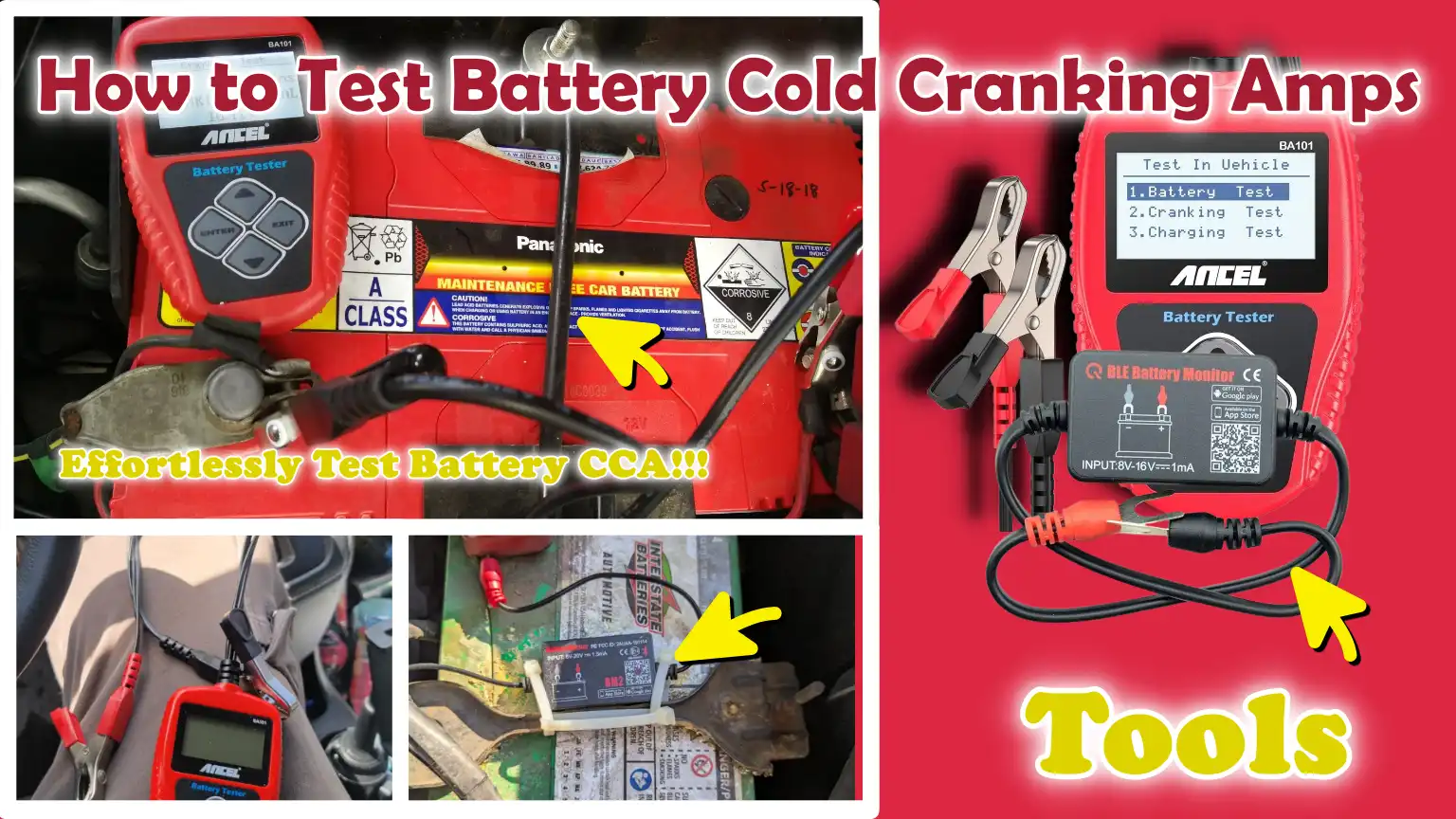
Written By: Dean Shali
Fact Checked By: Sabré Cook
Reviewed By: Tamara Warren
Actually, your battery can look the healthy on the outside and still fail, because a simple number known as CCA literally decides whether your car starts smoothly or leaves you stuck in middle of nowhere.
Basically, on the “COLD MORNINGS”, when you turn on your key or press the start button, then your entire vehicle literally depends on one simple thing: your BATTERY’S ability to deliver enough power instantly.
So, this ability is actually measured in “Cold Cranking Amps” or in short name: CCA, that actually tells you how many amps your battery can provide at 0°F for 30 seconds, while still maintaining enough voltage to start your engine.
But, most of the drivers assume a battery is “FINE” if the lights turn on or a multimeter shows around 12.6 volts, but that’s only the part of the story.
And, in reality: there’s studies and automotive testing standards that shows that batteries can appear fully charges yet fail under the load due to the internal resistance and chemical degradation as well.
So, as batteries ages: their CCA gradually drops often by 20% to 40% before complete failure, which is why slow cranking, dimming lights during startup and cold-weather struggles are early warning signs, not just random things to show up.
Now, in this guide you’ll learn How to Test Battery Cold Cranking Amps, so that you can know and test your battery’s true starting power using easy methods.
What are Cold Cranking Amps – CCA?
Cold Cranking Amps, commonly referred to as CCA, are one of the most critical metrics indicating just how powerful your car battery truly is, precisely at the moment you need it most.
Simply put, CCA measures the amount of power your battery can deliver under extreme cold conditions, the very time when starting an engine is most difficult.
A battery may appear perfectly fine visually and its voltage may even seem normal; however, if it cannot rapidly deliver sufficient current, your engine may struggle to start, or it may fail to start altogether.
This occurs because starting an engine requires a sudden surge of power to rotate its internal components and ignite the fuel; this demand intensifies in cold weather, as the engine oil thickens and internal resistance increases.
Understanding CCA allows you to move beyond mere guesswork regarding your battery’s health, providing you with clear, objective insight into how your battery will perform in real-world conditions.
1. Definition of CCA
Cold Cranking Amps are defined as follows: It is the number of amperes that a fully charged battery can deliver for 30 seconds at a temperature of 0°F (−18°C), while maintaining a voltage of at least 7.2 volts for a 12-volt battery.
This standard is utilized throughout the automotive industry to ensure that all batteries can be compared on a fair and consistent basis.
The rationale behind conducting this test at such a low temperature is that cold weather places the greatest strain on a battery.
The chemical reactions occurring within the battery slow down, thereby diminishing its capacity to generate power; Conversely, the effort required to crank the engine increases simultaneously.
If a battery fails to maintain sufficient voltage during this test, it implies that it may be unable to start your car in cold conditions.
For this very reason, CCA is not merely considered an indicator of a battery’s charge level, but rather the true measure of its engine-starting power.
2. The Difference Between CCA, CA and MCA
Although CCA is the most widely used rating, you may also face CA and MCA ratings listed on batteries; understanding the distinction between them is crucial.
Cranking Amps (CA), sometimes referred to as Marine Cranking Amps, measures the amount of current a battery can deliver at a temperature of 32°F (0°C); this temperature is slightly warmer than the temperature used for the CCA test.
Because the temperature is higher, the battery’s performance improves; consequently, the CA rating for any given battery will always be higher than its CCA rating.
Marine Cranking Amps (MCA) is largely similar to CA and is primarily used for marine batteries; it, too, is measured at 32°F.
The key takeaway is that CCA serves as a more rigorous and reliable rating for a battery’s performance in cold weather, whereas CA and MCA reflect performance in milder weather conditions.
For everyday vehicles, particularly those operated in cold climates, CCA remains the most reliable metric and should be given priority.
3. Why Manufacturers Specify CCA Ratings
Vehicle manufacturers specify a required CCA rating because every engine requires a specific amount of starting power to function correctly.
Larger engines, high-compression engines and vehicles equipped with extensive electronic systems require a higher current output to start properly.
If a battery fails to meet the CCA rating specified by the manufacturer, it may still be capable of starting a car in warm weather; however, in cold conditions, or as the battery ages, it may struggle to start the vehicle, or it may fail to start altogether.
Manufacturers test and determine the minimum CCA required to ensure consistent starting across various conditions; therefore, when replacing a battery, it is crucial to select one with a rating equal to or higher than this specified value.
Choosing the correct CCA also safeguards other electrical components, as a weak battery can lead to voltage drops that may adversely affect sensors and onboard systems.
Understanding this rating ensures that whenever you turn the key, your vehicle will start easily and reliably every time.
Why is CCA Testing Important?
Cold Cranking Amps (CCA) testing is the most practical method for determining the true condition of your car’s battery, as it reveals how the battery performs under load, rather than merely in a resting state.
Many drivers rely solely on voltage readings; however, voltage indicates only the charge level, not the actual starting power.
A battery may display a normal voltage reading yet fail precisely when the engine suddenly demands a surge of power.
CCA testing eliminates this guesswork, providing a clear picture of whether your battery can deliver sufficient current to start your vehicle under real-world conditions.
This is particularly crucial today, as modern vehicles rely on a stable power supply for their ignition systems, fuel systems and onboard computers; consequently, a weak battery can compromise far more than just the starting process itself.
1. Detect a Weak or Failing Battery Before Total Failure Occurs
The primary benefit of CCA testing is that it enables you to identify battery issues before a complete failure occurs.
Batteries typically do not cease functioning abruptly or without warning.
Instead, their internal components degrade gradually and their capacity to deliver current diminishes over time.
By performing a CCA test, you can determine whether the battery is still performing according to its original specifications, even if the car is currently still starting.
This early detection allows you to replace the battery at the appropriate time, thereby avoiding the inconvenience of sudden breakdowns, towing expenses, being stranded in a difficult situation and potential safety hazards.
2. Impact on Engine Starting Reliability
Starting an engine requires a rapid and powerful surge of electrical current, and CCA is precisely the metric that measures this capability.
When the CCA is low, the starter motor does not receive sufficient power to crank the engine at the necessary speed; consequently, the engine cranks slowly or fails to start altogether.
This can also place excessive strain on the starter motor and other electrical components, increasing the risk of their premature failure over time.
A battery with a higher CCA ensures that the engine starts easily and consistently, reduces strain on the vehicle’s electrical system and enhances overall reliability.
Simply put, having a good CCA rating means that your car starts without hesitation, precisely when you need it to.
3. Seasonal Significance: Performance, specially in Winter
CCA becomes even more critical in cold weather, as low temperatures impact both the battery and the engine.
Inside the battery, chemical reactions slow down, thereby reducing its capacity to generate electrical power.
Additionally, engine oil thickens, making it even more difficult to crank the engine.
The combined effect of these two factors is that, in winter, your battery has to work significantly harder than it does in warm weather.
Checking the CCA before the onset of cold weather ensures that your battery is capable of meeting this increased demand.
If the CCA is low, even a slightly weak battery can fail completely on a cold morning, which is precisely why so many battery-related issues arise during the winter season.
4. The Relationship Between Battery Age and Capacity Degradation
As a battery ages, its internal components such as: the plates and electrolytes, gradually deteriorate, leading to a decline in their functional efficiency.
This natural aging process diminishes the battery’s ability to store and deliver energy, which has a direct impact on its CCA rating.
In many cases, after a few years of use, a battery loses a significant portion of its original CCA, even if it appears to be functioning properly.
Factors such as heat, frequent short trips and improper charging can accelerate this process of capacity degradation.
Regularly monitoring the CCA allows you to track this gradual decline over time; this helps you determine how much longer your battery will last, enabling you to plan for a replacement before a critical situation arises.
Common Signs Shows Your Battery’s CCA May Be Low
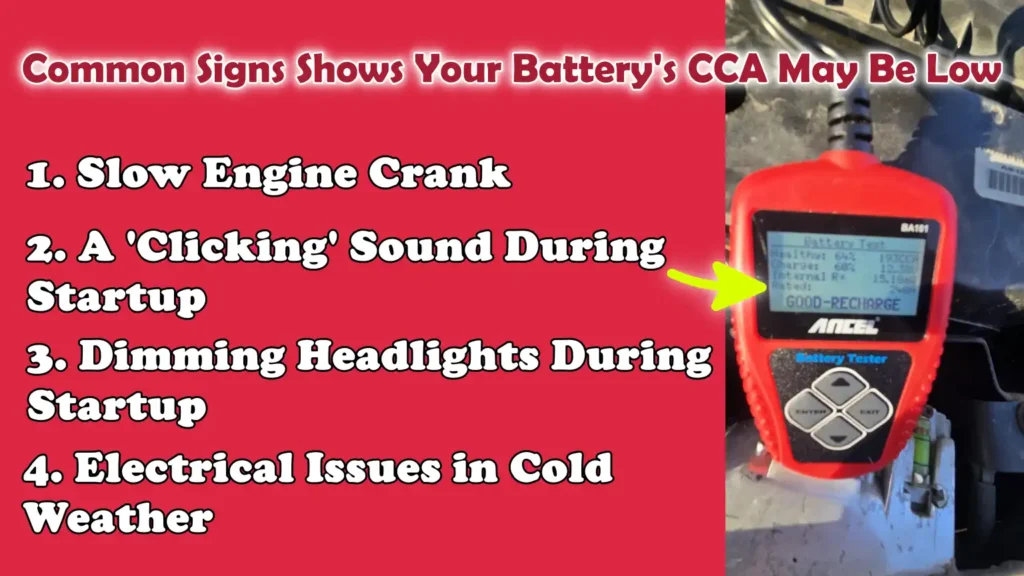
Low Cold Cranking Amps (CCA) often provides clear warning signs well before a battery fails completely, yet many drivers overlook them or assume they are minor issues.
CCA is directly linked to how effectively your battery delivers power during engine startup; therefore, when it is low, initial problems typically manifest during the ignition process itself.
These symptoms do not occur suddenly.
They serve as early indicators that the battery is struggling to deliver sufficient current when placed under load.
Recognizing these signs in a timely manner allows you to have the battery tested promptly and avoid sudden breakdowns, specially in cold weather, when the battery is under the greatest strain.
1. Slow Engine Crank
One of the most common and easily recognizable signs of low CCA is a slow engine crank.
When you start your car, the engine should turn over quickly and smoothly; however, if the battery is weak, the starter motor does not receive enough power to spin the engine at the necessary speed.
The result is a slow or grinding sound when attempting to start the car.
This occurs because the battery is no longer capable of delivering a powerful surge of current, which is precisely what CCA measures.
Over time, this issue of a slow engine crank typically worsens, particularly in cold temperatures, and often serves as the first clear indication that the battery is losing its strength.
2. A ‘Clicking’ Sound During Startup
A distinct ‘clicking’ sound when turning the key or pressing the start button is another sure sign of low CCA.
This sound typically originates from the starter solenoid; The solenoid attempts to engage but fails to draw sufficient power from the battery to fully activate the starter motor.
Simply put, the battery possesses enough energy to produce an audible ‘click,’ yet it lacks the necessary power to actually turn over the engine.
People often mistake this for a starter issue; however, in many instances, the true culprit is a weak battery lacking adequate Cold Cranking Amps (CCA).
If this occurs repeatedly, it serves as a clear indication that the battery requires immediate inspection.
3. Dimming Headlights During Startup
A significant dimming of the headlights while starting the car can also be a sign of low CCA.
When you turn the ignition key, the battery is required to deliver a massive surge of current to the starter motor.
If the battery is weak, it struggles to meet this demand, resulting in a momentary drop in voltage.
This voltage drop causes the headlights, along with other electrical components of the vehicle, to dim.
While a slight dimming of the headlights is normal, if they dim excessively or significantly, it implies that the battery is unable to maintain a stable power output when placed under load.
This is a direct indication that its Cold Cranking Amps (CCA) are likely insufficient.
4. Electrical Issues in Cold Weather
Electrical problems that manifest primarily during cold weather are often linked to low CCA.
Cold temperatures diminish the battery’s power-generating capacity while simultaneously increasing the engine’s resistance.
Due to this dual effect, any internal weakness within the battery becomes far more pronounced.
You may experience difficulty starting your vehicle, flickering lights, sluggish power windows, or temporary malfunctions in the electronic systems while starting the car.
These issues arise because the battery fails to deliver sufficient current precisely when the demand for power is at its peak.
If these problems resolve during warm weather but resurface as soon as the cold sets in, it is a definitive indication that the battery’s CCA (Cold Cranking Amps) have diminished and it requires inspection.
Tools
| Tool Name | Why It Is Needed | How to Use It |
|---|---|---|
| Battery Load Tester | This is the most reliable method for testing actual starting power, as it simulates engine cranking conditions. | Connect the clamps to the battery terminals, set the load to approximately half of the rated CCA, apply the load for 10 to 15 seconds, observe the voltage drop and compare it against standard values. |
| Carbon Pile Tester | This allows you to precisely control the load and conduct a detailed assessment of the battery’s strength. | Connect the clamps, gradually increase the load using the control knob, monitor the voltage while maintaining the load and verify that the voltage remains within safe limits. |
| Electronic Load Tester | This method is faster and easier than using a manual tester and it minimizes the potential for human error. | Connect the clamps, input the battery’s CCA rating, initiate the test and read the automated results displayed on the screen. |
| Digital Battery Analyzer | It delivers instant results without imposing a heavy load on the battery; it is a safe and convenient option for frequent testing. | Connect the clamps, input the battery type and CCA rating, run the test and interpret the results such as: “Good,” “Recharge,” or “Replace.” |
| Multimeter | This is useful for basic checks when other testing equipment is unavailable; it indirectly aids in identifying signs of poor performance. | Set the device to the DC voltage range, measure the resting voltage, then measure the voltage while cranking the engine and observe the extent of the voltage drop. |
How to Test Battery Cold Cranking Amps – CCA Testing
1. How to Use a Battery Load Tester
Testing your battery with a load tester is the most accurate way to determine its true starting power, as it simulates the exact stress placed on the battery when starting the engine.
Unlike simply checking the voltage, this method reveals how effectively the battery can deliver power under load.
When you turn the key, the starter motor demands a massive surge of current in a very short time and a load tester replicates this precise scenario.
This allows you to observe whether the battery can maintain the necessary voltage while delivering that power.
A healthy battery maintains a stable voltage even under load, whereas a weak battery’s voltage drops rapidly.
This method is widely utilized by professionals because it yields clear and reliable results regarding the battery’s actual performance.
Turn Off the Vehicle and Let the Battery Rest
Before conducting the test, it is crucial to turn off the vehicle and allow the battery to rest for a short period, typically 10 to 15 minutes.
This gives the battery’s “surface charge” time to stabilize, resulting in a more accurate reading.
If you test the battery immediately after driving, the voltage may appear higher than its actual level, potentially leading to misleading results.
Allowing the battery to rest ensures that you are testing the battery’s true condition, rather than the influence of a temporary surface charge.
Connect the Tester Clamps
Next, connect the load tester’s clamps directly to the battery terminals; ensure that the connections are clean and secure.
The positive clamp must be connected to the positive terminal and the negative clamp to the negative terminal.
A secure connection is essential, as loose or dirty terminals can interfere with the readings and produce inaccurate results.
A secure connection ensures that the tester can properly apply the load and accurately measure the battery’s performance.
Apply a Load Equal to Half the Rated CCA
Once the tester is connected, apply a load approximately equal to half of the battery’s rated Cold Cranking Amps (CCA).
For example, if your battery is rated at 600 CCA, you should apply a load of approximately 300 amperes.
This load level is used because it closely simulates the demand placed on the battery during engine starting, without subjecting the battery to unnecessary stress.
Applying the correct load is crucial; if too little load is applied, the battery’s weaknesses may not be revealed, whereas applying too much load can result in inaccurate readings.
Monitor the Voltage Drop
Once the load has been applied, closely monitor the battery’s voltage.
A healthy battery should maintain a voltage of at least 9.6 volts at 70°F during the test, typically for a duration of about 10 to 15 seconds.
This voltage level is an industry standard indicating that the battery is capable of handling starting conditions.
If the voltage drops rapidly below this level, it signifies that the battery is struggling to deliver sufficient power under load.
Temperature also affects this reading, as voltage naturally decreases in cold conditions; therefore, adjustments may be necessary in very cold environments.
Interpret the Results
Once the test is complete, the final step is to understand what the results signify.
If the battery maintains a voltage above the recommended level, it is considered to be in good condition and capable of reliably starting the engine.
If the voltage drops significantly or continues to decline throughout the test, it indicates that the battery has lost its capacity to deliver sufficient current and may require replacement.
It is crucial to understand this, as it helps you make a clear decision based on actual performance rather than mere guesswork, thereby ensuring that your vehicle remains reliable and is ready to start whenever needed.
2. How to Use a Digital Battery Tester
A digital battery tester is the easiest and fastest way to check your battery’s health (condition) and estimate its Cold Cranking Amps (CCA) without applying excessive manual load.
This tool utilizes advanced internal resistance measurements and built-in algorithms to determine how effectively the battery can deliver current.
Instead of placing a heavy strain on the battery like traditional load testers do, it sends a small signal through the battery and observes how the battery responds to it.
Based on this response, it calculates the battery’s available CCA, health status and overall condition.
This method is widely used in modern workshops because it is fast, safe and sufficiently accurate for most real-world scenarios.
It is particularly beneficial for routine checks, preventive maintenance and for testing batteries in vehicles equipped with sensitive electronics.
Connect the Tester
To begin, attach the tester’s clamps directly to the battery terminals; ensure that the connections are secure and clean.
The positive clamp must be connected to the positive terminal and the negative clamp to the negative terminal.
A correct connection is crucial, as even slight dirt or looseness can interfere with the signal and produce inaccurate results.
Once connected, most digital testers automatically power on using the battery’s own voltage.
Enter the Battery Rating – CCA Value
After connecting the tester, you must input the battery’s rated CCA value into the device.
This number is typically printed on the battery’s label.
Entering the correct rating is essential, as the tester compares the battery’s current performance against its original specifications.
If incorrect parameters are entered, the results may not accurately reflect the battery’s true condition.
Some testers also request the battery type such as: Standard Flooded, AGM, or Gel, because different battery designs behave differently during the testing process.
Run the Automatic Test
Once the correct information has been entered, initiate the test by following the device’s instructions.
The tester will automatically perform a rapid analysis, typically within just a few seconds.
During this process, it measures internal resistance, voltage response and overall current-delivery capability.
Unlike older methods, this process does not require you to apply any manual load or run the test for an extended period.
The device processes all the data instantly and provides a clear result based on the battery’s condition.
Interpreting the Results – Good, Recharge, Replace
Upon completion of the test, the device will display a simple result such as: “Good,” “Recharge,” or “Replace”, often accompanied by the measured CCA and voltage values.
A “Good” result indicates that the battery is in good condition and capable of providing the necessary power to reliably start the vehicle.
A “Recharge” result signals that the battery’s charge is low and that it should be recharged before conducting any further tests, as low charge levels can skew performance readings.
A “Replace” result indicates that the battery has lost a significant portion of its original CCA capacity and may be unable to start the engine, particularly under high-load conditions or in cold weather.
Understanding these results allows you to take immediate and appropriate action, whether that involves recharging the battery or planning to replace it before it fails.
3. How to Use a Multimeter – Basic Check
Testing your battery using a multimeter is the simplest method, specially if you do not have access to a load tester or a digital analyzer.
Although it cannot directly measure Cold Cranking Amps (CCA), it can still provide you with useful insights into how your battery performs under actual starting conditions.
A multimeter measures voltage; by observing the voltage fluctuations that occur while the engine is cranking, you can determine whether the battery is robust or beginning to weaken.
This method works because a healthy battery should maintain a stable voltage even when the starter motor places a heavy load upon it.
If the voltage drops significantly, it generally indicates that the battery is unable to deliver sufficient current, a condition often associated with low CCA.
Measure Resting Voltage
To begin, measure the battery’s resting voltage.
Do this while the vehicle is turned off and has been stationary for at least 10 to 15 minutes.
This resting period allows the battery to stabilize and dissipates any temporary “surface charge” that may have accumulated on it.
Set the multimeter to DC voltage mode and place its probes on the battery terminals.
A fully charged battery should register a voltage of approximately 12.6 volts.
If the reading is lower such as: 12.4 volts or less, it may indicate that the battery is partially discharged or has begun to deteriorate.
However, it is important to understand that resting voltage alone does not provide definitive confirmation of a battery’s health, as a battery may display a normal voltage reading yet fail when placed under load.
Measure Voltage During Cranking
Next, keep the multimeter connected to the battery and monitor the voltage reading while starting the engine.
This step demonstrates how the battery performs when subjected to real-world operational stress.
When the starter motor engages, the battery is required to deliver a massive surge of current within a very brief timeframe.
During this process, a slight drop in voltage is natural; however, this decline should not be excessive.
At normal temperatures, a healthy battery typically maintains a voltage level above 9.6 volts during cranking.
Monitoring this value provides a practical indication of how effectively the battery can handle the demands of the starting process.
Analyze the Voltage Drop
After observing the cranking voltage, the most critical step is to analyze the magnitude of the voltage drop relative to the resting voltage level.
A slight drop in voltage is normal and expected; however, if there is a significant or sudden decline in voltage, it indicates that the battery is struggling to deliver sufficient current.
If the voltage falls below the recommended threshold or drops too rapidly, it suggests that the battery possesses excessive internal resistance or has diminished capacity, both of which are signs of a weakening battery.
This behavior is strongly correlated with low Cold Cranking Amps (CCA), even though a multimeter cannot directly measure CCA.
A consistent and pronounced drop in voltage during cranking serves as a definitive warning sign that the battery is nearing the end of its useful life.
Limitations of This Method
While this method is useful for preliminary diagnostics, it has certain specific limitations of which you should be aware.
A multimeter cannot measure actual Cold Cranking Amps (CCA), nor can it simulate a controlled load in the manner of a dedicated battery tester.
It merely reveals voltage behavior; consequently, rather than providing a precise measurement of the battery’s total capacity, it offers only indirect diagnostic information.
Factors such as ambient temperature, charge status and the quality of electrical connections can also influence the readings.
For these reasons, the most prudent approach is to use the multimeter method as a quick, preliminary assessment, rather than as a definitive diagnostic tool.
For accurate and reliable results, specially when determining whether or not a battery needs to be replaced, using a dedicated battery tester is always the superior option.
How to Determine Your Battery’s CCA Rating
Knowing your battery’s Cold Cranking Amps (CCA) rating is crucial, as the results of every test are compared against this specific number to determine whether the battery is still functioning correctly.
The CCA rating serves as a baseline for your battery’s performance; it indicates the amount of electrical power the battery is designed to deliver in cold environments.
Without knowing this value, it is difficult to assess whether your battery is operating properly or if its capacity has diminished over time.
This number also assists you in selecting the appropriate replacement battery; using a battery with an insufficient CCA rating can lead to difficulties in starting the vehicle, whereas using a battery with the correct, or slightly higher, rating ensures reliable performance.
1. Reading the Battery Label
The easiest and most direct method for determining your battery’s CCA rating is to simply check the label printed directly on the battery itself.
On most automotive batteries, the CCA value is clearly displayed on the top or side of the unit, often listed alongside other specifications such as voltage and reserve capacity.
This number typically appears as a numerical value followed by “CCA”, for example, “600 CCA” or “750 CCA.”
This label is provided by the manufacturer and reflects the verified performance capabilities of that specific battery model.
It is essential to read this number carefully, as it serves as the benchmark for all future tests and comparisons.
If the label has become soiled or is illegible, gently cleaning the surface will usually restore the visibility of the information.
2. Information Provided in the Owner’s Manual
If the battery label is missing, unreadable, or if you simply wish to verify the accuracy of the information, your vehicle’s owner’s manual serves as a reliable resource.
The owner’s manual outlines the specific battery specifications recommended for your particular vehicle, including the minimum required CCA rating.
This value is determined by the vehicle manufacturer, based on factors such as engine size, design and the vehicle’s overall electrical demands.
Adhering to this recommendation ensures that the battery can reliably meet the vehicle’s starting requirements across various weather conditions.
If you use a battery with a CCA rating lower than the specified requirements, you may experience difficulty or delays in starting the vehicle, particularly in cold weather, whereas using a battery with the correct rating ensures optimal vehicle performance.
3. Manufacturer’s Website
Another reliable method for determining your battery’s CCA rating is to visit the battery manufacturer’s website.
By entering the battery’s model number or searching based on your vehicle’s make and model, you can access comprehensive information about the battery, including its CCA rating, battery type and performance-related data.
This method is particularly useful when the label on the battery is no longer legible, or when you wish to verify technical specifications.
The manufacturer’s website typically provides the most up-to-date and accurate information, helping to ensure that you are utilizing the correct data when testing or replacing the battery.
What Constitutes a “Good” CCA Reading?
A “good” CCA (Cold Cranking Amps) reading is not merely the number displayed on the tester; rather, it involves assessing how closely that number aligns with the battery’s original specifications.
Every battery is designed to deliver a specific level of current when new; however, over time, this capacity naturally diminishes due to internal wear and chemical degradation.
Understanding what constitutes a “good” reading helps you determine whether your battery remains reliable or if its service life is nearing its end.
A battery performing close to its rated CCA can easily start your engine; conversely, a battery with diminished capacity may struggle to start the vehicle, particularly under challenging conditions, such as in cold weather or during frequent short trips.
1. Comparing Measured vs Rated CCA
The most critical step in assessing a battery’s health is this: comparing the measured CCA obtained from your test against the rated CCA listed on the battery itself.
For instance, if your battery is rated at 600 CCA and your tester displays approximately 500 CCA, the battery is still performing quite well.
This comparison is essential because the number alone reveals very little, unless you know the specific current output for which the battery was originally designed.
As a battery ages, a gradual decline in the measured CCA is to be expected; however, the most critical factor is the extent of this decline.
While a slight reduction is normal, a significant discrepancy between the rated and measured CCA indicates that the battery is no longer capable of delivering the robust power required to reliably start the engine.
2. Industry Standard: 70–80% = “Okay”
Generally, in the automotive world, a battery is considered to be in “okay” condition when it is still capable of delivering approximately 70 to 80 percent of its original CCA rating.
This range indicates that the battery retains sufficient power to start the engine normally under most circumstances.
For instance, a battery with a 600 CCA rating is typically deemed serviceable as long as it is still delivering between 420 and 480 CCA.
However, even though it remains functional, it is no longer operating at peak performance; consequently, you may begin to notice subtle signs such as: the engine cranking slowly or a slight decline in performance during cold weather.
This range is often regarded as a “warning zone”, signifying that while the battery is still operational, it now requires close monitoring.
3. Below 60% = Replacement Recommended
When a battery’s measured CCA drops below approximately 60 percent of its rated value, it is generally no longer considered reliable and should be replaced.
At this stage, the battery has lost a significant portion of its current-delivering capacity, thereby increasing the risk of difficulties in starting the vehicle.
For example, if a 600 CCA battery is delivering less than 360 CCA, it may struggle to start the engine, particularly in cold weather, when the battery is under increased strain.
Even if the vehicle occasionally starts, the battery is in the final stages of its service life and could fail suddenly, without any specific warning, at any moment.
Replacing the battery at this stage helps prevent unexpected vehicle breakdowns and ensures consistent vehicle performance.
Know, Common Factors That Affects CCA Performance
Cold Cranking Amps (CCA) performance is not static; it can vary based on several real-world conditions that influence the amount of power the battery delivers.
If external or internal factors are not in optimal condition, even a perfectly healthy battery may yield a CCA reading lower than expected.
Understanding these factors helps you accurately interpret test results and avoid drawing incorrect conclusions regarding the battery’s health.
Many of these conditions develop gradually and often go unnoticed; nevertheless, they directly impact the amount of current your battery can deliver during engine startup.
By identifying what influences CCA, you can better maintain your battery and ensure reliable engine-starting performance.
1. Temperature – Cold Reduces Output
Temperature has a profound impact on battery performance, particularly in cold conditions.
Inside the battery, power is generated through chemical reactions; as the temperature drops, these reactions slow down.
In cold weather, a battery is unable to generate as much current as it can in warmer conditions.
Furthermore, cranking (starting) the engine becomes even more difficult because the engine oil thickens, thereby increasing the load on the battery.
The combination of these factors means the battery has to work harder while simultaneously generating less power.
This is precisely why CCA is measured at very low temperatures, to simulate this “worst-case scenario.”
Even a slight drop in temperature can reduce available power, making cold weather one of the most significant challenges for battery performance.
2. Battery Age
As a battery ages, its capacity to deliver current gradually diminishes.
This occurs because internal components such as: lead plates and electrolytes, gradually wear down and degrade over time.
Repeated charge-discharge cycles trigger microscopic changes within the battery, leading to a decline in its operational efficiency.
As the years go by, this manifests as a significant drop in CCA.
Most automotive batteries begin to show a noticeable decline in performance after a few years of use, even if they appear to be functioning normally on the surface.
Aging is a natural process and regular testing helps you assess the extent of the battery’s degradation and identify when it is nearing the end of its useful lifespan.
3. Corrosion and Poor Connections
Corrosion on battery terminals and poor electrical connections can reduce the amount of current reaching the starter motor.
Even if the battery itself is robust, obstructions or resistance at the terminals can impede or restrict the flow of electricity.
Corrosion typically appears as a white or bluish powdery coating around the battery posts and cable ends; this acts as an obstruction that weakens the connection.
Loose or damaged cables can have a similar effect.
This additional resistance can cause a voltage drop during start-up, creating the impression that the battery has low CCA, when the actual issue lies with the connections.
To maintain optimal performance, it is essential to keep the terminals clean and ensure that the connections are secure.
4. State of Charge
“State of Charge” refers to the amount of energy currently stored within the battery.
A fully charged battery can deliver its maximum CCA, whereas a partially discharged battery will generate less current.
This means that even a healthy battery may exhibit poor performance if it is not fully charged.
For instance, leaving lights on, making frequent short trips, or a weak charging system can deplete the battery’s charge level.
Testing the CCA of a low-charge battery can yield misleading results, making it appear weaker than it actually is.
Ensuring that the battery is properly charged prior to testing provides a more accurate assessment of its true condition.
5. Internal Resistance
Internal resistance is one of the most critical factors determining how a battery delivers current.
As a battery ages or degrades, its internal resistance increases.
Elevated resistance impedes the flow of electricity, thereby reducing the amount of current the battery can deliver during high-demand situations such as: when starting the engine.
This is the primary reason why a battery’s CCA diminishes over time.
Increased internal resistance also leads to excessive heat generation and voltage drops when the battery is placed under load.
Modern battery testers often measure internal resistance directly, as it is deeply intertwined with the battery’s overall health and performance.
Know, Common Mistakes to Avoid During Cold Cranking Amps Test
Testing a battery’s Cold Cranking Amps (CCA) can yield highly accurate and useful results, but only if performed correctly.
During the testing process, many people make minor errors that lead to an inaccurate assessment of the battery’s health.
Due to these mistakes, a weak battery might appear to be in perfect condition, or conversely, a perfectly good battery might be misdiagnosed as faulty.
As CCA testing is used to determine whether or not a battery needs replacement, avoiding these errors is crucial for making the right decision.
Understanding these common mistakes ensures that you obtain reliable results, thereby helping you avoid unnecessary expenses and unexpected breakdowns.
1. Testing Immediately After Driving
One of the most common mistakes is testing the battery immediately after driving the vehicle.
When the engine is running, the alternator charges the battery and creates a “surface charge.”
This temporary charge can artificially inflate voltage readings, making the battery appear stronger than its actual capacity.
If you conduct a test under these conditions, the results can be misleading and may not accurately reflect the battery’s true condition.
Allowing the battery to rest for approximately 10 to 15 minutes after shutting off the engine allows the surface charge to dissipate, thereby providing a more accurate reading of its actual performance.
2. Not Charging the Battery Before Testing
Testing a battery that is not fully charged is another common error.
If the battery is even slightly discharged, it will be unable to deliver its full CCA output, regardless of whether it is in good condition in all other respects.
This can lead to erroneous results, where a perfectly functional battery is mistakenly deemed weak or defective.
As a battery’s state of charge directly impacts its current-delivering capacity, testing should always be conducted when the battery is fully charged.
If the tester indicates a low state of charge, the battery must first be recharged and then re-tested to ensure accurate and reliable results.
3. Overlooking Temperature Variations
Temperature plays a crucial role in battery performance, yet it is often overlooked during testing.
Cold temperatures diminish a battery’s ability to generate current, whereas warmer temperatures can enhance its performance.
Standard CCA ratings are based on testing conducted at 0°F; however, most real-world testing takes place at higher temperatures.
If temperature is not taken into account, the results will fail to accurately reflect how the battery would perform under cold conditions.
Some testers automatically adjust for temperature variations; however, if this feature is not utilized or is unavailable, it may lead to an inaccurate assessment of the battery’s capacity.
4. Using Incorrect Tester Settings
Using incorrect settings on the testing device is another error that can compromise the accuracy of the results.
On many modern testers, you are required to input the correct battery type and CCA rating before initiating a test.
If incorrect values are entered, the tester will compare the battery’s performance against an incorrect standard, potentially yielding misleading results.
Different types of batteries such as: standard flooded, AGM, or Gel, also operate differently; therefore, selecting the correct type is essential.
Ensuring that all settings correspond to the specific battery being tested helps in obtaining accurate and meaningful results.
Read More:
- How to Check Car Battery Voltage with Multimeter
- How to Check Parasitic Battery Drain
- How to Replace a Starter Motor
- How to Check Car Battery Health with a Multimeter
- How to Fix Car Not Starting
Know, Difference Between Professional vs DIY CCA Testing
The choice between professional and DIY CCA testing depends on the level of accuracy you require, the frequency with which you test your battery and the tools you have available.
Both methods can be useful, but they serve different purposes.
DIY testing offers convenience and is suitable for quick, on-the-spot checks at home, whereas professional testing utilizes more advanced equipment capable of delivering more in-depth and reliable diagnostic results.
Understanding this distinction helps you determine when a simple home check suffices and when it is better to rely on expert equipment and experience.
1. Comparison of Accuracy
Professional CCA testing is generally more accurate because it employs advanced tools designed to measure battery performance under controlled conditions.
These tools can apply precise loads, measure internal resistance and compensate for temperature fluctuations, thereby providing a clear and reliable picture of the battery’s condition.
Technicians also possess the expertise to correctly interpret the results, thereby minimizing the margin for error.
Conversely, DIY testing can also provide useful information, although its accuracy depends largely on the specific tools used and the precision with which the test is conducted.
A simple multimeter provides only indirect readings, whereas a high-quality digital tester can approach professional-grade accuracy.
However, minor errors in the setup or interpretation process can still compromise the validity of the results.
2. Cost Considerations
Cost is a significant factor when choosing between professional and DIY testing.
DIY testing typically involves a one-time investment in a tool (such as a multimeter or a digital battery tester), which can be utilized multiple times throughout the entire lifespan of your vehicle.
This makes it an economical option for routine checks and maintenance.
While professional testing may be offered free of charge at some auto parts stores, in other instances, particularly at repair shops, a service fee may apply.
Although professional testing may entail a higher upfront cost, it can ultimately save you money in the long run by providing accurate results and preventing unnecessary battery replacements or sudden breakdowns.
3. When to Visit a Mechanic or Auto Parts Store
There are certain situations where professional testing is the best course of action.
If you are experiencing recurring difficulties in starting your vehicle, if electrical components are malfunctioning, or if the results obtained from DIY testing methods are inconclusive, visiting a mechanic or an auto parts store is a prudent step.
It is also advisable to undergo professional testing before embarking on a long journey, during seasonal transitions, or when your battery is several years old and nearing the end of its service life.
In such scenarios, a more comprehensive and accurate diagnostic test can help confirm whether the battery remains reliable or requires replacement.
Relying on professional testing at the appropriate time adds an extra layer of confidence and helps prevent unexpected complications.
How Often Should You Test Your Battery’s CCA?
Testing your battery’s Cold Cranking Amps (CCA) at the right time is crucial, as battery performance does not decline abruptly but rather diminishes gradually over time.
Regular testing helps you monitor this decline, enabling you to determine whether the battery remains reliable or is nearing the end of its useful life.
As CCA directly impacts your car’s ability to start, particularly in challenging conditions, timely checks can prevent sudden breakdowns.
Many instances of battery failure occur simply because the battery was not tested at the appropriate time, despite warning signs already being present.
1. Suggested Intervals
A good general practice is to test your battery’s CCA at least once or twice a year under normal driving conditions.
For most drivers, this interval is sufficient to monitor the battery’s health without subjecting it to excessive or unnecessary testing.
If your battery is new, frequent testing may not be required; however, once the battery is a few years old, regular checks become significantly more important.
As a battery ages, its capacity to deliver current diminishes, a decline that can accelerate over time.
Testing at regular intervals helps you detect these changes early, allowing you to make informed decisions regarding battery maintenance or replacement before any issues arise.
2. Seasonal Checks – Before Winter
The most critical time to test your battery’s CCA is just before the onset of winter.
Cold weather places the greatest strain on your battery, as it slows down the chemical reactions occurring within the battery while simultaneously increasing the power required to start the engine.
A battery that functions perfectly well in warm weather may fail to operate properly, or even fail completely, in cold temperatures, specially if its CCA capacity has already diminished.
Testing your battery before the onset of winter ensures that it is capable of withstanding these challenging conditions.
By taking this simple step, you can avoid one of the most common causes of vehicle breakdowns during the winter season: a weak battery that lacks the necessary power to start the car in cold weather.
3. Before Long Journeys
Testing your battery before embarking on a long journey is another essential precaution.
During extended trips, you often venture far from home into areas where assistance is not readily available; in such situations, having a reliable battery is absolutely crucial.
Even if your car currently starts without any issues, a hidden decline in CCA capacity can lead to problems under various circumstances such as: fluctuating temperatures or the need to frequently restart the vehicle during the trip.
Checking your battery before setting off provides the peace of mind that it will reliably power your vehicle throughout the entire journey without interruption.
Furthermore, doing so gives you the opportunity to replace the battery if necessary, thereby preventing any potential inconvenience or delays during your travels.
Understand, When to Replace Your Car Battery?
Knowing the right time to replace your car battery is crucial; waiting too long can lead to sudden battery failure, while replacing it too early can result in wasted money.
Due to normal wear and tear, chemical aging and external factors such as extreme heat or cold, a battery gradually loses its capacity to store and deliver electrical power.
Even if the car still starts, the battery may already be weak and nearing the end of its useful life.
Replacing the battery at the appropriate time ensures reliable starting, protects electrical components from voltage fluctuations and saves you from the inconvenience of a sudden vehicle breakdown.
1. Specific Indicators
The most straightforward method for determining when to replace a battery is to observe its performance during testing.
If the measured Cold Cranking Amps (CCA) drop below approximately 60 percent of the original rating, the battery is generally no longer considered reliable and should be replaced.
Other warning signs include slow engine cranking, a rapid “clicking” sound when attempting to start the car, dimming lights during startup and a recurring need for “jump-starts.”
These indicators suggest that the battery is no longer capable of delivering the necessary current under load.
Furthermore, if the battery fails a “load test” or displays a “Replace” result on a digital tester, it is a definitive sign that its operational lifespan has come to an end.
2. Typical Lifespan – 3 to 5 Years
Most car batteries last between three and five years under normal driving conditions, although this can vary depending on usage patterns and external factors.
Frequent short trips, exposure to extreme heat or cold and poor charging conditions can significantly shorten a battery’s lifespan.
In extremely hot weather, heightened chemical activity can cause batteries to deteriorate rapidly, whereas in extremely cold weather, weak batteries become more readily apparent because starting the vehicle requires a greater surge of power.
Even if a battery has not failed completely, its performance typically declines gradually after a few years of use.
Conducting regular tests during this period helps you estimate the battery’s remaining lifespan and allows you to avoid sudden, unexpected breakdowns.
3. The Trade-off: Cost vs Reliability
Replacing a battery is not merely a matter of cost; it is also a matter of reliability and peace of mind.
While one might be tempted to continue using a battery until it fails completely, the inconveniences such as: getting stranded on the road, missing important engagements, or incurring expenses for emergency assistance, as it can prove far more costly than simply replacing the battery.
A slightly weakened battery may perform adequately under ideal conditions; however, as its condition deteriorates further, it ceases to be reliable.
When a battery begins to exhibit clear signs of weakness or its performance drops below a safe threshold, replacing it is a prudent decision; this ensures consistent vehicle starting and minimizes the risk of sudden, unwanted complications.
Know, Pro Tips to Maintain High CCA
Maintaining high Cold Cranking Amps (CCA) isn’t just about the battery itself, but also about how you use and care for it over time.
CCA relies on the battery’s ability to deliver a powerful surge of current rapidly; if the battery is not properly maintained, this capacity can diminish quickly.
Many common driving habits and minor issues such as: low charge levels or dirty connections, as it can degrade your battery’s performance without you even realizing it.
By adopting simple maintenance practices, you can slow this decline, keep your battery operating at its peak, ensure reliable engine starting and extend its overall lifespan.
Even, there’s scientific research that shows that cold temperatures directly impact battery performance as it slows internal chemical reactions and increases resistance as well, so this is why CCA testing is done at very low temperatures, as it reflects the most of the challenging conditions a battery will face. Basically, studies confirms that analyzing voltage drop during the discharge actually provides an accurate picture of a battery’s real starting ability as well.[¹]
1. Always Keep the Battery Fully Charged
Keeping your battery fully charged is one of the most critical factors in maintaining robust CCA.
A battery that remains consistently near full charge can deliver maximum current when needed; conversely, a partially charged battery struggles to provide the necessary power.
When a battery remains in a low-charge state for an extended period, it can suffer internal damage, which reduces its capacity and increases its internal resistance.
This has a direct negative impact on its ability to deliver the high current required to start the vehicle.
Driving regularly at a steady pace helps the alternator recharge the battery; however, if the vehicle is not used frequently, the battery may gradually lose its charge.
Ensuring that the battery remains properly charged helps preserve its strength and prevents premature failure.
2. Clean the Terminals Regularly
Clean battery terminals are essential for proper current flow.
Over time, corrosion can accumulate around the terminals, creating electrical resistance.
This resistance impedes the flow of electricity from the battery to the starter and other systems.
Even if the battery itself is in good condition, this resistance can diminish the actual power delivered, creating the impression that the battery’s CCA has decreased.
Corrosion often manifests as a white or light-blue powdery layer and it can disrupt electrical contact.
Regularly cleaning the terminals and ensuring tight connections allows the battery to deliver its full power without interruption, thereby enhancing both its performance and reliability.
3. Avoid Short Trips
Frequent short trips can have a detrimental effect on a battery’s health and CCA.
When you start your vehicle, the battery expends a significant amount of power to crank the engine.
If your trip is very brief, the alternator may not have sufficient time to fully recharge the battery.
Over time, this cycle of repeated partial discharge without full replenishment can deplete the battery’s overall capacity and negatively impact its performance.
This situation can lead to a gradual decline in CCA, even if the battery is relatively new.
Taking longer trips, or occasionally driving the vehicle for extended periods, ensures that the battery is fully recharged and maintains its strength.
4. Use a Battery Maintainer When Necessary
A battery maintainer, also known as a trickle charger, is a useful tool for keeping a battery in good condition, particularly when the vehicle is not used regularly.
It delivers a continuous, low-level charge to the battery, ensuring that it remains at an optimal charge level without becoming overcharged.
This is specially beneficial for vehicles that are stored for extended periods or driven only occasionally.
Without a maintainer, a battery can gradually lose its charge over time, potentially diminishing its capacity and reducing its CCA.
Using a maintainer preserves the battery’s internal health, maintains a consistent charge level and ensures that the battery is ready to deliver full power whenever needed.
Conclusion – How to Test Battery Cold Cranking Amps
Checking your battery’s Cold Cranking Amps (CCA) is the most practical and reliable method for determining whether your car will start exactly when you need it most.
Many drivers rely solely on voltage readings or wait until the battery fails completely; however, a battery’s true strength is measured by how well it performs under load.
CCA provides a definitive answer to this question.
It indicates whether your battery can deliver the high-amperage current required to start the engine, particularly in challenging conditions, such as cold weather, when both the battery and the engine are under increased strain.
Throughout this comprehensive guide, you have learned that battery issues rarely arise suddenly; instead, they develop gradually.
Slow cranking, clicking sounds, dimming lights, or difficulty starting in cold weather, these are early warning signs that your CCA capacity may already be diminishing.
By utilizing proper testing methods such as: a load tester, a digital analyzer, or even a simple multimeter check, you can identify these issues before they result in a complete breakdown.
This shift from guesswork to proactive testing is precisely what helps protect you from sudden failures and costly repairs.
You have also discovered that a battery’s performance is influenced by various real-world factors, including ambient temperature, the battery’s age, its charge level and the quality of its connections.
Even a high-quality battery can perform poorly if it is not fully charged or if corrosion is impeding the flow of electricity.
Conversely, by adopting a few simple habits such as: keeping the battery charged, cleaning the terminals and avoiding frequent short trips, you can help maintain robust CCA levels and extend the battery’s lifespan.
Over time, these small steps make a significant difference.
Most importantly, understanding what constitutes a healthy CCA reading empowers you to make informed decisions with complete confidence.
A battery that is still delivering approximately 70 to 80 percent of its rated CCA can typically perform well; however, once it drops below this safe threshold, replacing the battery becomes the more prudent and secure course of action.
Waiting too long can lead to sudden battery failure, often at the very moment you need it most.
Now, that’s all from this guide about How to Test Battery Cold Cranking Amps, if you still have confusion: just comment.
Frequently Asked Questions
FAQ 1: What is a good CCA for a car battery?
A good Cold Cranking Amps (CCA) value depends on your specific vehicle; however, generally speaking, most cars require between 400 and 800 CCA to start reliably. Smaller cars typically require a lower CCA rating, while larger engines and trucks require a higher value. The most important thing is to ensure that the battery’s CCA rating matches or slightly exceeds, the manufacturer’s recommendations. A battery is considered healthy when it is still capable of delivering approximately 70 to 80 percent of its original rated capacity. If its output drops significantly below this threshold, the battery may continue to function intermittently, but it can no longer be considered reliable specially in cold weather.
FAQ 2: Can you check CCA with a multimeter?
A multimeter cannot directly measure Cold Cranking Amps; however, it can still provide a basic indication of the battery’s condition. It measures voltage rather than current output under load. By checking the voltage in two scenarios, at rest (with the engine off) and while cranking the engine, you can observe the extent of the voltage drop. If the voltage drops significantly during startup, it is generally an indication that the battery is weak and its CCA rating has likely deteriorated. However, this method provides only an estimate and is not as accurate as using a dedicated battery tester.
FAQ 3: What voltage indicates a bad battery?
A fully charged car battery should have a voltage of approximately 12.6 volts when the engine is off. If the voltage drops below 12.4 volts, the battery is likely partially discharged. When cranking the engine, under normal operating conditions, the voltage should remain above approximately 9.6 volts. If it drops below this level, it is a clear indication that the battery is unable to effectively handle the electrical load and may be failing. However, voltage alone does not always tell the whole story, which is why a CCA test is considered more reliable.
FAQ 4: How do I know if my battery has low CCA?
Low CCA typically manifests through clear signs during daily use. You may notice that the engine cranks slowly when starting specially in the morning or in cold weather. Instead of the engine firing up, you might hear clicking sounds, or the headlights may dim when you attempt to start the car. In cold temperatures, these issues often become more pronounced because the battery struggles to generate sufficient power. The most reliable way to confirm low CCA is to test the battery using a precise load tester or a digital analyzer.
FAQ 5: Is higher CCA always better?
Higher CCA generally translates to better starting performance particularly in cold climates, but it should still fall within the appropriate range for your specific vehicle. Using a battery with a CCA rating slightly higher than the manufacturer’s recommendation can result in more reliable performance and easier starting. However, choosing a battery with an excessively high CCA rating is generally unnecessary and may increase costs without offering any tangible benefits. The best approach is to select a battery with a rating that meets or slightly exceeds, the standards specified by the manufacturer.
FAQ 6: How often should I check my car battery’s CCA?
Under normal circumstances, it is a good idea to test your battery at least once or twice a year. As a battery ages particularly after about three years, as it becomes even more critical to inspect it, as its performance can deteriorate rapidly. It is advisable to have your battery checked before the onset of winter, as cold weather places additional strain on the battery. Regular inspections allow you to detect potential issues in a timely manner and prevent sudden battery failure.
FAQ 7: Can cold weather permanently reduce a battery’s CCA?
Cold weather, in itself, does not permanently reduce a battery’s CCA; however, it does temporarily diminish its capacity to deliver power. At lower temperatures, the chemical reactions occurring within the battery slow down, resulting in reduced output. Nevertheless, repeated exposure to extreme cold specially if the battery is already weak or aged, as it can make this decline in performance more pronounced and accelerate the battery’s deterioration process. A robust and well-maintained battery will regain its full capacity once the temperature rises, whereas a weak battery may fail to do so.
FAQ 8: What happens if my battery’s CCA is too low?
If your battery’s CCA is too low, it will struggle to provide the necessary current required to start the engine. Consequently, the vehicle may start sluggishly, fail to start altogether, or require a ‘jump-start.’ In some instances, a vehicle may start easily in warm weather but refuse to start at all when temperatures drop. A low CCA rating can also place excessive strain on the starter motor and electrical system, potentially leading to increased wear and tear over time.
References:
[1] ANN modeling of cold cranking test for sealed lead-acid batteries
https://www.sciencedirect.com/science/article/abs/pii/S037877530501582X

Hello Folks, Dean Shali here to help you out to solve the problems with your lovely vehicle, as i have lots of experience and knowledge about automotive industry as i woks directly with the customers and repair vehicles and i love to help the people to keep their cars safe and running smoothly.