Written By: Dean Shali
Fact Checked By: Sabré Cook
Reviewed By: Tamara Warren
It is true that: a healthy tire should wear evenly across the tread otherwise your car can vibrate, pull to one side or shows bald spots on the tires are actually sign of having imbalanced and alignment issues with the tires.
Plus, the tire condition directly affects how safely and how efficiently your car handle the situations in the harsh weather conditions.
Ideally, the tire should wear down in even way across the entire tread surface, but many vehicle actually develops uneven tire wear, where certain parts of the tire tread wear faster than the others, that’s where the actual problem is.
You can see uneven tire wear in several types such as: excessive wear on the inner or outer edges, bald spots, feathered tread patterns or cupping that actually creates vibration while driving.
So, these are the patterns which often indicated that there’s problems such as: incorrect tire pressure, poor wheel alignment, worn suspension components or missed tire rotations as well.
This is the reason, that we have come up with this guide on How to Fix Uneven Tire Wear, so that you can easily recognize the warning signs and understand the most common causes behind it to smoothness the vehicle and ensure safety during journey.
What Is Uneven Tire Wear?
Uneven tire wear is a condition in which different parts of a tire’s tread wear at different rates, rather than uniformly across the surface.
Tires are designed to maintain consistent contact with the road, ensuring stable, safe and efficient driving.
When tread wear is uneven, it usually indicates a vehicle malfunction.
This can include incorrect tire pressure, poor wheel alignment, worn suspension parts, or tires that haven’t been regularly rotated.
Automotive safety organizations like the National Highway Traffic Safety Administration emphasize that proper tire condition is essential for safe braking, steering control and traction on the road.
Uneven tire wear not only shortens tire life but can also reduce fuel efficiency and increase the risk of tire failure.
Understanding what uneven tire wear is and recognizing its early warning signs can help drivers fix small problems before they become costly or dangerous.
1. Uneven Tire Wear
Uneven tire wear is a condition in which a tire’s tread wears unevenly across its entire surface.
Instead of the tire’s tread wearing evenly from edge to edge, some areas of the tire become thinner or smoother faster than others.
This can create patterns on the tread, such as the inner edge, outer edge, center, or scattered patches.
These patterns often form when tires are not in equal contact with the road surface while driving.
For example, if a tire is underinflated, the outer edges may wear faster, while an overinflated tire may experience more wear in the center.
Misaligned wheels can put more weight on one side of the tire, causing faster wear on that side.
Over time, this uneven wear reduces the tire’s ability to grip the road properly, which can impact steering precision, braking performance and overall driving safety.
2. What Normal Tire Wear Should Look Like
Normal tire wear is gradual and uniform across the entire tread surface.
When tires are properly inflated, properly aligned and regularly rotated, tread depth gradually decreases at a uniform rate across the entire width of the tire.
This uniform wear pattern indicates that the tire is maintaining balanced contact with the road and that the vehicle’s suspension and alignment systems are functioning properly.
Tire manufacturers design tread patterns for uniform wear so that drivers can get the maximum life out of their tires, which often ranges from 40,000 to 60,000 miles, depending on the tire type and driving conditions.
Even wear also helps maintain consistent traction, stable steering and reliable braking performance.
When drivers check their tires and notice that the tread depth appears consistent from side to side, it’s usually a sign that the tires have been properly maintained and the vehicle is handling smoothly.
3. Signs Your Tires Are Wearing Evenly
When tires begin to wear unevenly, there are often several signs that indicate something may be wrong with the vehicle or tire maintenance.
One of the most common symptoms is a noticeable difference in tread depth across the tire surface, with some areas appearing more worn or smooth than others.
Drivers may also notice vibrations in the steering wheel while driving, specially at higher speeds, which can occur when the tire surface becomes rough.
Another common symptom is the vehicle pulling slightly to one side when driving on a straight road.
This could be a sign of alignment issues, causing the tire to make poor contact with the road.
In addition to these issues, drivers may notice increased road noise from their tires, as irregular tread patterns can create more friction and noise while driving on the road.
It’s important to recognize these early warning signs, as they often indicate internal problems that should be addressed quickly to prevent further tire damage and maintain safe driving conditions.
Know, Common Types of Uneven Tire Wear
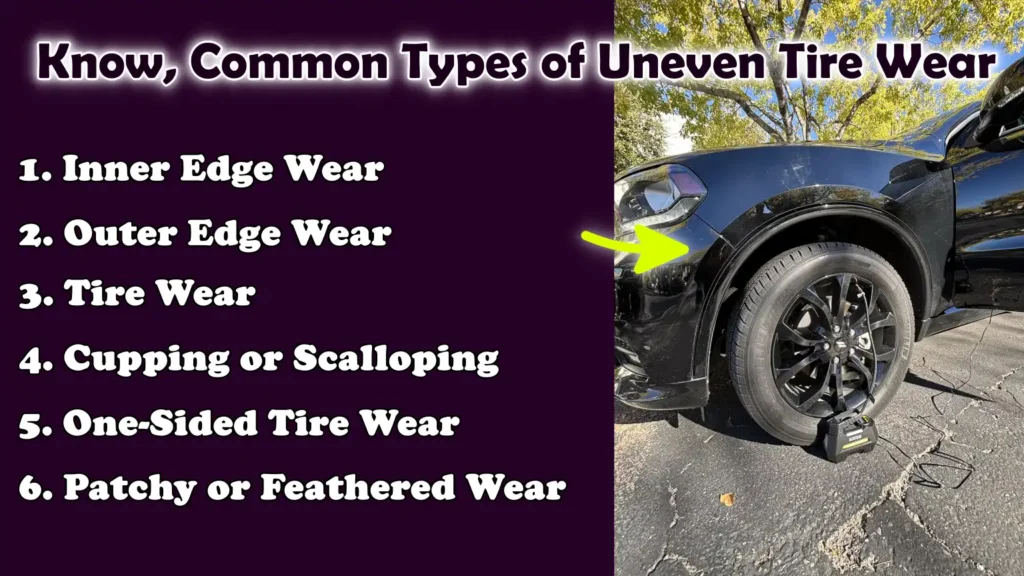
Uneven tire wear can appear in several different patterns and each pattern often indicates a specific problem with the vehicle.
Tires are designed to maintain balanced contact with the road so that the tread wears evenly over time.
When some areas of a tire begin to wear faster than others, it usually means something is affecting the way the tire touches the road surface.
Automotive safety experts and organizations like the National Highway Traffic Safety Administration say that tire wear patterns can reveal hidden problems related to alignment, suspension, tire pressure, or driving habits.
By carefully observing the tread patterns on your tires, you can often identify what type of problem is causing uneven wear.
Understanding these different types of wear helps drivers detect problems early, fix them correctly and avoid costly tire replacements.
1. Inner Edge Wear
Inner edge wear occurs when the inner edge of a tire’s tread wears significantly more than the rest of the tire.
This means that the part of the tire closest to the vehicle’s suspension system loses tread faster, while the outer edge still appears fairly normal.
This type of wear is usually caused by wheel alignment issues, specially when the wheel’s camber angle is incorrect.
Camber refers to the tilt of the wheel when viewed from the front of the vehicle.
If the top of the wheel tilts too much inward, the inner edge of the tire bears more weight and rubs more against the road surface.
Over time, this constant pressure causes the inner edge of the tire to wear faster.
Inner edge wear can also occur when suspension parts, such as control arms or bushings, wear out and change the wheel’s angle.
If this problem is not corrected promptly, the tire may no longer be safe to drive, even if most of the tread still appears usable.
2. Outer Edge Wear
Outer edge wear occurs when the outer edges of the tire tread wear faster than the center or inner edges.
This pattern often indicates that the tire is underinflated to the correct pressure.
When a tire is underinflated, more of the tire’s weight is distributed evenly across the tread surface.
Therefore, the tire edges come into greater contact with the road and wear faster.
Poor driving habits can also cause tire outer edge wear, specially when repeatedly making sharp turns at high speeds.
When a vehicle turns sharply, the outer edges of the tire experience greater pressure and friction on the road.
Over time, this repeated pressure can cause the outer edges of the tire to wear faster.
Inflating tires to the correct tire pressure recommended by the manufacturer distributes the vehicle’s weight evenly and prevents this type of wear.
3. Tire Wear
Tire wear occurs when the center of the tire becomes thinner than the outer edges.
This pattern is usually a clear sign that the tire has been overinflated for a long period of time.
When a tire is overinflated, the center of the tire expands outward and comes into contact with the road more than the edges.
Because the center of the tire bears most of the load, it wears faster, while the edges remain thicker.
Overinflation not only shortens tire life but can also result in a rough ride because the tire becomes less flexible.
Additionally, overinflated tires can lose traction on wet or slippery roads because less of the tire surface is touching the ground.
Maintaining the correct tire pressure recommended by the vehicle manufacturer ensures even tire wear across the entire tread.
4. Cupping or Scalloping
Cupping, sometimes called scalloping, is a type of uneven tire wear that causes small pits or raised areas to appear on the tread surface.
Instead of wearing smoothly, the tire moves up and down unevenly, creating a wavy pattern.
This type of wear is often caused by problems with the vehicle’s suspension system.
A worn shock or strut can cause the tire to bounce slightly while driving.
When this bouncing occurs repeatedly, the tire makes uneven contact with the road surface, gradually forming a cup-like pattern.
Drivers often notice cupping because it causes a humming or rumbling sound while driving, specially at high speeds.
If left untreated, cupped tires can cause vibrations that make driving difficult and reduce the tire’s overall performance.
5. One-Sided Tire Wear
One-Sided tire wear occurs when the inner or outer side of the tire wears faster than the other.
This pattern is usually associated with wheel alignment issues, particularly issues with the camber angle.
When the camber angle is not set correctly, the wheel can tilt too much inward or outward, causing more weight to be placed on one side of the tire than the other.
Due to this uneven pressure, the more heavily loaded side of the tire rubs more against the road and wears faster.
Over time, this imbalance can reduce the tire’s ability to maintain proper traction and stability.
One-Sided tire wear can also cause steering to feel less precise and cause the vehicle to drift slightly when driving straight.
Correcting the wheel alignment is usually necessary to prevent this type of wear from continuing.
6. Patchy or Feathered Wear
Patchy or feathered wear occurs when the edges of the tread blocks on a tire become uneven or feel rough to the touch.
Instead of wearing smoothly, the tread blocks form a pattern in which one edge becomes more pointed or raised than the other.
This condition is often caused by problems with the toe alignment of the wheels.
Toe alignment refers to the direction the tires point in relation to each other when viewed from above.
If the tires point slightly inward or outward, they rub against the road surface as the vehicle moves forward.
This constant sideways friction gradually wears the tread blocks unevenly and creates a feather-like pattern.
Drivers may notice that the tires make more noise on the road or feel rough to the touch against the tread surface.
Correcting toe alignment through a professional wheel alignment service usually helps prevent this wear pattern from worsening.
What Are The Main Causes of Uneven Tire Wear
Uneven tire wear typically occurs when something comes into contact with the road surface.
Tires are designed to carry the vehicle’s weight evenly and rotate smoothly, allowing tire parts to wear at a balanced rate.
When mechanical problems, poor maintenance, or driving conditions disrupt this balance, some parts of the tire experience more friction than others.
Over time, this increased pressure distorts the tire’s wear pattern, reducing tire life and impacting driving safety.
Automotive safety authorities like the National Highway Traffic Safety Administration state that proper tire maintenance is essential because tires impact braking performance, steering control and traction.
Uneven tire wear can reduce fuel efficiency, increase stopping distances and, if left unaddressed, increase the risk of tire failure.
Understanding the main causes of uneven tire wear helps drivers identify the problem early and take the right steps to ensure their tires wear evenly and safely.
1. Incorrect Tire Pressure
Incorrect tire pressure is one of the most common causes of uneven tire wear.
Every vehicle manufacturer recommends a specific tire pressure level so that the tire can properly support the weight while maintaining full contact with the road.
When tire pressure is too high or too low, the tire does not distribute the vehicle’s weight evenly across the tread surface.
This imbalance causes some parts of the tire to experience more friction than others, causing them to wear faster.
Regularly checking tire pressure and adjusting it according to the manufacturer’s advice is one of the easiest and most effective ways to prevent uneven tire wear and maintain optimal tire performance.
Overinflation occurs when a tire has more air pressure than the recommended pressure.
When this happens, the center of the tire rises slightly above the edges.
Because of this shape change, the center of the tire touches the road more than the edges.
As the vehicle moves, the center tread experiences more pressure and friction, causing it to wear faster than the rest of the tire.
Overinflated tires can also make the ride rougher because the tire becomes less flexible and absorbs less shock from the road.
Underinflation occurs when there isn’t enough air pressure inside the tire.
In this situation, the outer edges of the tire bear most of the vehicle’s weight as the tire flexes slightly inward.
This causes the edges of the tread to rub more against the road surface, while the center has less contact.
As a result, the edges wear faster than the center.
Underinflated tires can also generate more heat during driving, increasing rolling resistance and reducing fuel efficiency.
2. Poor Wheel Alignment
Wheel alignment refers to how the wheels are positioned in relation to the vehicle and the road.
Proper alignment ensures that all four tires are facing the correct direction and making balanced contact with the road surface.
When the alignment angles deviate from their correct setting, tires begin to wear unevenly because they are no longer rotating straight.
Even minor alignment errors can gradually create uneven wear patterns on the tire tread.
Professional wheel alignment services adjust the wheel angles to the manufacturer’s specifications and ensure even tire wear.
Camber problems occur when the wheels lean too much inward or outward when viewed from the front of the vehicle.
A little camber is normal, but excessive camber causes more weight to fall on one side of the tire than on the other.
If the top of the wheel tilts too much inward, the inner edge of the tire wears faster.
If it leans outward too much, the outer edge of the tire can wear out faster.
Toe misalignment occurs when the front of the tire leans slightly inward or outward instead of facing straight ahead.
When the toe angle is incorrect, the tires don’t glide smoothly on the road.
Instead, they rub slightly as the vehicle moves forward.
This side friction causes uneven tread wear, such as feathering or patchy wear.
Castor problems are related to the angle of the steering axis when viewed from the side of the vehicle.
Although caster doesn’t typically wear out tires as quickly as camber or toe problems, incorrect caster can affect steering stability and the way weight is distributed on the tires.
Over time, if the alignment remains incorrect, this imbalance can lead to uneven wear.
3. Suspension Problems
The suspension system is responsible for keeping the tires firmly attached to the road and absorbing shock from potholes and uneven surfaces.
When suspension components wear out or deteriorate, the tires can lose consistent contact with the road.
This can cause bounce, vibration, or irregular pressure on the tire surface, leading to uneven tread wear.
A good suspension system helps maintain proper tire alignment and ensures the vehicle remains stable during acceleration, braking and cornering.
Worn shock absorbers can cause the tires to bounce slightly when the vehicle travels over potholes or uneven roads.
When this bounce occurs repeatedly, the tire makes uneven contact with the road surface.
Over time, this repeated shock can cause irregular wear patterns, such as cupping or scalloping, on the tread.
Bad struts can also affect how tires interact with the road.
Struts are structural components that support a vehicle’s suspension and help maintain wheel alignment.
If a strut weakens or wears out, it can change the angle of the wheels and create uneven pressure on the tire surface.
Loose suspension parts, such as bushings, ball joints, or control arms, can cause the wheels to slide slightly while driving.
Even small movements can change the tire’s contact pattern with the road, gradually causing uneven tire tread wear.
4. Lack of Tire Rotation
Tire rotation is the process of rotating a vehicle’s tires so that they wear evenly over time.
In many vehicles, the front tires bear more weight and workload because they handle steering and often also carry the weight of the engine.
Because of this, the front tires typically wear faster than the rear tires.
If tires aren’t rotated regularly, this difference in workload can accelerate tire wear patterns.
Rotating tires at recommended intervals, typically every 5,000 to 8,000 miles, ensures even wear across all tires and increases their overall life.
Read More:
5. Driving Habits
Driving style also significantly impacts tire wear over time.
Some driving habits put more stress on tires, increasing the likelihood of uneven wear.
Gentle driving habits help protect tire tread and balance the wear pattern.
Sharp braking puts sudden pressure on the front tires, which can cause them to wear faster in certain areas.
Repeated hard braking can gradually create a rough pattern on the tire surface.
Sharp turns put more stress on the outer edges of the tires.
When drivers repeatedly turn at high speeds, the outer parts of the tires rub more against the road, causing the edges to wear faster.
Bumpy roads can also cause uneven tire wear because potholes, bumps and uneven surfaces exert sudden impact on the tires and suspension system.
These impacts can temporarily alter how the tire interacts with the road, gradually leading to an irregular wear pattern.
6. Poor Wheel Balancing
Wheel balancing ensures that the weight of the tire and wheel assembly is evenly distributed around the axle.
When a wheel is properly balanced, it rotates smoothly without vibration.
If the wheel is unbalanced, some parts of the tire become heavier than others.
When the tire rotates, this imbalance causes vibrations that can be felt through the steering wheel or the vehicle body.
Constant vibration creates uneven pressure across the tire surface and, over time, causes the tire’s wear pattern to become irregular.
Proper wheel balancing ensures smooth tire rotation, reduces vibration while driving and ensures even wear across the entire tread surface.
How to Detect Uneven Tire Wear
Detecting uneven tire wear is an essential step in maintaining vehicle safety, tire life and overall driving performance.
Tires are the only part of a vehicle that directly touches the road, so their condition provides valuable clues about the health of many other parts, such as alignment, suspension and tire pressure systems.
When uneven tire wear begins, it often appears gradually and many drivers don’t notice it until the problem becomes more serious.
Automotive safety authorities like the National Highway Traffic Safety Administration say regular tire inspections are essential because worn or damaged tires can reduce traction, increase braking distances and impact steering stability.
Early detection of tire wear allows drivers to correct minor maintenance problems before they escalate into costly repairs or unsafe driving conditions.
By carefully inspecting tires, measuring tread depth, checking pressure levels and evaluating suspension and alignment conditions, drivers can determine the root cause of uneven wear and take necessary steps to correct the problem.
1. Visual Inspection of Tires
Visual inspection is one of the easiest and most effective ways to detect uneven tire wear.
This process involves carefully examining the entire surface of the tire tread to see if there are any irregularities in the wear pattern.
When inspecting tires, it’s important to look at the inner edge, outer edge and center of the tread to see if the depth appears consistent across the entire surface.
Uneven tire wear is often indicated by patterns such as excessive wear on one side of the tire, patchy areas where tread is missing, or cup-like areas that create small depressions on the tread surface.
Drivers may also notice small cracks, cuts, or bulges that indicate structural damage to a tire.
By carefully comparing the condition of all four tires, it’s easier to identify whether the wear pattern is affecting just one tire or multiple tires on the vehicle.
Regular visual inspections help drivers detect early warning signs before tires become unsafe to use.
2. Measure Tread Depth
Measuring tread depth is another important step in detecting uneven tire wear because it provides a more accurate way to determine how much tread remains on different parts of the tire.
Tire tread depth is crucial for maintaining traction, specially on wet or slippery roads.
The grooves in the tire help drain water away from the contact surface so the tire can properly grip the road.
A tread depth gauge is a small measuring tool designed to measure the depth of the grooves on the tire surface.
When measuring tread depth, it’s important to check multiple parts of the tire, including the inner edge, middle edge and outer edge.
If there’s a significant difference in the measurements, it usually indicates uneven tire wear.
In many areas, when the tread depth drops below approximately 2/32 inches, a tire is considered unsafe because traction is significantly reduced.
Regularly measuring tread depth helps drivers understand how evenly their tires are wearing and when they may need to be replaced.
3. Check Tire Pressure
When uneven tire wear is detected, checking tire pressure is an important step, as improper pressure is one of the most common causes of abnormal tread patterns.
Every vehicle manufacturer specifies tire pressure levels to ensure that tires can properly support weight and maintain consistent contact with the road surface.
These recommended pressure values can usually be found in the vehicle’s owner’s manual or on a label inside the driver’s door frame.
When tire pressure is too high, the center of the tire wears out faster because it has more contact with the road.
When the pressure is too low, the outer edges of the tire bear more weight and wear out faster.
Using a reliable tire pressure gauge allows drivers to measure the air pressure inside each tire and compare it to the recommended value.
Maintaining proper tire pressure not only prevents tire wear but also improves fuel efficiency and overall driving safety.
4. Check Suspension Parts
When driving on different surfaces, the suspension system plays a crucial role in controlling how tires interact with the road.
When suspension parts become worn or damaged, they can affect the tire’s contact with the road and cause uneven tire wear patterns.
During a suspension check, the driver or technician inspects parts such as shocks, struts, control arms, bushings and ball joints to ensure they are functioning properly.
Worn shocks can cause a tire to bounce slightly after hitting a bump, resulting in a cupped or scalloped wear pattern on the tread surface.
Worn bushings or loose suspension joints can cause the wheel to move slightly out of position, causing uneven pressure on different parts of the tire.
Early identification of worn suspension parts helps restore proper tire contact and prevent further tire damage.
5. Check Wheel Alignment
Wheel alignment refers to the precise angle at which the wheels are positioned relative to the vehicle and the road surface.
Proper alignment ensures that all four tires are facing the correct direction and that the vehicle’s weight is evenly distributed.
When alignment angles, such as camber, toe, or caster, deviate from their intended range, tires begin to wear out because they are not traveling straight on the road.
Detecting alignment problems usually requires a professional inspection using specialized alignment equipment that measures wheel angles very precisely.
During an alignment check, technicians compare the current wheel angle to the manufacturer’s specifications and make adjustments if necessary.
Correcting alignment problems helps ensure that tires maintain balanced contact with the road surface, reducing tread wear and improving steering stability while driving.
How to Fix Uneven Tire Wear – Easy to Follow Steps
To fix uneven tire wear, it’s important to identify and correct the cause before the tire becomes unsafe.
Tires are designed to wear evenly across the tread to maintain strong grip, stable steering and reliable braking performance.
When wear is uneven, it’s usually a sign of a vehicle problem, such as tire pressure, alignment, suspension, or wheel balance.
Automotive safety experts, including the National Highway Traffic Safety Administration, say proper tire maintenance is crucial because tire condition directly impacts traction, stopping distance and vehicle control.
If uneven tire wear is detected early, the problem can often be corrected with simple maintenance steps, restoring proper tire contact with the road.
By adopting a systematic approach, drivers can identify the root cause of wear patterns, improve driving comfort and extend the life of their tires.
1. Check and Adjust Tire Pressure
Checking tire pressure is the first and most important step in correcting uneven tire wear, as incorrect pressure is a very common cause of irregular tread patterns.
Each vehicle manufacturer specifies a specific pressure level, measured in pounds per square inch, often referred to as PSI.
This recommended pressure ensures that the tires carry the vehicle’s weight evenly across the tread surface.
When the pressure is too high or too low, certain areas of the tire rub more against the road, leading to uneven tire wear over time.
To correct this problem, drivers should measure tire pressure using a reliable pressure gauge and compare the reading to the recommended value in the vehicle’s owner’s manual or on a label inside the driver’s door frame.
If the pressure is too low, carefully inflate the tire until it reaches the correct level.
If the pressure is too high, deflate the tire slightly to bring it back to the correct PSI.
Maintaining proper tire pressure not only ensures even wear but also improves fuel efficiency and driving stability.
2. Rotate Your Tires
Tire rotation is another important maintenance step that helps even out wear and prevent further damage.
In most vehicles, the front tires do more work because they carry more of the vehicle’s weight and are responsible for steering.
This extra workload causes the front tires to wear out faster than the rear tires.
Tire rotation involves moving the tires from one position to another on the vehicle so that each tire receives different workloads over time.
By distributing wear evenly across all four tires, rotation helps extend their life and maintain balanced traction.
Automotive experts generally recommend rotating tires every 5,000 to 8,000 miles, although the exact interval can vary depending on the vehicle type and driving conditions.
Regular rotation helps ensure that no tire is subjected to excessive stress for a long period of time, significantly reducing the risk of uneven wear patterns.
3. Get a Wheel Alignment
Wheel alignment plays a crucial role in ensuring that tires rotate straight and make balanced contact with the road.
When alignment angles deviate from their correct setting, tires begin to slide slightly on the road surface instead of rotating smoothly.
This sliding movement creates extra friction on certain parts of the tread, leading to uneven wear.
During a professional wheel alignment service, technicians use specialized equipment to measure and adjust three key alignment angles: camber, caster and toe.
Camber controls the inward or outward tilt of the wheel, toe determines the direction the tires are facing relative to each other and caster affects steering stability.
When these angles are adjusted to manufacturer specifications, tires distribute weight evenly across the tread surface.
Proper alignment not only corrects uneven tire wear but also improves steering precision and overall vehicle handling.
4. Balance the Wheels
Wheel balancing ensures that the tire and wheel assembly rotate smoothly and without vibration.
Even a slight weight imbalance can cause some parts of the tire to strike the road harder than others during rotation.
Over time, this repeated friction causes uneven tread wear and can cause noticeable vibrations in the steering wheel or vehicle body.
During a wheel balancing service, technicians use special machines to locate heavy spots in the wheel and then apply small balancing weights to correct the imbalance.
When a wheel is properly balanced, it rotates evenly and distributes pressure evenly across the tire surface.
This smooth rotation helps prevent wear from vibration and allows the tire tread to wear evenly throughout its lifespan.
5. Replace Worn Suspension Parts
The suspension system plays a vital role in keeping tires firmly attached to the road.
Parts like shocks, struts and control arms help absorb potholes and maintain proper wheel alignment.
When these parts wear out or deteriorate, tires can lose contact with the road surface.
For example, worn shocks can cause tires to bounce repeatedly after hitting a pothole, causing cupping or scalloped wear patterns on the tread.
Worn struts can change the wheel angle and apply uneven pressure to the tire surface.
Loose control arms or suspension joints can also cause the wheels to slip slightly while driving, increasing friction on certain areas of the tire.
Replacing worn suspension parts restores control to the wheels and ensures that the tires maintain contact with the road.
6. Replace Tires That Are Too Worn
In some situations, tire wear becomes so severe that it cannot be corrected with maintenance alone.
When the tread depth falls below a safe level or when the tire has significant structural damage, replacement becomes necessary.
Tire tread plays a vital role in providing traction by gripping the road and removing water from wet surfaces.
When the tread becomes too shallow, the tire loses its ability to maintain proper grip, increasing the risk of skidding or hydroplaning.
Many safety standards consider tires unsafe when the tread depth falls below approximately two-thirty-two inches.
If uneven wear has caused some areas of the tire to reach this limit, while other areas still have tread remaining, tire replacement is the safest option.
Installing new tires ensures that the vehicle regains proper traction, stability and braking performance on the road.
Effective Tire Rotation Patterns That Prevent Uneven Tire Wear
Tire rotation is one of the most effective maintenance methods for preventing uneven tire wear and extending tire life.
During normal driving, each tire on a vehicle experiences varying levels of stress depending on its position.
For example, the front tires often bear more weight because they support the engine and handle steering, while the rear tires may experience different forces during acceleration.
Because of these differences, tires do not wear at the same rate if they remain in the same position for a long time.
Automotive safety organizations like the National Highway Traffic Safety Administration emphasize that regular tire rotation helps distribute wear evenly across all four tires, improving traction, stability and overall driving safety.
Tire rotation also helps drivers get the most mileage out of their tires, which often ranges from forty thousand to sixty thousand miles, depending on the type of tire and driving conditions.
By following the correct rotation pattern based on the vehicle’s drivetrain and tire design, drivers can reduce tire wear and maintain consistent performance on the road.
1. Front-Wheel Drive Rotation Pattern
Front-wheel drive vehicles send engine power to the front wheels, which means the front tires perform several important functions simultaneously.
They carry most of the vehicle’s weight, handle steering and provide power to propel the vehicle.
Due to this increased workload, front tires typically wear out faster than rear tires.
A common rotation pattern for front-wheel drive vehicles involves rotating the front tires to the rear axle and then rotating the rear tires directly to the front axle.
This pattern helps balance wear because the tires that previously handled steering and power delivery are moved to areas where they experience less stress.
Over time, this redistribution of workload allows for more even wear across all four tires, improving the overall life of the tire set.
2. Rear-Wheel Drive Rotation Pattern
In rear-wheel drive vehicles, engine power is directed to the rear wheels rather than the front.
This means that the rear tires handle most of the acceleration force, while the front tires primarily handle steering and some of the vehicle’s weight.
Because the rear tires provide the driving force, they can wear faster than the front tires in many driving conditions.
A common rotation pattern for rear-wheel drive vehicles is to rotate the rear tires directly to the front axle, then the front tires directly to the rear axle.
This rotation pattern helps equalize the workload between the front and rear tires so that no single pair of tires wears out excessively over time.
3. All-Wheel Drive Rotation Patterns
All-wheel drive vehicles distribute engine power to all four wheels simultaneously, improving traction and stability in varying road conditions.
Even though power is shared between all wheels, tire wear cannot be uniform because each wheel may experience slightly different forces during cornering, braking and acceleration.
For this reason, regular tire rotation is specially important for all-wheel drive vehicles.
Many rotation patterns for these vehicles involve rotating the tires in a cross-sectional pattern so that each tire eventually occupies every tread area of the vehicle.
This method ensures that all tires receive consistent driving conditions over time.
Maintaining consistent tire wear is specially important in all-wheel drive systems, as significant variations in tire tread depth can put increased stress on drivetrain components.
4. Directional Tire Rotation
Some vehicles use directional tires, which are designed with a tread pattern that rotates in only one direction.
These tires often have arrows on their sidewalls indicating the correct direction of rotation.
Directional tread designs are typically used to improve water drainage and maintain better traction on wet roads.
Because these tires are designed to rotate in a specific direction, their rotation pattern differs from standard tires.
Instead of rotating sideways, directional tires typically rotate from front to back on the same side of the vehicle.
This means that the left front tire moves to the left rear position and the left rear tire moves to the left front position, while the same process occurs on the right side.
This rotation pattern helps the tire maintain its designed rotation direction and maintain even wear on the vehicle.
How Often Should Tire Wear Be Checked?
Regularly checking tire wear is crucial to vehicle maintenance, as tires directly impact safety, handling, braking performance and fuel efficiency.
Tires are constantly exposed to road friction, vehicle weight, temperature changes and changing driving conditions, gradually reducing tire tread depth over time.
If tire wear isn’t regularly monitored, minor issues like low tire pressure or alignment can gradually develop into serious uneven wear patterns.
Automotive safety authorities like the National Highway Traffic Safety Administration state that proper tire maintenance is crucial to preventing accidents, as worn tires reduce traction and increase braking distances, specially on wet or slippery roads.
By regularly checking tire wear and performing basic maintenance like rotation and alignment inspections, drivers can extend tire life, maintain better fuel economy and keep their vehicles safe and stable during daily driving.
1. Monthly Tire Inspection
Performing a monthly tire inspection is one of the easiest and most effective ways to monitor tire wear and detect problems early.
During this inspection, drivers should carefully examine the surface of each tire to check for uneven wear, cracks, bulges, or tread wear.
It’s also important to check the tread depth on different parts of the tire, such as the inner edge, center edge and outer edge, to ensure that the tread is wearing evenly.
Regular inspections help drivers recognize early warning signs, such as hairless spots, feathered edges, or cupping patterns, which may indicate alignment or suspension problems.
It’s also important to check tire pressure, as incorrect pressure can lead to uneven tire wear.
By performing this simple check once a month, drivers can quickly identify changes in tire condition and address potential problems before they become serious.
2. Tire Rotation Interval
Tire rotation should be performed at regular intervals to ensure that all tires wear evenly over time.
In most vehicles, the front tires bear more pressure because they bear more of the engine’s weight and handle steering forces.
Due to this increased workload, front tires often wear faster than rear tires.
As they rotate, tires shift their position on the vehicle, resulting in different driving forces on each tire over time.
Automotive experts generally recommend tire rotation every 5,000 to 8,000 miles, although the exact interval can vary depending on the type of vehicle, tire design and driving conditions.
Regular rotation ensures even wear of all four tires, extending their life and maintaining consistent traction and stability during driving.
3. Annual Alignment Check
Checking wheel alignment at least once a year is another important step in ensuring proper tire wear.
Wheel alignment refers to the angle at which the wheels are positioned relative to the vehicle and the road surface.
When this angle deviates from the manufacturer’s recommended setting, tires may begin to slide slightly on the road instead of rotating smoothly.
This slight sideways movement creates more friction on certain areas of the tread, leading to poor tire wear over time.
Annual alignment checks help ensure that the wheels are in the correct position so that the tires maintain balanced contact with the road.
If drivers notice symptoms such as sideways pulling, fluctuations in the tread pattern, or vibrations while driving, they may need an early alignment check.
Regular alignment inspections help prevent premature tire wear and provide better steering control and overall driving comfort.
How to Prevent Tire Wear
Preventing tire wear is much easier and cheaper than repairing tires after they’ve already worn out.
Tires are designed to wear slowly and evenly across the tread surface, ensuring strong grip, stable handling and reliable braking performance throughout their life.
However, factors like incorrect tire pressure, poor alignment, worn suspension parts and driving at high speeds can disrupt this balance, causing some parts of the tire to wear faster than others.
Uneven tire wear not only shortens tire life but can also reduce traction and increase the risk of accidents, specially on wet or slippery roads.
Automotive safety organizations like the National Highway Traffic Safety Administration emphasize the importance of regular tire maintenance because properly maintained tires improve vehicle control and help drivers respond more effectively during emergency braking or sudden steering changes.
By following a few simple maintenance methods and paying attention to driving habits, drivers can significantly reduce the risk of uneven tire wear and ensure the longevity of their tires.
1. Maintain Correct Tire Pressure
Maintaining correct tire pressure is one of the most important ways to ensure even tire wear.
Tires are designed to operate within a specific pressure range, allowing them to distribute the vehicle’s weight evenly across the tread surface.
When tire pressure is too low, more weight is placed on the outer edges of the tire, causing them to wear faster.
When pressure is too high, the center of the tire rises and rubs more against the road, causing the center tread to wear faster.
Regularly checking tire pressure with a reliable pressure gauge and adjusting it to the manufacturer’s recommended level helps ensure that tires maintain balanced contact with the road.
Correct pressure also improves fuel efficiency because properly inflated tires reduce rolling resistance and help the vehicle ride smoother.
2. Rotate Your Tires Regularly
Regularly rotating your tires is another important maintenance practice that helps prevent uneven wear.
Each tire on a vehicle experiences different levels of stress depending on its position.
Front tires often bear more weight and handle steering forces, while rear tires may experience more pressure during acceleration.
If tires remain in the same position for too long, these varying forces can cause some tires to wear faster than others.
Rotating tires allows them to adapt to different driving conditions over time.
Automotive experts generally recommend rotating tires every five thousand to eight thousand miles to maintain balanced tread wear.
This simple maintenance step helps distribute wear more evenly across all four tires and helps drivers get the most out of their tires.
3. Get a Wheel Alignment
Wheel alignment is essential for keeping tires in the correct position so they ride straight on the road surface.
Alignment refers to the angle at which the wheels are set in relation to the vehicle and the road surface.
If these angles are displaced from their correct range due to potholes, curb impacts, or normal suspension wear, the tires may begin to slide slightly to the side instead of rotating smoothly.
This sideways movement creates more friction on certain areas of the tire tread and gradually leads to an uneven wear pattern.
Regular alignment checks help ensure that camber, caster and toe angles remain within manufacturer specifications.
Proper alignment helps the tires distribute the vehicle’s weight evenly, improving steering precision and stability.
4. Periodically Balance the Wheels
Wheel balancing ensures that the tire and wheel assembly distribute weight evenly as the tire rotates.
Even slight imbalances can cause the wheel to rotate erratically, causing noticeable vibrations to the steering wheel or vehicle body.
Over time, this vibration exerts varying pressure on different parts of the tire tread, leading to irregular tire wear.
During a wheel balancing service, technicians use specialized equipment to locate heavy spots on the wheel and place small balancing weights to correct the imbalance.
Periodic wheel balancing ensures smooth tire rotation, reduces vibration and ensures even tread wear across the entire tire surface.
5. Avoid Fast Driving
Driving habits significantly impact how quickly tires wear and whether their wear pattern is consistent.
Fast driving, such as sudden acceleration, hard braking and sharp turns, puts more stress on tires and increases friction between the tires and the road surface.
Hard braking often causes excessive wear on the front tires, while sharp turns put more pressure on the outer edges of the tires.
Over time, this repeated pressure creates an uneven wear pattern, shortening tire life.
Driving comfortably, maintaining a consistent speed and slowing down gradually when braking or turning helps reduce unnecessary tire pressure and ensure even tread wear.
6. Maintain Suspension Parts
The suspension system plays a vital role in maintaining proper tire contact with the road surface.
Parts like shocks, struts, control arms and bushings help absorb road impact and keep the wheels properly aligned while driving.
When these parts wear out or become damaged, tires can lose contact with the road or bounce slightly when driving over potholes.
This uneven contact can create uneven pressure on different parts of the tire tread and cause patterns like cupping or scalloping.
Regular inspection and timely replacement of worn suspension parts ensures that tires remain stable and receive equal support.
A well-maintained suspension system not only prevents uneven tire wear but also improves driving comfort and vehicle handling.
When Uneven Tire Wear Becomes Dangerous
Plus, there’s research that shows that the uneven tire wear should never be ignored no matter what, as you need to practice tire maintenance practices such as: proper inflation, proper alignment and rotation of the tire time-to-time, but if these maintenance practices are ignored then it can lead to uneven tread patterns and increase the risk of the tire failure as well, that’s why you need to address this uneven tire wear quickly as it improves tire lifespan and also well maintained tires plays a critical role in preventing any possible road accidents and improves overall driving safety and experience as well.[¹]
Tire wear becomes dangerous when a tire loses its ability to maintain safe and consistent contact with the road.
Tires are designed with deep tread patterns that help grip the road surface and carry away water in wet conditions.
When tread wears unevenly, some areas of the tire can become much thinner than others, reducing the tire’s strength and traction.
This imbalance can affect how a vehicle accelerates, turns and stops.
Safety experts and transportation authorities like the National Highway Traffic Safety Administration say that worn or damaged tires are a major cause of many road accidents because they increase braking distances and reduce control, specially during sudden turns or in bad weather conditions.
When uneven tire wear reaches a critical stage, the tire can no longer provide reliable grip or structural stability.
Recognizing the warning signs of dangerous tire wear can help drivers take immediate action before a minor problem becomes a serious safety risk.
1. Bald Spots
Bald spots appear when some areas of the tire tread are completely worn away while others still have some tread depth remaining.
These smooth patches form when parts of the tire rub excessively against the road surface due to inadequate tire pressure.
When a bald spot develops, that area of the tire can no longer grip the road properly.
Tread grooves that normally help drain water from the tire are no longer there, increasing the risk of the tire skidding on wet roads.
Bald spots can also cause noticeable vibrations while driving because the tire surface is no longer uniform.
If a tire develops large bald spots, it becomes much less effective at maintaining traction, requiring tire replacement to restore safe driving conditions.
2. Structural Tire Damage
Structural tire damage occurs when proper wear weakens the inner parts of a tire that provide its strength.
Modern tires are made of multiple layers of rubber, steel belts and fabric materials that work together to support the vehicle’s weight and absorb road shock.
When improper wear causes the tire’s tread to become too thin, the inner layers can become exposed or weakened.
This can lead to visible problems such as cracks, bulges, or disjointed tread areas.
Structural damage often occurs gradually as the tire is subjected to stress from repeated driving, heat generation and road friction.
Once the tire’s internal structure is damaged, the tire will no longer be able to safely withstand normal driving forces, making replacement the safest option.
3. Risk of Tire Burst
Excessive tire wear can significantly increase the risk of a tire burst.
A tire blowout occurs when a crack in the tire’s structure causes a sudden loss of air pressure.
When certain parts of a tire are excessively worn, they may not be strong enough to withstand the pressure and heat generated by driving.
High speeds, heavy loads and hot weather can further stress already weakened parts of a tire.
If a weakened part becomes damaged while driving, the tire can suddenly burst, leading to a rapid loss of control.
Tire blowouts are specially dangerous on highways where vehicles travel at high speeds.
To avoid this danger, it’s important to replace tires before uneven wear becomes so severe that it compromises the tire’s structural strength.
4. Reduced Traction and Braking
Uneven tire wear also reduces traction and braking performance, which are essential for safe driving.
The tire tread creates friction between the tire and the road surface, allowing the vehicle to maintain control when accelerating, turning, or stopping.
When parts of the tread wear out or bend, the tire cannot grip the road properly.
This loss of traction is specially noticeable on wet, icy, or loose road surfaces, where tires rely heavily on the tread grooves to maintain contact with the road.
Reduced traction can cause the vehicle to skid on turns or lose stability under sudden braking.
Uneven wear can also increase stopping distances because the tires cannot generate the necessary friction levels for effective braking.
Maintaining healthy tire tread and replacing tires when wear becomes excessive helps ensure the vehicle continues to respond safely to normal and emergency driving situations.
Read More:
Know, The Cost of Fixing Uneven Tire Wear
Fixing uneven tire wear can involve a variety of maintenance or repairs, depending on the underlying cause.
Uneven tire wear isn’t usually a problem in itself, but it can be a sign that something else needs attention.
This could include improper wheel alignment, poor tire maintenance, worn suspension parts, or tires that are already so worn that they can no longer be safely used.
It’s important to address these problems quickly, as delaying repairs can lead to higher costs in the future.
Automotive safety authorities like the National Highway Traffic Safety Administration emphasize that regular tire maintenance is an essential part of vehicle safety, as properly maintained tires improve traction, braking ability and fuel efficiency.
The total cost of repairing uneven tire wear varies greatly depending on the type of vehicle, the severity of the wear and the repairs required to correct the actual problem.
Understanding these potential costs helps drivers better plan their maintenance and prevent minor issues from turning into costly repairs.
1. Wheel Alignment Cost
When uneven tire wear occurs, wheel alignment is one of the most common services required.
Alignment involves adjusting the wheel angles to the vehicle manufacturer’s specifications.
These angles control how the tires meet the road and how evenly they support the vehicle’s weight.
When tire alignment is impaired due to potholes, road bumps, or normal suspension wear, the tires may begin to wear slightly sideways while driving, gradually causing tread wear.
Professional alignment services use specialized equipment to measure camber, caster and toe angles and bring them into proper alignment.
The cost of a wheel alignment can vary depending on the vehicle type and service provider, but it is generally considered one of the most affordable tire wear repairs.
Regular alignment checks help prevent premature tire wear and improve steering accuracy and vehicle stability.
2. Tire Rotation Cost
Tire rotation is one of the simplest and most affordable maintenance services used to prevent and correct tire wear.
During tire rotation, tires are moved from one position on the vehicle to another so that each tire is subjected to different driving forces over time.
For example, front tires often wear faster because they bear more of the vehicle’s weight and handle steering.
Tire rotation gives each tire a chance to work in different positions, helping to balance this wear.
Tire rotation costs are generally low because they only require labor and basic supplies.
Many service centers include tire rotation in their regular maintenance packages.
Performing this service every 5,000 to 8,000 miles ensures that all tires wear evenly and reach their full lifespan.
3. Suspension Repair Cost
In some cases, uneven tire wear is caused by problems with the vehicle’s suspension system.
The suspension consists of parts such as shocks, struts, control arms, bushings and ball joints that help keep the tires firmly attached to the road and absorb potholes and vibrations.
When these parts wear out or become damaged, the tires may bounce slightly or move out of position while driving.
This uneven contact with the road can cause cupping, scalloping, or uneven wear along the edges.
The cost of repairing suspension parts depends on which parts need replacing and the complexity of the repair process.
Although suspension repairs can sometimes be more expensive than basic maintenance services, it’s important to address these issues because a faulty suspension system can damage even new tires if left uncorrected.
4. Tire Replacement Cost
If tires are excessively worn, it may be necessary to replace the affected tires.
Tires are designed with a set tread depth that gradually wears down as you drive.
When uneven wear causes some areas of the tire to become too thin while others still have tread, the tire may no longer be safe to use.
Many safety standards recommend replacing tires when the tread depth reaches approximately two to thirty-two inches, as traction is significantly reduced at that point.
Tire replacement costs depend on several factors, including tire size, brand, performance rating and whether the vehicle requires a specific tire design, such as all-season or performance tires.
While tire replacement can be a significant expense, it’s essential to maintaining proper traction, braking performance and overall vehicle safety.
Proper maintenance practices, such as correct tire pressure, regular rotation and alignment checks, can help drivers avoid premature tire replacement and long-term expenses.
When to Replace Tires Instead of Repairing Them
Sometimes, uneven tire wear can be corrected with maintenance steps like adjusting tire pressure, rotating the tires, or aligning the wheels.
However, there are situations when a tire is so damaged or worn that it cannot be safely repaired.
Tires are designed to provide strong traction, carry the vehicle’s weight and absorb driving forces.
When a tire becomes excessively worn or structurally damaged, it can lose its ability to safely perform these functions.
Safety organizations like the National Highway Traffic Safety Administration state that worn or damaged tires significantly increase the risk of accidents because they reduce traction and increase braking distances.
When certain warning signs appear, replacing tires becomes the safest option rather than continuing to drive on worn tires.
Understanding these conditions helps drivers make safe decisions and avoid dangerous road conditions.
1. Tread Depth Less Than the Safe Limit
Tread depth is one of the most important indicators of tire safety and performance.
Grooves in a tire’s tread help maintain grip on wet roads.
These grooves channel water away from the tire as it rubs against the road surface.
As tires are used over time, these grooves gradually become shallower due to normal wear.
When tread depth becomes too shallow, the tire cannot grip the road properly.
Many safety standards recommend replacing tires when the tread depth reaches approximately two to thirty-two inches, as traction is significantly reduced at this point.
Tires with too shallow a tread are more likely to skid on wet roads and are also at increased risk of hydroplaning, which occurs when a layer of water forms between the tire and the road surface.
If uneven wear causes some areas of the tire to reach this minimum tread depth while others still have tread, a tire replacement is usually necessary to maintain safe driving conditions.
2. Sidewall Damage
Sidewall damage is another condition that often requires tire replacement.
The sidewall is the outer part of the tire that connects the tread area to the wheel rim.
This part of the tire plays a vital role in supporting the vehicle’s weight and maintaining structural strength during driving.
If the sidewall is damaged by a cut, deep crack, bulge, or puncture, the tire’s internal structure may also be damaged.
Unlike tread damage, sidewall damage is rarely repairable because the sidewall must remain strong enough to maintain air pressure inside the tire and absorb road shock.
Driving on a tire with sidewall damage can be very dangerous because the weakened structure can suddenly fail, specially at high speeds.
Tire replacement ensures that the vehicle maintains the structural stability necessary for safe operation.
3. Severe Cupping or Patch Wear
Severe cupping or patch wear occurs when deep, rough pits or irregular wear patches form on the tire’s tread surface.
These patterns often form when suspension components, such as shocks or struts, wear out, causing the tire to bounce slightly while driving.
Because the tire repeatedly face uneven road surfaces, small areas of the tread can wear much faster than others.
Mild cupping can sometimes be corrected by rotating the tires and addressing suspension issues, but severe cases are usually beyond repair if the damage is extensive.
Tires with deep cupping or irregular patch wear can cause excessive vibrations while driving and can also make loud noises on the road because the tread surface is no longer smooth.
These rough surfaces also reduce the tire’s ability to maintain consistent grip on the road.
When cupping or patch wear becomes excessive, tire replacement is often the safest option to regain smooth driving and reliable road grip.
Conclusion – How to Fix Uneven Tire Wear
So, it’s not just an small issue to avoid them without inspection, as tires actually carry the entire weight of your vehicle, that’s why you need to maintain them in top condition; no matter the distance and anything at all.
Tires are designed to wear evenly throughout their lifespan to provide consistent traction, stable steering and reliable braking performance.
When some parts of a tire begin to wear faster than others, it’s usually a sign of internal problems, such as incorrect tire pressure, poor wheel alignment, worn suspension parts, or missed tire rotations.
If these problems are ignored, they can shorten tire life, reduce fuel efficiency and make driving less safe, specially during sudden braking or wet road conditions.
Understanding different tire wear patterns helps drivers identify problems early and take the right steps to correct them.
Simple maintenance practices like regularly checking tire pressure, rotating tires at recommended intervals, balancing wheels and maintaining proper alignment can make a significant difference in ensuring even tire wear over time.
These regular checks not only help prevent premature tire wear but also improve vehicle performance and driving comfort.
So, that’s it from this guide about How to Fix Uneven Tire Wear and now you can ask related questions regarding this.
Frequently Asked Questions
FAQ 1: Why do car tires wear unevenly?
Tires typically wear out when they aren’t in proper contact with the road surface. This can be due to a variety of reasons, such as incorrect tire pressure, poor wheel alignment, unbalanced wheels, worn suspension parts, or irregular tire rotation. When any of these problems occur, some parts of the tire bear more weight or experience more friction than others. Over time, those areas wear faster, leading to an uneven tread pattern. For example, low tire pressure often causes faster wear at the edges, while overinflated tires wear more in the center. Early detection of the underlying cause can prevent tires from wearing out too quickly.
FAQ 2: Can uneven tire wear be fixed?
In many cases, uneven tire wear can be corrected if the problem is detected early. Maintenance steps like adjusting tire pressure, rotating tires, balancing the wheels, or performing a wheel alignment can prevent further tread wear. However, if the tread is already significantly worn or has developed large bald spots, it may not be safe to continue using the tire. In this case, tire replacement becomes necessary. If a worn tire does need to be replaced, it’s important to determine the underlying cause to prevent the same problem with a new tire.
FAQ 3: How do I know if my tires aren’t wearing properly?
Drivers can usually tell if their tires are wearing properly by carefully examining the tire tread surface. If some areas of the tread appear much thinner than others, or if one area of the tire appears more worn than another, the tire is not wearing properly. Other warning signs may include vibrations in the steering wheel, strange road noises, or the vehicle pulling slightly to one side while driving. These symptoms often indicate that the tires are not wearing properly and may require attention to maintenance issues like alignment or suspension.
FAQ 4: How often should tires be rotated to prevent improper wear?
Most automotive experts recommend rotating tires approximately every 5,000 to 8,000 miles. Tire rotation involves moving the vehicle’s tires so that each tire experiences different driving forces over time. For example, front tires often wear faster because they handle the steering and carry more of the vehicle’s weight. By rotating tires regularly, drivers can distribute wear more evenly across all four tires. This method not only prevents uneven tread patterns but also helps extend tire life.
FAQ 5: Does wheel alignment fix uneven tire wear?
Wheel alignment can help prevent uneven tire wear from continuing, but it usually cannot fix already worn tread. Alignment adjusts the angle of the wheels so that they rotate straight and maintain balanced contact with the road. When the alignment is incorrect, the tires may wear slightly askew while driving, causing uneven friction on the tread. Once the alignment is corrected, the tires may begin to wear more evenly again. However, if the existing wear is excessive, the tires may need to be replaced even after the alignment is corrected.
FAQ 6: Is it safe to drive with uneven tire wear?
Driving with uneven tire wear can be risky, specially if the wear pattern becomes too extreme. Uneven tread reduces tire grip, which can increase stopping distances and make steering less stable. This problem becomes even more dangerous in wet weather because worn tread cannot properly remove water from the tire surface. In extreme cases, excessive uneven wear can weaken the tire’s structure and increase the risk of a tire blowout. For safety reasons, drivers should regularly inspect their tires and have any uneven wear repaired as soon as possible.
FAQ 7: How does tire pressure affect tire wear?
Tire pressure plays a vital role in ensuring that tires wear evenly over time. When tires are inflated to the correct pressure, the tread distributes the vehicle’s weight evenly across the road surface. If tire pressure is too low, more weight is placed on the outer edges of the tires, causing them to wear faster. If the pressure is too high, the center of the tire becomes more rounded and rubs more against the road. Both conditions result in uneven wear, which reduces tire life. Regularly checking tire pressure and maintaining the recommended pressure level ensures even tread wear and improves vehicle performance.
References:
[1] Tires, nhtsa.gov
https://www.nhtsa.gov/vehicle-safety/tires
Hello Folks, Dean Shali here to help you out to solve the problems with your lovely vehicle, as i have lots of experience and knowledge about automotive industry as i woks directly with the customers and repair vehicles and i love to help the people to keep their cars safe and running smoothly.