
Written By: Dean Shali
Fact Checked By: Sabré Cook
Reviewed By: Tamara Warren
Basically, modern cars won’t even start unless the key and the computer agrees it is safe to do so.
As, starting the engine is not longer just a mechanical thing, as it is a really secure digital handshake between yorur key fob and your car’s computer systems.
Even, most of the cars today actually uses an immobilizer system: which is basically built-in anti-theft technology which is designed to prevent the engine from starting unless it recognizes the correct key or key fob.
That’s why, inside of your key there’s small transponder chip that literally sends a unique code to a receiver near the ignition or start button and then the vehicle’s ECU or body control module has to verify this code within the milliseconds.
So, if anything interrupts this communication such as: weak key battery, a faulty antenna ring or a software mismatch, then the system blocks the engine completely.
That’s why, car cranks but refuses to start at all or sometimes not crank at all as well.
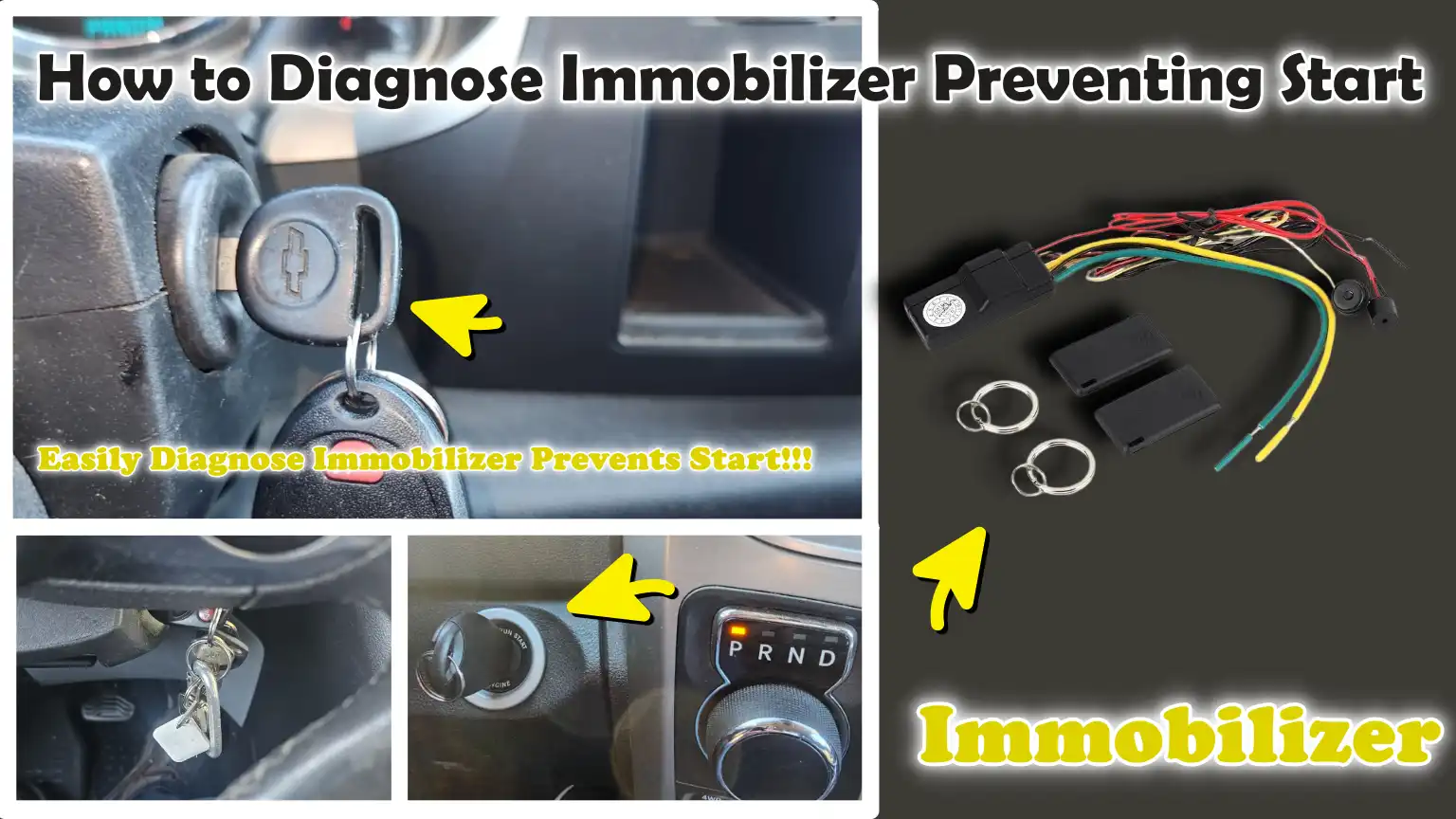
So, in this guide you’ll learn How to Diagnose Immobilizer Preventing Start, so that you can avoid unnecessary repairs and quickly identify whether the issue lies in the key, wiring or the control modules.
Now, Let’s Understand How the Immobilizer System Works
Modern vehicles utilize an immobilizer system to prevent theft.
This system prevents the engine from starting until the correct key is detected.
Unlike older cars, which relied primarily on mechanical keys, today’s vehicles employ electronic communication between the key and the car’s computer system.
If, for any reason, this communication fails, the vehicle may crank (make a starting sound) but will not start; or, in some cases, it may not even attempt to start.
Understanding how this system functions helps drivers identify the root cause of many perplexing issues related to a vehicle failing to start.
1. The Key’s Transponder Chip and Receiver Ring
Inside the car key or key fob lies a small transponder chip that stores a unique security code.
Surrounding the ignition switch or push-start button is a receiver ring, also known as the ignition antenna.
When the driver inserts the key or presses the start button, the receiver ring activates the transponder chip and reads its signal.
If the signal is weak, corrupted, or unreadable, the immobilizer system may prevent the engine from starting.
2. ECU or Body Control Module Verification Process
Once the receiver ring has read the key’s signal, this information is transmitted to the ECU (Engine Control Unit) or Body Control Module for verification.
These control modules store the security data for the authorized keys that have been programmed for that specific vehicle.
If the incoming code matches the stored information, the system permits the fuel supply and ignition systems to function normally.
If the code does not match, the vehicle deems the key unauthorized and prevents the engine from starting.
3. Signal Exchange/Handshake Between Key and Vehicle
The communication that takes place between the key and the vehicle is often referred to as a “signal handshake”.
The key transmits its unique identification code and the vehicle’s onboard computer verifies whether that code is valid.
This entire process is completed within a few seconds and typically goes unnoticed by the driver.
Modern systems utilize encrypted (secure) signals to ensure enhanced security; consequently, even a minor glitch in this communication link can disrupt the handshake and trigger issues related to the immobilizer system.
4. What Happens When Authentication Fails?
If the immobilizer system fails to recognize the key, the engine is typically disabled for security reasons.
In some vehicles, the engine may crank (make a starting sound) but fail to fire up, as the supply of fuel or spark is cut off.
In other vehicles, the starter motor may not engage at all.
Drivers often observe specific symptoms, such as a flashing security light, a “Key Not Detected” warning message, or the vehicle suddenly failing to start.
Common causes for such issues include a defective key, a weak key battery, a faulty antenna ring, a blown fuse, or communication errors between various control modules.
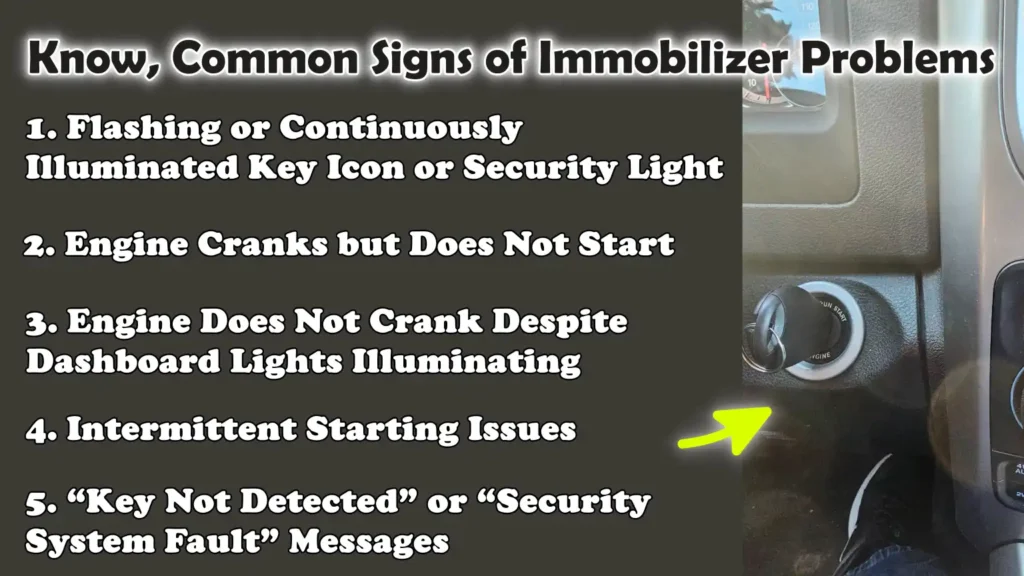
Know, Common Signs of Immobilizer Problems
Problems associated with the immobilizer often arise suddenly and can easily confuse drivers, as their symptoms closely resemble those of battery, starter, or ignition issues.
As the immobilizer system itself determines whether or not the engine will start, even a minor glitch in the communication between the key and the vehicle can completely halt the engine-starting process.
In many cases, the engine itself is mechanically sound; nevertheless, the security system prevents the fuel supply, ignition, or starter from functioning because it fails to properly recognize the key.
Recognizing these common warning signs can help drivers identify an immobilizer-related issue early on and avoid replacing components that are not actually defective.
1. Flashing or Continuously Illuminated Key Icon or Security Light
The most common sign of an immobilizer problem is a security light on the dashboard that either flashes continuously or remains constantly illuminated.
When the immobilizer system detects an issue, many vehicles display a key icon, a lock icon, or an anti-theft indicator.
Typically, this light turns off just a few seconds after the key is inserted or the start button is pressed.
If this light continues to flash or remains illuminated while attempting to start the vehicle, it often indicates that the system has failed to recognize the key or complete the security verification process.
This can be caused by a faulty transponder chip, a weak battery in the key fob, a defective ignition antenna, or a communication error within the control module.
2. Engine Cranks but Does Not Start
A very common symptom of an immobilizer problem is that the engine cranks normally but refuses to start.
In this scenario, the starter motor engages and the engine turns over; however, the immobilizer system cuts off fuel injection or the ignition spark to prevent the engine from running.
Many drivers mistakenly assume that the problem lies with the fuel pump or the ignition system, whereas a faulty immobilizer can produce symptoms that mimic these issues exactly.
If the security indicator light remains illuminated and the vehicle cranks vigorously, the immobilizer system should always be investigated as a potential cause.
3. Engine Does Not Crank Despite Dashboard Lights Illuminating
Occasionally, the immobilizer system completely prevents the starter motor from engaging.
In this situation, the dashboard lights, radio and other electrical accessories may function normally; however, when the key is turned or the start button is pressed, the engine fails to crank.
This occurs because the security system is blocking the starting sequence.
The vehicle’s battery may be fully charged, a factor that often confuses drivers, leading them to believe that the starter motor itself has failed.
In reality, the immobilizer system is likely simply disabling the starter relay or interrupting the ignition circuit.
4. Intermittent Starting Issues
Problems associated with the immobilizer are not always consistent and may manifest only sporadically.
Some vehicles may start perfectly fine one day but refuse to start the next, particularly if electrical connections are loose or internal components within the transponder system have begun to deteriorate.
These intermittent immobilizer issues are typically caused by low battery voltage, a faulty key chip, loose antenna wiring, or communication disruptions between the electronic control modules.
These issues may become more severe in cold weather, after replacing the battery, or when using a spare key that contains programming errors.
5. “Key Not Detected” or “Security System Fault” Messages
Modern vehicles often display warning messages directly on the dashboard or infotainment screen when the immobilizer system fails to verify the key.
Messages such as “Key Not Detected,” “Immobilizer Active,” or “Security System Fault” typically indicate that the vehicle is unable to communicate properly with the transponder chip embedded within the key.
In vehicles equipped with a push-button start system, this may occur if the key’s battery is low or if the vehicle’s antenna system is unable to properly detect the signal.
These warning messages are crucial, as they help narrow down the diagnosis of the problem to the security system, rather than attributing it to mechanical engine issues.
Know, What are the Immediate Checks to Diagnosis
Before testing expensive components or utilizing advanced diagnostic tools, it is essential to perform a few simple checks.
These checks help quickly identify the true cause of “no-start” issues related to the immobilizer system.
Many starting-related problems stem from minor oversights, weak signals, or safety systems designed to prevent the engine from starting under specific conditions.
Modern vehicles rely heavily on electronic communication; consequently, even a minor issue such as: using the wrong key or a faulty brake switch, as it can interrupt the vehicle’s starting process.
Performing these immediate checks first saves time, prevents unnecessary repairs and confirms whether the immobilizer system is, in fact, the root cause of the problem.
1. Verify That the Correct Key Is Being Used
The simplest, yet often overlooked, check is to ensure that you are using the correct key or key fob.
Modern vehicle keys contain a built-in transponder chip that is specifically programmed for that particular vehicle.
Even if a different key physically fits into the ignition, the immobilizer system will not allow the engine to start unless the electronic code matches.
Some drivers inadvertently attempt to use an unprogrammed spare key, a defective key, or a key from a different vehicle that appears visually identical.
If the immobilizer fails to recognize the transponder code, the engine may crank (turn over) but will not start, or the safety indicator light on the dashboard may remain illuminated.
2. Try a Spare Key or Backup Fob
Testing with a spare key or backup key fob is the quickest way to determine whether your primary key is defective.
The transponder chip embedded within the key can malfunction over time due to drops, exposure to water, excessive heat, or internal electronic faults.
In vehicles equipped with a push-button start, a weak key fob battery can also diminish signal strength, preventing the vehicle from communicating properly with the fob.
If the vehicle starts normally using the spare key, it indicates that the problem lies with your primary key, rather than with the immobilizer module.
This simple check can help you avoid unnecessarily replacing ignition components or electronic control modules.
3. Check if the Steering Lock is Engaged
Many vehicles feature an electronic or mechanical steering lock as part of their anti-theft system.
If the steering wheel becomes locked under tension, the ignition key may fail to turn properly, or, in systems featuring a start button, the starting mechanism may fail to activate.
This often occurs when the vehicle’s front wheels are sharply turned to one side just before the engine is shut off.
Gently turning the steering wheel left and right while turning the key or pressing the start button can sometimes disengage the lock, allowing the vehicle to start normally again.
In vehicles equipped with an electronic steering lock, a malfunction within the lock module itself can also lead to immobilizer-related starting issues.
4. Ensure the Gear Selector is in ‘Park’ or ‘Neutral’
Vehicles equipped with automatic transmissions feature a “neutral safety system,” which prevents the engine from starting unless the gear selector is positioned in ‘Park’ or ‘Neutral.
‘ If the transmission range sensor or shifter position sensor transmits incorrect data, the vehicle may appear completely dead, even if the battery and immobilizer systems are functioning correctly.
Sometimes, firmly engaging the shifter into ‘Park’ or attempting to start the vehicle while in ‘Neutral’ can help determine whether the issue lies with the immobilizer or the safety switch.
This is a crucial step, as symptoms of transmission-related safety issues often closely mimic those of an anti-theft system malfunction.
5. Verify that the Brake or Clutch Switch is Functioning
In many modern vehicles, depressing the brake pedal or clutch pedal is a prerequisite for starting the engine.
Push-button start systems typically rely on a brake pedal switch, whereas vehicles with manual transmissions often utilize a clutch safety switch.
If these switches fail or fail to properly detect pedal movement, the vehicle may refuse to start, even if the key has been correctly recognized.
Drivers may observe that the dashboard lights illuminate normally, yet nothing happens when the start button is pressed.
Checking whether the brake lights illuminate when the pedal is depressed can sometimes help quickly identify a faulty brake switch.
Although these safety switches may appear to be simple components, when they malfunction, people often misdiagnose the resulting issues as problems with the immobilizer or ignition system.
Know, How to Check Battery and Power-Related Diagnosis
Many issues related to the immobilizer and a vehicle’s failure to start are directly linked to a weak battery, unstable voltage, or interruptions in the power supply.
Modern immobilizer systems rely on constant electrical communication between the key, the ECU, the Body Control Module, the ignition system and various sensors.
Even if the engine itself is mechanically sound, low voltage can prevent these electronic systems from communicating effectively.
Therefore, battery and power-related checks should always be the first steps performed during the diagnostic process.
In many instances, a minor issue with the battery or a fuse can manifest symptoms that closely mimic those of a faulty immobilizer system.
1. Symptoms of a Weak Key Fob Battery
In modern vehicles equipped with push-button start systems, the most common cause of immobilizer communication issues is a weak Key Fob battery.
When the battery inside the Key Fob becomes weak, the signal transmitted to the vehicle may become unstable or too faint for the immobilizer system to consistently recognize.
Drivers may face issues such as delayed unlocking of the vehicle, reduced remote range, “Key Not Detected” warnings, or the need to press the start button multiple times to start the engine.
In some vehicles, the engine will only start if the Key Fob is held in very close proximity to the start button or the steering column.
Replacing the Key Fob battery is an inexpensive procedure and often resolves intermittent starting issues caused by a weak signal.
2. Checking Vehicle Battery Voltage
The vehicle’s main battery plays a crucial role in the operation of the immobilizer system, as all control modules rely on stable voltage to function correctly.
In most vehicles, a healthy battery should typically maintain a voltage of approximately 12.6 volts when the engine is switched off.
If the battery voltage drops too low, the ECU, BCM, or immobilizer module may fail to communicate effectively during the vehicle startup sequence.
Low voltage can trigger erroneous warning lights, generate spurious fault codes, or prevent the vehicle from starting altogether.
While cranking the engine, the battery voltage must remain robust enough to power the starter motor while simultaneously supporting the vehicle’s electronic systems.
A weak battery often manifests symptoms such as slow engine cranking, dimming dashboard lights, clicking sounds, or intermittent starting issues; these symptoms can easily be misdiagnosed as problems related to the immobilizer system.
3. The Impact of a Weak Battery on Immobilizer Communication
Modern immobilizer systems are highly sensitive to voltage fluctuations, as they rely on rapid electronic communication between multiple control modules.
If the battery voltage becomes unstable, the system may fail to complete the security verification “handshake” required between the ignition key and the vehicle’s onboard computer.
In some instances, the synchronization between the immobilizer and the ECU, or the Body Control Module, may be temporarily disrupted during the startup process.
The resulting symptoms may include a flashing security indicator light, the engine cranking but failing to start, or the starter motor becoming completely locked out.
Low-voltage issues tend to be more prevalent in cold weather, as low temperatures naturally reduce a battery’s power output capacity.
Older batteries may still possess sufficient power to operate accessories such as lights and the radio, but they often fail to provide the stable voltage levels required for the immobilizer system to function correctly.
4. Check Fuses Associated with the ECU, BCM and Ignition System
Fuses protect critical electrical circuits from overloads and are essential for the proper functioning of the immobilizer system.
If a fuse associated with the ECU, Body Control Module (BCM), ignition system, or immobilizer circuit blows, the vehicle may suddenly fail to start, even if the battery is fully charged.
The failure of certain fuses can disrupt communication between control modules, leading the immobilizer system to interpret the situation as a security breach.
Drivers may observe symptoms such as: the engine failing to crank, dashboard indicators malfunctioning, or the security light remaining continuously illuminated.
Checking the fuse box for faulty or blown fuses is a crucial diagnostic step, as a single defective fuse can render the entire starting system inoperative.
It is also vital to identify the root cause of the blown fuse; if underlying issues such as: faulty wiring or short circuits, are not rectified, the problem of recurring blown fuses may persist.
Inspect the Key Fob and Transponder
The key fob and transponder chip are among the most critical components of the immobilizer system, as they provide the necessary security codes required to start the engine.
If the vehicle fails to properly read or verify the key’s signal, the immobilizer system can completely disable the engine, even if the battery, starter and fuel system are functioning correctly.
In fact, many issues associated with the immobilizer system stem from a weak key fob battery, a faulty transponder chip, or a loss of communication between the key and the vehicle.
Carefully inspecting the key and its signal is often the quickest method for diagnosing the root cause of an engine no-start condition.
1. Key Fob Signal Check
The simplest way to assess the condition of a key fob is to test its lock and unlock functions.
If the buttons respond sluggishly, work only at close range, or operate intermittently, the key fob battery may be weak, or its internal electronic components may be malfunctioning.
In many modern vehicles, the immobilizer system and the remote locking system operate in tandem; consequently, a weak signal can adversely affect both systems.
Some vehicles may unlock normally but fail to start because the immobilizer system is unable to properly read the transponder signal.
Drivers should also inspect the key for external damage such as: cracks in the casing, moisture exposure, or worn-out buttons, as these issues can damage the internal circuit board and disrupt the signal transmission process.
2. Checking for a Faulty or De-programmed Transponder Chip
Most modern car keys contain a small, embedded transponder chip that stores a unique electronic security code; this code is specifically programmed for that particular vehicle.
This chip does not always rely on the key fob’s battery for power, as many systems utilize passive radio-frequency communication technology.
If the transponder chip malfunctions, is lost, or its programming is erased, the immobilizer system will reject the key and prevent the engine from starting.
Common symptoms include a flashing security light, the engine cranking but failing to start, or a “Key not recognized” message appearing on the dashboard.
Issues related to the transponder can stem from dropping the key, water damage, internal chip failure, or the use of an incorrectly programmed spare key.
In some instances, an aftermarket key may turn on the ignition, but the engine will fail to start because the transponder was never properly programmed.
3. How to Test Using a Second Programmed Key
Using a second programmed key is the most effective method for determining whether the issue lies with the key itself or with the vehicle’s immobilizer system.
If the engine starts easily with the second key, it indicates that the original key is defective, broken, or was not programmed correctly.
This simple test can save a significant amount of time during troubleshooting, as it immediately rules out potential faults in key components such as the ECU, ignition system and Body Control Module.
If the vehicle fails to start with both keys, and both exhibit the same warning symptoms, there is a very high probability that the problem lies with the immobilizer receiver, wiring, control module, or power supply.
It is crucial to use a properly programmed spare key, as unprogrammed duplicate keys will not function correctly with the immobilizer system.
4. Symptoms of Key Synchronization Failure
Modern immobilizer systems rely on synchronized communication between the key and the vehicle’s control module.
If this synchronization is disrupted, the vehicle may suddenly stop recognizing the key, even if the key exhibits no apparent external defects.
Common symptoms of this issue include intermittent failure to start, frequent “key not detected” messages, a flashing anti-theft indicator light, or the need to make multiple attempts to start the engine.
Synchronization glitches can occur following a battery replacement, module replacement, low-voltage conditions, software malfunctions, or incorrect programming procedures.
In some vehicles, the system may require a “re-learn” or “re-programming” procedure to re-establish communication between the key and the immobilizer module.
These issues are more prevalent in vehicles equipped with modern systems such as: “push-button start”, which utilize encrypted “rolling security codes” for theft prevention.
How to Inspect the Ignition Antenna or Reader Ring
The ignition antenna, also referred to as the reader ring or transponder antenna, is a critical component of the immobilizer system.
Its function is to recognize and read the security code stored within the key’s transponder chip.
Even if the key is fully functional, the vehicle will not recognize it until the antenna ring successfully captures its signal.
Many vehicle no-start issues linked to the immobilizer system are frequently caused by a faulty antenna ring, defective wiring, or loose electrical connections, rather than a malfunction of the key or the ECU.
As this component governs the initial stage of communication between the key and the vehicle, a thorough inspection of this part is essential for diagnosing immobilizer-related problems.
1. Location Surrounding the Ignition Cylinder or Push-Start Button
In vehicles utilizing a traditional key for ignition, the antenna ring is typically mounted directly around the ignition cylinder, the slot where the key is inserted.
Its purpose is to generate a small electromagnetic field that activates the transponder chip embedded within the key and reads its identification signal.
In vehicles equipped with a push-button start feature, the antenna system is often situated near the start button, on the steering column, inside the center console, or at another location within the cabin where it can easily capture the signal transmitted by the key fob.
Because these antennas are frequently hidden behind trim panels or steering column covers, many drivers remain completely unaware of their existence.
If the antenna fails to properly capture the key’s signal, the immobilizer system may prevent the engine from starting, even if you are using the correct key.
2. Symptoms of a Faulty Antenna Ring
A faulty antenna ring can manifest a variety of symptoms that closely resemble those of a defective key or immobilizer module.
One of the most common symptoms is the appearance of a “Key Not Detected” message, even when the key is physically present inside the vehicle.
In some vehicles, the engine may crank but fail to start; conversely, in others, pressing the start button or turning the ignition key may elicit no response whatsoever.
Drivers may also observe flashing security lights, experience intermittent difficulty in starting the vehicle, or face situations where the car will only start if the key is held in very close proximity to the ignition slot.
In certain instances, these issues may be exacerbated by cold weather or driving on rough terrain, as the internal connections within the antenna may become loose or unstable.
As the primary function of the antenna ring is to read the key’s signal, any malfunction in this component can result in a complete failure of the immobilizer system.
3. Loose Connectors or Broken Wiring
Loose electrical connections and broken wiring are very common causes of problems associated with the antenna ring.
The wiring surrounding the steering column or ignition area is subject to constant movement and vibration, which, over time, as it can cause connectors to weaken or their insulation to degrade.
Exposure to moisture, corrosion, heat, or previous repair work can also adversely affect these electrical connections.
If the antenna loses power or its communication link with the immobilizer module is severed, the key’s signal cannot be transmitted correctly.
This can lead to intermittent difficulties in starting the vehicle, a problem that is often challenging to diagnose, as its symptoms may appear and then suddenly vanish.
Inspecting the wiring harness for bent pins, loose plugs, damaged insulation, or corrosion often reveals the true root of the problem, thereby eliminating the need to replace expensive components.
4. Basic Resistance or Connection Checks
Basic electrical testing can help determine whether the antenna ring is functioning correctly.
Many antenna rings contain internal coils, the resistance of which can be measured using a multimeter.
If the reading indicates an “open circuit,” or if the resistance level significantly exceeds the manufacturer’s specified standards, it may suggest that the antenna has failed internally.
It is also crucial to verify that the antenna is receiving proper power and ground connections from the immobilizer system.
Loose ground connections or voltage drops can prevent the antenna from generating a signal strong enough to activate the transponder chip.
During the diagnostic process, technicians can also utilize a “scan tool” to verify whether the immobilizer module is correctly recognizing the key’s signal.
These simple electrical checks help distinguish antenna-related issues from faults involving the key, the ECU, or system programming.
How to Inspect the Steering Column and Ignition Switch
The steering column and ignition switch play a crucial role in the vehicle starting process, as they serve to bridge the input provided by the driver via the key with the vehicle’s electrical and security systems.
In many modern vehicles, the ignition switch performs functions far beyond merely cranking the engine; it also communicates with the immobilizer system, steering lock module, body control module and the ECU.
If the ignition switch or components within the steering column become faulty, the vehicle may fail to properly recognize the key or may interrupt the electrical signals necessary for starting.
The symptoms of these issues can easily manifest as if there were a malfunction in the immobilizer system, even if the key and security systems are functioning correctly.
1. Symptoms of a Worn Ignition Switch
Over time, due to constant use, ignition switches can wear out, particularly in high-mileage vehicles or those where the ignition key is attached to a heavy keychain.
The ignition switch contains internal electrical contacts responsible for routing power to various systems when the key is turned.
As these contacts degrade, the vehicle may occasionally struggle to start, experience a delay in cranking, or fail to start altogether.
Drivers may notice that the key feels loose, is difficult to turn, or requires being turned further than usual before the dashboard lights illuminate.
In some instances, if an internal electrical connection within the switch severs, the engine may suddenly shut off while the vehicle is in motion.
As the ignition switch operates in conjunction with the immobilizer system, worn contacts can disrupt communication, preventing the vehicle from successfully completing its security verification process.
2. Interruption in Electrical Signals Due to a Faulty Switch
Modern ignition systems rely on precise electrical signals to activate the functions of the starter motor, ECU, fuel system and immobilizer.
If the ignition switch develops an internal fault, these signals may become weak, unstable, or cease entirely.
Symptoms may include flickering dashboard lights, a loss of power to accessories while starting, or the engine failing to crank despite having a fully charged battery.
In some vehicles, security-related warnings may also appear, as the immobilizer module fails to receive the correct ignition signal required to start the engine.
Diagnosing an internal electrical fault within the switch can be quite challenging, as the problem often manifests intermittently.
Factors such as heat, vibration, or wear on internal contacts may cause the switch to function correctly one moment and fail the next.
3. Mechanical Issues Interfering with Key Recognition
Mechanical issues within the steering column or ignition cylinder can also disrupt the operation of the immobilizer system.
If the key does not fully insert into the ignition cylinder, fails to turn smoothly, or is not properly aligned, the antenna ring may struggle to read the signal from the transponder chip.
A worn ignition cylinder, a damaged key blade, a broken steering lock mechanism, or debris lodged inside the ignition housing, all of these factors can create communication issues between the key and the immobilizer system.
In some vehicles, excessive pressure applied to the steering wheel can cause the ignition mechanism to lock, thereby preventing the key from turning fully.
In vehicles equipped with a push-button start feature, the steering lock module may malfunction, preventing the vehicle from recognizing the key and, consequently, failing to start.
These mechanical issues often manifest as symptoms of a “no-start” condition, problems that appear to be electronic in nature, but are, in reality, caused by wear or alignment issues within the steering column system.
How to Use Scan Tools and Understand Diagnostic Trouble Codes – DTCs
Modern immobilizer systems are deeply integrated with the vehicle’s Electronic Control Unit (ECU).
This means that when a problem arises with starting the vehicle, the issue is often stored in the system’s memory as a Diagnostic Trouble Code (DTC).
Moving beyond mere guesswork, using an OBD2 scanner is the most reliable method for precisely understanding what the vehicle is detecting.
Unlike simple mechanical malfunctions, immobilizer-related issues often involve communication failures between modules such as the ECU, BCM and key recognition system.
A scan tool helps determine whether the vehicle is rejecting the key, losing communication, or facing voltage and network errors that are preventing it from starting.
This step is crucial because it translates invisible electronic faults into readable data, thereby facilitating an accurate diagnosis.
1. Using an OBD2 Scanner for Immobilizer-Related Codes
An OBD2 scanner connects to the vehicle’s diagnostic port and communicates with various control modules to retrieve stored error codes.
In immobilizer systems, these codes do not always appear solely within the engine ECU, as the root cause of the problem often lies within the Body Control Module (BCM) or the security module.
Many basic scanners read only engine codes; therefore, a more advanced scan tool is often required to access data from the BCM or the immobilizer system.
When the system detects an issue with key recognition or communication, it stores a fault code; this code helps identify whether the problem stems from a defective key, wiring, antenna ring, or control module.
Without a scanner, these faults may remain hidden, making the diagnostic process significantly more difficult.
2. Common Codes Such as P1260, B2799 and U-Codes
Trouble codes associated with the immobilizer vary by manufacturer; nevertheless, certain common patterns can be observed.
Codes such as P1260 are often linked to issues within the anti-theft system, while B2799 is frequently associated with key recognition or immobilizer malfunctions in specific vehicle brands.
U-codes, known as network communication codes, indicate that control modules are failing to communicate effectively with one another.
These codes do not always point to a single defective component; rather, they pinpoint where communication disruptions are occurring within the system.
As every manufacturer employs distinct programming standards, identical symptoms may trigger different codes across different vehicles; consequently, interpreting these codes becomes a critical component of the diagnostic process.
3. Understanding Faults in the BCM, ECU and Immobilizer Module
When a scan tool reports a fault related to the Body Control Module (BCM), Engine Control Unit (ECU), or immobilizer system, it generally signifies that one or more of these modules are unable to properly verify or exchange security-related data.
The BCM typically manages key recognition and the vehicle’s interior electronics, whereas the ECU governs engine operation and fuel delivery.
If communication between these modules is disrupted, the immobilizer system, acting as a security safeguard, may prevent the engine from starting.
Diagnosing these faults requires not only knowledge of the specific codes but also an understanding of the interdependencies between the various modules.
A malfunction in one module can trigger a cascading chain of errors throughout the entire system; Therefore, rather than focusing on a single code in isolation, scanning the entire system proves to be a far more effective diagnostic approach.
4. Checking Live Data for Key Recognition Status
In addition to reading stored trouble codes, advanced scan tools can also display live data from the immobilizer system.
This live data indicates whether or not the vehicle is properly recognizing the key in real time.
It can reveal whether the key is being accepted, rejected, or not recognized at all during an attempted vehicle start.
This is extremely helpful, as it allows the technician to observe exactly what is transpiring at the precise moment the vehicle fails to start.
If the live data indicates that the key is not being recognized, even when a valid and functional key has been inserted, it implies that the issue does not lie with the key itself, but rather with the antenna ring, wiring, or control module.
This real-time information significantly accelerates the diagnostic process and prevents the unnecessary replacement of components.
How to Inspect ECU and Body Control Module Issues
The ECU (Engine Control Unit) and Body Control Module (BCM) serve as the central computers in modern vehicles.
They manage the communication flow between the engine, security systems, key recognition systems and various other electrical functions.
Within the immobilizer system, these modules are responsible for verifying that the correct key is being used, thereby authorizing the engine to start.
When a fault develops in either of these modules, the vehicle may exhibit severe symptoms, most notably, a failure to start, even if the battery, starter motor and key (key fob) are functioning correctly.
Because these systems rely heavily on digital communication, even a minor glitch in the ECU or BCM can completely prevent the engine from starting.
1. Signs of Module Communication Failure
When communication fails between the ECU, BCM and the immobilizer system, the vehicle often displays multiple warning signs simultaneously.
The engine may crank but fail to start; the security indicator light may remain illuminated; or messages such as “Key Not Recognized” or “System Malfunction” may appear on the dashboard.
In some instances, a diagnostic scan tool may display various “U codes,” which indicate a loss of communication between the modules.
Electrical accessories may also behave erratically, for example, lights may flicker, or power supply may become intermittent.
These symptoms occur because the modules are unable to exchange the necessary security data required to start the engine.
2. Immobilizer Programming Glitches
The immobilizer system relies on stored digital data that links each authorized key to the vehicle’s ECU or BCM.
If an error occurs during this programming process, the system may no longer be able to recognize the correct keys.
This can be caused by software glitches, failed reprogramming attempts, low battery voltage during an update, or internal memory corruption within the control module.
When a programming error occurs, neither a functional key nor a properly working antenna ring will be able to resolve the issue, as the vehicle has lost its ability to verify the authentication data.
In such cases, the immobilizer system may deem all keys invalid, resulting in a complete “no-start” condition for the vehicle.
3. Water Damage or Electrical Surges
The ECU and BCM units are sensitive electronic components that can be damaged by water intrusion, moisture accumulation, or sudden electrical surges.
Water damage can lead to corrosion within the circuit boards, causing unstable communication or permanent failure of the module.
Electrical surges such as: those caused by improper jump-starting or sudden spikes in alternator voltage, as it can also damage the internal circuitry and memory storage.
When this occurs, the immobilizer system may behave erratically, manifesting as intermittent starting issues, difficulty recognizing keys, or a complete loss of communication with the engine control system.
If left undiagnosed, these faults often worsen over time.
4. When Reprogramming Is Required
Reprogramming or component replacement becomes necessary when the ECU or BCM is unable to properly store or process the immobilizer data.
This is often confirmed when multiple keys cease to function, communication errors persist even after checking the wiring and power supply, or diagnostic scan tools reveal a fault within the module.
Reprogramming involves resetting or rewriting security data so that the vehicle can once again correctly recognize authorized keys.
In some instances, it becomes necessary to install a new module and program it to synchronize with the vehicle’s immobilizer system.
This procedure typically requires specialized diagnostic equipment, as modern immobilizer systems utilize encrypted data that cannot be reset using standard tools.
How to Inspect Wire and Grounding
Electrical wiring and grounding play a crucial role in how the immobilizer system communicates with the key, the ECU and the Body Control Module.
Although these wires are hidden within the vehicle, they carry all the signals necessary for key recognition and engine starting.
If these circuits suffer from any faults, corrosion, or loose connections, the immobilizer system is unable to complete its communication process.
The symptoms of such issues can often be misleading; the vehicle may behave as if it has developed a major electronic malfunction, whereas, in reality, the problem lies solely within the wiring or grounding.
As immobilizer systems rely on stable and clean electrical signals, even the slightest interruption can prevent the engine from starting.
1. Damage to the Wiring Harness Near the Ignition Area
The wiring harness located near the ignition switch or steering column is one of the vehicle components subjected to the greatest mechanical stress; this is because it undergoes slight movement whenever the steering wheel is adjusted or the ignition key is turned.
Over time, this constant movement can cause the wires inside the harness to fray, break, or suffer damage to their insulation (outer casing).
When this occurs, the transmission of signals between the ignition switch, the antenna ring and the immobilizer module may become weak or cease entirely.
Drivers may experience intermittent difficulty in starting the vehicle, at times, it may start without any warning, while at other times, it may fail to start at all.
In some instances, internal wires may even snap, due to previous repairs or accidental pulling, even if no external damage is visible.
2. Corrosion on BCM or ECU Circuit Connectors
The connectors that link the wiring harness to the Body Control Module (BCM) or Engine Control Unit (ECU) are critical for the proper functioning of the immobilizer system.
If these connectors become corroded due to moisture, humidity, or water ingress into the vehicle, electrical signals may become unstable or cease entirely.
Corrosion accumulates on the metal pins within the connectors, increasing electrical resistance and preventing the accurate exchange of data between the modules.
Symptoms may include the vehicle failing to start, flickering dashboard lights, or the immobilizer system failing to recognize the correct key.
In many cases, simply cleaning or repairing the connector restores communication, thereby eliminating the need to replace any major components.
3. Intermittent Immobilizer Faults Caused by Poor Grounding
A proper ground connection is essential for every electronic system in the vehicle, including the immobilizer, ECU and BCM.
If a ground point becomes loose, corroded, or damaged, the system cannot receive the stable voltage required for reliable communication.
Poor grounding often leads to intermittent faults that are difficult to diagnose, as the vehicle may start correctly one moment but fail to start the next.
Drivers may also face a variety of simultaneous electrical issues, such as dimming lights, sudden warning messages, or dashboard malfunctions.
As the immobilizer system relies on precise voltage signals to verify key recognition, even a slight weakness in the ground connection can disrupt the entire starting sequence, potentially preventing the vehicle from starting at all.
How to Reset or Re-Learn the Immobilizer System
The immobilizer system is designed to safeguard the vehicle.
This system strictly regulates the communication occurring between the key, the ECU and the Body Control Module.
When this communication becomes unstable, due to low voltage, battery replacement, key-related issues, or module malfunctions, a procedure to reset or “re-learn” the system may be required.
This process helps re-establish proper synchronization between the key and the vehicle’s security system, thereby enabling the engine to start again.
However, it is crucial to understand that not all immobilizer-related issues can be resolved merely by a simple reset, as some problems stem from hardware failures, defective keys, or errors in module programming.
1. Resetting by Disconnecting the Battery – Limited Effectiveness
One of the simplest methods sometimes employed is to temporarily disconnect the vehicle’s battery to reset the electronic systems.
This can occasionally resolve minor communication glitches or temporary malfunctions within the ECU or Body Control Module.
When the battery is disconnected, the residual electrical charge stored in the vehicle dissipates; consequently, when power is restored, certain control modules are forced to reboot and restart.
However, this method has limited effectiveness in resolving immobilizer-related issues, as modern systems store security-related data in “non-volatile memory”, a type of memory that retains its information even when the battery is disconnected.
In many instances, the immobilizer-related problem persists even after power is restored, particularly if the root cause lies in key programming errors or a defective module.
2. Key Re-learn Procedures – Varying by Manufacturer
Many vehicles support a “key re-learn” or re-synchronization procedure, which allows the immobilizer system to re-establish communication with a valid key.
These procedures vary significantly depending on the manufacturer and model and may involve specific steps such as inserting the key, turning the ignition in a particular sequence, or utilizing onboard menus within the vehicle’s system.
Some vehicles permit manual key re-learn procedures, while others require a “scan tool” to initiate the process.
During the re-learn procedure, the vehicle re-verifies the “transponder chip” embedded within the key and updates its internal memory to ensure that the key is authorized.
This process is often required after a battery replacement, should synchronization be lost, or when a newly programmed key is being added to the system.
3. When Professional Programming is Required
In more severe cases, immobilizer-related issues cannot be resolved through simple resets or “re-learn” procedures alone; they necessitate the use of professional programming tools.
This process is typically required when data stored within the ECU, BCM, or immobilizer module has been lost or corrupted, or when a module has been completely replaced.
Professional tools are required to access secure, manufacturer-level software in order to reprogram keys, reset security data, or integrate new modules with the vehicle.
Without this level of programming, the immobilizer system will continue to prevent the engine from starting, as it is unable to properly authenticate.
Such situations often arise following module malfunctions, water damage, or failed programming attempts and specialized diagnostic tools are required to fully restore the system’s functionality.
So, When to Replace Components
Knowing when to replace parts of the immobilizer system is crucial, as many “no-start” issues stem from minor glitches that do not always necessitate expensive repairs.
The immobilizer system relies on seamless communication between the key, the ignition antenna, the ECU and the Body Control Module.
If any of these components fail completely, the vehicle will be unable to verify the key’s security code, thereby preventing the engine from starting.
However, component replacement should only be considered after basic checks such as: inspecting the battery’s condition, examining the wiring and running diagnostics with a scan tool, have been completed; this is because many symptoms that appear severe are, in reality, caused by weak signals or minor electrical issues.
Also, NHTSA shows that immobilizers have huge role in reducing the theft by electronically blocking the engine start without having the correct key authentication.[¹]
1. When to Replace the Key Fob
A key fob should be replaced when it consistently fails to transmit a proper signal, or when its internal transponder chip becomes damaged or ceases to function.
Common symptoms include: the vehicle failing to recognize the key even after the battery has been replaced; a significant reduction in the remote’s operating range or a lack of reliability; or the frequent appearance of a “Key Not Detected” message.
Physical damage such as: cracks in the casing, water exposure, or internal circuit damage, as it can also render the key fob unreliable.
In some instances, software glitches or voltage fluctuations occurring during a battery replacement can corrupt the key’s programming, rendering it permanently inoperable until it is reprogrammed.
If you possess a spare key that functions correctly while your primary key is not working properly, the appropriate solution is typically to replace or reprogram the faulty key.
2. When is it Necessary to Replace The Ignition Antenna?
The ignition antenna, also known as the reader ring, should be replaced when it consistently fails to recognize or communicate with a functioning key.
Symptoms of failure include: intermittent difficulty in starting the vehicle, the engine cranking but failing to start, or the vehicle only starting when the key is held in very close proximity to the ignition cylinder or push-to-start button.
If the associated wiring and connectors are in good condition, yet the system still struggles to recognize the key, the antenna ring itself may have failed internally.
Over time, internal coils can degrade due to heat, vibration, or electrical wear and tear, leading to instability in signal transmission.
If a resistance test or data from a diagnostic scan tool confirms that the antenna is unable to properly read the transponder signal, replacing the antenna often becomes necessary to restore the immobilizer system to proper working order.
3. Signs Indicating the Need to Replace the ECU or BCM
The ECU (Engine Control Unit) or BCM (Body Control Module) should only be replaced when there is clear evidence of an internal malfunction such as: persistent communication errors, corrupted immobilizer data, or a complete failure to recognize the key, even when using known-good components.
Symptoms may include the simultaneous failure of multiple keys, diagnostic scan tools indicating internal faults within the module, or the appearance of “U-codes”, which signal a disruption in communication between modules.
These are issues that cannot be resolved through simple wiring repairs or system reset procedures.
Water damage, electrical surges, or failed programming attempts can permanently damage these modules, rendering them unable to properly store or process immobilizer data.
When a module requires replacement, the new module must be correctly programmed and synchronized with the vehicle’s immobilizer system; without proper programming, the vehicle will continue to prevent the engine from starting as a security measure.
Read More:
Conclusion – How to Diagnose Immobilizer Preventing Start
Basically, a modern car will only start when every electronic checkpoint confirms that the key is truly authorized and the just a broken link in that chain of electronic communication can totally ruin this starting engine process.
The most crucial point to understand is that this system is not designed to malfunction arbitrarily; rather, its purpose is to prevent the engine from starting whenever it fails to recognize the correct key or when communication between the electronic modules is interrupted.
This implies that the root cause is typically not a mechanical fault within the engine itself, but rather a disruption somewhere within the security system’s operational workflow such as: a glitch in the signal, power supply, wiring, or programming.
By conducting a logical and systematic diagnosis, beginning with an inspection of simple components like the key, battery and fuses and then progressively analyzing scan tool data, antenna functionality, wiring integrity and inter-module communication, most immobilizer-related problems can be accurately pinpointed without resorting to guesswork.
Fundamentally, every component of the system relies on stable voltage and clean electrical connections; consequently, even a minor fault can completely halt the entire engine-starting process.
Now, that’s all from this guide and you can comment down below for more related information.
Frequently Asked Questions
FAQ 1: Why won’t my car start, even though the battery is fine?
Answer: If your battery is fully charged yet the car still won’t start, the immobilizer system may be blocking the engine. This typically occurs when the vehicle fails to properly recognize the key, or when the “security handshake”, the communication protocol between the key, the ECU and the Body Control Module, as it cannot be successfully completed. Even with a healthy battery, a weak signal from the key, a faulty antenna ring, or a communication glitch between the modules can completely halt the car’s starting process.
FAQ 2: What are the most common symptoms of an immobilizer malfunction?
Answer: The most common symptoms include the security light on the dashboard flashing or remaining continuously illuminated, a “Key Not Detected” message appearing, the engine cranking but failing to start, or, in some cases, the engine failing to crank at all, even if the lights and electronics are functioning normally. These symptoms manifest because the immobilizer system is either unable to recognize the key or is unable to complete the necessary authentication process required to start the engine.
FAQ 3: Can a weak key battery prevent the car from starting?
Answer: Yes, a weak key battery can certainly cause starting issues in vehicles equipped with push-button start or keyless entry systems. When the battery inside the key fob runs low, the signal transmitted to the vehicle may become so weak or erratic that the immobilizer system is unable to read it correctly. In many cases, simply replacing the key battery provides a quick and easy solution to intermittent issues such as the “Key Not Detected” error.
References:
[1] Vehicle Theft Prevention
https://www.nhtsa.gov/vehicle-safety/vehicle-theft-prevention

Hello Folks, Dean Shali here to help you out to solve the problems with your lovely vehicle, as i have lots of experience and knowledge about automotive industry as i woks directly with the customers and repair vehicles and i love to help the people to keep their cars safe and running smoothly.