
Written By: Dean Shali
Fact Checked By: Sabré Cook
Reviewed By: Tamara Warren
That small looking ABS light is the real safety hazard, as it could literally be the difference between having safe braking or losing control in an emergency braking condition.
Yes, it is the critical indicator from your car’s Anti-Lock Braking System: which is a safety feature which is literally designed to prevent wheel lock-up during the sudden braking and that’s how it helps you to maintain steering control and have successful braking without any wrong deeds.
Now-a-days, modern vehicles actually relies on the ABS sensors, electronic control modules and hydraulic systems working together in real time, that often makes hundreds of adjustments per seconds just to keep your car really stable specifically on the wet, slippery or uneven roads.
But, the thing is: whenever this light turns on, then it usually means that the system actually detected a fault such as: malfunctioning wheel speed sensor, low brake fluid, wiring issues or having a problem with the ABS module itself as well.
Plus, there’s studies and automotive safety reports that have consistently shown that ABS can significantly reduces the risk of skidding and that actually improves control during the emergency braking situations, that’s why you should be do such huge mistake to ignore this real warning.
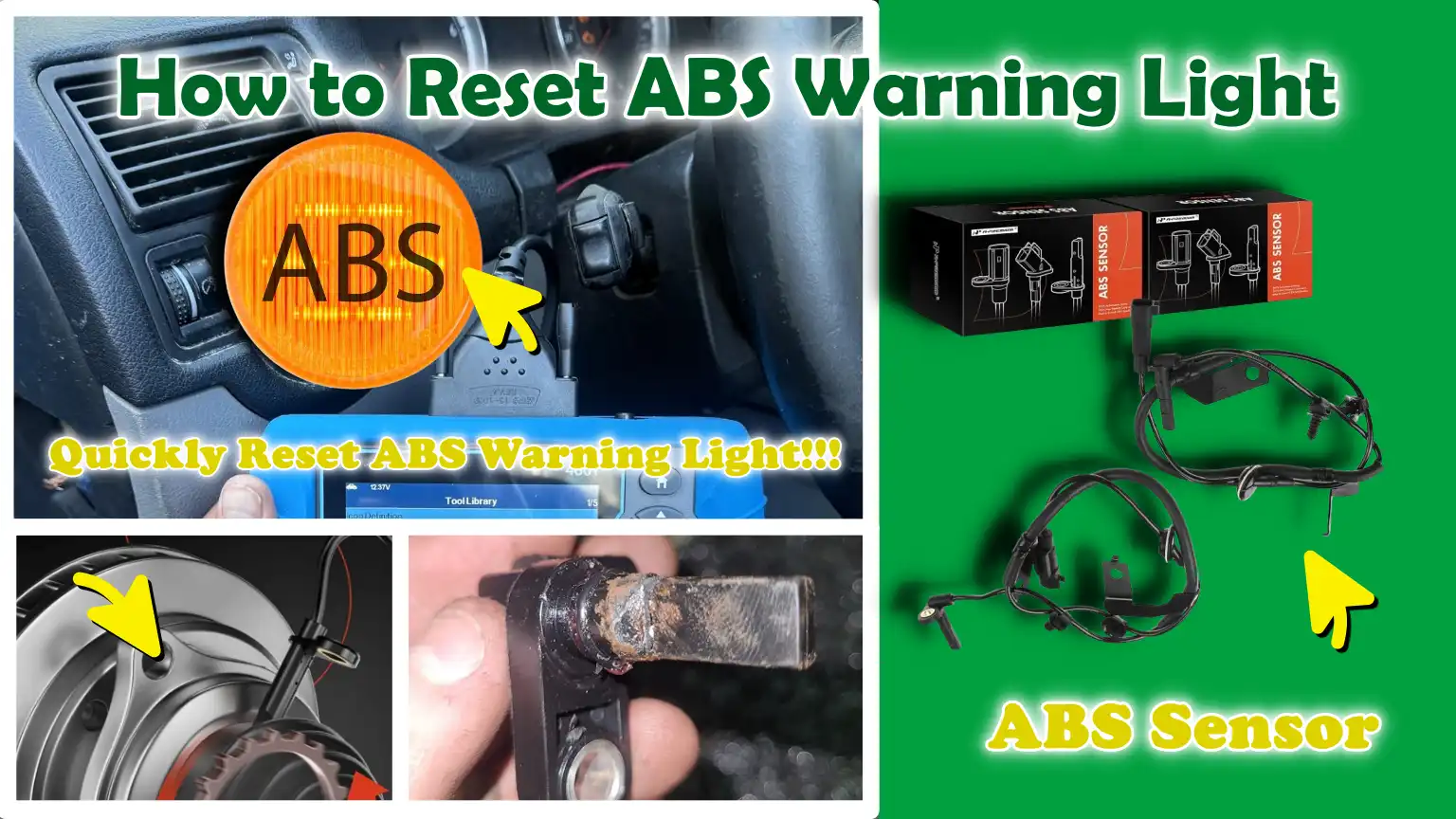
So, with this guide on How to Reset ABS Warning Light, you’ll learn to identify common symptoms, understand what actually triggering the ABS light and then fix it with safe and easy to follow method.
Understand, What is the ABS System in a Car?
The Anti-lock Braking System, commonly referred to as ABS, is an advanced safety feature installed in most modern vehicles.
It helps prevent the wheels from locking up during rapid or sudden braking.
Simply put, it assists the driver in maintaining steering control of the vehicle even while braking, ensuring that the tires do not skid across the road surface.
This system utilizes a combination of electronic sensors, a control unit and hydraulic components to monitor and regulate the behavior of each wheel during braking.
ABS proves particularly invaluable in emergency situations where both bringing the vehicle to a rapid halt and maintaining control over it are equally critical.
1. Definition of the Anti-lock Braking System
The Anti-lock Braking System is a safety technology designed to prevent the wheels from locking up completely during hard braking.
When wheels lock up, the tires lose their grip on the road surface, potentially causing the car to skid uncontrollably.
ABS prevents this by automatically adjusting the brake pressure multiple times per second, thereby ensuring that the wheels continue to rotate just enough to maintain traction with the road.
This makes it easier for the driver to steer around obstacles while braking, thereby eliminating the risk of losing control due to skidding.
2. How It Works – The Basics
ABS operates through a network of sensors that monitor wheel speed.
These sensors continuously track how fast each individual wheel is rotating.
If the system detects that one or more wheels are about to suddenly stop rotating while the vehicle is still in motion, it immediately modulates the brake pressure applied to those specific wheels, rapidly releasing and then re-applying it.
This process occurs very rapidly, often multiple times within a single second and is controlled by the ABS’s Electronic Control Module.
During this process, the driver may feel a slight vibration or pulsation in the brake pedal; this is entirely normal and serves as an indication that the system is actively working to maintain the vehicle’s control and stability.
3. Its Importance for Safety and Control
The significance of ABS lies in its ability to enhance both safety and vehicle control during braking.
Without ABS, sudden or forceful braking can cause the wheels to lock up, thereby increasing the risk of skidding and losing steering control, particularly on wet, icy, or loose surfaces, such as gravel.
With the aid of ABS, drivers can maintain control over the vehicle even while braking, thereby significantly reducing the likelihood of accidents in emergency situations.
Research in automotive safety has demonstrated that vehicles equipped with ABS are more effective at maintaining stability and avoiding obstacles during sudden stops.
Although ABS does not always reduce the vehicle’s stopping distance on every type of surface, it plays a crucial role in enabling the driver to maintain control over the vehicle, a factor that often proves decisive in preventing collisions.
Know, Common Causes for the ABS Light Illuminating
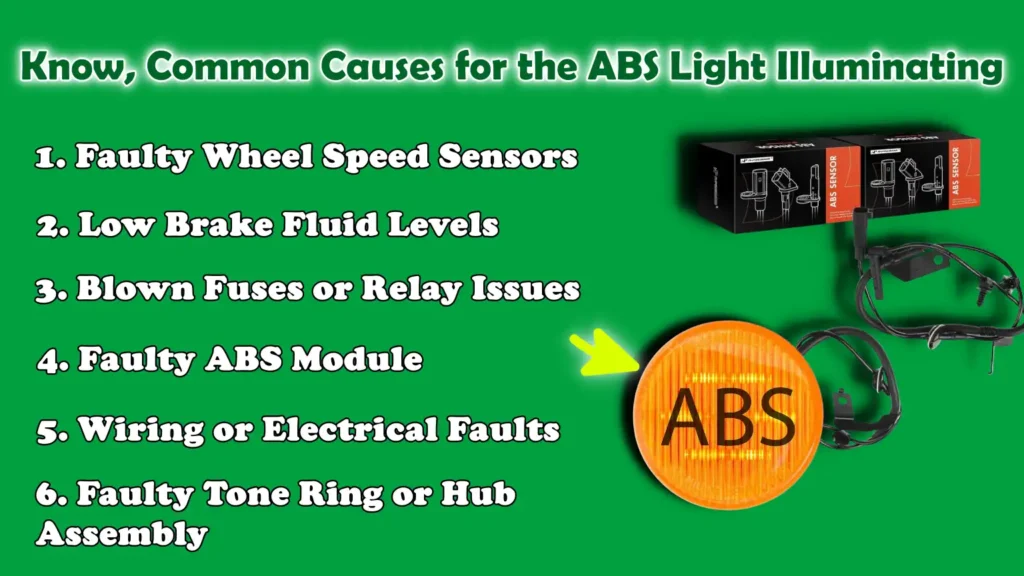
The ABS warning light typically illuminates when the system detects a fault that could potentially compromise your vehicle’s traction and braking control.
The Anti-lock Braking System continuously monitors wheel speed, brake pressure and electrical signals through a network of sensors and modules; even a minor malfunction in any of these components can trigger the warning light.
In many instances, the issue does not lie within the brakes themselves, but rather in the electronic or sensor-based components that facilitate the ABS’s operation.
Identifying the precise cause is crucial, as each specific problem requires a distinct solution; simply resetting the light, without rectifying the underlying issue, will not restore the system to proper working order.
1. Faulty Wheel Speed Sensors
One of the most common reasons for the ABS light to turn on is a faulty wheel speed sensor.
These sensors are mounted near each wheel and are responsible for measuring the rotational speed of the wheels.
If a sensor becomes dirty, malfunctions, or ceases transmitting accurate data, the ABS system is unable to correctly determine the wheel’s speed.
This can occur due to road debris, corrosion, or general wear and tear over time.
When the system receives erroneous readings, it disables the ABS as a safety precaution and activates the warning light.
2. Low Brake Fluid Levels
Low brake fluid levels are another common cause for the ABS warning light to illuminate.
Brake fluid is essential for generating the hydraulic pressure required to apply the brakes effectively.
If the fluid level drops below the recommended threshold, it can adversely affect the performance of both the standard braking system and the ABS.
This may result from leaks, worn brake pads, or a lack of proper maintenance.
When the fluid level drops, the system may fail to maintain the necessary pressure, causing a warning indicator to illuminate on the dashboard.
3. Blown Fuses or Relay Issues
The ABS system relies on electrical power to operate its sensors, control module and pump.
A blown fuse or a faulty relay can interrupt the power supply to these components, causing the system to cease functioning correctly.
Fuses may blow due to sudden power surges or simply due to aging, while relays can fail over time due to exposure to heat and repeated use.
When this occurs, the ABS system shuts down completely and a warning light illuminates to signal the malfunction.
4. Faulty ABS Module
The ABS control module acts as the “brain” of the entire system; it processes data received from the sensors and regulates brake pressure as needed.
If this module malfunctions or fails to operate correctly, it can lead to erroneous decisions or cause the entire system to fail.
Such malfunctions can stem from internal electronic glitches, exposure to excessive heat, or water intrusion.
A faulty ABS module often causes the warning light to remain continuously illuminated and can also adversely affect other interconnected systems.
5. Wiring or Electrical Faults
Another major cause for the ABS light illuminating is wiring-related issues.
The system relies on a network of wires and connectors to transmit signals between the sensors and the control module.
Over time, exposure to vibration, heat, or moisture can cause these wires to become loose, corroded, or damaged.
Even a minor interruption in the circuit can disrupt communication, prompting the system to detect a fault and trigger the warning light.
6. Faulty Tone Ring or Hub Assembly
The tone ring, also known as the reluctor ring, works in conjunction with the wheel speed sensors to measure the rotational speed of the wheel.
It is typically attached to the wheel hub or axle and features evenly spaced teeth or notches that assist the sensor in accurately reading the wheel’s speed.
If the tone ring cracks, becomes worn, or accumulates dust and rust, it may transmit erroneous signals to the ABS system.
In some vehicles, the tone ring constitutes an integral part of the wheel hub assembly; consequently, any internal defect within the hub can also impact the sensor’s readings.
Such anomalies in the data trigger the illumination of the ABS warning light.
Can You Reset the ABS Light Without Fixing the Problem?
Yes, in many vehicles, it is possible to reset the ABS warning light by using a scan tool or by disconnecting the battery; however, doing so, without addressing the underlying issue, does not restore the system’s ability to keep you safe during braking.
The ABS system is designed to disable its advanced functions whenever it detects a malfunction; therefore, even if the warning light turns off, the safety features may not be operational.
This means your car will likely brake just like an older vehicle, without anti-lock protection specially during sudden stops or on slippery roads.
Resetting the light merely removes the warning signal from the dashboard; it does not erase the fault codes stored in the system’s memory, nor does it resolve the actual mechanical problem that triggered the warning.
1. Why Resetting Alone Is Not a Real Solution
Resetting the ABS light without fixing the underlying problem is merely a temporary workaround, as it does not resolve the root cause of the system failure.
The ABS control module constantly monitors inputs from sensors, fluid levels and electrical connections; if it detects the same malfunction again, it will immediately disable the system and reactivate the warning light.
For instance, if a wheel speed sensor is defective or transmitting incorrect data, simply clearing the fault code will not magically repair the sensor or restore its functionality.
Simply put, resetting the light is akin to silencing a warning alarm without addressing the specific danger that triggered it, meaning the actual threat still persists.
2. When Will the Light Come Back On?
If the underlying problem remains unresolved, the ABS warning light will typically come back on very quickly.
In some instances, the light may illuminate again immediately upon restarting the vehicle, as the system performs a self-diagnostic check every time the ignition is switched on.
In other cases, the light may remain off for a while, only to light up once the vehicle begins moving and the sensors start transmitting data.
The exact timing depends on the specific nature of the fault; however, the most crucial point to understand is that the system will not overlook a genuine issue.
As soon as it detects a recurring malfunction, it will reactivate the warning indicator to alert the driver.
3. The Importance of Proper Diagnosis
Before attempting to reset the ABS light, proper diagnosis is the most critical step, as it helps pinpoint the root cause of the problem.
By utilizing an OBD scanner capable of reading ABS codes, you can identify specific error codes related to sensors, control modules, or electrical faults.
Armed with this information, resolving the issue becomes significantly easier, rather than relying on guesswork or replacing parts unnecessarily.
Accurate diagnosis not only saves time and money but also ensures that the ABS system functions exactly as intended, precisely when you need it most.
A properly functioning ABS system plays a vital role in maintaining vehicle control and minimizing the risk of accidents; therefore, prior to resetting the warning light, one should always prioritize rectifying the underlying cause of the problem.
Tools
| Tool Name | Why It Is Needed | How to Use It |
|---|---|---|
| OBD-II Scanner | By displaying fault codes stored within the system, this tool helps you pinpoint the exact cause behind an illuminated ABS light. | Plug the scanner into the OBD port (typically located beneath the dashboard), turn on the ignition, follow the on-screen instructions to read the ABS codes and use the ‘Clear’ option only once the underlying issue has been resolved. |
| Basic Tool Kit – Wrench, Screwdriver | When troubleshooting, these tools are essential for accessing components such as sensors, battery terminals, or the fuse box. | Use a wrench to loosen or tighten bolts (such as those on the battery terminals) and use a screwdriver to open covers or carefully remove components without causing damage. |
| Multimeter – Truly Optional | This tool helps verify whether wires, sensors, or connections are functioning correctly, particularly in the event of an electrical fault. | Set the multimeter to the appropriate mode (e.g., voltage or resistance), connect the probes to the component you wish to test and check the readings to ensure they fall within the normal operating range. |
| Owner’s Manual | Depending on your vehicle’s make and model, this resource helps you locate specific details such as: the fuse box, ABS components and fluid requirements. | Refer to the ABS section or the index within the manual to find relevant diagrams and instructions and follow the recommended steps and specifications specific to your particular car model. |
How to Reset the ABS Warning Light – Easy But Effective Steps
Extreme caution should always be exercised when resetting the ABS warning light and this should only be attempted if you have a complete understanding of the underlying issue, as this system is directly linked to your vehicle’s safety.
The most accurate and reliable method for resetting the ABS light is to use an OBD-II scanner, which can read and clear specific fault codes associated with the ABS system.
This method not only extinguishes the warning light but also provides an opportunity to verify whether the underlying problem has been properly resolved.
Whenever modern vehicles detect a fault, they store associated error codes within their control modules; these codes remain stored until they are cleared using a diagnostic tool.
Following the correct steps ensures that you do not inadvertently overlook an active issue, thereby helping to restore the system to its normal operating condition.
Method 1: Reset ABS Warning Light By Using an OBD-II Scanner – Highly Recommended
Using an OBD-II scanner is the safest and most effective method, as it establishes a direct connection with your car’s onboard computer and ABS control module.
This method is highly popular among professionals and is also quite accessible for beginners, as most scanners display straightforward, easy-to-understand instructions directly on their screens.
With the aid of this tool, you can pinpoint the exact fault, address it and then clear the stored codes; this ensures that the system has been properly reset without any guesswork.
1. Locate the OBD-II Port
The OBD-II port is typically located beneath the dashboard, on the driver’s side, near the steering column.
In most cars, it is easy to locate and does not require the removal of any components; However, in some vehicles, it may be hidden behind a small access panel.
This port serves as the primary connection point, allowing the scanner to access your car’s diagnostic system and retrieve information related to faults.
2. Connect the Scanner
Once you have located the port, securely plug the OBD-II scanner into it.
The connection should fit firmly without requiring excessive force.
Most scanners power on automatically as soon as they are connected, while for others, you may need to press a power button to turn them on.
This step establishes a link between the scanner and your car’s control systems, enabling data to be read and managed.
3. Turn On the Ignition
After connecting the scanner, turn the ignition key to the ‘ON’ position, but do not start the engine.
Doing so powers up the vehicle’s electronic systems, including the ABS module, allowing the scanner to establish communication with them.
For vehicles equipped with a push-button start, this typically involves pressing the start button without depressing the brake pedal.
4. Read ABS Codes
Use the scanner’s menu to access the ABS system and read the stored fault codes.
These codes typically consist of a combination of letters and numbers that identify a specific issue such as: a faulty sensor, electrical problems, or a module malfunction.
Understanding these codes helps you identify why the ABS light is illuminated, making it easier to accurately diagnose and resolve the problem rather than relying on guesswork.
5. Clear the Codes
Once the issue has been resolved, use the scanner’s ‘Clear’ or ‘Erase’ function to remove the stored ABS codes.
Performing this action resets the warning light displayed on the dashboard.
It is crucial that you clear the codes only after the necessary repairs have been completed; If you clear the code too quickly, the underlying problem may remain hidden; and if the issue persists, diagnosing it could become even more difficult.
6. Restart the Vehicle
Once the code has been cleared, turn off the ignition, disconnect the scanner and then restart the vehicle in the normal manner.
If the problem has been resolved, the ABS light should turn off.
The system may perform a brief self-check while the vehicle is starting or being driven; if no faults are detected, the light will remain off, confirming that the reset was successful.
Method 2: Reset ABS Warning Light By Disconnecting the Battery
Disconnecting the battery is a simple method that can sometimes clear accumulated temporary fault data within the vehicle’s electronic system and reset the ABS warning light.
When you disconnect the battery, power is cut off from the control modules, including the ABS module, thereby erasing minor or temporary error codes.
However, this method does not fix the underlying problem; if a genuine fault exists such as: a defective sensor or a wiring issue, the ABS light will illuminate again after the system performs its self-check.
It is important to understand that modern vehicles store various settings in their memory; therefore, disconnecting the battery may also reset the clock, radio presets and other saved data.
It is best to employ this method only when you suspect a temporary glitch or when repair work has already been completed.
1. Turn Off the Engine
Before disconnecting the battery, ensure that the engine is completely shut off and the key has been removed from the ignition.
This is crucial for safety reasons and helps prevent any potential electrical damage while working on the battery.
All electrical systems should be turned off to avoid sparks or short circuits.
2. Disconnect the Negative Terminal
Locate the battery, which is typically situated under the hood and identify the negative terminal; this is usually marked with a minus sign.
Using a wrench, carefully loosen the nut and detach the negative cable from the terminal.
The negative terminal should always be disconnected first, as this minimizes the risk of accidentally causing a short circuit while working on the battery.
3. Wait 10–15 Minutes
After disconnecting the terminal, wait for approximately 10 to 15 minutes.
During this waiting period, any residual electrical charge remaining in the system completely dissipates, thereby facilitating the resetting of the control module.
In some vehicles, this process may take slightly longer; however, for most cars, this duration is sufficient.
4. Reconnect the Battery
Reconnect the negative terminal by placing the negative cable back onto the battery post and tightening it securely with a wrench.
Ensure that the connection is firm and clean, as loose or poor connections can lead to electrical issues or prevent the vehicle from starting properly.
5. Start the Vehicle and Check the Lights
After reconnecting the battery, start the vehicle as you normally would and observe the dashboard.
If the issue was intermittent or had resolved itself, the ABS light may turn off.
However, if the light illuminates again, whether immediately or after driving the vehicle, it indicates that the system still detects a fault and further diagnostics will be required to properly resolve the issue.
Method 3: Reset ABS Warning Light By Addressing the Root Cause
The most crucial and effective method for resetting the ABS warning light is to first resolve the underlying problem.
This is because the system is designed to keep the light illuminated until the actual fault has been rectified.
The ABS system constantly monitors sensors, fluid levels and electrical signals.
If any component malfunctions, the system deactivates itself and alerts the driver.
Simply turning off the light without fixing the root cause will not fully restore braking safety.
As soon as the system detects the same issue again, the warning light will illuminate once more.
By first identifying and repairing the underlying problem, you ensure that the ABS system functions correctly, maintains vehicle traction during braking and delivers all the safety benefits for which it was designed.
1. Replace a Faulty Wheel Speed Sensor
One of the most common reasons for the ABS light to illuminate is a faulty wheel speed sensor.
These sensors monitor the rotational speed of each wheel and transmit this data to the ABS control module.
If a sensor fails, becomes contaminated, or malfunctions, the system receives incorrect information and is unable to effectively regulate braking.
Replacing a faulty sensor restores the proper flow of data.
This allows the ABS system to resume normal operation and the warning light will often turn off following the repair.
2. Refill Brake Fluid
Brake fluid plays a critical role in generating the hydraulic pressure necessary for braking.
Furthermore, it is essential for the proper functioning of the ABS system.
If the fluid level drops too low, the system may be unable to maintain consistent pressure.
This condition can trigger the ABS warning light.
Refilling the brake fluid to the recommended level restores the proper functioning of the hydraulic system.
Furthermore, it is essential to inspect for any fluid leaks or signs of wear on the brake components.
This is because a low fluid level often indicates an underlying internal issue that requires immediate attention.
3. Replace Blown Fuses
The ABS system requires electrical power to operate its sensors, pump and control module.
If a fuse associated with the ABS system blows (fails), the entire system may cease to function.
Replacing a blown fuse with a new one of the correct rating restores the power supply to the system.
Using the correct type of fuse is crucial; using an incorrect fuse can lead to further electrical complications or damage to the system.
4. Repair Wiring Issues
Wiring and electrical connections are vital for maintaining communication and coordination among the various components of the ABS system.
Over time, exposure to heat, vibration, or moisture can cause wires to degrade, loosen, or corrode.
Even a minor fault in the wiring or a poor connection can interrupt signals and trigger a malfunction within the ABS system.
Repairing or replacing damaged wires and ensuring that all connections are securely fastened, restores proper communication within the system; this ensures that the system functions correctly and prevents the warning light from illuminating again.
Method 4: Reset ABS Warning Light By Drive Cycle Reset – Works In Some Vehicles
A drive cycle reset is a process in which the vehicle’s computer, often referred to as the ECU, automatically turns off the ABS warning light once it verifies that the underlying issue has been resolved.
This method is effective only in specific vehicles and typically occurs when the system detects no malfunctions during normal driving.
Modern vehicles are designed to constantly monitor sensors, brake pressure and wheel speeds; if all components begin functioning correctly, the system can automatically deactivate the warning light.
This method requires no specialized tools, though its success depends on the underlying issue having already been properly repaired.
1. Understanding the ECU Self-Reset
Every time you start and drive your vehicle, the ECU continuously monitors the status of the ABS system.
If a malfunction is detected, it stores an error code and activates the warning light.
However, if the system subsequently receives correct signals from all components, it recognizes that the issue no longer exists.
After a specific number of successful diagnostic checks, the ECU may automatically clear the stored error code and turn off the ABS light.
This process is known as a “self-reset” and is incorporated into many modern vehicles to prevent unnecessary warnings once minor or intermittent malfunctions have resolved themselves.
2. Required Driving Conditions
For a drive cycle reset to occur, the vehicle typically needs to be driven under normal and consistent conditions so that the system can thoroughly evaluate all components.
This often involves starting the vehicle, driving at various speeds, applying the brakes gradually and allowing the system to monitor wheel speed sensors and the performance of the braking system.
In many cases, it is necessary to bring the vehicle to a steady speed and apply the brakes several times in a controlled manner to allow the ABS system to verify that all components are functioning correctly.
Specific requirements may vary depending on the vehicle; however, generally speaking, consistent and routine driving conditions are required.
3. When This Method Works
This method works best when the ABS issue was temporary or has already been resolved, for instance, after cleaning sensors, replenishing brake fluid, or fixing loose connections.
If the system detects no further faults over the course of several driving cycles, it may automatically turn off the warning light.
However, if a fault persists, the light will remain illuminated, as the system will continue to receive erroneous data.
In such cases and with proper diagnostics, a manual reset using a scanner will still be necessary to fully resolve the issue.
How to Diagnose ABS Problems Before Resetting?
Diagnosing ABS problems before resetting the warning light is crucial, as it helps you understand the root cause of the issue rather than merely hiding the warning indicator.
The ABS system is designed to detect malfunctions in sensors, electrical circuits and braking performance and it stores this information in the form of error codes.
If you reset the light without conducting an inspection, the underlying problem will persist and the system may fail to function correctly precisely when you need it most.
Proper diagnosis allows you to address specific issues, avoid unnecessary parts replacement and ensure that the braking system operates safely and effectively.
1. Using Diagnostic Codes
Diagnostic codes are one of the most accurate methods for identifying ABS problems, as they originate directly from the vehicle’s control module.
When the ABS system detects a malfunction, it stores a specific code that pinpoints the exact component at fault such as: a wheel speed sensor or an electrical anomaly.
By using an OBD scanner that supports ABS functions, you can retrieve these codes and determine the specific repairs required.
These codes save time and minimize the need for guesswork, making it easier to resolve the problem accurately rather than replacing parts without a solid basis.
2. Visual Inspection of Sensors
A simple visual inspection of ABS sensors can often reveal obvious issues without the need for sophisticated diagnostic equipment.
Wheel speed sensors are typically mounted near the wheels and can become dirty, damaged, or obscured by dust, mud, or metal debris.
Such contamination can interfere with the sensor’s ability to accurately read the wheel’s rotational speed.
Checking for loose mountings, faulty wiring near the sensor, or signs of any external physical damage can help you identify potential issues early on.
Cleaning the sensor components or replacing a defective sensor often resolves the problem, allowing the system to resume proper operation.
3. Inspecting Wiring Connections
Wiring and electrical connections play a crucial role in facilitating communication between the various components of the ABS system.
Over time, exposure to heat, vibration, or moisture can cause wires to become loose, frayed, or corroded.
Inspecting the wiring involves ensuring the tightness of connections and checking for signs of damage such as: cracks or exposed wires.
In some cases, a multimeter can be used to verify that electrical signals are flowing correctly.
Proper wiring ensures that the system receives accurate data from the sensors and can function without interruption.
4. Paying Attention to Unusual Sounds During Braking
Unusual sounds or abnormal behavior observed during braking can provide vital clues regarding ABS-related issues.
While driving, a driver may notice grinding noises, clicking sounds, or the absence of the pulsating sensation typically felt during hard braking.
These signs indicate that the ABS system is not functioning correctly, or that a specific component is failing to operate as intended.
Paying close attention to how the brakes feel and the sounds they emit, during both routine and sudden braking maneuvers can help detect potential problems early on.
Furthermore, this approach can assist you in accurately pinpointing the root cause of the issue before attempting to reset any warning lights.
Know, Common Signs That Shows Your ABS System Requires Immediate Attention
Recognizing the early warning signs of ABS-related problems is crucial, as this system plays a vital role in maintaining control over your vehicle during braking, particularly in emergency situations.
The ABS functions by rapidly modulating brake pressure to prevent the wheels from locking up; consequently, when it begins to malfunction or operate incorrectly, drivers can often perceive changes in the vehicle’s braking behavior or hear unusual sounds.
These signs should never be ignored, as they may indicate that the system is no longer capable of providing the necessary safety assistance.
Early detection of these symptoms can help prevent accidents, minimize repair costs and ensure that your vehicle remains safe to drive.
1. Brake Pedal Vibration
A slight vibration in the brake pedal during hard braking is typically an indication that the ABS system is functioning correctly, as it rapidly applies and releases brake pressure to prevent the wheels from locking up.
However, if this vibration occurs during normal, light braking, or feels unusually intense or irregular, it may signal an underlying issue within the ABS system.
Potential causes range from faulty sensors or uneven brake pressure to internal malfunctions within the hydraulic unit.
Abnormal vibration suggests that the system is failing to properly regulate braking force, which can compromise the vehicle’s ability to come to a smooth and safe stop.
2. Increased Stopping Distance
One of the most serious indicators of an ABS malfunction is an increase in the vehicle’s stopping distance.
Although the ABS is primarily designed to help maintain vehicle control, rather than solely to reduce stopping distance, a malfunctioning system can nonetheless result in delayed braking response or irregular braking performance.
If the system fails to properly regulate brake pressure, the wheels may be unable to maintain the necessary grip (traction) on the road, particularly on wet or slippery surfaces.
Consequently, it may take longer for the vehicle to come to a complete stop, thereby increasing the risk of a collision during sudden braking situations.
3. Simultaneous Illumination of ABS and Brake Lights
When both the ABS warning light and the main brake warning light illuminate simultaneously, it often signals a more serious underlying issue that could compromise the entire braking system.
The cause could range from low brake fluid levels or hydraulic malfunctions to a fault within the ABS control module itself.
In such scenarios, not only is the functionality of the ABS impaired, but the primary braking system may also fail to operate at its full capacity.
This specific combination of warning lights must be treated with the utmost seriousness and should be inspected as soon as possible to mitigate potential safety hazards.
4. Unusual Noises During Braking
Unusual noises heard while braking such as: grinding, clicking, or buzzing sounds, may indicate problems related to the ABS.
While a brief buzzing sound during hard braking (when the ABS is actively engaged) is considered normal, persistent or unusual noises could signal worn-out components, a faulty sensor, or an issue with the ABS pump or control module.
Furthermore, these sounds may indicate that the system is struggling to properly regulate brake pressure.
Paying close attention to these noises allows for early detection of issues, enabling you to take the necessary corrective measures before the problem escalates into a more serious condition.
Read More:
- How to Fix Central Locking Not Working
- How to Fix Power Windows Not Working
- How to Fix a Blown Fuse in a Car
- How to Fix Car Electrical Problems
Common Mistakes to Avoid During Resetting ABS Warning Light
When the ABS warning light illuminates, many drivers make minor errors that can lead to major complications, increased repair costs and compromised safety.
The ABS system is a sensitive and critical component of your vehicle, relying on precise data from sensors and sound electrical connections.
If a mistake occurs during inspection or while attempting to reset the system, the ABS may fail to function correctly, even if the warning light temporarily turns off.
Understanding these common pitfalls allows you to avoid unnecessary damage and ensures that the ABS system continues to safeguard you during braking.
Additionally, there’s research on the ABS technology that actually shows that its core purpose is to keep the wheels from locking under the sudden braking and to maintain the steering control, as that’s how it reduces the risk of uncontrolled skidding. Also, studies have found out that advanced ABS systems significantly enhances the braking stability and directional control as well: that literally makes them truly crucial safety features in modern vehicles, so these scientific finds supports the importance of diagnosing and maintain ABS in properly functional way as they intended when they are needed most.[¹]
1. Ignoring the Root Cause
Ignoring the underlying reason for an illuminated ABS light is one of the most common and dangerous, mistakes drivers make.
The warning light activates for a specific purpose, often because the system has detected a fault that could compromise braking performance or vehicle control.
If you disregard this warning and continue driving without investigating the issue, the ABS system may cease to function; this means that in sudden or emergency braking situations, your vehicle could become uncontrollable.
Over time, minor issues such as: a faulty sensor or low brake fluid levels, as it can escalate into major problems if left unaddressed, potentially requiring extensive and costly repairs.
2. Clearing Codes Without Diagnosis
Clearing ABS codes without first identifying the root cause of the problem can complicate the troubleshooting process and obscure vital diagnostic information.
Stored diagnostic codes are designed to pinpoint exactly what has gone wrong; erasing them without understanding their significance can lead to confusion when the issue inevitably resurfaces.
In many cases, the warning light simply illuminates again because the underlying fault has not yet been resolved.
Proper diagnostics ensure that you address the actual problem right from the start, rather than relying solely on guesswork and repeatedly applying the same troubleshooting methods.
3. Using the Wrong Scanner – A Scanner That Does Not Support ABS
Not all diagnostic scanners are capable of reading ABS-related codes; using the wrong scanner can result in incomplete or inaccurate diagnostic information.
Generic scanners typically only read engine-related codes and fail to detect faults within the ABS system.
This can create the misconception that everything is functioning correctly, while in reality, an underlying internal issue may still exist.
It is crucial to use a scanner that supports ABS functionality, as this provides full access to the system’s data, enabling you to accurately identify and resolve the problem.
4. Improperly Disconnecting the Battery
Disconnecting the battery without following the correct procedure can lead to electrical issues and the ABS system may not reset as intended.
If the terminals are removed in the wrong order or reconnected loosely, it can compromise electrical connections, trigger warning lights, or cause difficulties in starting the vehicle.
In some modern vehicles, disconnecting the battery can reset critical system settings or necessitate a system relearning process.
It is essential to handle the battery with care and to understand that this method is not a definitive solution for ABS-related problems, but merely a temporary reset.
When You Should Visit a Mechanic
To ensure the continued safety and reliability of your vehicle’s braking system, it is crucial to know when to seek professional assistance.
While some ABS issues can be resolved with a simple reset or minor repairs, there are situations where attempting a DIY (Do-It-Yourself) fix can be unsafe or ineffective.
A mechanic possesses the necessary knowledge, experience and specialized tools to accurately diagnose and repair ABS problems, thereby ensuring that the system functions correctly and your vehicle remains safe on the road.
Recognizing the signs that require professional attention can prevent further damage, reduce repair costs and avert potential accidents caused by brake failure.
1. ABS Light Remains On After Reset
If the ABS warning light remains illuminated, or lights up again shortly after being reset, it indicates that the underlying issue has not yet been resolved.
This could mean that a sensor is still malfunctioning, wiring issues persist, or the ABS control module is not functioning correctly.
A professional mechanic can conduct a comprehensive inspection using modern diagnostic scanners and testing equipment to pinpoint the exact cause of the problem and perform a reliable repair.
Ignoring a persistently lit ABS light compromises the safety of your braking system; therefore, you should never delay addressing this issue.
2. Complex Electrical Faults
The ABS system relies heavily on electrical signals transmitted by sensors, control modules and wiring circuits.
Complex electrical faults such as: intermittent short circuits, defective wiring harnesses, or communication errors between modules, are often difficult to diagnose and repair without specialized tools and expertise.
Mechanics can safely identify these issues and restore proper communication among all ABS components, thereby ensuring that the system functions exactly as intended.
3. ABS Module Failure
The ABS control module acts as the “brain” of the braking system; it processes inputs received from sensors and regulates brake pressure.
If this module fails, the ABS may cease to function entirely, leaving your vehicle without “anti-lock braking” protection.
Replacing or repairing an ABS module is a highly precise procedure that often requires professional calibration and programming.
Attempting this repair without the necessary expertise can result in an incomplete fix and may even lead to further malfunctions within the system.
4. Lack of Proper Tools
Many ABS repairs require specialized tools such as: ABS-compatible diagnostic scanners, multimeters, or specific types of wrenches.
Without the right equipment, accurately diagnosing, testing, or repairing ABS-related issues becomes difficult.
Professional mechanics have access to these specialized tools and have received training on their proper usage; this ensures that repair work is performed efficiently and safely.
Attempting to perform complex ABS tasks without the appropriate tools increases the risk of damaging the system and could even compromise the vehicle’s safety.
Understand, Estimated Cost of Repairing ABS-Related Issues
Understanding the potential costs involved in repairing ABS-related problems is crucial for planning vehicle maintenance and making informed decisions.
The total expense depends on the specific cause of the issue, the vehicle model and whether you choose to use Original Equipment Manufacturer (OEM) parts or aftermarket alternatives.
The cost is influenced by both the price of the parts and the labor required to diagnose and resolve the problem; furthermore, addressing ABS-related issues promptly can prevent more expensive damage to the braking system or other associated components.
1. Cost of Replacing a Wheel Speed Sensor
Replacing a faulty wheel speed sensor is one of the most common ABS repair tasks.
The cost of a single sensor typically ranges from $50 to $150, depending on the vehicle’s make and model.
Labor charges (mechanic’s fees) can add another $50 to $100 to the total cost, depending on the accessibility of the sensor and the workshop’s hourly rates.
Replacing a wheel speed sensor is a relatively straightforward procedure; nevertheless, proper diagnostics are essential to ensure that the correct sensor is replaced and that the ABS system functions correctly following the repair.
2. Cost of Repairing an ABS Module
Repairing or replacing an ABS control module is a more expensive and technically complex undertaking.
The ABS module itself can cost anywhere from $300 to $1,000 or more, depending on whether it is a new, refurbished, or OEM unit.
Labor charges can also vary significantly, ranging from $100 to $300, as replacing or programming an ABS module often requires specialized tools and calibration procedures.
It is advisable to enlist the services of a professional for this repair to ensure that the system is correctly integrated with the vehicle’s braking and electronic systems.
3. Diagnostic Costs
Before commencing any repairs, it is crucial to conduct a comprehensive diagnostic assessment to pinpoint the root cause of the illuminated ABS warning light.
Diagnostic fees typically range from $50 to $150, depending on the specific workshop and the complexity of the system.
The diagnostic process involves using an ABS-compatible scanner to retrieve stored “trouble codes,” inspecting sensors and wiring and conducting tests on the braking system.
Investing in an accurate diagnosis helps avoid the unnecessary replacement of parts and ensures that the repair effectively resolves the actual issue; thus, it saves both time and money while also enhancing safety.
Bonus Pro Tips for Avoiding ABS Light Issues
Preventing ABS warning light issues is easier and more cost-effective than fixing them after they occur.
As the ABS system relies on sensors, electrical signals, brake fluid and mechanical components to function correctly, a few simple preventive measures can help maintain the system’s reliability and ensure safe braking.
Regular maintenance and careful driving habits can minimize the risk of sensor failure, electrical malfunctions, or other issues that trigger the warning light.
1. Regular Brake Inspections
Regularly inspecting your brakes is crucial for keeping the ABS system in good working order.
Worn brake pads, damaged rotors, or leaks within the braking system can lead to reduced brake pressure and trigger the ABS warning light.
During an inspection, a mechanic or car owner should check for adequate pad thickness, rotor condition and signs of leaks.
Ensuring that all braking components are in good condition helps ABS sensors detect accurate information and prevents unnecessary warning lights from illuminating.
2. Keep Sensors Clean
Wheel speed sensors and tone rings are vital to ABS operation; dust, mud, or metal particles can interfere with their readings.
Keeping these components clean ensures that the system functions correctly and helps avoid false alerts.
Cleaning the sensors during routine maintenance, or after driving in dusty or muddy conditions, ensures that the ABS module receives accurate data from the wheels, which is essential for proper braking performance and safety.
3. Maintain Proper Fluid Levels
Brake fluid is a critical component that facilitates the operation of both standard braking and the ABS.
Low or degraded brake fluid can prevent the system from generating the necessary hydraulic pressure, potentially triggering the ABS warning light.
Regularly checking the brake fluid and topping it up to the level recommended by the manufacturer ensures smooth brake operation and prevents the warning light from illuminating.
It is also essential to replace old brake fluid at the intervals suggested in the owner’s manual to prevent moisture-related damage, which can compromise the system’s efficiency.
4. Avoid Driving Frequently Through Deep Water
Repeatedly driving through deep water or flooded areas can damage the ABS sensors, wiring and the module itself.
Exposure to water can lead to corrosion or short circuits, which may disrupt sensor readings and trigger the ABS warning light.
Whenever possible, avoiding deep water helps protect these sensitive electronic components.
If driving through deep water is unavoidable, inspecting and drying the affected parts afterward can reduce the risk of long-term damage and ensure the proper functioning of the ABS system.
Conclusion – How to Reset ABS Warning Light
So, it’s not just a small glowing thing that doesn’t harm at all, as it is literally your car’s way of protecting you and your passengers from any potential braking hazards during journey.
The ABS system plays a pivotal role in preventing wheel lock-up, maintaining steering control during sudden braking and enhancing the vehicle’s overall stability, particularly on wet or slippery road surfaces.
Simply turning off the light without addressing the underlying issue can expose you to serious risks; conversely, proper diagnosis and repair restore the system’s reliability.
By utilizing tools such as OBD-II scanners, conducting thorough inspections and adhering to safe repair protocols, drivers can maintain their braking systems with complete confidence.
So, that’s it from this guide about How to Reset ABS Warning Light, still if you have queries related to this guide, just comment down for more info.
Frequently Asked Questions
FAQ 1: What does the ABS warning light mean?
The ABS warning light on your dashboard indicates that a malfunction has occurred within your vehicle’s Anti-lock Braking System (ABS). This system helps prevent your wheels from locking up during sudden braking and allows you to maintain control over the vehicle. When this light illuminates, it generally signifies a fault with the ABS sensors, wiring, brake fluid, or the ABS module itself. This is a safety warning and should not be ignored.
FAQ 2: Can I reset the ABS light myself?
Yes, you can reset the ABS light yourself using certain methods, but it is crucial to ensure that the underlying issue has been resolved first. The most reliable method is to use an OBD-II scanner capable of reading ABS codes. Some vehicles also allow for a temporary reset by disconnecting the battery or by driving under specific conditions (which triggers an automatic reset). However, simply turning off the light without fixing the root cause will not repair the system and the light will eventually come back on.
FAQ 3: Why does the ABS light keep coming back on even after being reset?
The ABS light illuminates again when the underlying problem has not been properly resolved. Common causes include faulty wheel speed sensors, low brake fluid levels, blown fuses, wiring issues, or a defective ABS module. The system is designed to continuously detect malfunctions; therefore, even if you turn off the light, it will reactivate as soon as the system detects that the problem still persists. Proper diagnosis and repair are required to turn off the light permanently.
FAQ 4: Is it safe to drive with the ABS light on?
It is generally safe to drive short distances with the ABS light illuminated; however, the ABS system will not function correctly. This means that under heavy braking specially on slippery surfaces, your wheels could lock up, making it difficult to maintain control of the vehicle. Until the ABS system has been inspected and repaired, you should drive with caution and avoid high speeds, hard braking, or driving in wet and icy conditions.
FAQ 5: What tools will I need to reset the ABS light?
The most useful tool for resetting the ABS light is an OBD-II scanner capable of reading ABS codes. If you need to access sensors, the battery, or the fuse box, a basic toolkit containing a wrench and a screwdriver will prove helpful. A multimeter can come in handy for checking electrical connections and your vehicle’s owner’s manual provides information regarding the location and specifications of various components. Using the right tools ensures that the reset procedure is completed safely and correctly.
FAQ 6: How much does it cost to fix ABS problems?
The cost depends on the nature of the problem. Replacing a faulty wheel speed sensor can cost anywhere from $50 to $150 for the part alone, in addition to labor charges. Repairing or replacing the ABS module is more expensive; parts can range from $300 to $1,000, plus additional labor charges for programming and calibration. Diagnostic fees typically range between $50 and $150, depending on the shop you visit and the complexity of the system. Timely diagnosis can help you avoid replacing parts that do not actually need to be replaced, thereby saving you money.
FAQ 7: Can the ABS light illuminate if the brake fluid level is low?
Yes, a low brake fluid level is a common cause for the ABS warning light to turn on. The ABS relies on the hydraulic pressure generated by the brake fluid to function correctly. If the fluid level drops whether due to a leak or wear and tear on brake components, the system cannot maintain the necessary pressure, causing the warning light to illuminate. Refilling the fluid to the recommended level and checking for leaks often resolves this issue.
FAQ 8: How can I prevent the ABS warning light from turning on?
Regular maintenance is crucial for avoiding ABS-related problems. Having your brakes inspected regularly, keeping sensors clean, maintaining the correct brake fluid level and avoiding driving through deep water are all effective ways to minimize issues. Clean sensors provide accurate data regarding wheel speed, while proper fluid levels and intact brake components ensure that the system operates correctly. By taking proactive care, you can avoid sudden ABS warnings and keep your vehicle safe.
FAQ 9: Can a minor technical glitch also trigger the ABS warning light?
Yes, sometimes the ABS warning light may illuminate due to a minor technical glitch such as: a sensor briefly transmitting incorrect data, slight electrical fluctuations, or driving through water or mud. In such instances, the light may turn off automatically after driving for a short while or after using a diagnostic scanner. However, if the light remains illuminated or begins to turn on repeatedly, it indicates a genuine underlying issue that requires proper diagnosis and repair.
References:
[1] Anti-Lock Braking Systems: A Comparative Study of Control Strategies and Their Impact on Vehicle Safety
https://www.researchgate.net/publication/384620934_Anti-Lock_Braking_Systems_A_Comparative_Study_of_Control_Strategies_and_Their_Impact_on_Vehicle_Safety
Hello Folks, Dean Shali here to help you out to solve the problems with your lovely vehicle, as i have lots of experience and knowledge about automotive industry as i woks directly with the customers and repair vehicles and i love to help the people to keep their cars safe and running smoothly.