
Written By: Dean Shali
Fact Checked By: Sabré Cook
Reviewed By: Tamara Warren
Generally, in normal days if your AC is giving you hot air then it signals to the low refrigerant, a failing compressor or a clogged airflow system, even electrical parts such as: fuses or switches malfunction can be the reason as well.
That’s why you need to first inspect for the exact reason, as low refrigerant actually reduces the cooling capacity, while a malfunctioning compressor prevents the refrigerant from circulating that air properly.
Along with this, debris or dirt in the condenser or evaporator can block the airflow and that’s how they reduce the efficiency of your vehicle’s AC.
Moreover, if there’s blown out fuses, faulty pressure switches or damaged wiring then it literally stops the AC from functioning properly.
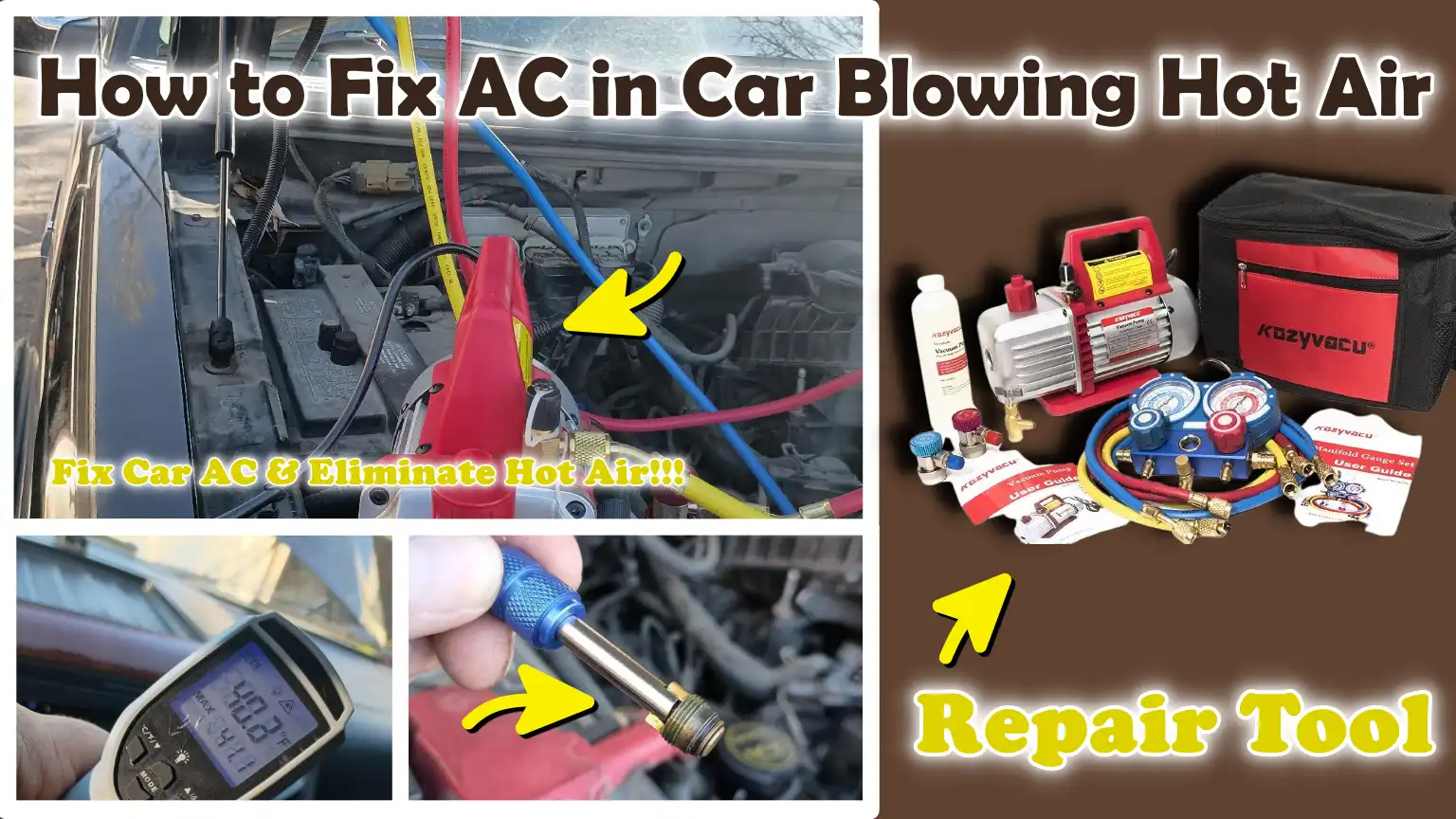
That’s why, in this guide you’ll learn How to Fix AC in Car Blowing Hot Air, so that you can learn easy diagnosis and resolve the issues to restore that cool air without costing much.
Know, How a Car AC Works – A Brief Overview
Rather than “generating cold air,” a car’s air conditioning system functions by extracting the heat present inside the cabin.
It utilizes a specialized fluid known as a refrigerant, which possesses the unique property of being able to rapidly transition between liquid and gaseous states.
As this refrigerant circulates through the various components of the system, it absorbs the heat from within your car and expels it, thereby making the interior air feel cool and comfortable.
Understanding this fundamental principle helps you grasp why a minor issue such as: low refrigerant levels or a weak compressor, as it can prevent your AC from cooling effectively.
1. The Role of Refrigerant in Cooling
The refrigerant is the primary element that enables your car’s AC to function.
It circulates continuously throughout the entire system; as it transitions from a liquid to a gas inside the evaporator, it absorbs heat from the cabin air.
This specific process is what actually cools the air flowing out of your vents.
If the refrigerant level is low, typically due to minor leaks in the hoses or connections, the system cannot absorb sufficient heat, resulting in the AC blowing warm or even hot air.
Maintaining the correct refrigerant level is crucial; if it is too low, cooling efficiency diminishes, while an excessive amount can cause damage to the system.
2. How the Compressor, Condenser, Evaporator and Blower Work Together
The compressor acts as the “heart” of the AC system; it pumps and pressurizes the refrigerant, enabling it to circulate throughout the entire system.
After being pressurized, the refrigerant flows into the condenser, typically mounted directly in front of the radiator, where it releases its heat into the outside air and reverts to a liquid state.
Subsequently, the refrigerant enters the evaporator, located inside the dashboard; there, it absorbs heat from the cabin and transforms back into a gas, thereby generating cool air.
The blower fan then circulates this cool air throughout the car’s interior via the vents.
All these components work together seamlessly; however, if even a single part malfunctions such as: a weakening compressor or a clogged condenser, the entire system may cease to provide adequate cooling.
3. How Understanding the System Helps in Diagnosing Problems
Knowing how each component of the AC system functions makes it significantly easier to diagnose issues when your AC begins blowing warm air.
For instance, if there is absolutely no cooling, it could indicate low refrigerant levels or a problem with the compressor; conversely, if the airflow is weak, it may signal a clogged evaporator or a faulty blower motor.
Unusual noises may point to a compressor malfunction, while inconsistent cooling could be linked to an electrical fault or a sensor issue.
By understanding the role of each component, you can quickly pinpoint the root cause of the problem, avoid unnecessary repairs and resolve the issue more effectively, ultimately saving you both time and money.
Understand, Common Causes of Hot Air from the AC
When your car’s AC begins blowing warm air, it often indicates that one or more components of the cooling system are not functioning correctly.
A car’s AC system relies on the proper flow of refrigerant, correct pressure levels, unobstructed airflow and fully functional electrical components.
If any of these parts fail, the system is unable to effectively extract heat from the car’s interior.
Understanding the most common causes helps you quickly identify the problem and take the appropriate steps to resolve it before it escalates into a costly repair.
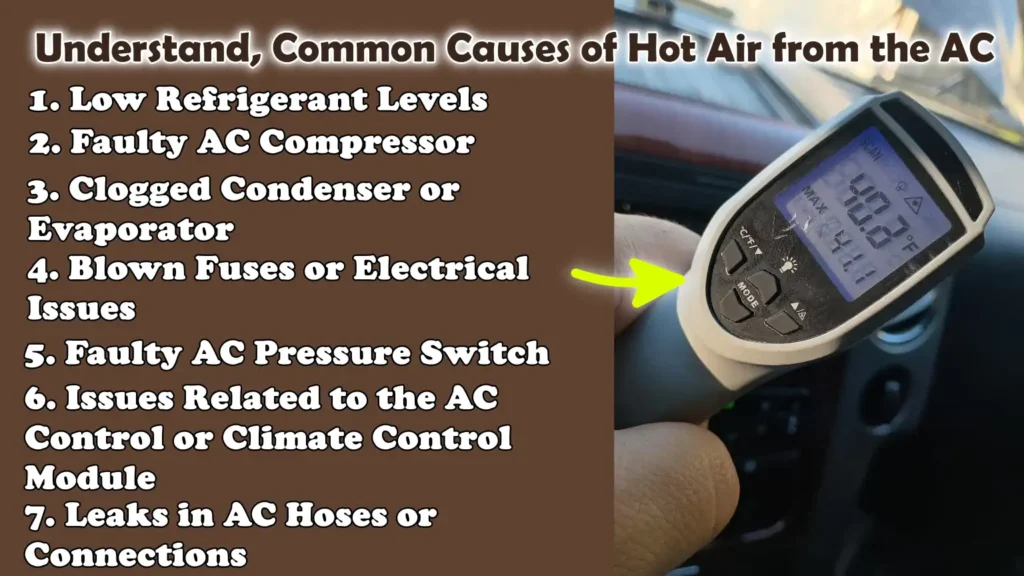
1. Low Refrigerant Levels
Low refrigerant levels are one of the most common reasons for an AC blowing warm air.
Refrigerant is the fluid responsible for absorbing heat from inside the car; if its level drops, the system cannot effectively cool the air.
This typically occurs due to minor leaks in hoses, seals, or connections that develop over time.
When refrigerant levels are low, you may notice reduced cooling performance, the air gradually becoming warmer, or the AC clutch cycling on and off frequently.
As refrigerant does not “get used up” like fuel, a low level almost always implies the presence of a leak somewhere within the system, a leak that must be located and repaired before the system can be recharged.
2. Faulty AC Compressor
The compressor is the central component responsible for circulating the refrigerant throughout the entire system under pressure.
If the compressor fails or its operational efficiency diminishes, the refrigerant cannot circulate properly, resulting in the AC blowing warm air.
Common symptoms of a faulty compressor include strange noises when the AC is turned on, failure of the compressor clutch to engage, or a complete lack of cooling.
Compressor issues can arise from wear and tear, a lack of lubrication, or operating the AC when refrigerant levels are low; all of these factors place excessive strain on the system.
3. Clogged Condenser or Evaporator
The condenser and evaporator play crucial roles in dissipating and absorbing heat.
The condenser, typically located at the front of the car, as it can become clogged with dirt, dust, or debris, preventing heat from being released.
The evaporator, situated inside the dashboard, can also become clogged due to the accumulation of dust or moisture, thereby reducing its capacity to absorb heat from the car’s interior.
When either of these components becomes clogged, airflow is obstructed and the cooling process becomes ineffective, resulting in warm air blowing from the vents.
4. Blown Fuses or Electrical Issues
A car’s AC system relies on various electrical components such as: fuses, relays and wiring, to function correctly.
If a fuse blows or a relay fails, electrical power cannot reach essential components like the compressor or blower fan.
Consequently, the AC may cease functioning entirely or begin blowing warm air.
Electrical issues can also involve damaged wiring or loose connections, which may result in intermittent cooling or prevent the system from starting up at all.
5. Faulty AC Pressure Switch
The AC pressure switch is a safety device that monitors the refrigerant pressure within the system.
If the pressure becomes excessively high or low, this switch shuts down the compressor to prevent potential damage.
However, if the pressure switch itself malfunctions, it may send an erroneous signal that prevents the compressor from engaging, even if all other components are functioning correctly.
Consequently, the AC may blow warm air despite containing an adequate amount of refrigerant.
6. Issues Related to the AC Control or Climate Control Module
Modern cars utilize electronic controls or climate control modules to manage the AC system.
If these controls fail or malfunction, they are unable to send the correct signals to the compressor, blower, or air mix doors.
This can lead to a variety of issues, such as the AC blowing warm air even when switched on, incorrect temperature settings, or improper adjustment of airflow.
In some instances, the problem may be relatively minor such as: a faulty switch, while in other cases, the issue may lie within the control module itself.
7. Leaks in AC Hoses or Connections
Leaks in AC hoses or connections are a primary cause of low refrigerant levels.
Over time, exposure to heat and vibration can cause cracks to form in rubber hoses, seals to wear out and connections to loosen.
Even a very minor leak can gradually deplete the refrigerant level and compromise cooling performance.
Symptoms of a leak include the appearance of an oily residue around AC components, a distinct “hissing” sound, or a gradual decline in cooling efficiency over time.
Repairing these leaks is crucial; simply refilling the refrigerant without first fixing the leak serves only as a temporary solution to the problem.
How to Fix AC in Car Blowing Hot Air – Easy Troubleshooting Guide
When your car’s AC is blowing warm air, a proper step-by-step troubleshooting process helps you pinpoint the actual problem, rather than relying on guesswork and wasting your time or money.
Car AC systems depend on correct settings, proper refrigerant pressure, properly functioning mechanical components and stable electrical connections.
By checking each component in a simple and logical sequence, you can quickly identify the root cause of the malfunction and determine whether it is a minor issue you can fix yourself or if it requires professional repair.
1. Check AC Settings
Begin by checking the basic AC settings inside your car, as sometimes the problem is not mechanical but simply the result of incorrect settings.
Ensure that the AC button is switched on, the temperature is set to the coldest level and the fan speed is functioning correctly.
Additionally, check if the airflow is set to recirculation mode; this cools the cabin faster because, instead of drawing in warm air from outside, it recirculates the air that has already been cooled.
If the settings are incorrect, the AC may blow warm air even if the system itself is functioning perfectly fine.
2. Check Refrigerant Levels
Refrigerant levels are one of the most critical factors in AC performance.
You can check this using a pressure gauge connected to the AC system’s low-pressure service port.
When the AC is running, the gauge reading should fall within a specific range; this range may vary depending on the vehicle model and the ambient temperature.
If the pressure is too low, it generally indicates that the refrigerant level is low, a condition often caused by a leak.
Common symptoms of low refrigerant levels include: reduced cooling capacity, the air becoming warm after a short period and the compressor clutch cycling on and off frequently.
3. Check the AC Compressor
The compressor plays a crucial role in circulating the refrigerant; therefore, inspect it carefully.
When you switch on the AC, listen for a distinct “click” sound; this sound indicates that the compressor clutch has engaged.
If no sound is heard, or if you hear any unusual noises (such as grinding or squealing), the compressor may not be functioning correctly.
You can also visually verify whether the compressor pulley is rotating when the AC is switched on.
If the compressor is faulty or has weakened, it will be unable to circulate the refrigerant through the system; consequently, warm air will blow from the vents.
4. Check the Condenser and Evaporator
The condenser and evaporator are responsible for releasing and absorbing heat, respectively; therefore, any blockage or malfunction in these components can compromise cooling efficiency.
The condenser, typically located at the front of the vehicle, should be inspected for dirt, dust, leaves, or debris, as these can obstruct airflow.
Restricted airflow prevents heat from dissipating, causing the refrigerant to remain hot.
The evaporator, located inside the dashboard, can also become clogged or develop leaks over time.
Symptoms of such issues include reduced airflow, foul odors, or ineffective cooling.
5. Check Electrical Components and Fuses
Electrical components control various parts of the AC system, including the compressor and the blower fan.
First, locate the fuse box and inspect the fuse associated with the AC system.
If the fuse has blown, the AC may cease to function entirely.
The relays should also be checked, as they help regulate the flow of power to key components.
Additionally, inspect the wiring for any visible defects or loose connections.
The AC pressure switch should also be examined; if it detects incorrect pressure levels, it can shut down the compressor, even if the rest of the system is functioning correctly.
6. Check for Leaks
Leaks are a very common cause of AC problems, as they lead to a gradual depletion of refrigerant levels over time.
To detect leaks, you can use a UV dye mixed with the refrigerant; this causes the leaks to become visible under specific lighting conditions.
Leak detection kits are also available and can assist in identifying minor leaks in hoses, connections, or components.
Common symptoms include the appearance of oily residue around AC components, a distinct “hissing” sound, or a gradual decline in cooling efficiency over time.
Identifying and repairing leaks is crucial, as simply refilling the refrigerant without fixing the leak will not provide a permanent solution to the problem.
Now, How to Fix Specific Problems
Resolving the issue of hot air blowing from a car’s AC depends on accurately identifying the root cause and subsequently applying the correct solution.
Each internal issue within the AC system affects cooling performance differently; therefore, rather than attempting repairs based on guesswork, it is crucial to address the specific problem directly.
When repairs are executed correctly, the system can return to its normal cooling performance, passengers enjoy greater comfort and expensive components are protected from further damage.
1. Low Refrigerant Level – Recharge the AC System
When the refrigerant level is low, the AC system cannot absorb sufficient heat from the vehicle’s interior, resulting in hot air blowing from the vents.
The correct solution is to recharge the AC system using the specific type and quantity of refrigerant recommended for your vehicle.
Before recharging, it is essential to check for leaks, as refrigerant does not deplete on its own under normal operating conditions.
A pressure gauge is used to measure the system’s pressure and the refrigerant is introduced through the low-pressure port while the AC is running.
Filling the correct amount of refrigerant is critical; if the level is too low, cooling will be ineffective and if it is too high, the system could sustain damage.
2. Faulty Compressor – Repair or Replace
A malfunctioning compressor is unable to circulate the refrigerant, causing the cooling process to come to a complete halt.
If the compressor clutch fails to engage, or if the unit emits unusual noises, it may require repair or replacement.
In some instances, minor faults such as: issues involving the clutch or electrical connections, as it can be repaired without the need to replace the entire compressor unit.
However, if the compressor has sustained internal damage or has worn out, replacing the unit is the only reliable solution.
Following the replacement, the system typically requires flushing and recharging with refrigerant to function correctly.
3. Clogged Condenser – Clean Dirt or Replace if Damaged
The condenser extracts heat from the refrigerant; therefore, it requires adequate airflow to function properly.
If it becomes clogged with dirt, dust, or debris, heat cannot dissipate effectively, resulting in the AC blowing warm air.
Cleaning the condenser with water or compressed air can restore airflow and improve cooling performance.
It is crucial to clean it gently to prevent bending its fins.
If the condenser is damaged, leaking, or severely clogged, it may need to be replaced to restore the system’s full performance.
4. Electrical Issues – Replace Fuse/Relay or Repair Wiring
Electrical issues can cause an AC system to stop functioning, even if all its mechanical components are in good condition.
A blown fuse can interrupt the power supply to the compressor or blower, while a faulty relay may prevent specific components from activating.
Replacing a blown fuse or a faulty relay is often a simple and quick fix.
If the problem stems from faulty wiring or loose connections, it is necessary to repair the wires or tighten them securely.
Maintaining stable electrical connections ensures that all components of the AC system operate correctly.
5. Leaks – Seal Leaks or Replace Hoses/Components
One of the most common causes of AC failure is a leak, as this leads to a gradual depletion of the refrigerant supply.
In some cases, minor leaks can be sealed using specialized AC sealants; however, this is generally considered to be merely a temporary solution.
A more reliable approach involves pinpointing the exact location of the leak and repairing or replacing the faulty hose, seal, or component.
Once the leak has been fixed, the system should be evacuated to remove air and moisture and then recharged with the appropriate amount of refrigerant.
This ensures optimal long-term performance and prevents the issue from recurring.
Read More:
- How to Check Coolant Level
- How to Recharge Car AC
- How to Fix a Coolant Leak
- How to Fix Car Overheating
- How to Flush a Radiator
When You Should Consult to the Mechanic
While many basic car AC issues can be diagnosed and fixed at home, certain problems require specialized tools, technical expertise and safety precautions that only trained professionals can handle.
Car AC systems operate under high pressure and utilize refrigerants that must be handled with extreme care to prevent personal injury or environmental damage.
If a problem is complex, recurring, or difficult to diagnose, seeking professional assistance is always the safer and more effective approach.
This not only ensures accurate diagnosis but also helps prevent further damage to expensive components.
1. Complex Issues Involving the Compressor or Evaporator
Diagnosing and repairing problems related to the compressor or evaporator is often difficult without the proper experience.
The compressor contains internal moving parts that can wear out, seize up, or fail due to dirt accumulation or a lack of lubrication.
Repairing or replacing it often requires removing other components, flushing the system and then recharging it with the precise amount of refrigerant.
The evaporator, typically located inside the dashboard, is also difficult to access and reaching it may require partially dismantling sections of the car’s interior.
If you observe symptoms such as a complete lack of cooling, strange noises, or visible contaminants in the refrigerant, a professional mechanic can use specialized tools to safely diagnose and resolve the issue.
2. AC System Leaks Requiring System Evacuation and Recharging
When a leak occurs within the AC system, simply adding more refrigerant is not the correct solution.
It is essential to completely evacuate the system, a process involving the use of a vacuum pump to extract all air and moisture, before charging it with the precise amount of refrigerant.
Moisture present inside the system can lead to internal corrosion and compromise its cooling efficiency.
Professionals utilize advanced equipment to accurately detect and repair leaks and subsequently recharge the system in strict accordance with the manufacturer’s specifications.
This procedure ensures optimal long-term performance and prevents recurring refrigerant leaks.
3. Persistent Electrical or Control Module Issues
Electrical issues in modern car AC systems can be complex, as these systems incorporate sensors, wiring, relays and, in some cases, a dedicated climate control module that governs the entire operation.
If the AC functions intermittently, fails to respond to control inputs, or displays inaccurate temperature readings, the issue may stem from a faulty sensor or control unit.
Diagnosing these problems often requires diagnostic scanners and specialized technical expertise to interpret error codes and accurately inspect the electrical circuits.
A professional mechanic can pinpoint the exact fault, repair or replace defective components and restore the system to proper working order without the need to replace any unnecessary parts.
How to Maintain Your Car’s AC
Keeping your car’s air conditioning system in good condition is crucial for ensuring its long-term performance, passenger comfort and for avoiding costly repairs.
A well-maintained AC system cools the cabin faster, consumes less engine power and lasts longer because all its components operate at peak efficiency.
Most AC-related issues such as: reduced cooling or the emission of warm air, typically develop gradually.
These issues are often caused by a lack of maintenance, the accumulation of dust and debris, or minor leaks.
By adopting simple and regular maintenance practices, you can keep the system running smoothly, prevent sudden breakdowns and ensure consistent cooling even during the hottest days.
Furthermore, there’s research that clearly shows that the refrigerant levels plays a major role in AC performance, so whenever the refrigerant is low or not properly balanced, then the system just cannot remove that level of heat in effective way; that leads to the weak cooling or hot air, this is why you need to check the refrigerant levels at the regular time intervals and that’s been the first steps in diagnosing AC problems as well.[¹]
1. Regularly Check Refrigerant Levels
Refrigerant is the primary medium responsible for cooling; therefore, maintaining it at the correct level is essential.
Over time, refrigerant levels may drop due to minor leaks or aging seals, resulting in diminished cooling capacity.
Checking the refrigerant pressure using the appropriate gauges helps you determine whether the system is operating within the correct range.
If the level is low, it is critical to identify and repair any leaks before recharging the refrigerant.
Regular checks ensure that the compressor does not have to work harder than necessary, thereby helping to prevent premature failure and extend its lifespan.
2. Regularly Clean the Condenser and Radiator
The condenser and radiator are located at the front of the vehicle and are constantly exposed to dust, dirt, insects and road debris.
When these components become clogged, airflow is obstructed, making it difficult for the system to effectively dissipate heat.
This degrades cooling performance and may even result in the AC blowing warm air.
Cleaning the condenser and radiator using water or gentle air pressure helps maintain proper airflow and improves the system’s overall efficiency.
Keeping these parts clean also reduces the strain on the compressor, allowing the system to operate more smoothly.
3. Avoid Running the AC at Full Speed When the Car is Extremely Hot
When a car is parked directly under the sun, its interior temperature can rise significantly.
Running the AC at full speed immediately places immense strain on the system, as it is forced to work overtime to rapidly expel the intense heat trapped inside.
A better approach is to first open the windows or doors for a short while to allow the hot air to escape, then switch on the AC and gradually increase the cooling intensity.
This reduces the pressure on the compressor and enables the system to cool the car’s interior more effectively and safely.
4. Get Your AC Professionally Serviced Every Year
Even if your AC appears to be functioning correctly, regular professional servicing is crucial to maintain it in optimal condition.
During a service, technicians check refrigerant levels, inspect for leaks, measure system pressure and examine key components such as the compressor, condenser and evaporator.
They also clean internal parts and ensure that all electrical connections are functioning properly.
Annual servicing helps detect minor issues early, before they escalate into major problems, thereby enhancing cooling performance and ensuring that the AC system continues to operate reliably for the long term.
Conclusion – How to Fix AC in Car Blowing Hot Air
Now, you have understood that most of the AC problems can be solved in quick fashion, but the thing is you need to know what to check and how each parts actually works.
In most cases, the issue stems from a few common causes, such as low refrigerant levels, a weak or faulty compressor, obstructed airflow through the condenser, or minor electrical glitches such as: a blown fuse or defective wiring.
Each of these issues directly impacts the AC system’s ability to extract heat from the vehicle’s interior, which is why the air flowing from the vents feels warm rather than cool.
By adopting a clear, step-by-step troubleshooting process, you can pinpoint the actual source of the problem rather than relying on guesswork, thereby saving both time and money.
It is also important to remember that not every issue necessitates expensive repairs.
Many problems such as: incorrect settings, a dirty condenser, or minor electrical faults, as it can be quickly resolved through a few basic checks and simple maintenance procedures.
Conversely, more complex issues such as: a failed compressor or a refrigerant leak, should be addressed with caution or with the assistance of a professional to prevent further damage to the system.
So, that is it from this guide on How to Fix AC in Car Blowing Hot Air, now you can ask all the related questions in the comment section.
Frequently Asked Questions
FAQ 1: What are the main reasons why a car AC blows warm air?
A car AC typically blows warm air when the system fails to extract the heat from inside the cabin. This often occurs because the refrigerant level has dropped, thereby reducing the cooling capacity. Other common causes include a faulty compressor, which is unable to circulate the refrigerant properly; a clogged condenser, which prevents heat from dissipating effectively; or electrical issues, such as a blown fuse or defective wiring. Occasionally, minor issues such as: incorrect AC settings or obstructions in the airflow, as it can also cause warm air to blow from the vents. Identifying the exact cause is crucial, as each specific problem requires a distinct solution.
FAQ 2: How can I tell if my car’s AC is low on refrigerant?
If you pay close attention, there are often clear signs indicating a low refrigerant level. The AC’s cooling performance may be weak; the air might feel cool initially but quickly turns warm. You may also notice that the compressor is cycling on and off more frequently than usual. In some cases, you might hear a faint “hissing” sound, which could be a sign of a leak. The most accurate way to confirm this is by using a pressure gauge connected to the AC system, which indicates whether the refrigerant level falls within the correct operating range. If the level is low, it typically implies the presence of a leak somewhere in the system, which must be repaired before the refrigerant is refilled.
FAQ 3: Can I fix my car’s AC myself at home?
Yes, provided you have the right tools and adhere to proper safety protocols, some basic AC-related issues can be resolved at home. You can check the AC settings, inspect the fuses, clean the condenser and if the refrigerant level in the system is slightly low, top it up a little. However, fixing more complex issues such as: a faulty compressor, major leaks, or internal blockages, as it requires specialized tools and expertise. It is crucial to recognize your limitations, as working with AC systems involves high pressure and the use of specialized fluids that must be handled with extreme caution.
FAQ 4: How much does it cost to repair a car’s AC if it is blowing warm air?
The cost depends on the specific nature of the problem. Simple tasks, such as replacing a fuse or recharging the refrigerant, typically incur lower costs. Cleaning the condenser or repairing minor leaks may cost a bit more, but these repairs generally remain affordable. However, if the compressor needs to be replaced or if there is a major leak in the system, the cost can rise significantly due to the expense of parts and labor. The best way to avoid high repair costs is to identify and fix minor issues before they escalate into major problems.
FAQ 5: Why does my car’s AC blow warm air when the car is stationary, but blow cold air while driving?
This typically occurs when the airflow passing through the condenser is insufficient. When the car is in motion, the natural airflow passing through the front grille helps the condenser dissipate heat effectively. However, when the car is stationary, this airflow diminishes; if the cooling fan is not functioning correctly or if the condenser is dirty, the system is unable to cool effectively. Consequently, when the car is idling (stationary), the AC blows warm air; however, when the vehicle is in motion, it blows cool air. Cleaning the condenser or inspecting the cooling fan often resolves this issue.
FAQ 6: How often should I have my car’s AC system serviced?
It is advisable to have your car’s AC serviced at least once a year, even if it appears to be functioning correctly. Routine servicing involves checking refrigerant levels, inspecting for leaks, cleaning components and testing the system’s pressure. This ensures that minor issues are detected early on, allowing the AC to continue operating efficiently. During periods of extreme heat or heavy vehicle usage, more frequent inspections can be beneficial to maintain consistent cooling performance.
FAQ 7: What happens if I ignore issues with my car’s AC?
Ignoring AC-related issues can cause them to escalate into larger, more costly problems over time. For instance, low refrigerant levels place excessive strain on the compressor, which can eventually lead to its failure. Minor leaks may worsen over time and clogged components can compromise the system’s overall efficiency. Ultimately, this could result in the complete breakdown of the AC unit. Addressing issues promptly not only saves money but also ensures that your driving experience remains comfortable and stress-free.
References:
[1] Thermal analysis of car air conditioning
https://www.researchgate.net/publication/258379560_Thermal_analysis_of_car_air_conditioning
Hello Folks, Dean Shali here to help you out to solve the problems with your lovely vehicle, as i have lots of experience and knowledge about automotive industry as i woks directly with the customers and repair vehicles and i love to help the people to keep their cars safe and running smoothly.